The Virtue of Selfishness: The Objectivist Ethics: a critique (part 3)


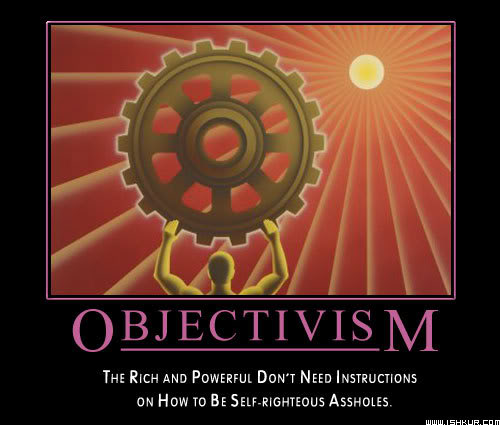
objectivismLast time, on Ayn Rand rationalizes selfishness….

Sorry, I’m apparently working on a TV series here.  I cannot confirm or deny whether it will air on Fox News.

In part 2, we addressed Ayn Rand’s argument that reason is important as a means to realizing our capability for pleasure, life, and giving to charity.  OK, maybe not that last one.

Today, we continue with Rand’s essay, picking up with the theme that human life is the standard of value.

The Objectivist ethics holds man’s life as the standard of value—and his own life as the ethical purpose of every individual man.

In this case, the repetitive nature of this essay is helpful is useful to us, because it acts like a scene from the previous episode, in case you missed it.  Rand either assumes that her readers have the attention span of a goldfish, or she just never edited her essays very well.

This repetitiveness, along with her stark dichotomies, straw men, and logical fallacies are trademarks of her writing.  It makes good speeches for people prone to agree with her, and I can imagine many Objectivists feeling the emotional rhythm of the repetitive nature of these essays, coming at them in waves of freedom, individual virtue, and life, but this is nothing more than affective rhetoric.  It’s no different from a good sermon or political speech, but it’s not good philosophy.

The rest of the essay is better imagined as a stump speech at a political rally, or perhaps a sermon at a revival.  A godless, selfish, pleasure-seeking revival.

Rand has laid out the groundwork of her ideas and has tantalized us enough that it’s time to get to the flesh of the ideas.  As the following commences, you might imagine the crowd becoming more animated, and perhaps hands pound lecterns with each emphasized word.

The three cardinal values of the Objectivist ethics—the three values which, together, are the means to and the realization of one’s ultimate value, one’s own life—are: Reason, Purpose, Self-Esteem, with their three corresponding virtues: Rationality, Productiveness, Pride.
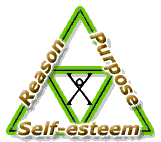
RPSAren’t those things nice? I mean, sure they are!  I like when I’m reasonable, I like when I have a purpose, and self-esteem is s good thing for all of us to have.  The ability to be rational, production, and proud of my achievements are all good things.  So, what’s my problem? Why and I not excited about this Ethic which promises me all of this? How could a rational person disagree?

Here’s the rhythmic, pulsating, cheer-inducing climax (although the end would be cut out in today’s political atmosphere);

It means one’s acceptance of the responsibility of forming one’s own judgments and of living by the work of one’s own mind (which is the virtue of Independence). It means that one must never sacrifice one’s convictions to the opinions or wishes of others (which is the virtue of Integrity)—that one must never attempt to fake reality in any manner (which is the virtue of Honesty)—that one must never seek or grant the unearned and undeserved, neither in matter nor in spirit (which is the virtue of Justice). It means that one must never desire effects without causes, and that one must never enact a cause without assuming full responsibility for its effects—that one must never act like a zombie, i.e., without knowing one’s own purposes and motives—that one must never make any decisions, form any convictions or seek any values out of context, i.e., apart from or against the total, integrated sum of one’s knowledge—and, above all, that one must never seek to get away with contradictions. It means the rejection of any form of mysticism, i.e., any claim to some nonsensory, nonrational, nondefinable, supernatural source of knowledge. It means a commitment to reason, not in sporadic fits or on selected issues or in special emergencies, but as a permanent way of life.

[emphasis mine]

This is the kind of speech that would, for the most part, fit into an atheist convention.  The values enumerated here are good ones, generally, and I agree with most of it.  Where I start to differ is here:

It means that one must never sacrifice one’s convictions to the opinions or wishes of others (which is the virtue of Integrity)

I have a different use of ‘integrity,’ one which permits me to not hold onto my convictions so tightly.  While I will not change my mind merely because others wish it, I would consider the wishes and opinions of others in the potential interest of changing my convictions if the evidence or perspectives warranted such a change.  The level of stubbornness here is a little worrying, especially from a skeptical point of view (and no, I would not call Ayn Rand a skeptic).  This rigidity of conviction is quasi-religious, yes, but it is also consistent with modern Right Wing politics where loyalty, conviction, and not hesitating or changing one’s mind are often considered virtues.  I don’t think such things are necessarily virtuous.

Perhaps this level of  conviction is related to “pride.”

The virtue of Pride can best be described by the term: “moral ambitiousness.” It means that one must earn the right to hold oneself as one’s own highest value by achieving one’s own moral perfection….by never placing any concern, wish, fear or mood of the moment above the reality of one’s own self-esteem. And, above all, it means one’s rejection of the role of a sacrificial animal, the rejection of any doctrine that preaches self-immolation as a moral virtue or duty.

reflections_i98Because nothing is more important than you.  Your truth, your life, and your feeling of self-worth trumps everything.  You (not humanity in general, just you) are the standard by which you decide which is right.  And if anything out there conflicts with that self-esteem or value, then that thing brings with it death.  In some ways, this is not all that different from the concept of “spiritual death” within some interpretations of Christianity; Any form of altruism is a kind of “sin” which separates you from true, selfish, morality.

I know this type of thought well.  When I’m defensive, scared, and feeling insecure about myself. I paint myself into a corner with self-interest.  And I can feel the rationalization churning away as I do this, because what’s happening when I feel this way is that I’m trying to hold back the flood-gates of things that contradict my own happiness, pleasure, and dissonance with the view of myself as a virtuous and good person.

What bothers me most is that while I get this, I know many other people do not get this, and many of them genuinely think that they are not insecure, defensive, or delusional about themselves.  They just seem themselves as successful and awesome.  You know, attributes consistent with narcissism.

I, therefore, think that I have the same gut feeling as Ayn Rand is describing here in her Ethic, and I recognize it for what it is; a self-centered and inconsiderate impulse–a reaction–against the threat of the Other. It is a reaction against being potentially wrong, of being uncertain, of having to admit that maybe other considerations besides my own might be worth caring about.  It’s tempting, sometimes, to just go with what’s comfortable and easy; to allow my selfish impulses to rule my decisions, actions, and subsequent worldview created by trying to rein those actions into a coherent worldview of myself as virtuous and awesome.

Knowing and understanding other people is hard, and knowing what we want and what brings us pleasure is easier by comparison. The idea here seems to be that if we can see ourselves as virtuous, reasonable, and productive people then we can take pride in that. It’s not our job, says this Ethic, to account for the reasonableness, production, or pride of others.  That’s their job.  Anyone else who is not succeeding is doing so because they aren’t being reasonable or productive, and so their struggles are their own doing.

Happiness is the successful state of life, suffering is the warning signal of failure, of death.
This is bullshit too

That is simply not true.  This is a wonderful example of the just-world fallacy at work.  The world does not, whether by gods, fate, or karma, dish out happiness to the just or not suffering to the unjust.  This delusional belief, which is similar to the ideas behind The Secret and similar worldviews, must be confronted and slapped down as the bullshit it is.  And yet it is all too common a belief that if you work hard and are ethical (no matter the ethic), you will be rewarded.  It’s quite possible you won’t be.  It’s also possible that you will be very happy while making many people around you miserable.  It happens all the time, and it blinds the happy person from the effects of their behavior.  And if said person is predisposed to selfishness and egoism, they are even less-likely to realize it.

All too common.

More John Galt:

“Happiness is a state of non-contradictory joy—a joy without penalty or guilt, a joy that does not clash with any of your values and does not work for your own destruction. … Happiness is possible only to a rational man, the man who desires nothing but rational goals, seeks nothing but rational values and finds his joy in nothing but rational actions.”

Pure delusion.  But at least Rand is aware enough to make the following distinction:

If you achieve that which is the good by a rational standard of value, it will necessarily make you happy; but that which makes you happy, by some undefined emotional standard, is not necessarily the good. To take “whatever makes one happy” as a guide to action means: to be guided by nothing but one’s emotional whims.

The distinction is important, and I’m glad she made it here, otherwise she leaves herself open to the “Nietzschean egoism” she despises.  She’s not stupid; she’s just myopic, oblivious, and obtuse.
Further, she is no mere hedonist;

This is the fallacy inherent in hedonism—in any variant of ethical hedonism, personal or social, individual or collective. “Happiness” can properly be the purpose of ethics, but not the standard.
hedonismI’m also glad she makes this distinction as well, as it is also important.  Happiness, Rand argues, is great as a result but it is not the standard.  The standard is, of course, is life itself (according to Objectivism, anyway).  A happy life is just the reward for living with reason, productivity, and pride.  All bullshit, of course, but at least it’s somewhat internally coherent bullshit.

Perhaps the following is a more clear illustration of the relationship between sacrifice, conflict, and the difference between egoism and altruism.  This quote comes directly after addressing utilitarianism, wherein (according to Rand) the centrality of desire leads to situations where “men have no choice but to hate, fear and fight one another, because their desires and their interests will necessarily clash.”  Desire, says Rand, cannot be the ethical standard.

And if the frustration of any desire constitutes a sacrifice, then a man who owns an automobile and is robbed of it, is being sacrificed, but so is the man who wants or “aspires to” an automobile which the owner refuses to give him—and these two “sacrifices” have equal ethical status. If so, then man’s only choice is to rob or be robbed, to destroy or be destroyed, to sacrifice others to any desire of his own or to sacrifice himself to any desire of others; then man’s only ethical alternative is to be a sadist or a masochist.

The moral cannibalism of all hedonist and altruist doctrines lies in the premise that the happiness of one man necessitates the injury of another

OK, that’s interesting.  The idea seems to be that built into the very fabric of altruistic ethical philosophy implies that all desires, whether of the owner or the robber, are indistinguishable, and so equally valid.  As a result, Rand seems to argue, we are all in perpetual conflict and that only by inciting sacrifice can we avoid perpetuating this conflict.

If you believed in a Hobbesian universe where we were all brutes who will try to rob, cheat, and lie to each other for our own benefit (a quite cynical view), enforced altruism might seem a way to get society to work. But what if that was not the motivation for altruism? What if the reason we ask for consideration, compromise, etc are not because we assume humanity is in a perpetual state of conflict?
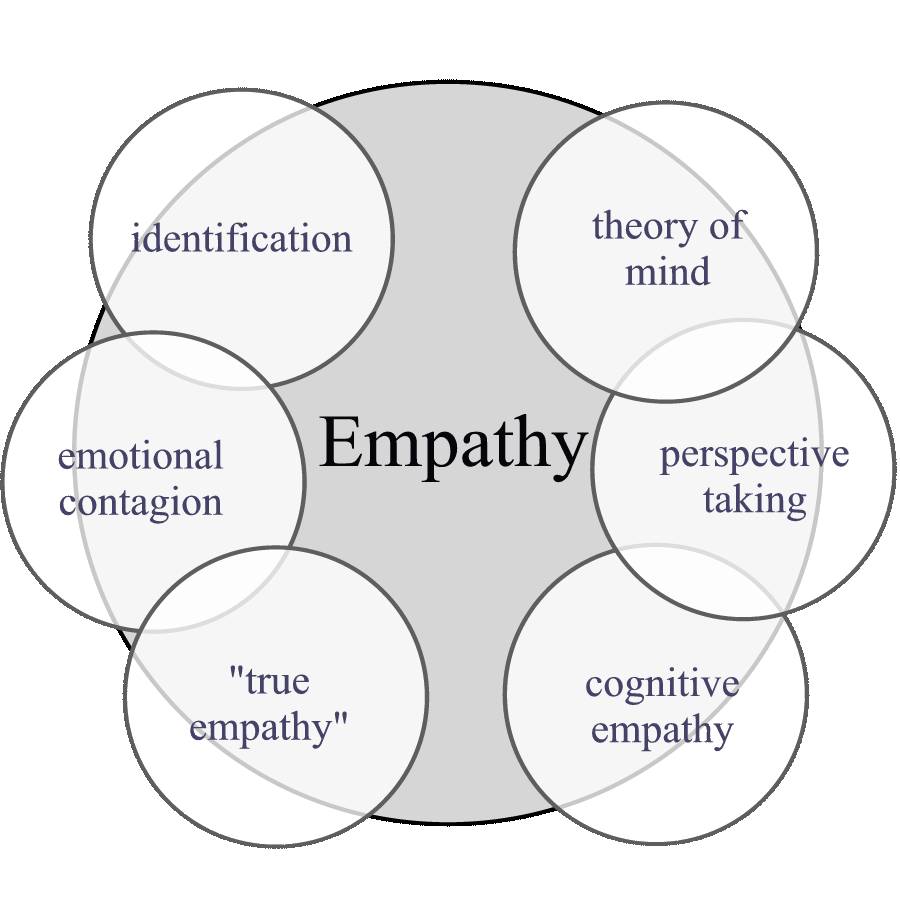
Image1It’s very possible that a sense of empathy, altruism (in the sense of the willingness and ability to sacrifice some of our desires, not Rand’s caricature), and care can be mapped onto a reasonable and logical moral framework without appealing to this view that leads to either sadism or masochism.  If that were true, then self-sacrifice would not be causally related to conflict, and so we would not have to demonize altruism.  Then, if (like Rand) we were to believe that human interactions are not inherently conflict-based, the solution does not have to be a fundamentally selfish set of values and virtues, whether Objectivist or otherwise.  The solution could also be altruism or some compromise between selfish and selfless values (as most ethical philosophy does).

Choosing selfishness, whether as Rand does via reason, purpose, and self-esteem or otherwise, would then be as valid as any oither attempt to formalize ethics, rather than being objective or the true foundation of ethics, as Rand claims.

If our being reasonable, productive, and proud lead to us being happy (because we deserve it), then why she even worried about whether we are altruistic? Or, is it that her Ethic rids the world of this conflict and the injury. Or perhaps it just ignores it by eliminating selfless acts? If conflict is not inherent to human interaction, then being altruistic is not necessarily self-immolating, and will not lead to any kind of death. It might be unnecessary, but that’s another question than it being evil. I’m having trouble making sense of all that.  So much for internal coherence, I suppose.

In any case, let’s see how Rand deals with some of the implications of being selfish on other people.

[W]hen one speaks of man’s right to exist for his own sake, for his own rational self-interest, most people assume automatically that this means his right to sacrifice others. Such an assumption is a confession of their own belief that to injure, enslave, rob or murder others is in man’s self-interest.

This is obviously a preemption of concerns about Rand’s Ethics implying that since we shouldn’t sacrifice ourselves, it means we simply sacrifice others.  It seems to imply that by doing neither type of sacrifice (of ourselves or others), we are left with neutral parties free to interact without a sense of sacrifice or conflict between them.  Nobody has to sacrifice anything! Sounds great.

But what if the very nature of refusing to give an inch of your interests (or convictions) was inherently sacrificial of not only the interests of others, but ultimately our own interests? Not because the others are moochers or trying to steal from us, but because the very nature of human interaction or communication is already inefficient and requires some level of effort (on both parts) in order to succeed.  The very nature of communication, therefore, would require self-sacrifice.

Let me try to sketch this out.

Communication-TalkCommunication is inherently difficult, but even more so the more different we are. If I am to interact with other people, especially if those people are significantly different from me (whether due to language barriers, psychological differences, temperaments, etc), then that interaction inherently requires some level of work on my part to effectively communicate my proposals, ideas, etc.  So, is this work in my interest? Not always.

When misunderstandings or conflicts do occur (and they will, even among Objectivists), the unwillingness to give up any level of self-interest for the sake of another will make it very difficult, if not impossible, to communicate the specifics of a neutral and mutually beneficial proposal, let alone where there actually is a conflict of interests.

This unwillingness blocks the possibility of understanding points of view not immediately in the Objectivist’s interest, or even ones that might be in their interest but are unknown to them.  But because an Objectivist would be unwilling to extend any “altruistic” effort to understand the interests of other people, they would never learn about the ideas connected to those alien interests.  What’s worse is that they might not even see this as a loss.  Nothing in The Objectivist Ethics would imply otherwise.

If sacrifice for the sake of others is actually evil, then perhaps understanding others might require being evil in some cases. My taking the time to try to empathize, listen, and hopefully understand the interests of others is a sacrifice on my part.  It’s a sacrifice of my time, patience, and cognitive effort to communicate with people who think differently than I.  And if I see this effort as a sacrifice, then Rand might say that putting forth that effort would be bowing to altruistic demands, and therefore not being virtuous.  And the result of this is that I cut myself off from not only potential neutral trade partners, but sets of ideas which are significantly different from my own, which will end up isolating myself from people with diverse perspectives, opinions, and worldviews.

galts-gulch-1Just like with Galt’s Gulch, Objectivism seems to want to isolate itself from the world, effectively impoverishing its access to ideas, people, and experiences which they might learn from if they were not so self-absorbed and against any sort of self-sacrifice.


Getting back to Rand’s argument, Rand is asserting that the non-selfish ethical systems (whether utilitarian, Kantian, or full-blown altruism) view the world as full of people ready to take advantage of others and to ask us to sacrifice ourselves as a reaction to that inherent conflict.  Rand does not assume this conflict is necessarily the case but neither do I, who she would have called an altruist, think that this is the case (no, I’m not even that cynical).

Let’s continue with the essay.

The idea that man’s self-interest can be served only by a non-sacrificial relationship with others has never occurred to those humanitarian apostles of unselfishness, who proclaim their desire to achieve the brotherhood of men.

Perhaps it has not occurred to some, but it has occurred to me, at least.  Ayn Rand has set herself up as a sort-of prophet for true ethics, but what she really is doing is demonstrating her ignorance and misunderstanding of ethical philosophy in such spectacular fashion that all I can to is stare, slack-jawed.  And yet this philosophy is revered by so many people!

The great speech of the essay has climaxed, and we head towards resolution.  At this point, we’re past the part of the great speech where the music swells and the lights flicker, and we reach the part where the crowd is hushed and the speaker drops into a lower register, almost whispering so the everyone needs to strain to hear them.  It’s now time for Objectivist pillow-talk.

The Objectivist ethics proudly advocates and upholds rational selfishness—which means: the values required for man’s survival qua man—which means: the values required for human survival—not the values produced by the desires, the emotions, the “aspirations,” the feelings, the whims….

The Objectivist ethics holds that human good does not require human sacrifices and cannot be achieved by the sacrifice of anyone to anyone. It holds that the rational interests of men do not clash—that there is no conflict of interests among men who do not desire the unearned, who do not make sacrifices nor accept them, who deal with one another as traders, giving value for value.

Nobody expects, accepts, or offers any compromise.  This neutrality is a sort of marketplace of self-interested people who will trade their ideas and products in order to create a non-competitive world, or so Rand thinks.  Not competition.  Not brutish, emotional, covetous desire.

However, when this Objectivism is actually put into practice in life with other people around, it does in fact create a kind of conflict.  The conflict is there, it’s just that this philosophy encourages people to re-define any sign of this conflict as an attempt of moochers and robbers to steal from them in some way, rather than some actual injustice.

Any request or expectation of consideration looks like a demand for the Objectivist to sacrifice their convictions; to give into altruistic morality.  Any request of empathy is a demand for the Objectivist or egoist to sacrifice themselves in some way; a demand to give up what they consider to be virtues. Why should they give up anything, material or conceptual, for your sake? You should do that yourself (they think as they step on your toes, dominate a conversation, or otherwise impose themselves onto the world around them). The logical conclusion of this view of self-sacrifice makes any request of empathy or consideration look like a kind of demand or theft.

In order to operate effectively in the world, however, consideration, empathy, and some level of self-sacrifice is necessary; not merely ethically, but practically as well. Until we are able to transcend the realm of individual interests and dive into intersubjective concerns (where ethics lives), we can’t even consider what I want from, to do, etc other people. In other words, it’s not even possible to have interests related to others until I have some ethically relevant relationship with another person.  I can only do this by sacrificing my immediate interests for the sake of external reality.

But Objectivist Ethics never leaves the realm of individual interests, because it considers doing so “evil”.  Now, actual Objectivists might employ some level of empathy and consideration in their lives, but this would accidental or incidental, rather than inherent to the Ethic. That is, if the Objectivist doesn’t have an inclination towards empathy or consideration already, Objectivism does not encourage this empathy (and actually discourages it), so the Objectivist can feel fine not employing such tools, isolating themselves from people, ideas, and whole sections of cultures.

Objectivism gives us no reason to employ empathy, and even uses reason to imply that being asked to do so is a form of theft.  But without empathy of some kind, communication and understanding are not possible, leaving the non-empathetic Objectivist as indistinguishable from the “Nietzschean Egoist,” who merely does whatever they want.  If Ayn Rand ever employed any kind of empathy, she was only doing so while being a bad Objectivist.

Rand’s claims that her Ethic does not lead to the sacrifice of others is not reasonable given that the unwillingness to empathize does not, in fact, create a neutral relationship.  The difficulty of communication, understanding, etc create an imbalance; not one of tension between owner and potential robber, but simply of comprehension.  Thus, it hurts us all. This is the absurdity of calling any self-sacrifice as evil; avoiding self-sacrifice hurts us all in the long run.

Rand continues:

Only a brute or an altruist would claim that the appreciation of another person’s virtues is an act of selflessness.

Also,

a trader is a man who does not seek to be loved for his weaknesses or flaws, only for his virtues, and who does not grant his love to the weaknesses or the flaws of others, only to their virtues.

In other words, we don’t love someone despite their flaws.  We love them when they don’t have any, or at least we love them insofar as their virtues overshadow their flaws.  That may sound good to you, but I would caution you against falling into a trap of privilege here; many of us struggle with aspects of ourselves that make our virtue harder to act on.

I’m not convinced that reason, productivity, and pride are sufficient to create a person of virtue.  Is there no room for depression and its side-effects in virtue, where one might struggle with pride? What about economic factors that hold many people back from production? Are they not allowed to be loved or considered virtuous? What about a person whose reason is handicapped, at times or chronically,by either emotional disorders or simple cognitive inability? Do they get no love?
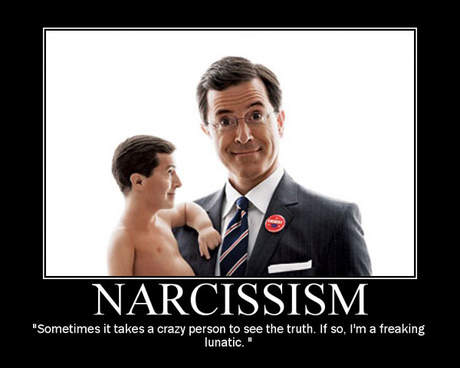
57596-49806The worry here is that a person who wants to adopt this view will either be the type of person who is blind to their own faults (narcissists, for example) or who exist in such a bubble of privilege that they are deluded into thinking that they actually earned their success and happiness without the sacrifice of others around them.   This view, therefore, is in tension with social justice insofar as economic and neuro-typical privilege (at least) is concerned.  It seeks to pump up the already privileged, stigmatize the non-privileged, and to rationalize it all as “reasonable.”

But the line between reason and whim, as I discussed previously, is but a neuron or two away and all too often we are incapable of distinguishing them, especially when privilege takes its toll on us.  I do not believe that Ayn Rand, or her followers, are any more reasonable than utilitarians, Kantians, or even those who follow the ethics of care (for example).  I think they think they’re more reasonable, but we have Dunning-Kruger for that. But, of course, knowing you are subject to the Dunning-Kruger effect requires a certain level of self-awareness, attention, and care towards others.  People prone to follow Ayn Rand have little of those qualities, in my experience.

And yet, they speak of love, human society, and the trade of knowledge and potential.  However, Rand speaks of these things as things to be earned solely, and those “moochers” and other parasites cannot live in a rational, loving, cooperating society.  It all sounds great, especially to Objectivist ears, but it’s an ideology which is startlingly ignorant of the nature of knowledge, intelligence, and the complexities of power and privilege.

But, what of government?

The only proper, moral purpose of a government is to protect man’s rights, which means: to protect him from physical violence—to protect his right to his own life, to his own liberty, to his own property and to the pursuit of his own happiness. Without property rights, no other rights are possible.

And while Rand does not deal with the politics of Objectivism here (the answer is Capitalism; “full, pure, uncontrolled, unregulated laissez-faire capitalism”), I’m glad she’s for the separation of church and state, at least.

In a sort of summation, she offers this:

I have presented the barest essentials of my system, but they are sufficient to indicate in what manner the Objectivist ethics is the morality of life—as against the three major schools of ethical theory, the mystic, the social, the subjective, which have brought the world to its present state and which represent the morality of death.

And then, following some more analysis of each school of ethical theory, she says that

It is not men’s immorality that is responsible for the collapse now threatening to destroy the civilized world, but the kind of moralities men have been asked to practice.

And then she ends by quoting John Galt (AKA herself) once more.

“You have been using fear as your weapon and have been bringing death to man as his punishment for rejecting your morality. We offer him life as his reward for accepting ours.”

However, the life that is offered is one infested with myopia, privilege, and an impoverishment of understanding of anything not immediately self-interested.  This is a philosophy not built upon reason, but of rationalized selfish whims.

ayn-rand-paul-ryanSmart people are really good at rationalizing their whims and making themselves think they are being reasonable.  Ayn Rand was a smart woman who found a way to not only do so for herself, but created a worldview that still resonates with millions of people.  If you look for them, you will find real places called Galt’s Gulch, and the influence of some of Rand’s ideas are still quite popular in political spheres, specifically for Rand Paul and many others within the Tea Party.

This essay demonstrates a sophomoric ethical philosophy, hardly worth serious attention except for its continuing influence.  But there is more book to go (18 chapters, in fact), so we still have a way to go.  Future posts will be shorter, as I will try not to address the same points.

I might need a day or two to recover, however.



The Virtue of Selfishness: The Objectivist Ethics: a critique (part 2)


Introduction

—-

In part 1 of this analysis, we primarily addressed the attempt of Objectivist Ethics to use reason, divorced from emotion, preference, or what Rand calls our mere “whims” in order to establish the “discovery of ethics.  Let’s pick up on that theme as we continue, in order to work our way back into the structure of her essay.

Today, as in the past, most philosophers agree that the ultimate standard of ethics is whim (they call it “arbitrary postulate” or “subjective choice” or “emotional commitment”)—and the battle is only over the question or whose whim: one’s own or society’s or the dictator’s or God’s. Whatever else they may disagree about, today’s moralists agree that ethics is a subjective issue and that the three things barred from its field are: reason—mind—reality.

Perhaps that was true in 1964, but even if this narrative of popular ethical thinking was the case then, to treat the entirety of ethical philosophy, from Plato on through the 1950’s, as if a monolithic set of subjectivist or relativist claims based in a dangerous altruism is over-simplistic at best.  And if this was an obscure argument from 50 years ago (The Virtue of Selfishness was published in 1964, and is a collection of essays from earlier years) which had little to no influence today, my pointing out such a problem would be uninteresting and irrelevant.  But Ayn Rand’s words are still influential, resonant, and a common voice for many people who have not even read her work.

But the fact that people still make this argument today is problematic considering the wealth of information–from both science and philosophy–about how morality can be built upon objective facts about our actual real life in other ways besides Rand’s egoism. The dichotomies which Rand paints, even if they had been relevant in 1964, are certainly not relevant any longer.  We really should leave this simplistic ethical dichotomy between subjectivism/relativism and Objectivism/individualism in the pile of philosophically impotent ideas, where it belongs.

And yet, Objectivism persists.  If you think that individual selfishness is a virtue, well OK. But if you think that this alone can inform ethics, then I can’t trust you to be ethical nor do I think you know what ethics is.

Ayn Rand is concerned with things like virtues and values.  So let’s see what she means by “value.”

“Value” is that which one acts to gain and/or keep. The concept “value” is not a primary; it presupposes an answer to the question: of value to whom and for what? It presupposes an entity capable of acting to achieve a goal in the face of an alternative. Where no alternative exists, no goals and no values are possible.

Only a living entity can have goals or can originate them. And it is only a living organism that has the capacity for self-generated, goal-directed action….

she continues shortly after by saying

Life can be kept in existence only by a constant process of self-sustaining action. The goal of that action, the ultimate value which, to be kept, must be gained through its every moment, is the organism’s life.

and then

An organism’s life is its standard of value: that which furthers its life is the good, that which threatens it is the evil.

This is all fine, and I am in general agreement that life is good (I would, being alive) and that in general what supports life is good and what takes it away is bad (not ‘evil’, because I read Nietzsche).  However in what follows it seems like she’s making the same mistake she was chiding above (in criticizing how people submit their ethics to a god, society, or others in general); she appeals to an ultimate authority:

Without an ultimate goal or end, there can be no lesser goals or means: a series of means going off into an infinite progression toward a nonexistent end is a metaphysical and epistemological impossibility.

But this is absurd.  Not only is this not reasonable or rational, it’s not even consistent with er own argument above.  What is the desire for life but another whim (if not a deeper one)? It’s not ultimate any more than my preference for vanilla over chocolate is ultimate.  She then doubles down:

Metaphysically, life is the only phenomenon that is an end in itself

This can only be true if we were myopic enough to actually take our own individual perspectives as in some way privileged or ultimate.  The level of self-centered bias here is so staggering that it leaves me nearly speechless.  Further, so far the ethical perspective being advocated is consistent with the “Nietzschean egoism” she dismisses (putting aside that Nietzsche is not the straw-man she makes him out to be).

Ayn Rand wants to simultaneously decry the subjectivist parade of “whims,” and then proceeds to champion the one whim that (we might assume) we all happen to share.  This is not a fundamental metaphysics, this is myopia projected onto metaphysics.  The level of obtuseness and lack of perspective here is, perhaps, the key to understanding The Objectivist Ethics.  It is this vacuous scaffolding which the whole Ethic is based upon, and I cannot fathom how Ayn Rand, as well as egoists in generall, are so self-absorbed as to miss the error here.

The fundamental problem here is not that Rand’s object of criticism (self-hating altruism) is actually right (it’s mostly a straw-man), but that her alternative to this straw-man is so absurd.  There’s this, for example:

In answer to those philosophers who claim that no relation can be established between ultimate ends or values and the facts of reality, let me stress that the fact that living entities exist and function necessitates the existence of values…

Agreed.  I would quibble over the use of “ultimate” ends or goals, but I essentially agree with the above. She then, however, finishes the clause;

and of an ultimate value which for any given living entity is its own life.

How is any individual life ultimately valuable?  Only to itself.  But this is subjectivity! This is more people prattling on about whims; it just happens to be her whims.  And even if it were the case that the ultimate value is our own life, how does this point to selfish interests rather than either an altruistic value or even a balance of selfish/selfless values? What makes my interests more valuable than those of another? Nothing but a purely myopic lack of mirror neurons in action. Let’s put that aside for the moment.  For the moment, something else just caught my eye, and I think David Hume just resurrected and is eloquently screaming from pure frustration.

The fact that a living entity is, determines what it ought to do. So much for the issue of the relation between “is” and “ought.”

(For some context on my views about the relationship between facts, values, is, and oughts, see my post here)

Not only is this mere brush-off of Hume a misunderstanding of the Is/Ought problem (the Naturalistic Fallacy, as G.E. Moore later called it), but it is not even insightful or clever.  For some context, here’s David Hume, from A Treatise of Human Nature:

In every system of morality, which I have hitherto met with, I have always remarked, that the author proceeds for some time in the ordinary ways of reasoning, and establishes the being of a God, or makes observations concerning human affairs; when all of a sudden I am surprised to find, that instead of the usual copulations of propositions, is, and is not, I meet with no proposition that is not connected with an ought, or an ought not. This change is imperceptible; but is however, of the last consequence. For as this ought, or ought not, expresses some new relation or affirmation, ’tis necessary that it should be observed and explained; and at the same time that a reason should be given; for what seems altogether inconceivable, how this new relation can be a deduction from others, which are entirely different from it. But as authors do not commonly use this precaution, I shall presume to recommend it to the readers; and am persuaded, that this small attention would subvert all the vulgar systems of morality, and let us see, that the distinction of vice and virtue is not founded merely on the relations of objects, nor is perceived by reason.

Hume here seems to be inferring that we at least need some connection between our declarations of facts and what we should do with the facts.  And I agree with him; is can be connected to an ought, but we should at least try to delineate the connection rather than merely assert a connection.  Perhaps Rand intuits some obvious logical connection, but if she values reason as highly as she does, she should spell it out in a philosophical defense of her thoughts.

OK, so the connection between her is and her ought is a little shaky, but perhaps we can take a look at what kinds of actions we ought to take, and perhaps that will shed some light hat kinds of actions we should take as living things.  Lets start with the question “what has value?”

Now in what manner does a human being discover the concept of “value”? By what means does he first become aware of the issue of “good or evil” in its simplest form? By means of the physical sensations of pleasure or pain.

she continues a bit later by saying that

The physical sensation of pleasure is a signal indicating that the organism is pursuing the right course of action.

If it’s pleasurable, it’s right.  If there’s pain, it’s not.  The childish simplicity of this is mind-boggling.  The moral implications are, to me, startling.  Contemplating the kind of mind that can seriously propose this as a means to defining a set of ethical actions is terrifying.  And yet, if we remember from her introduction, she does delineate between a ‘Nietzschean egoism’ and hers, but so far here I’m not seeing any reason to not simply do what you will.  Perhaps there’s more below.

After some discussion of the hierarchy of life, based upon differing levels of consciousness where we go from plants, animals with mere “sensation,” and on through “perception” we get to people, who are different from animals and plants in a significant way.  And I know that Rand is writing 50 years removed, and that we understand a lot more about how the brain processes information, feelings, and decisions, but the following is just silly;

Man has no automatic code of survival. He has no automatic course of action, no automatic set of values.

Jonathon Haidt
Jonathon Haidt

We, unlike the animals, don’t have things like instincts or any unconscious moral sense (Rand claims).  As I referred to in my critique of the introduction, this is flatly false.  The research of people such as Jonathon Haidt (cf. The Righteous Mind), who have shown that much of our ethical reasoning is post-hoc rationalization of our automatic moral senses, simply contradicts Rand’s view here.

The simple fact is that Ayn Rand is stuck inside a Platonic-style dualism wherein the intellect is separate and superior to the animal instincts and material existence of us as animals.  Our rational processes, moral thinking, etc are not separate and logical structures floating over a miasma of sensations and feelings.  We cannot pull apart the rational, logical, and coldly logical from the mess of instincts, emotions, and “whims.’ This ontological dualism, one that Rand thinks she’s transcending, is exactly the delusion that Objectivism is subject to.

The faculty that directs this process [of “concept-formation”], the faculty that works by means of concepts, is: reason. The process is thinking.

We cannot always separate, at least with any meaningful certainty, reason and whim. Ayn Rand’s whims, which are based on the preservation of human life, is no better than a whim for the preservation of the society.  Granted, this tension between the focus on protecting the society or the individual is a real one in ethical history, but the stark dichotomy between the sacrifice for the self for the society versus the society for the self (remember, Ayn Rand escaped soviet Russia) is hyperbole.

Perhaps this hyperbole is understandable given Rand’s experience within the problems of Russian Communism, but it is no less reactionary because of those considerations.  Ayn Rand is as much the crystallization of the cultural phenomenon of the “Red Scare” than any American writer, and the kinds of thoughts that she proposed have influenced a large segment of people who seek to fight for individual rights at the very expense of the culture in which they live.

Any way you cut it, the subjectivism that Rand criticizes is as much a part of her thought as anyone else’s.  Pleasure, happiness, and reasons are no more a way to advocate for a rational morality than pure asceticism or extreme altruism.

Rand wants us to actively pursue this thinking, because to not do so is to choose death:

Psychologically, the choice “to think or not” is the choice “to focus or not.” Existentially, the choice “to focus or not” is the choice “to be conscious or not.” Metaphysically, the choice “to be conscious or not” is the choice of life or death.


Constant diligence, therefore, is necessary.  Now, to a certain extent I think there is something of value here; it is good to be able to maintain focus and attention, but I don’t accept that to stop doing so is analogous to a kind of mental death.  There are times when we need to slow down, quiet our minds, and allow our unconscious processes to do their thing.  When we are too involved and attached to a process, a set of arguments, or even a conclusion then we can often miss too much.  Sometimes, we need to listen and be passive in order to learn.  Not always, mind you, but sometimes.

But then Rand says something, occasionally, which I fully agree with.  The following is an example.

But man’s responsibility goes still further: a process of thought is not automatic nor “instinctive” nor involuntary—nor infallible. Man has to initiate it, to sustain it and to bear responsibility for its results. He has to discover how to tell what is true or false and how to correct his own errors; he has to discover how to validate his concepts, his conclusions, his knowledge; he has to discover the rules of thought, the laws of logic, to direct his thinking. Nature gives him no automatic guarantee of the efficacy of his mental effort.

Yes.  Because even if we cannot divorce reason and logic from ours whims completely, we can sharpen those tools to be more effective.  The mistake, one that many people make, is in concluding that when we sharpen those tools enough, such tools are no longer subject to bias or emotional influence.  I know of too many ‘skeptics’ and atheists who fall victim to this vanity, and it is as universal an attribute as there is.

Rand continues.

What is open to his choice is only whether he will discover it or not, whether he will choose the right goals and values or not. He is free to make the wrong choice, but not free to succeed with it. He is free to evade reality, he is free to unfocus his mind and stumble blindly down any road he pleases, but not free to avoid the abyss he refuses to see.

Agreed.

Knowledge, for any conscious organism, is the means of survival; to a living consciousness, every “is” implies an “ought.”

And then she loses me again.  Now, if this is merely equivalent to the ancient idea of “do thy will,” then I can be on board, insofar as the traditional “harm no one” follows it.  But it doesn’t, here.  Here, Rand wants us to associate what is (our pleasure, which comes from our physical nature) with what we ought to do.  What is good for us, what is pleasurable, is good.  Full stop.

But what about ‘ethics’?

What, then, are the right goals for man to pursue? What are the values his survival requires? That is the question to be answered by the science of ethics. And this, ladies and gentlemen, is why man needs a code of ethics.

OK, finally, we get to the meat! Now we can leave the confines of selfish desires and pleasure-fulfillment and get to how we should behave, ethically.

Ethics is an objective, metaphysical necessity of man’s survival—not by the grace of the supernatural nor of your neighbors nor of your whims, but by the grace of reality and the nature of life.

Ethics is a real thing, observable and scientific, which is not dependent upon gods or neighbors.  OK, I will agree that we don’t receive moral absolutes or conclusions from neighbors, but I think that without consideration for the interests of our neighbors we might have some trouble developing an ethical sense. Without that, we’re just concerned with the effects as they pertain to us, which while important, is not ethics.

What else? Well, more quoting from John Galt, of course! (Which is really just her quoting a character from a book she wrote)

“Man has been called a rational being, but rationality is a matter of choice—and the alternative his nature offers him is: rational being or suicidal animal. Man has to be man—by choice; he has to hold his life as a value—by choice…”

and then some more commentary about choice.  I’m not even touching the implications of determinism and free will on this, because Ayn Rand seems to take free will for granted.  So, leaving that aside, what should we choose to do? And by what standard?

The standard of value of the Objectivist ethics—the standard by which one judges what is good or evil—is man’s life, or: that which is required for man’s survival qua man.

OK, going around the circle again.  We covered this already.  Survival is good, and in general I agree. So what? What kind of survival? What kind of life? And what about other people’s lives?

Since reason is man’s basic means of survival, that which is proper to the life of a rational being is the good; that which negates, opposes or destroys it is the evil.

OK. A reasonable and rational life.  That sounds good, I guess.  But, again, we covered that.  What kind of reason? what factors should we consider? How should I weigh my reason in comparison to the reasons of others? How do you know when it’s reason and not merely a “whim” that feels like reason?

Since everything man needs has to be discovered by his own mind and produced by his own effort, the two essentials of the method of survival proper to a rational being are: thinking and productive work.

Somehow, this is not a slogan popular among Objectivists.

OK, that’s a little better.  We need to think (good) and we need to produce, through work.  OK, as an economic principle that is true. But this is true within a world of altruistic self-sacrifice and of selfish egoism just as equally; whether we are working for our own benefit, for everyone else’s benefit, or for a mixtures of all of our benefits, work and thinking can still be good qualities. I’m curious what makes these two things important to Objectivism specifically.

So, what kind of work? And, again, what kind of thinking?

If some men do not choose to think, but survive by imitating and repeating, like trained animals, the routine of sounds and motions they learned from others, never making an effort to understand their own work, it still remains true that their survival is made possible only by those who did choose to think and to discover the motions they are repeating. The survival of such mental parasites depends on blind chance; their unfocused minds are unable to know whom to imitate, whose motions it is safe to follow.

In other words, think for yourself.  Good advice for individuals in any situation.  Learn to think independently, reason out the world for yourself, and don’t merely follow.  That’s good advice! However, that still could be true in an altruistic and selfless society of individuals.  I am not seeing, here, how this reasonable ethics differs from an altruistic and social morality.  I don’t see the contradiction between altruism and reason.

I’m not seeing what this reasonable selfishness is offering me that another set of values couldn’t.  Just like when religion offers me community, shared values, and morals, my answer is “I can do that without religion too!”

I can have free-thinking and productivity without the virtues of selfishness.

But then, something bizarre happens:

If some men attempt to survive by means of brute force or fraud, by looting, robbing, cheating or enslaving the men who produce, it still remains true that their survival is made possible only by their victims, only by the men who choose to think and to produce the goods which they, the looters, are seizing. Such looters are parasites incapable of survival, who exist by destroying those who are capable, those who are pursuing a course of action proper to man.

Now, I imagine that here is where Rand differs from the egoists (she calls the “Nietzschean egoists” in the introduction) who simply do what they will.  The difference seems to be that one produces while the other simply takes.  But I don’t see how one could not start with the valuation of pleasure and life (as Rand does) and not logically be able to get to being a thief.  A thief, after all, is following his or her pleasure, and many a thief or robber is quite capable of survival.  Also, I know many people who strive to work and produce who are on the edge of survival, because those who control the means of production….

Oh, wait, I’m starting to sound like a socialist….

I was about to associate those who are at the top of the economic food-chain, the so-called producers (we call them “job creators” now), are making it so that one might consider crime in order to survive, because having the value of production and work are insufficient what the system is tilted against you.  But that would be associating the “Robber Barons” with the mere “robbers.”  As we saw in the introduction, Ayn Rand dislikes this comparison.  I’m guessing that Ayn Rand would not have been at Occupy Wall Street, except to tell them all to get a job (or to be some sort of entrepreneurial genius, like John Galt).

Man cannot survive as anything but man. He can abandon his means of survival, his mind, he can turn himself into a subhuman creature and he can turn his life into a brief span of agony—just as his body can exist for a while in the process of disintegration by disease. But he cannot succeed….

AynRandVersusJesusNo, I have not stopped quoting Ayn Rand and started quoting recent Republican speeches.  if this rhetoric sounds familiar to you, it’s because of the influence of the “teabagging” right-wing of American politics these days.  Because while Ayn Rand was not the only influence of this political set of ideologies, she was a strong influence.  The fact that these ideas have subsequently been hitched to conservative religious ideas is, to me, high comedy.

But more than being comedy, this fact demonstrates the center of my critique; Ayn Rand’s whole philosophy here is not, in fact, a reasonable discourse divorced from the human whims and fancies from which religion, dictatorships, and crime arise.  This delusion of being above the fray is the source of this ideology becoming the new fray.

For every person who claims to be above being superior to the faults of human bias, error, and self-deception, I give you a person steeped in such biases.  The way to escape is not to rise above it, it is to dive down into it and get to know them.  Because we can only avoid traps if we are on our hands and knees, in the mud of our messy emotional selves, feeling for traps.  Ayn Rand thought she transcended the mucky swamp of human whims, but like the rest of us she was swimming waist deep in her own shit, but just not looking down.

We have to have the courage to look down.  And when we do look down and see the abyss, and that abyss looks back, we need the courage to not blink or look back up out of fear. Because whether we look back up to a god (as Rand encouraged us to avoid) or to some Platonic ideal of pure reason (it amounts to the same), we are deluding ourselves.

And here we must pause again.  Later this evening or tomorrow, I will post the final part of this analysis, where we will discuss the cardinal values of Objectivism and how they might usher in a utopia, somehow.  Stay tuned.

PART 3!

The Virtue of Selfishness: The Objectivist Ethics: a critique (part 1)


"Who is John Galt" has become a meme of Objectivist circles, and is based in a kind of marketing campaign within Rand' novel Atlas Shrugged
“Who is John Galt” has become a meme of Objectivist circles, and is based in a kind of marketing campaign within Rand’ novel Atlas Shrugged

Many years ago I read Ayn Rand’s novel Atlas Shrugged.  I found it entertaining, but mostly it was preachy.  The convoluted universe within contains idealistic characters who give long diatribes composed in an attempt to get the reader riled up about how our culture is broken morally, and how we can pull ourselves up through our individual greatness to a utopian future. Such narratives failed to evoke more than mild positive feelings in me, and in the end I found Ayn Rand’s novel to be emotionally immature and philosophically problematic.

And yet, in opening her essay about ethics, Ayn Rand quotes one of the characters from this book as a representative of her “Objectivist Ethics,” as a man we should try to emulate.  Here are the words of John Galt.

“Through centuries of scourges and disasters, brought about by your code of morality, you have cried that your code had been broken, that the scourges were punishment for breaking it, that men were too weak and too selfish to spill all the blood it required. You damned man, you damned existence, you damned this earth, but never dared to question your code. …

“Yes, this is an age of moral crisis. … Your moral code has reached its climax, the blind alley at the end of its course. And if you wish to go on living, what you now need is not to return to morality … but to discover it.”

And with this as the battle cry, Ayn Rand attempts to help us discover ethics, a process which seems to include trashing the history of ethical philosophy as misguided and ultimately evil.  Despite her antipathy to Nietzsche’s egoism, this is very much a quest that we have found Nietzsche to be on many years before (especially with Beyond Good and Evil), and while I appreciate the need for a re-valuation of value (Nietzsche’s phrasing), as we have seen previously I am skeptical that Ayn Rand’s contribution is worthy of significant seriousness.  So, in order to understand why, let’s take a look at a few highlights from chapter one of The Virtue of Selfishness, which is composed of an essay called “The Objectivist Ethics.”


What is morality/ethics?

It is a code of values to guide man’s choices and actions—the choices and actions that determine the purpose and the
course of his life. Ethics, as a science, deals with discovering and defining such a code.

The first question is: Does man need values at all—and why?

These are fair questions and definitions for starting to think about ethics.  And I agree with Rand that ethics is essentially a scientific, or at least empirical, exercise.  Rand is reacting, in part, to the movement in popular ethics which was largely subjective and relative, and while I am not a relativist myself I am also not an Objectivist.  One thing to be aware of is the dichotomy set up there; those are not the only options.

Returning to the distinctions between reason and whims, which we looked at in the introduction, Rand asks the following.

Is ethics the province of whims: of personal emotions, social edicts and mystic revelations—or is it the province of reason? Is ethics a subjective luxury—or an objective necessity?

Clearly, Rand thinks that ethics is not a mystical, social, or subjectivist project.  Rather, it is “scientific” and “objective”–hence Objectivism.  And despite the fact that a number of philosophers, including Nietzsche, have sought a scientific approach to ethics prior to Rand (and many more since Rand wrote this book), Rand has the following criticism.

No philosopher has given a rational, objectively demonstrable, scientific answer to the question of why man needs a code of values. So long as that question remained unanswered, no rational, scientific, objective code of ethics could be discovered or defined.

The greatest of all philosophers, Aristotle, did not regard ethics as an exact science; he based his ethical
system on observations of what the noble and wise men of his time chose to do, leaving unanswered the questions of: why they chose to do it and why he evaluated them as noble and wise.

Aristotle's notion of virtue is about temperament and moderation.
Aristotle’s notion of virtue is about temperament and moderation.

I’ve admired Aristotle’s approach to ethics for a long time.  I don’t consider him to be the greatest philosopher, but I think his contribution to philosophy is profound and influential.  His Nichomachean Ethics is among my favorite works of ethical philosophy, and anyone who takes ethics seriously should be at least familiar with it.  Let’s spend a moment looking at Aristotle’s Virtue Ethics, since Rand at least hold Aristotle himself in high regard.

“Virtue Ethics,” as Aristotle’s view is called, is an interesting and powerful method for thinking about how we behave and why. Essentially, it focuses less on outcomes or principles, and instead looks at varying human attributes–virtues and vices–and considers what would be the ideal level of such attributes, which is often some moderate between extremes.  We identify which temperaments make better people, and try to emulate those characteristics in ourselves. Looking at the individual behavior of a person who is admired, respected, and sought as virtuous is often an indicator of (at least) who a culture holds as a virtuous person.

However, if we left it there we would be missing something.  Ethics, as I stated in the introduction, can start with individual interests, attributes, and concerns, but it must transcend these things to be powerful enough to be ethical.  Much of Objectivism can be seen as a lesson in how to be an individual, but it often fails (for reasons I’ll get to) in addressing ethics primarily because it rejects the very definition of ethics.  I realize Rand is doing this intentionally, I just think it fails.

Why? Let’s get back to Aristotle.

What does it matter what this or that “wise” or “virtuous” person does unless we are interested in the social and cultural implications of those actions? That is, unless we are concerned with the implications of a set of actions or virtues which we may or may not emulate, then why would we even bother paying attention to the actions of said person? Unless we are concerned with how our actions affect other people, or with how their actions affect us, then we would not care what they did.  It is the very fact that we concern ourselves with the right set of actions and virtues in (other) people which excavates the fact that ethics is a social question, not an individual one.

Rand rejects “subjectivism,” but the “Objectivism” that she proposes rarely, if ever, leaves the bounds of individual interest.  She thinks that the effect on the world will be one of love, collaboration, and fair trade (as we shall see), but she never articulates how this happens or why we should care about that.  Without a connection between the virtues of selfishness and how it avoids making our culture and society sick, evil, or at least unsuccessful, we are left holding a bag of our own selfish interests and successes without any overt concern for anyone else, or even why we should care about them.  Ayn Rand never traces how her virtues of selfishness translate into a better world in this essay, and often states directly that we should not be concerned with this.  If this is not a contradiction, it is at least a serious tension.

Selfishness per se is insufficient to address a question of social significance, such as ethics.  Selfishness cannot bring in empathy (a word that never comes into “The Objectivist Ethics” or the rest of the book) or understanding, which seems intentional on Rand’s part.  Rand seeks to de-couple ethics from its mystical past of self-sacrifice and “irrationality” in an attempt to de-couple reason from emotion.

quote-an-emotion-is-an-automatic-response-an-automatic-effect-of-man-s-value-premises-an-effect-not-a-ayn-rand-349736
“Proper relationship” seems to mean that reason transcends emotion. I don’t think Rand’s reason does, in fact, transcend emotion.

But you can’t de-couple reason from emotion.  You can’t be coldly reasonable and rational without concern for emotion, because our brains simply are not constructed in such a way that we can separate reason from emotion.  We can delude ourselves into thinking we have done so (which Rand seems guilty of), but this is an illusion.

Ayn Rand is just focusing on her set of preferences and turning them into “objective” ideals (they are, at best, intersubjective).  There is nothing wrong with that inherently, but her conclusions are so self-centered, myopic, and (ironically) disjointed from reality that Objectivism can only appeal to those who are predisposed to avoiding any kind of self-sacrifice for the sake of their own selfish interests.

In other words, it seeks as a rationalized shelter for selfish people, rather than a reasonably constructed utopia of ethical living away from an evil world of altruistic fear.

Insofar as Western thought has tried to de-couple ethical philosophy from religion and mysticism specifically,

…their attempts consisted of trying to justify them on social grounds, merely substituting society for God.

This is quite similar to arguments I have heard from many conservatives, especially Christian apologists, who claim that liberals/atheists are substituting the government, science, or (in one case, at least) time for god.  Society, progress, and time are all “replacements” for the missing god, supposedly.  The basic complaint seems to be that where people try to understand something, all they end up doing is replacing god, rather than actually figure out what the truth is.

Now, Ayn Rand was no fan of god (she was an atheist and spoke against religion openly).  Her complaint here is not that in creating a social morality we are replacing the true source of morality; god.  Her problem seems to be that in attempting to re-think ethics as secular or social ideal, we are just doing the same thing as the broken systems of religion, communism, etc were doing, and which Objectivism is trying to transcend.  I have had similar thoughts in relation to some of the humanist community, and so I recognize this complaint as sometimes legitimate.

Insofar as secular ethics merely clones religious ethics, I think this criticism is fair.  But is this what ethical philosophy was doing? And even if it was then, is it still doing so now?

No.

If we are to build ethics from the ground up (using reason and science), it does not mean that the structure of social morality must be abandoned as a conclusion, even if we do abandon a subjectivist, social, or mystical grounding of ethics as a starting point.  One can build a reasonable ethics that leads to us thinking about ethics as a social phenomenon without starting there.  In fact I’d argue that not only must we start with the facts of individual interests and considerations, if we don’t arrive at a set of social considerations when we’re done then all we are doing is arguing for the abandonment of ethics in favor of individual interests, not the discovery of ethics.

How does Rand see the relationship between society and ethics?

This meant, in logic—and, today, in worldwide practice—that “society” stands above any principles of ethics, since it is the source, standard and criterion of ethics, since “the good” is whatever it wills, whatever it happens to assert as its own welfare and pleasure.

Rand’s confusion here is to say that, for the culture and society she is criticizing, ethics starts as being what society claims to be right, wrong, or true.  This description of social ethics, if true, is indeed circular and does often lead to a kind of relativism rather than anything objective or true. But this description is a straw-man. What Rand continues to misunderstand is that it is possible (and has been done, many times) to build an ethical system from the ground up (using reason, and not mere “whims”) and conclude that ethics are about social good and may, in fact, include some aspects of altruistic thinking.

Ayn Rand's continuing influence
Ayn Rand’s continuing influence

Rand is essentially saying that we have all been spoon-fed a social standard of morality which is harmful to us as individuals and as a group, and I’m responding by saying simply that this is not necessarily true.  It might be true for some people; some people might accept a social morality without thinking about it or taking the time to care about their individual interests enough, but this does not imply that we must abandon social concerns as a legitimate question in ethics in order to be reasonable.

My argument is that ethics can start with individual virtues, selfish concerns, and other non-inherently social factors and when we then ask the question about interactions, differences of opinion, etc, then those individual factors coalesce and supervene to create a larger level of description via the emergent properties of selfish interests.

That larger level of description is ethical philosophy.  In the same way that cells operate individually, yet when we study the implications of how they interact, new levels of description (tissues, organs, bodies, ect) come into view.

If Ayn Rand’s ethics were biology, it would imply that the only thing that would matter is how cells operate independently of other cells. And just like cellular biology isn’t all of biology, selfishness isn’t all of ethics.  Selfishness is, at best, the start of the conversation.  How does Ayn Rand deal with the rest? Well, we’ll have to see in part 2.

This is a good time to pause.  In reading, analyzing, and writing this post I have managed to compose nearly 9000 words (so far), and after writing a nearly 6000 word introduction, I decided to break up this analysis into 3 parts.  I will publish part 2 in the next day or so, depending on how busy I am.


Communicating about communicating: some initial thoughts


Communication style is my jam. Show me to a conversation about how we communicate with each other and how different people perceive the same words, gestures, and contexts, and I’ll happily yammer away all night with you. So many of the troubles and strife between people seems to me to come down to how we communicate with each other: I said this, and you interpreted it, and your interpretation and my intent don’t match up, and now we both believe things about the other’s point of view that aren’t true, and that’s going to color the rest of our interaction.

I’m not into figuring out which communication style is “best.” It’s just not an interesting argument to me. I’m much more interested in working with other people to make sure that what I say and what they hear match up as well as possible, and any solution that increases the amount of accurate understanding that happens is good to me. And one of the first steps to having these kinds of discussions productively is to deeply understand our own communication style. When I’m feeling this way, I express myself this way. When I hear this from a person, I tend to assume it means that. That kind of thing. Unearthing our own patterns of communication helps us check the assumptions we tend to make, and it lets us discuss our patterns and preferences with those close to us.

It’s not just about specific messages and interpretations, either. The medium in which we communicate is also a meaning-laden decision, and can have very different meanings to different people. Choosing to have an important, emotional conversation over chat or text rather than in person could mean, to one person, “This is not important enough to take time to discuss with you face-to-face” while to the other it means, “This is so important that I want to talk about it in a medium where both of us can choose our words carefully, and have a record of the conversation to go back to later.” Without meta-communication about that choice, the two people are going to misunderstand and be frustrated with each other.

The order in which to communicate two messages is also a meaning-laden decision. If you’re simultaneously angry with someone for how they hurt you, and sorry for how you’ve hurt them (surely I’m not the only one for whom this is a common combo!), you have to decide how to prioritize those messages. If you lead with either, “I’m angry” or “I’m sorry,” there’s a risk of the entire conversation becoming about that message (and thus, an implicit communication that one is much more important than the other). Sometimes that’s what you want, if you have a hard time facing up to your own guilt or your own anger. Sometimes, you genuinely meant to get around to the other half of it, but the conversation in the meantime has spiralled far away from a point where that makes sense to say. You can try putting both of them into the conversation right at the beginning: “I’m really mad about what happened, but also I’m sorry for how I treated you” or vice versa. That’s generally the preferable approach to me, but to some people it reads as if the apology is insincere. Same message, different approaches, different interpretations.

Even the decision to communicate a message at all is a meaning-laden decision. I’ve argued with Shaun about this before so let’s see if I can convince him here. By expressing a feeling to someone, I am not just saying, “This is how I feel.” I’m saying, “This is how I feel and I want you to know about it.” For a lot of people this might be a trivial distinction: I guess, people who generally always want people to know how they’re feeling, or don’t feel that they have the ability to conceal their feelings. For me, though? I have a lot of feelings I don’t express, for various reasons, so communicating a feeling is a very conscious and sometimes weighty decision. Communicating a feeling, to me, means either, 1) we’re on such intimate terms that I pretty much always want you to know how I feel (for me, there are about five people on this list, and I struggle to maintain that level of openness even with them), or 2) I believe my expression of feeling will have some kind of positive effect: on you, on me, on our relationship. I believe it will make you feel good… or I believe that it will benefit our relationship in the long run even if it makes you feel bad right now… or we have an instrumental relationship and I believe it will help me get what I want.

So, if I’m at a restaurant, and I’m getting really annoyed with the waiter’s service (the waiter/customer relationship is an example of what I mean by “instrumental relationship”), I may communicate my annoyance if I believe it’s likely to make the waiter move faster and pay more attention, or if I believe it will get me free dessert, or something like that. If I think it’s likely to make the waiter more nervous, avoid our table, or spit in my food, I won’t communicate that.

Maybe part of looking at things this way (besides a possibly-unhealthy level of emotional reserve) is due to being a writer. I’m used to analyzing interactions in terms of motivated action and consequence. If two characters are in a scene together, every line of dialogue — ideally — has a motivation and a result. Characters don’t just say whatever pops into their heads… that would be boring. They say things for a reason, and what they say has an effect (usually on the other character.) Dialogue is action, at least it should be.

But, sure, some people — some people who are married to me, even — are much less deliberate about what they say and when and to whom. I’ve been told (and I really am taking this on authority because it’s sort of incomprehensible to me) that a lot of people really do just say a thing because it popped into their head. So maybe communicating that thing didn’t have semantic content for that person; it did, however, have an effect of some kind. The listener now has knowledge that they didn’t have before. And the listener might assume that it was a more consciously motivated action: that there’s some specific effect the speaker wanted that message to have on them.

So, for example, if someone says, “I’m sexually attracted to you,” the message itself is pretty simple and not particularly liable to being misconstrued. But the act of saying that — what does that mean? Someone like me is going to assume that the speaker doesn’t go around telling everybody that they’re sexually attracted to. (Probably a correct assumption.) So why did they say it to me? I’m likely to further assume that they considered whether or not to say it, and decided that the effect it had was likely to be positive, by whatever standards they use. (Possibly an incorrect assumption: maybe I caught them in a moment of inhibition-free expressiveness.) Which means that they’ve decided the chance of my responding positively is high enough to outweigh the risk of causing me discomfort. Which could be because they think I’m very likely to respond positively. Or it could be because they don’t consider my discomfort to be much of a negative consequence. Or it could be because they want a level of closeness with me where feelings like that are openly expressed between us, even if the other one isn’t interested.

All these possibilities are going to flit through my head and I’m going to make a knee-jerk assessment of which one is most likely. And that’s going to impact how I view the speaker. Maybe they’re a person who’s correctly interpreted my signals of interest (in which case, bonage ahoy!) Maybe they’re a person who’s incorrectly interpreted my signals of non-sexual friendliness (in which case, some embarrassment for both of us follows.) Maybe they’re a person who doesn’t care about causing me discomfort if there’s any slight chance of getting something they want from me (in which case, bye asshole.) Or maybe it’s the open-vulnerable-friendship thing, in which case some lengthy and deep conversatin’ is likely to follow.

And if I know they have a pattern of uninhibited self-expression (occasionally known as foot-in-mouth syndrome), I’m going to interpret it still differently. Which takes us back to the beginning, where I view understanding communication patterns — our own and others’ — as vitally important. I know I’m prone to making the error of attributing too much importance to the fact that someone chose to say such-a-thing at such-a-time. I try to correct for that. The people I’m closest to know that when I communicate a feeling, it’s important and probably something I’ve carefully considered. Understanding how we individually communicate, and communicating about that with each other, is one of the most important steps to intimacy for me, and I think we’d all do better to be more conscious about it.

Some people might be doing poly wrong: Peaks in the polyamorous landscape


A couple of days ago, Cunning Minx posted an article on polyweekly.com which I read yesterday, entitled “Everyone is doing poly wrong and needs to die in a fire.”  The post was about how we need to step back and be more tolerant of differences in evaluating the many philosophies of polyamory.  The gist seems to be that there is not one universal way of doing polyamory, and we should not hold our own lifestyle as superior to how others approach non-monogamy.

Overall, I believe that Cunning Minx made some accurate and true observations, but I have a few things I want to explore related to the question of whether there are better ways to do polyamory.  Essentially, I believe that there may not be one best way to do polyamory, but I do believe that there are some non-monogamous practices that will be better in general and specifically (for certain people).  Let’s look at some parts of Cunning Minx’s article and see if we can tease out some things.

Let’s start from the basic premise: those of us participating in online forums, posting opinions on blogs or Facebook and attending conferences with poly tracks are all either practicing or interested in practicing polyamory. Or non-monogamy. Or swinging. Or open marriage.

We all have opinions, some of them quite strong. And those opinions are not all the same.

So why are so many of us so vehement in our desire to demean, judge and exclude others?

Well, to answer that, we have to remember that judging is not necessarily a bad thing.  Criticism is not always uncivil.  Demeaning others is a different story, and I try not to do it, and I will only exclude people from my life, not from the community (as if one could do such a thing).  I will not use mere semantics to ostracize anyone, even if such an attempt made any sense.

There are some times when someone acts in such a way that perhaps they have merited some criticism (I’m certainly not immune to that).  Or perhaps a poly triad, network, etc has created a set of rules, guidelines, etc which end up not working for whatever reasons.  Those facts are empirically and logically valid subjects for criticism, so long as we practice good critical thinking skills, compassion, and listening skills. As a community, if we seek to make ourselves better and to improve our understanding of ourselves, relationships, and each other we may occasionally need to judge and criticize one-another.  We also need to accept such criticism from others.

We may, in fact, need to keep our critical thinking skills sharp, and thus judge pretty regularly.  The question is whether our judgment is sound, fair, and compassionate.

To be fair, I understand why we do this. Since polyamory is an alternative relationship structure, most of us have worked very hard at defining what polyamory is for us. We try poly once and make a mess of it. We try again, and it works better, so we decide that what we did the first time was wrong. We try again, and it works better for us, so we decide that we need to advise everyone coming after us that the way we are doing it now is the right way to do polyamory, and every other way is wrong.

I understand what Minx is saying here, and I agree with what I understand to be the point; that we should not conclude that we know that our way of doing things is universally best and that there might be different structures that work for different personalities, circumstances, etc.

But I want to make sure that we are not missing the nuance here.  There may, in fact, be things that newer (or even more experienced!) polyamorous people are doing, which we have seen or done ourselves, which might benefit from our experience, judgment, and criticism.  It may even be possible that some practices are almost always harmful, whether generally or to specific people.  Or, it might be the case that we see that the behavior is not ideal for these people, for these reasons. Now, I agree that in our attempts to talk about such things we should approach the problem in a way conducive to understanding rather than demeaning, but I don’t want the conclusion to be that we should never criticize or judge other people’s way of doing things.

As she says:

But please, I beg of you, let’s stop judging others so harshly, even after we’ve discovered a brand of polyamory that works for us. Before critiquing others based on your personal definitions of what poly is or isn’t, first perform a quick self-check: would you like it if someone told you you weren’t really poly? Would you want someone telling you that your marriage wasn’t real? Would you like for someone else to define what love or commitment means for you? So let’s not impose our definitions and experiences on others.

Right. Agreed.  However, there is a difference between imposing our definitions and experiences and putting them in context in order to evaluate the effects of behavior, (again) whether generally or specifically.  In short, the conversation about how to best do polyamory is not purely subjective or relative (although, just like ethics, it is partially both of those things), but is rather intersubjective and contextual.

I also agree that the “you’re not polyamorous” discussions are not especially helpful in terms of figuring out what is good for us, since it’s hung up on the term itself rather than its antecedent.  Just like the conversations about “you’re not an atheist” or “you are an atheist” are not especially important in the larger scheme, even if having a clear definition of the term “atheist”might be of some importance in itself (at least to people interested in such things).  So long as we don’t slip into the realm of stretching terms such as “polyamory” and “non-monogamy” into meaningless terms that could mean anything (and therefore nothing), I don’t see a problem.

The larger issue is a wider understanding and acceptance of more relationship styles, as well as the ability to try to figure out what works best for people, in terms of relationships, and why.  Whether we call someone “polyamorous” is, perhaps, an interesting semantic conversation, but whether a group of people fall into “polyamory,” “swinging,” “monogamish” (ugh), etc is not as relevant as whether what they are doing is fulfilling, healthy, and consensual.

In the BDSM world, there is a philosophy that folks are encouraged to embrace. Since BDSM involves exposure to a plethora of fetishes and kinks that we may only not share but may actively dislike, folks are encouraged to be accepting. Even when exposed to a kink that incites disgust, we are encouraged to embrace the notion of “your kink isn’t my kink, but your kink is OK.” Let’s please do that with polyamory as well. Let’s stop spending our time judging others and telling them they are doing poly wrong and simply agree to say:

Your polyamory is not my polyamory, but your polyamory is OK.

But what if it isn’t? There must be room for us to evaluate whether how someone’s relationship affects everyone involved might not be optimal for them.  Granted, the fact that some practice or another didn’t work for me (or us) is not sufficient, but it doesn’t necessarily mean that it could also not be a good practice for others, either.  The question is not whether your relationship structure could work for me, it’s whether it is working for you! And it is sometimes the case that we (all of us!) are not the best judges of what is best for us (not to say that anyone is a better judge necessarily, just that we might be wrong in our opinions, for many reasons).  Sometimes, the perspective of others is the only way to see past our blinders.

Let me be clear and say that I think that this criteria is relevant for all human behavior.  Following Sam Harris’s concept of the Moral Landscape, I believe that there are actual empirical (and thus, not merely subjective) ways we can (in principle) evaluate whether a (set of) behavior(s) is better than another.  Similarly, I believe that there may be be many “peaks” (continuing Harris’ metaphor) in the polyamorous landscape which represent a set of possible healthy ways to be polyamorous.  What makes them healthy is partially subjective, partially based in personality dynamics, and partially ‘objective.’

To summarize what that analogy implies, I believe that while there may be no single universally better way to approach relationships (whether polyamorous or otherwise), I believe that we can identify unhealthy or even immoral behaviors within the logically possible space of (polyamorous) relationships which, once we can evaluate them, we should be willing to criticize and avoid.  The other side of that coin is that there may be many better ways, many “peaks” in the poly landscape, to be polyamorous well.

In terms of this analogy I think that Minx is saying, in her article, that when we yell at each other from our various metaphorical peaks to criticize the lifestyle of another peak, we may be stepping off the edge of our own peak.  There is a difference between the benefit of your experience allowing you to see potential cliffs and shaky ground in the path up to the various peaks and seeing another peak as inferior to ours because it doesn’t work for us.  And sometimes, we may even understand that some person or group might be on the wrong mountain, and maybe we can point them to another one as an alternative.  Some peaks are better than others for some people.

Cunning Minx’s discussion next is about how we should approach situations where we might be concerned or critical.

When someone is kind enough to share with you his poly situation, it is our job to listen, to ask questions and to offer support if asked for it. Labels are the beginning of a discussion and an invitation to ask more questions, not the be-all and end-all. So when someone says, “I’m polyamorous,” my favorite tool to whip out is:

Tool #1: “Cool! So what does that mean to you?”

I believe it’s not anyone’s job (including mine!) to judge and tell someone she is doing poly wrong. Criticism like that only serves to puff up the speaker with a sense of power and to disempower the person sharing his story. If you truly believe that someone you’re speaking with is doing something horribly wrong, a good way to offer an option without judging is, “My experience has been… ” and share your story. See? No judgment necessary.

I hate to jump on this pet peeve again, but this is judgment.  When you offer another perspective, in order to address what appears problematic to you, you are judging.  I would ask Minx to consider that rather than frame this as “don’t judge,” we should all think about this as “judge fairly and with compassion.”  Judgment is a neutral exercise, and can be done harshly or with compassion, but it is all judgment.

Tool #2: “My experience has been… “

One caveat, since I know someone will ask: yes, I do have a personal belief about a “wrong” way to do polyamory based on the dictionary definition involving the “full knowledge and consent of all parties involved.” So if, for example, a person self-identifies as poly and has an additional partner that his wife is unaware of, I personally am more inclined to label that “cheating” rather than polyamory due to the fact that his wife doesn’t have knowledge and therefore can’t consent. However, my response is not “you’re not really poly” but rather, “In my experience, poly tends to work best when everyone involved is honest, open and consenting. Have you tried talking with your wife about that?” to open up a conversation rather than impose a judgment.

This is good advice if your concern is to not to activate the defense mechanisms of biases, cognitive dissonance, etc within your interlocutor.  Some people don’t care about that, and will ignore this advice because of that lack of empathy or concern.  I am becoming increasingly sensitive to this, and am making an effort to be more compassionate and constructive in my judgment and criticism.  The bottom line is whether you want to have a constructive conversation or if you just want to finesse up some clever quips.  I do love me some clever quips (Hitchslaps, anyone?), but in most cases I want a conversation and will try and heed this advice.

I’ve read a few assertions from intelligent poly folk of late that claim that anyone who defines poly or poly family as [fill in the blank] is wrong and needs to “die in a fire” because that doesn’t match the writer’s or speaker’s own experience.

I don’t know about you, but I dislike it when someone who isn’t in my shoes and who hasn’t lived my life tries to tell me what my poly experience should be. It brings to mind right-wing extremists who claim that they have the right to define what marriage is for everyone else. Or what “family” or “family values” are for everyone else.

Word.

If we don’t want others to define marriage or family for us, let’s not do that to each other. The person who gets to define your brand of polyamory is YOU. No one else. And the ONLY person for whom you get to define polyamory is you. Share your definition with your loves, your partners and anyone who asks for it, but please don’t impose it on others or judge others who have chosen to do poly a different way from you. Offer to listen; offer support; offer discussion,;offer your own anecdotes. But please do not offer judgments or critiques. We have the aforementioned right-wing extremists for that.

If you don’t like it when others judge your lifestyle, maybe you should stop judging theirs.

But I don’t mind when other people judge my lifestyle.  I like it a lot less when they do so without compassion, fairness, or when they don’t know me well, but I don’t mind judgment per se.

Further, I don’t think other people should mind judgment per se.  So while I agree that the arguments about whether someone is a true polyTM are not especially helpful or interesting, the conversation about whether one’s actual relationship structures are healthy are helpful, and we should all be open to such judgment and criticism.

If you are lucky enough to have found a brand of non-monogamy, polyamory, swinging or open relationships that works for you, GREAT! Many of us take months or years to figure out what we need in order to be happy and healthy in our relationships. And please do share that with others when asked: many of us are looking for models, ideas and roadmaps that might work for us.

So please, share rather than critique. Listen rather than judge. And communicate your definition as an option rather than imposing it as a rule.

The tendency, among progressive minded people, to demonize the practices of judgment and criticism is wrong-headed, in my opinion.  Criticize and judge after listening, and continue to listen while you communicate your judgment and criticism.  We, progressive-minded people, need to stop looking at criticism and judgment as bad, reactionary, right wing efforts.  They are critical thinking tools, not weapons.  They can be used as weapons, sure, but so can hands.  Hands are also one of the means by which we can show affection, love, and lust.  Similarly, if wielded properly, judgment and criticism can be wielded with affection, love, and, well, maybe not lust (but who knows!).

And as a final word, absolutely no person or concept should “die in a fire” or “burn in hell.” Let’s just say “My experience has been… “

Amen.  My experience as been that many people may not be doing relationships in a way best for them, and we should all be open to the conversations which will evaluate whether that is the case or not.  So long as we try to listen and understand first, of course.

Humanism and polyamory (a video)


Here is a video by youtuber Jess D, wherein he talks about humanism and polyamory. I think the video is generally good, although I have some minor issues with his discussion about whether polyamory is “natural” or not. This has mostly to do with my pet peeve of making a distinction between “natural” and human actions, but I also believe there is some equivocation going on there.  Otherwise, it’s a fairly good introduction to polyamory from a humanist;s point of view, and worth the 14 minutes or so.

enjoy!

Quick update


In recent weeks, there have been some significant upheavals in my life, and those upheavals have effects on PolySkeptic.  I’m not entirely sure when I will start writing again, but it is possible that it might be a while.  As some of you may have noticed, Gina and Wes are no longer listed in the bio, and will probably not be writing for PolySkeptic again.  The reasons for this are not relevant to readers, but I consider this a loss for the site as a whole.

In any case, the blog will continue to exist.  The podcast may also be reborn in the future.  Know that I am thinking about what direction to take the blog, and that I will hear any input from readers, whether in comments or through email.

I’m still and atheist, I’m still polyamorous, and I’m perpetually a skeptic.  I’m just taking time to evaluate the major recent changes in my life, and trying to rebuild.

5 years


On February 12th, 2009, I started a blog with this post.  I had just been laid off from a job that I really liked (and was good at), I was living in Philadelphia (it was several months before I moved to Atlanta), and the blog was called ‘The Atheist, Polyamorous Geek’. That was 5 years ago today.  Some things have changed around here.  New logo, writers, and more followers have been added since 2009, and I still enjoy writing.


remember this logo?
remember this logo?

In the beginning, most of my writing was about atheism and religion.  Early on, I dropped the “Geek” at the end and replaced it with “skeptic”, due to my increased exposure to the larger skeptical community.  It would be some time before I would add writers, some of which have moved on due to interpersonal issues.  Who will be writing down the road is something I don’t know.  Will it make it another 5 years? If so, what will it look like? I don’t know that either.  But with that said, let’s take a look at some of my posts that I like from over the years.

Theis XKCD comic epitomizes "agnostics" for me
I love XKCD

Very early on, I wrote a post aimed at agnostics, because I had had so many conversations with people who disliked and avoided the word ‘atheist’, even though they were one.  The word ‘atheist’ has become somewhat more mainstream in the last 5 years, but this post is still relevant, and will probably be so for years to come.  Shortly after that, another favorite of mine is this short story about a conversation with God, which was intended to be a response to the design argument and the special pleading fallacy inherent to irreducible complexity.  Recently, DarkMatter2525 made a video which reminded me of that post:

Shortly after that, a post about death and the appreciation of life was apparently translated to French, and then back to English, which prompted a post about translation (since, at the time, I was reading Douglas Hofstadter’s book Le Ton beau de Marot: In Praise of the Music of Language, which I highly recommend to anyone who is interested in language).  This post actually led me to have a brief email correspondence with Douglas Hofstadter, who commented on the translation himself.

Of course, I would have to poke at Christianity now and then, and my favorite post about Christianity is this one about how Jesus’ death (even if it happened) is not a sacrifice at all.Also, I wrote about how the love of god is misplaced, with a little science geekery mixed in.  Late in 2009, I wrote a long, 3-part post about how God is a metaphor, which was originally not written as a blog post (hence the length). Parts one, two, and three.

One of my all-time favorites is the post, from 2011, where I argue that I prefer atheism to humanism, mostly because I find humanism to be atavistic and still steeped in the mistakes of religious history.

Also, there were a couple of posts looking at history and culture, and showing how religion (Christianity specifically) contribute to diminishing culture, rather than making it better.  I especially like the McDonald’s post.

Of course, I can’t forget my take-down of Alain de Botton (who I still despise).

I still wear this shirt

Eventually, i started writing more and more about polyamory, and one of the posts that stands out for me is the one about jealousy, where I argue that jealousy is not a reason to not be polyamorous.  Also, sex-positivity is a good thing, and we should all be comfortable with being slutty (if we want to) and we should sin responsibly.  What else did I write about polyamory? When it comes to love, we should do so authentically.. We should be creating a new and improved polynormativity.  We were in some documentary, apparently. another personal favorite is my post about accidental monogamy, where I started thinking about how there is no reason to ever want to be monogamous (one should get there only by accident), which later led to a post about relationship agnosticism.  Of course, I got nerdy with set theory and polyamory, but much more recently I wrote about the space between being friendship and being lovers, which is still quite relevant this very day.

Of course, having a MA in philosophy means that I will occasionally become erudite…ok, more like smart-assed and long-winded. Some of my favorites include Facts or it didn’t happen: unhooking the bra of reality, Thorough and perpetual Sskepticism, and this post which got a little too meta, even for me.  Also, let’s not forget my tendency to try and simultaneously criticize monogamy and religion.

There is also my post about the history of Christmas, which I have reposted a couple of times and always put on Facebook around the end of December.

Sometimes, I got political.  I liked this short post where I quote from a book about the American Revolution that demonstrated that political tropes we use today are not new.  But my favorite post about politics was where I essentially declared that I could never be a conservative.

That's me!
That’s me!

Lastly, I wrote about the various wars going on in the atheist community.  In this post, I utilize Moral Foundation Theory to talk about the “great schism” (as it is called by some) in the atheist community.  I also talk about feminism, both in terms of the #shutupandlisten debacle (as it pertains to lessons from Zen Buddhism) of last year but also as it pertains to the history of technology.

Lastly, I wrote a book.  This is significant because I started writing that book around the same time I started the blog.  And as I move towards another 5 years of blogging (perhaps), I will also consider finishing the second book (I’ve written 3 chapters or so).

Thank you to everyone who has liked, commented, and continues to read.  I do this because I love it, and I also love when other people love my work.

If you think I missed a post you loved, let me know in the comments.

I’ll leave you with this song.


“Your Character Needs More Character…”


“Have you considered giving him a limp?”

This is what our director told my friend Chris Herrle during one of many ridiculous rehearsals for the Drexel production of A Midsummer Night’s Dream.  Chris was one of the mechanicals but apparently wasn’t individual enough…or something.  Chris heard this suggestion, and raised his one eyebrow way up high.

“A limp?” He was incredulous.

“Yeah, what do you think?  The limp could have a whole back story.”

“You want my character to have a limp.”

“Yes, I think it would be a great character choice.”

“That’s…that’s not…Character choice? Really?”

“…Well…do SOMETHING.”

Needless to say, he did not choose to give himself a limp.

Chris Herrle died last week.  He was 30 years old and used to be a pretty constant presence in Wes’ and my life.  Things got hard for him and he was dealing with heavy loads and he would disappear from public life for months at a time.  He was a frustrating sometimes absolutely maddening man but he was also one of the few people back a few years ago that I felt comfortable telling when he was full of shit.  I don’t know if it enlightened him at all, but it was something that happened and we kept being friends.  At the time when he was most in my life, this was something deeply valuable to me.  While I was often furious with his antics, I couldn’t hold them against him for long because he was such a big personality, often the life of the party, and caring, loving, and someone you could count on, even though he would get in his own way a lot.

Often I felt like Chris didn’t know what to do with me because I was a woman he had deemed “off limits” for romantic/sexual relationship status (he was a deep believer in The Bro Code and I dated a good friend of his before Wes.  He was pretty awful to Wes for a while and then he was in our wedding, so, you know, Bro Code Shmro Shcode), but I was also a woman who he deemed “not like ‘typical’ women”.  It was a sexist attitude that I got on his case for often, but I knew that he valued me as a good friend and shared with me things that he would share with his guy friends.  I was a trusted mutant in his band of oddities and I was often called upon for unique perspective, much like one of the many bizarre factoids his mind teemed with on a daily basis.

That may sound like I am devaluing this status, but honestly, Herrle’s strange and extensive collection of knowledge was one of my favorite things about him. I often would consult him when trying to think of something obscure that I couldn’t quite put my finger on.  His mind was a data base that looks like Wikipedia in my imagination.  He was smart, articulate, hilarious, and had an ongoing thirst for knowledge.  He liked to learn new things and share them with his friends. He was a musician.  He was a writer.  He was a singer and a scientist.

Herrle, like everyone, had gone through different versions of himself.  I have two versions that I always loved: Herrle, the Poker Player and Herrle, The Glassblower.  When we were still in college and Wes and I had an apartment in University City, we would have a regular group of friends who we played tournament style Texas Hold ‘Em.  Chris was a good player, certainly better than the rest of us shmoes.  He played in Atlantic City often and while our favorite stories are often about him feeling fabulous about losing obscene amounts of money, he actually paid back his student loans from winning at the tables.  I tried to learn from him but being awesome at poker was not something that was destined to be one of my life skills.  We spent hours around that dining room table, Chas buying in again three times after missing out on some really promising “pair draws”, me waiting until I was pretty much down to nothing before making my move (I was the queen of the slow play…because being aggressive was not something I could actually do), Jake drinking his Vitamin Water to get that extra advantage, Wes and Hoffman exchanging South Park quotes.  It was a good time and I will remember those nights as bright spots in a time when I was pretty miserable often.

But I think he was happiest when he was Herrle The Glassblower.  He worked at a lovely little shop in Old City.  Wes had seen an article about the place looking for people who wanted to apprentice.  Herrle had been looking to change careers and wanted to work with his hands.  Wes let him know about the apprenticeships and before we knew it, Herrle was learning to make whiskey glasses.  He gave a special one to Wes, one with a blue color in it that was a version that they didn’t sell.  It was one of a kind and he gave it to Wes for helping to change his life.

Chris was a good man and a good friend, if not always the easiest man to understand or connect with.  It took me a long time yesterday to really understand the reality of his passing.  I had gotten so used to him disappearing for a while and then reappearing.  But he won’t be reappearing this time.  I will never hear one of his ridiculous stories again, or hear his perfect Murderface impression, or see him bring down the house at karaoke.  I won’t have a chance to help him anymore, and so I wish that I had been there more when I could have been.

Chris, you will be missed.  Thank you for your friendship.  Thank you for the host of good memories I have of you.  Thank you for being in our wedding.  Thank you for always working towards being a better man. Thank you for being open about your problems, even if we were never all that helpful.  Thank you for everything.

There is beauty in the world.

You are loved.

Goodbye, friend.  I am happy for the fleeting chance I had to know you.

What’s your poly personality?


The poly community has sects just like any other community. (Go ahead and enjoy the aural pun, I’ll wait.) If you hang out in a poly discussion group, you’ll see words like “polyfidelity,” “polyfuckery,” “closed triad,” “relationship anarchy” pop up, and alongside them you will often see hackles rise. We’re a pretty liberal, tolerant bunch, so most of the time cries of “Everybody needs to do what works for them! Let’s all just accept each other’s differences!” will shut down an argument before it gets rolling, but underneath it the differences are still bubbling. Those of us who call ourselves poly do poly really differently, and there can be a lot of tension around your way vs. my way, and whether I think my way is superior, or whether I think you think your way is superior, or whether I’m unintentionally erasing your way altogether because I have a hard time conceiving that anyone could construct their life like that.

Personality typing systems, especially Myers-Briggs (but I’m a fan of several others too!), have been really important to me in how I relate to others. While I don’t view them as hard and fast categories, and some people have a hard time fitting themselves into a particular model, they’re incredibly useful ways of identifying trends of difference between people, in a way that doesn’t position one way as superior to another. They give us a way of talking about our different personalities, preferences, and approaches to life that is easily intelligible and judgement-neutral.

I wasn’t aware of it until today, but the writers over at polytripod (who were featured, along with us, in the Our America documentary!) came up with a similar schema for poly personality differences. I think it’s really great. Because there are many more variables, it doesn’t lend itself to easy acronyms the way Myers-Briggs does (I’m told people who didn’t grow up on Myers-Briggs don’t find those acronyms so easy either), but it is at the very least a terrific jumping-off place for discussions about what style of poly a person prefers, and why. A lot of the axes point to things that I hadn’t consciously noted as big, stable differences between people, but which I immediately recognized as being important and relevant.

I kind of like that the system, as it stands, doesn’t lend itself to a simple identifier the way you can say, “I’m an INFP.” It more requires you to go down the list, check the box that applies to you, and then compare lists and discuss. Requiring a more deliberate discussion rather than a simple verbal tag… that’s so poly it’s gross. (I kid, I kid. If I wasn’t into obsessive discussion and overanalysis I probably wouldn’t be poly.)

Scanning down the list, here’s where I line up (and some thoughts on the category in general):

“Speed” axis: How quickly do you form connections/relationships in general?
 Fluid- more rapid in forming emotional and/or sexual connections.
 Growth- deliberate in forming emotional and/or sexual connections.
 Static- slow moving in forming emotional and/or sexual connections.

I find it really interesting, and cool, that “growth” and “static” are two different categories rather than just sorting speed into fast and slow. It makes a lot of sense to me. I’m slow to connect (in most cases) but I’m also not inclined to pick out someone and deliberately work to build a relationship. I prefer to be guided by my feelings in the moment, rather than a deliberate decision that I want to pursue a relationship with a particular person. But I’ve talked to others who felt differently.

“Structure” axis: How would you describe your ideal poly relationship structure?
 Open- People come and go at will forming “polycules” which consist of individual dyadic relationships.
 Network- People often connect socially with metamours. Some sort of “get to know you” is usually requested or offered early on in becoming part of the extended group.
 Closed- Approval of existing members needed before new member is allowed to join.

I’m very comfortable in this “connections with metamours are encouraged and pursued, but not required” spot.

“Attitude” axis: What level of entanglement is desired with partners and/or metamours?
 Independent- Prefers to do their own thing with their own partner .
 Community- Enjoys being part of socially connected groups some of the time.
 Family- Actively prioritizes shared time and/or space with partners and metamours.

Ditto. If one were trying to simplify this system, I could see folding this and the Structure axis together, but as discussed, I don’t feel simplification is necessary.

“Intimacy Style” axis: How is romantic closeness with others achieved? More than one may apply.
 Sexual – Connects with others via sharing physical intimacy.
 Emotional – Connects with others via sharing feelings.
 Activities and Shared Experience- Connects with others via sharing experience and spending time together.

Definitely important that more than one can apply.

Prioritization Axis:
 Hierarchical- priority is given to preservation of existing primary relationship/s.
 Weighted- some relationships are prioritized over others, but open to changes, adding an additional primary, etc.
 Egalitarian-committed to not prioritizing some relationships over others.

Here’s another one where I’m thankful to have a middle ground. In truth, my relationship with Shaun is de facto primary to me, and I do prioritize it over others, but it’s not hard-and-fast.

Relationship Saturation Axis: What would your ideal relationship concentration look like?
 Full-boat- completely satisfied with current relationship(s). Prefer relationships to dating.
 Open to opportunities to connect-neither closed off to forming new relationships, nor actively looking, but being closed to possibilities would feel restrictive.
 Actively seeking new partner(s)? Looking for new connections regardless of current partner status. Consistently open to dating and exploration.

This is one that I hadn’t fully conceptualized, but I think is really useful. These questions often get framed as, “How many partners is enough to you?” but to me it makes much more sense to look at it as a dispositional thing. Some people just really enjoy the dynamics of new connections and pursuit, and it’s not necessarily about how many people they’re already dating. It’s also important to note that this category is about an ideal situation, not one’s current situation. I think it’s hard for people whose ideal life involves a continual stream of new partners, and people whose ideal life includes a stable set of partners without new relationships, to understand each other, and this should be helpful.

Nature or Nurture Axis:
 Born Poly- Came out of the womb hardwired for multiple relationships. Being monogamous would feel unnatural.
 Poly by Choice- Poly makes sense, and is a desired style of relationship for a myriad of reasons. Unlikely to get into a monogamous relationship.
 Mono or Poly- Happy being open to either poly or mono, depending on circumstances in life, if current partner is open to poly, etcetera.

I’d be inclined to frame this not as Nature or Nurture, but just as “how flexible are you in your poly orientation?” But that’s because phrases like “born this way” and “hardwired” make me twitchy.

Flow of Information Axis:
 Confidential- No desire to hear about other partners/activities with and/or have information about the relationship they are involved in shared with metamours, unless explicitly approved in advance.
 Pertinent- Don’t need to have all the details, but want to have personally relevant information shared.
 Transparency- Desire the free flow of information about all relationships partners are involved in, and are comfortable with partner sharing that with metamours.

HUGELY important and something that should be discussed in every new poly relationship.

Formality Axis:
 Detailed- extensive agreements/contracts covering every eventuality.
 General- conscious agreements about a few major subjects.
 Short-term- temporary agreements only.

I feel like this category could be tweaked a little more, or maybe a second rule-related category be added, but it’s definitely a key part of poly style.

Thinking about my partners and metamours, I can guess how they’d answer these questions similarly and differently to me. But it’s definitely a useful tool for discussions (and it’s making me itch to run a poly/open relationship workshop to use it!)

Thanks, Regina, for taking the time to develop this! I’d love to see it shared and used more in the online poly community.