5 years


On February 12th, 2009, I started a blog with this post.  I had just been laid off from a job that I really liked (and was good at), I was living in Philadelphia (it was several months before I moved to Atlanta), and the blog was called ‘The Atheist, Polyamorous Geek’. That was 5 years ago today.  Some things have changed around here.  New logo, writers, and more followers have been added since 2009, and I still enjoy writing.


remember this logo?
remember this logo?

In the beginning, most of my writing was about atheism and religion.  Early on, I dropped the “Geek” at the end and replaced it with “skeptic”, due to my increased exposure to the larger skeptical community.  It would be some time before I would add writers, some of which have moved on due to interpersonal issues.  Who will be writing down the road is something I don’t know.  Will it make it another 5 years? If so, what will it look like? I don’t know that either.  But with that said, let’s take a look at some of my posts that I like from over the years.

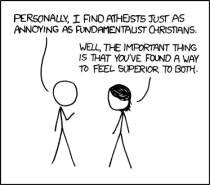
Theis XKCD comic epitomizes "agnostics" for me
I love XKCD

Very early on, I wrote a post aimed at agnostics, because I had had so many conversations with people who disliked and avoided the word ‘atheist’, even though they were one.  The word ‘atheist’ has become somewhat more mainstream in the last 5 years, but this post is still relevant, and will probably be so for years to come.  Shortly after that, another favorite of mine is this short story about a conversation with God, which was intended to be a response to the design argument and the special pleading fallacy inherent to irreducible complexity.  Recently, DarkMatter2525 made a video which reminded me of that post:

Shortly after that, a post about death and the appreciation of life was apparently translated to French, and then back to English, which prompted a post about translation (since, at the time, I was reading Douglas Hofstadter’s book Le Ton beau de Marot: In Praise of the Music of Language, which I highly recommend to anyone who is interested in language).  This post actually led me to have a brief email correspondence with Douglas Hofstadter, who commented on the translation himself.

Of course, I would have to poke at Christianity now and then, and my favorite post about Christianity is this one about how Jesus’ death (even if it happened) is not a sacrifice at all.Also, I wrote about how the love of god is misplaced, with a little science geekery mixed in.  Late in 2009, I wrote a long, 3-part post about how God is a metaphor, which was originally not written as a blog post (hence the length). Parts one, two, and three.

One of my all-time favorites is the post, from 2011, where I argue that I prefer atheism to humanism, mostly because I find humanism to be atavistic and still steeped in the mistakes of religious history.

Also, there were a couple of posts looking at history and culture, and showing how religion (Christianity specifically) contribute to diminishing culture, rather than making it better.  I especially like the McDonald’s post.

Of course, I can’t forget my take-down of Alain de Botton (who I still despise).

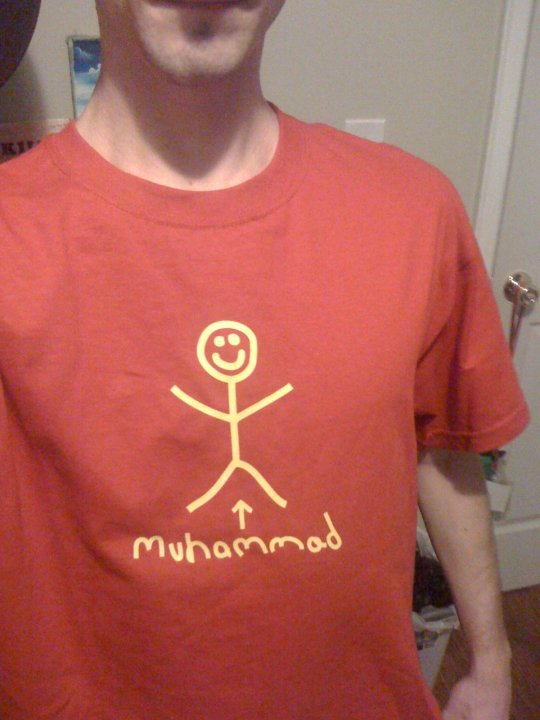
I still wear this shirt

Eventually, i started writing more and more about polyamory, and one of the posts that stands out for me is the one about jealousy, where I argue that jealousy is not a reason to not be polyamorous.  Also, sex-positivity is a good thing, and we should all be comfortable with being slutty (if we want to) and we should sin responsibly.  What else did I write about polyamory? When it comes to love, we should do so authentically.. We should be creating a new and improved polynormativity.  We were in some documentary, apparently. another personal favorite is my post about accidental monogamy, where I started thinking about how there is no reason to ever want to be monogamous (one should get there only by accident), which later led to a post about relationship agnosticism.  Of course, I got nerdy with set theory and polyamory, but much more recently I wrote about the space between being friendship and being lovers, which is still quite relevant this very day.

Of course, having a MA in philosophy means that I will occasionally become erudite…ok, more like smart-assed and long-winded. Some of my favorites include Facts or it didn’t happen: unhooking the bra of reality, Thorough and perpetual Sskepticism, and this post which got a little too meta, even for me.  Also, let’s not forget my tendency to try and simultaneously criticize monogamy and religion.

There is also my post about the history of Christmas, which I have reposted a couple of times and always put on Facebook around the end of December.

Sometimes, I got political.  I liked this short post where I quote from a book about the American Revolution that demonstrated that political tropes we use today are not new.  But my favorite post about politics was where I essentially declared that I could never be a conservative.

That's me!
That’s me!

Lastly, I wrote about the various wars going on in the atheist community.  In this post, I utilize Moral Foundation Theory to talk about the “great schism” (as it is called by some) in the atheist community.  I also talk about feminism, both in terms of the #shutupandlisten debacle (as it pertains to lessons from Zen Buddhism) of last year but also as it pertains to the history of technology.

Lastly, I wrote a book.  This is significant because I started writing that book around the same time I started the blog.  And as I move towards another 5 years of blogging (perhaps), I will also consider finishing the second book (I’ve written 3 chapters or so).

Thank you to everyone who has liked, commented, and continues to read.  I do this because I love it, and I also love when other people love my work.

If you think I missed a post you loved, let me know in the comments.

I’ll leave you with this song.


Reflections on loss and regret


I’ve been here before.  It’s after 3 AM (as I started to write this, anyway) and I’m awake, tired, and anxious.  I’m sure many of you have been here too, from time to time.  The thing about this, however, is I was sleepy and went to bed hours ago.  I slept for 2  hours and woke up thinking it must be 5 AM (which it is now, as I am about to publish) or so because I felt awake but it was still dark. Anxiety is fun.

The last few years have been the theme of my thoughts, which are admittedly disorganized and barely consciously available, despite my intense desire to glean them.  Sometimes, even being deeply introspective is not enough to dig that deep.  I very much want to understand my mind, especially where the fears, insecurities, and darkness lay.  I believe, quite strongly, that one of the most moral things we can do is to know ourselves; not as we want to see ourselves but as we actually are, under all the bullshit we create to hide the terrifying truths hidden within.  Only through such labors can we even hope to effectively grow and contribute well to our environment.  Without such a desire for self-understanding, I would be but a shadow of the person I am today. I would not (could not) love myself (and yes, even in the depths of sadness I still love myself).

How do obtuse and oblivious people survive without deep introspection? (is a question I wonder frequently). Probably because success and superficial contentment are not dependent upon self-knowledge or the courage to dig into oneself critically and honestly.  One can get along quite well, in our current human culture, being myopic because depth of spirit is not the root of the social and political games which bring ‘success.’

Such myopia is an ideal firewall to the insight that would prevent someone from valuing such ‘success’ as highly as so many do. Without insight, one would never know that something was amiss and keep themselves in the delusion that they are healthy and good people.  I have come to learn, over the years  (especially the last couple), that myopic, obtuse, and oblivious people tend not to think about such things often or deeply. I am not even sure they are capable of understanding what I mean.  I hope they will, sooner than later, for all our sakes.

What’s worst, however, is that many who read this will not understand that it is them I am talking about (such people seem immune to such self-criticism), and yet there are many others who will assume I am talking about them (for them, self-criticism is usually the default).  But such a self-deprecating thought usually implies the depth and complexity of a mind who couldn’t be myopic or obtuse, even if they might think such things of themselves quite often.

And yet, such deep and complex people are quite forgiving of such obtuse banality in others, for reasons which escape me.  I don’t think it’s mere compassion and forgiveness, although that’s often a part of it.  Such sensitive people often excuse and even come to accept and love that which they would never be, usually because the insensitivity that compels banality also often makes one seem confident and attractive.  Like a moth to a flame.  Nothing is less attractive than undeserved and so obviously pea-cocked confidence (but you have to be able to see through it, first, I suppose).

Vanity and illusion attract those who are neither vain nor delusional but who seek to be beautiful.  What such-attracted-people often don’t understand is that they were already beautiful, and they needed no salvation from anyone else.  Yet, they so often attribute their concocted ‘salvation’ to the smoke and mirrors of illusion because once you invest so much into the illusion (religion is the most obvious example of this), it’s hard to see it for what it is because we are prone to cognitive dissonance.  It’s why people tend to not leave religion, unhealthy relationships, or their own bad habits. They rationalize and make excuses for what habits they have acquired. Eventually the illusion hides within their own mind, and their very memories are forged to reflect the lie.

And it’s more obvious from the outside.  Atheists see it in Christians, polyamorous people often see it in the monogamous world, and most of us have seen it in the unhealthy relationships of friends, family, and acquaintances.  Not that those relationships could not become healthy if both parties were willing to actually deal with their shit honestly by tossing aside their illusions. This rarely happens, however, even among the intelligent and relatively enlightened.   It’s nearly impossible to have the affected see it for what it is, and so in the vast majority of cases the dissonant song plays on, unchanged and unchallenged, sometimes for many years.  Some never see it and die in the illusion, never knowing there was a better way.

I will never let the above happen to me.  And I don’t have time for people in or adjacent to my life who will allow it to happen to them.  That thought is what has been keeping me awake. In the last week, I have not slept more than a few hours per night and I have bouts of sadness between moments of joy and relative contentment.  You know; I’m human.  But at night, when there are no distractions, I rake myself over the coals of the past, wondering what there is to learn, knowing all too well I’m just making this worse.  But I can’t turn it off.

This week, I’ve also had some good times.  I have to keep moving forward, or the sadness and regret will take over.  But when I can’t sleep, alone in the cold and dark, I can’t escape it.  The fear, the uncertainty, and the loss are palpable.

It’s just like it was 4 years ago when Seana left me, in many ways. Just like back then, I know I have made mistakes and those mistakes led to lack of trust, but there is more here that I may never understand.  Most frustratingly, I’m not completely sure what I am supposed to be learning.  The loss feels surreal, and I don’t have a direction in mind.  I don’t know where the goal is, or what game I’m playing.

As I sit here, writing in the heat of emotions and uncertainties, I reflect once again on what happened 4 years ago.  It was within 2 weeks of losing that relationship when I awoke, in a fever of creativity, and made a truly terrible and sappy video for the woman who left me.  I have no idea if she ever watched it.  It doesn’t really matter, because that creative burst was the beginning of moving on.  It was the first glimmer of what became an understanding that I was better for the loss, even if i did still love her.

But right now, the problem is that I don’t know what side I will land on, when that time comes soon, with this loss.  I do not know what I will want in the future.  There is no lack of love, but the fact is that I have never stopped loving someone who I genuinely loved. I miss Gina. I loved her more deeply than most, and miss her more than I will try to express. How will I feel in a year? I don’t know.  I’m scared to know, and perhaps that’s why the mind refuses to settle on any one feeling so close to the event.  Perhaps I’m stuck in my own illusion.  

But what I am fairly sure of is that part of what causes such losses are out of my control.  No matter how much responsibility I have for what caused her to leave me, there remains the parts I could not control.  Whether fear, unhealthy attachments to ideas, people, or things (on both our parts)—whatever the cause, there comes a point where punishing myself will have to end.  There is a point, and I see glimpses of it already, where the pieces of the puzzle become more clear from a distance.

Will my face appear in that completed puzzle? I don’t know yet. And I still am not sure what exactly I am supposed to learn or what I will want.  There’s still too much debris from the destruction, too much sifting through the ashes, looking for surviving relics that I may or may not take home with me.

Where our lives were entwined, they are now days away from essentially being estranged.  What was to be home is now a place of pain and sadness.  What was a source of hope now has become a source of sadness and emptiness.  What was certain has become uncertain.

Can I sleep now, please?

Lost and Found


A little over 4 years ago, I lost a relationship which was, at the time, important enough to move me away from Philadelphia.  The same day that relationship ended, just a few months later, the origins of my relationship with Ginny started.  And that, ultimately, brought me back to Philadelphia.  More importantly, it brought me back to myself, and possibly a better self due to the struggles I had with depression and other emotional difficulties caused by that loss.  In my opinions, the gains outweighed the losses in that case.  Ginny is my rock.  She always stands besides me and loves me, and I am extraordinarily lucky to have her.

And up until a few days ago, another person was as integral to my life as Ginny is, in many ways.  We lived together, laughed together, and when things were wonderful they were amazingly wonderful.  Gina was a person I intended to spend the rest of my life with, and now that possibility is uncertain.  Now that relationship is gone, at least for now.  And I feel lost again.

So, now I spend a lot of time analyzing what it’s like to struggle through painful times, while looking for the light at the end of the tunnel.  And being the cynic I am, I’m not seeing beds of metaphorical roses.

Pain, struggle, and all the related emotions and circumstances are hard, especially for someone who struggles with emotional stability and proportionality.  The increased introspection brings forth more self-awareness, emotional maturity (at least, hopefully), and forces me to take some more time for re-evaluation.  At least, that’s what I have told myself, before, when I healed from such times.  But right now I’m not sure if I buy that narrative; at least not completely.  It’s true that I think more than usual, but not really that much.  I just think about specific, painful things more.  I just hurt more.  I may not actually be any more introspective at such times (but I’m definitely outside the norm in terms of my normal level of introspection).

I’m starting to think that maybe the narrative of ‘painful times are periods of growth’ is not completely correct. Our brains do their best to maintain the illusions and narratives of a whole self who does not act completely crazy and unpredictable, let alone simply irrationally and unreasonable.  Our memories are altered by a process that maintains this illusory narrative to put together our selves and lives into a sensible story.  As we remember those times of pain and struggle, we have to put them in a context of where we are when we don’t feel that way any longer, and growth is as good a narrative as any other.  In order to maintain some level of consonance with our self image as a stable and grown person, we humans tend to construct a narrative of how the pain we went through made us stronger, better, and more prepared for life.  It never feels that way when in the midst of it, though.  At the time, it just sucks.

I hope I’m a stronger and better person than I was 4 years ago, but the fact is I can’t be sure.  I have painful memories which give me pause when approaching similar mistakes which helped precipitate those painful events, sure, but is that strength? Isn’t that just conditioning, a la Pavlov? Is it not possible that I would actually be stronger today if those painful experiences had never happened? How would I know?  Because if I’m stronger and better today, perhaps that would have happened whether I went through those painful times or not.

Then I think of all the utterly obtuse and non-self-aware people I know, and I think that maybe I’m just being too pessimistic and cynical.  Why are so many people apparently oblivious to not only their own issues but the cues of others? How have they avoided actual emotional growth for so many years? It seems weird to me to not be introspective, but I guess my introspective nature looks weird to them, too.  I’m getting off track.

What I want to know, essentially, is whether the pain we go through when dealing with loss–whether through death, break-ups, etc–is actually ever good, or whether we create a narrative which makes it seem good in retrospect.  Because when we’re better, things look better.  And so in that case we can weave memories to fit how we feel.  If we are fine after the shit is all over, then the crappy days, weeks, or months we just plowed through must have been worth it, because here we are! Right? But that’s not how the brain works.  Sometimes, we just feel better because we forget the pain (or, at least, most of it), new good stuff happens, or because we ate the right foods that day to help support a healthy mind.  And then we reconstruct the past to fit the present state of mind.

I really am being cynical and pessimistic, aren’t I?

*Sigh*

I’m dealing with loss right now.  I’m hoping that I will run into some ‘finding’ as well.  The fact is that I am on the verge of starting a new relationship, so I may be repeating the pattern of losing and finding simultaneously, but it’s also premature to make any hay out of that.  The happiness I am feeling from that is somewhat mitigated by the pain of that other loss, but it’s still happiness and hopefulness.  But mostly, right now, I’m feeling sad, hurt, and angry (mostly at myself).

And I miss her.  Badly.  I’m trying to make sense of my life without her in it, and it just doesn’t make much sense at all.  I think of things I would usually share with her, and I can’t.  Too painful to talk right now.  And everyone keeps telling me that this might just be temporary, but it sure as hell doesn’t feel that way.  I’m just going to have to wait out the worst of this, and hope that when I feel better things will be different.  The scary thing, however, is I don’t know how they will feel better.  The uncertainty of it is terrifying.  I guess I just need to practice patience, and hopefully all will be better soon.

In the mean time, I can’t stop moving forward, otherwise I will spin my wheels into a rut of listless sadness.  I need to keep moving forward, and hope that maybe that lost relationship might be found when things feel better.

But for now it hurts too much.

Intelligence is insufficient


Intelligence is a useful quality to have, but it is not enough if we seek things such as wisdom, fairness, or even simply being correct.

I know some pretty smart Christians.  I know some people who are smart and yet who still have some pretty dated and conservative views on the world.  There are pretty awesome people I meet who react to polyamory unfavourably,and not just as a personal preference.  They are able to think, they have impressive cognitive abilities, and yet while talking to them it’s sometimes obvious that they are missing something from their thought process. To the untrained eye, this may look like lack of understanding, but it may not be that simple.  5 or 10 years ago, when my eye was less trained, I would have argued with such people and tried to convince them of my position.  Their smart, I’d have thought, and so if I present a solid argument they’ll have to agree with this reasonable belief I have.  The problem, here, is two-fold.

First, this presumes I’m actually correct.  I may not be correct, and starting as if I am is no help to me nor my interlocutor.  If I might be wrong, then starting by trying to convince them of my position will not serve greater understanding or intellectual growth since it will either end in my convincing them of an untruth or of an endless argument where they are the one with the hopefully keener eye to see what we are missing.  On top of this, there is a cognitive block that occurs when you argue from a position of “I’m already right,” because it prevents listening.  While you argue your points, in such cases, it is harder to see the others’ points being made because our minds will protect our current worldview against dissonant ideas.  And really smart people are really good at this worldview-protection, because they can easily and quickly think up rationalizations for why an objection isn’t relevant or right.  But by doing this, we miss important facts and perspectives which may be of value to us if we could understand them.  You know, just like how you want your interlocutor to think and feel while making your points.  Funny how that works.

Therefore, we should start with as neutral a position as possible, and be willing to question every assumption, value, and belief we hold.  Also, we should talk to others as if we are willing to do so, because doing so not only looks more open-minded, but actually is part of becoming open-minded.

Second, it presumes that the difference in opinion is one of mere comprehension, when it very well may not be about comprehension at all.  The issue may be a difference in values.  A difference in values is much harder to shift, for many of the same reasons generated by dissonance theory referred to above, and most arguments I’ve heard boil down not to facts, but values.  And while I don’t believe that facts and values are fundamentally different ontologically, they are behaviourally different at very least.  That is, a fact is easily proved or disproved, but because a value is part of the process of thinking and behaving, it is harder to see for what it is and how easily it can lead us stray of rational behavior and beliefs.

I believe that a value can be more true than another value (in terms of how it lines up with what goals we share.  What goals we should share is another question).   A fact is an external reality or claim about said reality which can be checked with empirical and or logical methods.  It is demonstrably testable whether this element has those properties, this mathematical proof works, or that lead is denser than water.  A value is a fact which is part of the process you use to evaluate other kinds of facts, and thus is generally out of the line of sight for your intellectual powers. More fundamentally values are ideas, which makes them physical processes (ontological dualists can exit through the door, as I have no patience for that shit any more), which also means they are also subject to empirical and logical methods as well (although the exact technique to do such a thing is still quite difficult) and thus values can be measured against reality in a similar way as mere ‘facts.’  I’m willing to submit that values can, therefore, be better or worse than other values.  Honesty is better than deceit.  Compassion better than harm. And, maybe, the desire for truth is better than the desire for comfort.

Or is it?

Some people don’t care about the truth, in itself.  I mean, if you are talking about something as banal and mundane as ‘are you telling me the truth about this drink not being poisoned,’ then people usually care about that level of truth.  But what about the willingness to try and learn, grow, and change beyond what is comfortable? What about someone who does not really care what the truth may be, because their faith makes them feel safe and loved? Arguing with such a person about the existence of the supernatural is a wasted effort; they don’t care what’s true.  There are smart people who hold such positions, including people that I know and care about.  Utilizing intellectual means to try and convince such a person will probably be pointless and frustrating for both of you.  They value differently than you, and by applying such a method you are attacking the facts rather than their values.  You need to appeal to their values, and doing that by intellectual means is hella hard, and often pointless (but I don’t think it’s impossible).

Or, what about a person who has a moral worldview which you find abhorrent, flawed, or merely not moral? I know quite a few such people, and I do not address why I disagree with them most of the time, because our disagreement is not about facts, it’s about a specific kind of value; preferences.

Morality is not a reasoned activity fundamentally, even if we can use reason and science to improve it and clarify the problems raised by morality’s mantle.  Morality, especially where it is codified or systematized, is usually (if not always) ad hoc reasoning.  That is, we simply have deep preferences for which we build logical boxes for storage and for hitting our opponents over the head with.  Kant, for example, didn’t start from some idealized blank slate of a mind to reach his deontology, his universalization of maxims, rather he had certain preferences and quirks about his mind that made it feel right to do this and not right to do that, and created (brilliantly, mind you) a logical scaffolding to make sense of these brute facts of his mind into a systematized universal standard.  I happen to share much of those preferences that Kant seems to have had, so I tend to agree with Kant when it comes to ethics (although I thought he was wrong about many other things, like aesthetics).  Where I think Kant erred, in terms of his ethical thinking, was believing that his exercise was a truly intellectual one, rather than one of rationalizing values.  The same is true for Bentham and Mill with their versions of utilitarianism, and perhaps even Aristotle with his Nichomachean Ethics (which everyone who is interested in ethics should read, in my opinion).

So, having intellectualized and semantic arguments about ethics is usually completely pointless (not always, mind you).  When this type of conversation happens, what we tend to observe is a proxy war for our preferences.  The question is not whether my scaffolding is more rationally stable than your scaffolding (I actually really don’t like that game), but whether my preferences themselves actually have better effects on people and in the right ways, and whether (therefore) I might try to shift my values.  All too often, we see something like a person whose preferences are more self/freedom oriented arguing with a person who finds consideration and efficiency more valuable, but they don’t address the values themselves.  Instead, it turns into a conversation about what “rights” mean or some other epiphenomenal factor, which is less helpful to everyone and merely seeks to put on display rhetorical skills.  It’s like lovers trying to hammer out an intellectual solution to feeling unloved; it’s bound to not really help, in the long run, because what the hurt lover wants to just to be loved (it’s a mistake I’m prone to making).

Intelligence is a great tool but without perspective it can often be a blunt tool instead of a sharp one.  Perspective requires the spirit of not only a skeptic, but an archaeologist of the soul (‘spirit’ and ‘soul’ used metaphorically there, of course.  And yes, that’s yet another set of references to Nietzsche).  It’s one thing to use rhetoric, logic, and eloquence to find the flaws in the argument of your opponent, but it is quite another to have the courage to take a hammer to your very psychological and emotional bones.  And when a person can utilize whatever level of intelligence they have and work for the character of self-criticism, then a person begins to approach wisdom.  Because while we don’t choose our level of intelligence, we have some control (assuming free will is meaningful) over how we use it.  The how of our intelligence is more important than its raw power.

Our insecurities will compel us to show off our intelligence.  We want respect, love, and friends. And we can get those things if we are (perceived as ) smart.  That world is all vanity, the neighbour to fear.  Fear is the mind killer, right?  And fear has a tendency to create the illusion of confidence or even to actually create arrogance, where practicing intellectual patience instead might be wiser.  Because even if we are right, we still might have something else to learn if we are not so ready to be right that we only swing our intelligence outward while not watching for the parry and counterstrike.  Also, it does not help to make people like us very much.  You may not care about that.  I care about that, at least a little.  Just don’t make the mistake of allowing your insecurity and fear make you act in such a way that you tell yourself, after the fact, that you didn’t want people to like you when you really did want them to like you.  Because that’s a thing that happens.  Again, it’s called cognitive dissonance, so read about it.

The turbulant seas between Philotes and Eros


Because I am poly polyamorous, having friends of the gender I tend to be attracted to can often be an adventure of uncertainty and transitions.  Some of them I am attracted to, some I am not, and sometimes that attraction leads to something.  Many times it does not.  But when it does, the transition can be, well, it’s a lot of things.

With attractive friends, and acquaintances, who are not already polyamorous, the issue is less uncertain as one learns to curb the attraction because it is not appropriate, and usually not wanted.  Sure, I might flirt, playfully, but I do my best to leave it at that unless the cues are overwhelmingly in my favor.  But then, inevitably, some of those people want to be polyamorous (Who wouldn’t?)  or they were already but for whatever reason things didn’t click at first.  And if they demonstrate interest in me, the flirtation and the relationship in general takes on a different tone.  Interest is communicated, and hopefully requited.  Suddenly I find myself in a place between friendship and something else (assuming we accept the distinctions and roles of those mainstream relationship types, of course).

From a Relationship Anarchy point of view, this transition is less significant.  Yes, there will be actual differences in how people interact when they stop being merely ‘friends’ and playfully flirting to being sexually affectionate, but if we were to reject the model of relationships of our mainstream culture (in which one is either a friend or a lover but not both) then that difference is less meaningful and often less distinct.  And while I have some affinities with Relationship Anarchy, the distinction between these two relationship phases is significant and important to me.  This is mostly for reasons having to do with my level of comfort of physical affection with friends versus lovers (something I’m open to being less dichotomous about, as I grow).

I have few non-sexual friends with whom I’m comfortable being affectionate with beyond things like hugging and basic body contact.  This is because sexuality is extremely powerful and often overwhelming for me, mostly as an emotional and sensual experience.  Being affectionate with a person I don’t have some level of sexual relationship with (especially women, being that I am heterosexual) can lead to spikes in desires which are inappropriate with some people.  There are quite a few women in my life with whom I have no sexual relationship, but am still attracted to, and so I minimize my physical contact with them because physical intimacy can sometimes lead to spikes in sexual desire which are uncomfortable for me to have when I don’t perceive them as reciprocated or wanted by those women.  Respecting other people’s boundaries is especially important to me, and the vast majority of times I will not initiate flirty touching without making sure it’s wanted.

Of course, one of the exceptions to that rule was the night I met Ginny.  And now we’re married.  I don’t know what to learn from that, exactly.  I do know that the lesson is not to just touch whomever I want in the hopes they like it, because boundaries.  Also, non-verbal cues are not always sufficient, because sometimes we mis-read them.  Nonetheless, I have chanced it a few times, and it worked out fantastically once.  I don’t plan on chancing it again, because some people really don’t want that and I don’t want to be that guy.

So when I find myself in a situation where I’ve communicated my interest, that interest has been requited, I find myself in a limbo between knowing those desires are appropriate, wanting to act on them, and still being somewhat nervous to touch those people affectionately, let alone sexually, it is tough for me.  And as the idea of future potential affection and sexual contact hovers over me, the beginnings of New Relationship Energy start to form (let’s call that pre-NRE).  And despite the fact that it is potentially premature to have those feelings, they happen (and sometimes they remain in that pre-NRE stage, which is also fine).  And for a borderline like me, those feelings are often overwhelming and cause days of anticipatory anxiety and anticipation.  I both love it and hate it.  I love it when it genuinely does become NRE (which I define as a multi-way magnification of emotions and desires between 2 or more people, and not personal infatuation towards another), and I fear that what I desire might not materialize at all.  If what I desire does materialize, but never reaches genuine NRE, that’s actually fine.

This experience of pre-NRE (As well as NRE itself)  has another side effect, which I don’t think my current partners mind so much (and I might be wrong here, but I’m sure they will let me know…).  It gives my sex drive a huge boost.  For me, new sexual (requited) attraction has the effect of making me want sex with my current partners even more.  The spill-over effect of being sexually charged is not limited to the source of that desire, at least not completely.  In my experience, my desire for one person can only be fully quenched by them,* but that desire amplifies the already existing desire I have for other people.

Of course that level of excitement doesn’t happen always, but it does happen enough to be a thing worth thinking and talking about.  Those pre-NRE feelings don’t always become overwhelming in the beginning of meeting and conveying interest.  Sometimes, in other cases, the feelings grow slowly.  There are some people I grew to love and desire (more), when in the beginning the attraction existed but was not overwhelming, nor did an emotional attraction exist at first.  Sometimes, in the beginning I just saw us as incompatible, but later changed my mind about that.  I never know what to do in those situations. Mostly, I remain friends with them and wait for what I think will be the right time to say anything.  Sometimes that right time never seems to happen.  Like I said the other day, I’m not always great at communicating my desires.  

Writing all that makes me wonder if any of those friends of mine might wonder if they are one of the people I might have feelings for I’m not expressing. Gah! Blogging is hard! I’m trying to get better at that.  It’s scary.  No, it’s down-right terrifying sometimes.  I have issues. 

So, the times when I am swimming between the shores of one way of interacting with a person to the other is always overwhelming, scary, and exciting for me.  There is the nervousness of whether it will actually happen, the conversations which cross the lines between friendly and potentially sexual flirtation, and the feeling of fuzziness in my head and flutters of butterflies in my stomach as I think about it.  But in any case, I’m surrounded by wonderful, beautiful, sexy people who I love in many different ways.  But don’t worry, I’m not secretly restraining overwhelming sexual desires for all of you out there.

Not all of you.

All this makes it really hard to concentrate on tasks.  That reminds me, I have to change out laundry and eat some lunch.

*and if it doesn’t happen, that sticks with me for a long time.  This situation, which never came to be, still sticks with me now and that was 3-and-a-half years ago! Granted, that was a huge exception to my usual level of sexual attraction

The value of attentiveness


As an introvert, I value time alone.  I get overwhelmed by too much social activity.  And yet, I love social activity often, especially with people I like and love.  I mention this as a disclaimer for what will follow, because I am aware that my values are derived from these facts.

Growing up, I attended a Quaker school.  Part of our routine, at a Quaker establishment of education, was meeting for worship; a silent time of reflection and potential personal communion with some god once a week.  As a person who is easily distracted, it was useful to be exposed to and forced to get used to being quiet and inactive for a little while.  It may be a post hoc rationalization, I know, but I have come to view the ability to do so as a sign of good character.   I believe this because I’m generally happier the less I am distracting myself.  I’m happier when I spend some time, each day, doing essentially nothing.  Not all day, mind you, or even for a long time.  Usually, taking 5-15 minutes now and then to just sit, not thinking about anything in particular and just relaxing without podcasts, TV, etc in the background is a means to allow my mind to calm and to unconsciously process perspective.

But more than those moments of quiet, I value attentiveness and the related skills of empathy and sympathy.  I value these things because they expose us to parts of our minds, behavior, strengths and weaknesses contains within us in ways that we are likely to be blind to when we distract ourselves constantly.  I know, I know…I’m starting to sound like that tropish old, grouchy man who complains that modern technology is destroying the world.  No, it’s not that, it’s something more universal than that.  That trope of the old grouchy Luddite is based on an ancient struggle for a balance between introspection and having to be active in order to survive being translated into concerns about technology.

I believe that there is a lot that happens in our brain that we are not aware of.  Consciousness, whatever it’s nature, is only a small part of what our brain is doing at any given time, and if you have ever gone away from thinking about a problem to have the solution seem to come out of nowhere later, then I think you know what I mean by saying that when we are (consciously) thinking, we are still thinking.  And while I don’t have any evidence on hand at the moment, I believe that when we distract ourselves constantly, we are unable to effectively introspect and process parts of ourselves which might be scary, unwanted, or apparently boring.  Further, by glossing over those things I think we miss much about ourselves we could learn from.

It is for this reason that I have a fair amount of respect for meditation, at least insofar as it is practiced in a secular manner (the way Sam Harris advocates).  It is also the reason why I have some affinity to the side of religion, as it has popped up through history, which tends towards the mystical or esoteric.  Whether it’s wisdom literature, philosophical introspection, etc I am able to see the importance of this aspect of religion’s role in history because I have a similar set of values and internal attributes as the various writers I have loved from religious and philosophical traditions.  For me, reading a good writer is like peeking inside someone else’s mind for a little while.  I’m less interested in their beliefs, conclusions, etc as I am in the process, tone, and emotional environment of their thinking.

There is something essential, in my opinion, about being able to merely be without effort, sometimes.  Other times, it is important to be silly, irreverent, ecstatic, and very busy, especially when their is shit to do.  Because I’m an introvert, I work most often on my skills at being social.  I work to overcome my fear of embarrassment, rejection, and (probably the worst of all) allowing my own emotional environment to awaken the parts of me I am trying to transcend (like defensiveness, when disagreeing with someone).  My weakest point (as many people know) is probably my poor ability to communicate my needs and desires well, especially in the face of other people who have little problem making their preferences known.  It’s, frankly, intimidating.  For those who are good at making preferences and desires known, this can be frustrating in terms of being around me (both because I have trouble communicating my desires and because I will sometimes resent your ability to do so easily).  Where others will ask (which often feels like a demand to me), I will rely on social context cues.  This, for me and others, is inefficient and frustrating.   It is, however, where my strengths lie, and is as a result of thinking that way most of my life t I am very good at reading those cues, where some people are not.

Those cues seem so obvious to me, but not to most people (Ginny will attest to that).  It’s why I’m working on communicating better, while also trying to show how and why the ability to read cues is an important skill as well.  That is because in the debate about whether it is better to communicate or to have a set of skills designed to make such communication generally unnecessary (some things will always be necessary to communicate overtly) is wrong-headed, in my view.  Yes, we should all communicate effectively, but we should also be learning how to be more self-aware, and that self-awareness is the result of the ability to pay more attention to what is happening around you. That can only be done if we are not distracting ourselves.  Because if people are better at being attentive and aware, those of us who are struggling to communicate well will be less stressed out about communicating, because we won’t have to as often.

But, as usual, such conflicts are the result of the social interactions of differing value sets.  Never attribute malice where simple laziness, inattentiveness, and misunderstanding are a better explanation. All too often disagreements are about values which are incompatible, like when people think they are arguing about the same thing, when they aren’t.

To use an partially relevant example which Wes used, earlier today:

I got into an argument on Facebook the other day about whether it’s rude to be using your smartphone while you’re out with someone socially. My policy is that social interactions should be entirely consensual, so if Person A longer wants to engage with Person B, they should stop engaging and do what they want (my friend Miri has a similar view).

Here’s the thing about this; I agree with him.  His argument is sound, he has every right to use his phone whenever he wants to and he has no obligation to interact with people around him.  But when I read this, my mind sort of winced, because from where I’m standing this approach is missing a larger question, one which trumps this question in some ways.  Now, granted Wes is answering a specific question; whether it is acceptable to use your smartphone in a social situation, where doing so might offend people.  Another disclaimer, I will grant that I have a visceral feeling of guilt when using my phone too much in social situations, which I admit is not an argument for not doing so, but it is the reason that I don’t tend to do it unless I have some significant business to attend to with people who are elsewhere.

But the other reason I don’t find this question particularly interesting or compelling is because I would have addressed another issue before I even got to that question.   Insofar as I might disagree with Wes’s conclusion has nothing to do with consent or obligation in social situations.   For me, the consent issue here is secondary to the larger issue–the larger meta-value–of whether I should be distracting myself in such a way at all generally, whether in a social situation or not.  I agree that I don’t morally owe people my attention (in most cases), so I can choose to, without morally infringing on anyone by using my phone while around them.  They may not like me for doing so, but maybe I’m OK with that.  But because I value being attentive, I won’t use my phone in such situations because the attention I invest has the long term consequence of allowing me to be more sensitive,  and fosters self-awareness which I value quite highly.  Here, the moral question is not whether I’m bothering the other people right now, but it is a strategy I employ to be a better person generally in the long run, by being generally more attentive.

Wes might argue, as I have heard him say, that he’s not interested in the social activity physically around him, so he’s opting for the social activity through technology.  And yes, that is a fine argument to make.  And in some cases I will do the same.  But what I keep struggling with is the problem of missing on the beautiful subtleties of things around me.  For me to be open to the things which bring me real joy, fulfillment, and teach me not only about the world, but also myself, I need to often be willing to be attentive fully to my thoughts, feelings, the room I’m in, and the thoughts and feelings of others around me.  And all too often, people (myself included) are merely distracting themselves with their smartphone, rather than using it as an alternate means to being attentive to the world.

S, while I will conclude, at least tentatively, that is is sometimes fine to be on your smartphone in social situations, especially where it fosters relationships with people who are elsewhere.  But the question I keep wondering is whether people who are almost always on the smartphones (computers, TVs, etc) in social situations or not are doing so to foster and maintain actual relationships, or is it a habitual means to perpetually distract oneself? Insofar as technology is a means to establish and maintain community and relationships, I think it’s great.  Where it doesn’t do that, I would prefer to minimize it’s presence in my own life (I’m not so good at that sometimes).  Also, I recognize that there are legitimate times when distracting oneself is a helpful strategy, especially when it comes to things like clinical depression or other mental health concerns.  There are certainly times when I need to distract myself to prevent the spiral of insecurity, fear, and anger which is a perpetual concern, but I can’t allow this to be an excuse to always distract myself.  My concern is the apparent inability to put the phone away, turn the TV off, stop playing the game, etc for a little while and just stop.  The inability to be bored, patient, and not entertained is a good skill, and I believe it helps us be more compassionate, empathetic, and (in the long run) moral people.

If I were more attentive to the world around me, rather than allow myself the easy distractions, I would be generally happier, I think.  And I suspect that people generally following that advice would lead to better things as well.  I would also write more, which is also good for me, psychologically and emotionally, since I would be thinking more.  There are aspects of myself that I really love, and they too often get buried by the miasma of distraction.  That me is attentive, affectionate, and more social.  I want my family, friends, and lovers to keep encouraging me to be that person more, and I encourage others to consider doing the same.

Transitions


This blog has been quiet for a while.  The podcast has also been quiet.  There have been reasons for this, most of which don’t need to be spelled out here.  Some explanation, however, is relevant to readers, assuming you have not forgotten about us.

Back in 2012, Ginny and I got married.  Our living situation was not ideal, our financial situation not great, but our relationships with a few people was such that we were given the opportunity to share space, as well as a blog, with some people that were integral to our lives.  So we packed up and moved to Collingswood, NJ.

I was optimistic, at the time.  We knew there were risks in melding lives in this way, and we all knew it could not work out.  But like all relationships, you sometimes have to gamble for the sake of it working out.  I’ve gambled in such ways in the past and not had it work out, but my view on life is perpetual self-improvement and not giving up, because I don’t want to resign myself to cynicism.  I want to make things work, when possible, and I hate giving up because things get hard.

But that isn’t enough.  Everyone in a relationship has to have the same interest in working through problems for a relationship to have a chance at working.  And even if everyone does want it to work, sometimes there are too many differences for it to succeed.  So, despite my initial optimism and our attempts to meld a new home, this gamble will not work out.  At least for now.

Polyskeptic.com isn’t going anywhere, however.  PolyskeptiCast has been hanging silently for a while and I hope it returns, but I am unsure about its future.  For now, some transitions are upcoming.

To start, I will be wearing glasses from now on.  I just got a new prescription, and two new pairs, that I will be receiving within a week.  Ginny and I will be moving out of the PolySkeptic compound in coming months, and moving back to Philadelphia.  I will admit, I am looking forward to being back in the city, but I hate giving up on all of this.  It feels like resigning.  It feels like running away.  It feels like losing family.  But it’s quite clear that moving forward as things are is impossible, and my feelings of resigning and giving up are not shared, so move on we must.

The details are not necessary to you all.  I will say that most of my silence on the blog has been due to the fact that the subjects I wanted to write about being too close to home.  I don’t mind writing about my own shortcomings and struggles for growth, but when the issues I have extend beyond my own issues, and are not about our culture in general, my moral compass gains my attention and I tend to remain quiet.  In coming months, that may change, as I try and sort through and articulate what I can learn from all of this, but for now I am reticent because I’m too stuck in the middle of everything to be even remotely unbiased.

I will also say that Gina and I will be staying together, hopefully indefinitely.  I love her very much, we both enjoy each other thoroughly, and we intend to work through the difficulties to come to maintain committed to each other.  It will be difficult, in term of maintaining our relationship, to not share space in the way we have over the last year plus, but I realize that it is necessary.  We have not seen her voice here recently on the blog, for her own reasons, but I hope to continue to read her hilarious and insightful posts here in the future and long down the road.

If Wes wishes to keep writing (and I hope he will), then he will.  His perspective on the world is very different from mine, and I don’t wish this space to be an echo-chamber for my views on the world, and so I hope to see more of his posts start to appear in the future.  Also, if Jessie, who has been invited to write but has not so far done so, desires to add her voice to the blog then I will look forward to read what she has to say.  And perhaps as time moves on I will add new writers (as I have in the past, which didn’t work out).  That is to be seen.

To sum up, our living arrangements and intimacy will change (as Wes might say, it’s not an ending, it’s a change in our relationship as a group), but I intend to keep moving forward with the blog, hopefully improved with some time.  There are tensions here, and plenty of responsibility to be shared for those tensions, but I hope that in time those tensions will be resolved with new circumstances.

That’s the thing about family.  Sometimes you love them, sometimes you hate them, and sometimes you really cannot live with them.  But even when you hate them and can’t live with them, you love them.  I don’t know what the future will hold for us all, but I hope that it gets better, and in the long run this will look like a mere stain on an otherwise really comfortable sweater.  Because the winters of life are cold and often dark, and the people around us keep us warm, even if they might be imperfect.


Regression towards the mean (a rant)


All cultures have traditions, values, means of communication, etc.  All of these, and more, help define meaning and appropriate behavior for the group of people that interact with that culture.  It sets values for moral behavior, words for communication, and expectations to evaluate your decisions and circumstances against.  It gives you a set of standards to compare how well you’re doing in your process of personal growth.  Culture creates a filter through which we define what is good personal growth.  The problem is that sometimes cultures are bad standards for such things.

What do you do when the values, expectations, and even the very language your culture uses seem, well, wrong? Not all of them, necessarily.  Really, it just takes one value or tradition to create this problem, and I am not sure it is a problem which will ever go away.  We may perpetually, as a species, be evolving and progressing our cultures towards various ideals, assuming we don’t kill each other first.  I’m rarely optimistic.  So, given that, it seems rational to assume that those working for social justice, of all flavors, are the people we should be paying more attention to as members of culture.  But we don’t, because the path of least resistance is easier.  It’s totally understandable, right? Well, it’s certainly human. As if that’s sufficient reason to do something in itself.

(Just another reason I’m a misanthropist and not a fan of humanism; I don’t want humanity to be our example or our standard, I want the ubermensch to be the standard.  I want to transcend mere humanity towards something perpetually better, culturally.  No, not a trans-humanistic future of perfect cuber beings or even Cybermen, but a perpetually improving set of cultures.).

Well, in such cases where we find ourselves dissatisfied with our cultural environment, we have little choice but accept it or to (hopefully) find some other people who feel the same way and create your own sub-culture where we will often have to hide some behaviors so that the normals can go around feeling comfortable with their quaint little lives, unchallenged and sometimes even unaware that challenge is even an option.  And if we, rebels and other hooligans, happen to encroach on their territory (which is everywhere, seemingly), we have to apologize and slink back into our little holes, lest they get offended and have feelings they don’t want to deal with.  Examples? Christian privilege in the Christmas wars, for starters, but also the fear that many polyamorous people have in being discovered by employers, family, etc because of the effect of cultural norms on our legal and practical rights.

And, sometimes, you meet one of these friendly normals who seem to think your little hole in the culture is sort of fascinating and interesting.  They sort of like some of what you have to say, or they have a friend who also has a similar hole and they want to be liberal, open-minded, and accepting but they don’t really feel it deep down the way we do so it always feels like they are merely patronizing.  Because they are patronizing, even if it is also partially genuine (I’ll be clear; sometimes it is actually genuine).  They will occasionally visit your little hole, play around for a while in that hole, but they are not prepared to live their.  In some cases, a person might spend time with the weird people because a friend likes the weird thing or because their partner is weird as well, and they feel like they should be supportive even if they don’t really get it.  I mean, sometimes they do get it, but sometimes not.  Either way, they are not invested in your little cultural oddity, and most of their thinking and feeling is still tied to the mainstream culture in which they live most of their lives.

As we grow up, the things that are meaningful to us are tied to the culture in which we live.  And for most people, that is the mainstream culture.  Generations of people have common cultural items to use as stand-ins for more universal human commonalities, and we latch onto those things.  For many people it is the church they went to, but it could also be the love of popular TV shows, music, or hobbies.  And this is all fine.  The problem is when the things we value and have fond associations with are a part of the problem.  I’ll use a personal example.

When I was in graduate school, I made friends with a fellow graduate student who was the member of a fraternity.  He was very active and loved this fraternity, and he spoke well of it.  Through our friendship, I became fascinated with the ideals and the experience of this group of brothers, and because I valued him and the ideals proposed by the fraternity I decided to join.  I had hoped to meet other people who shared certain values with me and to become part of a group that seemed actually worth-while, rather than the ones I had seen elsewhere.  It was against my general nature of not being the type who joined things like this; I never went to church (willingly), I have never been enamored by any particular political party, and I had some prejudices about fraternities.

Upon joining, I slowly but inevitably saw the private, secret rituals of the fraternity as well as how my new ‘brothers’ really were, and things started to sour.  I learned, quickly, that the role of the fraternity was exactly like the role of church for most mainstream and normal people.  While in the ritual times and spaces, people tend to be solemn, respectful, and even reflective.  But as soon as they leave, the ideals (for most of them), go by the wayside.  Then I saw that people were sort of douchebags, just like everywhere else.  On top of that, the ideal that the fraternity upheld were available without the fraternity; just like with religion.  There was no need to join the fraternity, because I could have the ideals without that particular group of people.

One example always sticks with me.  I had some interaction with the prytanis (president) of the chapter at Drexel University a while ago, during my early days as a volunteer, and it was like talking to any self-serving, arrogant, and self-important douchebag I have ever had the displeasure of talking with. The values of the organization do not tend to filter down to the members.  So it is with such things.  This, and other things I learned during my brief activity (you are a brother for life, after all), showed me that no matter how good the ideals of a community, or culture, are, those ideals won’t translate.  You don’t have to be a member to share the ideals, and if you do become a member you won’t necessarily meet better people.  Unfortunately, this truth carries through to all of my experiences with groups of all kinds, including the atheist community.  I have many friends in the atheist community, but it is full of many douchebags as well.  The Polyamorous community is a little better.

So, it’s even worse when even the ideals of a community, group, or culture are not, well, ideal. Take the ideals of love and romance in our culture to start with.  Most people associate love with concepts of possessiveness and jealousy as a positive sign of love being ‘real’.  But those are the ideals of love and romance in our culture in general, whether we like it or not.  It might be changing slowly, but that’s where it seems to be for most people.  Those of us who are polyamorous tend to recognize that those values are broken, and see love as expansive and less limiting (it’s not actually infinite, because nothing is.).  But from the point of view of someone steeped in  mainstream culture, we poly people often look like we’re crazy, or at least playing with fire (which is also fun).  We are, after all, intentionally breaking the expectations of the culture they live in and value.  I mean, it’s one thing to cheat, but at least the normal monogamously-inclined cheater has the ideal of exclusivity, possessiveness, and jealousy…I mean, true love and romance…as a goal.  At least those cheaters are (generally) trying to do things right, but they keep messing it up because they are human.  But to throw away those ideals and love 2 or more people? That’s just nuts.

So when those hangers-on, those people who are, intellectually and theoretically, accepting of us rebels and hooligans (you know, because they are open-minded, liberated people); those people who hang around because they have friends who are also weird; those who hang around because the person they are dating wants to be part of it, even if they are unsure about it.  When those people start to really face the hard parts of being an adult and dealing with the real complexities of attraction, jealousy, envy, time-management, trust, etc what do they do? Well, they tend to regress towards the cultural expectations. The average. The ‘mean’.

Monogamy as an expected ideal, as it is in our culture, is not a healthy value to defend and to default towards.  I recognize that some people will be truly happy and fulfilled in monogamous situations, but as a default this ideal is broken when held against the shape of human desires, capabilities, and actual behavior.  When you have millions of people nourished with in a set of values around love, relationships, and sex which imply the expectations of monogamy, their emotions and thus their opinions latch onto those ideals.  Subsequently, due to various cognitive biases and imperfections, they are offended by opposing values which may actually be superior (either generally or for them specifically).  So when some of those people are exposed to polyamory, even if they are willing to accept or even try it, their emotions are still tied to the ideals of love, relationships, and sexuality which make polyamory seem wrong, impractical, or “not for me.”

Let’s use another example, not from myself but based, in part, on someone I have known all of my life.

If someone grows up going to church, loving the music, the community, etc, they will attach emotional significance to much of the tradition and ritual.  They have emotional bonds to the sounds, smells, architecture, etc.  For someone like this, being in their religious space brings to mind good feelings, memories, etc which cannot be replaced, but which are valued by them whether they would choose to value them or not.  If they start to disbelieve in any or all of the doctrines of the church, those feelings don’t go away.  So even if they leave the church, they seek out some sort of substitute, or create atheist churches (*gag*).  And from time to time, they will think about and miss what they left.  Their emotions bond to such sounds, smells, images etc which they formed in those places while they developed as people.  And sometimes, especially if they experience trauma, hard time, etc, they go back.  They regress.

The same thing often  happens to people who are interested in, or try, polyamory.  It gets hard, their emotions–which were tied with ideas about love and security which are antithetical to being polyamorous–pull them towards the cultural norm.  It’s the path of least resistance, after all, to appear normal.  it’s even easier to actually just be normal.  Polyamory is not normal (and it may never be).  The normal alternatives, whether monogamy, serial monogamy, or even swinging (which is, let’s be honest, just couples who like to fuck other people sometimes, and not a real challenge to the fundamental norms of couple-based relationships) requires less personal struggle and work, it’s easier to explain to co-workers and family, and it does not force you to grow.  Growing is hard, fitting in is easier.

And we as sensitive, caring, and mature people, are supposed to sympathize with their struggle when they regress in such ways.  We are supposed to allow them to go the path they want with our blessings and support, because their life is theirs.  Well, sure it is, but that does not mean that the decision to regress towards the norm is not often based on some fear, unwillingness to be challenged, and even cowardice.  That does not mean we have to actually agree with them.  Also, it does not mean we have to respect their decision.  We are supposed to not challenge them when shit gets hard for them because shit is already hard for them, I understand.  We are supposed to be patient (and some patience is fair to ask for, but their must be a limit).  We are supposed to not rock the boat.  We are supposed to behave ourselves. we are supposed to know our place.  Our place is not to question the norm. Most people will defend their norms all day and all night because it is comfortable, and they will do it with a smile and get offended when you find them ridiculous, because they are so conditioned to see it as right even if it might not be.

They are so easily offended, those open-minded, liberated, progressive normal people.  Not to mention the conservatives; they are a whole different problem.  But the liberal-minded mainstream normal people who find us weird people so interesting to hear stories about on NPR or have representative friends to make them seem interesting…. They are very often, to this weird person anyway, quite amusing and interesting.  They are like the Unitarians from the point of view of radical new atheism; not the source of the problem, but not really helping either.  They are just sort of boring, trite, and uninspiring.  They just sort of blend into the background of the culture, which we already (hopefully) agree is not ideal.

And we are supposed to respect them and their lives.

That’s another part of the values of our mainstream culture.  That is the quiet, brilliant lore of mainstream inoffensiveness.  That is what feeds and keeps alive what is wrong with mainstream culture.  Where privilege of all kind lives, it is guarded by the desire to be polite, because being polite is nice and it won’t offend your grandmother or the neighbors.  Where injustice lives, so does the smiling, ubiquitous face of “it’s just how people are” and “live and let live.”  Where cowardice, fear, and conservative tendencies live, so do the values of tradition and “just fitting in”.  And so when shit gets hard, it’s easier to just fall back into the tendencies of the lazy and cowardly culture that we live among and within.  When shit happens, it’s easy to just blend into the background pattern of normal culture, and appear as just another person who feels more evolved and liberated because you had this time in college (or whenever) when you tried that weird thing, but it wasn’t for you.  Or perhaps you have some weird friends who are interesting to invite to parties and amaze the other normals with how many interesting people you know.  Don’t I look all open-minded now? Aren’t I a mature and responsible adult? Aren’t I interesting?

Not necessarily.

So this is where I regress to being (a little) mean.  I don’t respect the majority of our culture or its values.  I don’t want to be nice or to sympathize beyond a reasonable level of time to allow you to get used to the culture shock you have when you run into weird people or radical ideas.  I’m willing to allow you some time to calm from your privilege or parochialistic shock, but then I expect you to actually grow up a little or go away where I don’t have to tolerate the inoffensiveness you reek of.  And, unfortunately, most will go away and regress to their mean.  That’s fine, my world is better without you anyway, but I will be disappointed because this reaction is so common.  I’m not going to be nice to you just because you have some emotional attachments to being normal and unchallenged, and you would rather run away or hide behind wanting to fit in or not offend your co-workers or your family for the sake of something that scares you to think about doing.

I’m sympathetic to emotional difficulty when it’s warranted, but the common emotional attachments to a set of values affixed to a broken and stupid culture are not sufficient warrant after a while.  If you are exposed and given time to adjust to the weird alternative to the norm, and you don’t adjust, then I’m no longer sympathetic.  You have time, especially if you have the time to read blogs like this, to think about the nature of our culture and your relationship with it, so do it already and stop being boring.  If you don’t do that work now, then I hope that if you eventually figure out that the (for example) monogamous marriage which you willingly enter, but later find yourself stuck in, was the result of unrealistic expectations about relationships which you learned from our culture, then you will be willing to do the work.  I also hope that you will then be willing to start re-thinking your values and your attachment to the dominant cultural values.

I hope you figure that out before all of that, and I hope that our experiences and insights as (polyamorous, atheist, social justice activist, etc) people, while not perfect (I’m certainly far from it) might be more than mere interest from afar.  Because for many people out there, the weird stuff around them is just a way to play with ideas while not really questioning your very basic values and assumptions in any meaningful way.  Weird sub-cultures and counter-cultures are a sort of cultural clothing that makes our culture look interesting to those living in it, when it is not interesting in itself.  In short, I’m not impressed by your emotional freak out because you are more comfortable with what is normal than with doing the real work to challenge your cultural conventions and assumptions. I’ll be impressed when the freak out happens when you are genuinely trying to adjust to the fact that the dominant culture inculcated so much crap into you and you are trying to change those ideas for better ones, actively, painfully, and most of the time.

I am no longer impressed by the values, methods of solution, or rules of a culture–any culture–which is fundamentally broken as our mainstream Western culture is.  And if you don’t think this mainstream Western culture is broken in many ways, then you might be part part of the problem.


Learning and growing


Sometimes shit gets real.  We all make mistakes, we have people hurt us, and we become emotional and life gets hard.  Welcome to Earth.  Hopefully, we have people close to us who we trust and who trust us despite the fact that mistakes will be made.  Because mistakes will be made.  But what do we do about it?

First, don’t be defensive and don’t beat yourself more than is proportionate.

Start with the assumption that you did something wrong to cause the situation you are currently debugging.  Also, start with the assumption that your super powers for mayhem are not so vast that other people don’t have any responsibility for the circumstances before you, and that you are not completely to blame.  There are some people out there who blame themselves first, and some who blame others first.  In both cases, intelligent people can rationalize their tendency, and we all need to be aware of that.  Otherwise, some people take too much blame, while others will deny theirs (or, more likely, forget about it later).  The truth is important, and we sometimes need to force ourselves to adopt a more objective perspective in order to see around our own biases and faults.

Other people can help us do that, so listen to them.  That leads me to the next piece of advice.

Actively listen.  I don’t mean to merely stop talking, but actively listen rather than defensively react.  I mean shut off your defensive rationalization powers for a little while and accept that what people say might be worth trying to internalize.  The people that know you, love you, and are willing to talk to you when shit gets real are not trying to fuck with your head.  If they are saying that it’s not all your fault, it probably isn’t all your fault (or all your responsibility).  If they are saying you are at fault,  figure out why and what you are going to do about it (insofar as it is your responsibility).

When we are emotional, we are not ideally rational.  We sometimes think we are rational in such cases, especially if we are repressing some tough emotions, but that is a lie our brain tells us when it’s in defense mode.  Insecurity and fear create firewalls and other mechanisms to protect your operating system of a mind in order to (in effect) maintain the part of you that is fucking up.  Our intelligence can too easily be used to conserve the things about us we would ideally like to change.  Realize that, and then keep it in mind for when you plan on upgrading your software.

In other words, don’t let yourself slip back into your standard behavior, since that is likely part of the cause.  When the battle or war is over, we don’t necessarily go home and keep on keeping on, because that might have been part of what started the fighting.  You absolutely must realize that our normal, every-day behavior is probably the cause of some future tension, because it is bothering or hurting someone else.  And if you don’t think or care about this, then your fault compounds the longer you ignore this.  This leads me to another piece of advice.

Try and identify the cause of the mistake.  All too often, we address the symptoms of the problem, rather that honestly deal with the underlying cause.  All too often, the cause is fear, insecurity, and related daemons.  And when the smoke clears, and those feelings are not banging on the door, we forget that they still exist, quietly, under the surface.  If, like me, you spent years learning to meditate and to be always aware of the daemons running under most of your daily noise (as much as possible, anyway), you will know that those daemons are always nearby and are just waiting to be called into action by circumstances; triggers.  If you have not done that work, you may be completely oblivious to your own daemons.  But I guarantee you that other people close to you are aware of them, and probably know some of your triggers (to avoid them, mostly to keep you from freaking out and making shit get get).

Triggers can be just about anything.  They can be a tone of voice, a smell, a word, a type of social interaction, etc.  For me, it is things like lack of consideration of my time and space (especially by people close to me).  It is also being restrained for no reason.  What do you mean I can’t be critical of religion? Fuck you and your gods! What do you mean I can’t love more than one person and manage a relationship with them? Fuck you and your monogamy! What do you mean I can’t rob that bank? Fuck you and your laws!

OK, maybe not so much that last one.  Morality, after all, is superior to even my own personal desire for bank-robbing.  For me, the rank of considerations are: 1) Morality 2) interpersonal considerations (things like consent, preferences of people around me as well as my own) and 3) law.  And really, I only care about the law insofar as it is a legislation of morality.  The reason I don’t go through red lights has much more to do with concerns for efficiency and considerations for safety than it has to do with the fact that it’s a moving violation.  If there were no fine, I would still not do it in the vast majority of cases.


Our emotions, whether marinated in fear or whatever else, are responsible for more of our behavior than even the most intelligent and rational of us realize.  We are never fully (or perhaps even mostly) free from emotional influence.  In my case (having Borderline Personality Disorder), the effects are more severe and worrisome, but that only means that I deal with it all the time rather than only occasionally.  Most of us have the capability of losing our shit and making (and often rationalizing) bad decisions.

What is important is not merely sliding by and going back to normal after things calm down.  We need to remember that the daemon is still running under everything, and it’s only a matter of time before it launches an attack on our executive functions again.  So, after you have dealt with the symptoms, go back and dig deep into yourself and figure out the nature of the cause.  Be willing to give up your habits of behavior, even your deepest preferences, because they might be the causes.  You might have to change drastically, especially if you don’t want to.

I am not the same man I was 10 years ago.  I have made mistakes which have alienated me from people I loved in the past, and I spent the time to make huge changes in my ability to communicate, deal with difficult feelings, etc.  And there is still much more for me to do.  I will never stop evolving and changing based on what I learn, especially from my mistakes.  But I had to first learn that it was possible that everything I believed was wrong.  I had to start, like a skeptic, to question even my own deepest values.  I had to be willing to, as Nietzsche called it, be an archaeologist of my own soul, and dig out artifacts that were not mine so much as they were influencing the culture of my own mind in ways I didn’t like or fully understand.

It would have been much easier to remain the selfish, manipulative, and rationalizing person I sometimes was while younger (not always, mind you).  I could have kept moving down another path of growth (or lack of growth) and subsequently turned into a man I would not have been happy being, but who also would have been more acceptable to our culture (because I would have been ‘monogamous’ and otherwise mainstream).  In our culture, it is easier to be a manipulative cheater than responsibly polyamorous.  It is more acceptable to be defensive and “respectful” of religion, rationalizing the cognitive dissonances so many people carry, than to be an honest critic.

It is easier to not grow, than to do the real work of growth.  Because not doing real personal work towards growing is so common in our culture that it often looks like it is a value of our culture, rather than a plague.    Because we are so good at pretending to grow and change while only doing enough to pass, that we end up stagnating.  For real growth, we need to sometimes dig deeper than we are comfortable doing, and challenge every aspect of our behavior and beliefs.  We can’t hide behind excuses.  We have to do it openly, and make ourselves vulnerable.

All too often we don’t do this–myself included!–all because of fear and insecurity.  We call it protecting ourselves or something like that, but it’s just an excuse, a rationalization, because it’s scary.  No shit it’s scary.

So, let’s be scared together, rather than be scared separately.