Anger, hurt, and (unintentional?) bullying


About four years ago, when my therapist first suggested Borderline Personality Disorder as a description of the emotional volatility I’ve experienced throughout my life, he also said something that has stuck with me ever since. I had been describing how angry I was, talking about what I thought the causes were, what it felt like, and what I thought about it.  After listening for a while, he simply said “it sounds like you are describing being hurt, more than anger” (or something like that).  As I thought about it, it became clear that he was right.  I had been angry, but the anger was the hanger-on, the after effect of a tremendous amount of hurt I was feeling.  It was the result of hurt not being addressed.

Being the nerd I am, I also immediately thought of this:

“Fear leads to anger, anger leads to hate, hate leads to suffering,” Yoda says to a young Anakin Skywalker who was simply asked if he was afraid (to which he became defensive…foreshadowing much?). There are reasons why both Anakin and Luke Skywalker are significant characters for me, personally.  I understand them both natively, and find them to be interesting characters (especially in comparison to each-other), despite the often bad dialog of George Lucas.

And while Yoda’s prophesy was true for Anakin (as well as for me, in some contexts), sometimes in my case it simply starts with my being hurt, which leads to anger, resentment, and hate (which does, in fact, lead to suffering).  That is, there are times when people in my life act as a walking emotional trigger for me, and it causes a spiral of behavior which almost never ends well.

I’ve had a few people in my life whom, for various reasons, have hurt me both repeatedly and singularly.  I don’t think that they (most of them) did it on purpose or without reason, I simply think that our flaws make us hurt each other, whether due to fear or some other emotional conflict which creates tension and stress.  I’ve been bullied, when younger and also quite recently, by people who I understand to be insecure and largely unaware of the effects of their actions and their own emotional nuances.  Managing my reactions to such behavior, and the hurt which results from it, is especially difficult for me (being a borderline), and that stress tends to come out against the people I love.

That is, the hurt I receive all too often turns into the hurt I redirect to others.  It’s one of the hardest things for me to manage, but I am (increasingly) aware of it these days.  The side effect is that those people, whom I hurt, become angry with me.

The biggest fear that I have is my emotional fragility and volatility chasing people I love away.  I’m afraid of that because it has happened, because I never want it to happen, and because when it does happen all I can do it occasionally be left alone with the suffering that is the remembering of how I did it and not being able to change it.  When I lose someone because of my emotional instability, I then will reflect and dwell on how it happened and why. Later, when the hows and whys starts to become clear, all I can do is feel awful for having behaved so.  I didn’t intend to do it, I would have stopped if I understood, and I would do almost anything to take it back.  Guilt and loss are my suffering, because I was hurt and afraid, and I didn’t deal with those feelings well enough when they were happening.

I could try and rationalize the blame to other people.  ‘I was being hurt over here, by this person, and I have a disorder so I can’t help being mean sometimes when I’m suffering from that hurt,’ I could try to say.  But that would be not taking responsibility for my feelings.  Yes, people hurt me.  Yes, dealing with it every day in a hostile environment is hard, but that is not an excuse to redirect that hurt to someone else.  There are other options, ones I will work on for the future.

But most importantly, I cannot allow what is primarily hurt (or fear) to become anger.  I need to learn to express that I’m being hurt or are afraid, and ask for help rather than allow it to fester into resentment, anger, and suffering.  It’s hard to manage and respond to such sources of pain, especially when the person doing it feels like a bully to me, but that is a problem I once learned years ago and have apparently forgotten.  It’s been a long time since I was hurt consistently by another person in that way, and I forgot that bullies are afraid too.  I forgot that bullies create bullying behavior.

I will do my best to not make the same mistake again.

The clarity of being away from a stressful, unhealthy, and ultimately unsafe (for me) environment has been both enlightening and revealing.  What is being revealed is that much of the last year has been emotionally traumatic for me, and that trauma resulted in behavior (of mine) which led to the ending of a relationship which was immensely important to me. As a result of this clarity, I’m starting to understand what I should be learning from all of this transition and pain I’ve been going through in the last couple of weeks.

I need to avoid environments and people who treat me poorly or who trigger my emotional instability.  And when I can’t avoid it, I need to confront it directly.  Bullies don’t always intend to bully, but that’s what they do so I need to avoid them when I can and stand up to them when I can’t.  And that might mean that relationships with people close to such triggers might be unwise for me to pursue because perpetual, ongoing stress is bad for me.

That makes me profoundly sad right now, mostly because it’s not a problem I can solve.  So, I keep moving forward.

5 years


On February 12th, 2009, I started a blog with this post.  I had just been laid off from a job that I really liked (and was good at), I was living in Philadelphia (it was several months before I moved to Atlanta), and the blog was called ‘The Atheist, Polyamorous Geek’. That was 5 years ago today.  Some things have changed around here.  New logo, writers, and more followers have been added since 2009, and I still enjoy writing.


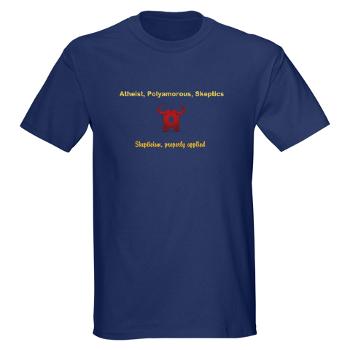
remember this logo?
remember this logo?

In the beginning, most of my writing was about atheism and religion.  Early on, I dropped the “Geek” at the end and replaced it with “skeptic”, due to my increased exposure to the larger skeptical community.  It would be some time before I would add writers, some of which have moved on due to interpersonal issues.  Who will be writing down the road is something I don’t know.  Will it make it another 5 years? If so, what will it look like? I don’t know that either.  But with that said, let’s take a look at some of my posts that I like from over the years.

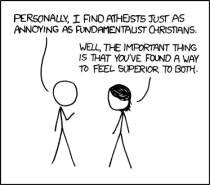
Theis XKCD comic epitomizes "agnostics" for me
I love XKCD

Very early on, I wrote a post aimed at agnostics, because I had had so many conversations with people who disliked and avoided the word ‘atheist’, even though they were one.  The word ‘atheist’ has become somewhat more mainstream in the last 5 years, but this post is still relevant, and will probably be so for years to come.  Shortly after that, another favorite of mine is this short story about a conversation with God, which was intended to be a response to the design argument and the special pleading fallacy inherent to irreducible complexity.  Recently, DarkMatter2525 made a video which reminded me of that post:

Shortly after that, a post about death and the appreciation of life was apparently translated to French, and then back to English, which prompted a post about translation (since, at the time, I was reading Douglas Hofstadter’s book Le Ton beau de Marot: In Praise of the Music of Language, which I highly recommend to anyone who is interested in language).  This post actually led me to have a brief email correspondence with Douglas Hofstadter, who commented on the translation himself.

Of course, I would have to poke at Christianity now and then, and my favorite post about Christianity is this one about how Jesus’ death (even if it happened) is not a sacrifice at all.Also, I wrote about how the love of god is misplaced, with a little science geekery mixed in.  Late in 2009, I wrote a long, 3-part post about how God is a metaphor, which was originally not written as a blog post (hence the length). Parts one, two, and three.

One of my all-time favorites is the post, from 2011, where I argue that I prefer atheism to humanism, mostly because I find humanism to be atavistic and still steeped in the mistakes of religious history.

Also, there were a couple of posts looking at history and culture, and showing how religion (Christianity specifically) contribute to diminishing culture, rather than making it better.  I especially like the McDonald’s post.

Of course, I can’t forget my take-down of Alain de Botton (who I still despise).

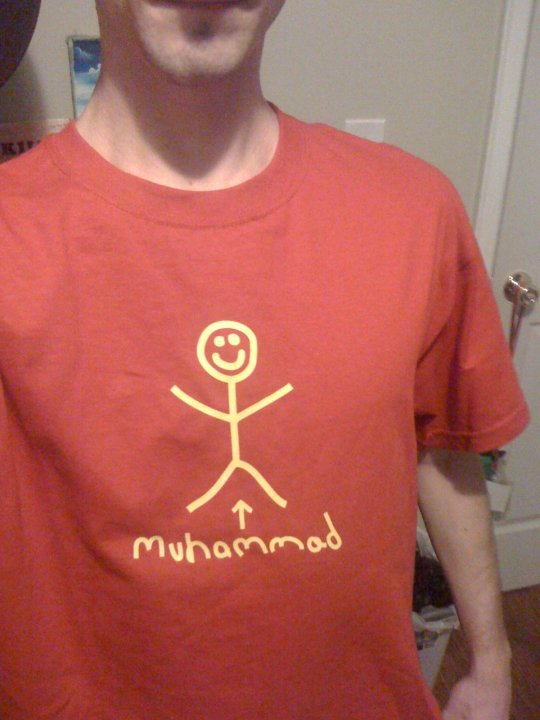
I still wear this shirt

Eventually, i started writing more and more about polyamory, and one of the posts that stands out for me is the one about jealousy, where I argue that jealousy is not a reason to not be polyamorous.  Also, sex-positivity is a good thing, and we should all be comfortable with being slutty (if we want to) and we should sin responsibly.  What else did I write about polyamory? When it comes to love, we should do so authentically.. We should be creating a new and improved polynormativity.  We were in some documentary, apparently. another personal favorite is my post about accidental monogamy, where I started thinking about how there is no reason to ever want to be monogamous (one should get there only by accident), which later led to a post about relationship agnosticism.  Of course, I got nerdy with set theory and polyamory, but much more recently I wrote about the space between being friendship and being lovers, which is still quite relevant this very day.

Of course, having a MA in philosophy means that I will occasionally become erudite…ok, more like smart-assed and long-winded. Some of my favorites include Facts or it didn’t happen: unhooking the bra of reality, Thorough and perpetual Sskepticism, and this post which got a little too meta, even for me.  Also, let’s not forget my tendency to try and simultaneously criticize monogamy and religion.

There is also my post about the history of Christmas, which I have reposted a couple of times and always put on Facebook around the end of December.

Sometimes, I got political.  I liked this short post where I quote from a book about the American Revolution that demonstrated that political tropes we use today are not new.  But my favorite post about politics was where I essentially declared that I could never be a conservative.

That's me!
That’s me!

Lastly, I wrote about the various wars going on in the atheist community.  In this post, I utilize Moral Foundation Theory to talk about the “great schism” (as it is called by some) in the atheist community.  I also talk about feminism, both in terms of the #shutupandlisten debacle (as it pertains to lessons from Zen Buddhism) of last year but also as it pertains to the history of technology.

Lastly, I wrote a book.  This is significant because I started writing that book around the same time I started the blog.  And as I move towards another 5 years of blogging (perhaps), I will also consider finishing the second book (I’ve written 3 chapters or so).

Thank you to everyone who has liked, commented, and continues to read.  I do this because I love it, and I also love when other people love my work.

If you think I missed a post you loved, let me know in the comments.

I’ll leave you with this song.


Reflections on loss and regret


I’ve been here before.  It’s after 3 AM (as I started to write this, anyway) and I’m awake, tired, and anxious.  I’m sure many of you have been here too, from time to time.  The thing about this, however, is I was sleepy and went to bed hours ago.  I slept for 2  hours and woke up thinking it must be 5 AM (which it is now, as I am about to publish) or so because I felt awake but it was still dark. Anxiety is fun.

The last few years have been the theme of my thoughts, which are admittedly disorganized and barely consciously available, despite my intense desire to glean them.  Sometimes, even being deeply introspective is not enough to dig that deep.  I very much want to understand my mind, especially where the fears, insecurities, and darkness lay.  I believe, quite strongly, that one of the most moral things we can do is to know ourselves; not as we want to see ourselves but as we actually are, under all the bullshit we create to hide the terrifying truths hidden within.  Only through such labors can we even hope to effectively grow and contribute well to our environment.  Without such a desire for self-understanding, I would be but a shadow of the person I am today. I would not (could not) love myself (and yes, even in the depths of sadness I still love myself).

How do obtuse and oblivious people survive without deep introspection? (is a question I wonder frequently). Probably because success and superficial contentment are not dependent upon self-knowledge or the courage to dig into oneself critically and honestly.  One can get along quite well, in our current human culture, being myopic because depth of spirit is not the root of the social and political games which bring ‘success.’

Such myopia is an ideal firewall to the insight that would prevent someone from valuing such ‘success’ as highly as so many do. Without insight, one would never know that something was amiss and keep themselves in the delusion that they are healthy and good people.  I have come to learn, over the years  (especially the last couple), that myopic, obtuse, and oblivious people tend not to think about such things often or deeply. I am not even sure they are capable of understanding what I mean.  I hope they will, sooner than later, for all our sakes.

What’s worst, however, is that many who read this will not understand that it is them I am talking about (such people seem immune to such self-criticism), and yet there are many others who will assume I am talking about them (for them, self-criticism is usually the default).  But such a self-deprecating thought usually implies the depth and complexity of a mind who couldn’t be myopic or obtuse, even if they might think such things of themselves quite often.

And yet, such deep and complex people are quite forgiving of such obtuse banality in others, for reasons which escape me.  I don’t think it’s mere compassion and forgiveness, although that’s often a part of it.  Such sensitive people often excuse and even come to accept and love that which they would never be, usually because the insensitivity that compels banality also often makes one seem confident and attractive.  Like a moth to a flame.  Nothing is less attractive than undeserved and so obviously pea-cocked confidence (but you have to be able to see through it, first, I suppose).

Vanity and illusion attract those who are neither vain nor delusional but who seek to be beautiful.  What such-attracted-people often don’t understand is that they were already beautiful, and they needed no salvation from anyone else.  Yet, they so often attribute their concocted ‘salvation’ to the smoke and mirrors of illusion because once you invest so much into the illusion (religion is the most obvious example of this), it’s hard to see it for what it is because we are prone to cognitive dissonance.  It’s why people tend to not leave religion, unhealthy relationships, or their own bad habits. They rationalize and make excuses for what habits they have acquired. Eventually the illusion hides within their own mind, and their very memories are forged to reflect the lie.

And it’s more obvious from the outside.  Atheists see it in Christians, polyamorous people often see it in the monogamous world, and most of us have seen it in the unhealthy relationships of friends, family, and acquaintances.  Not that those relationships could not become healthy if both parties were willing to actually deal with their shit honestly by tossing aside their illusions. This rarely happens, however, even among the intelligent and relatively enlightened.   It’s nearly impossible to have the affected see it for what it is, and so in the vast majority of cases the dissonant song plays on, unchanged and unchallenged, sometimes for many years.  Some never see it and die in the illusion, never knowing there was a better way.

I will never let the above happen to me.  And I don’t have time for people in or adjacent to my life who will allow it to happen to them.  That thought is what has been keeping me awake. In the last week, I have not slept more than a few hours per night and I have bouts of sadness between moments of joy and relative contentment.  You know; I’m human.  But at night, when there are no distractions, I rake myself over the coals of the past, wondering what there is to learn, knowing all too well I’m just making this worse.  But I can’t turn it off.

This week, I’ve also had some good times.  I have to keep moving forward, or the sadness and regret will take over.  But when I can’t sleep, alone in the cold and dark, I can’t escape it.  The fear, the uncertainty, and the loss are palpable.

It’s just like it was 4 years ago when Seana left me, in many ways. Just like back then, I know I have made mistakes and those mistakes led to lack of trust, but there is more here that I may never understand.  Most frustratingly, I’m not completely sure what I am supposed to be learning.  The loss feels surreal, and I don’t have a direction in mind.  I don’t know where the goal is, or what game I’m playing.

As I sit here, writing in the heat of emotions and uncertainties, I reflect once again on what happened 4 years ago.  It was within 2 weeks of losing that relationship when I awoke, in a fever of creativity, and made a truly terrible and sappy video for the woman who left me.  I have no idea if she ever watched it.  It doesn’t really matter, because that creative burst was the beginning of moving on.  It was the first glimmer of what became an understanding that I was better for the loss, even if i did still love her.

But right now, the problem is that I don’t know what side I will land on, when that time comes soon, with this loss.  I do not know what I will want in the future.  There is no lack of love, but the fact is that I have never stopped loving someone who I genuinely loved. I miss Gina. I loved her more deeply than most, and miss her more than I will try to express. How will I feel in a year? I don’t know.  I’m scared to know, and perhaps that’s why the mind refuses to settle on any one feeling so close to the event.  Perhaps I’m stuck in my own illusion.  

But what I am fairly sure of is that part of what causes such losses are out of my control.  No matter how much responsibility I have for what caused her to leave me, there remains the parts I could not control.  Whether fear, unhealthy attachments to ideas, people, or things (on both our parts)—whatever the cause, there comes a point where punishing myself will have to end.  There is a point, and I see glimpses of it already, where the pieces of the puzzle become more clear from a distance.

Will my face appear in that completed puzzle? I don’t know yet. And I still am not sure what exactly I am supposed to learn or what I will want.  There’s still too much debris from the destruction, too much sifting through the ashes, looking for surviving relics that I may or may not take home with me.

Where our lives were entwined, they are now days away from essentially being estranged.  What was to be home is now a place of pain and sadness.  What was a source of hope now has become a source of sadness and emptiness.  What was certain has become uncertain.

Can I sleep now, please?

Lost and Found


A little over 4 years ago, I lost a relationship which was, at the time, important enough to move me away from Philadelphia.  The same day that relationship ended, just a few months later, the origins of my relationship with Ginny started.  And that, ultimately, brought me back to Philadelphia.  More importantly, it brought me back to myself, and possibly a better self due to the struggles I had with depression and other emotional difficulties caused by that loss.  In my opinions, the gains outweighed the losses in that case.  Ginny is my rock.  She always stands besides me and loves me, and I am extraordinarily lucky to have her.

And up until a few days ago, another person was as integral to my life as Ginny is, in many ways.  We lived together, laughed together, and when things were wonderful they were amazingly wonderful.  Gina was a person I intended to spend the rest of my life with, and now that possibility is uncertain.  Now that relationship is gone, at least for now.  And I feel lost again.

So, now I spend a lot of time analyzing what it’s like to struggle through painful times, while looking for the light at the end of the tunnel.  And being the cynic I am, I’m not seeing beds of metaphorical roses.

Pain, struggle, and all the related emotions and circumstances are hard, especially for someone who struggles with emotional stability and proportionality.  The increased introspection brings forth more self-awareness, emotional maturity (at least, hopefully), and forces me to take some more time for re-evaluation.  At least, that’s what I have told myself, before, when I healed from such times.  But right now I’m not sure if I buy that narrative; at least not completely.  It’s true that I think more than usual, but not really that much.  I just think about specific, painful things more.  I just hurt more.  I may not actually be any more introspective at such times (but I’m definitely outside the norm in terms of my normal level of introspection).

I’m starting to think that maybe the narrative of ‘painful times are periods of growth’ is not completely correct. Our brains do their best to maintain the illusions and narratives of a whole self who does not act completely crazy and unpredictable, let alone simply irrationally and unreasonable.  Our memories are altered by a process that maintains this illusory narrative to put together our selves and lives into a sensible story.  As we remember those times of pain and struggle, we have to put them in a context of where we are when we don’t feel that way any longer, and growth is as good a narrative as any other.  In order to maintain some level of consonance with our self image as a stable and grown person, we humans tend to construct a narrative of how the pain we went through made us stronger, better, and more prepared for life.  It never feels that way when in the midst of it, though.  At the time, it just sucks.

I hope I’m a stronger and better person than I was 4 years ago, but the fact is I can’t be sure.  I have painful memories which give me pause when approaching similar mistakes which helped precipitate those painful events, sure, but is that strength? Isn’t that just conditioning, a la Pavlov? Is it not possible that I would actually be stronger today if those painful experiences had never happened? How would I know?  Because if I’m stronger and better today, perhaps that would have happened whether I went through those painful times or not.

Then I think of all the utterly obtuse and non-self-aware people I know, and I think that maybe I’m just being too pessimistic and cynical.  Why are so many people apparently oblivious to not only their own issues but the cues of others? How have they avoided actual emotional growth for so many years? It seems weird to me to not be introspective, but I guess my introspective nature looks weird to them, too.  I’m getting off track.

What I want to know, essentially, is whether the pain we go through when dealing with loss–whether through death, break-ups, etc–is actually ever good, or whether we create a narrative which makes it seem good in retrospect.  Because when we’re better, things look better.  And so in that case we can weave memories to fit how we feel.  If we are fine after the shit is all over, then the crappy days, weeks, or months we just plowed through must have been worth it, because here we are! Right? But that’s not how the brain works.  Sometimes, we just feel better because we forget the pain (or, at least, most of it), new good stuff happens, or because we ate the right foods that day to help support a healthy mind.  And then we reconstruct the past to fit the present state of mind.

I really am being cynical and pessimistic, aren’t I?

*Sigh*

I’m dealing with loss right now.  I’m hoping that I will run into some ‘finding’ as well.  The fact is that I am on the verge of starting a new relationship, so I may be repeating the pattern of losing and finding simultaneously, but it’s also premature to make any hay out of that.  The happiness I am feeling from that is somewhat mitigated by the pain of that other loss, but it’s still happiness and hopefulness.  But mostly, right now, I’m feeling sad, hurt, and angry (mostly at myself).

And I miss her.  Badly.  I’m trying to make sense of my life without her in it, and it just doesn’t make much sense at all.  I think of things I would usually share with her, and I can’t.  Too painful to talk right now.  And everyone keeps telling me that this might just be temporary, but it sure as hell doesn’t feel that way.  I’m just going to have to wait out the worst of this, and hope that when I feel better things will be different.  The scary thing, however, is I don’t know how they will feel better.  The uncertainty of it is terrifying.  I guess I just need to practice patience, and hopefully all will be better soon.

In the mean time, I can’t stop moving forward, otherwise I will spin my wheels into a rut of listless sadness.  I need to keep moving forward, and hope that maybe that lost relationship might be found when things feel better.

But for now it hurts too much.

“Your Character Needs More Character…”


“Have you considered giving him a limp?”

This is what our director told my friend Chris Herrle during one of many ridiculous rehearsals for the Drexel production of A Midsummer Night’s Dream.  Chris was one of the mechanicals but apparently wasn’t individual enough…or something.  Chris heard this suggestion, and raised his one eyebrow way up high.

“A limp?” He was incredulous.

“Yeah, what do you think?  The limp could have a whole back story.”

“You want my character to have a limp.”

“Yes, I think it would be a great character choice.”

“That’s…that’s not…Character choice? Really?”

“…Well…do SOMETHING.”

Needless to say, he did not choose to give himself a limp.

Chris Herrle died last week.  He was 30 years old and used to be a pretty constant presence in Wes’ and my life.  Things got hard for him and he was dealing with heavy loads and he would disappear from public life for months at a time.  He was a frustrating sometimes absolutely maddening man but he was also one of the few people back a few years ago that I felt comfortable telling when he was full of shit.  I don’t know if it enlightened him at all, but it was something that happened and we kept being friends.  At the time when he was most in my life, this was something deeply valuable to me.  While I was often furious with his antics, I couldn’t hold them against him for long because he was such a big personality, often the life of the party, and caring, loving, and someone you could count on, even though he would get in his own way a lot.

Often I felt like Chris didn’t know what to do with me because I was a woman he had deemed “off limits” for romantic/sexual relationship status (he was a deep believer in The Bro Code and I dated a good friend of his before Wes.  He was pretty awful to Wes for a while and then he was in our wedding, so, you know, Bro Code Shmro Shcode), but I was also a woman who he deemed “not like ‘typical’ women”.  It was a sexist attitude that I got on his case for often, but I knew that he valued me as a good friend and shared with me things that he would share with his guy friends.  I was a trusted mutant in his band of oddities and I was often called upon for unique perspective, much like one of the many bizarre factoids his mind teemed with on a daily basis.

That may sound like I am devaluing this status, but honestly, Herrle’s strange and extensive collection of knowledge was one of my favorite things about him. I often would consult him when trying to think of something obscure that I couldn’t quite put my finger on.  His mind was a data base that looks like Wikipedia in my imagination.  He was smart, articulate, hilarious, and had an ongoing thirst for knowledge.  He liked to learn new things and share them with his friends. He was a musician.  He was a writer.  He was a singer and a scientist.

Herrle, like everyone, had gone through different versions of himself.  I have two versions that I always loved: Herrle, the Poker Player and Herrle, The Glassblower.  When we were still in college and Wes and I had an apartment in University City, we would have a regular group of friends who we played tournament style Texas Hold ‘Em.  Chris was a good player, certainly better than the rest of us shmoes.  He played in Atlantic City often and while our favorite stories are often about him feeling fabulous about losing obscene amounts of money, he actually paid back his student loans from winning at the tables.  I tried to learn from him but being awesome at poker was not something that was destined to be one of my life skills.  We spent hours around that dining room table, Chas buying in again three times after missing out on some really promising “pair draws”, me waiting until I was pretty much down to nothing before making my move (I was the queen of the slow play…because being aggressive was not something I could actually do), Jake drinking his Vitamin Water to get that extra advantage, Wes and Hoffman exchanging South Park quotes.  It was a good time and I will remember those nights as bright spots in a time when I was pretty miserable often.

But I think he was happiest when he was Herrle The Glassblower.  He worked at a lovely little shop in Old City.  Wes had seen an article about the place looking for people who wanted to apprentice.  Herrle had been looking to change careers and wanted to work with his hands.  Wes let him know about the apprenticeships and before we knew it, Herrle was learning to make whiskey glasses.  He gave a special one to Wes, one with a blue color in it that was a version that they didn’t sell.  It was one of a kind and he gave it to Wes for helping to change his life.

Chris was a good man and a good friend, if not always the easiest man to understand or connect with.  It took me a long time yesterday to really understand the reality of his passing.  I had gotten so used to him disappearing for a while and then reappearing.  But he won’t be reappearing this time.  I will never hear one of his ridiculous stories again, or hear his perfect Murderface impression, or see him bring down the house at karaoke.  I won’t have a chance to help him anymore, and so I wish that I had been there more when I could have been.

Chris, you will be missed.  Thank you for your friendship.  Thank you for the host of good memories I have of you.  Thank you for being in our wedding.  Thank you for always working towards being a better man. Thank you for being open about your problems, even if we were never all that helpful.  Thank you for everything.

There is beauty in the world.

You are loved.

Goodbye, friend.  I am happy for the fleeting chance I had to know you.

Intelligence is insufficient


Intelligence is a useful quality to have, but it is not enough if we seek things such as wisdom, fairness, or even simply being correct.

I know some pretty smart Christians.  I know some people who are smart and yet who still have some pretty dated and conservative views on the world.  There are pretty awesome people I meet who react to polyamory unfavourably,and not just as a personal preference.  They are able to think, they have impressive cognitive abilities, and yet while talking to them it’s sometimes obvious that they are missing something from their thought process. To the untrained eye, this may look like lack of understanding, but it may not be that simple.  5 or 10 years ago, when my eye was less trained, I would have argued with such people and tried to convince them of my position.  Their smart, I’d have thought, and so if I present a solid argument they’ll have to agree with this reasonable belief I have.  The problem, here, is two-fold.

First, this presumes I’m actually correct.  I may not be correct, and starting as if I am is no help to me nor my interlocutor.  If I might be wrong, then starting by trying to convince them of my position will not serve greater understanding or intellectual growth since it will either end in my convincing them of an untruth or of an endless argument where they are the one with the hopefully keener eye to see what we are missing.  On top of this, there is a cognitive block that occurs when you argue from a position of “I’m already right,” because it prevents listening.  While you argue your points, in such cases, it is harder to see the others’ points being made because our minds will protect our current worldview against dissonant ideas.  And really smart people are really good at this worldview-protection, because they can easily and quickly think up rationalizations for why an objection isn’t relevant or right.  But by doing this, we miss important facts and perspectives which may be of value to us if we could understand them.  You know, just like how you want your interlocutor to think and feel while making your points.  Funny how that works.

Therefore, we should start with as neutral a position as possible, and be willing to question every assumption, value, and belief we hold.  Also, we should talk to others as if we are willing to do so, because doing so not only looks more open-minded, but actually is part of becoming open-minded.

Second, it presumes that the difference in opinion is one of mere comprehension, when it very well may not be about comprehension at all.  The issue may be a difference in values.  A difference in values is much harder to shift, for many of the same reasons generated by dissonance theory referred to above, and most arguments I’ve heard boil down not to facts, but values.  And while I don’t believe that facts and values are fundamentally different ontologically, they are behaviourally different at very least.  That is, a fact is easily proved or disproved, but because a value is part of the process of thinking and behaving, it is harder to see for what it is and how easily it can lead us stray of rational behavior and beliefs.

I believe that a value can be more true than another value (in terms of how it lines up with what goals we share.  What goals we should share is another question).   A fact is an external reality or claim about said reality which can be checked with empirical and or logical methods.  It is demonstrably testable whether this element has those properties, this mathematical proof works, or that lead is denser than water.  A value is a fact which is part of the process you use to evaluate other kinds of facts, and thus is generally out of the line of sight for your intellectual powers. More fundamentally values are ideas, which makes them physical processes (ontological dualists can exit through the door, as I have no patience for that shit any more), which also means they are also subject to empirical and logical methods as well (although the exact technique to do such a thing is still quite difficult) and thus values can be measured against reality in a similar way as mere ‘facts.’  I’m willing to submit that values can, therefore, be better or worse than other values.  Honesty is better than deceit.  Compassion better than harm. And, maybe, the desire for truth is better than the desire for comfort.

Or is it?

Some people don’t care about the truth, in itself.  I mean, if you are talking about something as banal and mundane as ‘are you telling me the truth about this drink not being poisoned,’ then people usually care about that level of truth.  But what about the willingness to try and learn, grow, and change beyond what is comfortable? What about someone who does not really care what the truth may be, because their faith makes them feel safe and loved? Arguing with such a person about the existence of the supernatural is a wasted effort; they don’t care what’s true.  There are smart people who hold such positions, including people that I know and care about.  Utilizing intellectual means to try and convince such a person will probably be pointless and frustrating for both of you.  They value differently than you, and by applying such a method you are attacking the facts rather than their values.  You need to appeal to their values, and doing that by intellectual means is hella hard, and often pointless (but I don’t think it’s impossible).

Or, what about a person who has a moral worldview which you find abhorrent, flawed, or merely not moral? I know quite a few such people, and I do not address why I disagree with them most of the time, because our disagreement is not about facts, it’s about a specific kind of value; preferences.

Morality is not a reasoned activity fundamentally, even if we can use reason and science to improve it and clarify the problems raised by morality’s mantle.  Morality, especially where it is codified or systematized, is usually (if not always) ad hoc reasoning.  That is, we simply have deep preferences for which we build logical boxes for storage and for hitting our opponents over the head with.  Kant, for example, didn’t start from some idealized blank slate of a mind to reach his deontology, his universalization of maxims, rather he had certain preferences and quirks about his mind that made it feel right to do this and not right to do that, and created (brilliantly, mind you) a logical scaffolding to make sense of these brute facts of his mind into a systematized universal standard.  I happen to share much of those preferences that Kant seems to have had, so I tend to agree with Kant when it comes to ethics (although I thought he was wrong about many other things, like aesthetics).  Where I think Kant erred, in terms of his ethical thinking, was believing that his exercise was a truly intellectual one, rather than one of rationalizing values.  The same is true for Bentham and Mill with their versions of utilitarianism, and perhaps even Aristotle with his Nichomachean Ethics (which everyone who is interested in ethics should read, in my opinion).

So, having intellectualized and semantic arguments about ethics is usually completely pointless (not always, mind you).  When this type of conversation happens, what we tend to observe is a proxy war for our preferences.  The question is not whether my scaffolding is more rationally stable than your scaffolding (I actually really don’t like that game), but whether my preferences themselves actually have better effects on people and in the right ways, and whether (therefore) I might try to shift my values.  All too often, we see something like a person whose preferences are more self/freedom oriented arguing with a person who finds consideration and efficiency more valuable, but they don’t address the values themselves.  Instead, it turns into a conversation about what “rights” mean or some other epiphenomenal factor, which is less helpful to everyone and merely seeks to put on display rhetorical skills.  It’s like lovers trying to hammer out an intellectual solution to feeling unloved; it’s bound to not really help, in the long run, because what the hurt lover wants to just to be loved (it’s a mistake I’m prone to making).

Intelligence is a great tool but without perspective it can often be a blunt tool instead of a sharp one.  Perspective requires the spirit of not only a skeptic, but an archaeologist of the soul (‘spirit’ and ‘soul’ used metaphorically there, of course.  And yes, that’s yet another set of references to Nietzsche).  It’s one thing to use rhetoric, logic, and eloquence to find the flaws in the argument of your opponent, but it is quite another to have the courage to take a hammer to your very psychological and emotional bones.  And when a person can utilize whatever level of intelligence they have and work for the character of self-criticism, then a person begins to approach wisdom.  Because while we don’t choose our level of intelligence, we have some control (assuming free will is meaningful) over how we use it.  The how of our intelligence is more important than its raw power.

Our insecurities will compel us to show off our intelligence.  We want respect, love, and friends. And we can get those things if we are (perceived as ) smart.  That world is all vanity, the neighbour to fear.  Fear is the mind killer, right?  And fear has a tendency to create the illusion of confidence or even to actually create arrogance, where practicing intellectual patience instead might be wiser.  Because even if we are right, we still might have something else to learn if we are not so ready to be right that we only swing our intelligence outward while not watching for the parry and counterstrike.  Also, it does not help to make people like us very much.  You may not care about that.  I care about that, at least a little.  Just don’t make the mistake of allowing your insecurity and fear make you act in such a way that you tell yourself, after the fact, that you didn’t want people to like you when you really did want them to like you.  Because that’s a thing that happens.  Again, it’s called cognitive dissonance, so read about it.

What’s your poly personality?


The poly community has sects just like any other community. (Go ahead and enjoy the aural pun, I’ll wait.) If you hang out in a poly discussion group, you’ll see words like “polyfidelity,” “polyfuckery,” “closed triad,” “relationship anarchy” pop up, and alongside them you will often see hackles rise. We’re a pretty liberal, tolerant bunch, so most of the time cries of “Everybody needs to do what works for them! Let’s all just accept each other’s differences!” will shut down an argument before it gets rolling, but underneath it the differences are still bubbling. Those of us who call ourselves poly do poly really differently, and there can be a lot of tension around your way vs. my way, and whether I think my way is superior, or whether I think you think your way is superior, or whether I’m unintentionally erasing your way altogether because I have a hard time conceiving that anyone could construct their life like that.

Personality typing systems, especially Myers-Briggs (but I’m a fan of several others too!), have been really important to me in how I relate to others. While I don’t view them as hard and fast categories, and some people have a hard time fitting themselves into a particular model, they’re incredibly useful ways of identifying trends of difference between people, in a way that doesn’t position one way as superior to another. They give us a way of talking about our different personalities, preferences, and approaches to life that is easily intelligible and judgement-neutral.

I wasn’t aware of it until today, but the writers over at polytripod (who were featured, along with us, in the Our America documentary!) came up with a similar schema for poly personality differences. I think it’s really great. Because there are many more variables, it doesn’t lend itself to easy acronyms the way Myers-Briggs does (I’m told people who didn’t grow up on Myers-Briggs don’t find those acronyms so easy either), but it is at the very least a terrific jumping-off place for discussions about what style of poly a person prefers, and why. A lot of the axes point to things that I hadn’t consciously noted as big, stable differences between people, but which I immediately recognized as being important and relevant.

I kind of like that the system, as it stands, doesn’t lend itself to a simple identifier the way you can say, “I’m an INFP.” It more requires you to go down the list, check the box that applies to you, and then compare lists and discuss. Requiring a more deliberate discussion rather than a simple verbal tag… that’s so poly it’s gross. (I kid, I kid. If I wasn’t into obsessive discussion and overanalysis I probably wouldn’t be poly.)

Scanning down the list, here’s where I line up (and some thoughts on the category in general):

“Speed” axis: How quickly do you form connections/relationships in general?
 Fluid- more rapid in forming emotional and/or sexual connections.
 Growth- deliberate in forming emotional and/or sexual connections.
 Static- slow moving in forming emotional and/or sexual connections.

I find it really interesting, and cool, that “growth” and “static” are two different categories rather than just sorting speed into fast and slow. It makes a lot of sense to me. I’m slow to connect (in most cases) but I’m also not inclined to pick out someone and deliberately work to build a relationship. I prefer to be guided by my feelings in the moment, rather than a deliberate decision that I want to pursue a relationship with a particular person. But I’ve talked to others who felt differently.

“Structure” axis: How would you describe your ideal poly relationship structure?
 Open- People come and go at will forming “polycules” which consist of individual dyadic relationships.
 Network- People often connect socially with metamours. Some sort of “get to know you” is usually requested or offered early on in becoming part of the extended group.
 Closed- Approval of existing members needed before new member is allowed to join.

I’m very comfortable in this “connections with metamours are encouraged and pursued, but not required” spot.

“Attitude” axis: What level of entanglement is desired with partners and/or metamours?
 Independent- Prefers to do their own thing with their own partner .
 Community- Enjoys being part of socially connected groups some of the time.
 Family- Actively prioritizes shared time and/or space with partners and metamours.

Ditto. If one were trying to simplify this system, I could see folding this and the Structure axis together, but as discussed, I don’t feel simplification is necessary.

“Intimacy Style” axis: How is romantic closeness with others achieved? More than one may apply.
 Sexual – Connects with others via sharing physical intimacy.
 Emotional – Connects with others via sharing feelings.
 Activities and Shared Experience- Connects with others via sharing experience and spending time together.

Definitely important that more than one can apply.

Prioritization Axis:
 Hierarchical- priority is given to preservation of existing primary relationship/s.
 Weighted- some relationships are prioritized over others, but open to changes, adding an additional primary, etc.
 Egalitarian-committed to not prioritizing some relationships over others.

Here’s another one where I’m thankful to have a middle ground. In truth, my relationship with Shaun is de facto primary to me, and I do prioritize it over others, but it’s not hard-and-fast.

Relationship Saturation Axis: What would your ideal relationship concentration look like?
 Full-boat- completely satisfied with current relationship(s). Prefer relationships to dating.
 Open to opportunities to connect-neither closed off to forming new relationships, nor actively looking, but being closed to possibilities would feel restrictive.
 Actively seeking new partner(s)? Looking for new connections regardless of current partner status. Consistently open to dating and exploration.

This is one that I hadn’t fully conceptualized, but I think is really useful. These questions often get framed as, “How many partners is enough to you?” but to me it makes much more sense to look at it as a dispositional thing. Some people just really enjoy the dynamics of new connections and pursuit, and it’s not necessarily about how many people they’re already dating. It’s also important to note that this category is about an ideal situation, not one’s current situation. I think it’s hard for people whose ideal life involves a continual stream of new partners, and people whose ideal life includes a stable set of partners without new relationships, to understand each other, and this should be helpful.

Nature or Nurture Axis:
 Born Poly- Came out of the womb hardwired for multiple relationships. Being monogamous would feel unnatural.
 Poly by Choice- Poly makes sense, and is a desired style of relationship for a myriad of reasons. Unlikely to get into a monogamous relationship.
 Mono or Poly- Happy being open to either poly or mono, depending on circumstances in life, if current partner is open to poly, etcetera.

I’d be inclined to frame this not as Nature or Nurture, but just as “how flexible are you in your poly orientation?” But that’s because phrases like “born this way” and “hardwired” make me twitchy.

Flow of Information Axis:
 Confidential- No desire to hear about other partners/activities with and/or have information about the relationship they are involved in shared with metamours, unless explicitly approved in advance.
 Pertinent- Don’t need to have all the details, but want to have personally relevant information shared.
 Transparency- Desire the free flow of information about all relationships partners are involved in, and are comfortable with partner sharing that with metamours.

HUGELY important and something that should be discussed in every new poly relationship.

Formality Axis:
 Detailed- extensive agreements/contracts covering every eventuality.
 General- conscious agreements about a few major subjects.
 Short-term- temporary agreements only.

I feel like this category could be tweaked a little more, or maybe a second rule-related category be added, but it’s definitely a key part of poly style.

Thinking about my partners and metamours, I can guess how they’d answer these questions similarly and differently to me. But it’s definitely a useful tool for discussions (and it’s making me itch to run a poly/open relationship workshop to use it!)

Thanks, Regina, for taking the time to develop this! I’d love to see it shared and used more in the online poly community.

The turbulant seas between Philotes and Eros


Because I am poly polyamorous, having friends of the gender I tend to be attracted to can often be an adventure of uncertainty and transitions.  Some of them I am attracted to, some I am not, and sometimes that attraction leads to something.  Many times it does not.  But when it does, the transition can be, well, it’s a lot of things.

With attractive friends, and acquaintances, who are not already polyamorous, the issue is less uncertain as one learns to curb the attraction because it is not appropriate, and usually not wanted.  Sure, I might flirt, playfully, but I do my best to leave it at that unless the cues are overwhelmingly in my favor.  But then, inevitably, some of those people want to be polyamorous (Who wouldn’t?)  or they were already but for whatever reason things didn’t click at first.  And if they demonstrate interest in me, the flirtation and the relationship in general takes on a different tone.  Interest is communicated, and hopefully requited.  Suddenly I find myself in a place between friendship and something else (assuming we accept the distinctions and roles of those mainstream relationship types, of course).

From a Relationship Anarchy point of view, this transition is less significant.  Yes, there will be actual differences in how people interact when they stop being merely ‘friends’ and playfully flirting to being sexually affectionate, but if we were to reject the model of relationships of our mainstream culture (in which one is either a friend or a lover but not both) then that difference is less meaningful and often less distinct.  And while I have some affinities with Relationship Anarchy, the distinction between these two relationship phases is significant and important to me.  This is mostly for reasons having to do with my level of comfort of physical affection with friends versus lovers (something I’m open to being less dichotomous about, as I grow).

I have few non-sexual friends with whom I’m comfortable being affectionate with beyond things like hugging and basic body contact.  This is because sexuality is extremely powerful and often overwhelming for me, mostly as an emotional and sensual experience.  Being affectionate with a person I don’t have some level of sexual relationship with (especially women, being that I am heterosexual) can lead to spikes in desires which are inappropriate with some people.  There are quite a few women in my life with whom I have no sexual relationship, but am still attracted to, and so I minimize my physical contact with them because physical intimacy can sometimes lead to spikes in sexual desire which are uncomfortable for me to have when I don’t perceive them as reciprocated or wanted by those women.  Respecting other people’s boundaries is especially important to me, and the vast majority of times I will not initiate flirty touching without making sure it’s wanted.

Of course, one of the exceptions to that rule was the night I met Ginny.  And now we’re married.  I don’t know what to learn from that, exactly.  I do know that the lesson is not to just touch whomever I want in the hopes they like it, because boundaries.  Also, non-verbal cues are not always sufficient, because sometimes we mis-read them.  Nonetheless, I have chanced it a few times, and it worked out fantastically once.  I don’t plan on chancing it again, because some people really don’t want that and I don’t want to be that guy.

So when I find myself in a situation where I’ve communicated my interest, that interest has been requited, I find myself in a limbo between knowing those desires are appropriate, wanting to act on them, and still being somewhat nervous to touch those people affectionately, let alone sexually, it is tough for me.  And as the idea of future potential affection and sexual contact hovers over me, the beginnings of New Relationship Energy start to form (let’s call that pre-NRE).  And despite the fact that it is potentially premature to have those feelings, they happen (and sometimes they remain in that pre-NRE stage, which is also fine).  And for a borderline like me, those feelings are often overwhelming and cause days of anticipatory anxiety and anticipation.  I both love it and hate it.  I love it when it genuinely does become NRE (which I define as a multi-way magnification of emotions and desires between 2 or more people, and not personal infatuation towards another), and I fear that what I desire might not materialize at all.  If what I desire does materialize, but never reaches genuine NRE, that’s actually fine.

This experience of pre-NRE (As well as NRE itself)  has another side effect, which I don’t think my current partners mind so much (and I might be wrong here, but I’m sure they will let me know…).  It gives my sex drive a huge boost.  For me, new sexual (requited) attraction has the effect of making me want sex with my current partners even more.  The spill-over effect of being sexually charged is not limited to the source of that desire, at least not completely.  In my experience, my desire for one person can only be fully quenched by them,* but that desire amplifies the already existing desire I have for other people.

Of course that level of excitement doesn’t happen always, but it does happen enough to be a thing worth thinking and talking about.  Those pre-NRE feelings don’t always become overwhelming in the beginning of meeting and conveying interest.  Sometimes, in other cases, the feelings grow slowly.  There are some people I grew to love and desire (more), when in the beginning the attraction existed but was not overwhelming, nor did an emotional attraction exist at first.  Sometimes, in the beginning I just saw us as incompatible, but later changed my mind about that.  I never know what to do in those situations. Mostly, I remain friends with them and wait for what I think will be the right time to say anything.  Sometimes that right time never seems to happen.  Like I said the other day, I’m not always great at communicating my desires.  

Writing all that makes me wonder if any of those friends of mine might wonder if they are one of the people I might have feelings for I’m not expressing. Gah! Blogging is hard! I’m trying to get better at that.  It’s scary.  No, it’s down-right terrifying sometimes.  I have issues. 

So, the times when I am swimming between the shores of one way of interacting with a person to the other is always overwhelming, scary, and exciting for me.  There is the nervousness of whether it will actually happen, the conversations which cross the lines between friendly and potentially sexual flirtation, and the feeling of fuzziness in my head and flutters of butterflies in my stomach as I think about it.  But in any case, I’m surrounded by wonderful, beautiful, sexy people who I love in many different ways.  But don’t worry, I’m not secretly restraining overwhelming sexual desires for all of you out there.

Not all of you.

All this makes it really hard to concentrate on tasks.  That reminds me, I have to change out laundry and eat some lunch.

*and if it doesn’t happen, that sticks with me for a long time.  This situation, which never came to be, still sticks with me now and that was 3-and-a-half years ago! Granted, that was a huge exception to my usual level of sexual attraction

This is the B-Movie of “Scientific” Theories


A few people on my Facebook news have shared this “article” and I really want to thank them for it because WOW! It’s hysterical and I laughed and laughed.  The people who shared it, shared it with a great deal of anger and ranting.  But I say “bullocks!” to that because it’s way more fun to relentlessly make fun of it.

Is sarcastic mockery an example of positive thinking?  See, I know that it makes me happy to have opportunities like this, much like I experience glee when attending a high budget movie that’s bound to be terrible and fails to disappoint.  Last weekend, several of us went to see The Legend of Hercules in 3D and I doubled over in laughter for most of the film, mainly due to the excessive use of slow motion effects on mud splatter and how the movie would have only been slightly more ridiculous had there been a caption during “character and relationship development” scenes saying, “HEY.  YOU ARE SUPPOSED TO CARE ABOUT THESE PEOPLE. BETTER GET TO CARING, BITCHEZ!”  But alas, there was no informative caption.  Luckily for everyone sitting around me in the theater, I provided the necessary commentary.  Periodically I would say, “Wow, I am really invested in these characters.  FOR REAL.”  I think I gave a convincing performance.

What I’m saying is that one of my favorite pastimes is laughing at moronic garbage dressed up as Art or Cinema or, most of all, Science. So I’m pretty happy to have been directed to an article that says stuff like,

Dr. Masaru Emoto, a researcher and alternative healer from Japan has given the world a good deal of evidence of the magic of positive thinking. He became famous when his water molecule experiments featured in the 2004 film, What The Bleep Do We Know? His experiments demonstrate that human thoughts and intentions can alter physical reality, such as the molecular structure of water. Given that humans are comprised of at least 60% water, his discovery has far reaching implications… can anyone really afford to have negative thoughts or intentions?

And  has this really informative explanation of his “snowflake experiment”:

So, the article is about his “rice experiment”, wherein he labeled jars of cooked rice, each with either a “positive” sentiment like, “You are an awesome grain and I really enjoy making pudding out of you” or a “negative” sentiment like, “Hey, fuck you.  You’ve got nothing on barley.  BARLEY 4EVA, RICE NEVA”. He did this in a school or something and told the kids to say whatever sentiment was written on the jar to the jar every time they passed it by.  And then science happened and the rice inside the forsaken negative jar grew mold and the rice in the happy fun time jar remained unmarred.

Welp, that proves it I guess.  Seeing as this changes everything we think about the world, I think it’s time that we reexamine the concept of spontaneous generation. Sure, sure, Pasteur did a shit ton of work to teach everyone that hunks of beef did not, in fact, conjure flies because they were annoyed at being left to rot on a table.  Instead, he proved that hunks of beef probably already have bugs in them.  YUM!  Good thing humans have the use of fire and learned how to cook their bug infested beef, amirite? THANKS, PROMETHEUS!  Sorry about the whole liver thing though.  Does it help if I say you died for our flaming sins? No? That just makes it worse…Well…um…I think I left something in my car…

…vrooooooom…

Anyway, so yeah, negative thoughts make rice go bad and I assume that flies appear because, to quote Shaun, you touch yourself at night.

The best part of this article is the lively “debate” happening in the comments.  One of the believers makes an inane statement about how beautiful snowflakes are.  Another person tries to make a big scientific sounding claim about how obviously we can control the formation of ice crystals with our minds because they have a very loose understanding of quantum mechanics! And all us skeptics are just a bunch of negative Neds who will be able to only produce ugly, toxic ANGER SNOW.  I mean, think about it: Your mind is a collection of electrical signals and shit, right?  Electricity is made of moving electrons and stuff.  Everything else in the world is made of that too!  So, ipso facto, e pluribus unum, pisca es a patina, because you’re conscious of your mind (’cause consciousness and minds are totes separate things), you can will the objects around you! Probably also the weather!  This rice stuff has revealed a great secret to life.

Maybe I should write a book about it.

Wait…Damn.  Someone already beat me to it. Fine.  How about I just commercialize Anger Snow.  I’m pretty sure it would be Gak or Floam.  Mental note: Email Nickelodeon.

Also, my head hurts now.  And I’ve survived three terms of physical chemistry and one term of quantum mechanics.  My head never hurt this much EVEN THEN. Shit, all the rice around me is rotting.  I’m being too much of an asshole about this…

Why is there all this rice here?

Must be Friday.

I THINK IT’S TIME TO GO HOME.


The value of attentiveness


As an introvert, I value time alone.  I get overwhelmed by too much social activity.  And yet, I love social activity often, especially with people I like and love.  I mention this as a disclaimer for what will follow, because I am aware that my values are derived from these facts.

Growing up, I attended a Quaker school.  Part of our routine, at a Quaker establishment of education, was meeting for worship; a silent time of reflection and potential personal communion with some god once a week.  As a person who is easily distracted, it was useful to be exposed to and forced to get used to being quiet and inactive for a little while.  It may be a post hoc rationalization, I know, but I have come to view the ability to do so as a sign of good character.   I believe this because I’m generally happier the less I am distracting myself.  I’m happier when I spend some time, each day, doing essentially nothing.  Not all day, mind you, or even for a long time.  Usually, taking 5-15 minutes now and then to just sit, not thinking about anything in particular and just relaxing without podcasts, TV, etc in the background is a means to allow my mind to calm and to unconsciously process perspective.

But more than those moments of quiet, I value attentiveness and the related skills of empathy and sympathy.  I value these things because they expose us to parts of our minds, behavior, strengths and weaknesses contains within us in ways that we are likely to be blind to when we distract ourselves constantly.  I know, I know…I’m starting to sound like that tropish old, grouchy man who complains that modern technology is destroying the world.  No, it’s not that, it’s something more universal than that.  That trope of the old grouchy Luddite is based on an ancient struggle for a balance between introspection and having to be active in order to survive being translated into concerns about technology.

I believe that there is a lot that happens in our brain that we are not aware of.  Consciousness, whatever it’s nature, is only a small part of what our brain is doing at any given time, and if you have ever gone away from thinking about a problem to have the solution seem to come out of nowhere later, then I think you know what I mean by saying that when we are (consciously) thinking, we are still thinking.  And while I don’t have any evidence on hand at the moment, I believe that when we distract ourselves constantly, we are unable to effectively introspect and process parts of ourselves which might be scary, unwanted, or apparently boring.  Further, by glossing over those things I think we miss much about ourselves we could learn from.

It is for this reason that I have a fair amount of respect for meditation, at least insofar as it is practiced in a secular manner (the way Sam Harris advocates).  It is also the reason why I have some affinity to the side of religion, as it has popped up through history, which tends towards the mystical or esoteric.  Whether it’s wisdom literature, philosophical introspection, etc I am able to see the importance of this aspect of religion’s role in history because I have a similar set of values and internal attributes as the various writers I have loved from religious and philosophical traditions.  For me, reading a good writer is like peeking inside someone else’s mind for a little while.  I’m less interested in their beliefs, conclusions, etc as I am in the process, tone, and emotional environment of their thinking.

There is something essential, in my opinion, about being able to merely be without effort, sometimes.  Other times, it is important to be silly, irreverent, ecstatic, and very busy, especially when their is shit to do.  Because I’m an introvert, I work most often on my skills at being social.  I work to overcome my fear of embarrassment, rejection, and (probably the worst of all) allowing my own emotional environment to awaken the parts of me I am trying to transcend (like defensiveness, when disagreeing with someone).  My weakest point (as many people know) is probably my poor ability to communicate my needs and desires well, especially in the face of other people who have little problem making their preferences known.  It’s, frankly, intimidating.  For those who are good at making preferences and desires known, this can be frustrating in terms of being around me (both because I have trouble communicating my desires and because I will sometimes resent your ability to do so easily).  Where others will ask (which often feels like a demand to me), I will rely on social context cues.  This, for me and others, is inefficient and frustrating.   It is, however, where my strengths lie, and is as a result of thinking that way most of my life t I am very good at reading those cues, where some people are not.

Those cues seem so obvious to me, but not to most people (Ginny will attest to that).  It’s why I’m working on communicating better, while also trying to show how and why the ability to read cues is an important skill as well.  That is because in the debate about whether it is better to communicate or to have a set of skills designed to make such communication generally unnecessary (some things will always be necessary to communicate overtly) is wrong-headed, in my view.  Yes, we should all communicate effectively, but we should also be learning how to be more self-aware, and that self-awareness is the result of the ability to pay more attention to what is happening around you. That can only be done if we are not distracting ourselves.  Because if people are better at being attentive and aware, those of us who are struggling to communicate well will be less stressed out about communicating, because we won’t have to as often.

But, as usual, such conflicts are the result of the social interactions of differing value sets.  Never attribute malice where simple laziness, inattentiveness, and misunderstanding are a better explanation. All too often disagreements are about values which are incompatible, like when people think they are arguing about the same thing, when they aren’t.

To use an partially relevant example which Wes used, earlier today:

I got into an argument on Facebook the other day about whether it’s rude to be using your smartphone while you’re out with someone socially. My policy is that social interactions should be entirely consensual, so if Person A longer wants to engage with Person B, they should stop engaging and do what they want (my friend Miri has a similar view).

Here’s the thing about this; I agree with him.  His argument is sound, he has every right to use his phone whenever he wants to and he has no obligation to interact with people around him.  But when I read this, my mind sort of winced, because from where I’m standing this approach is missing a larger question, one which trumps this question in some ways.  Now, granted Wes is answering a specific question; whether it is acceptable to use your smartphone in a social situation, where doing so might offend people.  Another disclaimer, I will grant that I have a visceral feeling of guilt when using my phone too much in social situations, which I admit is not an argument for not doing so, but it is the reason that I don’t tend to do it unless I have some significant business to attend to with people who are elsewhere.

But the other reason I don’t find this question particularly interesting or compelling is because I would have addressed another issue before I even got to that question.   Insofar as I might disagree with Wes’s conclusion has nothing to do with consent or obligation in social situations.   For me, the consent issue here is secondary to the larger issue–the larger meta-value–of whether I should be distracting myself in such a way at all generally, whether in a social situation or not.  I agree that I don’t morally owe people my attention (in most cases), so I can choose to, without morally infringing on anyone by using my phone while around them.  They may not like me for doing so, but maybe I’m OK with that.  But because I value being attentive, I won’t use my phone in such situations because the attention I invest has the long term consequence of allowing me to be more sensitive,  and fosters self-awareness which I value quite highly.  Here, the moral question is not whether I’m bothering the other people right now, but it is a strategy I employ to be a better person generally in the long run, by being generally more attentive.

Wes might argue, as I have heard him say, that he’s not interested in the social activity physically around him, so he’s opting for the social activity through technology.  And yes, that is a fine argument to make.  And in some cases I will do the same.  But what I keep struggling with is the problem of missing on the beautiful subtleties of things around me.  For me to be open to the things which bring me real joy, fulfillment, and teach me not only about the world, but also myself, I need to often be willing to be attentive fully to my thoughts, feelings, the room I’m in, and the thoughts and feelings of others around me.  And all too often, people (myself included) are merely distracting themselves with their smartphone, rather than using it as an alternate means to being attentive to the world.

S, while I will conclude, at least tentatively, that is is sometimes fine to be on your smartphone in social situations, especially where it fosters relationships with people who are elsewhere.  But the question I keep wondering is whether people who are almost always on the smartphones (computers, TVs, etc) in social situations or not are doing so to foster and maintain actual relationships, or is it a habitual means to perpetually distract oneself? Insofar as technology is a means to establish and maintain community and relationships, I think it’s great.  Where it doesn’t do that, I would prefer to minimize it’s presence in my own life (I’m not so good at that sometimes).  Also, I recognize that there are legitimate times when distracting oneself is a helpful strategy, especially when it comes to things like clinical depression or other mental health concerns.  There are certainly times when I need to distract myself to prevent the spiral of insecurity, fear, and anger which is a perpetual concern, but I can’t allow this to be an excuse to always distract myself.  My concern is the apparent inability to put the phone away, turn the TV off, stop playing the game, etc for a little while and just stop.  The inability to be bored, patient, and not entertained is a good skill, and I believe it helps us be more compassionate, empathetic, and (in the long run) moral people.

If I were more attentive to the world around me, rather than allow myself the easy distractions, I would be generally happier, I think.  And I suspect that people generally following that advice would lead to better things as well.  I would also write more, which is also good for me, psychologically and emotionally, since I would be thinking more.  There are aspects of myself that I really love, and they too often get buried by the miasma of distraction.  That me is attentive, affectionate, and more social.  I want my family, friends, and lovers to keep encouraging me to be that person more, and I encourage others to consider doing the same.