Shaming and jealousy (via polytical.org)


Yesterday, Dan Jasper over at Polytical posted some thoughts about shaming and respectful dialogue. As anyone who knows me will guess, I think about the issue of respect and criticism a lot, so this was a subject which grabbed my interest.

I put up a comment (currently awaiting moderation) and wanted to put that comment up here:

Breast milk IS better. The patriarchy IS alive and well. The veto rule IS dangerous. Biblical inerrancy IS illogical. These ideas might be inferior to their counterparts, yet couldn’t that be demonstrated through respectful dialogue, as opposed to shaming?

Sometimes, yes.  But not always.

Christopher Hitchens, a personal favorite of mine actually, personally used shame as a tool against representatives of the Catholic Church (during debates with them, in some cases) in addition to rational points.  He did not respect the Church, and so why would he act as if he did?  In my opinion, Catholic doctrine and actions throughout the world are shameful, and in some cases the people in charge SHOULD be ashamed of what they have done, represent, etc.  We should not merely shame them, but sometimes emotion is the key to rational action.

Your seeming dichotomy between respectful dialogue and shaming is problematic, I think.  For me, respect is based upon honesty, truth, and a willingness to challenge and be challenged, not merely being nice.  Pure rational approaches (if this is what you mean by “respectful dialogue) are not always effective (or affective–HA!).  Unless we are to become straw-Vulcans, we have to recognize the relationship between emotions and intelligence, and that people don’t get to conclusions through purely respectful (especially if only rational) dialogue.  Sometimes the only way to get through to us is to show us how ridiculous our ideas are by playful mockery, pointing to moral failings in our ideals, etc.  In many other cases such tactics are not useful or helpful, but I don’t think shame is never appropriate.

Jealousy is a problem for many, not so much for others.  It is not a moral failing, but it is an unfortunate reality for many people.  I don’t think anyone should be shamed because they are jealous.  I think people should have compassion for the struggle with jealousy.  But if someone is not struggling–not trying to improve their relationship with–jealousy (or other emotional realities), then perhaps they are not working as hard as they could to make themselves emotionally healthy people.  Is that worthy of being ashamed? No, I don’t think so.

But the measure of a person is not so much what you are given, but what you do with it.  If a person who suffers from bouts of jealousy does not confront that problem as best they can, openly and with a desire to actually change it, then perhaps shaming is not appropriate but perhaps transparent disappointment and constructive criticism are appropriate.  And the unfortunate reality is that disappointment and criticism cause shame in people–because they actually are ashamed of being ridden with something.  That is, sometimes shame is the cause even when it is not the tactic used.  So, should we avoid any sort of interactions which might trigger shame, or should we only not intentionally shame?

And if someone is shamed by our attempts at respectful dialogue, should we be ashamed of doing so?  This is more complicated than respect/shaming dichotomies.  Just some thoughts I had after reading this yesterday.  While I agree with many of your points, I think that I disagree with what I perceive as some background assumptions which I see here.

I think that people feel shame quite often not because they were shamed, but because they are ashamed. Thus, it seems that this question of whether we should use shame, while interesting, is not the whole story. Criticism is not using shame, and the post at polytical seems to create ideas which could conflate criticism with shaming, which is problematic.

(sorry for my lack of activity recently. I’ve been feeling sort of depressed recently and am doing what I can to get out of it. Apparently reading polytical.org helps…)

Is polyamory better for humanity? Let’s find out!


I am well aware that there are people within the polyamory world for whom the idea that polyamory is better than monogamy is quite annoying.  To say that polyamory is somehow objectively better, from their point of view, is to miss the varieties of human experience.  How can anyone be so arrogant, parochial, or unobservant to not notice that many people are quite happy being monogamous?  How can such people not see that not everyone wants to or can be polyamorous?

I have a feeling that some people who read this blog, or who know me, think my opinion is that polyamorous people are better than non-poly people.  But before I address that question directly, allow me to make an important distinction that may help avoid conflating two different sets of views which are related to the question, and which may be creating confusion as to what is being claimed by some “arrogant” polyamorous people.

(Not that anyone has ever called me arrogant…)

There are probably people out there who will make the claim that poly people are better than monogamous people.  One can trip them up by pointing to quite mature, happy, awesome monogamous people and compare them to people who are polyamorous but aren’t as respectable.  There are many out there who are doing polyamory—well, they are really just doing relationships and personal growth—in unhealthy ways.  Such people who will want to maintain some form of this claim of superiority will step back and make some bell-curve restatement; something like people who are polyamorous are generally better than monogamous people, but there are exceptions (of course).

This line of argument is pretty fruitless, as there is no research I know of that could support this (or the opposite) claim.  We don’t have agreed-upon criteria for better or worse, necessarily (although we could come up with some), and even if we did have such criteria, we don’t have the data to apply to such.  The conversation about whether poly people are better, equivalent, or worse than monos leads us [nowhere practically useful], in my opinion.  We are left with individual judgments about other people based upon our experience, which is subject to personal biases and criteria, which is not particularly helpful in general claims about superiority.  Thus, to make general claims about whether poly or mono people are better is quite difficult, even if one where to identify some rubric for talking about such a general claim.  So while there may be aspects of polyamory which are superior, whether the people themselves are is a separate question.

These (I hope uncontroversial) observations lead many people to the conclusion that we cannot create an objective criteria for judging the relative superiority of polyamory and monoamory (rather than monogamy because we are not necessarily talking about marriage, since -gamy means marriage).  But, further, it leads many people to the conclusion that the whole enterprise of judging the general merits of polyamory in relation to relationship exclusivity is not only fruitless or complicated, but simply wrong-headed; poly people are not better than mono people, they just have chosen what works for them, just like many monogamous/monoamorous people.  And, the argument goes, since we all have to make our own choices about how to live, and since we have different desires and experiences, we cannot judge whether one relationship philosophy is better than the other.

However, polyamory is not sufficiently culturally disseminated, as an idea, to say that the vast majority of people have actually chosen monoamory.  There is simply no way to rationally claim that there is a real choice between mono and poly styles of relationships for most people.  There are too many acculturated ideologies, fears, and assumptions about how sexuality and relationships work to say that there is a level field of competition in the mind of people exposed to polyamory to make the claim that mono people have really chosen their relationship styles with appropriate consideration.

The question is what would happen is the vast majority of people really understood what this choice entailed.  If most people understood what polyamory was about—including the importance of honesty, communication, the desire to deal with jealousies in mature ways, etc—would most people still choose and be happy with monogamy?  We simply have no good way of knowing the answer to this question.  I may have my (biased, even if educated) guess, but I have little to no evidence to support those views.  I think it is an interesting thing to think about.  I think the discussion will draw out our assumptions about human nature, human sexuality, and how we think about relationships.  But we can only get so far with that conversation, and it will be based upon a fair amount of supposition.

So, keeping that in mind, I want to sketch out a project.  I begin with the assumption that there is meaning to the idea that there are better ways to be as human beings; there are attributes, behavior-patterns, and worldviews which are better at creating happiness, well-being, and quality of life.  There is meaning to the idea that there is an objective, rationally-based, metric for how to think about how to be human better, and we may not be far from defining what those things may be.

I think such a metric must be evidenced-based (that is, skeptical).  I believe that while personal taste is a factor, we cannot retreat to pure relativism where we merely get to decide, on a whim, what is best for us.  I think that sometimes we are wrong about what is best for us, and that we often need to appeal to something larger than us (a community, an idea, etc) to figure out if what we have chosen, while not terrible or overtly bad, may not actually what will make us happiest and most fulfilled. I think that there is always room for improvement in our lives, and we need to perpetually question our assumptions and worldview.

I agree with the idea that morality, even absent a god or cosmic purpose, is in some way objective and definable and that morality has a lot to say about how we could live in order to be happier, fulfilled, and live more authentically.  I believe that honesty, attention, and authenticity are high values that we all should try and incorporate in our lives.  And I think that we need to be prepared to both challenge and be challenged, and if we do so we can transcend the cultural idea that criticism and judgment are bad things.

So, what if we were to try and come up with a metric for what is more rational and better behavior for people in terms of leading to more happiness and fulfillment?  Would it turn out that polyamory is the option which would be better for most people?

The rub for me is that I think there are objective facts which can help us make such judgments, but that how we rule on such questions will depend on too many unknown factors.  I am willing to admit that it may end up being the case that monoamory is objectively better for most people.  The point is that I think that this is a real issue that can really be tested, not something merely subject to personal taste or mere choice—especially given that most people don’t know enough about polyamory to effectively choose it.

I think there may be ways to objectively judge if polyamory is or is not better for people, even if I cannot fully define such a project right now.

So, rather than ask if polyamorous people are better than monoamorous people, the question should be whether polyamory is better than monoamory for people given that currently-monoamorous people are indeed fine people in most cases and that they are currently generally content with their choice.  The implication is not that monogamous people are doing anything wrong, are unhappy, or any such thing.  The question is whether polyamory fits better with human desires, behavior patterns, etc. and will serve as a more objectively practical relationship style in terms of providing humanity with a better way to think about love, sex, and well-being.

I make such a distinction because I perceive that when I make a claim like “polyamory is better than monogamy” I think people interpret this to mean that I think I’m better than monogamous people because I’m polyamorous (or even that I’m polyamorous because I’m better, in case anyone has forgotten about that fracas).  No, I think I’m better than some people because I’m better than some people.  I’m worse than others because I’m worse than others.  My being polyamorous is, in part, a result of some of the attributes that I like about myself—I’m honest with my desires, I seek to live authentically, and I seek to challenge myself to perpetually grow as a person.  I just happen to be convinced that polyamory is a wonderful way to be human and that it fits very well with what I observe as human inclinations  and follows along nicely with efforts to be a better person in general.  And if some (or many) people end up being accidentally happy as monoamorous, then so long as they are not suppressing anyone’s desires to do so, I have no quarrel.

In the future, I will want to sketch out the criteria about how we might pursue such a question as whether polyamory is actually objectively better than monoamory, but for now I want to make it clear that this is not a competition about what people are better than other people (although that can be a fun game too, I suppose), but rather what relationships behaviors are better for groups of humans.

Some further thoughts on the distinction between orientation and polyamory.


So, I read the comments on reddit.  I know, I know, comments are the realm of trolls and other unpleasant beings, but when we post things there, I’m curious what people have to say.

Wes tends to get a number of comments there (I wish they would just comment here, but alas…), and his last post is no exception.

Click on over if you want to read the comments there at reddit, as some of them are not terrible, but what I want to highlight was my latest reply to one commenter, which I think is worth posting on its own.

The issue is whether polyamory can be thought of as a choice or not.  Many people feel like polyamory is an orientation; they feel compelled to be polyamorous (to not be exclusively sexual/romantic).  This was my comment:

Of course, my opinion may differ from that of Wes (the author of the OP, but we both write for that blog), but I can address some of this.

I think that the hard distinction between choice and orientation is not the best model to use here, and I don’t think Wes meant it as a digital relationship. My post, which is linked to in his, claims that the orientation part comes in either being interested in intimacy (sexual, emotional, etc) with varying kinds and quantities of people. Who, and how many, people you are interested in maintaining relationships with is not something you choose, and can be described as an orientation.

But you have some choice about how to act on your inclinations. So, you can choose to have a mono relationship and cheat (or not), stay single and sleep around (or not), maintain multiple relationships with sexual contact with many people (or not), etc. The distinction is between the inclination, the desire, and the deciding how to act on it. For people who want to live authentically, the desire leads to an act (done ethically), and so they don’t really see the distinction because it flows so naturally.

I get that for many people what distinguishes poly from mono is the inclusion of sexuality in relationships. I get that some people simply cannot imagine being exclusively sexual with one person. I get that it feels like an orientation. It feels that way to me too. But when I examine the idea of what polyamory is, I have to recognize that there is a difference between my inclination (my ability to love many people, including sexually) and my acting on it. Polyamory is not coterminous with the desire (the orientation) itself, but is an expression of that desire.

The desire is the orientation. The distinction here is that when I willingly enter into relationships with people to express this desire; that’s polyamory. Now in some ways this is not really a choice; we feel compelled to do so, but it is an act, based upon a related orientation.

That feeling of being oriented towards sexuality, emotional intimacy, etc with many people, the thing that makes being mono seem impossible, is not the polyamory part per se. The polyamory comes in when we decide, or are compelled, to act of our inclinations openly, transparently, etc.

I think that Wes agrees with this distinction, and whether he does or not, I think the distinction is important.  I am not sure that people who “reddit” always read closely enough to pick up such ideas.

Which is why I think it should be skimmit.com….


Polyamory and being Honesty-Oriented


Yesterday, Alex wrote a post about polyamory and orientation.  The issue here is whether we can think about polyamory as an orientation, sort of like how we think of homosexuality, heterosexuality, or bisexuality as orientations.  I wanted to add my thoughts of the topic today.

Alex brought up the issue of distinguishing between who we are and what we do.  My understanding of this distinction is that “who we are” deals with our set of non-chosen  desires, inclinations, and preferences.  We do not choose who we are attracted to, although it is rather common for people to hide certain types of attractions due to social, often religious, pressures.

We can choose what to do about these desires.*  We can be attracted to someone, and not act on it.  We can not be attracted to someone, and act as if we were.  We can choose to live a life of homosexuality even if we were not attracted to the same gender.  We can choose to live a heterosexual life even if we actually desire same-gender relationships.  The question is why would anyone do so? Why would we act contrary to our deep desires, and so often do this when it comes to our sexuality?

Some value, in such cases, would have to supersede that of requiting desires.  It might be some religious rule, a sense of shame due to a social bias against our non-chosen preferences, etc.  For a person to reject, suppress, or ignore–to put oneself in the closet!–their true inclinations, strong social or psychological motivations must be present.


The Privilege of Normal

The privilege of being heterosexual, cis, and monogamous allow such people to navigate the dating world with little to no interference.  Such people might get annoyed by old-fashioned ideas about marriage, sex, etc, but most of our culture has accepted that a boy and a girl will get to sexin’ when they want to., and think it healthy when they pair off and move towards exclusivity and possibly consider marriage and family.

So, when people start to feel desires which don’t fit that mold they start to experience some cognitive dissonance.  The normal worldview is held to be the moral ideal and is defended by family, media (especially most romantic comedies and in many children’s love stories), and often by our partners who are often living in the same cultural expectations.  And so we make sacrifices, because that is what we are supposed to do.

Because that is the way relationships are supposed to work.

And of course what is normal has shifted.  Homosexual relationships have, for many of us educated and especially liberal folk, become part of the normal narrative.  So, the people on top of the cake might be two men or two women, but there are still two of them and there is no ambiguity about whether they are actually men or women.  Like I said; normal.

Even still, LGBT activists and allies still have work to do to help our society improve when it comes to how non-heterosexual people find their way to be who they are.  The LGBT community knows one set of directions this story goes.  So often, a gay or lesbian people (and let’s not forget the bisexuals out there–I have a feeling they are more numerous than most people think)  get involved in relationships, get married, etc to find themselves unhappy.  The dream they were promised never came to fruition.  Too many stories exist of people finally coming to grips with their sexuality in their 40’s, 50′. or later.

Too many stories of people living in the closet for too long for no good reason.

And in the last 10 years the atheist community has adopted the language to talk about people who have hidden their lack of belief in whatever their local mythology is.  And more people are coming out as atheists now than ever before.  It is a good sign for the future of atheism, towards the goal of making being an atheist no issue at all.

So, what about polyamory? Yes, there is some effort to get people to come out of the closet, but this is about getting people who are already living polyamorously to let people around them know; to take the social risk to be out about it.  I support this, but what I’m addressing here is a different issue, and one which many polyamorous people will certainly disagree with me about.

I think that most people are closeted potential polyamorous people.


The Poly Closet

I think that polyamory is the rational “lovestyle” for many people, possibly most people, because many people are attracted to, interested in, etc more than one person.  And most people could, if they chose to do the work, maintain a relationship with people in more than the restrictive ways than what mono-normativity allows.

As I said in my comment yesterday:

…yes! I am attracted to, and capable of loving more than one person. So of course I am polyamorously oriented. So are most people. I’m just aware of it and honest about it. Most of the rest of our culture has managed to run away and hide from this reality, and have created an artificially restrictive model for ideal relationships. I simply discovered the absurdity of that model and ditched it. Others have failed to do so, thus far.

I think this is a good start, but I think I want to tweak this a little.  Because we are distinguishing between our innate desires and our choices, I will continue that distinction below.

Being oriented towards being non-monogamous is not always going to lead to actively seeking out poly relationships.  Polyamorous relationships are hard (as are all relationships), and the choice to be honest with what we want and pursue those desires responsibly is one with many potential social consequences.

Being polyamorous involves actively choosing and pursuing the non-monogamous desires that we, as human beings, really do have..  In the same way that people simply are attracted to who they are attracted to (thus they don’t choose what they want to pursue a certain person, regardless of whether they actually pursue such a thing), many people actually are attracted to more than one person, interested in a deeply close relationship with more than one person, and capable of the communication it would take to do so successfully.

Many, if not most (if not the vast majority of people), are inclined towards loving or at least having sex with more than one person.  Social pressure, insecurity, and fear get in the way of pursuing such in too many cases, or even of thinking about it in the first place, but the inclinations are there.  If it wasn’t, cheating would rarely happen and jealousy would not be such an issue that it would end relationships.  The prominence of cheating tells us that we are actually interested, and jealousy tells us that not only do we know this, but feel like we actively have to be concerned about it.

But cheating and jealousy change their colors in the context of polyamory.  They are still possible and real, but they become different animals; All sexual contact outside one relationship is not automatically cheating and jealousy becomes a challenge to deal with, not merely submit to.  Trust and personal challenges to mature emotionally in the context of pursuing what you really want; what any healthy relationship requires, and what polyamory has taught many people.

And the more people who do so openly, the better it will be for future poly people.


Honesty-Oriented

I feel it is important here to distinguish between the desire for non-monogamy, and the ideal goal of transparent, mature, and responsible relationship maintenance.  Just like we have the responsibility to act on our desires in other areas with maturity and openness, we have the responsibility to treat all of our relationships with the utmost level of honesty, respect, and appropriate transparency, whether we are monogamous or not.

The only rational conclusion I can draw from the facts is that people are oriented towards non-monogamy.  That is, if we are honest with ourselves, we will see that what we really want doesn’t match up with the social ideal of monogamy.  So those of us who are polyamorous, at least those of us doing it in healthy, transparent, ways are honesty-oriented.

Now, whether most people can and will move towards polyamory—that is responsibly pursuing our sexual and romantic desires for multiple people—is a different question.  So far, most people have not been able to escape the acculturation which trains us to seek exclusivity, monogamy, and thus to ignore what we really desire in the name of an ideology .  They can often be happy, rationalize reasons to ignore other desires, and will find defenses for their monogamy.  Theists do the same thing all the time in the face of atheism.

Truth is not a deep value in our culture; at best, it’s a superficial value, paraded out occasionally but which holds no real power.  To actually seek truth, you have to be willing to knock down walls, question basic assumptions, and (as Nietzsche implores of us) to philosophize with a hammer.  But we don’t often, as a society, do so.

Some of this can be blamed on religion, but not all of it.  Religion, after all, is but one carrier of the problem, which is that of power, property, and fear.  Whether we frame it in terms of patriarchy, economics, politics, or religious control over people’s desires and actions (and all of these frames contain some part of the puzzle), monogamy is about ideology manipulating our natural desires.  It is about making what we really want seem wrong, impractical, or even subversive.

Because whether we are total sex sluts, asexual, or somewhere in between, the vast majority of us actually have and maintain relationships with more than one person.  We are capable of liking, loving, and fucking many people in a variety of ways, but for some reason we set sexuality, romance, etc aside for one person, even if only ideally.  The fact that we keep getting pulled towards the absurd ideal of monogamy, even while being single and young, is the ideology that does not jibe with the direction our desires are pulling us.

Being single and young is the exception, not the rule.  Being sexually open, promiscuous, and exploring our sexuality is what we do before we are ready to settle down and be real adults.

This idea needs to be trashed.  People need to realize they are in a closet, one they may not even see of as a closet.  The social expectation of exclusivity and monogamy is a set of walls around our sexuality, painted as an ideal and mature way to think about relationships.  Many of us have found the door, knocked over the walls, or invited other people in (the analogy could be seen in many ways, I suppose), and we are seen as destructive, rebellious, and possibly immoral.

All it takes is to ask a simple question; why is monogamy good?

Not “why is monogamy bad?” because it isn’t necessarily bad.  But why is is good? Why is it the ideal? Why is it the goal? why is it more mature?

The burden of proof lies with the apologist for monogamy.  If you can meet it, then congratulations, you can go live your life happily monogamous and I will have no quarrel with you; I will wish you well and hope that your partner agrees with you, otherwise you may be artificially limiting their sexuality.

So, monogamists, I am happy that you are happy (if you are happy).  But others have a different orientation towards truth, honesty, and transparency about our desires; we have the ability to love each as we actually love them without consideration of monogamous social expectations. We no longer have a need for an artificial goal of exclusivity, as we can allow our true desires to be shared without shame.

Non-monogamy is an orientation based upon honesty, and more people share it with me than many think.

It’s time for more honesty-oriented living, don’t you think?


—-

*I am leaving aside the issue of contra-causal free will here.  I mean this in the sense that even if our will is not free, there is a subjective distinction between the preferences we feel and the cognitive processes which analyzes and “chooses” what to do about them.

Misanthropy and Stockholm Syndrome


So, I am sometimes a bit misanthropic.  I want to like people, but they so-often disappoint me.  I try and give people the opportunity to impress me, and will give some benefit of my doubts about their ability to do so, but I have a streak within me which is pretty pessimistic.

Not always though.  Some days I really, genuinely, like people.  Even the stupid and oblivious ones.

So, today I was thinking about the nature of socialized behavior; etiquette, social politeness, etc.  You know, those largely non-articulated rules about how we interact, behave in public or at parties, etc.  To begin with, I grant that such socialized rules are important for both pragmatic and moral reasons (which is not to say those two things are not related; they are).  They are not all stupid or harmful, but I think there is always room for improvement and I think there are ways we can either request or demand that such such socialization needs to be pushed one way or another.  Not that anyone has to agree or comply, but that maybe they should at least consider the criticism.

Wes and I have both discussed tangential issues to this in recent days, and as you, dear reader, can see I believe that the line between acceptable and unacceptable social behavior needs to be adjusted somewhat.  Our expectations about how to interact and think about things such as sex, religion, and honesty (you know, the fun stuff) should be re-examined.  Religion needs to be fair game for criticism rather than given special status and treated with kid gloves; sex needs to be though of as less dirty, wrong, or guilt-inducing and thought of as a fun activity between consenting adults; and we need to be more honest, openly, with what we want/think and how we express ourselves.

So, what if we were to think of culture–those sets of rules, languages, and shared mythologies–as a sort of psychological captor? We are, from a sociological and anthropological point of view, held hostage by our socialization.  I don’t want to draw the analogy too closely, because it will come apart at the seams at some point, but I think that there is a comparison to be drawn between being stuck somewhere as a hostage and being stuck, psychologically, in our cultural milieu.

We did not choose our culture.  We did not choose the family we were brought up in, the religion (or lack thereof) we were raised within, and we did not choose the values which we acculturated into.  Whether those things are good or not, the fact is that to some degree our personality, opinions, and the ways we interact are not of our choosing.  And it is possible that they are irrational or harmful.

(And, if in fact in free will is an illusion, none of it is chosen.  I will leave this issue aside in this post and assume, for the sake of exploration of an idea, that we have some measure of choice.  If we don’t, it doesn’t matter anyway.)

But despite the fact that we (as in, our culture generally), usually, do not choose our values and behavior rules, we often defend them.  This is true for most people, I think.  And while there may be some amount of cultural transcendence which is possible, especially through exposure to other cultures and ideas (which gives us perspective to compare ideas, even if not wholly objectively), we are perpetually stuck in our own subjectivity.

My concern is with a phenomenon which I have observed for many years now, especially as I studied anthropology, religion, and sexuality.  We defend expected social behavior, almost without realizing we are doing it or that there may be another way to think about such things.  In our culture, there are values about “respecting” people’s beliefs, not challenging or criticizing personal ideas, and lying (sometimes “framing,” which is not always bad) to protect people’s sensitivities.  Now, in some cases, these values may be rational, but as I have seen them practiced by many well-meaning people they are often mere survival mechanisms for bad ideas.

If your goal is to be rational and skeptical, you should have a value of truth.  You should want to find out if your ideas are likely to be true, and have little compunction about challenging whether other people’s ideas might be true.  But our culture does not value truth in this way; we are taught to be respectful of people’s beliefs, we are taught that white lies are preferable, and we are taught about “good” things like faith, monogamy, and that sex is dirty and only appropriate under certain restrictive circumstances; namely monogamy.

Our culture defends these ideas like an abused lover defends her abuser.  They are not all bad, they really care about us, and they are good for us because we are so broken, incapable, etc.  And when people hear about atheism, polyamory, and sex-positivity they often exhibit signs of fear, insecurity, or guilt and then hide behind them and defend them.  They defend their cultural conditioning which holds them captive, defending that culture as moral, civil, or even as comfortable.

Our culture needs to start being more comfortable with discomfort.

Criticism is not uncivil.

Thoughts?

Shifting the standards of communication


I said this in a comment to my last post:

The standard social rules, as I understand them, privilege a worldview of monogamy, heterosexuality, and a stance leaning towards sex-negativity. I would like the standards to shift towards polyamory, pansexuality (or at least bisexuality), and sex-positivity. How far should the standards shift? I don’t know. That’s the discussion I want to have (Generally, not necessarily here and with you. Unless that conversation interests you).

This, I think summarizes my primary issue with the whole harassment policy/sex-positivity issue I have been talking about recently.

The way we communicate in this culture has been devised, probably organically, in a world of  conservative sexuality; hetero-monogamo-sexnegativity.  That is, the rules about how we flirt, express our desires, arose in a world where you had to first determine if the object of your desire is single, interested in your gender, etc.

In an ideal world, it should not matter.  If a person directly and respectfully expresses interest, it should not matter if they are married, monogamous, and like only people of not-your-gender.  It should not matter if they are asexual.  They can simply say that they are not interested, and the world simply moves on.

Granted, it is tiring having to say no many times (just like its tiring explaining what “atheism” and “Polyamory” are many times), but it is better than not expressing what we really want, clearly and unambiguously.  That’s my view.

If we get used to directness, it will eventually becomes as natural to us as our current standard of indirectness and politeness.  As Nietzsche said;

that may be a strange and insane task, but it is a task

polymoons, set theory, and boundaries


Ginny and I returned from Austin, Texas yesterday.  Gina, who had been with us for s few days, had returned a few days before that.  Ginny and I had decided to go to Austin for a few reasons.  One, she attended a conference which would be helpful for her academically and (potentially) professionally.  Two, Austin is pretty awesome, and three, there is a very active atheist community there.

Oh, right…we also just got married.  So, it was partially a honeymoon.

So, for those of you not paying full attention, what happened here is that my girlfriend came with us for part of our honeymoon.  In a sense, it became a polymoon.  That’s right folks, a polyamorous honeymoon.

There was some discussion while planning this trip, as to whether it was appropriate to have one’s other significant other (OSO) join them for their honeymoon.  Ginny and I agreed, months before the wedding, that this relationship is not all about us.  Neither of us feel very strongly about the idea of hierarchies in polyamorous relationships, and so there does not need to be a sacred space, time, or vacation that is just about us.  Yes, we wanted some of it to be just about us, but all of it did not need to be so.

At the wedding itself, Gina was not only there, but she was a central part of the party as well as the ceremony, as I chose her to be my signing witness on the license.  For most of my relationship with Gina, she has played a central, integrated, and important part of my life.  So why wouldn’t she come with us to Austin? And being that Austin is one of the best places to hear live music and be around the vagaries of hipster culture, Gina and I had a great time watching ridiculous and down-right awesome live music while enjoying some good local food and drinks.


A new paradigm of relationships

What I am not sure many people fully understand about polyamory, at least as I view it, is that it is not merely about adding relationships to our lives.  It isn’t merely having a girlfriend and a wife (in my case).  It’s about discarding the very foundation of traditional monogamous culture.  It’s about saying that there may, in fact, be something fundamentally broken about the way our culture looks at relationships.

In short, I am trying to destroy so-called “traditional marriage” in our culture.  But more precisely, I’m trying to show that this “traditional” idea is not particularly good nor even very traditional.  It is a broken, largely unhealthy, and unskeptical approach to relationships which does not answer our needs and desires in this short life.  Some changes need to be made, if we are to live this life on our terms, not the terms of obsolete ideas about sex, love, and relationships.

Why do we make the logical leap from “I like this person and want to be with them” to “they are mine, and nobody else can have them”? Well, partially because this is not a logical leap at all, but it is a leap based upon emotions which are largely driven by uncertainty and fear.

Surely, at the beginning of relationships we are often genuinely distracted by the relationship, but why, upon having the relationship mature, do we continue along the path of exclusivity? Why do we seemingly forget that a relationship with another person does not have to be a contract of exclusivity, setting one person above all, forever, forsaking all other loves?

Why do we place other relationships second, third, etc hierarchies below that one special place?  I don’t mean the people we are not very close to or perhaps don’t like; why do friends, other potential love interests, etc all become somehow demoted below that relationship necessarily and automatically?

Don’t get me wrong, when people voluntarily enter into relationships of their choosing, they can do so in any hierarchical fashion they like.  But why (as I ask again and again) is their a default setting to put your significant other into a role of unique importance?  Why can’t anyone else be placed there, or at least near there, as well?

The problem isn’t that people are not more or less important to us and our life, it is that we artificially have a slot for that one special person, when in real life things are not so simple.  There is no reason to have to choose one person to inhabit that special part in our lives.


Poly set theory?

What I offer as an alternative is something like the following.  Let’s think of relationships as fitting into sets. Each set may or may not overlap, especially over time, but they have levels of intimacy, care, and importance attached to them.

  • Let’s start with what I will call strangers.  These are people with whom you interact at a very superficial level, and who you either don’t know or don’t know well. These people are not close to you, you probably don’t know their name, and they are less likely to become part of your life in any meaningful way.
  • Then there is a set of acquaintances.  These are people with whom you share familiarity, but not closeness.   You may like them or you may dislike them.  You may, in fact, like them or hate them a great deal.  They may be people from work, people in your network of social ties, neighbors, or distant relatives you see occasionally.  These people may become close to you under certain situations, but likely only for short periods of time before returning to their relative distance.
  • Also, there is  the set of what I will call platonic friends.  These are people with whom you share commonalities of interest, background, etc and with whom you have no romantic of sexual interest.  You like, possibly love, these people and you enjoy spending time with them and may do so often.  There is no rule that you cannot be lovers with them, but one or both of you is not interested in this arrangement, for whatever reasons, and so you do not.  A good example here is your best friend from high school, college, work, close family members, etc.
  • Then there are your friends, perhaps we could call them poly friends, with who you share romantic, sexual, etc relationships.  These people are not your partners, not in the sense of a “girlfriend” or “boyfriend” kind of way, but they are people with who you have more than a mere friendship.  Whether you do kink scenes with them, have occasional sex, or just like to spend time with them talking, sharing emotional intimacy, etc they are not mere friends, but also lovers and people with whom you share some level of intimacy.  But they don’t quite make the set of partners, significant others, or even spouses.
  • That last set, those with who you are closest and with whom you share highly integrated lives in addition to sexual and/or romantic intimacy are your partners or perhaps your family.  In mainstream relationship culture, this role is set aside of one person, usually your wife, husband, etc.  These are the people with whom you plan long-term lives with.  You consider these people in making life-choices, they know you very well and care for you, and you may hope to spend the rest of your life with them around as part of your life.

But why should this last set, your partners, be defined as being a set of one ideally? What is the rational explanation for this? The fact is that any of these sets can have many or few people in it.  And, I would argue, many forms of polyamory probably maintain the arrangement of that last set being set aside for one person.


Hierarchy in Polyamory

In my experience, many forms of polyamory still include this idea that one person is still relegated to this last set.  Some poly people see the primary relationship as sacred, unique, and other partners should not transgress the boundaries set by a primary partner.  Now, clearly boundaries agreed to are important, but I wonder to what extent those boundaries are necessary or ideal.

The idea that my girlfriend should not join my wife and I on our honeymoon assumes a boundary around such times and places.  It assumes a sacred space into which another person should not tread.  Now, if my wife and I decide to set that boundary, a girlfriend should not cross it, but the question is whether such a boundary should be created.

In polyspeak, are rules and boundaries necessarily a good thing to require, or do they perpetuate the very basis of mainstream monogamous culture?

Basic rules about safety, property, etc are good ideas, but it seems to me that any healthy relationship would not have to enumerate such rules.  Why, for example, would I want to be in a relationship with a person who would flaunt and disregard safety, property, etc?

If a new lover said to me something like “don’t bother with the condom.  I know we haven’t talked about it or cleared it with your partner, but I’m clean and I won’t tell anyone,” then not only am I most-certainly using a condom, but I might decide to discontinue the sexual relationship under some circumstances.

Why? Because it shows that this person cannot be trusted to respect safe sexuality.  How many other partners has this person said that to? How many of them are usually safe? There are too many uncertainties for me to follow this request and still consider myself a loving partner.  It shows that this is a person I should not want to be very close to me because I already know they are willing to lie and deceive.  Such a person could not enter my last set of partner, and may not last long as a poly friend, depending on other factors.

Boundaries are rules that grown organically out of actually loving and being considerate of the people we are with.  It seems to me that to enumerate such rules demonstrates some level of distrust.  And so the more a person moves from one set to another, the less rules should be necessary.  When we have people we wish to think of as partners, family, and spouses, we should not have to have rules so much as respect and good decisions.  We should want to keep them as safe, or safer, than we would be willing to keep ourselves.

Bottom line, Ginny and Gina are my partners.  I trust both of them, even in their times of human weakness and uncertainty.  My life is entangled with both of them, and as a  result their lives will be entangled with each other, and also with the people with who they are entangled.  Therefore, Gina does not need to be relegated to a second-class place in my life any more than I would want to be relegated to a second-class place in hers.

And through this tangled web of sets, a family forms.  Not that we are all extremely close, that we are all necessarily intimate, but that the decisions I make affect them and vice-versa.  Rules and boundaries for such arrangements only betray lack of trust, and I want trust as part of my life.

Poly lessons I learned from cheating while monogamous.


This post will be hard for me to write.  It will be difficult because it involves mistakes I have made juxtaposed with ideas about love and polyamory that may come across as crass, cold, and possibly uncaring.  There will undoubtedly be people who read this that think of me as an asshole for the thoughts I will express below, but I think it’s worth exploring these ideas anyway.

After all, it is such experiences which helped give me perspective on polyamory, and perhaps some people will sympathize or have experienced similar things.

So, I have not always been polyamorous.  Well, I suppose somewhere deep down, I have always been predisposed to polyamory, but I have not always practiced polyamory in my relationships.  I discovered it early, being around 20 or so, and while I had a quasi polyamorous relationship back then, I was immature, uninformed, and was not really ready to have very healthy relationships then.

So, after college I was monogamous, serially so anyway.  And during the most serious relationship I was in during my 20’s, I acted badly on at least one occasion.  All of the details of the act are not necessary, but it should be sufficient for me to say that I cheated, hid that act from my girlfriend (with whom I was living at the time), and it was eventually found out.

But I want to focus in on a small part of all of this in order to draw out a lesson I learned about myself, love, and non-monogamy from that time.  This part occurred a long while (I think 6 months or so) before she found out about the act.  It was pretty immediately after the act happened, in fact.  It was the first real opportunity I had to reflect on it in the presence of my girlfriend, and I regret not coming clean at that time, but it’s the past….

I loved her.  In many ways, I still do.  But I truly loved her then and appreciated our relationship and all the wonderful times we had.  Sure, we argued about things like cleaning (she was terribly messy), being on time (She was perpetually late), and so forth, but I loved her genuinely.  The sex was great, she got along with my friends, and I loved being with her.  I found her very attractive, passionate, and there was never a lack of desire from my part.

The cheating act, therefore, was not about lack of attention or satisfaction.  It was just about me being into someone else I had met and with whom I had spent some time in social gatherings  One weekend, the circumstances allowed the possibility to act on it, which I did.  Yes, alcohol was involved, but the responsibility was ours.  We both knew what we were doing was wrong.  We did it anyway.

A couple of days later I was faced with my girlfriend, and I had a choice.  I knew that it would have been easy to get away with what happened, and so while I felt like I should say something, I hesitated.  And so with the intention of sitting her down and telling her, despite knowing it could end the relationship, I found her and could only express a strained but genuine smile.  She was happy.  She was in a great mood, had plans for the day she was excitedly telling me about, and I was genuinely glad to see her.  Yes, the sex had been good with the other girl.  Yes I also liked the other girl.  Yes, I had violated a trust.  Yes, I should have stopped her and said something.

But we were happy. A rationalization for sure, but a true one.

It was at this moment that it fully clicked home for me that there is no contradiction between loving two people.  Or at least loving one person while enjoying sex and intimacy with another person, as I cannot say honestly I was in love with the other girl; that would be a severe stretch of the truth.  We were recent acquaintances, really.  I didn’t know her very well.  But we liked each other, shared attraction, and decided to act on it spontaneously.

I felt the tension of knowing I had acted badly and feeling genuine love for the person whose trust I had violated.  It was guilt mixed with happiness.  I knew, at that moment, that I would be capable of caring for a person deeply and genuinely while also being with someone else.  I knew that polyamory was something I wanted and would be capable of.  The irony of discovering this in the context of doing it all very wrong is not lost on me at all.

We were together for some time after this, even after she found out about the act.  We actually had a polyamorous relationship with another woman later on, which was a fairly successful even if relatively short triad.  The cheating act did create problems, but we worked through them and moved on.  I don’t know if the trust ever fully returned, and the relationship eventually faded until we were friends with benefits, friends, and now there is distance between us.

Now I’m married, and she engaged.  We don’t talk much anymore, but are on friendly terms.  I still love her and care about her, even knowing we cannot work as partners nor, do I think, would either of us want to.  Such is life.

—-

So, here is the thing.  I violated an important trust.  I had sex with another woman while in a monogamous relationship, and after having done so all I could think about was how happy I was with my girlfriend, how much I loved her, and how much I still wanted to be with her. I also thought about how in an ideal world I would continue to see that other girl.  That never happened.  We only saw each other a couple times after that, and eventually job opportunities led her away.

There was no immediate, visceral contradiction there for me.  Yes, there was a tension, but it was mostly fear of losing a person I loved with some guilt for having done it.  But there was no deep feeling of having done something inherently wrong; no feeling that sex with another person while in a relationship was always wrong, just wrong when done in this way.

I was aware of the fact that according to common wisdom there should have been a contradiction there, but it didn’t exist for me.  The tension was all in knowing that I could do it again, at least not in the wrong way.  I wanted to do it in the right way.  And eventually (after she found out) we would start talking about opening up our relationship, and we eventually did decide to become polyamorous.

I was as if, in my mind at that time, I was already polyamorous.  I completely got how one could share and be shared without it being an issue.  The fact that we were not polyamorous at the time, that we had not agreed to share, was a problem that did erode at me, but we continued to be happy.  In fact, later on she did something rather similar with a male friend of hers while visiting home and did disclose it to me immediately.  And it was fine.

It was fine because in my mind I was already willing to share.  I was already geared to have that conversation.  I had already stopped thinking about her as being exclusively mine.  I would love her whether she was with other men (or women) or not.  I loved her because I loved her, not because she loved only me.

Now that I am polyamorous, I experience a similar feeling all the time.  Whether I spend some intimate time with Gina, Ginny, or someone else, if I am to then spend time with my wife or my girlfriend afterwards, I am then focused on them.  The fact that I just had sex with another person cannot touch what I have with them.  What I have with them is special, powerful, and transcends such silly things as where my penis was just a little while ago or whose penis was with them.

Why does that matter? Why should that matter?

And I understood that in that moment I should have disclosed the act, but didn’t.  I rationalized all sorts of reasons why it was better to keep it secret.  I get that even if it didn’t change how I felt or that it really should not matter, I should have disclosed.  And now I do disclose.  If I am with someone else, Ginny and Gina usually know that it is a fair possibility before it happens.  And if it does happen, they know.

And I still love them both, am happy with them both, and all is transparent.

What I learned was that sex and other people cannot damage relationships in themselves.  Relationships fall or stand on their own merits.  If your relationship is strong, it can withstand external intimacy.  If your relationships have weaknesses, those external intimacies will become a lightning rod for those weaknesses, but are not necessarily the cause of them.

So yes, cheating is a violation of trust.  But it is not the act, the sex, that does the damage.  The damage is the violation of trust.  That was a distinction I learned that day, and have ever forgotten.

You don’t have to be a slut, but you should if you are


I love sex.  I think people should have as much sex as they want.

There are a number of cultural, social, and psychological barriers between people’s desires and what they do.  In many cases, these barriers are necessary and good, such as the object of said desire being attached to a subjective point of view that does not share that desire.  In other words, wanting sex with another person is insufficient; they need to want it too.  Having sex with mere objects, however, is fine (so long as it’s your object, I suppose).

Religion, while not really the ultimate source of such barriers, certainly perpetuates many of the behaviors that act as a barrier to healthy desires.  Religion is but a very prominent and powerful outgrowth of human behavior, and much of that behavior is not healthy.  Theological positions which declare our desires to be sinful, ungodly, etc are expressions of our deep fears and insecurities projected onto the universe, magnifying our senses of guilt, repression, and self-deprivation beyond its rational scope.  Most of theology, that is, is anti-human.

We all want sex to some degree.  For some, that amount is zero, and those people will probably not be sluts.  I mean, they can choose to participate in sex, but without the raw desire and attraction, why would they?  It’s not what they really want, so deep down they are not sluts.

For other people, that degree of interest in sex is great.  When I was younger, I remember spending weekends with a girlfriend where marathon sexcapades were common.  Having aged a bit, that is no longer the case but I still love sex, and I like it with women of varying body types, varying personalities, and even with varying numbers of them.  I am an unapologetic slut deep down, and I a not a slightest bit ashamed of that, and I love meeting people who feel the same way, or who at least share an attraction to me.

Whether they also share it with 1, 2 or a 10 others is not really important.

But I also don’t have that much time.  I have two very meaningful relationships, with my wife(!) Ginny and my girlfriend Gina.  Frankly, I don’t have much time to meet other women.  And other times even if I know other women I am attracted to, I don’t communicate it if it seems to create logistical problems, I get no indication that the attraction is two-way, etc.  But, when I do meet someone that I find attractive, I often communicate my interest.  Sometimes it works out, other times not so much.

The point is that I follow where my real desires actually lead, and not to some ideal or expectation.  I don’t artificially pretend that I am more or less interested in sex than I actually am.  Not everyone does this.  Some people reign in their desires, magnify them, or try and intentionally divert them away from some direction they find objectionable.  Now, if they have a good reason for doing so (and what I consider a good reason may differ from theirs), then no problem.  But some people are not comfortable with their sexuality, and that is not healthy.

Slut-shaming is a problem.  There is no reason to talk badly about a person who has a lot of sex with a lot of people, unless they are hurting people in the process.  There is nothing inherently wrong with such a thing as really liking sex and then having it, so long as it is done consensually, comes from real desire, and with transparency.  There is also no reason to feel bad about wanting such things to start with.

From where I stand, the problem comes from where people have those desires but don’t find healthy ways to act on them.  That is if you do have those desires to be sexual, and you are not seeking healthy and consensual ways to act on them, then perhaps there is something wrong.

Are you in an exclusive relationship? Perhaps you need to have an open and frank conversation with your partner.  Are you intimidated? You need to find ways to take steps to get over that.  You you feel dirty? Come on, you don’t find that as part of what makes it hot? No? Well, then perhaps you should find “clean” ways to have sex.

I feel too much pity for people who get into their 40’s, 50’s, or later and finally cannot stand to put off their desires any longer.  I have met many people in the poly community that talk about how they ignored so much about their sexuality when they were young, and then they found later on what they wanted.  Don’t get me wrong, I am glad they did find it, I just wish people would find it earlier.

We need to be who and what we really are under all the bullshit of socialization, religious training, and following of default expectations.  We will all be happier getting what we want out of life by pursuing it rather than putting it off.

In short, we’d be better getting off than putting off.


Holy crap, I’m married!


Like, for real.  Like, marriage license, wedding, reception, and all the rest that goes with it.

Damn, why do I always stand so awkwardly?

So, Ginny is more into things like traditions, cultural rituals, etc than I am.  In fact, she would pretty much have to be.  But on the whole, the day was pretty normal, at first glance.  There was a guy standing between us saying some words, there was a bridal party, and we stood there looking at each other all lovingly and crap.  You know, like a wedding.

But the guy standing there (my friend Staks) said some non-traditional things.  The nod to gay marriage (we were at a gay community center in downtown Philadelphia, after all), references to Doctor Who, and stuff like that.  He also included some traditional words that one finds in a marriage ceremony, but no references to any sky-fairies or zombie Jews, so that’s a bit abnormal, I guess.

Also, my girlfriend, the hilarious and talented Gina who readers here will all know as the very serious scientist who pisses off reddit with her analysis of comic book science, brought some people with instruments to play some rocking tunes.  (And yes, Arcati Crisis does indeed rock).  So, yes, girlfriend at my wedding.  Happy poly time!

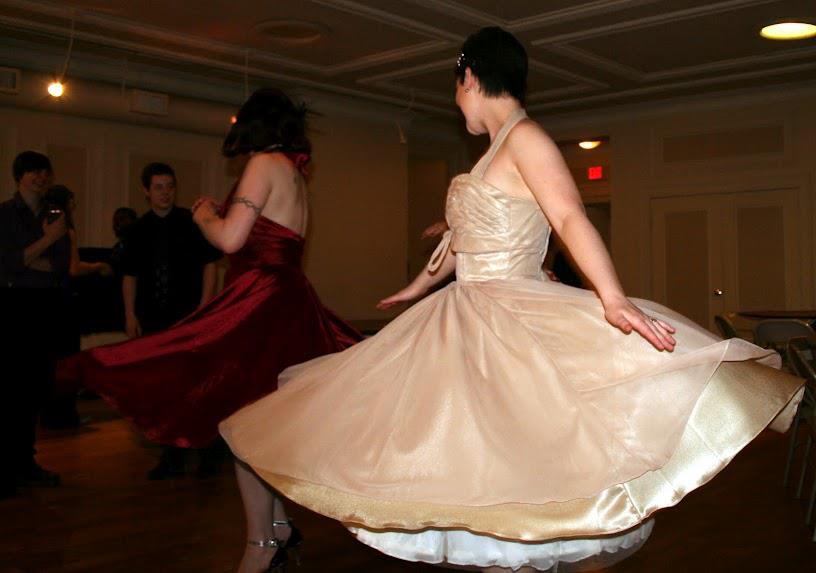
There were speeches, including one quite sappy and teary one which was forced out through sobs (oh, right…that was me).  There was food, drinks, after parties, and crashing of other wedding parties.  Also, dancing to said rocking tunes.

People visited from out of town, mimosas were had with brunch, and people left to go back home.  Now back to real life, right?

This does not change much in our lives.  We are still polyamorous; marriage and commitment do not change that.  I am looking forward to the future, living in the present, and remembering the past few days with a smile, but also knowing that we can’t always have the people we enjoy being with around.

It was great seeing friends from Atlanta, Illinois, Virginia, etc for a couple of days.  It’s a shame that we can’t all hang out on a Saturday night, in a hotel room, with drinks and ginormous pizzas every week.  It’s a shame that everyone had to go home.

But many of them remain, and I am glad for that.