Cynical City Living


I’m going to step aside from polyamory and religion for a quick second.  Today, a thought occurred to me.  It was not the first time this thought occurred to me, but I felt compelled to share it today, for some reason.

Ah, home...

I love living in a city.  I can walk or bike pretty much anywhere I want to go, there are tons of things to choose from to do, and there are lots of interesting people to spend time with.

My thought orbits around that last point, and I would like to make an observation concerning this issue of interesting people.

Interesting people are rare.  In my opinion, most people are severely uninteresting.  They are often not merely unintelligent (although some are, and I don’t fault them for it), but they are uneducated, incurious, and unwilling to challenge themselves.  They are boring, hetero-normative, monogamous, and fearful people who I really don’t want to spend time with.

(This is not to say that a person is is any of these things is automatically uninteresting, it just seems to make it more likely to be a correlative marker)

San Fransisco, apparently

And because they are rare, you need a large sample size of people to have enough of them around.  Further, concentrated areas like cities draw people like this in, like magnets to each other.  In rural areas, suburbs, or other less populated areas rare people often feel left out, abnormal, and seek to be closer to open minded and intelligent people.  Like cities.

One reason I don’t think I could enjoy living in a small town, a suburban area, etc is that I’d miss the dynamic of people that cites bring.  Not that interesting people can’t and don’t live away from cities (I know they do), but that there are less of them, and they will be harder to find.  Also, we’d have less varied choice of activities.

For those of you who like the suburbs or the country, I suppose you have your reasons.  If you would like to share them, by all means do so.  I just don’t get it.

Interdependence in relationships


Recent events in life have gotten me thinking about how relationships affect each other.  I mean all kinds of relationships, and not only polyamorous ones.  Of course, the level of intimacy and proximity exacerbates this phenomenon, but it occurs naturally nonetheless, and to think that it does not is simply not reasonable.

The relationships we have affect our mood, thinking, etc and therefore affect our behavior and disposition.  The argument you have with a parent, a friend, etc will affect your mood when you see you lover, or vice-versa.  The dynamics of all your relationships will affect the others you have, and that will, in turn, effect their other relationships.

Expectations, needs, and the logistics of time-management are a few of the obvious suspects here.  How much time do you dedicate to that project at work? How much time do you give your friends who you meet for drinks after work? How much time to just spend with your boyfriend or girlfriend in the evening? And if you have 2 or 3 lovers, how much time, and in what configuration, do you give each?

All of these questions, and the answers you give to them, will affect the other people in your life, as well as the people in theirs.  There is simply no way to get around this.  Your relationships, even relatively small and non-intimate ones, are not islands.  They cannot exist independent of the other ones you have, at least not completely.  Even in situations where you may think that no overlap makes sense to consider, because of the way you are affected (perhaps unconsciously) it will have some effect.

Even in situations where monogamous people have love/sex affairs, it does not take long for their partner to notice (or to at least ignore the obvious signs of) the affair.  Your mood changes, the way you interact as well, and before you know it things are different, and people are effected.  And in this situation it is in the interest of the violator of fidelity to keep these relationships as separate as possible.  And yet, it usually fails.

The great thing about polyamory is that, at least ideally, everyone is aware of this issue.  We recognize that the decisions we make effect other people in terms of how often we see them, how they feel, and what they will think.  To be a responsible, caring, and fair partner, you have to consider how the decisions you make will affect not only the other people in your life, but how those decisions will affect other people in the life of those you choose to be with.

It’s not an easy problem to master.  The issues of time-management, meeting of multiple needs (even the ones of people you are not directly connected to), and management of emotions is of paramount importance, and takes communication and practice.  These skills are necessary if you intend to make your life more efficient, happy, and to prevent or solve problems that are rife in such complexity.  Failure to master, or at least to address openly, these skills is a recipe for disaster in the long run.  I know this from experience.

What you do, say, or think about people will affect you, them, and ultimately everyone who is important to them.  This idea must be kept in mind, or you risk losing something in what you have.  Relationships require maintenance, and sometimes that means maintaining things which are not in your direct interest.  It’s like the idea of enlightened self-interest but applied to sets of people, rather than mere individuals.  Take care of the community you are in, and the community will take care of you.

Damn, that sounded really hippy.  Stupid Quaker schools!

I’ll stop there before I start advising people to have feeling-sharing exercises or something lame like that.

Now, where did I put that granola….

9/11 and Smarmy Ecumenicalism in Philadelphia


So, I was walking with Gina through town earlier today, since she had to pick up tickets for her show this after noon and evening, and I decided I would walk over to Rittenhouse Square and read my book for a while.  But when I got there, I realized I would be reading no book.  It turned out that the atheist fairy left me some presents.

As I approached the center of the park, I saw a number of white-topped tents set up (there turned out to be 15 of them) and my eyebrows raised.

Today is September 11th I said to myself.  It’s been ten years They are going to be doing some uber patriotic anniversary thing.

Not quite.  Better.

Is that a church group? Is that a Moslem group?

The answer was yes, to both, and my mouth curled into a devilish smirk (of course).  This is going to be fun.

Now, since I had originally planned on being at a wedding this weekend (the trip got canceled due to lack of traveling funds), I had not bothered to pay attention to what might be going on in Philadelphia this weekend, so I didn’t know about this event until I stumbled upon it.  But after I thought about it I realized that I should have known about this anyway…but I’m getting ahead of myself.

15 booths.  One city living group (or something like that), the Shambala meditation center, one Jewish, one Moslem (CAIR), one Turkish American group, and about 10 Christian churches were milling about and talking to each other.  Then I saw the stage, complete with lectern and seal of the Mayer of Philadelphia, Mr. Nutter himself.  He was off stage at first, but that would change.

This was going to be an interfaith, ecumenical lovefest among the local religious groups and I was going to be able to watch.  I was quite amused.  It was called Hands Across the Square.  It was supposed to start at 2:00, and it was around 1:00 when I arrived.  I had time to mingle, and mingle I did.  I had some short but friendly conversations with people who noticed my “Atheism: A Non-Prophet Organization” T-Shirt (what else is a man supposed to wear?), and when it was time for prayers and such, I made my way near the front to watch, take notes, and a couple of pictures.

And before I knew it, I was saying to myself Hey, there’s the mayor.  He’s totally going to speak, isn’t he? Yes, totally going to get his G-O-D on today!  With official government seal and everything.  Yay church and state!

So, when the invocations, prayers, etc started (led by a female priest from St. Mark’s) I started taking notes.  Phrases like the following would be thrown about liberally;

“Celebrate our unity”

“we need each other”

“No religion is an island”

“Disagreement without disrespect’

and, of course…

“One nation under God” (said by a Moslem)

There was a sense that these religious traditions are really alike, and there is no reason for there to be strife.  They doth protest too much, methought, and I started to think about all the things religious texts say about other faiths as I tried not to laugh or look too amused.

And, of course, there were no atheist groups represented.  And, believe me, many of us would have liked to participate.  Had the people organizing the event even considered inviting an atheist, I would have likely heard something about it.  I would have personally loved to address the crown as a voice for atheists; and yes, I would have remained civil, even if I would not have toed the ecumenical line completely.  I suppose that’s why I would not have been invited.

I tried to ask Mayor Nutter, after the event ended, why no atheist was included in the event.  But rather than even get a chance to voice the question he looked me up and down, read my shirt, and made some comment about having to be at another appointment.  Not surprising, really. No time for us atheists, especially with voters around.  We atheists, after all,  are nothing but rabble-rousers and have no place in such an event. We might cause trouble, such as pointing out the utter absurdity of unity through religious difference, especially in how it overlooks the obvious logical flaws in ecumenicalism.  Couldn’t they have at least thrown in a token accommodationist atheist?

Would the Mayor’s Office of Faith Based Initiatives even know what an accommodationist v. a gnu atheist is? I doubt it.  It’s not really their job, I suppose.  But they didn’t even try and include us.

The prayers and so forth were followed by everyone holding hands in a continuous line around the park, while the church on the corner did some music with it’s bell tower.  A few minutes of silence to remember that horrible day 10 years ago.  I didn’t include myself because, as I told one person who tried to make room for me, I’m philosophically opposed to the basis for this act of religious ecumenicalism, even if it was in part a rememberence of 9/11.  Atheists remember this day too.  And for many of us, myself included, 9/11 was a catalyst for more dramatically opposing religion and faith in our world, not a cause to overlook those differences in order to pretend we can all be friends.  It’s a delusion; religions, while having some good qualities, are a part of the problem, not the solution.  Events such as this are an attempt to cover this fact with wishes and rainbows.

I remain unimpressed.

I do not believe that ecumenicalism is useful.  I do want people to live among each other peacefully, but I think it is a deception to argue, as the many speakers did today, that religions need each other, that the fundamental virtues of compassion, love, and unity supersede the fact that much of religion calls for the death of non-adherents, apostates, and perpetually oppression of women much more than they call for unity.

Unity is a human virtue, usurped by religion and claimed as its own.

I am perpetually annoyed by this short-sighted and insincere attempts by groups such as these to pretend like there are not real things within their religions which make this ecumenical perspective fundamentally flawed.  There are parts of scripture from the Tanakh, the Qu’ran, and the New Testament which make each mutually exclusive to the other.  Granted, the Shambala Center, which was also represented, truly does accept people of all faiths (and no faith, thank you  Jeffrey Lee, for adding that to your talk), but their willingness to accept people does not say whether those people can actually do so with logical coherence.

Oh, right, logical coherence is not really a buzz word in ecumenical circles.  Never mind, I suppose.  This was an event for warm fuzzy feelings devoid of actual critical thought.  They must know that real analysis of religion, faith, and history does not lead to the liberal-porn of ecumenicalism which I saw paraded about today.  And if they don’t know, their levels of compartmentalization transcend anything I would have thought possible.  But, then again, I have stopped being surprised by human inadequacy, especially when it comes to faith.  Moving from a position of faith in gods and souls to the idea that people with other ideas of gods and souls could be their BFF  is not really a huge step.  Never mind that their heaven is not yours, and you aren’t invited.

Without the need for reality-based thinking, there is no limit to the amount of rationalization and one could achieve.  The sky is not even the limit when there is an imaginary heaven above.

There was, of course, a lot of reading from scripture, including Arabic reading from the Qu’ran, Old and New Testaments, and some talk of fearlessness and cowardice (which I thought was actually pretty cool.  I may blog about that later).  I was bemused by the statement, made by more than 2 speakers, that we are all drawn together as “children of Adam” or at least of some god.  Lets just say that I felt a little unrepresented in this category, as I don’t have any Adams in my family (I don’t think) and this god-thingy is somewhat puzzling to me.  Perhaps I’m not a real Philadelphian.  Because, as Mayor Nutter said, “this is so Philadelphia.”  I guess I’m not included, even though it is my home town and all. And while it is true that Philadelphia, with it’s pluralism rooted in William Penn’s view of religious freedom, is a tolerant and open city, Mayor Nutter forgets that there are people that are not of god at all.  He also forgets that he represents a government which is supposed to be neutral in such regards, and I feel somewhat slighted in his office even having a Faith Based Initiatives office, let alone utilizing it in this discriminatory way.
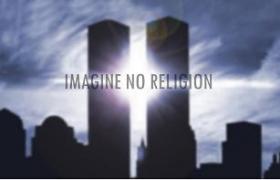
The similarities of these religious traditions are due to the fact that they are done by humans, and not because of any shared divine insight.  Religion has usurped our humanism and called it their own, and they overlook their vast differences in order to try and pretend that we can all just live with each other without conflict.  It’s naive.  Yes, we can live with each other without killing each other, but that’s only because the common decency that exists within most people trumps what the scriptures say when they command us to kill each other.  The people that get together to have these religious love fests are ignoring too much of the scriptures they claim to be god’s word, cherry-picking what they like and ignoring what they don’t.  It’s simply annoying to witness.

Oh, and after the event the Truthers came out.  They don’t deserve any more comment than that.

Heisenberg’s Uncertainty Priciple and “true religion”


I was just reading the comments over at Greta Christina’s new piece when I ran across this:

As soon as someone points out an ACTUAL issue with Christian culture, doctrine, or a sacred book, all the “true Christians” somehow scatter and disappear.

Something in my head clicked.

I have written before, at some point, about how people pick and choose their beliefs based on interpretations of their religious tradition.  In many cases, it is due to clear ignorance; they simply don’t know enough about their scripture or the history of their religion to know better, and so their beliefs are not coherent either internally or with the any theological tradition.  In many cases, their selection bias takes over and they only pay attention to what their worldview allows them to, which often is at odds with the orthodoxy of their religious tradition.  I see many Catholics do this, for example, when it comes to pre-marital sex, divorce, and contraceptives.  They will claim that their source is the word of god, that they really do believe in it, but they either don’t know or don’t care what the orthodox position is.  They seem, in other words, to exist in some epistemological limbo where their worldview is a mix of allegiance to tradition as well as rebellion against it.  Their simply is no larger consistency for them, and they don’t seem bothered by this at all. Granted, we all are irrational and inconsistent sometimes, but I think we should at least try or to correct it when it is pointed out.

And, of course, people think they are right.  What I mean by this (because this claim has been the source of some argument between myself and people who called this claim arrogant or wrong-headed) is that people accept that their opinions are ideas which are true.  Not that they don’t, in some cases at least, think they could change their mind, only that they are currently convinced of that which they currently believe.  I don’t know why that point is so controversial, but it is.

And so when you talk to some Christians (for example; this is true for people of all sorts of worldviews) about what it means to be a Christian, they think that either their sect is the true Christianity (or, more generally, the Truth) or they claim that there really is a truth and it is at least related to their opinion.  They may not know all the answers, but the god they believe in surely does. And this, in conjunction with the inconsistencies they have, leads to a situation where they believe both that their ideas are right, and that the religious tradition which they associate is also true even if they don’t adhere to all of its doctrines.  So,when you ask them for the truth, or at least answers to specific questions, the answer you will get depends on factors too complicated to spell out here but which are logically incoherent.

Ask a Catholic of they use condoms.  Ask them what is the right thing to do.  Ask them what the church thinks about this issue.  Ask them, again, if they are really a Catholic.  Chances are, this line of questioning will leave you flabbergasted and possibly cynical.  I’ve become to used to it to be surprised anymore, so I usually just skip over to the cynicism.


Meta-theology

In the public discourse about religion, policy, etc there is this problem that is pointed out to those that say, for example, that this is a Christian nation.  The problem is actually quite simple, and goes something like this:

Which Christianity?

And this is certainly a problem for those public representatives who make such claims, but his problem goes deeper.  More essential to this question is the meta-theological question of what interpretation (or set of interpretations) is accurate? Which theological school is right?

Now, from my point of view, this question is meaningless.  It is akin to asking what color underwear Batman wears.  The question has no answer because unless Batman is drawn wearing some particular underwear (and I am not aware that this has been the case in any of his many comics), this question has no answer.  It’s like the classic example whether the King of France is bald?  Unless there is a king of France, this question is meaningless.  Similarly, unless their is a god or some other sort of divine truth, an internally coherent and true theology is meaningless.

But for a believer, this question of meta-theology becomes important, and leads to the many complicated hallways of theological intricacy which I have little interest in.  Because as one studies such things, one begins to realize that the closer you get to answering such questions the more the problem starts to slip away from you.  Now, this is not a problem of internal inconsistency as much (although this is a problem) as it is a problem for consistency with the world in general.  And because the ways in which theological opinions are related to the real world (and sometimes it seems that the former prefers to ignore the latter), theology is in flux, motion, or can be said to have a position and momentum, in some analogous sense.

Theological worldview are, in a very loosely analogous way, not unlike physical particles.  Describing it takes complex descriptions, and in some sense they do not really exist in the way we classically thought of stuff existing; not as solid and unchanging substance, but as concepts involving probabilities in relation to what is around them.  And just like with a particle, a theological position is something that cannot be pinned down with precision;  the more you know about its position, the less you know about its momentum (and vice-versa).  I say this because things such as theological positions are agent-dependent; they exist in the real-time shifting environments of minds, and change in relation to social, cultural, and historical factors.  Theology changes due to its relationships with science, history, and skeptical analysis in general.  It is not solely dependent upon revelation or scripture, it has to contend with reality (even if only minimally).

In short, finding what the true religion is becomes subject to something akin to Heisenberg’s Uncertainty Principle.  Perhaps we can call it Theisenberg’s Uncertainty Principle? Nah, that’s lame.

And within a larger politically charged field, especially in current America where religion is such a large factor, what a true Christian is can never be nailed down. Not only are their too many claims to the title, even when you get one of them, they slip and slide around, refusing to be defined.

Take, for example, what the anonymous emailer said to Greta Christina from her post today:

The problem is that you’re not talking about any actual progressive religious types I’ve ever encountered. You’re talking about a straw man, a portrait of the religious progressive that certainly doesn’t represent all of them, and which may not even exist.

Now, Greta and the many commenters on her blog have made many excellent comments in response to this already, so I will try not to be too repetitive.  This person has made a claim that Greta (and by extension me, since I have made similar points) is doing something uncouth by trying to criticize people who seem to pick and choose their beliefs from a larger set of possible beliefs drawn from the tradition they associate with.  Why is it uncouth? Because, you see, they apparently they don’t do so.

Even as a commenter points out (in defense of the emailer)

When you see somebody apparently cherry picking, you can only conclude that they have a highly nuanced way of reading their scripture. And if they agree that they are cherry picking, that might only because their nuanced view is too complex to easily explain, so it is easier to go along with the crude “cherry picking” description.

It’s not that they are choosing what to believe, it is that their epistemological criteria is complicated.  It’s not that people are ignorant of their religious tradition and so they simply grab onto what they do hear mixed with their own humanistic intuitions, it is that they are super ninjas of theology (despite the fact that religious people are much less informed of their own religion) and so they are coming up with uber ways to believe in way that look to us to be theological noise.  My skepticism does not allow me to accept this claim of nuance.  It is, in fact, reminiscent of the term “sophisticated theology,” which is also annoying.

The fact that people do “cherry-pick” their beliefs from a larger theological set is pretty incontrovertible, it seems.  A fully consistent and non-picked worldview from a varied tradition such as Christianity, but certainly any major religion would just as easily serve as an example, is seemingly impossible.  The traditions change too frequently, beliefs are not checked against the whole of tradition and its sources, and so therefore what it means to be a true [insert religion here] is frankly impossible.  Once you have most religious apologists pegged on a view, they are moving in a different direction due to some moral or philosophical conflict we point out, and then they are somewhere else.  Our observing their theological point of view changes their theological point of view, again much like a particle.  And then once you have them admit that they are moving (questioning, or whatever), you have no idea where they are or will end up.  Inevitably, they will often return to their original position, and you don’t know how they got there again.

I’ve seen this behavior for years, both in my personal correspondences, on shows such as the Atheist Experience, etc.  Trying to figure out what a religious person believes in the light of an observing non-believer is a task to marvel at, and one worthy of a person who likes paradoxical-seeming circumstances.  Sounds like a job for a quantum physicist.  No, wait.  It sound like a job for a psychiatrist.

Time flies….


I had hardly noticed that so much time had passed without a post.  Frankly, I’ve ben having too much fun.  The summer is winding down, people are going back to school (includng my lovely Ginny, who just started a Human Sexuality program at Widener), and this weekend is full of cooking, eating and drinking.  Later today I will go to a BBQ at some other poly peoples’ house and continue this fine tradition.

So, what have I been up to? Well, spending time with Ginny and Gina (being polyGinous….) for the most part.  There has been a hurricane, an earthquake, and some idiot Republican candidates making me want to move to Europe, but there have not been any issues either polyamorous or atheist which caught my attention enough to comment upon them.  Hell, even my google reader has been neglected so there may be all sorts of interesting things going on of which I am simply not aware.

So, polyamory is great, monogamy is fine but artificially limiting and should not be the social default.  Religions are sort of silly, there are no reasons to believe in any gods that I have seen, and people should grow up and realize this so we can actually find solutions to problems rather than pray and hope them away.  Skepticism, the application of reason and the scientific method of questions in our lives, should be a practice which employ in all aspects of our lives, and doing so properly will lead to atheism and the negotiated relationships which bring us fullfillments of desirs platonic, romantic, and sexual.

That’s pretty much my blog,  dear readers.  If I have something more specific to say, I’ll try and do so more frequently.  In the mean time, enjoy the end of your summer (for those of you in the northern hemisphere) and keep enjoying this life.

It’s the only one we have, and we should love those whom we love openly, freely, and without reservation or fear.

Why do people “hook up”?


In other words, why do we fuck each other?

Now, this is not my question.  It is, in fact, the question of Christian author Donald Miller.

He has recently posted questions to both women and men.  If you look at some of the responses, you will see that there really is some feeling among the readers, likely to be Christians, that are not what I call “sex positive.”

Now, I added my response (awaiting moderation), and I will be interested to see what kind o response it gets.  In any case, I said this:

Because sex is fun, and it feels good (this is the same answer my fiance gives, btw). The question assumes a sort of sex-negativity that I find a little amusing and a little more disturbing. Why is this question necessary? Isn’t it obvious that men and women genuinely enjoy sex?

Now, my fiance and I are open and proud sluts. We love sex with each other and our other lovers (we are polyamorous). But in addition to the fact that sex is simply fun, it also allows us to experience human intimacy, which is beautiful.

For those that are not hooking up (and who have the physical desires to do so), why are you denying sometimes so pleasurable and intimate? Do you really believe that it is wrong? Do you really think (if religious doctrine is the reason) the creator of the universe cares what you do with your “naughty bits”?

What would you have said?

(H/T Hemant Mehta, AKA the Friendly Atheist)

Skepticism versus the intelligent design of irrefutible complexity


Thesis: Theological apologetics becomes more complicated in the presence of skepticism.  In other words, arguments which theists make in defending their religious beliefs become more and more convoluted sophisticated (and again) the better our questions about those beliefs get.  But, of course, I have written about this topic before.  Nonetheless, I have a few more things to say.

Thousands of years ago, some metaphysical ‘genius’ could proclaim that the universe was all fire, water, or made of god stuff and we, a very young intellectual species, would not have had the tools or understanding to question such claims without it turning into a ‘he said, she said‘ affair (assuming a ‘she’ would have been permitted to say anything).  That is, there was once a time when truly there was no significant epistemic distinction between religious and skeptical claims.

Because there was no established skepticism.

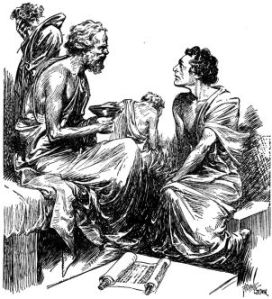
Phaedrus

But with many of the ancient urban societies where philosophical ideas were born–China, India, Greece, etc–came questions of how we know things.  Eventually, intellectuals would begin to question the bases of religious thought, and would become subsequently revered and sometimes chastised by contemporary religious and governmental institutions.  Here in the West, Socrates is the most well-known example of this.  With this infancy of philosophy, but more specifically epistemology or the study of knowledge and how we know things, traditional knowledge became subject to suspicion.  For an example, here is Socrates (well, Plato at least) when asked by Phaedrus if he believes in the myth of Boreas seizing Orithyia from the river bank upon which the members of the dialogue sit.  Socrates replies:

I can’t as yet ‘know myself’ as the inscription at Delphi enjoins, and so long as that ignorance remains it seems to me ridiculous to inquire into extraneous matters.

This early form of questioning would lead to more direct skepticism, of course.  And with it, theistic philosophers would be forced to do more than merely assert their positions.  (Well, ideally it would lead to this, but the fact is that much of apologetics, even from the revered William Lane Craig, is full of bald assertions).  And as history marched along, theology became a serious philosophical topic.  What’s the phrase? That philosophy is the handmaiden of theology.   Well, for centuries that was true, as to be a philosopher in Europe was to be a member of the church.  No other intellectual institution was very influential for many centuries; no competition was allowed to survive, where the church had the power to stop them.  Consider the Cathars, Giordano Bruno, and Galileo Galilei for starters.  The Inquisition was not a period of increased curiosity, after all.

Duns Scotus

So, with the basic epistemic questions posed, the tools of logic and inquiry developed.  The tools of skepticism were sharpened both by the luminaries of orthodoxy who defended the faith of their particular institution as well as those who quietly (or not so quietly) harnessed doubts.  There is no doubt that Thomas Aquinas, an orthodox philosopher if ever there was one, was a genius.  But let’s not forget such thinkers as Peter Abelard, William of Ockham, and Duns Scotus who, who were not in any meaning of the word ‘atheists’ but were openly skeptical of many orthodox theological ideas.

With the advent of the empirical methods which would lead to what we know today as the scientific method, the world of theological apologetics would receive a vital blow, even if it would not be felt by most people even now.  The fact is that many people do not understand the implications of this methodology on theology, which is the basis for this argument between accommodationists and people such as Jerry Coyne, PZ Myers, and of course humble ol’ me, is a testament to how little most people think about complicated matters such as philosophy.  But it has always been that way, I suppose.  But for those of us who consider such matters, the opposition to theology and theism in general is not mere distaste (although it is that too), but one of realized philosophical implication.  Theological apologetics simply does not have the rational justification to stand up to the power of the scientific method.

This is not a debate over mere conclusions, but one about methodology and therefore justification.  One method is simply superior to the other.  When religion is subjected to empirical testing, almost none of is survives.  Not even the happy and progressive liberal theology survives, even if it tends to be more accepting and friendly.  it’s sort of how you prefer people who are nicer, even if they have radically different lifestyles or beliefs than you.

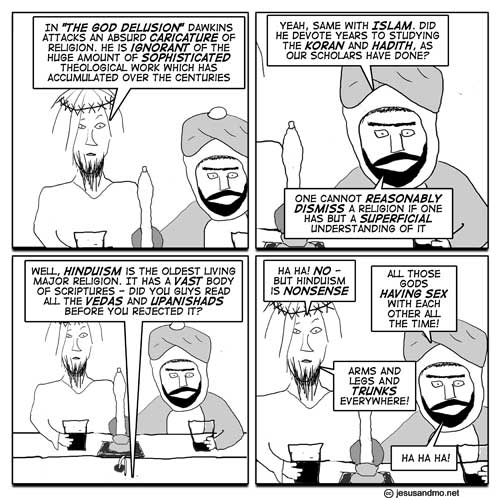
Recently, one of the buzz terms in the blogosphere in which I swim is “sophisticated theology.”  The basic idea is that we atheists and skeptics are not sufficiently educated in the complexity, subtlety, or profundity of modern theological thought.  Of course, every time we run into some deep thoughts a la theologian, all we get is either postmodern word salad or bold assertions without philosophical or empirical justifications.  Here is an example of the sort of thing I am talking about which I discovered a few weeks back via WEIT (also via the link above)

The bottom line here is that skepticism has put theology up against the metaphorical wall, and theology is flailing around in an attempt to save itself.  Now, the metaphor is not really apt, because skeptics are not figuratively (or literally) threatening theologians or apologists with harm, but we are merely tapping them on the shoulder and asking hard questions.  Sometime, when they agree to sit down with us and debate or discuss the issue, we ask those hard questions in bold ways.  And, of course, when we skeptics talk to each other those hard questions often are paired with humor, frustration, and flabbergastion (that isn’t a word, is it? meh…).   And this, to them, looks aggressive.  And in many cases it is aggressive, because we are frankly fed up with pseudo-intellectual crap and the fact that they have so many credulous people to believe them.  It does not bode well for humanity.

Like  someone who will say anything to not be harmed when they feel threatened, assertions will lash out like fists and feet, adrenaline takes over, and survival supersedes truth.  It just may take centuries for the disease’s symptoms to be noticeable to everyone, but they are already felt by many.  We skeptics, like doctors of the body of humankind, can already see the theological cancer spreading over the body of humanity and have made our diagnosis; it is malignant.  If we as a culture and a species are to become healthy this cancer needs to be treated, and possibly removed.  If it isn’t, we may survive, but we will continue to be  infirm and weak.

But in the mean time, the arguments of assertive theologians will continue to maintain influence on millions of people.  Their claims will continue to be complicated, intelligent, and profound-sounding.  This, of course, will not lend their ideas actual justification, but that will not matter because it will still compel many.  And the more complicated, in-depth, and meticulous these rationalizations are, the harder skeptics have to exercise their sharpened tools to demonstrate the lack of reasonable foundation of such beliefs.  It is a game where those who care about influence over truth have the advantage over those that genuinely care about what is demonstrable.

And then the sharper skeptics make their criticisms, the deeper theologians dig themselves into the rabbit-hole of complex and erudite obfuscation.

Thus the viscous cycle, the intellectual ‘arms race’ (Richard Dawkins would be proud, perhaps), continues.

But the complexity and obfuscation don’t make theological arguments better, they only make them harder to follow.  It allows them to live in their worlds where they pat each other on the back for being clever, but never actually demonstrate anything.  They just become more convoluted, intricate, and find themselves tied in knots that nobody else wants to try and untie because it is a waste of time and we can see that.  Then they can make the easy rhetorical point that we don’t understand sophisticated theology.

It’s all just silly, like games children play where they make up the rules along the way and then declare victory.

Intelligence is needed to compose such sophisticated theology, but it is intelligence applied to rationalizing a conclusion and not in utilizing or improving the best methodology we have at our disposal.  For theologians to do that would be suicidal, and they must know that to some degree.

When pressed against the wall, survival supersedes truth.

Multiple loves


I’ve been doing some work to put together a future lecture or discussion about the relationship between the atheist and polyamory communities, especially as they intersect via skepticism.  What it will look like when done I cannot say, but I thought of a quick analogy (parable, perhaps) that might make the point for some people.  It is an analogy I intend to use in some form, and wanted to share it here.

Let’s say there is some physicist.   They always had an inclination towards science, despite many other interesting fields of study available to them (some early fascination with computer programming just wasn’t a good experience in the end, but they learned a lot from it).  So, after some searching around for what to do with their life, they got a degree in physics, found a job at a respectable lab, and paid little to no attention to other subjects.  Yes, they were interested in politics and perhaps baseball, but there was just no real love there, and they really didn’t have time to make a real commitment to such things.  These things were just friendly interests, things they talked about to unwind after a long day, or whatever.  But always they wake up to and and go to sleep with physics on their mind.

They may see other people dabbling a little in chemistry here, a little in journalism there, but these people (our physicist thinks)  just can’t settle down into something real.  Their commitment to physics gives their life meaning, structure, and goals which their meandering cohorts simply cannot understand.  Our physicist, you see,  can’t imagine any other subject being as interesting to them, even if the tedious day-to-day maintenance of their work is not always exciting.  They made a commitment, and that means that they cannot afford to get caught up in other interests.  They may occasionally think about other things, fantasizing about what it would be like to take a short vacation learning how to make pottery or maybe look up some information about computer programming to see how it has changed over the years.  After all, it was fun for a while.  perhaps it could be again.  But no, our physicist has moved on.  They are, indeed, a physicist.  They must leave aside thoughts of pottery and nights of staying up all night programming.

Then one day, perhaps because they got locked in a room with nothing else to do, this physicist ends up reading, say, some Russian literature.  Maybe it’s Dostoevsky, maybe Tolstoy, but it really does not matter.  And upon doing so, they find that they just love reading this Russian literature; they find that it complements their life in such a way that they want to read more, and their life becomes more rich and more enjoyable. They find themselves thinking about the characters, the plot, and they just want to dive into a book and just live there for a week.  They cannot help themselves in desiring to explore more of what has been written, and to they find themselves excited in a way they have not been excited in a while…but they still love physics, of course.   Despite this, they want to read chapters over and over again.  They are, in a word, smitten with this new topic they had not been familiar with until now.

Now, let’s say that this scientist looks back at their years of study of physics, their job, and their daily life as a physicist.  They look at their job, and they say to themselves “oh, how can I do this to physics?”  They wonder whether they should bring their literature to their lab, to read during lunch, or whether they should give up their new interest since it may effect their ability to do physics work.  They wonder whether their love of physics can survive, or whether it will wither away into cold resentment in the blinding light of this new excitement about some other intellectual endeavor.  And so they consider leaving their job, considering eschewing any thought of particles, gasses, or even obscure formulas and instead seek to go back to school to study Russian literature so they can dedicate their lives to the reading, teaching, and enjoyment of Russian literature.  Physics would be left behind, for to have two loves is, well, wrong.  Or it’s just hard.  It’s just not for me….

A ridiculous story.  But why is this kind of thing ridiculous when it is applied to careers or personal interests, but not to relationships?  Why does it seem so strange or even inconceivable that we can share our love with more than one person, when it seems so natural that we can love both knitting and bike-riding? What is the fundamental difference?

I have answers to this question.  But they are not quite formulated yet.  I will leave it for you to ponder, and to comment if you wish, but will not address this question here and now.

Marriage, commitment, and polyamory


Awwww....

So, Ginny and I are engaged.  That’s right folks, marriage! That ancient institution of property-arrangement designed to let everyone know that this woman is mine.  If you want her, too bad; I have obviously paid her father some bride price (or she has paid me some dowry) and so she is spoken for.

Oh, wait, that’s right! The concept of marriage has changed.  Those valued ancient traditions that defined our culture and gave the sacred institution of marriage meaning have been radicalized and re-defined by social progressives (probably feminists and socialists) in an attempt to destroy the traditional concept of marriage.  And as a result, women are no longer property by which men can get their jollies and also continue their genetic line (the legitimate ones, anyway).

Now, marriage has come to mean the willing entrance into a committed and potentially life-long relationship by 2 or more adults.  It’s an arrangement which gives each adult who has entered into it certain legal rights concerning decisions for and access to their spouse(s).  It has changed from being a property arrangement not unlike owning a cow to being a decision to bind one’s life to other adults in emotional, financial, and legal ways.

Oh, wait, I got ahead of myself.  We are still somewhere between that traditional marriage and what actually makes sense to emotionally mature and intelligent adults.  We still live in a culture where the idea of marriage has not yet evolved past the transitional stage of a civic union between one man and one woman.  We live in a culture with such a bad sense of history, genuine adult relationships, and full of conservative fear that we still think that commitment is defined by an arrangement between two people who have no obligations of love, intimacy, or time to other people.

I keep forgetting that the vision of actual human emotional achievement and popular maturity only exists in my head.

*sigh*

What is commitment?

Commitment is not the same thing as exclusivity.  To be committed to something is not to eschew consideration to other things completely.  It does not mean that comparable relationships are forgotten.  Go ahead, look up the term.  There is nothing about commitment that necessarily implies that to commit yourself to a person (or to a cause or idea) means that you give up any effort towards others.

And yet, if you hear someone say that they are in a committed relationship, it is understood to mean that they are unavailable for romantic and/or sexual relationships with people other than the person to whom they are committed.  It does not imply that perhaps that relationship is of mere primary (or at least very high) importance to them.  It does not, in ‘polite’ society, mean that any further arrangement of relationships must consider the impact to that existing relationship.  It does not mean that that relationship is something of great importance to their life, and that perhaps, if things work out, you may be able to share some of that importance with others as well.

That would be silly.  Except that it wouldn’t be silly at all.  It would be pretty awesome, actually.

I am committed to Ginny.  I intend to keep her as a primary part of my life, and to grow and love her as long as I am able to do so.  All decisions that effect my life will have to consider her and how it may affect her.  All further relationships, whether with Gina or anyone else, will have to be weighed in terms of their implications for my relationship with Ginny.  And since Ginny and Gina get along so well, it means that the continued existence of my relationship with Gina (which is young but relatively strong considering its youth) is preferable for all involved.  So, not only does my relationship with Gina not threaten my relationship with Ginny, it may actually complement my commitment to Ginny.  It may actually add value to that other relationship.  Isn’t that awesome?

This is a concept that I think more people in our culture need to understand.  In the same way that many friendships can complement other friendships, romantic relationships can also add to the ones we have already.  Jealousy, resentment, and pain are not the only result of your lovers knowing about each other.  There are also wonderful things, like friendship (and occasional new lovers) that can be derived from this.  If you love someone, the qualities that you love just might be noticed by the other people you love.  Crazy, I know!

What is the meaning of Marriage, if it does not mean commitment?…oh, wait….

Are you getting it yet? In the same way that being committed to one-another does not have to imply romantic and sexual exclusivity (although it can also mean that, if the people involved desire that for whatever reason), marriage does not have to imply exclusivity either.

But further, in the same way that 3 (or more) people could possibly find a way to arrange commitment and share each other emotionally, sexually, etc, there are times when those same 3 (or more) people can find themselves all ready to commit their lives to each other in ways that walks, sounds, and acts like marriage.  What sense is it to have (for example) 3 people living together, sharing a bed, finances, and activities together and say that this could not be considered potential marriage for more than 2 people?  How does polyamorous marriage not make sense for those for whom such arrangements are desirable?

But much more basically (and more personally relevant to me right now), how is my marrying a woman who I love, despite the fact that I love another woman (openly and unashamedly), not marriage?  How does my being in another relationship de-legitimize any meaningful use of the term ‘marriage’? Well, frankly, it doesn’t.  But many people seem to think that it does, and I think that this is an obvious point of needed re-consideration by our culture generally.  We, as a society, need to re-evaluate our values about relationships, marriage, and commitment.

Gay and polyamorous marriage are really about the same thing

I believe that those who were once considered liberal and open-minded, the radicals of the past, are in some ways tomorrow’s conservatives.  We, as humans, get so caught up in the definitions and causes that our cultural ancestors fought for that we forget that it is the continued struggle for freedom and choice that is the fight, not the updated definitions of things like marriage.  Less than 50 years ago I, as a US citizen, marrying a black woman would have been illegal.   Those who now take that for granted have now accepted the new conservative definition of marriage which is problematic for both gay couples and polyamorous groups who desire the same rights.

Granted, there are issues related to the abusive treatment of women in polygamist religious groups, such as the FLDS organizations and Moslem societies which support such things, and I do not want these women to keep experiencing this abuse, when it is abusive.  I want marriage to be a consensual and informed decision among adults, not one controlled by religious ideology in an abusive and patriarchal culture.  Marriage, at bottom, is NOT a religious institution, but rather a civic one.  Religion cannot tell us what marriage is any more than it can tell us what morality is.  They have not earned the right to have an authoritative position on such things.

In conclusion (a message of loves)

I love you Ginny, and I look forward to a life of sharing how wonderful you are with other people, because to do otherwise would be taking too much away from the world.  You are brilliant, beautiful, and as authentic a person as I could hope for.  And Gina, I love you too. You are talented, you make me laugh, and seeing you happy brings joy to my days.  I hope that our relationship will continue to grow into something meaningful and enduring.

Take that, convention!

Kirk Cameron on marriage: The blind leading the blind


*headdesk*

Ow, that hurt,  But not as much as reading this:

Woman with a Mancard: My Night at Kirk Cameron’s Marriage-Strengthening Event

Now, I’ve found Kirk Cameron’s Christian antics annoying for many years.  Since my friend Brian Sapient debated him and his Sith master Ray Comfort back in 2007, I have found him to be a pretty dense tool (almost as bad as Tof Friel, really), but this recent event just makes me want to scream with frustration.

Now, I want to write more substantially about the concept of marriage in the next day or so (mostly because I just got engaged to the lovely Ginny), but for now I want to say a few quick things about the idea of marriage, relationships in general, and the role of men and women in them.  I want to say these things because I think that the current model of marriage in the evangelical Christian community is poisonous for both men and women, advocates an immature way for men and women to communicate and interrelate, and just generally sucks giant troll balls.

And what’s worse, it informs many of our ‘traditional’ definitions of marriage.

Kirk Cameron advocates a model of marriage with the man (and there always will be a man, as marriage is defined as an institution between one man and one woman of course), is supposed to “play the role of Jesus Christ to your wife.”  There is no equality, no real sense of compromise, and certainly no meaningful feminism here.  The man is unambiguously in charge of his wife.  This is not a relationship of equals, but one of a power relationship.  Just as we are to obey God, the wife is to obey the husband.  Sure, if he has “crossed the line” (meaning, is emotionally/physically abusive) then he is not “protecting her” (because that is part of his job, of course) and is not doing his job well. But I doubt that divorce would be an option, as god ordained these marriages, and only we can fail in them;  not god.

This is but one of the many aspects of current Christian trends that makes me feel sick.  It promotes clearly obsolete gender roles, places people (specifically women) in a place of subservience (and not in the fun and kinky way that some women like, although I’m sure there is some overlap), and (again) it promotes vigorous suction on the balls of the troll which may or may not live under the bridge near your house.  His name is Ted.

The irony for me is that many people in our culture, even less batshit nutzoid people than Kirk Cameron, think that gay marriage or polyamorous marriage (not to be confused with the often harmful polygamous marriage) is unhealthy while finding this version of marriage proposed by evangelicals to be relatively healthy.  At least (they may say) they are really committed to each other.  Or they may say that at least it is the way god intended marriage to be.  This is an indication of a fundamental disease at the root of our culture when it comes to thinking about marriage and gender roles. There is no wonder that divorce and teen pregnancy rates are higher among so-called red states; it is these areas which are more prone to this unhealthy model of marriage.

I love my future wife.  I love her in a way that a man who sees himself as the master of his wife simply cannot.  I am genuinely interested in seeing her free, fulfilled, and treated as the equal that she is.  I cannot, not would I try, to “put my foot down” or to make a proclamation about what will be what.  It may be hard, we may disagree, but we will communicate openly about all of our desires, fears, and joys. Further, she loves me (this I know, for the Bible…wait, never mind…).  She desires me to be fulfilled, free, and will allow me to be who I am, genuinely, inside.  Neither of us has to pretend.  We don’t have to strive for some fantasy ideal or deny aspects of our selves in sacrifice for our relationship, because our relationship is about a celebration of our selves.

I will put my relationship against that between Kirk Cameron and his wife any day of the week.  Any man who sees his wife as subservient, who plays off of old cultural roles for each spouse without any hint of skepticism towards their ideological merit, or who gives men “man cards” which their wives are not even allowed to see is a weak and cowardly man.  His worldview is weak and cowardly, and it is a conservative worldview whose influence stretches beyond the evangelical Christian world, but surely dominates that world.

I know too many people, men and women (they are really boys and girls, even in their late 20’s or 30’s) who are inexperienced sexually, relationship-wise, and therefore emotionally stunted.  They see this ideal life and marriage set up before them and do not relent even as they fail over and over to find it’s reality.  They believe that Jesus will provide for them, and cannot see their own blindness.

And many of these “values” seep into mainstream culture, where (outside of the educated upper middle class generation I grew up around) these ideas are still held with reverence.  Heteronormative monogamous male-dominated marriage is more the norm than I think many of us educated and elitist types want to admit–and possibly more than we realize.  This idea of the traditional marriage, which is not even traditional if we want to be truly historical about it, is what is doing damage to real human relationships.  Not gay marriage.  Not polyamorous people who are married and who may want a legalized polyamorous marriage.

It is the closed-minded version of what god wants, what is right, what is ‘Merican even, that will destroy our relationships.

[/end rant]