Meaning of the Jesus Story; History v. mythology


I was just catching up on some blogs this morning and read Jerry Coyne’s thoughts on the virgin birth, the resurrection, and their importance in Christian (specifically Catholic) faith.  Towards the end, he says this:

…as has always been clear, the things that to Christians are non-negotiable “truths” of the Bible are those fables on which their faith rests most heavily. Therefore they can dispense with the parting of the Red Sea and the curing of lepers, [but] not with the Resurrection, which is the most important fable that Christians must accept as literal truth.

But if that’s the case, then why not treat Adam and Eve likewise?. For without the Original Duo, and Original Sin, the crucifixion and Resurrection of Jesus would make no sense (as they say, “Did Jesus die for a metaphor?”).

It is a set of points that I have thought about (and probably written about) myself over the years.  But it got me thinking; How do we approach the significance of an idea depending on how historically reliable it is? How do we think about the meaning of an act if we think it really happened versus if it is a mythological metaphor for something? How do the standards of import differ in contrasting history from mythology?

If a friend took off work to do you a favor, that would be appreciated and would have some real import.  If a person were to push you out of the way of a car, saving your life and sacrificing theirs, that has more import.  For many, Jesus’ sacrifice, is seen as the superlative sacrifice.  Further, it transcends the mere saving of a short mortal life, and becomes the transformation of an eternal life.  We are all doomed to death/separation from god/whatever and Jesus steps in to take the bullet.  And many believe this really happened, and is not merely a metaphor.

But our litany of stories from various religious, philosophical, and cultural sources contains a multitude of stories with moral, social, and philosophical import, many of which attempt such universality.  And it is clear, at least to me, that these stories are myths, even if they contain some historical truth to any extent.  They are, in essence, products of our imagination.  The complicated morals, literary structures, etc that such stories convey, and often contain high moral and philosophical import, are fancy fabrications.

And while reality may occasionally, accidentally, resemble such fabrications in terms of narrative complexity, moral import, etc, the rule is that the design of mythology is better at creating meaning and import than reality.  A narrative with more complex interwoven philosophical themes, governing more broad area of impact and importance, is more likely to be mythology.  The story of the New Testament, with its universal import and intended (but ultimately failed) sacrificial plot, is a good example of a story which is clearly mythological, even if potentially based on historical facts.

—-

So, the essence to my question today foes something like the following.  If I believed that the Fall of Adam and Eve, as well as the resurrection, were literal things that happened, does that mean that the import of the acts involved have more impact than if they were mere stories about the human experience? Would the fact that these actions really happened give them greater impact, emotionally and philosophically, than if they were mere stories?

Consider my example of someone taking off of work to help you with some problem; imagine that this story were part of a religious canon, rather than a thing that really happened to you.  If you found this story in the New Testament or the Koran, would you be impressed by it? Probably not.  But if someone really did this, for you or someone you know, it would have some importance and meaning, even if it were a small amount of such.  The fact that it is real gives it more import to your life, even if the act has less moral and philosophical complexity than mythology.

The thesis is that when things really happen, their personal and social importance is greater than if they were mythological.  Mythology has to be exaggerated, embellished, or at least rare to survive as a story of significance.  It may be that extraordinary real events inspire such mythology in some cases, but such stories always take on legendary status the more they are told and re-told, because story-tellers have to sell the story.  Thus, we will microfy the import of a story which is mythological because we understand that it is embellished, whereas reality, which sits in front of us, is not.

So, a story about a sacrifice, in order to be held as ultimate import, has to become embellished.  Religion, then, is part of our story-telling nature, and only stories with universal themes and import can survive to legendary status.  And while these stories sit behind our lives as an influence for our behavior and beliefs, reality continues on and we continue to act in less than superlative, but meaningful ways.

And many religious apologists argue that this is what makes religion great; it stands as an example for us and helps preserve our cultural norms and values in narrative form.  And for those that believe the stories are true, there is a greater amount of reverence towards those acts (and those who perform them), beyond mere inspiration.  But, for those people who don’t believe the literal truth of these religious stories,such stories can still remain as inspirational narratives, even if the non-historical nature of the story takes something away.

Of course, by not believing they literally happened, one can also criticize the import and morality of the lesson.  It seems more appropriate, for many, to criticize a story rather than a real act.  If we see Jesus as a metaphorical example, and not literally a person (or god) who “died” for our sins, then we can hold him up as an example (even if not a great one) of what humans can do for one-another.  But if he was (and is) god, then that fact puts the story on a level of import which dwarfs any mere myth.  The same story, depending on whether it is true or not, has different import.

But here’s the problem; if stories such as the all and the resurrection are literally true, including that a god is behind it all, then the distinction between mythology and reality breaks down in this respect.  The basis for real actions having inflated import is that such things occur within a real of minimal control over the circumstances, whereas in a story the composer has, well, god-like control over the circumstances.  A friend taking work off to help you is only in control of their own actions (taking off work and helping you), not the circumstances which led them to have to make that choice.

The story of Jesus, if we saw him as a mere human who acted in the real world, could be of great import as an inspiration towards sacrifice and love (assuming we ignore the non-loving stuff in there, of course).  But as an intentional creation of an all-powerful god, the Jesus story is designed, and poorly, because a better story could have been designed.  The world could have been different, the sacrifice unnecessary, and a greater story could have been written.  The more true the Bible is, the less powerful its story ultimately is; the more control the author of the story has, the less impressive it is.

As a set of inspirational stories, the New Testament has some philosophical and moral import on their own, but if Jesus was real and did a lot of the stuff in the gospel accounts, then the import increases because a person actually did those things, rather than them being idealistic narratives of some authors.  But if God is real, and god designed and orchestrated the whole thing, then I’m not impressed, because I think that I could write a better story than that.  God didn’t just compose the narrative of Jesus, but he also composed all of the circumstances which allowed them to be necessary.  In short, God is a terrible composer of stories (and universes).

The Bible, as a collection of stories, is a work of human minds and hands.  It takes the nature of the world, indifferent and often unpredictable, and comes up with a set of narratives which offer some consolation and moral import.  Bu those imports are inflated, exaggerated, and as a result they take on universal import through hyperbolic fabrication, rather than by being real.

We, with our imagination, intelligence  and articulate genius have come up with narratives which make reality look pale in comparison.  Our stories tell us about our dreams and nightmares, hopes and fears, and our height and depth of philosophical notions.  But what ends up mattering are the real acts, the non-miraculous human decisions,  which have a real effect on our lives.  Mythology might inspire,but it can only do so via exaggeration, by figurative flashing lights and shiny objects.

And, what’s worse is that the mythology, the meaning, of the essential Christian message is flawed and many subsequent stories have surpassed them in many ways.  Not only is the Christian message not truly universal, it isn’t even good.  So, not only should we not believe in the virgin birth or the resurrection, we should not even be inspired by such things.  Fabricated acts have no real meaning in the world; they only can attempt to make reality seem pale in comparison, but often merely succeed in making themselves look artificial, forced, and Platonic.

So, while stories are fun and inspire the imagination, what ultimately matters is reality.  Give me friends and lovers over a million Jesuses (Jesi?) any day.

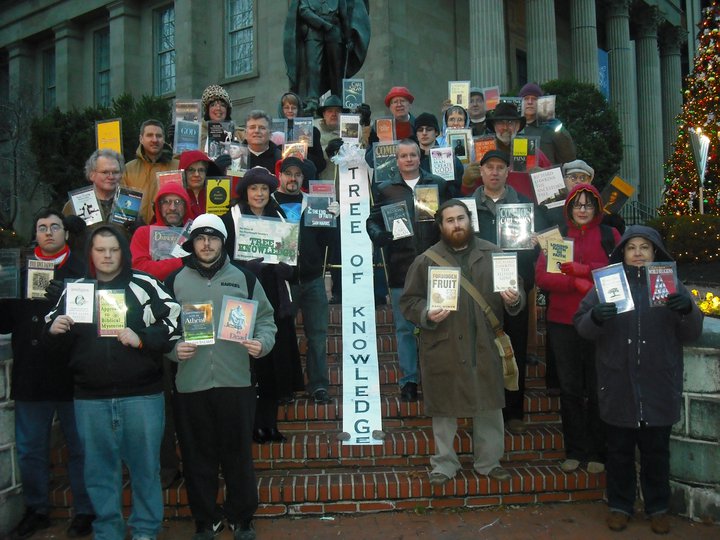
Tree of Knowledge Event December 1st in West Chester, PA, with some historical context.


It’s beginning to look a lot like…Discrimination?

Margaret Downey helping to decorate the Tree of Knowledge in 2008

Over the least few years, the Freethought Society, led by Margaret Downey, has been involved in an effort to include atheists, humanists, and other secular people in the public holiday display area of the West Chester courthouse.  It is this very courthouse that, in early 2002, I first met Margaret Downey during the court case of whether the 10 Commandment plaque  would remain displayed there.  It still remains in place, due to it being historical since it was on the wall for 80 years.  In other words, nobody complained for many years and so it became a part of the building’s history.  What I learned from this was to complain more about violations of the church/state separation, so that this squirmy legal reasoning cannot become valid.

Starting in 2007, The Freethought Society has tried to maintain seasonal inclusion by participating in the placing of holiday displays on the court grounds, and for some years we were allowed to participate in the mostly conservative county.   The tree’s lights were vandalized a few times that first year, but it ultimately remained and the new tradition was continued the next couple of years.  In 2009, some interviews sprung up about the event, which include some video about how the tree was decorated and a little more about the history of the idea.

2010 Human Tree of Knowledge

But then in 2010, the Commissioners rejected the request to be included in the displays, and so Margaret got to work on an alternative plan; a human Tree of Knowledge, which doubled as a protest and momentary display.  The same thing happened in 2011, and now in 2012 we are left in the same situation.  The Commissioners still refuse to allow a Tree of Knowledge on the courthouse grounds, while still including the traditional Christmas and Hanukkah displays.

So, because of this continuing discrimination in West Chester, PA, Margaret Downey and many members and friends of the Freethought Society will be gathering on Saturday, December 1st 2012 in order to create a human Tree of Knowledge.  The courthouse is in the middle of West Chester, at 2 High Street, and the event will start at 3:00 PM.  

I plan on being there, and we would love to see as many people as possible come out to show your support for a great organization and to protest a discriminatory decision by the West Chester Commissioners.

Atlanta Poly Weekend, March 15-17 2013


As many readers may know, I lived in Atlanta for a little while a couple of years back.  It was where I met Ginny! While living down there, I participated in the polyamorous community down there and made some friends.  Some of those people still read this blog, and because of my awesomeness, have invited me to participate in their annual orgy polyamory-themed event in Atlanta, Atlanta Poly Weekend.

Know that I had the option of putting a picture of a sexy woman here dressed for St. Paddy’s day.

It will be the middle of March of 2013 (you know, because the 2012 Mayan calendar thing is bullshit), winter will be starting to give way, it will be St. Patrick’s Day weekend, and Atlanta will be warming up! Also, lots of smart, sexy, poly people gathering for workshops, presentations, and possibly a few drinks after we solve all the world’s problems with said workshops and presentations.

You can take a look at the list of presenters to get an idea of who will be there, and they look like a fantastic bunch! I am looking forward to meeting them all in March, and I hope to see some of you there as well.

So, the skinny is this:

The What: Atlanta Poly Weekend 2013

The Who (no, not the band!): you, and all your awesome friends (who will be permitted to listen to The Who, if that is your kink.  The Kinks will also be acceptable).

The When: March 15-17, 2013

The Where: 

Holiday Inn Select Atlanta- Perimeter/Dunwoody
4386 Chamblee Dunwoody Road
Atlanta, GA 30341
(770) 457-6363
(770) 458-5282 (Fax)

The Why: Because it will be awesome!

The How: That is for you to figure out, because I don’t know who you are or where you are coming from.  If teleportation doesn’t work, try a car, train, plane, or penny-farthing.

The Culture Wars will continue


So, Obama won pretty big the other day, and overall the Democrats had their day of victory.  Now, in my opinion the Democratic party is not very liberal, but they are certainly the better option of the two major parties.  I like Obama, think he has been a fairly good president, and realize that having a truly progressive president is not a reality in today’s cultural climate.

Is Florida really still counting?

We live in a culture which is largely conservative and pragmatic.  Even many of the liberal friends and acquaintances I have are pretty moderate, much like Obama is.  And of course there are some radically-minded people I know, who argue for socialism, communism, etc, but I only sometimes agree with them.  I think our culture needs some radical change, but that change does not have to be political in nature.  That is, we don’t have to become a socialist nation, but we need to be more aware aspects of history, philosophy, and psychology which most people are almost completely ignorant of.

What do we need? Well, to name a few things I think are important, I’ll list skepticism first.  Skepticism is the methodology which we should be using to determine the truth of some claim.  We need science, critical thinking, and a willingness to listen to perspectives from outside your own to grow beyond our narrow views.  That is, we need to be aware of things like privilege, biases (whether cognitive or ideological), and tribalism.  We need to educate ourselves in pragmatic ways as well as in academic or philosophical ways.  Mere pragmatism is not sufficient to offer us a means towards improving our culture, as it takes the most efficient and traditional routes, rather than the best routes.  We need our pragmatism tempered by skeptical inquiry into the harms and benefits of that pragmatism.

But how can we do this in the context of such comments as this, from a comment from someone named ‘Doc’ over at a post called “Dresden in DC“:

Being the opportunist that I am, I started the night at a Romney party – because I hoped he would win. But when it became apparent he wouldn’t, I headed over to an Obama party that I knew of, met a sweet young thing who was happy to have turned 18 early enough to vote in this election. I took her home so that I could add to her night of firsts…

I learned long ago – hope for the best, but always take advantage of the situation. So I’ll continue to take advantage of the situation which is this train-wreck.

Over the last 4 years, I’ve moved more and more of my assets overseas – taking advantage of every tax loop-hole this administration created to be sure I paid zero in the US due to “losses” and “expenses” – of course all of my real profits were “elsewhere”… I’ve done quite well, although in the US I’ve been losing money left and right… I will continue this, but now I think I’ll leave the US at some point for good.

It is no longer “my country” since I believe in hard-work, opportunity, and succeeding by your own effort – rather than looting others. But that doesn’t mean I’m not going to take advantage of the stupidity of this administration (Government) – so if I can get guarantees that I can go bank-rupt on to hurry the inevitable destruction along, I will – especially if it is beneficial to me. :) Just like the young lady last night, whom I’ll be seeing this coming weekend to continue enjoying what she can “give me”…


Ugh, that poor woman….

This guy is my enemy? This is going to be easy….

Granted, this is just one comment from a conservative blog, and it is certainly non-representative of conservative ideas, but it’s also a fairly common worldview which stands in the way of progress.  And it’s not going anywhere soon, so the culture wars will continue.

The post itself, from which that comment was quoted, was not much better:

The Obama economy, poised to hit the young in urban population centers very hard, might be their Dresden. Make it rain. . .fire.

How lovely.  There is a real cultural war out there in American culture (also elsewhere, I know), and those who side with this guy are my enemies.

But there is reason to believe that the future will be an improvement.  Younger people lean towards the liberal as well as non-religious end of things, the last election brought in gay marriage, legalization of marijuana (not my thing, really, but it really should be legal), and Arizona has a bisexual atheist representative!  (Too bad about Pete Stark though…).

So, yes, we have a lot of work to do yet.  But in the free marketplace of ideas, skepticism reigns and progressive social policy wins.  I am not afraid of going toe-to-toe with such people as hiddenleaves, pictured above, or his misogynistic cronies.

Conservative Butthurt


I just made the mistake of perusing a few wordpress blogs which were tagged with politics.  There were more than a few who were lamenting the death of America, the loss of freedom, and the inevitable decline of our civilization in general.  We liberal, godless, perverts are going to ruin everything! Oh wait, I mean we are going to help and make it better, just not for them.

I know I am partisan here, but I cannot comprehend how stupid conservatives can be.  Not all conservatives are stupid, obviously, but I cannot comprehend how people who lived through the last several years have these absurd views (you know, the kind I parodied 2 days ago) about how socialist and terrible Obama is.  The fact is that he’s a moderate, a conservative Democrat, who takes pragmatic approaches to problems.  Yes, he does support some idealistic things which I agree with, like gay marriage, but he’s really pretty moderate and takes evidence-based approaches to lots of issues.  You know, the opposite of how the Republican Party has operated in recent decades.

I am hopeful that the conservatives whose butts are hurting right now, lamenting their slow but sure loss of socio-political control (often mixed with racism, misogyny, and many other effects of privilege), will become less and less prevalent in our culture in the next couple of decades.  I’m hoping that the efforts of skeptics and other forces for progress will have a positive affect on our social, cultural, and political world.  I am a bit skeptical, cynical even, that it will happen without lots of death-throws from the right, but it must happen if we are to survive and create a culture worthy of wanting to defend.

So, you Tea Partying, neo-con, far right theocracy/patriarchy toting morons out there, get over it and grow up.  Your privilege has been showing )except for to yourself), and you need to get out of your mental cave.  Your god is an illusion, your patriarchy is divisive and harmful, your misogyny hateful, and your traditions are often absurd and destructive.

I’ll be as clear as I can; you are on the losing side of history, and are hurting the world around you, including yourself.

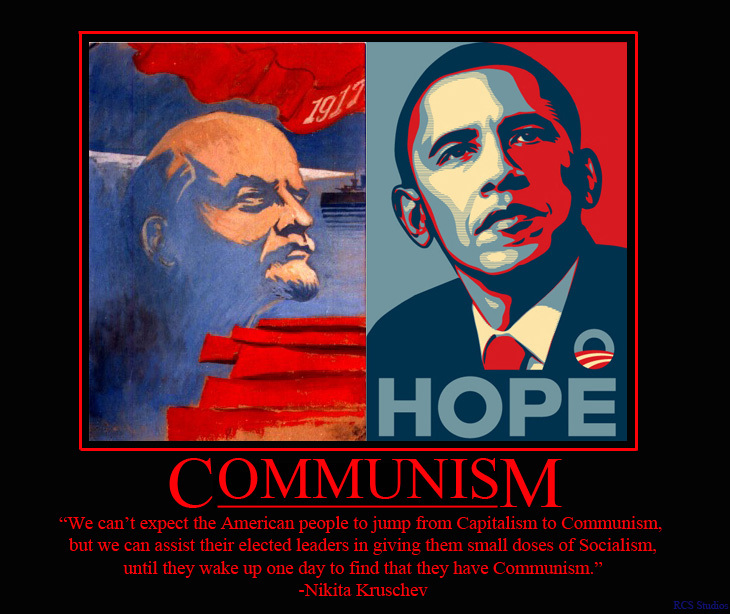
Obamapocalypse Now (Long live the Communist State!)


So, here at the PolySkeptic Compound, we have been Obama supporters.  Personally, I had a few issues with Obama over the last few years, but that was a necessary evil because we needed to wait for the right time.  But now things are really going to change, and I would like to be the first to present to you what we, here at PolySkeptic.com, have been planning.

Now that Obama does not have to worry about getting re-elected, he will be able to pull out all the stops and stop pandering to the middle, and even to the mere ‘left’.  It’s been quite hard for our secret godless cabal to plan the future without being caught, but let me be the one to tell you what is coming (I won the lottery at the last meeting, so I get to break the story, and details will follow over the next few weeks).

You see, for years the atheist movement has been working hard, behind the scenes, to build up a new political endeavor which will finally destroy god, freedom, and personal responsibility.  We have been meeting with the Obama campaign, the Socialist party, Communist party, and some others who will come to light son enough, and just last night we received official confirmation from those close to Obama that we are finally ready to strike tonight, after Obama wins the election.

Over the next few months, Congress and the Judiciary will be weakened before Obama will be named the GREAT CZAR for life, and the great Marxist plot to take over the world will finally truly begin (after a few failed attempts, mind you).  Within 6 months, we will officially be the Communist States of America (CSA), and the reckoning will follow.

We will finally unleash the goons on the churches of the land (but not the mosques, for they are actually secret atheist organizations, as Mohammad planned all along, unknown to the uninitiated) and destroy all things godly, and begin the new era of Muslim, atheist, communist dictatorship…I mean utopia.

All of those who have been fearing the loss of a free America, free markets, the 2nd Amendment, etc were right, and if they are smart they will take to the forests now where their stockpiles of weapons are stashed.  Not that it will matter, because when we unleash the robot army, their weapons will be useless.  With our mastery of Science, and all of the power and control that we can unleash with our mind-controlling chemicals in airplane chemtrails (all we need to do now is release the catalyst chemicals) and our re-education centers (some call it ‘brainwashing,’ but I find that crass), we will be unstoppable.

And the Tea Party and all the other right wing nut jobs who survive? They will be rounded up and forced to live in a new city (which we have built in secret) called Galt’s Gulch, where they will receive no help from the State, and will be left alone to be independent, responsible for themselves, and free to do whatever they want without regulation.  They will not be allowed to leave the city, of course (because they wouldn’t like what is outside anyway, so why would they want to), but they should be happy in their free market, non-nanny state that they want so badly.  They can be free to pursue wealth with shitty roads and infrastructure (with no taxes, how could they pay for them, right?), no regulation to protect them from sociopathic industry leaders, and all the stupid gods they can pray to for help.

A view from the nearly completed “Douchebag Tower” in Galt’s Gulch, location TBA soon!

Oh, it will be glorious here in the Communist States of America! No churches, praying finally outlawed, and freedom curtailed to keep everyone safe from things like guns, the 1%, and freedom.  And best of all, we will force the few extremely wealthy people we allow to remain around to finance our easy lives of sitting around watching gay porn and having debaucherous parties, at least until they run out of money.  And once they run out of money, we’ll send them into Galt’s Gulch to try and become wealthy again, and then raid the banks ofthat very city to re-finance our lifestyles without doing more than the minimal amount of work.  Great Czar Barack Hussein Obama truly is a genius!

The future utopia will be just like Rome!

In the new CSA, gay marriage will not only be legal but you will have to, by law, marry someone of the same gender as you.  And you must consummate that marriage at least once a month!  And we will be watching, so you better do it because we’ll know if you don’t.  But don’t worry, you will also be able to marry someone else, or like 15 other people if you like, and have your kinky three-ways and four-ways if that’s what you are into…which you better be!  Monogamy will obviously be illegal, punishable by threat of being thrown into the orgy pit; the kinky, leather, bondage orgy pit where the safe words must be guessed, and change daily.  Good luck!

We will all praise Darwin, PZ Myers (Freethought Blogs in general, actually, as their word is Truth, and always will be), and one other ‘saint’ (we will re-appropriate this word) of atheism of your choosing (from our approved list, of course), and you will have to give 6.66% of your social efforts (since money will be replaced by hugs, kisses, and hot, hot sex) to the great Science Altar where we will force children to be indoctrinated, I mean taught, about Evolution.

Concerning the Truth of Darwinism, we will all now capitalize Evolution and speak reverently, always, of Darwin.  For these are the Great Words of reverence which will never be questioned.  Creationists will be left in cages in public squares to be laughed at and there will be tomatoes present, if you feel the need to throw something at them.  And you WILL feel compelled to throw things at them, if you love the Great Czar.

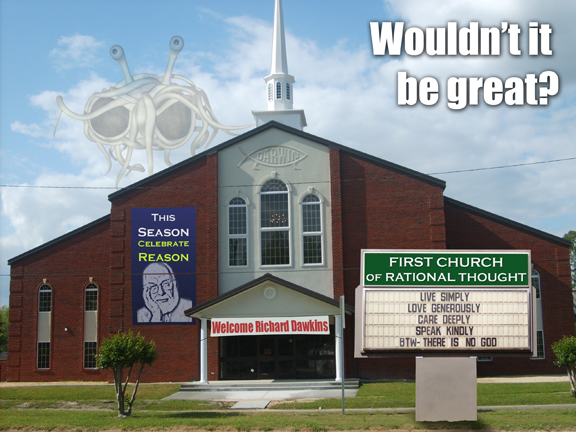
All churches will become this, or an orgy center.

Any praying, worshiping of gods, or even saying the word “Jesus” will be punishable by reprogramming at the Science Altar’s sister organization, the Ministry of Truth (AKA Pharyngula).  There, we will decide what is true, so that you can know, and any other attempts at truth will become illegal.  All Bibles will be burned, all crosses taken down, and all other religious symbols confiscated and destroyed along with all evidence that such a person as Jesus ever existed.  Over time, Christianity will be forgotten, and Islam will be revealed as the atheist cult that it has been all this time.  All the other religions? Well, they never seemed to matter much in American politics anyway, so who cares, right?  They just better keep it that way.

So, tonight we celebrate the dawning of a new era, and the future belongs to the Great Czar Obama and his Communist State.  This New Progress (as it may be called by herstory) has been brought to you by the Gay Agenda (thanks guys, you really gave 100%), Feminism (who taught me, personally, that being a real man is not really important), the Liberal Elite Media (ah, the LEMings! we really could not have done it without you!), and, of course, the Atheists for a New Socialist America (because we are the ‘ANSA’, amirite?), who have been working along side many atheist bloggers, groups, and even us here at PolySkeptic (this is why posting has been infrequent, recently; we were planning for the Obamapocalypse).

Thanks you all. And Obama bless America.

—-

[edit: This was all satire, based on stupid ideas that people have that Obama is a Communist/Socialist/Muslim, as well as ideas about atheists.  For some people, a few people were not sure how serious I was.  There’s your answer.]

Atonement and Monogamy as Impossible Ideals


As a student of anthropology, I think a lot about cultural constructs which permeate our lives, most of which are pretty invisible to us most of the time.  From an early age I was fascinated with the various institutions of religion, as well as the many more personal spiritual ideologies people espouse, and the various psychological and sociological structures which surround them.  Later on, I started thinking about similar aspects of how we think about sex and relationships, and eventually found many similarities between how we think about gods, spirits, and sex.  This is no surprise since one of the best ways for religions to hold our attention is to demand certain behaviors is to hold us hostage with fears about our deepest inclinations; sex is a great example of this.

In religion, there is this idea of atonement.  It comes in many forms from many theological systems, but it is basically the way that we come to make amends with some supernatural or natural power.  Whether we have to deal with a fundamental brokenness in our nature, some separation, or lack of enlightenment (to only scratch the surface of ways religious ideas deal with this atonement thing) from the power we seek atonement with, there is a set of actions and beliefs which we must do or have in order to reach some ideal relationship with the universe, deity, or ourselves.

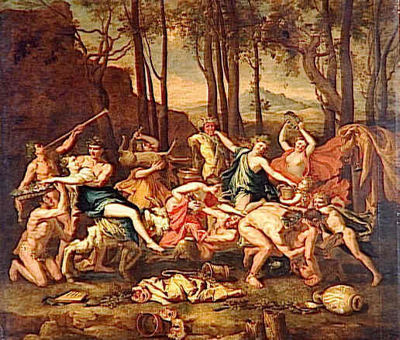
Tantalus perpetually reaching for fruit and water he will never grasp

It is my view that the religions which survive best find a balance of difficulty and comprehensibility in the ideals it sets up.  Adherents must be, like the  Tantalus of Greek mythology, perpetually reaching for this ideal of atonement which they cannot really achieve, but it must be something they can imagine as a logically possible thing to have.  Sure, people can think that they have achieved the goal (as many Christians believe they are saved), but the scriptures and religious leaders will always mention that this is pride, or something similar in order to keep them in check.

Opposed, conceptually, to atonement is some detriment presented as part of our nature or circumstance.  We stand unenlightened, sinful, or separated from some god(s), knowledge, or understanding and we will remain there until we atone, repent, or whatever must be done to solve this problem, heal this sickness, etc.  As Christopher Hitchens said many times,

Even the most humane and compassionate of the monotheisms and polytheisms are complicit in this quiet and irrational authoritarianism: they proclaim us, in Fulke Greville‘s unforgettable line, “Created sick — Commanded to be well.”

The bottom line here is that there is a tendency in human worldviews, whether religion or otherwise, to present a highly unlikely ideal against some much more likely, and often repugnant, set of behaviors or beliefs which we must be encouraged away from.


The sin of non-monogamy and the atonement with The One.

There is a mainstream view of sex and relationships, here in the modern west and most other developed nations, with monogamy as the ideal relationship type.  The majority of cultures have some version of this practice, and it’s major competitor is some kind of patriarchal polygamy.  Polyandry or true sexual/relationship equality is rare and considered aberrational when it occurs.  It took quite a while before we would have a sexual revolution, and with it true freedom started to become part of our cultural consciousness.

And yet even still there exists within our sexually liberated world a distinction between studs and sluts; men are expected to be promiscuous, women are often valued for their “purity.”  These promiscuous men and these sluts are expected, or at least encouraged, to eventually outgrow this part of their life and find The One, or at least settle for A One.

Do you believe that lifelong monogamy is a realistic expectation for a married couple? (click for context and details)

For most people who have a period of sexual liberation, it ends with the attempt to reach an ideal of monogamy. Men and women may be expected to have sexual experiences in their teenage years and into their 20’s, but eventually most people expect them to settle down.  “Settling down” means taking relationships seriously, and usually means exclusivity, marriage, and monogamy.  So while we are liberated as a culture in terms of having sex before we “get serious,” get serious we should, because seriousness means exclusivity and exclusivity is good.

The fallen circumstance, or nature, which even our progressive culture patiently tolerates for is one of promiscuity.  But this sexually liberated part of our lives is held against a stable future ideal of monogamy.   The holy grail of relationships, The One, is presented against the superficial and regrettable reality of youthful promiscuity.  This One is The  person with whom we can have a real relationship, rather than failing perpetually hopping from one insignificant relationship to another (sometimes at the same time!).

A mnemonic device I learned years ago about the word atone was that you can break it down into at+one.  In other words, especially for many Christian traditions, the goal was to work to become at one with some god or another.  All of our other inclinations, not having to do with this atonement, should be secondary to that relationship of working towards chasing that ideal, because nothing was more important than that.  Monogamy has taken a similar place in our culture as that ideal of religious atonement; the sinful and superficial world of sex, lust, and other failings of human behavior are presented against an ideal of monogamy.  That is, even liberal society maintains this ideal, even though that liberality allows sexual promiscuity, co-habitation before marriage, etc.  Anything that looks like monogamy, even if it isn’t really marriage, is what we should be striving for.  The difference here between mainstream conservatives and liberals on this issue is how we get to monogamy, not whether that is the goal.

This shows me that culture tends to be truly human (all too human!) and tends to have worldviews which are conservative even when we are progressive (I actually argue that today’s liberals are tomorrow’s conservatives, because the mainstream is largely conservatives concerning ideals).  We conserve ideals, even as our values shift.  So, even as we become increasingly liberal as a society in terms of seeing redemption and atonement in looser and looser terms, we hold onto the ideal itself.  Liberal views about the supernatural and what we should be doing with our lives changes in terms of the details of the path to get there, but the destination does not really change.  This is one of the greatest failings of most of mainstream liberal culture; it does not seek to question the ideals, assumptions, and goals of our worldviews.


Ideals Worth Wanting

What should be the strength of progressive culture, or perhaps a radical culture, is the re-valuing of our values.  We need to evaluate what is worth valuing, not what we should change in terms of how to get to our Heavens, Nirvanas, or other paradises whether they be otherworldly or physical.  The question is not how we can get to paradise or what we are allowed to do before we settle into monogamy, the issue is why do we value such ideals? Why is being at one with some supernatural power good? Why is monogamy the ideal?

I don’t think there are good answers to those questions, except to say that perhaps those things should not be ideals at all.  With religion, atonement is merely an impossible goal, set before us to tantalize us and keep us striving and behaving within acceptable boundaries.  Monogamy is no different, in that the only way to achieve it is to pretend as if our ability of love is so limited, and our sexual desires so parochial, that we force ourselves into ideal relationship expectations while repeatedly failing in thought if not act.  There is no reason to set us up with impossible ideals which make no sense to value, whether with gods or monogamy, when we have real ideals to inspire us.

A skeptical approach to reality brings us to an informed and skeptical atheism, and allows us to love the people we love, the way we want to love them, in order to live authentic and rewarding lives.  And while we may never be ideal skeptics or lovers, we can at least have ideals worth wanting.


God Who?


So, there’s this:

OK, so first of all the doorway to the polyskeptic compound is totally not in the shape of the TARDIS.

If you drive around New Jersey long enough, you will see this door. If you do, don’t stalk me.

OK, it is, but that does not mean that the house is bigger on the inside.  But the house can travel through time and space! …although only forward in time at the usual rate and in space only relative to things like cars, people, and so forth which move around and through it.

There are a couple of issues with the video above, such as the definition of religion used is not universally accepted, but I think it would be somewhat silly to seriously criticize such a video made with at least one tongue implanted in some cheek somewhere.

OK, so that sounds like it might be sexual, but I guarantee I’m only slightly turned on right now (and that has more to do with the TARDIS; it’s bigger on the inside.  That’s what she said).

OK, terrible jokes aside, I am sure that under some definitions of religion, some people I’ve met might classify as Whovian-cultists or someshit.  After all, a cult is really just a religion that is not Christianity, right? (It pains me to reference Matt Slick, so I feel like I need to balance that out with this video of a discussion between Matt Slick and Matt Dillahunty about the transcendental argument for god, or TAG).

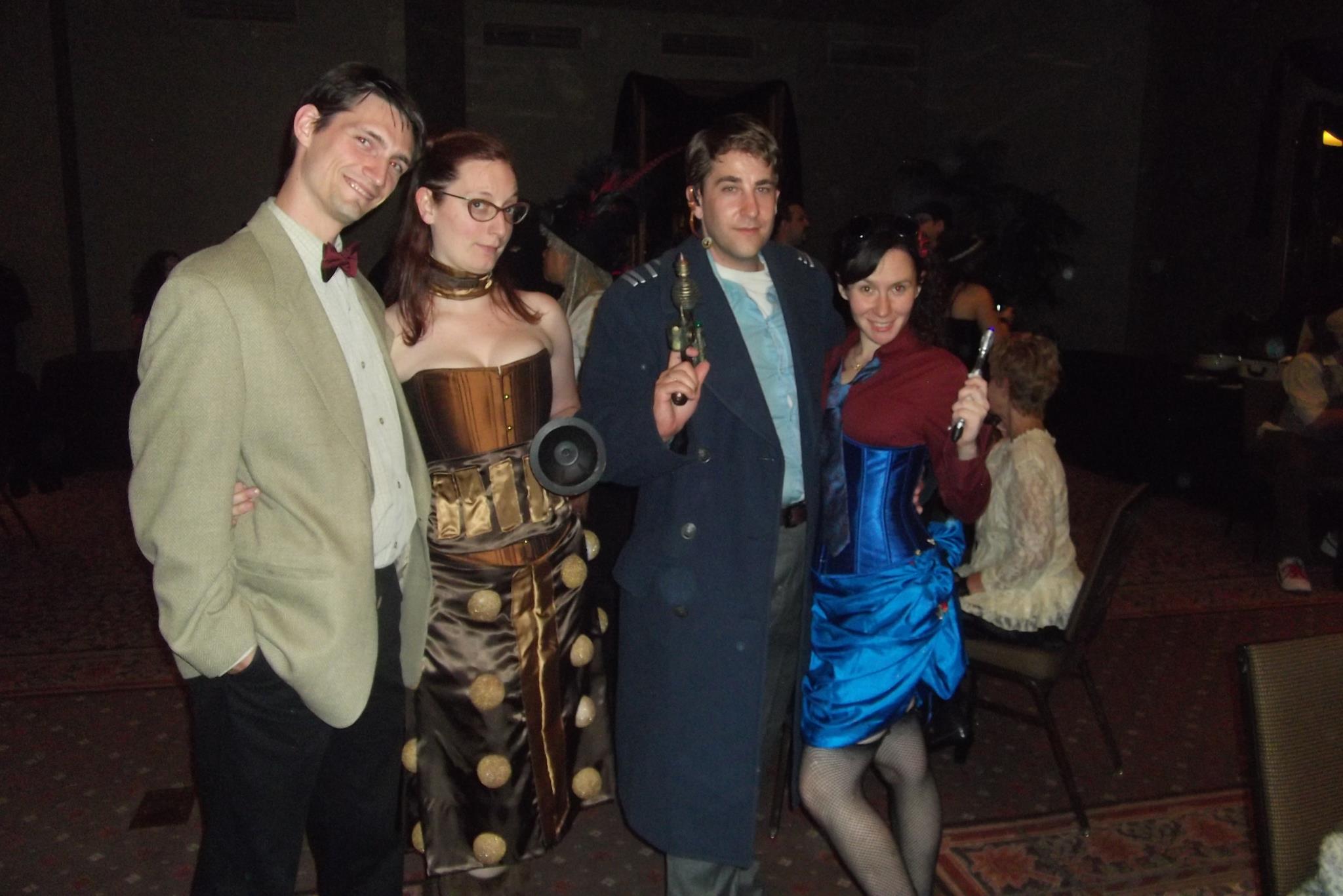
Two sexy Doctors, a Dalek, and even Jack Harkness participating in the traditional Whovian ritual of being drunk.

OK, so Doctor Who, in conjunction with its fan-base, might be thought of as a religion.  I have never thought of it that way, but I also think that one part of what makes something a religion is the acceptance, or belief, that the object of reverence is real.

And then I wonder how “real” the people who created texts in ancient times about gods, creation, etc thought the stories were.  I think part of what makes mythology interesting is realizing that for many people, throughout many eras, didn’t have the same distinction between reality and myth, nor did they have a solid meaning of reality which we would recognize.  In other words, it may be the case that many people who have religious beliefs are not thinking about “truth” or “reality” using empirical or skeptical concepts of either of those terms.

Certainly, people can take those mythological ideas and subsequently think of them as real in our modern sense, but the fact that they end up there does not necessarily mean they started there.  There is the question, for example, of whether many of the New Testament books were closer to literature than history (I would recommend Tom Verenna’s blog for more about that), and whether many scriptures from around the world are even comparable to any sort of skeptical inquiry.  It may be that Jesus was a character of inspiration for first century Palestine in a similar way as the Doctor is an inspiration for many people now, all over the world.

And this is the point where some people will point at me and be like ‘See! You admit that religion is not to be taken literally, so your criticisms of them as if they are literal beliefs is shown to be wrong-headed,’ or something similar.  The problem here is two-fold.

First, in many cases people do take mythology as real in the sense I mean it; as in it describes the actual world and they simply are wrong about the facts.  Second, the fact that some people do not think of things this way shows where they are going awry in not understanding that we have a reliable methodology for knowing things about the world, and that mythologizing the world is not a means to understanding, but obfuscation, parochialism, and ultimately a worldview based not on what’s real but rather what is comfortable or even non-confrontational.

Unfortunately, many postmodernist approaches to the world are much closer to those who mythologize the world, which is why, I think, many (secular) progressive intellectuals tend towards liberal theology or at least show deference to such liberal theologies.  Karen Armstrong, for example, has talked about ‘God’ without concern for whether such a thing exists, as if that was not even relevant.  While I appreciate some of the contributions of postmodernism in philosophy, the tendency towards anti-realism, as opposed to realism, in the philosophy of science and in metaphysics has always been a bane for me.

Art and religion

So, The Doctor is not real.  But the show can be a source for thinking about the nature of the world, our choices and their consequences, and so forth.  It’s a living mythology, of sorts, which many draw inspiration from.  But is that inspiration, entertainment, and possible edification spiritual? Is it a religious experience?

As a person who has never believed in supernatural realities, but who has had experiences that seem similar to the descriptions of spiritual/religious experiences, I would say that there is some gray area here.  Where I think I am likely to say no is that I think that these experiences are the result of art, and not religion per se.  Religion, the great usurper of all things human, has once again stepped in and claimed something as its own when it belongs to all of us, religious or not.

So, insofar as Doctor Who, or Star Wars, or Star Trek, or Shakespeare, or…you get the point.  So long as artistic expression invokes existential inspiration in us, it is art that has done it.  We need to stop associating these things with gods or spirits, because they are natural occurrences with no supernatural explanations necessary.

Where does this leave ‘religion’? Well, as we become more secular and educated as a species, I envision religion becoming conflated with artistic and ritual social ties which will probably never go away, even as their supernatural associations dissolve into the nothingness from which they came.  But we should not forget that those supernatural and irrational additions to the art we have created over time have been semantically tied to so many things, and that people will continue to associate nonsensical ontological concepts to everyday experiences, hopes, dreams, fears, etc.

Supernaturalism, theism, and even deism are irrational and even silly concepts which are clutching onto our art, even as they slowly die.  But the art, the inspiration, and the creativity of the human mind will continue long after the gods have all been forgotten.  So Doctor Who might be called a religion, but only in the loose and artistic sense that all that we do and love as humans is considered religious.  That is, in the watered down way that only seeks to distract us from what is truly irrational and dangerous about religion; faith.

When art turns into certainty, when creativity and inspiration is not checked by skepticism, is when it goes wrong for our art.  Because we can create illusory worlds to play in, but the imaginations of humanity are only for pretend and should not be guidelines from policy or morality without a skeptical check on their influence.  We need to leave faith behind because we don’t need to believe that our imaginings are real for them to be interesting.   Further, if we do believe they are real then we may be too unwilling, whether through reverence or fear, to make sure that they are rational.

So science and skepticism are not the source of all understanding, but they should be the arbiter of what we accept as true.  Art can inspire, entertain, and even teach us about the world, but we must make sure the lessons are actually true and not merely revere them unskeptically.

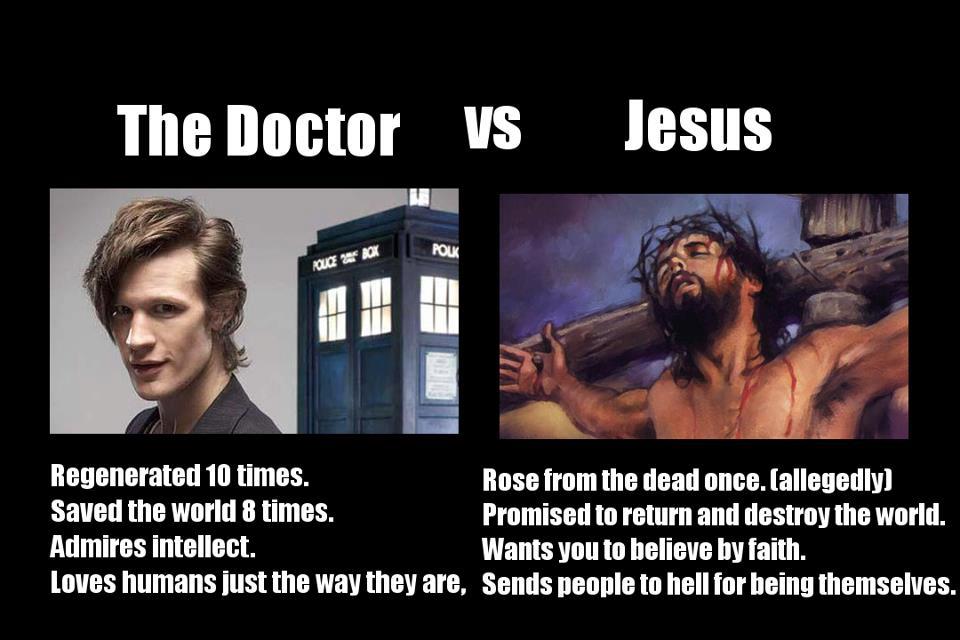
In other words, enjoy Doctor Who, and remember that he’s probably a better source of inspiration than Jesus.

Amen?

PZ Myers and Michael Ruse’s mis-attribution of the fault in our wars


I have been writing, reading, and thinking about the issue of accommodationism for some time.  Type ‘accommodationism’ in the search box above for some context, as there are too many posts to link to here.  I will say that  I have tended to agree with Jerry Coyne’s views about the relationship between religion and science most of the time, and I tend to agree with PZ Myers more often than not.

Yesterday, PZ Myers put up a post about Michael Ruse which I largely agree with, but I want to address something, not because it makes me disagree with the point PZ makes, but because I think it takes a step back and gives some larger perspective on this issue.  Here’s the relevant section from PZ’s post, quoting Ruse:

But wait! There are more paradoxes! One of the big problems with the New Atheism, says Ruse, is the way we idolize and support our leaders unquestioningly.

There are other aspects of the New Atheist movement that remind me of religion. One is the adulation by supporters and enthusiasts for the leaders of the movement. It is not just a matter of agreement or respect, but of a kind of worship. This certainly surrounds Dawkins, who is admittedly charismatic.

We worship Dawkins? And possibly Hitchens and Harris? Has he ever noticed how much we all freaking argue with each other? There are no saints and popes in the New Atheist movement.

Oh, wait, yes he has noticed. In the very next paragraph.

Freud describes a phenomenon that he calls ‘the narcissism of small differences’, in which groups feud over distinctions that, to the outside, seem totally trivial. It is highly characteristic of religions: think of the squabbles about the meaning of the Eucharist, for instance, or the ways in which Presbyterians tear each other apart over the true meaning of predestination. For those not involved in the fights, the issues seem virtually nonsensical, and certainly wasting energies that should be spent on fighting common foes. But not for those within the combat zone.

The New Atheists show this phenomenon more than any group I have ever before encountered.

So which is it? Blind, unquestioning worship of our leaders, or incessant fractiousness and dissension? It doesn’t matter. Ruse is just spinning his wheel of deplorable sins and accusing us of whatever random flaw pops up.

I will point out that PZ has missed that these two ideas are not, in fact, in necessarily contradiction, even if Ruse’s argument is ridiculous (which it is).  It is logically possible that people in the atheist movement idolize atheist leaders and that fractious arguments also result, just like with religion.  All it would take is a hypothetical Dawkins follower to argue with a Sam Harris follower, insofar as Harris and Dawkins would disagree.  And there are some people I have met who do seem to look up to some atheist “celebrities” with some level of idolization, but this is to be expected.  We are human, with personal flaws, after all.  The ideal, however, does not have anyone idolizing anyone.  I, for example, respect some people more than others, but I’ve never been a person who idolizes anyone, and never get fanboyish around well-known people, nor do I understand why other people do.

And I agree that there are arguments within the community, but I see this as largely a good thing even though in some cases it is evidence of bad ideas remaining among atheists (such as misogyny and privilege).  There is a lot of work to do before our culture matures emotionally, cognitively, and in terms of being aware of our privileges and biases.  And as a result of that, many atheists will tend to be stuck behind their own blindness, and fractures will exist which we need to addressed in the form of criticism and education of those people.  Hence Atheism+.

But what Ruse is identifying here is not so much that the atheist community is like religion, but that when groups of people gather for any common cause, belief, or lack of beliefs, they tend to have similar behavior patterns of idolization, arguing, etc.  So yes, the atheist community has some behavioral issues which are reminiscent of religion, but once again the error is in mis-attributing such things to religion, when in fact religion is the result of human group behaviors not the cause of it.  Ruse is showing how atheist communities are acting human, just like religious groups.  Why does Ruse make the (apparently unconscious) assumption that these behaviors fundamentally belong to religion?

Our goal—as skeptics and atheists concerned with our culture, our beliefs, and our actions—should be to improve how we all think, behave, and interact.  Those working on including social justice in their actions, whether atheist or religious, are taking a step in the right direction in such terms.  But what new/gnu atheism is about, Michael Ruse, is about asking whether the views some group has are true or not.  We must take as a given that we will err in how he think, behave, and interact, but the question which concerns us is whether our ideas are true, not whether our community is perfectly ideal.

That’s the long-term goal, and it will take time to get there.  And, as I understand it, this is what efforts such as Atheism+ were developed to answer.  Because if we want to address the human flaws and how they emerge in the atheist community, we have to understand how psychology turns into sociology; how our personal flaws turn into groupthink and tribalism.  The problem with religion is not that it fractures, idolizes its leaders, and then fights among themselves.  No, that’s a human problem which we all have to deal with.  The problem with religion is that it isn’t true; that they are arguing over fantasies.

Skeptical atheists, at least, are arguing over what is true with a methodology which works; science.  And if they are not using science and skepticism well enough, then we can use skeptical criticism to point out how and why.  When does religion do that? Religion uses logic on top of the assumptions of its theology, but it rarely, if ever, appropriately uses empirical methodology and good skepticism.

Michael Ruse is stuck comparing religion to atheism in ways which must be true because they are activities done by humans.  Where atheism and religion are alike, it is attributable to anthropology (what I have my undergrad degree in).  What Ruse misses, and what PZ does not articulate well in this case, is that what does separate religion from atheism is the concern for truth of worldviews rather than behavior of participants.

Because sure, some atheists go around  idolizing people and arguing over small details, but our goal is to help them personally grow until they are mature, skeptical, knowledgeable people with good cultural and personal perspective.  And unlike religion, we actually have real ways to achieve that because we do not have any scripture, doctrine, or limitations of criticism.

We have the best methods in our hands, no rules about where we cannot inquire, and only our personal flaws to hold us back.  That tempered by caring about what is true, rather than what is comforting, preferable, or sanctioned is a good road to progress.