Human, gamer, philosopher, godlike being, atheist, nonmonogamous, pariah, contrarian by nature, probably occasionally right human who writes nonsense to very few people.
Some people come here only to downvote my posts. That seems sort of ridiculous, right?
So, I have been a little busy recently. Started dating someone new, there was some Doctor Who burlesque that was distracting me, and I am now home brewing. So, this is a post to let you all know I’m not dead (Sorry, those of you wishing for that), and that things are going well.
I will eventually do non-extract brewing, but this is a start.
For those of you that don’t know me, I love beer. I have assisted in the making of beer in the past, but I have not yet ventured into doing so myself. I have decided to do so now, since I have a little free time (I’m in between work projects).
This morning, I spent some time doing some reading and then decided to create a yeast starter, since a lot of home brewing sites recommended that. I have just finishing doing so, and it is stored (it needs between 18 and 24 hours) so that I can brew tomorrow.
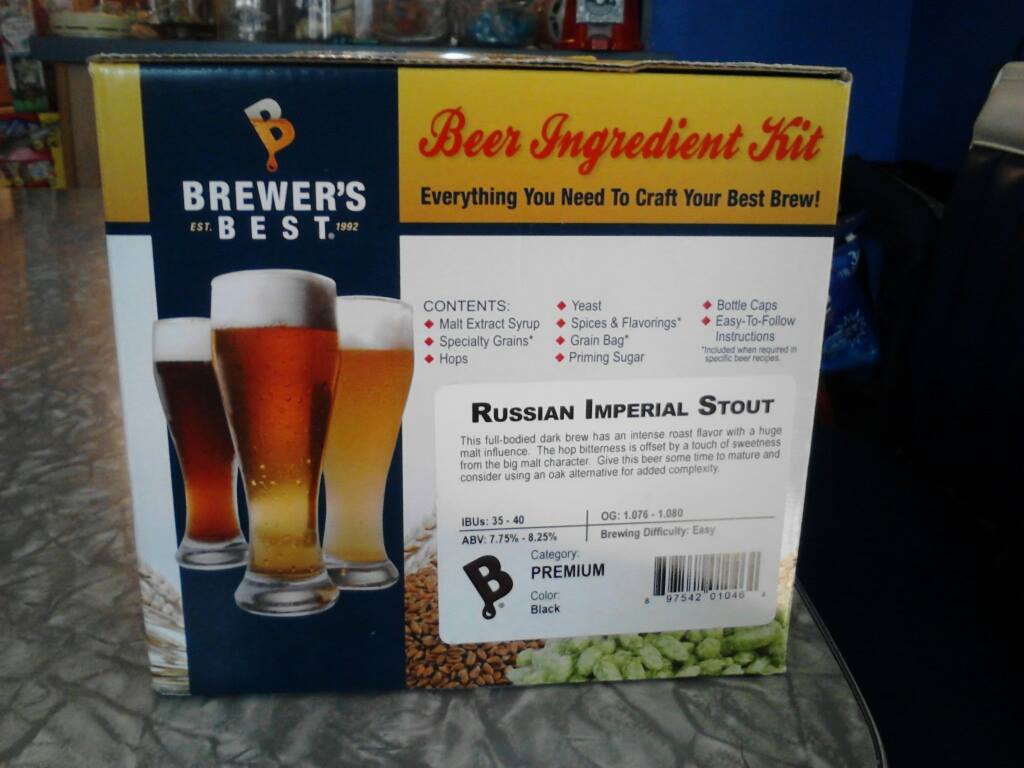
As you can see to the right, I decided to brew up a batch of Russian Imperial Stout (here are some commercial examples), a personal favorite fall/winter beer. Of course, after reading a bit more about brewing tips, it turns out this is a more complicated brew, and a few people said that someone with more experience should try this recipe. Too late now.
Russian Imperial Stouts tend to be very dark (and tasty).
So, I have all the ingredients laid out, I have the equipment out in order to be cleaned and sterilized in the morning, and in about a month I will have some beer! If you are local, and we like you enough, we may allow you to come over, have some (hopefully delicious) beer, and maybe we can talk you into going in the hot tub.
I don’t imagine too much arm-twisting will be necessary.
Also, I don’t know when we will be recording again. Maybe this weekend. Either way, we have not forgotten about PolyskeptiCast. We have all been busy with various things, including the burlesque show, and will get on that soon. In the mean time, check out the first three podcasts, if you haven’t already (or even if you have!) and send us some email with questions, comments, praise, berating criticism, etc.
I’m a slut. I know, I know, that’s supposed to be a derogatory term for sexually active women, but frankly I never accepted most of our mainstream hetero/mono-normative lingo anyway. We here at PolySkeptic are sex-positive, sex-enjoyin’, heathen mofos who support people of all genders, sexual orientations, and levels of kinkiness gettin’ their freak on. Be the slut you want to be!
And if you happen to be in the Philadelphia area tomorrow (Saturday, September 28th 2013) you can come out and hang out with a bunch of sluts and help raise awareness about rape culture, slut shaming, and other concerns of sex-positive advocates.
I will be there, at least for some of it (there is a poly party that will draw my attention in the afternoon). So if you are also a slut, if you think that you might be one deep down inside, or if you just want to show some support for slutty friends, perhaps you might stop by.
There is a facebook page for the group organizing the event, as well as a website (which seems to not have been updated recently).
People have all sorts of questions about polyamory. People hear that I’m polyamorous, and I explain what that means, and they want to know things. People ask me things like ‘how are you so awesome?’ and ‘what can I do to be just like you?’ a lot* and I can only tell them that this is all quite difficult sometimes to maintain the awesome.
But totally worth it. I mean, yeah we deal with jealousy, time-management issues, and sheer exhaustion sometimes, but then again I would not want to live any other way. When it is all working out, I’m happy, my partners are happy, and their partners are happy. It’s just a happiness clusterfuck.
I met Ginny more than 3-and-a-half years ago (married for more than a year) in a wonderful beer place in Decatur (outside of Atlanta) Georgia. I’ve been with Gina more than 2 years now as well. They are both central people in my life, and I enjoy being able to see them almost every day. But even though they are around most of the time, we still need to set times aside to do things together. We still need to have dates.
Last night, Ginny and I had dinner at a local great beer place–Eulogy–mostly because it’s closer to us than The Brick Store (the place where we met) and also has a great beer selection. I love Belgian beers, the Dijon mussels there are amazing, and it gives us some time to talk while not distracted by the internet, bubble wrap**, or other things that we do at home on an average evening.
Also last night Wes and Gina went to Monk’s, which is probably the premier place in Philly for Belgian beer and mussels (although Gina apparently drank wine–heresy!). so it seems we were all on a similar page last night. Al the while, Jessie had a date over to watch Doctor Who (because what else would anyone watch?), rounding out the house. All in all, a not so-rare night around here, where everyone has a date and it’s all natural. Take that mononormativity!
Pizza Pretzel!
And tonight, I have a date with Gina. So far, Gina has requested I make her some pizza pretzels for dinner (because while driving a date home a few nights ago, I stopped at the late night pretzel factory to pick up some pretzels. Because that’s a thing that exists here). I made myself one the other days and took a picture, which compelled her to threaten me with painful death*** if I didn’t make her one.
It will also likely include me mixing some ridiculous drinks at our in-house bar (PolyBar Galactica!) and maybe even watching Babylon 5 (oh, that’s what else people should watch…). In fact, for a while we would do things like that every Friday night, and it’s always a good time.
Oh, right, Ginny has a date tonight as well. And for all I know, 6 people may show up and be in the hot tub. It’s Friday after all.
Then tomorrow (you thought I was done, didn’t you?) there is the slut walk here in Philly. I will probably catch some of that, perhaps with my newest partner (who will remained unnamed to save her from the indignity of being associated with me), and then we will all be going to a party tomorrow with some poly friends. Three nights in a row with three different dates. My life is awesome.
So, people might ask how poly people manage to keep all of this in order. They may also wonder where we get the energy for it. Well, the energy part comes in with how awesome I am****, but the time-management has a lot to do with tools such as Google calendar, with its ability to share your calendar and have other people’s events show up on yours. This way, you know if your partner has plans some night (assuming they update their calendar) and can make time for the people you care about.
i just wanted to share some of our recent daily life, to show you that while this can be hard, it can be highly rewarding. This works, if you want it to. And while there are hard days (recently, there have been a few hard days and nights for me), I will keep moving forward.
I will keep enjoying life, because there will be a time when I can’t.*****
_____
*almost never. OK, never.
** Seriously, Ginny loves the stuff. The other night she was wearing some on her head and was popping it while watching some stupid show. She does that a lot.
*** No painful death was actually voiced. But it was heavily implied. I’m not taking any chances.
If you meet me at a poly meetup, for the sake of Lord Xenu and all the minions of Cthulhu don’t ask me how we deal with jealousy or other such banal questions. Instead, ask yourself how you would do so.
I know. Life is scary. You saw your boyfriend check out that cute girl at the bar. Your boyfriend is currently making out with that saucy minx in the hot tub. You think that maybe your partner is having a good time, without you, on their date right now. Maybe in a bedroom somewhere. Hell, you might just be worried that the person you are in the current process of sexually pleasuring might prefer the way another person does it. They might be thinking about the flirtatious sex bot at the party you just came from. You know, the one that triggered your insecurities about your own imperfections.
All of that shit is in your head.
And it’s in my head too. I worry whether I do enough to keep my partners happy. I worry about all sorts of things related to insecurity and fear. But I realize, even while suffering emotional throws of uncertainty, that it’s all an illusion. It’s all stupid, terrible, lies told by a madman who pulls the levers of fear in my head. I hate that madman sometimes. But that madman is me. And I don’t want to hate myself. So, instead it tell that madman to cut that shit out, because it isn’t helping.
He doesn’t usually listen to me, though.
I understand why people create boundaries, rules, and restrictions in relationships. I understand the impulse to want to stake a claim of ownership, or at least of permission, around your lovers so that this madman inside your head does not go crazy and start making you feel terrible and afraid. Monogamy, and polyamory with restrictive rules around things like sleeping over with another partner, not getting too emotionally attached, or something as simple as no sexual intercourse, makes sense from the point of view of accommodating this madman.
But those restrictions don’t solve the problem because that madman is, well, unreasonable.
Your partner really wanting to have sex with someone, but only being “allowed” to make out, touch, and get worked up with them while not doing what they want does not make you feel better. That’s an illusion. If your partner come back home from a date, does it matter exactly how much sexual contact they had with some other person (or people?) Isn’t the exact point of pain there either at the desire itself or your own fear? What does it really matter if they did what you were afraid of? Is the act itself the problem?
No. That’s all bullshit. When I’m feeling uncertain or jealous about what my wife or other partner is doing with someone else, the problem is not what “base” they got to (oh man, how stupid is that shit?), but my own fear of inadequacy. And my concern with what parts of their date was touching what part of them is not the location of the problem. And no matter how much it hurts, how many emotions flare up and demand to be attended to, the problem is illusory and stupid.
Whether a matter of social training about the possessiveness of relationships, an evolutionary/genetic set of dispositions, or something else, it’s all an illusion. The emotions are real, but the emotions are lying to you about the source of the pain. It’s a cognitive sleight of hand (and a good one, I’ll admit!), and even us poly people are susceptible to it. It’s very similar to “religious experience;” the experience really happened, but the experience is lying about its sources. It’s all in your head.
Fear is the mind killer. Emotions are powerful, and sometimes exist for legitimate reasons, but it is what we choose to do with those feelings that matters. Jealousy might make you want to punch the guy hitting on your partner, but that guy is not the source of the pain and fear. A sense of injustice might make you want to rant and rave against a clueless person (whether racist or not), but that person is not the source of the injustice. In those (and many other) cases, emotion can take us off the path of being the best people we can be. Fear, like depression, lies.
Don’t get me wrong. I am not advocating any sort of Vulcan-esque repression of emotion or even a complete distrust of our feelings. Emotions are wonderful, powerful, and useful parts of out human experience (when used well). I just want us to realize that there is a thing called rationalization, illusion, and a set of cognitive red herrings which compel belief in untruths. Emotions can convince us we are being reasonable when we are not. So whether it is possessiveness, righteous indignation, or many other forms of emotion which may compel action, we need to keep in mind that we might be being lied to, by our own brain.
Anger, fear, jealousy, and all the other emotions that are often called “bad” sometimes exist for good reasons. I will not tell anyone they cannot be angry, annoyed, etc. I will say that they should be careful with how they use those weapons. if you are not well trained in the use of a weapon, you are likely to hurt yourself or a loved ones with it.
So, anyone who tells you that polyamory is always easy is lying. I mean, the rewards, when it works out, are amaze-balls, but it requires a lot of work. And sometimes that work is really really hard. And scary. And utterly terrifying and real.
But, you know what makes it harder? Feelings. (Aren’t you glad I didn’t say “feels”? Yeah, well too bad because I said it anyway). I mean, all the warm fuzzies and sexy feelings from meeting someone new and awesome are great, and I love meeting awesome people that I like. Seeing your partners happy is a really nice thing as well, and seeing the people in my life continue to grow, mature, and learn about themselves is a wonderful thing (go us!). There are aspects of relationships, poly or not, which are wonderful. I would never not maintain relationships because it’s hard to do so.
I’m capable of allowing my partners to pursue what they want and need, and am doing so. The happiness that they get from their other relationships are not negotiable; they are part of those people, and I could not love them as they are (that is, authentically) if they were not also with those other partners. The rewards are being with those people I love, no matter who else they love.
But then there are things like anxiety and other fun things that come up when shit gets complicated. You know, like when the woman you are really into has a boyfriend who is new to and unsure about polyamory, and you feel like a total shit for making him feel terrible for fucking their shit up. That, coupled with the fact that the woman you are totes into is totes into you and doesn’t think she can go back to just being exclusive with her long term partner, largely because she has never really wanted monogamy. And then the time you meet is, perhaps, not the most ideal and it leads to shit getting real.
I don’t try to proselytize polyamory by meeting awesome women in monogamous/monogamish relationships,, or really at all. In this case, it just happened that way due to a random set of circumstances that lined up the right way (or wrong way, perhaps, from another point of view). I’ve never dealt with this type of situation before. I’ve met monogamously inclined single women that I liked (that didn’t work out), but not polyamorously inclined women in a relationship with a monogamously-inclined partner. I’m sure I’m not the first, but it’s new to me so I am trying to tread carefully.
After long conversations late into the wee hours of the night, it became clear that there is no clean way out of this situation. Sometimes, we can’t go just back to the way things were. Sometimes, to go forward involves changing everything, whether in good or bad ways. If circumstances were a little different, I might just walk away and let them repair their relationship, but I’m not sure that’s possible anyway. So I’m not just walking away, because I like her too much, and she likes me too much. At this point, the damage has been done, so it’s a matter of how we are going to re-build the boundaries. And it might mean that I might have to not be part of it, which I don’t prefer but have to accept as a reality.
This is where communication is most important. There are people hurt right now, and it’s partially (largely) my fault, but it cannot simply be ignored. Communication will be awkward, terrifying, and nerves will be raw. But it must be done. As I write this, I’m starting lines of communication with the boyfriend. I don’t know where it will lead, if it will be awful or fine, and I am all kinds of nervous. I’m nervous to not come across as threatening, aggressive, or flippant. I am also impressed that he’s willing to talk, despite his obvious discomfort. But it must be done.
For the sake of the woman in question (who will still remain unnamed), so that she does not have to keep mediating all of the conversation, we have to be adults and talk this out. It probably will not be fun, but it is necessary.
If there is a take away from this post, it is this. Make the effort to talk about the problems which exist as early as you can. Relationships are hard, and you should communicate all of your preferences, desires, fears, etc. Communication may not lead to the solution you want, but it will avoid the worst case scenarios that come about by ignoring the problems.
Way back in the 20th century I discovered polyamory while in college.
First, there was Erin. We met early in our freshman year, had instant chemistry, but she had a boyfriend. But our intense chemistry did not slow us down much, and eventually her and her boyfriend went their separate ways, and Erin and I dated through sophomore year.
When junior year came around I met another girl, Lauren while Erin and I were still going strong. These two women complimented each other for me in many ways, and as I started to spend more and more time with Lauren, Erin started to worry. Eventually I (stupidly) broke up with Erin and dated Lauren.
And then I started dating Erin again, this time while not breaking up with Lauren. They both were friends, they knew that I was dating both of them, and they were comfortable enough such that the 3 of us spent a lot of time together. Then I discovered the term ‘polyamory.’ To make a long story short, all that ended badly, due to being young, immature, and not having the experience that could have made it turn out better.
I bring this up today because it is a pattern that is familiar to many people, including monogamous people, and because there is a variation on this theme that comes up with polyamorous people a lot; meeting a polyamorous someone while monogamous.
Now, I have not had this happen to me in my own life, but it happens. And, as a polyamorous person, I see the other side of this frequently. Just recently, I’m seeing the other side of this in my own life. Just recently, someone who has been monogamous with someone for a few years met me.
Over the weekend, at the PA State Atheist Conference, I met a lot of people. I got a chance to hang out with some fellow atheist bloggers, old friends from the community I have not seen in a while, and made some new friends. There were a number of intelligent and attractive women there, and because I like attractive and intelligent women I flirted with some of them (because yes, that is still allowed…) and got some flirting back. In the end, I met someone fantastic.
So, as the conference was ending and people were leaving, I found myself sitting with a woman who I had noticed checking me out, and decided to just go for it. I asked her out. She smiled and said some words that told me that she was monogamous; “I have a boyfriend.” Because, see, a polyamorous person saying this would not be a no to the date, it would just be information about them. But the fact that this was the answer to being asked out, I figured that this was the end of that line of conversation.
As we kept talking (because a no to a dating proposition is not necessarily the end to a conversation, especially since I tend to ask people out I like and I am able to have attractive female friends), the sense of flirtation never quite left but I figured this was an example of how monogamous people are still attracted to other people, even if they may not do anything about it. Then I mentioned my girlfriend, and she gave me a confused look.
Oh, I never told her I am polyamorous, I thought. We had talked some, but it hadn’t come up because we were at an atheist conference and other things were going on.
And then the conversation changed a little. I explained polyamory (she already new what it was), and she expressed some interest in attending the Doctor Who burlesque that most of us here at polyskeptic were putting on that night. It turned out there was one extra ticket, and she showed up!
And then the real flirting started, after the show that night. There was real sexual and personality chemistry between us, but she still had a boyfriend. I knew that at some critical stage that attraction would become too difficult to manage, so rather than suppress it I made sure she knew exactly how I was feeling, what I wanted, etc. She knew I was into her, she told me she was into me, and I knew where it was going if we didn’t get off that train. She showed up, again, after the third show two nights later, and we talked more. I knew we were in trouble, and it was crystal clear when we kissed.
All this time, she had been in open communication with her boyfriend, who is out of town with family business. None of this was completely surreptitious. Had she been hiding her flirtation and interest in me from him, I would have not continued (despite my attraction) because that is a terrible way to start a relationship. I could not trust a person who was lying about me to their partner(s).
Being caught up in all of this whirlwind of the genesis of a potential new relationship, having new feelings for someone I just met, has taken me back to those early college days when I was first falling in love with Erin while having to navigate the right things to do, what to say, etc to try and respect an existing relationship while not pretending that I’m not burning up inside with desire. The difference here as compared to then is that then I saw no alternative to replacing the boyfriend, and this time I find myself wanting to make sure that the boyfriend does not see me as a threat. I don’t want to replace anyone. I just want to love who I love, how I love them, and understand that they want to do the same.
I want to add to, not subtract from, the life of this woman with whom I’m sharing this whirlwind. I don’t want to have her boyfriend see this as a threat, I want him to see that polyamory has the potential to have our horizons broadened, our ability to love enhanced and strengthened, and to break down the walls of social expectations around love, ownership, and exclusivity. A Brave New World indeed!
But from his point of view this is all scary, sudden, and confusing. I have not talked to him so far, but I know this is causing stress to both of them, and all I want to do is make it better. There is not much I can do, however, and so I find myself struggling with wanting to see her again (and again) but knowing that the more time we spend together, the harder it will be to not look threatening to him. Also, the more time I spend with her, the harder the potential end to this ride will be. I would be hurt if it had to end as things are, and so I find myself trying my patience in order to make sure it doesn’t have to. But it’s difficult.
I have to balance the desires that the two of us have with the struggle that her boyfriend is going through, and it is not an ideal situation for any of us.
I don’t know what’s going to happen. I know that this woman (who I will not name because I have not asked her if she would mind my doing so) is the kind of person I could stay with long term, potentially. I know she loves her boyfriend and does not want to hurt him (neither do I). I know I want her in my life, and that includes all of the sexy feelings we have for each other. Being just friends would be painful, inauthentic, and would ultimately fail in the long run. (I’ve been through a similar situation in the past, and that did not end well. I want this situation to end well).
I know I’m nervous and anxious about this. I know that he must be terrified. But I want him, and any other person in this type of situation, to know that I am not here to hurt anyone or break up any relationships. Poly people (ideally) do not end other people’s relationships; they add to them.
I just want to love who I love, as I love them, and understand that they will want to do the same. I am not a threat, even if the situation seems threatening. That is so hard to understand from a monogamous point of view, and it is a reality that much of our culture still has to learn.
So, here’s to monogamous culture adjusting to a growing polyamorous world. And to all of us loving who we love, how we want to love them, and understanding that they will all do the same.
For those of you who are interested in such things (and as a follow up to my post from the other day related to Babbage), I embed a youtube video of a Babbage Difference Engine, created from Babbage’s drawings and plans. The original one was (mostly) completed in 1991, but the one on the video, which is currently on display in Mountain View, CA, was completed several years ago. The video has details.
It’s fascinating to watch:
The machine in the video is the property of Nathan Myrhvold, who is a former CTO at Microsoft, who plans to eventually display this machine in his living room. Man, I hope if he has guests nobody spills a drink on it.
I don’t know if i will be in California again before it’s taken off display, but if you end up near Mountain view while it’s still there check it the museum. Hell, stop by anyway, the place looks pretty awesome.
Yet while Ada was lucky in the education she received, she has scarcely more ground for optimism than any other intellectually enthusiastic women of her day as regards finding an outlet for her mental energies after her education was completed.
…
For a woman of Ada’s day and social class who wished to lead a mentally fulfilling life, the opportunities were close to non-existent. There was generally little alternative but to marry, produce children, and live for one’s husband.
The Ada above is Ada Byron, the only legitimate child of Lord Byron, later known as Ada Lovelace (after marrying a man who later became the Earl of Lovelace). If you don’t know the name Ada Lovelace, you should. A close friend of Charles Babbage, who is sometimes referred to as the father of computers, she was inspirational and influential in the development and the spreading of Babbage’s Analytical Engine, which was the conceptual framework for the eventual practical creation of computers.
Over 100 years later.
The reasons why the development of computers happened closer to 1950 than 1850 is in part due to Babbage’s poor diplomatic and interpersonal skills, but also to politics of 1840’s England (Sir Robert Peel, then the Prime Minister of the United Kingdom, had a part in this, being the miser who refused Babbage’s funding in 1842). Ada Lovelace, a woman of enthusiasm and wonderful ability to explain the concepts that Babbage ingeniously foresaw, was not able to be the spokesperson nor the valuable colleague that she might have been had Babbage’s stubbornness not been so potent.
The ‘Interpretor’
Charles Babbage
Many men in academia and technology may have some traditional precedent, with Charles Babbage, in treating women collaborators as mere assistants or, in this case ‘interpreters,’ but at least there is no evidence or reason to believe that Babbage sexually harassed Lovelace (although it would not be impossible that they were lovers, although there is little evidence of this as well). Babbage was not especially misogynistic or awful, he was actually generally liked as far as I can tell, especially by Ada herself. But this was the 19th century, and misogyny was simply a stark truth about the European world.
Suffice it to say, Ada Lovelace may have had a much more profound influence on the earlier development of information technology had Babbage’s stubbornness and selfishness not been so debilitating to his obvious intellect. Perhaps there is a lesson in there for all intelligent and yet stubbornly selfish and short-sighted men in the various places where skepticism and technology reign.
But more universally, there is a lesson for all of us. Our intelligence, even if great, is often insufficient. We need more than mere processing power and memory to be wise, and perhaps it is wisdom which we should seek in addition to intellect. In too many cases, we see people with obvious intelligence (and memory, especially with everything logged online), but not as often do we see actual wisdom, perspective, or a willingness to challenge oneself. Had a man like Babbage been more wise, we might have had computers by 1900 rather than 1950. Further, the name Ada Lovelace may be remembered for much more than a mere interpreter or (dare I say) cheerleader for Babbage’s work, but as a fully recognized pioneer in information technology of which she was more than capable.
Notes of the ‘Interpreter’
I made reference, above, to Charles Babbage shrugging Ada Lovelace off, despite their very close friendship and collaboration, as a mere ‘interpreter’ of his work. This flippant title was bestowed upon her due to her translation of a paper about Babbage’s Analytical Engine by an Italian mathematician, Luigi Menabrea (Lovelace’s translation can be found here). But in addition to translating the paper, she added 20,000 words or so of ‘Notes’ which give more detail and depth to Babbage’s ideas.
A new, a vast, and a powerful language is developed for the future use of analysis, in which to wield its truths so that these may become of more speedy and accurate practical application for the purposes of mankind than the means hitherto in our possession have rendered possible. Thus not only the mental and the material, but the theoretical and the practical in the mathematical world, are brought into more intimate and effective connexion with each other. We are not aware of its being on record that anything partaking in the nature of what is so well designated the Analytical Engine has been hitherto proposed, or even thought of, as a practical possibility, any more than the idea of a thinking or of a reasoning machine.
The “idea of a thinking or a reasoning machine.” This was written in 1843, but the fundamental ideas were older than that, possibly tracing back as far as the night when Babbage conceived of the idea of the Analytical Engine in December of 1834 when he explained the idea to three women, one of which was a 17 year old Ada.
Mind and Machine (skip this section if philosophy annoys you)
I have been thinking a lot recently about the so-called mind-body problem. I remember when I first was exposed to this philosophical problem, when I started reading philosophy around age 16 or so. I also remember, when I got to college, being surprised that people still thought it was a problem. I remember listening to people, usually Christians, that would defend a form of dualism, or at least of perceived difference, between their personal subjective experience and the seeming objectivity of the matter that was their brain. For many people, there really seems to be a disconnect here. I honestly don’t get it.
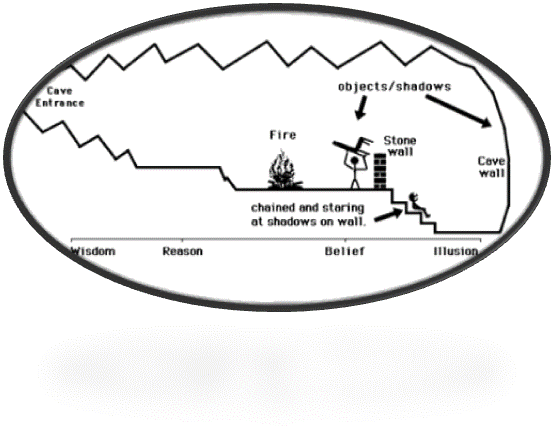
An illustration of Plato’s Cave
The idea that my subjective experience simply is what it is (like) to be my brain (well, my whole body really, but mostly my brain) seems intuitive to me. I don’t feel the disconnect between subjective experience and an objective (projected, really) external reality of ‘my brain.’ I recognize that the illusion is that separation, not either of the sides of the proposed dualism (I’m getting overly philosophical, I know).
This is why I understand idealists sometimes, I just think they are making the same basic error that dualists make–the conceptual distinction between subjectivity and where that subjectivity occurs. (stupid subject-predicate language making it really difficlt to express that idea!)
Some might balk at this and claim that they have no idea what it’s like to be a brain, but I will argue that this is all you know. You may say that you have never seen your brain, so you can only assume it exists, but this is disingenuous. You don’t literally see the light reflecting off of any surface of your brain, to be focused and sent to your brain for processing, but everything you think is your brain. You could use the same argument for the back of your head. You will never directly see the back of your head (this bothers me for some reason…). All of the light reflecting and refracting, entering your eyes, etc happens somewhere else. You are your brain, and so you have intimate knowledge of what it is like to be a brain.
Continuing with Plato’s cave as the basis for explanation, it is the (metaphorical) shadows on the wall–what Plato called the illusion– which are real. In other words, all that we ever really experience is our physical body. Our subjective experience is what it is like to be that body, experiencing the world. There is no separation of mind and body, because your mind is your body.
Believe it or not, this image (1839) was woven with silk on the first automated loom (first demonstrated in 1801) by Joseph-Marie Jacquard.
The looming question of AI (getting less philosophical)
Our brain is a machine. It’s a complicated machine and we don’t understand everything about how it works, but it is a machine. It is unlike computers we build, because we designed our computers to work in a different, logical, way (one that is largely based upon the technological ancestors of computer architecture, such as Jacquard’s Loom; the subject of the book I’m currently reading).
The bottom line is that our mind is a process which exists within matter–neurons and supporting tissue–within the brain. We are fully physical beings, made up of actual material stuff, like chemicals, atoms, and quarks.
There is no soul. There is no supernatural or dualistic spirit or soul here. There is no reason to believe that, and the very idea of dualism is fundamentally broken, in that to even talk about some supernatural substance has to steal from naturalism at very least, and that if it were truly separate, they could not interact (creating a more perplexing problem for dualism that I will not dwell on). Mind, put overly simply, is a process of matter arranged in a complex and delicate way.
And at some point, it may be possible to replicate this type of process artificially. Now, I’m not much of a transhumanist, at least in the sense of being overly optimistic (or pessimistic) about some potential Singularity which may occur at some point in the (near or distant) future, but I do believe that it is technically possible to create intelligence with computers, and I’m fascinated that Ada Lovelace seemed to foresee this possibility 170 years ago.
Learning from mistakes and successes
For those of you who are disappointed that I didn’t make any horribly misogynistic jokes about women and being artificially intelligent, fuck off. For those of you who see that our ability to progress–socially, politically, culturally, and technologically–is hampered by our inability to see past the mundane and conservative elements of our nature, then I gladly embrace you as a collaborator, no matter your gender.
We as a culture have come a long distance, and we have a long way yet to go. We must learn from our errors, yes, but we also must pay attention to when, and how, we succeed. Babbage didn’t succeed with his project to create an Analytical Engine in his lifetime because he was stubborn, unwilling to re-consider his abilities and deficiencies, and because some of the powers to which he was subject were more concerned with politics than the potential of human ingenuity.
Babbage dropped the ball in arguing his case for government funding to Sir Robert Peel (who was, it is agreed, already prejudiced against the project) in complaining about mistreatment and loss of reputation from people in his community. And yes, hindsight makes judging Peel’s refusal more biased for us living in a computer age. But it is worth remembering that rather than take the time to humble his admittedly great intellect and challenge himself to see the problem from another angle, or even to accept Lovelace’s suggestion to be his spokesperson in procuring funding for his work, he never succeeded in creating his Analytical Engine probably because of those faults.
But he left plenty of notes behind, and people used them. The eventual development of the computer was largely dependent upon the work he and his colleagues did in the middle of the 19th century. Imagine how much more, and better, they would have done had they not excluded more voices than they heard. Imagine how much Babbage could have accomplished had he not been so stubborn and, well, conservative (I realize the term ‘conservative’ in this context, is anachronistic).
Further, imagine how much we can accomplish if we all start being inclusive in all aspect of our social, cultural, and technological pursuits. Or maybe, it will take the Singularity to reach such inclusiveness, since so many people seem unable to escape their own tribalistic nature. And then ironically accuse others of tribalism. Much like the inseparability of mind and body, the great rift is the community. The problem, of course, is differentiating between the healthy tissue and the cancer.
When a community has some individuals with an un-drifting mission to merely replicate and spread with more concern for freedom than safety, while other parts listen to the world in order to to decide what to do and how to do it better, I think that is called brain cancer.
So, this is pretty awesome. I have spent many years reading about the history of religion, and i think that the subject is very interesting. I could have spent all of those years doing nothing except reading about religion, and still only scratched the surface of this:
Just a segment of the awesome.
That’s just a snapshot. To see the whole thing (and to zoom in and scroll around), click here or the image itself. The complex history and sheer number of religious traditions is astonishing to see displayed this way. I could get lost in this image for hours.
Perhaps it’s worth pointing out that the fact that we can categorize religious traditions into a tree says something about the nature of religion, and of human culture in general. Human culture, including religion, does not come out of a vacuum. Religion is not revelations from up high, it is natural, organic, and growths from us.
In one sense, religions are beautiful in that they represent not only what is amazing and sublime, but also what is terrifying and dangerous, about our ability to create and to interpret the world. They are windows into our “souls;” glimpses of what we could be–both good and bad. They are dreams and nightmares all at once, prying under our mundane lives into the engines of possibility.
And yet, for all that is good in them, there are paths which can clean up the mess and the grime attached to these fantastic reveries. There is a way to drain out the dirty water of fantasy and to know what is real, and as we advance in our understanding we learn more and more about how to do this. The growth of this religion tree will not cease, but it may be pruned by this method. There will always be branches of this religious tree, I’m willing to wager, but the branches which survive will have to contest with another tree.
Science, empiricism, and skepticism generally owe much of its existence to the intellectual traditions of this religion tree, but it is a different type of organism. Entangled, all too often, with this massive faith tree, skepticism takes root in a part of us which seeks to avoid the siren songs of Nietzsche’s old metaphysical bird catchers. That ground is fertile, but for many it is foreign soil. I hope that changes, because our culture needs better soil, if we are too grow, thrive, and survive.
So, once again I get to quote my favorite passage from Nietzsche, referred to above, because I think it encapsulates my values better than just about any collection of words I’ve yet seen:
To translate man back into nature; to become master over the many vain and overly enthusiastic interpretations and connotations that have so far been scrawled and painted over the eternal basic text of homo natura; to see to it that man henceforth stands before man as even today, hardened in the discipline of science, he stands before the rest of nature, with Oedipus eyes and sealed Odysseus ears, deaf to the siren songs of old metaphysical bird catchers who have been piping at him all too long, “you are more, you are higher, you are of a different origin!”—that may be a strange and insane task, but it is a task








 Skepticism, Properly Applied