Meaning of the Jesus Story; History v. mythology


I was just catching up on some blogs this morning and read Jerry Coyne’s thoughts on the virgin birth, the resurrection, and their importance in Christian (specifically Catholic) faith.  Towards the end, he says this:

…as has always been clear, the things that to Christians are non-negotiable “truths” of the Bible are those fables on which their faith rests most heavily. Therefore they can dispense with the parting of the Red Sea and the curing of lepers, [but] not with the Resurrection, which is the most important fable that Christians must accept as literal truth.

But if that’s the case, then why not treat Adam and Eve likewise?. For without the Original Duo, and Original Sin, the crucifixion and Resurrection of Jesus would make no sense (as they say, “Did Jesus die for a metaphor?”).

It is a set of points that I have thought about (and probably written about) myself over the years.  But it got me thinking; How do we approach the significance of an idea depending on how historically reliable it is? How do we think about the meaning of an act if we think it really happened versus if it is a mythological metaphor for something? How do the standards of import differ in contrasting history from mythology?

If a friend took off work to do you a favor, that would be appreciated and would have some real import.  If a person were to push you out of the way of a car, saving your life and sacrificing theirs, that has more import.  For many, Jesus’ sacrifice, is seen as the superlative sacrifice.  Further, it transcends the mere saving of a short mortal life, and becomes the transformation of an eternal life.  We are all doomed to death/separation from god/whatever and Jesus steps in to take the bullet.  And many believe this really happened, and is not merely a metaphor.

But our litany of stories from various religious, philosophical, and cultural sources contains a multitude of stories with moral, social, and philosophical import, many of which attempt such universality.  And it is clear, at least to me, that these stories are myths, even if they contain some historical truth to any extent.  They are, in essence, products of our imagination.  The complicated morals, literary structures, etc that such stories convey, and often contain high moral and philosophical import, are fancy fabrications.

And while reality may occasionally, accidentally, resemble such fabrications in terms of narrative complexity, moral import, etc, the rule is that the design of mythology is better at creating meaning and import than reality.  A narrative with more complex interwoven philosophical themes, governing more broad area of impact and importance, is more likely to be mythology.  The story of the New Testament, with its universal import and intended (but ultimately failed) sacrificial plot, is a good example of a story which is clearly mythological, even if potentially based on historical facts.

—-

So, the essence to my question today foes something like the following.  If I believed that the Fall of Adam and Eve, as well as the resurrection, were literal things that happened, does that mean that the import of the acts involved have more impact than if they were mere stories about the human experience? Would the fact that these actions really happened give them greater impact, emotionally and philosophically, than if they were mere stories?

Consider my example of someone taking off of work to help you with some problem; imagine that this story were part of a religious canon, rather than a thing that really happened to you.  If you found this story in the New Testament or the Koran, would you be impressed by it? Probably not.  But if someone really did this, for you or someone you know, it would have some importance and meaning, even if it were a small amount of such.  The fact that it is real gives it more import to your life, even if the act has less moral and philosophical complexity than mythology.

The thesis is that when things really happen, their personal and social importance is greater than if they were mythological.  Mythology has to be exaggerated, embellished, or at least rare to survive as a story of significance.  It may be that extraordinary real events inspire such mythology in some cases, but such stories always take on legendary status the more they are told and re-told, because story-tellers have to sell the story.  Thus, we will microfy the import of a story which is mythological because we understand that it is embellished, whereas reality, which sits in front of us, is not.

So, a story about a sacrifice, in order to be held as ultimate import, has to become embellished.  Religion, then, is part of our story-telling nature, and only stories with universal themes and import can survive to legendary status.  And while these stories sit behind our lives as an influence for our behavior and beliefs, reality continues on and we continue to act in less than superlative, but meaningful ways.

And many religious apologists argue that this is what makes religion great; it stands as an example for us and helps preserve our cultural norms and values in narrative form.  And for those that believe the stories are true, there is a greater amount of reverence towards those acts (and those who perform them), beyond mere inspiration.  But, for those people who don’t believe the literal truth of these religious stories,such stories can still remain as inspirational narratives, even if the non-historical nature of the story takes something away.

Of course, by not believing they literally happened, one can also criticize the import and morality of the lesson.  It seems more appropriate, for many, to criticize a story rather than a real act.  If we see Jesus as a metaphorical example, and not literally a person (or god) who “died” for our sins, then we can hold him up as an example (even if not a great one) of what humans can do for one-another.  But if he was (and is) god, then that fact puts the story on a level of import which dwarfs any mere myth.  The same story, depending on whether it is true or not, has different import.

But here’s the problem; if stories such as the all and the resurrection are literally true, including that a god is behind it all, then the distinction between mythology and reality breaks down in this respect.  The basis for real actions having inflated import is that such things occur within a real of minimal control over the circumstances, whereas in a story the composer has, well, god-like control over the circumstances.  A friend taking work off to help you is only in control of their own actions (taking off work and helping you), not the circumstances which led them to have to make that choice.

The story of Jesus, if we saw him as a mere human who acted in the real world, could be of great import as an inspiration towards sacrifice and love (assuming we ignore the non-loving stuff in there, of course).  But as an intentional creation of an all-powerful god, the Jesus story is designed, and poorly, because a better story could have been designed.  The world could have been different, the sacrifice unnecessary, and a greater story could have been written.  The more true the Bible is, the less powerful its story ultimately is; the more control the author of the story has, the less impressive it is.

As a set of inspirational stories, the New Testament has some philosophical and moral import on their own, but if Jesus was real and did a lot of the stuff in the gospel accounts, then the import increases because a person actually did those things, rather than them being idealistic narratives of some authors.  But if God is real, and god designed and orchestrated the whole thing, then I’m not impressed, because I think that I could write a better story than that.  God didn’t just compose the narrative of Jesus, but he also composed all of the circumstances which allowed them to be necessary.  In short, God is a terrible composer of stories (and universes).

The Bible, as a collection of stories, is a work of human minds and hands.  It takes the nature of the world, indifferent and often unpredictable, and comes up with a set of narratives which offer some consolation and moral import.  Bu those imports are inflated, exaggerated, and as a result they take on universal import through hyperbolic fabrication, rather than by being real.

We, with our imagination, intelligence  and articulate genius have come up with narratives which make reality look pale in comparison.  Our stories tell us about our dreams and nightmares, hopes and fears, and our height and depth of philosophical notions.  But what ends up mattering are the real acts, the non-miraculous human decisions,  which have a real effect on our lives.  Mythology might inspire,but it can only do so via exaggeration, by figurative flashing lights and shiny objects.

And, what’s worse is that the mythology, the meaning, of the essential Christian message is flawed and many subsequent stories have surpassed them in many ways.  Not only is the Christian message not truly universal, it isn’t even good.  So, not only should we not believe in the virgin birth or the resurrection, we should not even be inspired by such things.  Fabricated acts have no real meaning in the world; they only can attempt to make reality seem pale in comparison, but often merely succeed in making themselves look artificial, forced, and Platonic.

So, while stories are fun and inspire the imagination, what ultimately matters is reality.  Give me friends and lovers over a million Jesuses (Jesi?) any day.

God Who?


So, there’s this:

OK, so first of all the doorway to the polyskeptic compound is totally not in the shape of the TARDIS.

If you drive around New Jersey long enough, you will see this door. If you do, don’t stalk me.

OK, it is, but that does not mean that the house is bigger on the inside.  But the house can travel through time and space! …although only forward in time at the usual rate and in space only relative to things like cars, people, and so forth which move around and through it.

There are a couple of issues with the video above, such as the definition of religion used is not universally accepted, but I think it would be somewhat silly to seriously criticize such a video made with at least one tongue implanted in some cheek somewhere.

OK, so that sounds like it might be sexual, but I guarantee I’m only slightly turned on right now (and that has more to do with the TARDIS; it’s bigger on the inside.  That’s what she said).

OK, terrible jokes aside, I am sure that under some definitions of religion, some people I’ve met might classify as Whovian-cultists or someshit.  After all, a cult is really just a religion that is not Christianity, right? (It pains me to reference Matt Slick, so I feel like I need to balance that out with this video of a discussion between Matt Slick and Matt Dillahunty about the transcendental argument for god, or TAG).

Two sexy Doctors, a Dalek, and even Jack Harkness participating in the traditional Whovian ritual of being drunk.

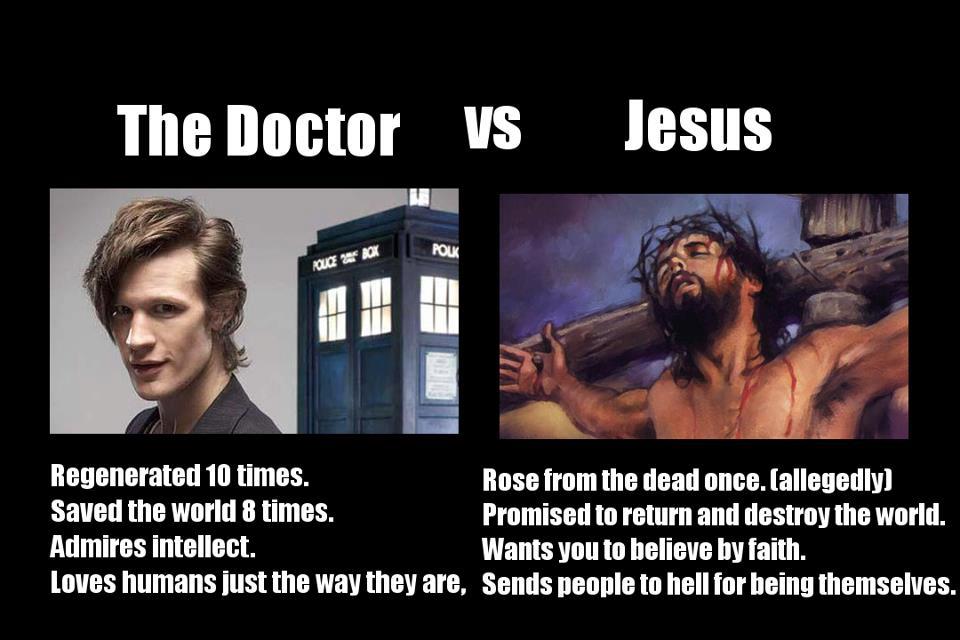
OK, so Doctor Who, in conjunction with its fan-base, might be thought of as a religion.  I have never thought of it that way, but I also think that one part of what makes something a religion is the acceptance, or belief, that the object of reverence is real.

And then I wonder how “real” the people who created texts in ancient times about gods, creation, etc thought the stories were.  I think part of what makes mythology interesting is realizing that for many people, throughout many eras, didn’t have the same distinction between reality and myth, nor did they have a solid meaning of reality which we would recognize.  In other words, it may be the case that many people who have religious beliefs are not thinking about “truth” or “reality” using empirical or skeptical concepts of either of those terms.

Certainly, people can take those mythological ideas and subsequently think of them as real in our modern sense, but the fact that they end up there does not necessarily mean they started there.  There is the question, for example, of whether many of the New Testament books were closer to literature than history (I would recommend Tom Verenna’s blog for more about that), and whether many scriptures from around the world are even comparable to any sort of skeptical inquiry.  It may be that Jesus was a character of inspiration for first century Palestine in a similar way as the Doctor is an inspiration for many people now, all over the world.

And this is the point where some people will point at me and be like ‘See! You admit that religion is not to be taken literally, so your criticisms of them as if they are literal beliefs is shown to be wrong-headed,’ or something similar.  The problem here is two-fold.

First, in many cases people do take mythology as real in the sense I mean it; as in it describes the actual world and they simply are wrong about the facts.  Second, the fact that some people do not think of things this way shows where they are going awry in not understanding that we have a reliable methodology for knowing things about the world, and that mythologizing the world is not a means to understanding, but obfuscation, parochialism, and ultimately a worldview based not on what’s real but rather what is comfortable or even non-confrontational.

Unfortunately, many postmodernist approaches to the world are much closer to those who mythologize the world, which is why, I think, many (secular) progressive intellectuals tend towards liberal theology or at least show deference to such liberal theologies.  Karen Armstrong, for example, has talked about ‘God’ without concern for whether such a thing exists, as if that was not even relevant.  While I appreciate some of the contributions of postmodernism in philosophy, the tendency towards anti-realism, as opposed to realism, in the philosophy of science and in metaphysics has always been a bane for me.

Art and religion

So, The Doctor is not real.  But the show can be a source for thinking about the nature of the world, our choices and their consequences, and so forth.  It’s a living mythology, of sorts, which many draw inspiration from.  But is that inspiration, entertainment, and possible edification spiritual? Is it a religious experience?

As a person who has never believed in supernatural realities, but who has had experiences that seem similar to the descriptions of spiritual/religious experiences, I would say that there is some gray area here.  Where I think I am likely to say no is that I think that these experiences are the result of art, and not religion per se.  Religion, the great usurper of all things human, has once again stepped in and claimed something as its own when it belongs to all of us, religious or not.

So, insofar as Doctor Who, or Star Wars, or Star Trek, or Shakespeare, or…you get the point.  So long as artistic expression invokes existential inspiration in us, it is art that has done it.  We need to stop associating these things with gods or spirits, because they are natural occurrences with no supernatural explanations necessary.

Where does this leave ‘religion’? Well, as we become more secular and educated as a species, I envision religion becoming conflated with artistic and ritual social ties which will probably never go away, even as their supernatural associations dissolve into the nothingness from which they came.  But we should not forget that those supernatural and irrational additions to the art we have created over time have been semantically tied to so many things, and that people will continue to associate nonsensical ontological concepts to everyday experiences, hopes, dreams, fears, etc.

Supernaturalism, theism, and even deism are irrational and even silly concepts which are clutching onto our art, even as they slowly die.  But the art, the inspiration, and the creativity of the human mind will continue long after the gods have all been forgotten.  So Doctor Who might be called a religion, but only in the loose and artistic sense that all that we do and love as humans is considered religious.  That is, in the watered down way that only seeks to distract us from what is truly irrational and dangerous about religion; faith.

When art turns into certainty, when creativity and inspiration is not checked by skepticism, is when it goes wrong for our art.  Because we can create illusory worlds to play in, but the imaginations of humanity are only for pretend and should not be guidelines from policy or morality without a skeptical check on their influence.  We need to leave faith behind because we don’t need to believe that our imaginings are real for them to be interesting.   Further, if we do believe they are real then we may be too unwilling, whether through reverence or fear, to make sure that they are rational.

So science and skepticism are not the source of all understanding, but they should be the arbiter of what we accept as true.  Art can inspire, entertain, and even teach us about the world, but we must make sure the lessons are actually true and not merely revere them unskeptically.

In other words, enjoy Doctor Who, and remember that he’s probably a better source of inspiration than Jesus.

Amen?

PZ Myers and Michael Ruse’s mis-attribution of the fault in our wars


I have been writing, reading, and thinking about the issue of accommodationism for some time.  Type ‘accommodationism’ in the search box above for some context, as there are too many posts to link to here.  I will say that  I have tended to agree with Jerry Coyne’s views about the relationship between religion and science most of the time, and I tend to agree with PZ Myers more often than not.

Yesterday, PZ Myers put up a post about Michael Ruse which I largely agree with, but I want to address something, not because it makes me disagree with the point PZ makes, but because I think it takes a step back and gives some larger perspective on this issue.  Here’s the relevant section from PZ’s post, quoting Ruse:

But wait! There are more paradoxes! One of the big problems with the New Atheism, says Ruse, is the way we idolize and support our leaders unquestioningly.

There are other aspects of the New Atheist movement that remind me of religion. One is the adulation by supporters and enthusiasts for the leaders of the movement. It is not just a matter of agreement or respect, but of a kind of worship. This certainly surrounds Dawkins, who is admittedly charismatic.

We worship Dawkins? And possibly Hitchens and Harris? Has he ever noticed how much we all freaking argue with each other? There are no saints and popes in the New Atheist movement.

Oh, wait, yes he has noticed. In the very next paragraph.

Freud describes a phenomenon that he calls ‘the narcissism of small differences’, in which groups feud over distinctions that, to the outside, seem totally trivial. It is highly characteristic of religions: think of the squabbles about the meaning of the Eucharist, for instance, or the ways in which Presbyterians tear each other apart over the true meaning of predestination. For those not involved in the fights, the issues seem virtually nonsensical, and certainly wasting energies that should be spent on fighting common foes. But not for those within the combat zone.

The New Atheists show this phenomenon more than any group I have ever before encountered.

So which is it? Blind, unquestioning worship of our leaders, or incessant fractiousness and dissension? It doesn’t matter. Ruse is just spinning his wheel of deplorable sins and accusing us of whatever random flaw pops up.

I will point out that PZ has missed that these two ideas are not, in fact, in necessarily contradiction, even if Ruse’s argument is ridiculous (which it is).  It is logically possible that people in the atheist movement idolize atheist leaders and that fractious arguments also result, just like with religion.  All it would take is a hypothetical Dawkins follower to argue with a Sam Harris follower, insofar as Harris and Dawkins would disagree.  And there are some people I have met who do seem to look up to some atheist “celebrities” with some level of idolization, but this is to be expected.  We are human, with personal flaws, after all.  The ideal, however, does not have anyone idolizing anyone.  I, for example, respect some people more than others, but I’ve never been a person who idolizes anyone, and never get fanboyish around well-known people, nor do I understand why other people do.

And I agree that there are arguments within the community, but I see this as largely a good thing even though in some cases it is evidence of bad ideas remaining among atheists (such as misogyny and privilege).  There is a lot of work to do before our culture matures emotionally, cognitively, and in terms of being aware of our privileges and biases.  And as a result of that, many atheists will tend to be stuck behind their own blindness, and fractures will exist which we need to addressed in the form of criticism and education of those people.  Hence Atheism+.

But what Ruse is identifying here is not so much that the atheist community is like religion, but that when groups of people gather for any common cause, belief, or lack of beliefs, they tend to have similar behavior patterns of idolization, arguing, etc.  So yes, the atheist community has some behavioral issues which are reminiscent of religion, but once again the error is in mis-attributing such things to religion, when in fact religion is the result of human group behaviors not the cause of it.  Ruse is showing how atheist communities are acting human, just like religious groups.  Why does Ruse make the (apparently unconscious) assumption that these behaviors fundamentally belong to religion?

Our goal—as skeptics and atheists concerned with our culture, our beliefs, and our actions—should be to improve how we all think, behave, and interact.  Those working on including social justice in their actions, whether atheist or religious, are taking a step in the right direction in such terms.  But what new/gnu atheism is about, Michael Ruse, is about asking whether the views some group has are true or not.  We must take as a given that we will err in how he think, behave, and interact, but the question which concerns us is whether our ideas are true, not whether our community is perfectly ideal.

That’s the long-term goal, and it will take time to get there.  And, as I understand it, this is what efforts such as Atheism+ were developed to answer.  Because if we want to address the human flaws and how they emerge in the atheist community, we have to understand how psychology turns into sociology; how our personal flaws turn into groupthink and tribalism.  The problem with religion is not that it fractures, idolizes its leaders, and then fights among themselves.  No, that’s a human problem which we all have to deal with.  The problem with religion is that it isn’t true; that they are arguing over fantasies.

Skeptical atheists, at least, are arguing over what is true with a methodology which works; science.  And if they are not using science and skepticism well enough, then we can use skeptical criticism to point out how and why.  When does religion do that? Religion uses logic on top of the assumptions of its theology, but it rarely, if ever, appropriately uses empirical methodology and good skepticism.

Michael Ruse is stuck comparing religion to atheism in ways which must be true because they are activities done by humans.  Where atheism and religion are alike, it is attributable to anthropology (what I have my undergrad degree in).  What Ruse misses, and what PZ does not articulate well in this case, is that what does separate religion from atheism is the concern for truth of worldviews rather than behavior of participants.

Because sure, some atheists go around  idolizing people and arguing over small details, but our goal is to help them personally grow until they are mature, skeptical, knowledgeable people with good cultural and personal perspective.  And unlike religion, we actually have real ways to achieve that because we do not have any scripture, doctrine, or limitations of criticism.

We have the best methods in our hands, no rules about where we cannot inquire, and only our personal flaws to hold us back.  That tempered by caring about what is true, rather than what is comforting, preferable, or sanctioned is a good road to progress.

New Film about Deepak Chopra


So, I just got an email about a movie about Deepak Chopra, called Decoding Deepak.  This was the content of the email:

Hi Atheist,


SnagFilms would like to get your expert opinion on the figure of Deepak Chopra.  Our film DECODING DEEPAK will be in theaters, on cable on demand, and on iTunes October 5th.  Gotham Chopra follows his father Deepak for a year to try to better understand him not only as a person but also as a spiritual leader.  Controversially, the film shows a side of Deepak that lacks spiritual sincerity.

We would love to get your feedback regarding the film and about Deepak.  If you would like to do a post about the film we will include it on our site/through SnagFilms social media network.  Please share this film with your readers, and you can find more information at http://www.snagfilms.com/decodingdeepak/.

Thanks and please let me know if you have any questions.

Best,

Jamie

Now, i have not written much about Deepak Chopra on this blog (I have mentioned him, as an example of spiritual idiocy a few times), and I am not an expert on his ideas, so I am curious how Jamie go my contact information.  I intend to ask.

If you browse over to the website, you can find this video:

You’ll see that the film is made by, or at least prominently features, his son Gotham Chopra.  The film is presented as a sort of personal journey shared by the Chopras, but because I have known a little about Deepak Chopra’s vague, meaningless, spirituality for some time, I am not compelled to watch this film.

Will any skeptics out there watch this film and report? I do not plan on wasting my time.


See my article about my visit to the America for Jesus rally on Saturday


I visited the America for Jesus rally/festival on Saturday September 29th, and wrote up an article for The Friendly Atheist blog which went up this morning.  Go take a look!

My Day at the ‘America for Jesus’ Rally


(Posting this makes me wonder how many people read this blog but don’t read Hemant Mehta’s, making me further wonder if this is redundant.)

Where in the world is Shaun McGonigal this evening?


Seeing Herb Silverman speak in Philadelphia, of course!

Herb Silverman

Herb has a new book out called Candidate Without a Prayer, and he will be speaking about it this evening in Philadelphia at the Ethical Humanist Society at Rittenhouse Square at 7:00,  as well as at the PA atheist conference this weekend in Harrisburg.

Since I am unable to make the conference this weekend, I wanted to at least get a chance to partake in some of the weekend fun by hopping on PATCO and strolling over to Rittenhouse Square (a place I like to sit and read anyway) and catch Herb Silverman speak with some like-minded people.

If you are in the Philadelphia area this evening and want to stop in as well, then I may see you.

If you don’t live in the area or you have other plans (what else could you be doing on a Friday evening?), then you could at least check out the new book, about his life, including an unsuccessful run for office in South Carolina.  Here’s the blurb from Amazon:

In this deeply revealing and engaging autobiography, Herb Silverman tells his iconoclastic life story. He takes the reader from his childhood as an Orthodox Jew in Philadelphia, where he stopped fasting on Yom Kippur to test God’s existence, to his adult life in the heart of the Bible Belt, where he became a legendary figure within America’s secular activist community and remains one of its most beloved leaders. Never one to shy from controversy, Silverman relates many of his high-profile battles with the Religious Right, including his decision to run for governor of South Carolina to challenge the state’s constitutional provision that prohibited atheists from holding public office. Candidate Without a Prayer offers an intimate portrait of a central player in today’s increasingly heated culture wars. It will be sure to charm both believers and nonbelievers alike, and will lead all those who care about the separation of church and state to give thanks.

I hope to see some of my atheist friends tonight, and I hope that everyone enjoys their weekend!

Meaning and Happiness


I’m not going to address the canard that without god we can’t have meaning in our lives. OK, yes I am. But only briefly, and the rest will only deal with that question indirectly. Yes, it is quite obvious that people without a belief in gods have meaning in their lives. Perhaps not inherent, absolute, and cosmically significant meaning, but those things are illusory, just like gods.

I have been, since childhood, rather introspective. I do a lot of thinking about thinking, reflecting on experience, and asking simple “why…” questions about mundane things that most people take as granted.  To me, the beginning of skepticism begins with the ability to ask why something is, and then asking for reasons to keep accepting it.  I never merely accepted the way things are and that they need to be that way. Thus, my becoming a degenerate deviant is not surprising.

Ultimately, I think seeing polyamory, atheism, and skepticism as deviant and degenerate is, well, unfortunate and morosely funny.  It does not speak well of our species that such basic values as demanding evidence for claims and then not accepting worldviews that can’t stand up to such demands is the weird thing. But I digress…

Anyway, I’m one of those annoying people who thinks asking why we do and believe certain things is good. I also am interested in various experiences. I was very interested in meditation while young, and much of what I learned and experienced during those times in my life have influenced how I see the world, how I think, and how I try and improve as a person.  I “experimented” with drugs while younger (meaning I enjoyed their effects while on them), and while I have little interest in such things now, I am glad that I had those experiences.

When I got to college, I was very interested in taking as many courses that dealt with religion, philosophy, and anthropology as I could. I was interested in questions about meaning, belief, and knowledge in culture and psychology. Is there any surprise that I graduated with a degree in ‘religious anthropology”?  Is there any surprise that I write about religion, think about religion, and ultimately oppose religion?

I knew that the history of ideas which dealt with meaning, experience, etc are contained in philosophy, theology, and religion. I also knew that I didn’t believe in any gods, had strong issues with religions, both organized and less-than-organized, and that I had an attraction to science and philosophy.

After reading religious thinkers from over the centuries, including many scriptures and apologetic writing, I knew that these things had something to offer us, even if much of it was meshed with absurd theological assertions and assumptions; I knew that it is all too easy to conflate interesting psychological insights with the tradition adjacent to their origin. That is, I understood that a Catholic, Moslem, or Hindu thinker could say something interesting, insightful, or even true without that idea having any logical relevance to the theology they believed.

So, any sophisticated theologian who attempts to claim that this gnu atheist is unfamiliar with sophisticated theology, I can confidently reply that they are simply incorrect. No Courtier’s Reply can stick to me, especially since the Reply is absurd on its face.


For a few years I have thought about how we, as a community of reason, could talk about such things outside of a theological context.  I mean, philosophers do it all the time, right? (And I do have a MA in philosophy).  Then today I ran into this post by Dale McGowan which talks about the importance of social interactions in happiness.  It is a quick review of a study about why religion makes people happier.

Essentially the point is encapsulated here, stolen from McGowan’s post, in these quotes by Chaeyoon Lim:

[Life satisfaction] is almost entirely about the social aspect of religion, rather than the theological or spiritual aspect…

and Raising Freethinkers co-author Amanda Metskas:

[T]heology is less important to most churchgoers than a number of other benefits. In many cases, they attend despite the theology. It is telling that only 27 percent of churchgoing US respondents to a 2007 Gallup poll even mentioned God when asked for the main reason they attend church. Most people go for personal growth, for guidance in their lives, to be encouraged, to be inspired—or for the community and fellowship of other members. These, not worship, are the primary needs fulfilled by churches. (p. 206)

This is illuminating, and speaks to precisely the point that many gnus have discussed over the last few years; it is not the beliefs which make people happy (they are usually harmful), but it is the social connections that keep many people in church.

The implication, I believe, is that we do need to do more to create social environments for atheists and such.  Skeptics in the pub, conventions, campus groups, etc are all great steps in that direction, even if some people take things too far in terms of emulating religion.  That is, Alain de Botton is wrong precisely because he does not just want to keep the social aspects around, but he wants to keep some of the theological parts alive too.

Part of what will cultivate community, I think, will be organizing under a banner, a label (or a very small set of labels at most), and a small set of major organizations who represent what we do share, our political concerns, and our social presence.  The Reason Rally was a step in defining much of these things, and the next few years will have a lot to tell us about the nature of our collective message, what organizations will be saying them, and how broad we need to be to draw people in.

We have issues, as a community, in terms of drawing in the voices of women, ethnic and racial minorities”, genderqueer people, and even blue collar secularists.  I don’t know what all the solutions are, but I am keeping my ears tuned to people who offer some and will be thinking and writing about it from time to time.

I know I am guilty of many of the things that turn many people away; my writing is esoteric, my tone is sometimes harsh, and I include commentary which does not fit in with most atheists and skeptics (specifically polyamory.  To what degree, if any, I may change any of this will depend on the strength of arguments, the evidence supporting said arguments, and my ability to actually change.

But I think we, the community of reason and skepticism, have a lot to say about how to create meaning in important ways and how to live lives of general contentment and happiness.  Fore me, my life project to be happy lead me to atheism and polyamory, while sharpening my skeptical tools along the way.  I think my story and views have something to add to this conversation.

The Secular Coalition gets a new executive director, and (I think) gets it right


I have been a fan of the past executive directors of the SCA.  Lori Lipman Brown and Sean Faircloth are both smart, friendly, fun-loving people who I enjoyed getting to know.  When Sean left the position to be with the Richard Dawkins Foundation, there was the hanging question of who would be chosen to succeed him.

And today we have an answer from Hemant Mehta’s blog.  The choice is a former Republican lobbyist named Edwina Rogers.  I have never heard of her until today, but let me tell you, based on what I read from Hemant’s interview, why I think that the choice is a good one.

First, her answers to Hemant’s questions are encouraging.  She’s a nontheist (her preferred term), secularist, and she seems to be aware of the issues which the SCA is designed to confront.  In short, she’s one of us.

Second, the fact that she is a she is a plus in the sense that we do have some issues with gender inequality in the larger community of reason.  Not that hiring a man would have been a mistake, but this is an added bonus from an equality point of view. 

Third, she has inroads to Republicans.  This, I think, is the most important part.  For some time there has been an idea that there is a divide in our “culture wars” which divide along the lines of Democrat/liberal/secularist versus Republican/conservative/theocrat.  This divide is way too simplistic, and as Edwina Rogers states, its not true in the majority of cases.

Secularism is not a uniquely liberal value or cause.  Yes, there are many conservative voices who declare their opposition to the liberal and secularist agendas, but even those conservatives have much to gain, and maintain, in a secular government.  With Edwina speaking for us, perhaps some of those voices will be forced to allow their connected ears to get some exercise.  Seculaism has much to offer conservatives, especially the religious ones.

Yes, I have stark political and philosophical differences with conservative people (some who are family members) who view me as some crazed, brainwashed, confused elitist who has been fed the liberal lie of separation of church and state.  Perhaps Edwina’s voice can carry a little more weight with such people (perhaps not, in many), ot at least be able to frame them in ways those people will understand.

And there may in fact be a majority of conservative contituents who hold similar views about us elitist progressive secularists, but there are paths towards developing political alliances with secular conservatives who hold, or at least are near, levers of power and authority.

I would prefer to see America become more progressive as a whole.  I would like to see the Democratic party become truly progressive, fully secular, and deal with real social inequalities such as those brought up by the Occupy movement.  I would like to see the Republican party return to leaders such as Barry Goldwater, rather than the theocracy-downed idiocy that so often sways Republican constituents and legislation.

I would like to see real, substantive, argument about policy between people who intelligently disagree, rather than be distracted by Biblical proclamations and religiously-based anti-gay, anti-women, and anti-science ideologies which end up doing damage to the nation we all live in.  There is much to love about America, but sometimes those attributes become smudged with too much mud from religious contamination.

Theocratic tendencies in politics harm us all in ways which we often don’t even realize, unless we are paying close attention.  Having someone familiar with conservative lobbying circles assisting in our efforts to support secularism in America will be a boon for us all–liberal, conservative, etc–long-term.

I think that the SCA made a smart move in choosing Edwina Rogers.  Let’s see if I’m right.  In the mean time, let’s all welcome Edwina to her new position.

Sunday, Bloody Easter


Jesus had a bad weekend for your sins.

Listen, I don’t accept the crucifixion and then the story of how Jesus rose on the third day for a second.  There is simply no corroborating evidence for it, it parallels too many pre-Christian stories, and the oldest Gospel, Mark, didn’t originally contain the story of the resurrection.  There is a lot out there to read about the issue of the resurrection, and I am certainly no expert (although I know one person who has expertise in related academic fields), so I will leave it to them to address that particular issue in more detail.

But if I did accept the story, that is, the bare facts that some guy (let’s call him Jesus, Yeshua, or Frank for all I care) almost 2000 years ago was wandering around with 12 dudes while preaching about some messianic Jewish story or how the Kingdom of Heaven is at hand, or possibly within you, was arrested, detained, questions, tortured, crucified, and then buried only to appear, alive, a couple of days later…. Well, so what?

Let’s say that I was willing to grant that this happened.  It does not have to mean I have to accept the interpretation of those who claimed to have been witnesses.  I don’t have to accept the dominant narrative that evolved into the Gospel stories nor the earlier Pauline accounts, via his letters to other people who started worshiping this guy around the Mediterranean Sea, do I?.  In fact, this historical fact, if assumed true, does not address the existence of any gods at all, necessarily (nor does it address whether that person was a god, let alone THE god…or at least one of three hypostases of god…whatever).  It would be a mysterious situation that would pique my curiosity (and skepticism), but if it happened then we would have to deal with it as a real event and figure out how it might have heppened.

The problem is that we are so far removed from the historical events, blind to essential details, that the type of necessary investigation would be impossible.  There is nothing to do with the facts other than wonder about them.  So, what does this type of story have to do with god, religion, hundreds of years of violence, repression of scientific and intellectual freedom to advance, and hierarchical infrastructures of people whom are generally automatically revered because they apparently know this guy who rose from the “dead”?

In a word; nothing.  At least it shouldn’t, if we were being rational about things.

Many Christian apologists have claimed that what makes Christianity unique is the fact that it is based upon not mere mythology, but historical fact.  Paul, in the first letter to the Corinthians famously said that

15:14 And if Christ be not risen, then is our preaching vain, and your faith is also vain.

and for many Christians this is the crux (lol) of the matter.  For them, the “miracle” of the resurrection is the fact that defines their faith.  And despite the fact that I (as well as many other people) do not think that it happened, this is irrelevant because even if it did actually happen it does not lead to the salvation story that many Christians want it to tell.


What happened to Jesus, if it happened at all like it is portrayed in Christian orthodox theological terms, was not a sacrifice.  If Jesus was god, or at least one with god, and if Jesus knew this, then it is not a sacrifice because he suffered no actual harm and no real loss,.  It is a bad couple of days, a stubbed toe, an inconvenient breeze in the face of eternity as a freaking all-powerful god! It would be less of a sacrifice than the sacrifice of effort and time it would take to flip a switch within arm’s length in order to save people from certain death by some killing machine, created by some super-villain.

Except in the case of Christianity, God is not only the switch-flipper, but God is also the mad super-villain who created the killing machine as well as the switch itself.  I simply cannot find meaning in this Easter story beyond metaphors for all sorts of themes surrounding rebirth, which are used by most religious traditions and which don’t imply that we are all evil sinners worthy of eternal torture for being what God made us to be so that he would have to send himself to have a bad couple of days to make up for lack of good planning concerning the fate of billions of people throughout all of history.

Yeah, that’s the story of Christianity, people.

Ok, so what if Jesus was a man, albeit a unique and important one? What if Jesus was a man inspired by a true god, or at least the chosen messenger of god, whose efforts in delivering said message would be rewarded with eternal paradise on the right hand, or even down the street from, the real God of the universe(s)?  Then it is merely a form of substitutional atonement; an awful event, morally, if ever there was one.  I’ve heard the apologetic responses, but the story of the atonement, or the replacing of the sacrificial sheep with Jesus (the most unblemished of sacrificial lambs) is absurd.  How does another person dying do anything for my imperfections? The level of theological rationalization around this issue is frankly staggering, and we need to see it for what it is.  The idea simply makes no sense, whatsoever, and it robs us of our personal responsibility for our own misdeeds.

Jesus dying for our sins, whether as god or man (or as some weird genetic cross-breed of god-man), is quite simply absurd and silly.  It appeals to us emotionally and can be rationalized into some meaningful pulp, but it has no nutritional value whatsoever.  It is irrational, un-skeptical, and even immoral in nature.

If anything, it’s just another old religious metaphor for the rebirth of the world, in Spring, from the death that is winter, with the addition of theological concepts which absorb us in self-deprecation and is ultimately anti-life.  You know, like symbols reminiscent of life, birth, and youth but bathed in blood and depressing self-hate.

It’s too bad we don’t have anything this time of year which is like that without all the blood, death, and anti-humanistic rhetoric built-in.

Oh, right, yes we do! Symbols of fertility, birth/rebirth, and youth surround our more secularized version of Easter.  Pagan will try to take credit, and they do deserve some of it, but this is simply human behavior; we want a way to symbolize and celebrate the return of life to the world.  Our history and literature is replete with such symbols and celebrations, and Christianity has (once again) seized them and used them as their own.

But in this case, the thieving Christians, specifically the Catholic Church, didn’t even have the common decency to re-name the holiday! Easter? really? EASTER?

I mean, come on, people? It’s bad enough that Christians stole Christmas, but at least in that case they chose an original name, right?

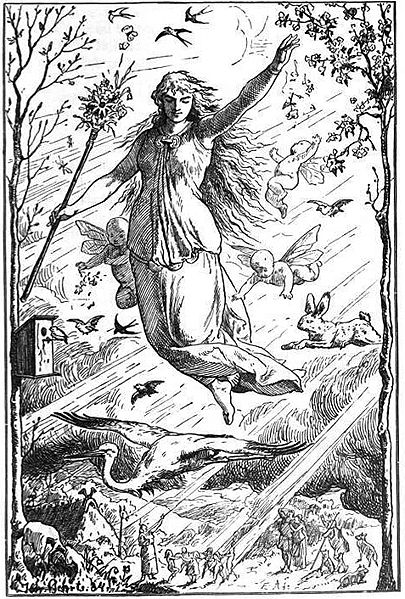
So, here is Ostara (she goes by many names, but essentially she is Ēostre/Easter.  Check the link if you want to know more about the pagan mythology and history of celebrations and rituals surrounding her and this time of year.  But if you don’t, at least take home with you the idea that this holiday is not merely Christian, and insofar as it is Christian it is not the story that the Pope or your pastor tells on Easter morning.

Please, learn your history.  If you are a Christian, please learn where your ideas came from.  Try to understand the context, the subtleties, and even the blatant cultural influences which shape how you see the world.  View the Jesus story as a metaphor, a metaphorical narrative, and possibly not a very good one, which tells you something about our psychology and needs, but not about historical or metaphysical truth.

Jesus, if such a person existed and died via crucifixion, is not the solution to your sense of ultimate personal lacking.  Your imperfections, misdeeds, and falling short of some ideal morality cannot be solved by a person dying, nor subsequent rising from said death, nor from some contrived ‘God sacrifices himself to himself to make up for a law he made about a piece of fruit that nobody ever actually ate’ theology.  You must take responsibility for yourself, toss aside this metaphysical concept of sin, and stop sacrificing this life for some promised other life.

This life is all we have, and we must do what we can to make it all that we want it to be.  So stop bowing to a pseudo-sacrifice and start living in a world which is currently blooming with things wonderful, terrible, and worth working for now

Happy Easter, everyone.

Individualism, association, and atheism


A recent post on Camels with Hammers about intellectual temptations atheists must avoid voices a lot of my thoughts better than I could. Fincke generally allies himself with the New Atheists, but often speaks out against the cruder and less thoughtful instances of New Atheist thought, in a way I really appreciate (since I’m basically in his position as well.) #6 in his list is one I’ve thought about a lot, and want to expand on somewhat here.

Atheists, on the whole, are a pretty individualistic bunch. Relative to the rest of humanity, they feel okay going against the grain, risking social pariah-hood, and rejecting customs that exist for the sole purpose of making humans feel more connected to each other. This makes sense: to adopt a position so counter to cultural norms, a person needs to have a pretty thick skin toward social disapproval. Individualism is a self-selecting quality for atheists in this day and age.

What I see happening a lot is that atheists conflate this individualistic personality trait with superior rationality. They care less about social approval and social bonding, they see that other atheists feel similarly and that people subscribing to all kinds of woo and religion care more about it, and they assume that caring about social approval and social bonding are in themselves less rational. So any time an attempt is made to incorporate community, ritual, and institutions which prioritize social bonding into an atheist frame, you get some voices pooh-poohing the attempt as worthless and meaningless and anti-rational. When someone confesses that they have difficulty leaving religion because of the inevitable social isolation, this is seen as a sign of weakness.

This point of view “I’m individualistic and rational, if you were rational you’d be individualistic too” ignores a basic fact of humanity: we are social animals. We were social animals before we were intellectual, inquisitive animals, and the rise of curiosity and higher-order intelligence did not erase that part of our nature. The social impulse is as valid a part of our humanity as the truth-seeking impulse, and to try to weed out either is to try to change the fundamental nature of humanity.

Humanity is greatly indebted to the individualists: they ask the questions no one else will ask, they think of things no one else has thought of, and they create new ways of being when no one else dares to try. But in doing this, they must also remember that they are statistical outliers: that if the rest of humanity is going to follow them, we’re going to transform the vision into something that meets our common need for connection and social order. This will always happen: this is the kind of beings we are.

I hear some individualists say, “Well, of course I understand that it’s hard to risk social rejection… I struggle with it too.” Yes indeed… individualism and the need for association are not mutually exclusive, and nearly all of us have elements of both. But what I would like more individualists to understand is that their need for association, while genuine, may be far less strong than another person’s. What, for you, was hard in the way running a marathon is hard, might for another person be hard in the way that climbing Mt. Everest is hard. We’re all calibrated differently; we all have different threshholds of need for different human necessities.

And yes, depending on social connection can be a bar to rationality. Of course it can. I’m a good example: several months after my initial deconversion, I was desperately searching for a way back into Christianity. Eventually I found a definition of “faith” I could accept, and I went with it, and continued calling myself a Christian for several years. It wasn’t until I began dating an atheist that I could call myself an atheist again, and that’s not a coincidence. I wanted back in because I was lonely. Because all the people who loved me were Christians, and I felt hopelessly cut off from them — even though they still loved me, I needed a sense of belonging. I couldn’t hack it as an atheist on my own. My need for social connection guided my intellectual investigations, and biased me towards one conclusion.

So, a need to “belong” can influence and distort rational thinking. You know what else can influence and distort rational thinking? A need to be smarter and more correct than other people… a personality trait that self-selecting atheists are overall in no shortage of. The wise, mature ones acknowledge this tendency, recognize how it can bias them, and find ways to minimize its effect. Similarly, I’ve come to acknowledge my profound need for social connection, recognize how it can bias me, and find ways to minimize its effect. One thing that doesn’t work is deciding to care less. That only leads to self-deception.

There are a lot of people who are socially dependent to a degree that cripples them, that cuts them off from acknowledging truths that would improve their lives. A LOT of people. But the way to self-improvement, for many, is not to become diehard individualists, but to become more thoughtful and choosy in the ways they form and maintain their social bonds. The diehard individualists would do well to remember this.