Ugh, I really get annoyed by this time of year. I’m referring to the time after Thanksgiving and right up until the New Year’s celebrations. You know, the last month of Fall, when winter descends upon us, the days get shortest, and for some reason people do a lot of shopping? You know…Christmas time. Oh, do I mean the holidays? Yeah, whatever.
I get annoyed by the consumerism, the obligatory gift-giving that commences at the culmination of the season, and the false expectation of joy that permeates it all. Yeah, I know, hum bug or someshit.
And now on top of it is the ideas of a war on Christmas. You know, the cultural conversation about “holidays” rather than “Christmas.” The privileged status of the Christian/secular Christmas becomes annoying to those of us who don’t like the tattered remains of the religious holiday (which is ultimately pagan anyway) nor the secular outgrowth of that tradition. Many people, like myself (and my acquaintance Tom Flynn), just feel that the day or so holiday should not be stretched into a month.
But, then there are the parties. Parties where people drink more eggnog than they should. Parties where you get to sometimes see another side of your co-workers than you do the rest of the year. Parties where friends and family who live far away some times come around. Parties with cookies, candy, warm drinks and various levels of tacky holiday decorations which are both colorful, lively, and (at least to me) hideous. It’s like the best and worst aspects of our culture become magnified.
No, I think that is precisely it. Our culture begins to express itself more loudly and the imperfections and relative awesomeness becomes pronounced. It’s like all the things that bubble under the surface become overt, taking life and becoming part of the common conversation. Where differences and intimacies are usually subdued in the name of pragmatism and rote behavior, something about this time of year trips up the conventionality of every day life and both exposes our differences via the culture wars and allows us to act more warmly towards each other. Perhaps its the opening up to each other which exposes those differences. Either way, it is what happens.
Of course, there are still people who quietly endure under the threat of this exposure. Men and women, boys and girls, who sit at dinner with family and quietly disbelieve in the grace or sermon being recited. Polite smiles despite sitting a few feet from a family member, co-worker, or religious leader who is hated, feared, or perhaps merely tolerated. There are emotions of desperation which come closer to the surface, felt more severely due to the presence of people and rituals which cause false intimacy and bring together the people who you usually do not associate with.
But for many others it becomes a time to enumerate, elucidate, and explore the differences, disagreements, and values which either adhere or rip apart our society. It becomes a time to expose the privilege of religious majority, to become closer to those with whom we share values and history, and to quite literally gather for warmth created by both said intimacy and the friction of those differences.
It is a powderkeg of our culture, bring closer to the surface all of our various interactions with each other. It exposes the cracks in our culture or, for some, heals some of those cracks. It is a strange brew on inauthentic pretending and rubbing together of wounds and scabs which leads to a meta-level authenticity which is so rare in our culture.
So yesterday, while visiting my mom for Thanksgiving, something amusing happened. After dinner, while sitting around and watching some TV and whatnot I got up to get my phone which was charging in the kitchen. By some irrelevant idiosyncrasy of social interaction it came to me to give reason for my getting up, and I said that I had to check my phone for text messages from my girlfriend. This brought some degree of mirth to a guest with whom I was barely acquainted, and she made some comment about how funny I am.
Because, you know, my fiance was right next to me. I’m obviously making some joke about my girlfriend which only exists for the sake of such jokes. I couldn’t actually, like in real life, have a girlfriend and a fiance as well. And even if I was that kind of douche bag, I would not make such an announcement with my doting fiance so close by, as that would be inhuman. What kind of monster am I?
And this is a phenomenon I have noticed for many years among the normals. There are these jokes about girlfriends, flirting between couples, and so forth which exists at the surface of monogamous life. Especially if some drinks are being served, there is a hilarity about these comments.
But only when it’s a joke.
I did not correct her in her mistake that I was joking. I did not say “Actually, I really am texting my girlfriend. In fact she is my fiance’s girlfriend as well.” This is because not only was I so amused by the moment that I didn’t really think about it, but by the time it occurred that some consciousness-raising would be possible, the moment had passed. And so it passed as a mere joke, to be forgotten.
But had I done so, I imagine that it would have dropped with some weight on the room. Yes, my mo knows about Gina, but she does not exactly advertise my uncommon lifestyle to the world.
So what is it about this levity of non-monogamy in the normal world while its reality is so often threatening, strange, and jealousy-inducing? Why do normal monogamous people find it so funny to joke about straying but find it so, well, scary in reality?
I’m sorry to say, I don’t have any solid answers to this question right now. I think that it is sufficient to make the observation and allow it to sit on my mind for a little while. Perhaps I’ll some up with something brilliant this weekend.
Or, I’m just to lazy to compose such brilliance right now. Whatever works for you, my dear reader.
Quick note: My blogging activity has been very light lately because I have just started working again. I am going to dedicate some more time to writing so that I can have at least a couple of posts a week, and hopefully more. One the positive side, my posts may become shorter (you’re welcome)
—
There continues to be conversations about the relationship between science and morality in the blogosphere (here’s some from yesterday), which is no surprise since it overlaps issues such as scientism, religion, and skepticism generally. These topics are all hot tamales, at least on my google reader.
Moral philosophy can bee thought of as an application of scientifically discovered facts to a problem in social dynamics. In a sense, it is a bit like a computer programming problem in that we know what kind of program we want to create (a harmonious society with minimal ill-treatment of its citizens), but we need to figure out how to achieve this goal with the software and hardware we have. The hardware and software are (loosely) ourselves, and the program we want to write involves coming up with a way to order social relationships in a way which benefits people while preventing their harm if possible.
And what is morality? Is it the study of how humans (or other sentient beings) interact in groups, or is it the study of the how those humans should act in groups given some given desires and goals? With morality the desires are given (they are the facts of our psyches), and the goals are at least defined even if not universally shared. It is the logistics of how to achieve those goals which are where science comes in.
Is this puzzle one for the scientific method, or more generally one for empirical research? That depend son how we are defining ‘science’ here. If it is meant merely are a set of tools towards pure research, where the empirical methodology we use is utilized in order to discover laws or support hypotheses towards some theory, then no. If it is meant as a more general application of reason and the scientific method, then yes. As I have written recently, I think that the term ‘science’ in terms of these philosophical questions (such as the issue of science v. religion) should make way for ‘skepticism’ instead.
Moral philosophy is not science in the same way that physics is a science. There is science where we know the road (method) but not the goal (like physics), and then there is science where we know the goal (some achievement, technological or otherwise) but not the path by which to get there. Morality is an example the latter; we know what we want to accomplish, but we need more information and analysis before we know how to get there. Morality is an applied science.
When we are talking about doing the science of morality, we are not talking about designing a set of experiments to discover the underlying laws of morality as we would with physics. But morality is a field where we have real, physical things about which we have questions and goals. We will use reason, empiricism, etc in doing moral philosophy but most importantly doing moral philosophy will compel the need for further empirical research, some of which might be physics. It will mostly be neuroscience.
So, to deny that morality is a scientific project only makes sense if we are to define science so narrowly as to limit it to pure research, rather than the larger skeptical project of discovering what is true or how to achieve things via naturalistic means. This is why I prefer to use ‘skepticism’ in place of science in so many conversations such as this, because so many people conflate ‘science’ with pure research. I think that is the source of much of the disagreement concerning this issue.
For people such as Sam Harris, Jerry Coyne, etc, ‘science’ seems to stand for that larger skeptical project. The best approach to any topic (including morality) is this skeptical method often referred to as ‘scientism’ by so many commentators, and confused with some kind of neo-positivism by others. That’s why morality is a skeptical project; it is by these empirical and logical methods that we can get real answers to meaningful questions asked.
For morality, the question asked is something like “how should we behave socially in order to allow people to maintain personal and social well being?” This goal of well being (or whatever term you prefer) is not the thing we are trying to determine or justify, it is the project of moral philosophy from the start. If we were not assuming, axiomatically, the values of well being, happiness, or whatever term we prefer, we would not be talking about morality at all, but something else. And what other method besides the empirical ones of science could we use to find out how to answer this question?
We are not using science to determine what morality is or should be, we are using it to find the best ways to solve the philosophical problem we are already aware of. That’s why this is not about the is-ought “fallacy.” We are not saying that these are the facts, and so we should do this. We are saying that here is the place we want to be, so how do we get there?
Much like how we are not using science to find or justify our desires for truth when we use it to determine what is true generally, we are not using science to discover or justify our desire for a moral society by trying to discover the best means to attain such a thing. If you don’t take that goal as axiomatic, then you don’t care about doing moral philosophy. Similarly, if you don’t care about the truth, you don’t do science.
We skeptical and scientistic moral philosophers take what the hard sciences give us through their pure research methods and apply it to this problem of creating a better society in which to live. That, to me, is applied science.
I had a conversation with a long-time acquaintance (and one-time friend) a couple of years ago about, well, a lot of things but which included polyamory. This is a person who claimed, credibly, to have had experience with things such as group sex, alternative sexual communities, etc. Nonetheless she had grown out of all of that, and she seemed to view my active polyamorous lifestyle as a sort of atavism towards our younger days when we were young and experimenting with ourselves.
She also seemed to have somehow concluded that my view of monogamy was to view it as prudish and ridiculous. Now, under some circumstances I might be willing to make such a declaration, but certainly not in general. I think that the assumption of monogamy is often problematic and I would like more people to understand the skills which I have learned from being polyamorous, but I do not think there is anything inherently bad, immature, nor reprehensible about deciding to be monogamous.
But one thing she said has stuck with me since that conversation. It was right after she said that she had experiences with non-monogamous activities that she said that she was with a man (her husband) who made her happy. She emphasized the fact that he had qualities which she appreciated, both physically and otherwise, which sufficiently satisfied her. And while I don’t remember the exact words, she implied that my desiring, or perhaps even requiring, multiple relationships was immature. She said that if I ever had a real woman (like herself, whom she considered out of my league) that I would not be able to handle her and I only chose this lifestyle because I was with inferior, insecure, women.
The basis for this claim was to indicate some recent women I had dated. One recent long term relationship, a girl I still talk to occasionally but with whom I have no continuing relationship , she referred to as a “fool.” The woman with who I had been living, but who had recently broke up with me, was referred to as highly insecure (hence my ability to talk her into polyamory), and the girl I was with at the time and with whom I had recently moved to Atlanta (yeah, her…) just seemed to my acquaintance to be similar to the last; insecure, uninteresting, being manipulated and possibly victimized by an insecure and predatory man.
Let’s just say this acquaintance of mine does not think highly of me, at least anymore.
To her, at least at that time, this polyamory thing was for insecure or at least immature people who are trying to overcompensate for something lacking. Real adults (“real” men and women) don’t do silly things like that It’s an old charge, and an amusing one for me.
But what stuck out to me was her repeated insistence that she was happy with her relationship as it existed. She saw no reason to add to it in any way, and I was missing something in not being with a “real woman” in a “real” relationship. I have no doubt that her claim to happiness was (and probably still is) sincere and probably true. I know her husband (I’ve known them both since high school), and he is a person I like. But something about her comment has stuck with me, and today I want to talk about why.
Conflating structure with quality
Here is what I think my old acquaintance, as well as many others I have talked to since who have made similar arguments, are missing. If you are happy, is your happiness dependent upon the structure or the quality of your relationship?
By the “structure” of your relationship I mean the negotiated rules and boundaries. Are you permitted to pursue other relationships? What are the limitations on those relationships? Are you married, just dating, and will you be co-habitating? Things like that.
By the “quality” of the relationship, I mean the level of communication, shared goals and activities, and other related considerations. Are you honest both with yourself and your partners? Do you try and communicate and address issues as they arise? Do you make an effort to maintain your relationship and not merely coast? Things like that.
In terms of the health of your relationship, it is not really relevant what the structure of your relationship is. Whatever rules and boundaries you agree to (non-coerced, obviously), you can be happy so long as you are doing the necessary work involved. The quality of your relationship seems to be a measure of your happiness itself. In other words, the level of communications and so forth are tool you use to make and maintain a healthy relationship. If you don’t communicate well, don’t share goals, and you don’t like each other then being happy in that relationship seems impossible.
So, what does it matter whether this acquaintance of mine was/is happy being monogamous? What does that have to do with my being polyamorous? Why address the structure of my relationship rather than the quality? Well, perhaps she knew little to nothing about the quality of my relationships (this seemed true). And in fact the quality of those relationships at the time were not ideal, but they were good. But she didn’t know that, and she showed no interest in addressing that in any case. For her, it was sufficient to say that she was monogamous, was happy, and so I was just overcompensating for something by doing what I was doing.
Happiness has nothing necessarily to do with structure of your relationship.
If you are honest with your partner(s), if you make an effort to communicate effectively, and you share goals, interests, and quality time with them, then you have a much better chance at being happy with them. Once you decide to do the necessary work to improve whatever relationships you have, you have the ability to make them healthier and more satisfying. And this can be done whether you decide to be monogamous, to swap partners, to go to swing clubs, to have casual sex outside the relationship, or start your own polyamorous commune where everyone belongs to everyone equally.
What matters in terms of being happy is being honest with what you want, communicating that to the people you care about, and doing the work it takes to maintain a healthy relationship based upon those considerations. Anyone can do this, whether they are monogamous like my acquaintance or polyamorous like me. I think this is something that our culture in general needs to better understand.
What I am saddened by is that my friendship with this person has not continued, in part because of this conversations. But largely it was the events around that time, much of it due to my own misdeeds, led to her distancing herself from me. And since then I have done considerable work to improve myself, and I believe that all of her criticisms of me at that time are no longer relevant. Nonetheless, now all that remains between us is the inauthentic polite chit-chat at our occasional meetings at a party, which has been thankfully rare. I think if she knew me now, as well as the quality of my relationships, she could see the two amazing women of high quality (“real womenTM“) I have built relationships with.
But she’s stubborn, and so it will likely not come to be. But I’m happy, and if she is happy then I suppose I can live with lost friends. What bothers me is being judged for what I’m not, by a person who seems to have no interest in knowing who I am. If I’m going to be judged, I want to be judged for what I am.
There have been quite a few comments in recent months—in articles, debates, etc—proposing the evils of scientism. Religion and science, say many thinkers, are compatible and to see otherwise is to see science’s reach as going beyond its fingers. John Haught, for example, defines scientism this way:
Sicentism may be defined as “the belief that science is the only reliable guide to truth.” Scientism, it must be emphasized, is by no means the same thing as science. For while science is a modest, reliable, and fruitful method of learning some important things about the universe, scientism is the assumption that science is the only appropriate way to arrive at the totality of truth. Scientism is a philosophical belief (strictly speaking an “epistemological” one) that enshrines science as the only completely trustworthy method of putting the human mind in touch with reality.
(Science and Religion: from conflict to conversation, page 16)
John Haught
Now, John Haught is considered, by many, to be one of the world’s foremost experts in the relationship between science and religion. And while I don’t deny that he has a lot to say about both science and religion, much of it valuable, I agree with Jerry Coyne (as well as Eric MacDonald) that his fundamental views about the intersection of science and religion is problematic if not down-right absurd.
Part of the problem, as I see it, is that the critics of the so-called “scientistic” people (one is tempted to juts call them “scientists”) seem to not understand the position as it is commonly used by those, such as myself, who believe that science is the preeminent epistemological methodology in the world (perhaps the universe!). The other part is, as has been pointed out, that this method conflicts too much with theological methodology which is often non-empirical. People like Haught have a bias, a conviction that ties them to a set of doctrines which make claims at odds with science, and so they see something beyond the reach of empiricism.
But to say something is beyond empirical reach is to say that there are non-empirical things. Well, how would they know? How could they know? From where could they get that data? Revelation? By what train does the “revelator” travel in order to get from a non-material world to a material one? What are the connecting tracks made of? Without a justification for how they get their information, we are right to be skeptical.
And that’s precisely it, isn’t it? It isn’t about science per se, but skepticism. The critics of us scientistic people think that we are claiming that we can design laboratory experiments in order to find answers for all questions, even their magic ones. They think that when we say that science can answer questions about morality (for example), that we mean that people in lab coats can sit around with complicated bunson-burner experiments to determine what types of things to value, what meaning is, and how many angels can dance on the head of a pin. It is a rather silly caricature, isn’t it?
Truth and the scientific method
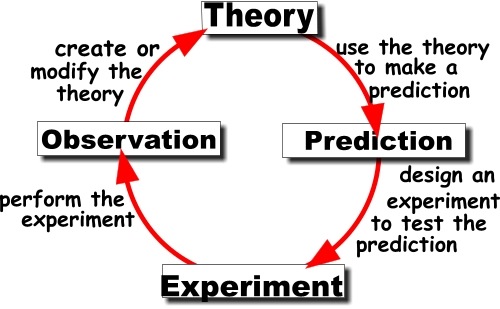
If we are concerned with what is true, then we need to find tools which can help us find clues as well as shift through them to determine which of those clues can help. But further, we need to find the best tool-set to use, how to use them, and how to know when they are not working. Over the millennia human culture has developed a complicated history to how we determine the truth. From the early days of philosophy and rationalism through the enlightenment which brought us more powerful tools of empirical research, we have developed what we now refer to as the scientific method.
It is through this method that we have the best information about what is likely to be true. No other methodology is close to competing in terms of practical success or theoretical power. This perpetually leaves me asking people who are critical of the scientific method what they could even try to put up against it. There is no competition. Cake or death, or something….
But despite this success of the scientific method, many people (especially postmodern philosophers and theologians) try and argue that neither empiricism and/or logic can tell us what is true. That is, we have to assume some axioms, we must assume some things, to get anywhere with any of these methods.
Well, of course we do. The question is whether A) other methodologies would have to accept the same axioms (such as non-contradiction, existence, and reliability of sensory perception) and B) whether this actually damages the method itself. All important questions, but also beyond the scope of this post. Instead, I want to take another related path here.
Do you value truth? Does it matter to you to have as many true beliefs as possible and as few false beliefs as possible?
As a preliminary, I must address the issue of whether I should have to justify why we should desire truth. Having to justify the desire for truth when considering what methodology to use in determining truth is akin to justifying hunger when considering nutritional value in deciding what meal to eat. If you aren’t ever hungry, there is no point in making such a decision. If you don’t value truth, there is no point in the consideration of methodologies.
Is it not a value of yours to know true things? If so, then just stop reading. Just go somewhere else, play some video games, and have a few drinks because nothing you say, do, or think is relevant any more concerning anything I have said here. If you don’t care about what is true, or if what you prefer to be true is more important than verification, then there is simply no talking with you about epistemology, methodology, etc because you don’t care enough so it does not matter.
If you do care, then it should be your value, as a direct logical descendant of that prior value of truth-having, to utilize the best methodology for determining if things are true. To accept any other method would be absurd, because it is not as good at determining if something is reasonable to accept as true.
And the best methodology for determining truth is, well, science right? Well, partially. The best methodology is actually…
Skepticism
That is, after all, the central theme of this blog. “The Atheist, Polyamorous, Skeptic,” right? The first two terms in that title are qualifiers of the last; they tell you what kind of skeptic I am. But further, I believe that skepticism, properly applied, necessarily leads to atheism (and possibly polyamory; a topic for another day), but that is beside the point that I am a skeptic first, which should imply that if the evidence were to point elsewhere I would be otherwise. Because evidence is what matters.
One of the primary ideas in skepticism is the idea of the null hypothesis. Now, I realize that in every day practical science this ideal is not a reality, but a s a rule of scientific inquiry in general it is essential as a part of the philosophy of science. It basically says that you should wait for sufficient evidence before accepting a hypothesis as true. That is, you withhold belief until enough evidence, or at least rational justification, is given to accept something as having a basis in reality.
Obviously the amount of evidence necessary to accept a claim is proportional to the claim; I don’t expect you to withhold belief in the claim that I ate pizza for dinner tonight; it’s not an extraordinary a claim that is worthy of serious skepticism, and accepting it even if false has little to no consequences generally. A supernatural being who created and controls aspects of the universe is a different matter, one worthy of skepticism and requiring good support to accept. As far as I have seen, no good support exists for such a claim.
Skepticism involves many tools and ideals beyond crude empiricism. Empirical testing, verification through demonstration of material effect, logic, reproducibility, etc. It is a large tool set which together give us a very powerful detection apparatus for what is true, what exists, and what is not sufficiently verified to rationally accept.
It is this method, that of skeptical inquiry, which the scientistic people are on about. It is not science per se but the whole set of empirical and logical tools which I call skepticism. It is thus my proposition that rather than call us “scientistic,” we should just call ourselves skeptics and have done with it. Rather than argue against scientism in the science/religion debates, we should be framing the debate as one about skepticism versus non-skepticism.
It is my contention that many fans of NOMA or other angles on the science/religion compatibility side are being non-skeptical, or at least not properly applying skepticism to all aspects of their beliefs, worldviews, or reality. I think this has been the crux of the issue all-along.
Religion
Against skepticsm, religion has a hell of a time competing. This is not to say that religion does not use logic, empiricism, or skepticism at all. It just often subverts them under the wing of revelation, authority, tradition, etc. Many theologians (including William Lane Craig) have said that if it came down to what science says and what their scripture says, they stick with scripture.
But of course many other religious thinkers, such as John Haught and Francis Collins, believe that the methods of science (and perhaps of skepticism) are compatible with their religion. But the problem with this is immediate, at least to me; religion is often essentially reliant on certain unquestioned propositions (sometimes referred to as “facts”) such as the crucifixion, the miracles of this or that deity or holy person, or the existence of a deity in the first place. These questions, when pressed against the methods of skepticism (and not merely science), do not stand. It has been one of the themes of this and many other “new atheist” blogs to demonstrate this week after week.
But when we open our skeptical tool boxes in the presence of ideas accepted due to tradition, faith, or unsupported personal experience we are told that those tools cannot reach there. We are told that the substance of those things, the nature of their meaning, or even there very ontological status is beyond material manipulation.
But we, as animals with material nervous systems which make up all that we are, are not exceptions to the universe. We ar enot privy to some magical bridge to some supernatural world. This has to be supported first. Haught and his cohorts on sciency-religious love-fests have to demonstrate that there is anything to their revelatory experiences in the first place. They have to demonstrate that there is any reason to accept that there really is a separation of nature from supernature before they start making claims that the questions about them need different tools.
Science and religion are incompatible because while they both deal with the real world, the extra stuff that religion is supposed to have exclusive access to are not credible in the first place. There is no reason to think they are real at all. Only the best set of truth-testing tools that we have can reliably determine what is likely to be true, and those tools don’t expose the presence of the magic world which religion claims propriety over.
If the science/religion discussion is about who can say what about what is beyond the scope of skeptical analysis, then I vote that we let religion have it. The result is that theologians get to play in imaginationland and skeptics and scientistics can go on having (as Haught says) “the only completely trustworthy method of putting the human mind in touch with reality.” What Haught and others don’t seem to get is that the rest simply is not rationally acceptable as real.
It has been asked of me, more than several times over the years, why I care so much about what people believe. Why can’t I just live and let live. Well, I do. It’s just that I don’t think that living and letting live necessarily involves not asking why people live the ways they do. I’m not stopping anyone from living by wondering why they live the way they do.
I have said it many times, but the truth is important to me. This is not to say I assume that all my beliefs are true, only that I try to believe things for good reasons. I try to have evidence, or at least good reason, for accepting ideas as true. So, if I do believe something I do think it’s true, but realize that I might be wrong and so I maintain an open mind about that possibility. This necessitates listening to criticism, going out of my way to challenge ideas (both mine and others’) in the face of dissenting opinions.
This skepticism of mine is part of my life project to be honest, open, and direct with the people around me. It is a value of mine to live authentically, which for me means that I don’t hide who I am to people, try not to allow self-delusion to survive within myself, and be open about my strengths and my faults. I challenge others because I challenge myself.
One implication of this is that I don’t want cognitive dissonance to exist within my mind, and don’t happily tolerate it in others. I don’t want to have ideas which are in methodological or philosophical opposition to one another, and I am sensitive to it in others. Cognitive coherence is a goal at which I will inevitably fail, but I strive for it nonetheless because to do otherwise is to capitulate to intellectual and emotional weakness.
Another implication is that I do not respect the idea that an opinion or view “works for me” as being sufficient to accept it as true. I actually care what is really true, not merely what coheres with my desires. This attitude is essential for a healthy skepticism. The desire to apply skeptical methodology to all facets of reality (sometimes referred to as “scientism”) is a value of mine, and I think it should be a value for everyone.
And this is why meeting someone who has little inclination towards this skepticism, who believes things which are not supported by evidence and do not care to challenge them, raises flags for me. It is, in fact, reason for me not to trust them.
Now, wait (you may be saying). How does being non-skeptical about things make a person untrustworthy?
Well, it does not make them completely untrustworthy. It would not necessarily mean that I could not trust them to watch my bag while I run into the bathroom or have them feed my cats while I’m out of town. No, it merely means that I will have trouble accepting some claims they make. It makes me trust them less intellectually.
They have already demonstrated that they are capable of being comfortable with cognitive dissonance, or at least in holding beliefs uncritically. They have demonstrated that they have less interest in holding true beliefs than holding comfortable ones. So if they were to claim some knowledge, opinion, etc I would be in my skeptical rights in having some issue with their trustworthiness.
This, of course, does not mean they are wrong. People with all sorts of strange ideas can be right about other things. It means that I would be more willing to demand argument or evidence for their claims, since they have already compromised their credibility in my eyes.
It also makes it harder to actually respect them, as people. It makes it less likely I will want to become closer to them personally. In potential romantic partners, unskeptical attitudes and beliefs are a turn off, for example. Beliefs in astrology, psychic powers, homeopathy, wicca, or even some aspects of yoga are indicators that a person may not be a new best friend or romantic partner.
Such beliefs are indicators that while we may get along well enough socially or in light conversation, our goals in life are incompatible. As a result, there is only so close I am willing to get because the attitude they take to the truth makes them vulnerable to deception. They have not exercised critical thinking to themselves or the world, and it seems likely that they may not know themselves well enough emotionally and/or intellectually and therefore are more likely to subject themselves, and thus people they are involved with, to undesirable situations.
This is not to say that people who believe these things cannot be educated or better informed, only that until they are willing to critically challenge such things they will occupy a place in my head of lesser reverence.
So, call be judgmental, elitist, and arrogant if you like. But I will judge unsupported ideas as flawed, consider demanding higher intellectual standards as preferable, and do not think that pride in these standards to be unwarranted. I am judgmental (so are you, so is everyone. I am just honest about it). I am elitist, and I don’t care if it offends your sensibilities. But arrogant? Well, I don’t think my ideas of self-importance, based upon my standards, are unwarranted. I think they help to make me a better person.
I’m honest, I care about what is true, and I hold myself up to high standards. If you don’t care about these things, then I likely don’t respect you. Live with it.
Sex is ubiquitous. We see it all over the media, entertainment, and our lives. Most of us think about sex quite frequently, and many of us have a fair amount of it. One thing all of our ancestors had in common was some kind of sex.
Artificial insemination, of course, makes it possible to pass your genes along without having sex, but I doubt more than a handful of people are virgin parents, Mary being no exception no matter what Christians try and tell you.
Now THAT's what religion should be like!
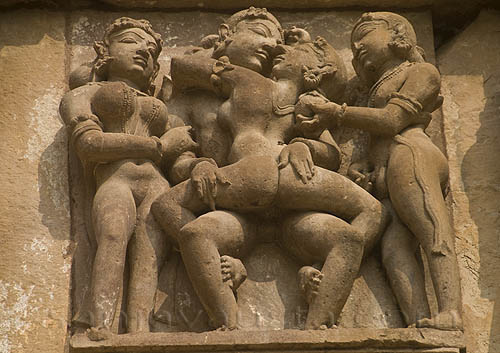
Religions have varied relationships with human sexuality. In our Christian-drenched culture, this relationship is somewhat strained, but this is not the universal relationship between religion and sexuality. Many Hindu temples, for example, depict sexual acts of all kinds; no prudishness inherent there.
Many new age religions celebrate sexuality in many ways, and I have found many religious people in my years among the polyamorous community. One is likely to find orgies, swingers, sex rituals, or just sex-positive monogamous couples in all sorts of religious traditions.
And yet in the West, where Christianity reigns over any other religious tradition, sexuality has a sort of schizophrenic role to play. On one hand, sex is (as I said) ubiquitous. Secular culture is ripe with it and much of it is great (which is to say some of it is not). And then there are the critics of this phenomenon, mostly from conservative Christianity, who view sex as something limited to marriage.
Which is, of course, excluded from everyone except monogamous couples, one of which is a man the other is a woman.
Scary....
I have been thinking about this for a long time, and I think that this strategy is somewhat smart, from the point of view of maintaining conservative religious lifestyles. There is a real separation from the mainstream American culture and that of the conservative America which tries to keep its distance from the rest.
Several years back I was invited to attend a Battle Cry event in Philadelphia. What was presented to me there, and what many (many) subsequent discussions with former conservative Christians (as well as current conservative Christians) have shown me, is that there is a concerted attempt to create a Christian culture which keep people protected behind a wall of Christian culture. The goal is to have people protected from the evil, Satanic, secular culture. One part of that is to keep their sexuality repressed, at least until they are married.
And they somehow expect their sexuality to open up and flower when marriage happens, as if one can turn off all that emotional association to sexuality in a day. It’s all a myth, a fantasy, a lie.
If you tell people that sexuality is sinful, that your lewd thoughts are Satan’s influence, and that when you have such feelings you should pray for forgiveness, then you are setting up the best guarantee that many people will keep coming back again and again. It initiates a cycles of activity which keeps people tied to their religion (bonus to anyone who gets the word-play there).
The parts of this cycle go something like this:
The vast majority of people think about sex frequently.
Most of those people’s thoughts, if they were raised in a conservative religious environment, will be seen as sinful or even evil.
Church teachings, including youth groups, provide young people with ways to combat these feelings (especially if they are homosexual in nature).
Those methods do not actually stop those thoughts or feelings, they just associate them with a religious ritual, activity, or belief.
Because people think about sex frequently, they have a built-in reminder of their religious upbringing, training, and the emotional associations inherent to that process.
This guilt (or even fear) often sticks with people even if they move away from their faith.
This cycle is not good for a sex-positive society. And a sex-positive society is good for everyone. Conservative religion, Christianity in particular, is not good for society or the people in it. Sex is only one example of why this is the case.
And while I would prefer people not be raise in religious environments, if I have to choose, I would prefer them to be raised in a moderate of liberal religious home where the damage is less severe. Yes, parts of this shame, guilt, and sinful views on sexuality still exist in many aspects of liberal Christianity, but it is less severe even if often nonexistent. Liberal theology allows people to be exposed to reality, including the truth about sexuality and its role in our lives, and thus it is the lesser of evils.
That’s right, liberal Christianity is the lesser of evils, especially when it comes to sexuality. That is not to say it is not still bad.
More specifically, I am going to be one of those door-knocking missionaries. You know what I’m talking about; white shirt, tie, name tag, some sort of bag, and literature to leave behind. Except I don’t have an proper name tag, the kind with my name and some LDS cred. So, I had to make one.
A few years ago I had been working with Margaret Downey on some project on another (likely a tabling event, but I don’t remember), and she gave participants some badges, and I have had mine ever since. I actually have a whole collection of such badges, from various conventions over the years, and never expected to have them come in handy. But today as I was thinking about putting together my costume for a Halloween party tonight, and since I have decided to go for the magic underwear angle (no, I’m not wearing that), I glanced over to the door-knob from which such badges hang from their lanyards and a smile crept along the side of my face.
I have a background in art. I actually attended a summer art class at Moore College of Art after my 8th grade year, due to winning an art competition at the school I attended (Friends Select, if you care) which landed me a scholarship for a summer program, primarily for painting. So, when it comes to having to use artistic talents, I have something from which to draw.
Evidence of an hour's work
But, having only white paper, no printer, and various pens, markers, etc around, I was left with a problem since I would need a badge with white lettering on a black background. I knew what I had to do, but it was just going to take some patience.
To start, I had to measure the size of the paper, map out the lettering plan on a grid (penciled in lightly), based upon an image of a real missionary ID badge which I had googled and left on my primary computer screen. Then, once the letters were penciled, I very carefully traced the outside of the letters with a black pen, then filled in the rest of the background with two sharpies. The results, among the tolls used, are to the left.
After that, it was a simple matter of sliding the paper in the plastic holder, covering the phrase “Proud to be an Atheist in America” but leaving the name above it in place. The result can be seen to the right.
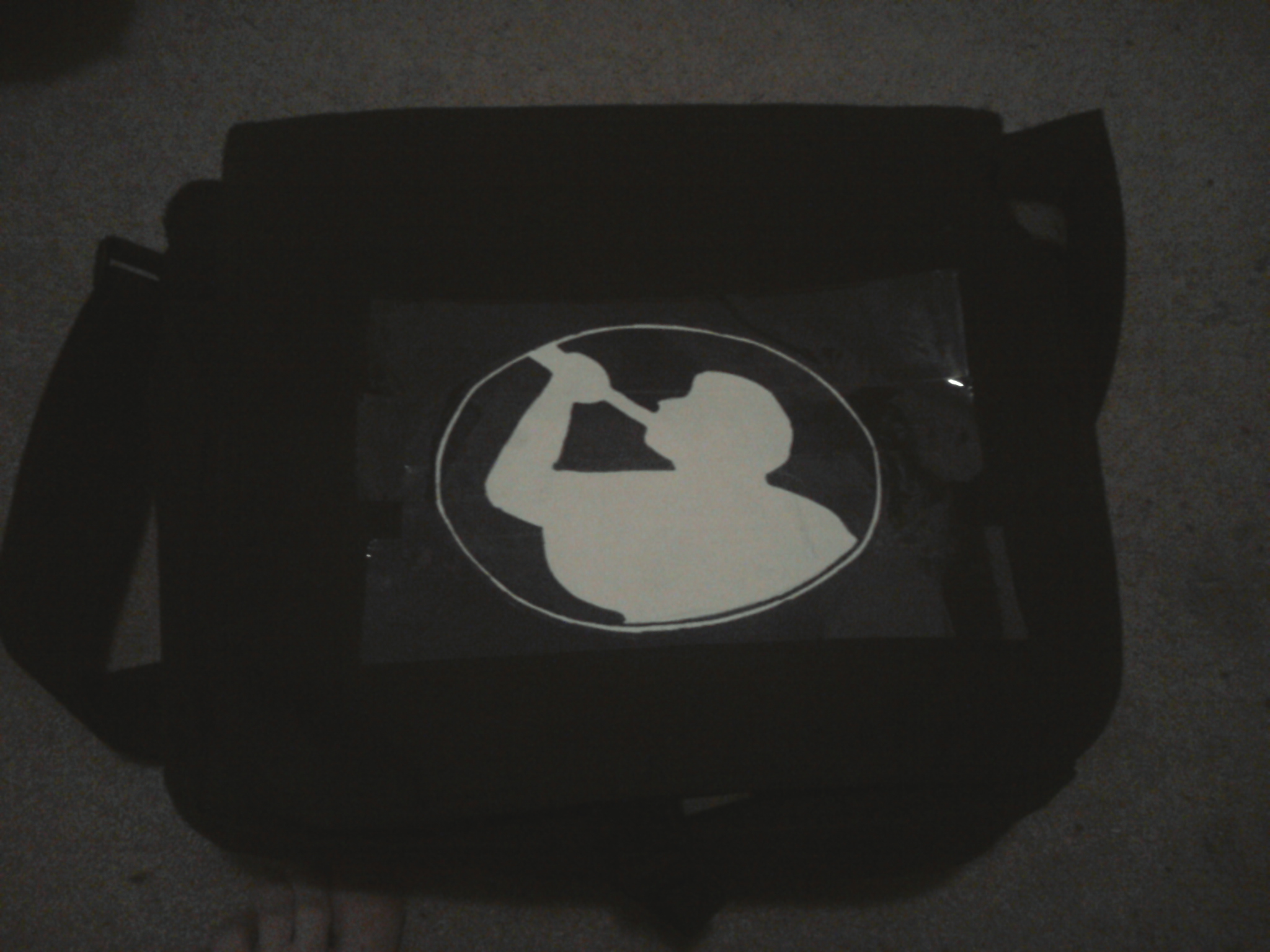
But that could not be all! Why? Well, every time I have seen those missionaries I have seen them carrying some sort of bag, backpack or messenger bag usually. And I have a messenger bag. Except it has the Dawkins scarlet ‘A’ on it, and that is no bag a Mormon missionary would carry, now is it?
So, I googled Mormon images, found a simple picture of the angel Moroni blowing his horn, and taped a piece of white paper to the screen to trace it (the juxtaposition of technology and Luddite technique does tickle me a bit). Then I filled it in with the same markers and, after doing so, I used some clear packing tape to affix the paper over the ‘A’ on my bag and, well, voila!
That, with my copy of the Book of Mormon in hand, allows me to transform into Mormon missionary man!
And with it all put together, it all looks like this. So, happy Halloween everyone.
I’ve been having a long conversation in the comments of another wordpress blogger recently. I was perusing the religion section of wordpress and ran across this post. The comments are where it gets interesting. If you are interested in such conversations, I urge you to take a look. Much of the following will reference that discussion, although you will be able to follow without reading it).
During the conversation, which touches on skepticism and the definition of ‘atheist,’ the blogger jackhudson said that “there is no such thing as a ‘mere atheist’,” and I was forced to agree. Actually, I quite enthusiastically agreed, as I had never made such a claim that such a creature existed (see the comments there for the details, if you like). But I immediately liked the term and it gave me a little insight into the nature of our disagreement. It also reminded me of a discussion within the atheist community some time back.
Remember that now infamous PZ post about “dictionary atheists” with which many atheists, including myself disagreed? Well, I do believe that the definition of “atheist” is still merely the lack of belief in any gods, but I also agree with PZ’s larger point which, ironically, is basically the point that jackhudson is making in the comments I have made reference to in this post. Ironic because the post is about PZ Myers being wrong about something. Well, it’s a little ironic.
In other words, PZ Myers was right to say that we, as atheists, are not atheists because we lack a belief in gods. At the time he wrote that post, I disagreed by arguing, as did many pothers, that being an atheist was nothing more than this lack of belief in gods. But as I came to understand it, PZ had a larger view in mind, one which jackhudson is also making; none of us are merely lacking belief in gods. We have other things we do believe in and those things inform our worldview and tell us about how we are atheists.
Even if the definition of atheism is, in fact, the lack of belief in any gods we are so much more than that. It’s a nuanced point, and I think worthy of further exploration.
Finding your inner atheist
People come to find that they are atheists in a number of ways. As they do so, they carry all sorts of beliefs, assumptions, and worldviews (all of which may change, of course). But an essential moment for people who consider their beliefs is when they first realize that they no longer (or never did) believe in a god.
Some of these just of shrug their shoulders and go on with their life. Others experience a great emotional relief, anxiety, or even anger upon realizing this. I imagine that some people even repress this and go on as if they do still believe. The reaction is dependent upon many personal factors which are relevant to a person’s worldview, but are not really relevant to the term ‘atheist’ per se. That is, if they accept that title as part of their identity, that title merely tells others what they do not believe (gods), but nothing about what they do believe in.
Other labels and titles can do that, in most cases. Sometimes new labels have to be invented. But no information about what one believes can be gleaned, necessarily, from “I’m an atheist” by itself.
So, I think that PZ’s objection is more about the existence of “mere atheists” rather than “dictionary atheists” (although I’m sure he is still annoyed with people reminding everyone of this definition, as his post indicates). Having heard him talk about this issue a few times however, I don’t think he disagrees that atheism, per se, is merely this “dictionary” use, only that this lack of belief does not tell you anything anything about what is important.
And while I think it is still important to clarify one’s philosophical opinion (I am a philosophically-minded person, after all), I think that PZ is largely correct. I will continue to explain the definition when the clarification is warranted, but I think that this is becoming a secondary consideration for me. It is a bit of a transition I have been noticing for a little while; a bit of atheist maturing, perhaps.
At this point, my concern is to not argue what the definition of atheism is so much as to answer the question that Matt Dillahunty has become known to ask (What do you believe, and why do you believe it?) for my own skeptical views. That is, I am more interested in explaining my views rather than labeling them and having arguemnts which are purely about those labels.
It is true that I don’t believe in any gods. It is still true that to claim that no gods exist is beyond my epistemic powers. It is also true that in some cases (like with the Christian god) I do believe that ‘God’ is not real. But I think the fundamental point is to show that a skeptical position is where to start, and that I simply do not see reason to believe in people’s religious ideas.
My motivation for all of this is not derived from being an atheist, but rather from being a skeptic who cares about having beliefs which are true. My being an atheist is not my motivation for writing this blog, being active in godless communities, etc. My motivation is what I do believe.
I do believe that the truth matters. I do believe it’s important to want to have reasons for what we believe. I do believe that skepticism is the best methodology for finding what is true. I do believe that having a good level of certainty about truth is possible. I do believe that people can educate themselves towards freeing themselves from delusions of all kinds, including faith. I do believe that the efforts of the skeptical community are helping our culture move away from religious commitments, even if more slowly than many of us would like.
So no, I’m not a mere atheist, and I don’t think any person is. To be a person is to have beliefs, even if only tentatively, and nobody is defined by a simple lack of a belief.
But I still believe that identifying openly as a person who does lack that belief, in this cultural context, is important for the ongoing cultural conversation. I do think there will be a time when identifying as an atheist will no longer have a use (it will still be true, but only useful in the way that identifying as an a-Santa-ist is now).
I was directed to an interesting conversation on Facebook today. It is in twoparts.
If you just refuse to read it, essentially it is a conversation between two people (“Jaime” and “Kelly”) about monogamy and “permanent promiscuity,” but the term polyamory is used in the conversation as well.
There are many points I find incomplete, flawed, etc on both sides (although I agree with the polyamory-advocate “Jaime” much more, obviously), but I will not bother with in-depth analysis.
What I do want to comment on is that “Kelly” comes across as saying that promiscuity, or polyamory, is too hard for most people and so to ask it of people is asking too much. This comes across to me as apologizing for human weakness.
It sounds to me like a person saying “being a good person is too hard, and you can’t expect people to do it.” Or, perhaps more to the point; “doing the work involved to become more emotionally mature, honest, and less fearful about my insecurities is too hard.”
I don’t have much sympathy for this. It is merely excusing laziness, fear, and mediocrity at best.
As I like to say, if you are happy, then great. But if it might be possible to be happier with some effort, what is stopping you besides fear and insecurity?







 Skepticism, Properly Applied