How much I love polyamory


Anyone who has seen me recently will attest that I am pretty happy with my life right now.  For a while, things were going pretty badly for me, but in the last year or two, things really turned out pretty well.  I can safely say that I would not use a time machine to avoid any of the bad times, just in case it were to prevent the good that I have found.
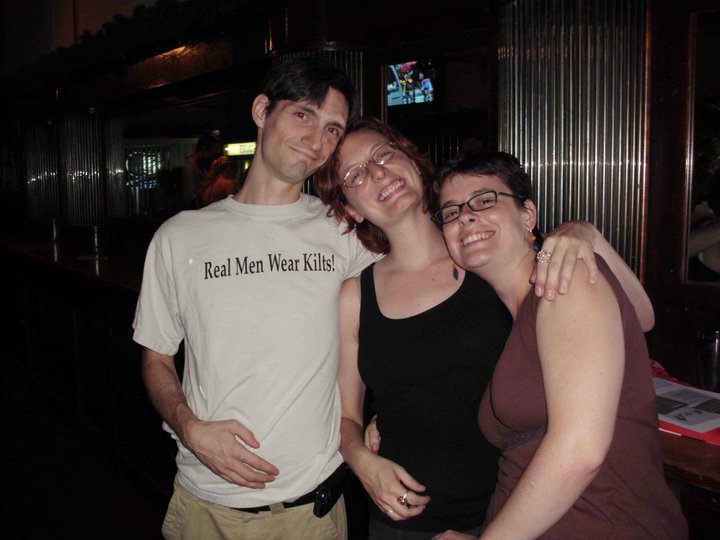
And a lot of this has to do with polyamory.  You see, being polyamorous has allowed me to maintain two very important and rewarding relationships in my life.  And for readers of this blog, you may have figured out that I am now willing to share them with readers here, at least insofar as their writing can provide a slice of their awesome-pie.

I am excited by the prospect of having more voices here at polyskeptic.com, whose perspectives differ from mine in some ways even if we agree on most things when it comes to polyamory and skepticism.  And I hope that you, whether you follow this blog, stop in now and then, or found us accidentally, will enjoy the perspectives and points of views that we all offer.

There is a lot that our culture does not understand about polyamory, but I think seeing it in action helps make it easier to comprehend.  I could blather on for pages (and I often do!) about why I think polyamory is a wonderful option for people, how it is in some ways more honest and authentic a lifestyle in comparison to monogamy, or how skepticism and polyamory should overlap more (there is a larger project I am working on, which I hope to publish soon-ish, which will address that very issue).

The people that post here, as of now, are my family.  They are my fiance (we will be married in less than 3 months!), my girlfriend, and possibly more to come.  I hope that aspects of our personal lives do seep through this blog in such a way that shows that we are pretty normal, in a lot of ways.

I mean, we are freaks in that we reject gods, monogamy, and some other social niceties, but in addition to that we function, day-to-day, like most people do.  We have dinner, drinks, watch movies or TV together, and sometimes we do awesome things like produce burlesque shows and so forth. OK, so that last one is not so normal.

Fine, our relationship structures are more complicated, but all that is about is more people sleeping with other people than any group of people who are friends and spend time with one-another.  Think of us like a group of people, like in a sitcom, who are more intertwined sexually and romantically than you are used to seeing in a sitcom.  There is funny shit, sometimes drama, and there are important moral lessons embedded in plot arcs which slowly erode the traditional concepts of love, sexual morality, and family.

In fact, we should write that sitcom.  (Ginny and Gina, are you taking notes? I want daily reports on the status of this project!).

In other words, the Religious Right hates us, the Left tends to marginalize us (because they don’t want the Right to think we are associated with them), and most of the center do not even know we exist.  Well, all parts of the spectrum share this ignorance, I suppose.  I hope to help change that.

So, in conclusion, I am very happy with my life right now.  I hope that happiness translates into an awesome blogging experience for years to come.  I hope you continue to read, and I hope that your feedback can help us better communicate our worldview to a larger world which is largely unaware of what polyamory (or skepticism, for that matter) is all about.


 

*Snicker* He Doesn’t Know About the Three Seashells


As I mentioned yesterday, while I am not new to considering myself an atheist, I most certainly am new to really thinking critically about it, reading and writing about it.  In the past, when I kept a LiveJournal, I would mention it here and there, but it wasn’t something that I particularly engaged people about.  Wes also has been an atheist forever and so there wasn’t really any debate about it at home.  We both thought the same and were comfortable in that.

When I met Shaun he was wearing one of many atheist themed t-shirts that he owns.  He was the first very out atheist I had ever met.  Not to say that Wes and I (or a few of our other atheist friends) were hiding it, but it wasn’t something that we actively advertised.  When the subject of religion came up, we would always announce our atheism immediately, without shame.  But we didn’t have t-shirts and buttons to show it.  I used to have a Crazy Eddie’s Electronics t-shirt that I really liked…but…that doesn’t seem to be relevant here.

It was around then that I started adding several prominent atheist/skeptic bloggers to my Google Reader.  I asked for suggestions of more and Shaun pointed me here.  What I found was, well, a lot of stuff that was over my head on first glance.  I would have to read sections of posts over and over again to understand them.  As I read and got to know Shaun more, I realized that it wasn’t that these things were over my head, but rather that Shaun (having earned an undergrad degree in religious anthropology and a Master’s degree in philosophy) simply had a breadth of knowledge that would take me an eternity to catch up on.  What I’m saying is, I read really slowly and don’t prioritize reading in my daily life.  I’ve been trying to finish The Stand for over a year.  It’s going to happen!  I BELIEVE IN MYSELF.  It’s not that I don’t see the value (far from it…I have started to change my bad reading habits this year.  I have started with keeping up with several blogs), it’s just that I have a lot going on, so I pick what is the best or most satisfying use of my time at any given moment.

So when Shaun asked me to start blogging here, I think I initially laughed at him.  Or, at least, I did so in my head.  I do that a lot.  I thought about it though and decided that it would be a good experience, and that it would encourage me to write more, both here and on my other blog.  He said that he wanted diverse points of view on here, which apparently meant his, Ginny’s point of view fueled by her past and her current master’s program, and my “hilarious” one.  OK, I’ll bite.  I can see the value in that.  I mean, who doesn’t enjoy hilarity?

I’ve written a couple of posts, and I’m happy with them.  But seeing them next to Shaun and Ginny’s both cracked me up and intimidated me.  Note that it isn’t stopping me, but there was something odd about seeing it in such stark contrast.  As I wrote my most recent post, I kept thinking, “Oy, I’m about to make some statement about religion…Do I even know what the hell I’m talking about?  Eh, probably not, but once I get into the part about the New Age, well…no one’s going to touch that with a ten foot aura.”

Can one measure auras in feet?  Can they be measured in metric, or is that too logical? Clearly they should stick with imperial units, but instead of feet, they should be measured in fathoms…or even better, hogsheads because…what the fuck do you use hogsheads for anyway and why is there a conversion for them in every composition book?  TELL ME!

Right, so, intelligent discourse. 

So as is the seeming tradition, I was having a morning text conversation with Shaun as I ate my cereal at my desk at work and he commuted to his job.  These conversations are an infinite source of entertainment for me as the subjects are never predictable.  Today I mentioned my insecurity about being the idiot writer on here and this is what ensued:

Me: Good morning! After reading through your and Ginny’s posts from the weekend, I am once again feeling like the dumb one.  But if my role is comic relief, then so be it!

Shaun: It’s not like we are actually smarter, it’s just that we tend to be less hilarious.

Me: I think seeing the posts next to each other showed me the stark contrast.  Not that I’m not writing things with depth, I am just aware of how little I actually know.

Shaun: Well, if we were posting on a blog about chemistry or toilets, the tables would be quite turned!

Me: Haha, awesome. I’m glad this is the legacy I have created for myself.

Shaun: Your arcane toilet knowledge is legendary!

Me: You know, it’s something I’ve worked really hard at.  Soon bathroom activities will be incomprehensible like in Demolition Man and people will yearn for a simpler time.  I will be able to tell those stories.  It’s called the Folk Process, or something.

Shaun: So, in the future we won’t take shits? That’s either awesome or disturbing, but either way it is fodder for science fiction.

Me: Dude, I don’t know how the three seashells work either.  I’d be screwed in that future.

So, as you can see, Shaun has invited a person who references Demolition Man in text message when it’s really not warranted to write here.  Here’s the promise I will make: I will continue to read and learn, and I will always try to back up my statements with evidence.  But really, there’s a whole lot I don’t know.  I realize everyone can (and should) say that, but I’m talking contextually to the rest of this blog.  I think that writing here will inspire me to go after more knowledge.  Sometimes gaining this knowledge will drive me nuts (I have been going through a period of growth recently where I keep getting disappointed in people and feeling hopeless about the world, but I think it will result in me feeling stronger), but ultimately, it’s always worth it.  Choosing ignorance never makes sense to me.  Why would you want to be in the dark when you don’t have to be?  Because it’s easier?  I suppose, but that never seemed easy to me because I always knew that the answers were there if you wanted them…and I always want them.

Stay tuned for a detailed critical essay of Judge Dredd.  Now that will be some fine literature!

My Warped History with Religion


I remember sitting in a World History class in highschool when we were doing a section about organized religion.  We were talking about the five major religion.

I grew up near Fabric Row in Philadelphia.  Historically this part of town is very Jewish.  In the early days of the 20th century, Fabric Row was part of a very large marketplace that was primarily run by Jewish families.  Today there is still a highly concentrated Jewish population there.  When I started school at 5, I was introduced to  the kids of the neighborhood…who were mostly Jewish.  As I got older, this didn’t particularly change.  I was among them.  My mother’s entire family is Russian Jew.  My father, I suppose, would be Catholic if only because his father was 100% Italian and in his words, “When you’re Italian, you’re just Roman Catholic…it doesn’t really mean anything”.  So, I’m half Jewish, but the “right” half to become a citizen of Israel, if I so desired…and also to avoid “Shiksa” status, if you care about such things.  This was basically the case with all of my friends.  In addition, very few of the Jews I knew were particularly religious.  They participated in rituals and went through their bar/batmitvahs, but no one seemed to actually care about “God” itself.  None of them prayed as far as I knew.  The most I heard anyone talk about religion is when they were whining about having to eat matzo during Passover.

Meanwhile, while my mother liked the idea of the cultural side of Judaism, she didn’t believe in any of it.  Instead, she was into astrology and the New Age.  My parents were both in EST (a New Age group that was very popular in the 70’s and 80’s)…

Side note: So, I totally went to look up a page on EST so that I link information about it here and all I found was that the founder used to be a used car dealer and is now on the run from the law.  HOT!

Anyway, my parents eventually rejected EST because, while a lot of the ideas that they were teaching were good (personal control and responsibility), it turned out that they were full of crap.  But, my mom still thinks about astrology and numerology and things like that.  This was very prevalent in my life when I was very young.  Also prevalent was the idea that organized religion was a pox on the world.

When I was five years old, my dad took me out walking around on South Street.  A middle aged man came up to me standing with my dad and spoke to me directly.  He  went to hand me a lollipop but before he let me take it, he asked, “Do you take Jesus to be your Lord and Savior?”

Without skipping a beat, I looked the guy in the eye and said, “I’m not really into Jesus.  I’ll take the lollipop though.”  My dad was astounded.  And looking back, I mark this as my first point of consciousness about my atheism.

So, for those following along, my perspective on religion/atheism at the time was that the biggest religion in the world was Judaism but that it was pretty meaningless because everyone was an atheist anyway.  I honestly believed that atheists were the majority.  Even more hilarious, I thought atheist Jews were the majority.  In addition, what I did know of spirituality in my own home was a spirituality centered around the stars, the spiritual significance of numbers and possibly crystals and past lives.  I was raised that the Universe will give you the things you want if you ask for it.  It was magic and I liked the idea of it…but I don’t think I ever really believed in it.  Needless to say, I had a peculiar and incorrect view of the world.

So I’m sitting in this class and it is revealed to me the Judaism is the smallest religion of the “big five”.  I was surprised.  Part one of my peculiar world view gone.  Then I got older and when I was a senior in highschool I was suddenly made aware that really very people I knew were atheists and that they found atheists utterly insulting.

I wrote an essay in for English about how I didn’t see why anyone needed prayer to be officially sanctioned in school.  It was in response to an article I read about a group of teens that formed a prayer group that would meet before school everyday.    The teens started the group because they felt deprived not being able to pray during class time.

I didn’t get it.  I mean, couldn’t you just pray to yourself during math class or something?  So…I wrote about it and the essay was handed out to the entire class (without my name) to be workshopped as a piece of writing.

Oy…it was a poorly written piece in my opinion.  But, of course, no one was getting on my case about the syntax or bad structure.  They were all up in arms about my disrespect for religion.  Suddenly I looked around the room (no one knowing that it was me who wrote it) and saw room full of people completely offended and hateful about the fact that I didn’t see prayer in school as appropriate.

I graduated and then went to Drexel and met Wes.  At the time, I was identifying as an atheist, but I still had the remains of liking the idea of the stars dictating my destiny and getting what I wanted from “The Universe”.  I don’t really remember how it happened that I lost the last of this, but I don’t remember it being cathartic.  It was just another thing that I got rid of when I thought about it rationally.

I am happy to be more aware now, to finally be joining in the “New Atheist” party.  I sort of regret that I am so late to it, but better late than never, right?  As I have started reading many atheist bloggers, I finally feel a sense of community in that aspect of my life.  Next month, just after I turn 31, I will be attending the Reason Rally and I have to tell you that I am really quite excited about it.  Before now, I don’t know that I ever defined atheism as an important thing about me to myself, but as I see the country inching towards theocracy I find that it is highly important.

Like I said, better late than never.

You can be 100% certain, and yet 100% wrong


Apparently, Ginny was writing about this issue while I was also writing this post, but beat me to publishing.  I have not read hers yet, but here it is.

Also, see the A-Unicornist’s thoughts on the issue.

So, as a follow-up from yesterday’s post about certainty and atheism, I want t say a few more things. Also, apparently I wrote about this last year.  I’m so ahead of the curve…or something….

First, I want to give a nod to Christina over at WWJTD because she had some very good things to say about the issue yesterday.  Many of the thoughts I composed for this post came after reading her post this morning.

For example, she says:

Part of understanding science is understanding that we should accept things provisionally, or probabilistically.

Right.  To accept something provisionally is to accept that we might be wrong.  Now in all fairness, I have not heard anyone who is claiming to be 100% certain about a god not existing say that they would not be willing to be proven wrong, nor even that they could not be wrong.  Certainty is not the same thing as proof, after all.

But more importantly, to accept something provisionally should mean that we should not maintain 100% certainty about it.  How do we justify absolute certainty in the face of a probabilistic proposition? I really don’t know.

Christina concludes her post by saying that

Science is probabilistic – which is one of the things that separates science from dogma. That’s good. That means science does not close itself off to new information or evidence. A scientist who says, “I don’t care if my data falsify my hypothesis, I am 100% certain my hypothesis is true” needs to hang up hir lab coat, as ze is not doing science. Someone approaching the world rationally is therefore agnostic about everything.

Everything.

Now, here is where I think that the differences of opinion stem from.  For me, certainty is about recognizing our epistemic limitations.  It is about being provisional about all conclusions, even if the evidence is overwhelming. I am not merely hiding behind any sort of radical skepticism in saying that there is some non-zero possibility that I am wrong about any conclusion about the world.  I am simply being honest about my limitations, especially where I am not even sure what the thing being claimed is supposed to be in the first place (i.e. “god”).

See, here’s the thing.  If deities are scientific propositions (and I know that this has been a question of past blogosphere arguments), then any conclusions about them have to be provisional.  If the claim that a god exists is an empirically-testable one, then even after if is has not been demonstrated after hundreds or thousands of tests (assuming you have not proven it to be logically nonsensical), there is still a non-zero possibility that the proposition is true, even if believing it is completely non-rational.

Surely, you can have an extremely high certainty that it does not exist, and even more surely you are rationally justified in denying its existence, but the words “100% certainty” have to mean something, and what it means is absolute certainty.

Look, if this certainty is nothing but a mere rounding up to the nearest whole number…well fine, but make that clear. But what appears to be the claim is not merely a rounding up (at least in some case), but a finer logical error that I tried to dispel yesterday, but apparently was not able to.  So here we are again.


Noncognitivism and certainty

Even if I were to accept absolute certainty as a real and meaningful epistemological position, there is still the fact that the being in question (“god”) is not even defined.  What does that word mean? Theologians can’t agree on a definition, and that’s what they do academically and professionally.  Sure, the fact that they have no evidence, no body to dissect, is part of the reason why this is the case, but it’s not all of it.

Further, I am not even sure what the necessary criteria of ‘godness’ are to determine if a definition for ‘god’  is legitimate.  So, if I were to define god as my cat, then I can demonstrate god’s existence, right? But is this definition legitimate? And if not, why not? And if you have an answer why not, then what about Kim Jong Il? What about Q?

What are the boundaries of criteria for definitions of god?  And if those boundaries include definitions which are not in contradiction with known facts about the world, even if they are not demonstrated as real right now, then they are not disproved and therefore claiming absolute certainty about their non-existence is not a rational position.

The noncognitivist position makes this question that much more absurd.  The implication seems to be that not only do certain atheists know what the definition of god is (or at least the right criteria for definitions), but that they know that none of the referents for those definitions exists anywhere in the universe (someone alert Ray Comfort!*).

As I said yesterday, this is rational for specific concepts of god, but not for all concepts of god. Noncognitivism explodes the premises of any 100% certainty of a god’s non-existence by showing that because we cannot be sure what the term even means, we cannot say it does not exist.

In conclusion, the only way it is sensible to claim that one knows, or is absolutely certain, that gods do not exist is to start with a definition, or criteria-based set of definitions, of gods which allows one to do this.  But this move is not legitimate, because it is essentially begging the question.  All such a person can be 100% certain of, at most, is that the definition of ‘god’ they have in mind does not exist.

If these certain atheists** (see what I did there?) were to actually address real definitions of gods used by many real (“sophisticated”) theologians, they will find that those slippery sophists have created gods which survive logical scrutiny because they are designed to be non-disprovable.

And yet those sophisticated gods have still not been demonstrated.  Of that we can be absolutely certain.

*scroll down to “Why the Atheist doesn’t exist”

** certatheists? No? OK, fine…

Gnosis


In the last week or so, I’ve begun a project of going through the emails, blog posts, and private journal entries I wrote throughout my deconversion from Christianity. There are a lot of them, and I may pull them together into a book project in the near future, but for now I want to comment on some thoughts they’ve provoked.

One advantage to having detailed personal records like this is that they guard against hindsight bias and retroactive interpretation. I haven’t looked at most of these writings for years, and I find, looking back, that the story I tell now about the trajectory of my deconversion isn’t entirely accurate. When I want to give the short version of my history with religion, it goes something like this: I was raised in a conservative branch of Christianity and accepted it pretty much without question for the first 25 years of my life. Around the time I was 25, I began seriously questioning my faith, and actually stopped believing in God,  although I wasn’t happy about that. I was basically an atheist, though I didn’t use that word, for about a year and a half, then I found a definition of “faith” that allowed me to go back to calling myself a Christian, although never with the same kind of faith as before. Then, around my 29th birthday, the last reasons I had for clinging to Christianity fell away, and I became a full-fledged atheist.

That’s the short version, and it’s broadly accurate, but in retrospect I missed a lot of the complicated nature of that in-between time, between “Yes I am definitely a Christian” and “Yes I am definitely an atheist.” For those who have never had God-belief as an element of their psyche, it might be difficult to understand exactly what was going on there, and it certainly muddies the definitions of “belief” and “knowing” that I’ve been using in the last couple of years. So let me try to explain it.

During part 1, the Christian part of my life, I absolutely believed in God. I would have found it impossible not to. Even if someone had rationally convinced me that there was no good reason to believe in God, I’d have been nodding along and saying, “You’re right, there isn’t a good reason to believe,” and wondering the whole time what God thought of this conversation. It was not something I was consciously maintaining or defending: it was just there, in my brain, a part of the way I thought about the world. To say “I don’t believe in God” would have been a lie, even if I had wanted to disbelieve and had every rational cause for disbelief.

At this time in my life, nearly the opposite is true. If evidence for a god’s existence started springing up all over the place, that internal state of belief still wouldn’t appear in my brain, at least not immediately. I could acknowledge, “Yes, given a Bayesian probability analysis it seems overwhelmingly likely that a deity is the cause of these things we are witnessing,” but in the back of my head I’d still be thinking, “But there can’t really be a deity… let’s keep looking for other explanations!”

It’s important to note before I go further that neither of these belief-states are unchangeable: as evidenced by the fact that my first one did eventually change. I’m no neuroscientist, but my guess is that these belief-states are simply strong neural patterns, habits of thinking that can’t be changed instantly, but only worn away over time as new patterns are developed and rehearsed.

The middle state, that transitional period of 3-4 years, is where things are weird. The things that were going on in my brain at that time don’t fit into a simple category of belief and knowing. The moment that really kicked off that whole transitional phase of my life was a moment where my rock-solid, undeniable belief in God was removed: and my emotional response was anger at God for removing it.

It doesn’t make a lot of sense. I stopped believing in God, and I was angry at God for making me stop believing in him. Clearly, then, on some level I still believed in God, and interpreted even my unbelief through a theistic worldview. But something very significant had changed in my brain, and the best way I could put it to myself was that I had lost my belief.

This state continued, by the way, even after I reclaimed a “Christian” identity. My state of belief didn’t change very much during this time; instead I changed my definition of “faith” to give myself a way back in. My reasons for doing that belong in another post, but from the point of view of mental states of belief and knowing, I didn’t change very much during those 3-4 years.

In atheist circles there’s been a lot of buzz recently about the difference between knowledge, belief, and certainty (prompted mostly by Richard Dawkins’ “shocking” revelation that he wasn’t 100% certain that no god existed, which anyone who’s actually read The God Delusion already knew (actually, anyone who’s read the subtitle of The God Delusion should have known: the word almost is there for a reason, people)). The relevant ground has been pretty thoroughly covered (and is being added to by Shaun even as I write… we’ll see which of us posts first! (I have a parenthetical addiction, by the way; I try not to use at all, because when I start it gets hard to stop)), so all I want to add is my own experience, and how it fits or doesn’t fit into the tidy “atheist/theist” “gnostic/agnostic” categories.

At no point in my life have I been 100% certain that my beliefs about God or gods were accurate. Even aside from evil genius / brain in a jar / Matrix scenarios, I recognize that my foundational assumptions about what constitutes a good basis for knowledge are just that: assumptions, that could be incorrect. I do the best I can with what I have.

I don’t use the word “know” a lot with reference to theism, just because its meaning is too ambiguous. Some people use “knowledge” synonymously with “certainty” (in which case I am an agnostic atheist), some people use it in less absolute terms (in which case I might be a gnostic atheist, depending on how severely you draw the line), and some people equivocate (in which case I’m not playing.)

Belief, now, is a harder question. I don’t think belief is a simple idea, based on my own experience. If all I’d ever experienced were those two states of initial full belief and present full unbelief, I probably would think it was simple. But my transitional phase leads me to think that there are several different strains or mechanisms of belief, which in most people (perhaps) are concordant, but which can also be conflicting. With part of my brain I believed in God, and with part of it I did not, and that was a very different mental state from the ones that came before and after.

Next up: digging a little deeper into the anatomy of that in-between time.

100% certainty and atheism


So, there has been some discussion all over the web, especially the atheist blogosphere, about Richard Dawkins’ recent revelation that he is not 100% certain that god does not exist (actually, this has been his consistent view for many years, as many have already commented).

Much has already been said, so much of what will follow may be redundant, but in an email exchange today on a local email list, someone said the following:

I’m 100% certain god doesn’t exist as well. I’m also 100% certain that Santa Claus doesn’t exist, and I’m 100% certain that gravity is not the cause of microscopic or invisible elves that apply glue to the bottom of my feet….

He went on, but this is the important part.  I responded to him and wanted to post that response here, because while it is not comprehensive of all the relevant issues, it addresses something that is overlooked by many atheists who claim more certainty than they can chew.

Here is my reply:

The problem with this 100% certainty is the meaning of the term ‘god’ there.  If you mean, by that generic term, the specific god as described in the Bible (for example), then you are on pretty firm ground.  But the term itself does not point to any specific god, but to the larger metaphysical/theological concept with many possible referents.

While it may seem trivial, I can point out that in history certain political figures have been thought of as gods.  The Sun has been considered god to many cultures as well.  You may argue that the definition of god does not allow such things to be meaningfully called “gods”, and there is some room for argument there, but my counter to most of them would be to say that the more transcendent, incomprehensible, etc concept of god that we think of today is basically a theological pull-back to vagueness as a response to the advance of empirical knowledge about the world.

What I mean by this is that while gods were once commonly thought of as either real beings which people could interact with (Zeus liked the ladies, for example) or general forces in nature which were directly responsible for events in the world, our understanding of nature, exponentially increased by the evolution of the scientific method, has pushed those concepts further and further from physical things which were super-human to completely transcendent and supernatural in nature (if that sentence can even be sensible at all…).

And even given the arguments against the supernatural in general (at least in terms of its ability to interact with nature and still be transcendent), there are still concepts of gods still used which either could not be dis-proven and which are also compatible with what we understand about the universe (therefore there is no way to be 100% certain of them not existing) or they are actualy physical things, like people, idols, etc which can be demonstrated to exist, even if we don’t think of them as being worthy of the title ‘god’.  It is not for us to determine what the definition of ‘god’ is for believers; it is for us to ask “what do you believe, and why do you believe it?”  Let semantics stand aside.

I am guessing that your certainty is pointing to very specific, and probably Abrahamic, definitions of gods.  If so, I will say that those concepts are logically incoherent, assuming you take all scripture to be equally valid.  Because if you consider some scripture more relevant, then all you need to do is decide which descriptions from scripture you like (based upon some logical criteria, say) and use those verses to define what god is.  And depending on how one does that, they could believe in a god which is logically coherent but which has no evidential support.   And many theologians do just that.

To such gods, all you can say is that “I have no proof that such a being does not exist, but I also see no reason to accept any claims that it does exist.”  That is what being an agnostic-atheist is; not 100% certainty, but lacking belief (whether due to lack of evidence or otherwise).  By making the broad statement that you are 100% certain that god doesn’t exist, you have not allowed for the possibility that the person who hears that phrase has a logically coherent concept of god which, technically, cannot be dis-proven. Therefore, claiming certainty of that level would seem unjustified to that theist.

And that seeming, by that theist with their logically-coherent god, would be correct.  Because even while they still have the burden of proof to demonstrate such a god, you then claim the ability to demonstrate that their god certainly does not exist, which you cannot do in every case, especially theirs.

OMG, Burlesque!


Hello!  I meant to write earlier today, but seeing that I had the work day from hell (hell being other people…demanding that I do a lot annoying, time consuming, stress inducing, curse yielding, insanity producing tasks) I had barely a second to myself to use company time to blog.  As such, I am updating this with the magic of mobile technology while waiting for the train to go into Philadelphia, because I multitask like that.

Do you notice that the word multitask has tit in the middle of it?  SO DID I!

Speaking of tits…

See what I did there? I totally left out the hyphen to make a joke in bad taste for the purposes of promoting my burlesque show tonight!  That’s what we in the biz call clever writing.

I’m not sure what business I’m talking about.  Probably used car dealer ad writing.

Many months ago, Shaun wrote a post introducing me to his audience.  In it, he stated that I’m a chemist, am in a band, do a lot of theater stuff and “other things that might not be appropriate to mention here”.  I’m assuming he wasn’t talking about my bisexuality (as he, nor I really, knew about that yet).  And I also assume that he wasn’t talking about that I think nuclear holocaust jokes are funny…in the right context…which is usually in the context of zombies and the fact that my grandfather has a sliderule used to calculate the number of megadeaths that would be caused by a blast.

No, likely he was talking about the fact that last July I officially became a burlesque dancer.  In fact, we consider our anniversary to be the evening of my first performance when he couldn’t help but show his interest.  There’s something to be said for a woman you like saying “yeah, it’s been nice talking to you.  Would you like to come see me strip artfully in public?”

Tonight I am doing my second ever performance, along with my husband, my husband’s girlfriend, my girlfriend (who happens to also be my husband’s other girldfriend and Shaun’s fiancee) and a few other people who haven’t managed to join our fabulous polyamorous web of fabulousness.  Also, Shaun’s running lights and sound.  It’s family affair!

Some day I’ll draw you a diagram.

Burlesque is a wonderful thing.  Yeah, at it’s heart it is stripping, but because it comes from the days of Vaudville, it is truly the art of the strip tease.  There is an artfulness to it and it is most certainly theatrical.  It is generally enjoyed by boys and girls alike.  It is empowering!  When you do a burlesque number, you are dancing because you want to…and the audience is privelaged to get to see it.

I adore it.  It makes me feel sexy and confident and puts me in touch with a strong feminity that I generally deny myself on a day to day basis.

Anyway, if you’re local and would like to check it out, swing by the Shubin Theatre (4th and Bainbridge) tonight and tomorrow at 8pm!

This shameless self promotion was not only authorized but requested by Shaun, so send your complaints to him!

Sex+ Questionnaire (via Laci Green)


I’m just answering the questions already answered by Laci and others.

Sex+ Questionnaire For: Shaun McGonigal
Age: 34
Sex: Male
Location: Philadelphia, PA

Sexual Awakenings

1. How did you learn about sex?
I attended a very liberal Quaker school in Philadelphia, where sex-ed was pretty good.  Thus, by 5th grade I had a pretty good idea about what sex was, and in 8th grade we dealt with more advanced questions about STIs, pregnancy, etc that most people don’t learn until later (if ever).  In terms of learning how to do it well, that took practice.  Lots of practice.

2. Were you able to talk about sex with your parents?
Somewhat, but because of good education in school it was largely unnecessary.  I am pretty open now, and have been for most of my adulthood, and now my parents and I can be pretty open about jokes, discussions, etc (so long as they don’t get detailed).

3. Do you remember your first kiss?
Yes.  I was playing truth or dare.  I chose dare (and dared!).  I was about 11, maybe 12.

4. Tell us about an embarrassing moment you’ve had with sexuality/a partner/etc.
Huh…many   Getting caught several times by both parents (mine and my partners) or almost caught.  One time, while with a girl for the first time (it was her first time ever), she looked down and said “I think you’re in the wrong hole” which led to me pulling out and almost falling off the bed.  She was just messing with me (a joke to lighten her anxiety, perhaps), but I was really humiliated nonetheless.

5. How old were you when you made your sexual debut? Were you ready for it?
19, and yes I was.  I waited, passing up a couple of opportunities when I was 14 and 17 or 18, and I suppose I am glad I did.

Relationships

6. Are you in a romantic or sexual relationship?
Yes, two of them (they are both sexual and romantic)

7. Would you prefer being in a relationship or being single? Why?
There have been times when being single was necessary and preferable, but I am extraordinarily happy with my relationships currently.  The joy, opportunity for growth, and intimacy I get with my partners is irreplaceable and wonderful.

8. Would you ever consider a polyamorous relationship?
Have, and am in one.  I am engaged to be married in a few months and my girlfriend and I consider ourselves long-term partners.  Polyamory is amazing.

9. Have you ever cheated on a partner?
Unfortunately, yes.  Worse, I lied about it once.  I learned that honesty is better than not, and eventually discovered taht I can have more sex without having to sacrifice relationships.

10. What was your longest relationship? Your shortest?
Longest was about 3 years, but it was a little off and on.  Mostly on.  Shortest? What is the definition of “relationship”? Because the answer could be “an hour” or ” a couple of weeks or so.”

11. What do you look for in a partner?
Intelligence, authenticity/honesty, lack of faith (IOW, skepticism), sex-positive attitude, and somewhat nerdy/geeky personality.

12. Do you have any “deal breakers”?
Deep religious conviction or lack of intellectual curiosity.

Sexploration

13. What is your favorite way to ask for consent?
“So, I am attracted to you; would you like to have some kind of sex?”

14. What is your favorite position?
Depends.  I love a woman on top, moving how she likes and watching her enjoy herself.  I prefer to finish while on top, especially from behind.

15. Would you/have you had a one night stand?
I have, and would again under the right circumstances.

16. What’s your favorite place to be touched by a partner?
Ears, nipples, penis.

17. Is there anything that you’ve wanted to try sexually but haven’t (yet)?
Not really.  I have had the opportunity to explore fantasies, and very little is left unexplored.  I’m pretty vanilla, overall, and am comfortable with that.

18. Would you/have you had group sex (3+ people)?
I have, many times, and will again, many times.  Most so far (with full penetration, anyway) was with 5 people.  I’ve “fooled around” with around 7 other people before, as well.

19. Would you/have you practiced BDSM?
I have, a little.  i would again, but it would be pretty tame.

20. Would you/have you done role-play?
I have.  Not my cup of tea.  I have trouble pretending not to be in reality (hence the atheism)

21. What is your biggest turn on?
watching someone cum, especially if I’m helping make it happen.

22. Biggest turn off?
being messy, dirty (literally, not metaphorically), or surrounded by excessive clutter.  Scat play is right-out!

23. How often do you masturbate?
Once or twice a week.  Mostly, it’s not necessary, but sometimes it’s just what I want.

24. What do you think is the most erotic part of your body?
right ear or my penis, depending.

Self Love

25. What’s your favorite thing about yourself?
My ability to challenge myself to be better than I have been, and to overcome the struggles I have been handed.

26. What’s your biggest accomplishment in the last 3 years?
Surviving an awful relationship which brought me to Atlanta, left me abandoned, and coming out stronger than I’ve ever been.

27. Tell us one goal you have for yourself.
I want to one day actually become the person I see myself as when I’m feeling confident (some say arrogant, but whatevs…)

28. How do you take care of yourself?
By being honest with myself, opening up to people I love when I need help, and by writing.

Hot Topics

29. Do you support a woman’s right to choose an abortion if she accidentally gets pregnant?
Yes.

30. Do you think prostitution should be legal?
Yes.

31. If you had a baby boy, would you have his foreskin removed (circumcise him)?
No.

32. Should same-sex marriage be legal?
Any legal arrangement between consenting adults should be legal.  So not only should same-sex/gender marriage be legal, but so should polyamorous marriage.

33. Should comprehensive sex education be given in high schools or abstinence only?
Comprehensive, and much of it before high school.

To Infinity, and Beyond

34. What do you want to be when you grow up?
A good husband, boyfriend, and (perhaps) father.  I want to be respected (and I want to earn that respect) and look back with as few regrets as possible.

35. Do you want to get married?
I am getting married (to a wonderful woman)!

36. Do you want to have children?
Almost certainly.  The question will be whether I want to have children with more than one person or not.  Time will tell, I suppose.

37. What do you want to do for others before you die?

Help them see what they are capable of if they rid themselves of there stupid fears.  We are all capable of much, but are held back by so little.

Hello! And Thanks for All the Odd Looks


Hello, good readers of Atheist, polyamorous, skeptics!  Gina here, of The Martinelli Variety Hour fame!  In an exciting turn of events, Shaun has invited me to contribute on here, since I’m one of those atheist, polyamorous skeptics he’s always going on about.  And since I am the author of a blog being officially followed by a whopping SIXTEEN people, you know that I’m going to really jazz up this place with the celebrity that I bring to the table.  I also happen to be dating him and his fiancee.  These things are unrelated…I think.

What’s that? You have not read my blog?  You are not one of those sixteen people?  Oh…well…fine.  I know.  I’m not particularly famous, but one time one of my posts got a lot of hits and I was on the news many, many years ago for walking around in an American flag unitard on Independence Day.  It was back in the days before YouTube, so you probably missed it.  But let me just tell you, as a five year old, I made this country look good with the power of patriotic spandex.

Mental note: Patriotic Spandex would be a fabulous name for a band…possibly for an ironic Tim McGraw tribute band.  Or, like, a hair metal band that sings songs about missing the days of McCarthyism.

Second Mental Note: I will write a song called “You Have Been Blacklisted from My Love”

So…yes, Shaun wanted me to start contributing here because these types of brilliant observations are what I offer as a blogger.  For the most part, I will be writing on my own blog and cross posting here when the subject is relevant.  I write about polyamory, atheism, and feminism a lot over there.  I also write a lot about toilets and other subjects not appropriate for this blog over there, so…take that for what it’s worth.  But if you’d like to know about me, my family and my super sweet personal life, feel free to check it out.

Anyway, as an intro to my presence here, I wanted to talk about something relevant that happened to me recently.  Warnings: I am kind of long winded, and I like to curse.  The F-Bomb is one of my favorite words to use, especially when surrounded by really good vocabulary.  Full disclosure: I also really like the word F-Bomb.  Anyway, onto my story.

Generally in my life, the subjects of polyamory, atheism and feminism are sort of separate things.  Sometimes, two of them intersect.  It is a rare thing when all three intersect, but it has been known to happen.  Take, for example, my recent experience at an atheist meetup in the area.

So, if you read this blog or generally any blog dealing with the skeptic community, you might have noticed that there is an ongoing debate about the low amount of women at skeptic events.  Apparently, this is a subject of great controversy because women sometimes speak out about wanting to feel comfortable and accepted at events they attend and therefore they are cunts…or something.  I don’t know.  I think a bunch of other things were said, but that’s ultimately the conclusion a lot of people seem to come to.  Other people like to be apologists about it and say that you should just be better at being comfortable in uncomfortable situations because dudes are dudes, yo, and you are totes hot.  Don’t you like being told that you are hot?  Other people still find it necessary to ask the question, “Why are women uncomfortable in the first place?”

So, I show up to the meetup.  Days before I had expressed an interest to Shaun because I thought that starting to be a presence at the local meetup would move the whole “women feeling cool about being places with men” thing forward.  His immediate response was, “You know you’re going to be hit on constantly, right?”  Later, he invited me to the next one and I asked if it was going to be horrible and he assured me that most of the people were nice.  So, I get there and find that the meetup consists of a long table with about 12 people sitting at it: one woman and a bunch of dudes.

What I experienced was not what I expected (me getting hit on relentlessly).

I sat down next to Shaun and was promptly not acknowledged by anyone there (except Shaun, of course).  I had met a couple of the other people there before, so I took the initiative to say hello, shake hands, whatever and that’s fine because it’s not everyone else’s job, necessarily, to get me to be social.  But, no one else, for several minutes looked at me, made eye contact with me or said a word to me.  At some point, the other guy sitting next to me turned around and introduced himself.  He happened to be in his 50’s and polyamorous and was clearly a hippie back in the days of hippies.  He was pleasant and I enjoyed talking to him.  The people sitting directly across from me refused to acknowledge my existence for most of the time I was there.

Then this other guy started talking about how when he goes to a bar, he likes to go up to women and treat them like crap so that he can figure out how much they can handle…because he’s an asshole apparently and wants women who put up with assholes.  I guess there’s nothing fundamentally wrong with this strategy, but I found it strange that he chose to start talking about basically verbally abusing strange women in bars for the purposes of sex right around the time I got there.  As in, he started this story a few minutes after I sat down as though on cue.  I remember making a comment like “Cool idea, bro!” but I think I said it pretty quietly.

After a few minutes he began to tell us a tale of how he picked up this woman at a bar once who invited him back to her place.  Shaun would tell me later that this guy identifies as polyamorous.  This an important point to, um, point out.  Anyway, the guy goes back to her apartment and upon entry into the bedroom, he sees a men’s suit hanging on the door.

“Yo, are you married?” he asked.

“Yeah, but he won’t be back for another hour,” she said.

“Whaaa?” He…um…gurgled.

“He doesn’t mind.”

The guy went on to say something like “Oh yeah, I’m sure, har har” and I piped in, “Well, you don’t know.  You don’t know what their rules are or what the structure of their relationship is.  She wasn’t necessarily lying.”

The guy sitting next to him, who had managed to not talk to me at all even though I said things directly to him says, “Yeah, he might be into cuckolding.”  And they laughed because (A) how absurd and (B) there are no other possibilities.

I was sitting on a beer and almost spit it out everywhere while Shaun laughed and reminded me that this was an atheist meetup and not a polyamory meetup.  But the one dude was poly, so…I don’t get the point of his story.  All it really did was serve as a way to kind of mock nonmonogamy and objectify a woman and paint her as a probable liar.

Finally, as a few people started to leave the meetup, I was able to engage in conversation with some people, but only after really being outgoing and talkative myself.  I made a lot of effort to get into the whole thing and was met with minimal results.

So, I’m telling this story because my experience was benign but typical.  I am telling this story because I think it answers the question why a lot of women don’t feel like getting more involved.  No one called me names or hit on me or anything like that, but my presence wasn’t valued.  By some of the people’s reactions it is possible that my presence was intimidating either because of the simple fact that I was female and making eye contact or because I was confident and outgoing.  Whatever the reason, I left feeling like the whole thing had been sort of a waste of time, except that I got to hang out with Shaun and a few of his close friends.  That was, of course, enjoyable.

Will I go back?  Yes, probably.  I will go back, not because it was a particularly great way to spend an evening for me, but because by continuing to be a presence there it could turn into a great way to spend an evening and me being there could start to make it more comfortable for other women to be there too.  It is a simple step towards something important and it’s something that I can be a part of.

So hello out there.  I hope you enjoy whatever I might put on here.  Let the games begin!