Faith, not Religion, is the Problem


Editorial Note: This post was written by Wes Fenza, long before the falling out of our previous quint household and the subsequent illumination of his abusive behavior, sexual assault of several women, and removal from the Polyamory Leadership Network and banning from at least one conference. I have left Wes’ posts  here because I don’t believe it’s meaningful to simply remove them. You cannot remove the truth by hiding it; Wes and I used to collaborate, and his thoughts will remain here, with this notice attached.

—–


Have you seen this video?

It’s a poem called “Why I Hate Religion, but Love Jesus.” It points out a lot of the hypocrisy that pervades organized Christianity and concludes that faith in Christ is the way to salvation. No religion necessary. You may have heard it expressed as “I’m not religious, I just have a personal relationship with Jesus Christ,” or its shorter, less defined version – “spiritual, but not religious.”

This is not a new idea. It’s very common in liberal circles, and I can see the appeal. It’s not the bible that causes the oppression of women and gays, restricts abortion, dominates our politics, and generally makes people miserable. It’s religion that does those things. Free from the organization and power structure of Big Church, people are free to develop their own spirituality and channel it into inclusive and positive avenues. Without the dogma and evangelism of traditional religion, all of the problems associated with religion can be solved.

…or so the thinking goes. But this overlooks the biggest problem (and quite possibly my only problem) with religion: faith. By faith, I’m using the second definition here – that is, “belief that is not based on proof.” Faith, in this sense, is what people use as an alternative to reason.

Faith is the real problem. All of the problems with religion are due to the fact that religions promote faith and suppress reason. Dogma is merely a suppression of reason. Bigotry thrives on a lack of rational thinking. Conservative politics rely on people voting against their self interest. All of these issues could be solved by reasonable thinking.

The religious are often quick to point out that the worst leaders of the 20th century – Hitler, Pol Pot, Mussolini, Mao Zedong, Stalin, etc. – were all atheists, and established atheistic societies. While some of these claims are doubtful, the idea is largely irrelevant anyway. Even if these leaders established atheistic societies, the societies in question looked awfully theistic in terms of encouraging faith. Except that instead of worshiping a god, they worshiped a charismatic leader. The belief systems of these societies were just as faith-based (if not moreso) than a religion. Like Sam Harris says, “no society in human history ever suffered because its people became too desirous of evidence in support of their core beliefs.” The problem isn’t religion – it’s faith.

This is the reason why I often feel like I have more in common with fundamentalists than I do with moderate believers. In my experience, fundamentalists tend to care deeply that their beliefs are true. While fundamentalists have faith, it often seems that their beliefs take less faith than those of religious moderates. Fundamentalists have faith in a book, faith in a leader, or faith in their parents. Many fundamentalists are very rational, once you recognize their assumptions. Moderates tend to make up their own religion, which means that each belief is its own separate article of faith. I actually find myself in agreement with Mike Tudoreaunu (arguing in favor of organized religion),  when he says:

[n]ow let me be absolutely clear: abandoning organized religion to embrace an ill-defined “spirituality” is a rejection of logic and reason, not an affirmation of it.

The other thing to remember is that not all religions involve faith. Several forms of Judaism are only concerned with ritual and tradition, with no false beliefs. Certain forms of Buddhism are about practices and lifestyle rather than an actual belief system. Unitarianism can basically be anything, including merely a community.

Skeptics are now forming communities that resemble religions in several respects. Some skeptics have an issue with this, as anything resembling religion is generally mistrusted. It’s a good impulse, but I think it’s misguided in this sense. It’s not organization that we need to be avoiding – it’s faith. So long as these organizations aren’t promoting dogma or authority (and to my knowledge, they are not), there is no problem.

This is why I think my identity as a skeptic is more important than my identity as an atheist. Atheism is just one byproduct of skepticism. Polyamory (for the right people) is another. Ditto for feminism, humanism, and left-wing politics. Skepticism informs my entire worldview, not just my views on religion. Skepticism is much bigger than that.

Opposing religion is a worthwhile endeavor, but religion is only one way in which faith-based thinking infects our societies. It’s important to remember that.

The Other Reason Why Your Beliefs Affect Me


Editorial Note: This post was written by Wes Fenza, long before the falling out of our previous quint household and the subsequent illumination of his abusive behavior, sexual assault of several women, and removal from the Polyamory Leadership Network and banning from at least one conference. I have left Wes’ posts  here because I don’t believe it’s meaningful to simply remove them. You cannot remove the truth by hiding it; Wes and I used to collaborate, and his thoughts will remain here, with this notice attached.

—–


Earlier this week, I wrote a post regarding some of the reasons why even “harmless” religious beliefs affect nonbelievers. The basic idea was because being an atheist is considered weird and being religious is considered normal, all non-private expressions of faith reinforce the status quo, which is bad for atheists (like me).

I think those are good, real, concrete reasons why even moderate, non-hateful, non-proselytizing religion is bad for atheists and bad for society, but it’s not the whole story, as far as I am concerned. The other reason that I am bothered by so-called “harmless” religious beliefs is that I have a strong emotional reaction to bad ideas.

Emotionally, I am usually rather stoic in the face of suffering. While I am affected by injustice and pain inflicted on others, I am generally able to look at it in a relatively detached manner. Peta commercials don’t stir my heartstrings. Photos of starving children don’t send me running to my computer to donate. I can usually discuss any topic, even topics that are of personal importance to me, in a dispassionate manner. I can watch a loved one cry and still think clearly about how to solve whatever problem is inspiring the tears.

I consider this a weakness. Part of being a good person, to me, is caring about things that do not affect you directly. I struggle with this. I often see people that I respect fly into righteous fury over injustices suffered by people that they have never met. I see people I love feel deep compassion for total strangers. I see people of very little means give all that they can because Some Things Are That Important. I do not do any of these things, and it often causes me, much to my shame, to doubt whether I truly care about anyone but myself.

That being said, there is one area where I become passionate about injustice that has little effect on me directly. I am very strongly emotionally affected by the existence of bad ideas. By “bad ideas,” I am referring specifically to false beliefs held by a person who does not care (or cares very little) whether such beliefs are true. The reasons why this affects me so much are not terribly important, and I’m not even sure I know what they are. Bad ideas, like injustice, like poverty, like bigotry, are all around us and will never go away. My reaction to them is just as irrational as the most bloody of bleeding hearts’ reactions to war, police brutality, or the death of Jerry Garcia. I know this.

But I treasure my reaction. When I experience it, I am reminded that there are things outside of myself that I care about. That my life is not limited merely to a selfish, egocentric existence.* I love this about myself, and I would never change it, regardless of the pain it causes me.

When people ask me “why do my beliefs matter to you?” I will probably direct them to my other post, because what I’ve said there is true, and is a very big part of why I struggle against religion and other forces of unreason. But if you’re reading this, then you know that there is more to it than that, and I hope that you will not hold it against me.


—————–

*metaphysically, I belief that all consciousness is entirely selfish, but in a way that is irrelevant to what I am discussing here.

Now for Something Completely Different


When I am having a tough day emotionally, I try to do something nice for myself at lunch.  Because I work in a relatively boring area, the options of what I can do at lunch are relatively limited.  It usually means getting some kind of food that is bad for me and wandering around a big box store.

So today was a trip to Taco Bell followed by a wander around the neighboring Target.

I know, I know, you’re all sitting there wishing you were me right now. “She got to get Grade F quality Mexican food AND walk around Target?!? What have I been doing with my life?”

Well, I don’t know fictional reader, but maybe it’s time to start reevaluating your priorities.

So, yes, I went to Taco Bell and ate something that I found absolutely delicious, all the while amusing myself watching the workers apply the sour cream to people’s meals with a restaurant grade caulking gun.  The important ridiculousness to note here is that I already had to start my personal self improvement project.  The place was relatively empty.  The only tables taken were the booths.  So when I got my food, I had the pick of the free standing tables around.  There were two top tables and four top tables.   So I thought, “OK, well, there’s only one of me, so I should take a two top table in case a bunch of theoretical larger parties come in.  I don’t want to be that jerk who is taking up four seats when there’s only one of me!”

Yes, I said this to myself and actually sat down at the tiny two top table and was uncomfortable, having nowhere to actually put anything.  And then I noticed that I had done that, got annoyed at myself and thought, “Jesus Christ, who are these people you are sacrificing for, you jackass?  There’s no one here! IF THEY WANTED A BIGGER TABLE THEY SHOULD’VE GOTTEN HERE EARLIER.  Why on Earth are you evening thinking about this? MOVE.”  So I did.  Happy, Me?

Then I walked outside and it was raining, so,  like a proper suburbanite, I drove over to Target. While I would usually walk, I figured walking around a parking lot in the pouring rain was just setting myself up to be in my own melodramatic music video, with my face all wet.  “Is the the rain, or TEARS?!?  This video is so moving!” -said no one.  So yeah, I drove.  So sue me.

Don’t actually.  What are you, some kind of asshole?  Don’t answer that.

Full disclosure, I went in there with the main purpose of buying some sort of gummy candy.  I love gummy candy, especially gummy candy filled with stuff.  I decided that fine, I might have uncovered some sort of awful truth about my own sense of self-worth and motivations for all things in my life, but that doesn’t mean I can’t still enjoy a god damn juice-filled gummy bear.  I did allow for the possibility that something brightly colored and plastic would catch my eye and I might want to buy it because why the hell not.  Target specializes in brightly colored plastic crap, so why don’t I just amend my reason for going to “I wanted gummy bears and brightly colored plastic impulse buys.”  FINE.

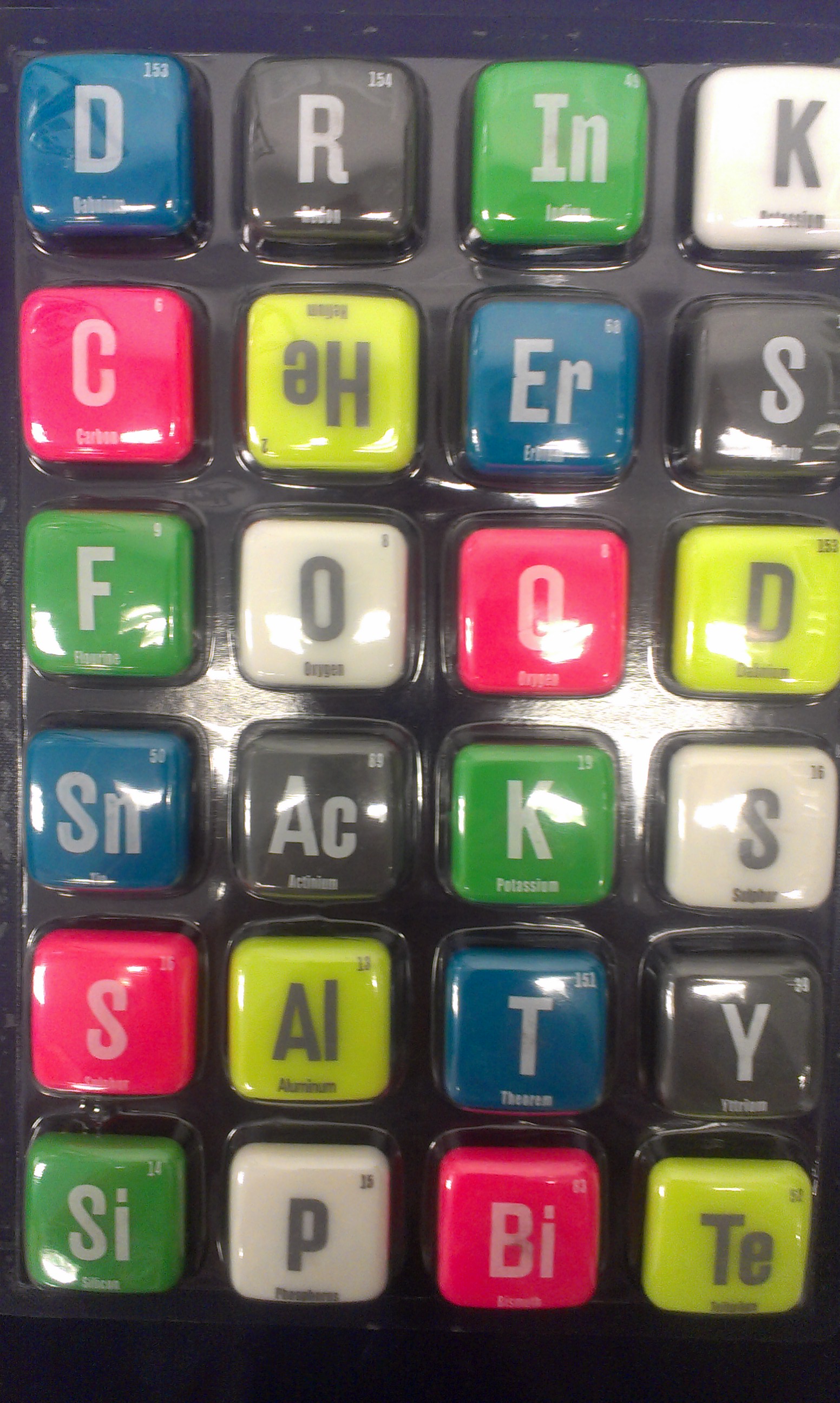
I found my gummy bears and then started to wander through the kitchen section whereupon I saw these magnets for sale:

periodic magnets


That’s right, people! PERIODIC TABLE REFRIGERATOR MAGNETS!  It’s like Target KNEW I was depressed and asked their cheap plastic crap supplier to make these just for me AT A DISCOUNT!  The set only cost $2.84.  WHAT A BARGAIN!

So, since my gummy bears were only a buck I figured I must have them for my desk at work.  I grabbed a set without looking at it very closely and went my merry way.

I got back to work and took a closer look at my magnets and what I saw upon second inspection was several hilarious inaccuracies that made me laugh out loud, making Target the hero of the hour in my quest to not be quite so pissed off today.

So, for my science loving readers, I give you the following:

1. The magnets have element letters on them so that you can spell things, apparently.  They also list the name and the atomic number.  Notice that the first element is D, for Dabnium, atomic number 153.

So…there’s no element D.  I have a periodic table above my computer monitor and I see no D.  There is Db, which stands for DUbnium.  Not Dabnium.  Also, according to my outdated Periodic Table, there are only 112 elements.  Now there might be a few more by now, but certainly not over 150.  So…everything about this is made up and it’s awesome.  They just really wanted a D to spell Drink apparently.

2. Next to the first D, there is element R.  Under the R they say that it is Radon, atomic number 154.

Well, the first problem is that Radon is NOT made up, but it has the symbol Rn and is atomic number 86.  Why would they even do that?  Don’t they know only nerds buy this crap?  Hmm, more likely they are marketing to parents who hope their kids will be nerds.

3. Finally, there is element T, Theorem, atomic number 151.  WUT? This is not an element. Obviously.

So yeah, I laughed and then showed my dork boss because I knew he’d appreciate it, which he did, because NERD POWER.  Best 284 cents I’ve ever spent. *snort*

Perhaps the problem lies with me.  Maybe if I didn’t have a periodic table in front of my face all day long I wouldn’t have thought these dubious.  Why can’t I just be content to live in ignorance while licking a nice frozen Theorem-sicle?

Anyway, thanks Target.  It’s good to know you’ve always got my back.

Well, What Do I Do Now?


You know, self-introspection is great any everything, but sometimes I wish I would give myself a god damned break already.  Every week I keep having revelations about what’s wrong with me and my list keeps getting longer and longer.  Further, I keep digging deeper and deeper, chiseling away at the superficial issues always managing to find the more underlying ones…the ones that dictate everything I do and cause me the most pain and stress.  They are buried and excavating them results in anger and sadness equivalent to unearthing a mummy with a nasty curse attached to it.

My present conscious brain is a lot like that rich asshole who bankrolls the expedition.  The local guide that she paid next to nothing to get her and flunkies to the pyramid warns of the curse and she’s all, “Curse, shmurse.  I’ll worry about the curse AFTER I pry off these rubies from the sarcophagus.”   And then there are locusts…or something.

I’m trying here, people.  I think I can still be funny sometimes, but fuck if I can muster it much at the moment.  What I’m saying here is that I’m really angry.  I don’t know how to deal with anger. I don’t really get angry about things.  I get sad.  I get anxious.  I feel guilt and all that.  I don’t get mad.  And more to the point, the person I am angriest with is myself.

In our last episode of “Gina Thinks About Things that Have Happened and Cries About Them at Her Desk,” we see our hero realizing that she never actually dealt with the sexual assault she went through two and a half years ago.

I hadn’t it called it assault before this past Friday.  Not really.  After writing the post, I decided that torturing myself about the whole thing was a great idea, so I went back and read the email I wrote the asshole that I called “scathing” and, because of the magic of Google and archiving, I even still had the gchat I had with this guy during which I forgave him and let him off the fucking hook.  I read all that and felt sick to my stomach.

Here’s what I did.  Yes, I told him that he’s a creep and a prick (in more eloquent terms that that, but that was the underlying message), and then I said all the things that I did wrong to bring this about on myself.  And then I told him that he wasn’t a bad guy and we just had a misunderstanding, but I just wanted him to know that he hurt me physically and emotionally so that he could treat others better in the future.

ARE YOU FUCKING KIDDING ME, GINA? Really? You want to make sure he knows that he hurt you NOT because you want him to feel some damn pain himself and get some retribution for having a wrong committed against you, but because you want to make sure his future relationships are fulfilling and healthy for all parties involved?!?  REALLY?  What the hell is wrong with you?

I know this is kind of bizarre, me yelling at myself in blog form, but this is part of the process people.  The thing I realized is that no, what happened to me was not my fault.  What WAS my fault was that I completely minimized it for everyone else, especially him, so that I wouldn’t be an inconvenience and I wouldn’t ruin anyone’s life with my trauma.  Why?  And here’s the terrible realization: I don’t matter to myself.

Self worth is an important thing.  Being able to recognize it for yourself is an important thing. I have articulated this many a time when talking about things like jealousy and general insecurity.  If you don’t think you are worth anything to anyone except for something you can physically provide (something tangible), then of course you will be afraid of losing everything eventually.  Perfection is the only way to keep people close to you if you subscribe to this philosophy (how hard I work and how much I give of myself is equivalent to my value in other people’s lives) and obviously, we can not achieve perfection so people who think like this are pretty much screwed.

I am one of those people!  But I have figured out a much harder thing!  I KNOW that I matter immensely to the people who love me.  The problem is that I don’t matter at all to me.

And this shouldn’t really be that much of a realization.  I think I’ve generally known this, but I have used different words.  I put everyone else first without even thinking about it.  The thing that is surprising is how deeply engrained this attitude is.

But it shouldn’t be surprising. Growing up, I was rarely asked for my preference. I was taught that kids don’t really have preferences, or at least, if they do, they don’t matter.  The only people’s preferences that matter are the adults (and in my case, really only one adult’s preferences mattered).  If I disagreed about something and tried to engage with my parents about it, I was told to stop copping an attitude and was barred from expressing my opinion.  It’s not that I wasn’t getting an attitude, but I was never engaged, only quashed.  I am a really docile and obedient person.  I always have been.  I still don’t like walking on grass unless I know that’s absolutely OK.  It was easy (and still is often) to manipulate me into giving people what they wanted.  I want to be liked.  I want to be loved.  And I learned very early that it was easiest to like and love me if I didn’t have opinions or preferences.

This continued into my teens.  My peers were strong minded and self-absorbed (you know, like teenagers).  I found that my having no preferences and no standards for how I should be treated made being friends with them a lot easier.  I barely even thought about it.  It didn’t matter anymore if I was at home or at school or anywhere: What I want or need does not factor into any equation.  I am a multiplicative factor of 1.  Whatever you want, I echo, because, well, I’m not important.  It was not until I was in my late twenties and Wes had had a few years to start breaking through all this that I started to state preferences.  And it’s not easy.  It takes a huge amount of effort for me to say, “Well, if I had my choice I would do Y.”  It is a script I make myself say in the hopes that some day it won’t feel like I’m in a stupid play.

I am shaking with rage thinking about this.  How dare I let this seep into me so deeply!  How dare I allow this to become the most defining factor of my fucking identity!

And I talk about this and know that people reading it probably don’t get it because I’m such a weirdo.  I have odd interests and hobbies.  I’m creative and have a good sense of humor.  I like public speaking and am generally outgoing and confident (about certain things).  I project a personality of one who is “her own person”.  But the tragedy is that I know now that I would change it all at the drop of a hat if someone I loved told me that they didn’t want me to be any of those things anymore.

Luckily, I’m not completely useless and worked to find people to love who inspire me and appreciate me for the many different things that I am, given my druthers.  But I wait anxiously for them to disapprove.  Since I don’t matter much to me, my defining characteristics can become unimportant to me too.

That is absolutely infuriating and terrifying.  It means that I have an underlying fear of interacting with new people because I can’t trust myself to value myself enough to not change or conform to their ideal vision of me.  I can’t trust myself to think I’m worth feeling safe.  I won’t feel that way because I’m not worth anything to me.  The only thing that makes me responsible for my safety and my individuality is that I have a handful of people who would be very sad if I were a different person or if I got hurt.  It is for them, not for me.

So, I have some major work to do and I have no idea how to do it.  This realization explains so clearly why I am fundamentally unhappy.  Not a bad thing to figure out at the young age of 32.  But I don’t know what I need to do now.  Over the last several years, I have learned a lot of useful skills for dealing with my emotions.  Much of these skills are related to identifying the underlying problem, articulating it to myself and others in a clear and definitive way, and then solutions come easier because I know the problem to solve.  But here, I am filled with anger and sadness at knowing that I have spent 25 years or so simply not caring about my well-being for my own sake.  I have minimized my worth and needs and desires for my entire life.  It’s the dreaded “Who I Am” that I have to dismantle and I don’t know what to replace it with.

I want to truly love myself.  I want to see myself the way that the people close to me see me.  But I have no real concept of what this means to me personally.  I don’t know what wiring needs to be redone.  How deep does this go?

This is what real freedom means to me.  I want to be free from the cage I have built for myself since I was a tiny kid.  Freedom to me has nothing to do with not having a 9-5 job or doing music and theater and art full time.  Freedom is feeling comfortable in my own skin, being everything that I can be without fear.

Other things that equal freedom to me (and this is sad, but also an amusing exercise):

  1. Cooking mushrooms with dinner even if no one else I’m cooking for at the time likes them.
  2. Picking the flavor of ice cream I like because I’m the one that went to the store.
  3. Finding funny what I find funny and not justifying it to the people who don’t laugh.
  4. Turning people down who want to make out with me at a party.

There are many other ridiculous things that I worry about.  My neuroses run deep.  But the first step is admitting it.

Hi, I’m Gina and I don’t matter to myself.

Hi, I’m Gina and I have run out of patience with myself.

Hi, I’m Gina and I want to be truly happy and healthy.

Hi, I’m Gina and I just don’t know what to do.

Unfortunately, due to Real Life, I can’t now just sign off and go on some kind of walkabout or anything.  My job might dislike that and I’d run out of money FAST.  So the journey is going to have to be more local…like…in my head or something.  I need to figure out how to strip all this away and be done with it finally.

Thanks for reading.  I am hoping to be inspired soon to write about less heavy things, but we write what we know, ey?

Descriptive Norms, or Why Your Beliefs Affect Me


Editorial Note: This post was written by Wes Fenza, long before the falling out of our previous quint household and the subsequent illumination of his abusive behavior, sexual assault of several women, and removal from the Polyamory Leadership Network and banning from at least one conference. I have left Wes’ posts  here because I don’t believe it’s meaningful to simply remove them. You cannot remove the truth by hiding it; Wes and I used to collaborate, and his thoughts will remain here, with this notice attached.

—–


Scientific American has an article up discussing the difference between descriptive norms and prescriptive norms. The gist is that descriptive norms describe how things are and prescriptive norms describe how things ought to be. When it comes to affecting people’s behavior, descriptive norms tend to work much better:

In a classic study, Cialdini and colleagues manipulated the signs that were displayed in Arizona’s Petrified Forest National Park, a site often plagued by tourists who end up grabbing some of the petrified wood to take home as a souvenir. In situations like this, the first inclination of well-meaning environmentalists might be to set a strong prescriptive norm — perhaps by saying something like, “Many past visitors have removed the petrified wood from the park, changing the state of the Petrified Forest. This is bad, don’t do this.” The idea here would be to invoke a sense of shame and severity before asking visitors to refrain from taking the wood. But read that prescriptive message once again. Is there anything descriptive in there? Yes, of course there is. That message is not just telling you that you shouldn’t take the wood — it’s also telling you that most other people do. In fact, people were actually more likely to steal wood from the forest when they saw the sign telling them how many people tend to do it themselves, even though the very next sentence was asking them to refrain. But when the researchers simply tweaked the message to read that “the vast majority of past visitors have left the petrified wood in the park, helping to preserve the natural state of the Petrified Forest,” the thievery plummeted.

We don’t really care so much about what we should do. We care about what other people do. And then we really, really care about not being different.

The article suggests that making your support of marriage equality public on Facebook may actually make more of a difference than a lot of people think. I agree. When we make our positions publicly known, often that can be more convincing than anything else we can do.

This relates to the main issue with moderate religion. There are a number of religions out there (and other faith traditions that may or may not be classified as “religions”) that do no real direct harm on society. I was raised by a Quaker mother, and attended meeting up until I was allowed to make choices for myself. I have Unitarian Universalist friends. I know several pagans, and other religious moderates who practice non-mainstream, non-coercive religions.

These religions aren’t causing any direct harm that can be easily identified. However, that does not mean that they are not causing harm. I live in a country positively saturated in religion. Religion pervades public life in America in ways that are unheard of in other developed countries, and it leads to all sorts of horrible outcomes.

All public expressions of faith exacerbate the issue through the power of descriptive norms. The more people who identify as religious, the more it encourages other people to be religious also. Even the most non-proselytizing expression of faith reinforces the cultural message that religion is normal, and a lack of religion is weird. Nobody wants to be weird! So people are encouraged to overlook their doubts about religion in order to fit in, even if nobody is explicitly sending that message.

American Cross

People often ask me why I care that people hold religious beliefs. This is often coupled with a spoken or unspoken assertion that their religious beliefs do not affect me in a negative way. Often, I will attempt to explain that beliefs inform actions, an in any society, and especially in a democracy, everyone’s actions affect everyone else. But there is also the problem of descriptive norms.

I believe that, all other things being equal,  a more secular society is a better society. Religion, even moderate, “harmless” religion, impedes that goal. Of course, moderate religion does less harm than fundamentalist religion, but it’s still making it more difficult for our society to move in a more secular direction. It still encourages the general population to value faith above reason. It still contributes to the social stigma of atheism.

This is, of course, not to justify being a dick about it.* The fact that moderate religion is a problem doesn’t mean that it’s ok to be rude. It doesn’t mean that religion doesn’t serve useful purposes in people’s lives. It doesn’t mean that people are justified in attempting to impose their lack of religion on other people. It just means that as an atheist, I have a stake in the beliefs of my fellow members of society. This is not meant to discuss tactics at all.

This is another reason why coming out is so important. When we proudly identify as atheist (or polyamorous for that matter), that declaration speaks louder than any argument we can make. When we create a society in which it’s no longer weird to be an atheist, then we create a society where there’s one less reason to turn to religion.

_______________________

*I sincerely wish that this disclaimer didn’t need to accompany every post discussing this topic, but such is life.

An Open Letter to Harassers: The Volatile Space Between Desire and Action


This post is a combination of a confession as well as an angry rant about the phenomena of harassment.  If you have not been following, there is a summary here by Greta Christina.  I will say that this issue has been especially emotional for me, because I recognize many of the patterns of  behavior within myself, and they are attributes I have long tried to re-direct into healthy directions.  This is an attempt to show that there are many powerful feelings we must contend with, as humans, but that there is a better way than the traditional harass and hide behind the wall of silence and shame that harassment puts victims behind.  There are better ways to pursue what we want, and to get it some of the time, without hurting people.

—–

While I don’t really look to meet people much, sometimes it just happens.  Sometimes you meet people you like at a conference or at work, sometimes they read your blog and then start chatting you up, and sometimes there is just a person in your life who, after being around for some time, starts to become a person you really care about or desire strongly.  In some cases, they reciprocate your interest, and sometimes they don’t (or they do but perhaps not in all the ways you would like).  And when it works out, it’s great!  When you meet someone and have chemistry flowing both ways and both can fulfill desires together, it’s a great and beautiful thing.  We should pursue those things in those circumstances.

But then there are the times when you aren’t sure.  You are into them, they seem (logically) available, respond to you positively (or so it seems to you), and you want the relationship to go further.   Of course, you should communicate your interest (this is sometimes hard for me, being human and all) and you should be comfortable with a yes, a no, or a maybe.  Also, you should be comfortable with a “yes, but…”, because sometimes shit gets complicated.

Welcome to life among humans.

Today, I want to talk about what it is like to not be able to realize one’s desires.  More specifically, I want to talk about when your desires are not shared by the object of  said desires and yet the desire persists and you feel compelled to act on it.  This is a phenomena that occurs everywhere, to many people.  But even as a polyamorous person there are all sorts of reasons I might not be able to fulfill my needs or desires.  Whether it is because the person you desire is monogamous, too far away, or they just aren’t into you in the way that you want them to be (or at all).  Whatever the reason, there are ways to handle this situation well, and ways to seriously fuck it up (such as dick stumping).  And in the worst of situations you don’t stop pursuing your unrequited desires and you end up harassing people.  That shit needs to stop; like yesterday.

Yay for timely and topical content!

If you meet someone who compels you think some sexual things–for whom you have some deep, primal, natural urges for–it can sometimes be difficult to hold it all together around them if it’s not wanted or shared.  The feeling of wanting to act on it does not merely go away because it’s not reciprocated.  It would be great if it would, but for many people (including myself) it does not go away easily.  Wanting to act on it becomes a distraction, in some cases, and that distraction will often fade in time, but for some….

For some, this becomes a challenge or a goal to achieve rather than a place to re-direct one’s intentions and behavior.   I urge those people to reconsider this reaction because in many cases this impulse is the origin of some behavior–i.e. harassment–which will not be appreciated or appropriate.  I’m saying that if ze is not interested, this is not a cause to break out your charm, your powerful intellect to convince them otherwise, or your position of power to leverage their behavior.  I’m saying, find another way to interact with this person, if at all, if you can’t keep the unwanted thoughts at bay.

Clearly, many people don’t take this advice.

I understand that the emotions pushing you towards satisfying your desires are powerful, but those desires are not aimed at objects; they are aimed at subjects.  You must remember that these people have their own minds, goals, and desires that may not have anything to do with you.  If you are unwilling or unable to do so, then perhaps you should keep your distance and think about something else.  If you are a decent and respectful person, someone else may reciprocate to similar desires, or they may not.  Life is unfair sometimes.  If you keep pushing in a direction that isn’t working, you can only get short term inflated desires at the cost of hurting other people.

Some personal confessions here; for me, the anticipation of a fulfilled fantasy is a powerful motivation and even an aphrodisiac for me.  It’s related to the feeling of NRE, except that it can happen even with people I’ve known for years, and even with people with whom I’ve already fulfilled some desires with (hopefully two-way desires).  Thinking about someone for whom I have strong desires can be a powerful experience, and the idea of acting on that desire is exciting.  But I always am aware that this excitement might be solely mine, and so I tend to be cautious in trying to act on my desires if I am unsure about how it would be taken.  And with few exceptions, usually for the good*, I have succeeded in this caution.

I’m sure I’m not saying anything ground-shaking here.  I’m sure that much of this is shared by many people.  Human beings are complicated, and our desires sometimes seek to push us in many directions which are potentially inappropriate.  We need to be able to distinguish our desires, which are not a problem in themselves, from our actions, which can be problems.

Of course I’m polyamorous, which adds a layer of complexity to this issue.  With polyamory the desire for variety and new experiences is somewhat mitigated by the presence of the people we have relationships with, but not always.  Sometimes a different specific person, action, etc which you desire cannot be satisfied by just anyone.  Desires, needs, etc are not like a universal fuel that can fill you up by spending time with any person, at least not with all things.  Sometimes specific people evoke unique feelings and satisfy specialized desires that other people, even the people closest to you, simply cannot provide.  In healthy expressions, this can take the form of a specific kink that a specific person shares with you, a hobby or interest that you associate with a particular person, etc.  It can also be as simple as you have been fantasizing about a specific person and only that person can fulfill that desire.  Thus, being polyamorous is not a cure for this problem; harassment happens within polyamorous circles as well.  Being open is not automatic consent, after all.

Sometimes your specific desire will never be fulfilled.  No matter how hard you work, how much you try, or how long you wait.  Sometimes you must leave the desire aside, and do something else.  You cannot allow yourself to rationalize coercion as being acceptable because your desire is too strong (“I can’t help it, baby, you just turn me on so much”).  You cannot rationalize harassing people because you think you can hide it (“whose going to believe you, anyway?”).  You cannot do these things and expect to be a decent human being.  Your desires, no matter how intoxicating and compelling, are not excuses for bad behavior.  That is selfish thinking.

The object of your desire may never reciprocate, and you must be comfortable with that.  It is important to allow your fantasies to have some freedom to indulge themselves, but you must remember that if that fantasy involves another person it may not be possible to satisfy and so maybe you should indulge another fantasy.  If your fantasy is reciprocated and possible to act upon with consent, then that’s wonderful.  Fulfilled fantasies and anticipation rewarded are wonderful things which we should cherish, as they happen infrequently (unless you get really lucky).  But when it becomes clear–and we need to be watching for, and asking questions concerning about, this–that the desire is not reciprocated, we need to be prepared to shift our focus immediately and  appropriately.

These days, I find myself in a situation where I have some hopes, fantasies, and anticipations which may (or may not) come to fruition over the next few months.  I find that I am enjoying the hoping and imagining, but I also have to keep in mind that some of these hopes may never materialize because they may not be shared or possible.  And while that may disappoint me, I can survive this without emotional implosion (or dick stumping) because I have many kinds of desires.

The people I have sexual desires for are more than sex objects for me.  In addition to thinking about them sexually (and I do), I also try to also develop non-sexual desires which include them.  If they don’t want to get busy doin’ it, then we can be friends and allies.  Will that suck a little? sure.  But I must approach people for whom I have desires with the attitude that even if all my desires cannot become real, there are all sorts of ways that the people that I desire can be important parts of my life, short of my hopes.  And sometimes this may mean that we simply go our separate ways too.  That has to be OK as well.

If the only desire I have for someone is sexual, I better be damned sure I communicate that and be ready to hear a “no” before setting myself up for a situation I’d like to act on it.  If my hopes are multi-faceted, I can allow the relationship to just be what it is.  If they want to bone (yeah, I went there), then we can bone.  If they want to be be friends, close or not, then that is something I can appreciate as well.   But there is no room for coercion here.  There is no room in my life for pushing in a direction that is pushing back against me.  There is no room in my life for harassment.  There is no excuse for harassment, with all the varieties of people, interests, and things to do in the world.  There is a healthy way to pursue your desires, and harassment is not one of them.

I wish that all people felt the same.  Because while I share many of the desires and impulses which I imagine those who have been harassing also feel, I have enough compassion, respect, and consideration to not allow those desires to control my behavior (and I hope it stays that way).  That is, all the hardware and software for harassment exist within me, but somehow I have grown past that and learned to use those desires in healthier ways.  How unaware, how selfish, and how cowardly…how flawed and human…do these people have to be to have kept up the behavior for so long?

I will not allow myself to rationalize trying to “convince” or coerce people to fulfill my desires.  I will not convince myself that I’m just wearing down their uncertainty about what they really want (ugh).  That is a mistake I learned early, and which ended up hurting someone I cared about many years ago.  And so rather than having an awesome and interesting friend, I have a person who will not talk to me anymore.  I have acted in such a way that they no longer trust me, let alone consider me a friend anymore (let alone a lover).  What did my attempts accomplish? And what have the many people, now being named in the skeptic community, who have harassed people they worked with accomplish? At most, it gave them a power rush at pursuing, at the cost of another person’s happiness.

Worth it?

For these and many other reasons those people who have acted poorly have my sympathy, but not nearly as much sympathy as I have for those they mis-treated.  My anger is directed at you, harassers, but that anger is mostly fueled by the potential for the same that exists within me.  I am angry at our many human flaws, because they are what hurt us.  Knowing that had I had a different past, one where I was not exposed to introspection, compassion, and (yes) feminism early, I might have been more like you is humbling and terrifying.  I hope you will all take this as a learning experience, rather than as a time to dig deeper and make excuses through lawsuits and further lying and hiding behind a system that has protected you (and myself) for so long.

We need to keep challenging ourselves to be better as individuals, as skeptics, and as a culture.  I hope that those being named–and more importantly those not named or those just getting started or who somehow have avoided being called out–will take this as a moment of transformation, rather than rationalization and defensiveness.  After all, we have enough people out there rationalizing their poor behavior already.  We don’t need more swelling their numbers.

—–

A final word, about polyamory.

Polyamory is about more than romance and sex.  The fact is that the women in my life for whom I have hopes are people I genuinely like and want to be closer to, to varying degrees.  If that means we are friends and allies and not lovers, that is a positive things as well (if not a little sucky).  Polyamory is not merely about having more lovers.  It can also be about shifting the way we see desire and how fluid our desires and relationships can be.

There is no need for rush, no compelling anxiety, to pursue a desire now and here if one’s concept of relationship is based in allowing oneself to love, and be loved, by the people in your life as is shared with them.  There are many people that exist in my life, many of them for whom I have strong physical and emotional desires.  But there is no compelling reason to rush towards those desires if they are not reciprocated.  Yes, I feel an anxiety and need inside, but I don’t need to act upon it if it is not shared.  I allow the relationships to be what they are, when they are, because if they are not interested in sharing my desires my pushing will not change that (and if it does, it never brings us closer).  And if they are to change their mind, that will happen by earning their trust by being a decent person, rather than pushing them away through harassment or unwanted solicitations.

While swimming in the sea of the backlash of sexual harassment which has been plaguing the skeptic community of late (again, summary here), I can’t help but think how terrible it is that some people cannot see others around them to whom they are attracted as more than just fantasies to try and procure.  If the people who find themselves wanting what may not be possible would understand that there is more to the fantasy than just sex, especially when that is only possible through coercion, then sexual harassment would be vanishingly rare ( oh, what a nice world that would be!).  Of course, part of the problem, at least in some cases, is probably the desire to conquer, to have power, and to coerce is more powerful than basic empathy.  If that’s the case, then I don’t know what the solution is.

I fear that some people share many of the inner desires that I do, but do not share the capability for empathy that I have.  That is a truly scary thought.

*A point of honesty; I have times in my past crossed appropriate lines, and these acts haunt me from time to time.  The important thing here is that we learn from these actions and grow as people, rather than hide them and allow them to become a secret that we hide from, until they are exposed.  There are quite a few people in the Skeptic community who may wish they had considered that a long time ago, these days.

Some Things are Hard to Say


[Content Note: Sexual Assault]

I struggled about whether I was going to write about this.  I have written a bit about it before, but the subject has come up again in fuller force than usual and I find myself doing some major processing.  I am going to be talking about a traumatic event in my life, so feel free not to read it.  As Ginny suggested the other day, doing a google search about cute animals might be a better choice.  I figured, fuck it.  It’s therapeutic for me and maybe someone else will find it helpful.  Or something.  I don’t know. I apologize in advance.  I’m kind of pissed and sad.

Two and a half years ago I was feeling like a new woman.  I had successfully plowed through a number of issues that were keeping me from embracing polyamory for myself.  I had my jealousy issues under control.  I felt confident and datable.  Soon after my 30th birthday I had my first real dates as a poly person.  The first one went well and I dated that guy for a month.  It ended stupidly, because he was a jackass in lot of ways, but it was good because it showed me that I could enjoy other relationships in a healthy way. That was awesome news!

Near the end of this relationship, I had a couple of dates with another guy…we’ll call him Dude.  I had known Dude for a few years, mainly through our interactions at a local karaoke night.  I thought he was funny and cute and entertainingly kooky.  Once I felt ok about dating, I talked to him and we expressed mutual interest.  We went on a date and it was cool.  I thought I could trust him.  He seemed harmless.  So when we decided that the second date would be at his house, I wasn’t particularly worried.

At the time, he was on crutches nursing a badly sprained ankle, so I decided that it made the most sense for me to make dinner for him at his place and then watch movies, since moving around was a laborious task for him.  And that’s what we did.  Until a while later, I found that I had drifted to sleep.  I woke up to him rubbing my arms and some kissing happened.  One thing led to another, as the kids say, and I went upstairs with him, even though I didn’t really want to.

This is where the “I should haves” start.  They’re so useful, right?  I mean, I didn’t think I needed to worry, but in hindsight, obviously I should have just said, “You know, it’s getting late.  I think I’m going to head home,” instead of going upstairs.  But I figured there would be more communication.

So there I was upstairs.  Things progressed quickly.  I went with the flow, still not really wanting to but at this point I was thinking the other really helpful thing, “Well, you let it get this far, didn’t you? What are you going to do, stop???” The rational answer is YES, but I wasn’t thinking rationally.  I figured that as a newly liberated poly person that I was supposed to be “slutty” and to do any less was somehow betraying my new lifestyle.

That’s completely embarrassing to write, by the way, but there it is.  Not to sound like a fucking public service announcement, but there’s not wrong with slutty behavior.  But there’s also REALLY nothing wrong with wanting to feel safe with partners.  If something doesn’t feel right, you do not owe it to ANYONE to go through with it.

Ugh.  Anyway, things continued and in the beginning, I noticed that he wasn’t really making eye contact with me AND he was being pretty rough with me.  I was suddenly terrified.  I began thinking about how I didn’t really know this guy and how we hadn’t talked at all about what we liked/what we were into.  Had I found myself in a situation with a kinky person who failed to communicate this?  I stiffened up immediately, but he didn’t notice.  I was quiet and barely moved and didn’t know what to do.  I figured that there was nothing I could do but continue since, you know, I had let it get this far.  Also I could manage to do before the “main event” was say, “please be careful.  That can be really painful for me.” His response was something about “Oh, I hope I can control myself then.”

Yeah. Awesome.

Well, he didn’t and it hurt like hell and I took it because I believed stupid things.  Eventually, I took what control I thought I could take and tried to steer things to activities that were less awful.

During all this, he never really checked in or seemed to care.  After everything was over, he asked if he managed not to hurt me.  I told him that yes, it hurt.  I recall him being sort of sorry, saying something about how it was hard to control himself since I was so hot.  God.  FUCK YOU.

And then I spent the night.  I don’t really know why.  I wanted to run home and cry, but I also didn’t want the guy to feel like a rapist or anything…for some reason.  I was embarrassed and all night I lay awake thinking about this is what happens to women ALL THE TIME.  I think I stayed over also to attempt to make it feel legitimate somehow.  And then the next morning, I should have just left, but I felt empty and terrible and wanted to own the experience, so I initiated more activity in a stupid attempt to have the experience on my own terms.  It didn’t help. Obviously.

None of these were healthy or good choices.

I got home and felt awful.  It took me a while to admit to Wes and Jessie what had happened.  I feigned okay-ness, but started to fall apart as the evening wore on.  I had an Arcati Crisis show that night and was thankful for the opportunity to rock out some of my stress, but Dude was there and I could barely bring myself to make eye contact with him.

A few days later I wrote Dude a scathing email detailing all the reasons I couldn’t see him anymore.  He was mortified.  And few days after that we had a gchat about it during which he apologized but also told me that he talked to some of his feminist friends and they don’t think he’s aggressive or scary.  Oh! I’m glad your feminist friends don’t think so! That makes this all better.  Again. FUCK YOU.

But, despite thinking that he was full of shit for various things he said, I let him off the hook.  I thought I would be OK eventually and be able to go back to the way things were before all that crap.

But it has been two years and it is clear that I am NOT OK.  Not at all.

This came up recently because we’ve been looking for a place to hold a monthly poly meetup in Philly and he runs a weekly event at a cool venue.  There would be a lot of plus sides about doing it there, but the downside is that he would be there and would be benefitting from us.  Wes, Jessie, and Ginny went to the event to check it out. I declined, wanting a night at home and also not wanting to be around Dude. I felt uneasy about it but thought I was being selfish and stupid for that.  I figured if it was awesome, I would just suck it up and deal.

Of course, it WAS awesome and I had simply made the decision that I was going to handle it because I didn’t want to get in people’s way of having a good time just because I had a bad experience with Dude.  Wes talked to me about it and had to really drag it out of me that no, actually, I wasn’t OK with this.  I would be OK with it for other people’s benefit, but given my choice, I would not support Dude and really, would enjoy never seeing Dude again.  The conversation had me remember all of the incident in annoying detail, and also do all the second guessing again and again.  “Oh, well, I should have left or communicated or something…I should’ve been able to avoid that.  I made dumb choices. I’m being too hard on him.  I can be comfortable enough in the face of really good craft beer specials…”

Yes, folks, I have such a hard time putting my own sanity first that I actually weighed its value against awesome beer specials…and the beer specials were winning, in my view.  WHAT?!?

So, it was a pretty fucking illuminating conversation.  I spoke recently about My List of things I need to work on or be vigilant about.  Knowing and respecting my own value is on there but always kicked to the bottom.  I don’t know what that is.  I guess it’s easy to do?  Who knows.  It’s a hard truth about me.

I am writing this today to affirm a few things.  First, yes, what happened to me was assault.  I don’t care what his intentions were.  I don’t care if he felt bad about it after I called him on it.  I don’t care if his feminist friends think he’s fine and dandy and that he would never hurt anyone.  He hurt me, after I asked him not to.  He can go fuck himself.  It was assault and it wasn’t OK and it’s reasonable for me to want nothing to do with him.  He was unkind and uncaring and we are not friends.

Second, admitting that something is traumatic and that this trauma makes you not want to be around certain people is not weakness or wrong or stupid.  I spend a lot of time analyzing my reactions to things and trying to get past negativity and move on.  But I shouldn’t be so obsessed with this that I make myself hang around with people who have hurt me.

Third, I know I am worth a lot to myself and the people who love me.  The fact that I thought it was better to just deal with this guy and be uncomfortable instead of telling them that it wasn’t ideal for me is baffling and ridiculous.  We’re not talking about having it at a bar that doesn’t sell cheap red wine here.  We’re talking about a bar event sponsored and hosted by someone who sexually assaulted me and I don’t have to be OK with it.

Fourth, some may question why I put all this out into the ether.  Well, I feel foolish and embarrassed and various other self deprecating feelings, but I know they are not original or unique feelings.  Writing them down puts them into reality.  This is what happened and these are the choices I made, for better or for worse.  I am not writing for sympathy.  I am writing because I need to write it down and own the story.  Perhaps next time I can own a story about a unicorn tea party in the clouds or something.

Man, this post is depressing.  Maybe a little empowering, but mostly angry and depressing.  Not great for a Friday but that’s the way it goes.  You should probably go listen to the podcast because I’m much funnier on there and didn’t talk about sexual assault AT ALL.

Anyway, I’m OK.  It’s just hard to see in real time how self destructive I can be.  Luckily, Wes is good at getting me to be real, so in the end it was a good conversation to have.  I kind of want a liquid lunch now, but instead, I’ll go get a sandwich and chill the fuck out.

On red flags and the benefit of the doubt


We seem to have breached a new wall in the “sexual harassment in skepticism” war: names are being named, stories are being told. If you haven’t been following it, Greta Christina has a good rundown on the news to date here. (If you haven’t been following it, and would rather look at pictures of a baby elephant playing on a beach, those are here, and I don’t blame you.)

Essentially, these stories implicate a couple of big skeptic organizations, specifically JREF and CFI, in severely underreacting to accusations and confirmed incidents of sexual harassment by various of their employees and speakers. This is not the first time JREF and CFI have been at odds with feminists in the skeptic and atheist movement — for CFI, it’s not even the first time this summer. Both organizations (and individuals like DJ Grothe, the current president of JREF) have said and done offensive things and been called out. But, to people like me who are not on the inside track, this is the first we’ve heard about this level of unacceptable behavior, this level of sweeping things under the rug and prioritizing keeping popular male leaders over creating a safe and welcoming environment for women.

And one thing I’ve heard a couple times, in reading over blogs and comments on this subject, is “We shouldn’t have been so forgiving before. We shouldn’t have given the benefit of the doubt.” And that’s disturbing to me, because it suggests that the next time someone behaves in moderately assholeish ways, we should go ahead and assume they’re full-blown rotten scumbags. Which, I think we’d all agree when looking at it coolly, is not a rational approach to take.

Anger here is justified. I know some people have a much hotter response when angry than I do, and say things they don’t actually think and mean. (How this works I don’t fully understand, but I recognize that it does.) I want to be sure, though, that when the dust settles and the anger loosens its grip, we don’t actually go around upgrading offenses and declining forgiveness (that we’d otherwise have granted) because a different organization or person screwed us over in the past. I think there’s this fear of being a fool, of granting someone the benefit of the doubt — in a case where it was fair to do so — and then being shown later that they didn’t deserve it. Ironically, there’s something victim-blamey about that very notion that it’s foolish to give someone the benefit of the doubt if they later prove to be a thorough jerkass. It suggests that if we fail to fully intuit or extrapolate the depth of someone’s rottenness from a few initial red flags, we’re the ones who have messed up. Not true. It is always meritorious to judge someone based on what you know of their actions at the time. Failure to act on the basis of information you didn’t have is not a mark of foolishness.

Now, pattern recognition is a thing, which is why the “red flag” concept exists in the first place. If we’ve observed that the people who publicly belittle women’s concerns frequently turn out to also be privately harassing and assaulting individual women, it’s not wrong to keep that data point in mind when making a judgment about another person who publicly belittles women’s concerns. That’s different from concluding that that person must also be a sexual predator. (Also take into account confirmation bias and the availability heuristic and all that.) It’s even okay to say, “You know what, I’ve been burned before by people who acted in ways that you’re acting, and even though you might not go on to do what they did, I’m not willing to take the risk of trusting you.” That’s a personal call that everybody has every right to make. What I’m not okay with is people saying, “I’ve been burned before by people who acted in ways that you’re acting, so I am going to assume you’re also guilty of everything they were.” It’s okay to hold a little cognitive dissonance around “they might not be guilty / I still don’t trust them.”

Let your anger burn, my fellow feminist skeptics. But don’t blame yourself for forgiving in the past, or giving the benefit of the doubt when it seemed merited. We judged then based on what we knew then. Now we know more.

Baby elephant says that’s ok.

baby elephant face looking up from the surf

Bad Faith


Following up on yesterday’s post about happiness and truth, I wanted to say a few words about how truth is better for us than comfortable mythologies.

I actually want to perpetually improve myself.  I’m not merely interested in being right (although I would lie if I said that were not a real desire I have) or just feeling comfortable.  I am interested in being a better and more healthy person.  And I cannot do so if I’m not willing to be honest with myself and those around me.

But honesty comes with a price.  Honesty means you cannot hide from the truth, whether it is within you or the universe itself.

This is why I demand a skeptical attitude about the world for myself, and those closest to me.  I believe that there are real answers about how to improve ourselves and our world, and lying to ourselves about the nature of reality is not conducive to finding real solutions.  If I want to be better, and I want the world to be better, I cannot be satisfied with comfortable fantasies.  Fantasy cannot give you real answers, it can only give fantastic, unbelievable, or incredible answers (notice those words, and think about what they really mean).  How can I trust people, including myself, to actually become better if they cannot do the very basic work of not lying to themselves about what is real?

If we cannot do reality, I can’t see how we can do the work of transcending ourselves into anything other than an avatar for a complicated and comfortable lie.

This is why I do battle with faith.  Faith cannot lead the human species to a better future, because faith cannot have a solid basis in reality.

Faith is inauthenticity.

A narrative which avoids the evidence of what the world really is cannot give us consistent good answers to tough questions.  At best, it can give us answers we like that work insofar as we remain within that narrative.  But once you lave that narrative, the answer may not be effective.  So, the question is whether that narrative is real or not.  why would you want to remain within a narrative structure, whether Christianity, Scientology, or New Age spirituality, etc if it contains ineffective solutions to real problems?

Wouldn’t you prefer real solutions for real problems?

Isn’t maintaining the fake narrative just another form of lying to yourself? Isn’t it avoiding the real problem?

That is the very heart of inauthenticity.  That is, as Sartre called it, bad faith.

—–

Not that it’s directly related, but just because it is a beautiful piece of (true) art:

Unskeptical Monogamy: “Monogamy is Natural”


Editorial Note: This post was written by Wes Fenza, long before the falling out of our previous quint household and the subsequent illumination of his abusive behavior, sexual assault of several women, and removal from the Polyamory Leadership Network and banning from at least one conference. I have left Wes’ posts  here because I don’t believe it’s meaningful to simply remove them. You cannot remove the truth by hiding it; Wes and I used to collaborate, and his thoughts will remain here, with this notice attached.

—–


Some time ago, I wrote a post about Skeptical Monogamy. My goal there was to go over a bunch of the reasons why I think monogamy is justified. There are other reasons, though, that are unjustified and lazy. One of the most common is this:

“Monogamy is natural.”

This is an argument used almost exclusively by people who also believe that “natural” relationships only involve one man and one woman. Sometimes, it’s phrased in terms of the animal kingdom. This is one of the easiest arguments to knock down. It’s easy because almost no animals are actually monogamous. Plenty form pair-bonds, some even form them for life, but they almost all play around on the side.

In fact, no species of mammals have been shown to truly be monogamous.. Swans, often held up as a model of monogamy, are, no such thing. Gibbons, who my local zoo claims are monogamous, turned out to be total swingers. Scientist used to estimate that 90% of birds were monogamous. Now the numbers are flipped, and most acknowledge that, at most, 10% of birds are monogamous. The animal kingdom offers no help to those advocating monogamy.

Then you get the other kind of naturalist argument. John Witte Jr., writing in the Washington Post, says:

Both traditional theorists and modern scientists point to four facts of human nature that commend monogamy. First, unlike most other animals, humans crave sex all the time, especially when they are young and most fertile. They don’t have a short rutting or mating season, followed by a long period of sexual quietude.

Second, unlike most other animals, human babies are born weak, fragile, and utterly dependent for many years. They are not ready to run, swim, or fly away upon birth or shortly thereafter. They need food, shelter, clothing, and education. Most human mothers have a hard time caring fully for their children on their own, especially if they already have several others. They need help, especially from the fathers.

Third, however, most fathers will bond and help with a child only if they are certain of their paternity. Put a baby cradle on a sidewalk, medieval and modern Western experimenters have shown, and most women will stop out of natural empathy. Most men will walk by, unless they are unusually charitable. Once assured of their paternity, however, most men will bond deeply with their children, help with their care and support, and defend them at great sacrifice. For they will see their children as a continuation and extension of themselves, of their name, property, and teachings, of their own bodies and beings, of their genes, we now say.

Fourth, unlike virtually all other animals, humans have the freedom and the capacity to engage in species-destructive behavior in pursuit of their own sexual gratification. Given the lower risks and costs to them, men have historically been more prone to extramarital sex than women, exploiting prostitutes, concubines, and servant girls in so doing and yielding a perennial underclass of “bastards” who have rarely fared well in any culture.

Given these four factors, nature has strongly inclined rational human persons to develop enduring and exclusive sexual relationships, called marriages, as the best form and forum of sexual bonding and reproductive success. Faithful and healthy monogamous marriages are designed to provide for the sexual needs and desires of a husband and wife. They ensure that both fathers and mothers are certain that a baby born to them is theirs. They ensure that husband and wife will together care for, nurture, and educate their children until they mature. And they deter both spouses from destructive sexual behavior outside the home.

So, Witte identifies four factors that justify monogamy in humans:
1) humans crave sex all the time;
2) human babies have a long period of dependence;
3) fathers require paternity certainty to bond with a child;
4) humans are unique in engaging in “species-destructive behavior” such as extramarital sex, prostitution, etc.

As we’ve already seen, #4 is crap. Almost all animals engage in such behavior. #3 is also begging for a citation. Paternity certainty is often brought up by evolutionary biologists as a way to justify the way our society mistreats women. However, it’s far from proven, and there is substantial evidence that the need for paternity certainty is far from “natural.” Christopher Ryan, in Sex at Dawn, lays out a pretty conclusive case that early humans societies didn’t care at all about paternity certainty. He also identifies several modern-day cultures for whom paternity certainty is not an issue. Witte’s glib statement that fathers require paternity certainty in order to bond with their children is not supported by the evidence. And I’d imagine the idea is extremely offensive to anyone with an adoptive father or child.

So after taking out the propositions that are unsupported, we’re left with:

1) humans crave sex all the time; and
2) human babies go through a long period of dependence.

Sounds like an argument for polyamory to me! I’d wager that my five-person household is just as well equipped to meet everyone’s sexual needs and care for children than a monogamous couple.

Furthermore, so what if something is natural? “Natural” is not synonymous with “desirable.” In many species, murder, rape, theft, and various other antisocial behaviors are natural. That’s not an argument in favor of humans engaging in these behaviors. Much of our progress as a species has been in overcoming our natural behaviors and learning to act in more beneficial ways.

Even if polyamory isn’t natural, I think it stands on its own merits. Nature isn’t everything.

***UPDATE***
Sex expert Dr. Darrell Ray weighs in on “natural sex”

If “natural” sex is better, then Catholics are far from practicing it. Natural sex does not include any hocus pocus of religion. Your dog has natural sex as do Bonnobos. The Mangainians of the South Pacific have natural sex and have had for centuries. It included many partners and a high focus on female orgasm. The Na culture in China have natural sex, it includes multiple men for a woman and no concept of marriage. I could site many other cultures that practice sex without the guilt and shame of religion AND they did not use birth control or condoms until recently.