The false wisdom of religious myths


‘Straight is the gate, and narrow is the way,…and few there be that find it.’ When a modern religion forgets this saying, it is suffering from an atavistic relapse into primitive barbarism. It is appealing to the psychology of the herd, away from the intuitions of the few.

This is a quote from the philosopher Alfred North Whitehead, from his Religion in the Making. To some it might sound like a promotional phrase from a local Christian organization, in that it might be interpreted such that it demonstrates how so many seem to miss God’s word, and only the few will accept it. But, knowing Whitehead a little better than that, I can say that it means something quite different.

Whitehead’s use of the term “few” is interesting and perhaps misleading. He does not mean that few will attain or choose this straight and narrow, but rather that few will comprehend the complexity in order to navigate it. The issue of religion in all of its philosophical, psychological, and sociological factors is much too complex to be comprehended in simplistic dogma handed to us as the “truth.” Thus any religious group that gives answers to the difficult questions of life in a way that hordes of people can understand and try to follow has severely, I believe, oversimplified the matter, and acts as a stumbling block to true wisdom. True understanding takesr genuine effort.

For those that would respond by saying that it is through belief that we will understand, I say bullshit. Our minds are plastic enough to rationalize something nonsensical which we accept, but this does not ean it will stand up to more objective scrutiny. Socrates is credited with saying “I know that I know nothing,” which made him wise in the eyes of many both ancient and contemporary. Many of those you will find preaching the “Word” today might claim a similar ignorance in saying that we only have the wisdom of man, while there is a wisdom of God available to those who choose to accept it.

But how is our “flawed” human wisdom to recognize divine wisdom without a divine point of view on our parts? This would not be a problem for a theoretical God-man, but it is a serious problem for any fully human receiver of that message to be able to recognize that the messenger or the message is legitimate without access to the divine wisdom in question. (Can anyone say circular reasoning?)

Our wisdom is indeed limited, and we each have much to learn in order to understand the vast universe. But this reasoning is not sufficient to conclude that our wisdom is so inferior that we should capitulate to dogmas and doctrines about the universe that offer a simplistic solution to difficult issues. The fact is that most people will never understand the world or themselves sufficiently in order to approach religious notions with serious comprehension. Yet some will. It is for the more rare mind that the social and psychological constructions of religion become clear. Many others, the “herd,” adhere to simplistic ideologies and beliefs in place of truly comprehensive understanding of religion either because they lack the time or energy to do so.

Religion in our culture has become so watered down, so common, that even someone uneducated in critical thinking, religious history, and philosophy can claim the supremacy of the “Word.” This is not to say that religion is without merit or significance, as there is much to religious thinking that is wonderfully deep and philosophical. Unfortunately, most are unable to appreciate this. And when they do appreciate it they utilize religion’s philosophical depth in order to argue that the simplistic notions epiphenomenal to this depth to are valid in themselves. In other words, they use the wisdom hidden behind the superficial myths to validate the myth.

As a Zen master once said, once you have used the finger to point out the moon, you no longer have use for the finger. So, if you find something useful and wise in the depths of religious traditions, wonderful. My suggestion is to throw away the simplistic dogmas that are promulgated as a lure for the masses in order to truly understand what is important in religious thought for the pursuit and love of wisdom. After all, the few are so few only because the masses don’t try hard enough, don’t care, or are too defensive or stubborn about their beliefs to challenge them.

Lessons; taking responsibility for our mistakes and our successes.


You know, sometimes the only way to learn a lesson about yourself is to see what evil you are capable of. Sometimes, for the unfortunate few, you can only truly grow and improve yourself upon reaching lows in life. I think that this is because when we are low we are finally willing to face the tough questions, challenge ourselves in deeper ways, and the ascension gives us newer perspectives.

The shame is that so many people that discover this give “god” the credit. I think that this diminishes the lesson.

Atheism is not choosing sin over the “straight-and-narrow”


There is a myth about atheists which I hear regularly from people, especially Christians. Basically, the idea is that people want to live a certain way, and knowing that god would not allow such things, they simply reject god in order to live a life of…well, sin. A Christian might say that our desire for sin overpowers our desire for salvation. That’s an interesting way to frame the discussion, but it is not how I would phrase it. I would say that I want to enjoy my life in ways that some would consider wrong, but which I don’t see reasons for them being wrong.

The idea that atheists turn away from god in order to not be subject to god’s laws (no matter the particular set of laws they believe) is based on the assumption that god’s truth is obvious to us, but we reject it. I understand why this line of thought makes sense to believers; the idea of god’s reality is so close to their mind that they have trouble imagining not believing in god. But the conclusion that atheists make concerning their views on gods is not a derivation of the lifestyle they choose. In fact, this conclusion is not a choice at all.

I never chose not to accept god, to reject god, or to not believe in any hods. Atheism is not a choice at all. It is what one concludes upon looking at the reasons, evidence, etc concerning god and finding that they are not convinced that one exists. Of course, one can have good or bad reasons to believe or to lack belief, and if one were to say that they didn’t believe in a god because they want to live their lives without hindrance, that is not a good reason.

So, if someone asks me if I am an atheist so that I can live my life in ways that are not acceptable according to their scripture, I tell them that it is mostly irrelevant what their scripture says because I don’t believe that it is any more than a fairy tale anyway. If a book tells me I can’t drink alcohol, I don’t reject that god and that religion because I want to drink., Rather, I have already found that I don’t believe in the god of that religion and subsequently found that this rule about not drinking to be silly in addition to my pre-existing lack of belief. And even if I think the rule silly before this lack of belief, people don’t actually reject deities solely because they don’t like the rules.

What I think is really going on here, in some cases anyway, is religious folks feel the desire to do things which their religions say they cannot do in good standing with their god. So when they see people outside of their religion doing those things, they project the sting of that desire as well as the guilt they feel at desiring it and place it on the person they see. Thus, they may conclude that the other person, in order to deal with this guilt, has convinced themselves that there is no god so that they can go about their sinning without feeling bad. The theist, for some reason, either cannot or will not understand that the lack of belief is actually derived from the so-called evidence not standing up to scrutiny.

Now, from my point of view, what religion often does is tells you that you cannot do things that are often in our nature, telling followers that these desires are either the work of Satan tempting us, our human pride in our own sinful ways, or some other mythology to explain away why we have desires that lead us towards “evil.” And some of our desires will lead us to do things we should not do, and we need to make sure that we are not controlled by these desires completely. But sometimes our desires are OK to explore, and not doing so will create resentment, guilt, and other long-term harm to ourselves for no good reason at all.

I’ve met too many people in my life who have lived a life of guilt, repression, etc based on religion-based fears to be able to give religion a pass on this. Telling people that their desires are evil is disgusting. Making people live in the closet (Ted Haggard, anyone?), creating a culture that makes cheating more acceptable than polyamory (I can’t tell you how many people will react worse to an open and honest sharing of your loved ones than to doing it behind closed doors in secret) , and to generally convincing people that they are sinners and guilty automatically for some mythological fruit-based sin….

For fuck’s sake, the Original SIn was because someone gained knowledge of good and evil? I won’t even comment…

I live my life according to an ethical view that makes primary honesty, concern for the desires of others, and doing no harm where hard is not wanted. If your scripture (or your interpretation thereof) states that something I’m doing with full consent of all involved, then I find your book silly. I find it silly because I see no reason to accept that any gods exist, let alone your particular interpretation of your particular book of your particular god.

Polyamory and Family


sexthreescompanyfeb5
Social and cultural training leaves its mark on us. Many new to polyamory will feel some discomfort with some aspects of a non-monogamous lifestyle, but their desire to pursue something less traditional overshadows this in time.

But what about those that don’t choose an alternative lifestyle? No, I don’t mean those coerced, as this is not a part of polyamory. I mean those relatives (and possibly friends) who watch people close to them leave behind tradition and “normal” expectations behind with disapproval and possible scorn?

For some reason, many parents, grandparents, etc are somehow offended and become angry upon finding out that their loved one is breaking with the tradition that they chose for their own lives (assuming that it was not merely assumed, which is often the case). For the most part, this is mere insecurity, close-mindedness, and fear. But there is a legitimate slice of this type of phenomena as well, and that is the unfortunate fact that being polyamorous can be an obstacle towards certain goals, and it is these obstacles that becomes the rub for family and friends.

Especially when conservative religion becomes involved (but certainly not only conservativeness or religiosity), there are many aspects to society that will ostracize and otherwise exclude those that are willing to follow a different path. That is, those with the courage to follow their ideals are squashed for standing out. Why? Well there are too many reasons to list exhaustively, but much of it is not wanting to be associated with the abnormal; being social creatures, people tend to desire fitting in.

And over time, certain abnormal things will become more normal. Interracial dating/marriage was abnormal in much of society in many places and for many years, but now is common. There will hopefully be a day when three, four, or more people in a legally-recognized relationship will not be an example of the result of a slippery slope argument used to scare people from allowing gay marriage.

But before this happens we will need brave people willing to stand in the open in their non-traditional lifestyles and risk the fray. I am willing to be one of those people, and I hope that all of those around me will some day feel the same.

But in the now, there will be the balancing act of how much you allow your family and friends see. There will be those that you trust who will know, and those that you don’t trust. It’s unfortunate, but it happens to atheists too; some of the family you see around their holidays don’t know you reject their religion (or at least lack belief in their god). The real shame of it is that the only way that these things change is through exposure to those that are afraid of change, but doing so comes at personal cost often.

Social good in the long-run at personal cost; a tough struggle.

Polyamory is difficult


…yet has lessons even for the monogamous.

Relationships are difficult. People are complicated, and figuring out how to get along with them can often be a challenge. Anyone who has ever been in a relationship with another person knows how difficult it can be. Now imagine that difficulty multiplied by, well, by however many relationships you have (and then double that, perhaps).

When you are polyamorous, the emotions of the people involved are much more present. It is much easier to gloss over and cruise by emotional difficulties when insecurities and fears are not as frequently unearthed. The fact is that the vast majority of us have insecurities, fears, and other issues that lay under our everyday lives. Our culture has evolved in such a way that, for most people, these insecurities can hide most of the time. They come out from time to time, and perhaps we see a therapist or have talks with close friends, but they don’t dominate our lives.

But the lifestyle of polyamory brings many circumstances to the table which bring the hot buttons of our insecurities to the surface, meaning that they will be pressed much more often. This, in turn, forcies us to become very familiar with the terrain of our emotional landscape. That is, you are forced to actually deal with your fears, insecurities, and other parts of ourselves that we try to hide (from ourselves as well as others).

When we are compelled, through the circumstances we find ourselves, to find ways to deal better with our issues in life, we grow and mature in ways that we would not otherwise. And as far as relationships are concerned, this can be a great boon. This is why I think that what polyamory has to teach us is invaluable to anyone who has emotions. That is, I think that what polyamorous people learn through living this lifestyle should be learned by everyone, whether they are single, monogamous, or polyamorous.

So, what are these things that we should learn? Well, I’m no expert, but I’ll give a very quick analysis of what I think is most important:

  1. Communication is essential: We must tell our partners what we really think. We must not hold back things we do not like or things that we want.
  2. Honesty is vital: We must first be honest with ourselves about what we want. Then we must be honest with our partners about what we want. Outside of things like the details for their upcoming surprise party, we need to keep an open line of communication about the things that our partners need to know, which brings us to…
  3. We must create and maintain boundaries: In each relationship, we must use our communication and honesty to decide what is acceptable and what is not in that relationship. Rather than have what is “normal” or standard become the default, we should create our own rules and borders of the relationships we are in, keeping in mind that they may change over time and may need periodic adjustments.

These should be the basic rules for all relationships, not just what poly people talk about. I think that if everyone would follow these basic rules, rather than having the assumed rules of the monogamous world imposed without question, then we would find that things like polyamory would naturally emerge among people who have, perhaps secretly, desired something a little different.

The problem is that most people fall into relationships and never bother discussing many of the important things about the relationship. Most people simply assume that at some point you have to make a decision to commit to one person or another or to remain uncommitted. This absurd dichotomy overlooks that people can, if they choose, commit to more than one person, or primarily to one but with others, or whatever structure suits everyone involved. But when people automatically settle towards the cultural standard of monotony… I mean monogamy…, then people are often left without much of what they really want, which they think is the necessary sacrifice for a “real” relationship.

You don’t have to sacrifice everything you want. Try and be honest with what you really want in your life, and you may find that there are people that want the same thing as you. And don’t forget to start being honest with yourself so that you don’t find that you have worked yourself deep into a relationship with a person with whom you share few relationship goals simply because you didn’t know what you really wanted.

Finally, don’t worry about those insecure and fear-ridden people that you may scare off with your particular goals or kinks, because those people have to work on themselves before they are worth your time anyway.

This is why atheists appear angry…(follow-up from yesterday)


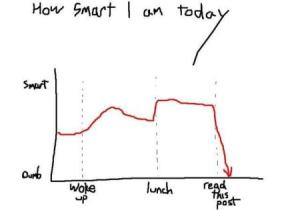
dumb-post

An email, sent in continuation of the conversation I blogged about yesterday, is included below. I post this for two reasons. One, it is a prime example of how some fundamentalists “debate.” Second, it is to show why atheists look angry to some people; it’s because we have to put up with absurd bullshit like the following.

(I edited the formatting to make clear which comments are mine and which are his. I have not changed anything except formatting, and excluded nothing. My comments are italicized, his are bold-faced.)

I was not aware that we were engaged in a formal debate, but such is the nature of blogging I suppose. To comment on your second reply:

Again, I have made no presupposition.

Sure you have. You have said God does not exist without having searched every possible corner of the universe, or every realm of existence. You presuppose you have weighed all of the evidence available but you have not.

Secondly, to claim that we have the same set of evidence seems to imply that you know what I know, and I doubt you do. Do you have some sort of special knowledge that is unavailable to me?

No, I do knot know everything that you do, but I do enough about me and the context of creation to place you within it, and to understand, at least in part, where you are coming from. This I can do because God has spoken to us through his Son, Jesus Christ. There is a sense in which I can identify with everybody, and to this degree I am able to “know” you.

I did not choose the conclusion I made, I was simply not convinced of a certain proposition because I didn’t see what was offered as evidence sufficient to stand up against scrutiny. Thus, I didn’t choose to make a different conclusion (and even if this were valid, what would prevent me from simply observing that the same is true for you?).

The same is true of me, which is precisely my point. Do you honestly believe you were forced to come to a single conclusion, that no alternative views were agreeable, or at least available to you when you denied God’s existence?

You say I’m not convinced because I do not want to be convinced. I find this response obnoxious, arrogant, and assuming.

Yes, I will have to admit that this seems to be the case, but I am not speaking on my own authority. Scripture condemns your unbelief. See Romans 1. You purposefully suppress the knowledge of God in unrighteousness. If this sounds simplistic, it’s because it is. God’s wisdom seems foolish to “big” thinkers, and he has done this to put to shame those who refuse to submit to his authority. Again, your unbelief stems from anarchy, not philosophy.

You don’t know anything about my background, personality, etc. Is it possible that you simply want to believe that anyone who does not share your conclusion must be hiding behind some insecurity, fear, or desire to be free from some responsibility of some god? Why else would you place the blanket assumption upon all non-believers with this reason other than to mask your own potential bias? Is it possible that I genuinely would want to know if a god existed but simply do not find the so-called evidence convincing?

What is so unconvincing? And before you launch into detailed scientific or philosophic explanations, please note that I will simply move these arguments onto my table as arguments supporting the knowledge of God, which, again, brings us back to presuppositions.

I have no presupposition in this matter. I am not claiming anything absolutely, so you cannot level the argument against me that I am “building [my] entire world on a belief which [I] cannot absolutely substantiate” because I am not trying to do this at all. Your response to me is entirely straw-man and disingenuous. Yo have not responded to me but rather a caricature of an atheist you have built up in your mind.

First of all, “There is no god” is speaking with totality and finality. You are certainly making an absolute claim when you declare this to the world.. The fact that we are even debating this issue only proves my point.

You say you rest your case on revelation. Which revelation, and of what? The revelation of one of the various Islamic theologies? Perhaps it is of Jewish origin? Maybe Zoroastrian? The problem with revelation is that there are so many kinds, and they cannot all be true.

Exactly. God has spoken to us through Jesus Christ of Nazareth, who is God incarnate, as manifest in the pages of the Christian scriptures. I suppose I could argue that your atheism has spawned a thousand contrary worldviews as well. But if you charge me with being narrow minded, I will have to plead guilty. Again, I have no problem with this because my presupposition allows me to do this.

Yes, you are being subjective, and so am I. I never claimed objectivity (I actually think objectivity is impossible. So now you do have an absolute claim of mine that I will have to back up, if yo desire me to do so.) so your criticism in this regard is also a straw-man.

I only meant that you have raised yourself to the position of intellectual superiority by claiming you have come to the sum of all knowledge (available to you). If there is no god, then you become the ultimate authority. There is no one to tell you how to interpret reality. I realize that I am also making a judgment about the evidence, and likewise proposing to have arrived at the sum of all knowledge. But the difference is that I am acknowledging, not that I have decided what truth is, but that God has revealed it to me/us. Therefore, I receive an interpretation of reality, but you form one because you contend their is no one higher than you who would have the authority to do so.

And your claim that my reasoning is insufficient, rather than the evidence, wthout even asking what my reasoning is! This explodes with the implication that you are responding not to me (again) but to some model of what an atheist must think, which stems from your inability to comprehend that someone might think, genuinely, that the data is insufficient for belief in such a being as a god.

You said:

You simply submit to another authority, which is your presupposition that there is no God. You say “There is no god” and behold, you are convinced there is no god.

Again, this is not my presupposition. But I must remind you that it is you that makes the proposition that a god exists. The burden of proof always is with the person making the claim.

Are you not making a claim as well? How do you know that God does not exist in another universe (though I myself do not believe this)? You say you understand this universe, but you are not certain that this is all there is, or at least, you should not be so certain. In this regard, the burden of proof rests on your shoulders. Sure, I must give an account for my reasoning, but I submit the Scriptures, which, if entirely true, make perfect sense of creation. You, on the other hand, submit a proposition that rests, not on the revelation of a Supreme Being, but on your own idea of what supreme knowledge is, i.e., naturalism, materialism, existentialism, or whatever, as long as God is not in the equation.

You make the claim that god exists, that the evidence is sufficient, etc, so you hold the burden of proof to show why this is the case. I claim that the evidence is insufficient for me to believe, and I would be happy to explain why this is the case. But rather than asking my reasons, you assume them and attack those assumptions. Bad form.

I disagree. I am well aware of the general tenets of atheism, so I do not presume anymore than you offer by way of wearing such a label. Likewise, you assume many things of me because I am a theist.. There is no reason to criticize my “form.” I am quite sure you do not have any original thoughts; nor do I. I have a general understanding of scientific and philosophic arguments against the existence of God. Do you really need to expound them again to me, as if I would need to do the same to you regarding arguments for the existence of God?

I must admit that my assumption here, and it is an educated guess as I run into this all the time, is that you are projecting the weakness of your argument onto me. I have no desire to reject god.. In fact, if a god exists I would like to know very much because the truth matters a lot to me. God, if it is worthy of the title, would know precisely how to convince me, and has not done so.

Again, this is simply not true. Remember, my presupposition allows me appeal to a higher authority, who, if he/she/it does exist, makes perfect sense of my interpretation of the “evidence.” If God exists, then my interpretation makes sense. You are simply throwing out the possibility of God’s existence, which allows you to “debunk” my belief in God. But you have not really thrown God out of the picture; you have merely painted another picture of the world without him in it, and are presenting it to me now as a “fact.”

My point is this: you are going around in circles, as am I; however, I am allowed to be circular in my reasoning, whereas you are required, because you claim ultimate authority over knowledge, to get behind an original thought and break the circularity of your reasoning. But you cannot do this because you always come back to your presupposition “God does not exist,” as if this is a priori, but it is not. Your grounds for arguing against him are the same grounds by which I prove his existence. You are simply beginning at an entirely different starting point.

I do not wish to launch into some sort of debate over God’s existence. I believe you are probably aware of my defense already. If I were to write you a million pages on reasons for God’s existence, I suppose you would simply turn my argument around to favor your proposition. In other words, and as I have already said, your defense is not merely intellectual, but volitional. You have ample evidence to believe in God but you choose not to. The greatest minds have debated this very topic and in the end few cross over to the other side. Why is this? Because you will stick to your guns no matter what because you have already decided in your head and heart that you will not be under the authority of any god, even though God has shown himself plainly to you.

This whole world makes perfects sense if viewed through the person of Jesus Christ. Since he is King of the Cosmos and Savior of sinners like us, I ask you to turn to him in joyful belief and hope. And if you think I am silly, so be it. I should only expect such criticism.

So, I invite yo to present the evidence that compels you. If it is evidence I have not considered, I would be glad to hear it.

Thanks for your response.

Notice how he ignores that last part there?

My favorite part at the end was the following:

The greatest minds have debated this very topic and in the end few cross over to the other side. Why is this? Because you will stick to your guns no matter what because you have already decided in your head and heart that you will not be under the authority of any god, even though God has shown himself plainly to you.

This is a classic example of projection. This is precisely the type of presupposition he is doing (he’s allowed to because it it true!), yet levels it at me. Again, I have not claimed that god does not exist. I’m saying I’m not convinced that one does. No matter how often I say this, he repeatedly attacks this straw-man as my proposition.

This is why atheists appear angry to so many people.

A fellow blogger and I discuss atheism…sort of


I sent a response to this blog post I commented the following:[edit note: I had to include my entire response here because he did not allow the comment to be shown on his blog. This is indicative taht he wants his blog to appear as unchallenged truth, rather than what it really is]

Your argument is lacking for one very important reason; your atheist is a straw-man.

The definition of atheism, the only definition that includes all atheists, is the lack of belief in any gods. True, some atheists also believe taht there is no god, and these positions are distinct and conflating them is a fallacy. There is a subtle but epistemologically crucial difference between lacking belief in something (say, the evidence for its existence is insufficient) and believing something does not exist (say, the thing is impossible by definition, that is to say logically impossible).

As an atheist, I am not saying that god does not exist. I’m saying, qua atheism, that I am not convinced. Said another way, when I hear (again, qua atheism) someone claim that a god does exist, I simply do not believe them. This straw-man of the atheist making an absolute claim is simply not true. And when one does make this claim, they are an atheist in addition to this claim, not as a result of it. That is, the absolute claim implies the lack of belief, but the lack of belief does not imply the belief of the lack (of gods).

Similarly, it is not true that atheists do not believe in authority. But stemming from the philosophical traditions of people such as Locke, many atheists (again, not all, as there will be some that do not agree with the forthcoming line of thought) believe that authority is derived from a shared set of laws that we agree to live under.

Some atheists argue for a biological, psychological, or evolutionary basis for concepts such as authority, making them nearly universal. Some may even accept some transcendent form of authority, something built into the nature of reality. The bottom line is that atheists can believe all sorts of things about authority, because the concept of authority is not derived from the concept of gods or disbelief in them. There simply is no necessary relationship between a deity and authority.

These myths that you are perpetuating here are frustrating to myself, as well as many other atheists I know. You cannot lump an opinion or set of beliefs on a group identified by the lack of one type of belief; that simply makes no rational sense.

I am an atheist because I see no reason to accept the proposition that any god exists. Until some evidence or reason is given that is sufficient for me to accept that the existence of a god is the most likely conclusion, I will, by necessity, be an atheist.

…Yada-yada, the entire reply should appear as a comment to the blog (assuming he allows the comment to be shown).

His response was typical to many apologist tactics; he replied to a straw-man version of an atheist, rather to what I said, and perpetuated further the myths that apologists tell. His full reply, via email, is here:

Thank you for your courtesy and civility. I genuinely appreciate your response. But I do believe you are still missing the point. We are all bound to presuppositions from which we cannot escape. The same evidence which is laid before me is before you, but you have simply chosen to reach a different conclusion. You are not convinced because you do not want to be convinced. If you wanted to be convinced, the evidence before you is sufficient to do the job. Enter your presupposition. You are building your entire world on a belief which you cannot absolutely substantiate. Sure it sounds nice and neat and tidy, but you have major holes in your logic. However, it is enough for me to rest my case on revelation, and to acknowledge my presuppositions, because they do not work against my conclusions. I am submitting to an absolute authority by acknowledging that I cannot escape circular reasoning–I admit I am not completely objective. I am bound by my finitude to fallacy and subjectivity, but again, this is no problem for me. These would be problems for you, though, since you are claiming to be entirely objective, and to remain unconviced because of insufficient evidence. But it is your reasoning, not the evidence, which is insufficient. You simply submit to another authority, which is your presupposition that there is no God. You say “There is no god” and behold, you are convinced there is no god. You have all the proof you need, but I believe it is your desire to reject God’s existence (and consequently, authority) which creates your suspicion. It is not born out of pure intellectual objectivity, but out of passionate, volitional subjectivity.

My response, via email, is the following:

Again, I have made no presupposition. Secondly, to claim that we have the same set of evidence seems to imply that you know what I know, and I doubt you do. I did not choose the conclusion I made, I was simply not convinced of a certain proposition because I didn’t see what was offered as evidence sufficient to stand up against scrutiny. Thus, I didn’t choose to make a different conclusion (and even if this were valid, what would prevent me from simply observing that the same is true for you?).

You say I’m not convinced because I do not want to be convinced. I find this response obnoxious, arrogant, and assuming. You don’t know anything about my background, personality, etc. Is it possible that you simply want to believe that anyone who does not share your conclusion must be hiding behind some insecurity, fear, or desire to be free from some responsibility of some god? Why else would you place the blanket assumption upon all non-believers with this reason other than to mask your own potential bias? Is it possible that I genuinely would want to know if a god existed but simply do not find the so-called evidence convincing?

I have no presupposition in this matter. I am not claiming anything absolutely, so you cannot level the argument against me that I am “building [my] entire world on a belief which [I] cannot absolutely substantiate” because I am not trying to do this at all. Your response to me is entirely straw-man and disingenuous. Yo have not responded to me but rather a caricature of an atheist you have built up in your mind.

You say you rest your case on revelation. Which revelation, and of what? The revelation of one of the various Islamic theologies? Perhaps it is of Jewish origin? Maybe Zoroastrian? The problem with revelation is that there are so many kinds, and they cannot all be true.

Yes, you are being subjective, and so am I. I never claimed objectivity (I actually think objectivity is impossible. So now you do have an absolute claim of mine that I will have to back up, if yo desire me to do so.) so your criticism in this regard is also a straw-man. And your claim that my reasoning is insufficient, rather than the evidence, wthout even asking what my reasoning is! This explodes with the implication that you are responding not to me (again) but to some model of what an atheist must think, which stems from your inability to comprehend that someone might think, genuinely, that the data is insufficient for belief in such a being as a god.

You said:

You simply submit to another authority, which is your presupposition that there is no God. You say “There is no god” and behold, you are convinced there is no god.

Again, this is not my presupposition. But I must remind you that it is you that makes the proposition that a god exists. The burden of proof always is with the person making the claim. You make the claim that god exists, that the evidence is sufficient, etc, so you hold the burden of proof to show why this is the case. I claim that the evidence is insufficient for me to believe, and I would be happy to explain why this is the case. But rather than asking my reasons, you assume them and attack those assumptions. Bad form.

I must admit that my assumption here, and it is an educated guess as I run into this all the time, is that you are projecting the weakness of your argument onto me. I have no desire to reject god. In fact, if a god exists I would like to know very much because the truth matters a lot to me. God, if it is worthy of the title, would know precisely how to convince me, and has not done so.

So, I invite yo to present the evidence that compels you. If it is evidence I have not considered, I would be glad to hear it.

Thanks for your response.

I’m curious how others see this discussion.

Growth: the result of challenged insecurities and fears


The longer we go in not challenging ourselves and others, the longer we will continue to live in a world that will crawling towards progress.

We are weak, insecure, fearful, and habitual people. I speak primarily of Americans, because that’s the culture I live in, but I think it is true everywhere to some extent. We are afraid of challenging the mythological assumptions of the world around us. Most believe that faith is good, monogamy is the default, and that success is more important than integrity. We believe these things because the structure of the culture that dominates the world is populated by people that were taught these things and perpetuate these things. Thus, in some perverted sense, they are practically true because they are tradition.

But what is the basis for these beliefs? How many times have I heard that to not believe in something, to simply believe that the world in blind processes without the faith in a god, some paradise, or at least some ultimate meaning, then life is not worth living. Fucking bullshit.

People believe such things because they have never challenged themselves to actually think about this seriously. People are emotionally attached to their beliefs, and so their is a kind of pain when some fact, idea, etc comes to mind that contradicts their worldview. More common is the cognitive dissonance that arises in people who accept contradictory ideas.

Then there are the insecure, lazy, and ignorant hypocrites of the world;

Sunday Christians (those that really are only god-fearing at church, and otherwise don’t give a rats ass except when they meet an atheist). You have never really challenged yourself to figure out what you might really believe if you looked at the claims of your religion. You rely on the support group of the others around you (many of which are using you for the same thing), and have probably never even read your holy book.

Monogamous couples who cheat. You know very well that you want more people in your life sexually, and most even still love their spouses. Yet when you are asked what is wrong with polyamory you say it’s wrong, unnatural, or “not for me.” When you say it’s not for you, you mean its not for your partner, or that you don’t have the guts to open yourself up to the jealousy and insecurity that come with thinking about sharing yourself and your loved ones. Yes, there are some people who just make poor choices and really aren’t into being poly, but I think that a lot more of you out there are just scared, insecure, and fearful of the concept of you not being enough for someone else.

The worst part is that we don’t talk about these things. Religion and politics. Ok, sex too, at least insofar as challenging the fantasy of the soul-mate or the “one for me” mythology; the things that we are not supposed to talk about. Bullshit. The only reason that is true is because when we do, we expose the insecurities and fears of those that refuse to challenge themselves. We tell ourselves that we do it out of respect, but respect for what; Insecurity and fear?

Stop allowing your fears, as well as the fears of those around you, from preventing these discussions. Challenging the worldviews of people we disagree with (hopefully after honestly considering your own position), is how we can help our culture grow out of this insecure and fear-ridden infancy.

Grow up, and help the world around you grow up.

Accomplishments


So, I’ve completed part one of my book I am writing. Just under 100 pages and I’m ready to dig into part 2 now. I will not post it online, at least not yet, but I wanted to comment about it.

I suppose all I can say is Kas-A!

That’s pretty much what I’ve been doing most of the day, and why I’m still up this late…