The Musicality of Love


4e6c6fb2Several weeks ago I acquired Daft Punk’s new Album, Random Access Memories.  I had heard a review, and part of a couple of songs, on NPR (because that’s what I listen to if I’m not listening to Daft Punk).  One of the songs (Doin’ it Right) got into my head (the NPR piece had used it as a bump after the review–good choice, NPR production!) and so I had to get the album to satiate the insanity of this song playing in my head.  So, upon acquiring it and adding it to my playlist on my player (I use Foobar), I started playing it and listened to I while I played some Starcraft 2 (yes, I’m that kind of nerd).  Let’s just say that I loved it.  I mean, the kind of love where after the album was done, I re-started it, and listened to it again (I had finished my Starcraft playing at that point).  And then, after that second listening, I listened to it again.

Soon enough, I burned a disc so that I could play it in the car (not having a fancy mp3 compatible player in the car).  And so for the next couple of weeks or so, whether I was in the car, had my iPod on, or at my computer I was likely listening to that album.  The more I listened, the more I liked it.  I would have different songs running through my head while not listening to it, and just had to hear them when I was able to do so.  The album took over my life for about 2 weeks.  It was love at first hearing.

I have a number of favorite albums and songs from various genres and time-periods, including Collective Soul’s Dosage, Counting Crows’ August and Everything After, Beethoven’s 5th and 7th Symphonies (well, the first 2 movements of the latter), Pink Floyd’s Meddle (among others), T Rex’s Electric Warrior, Green Day’s Dookie, R.E.M.’s New Adventures in Hi-Fi, Nas’ Illmatic, Miles’ Davis’ Kind of Blue, quite a few Phish albums (to name a favorite would be too hard), The Beatles (mostly their later work), The Clash’s London Calling, much of The Talking Heads (and David Byrne’s later solo work too),  Ween’s White Pepper, ….

I could go on, but I won’t.

There is some music which simply found its way into my brain and I love listening to them, especially in certain moods.  And as I reflected on this, I started to think about how, at least for me, certain songs, albums, or even musicians have a relationship with me in much the same way as people have.  That is, there are analogous relationships between my history with music and with people.  And in many cases, certain music will always remind me of certain people, and sometimes whole albums are associated with specific people.  Sort of the way that the line “with fingernails that shine like justice” will always remind me of Ginny (as she intended).

The last few weeks, in other words, have been akin to a torrid love affair where I could not get enough of, well, an album.  It’s worn off, mostly, now.  Now I can hear or think about a song from that album without having to listen to the entire thing, but I still love the album and will continue to listen to it in the future.  This experience is not unlike some relationships I’ve had in the past.  You know, with people.  And while the analogy can only go so far, I started to realize, as I thought about it, that I feel the same way about a lot of those people as I do about some music.
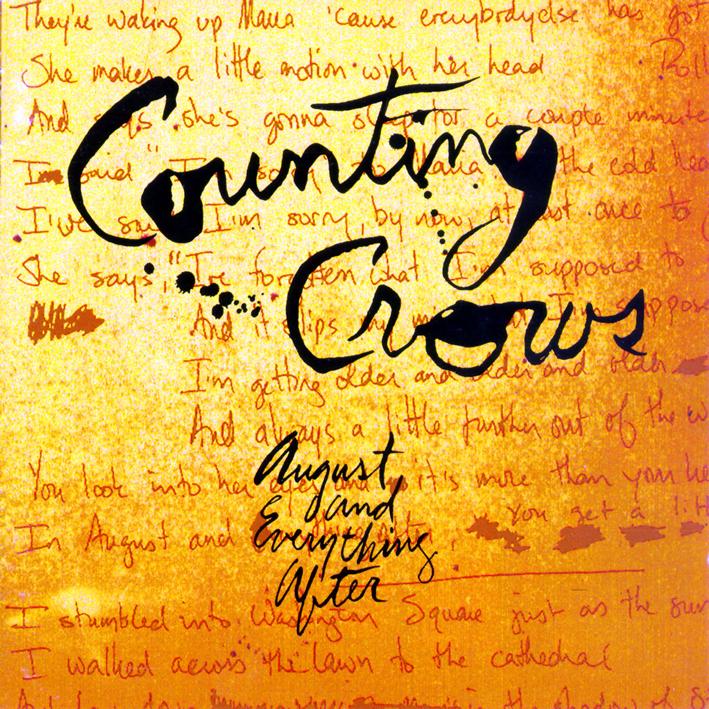
counting-crows-august-and-everything-after-delanteraLet’s start with one of my longest-loved albums, for example.  Counting Crows released August and Everything After in 1993, when I was in high school (the beginning of my sophomore year, in fact).  I have a vague but emotionally powerful memory of driving away from a vacation, with my parents, the following summer listening to that album.  I had met a girl, Nikki, who I liked considerably.  I was 17, hormonal, and the mere few days I spent with her was one of the earlier experiences I had of really getting to know and like somebody in a sexual and romantic way.  Having to say good-bye to her, get in the car, and drive away knowing that I would likely not see her again (we were in Hot Springs Arkansas–my parents choice of location of course–and I was going back to Philadelphia, Nikki back to Ohio) was emotionally devastating for me.  And listening to Round Here on my discman (you remember those?), a song which is emotionally crippling in many ways already, just made the feeling surge in ways I could hardly contain (if I had only known then what Borderline Personality Disorder was, the heart-wrenching pain would have made more sense to me then).  There is a piece of that still every time I gear the first few notes of that song.  I never did see her again, and sometimes I wonder what she’s up to now,  19 years after those few days spent with her.

Ever since then, I associate that song, and much of that album, with that summer and that vacation.   I love that albums still, and I think I always will.  Listening to it now, remembering that summer, thinking about how Nikki made me feel with her skin against mine all bring me the same cocktail of emotions.  Later associations of that album, as well as their second album (Recovering the Satellites, which was not nearly as good) with a relationship of 2 years while in college with a woman named Erin, many of the same feelings arise within me .  That album feels like young and naive love, the kind that incited deep feeling, stinging pain, and nostalgia for being young and being able to give of myself freely, without fear.  It feels beautiful and alien to the man who still is capable of love, but perhaps who will always be tainted by cynicism and fear when it comes to allowing that level of openness. I feel almost the same way about that album as I do about those 2 early relationships in my life, and I still have wonderful feelings about both of those women, even knowing that many years have gone by and neither of them is likely anything like who they were then.

And I could, if I chose, recount the many associations I have with specific music, friends, and lovers from my past.  I won’t do that because it is not all of the specific events of my personal life that I want to emphasize today (plus you probably don’t want to read that).  What I want to emphasize today is that, for some of us anyway, our relationships with music is, in many ways, akin to our relationships with people.  Music is, of course, an object so the analogy falls apart because people are, well, people and thus subjects of their own.  But in my experience, how I feel about things like music is similar enough to how I feel about people to make the analogy useful.

We change how we feel about music over the years the same way we change how we feel about music.   There is music I used to like, for example, but do not like as much anymore.  There is music I didn’t like at first, but now love.  And there is music that I always loved and always will love, but perhaps in different ways than I did before.  Our apprehension of music is not static, after all.  Our experiences of life change us, so how we will feel about other people (who will also change) and how we feel about music is dependent upon the function of that change.

GinnyGinaMeI genuinely miss, and often still have good (if not complicated) feelings about, some ex girlfriends.  There are some I don’t talk to anymore, whether because I don’t want to or they don’t want me to, and there are some I do still talk to (too varying degrees).  And of course, there are Ginny and Gina, who I am still with (and hope to always be with), as well as others who I have other kinds of relationships with.  When I met Ginny, I was into her immediately and immensely, much like my relationship with that Daft Punk Album.  I just wanted to be around her all the time and could not get enough of being with her.  Granted, I was in a bad place in my life and did need emotional support (which she gave), but when I was able to be calm, sane, and forget about that I realize I just wanted her around most of the time, and hopefully she will be around for many years to come, with her fingernails shining like justice.

When I first met Gina, on the other hand, I was not sure how much I would like her at first.  Granted, I first met her when she was in a crappy mood, and we didn’t have much time to actually interact directly for some time, but she was around enough that I got a chance to get to know her a little.  I knew I was attracted to her, but I didn’t know whether we would click together well and so I never took the opportunity to pursue conversation or flirtation of any kind.  But like many of my favorite albums, I didn’t really start to love her until I stopped what I was doing and just listened to her.  It was not until I stopped just having her around, as part of the background of my activities, and started giving her some attention that I realized that she is complex, hilarious, talented, and awesome.  In fact, now that I think about it, it’s not unlike how I see David Bowie’s Ziggy Stardust (an album which Gina loves).  It’s an album I had heard, at least in part, before but I had not really listened to as an album.  But once I took the time to really listen to it, I picked out qualities that a casual or background listen would miss.  Just like with Gina.  I had to have other people apparently leave us alone while at some Steam Punk event about 2 years ago to really talk with her and discover that we had very compatible senses of humor and knew that I wanted to be with her.  I went from liking her, to really liking her, to loving her in a short time because I paid some attention to her.  It makes me wonder how much great music, and people, in the world I’m missing by not paying more attention to them.  I know, first world problems.

And now I’m listening to The Rise and Fall of Ziggy Stardust and the Spiders from Mars as I write this.  Thanks Gina….

Then there are the non-favorite songs, but the ones you really just have to hear occasionally.  I mean, I cannot prevent myself from singing along to Ice, Ice Baby or Baby Got Back, but under no circumstances would I label either song as good, or songs I must have on my iPod nano (neither is, BTW).  Also, there are songs I like, but not in context of their albums.  The Verve’s Bittersweet Symphony is a song I really like to hear occasionally, for example (that song is on my iPod, but not the rest of the album), but it’s not from a great album or a favorite band of mine.  I just really want to hear it occasionally.

And so this is the point where I, unsurprisingly, make the transition to argue that polyamory is superior to monogamy.

I’m sure that many of you saw it coming.  If you didn’t, you have not been reading this blog long enough.  I could do the surface-level argument and say that just like we all love many albums, genres, etc of music, and are not expected to (and should not have to) choose between them in some exclusive way, neither should we be expected to choose who we love, or at least what kind of love we should have with whom.  And while that is true, and ultimately that is what my argument is,  I think that there is some deeper utility to the analogy than that surface point.
PFJust like one might love albums from high school or college years after those times are over, people can still have fond feelings for exes or for people who are not your current partner.  I mean, not always; sometimes there is no good feelings left after a relationship ends or with people you just don’t like.  Personally, I still have good feelings and memories about ex partners who hurt me and who I generally would generally prefer to never see again.  I mean, the relationship existed for reasons, and those reasons do not always evaporate when the relationship ends.  Just like my love of Pink Floyd did not affect my love of Daft Punk or Collective Soul’s Dosage when I discovered them, neither does any residual feelings I have for someone I am not dating anymore, or even someone else I’d like to date in the future, have to affect how I feel about a current partner.  There is a trope in our culture that talking about, liking, or thinking about exes or other potential partners is doing it wrong.  Somehow, if we chose someone, we cannot continue to, effectively, choose someone else.

And then there is that fact that we might not love certain music, but really like it, like it occasionally, or only at certain times.  Similarly, there are people we know who we don’t feel the need to interact with day to day, or to dedicate our lives to, but with whom we share similar interests, desires, etc and can establish a less committed relationship.  I am not sure how often this happens, but imagine two people who spend time together a couple time a month or so, perhaps even a sexual relationship, but who recognize that they are not good partners for one-another.  They enjoy their time together, but they have other things going on in their lives.  So, in our monogamy-oriented culture, if either, or both of them find a better partner match, this relationship may be expected to end (especially if it’s sexual in nature).  But why?

It’s obvious that the relationship is not a threat to some other more committed relationship (remember, commitment does not imply exclusivity), so why should it have to end? Wouldn’t it be better to allow such relationships to continue or end on their own terms, and not the terms of another relationship? I mean, I don’t want to listen to The Verve all the time, but my life would be (slightly, but noticeably) diminished if I could never hear Bittersweet Symphony again.  For rational reasons or not, that song contributes to my feeling happy (but in a bittersweet way…sorry…), so why, just because I like Daft Punk’s Random Access Memories a lot more, should I not continue to enjoy another song or album?

I’m not trying to be flippant here.  The social and cultural rules about monogamy really do seem as absurd as having to choose one album, or favorite food for that matter, over all others.  Why would we deny the variety of potential valuable relationships there is in the world for the sake of your (perhaps) favorite partner? I mean yes, if I had never met Gina and was married to Ginny and was only with her for the rest of my life, she would be a great partner for me and I would be very lucky to have her.  And if Gina and I had met under different circumstances and were exclusive, we could be happy as well.  So yes, I could be content (in the way that many monogamous people are “content”) with one partner, but the simple fact is that I have existing, and potential, relationships with other people who have things to offer that neither of them can offer on their own (and there are other people they could have relationships with–and do– whom offer things I cannot).  So why would any of us choose sexual and romantic exclusivity?  It’s simply as absurd, from my perspective, as having to choose one song, one album, one artist, or even one genre of music to listen to.

I love many kinds of music.  I don’t often go out of my way to discover new music, or new people for that matter, but I love that both music and people exist in my life.  I love different kinds of music for different reasons, appreciate them for different moods, and listen to music in different contexts and with different frequency.  I approach music on its own terms, like it for its own terms, and enjoy it irregardless of what I think about other music.  It would be silly to say that I can only like this or that genre, artist, or album.  Let me re-phrase that in case you missed the important part of that statement; it would be silly to create a rule which stated that I had to only like one kind of music, and not enjoy other music.  It would be silly because we cannot choose what music we like, just like we cannot really choose what people we like.  Insofar as we can make choices, we can only choose what we do, not what we like.  And just like we choose to listen to a variety of music because we like a variety of music, we should allow ourselves to have the relationships that we want, as we want them.

Some people, and some music, will be pleasant to have around, in the background of our lives.  Our passing acquaintances with people and music can give depth to our lives.  And while we only have so much time and space to truly and intimately appreciate music and people, that limitation should not be defined by the monogamous expectations of our culture.  I can appreciate Beethoven and Green Day, in different moods, times, and spaces.  In that case, I am willing to say I appreciate Beethoven more than Green Day, but if you were to ask me if I preferred the 5th symphony to the 7th…I don’t know.  I don’t know if it matters.  And so with people.  It is clear that I care more for Ginny than an acquaintance who I see from time to time, but beyond that we should not have to sort and rank people into hierarchies and choose one to be our romantic and sexual partner for life, or even just one at a time for weeks or months.

No, we should allow the beautiful musicality of love to add value to our lives as it does naturally, unconstrained by silly social conventions.

That said, anyone have any music that you really love and you think I should listen to?

Also, any awesome people I should meet?

Dear Prudence; yet another advice columnist ignorant about polyamory


Through a polyamory contact on facebook, I found this letter to “Dear Prudence,” a advice column at Slate.com, this morning:

Dear Prudence,
I’m a 27-year-old woman who recently made friends with a nice, attractive 34-year-old man. He asked me out for drinks soon thereafter and made it clear that he’s interested in a romantic relationship. He’s my type, and I like him, but after our date he explained that he’s in an open marriage. I have no doubt that it’s a mutual agreement between him and his wife. And I’m in a situation that makes the idea especially appealing: I just got out of a two-year relationship that was sexually unsatisfying (my boyfriend rarely climaxed). It left me feeling as if there’s something wrong with me. The idea of a fling with someone new, with no commitment potential and nothing to lose, seems like it could be a positive ego boost for me as I look for single, available men to date. New guy is saying: Let me be your rebound! Let’s be friends with benefits! But most of my friends think it’s a morally objectionable thing to do and doubt that I can get involved without getting my feelings hurt in the long run. What do you think?

—Want a Fling

This letter concerns an issue that more and more people are going to be thinking about as non-monogamy starts to spread throughout our culture more relevantly.  And yet a relatively well-known advice columnist drops the ball on it, as I have seen many of them do in recent years.  I think we need a newer set of advice columnists in the world.

Now, before we start let me say that not all of the advice  is terrible, but what it demonstrates is a couple of things: For one, Yoffe is obviously unfamiliar with polyamory.  She may know the word, but she certainly has not bothered to educate herself about any form of responsible non-monogamy.  Another thing is that her views on relationships are, well, old hat.  Let’s look at her response in parts, and I will respond to them in terms of what I was thinking as I read the piece.

She starts:

I wish you’d explained why you are so certain that this guy’s wife is also party to the information that they have an “open marriage.”

This is actually a fair point, but the way it’s made makes me wonder a little whether “Prudie” may addressing the problem too strongly and in the wrong way.  Yes, it is important, when approaching polyamory, an open relationship, etc, that you have some way to be relatively sure that knowledge and consent exists from other people involved with your person of interest.  But in this case I’m willing to take the letter-writer’s certainty for granted, and hoped that Prudie would answer the question as if it were true.  It seems to me that the real issue here is how “Want a Fling” could  deal with an actual open relationship and not how to spot false ones.  Perhaps I’m being over-sensitive about that.

But hen, she goes on:

I’m assuming that he didn’t text a photo of you to his wife in the middle of your date with the note, “Things are going well!” I bet if you decided to have an affair with him, it would quickly become clear your relationship is surreptitious and you would have to go along with his rules.

Why are you assuming that? Has Prudie never actually met real people with open relationships? Does she assume this is code for “I’m cheating” or “my wife/husband will not really care…so long as nobody tells her/him” in most (or all) cases?  This is a kind of poisoning the well before we can even address how to think about dealing with a potential relationship with a married, but open, person.  Rather than address the real issue here, Prudie is tipping her hand and revealing that she is probably not in favor of open relationships.

Don’t worry, it gets better worse:

It doesn’t speak well for this this man’s character (no matter what arrangement he and his wife have) that he withheld the central fact of his being married until after the seductive banter and drinks.

So, this is a great example of monogamous privilege at work.  Prudie has obvious not thought this through.  There may be reasons that this man wanted to keep his open relationship hidden at first. They may have to do with his job, his family, etc and so he only tells people to whom this information is pertinent; like someone he’d like to date, have sex with, etc.  Perhaps he just wanted to spend some time with her to find out if that’s what he really wanted before telling her.

I have been in similar situations before, and done the same thing (although now I divulge this as early as possible to people I’m into, being that I’m completely out of the closet.  Not all people have the privilege of doing so).   I believe that one should always reveal the nature of their relationship status to potential partners early, certainly before any sexual relationship develops, but not always immediately.  During or after the first date is a pretty good time to let your interest know, I think, so I disagree with Prudie here pretty strongly.

It continues:

However, I understand the appeal of a commitment-free sex romp after coming out of a sexually frustrating relationship. But before you give him the benefit of the doubt regarding his friends-with-benefits proposal, make two counterproposals of your own. One is that you two get to know each other better first. I’m guessing he won’t want to invest too much time in activities unrelated to said benefits. Another is that given his history, you need to get a current STD status on him. Again, I assume he’s not going to be interested in generating any paperwork in order to get in the sack with you.

OK, so there is a lot here, so let’s break it down.

Want a Fling has made it pretty clear that she is at least fine with the idea of no commitment fun, and yet Prudie advises a counter-proposal that would imply taking it slow and safely to scare the (probably cheating and lying, amirite?) man away.  The problem with this is that the man has said (according to the letter-writer; the only source of information we have here) that he’s interested in a romantic relationship.  But rather than pick up on this, Prudie thinks that slowing it down and asking for proof of STD cleanliness (which any responsible non-monogamous person would be fine with demonstrating) will expose the lies, rather than potentially turn Want a Fling’s interest in some fun into a situation where it might actually become a potential relationship.  You know, like polyamory.

If the man is actually in an open relationship and is actually interested in a romantic relationship, then this advice will sound fine to him.  I know if I were this man and the woman came back with that counter-proposal, I’d be fine with it.  Now, if that’s Prudie’s intent (to separate the wheat from the chaff, as it were) then fine, but why all the cynical and distrustful language in the response? Why the negativity towards this being a real thing? Why the negativity towards non-monogamy?

Let’s continue:

But even if he demonstrates he’s disease free, consider that aside from the moral questions about a married man, investing your time in one does have a cost. You think you can be looking for that real partner while you are carrying on with this guy. But, as your friends have warned, you can’t anticipate what happens to your emotions once you get involved with someone.

And this revels the problem; Prudie seems to have a view that having a relationship with a married person is immoral in general.  It does not seem to matter whether the relationship is open or not, because even if the wife agrees there is something inherently wrong about this situation.  Because if Want a Fling actually starts to like this married man (and what if he starts to really like here? I don’t know what this particular man means by “open”) then that’s bad,  right?

Well, not necessarily.  I know many polyamorous people who use the term “open” to describe their relationship status.  I don’t know if this man, or his wife, would be OK with more than just sexy fun (they should be, IMHO), so I cannot say any more about that.  But Prudie demonstrates here that she is really unfamiliar with this dynamic which many people live with all the time, and this is problematic for an advice columnist. All she can do is warn of false openness or the fact that she might start to like him.  The horror.

But, to cap it all off:

If this affair gets hot and heavy, it will likely make the available men seem lukewarm and lightweight in comparison. Keep at the forefront of your mind that your goal is to find your own life partner, not borrow someone else’s.

Holy fucking shit she did not just say that! I mean, she did, but holy fuckballs how is this person an advice columnist? Should such people have some actual perspective on things before they are allowed to get paid for this shit?

Anyway, this is terrible.  One, this man is available.  He’s in an open relationship.  His wife does not own him.  He does not belong to her.  Want a Fling is not borrowing property the way she would go to a neighbor to borrow their weed-wacker or someshit.  She is considering having a relationship with another person, who also happens to have a relationship with other people.  Just like we all do (but with sex, which is apparently the way we own people).

And how would this relationship becoming hot and heavy effect other potential partners? The man is obviously non-monogamous, so Want a Fling could be so as well, if she wanted.  She could have a few lovers to help her gain some confidence in her sexuality again, if she wanted.  Perhaps she could even have relationships with, and care about, all of them.

And who said anything about Want a Fling’s goals? Why should her goal be to find a life partner? Perhaps she doesn’t want that at all.  Perhaps she just wants to have flings with men who are in open relationships.  Perhaps she does not know exactly what she wants, but she just wants to try some thing out to learn more (something that, perhaps, Emily Yoffe could have done more of).

Bottom line: Some people should not be giving advice.  I don’t know much about Emily Yoffe, but I think she needs to gain some more life experience and perspective about relationships before she starts giving more advice.  We need more poly-friendly advice-givers.

Hey Slate, hire me.


A Captive Performer


Scene: I am in a car with a guy to whom I have not yet out myself.  I was discussing my recent wage debacle with him and he suggested that I simply quit since I don’t have any kids and Wes makes good money.

There were a lot of things sort of silly about this suggestion, mainly because of the massive assumptions that he was making about what I spend my money on.  In his (and many people’s worlds, I think) kids are the only reason not to be reckless. Otherwise, screw it.  Throw caution to the wind and backpack in Europe for a year surviving on baguettes and river water, just like you’ve always wanted.  One year I had the opportunity to work in Germany as an ink chemist for a very, very low wage.  When I was considering how I would do this and not be miserable, I thought I would just go be a street musician, specializing in singing Vietnam War era anti-war/government songs, since this was just around the time of Shock and Awe.

But instead, I chose to take a job at the time that would pay me in a week what the job in Germany would pay me in a month, and would set me up better for the career I currently have.  Yes, I am an odd bird in many ways, but I am also pretty practical in things like this.

So this guy tells me that I should just quit since I have nothing to stop me.  I took this opportunity to tell him that Wes and I have a mortgage, two cars to pay off, credit card debt, student loan debt, bills…and, well, I am polyamorous and live with 3 additional people.

The guy’s reaction was large, boisterous and embarrassing.

“WHAAAAAAAT?!? And what, you’re all having sex together or something??? WHAT ARE YOU DOOOOING?!? JESUS!”

I have been told a few times to be patient with people because my life style is weird and it takes people some getting used to.  I get that and I try to be patient, but honestly, I’m relatively over that now.  I can take people thinking it’s odd and having questions, but I do not have to put up with shaming behavior.  This initial reaction and things he subsequently said made me feel shame, like a slut (in the bad way), and stupid.

Of course, these feelings didn’t last long, since I know better.  I told him that his reaction wasn’t helpful and he told me that it was controlling to say that he shouldn’t react a certain way.  I laughed at him and said simply that his reaction makes me not want to talk to him about it because I didn’t feel respected. He said,

“What, do you want me to say ‘Oh Gina, that’s so beautiful!’ Fuck that, I’m not going to say that.”

“No,” I said, “But if you want to ask me extremely personal questions, you could be less of an asshole about it.”

We continued to talk and he told me sordid tales of his past, where he had affairs all the time in NYC while his ex-wife was home and unaware.  People like to tell me these stories of infidelity when I come out as poly.  I’m never sure why since all I have to say about it is, “Yep, that’s unethical and not what I’m doing.”  He told me story after story and my response to each was, “Well, yeah, that should have destroyed your marriage because you were lying and not respecting your relationship.”  He agreed and then said something about how he wants one person to be his and only his, but knows that he also wants other people.  I looked at him and said something to the effect of “Cool story, bro”.

When I come out to people about my relationship style, I’m actually not doing it to judge or convert you.  A common topic of discussion in the family is how I personally don’t thrive on being an ambassador of polyamory.  I’m generally approachable, I realize, but if I’m at a meetup or something, I will answer questions about my personal life and how I deal with it, but I don’t get off on it.  Wes and Jessie have told me that I should just send people to them, which I will definitely do when I can.  Generally though, I don’t really care about what relationship style you have or think you are somehow a jackass for being monogamous UNLESS you try to shame me or claim superiority over me for (a) having ovaries enough to be honest about the way I live and (b) for being capable of happiness and joy in a non-traditional (and fucking awesome) life.  I say this really for the sake of people who might try to shame me or act better than me because while I am not in the business of converting, I can certainly point out to these people the flaws in their assumptions…and can do it somewhat relentlessly if I am so inclined.

In March, the family went to Atlanta for Atlanta Poly Weekend and it was absolutely wonderful.  It was wonderful for many reasons, but one of the biggest reasons was that it was a whole bunch of poly people talking about navigating life and, while poly was an underlying theme…it wasn’t really about that.  Everyone’s life was pretty standard and “normal”, with the exception of the structure of their relationships.  All of the panels I went to discussed things that would be important regardless of one or four partners.  Relationship skills extend beyond our romantic partnerships out into our friendships, our extended families, and our lives at work.  What I’m saying is, it’s really not weird to not only be OK with this but to prefer it.  It is not strange for it to work. I accept that it is not the traditional thing and I accept that because it is nontraditional, I might get reactions that I don’t like…but I don’t have to respect and coddle those reactions.

I agreed to talk to the guy when he wanted to ask more questions, but I felt slimy and uncomfortable the whole time.  Something about the way he was made me feel like more of a specimen than I usually do…more like an exhibit at the Museum of Relationship Oddities and also Slut Bags or something.  But I answered the questions because he asked and I don’t generally refuse to reveal these things about myself.  This gross feeling lingered and I thought about how someone else could have asked those questions from a place of respect and I wouldn’t have felt gross at all.  See, my relationships are my life…they are the most important thing to me.  The fact that some people reduce them to nothing but sex is hurtful and offensive to me.  These are my people.  These are my life partners.  And no, I am not sleeping with all of them.  Weird that more than a spouse can be deeply important to a person.

FYI.

What I learned from that was that I don’t need to talk to everyone about myself just because they have ears and just because they ask.  I understand wanting some things private a little better now.  I still don’t care for the most part, but I think I will assess how safe I feel with someone before giving them the ammunition to hurt me.

When he dropped me off at my house after a long day, I jumped out of the car and walked proudly up the driveway into the house where my family was and, as it has been many times before, my home felt like the sweetest home in the world.

Poly Life 101: Taking Turns (with Gina)


OK, that title sounds lascivious, but just give me a sec and I’ll show that it’s not what that sounds like.

Since I have decided to write about more every day polyamorous life rather than always writing overly-philosophically about issues all the time, I figured I’d start with a bit about yesterday.

Thursdays are a day off for me, right now.  So, that meant that yesterday I got up early, did some auto-didactic reading, exercised, made myself a healthy lunch, then spent some quality time further educating myself by reading various interesting blogs and considering the social and cultural ramifications….

OK, that was mostly bullshit.  I did eat a healthy lunch (lettuce, spinach, red pepper, and tomato salad topped with chicken with a balsamic/oil dressing).  The rest of the day was spent watching Game of Thrones (I’m trying to catch up, and just started watching it a week or so ago).   I’m quite enjoying it, and am only a few episodes behind real time.  Oh, I also listened to the new Daft Punk album, Random Access Memories, for like the billionth time since I acquired it a couple of weeks ago.  Seriously, that album is amazing!  I am really having a problem not listening to it.  It plays in my head whether it’s actually playing or not.

Contains 100% Shaun...wait, I think I did that backwards...
Contains 100% Shaun…wait, I think I did that backwards…

But, back to polyamory.  To start with, not only did I make myself said salad, but I made Ginny some to take to work with her as well (because I am uber-husband).  Then, once she was gone I started watching Game of Thrones, and at some point in the day Gina asked me, over Gchat, to take the ground turkey out of the freezer to defrost.  After finishing the episode I was watching, I asked her what she intended to make for dinner, and whether I could help.  She said she planned on making sauce and meatballs, and knowing that I make awesome sauce (I’m also made of awesome sauce, it seems) and that Ginny (who subsequently came home from her short work day) makes meatballs well I suggested that I make some sauce, and Ginny volunteered to make the meatballs.  And so that’s what we started to do, while drinking some fine Belgian-style ales (Kwak and Three Philosophers).

At some point after that, Gina realized she could just come home from a long day at work and put her feet up, and thus it became our turn, Ginny and I, to make dinner.  Gina had planned on coming home and cooking, even though it was my day off and I like to cook, but I decided to do something nice and allow her to relax when she got home.  Most days I’m not home for dinner, because I work in the evenings, but when I am home I look to cook.  And having 5 people in the house means that there a number of everyday household chores and such which we take turns doing.  Not everyone cooks regularly, not everyone cleans regularly, and we are not always all around at the same time either.  But on Thursdays we are all usually here for dinner and thus it’s a situation where 1 or 2 of us accepts the duty (I’m very attempted to reference Kant’s deontological ethical rule here, but will resist more than this meta-comment…) of taking on a task for everyone.

Mmmmmmm....
Mmmmmmm….

Sometimes it’s shopping (Gina does that most often), sometimes it’s cleaning (that’s mostly Gina and I), and sometimes it’s barking at 3:00 AM (that’s usually Lola, the dog).  Whatever the tasks are, there are tasks to be done and just like another kind of family, say one with 2 parents and some kids, those tasks are accomplished by different people at different times.  And, like families with children, there are certainly some jobs some people just don’t do (for various reasons), or at least rarely.  My personal inclination is to be organized, relatively clean, and efficient when it comes to house-maintenance.  As a result of that, I end up cleaning things before other people tend to because I’m thinking about it and I care about it more than them.  When it comes to planning events, making executive decisions, or me remembering to take my phone with me when I leave for work, other people take up those roles because those are not my strong points.

The point is that this arrangement, this abnormal relationship matrix of 5 adults living together with various types of sexual and non-sexual relationships, is not really that much different than any other family.  The advantage, in this case, is that with more capable adults around the jobs that need to be done can be picked up by people who have the time and/or the inclination to do so.  And so when it comes to how we manage all the food for 5 people, that requires not only an app to add groceries to a database we can all access easily, but a expenses spreadsheet which we all contribute to (according to our relative incomes), and the time and spatial acuity to Tetris-like fit all the food into the fridge.  Then, when it comes to cooking the food into delicious meals, cleaning up afterwards, etc we have all done something to contribute, and that’s how this poly family works.

creepy-demotivational-poster-1217302146
What the…I don’t know…where can I get some?

So, yesterday Ginny and I took our turn to cook, and since Gina was involved (in that we were doing it to help her) the situation it was with, or perhaps concerning, Gina.  In other words, Taking turns (with Gina).  Rationalizing creepy phrasing is fun.

Apparently, creepiness mostly what I contribute.  OK, I’m done now.

Just remember, you don’t have to be creepy to be poly.  In fact, it doesn’t help at all.  Nobody told me this until recently.  Thanks, everyone…..

Writers Block


So, in an attempt to not have PolySkeptic disappear into complete (rather than relative) obscurity, I’m deciding to write about the fact that I have been unsure what to write recently.

I feel like I should be writing more often.  But here’s the thing; I feel like I’ve said most of the things that I think should be said about atheism, polyamory, etc already.  Yes, when issues arise I find ways to comment on them using those same themes, but I don’t want to be one of those bloggers who just writes the same posts over and over, in different ways, just to keep content flowing.  When I write something, I want it to be at least a little fresh, even if never completely original.

I’ve considered writing about every day life, living as an actively polyamorous person, but that seems sort of uninteresting.  As I thought that, I thought about how that idea itself is sort of interesting.  I mean, I live with my wife, my girlfriend, her husband, and his girlfriend (they are actually getting married, non-legally, next year).  That is abnormal from the point of view of our culture, even for those who are familiar with polyamory.

But the fact is (and I believe I’ve said this before) that it does not feel abnormal.  I mean, there are house chores, shopping, budgets, and all the other things that families do here at the PolySkeptic compound.  We all have our schedules, routines, times when we do things socially (my birthday just passed, and we all went to have some delicious Moroccan food, for example).  It’s just life, settled into a polynormal framework.

We are not throwing orgies every weekend (or ever, really), we are not always parading around naked (except in the hot tub, from time to time), and we are not knocking on doors together to sell polyamory (although that idea seems sort of hilarious to me).  No, we are just doing normal stuff in a non-normal relationship structure.

So, as I navigate this life of mine, I occasionally think that I should blog about stuff that happened to me today, just in case what seems normal to me would seem interesting, bizarre, or just identifiable to other people.   I mean, I come home from work at night and I say hello to those sitting in the living room (often Gina, Wes, and Jessie) walk over to give Gina a kiss, then usually walk over to the office area (where PolyBar Galactica is) and then kiss Ginny hello.  Is that weird to some people? Does that just seem fitting? I cannot tell how interesting, boring, or whatever that is to other people.  It seems normal to me, but then again so does atheism, feminist criticism of our culture, and having a wife and a long-term girlfriend whom I live with. I don’t know what other people think of as normal.

What I do know is that making a commitment to be with just one person, sexually and romantically, seems utterly silly and bizarre to me, knowing that it seems normal to many other people.  I know that believing in a god seems very strange and irrational to me, but it feels normal to other people.  I know that applying skepticism to as many aspects of my life is natural (now) and feels right to me, but most people do not do that nor would they want to.

So, my perspective on what is worth talking about here is skewed, and so most of the time when I have the thought, ‘I should blog this,‘ I don’t because of this uncertainty.  Perhaps I should just blog right through this uncertainty.

Thoughts?

Queer Youth Radio on Polyamory


I ran into this today:

I saw it on a blog called Youth Media for Building Healthy Commnities, which I just discovered today.

It’s a fairly good, and short introduction to polyamory intended for young people, specifically in the Long Beach, CA area.  I’m glad to see that resources for young people are inclusive enough, and aware enough, to include polyamory into it’s programming.  The video is pretty low tech, and I don’t know what kind of reach it has, but seeing it’s existence is at least encouraging to me.

I noticed that the video made the claim that polyamory fits under the umbrella of “Queer,” and thus LGBTQ generally, which is an idea which is not universally accepted by all poly people or by all LGBTQ members and allies.  That the struggles which poly people  endure are comparable to those of the traditional LGBTQ community is a tough sale, even if in some philosophical sense there is an affinity between the two groups.  There is a sense that poly people are queer, and perhaps the relationship is more obvious to younger people than it is to me.  I’d be interested to hear from younger people about how they think about that relationship.

I believe that the LGBTQ community should be generally informed about polyamory, especially because there is a natural affinity between minority groups who are struggling for understanding, rights, and community.  We have things to teach one-another, and projects like this video, and the blog with which it is associated, are good positive steps in the right direction.  Also, I would very much like to see a future when comprehensive sex education includes the basic concepts of polyamory as a possibility for people to explore, especially since it will be preferable and more healthy for many people (at least).  We need young people, for the sake of our future world to be a more sex-positive place, to have understanding about their sexuality, possibilities for relationships, and all things related to those two.

I also noticed that they said, near the end, that “monogamy is  an equally valid lifestyle choice, just as polyamory is a great fit for others.”  Putting polyamory on equal footing with monogamy is an improvement over the usual view that polyamory might merely be right for some people, which seems to imply it’s a weird thing that weird people do (well, it is that often too).  I might be willing to go further, and say that polyamory is superior (with the appropriate caveats, of course), but i appreciate the equal footing here.

More of this, please!

Toward a More Skeptical Monogamy


Editorial Note: This post was written by Wes Fenza, long before the falling out of our previous quint household and the subsequent illumination of his abusive behavior, sexual assault of several women, and removal from the Polyamory Leadership Network and banning from at least one conference. I have left Wes’ posts  here because I don’t believe it’s meaningful to simply remove them. You cannot remove the truth by hiding it; Wes and I used to collaborate, and his thoughts will remain here, with this notice attached.

—–


Here at polyskeptic, we tend to refer to atheism and polyamory as “skepticism, properly applied.” I’d like to unpack that a little. As happy poly people, we love polyamory. We love polyamory so much that sometimes, it sounds as though we think polyamory is the only way to have a good relationship. So when we say that properly applied skepticism results in polyamory, it might sound as though we mean that monogamy is inherently unskeptical. This is only half true. It is true that if we lived in a more skeptical world, there would be a lot more polyamorous people. If people took a skeptical approach toward their relationships, many people would conclude that monogamy was not the best way to achieve their goals. However, not everyone would. There are plenty of ways to practice monogamy skeptically, and I’d like to go through a few of those.

Both Parties are Only Interested in Each Other

This is the most often-cited reason for monogamy, but often one of the rarest to be approached in a skeptical manner. Most people feel sexual or romantic desire for more than one person. However, not everybody does. A couple who approached their relationship skeptically could easily conclude that they were only interested in each other. However, the difference between this and your garden-variety monogamy is that skeptical monogamy (or what Shaun calls accidental monogamy) would not have rules against outside sexual or romantic connections. They just wouldn’t happen, because neither party would be interested. A skeptical couple, however, will know they cannot predict their future desires (especially many years in advance), so a skeptically monogamous couple will not make long-term plans or rules that are dependent upon their desires remaining only for one another.

Both Parties Enjoy a Controlling Dynamic

One of my least favorite things about traditional monogamy is that it involves each party being controlling in regards to the other party’s sexuality. It’s a form of ownership over an incredibly important part of another person, and I find it repellent. However, some people are into that! And that’s totally ok! In the kink community, there are tons of examples of people who have no desire for an egalitarian relationship. There are relationships which are explicitly based on ownership and control. Both parties go into the situation with eyes open, knowing what they want, and knowing what they are getting. This is entirely compatible with skepticism. So long as each party has skeptically examined their own (and each other’s) desire and each party enthusiastically consents, this sort of relationship is compatible with a skeptical worldview.

Social Consequences

If we lived in a more skeptical world, this would not be an issue. However, we live in the real world, and in the real world, being polyamorous can have consequences. Often, if we are thinking skeptically, those consequences are less bad or less likely than they seem. But sometimes the consequences are real and relatively certain, and it makes sense to try to fit in. Part of what the community is doing is trying to make this less of a concern, but as it stands now, the fear of societal consequences (especially in less liberal regions/countries) can be a legitimate, skeptical reason to stay monogamous.

Lack of Ability or Desire

This is lumping a lot of things together, but basically it stands for the proposition that polyamory takes a certain amount of emotional work and emotional stability, and not everyone is able to do it, either due to mental illness, societal conditioning, or just plain personality. For most people, being happily polyamorous takes a lot of effort.* A skeptic will not shy away from working toward a worthwhile goal, but there is always a cost/benefit analysis. For some people, the amount of work is too great, the payoff (in terms of happiness) too small, or the chances of success too low. A skeptical approach to life will recognize this and make decisions accordingly. Some people will reasonably conclude that it’s just not worth it. So long as their partner agrees, it’s a reasonable position.

I’m sure I’ve missed other reasons why a truly skeptical person or couple might choose monogamy. My intention here was to explicitly acknowledge that monogamy is not always a bad or unskeptical choice. However, I’d also like to stress that the bar for skeptical monogamy is pretty high. It requires a critical examination of all parties motives, desires, predictions, and assumptions. Just as polyamory takes a lot of effort, so does monogamy, and it’s not something to be entered lightly. As with all important decisions, it’s best to approach it in a critical, skeptical manner.

———————-

*this is another area in which we are hoping society will improve. As polyamory becomes more mainstream and monogamy becomes less of a default expectation, starting a polyamorous relationship should take much less work in terms of switching away from a mononormative mindset.

Christians mocking themselves while unintentionally advertising for polyamory


Wait…have you seen this?

So, I found this today via the Friendly Atheist, and I really thought this was a parody.  I simply cannot believe that real people, trying to make a real point, could be so unaware.

Wait, yes I can.  But it hurts to think about it, because I really want to like our species, but find so many reasons not to.

So, a man admits his infidelity (his “adultery”) to his wife, with his accomplice at hand, and offers the argument that if she loves him, she has to love his adultery.  And she accepts it, even so far as to write up some placards to support this publicly.  Of course, the primary analogy is between accepting of the sin (of homosexuality/adultery) of the sinners we should love.  You know, “love the sinner hate the sin” and other hilariously stupid ideas derived from the absurdity of Christian theology.

But also, this video is hilarious (unintentionally) while simultaneously frustrating.  And, of course, the first thing I thought (when deciding whether it was a parody) was that this was a poly triad making a video mocking Christians.  But since this seems legit I’m just going to have to pose the question of whether poly people should take offense at this video or not.  I mean, this is clearly in the wheelhouse of the argument that homosexual marriage will lead to thing like group marriage, sex with alpacas, and whatever else Christians fantasize about when denying that their worldview is as crazy as a pack of rabid hyenas on coke.  But are the Christians who made this even aware of the overt similarity to polyamory here in this video? Is it making fun of us?

Perhaps, but I don’t think any offense should be taken, and I think what Hemant said in response to it is the reason why:

This is the sort of video you would expect an LGBT group to make to mock Christians’ narrow-minded thinking on the subject… Instead, the Christians here went ahead and did the work for them. They’re proving to the world how badly they don’t get it.

They are mocking themselves, without being aware of it.

See, what a video like this does is exposes the lack of self-awareness of people who make it.  Think of it this way; could we here at polyskeptic have made this exact video (with us in it, of course), and had it be a parody? Could we have written it much better to make the point of the absurdity of the conservative Christian worldview in relation to such issues as homosexuality? No, I don’t think so.

The nonchalance of the wife in this video, in reaction to her husband admitting adultery while holding hands with another woman is done for the sake of comedy.  The tension here is between an obviously not-acceptable situation of direct, in-your-face cheating along side the subsequent calm acceptance, tolerance, and ultimate capitulation to it.   Of course nobody is going to respond calmly to such a situation.  Of course these things are sinful and wrong. Of course this is comedy gold.  Just not for the reasons they intended.

The English idiom “of course” here is also telling.  It implies following the expected (mainstream) set of behaviors.  Except the “of course” used above is said mockingly, because that set of expectations only occurs within the rigid bounds of a monogamous (Christian, in this case) world.  My hope is that the fact that this video misses the point about homosexuality and the standard tropes about monogamy are equally understood by people.  I hope that this video is not just absurd because of the stupid analogy between “sins,” but because it teases itself where monogamy lies.

Because my worry is that for many people the calmness and acceptance of the quasi-polyamorous circumstance portrayed here will be missed.  That the effect of the joke will be at being offended by the effectiveness of the analogy.  The video is saying that just like the idea that your wife would calmly accept your “adultery” is absurd, so is the idea that we should accept homosexuality.  And the problem is that, for many people, this will land.  I am willing to bet that the producers of this video would be gobsmacked if they saw people who would accept what they would deem as “adultery” with calmness.  Granted, the actual act in the video is not polyamory, but the tension of the joke is embedded in the idea that no woman (or man, especially in a patriarchal system) would accept their spouse having another lover.  Without that “of course,” the joke cannot land, and we are left with the presentation of the equal acceptability of homosexuality and sexual non-exclusivity.

Sounds about right to me.

When I watched it all I saw was a hilarious pseudo-advertisement for polyamory via unintentional self-parody.  I saw the absurdity of having an issue with homosexuality compared to the absurdity of jealousy, exclusiveness, and monogamy.  And not only am I not offended but  I have a wry and mischievous smile on my face.  I love it when Christians do the work for me, I only wish they could understand it.

What has contentedness with monogamy got to do with polyamory?


I’m happy with my relationships.  Not directly related to this, however, is the fact that I’m not looking to meet anyone right now.  That is, I’m not actively seeking new partners right now, but its not merely because I’m happy.

There are women I’m interested in, to varying degrees, with whom I interact somewhat frequently but I either do not have any reason to believe my interest is reciprocated, or I know that this interest is not, in fact, reciprocated.  But I’m OK with that, because I’m not really looking anyway.  That may change at some point, but right now I’m content with the number of relationships I have.

Yesterday I was reflecting on this happiness and this contentment and it occurred to me that this was a feeling I had had while monogamous, in the past.  There were times, when exclusively committed to a girlfriend, where I had periods of genuine happiness with my life and contentedness with the nature of my relationship.  And this, in context to where I am now, made me realize two things about some of the reactions I hear from monogamous people upon being confronted with the possibility of polyamory.

The first is that that sense of happiness, when in a monogamous relationship,  does not imply that a person is built for monogamy, necessarily.  That would be mis-attributing the source of the happiness to the structure, rather than the contents, of their relationship.  Such a person, being happy and content with their monogamous relationship, could still pursue polyamory and be equally (and possibly more) satisfied with that alternative to sexual and romantic exclusivity.  The feeling of contentment with one’s relationships does not have to mean that one must merely tread the cultural water of mono-normativity, because perhaps being content, or even happy, is not always enough to stop the pursuit of each.  There are many potentialities in life which too many people miss because they are merely content where they are.  Perhaps they are capable of more, and don’t pursue more because they are merely ‘content’ or ‘happy enough.’

I call ‘bullshit’ on that.

A monogamous person who is happy with their partner may, in other words, be interested in other people but much like with other aspects of our lives (such as where faith comes in), be subject to confirmation bias when it comes to attributing that contentment to their exclusive relationship per se.  That is, they remember all the great aspect of the commitment they have (remember, commitment does not imply exclusivity), but forget all the times they have desires to love—erotically, romantically, etc—another person.  They feel a general contentment but may be mis-appropriating that contentment to the nature of the relationship, rather than the person they are with.  And being with other people does not (necessarily) take anything away from that great relationship, now does it?

If you answered yes, you are delusional.  Exclusivity does not a better relationship make, and loving two (or more) people does not necessarily diminish the love you have for any one of them.  If you really believe that then I will file you next to the creationists in terms of being un-attached to reality.

While I’m not actively pursuing anyone right now, or even feel a strong impulse to do so, I may in the future.  Hell, I might start doing so tomorrow, for all I know.   And this does not necessarily mean that my relationships are broken or that I’m lacking anything from my current partners, it just may mean that I might meet someone really awesome (as I did when I met Gina) or that variety in itself may be valuable to me (it is, just not all the time).

In short, I’m open to the fact that what I may want, need, etc will probably change throughout my life, and I want to keep my life open to all those possibilities out there (and, more importantly, I want to keep those opportunities open for those close to me).  And if someone else, say some monogamous person I’m explaining polyamory to, were to take their contentment at any given time  as a sign that the structure of their relationship is the cause of that contentment, then they are making a leap in logic which is not warranted.

The awesomeness of people bring us happiness and contentment, not how many of them you are romantically/sexually involved with.  How can adding more awesome people to your life be anything but, well, awesome?

I am not content because I’m polyamorous (again, per se), I’m content because the people I’m closest to are amazing, beautiful, and satisfying people.  In my case there just happen to be two of them who are willing to share me, but if their happened to just be one (or three) that would be awesome and contentment-inspiring.  But if I were monogamous, perhaps still married to Ginny, knowing and being around someone like Gina and wanting her constantly would NOT be a position of contentment for me.  And if I were monogamous thusly and intended to stay that way, I would therefore have to avoid being around someone like Gina (who I just can’t help but love) if I wanted to maintain the illusion of perpetual contentment with my hypothetical monogamy.

And this is what I think many monogamous people are doing; they are content often (perhaps very often), attribute that contentment to the exclusivity itself (hopefully tying it to the awesomeness of their partner), and ignoring or pretending that their extra-relationship desires don’t exist or would destroy that contentment by some magic unknown to me.  So they go on convincing themselves that monogamy is better for them, that polyamory would not work for them, etc while the truth very well may be that they would be happier being polyamorous if they were just willing to do the work.

This is why polyamory is superior.  Not because being with more than one person is better per se, but because being polyamorous, even while only involved with one person at any given time, allows open-ended pursuits of happiness and contentment rather than keeping us deluded that we are content in circumstances where we are unnecessarily limited, romantically and sexually.

Are you content with your monogamous relationship? Fine, what does that have to do with polyamory?

Thorough and Perpetual Skepticism


Skepticism is a method.

I’ll repeat.

skeptical-method-by-amySkepticism is a method.  It is not a set of beliefs or even tentative conclusions (it leads to the latter, however).  You cannot be a skeptic for a little while, come to some conclusions, and stop being skeptical.  OK, well, you can do that, but doing so is counter-productive, assuming you care what’s true and not merely a little better than what you used to think. I mean, if all you want is to ditch Christianity, and you use skepticism to do that and get to Scientology, then it did it’s job, but you left the job partially done (and poorly, in that case).

You have to keep that toolbox open all the time, apply it to new information, and make sure that old information is challenged in light of new data.  It may sound tiring, but being a skeptic is perpetual, and should be applied periodically.

I mean, sure, enjoy your life and don’t constantly analyze information skeptically, but when you hear new claims, be skeptical and either talk it through then or investigate it later.  Assuming you care about whether that thing is true, which brings me to the other thing.

You should be skeptically thorough.  

You should question your assumptions, carefully analyze your worldview about all sorts of things.  Again, not constantly, but periodically at least.  You should be willing to apply the tools of skepticism to all of the important ideas and behaviors you have, because you might miss some set of assumptions if you fail to do so, and end up living a silly lie for no good reason.

What happens if you don’t do this?

Well, being around the atheist community for many years, I’ve seen people find skepticism, apply it to their religious beliefs, and either accept some other religious or spiritual belief because they didn’t follow through or simply stop after doing so.  This is how Christians become Pagans or atheists who oppose inclusiveness in our community and larger skeptical movement.  I’ve also seen tons of skeptics become atheists (as they should) and then fail to apply that skepticism to other things, like Men’s Rights Activism, for example.

No! just no....
No! just no….

Or monogamy.  You know, the acceptance of possessiveness and exclusivity in romantic relationships.  That doesn’t make any sense, except as a rationalization of jealousies, fears, and other unsavory behaviors towards people they supposedly “love.”  I both laugh and cry when I see someone declare love with words clothed in possession (you are “mine”, you “belong to me”, etc). It’s absurd.  I mean, sure, if you simply are not into anyone else, then fine, but if so you don’t need to be possessive or jealous because your happiness with monogamy has nothing to do with the fact that it’s not all about you.

If you love someone, them loving other people should not matter.  Hopefully, they love you too, and you should be willing to share.

I’ve seen the same thing, in reverse order, in the poly community.  Somehow these people come to realize the absurdity of this possessiveness and exclusivity, but don’t think to criticize their basic beliefs about the nature of reality.

I know, I know, I’m weird because I think about stuff like that naturally.

—-

Strengthening your tools

I think that the more aspects of your life you apply skepticism to, the better skeptic you can become.  The more ideas you get over, the easier it can become to think through other ideas.  Don’t stop questioning just because you gave up religion, monogamy, or chasing Bigfoot (seriously, does anyone still really do that?).  Keep applying those tools, and you will be better for it in the long run.  It can be tiring, emotionally, cognitively, and socially, but there are others out there who are willing to help, befriend, and accept you as one of us weird skeptics.