Monogamy and meeting someone new


Way back in the 20th century I discovered polyamory while in college.

First, there was Erin.  We met early in our freshman year, had instant chemistry, but she had a boyfriend.  But our intense chemistry did not slow us down much, and eventually her and her boyfriend went their separate ways, and Erin and I dated through sophomore year.

When junior year came around I met another girl, Lauren while Erin and I were still going strong.  These two women complimented each other for me in many ways, and as I started to spend more and more time with Lauren, Erin started to worry.  Eventually I (stupidly) broke up with Erin and dated Lauren.

And then I started dating Erin again, this time while not breaking up with Lauren.  They both were friends, they knew that I was dating both of them, and they were comfortable enough such that the 3 of us spent a lot of time together.  Then I discovered the term ‘polyamory.’  To make a long story short, all that ended badly, due to being young, immature, and not having the experience that could have made it turn out better.

I bring this up today because it is a pattern that is familiar to many people, including monogamous people, and because there is a variation on this theme that comes up with polyamorous people a lot; meeting a polyamorous someone while monogamous.

Now, I have not had this happen to me in my own life, but it happens.  And, as a polyamorous person, I see the other side of this frequently.  Just recently, I’m seeing the other side of this in my own life.  Just recently, someone who has been monogamous with someone for a few years met me.

Over the weekend, at the PA State Atheist Conference, I met a lot of people.  I got a chance to hang out with some fellow atheist bloggers, old friends from the community I have not seen in a while, and made some new friends.  There were a number of intelligent and attractive women there, and because I like attractive and intelligent women I flirted with some of them (because yes, that is still allowed…) and got some flirting back.  In the end, I met someone fantastic.

So, as the conference was ending and people were leaving, I found myself sitting with a woman who I had noticed checking me out, and decided to just go for it.  I asked her out.  She smiled and said some words that told me that she was monogamous; “I have a boyfriend.”  Because, see, a polyamorous person saying this would not be a no to the date, it would just be information about them.  But the fact that this was the answer to being asked out, I figured that this was the end of that line of conversation.

As we kept talking (because a no to a dating proposition is not necessarily the end to a conversation, especially since I tend to ask people out I like and I am able to have attractive female friends), the sense of flirtation never quite left but I figured this was an example of how monogamous people are still attracted to other people, even if they may not do anything about it.  Then I mentioned my girlfriend, and she gave me a confused look.

Oh, I never told her I am polyamorous, I thought.  We had talked some, but it hadn’t come up because we were at an atheist conference and other things were going on.

And then the conversation changed a little. I explained polyamory (she already new what it was), and she expressed some interest in attending the Doctor Who burlesque that most of us here at polyskeptic were putting on that night.  It turned out there was one extra ticket, and she showed up!

And then the real flirting started, after the show that night.  There was real sexual and personality chemistry between us, but she still had a boyfriend.   I knew that at some critical stage that attraction would become too difficult to manage, so rather than suppress it I made sure she knew exactly how I was feeling, what I wanted, etc.  She knew I was into her, she told me she was into me, and I knew where it was going if we didn’t get off that train.  She showed up, again, after the third show two nights later, and we talked more.  I knew we were in trouble, and it was crystal clear when we kissed.

All this time, she had been in open communication with her boyfriend, who is out of town with family business.  None of this was completely surreptitious.  Had she been hiding her flirtation and interest in me from him, I would have not continued (despite my attraction) because that is a terrible way to start a relationship.  I could not trust a person who was lying about me to their partner(s).

Being caught up in all of this whirlwind of the genesis of a potential new relationship, having new feelings for someone I just met, has taken me back to those early college days when I was first falling in love with Erin while having to navigate the right things to do, what to say, etc to try and respect an existing relationship while not pretending that I’m not burning up inside with desire.  The difference here as compared to then is that then I saw no alternative to replacing the boyfriend, and this time I find myself wanting to make sure that the boyfriend does not see me as a threat.  I don’t want to replace anyone.  I just want to love who I love, how I love them, and understand that they want to do the same.

I want to add to, not subtract from, the life of this woman with whom I’m sharing this whirlwind.  I don’t want to have her boyfriend see this as a threat, I want him to see that polyamory has the potential to have our horizons broadened, our ability to love enhanced and strengthened, and to break down the walls of social expectations around love, ownership, and exclusivity.  A Brave New World indeed!

But from his point of view this is all scary, sudden, and confusing. I have not talked to him so far, but I know this is causing stress to both of them, and all I want to do is make it better.  There is not much I can do, however, and so I find myself struggling with wanting to see her again (and again) but knowing that the more time we spend together, the harder it will be to not look threatening to him.  Also, the more time I spend with her, the harder the potential end to this ride will be.  I would be hurt if it had to end as things are, and so I find myself trying my patience in order to make sure it doesn’t have to.  But it’s difficult.

I have to balance the desires that the two of us have with the struggle that her boyfriend is going through, and it is not an ideal situation for any of us.

I don’t know what’s going to happen.  I know that this woman (who I will not name because I have not asked her if she would mind my doing so) is the kind of person I could stay with long term, potentially.  I know she loves her boyfriend and does not want to hurt him (neither do I).  I know I want her in my life, and that includes all of the sexy feelings we have for each other.  Being just friends would be painful, inauthentic, and would ultimately fail in the long run. (I’ve been through a similar situation in the past, and that did not end well.  I want this situation to end well).

I know I’m nervous and anxious about this.  I know that he must be terrified.  But I want him, and any other person in this type of situation, to know that I am not here to hurt anyone or break up any relationships.  Poly people (ideally) do not end other people’s relationships; they add to them.

I just want to love who I love, as I love them, and understand that they will want to do the same.  I am not a threat, even if the situation seems threatening.  That is so hard to understand from a monogamous point of view, and it is a reality that much of our culture still has to learn.

So, here’s to monogamous culture adjusting to a growing polyamorous world.  And to all of us loving who we love, how we want to love them, and understanding that they will all do the same.

Charles Babbage’s Difference Engine (no. 2) in action


For those of you who are interested in such things (and as a follow up to my post from the other day related to Babbage), I embed a youtube video of a Babbage Difference Engine, created from Babbage’s drawings and plans.  The original one was (mostly) completed in 1991, but the one on the video, which is currently on display in Mountain View, CA, was completed several years ago.  The video has details.

It’s fascinating to watch:

The machine in the video is the property of Nathan Myrhvold, who is a former CTO at Microsoft, who plans to eventually display this machine in his living room.  Man, I hope if he has guests nobody spills a drink on it.

I don’t know if i will be in California again before it’s taken off display, but if you end up near Mountain view while it’s still there check it the museum.  Hell, stop by anyway, the place looks pretty awesome.

Feminism and Artificial Intelligence


Yet while Ada was lucky in the education she received, she has scarcely more ground for optimism than any other intellectually enthusiastic women of her day as regards finding an outlet for her mental energies after her education was completed.

For a woman of Ada’s day and social class who wished to lead a mentally fulfilling life, the opportunities were close to non-existent.  There was generally little alternative but to marry, produce children, and live for one’s husband.

Jacquard’s Web, p. 126.

377px-Ada_Lovelace
Augusta Ada King, Countess of Lovelace

The Ada above is Ada Byron, the only legitimate child of Lord Byron, later known as Ada Lovelace (after marrying a man who later became the Earl of Lovelace).  If you don’t know the name Ada Lovelace, you should.  A close friend of Charles Babbage, who is sometimes referred to as the father of computers, she was inspirational and influential in the development and the spreading of Babbage’s Analytical Engine, which was the conceptual framework for the eventual practical creation of computers.

Over 100 years later.

The reasons why the development of computers happened closer to 1950 than 1850 is in part due to Babbage’s poor diplomatic and interpersonal skills, but also to politics of 1840’s England (Sir Robert Peel, then the Prime Minister of the United Kingdom, had a part in this, being the miser who refused Babbage’s funding in 1842).  Ada Lovelace, a woman of enthusiasm and wonderful ability to explain the concepts that Babbage ingeniously foresaw, was not able to be the spokesperson nor the valuable colleague that she might have been had Babbage’s stubbornness not been so potent.

The ‘Interpretor’

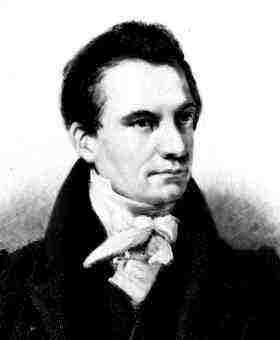
Charles Babbage
Charles Babbage

Many men in academia and technology may have some traditional precedent, with Charles Babbage, in treating women collaborators as mere assistants or, in this case ‘interpreters,’ but at least there is no evidence or reason to believe that Babbage sexually harassed Lovelace (although it would not be impossible that they were lovers, although there is little evidence of this as well).  Babbage was not especially misogynistic or awful, he was actually generally liked as far as I can tell, especially by Ada herself.  But this was the 19th century, and misogyny was simply a stark truth about the European world.

Suffice it to say, Ada Lovelace may have had a much more profound influence on the earlier development of information technology had Babbage’s stubbornness and selfishness not been so debilitating to his obvious intellect.  Perhaps there is a lesson in there for all intelligent and yet stubbornly selfish and short-sighted men in the various places where skepticism and technology reign.

But more universally, there is a lesson for all of us.  Our intelligence, even if great, is often insufficient.  We need more than mere processing power and memory to be wise, and perhaps it is wisdom which we should seek in addition to intellect.  In too many cases, we see people with obvious intelligence (and memory, especially with everything logged online), but not as often do we see actual wisdom, perspective, or a willingness to challenge oneself.  Had a man like Babbage been more wise, we might have had computers by 1900 rather than 1950.  Further, the name Ada Lovelace may be remembered for much more than a mere interpreter or (dare I say) cheerleader for Babbage’s work, but as a fully recognized pioneer in information technology of which she was more than capable.

Notes of the ‘Interpreter’

I made reference, above, to Charles Babbage shrugging Ada Lovelace off, despite their very close friendship and collaboration, as a mere ‘interpreter’ of his work.  This flippant title was bestowed upon her due to her translation of a paper about Babbage’s Analytical Engine by an Italian mathematician, Luigi Menabrea (Lovelace’s translation can be found here). But in addition to translating the paper, she added 20,000 words or so of ‘Notes’  which give more detail and depth to Babbage’s ideas.

For example:

A new, a vast, and a powerful language  is developed for the future use of analysis, in which to wield its truths so that these may become of more speedy and accurate practical application for the purposes of mankind than the means hitherto in our possession have rendered possible. Thus not only the mental and the material, but the theoretical and the practical in the mathematical world, are brought into more intimate and effective connexion with each other. We are not aware of its being on record that anything partaking in the nature of what is so well designated the Analytical Engine has been hitherto proposed, or even thought of, as a practical possibility, any more than the idea of a thinking or of a reasoning machine.

The “idea of a thinking or a reasoning machine.”  This was written in 1843, but the fundamental ideas were older than that, possibly tracing back as far as the night when Babbage conceived of the idea of the Analytical Engine in December of 1834 when he explained the idea to three women, one of which was a 17 year old Ada.

Mind and Machine (skip this section if philosophy annoys you)

I have been thinking a lot recently about the so-called mind-body problem.  I remember when I first was exposed to this philosophical problem, when I started reading philosophy around age 16 or so.  I also remember, when I got to college, being surprised that people still thought it was a problem.  I remember listening to people, usually Christians, that would defend a form of dualism, or at least of perceived difference, between their personal subjective experience and the seeming objectivity of the matter that was their brain.  For many people, there really seems to be a disconnect here.  I honestly don’t get it.

Plato_Cave
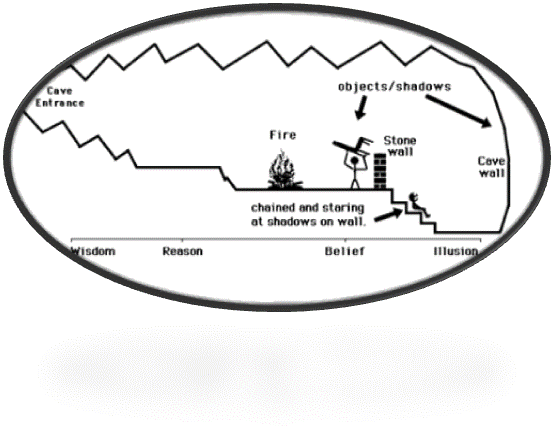
An illustration of Plato’s Cave

The idea that my subjective experience simply is what it is (like) to be my brain (well, my whole body really, but mostly my brain) seems intuitive to me.  I don’t feel the disconnect between subjective experience and an objective (projected, really) external reality of ‘my brain.’  I recognize that the illusion is that separation, not either of the sides of the proposed dualism (I’m getting overly philosophical, I know).

This is why I understand idealists sometimes, I just think they are making the same basic error that dualists make–the conceptual distinction between subjectivity and where that subjectivity occurs.  (stupid subject-predicate language making it really difficlt to express that idea!)

Some might balk at this and claim that they have no idea what it’s like to be a brain, but I will argue that this is all you know.  You may say that you have never seen your brain, so you can only assume it exists, but this is disingenuous.  You don’t literally see the light reflecting off of any surface of your brain, to be focused and sent to your brain for processing, but everything you think is your brain.  You could use the same argument for the back of your head.  You will never directly see the back of your head (this bothers me for some reason…).  All of the light reflecting and refracting, entering your eyes, etc happens somewhere else.  You are your brain, and so you have intimate knowledge of what it is like to be a brain.

Continuing with Plato’s cave as the basis for explanation, it is the (metaphorical) shadows on the wall–what Plato called the illusion– which are real.  In other words, all that we ever really experience is our physical body.  Our subjective experience is what it is like to be that body, experiencing the world.  There is no separation of mind and body, because your mind is your body.

Believe it or not, this image was woven with silk on the first automated loom
Believe it or not, this image (1839) was woven with silk on the first automated loom (first demonstrated in 1801) by Joseph-Marie Jacquard.

The looming question of AI (getting less philosophical)

Our brain is a machine.  It’s a complicated machine and we don’t understand everything about how it works, but it is a machine.  It is unlike computers we build, because we designed our computers to work in a different, logical, way (one that is largely based upon the technological ancestors of computer architecture, such as Jacquard’s Loom; the subject of the book I’m currently reading).

The bottom line is that our mind is a process which exists within matter–neurons and supporting tissue–within the brain.  We are fully physical beings, made up of actual material stuff, like chemicals, atoms, and quarks.

There is no soul.  There is no supernatural or dualistic spirit or soul here.  There is no reason to believe that, and the very idea of dualism is fundamentally broken, in that to even talk about some supernatural substance has to steal from naturalism at very least, and that if it were truly separate, they could not interact (creating a more perplexing problem for dualism that I will not dwell on).  Mind, put overly simply, is a process of matter arranged in a complex and delicate way.

And at some point, it may be possible to replicate this type of process artificially.  Now, I’m not much of a transhumanist, at least in the sense of being overly optimistic (or pessimistic) about some potential Singularity which may occur at some point in the (near or distant) future, but I do believe that it is technically possible to create intelligence with computers, and I’m fascinated that Ada Lovelace seemed to foresee this possibility 170 years ago.

Learning from mistakes and successes

For those of you who are disappointed that I didn’t make any horribly misogynistic jokes about women and being artificially intelligent, fuck off.  For those of you who see that our ability to progress–socially, politically, culturally, and technologically–is hampered by our inability to see past the mundane and conservative elements of our nature, then I gladly embrace you as a collaborator, no matter your gender.

We as a culture have come a long distance, and we have a long way yet to go.  We must learn from our errors, yes, but we also must pay attention to when, and how, we succeed.  Babbage didn’t succeed with his project to create an Analytical Engine in his lifetime because he was stubborn, unwilling to re-consider his abilities and deficiencies, and because some of the powers to which he was subject were more concerned with politics than the potential of human ingenuity.

Babbage dropped the ball in arguing his case for government funding to Sir Robert Peel (who was, it is agreed, already prejudiced against the project) in complaining about mistreatment and loss of reputation from people in his community.  And yes, hindsight makes judging Peel’s refusal more biased for us living in a computer age.  But it is worth remembering that rather than take the time to humble his admittedly great intellect and challenge himself to see the problem from another angle, or even to accept Lovelace’s suggestion to be his spokesperson in procuring funding for his work, he never succeeded in creating his Analytical Engine probably because of those faults.

But he left plenty of notes behind, and people used them.  The eventual development of the computer was largely dependent upon the work he and his colleagues did in the middle of the 19th century.  Imagine how much more, and better, they would have done had they not excluded more voices than they heard.  Imagine how much Babbage could have accomplished had he not been so stubborn and, well, conservative (I realize the term ‘conservative’ in this context, is anachronistic).

Further, imagine how much we can accomplish if we all start being inclusive in all aspect of our social, cultural, and technological pursuits.  Or maybe, it will take the Singularity to reach such inclusiveness, since so many people seem unable to escape their own tribalistic nature.  And  then ironically accuse others of tribalism.  Much like the inseparability of mind and body, the great rift is the community.  The problem, of course, is differentiating between the healthy tissue and the cancer.

When a community has some individuals with an un-drifting mission to merely replicate and spread with more concern for freedom than safety, while other parts listen to the world in order to to decide what to do and how to do it better, I think that is called brain cancer.

Summer


Yesterday, I sat next to the pond for a while and read.  There is a park in Collingswood.  It has soccer fields, trees, and a pond.  There are benches there to sit on, ducks, geese, and even some fish.  It is a nice place to sit on a beautiful summer day.  Those summer days will end, soon enough.

When spring came around, I yearned for the warm days and sunshine to be able to go outside.  I dislike the cold.  Hell, it’s summer still and my feet are still cold, so Winter is not my friend.  And now as summer is nearing its end, I find myself feeling reflective and I think about aging and appreciating youth and health.

Autumn is beautiful.  It is still warm enough, at least in the beginning, but I love the summer.  The sounds, the smells, the warmth!  And each year that passes I find myself more and more aware that all of this is temporary.  I have not reached the point where I believe all is downhill from here.  I have many healthy and vibrant years in me still to come.  But I am more aware of the finite nature of life.  And I must say that I think that I am now experiencing the full bloom of my summer, these last couple of years, and I hope that there are many more to come.

Anyone who thinks that without a god, or other transcendent perspective we cannot truly value life, is not thinking clearly.  It is the limitations of life, its brevity, and it’s frailty that makes it valuable.  I must keep reminding myself to not let all of this pas unnoticed or under-appreciated.  I must keep reminding myself that this will not last, whether it ends happily or in great pain.  There will be a day, hopefully many decades from now, when my consciousness will fade into the oblivion, and I will be no more.

But not today.  Today I will go back to that park, sit next to that pond, and I will listen to the sounds, smell the scents, feel the breeze and warm sunshine on my face.  I will watch the ducks (perhaps feed them a little) and I will know that geese are assholes.  I will live today, and appreciate all that I have.

I appreciate all the wonderful people in my life.  We all struggle, together, through this ultimately pointless life, creating meaning together.  Except for those whom insist upon fabricating or perpetuating false narratives, we as a species are condemned to the reality together.  I have no time to make up stories, as I have too much that is real to enjoy.

Therefore, I do not bow to theologies nor to mere social convention.  I am capable of loving who I want to and believing what is true.  I will not waste this short life pretending or lying to myself.  There is too much that is true to keep my attention and appreciation busy.

Now, if you’ll excuse me, I have reality to enjoy.


Normalizing polyamory


A while back, I ran into this:

You knew it was coming. Scientific American — which often pushes cultural agendas as much as scientific ideas — has an article informing us that polyamorous people have so much to teach the rest of us about life. From “The New Sexual Revolution: Polyamory May Be Good For You

….

Follow the link for the rest (it’s short).

Then today, some follow up, which links to this article by the BBC about how a polyamorous relationship between four people works.  From that BBC article:

“We have a generation of people coming up who are saying, we also want stability and committed relationships and safety and security, but we also want individual fulfilment. Let us see if we can negotiate monogamy or non-monogamy in a consensual way that prevents a lot of the destructions and pains of infidelity.”

At first glance, the writer could seem (if you are unfamiliar with who he is) to be supporting or criticizing this process of normalization, but then we see that he writes very similar articles about pedophilia:

Decadence is on the march! And now, a defense of pedophilia as just another “sexual orientation” has been published in the mainstream left wing UK newspaperThe Guardian.  From, “Paedophilia: Bringing Dark Desires Into the Light:”

and

I have written about this before. In our growing hedonistic culture, pedophilia is in the process of being normalized, downgraded by some from a severe sexual perversion into a mere ”orientation.”


Follow the links if you want to see more, but the bottom line is that Wesley J. Smith doesn’t like any kind of pervert, polyamorous nor pedophile.  I am not very familiar with his writing, aside from what I just linked to above, but I would not call him an ally.  I would say that in terms of the goals and values that Mr. Smith seems to endorse and the goals and values that I endorse, we are opponents.  I’m sure I have more than one opponent in that sense.

The interesting thing is that reading the articles about polyamory could be read as positive, at first glance, because while the conclusions (“Normalization today. Group marriage tomorrow.”) seem dire to the writer, they seem right to many of us.  I guess we’re just perverts.  No difference between consenting adults who decide to not be exclusive and having sex with children (sorry about your sarcasm meter…).

I’ve thought a lot about, and even written about, how the same information, with the same tone, can look very different to people with different worldviews.  Our worldviews are not primarily about having different data, they are about having different values and thus different lenses or filters in the way we interpret and judge the world.  The differences between liberals and conservatives, for example, have more to do with morality than information.  The differnece between Mr. Smith and myself are more about values, and so when he writes “”Normalization today. Group marriage tomorrow,” he means something different that I would, using the same words.

As I have written before, I look forward to a new kind of polynormativity.  But this is not just about making the polyamorous world better, but it is also about being a model for relationships for the world.  Wesley J. Smith’s reaction to a basic response to jealousy, and talking about compersion, is to say “Oh, if we could only all be so enlightened.”  This could be read as being in agreement, as if to say that the author does wish that everyone could be so enlightened, but by now we know better.  This alternative interpretation, of actually wishing for universal enlightenment of this type, would have been in a tone many people,are not comfortable with.  However, it’s certainly not a tone that has not been conveyed (by myself, in some cases…wait for it….).

But yes, if only we could all be so enlightened.  It’s not that all polyamorous people are wiser and better at relationships than all monogamous people. It’s not even that polyamory is always superior to monogamy.  It’s that because we poly people think about relationships more, experience more of them, and because we are forced to deal with relationship skills of higher complexity and more frequency, that we tend to have insights that many non-poly people don’t have.  I mean, just look at how poorly non-poly advice columnists deal with questions concerning polyamory–and that’s what they do for a living!

It’s also that we have a community of people who have these experiences who talk to each other about relationships–practically, philosophically, politically, legally, etc–such that we have created a set of resources which have a lot to teach a lot of people, whether monogamous or not, about relationship skills.  Put concisely, the polyamorous community may have created the single most powerful resource for understanding sexual and romantic relationships which exists anywhere.  We are the experts.

Now, if only we could make ourselves better, as individuals and as a community, we might actually be the enlightened people who could help lead the various societies and cultures all over the world into a better way of loving one another, creating healthy relationships, and having the sex we want.

No pressure though.


We should still have a dream


Friends Select School, where i spent 13 years of my early life
Friends Select School. 13 years of my early life was spent here

Growing up, I attended a Quaker school in downtown Philadelphia.  A private, religious, and often very wealthy school in the middle of a liberal city.  To describe this experience as being progressive would be understating it.  Wealthy, educated, and generally privileged as well.

But there were students there who didn’t come from an especially privileged economic background.  They lived in various poorer neighborhoods in the city, were often struggling financially (lower middle class, rather than actually poor), but were intelligent and managed to get a scholarship of some kind to attend.  My mother, being a person who cared about my education, took a job that she did not especially like nor where she was treated well by an administration who looked down on her (classism and elitism was not unheard of among the Quakers, for sure), which allowed me to attend this expensive and elite school at a severely reduced rate for her to pay.

Being white, I certainly had an advantage over many people in our culture, including many classmates.  I didn’t understand this then, at least not the same way I am starting to understand these last few years.  I grew up, until I was around 8, in a lower class blue collar neighborhood; Frankford, to be specific.  I did not get along with the other local children, who were mostly white.  I did not understand them.  They lived in a different world than I did, even if they lived on the same block as I did.  And even when I moved to a better neighborhood of Philadelphia–Holmesburg–I still didn’t understand the neighborhood children.  Our experience of the world was different.

For me, home always felt more like downtown Philadelphia (I still love it there) and the teachers and friends I made there.  I still talk to many of them.

At school, I was exposed to music, history, math, and writing in a safe space where a fight was as rare as once or twice a year.  Teachers were intelligent, dedicated, and often old hippies.  There was some diversity of color and even creed, but there was a large contingent of reformed Judaism.  It would forever skew my understanding of how many Jews exist in our culture, being that there may have been 1/3 of the 53 people in my graduating class who were Jewish.  Graduating high school, I knew more about the world’s religions, including Islam, Buddhism, and Hinduism, because I was educated in an environment where understanding difference and diversity was a prime value.

The student body was fairly diverse, such that my first girlfriend was born in Sri Lanka.  It’s strange how even after many years, a certain fondness still remains for her.  But I’m getting away from the thread here (I’m getting there…).  And while I looked more like the rich white Jewish students, I had more in common early on, in terms of class and home life, with many of the lower middle class black students, many of whom I spent a lot of time with around 7th and 8th grade.  There, I was exposed to some more underground and political kinds rap and hip hop culture, including graffiti (which I participated in), and even started to hear some talk about race privilege (although the term ‘privilege’ was never used, that I remember).  I never quite understood the nature of the difference then, but the exposure gave me some perspective.

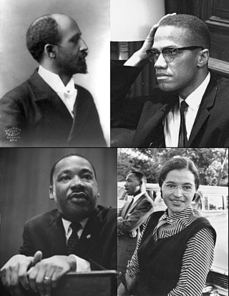
W.E.B. Du Bois, Malcolm X, Dr. Martin Luther King Jr., and Rosa Parks

When high school came around, I was exposed to another side of this issue.  I don’t remember the details, but we had a class which was dedicated to the civil rights movement.  Figures such as Mohatma Gandhi, Rosa Parks, and Dr. Martin Luther King Jr. were highly venerated people in this largely wealthy, elite, liberal school.  We read many of their works, learned of their many deeds and woldviews, and were encouraged to revere them.  But what is clear, now, is that the bias of the Quaker view, especially in liberal Philadelphia, ignored much of the fundamental difference and tension inherent in our culture which lay at the foundation of race relations in our society.

Diversity, tolerance, and peace were among the guiding principles, and so when we were exposed to civil rights history the non-violence and messages of peace were amplified while the concepts of privilege (a word I never learned in school) and radicalism were minimized (although, a history teacher did have us read the Communist Manifesto, separate from our civil rights class).  This education was a privileged and largely white perspective on the history of race relations in our culture, even when we were reading the works of Dr. King or Booker T. Washington.

Don’t get me wrong; I learned a lot about the many protests, organizations, and thoughts of these leaders.  We learned about Frederick Douglass, Marcus Garvey, Malcolm X, and many others.  We learned about the Harlem Renaissance of the early 20th century, about the growth of Islam in the black community, and the black influence on modern American music.  We were exposed to the concepts of social justice, equality, and it was presented by people who really cared about these things genuinely, some of whom lived through a lot of it.

And no, not all my teachers were white.  The few black teachers I had over the years did present us with a different perspective, but there were too many barriers for all of that perspective to strain through.  It’s difficult to convey perspective and experience to young people who don’t understand themselves enough yet.  At least in retrospect, I can appreciate it more.  Some had been there for many of the civil rights events of the 1960’s.  One was an open Marxist who taught us about the Black Panthers and had us read Howard Zinn’s famous book (I still have my copy).  One of my favorite teachers from middle school is still a musician in Philadelphia, who taught me many things about myself, and who I still communicate with from time to time.

Not completely unlike our Meeting  for worship (Wednesdays) at school.
Not completely unlike our Meeting for worship (Wednesdays) at school.

But there was just a religious bias.  A liberal (theologically and politically) religion for sure, but a religious bias.  Just like all religion, it skews, re-focuses, and distorts the view of these issues, but it does care about them.  I would not question the intentions, authenticity, or genuine care of the people I learned from then, but in years since I have come to look skeptically at bias of Quakerism on my early education.  If you have been reading this blog since the beginning, you may remember some of these themes from my earlier writing here (before it became polyskeptic.com, and when it was just me writing here).

Because while I read many atheist bloggers who talk about escaping from conservative religious backgrounds, I would describe my journey as growing out of my liberal one.  I mean, I’m still a liberal (although I think I’m more radical now), but I get as annoyed with liberal theology as many people do with their former conservative theologies.  It’s one of the reasons I have little patience for New Age Pagan ideas; they are too similar to the Quaker background I was raised around, and they are just as untrue.

This Quaker, liberal, theological worldview seeped it way into our understanding of the civil rights movement, history, etc.  it was not intentional, it was not even universal, but it was there.  I did not understand it at the time, and I am not certain that I remember it exactly as it actually was, but there were times when it was very clear.  Here’s one;

It was during a class called ‘Religious Thought,’ which was taught be a very liberal hippie woman who was about as happy and nice as anyone I’ve ever known.  One day, she wrote the word ‘God’ on the blackboard, paused, and then wrote under it the word ‘good,’ then proceeded to ramble about how God was good, citing the one letter difference in spelling.  At the time, this just seemed odd, and I remember thinking that this accident of language said nothing significant at all.  But now, it’s one of the clearest examples of this bias playing out from my high school years.  This was before I called myself an atheist, but I certainly didn’t believe in any god at this time, even if god was supposed to be just this good light within us all (as Quakers often believe).

We all have biases.  The biases I was raised around, at least while at school, were centered around the ideals of peace, diversity, and tolerance.  They are generally good ideals, except when they skew the truth.  I have come to regard the truth as being more important than tolerance, for sure, and think that lying about the nature of reality will not necessarily give us diversity or peace.  Of course, those who really believe God is the peaceful light within us all are not lying, so much as just speaking nonsense.


50 years since the dream was proclaimed

Washington DC, August 28th, 1963

Tomorrow is the 50th anniversary of the march on Washington, which culminated with the legendary and historic speech that Dr. Martin Luther King Jr gave.  Today, I am left reflective about my early education, especially in light of what I have learned since.  Influences being varied, I think of KRS-ONE, who once said that peace does not come with a flower, but that when negativity comes with a small gun, positivity comes with a larger one.  I think of how we remember Dr. King’s non-violence, but forget that he was a radical (especially for his time) who advocated for a shift of economic equality.  I think about how many white people I know (or see in media) want to just forget the past, not talk about the racism that many see as past tense, and to just move forward ignoring the continuing tensions.

Recognizing my own white privilege is a struggle for me, given my educational background.  Having grown up in a cultural environment where the people are better than average in terms of their views on race, but who also gloss over the real issues still being quite real is problematic.  The fact is that even despite this education and exposure to people with different experiences and perspectives on race, I still feel the impulses within me which must lead to racism in our culture.  I feel the tribalistic fear and discomfort that must result, when aggregated over the whole culture, in the biases and privileges that effect other people.  Within me lies the germ of racism, and only through awareness, education, and struggle do I minimize it.

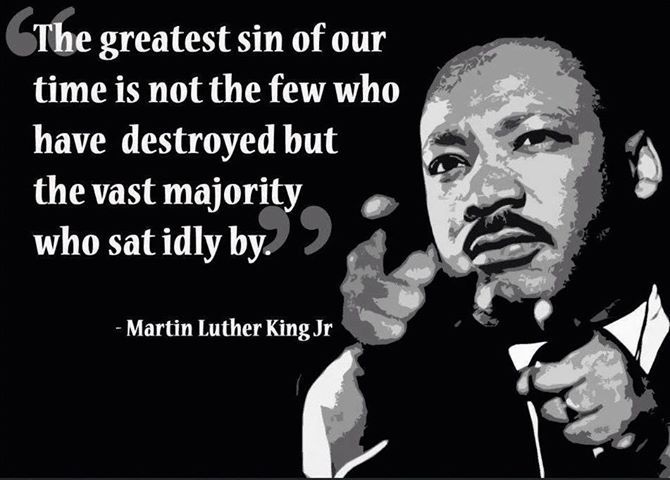
martin-luther-king-greatest-sin-one-world-governme1And I don’t know what to do about it.  Studies consistently show that we unconsciously view people who look different than we do differently; that we are more likely to trust those who look like us.  And I can feel those impulses, and I am ashamed of them.  So no, the race problem in our culture is not past, even if we have made significant improvements.  The dream of Dr. Martin Luther King Jr., whose historic speech we remember this week, is not yet realized.

It’s depressing that there are millions of Americans out there who don’t see the problem or who don’t care.  Because while I have a long way to go personally before I stop contributing to the culture of privilege and bias at all (if that’s even possible), there are many more who are not even this far.  I find myself wishing that the world was composed of people where my current level of contribution was the worst example of privilege and bias.  I’d rather it be me, who is struggling, who is the bad example rather than being surrounded by the culture we live in which is drowning in bad examples.  Because while we have achieved, politically and socially, many strides towards equality there are many minds still stuck in the cultural time-warp of out instincts, fears, and cognitive biases which result in racism, sexism, etc.  

In many ways, we are still stuck in the ancient days of tribalism; primates dressed up in culture but inside still itching to make war with the next settlement (professional sports is an outlet for this) and to protect our own tribe.  Conservative think tanks have found ways to pull at this primal drive, as “family values” has demonstrated for many years, conserving conservatism rather than do the work to grow and change.

So, today I want to celebrate the achievements of the civil rights movements throughout history, especially those 50 years ago or so, but am still mired in the realization that we are nowhere near the dream.  I appreciate the efforts of the great leaders of the past, including all of those people responsible for the March on Washington 50 years ago, but I am left wondering if the cycle of human ignorance and fear will ever truly end.  

I am angry, I am ashamed of the part I play in this still, and I look hopefully at the horizon for real change.  I hope I live to see some more of that.

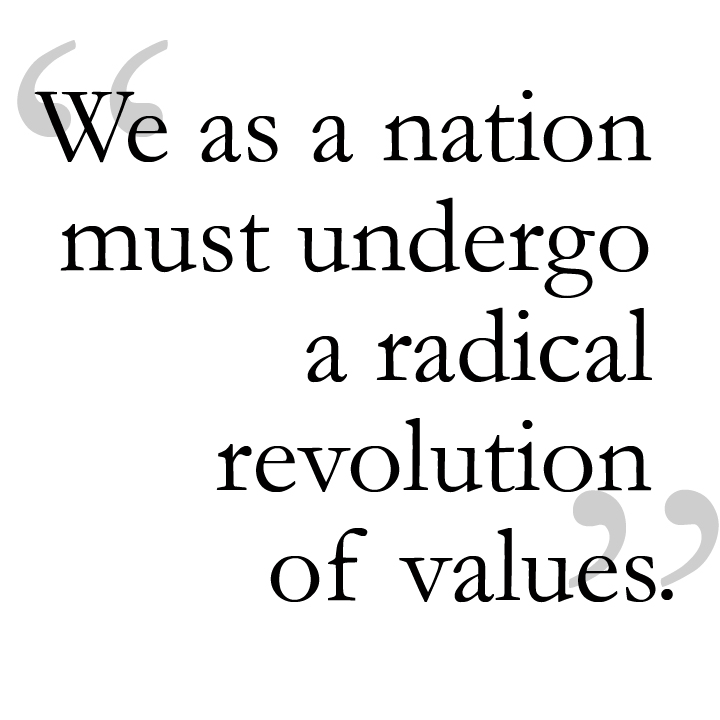
I leave you with these words, spoken by Dr. Martin Luther King from April 4th 1967, a year before his assassination:

MLKSource: 


Sin responsibly


You know how people, after reaching a rock bottom point in their lives, often find religion? You know, the old redemption and salvation story.  They have had evil done to them, did evil themselves, but now they walk the righteous path!  It’s a powerful narrative, and the times it has been utilized in story-telling (both in text and in personal behavior) are countless. It’s a ubiquitous narrative structure of religion, literature, and personal psychology.

In sort, it’s one of the most fundamental aspects of being human.

Now, I could go on about how this narrative is flawed, especially in how it is utilized by religion as a vehicle for more than mere narrative, but of actual truth, but that’s obvious and banal.  Besides, many atheist commentators have made that point numerous times, and blogs which keep pestering the same points get stale after a while.

So, how about this; Let’s try and take that narrative and fit it onto a different vehicle.  Let’s see how, perhaps, this narrative relates to how we create a false dichotomy in terms of relationships, specifically when it comes to cheating and exclusive commitments.

Similar to the penitent sinner, there is the repentant adulterer.  Yes, there are the people who have cheated and who try and commit themselves to being successfully monogamous, but I’m interested in the less obvious versions of this story.  I’m interested in a story of the person who struggles with the desire to cheat, and who fights of this desire with an ideal of monogamy and exclusivity.  I imagine that this struggle has many facets that we would recognize in man other tropes, including many “romantic” ideals which include concepts such as “one true love,” “soul mate,” and “belonging” to someone.

Somehow, the natural, and undoubtedly widespread, inclination to be attracted to many types of people is shrugged off by rationalizing some special exceptionalism or superficial romantic notion of exclusivity by people who are struggling to fit into respectable expectations.  To fit in.  They see their desire as a roadblock, rather than as an alternate route.  They probably don’t even see the path less traveled.  They see the road, the obstacle, but not the other lanes of traffic.

Why is this narrative so clean and obvious in our culture? Is it as simple as the fact that many cultural forces, including the conservative influence of religion, have tried to battle our animal nature, trying to beat the swords of our lust into ploughshares of civil monogamy?  Is it as simple as groupthink and herd behavior?

In today’s cultural and political climate, “family” (usually meaning a man and a woman who have children) is often held up to be the foundation of our society and culture.  This structure, solidified in monogamy, sexual exclusivity and (ultimately) ownership, is thought to be what holds all of this together.  If it disappeared, it would lead to anarchy (“yay” the anarchists may say).

So to not struggle against our instincts is to invite destruction.  Not merely of our relationships and our personal salvation and redemption story, but to that of our entire society.  This is why I think that the insights of both atheism and polyamory, founded by skepticism (the method, not the community), are so radical.  They question the very dichotomy of not only our instincts with many assumed ideals, but they present an alternative perspective through which to view these instincts.  They seek to deconstruct the problem, very much in the tradition of the best of postmodern criticism (yes, there are good aspects to postmodernism, believe it or not!) so that we can see the problem from a different perspective.

At bottom, the answer is not to repress, struggle against, or transcend our instincts, but rather to find a way to make our instincts the fuel for creating a responsible, mature, and enjoyable life.  The answer to desire is not always denial; sometimes it’s merely to re-think the nature of that desire in terms of what is possible, even if not popular or easy.  Our instincts are not good nor are they bad, but they are real and they will continue to pester us, so we might as well get comfortable with that.  And since we are getting comfortable with them, we will have to live with giving them some limitations, boundaries, and maybe even rules.

Monogamy is not the answer to variety of sexual and romantic desire.  Monogamy is the answer to a genuinely limited set of such desires.  Monogamy is what happens when happiness involves one person.  Religion is not the answer to our metaphysical needs (cf Nietzsche).  Religion is only such an answer when it happens to be true (and unlike monogamy, religion may never fit this bill.  That is, monogamy may be rational, but religion may never be so).

We have the capability to re-define things such as “family,” “commitment,” and “love” to be broader than the exclusive and restrictive definitions which are common today.  We, if we are to care about progress over the conservative impulses of some of our culture (conserving a system that simply does not work), must continue to demonstrate that progress is not only inevitable, but that it is morally superior.

We should be struggling along with our instincts and desires, rather than against them.  It’s not only a pragmatic strategy, but an authentic (and thus moral) one.

In short, keep sinning because it’s not actually a sin.  But do it responsibly.

Descriptive Norms, or Why Your Beliefs Affect Me


Editorial Note: This post was written by Wes Fenza, long before the falling out of our previous quint household and the subsequent illumination of his abusive behavior, sexual assault of several women, and removal from the Polyamory Leadership Network and banning from at least one conference. I have left Wes’ posts  here because I don’t believe it’s meaningful to simply remove them. You cannot remove the truth by hiding it; Wes and I used to collaborate, and his thoughts will remain here, with this notice attached.

—–


Scientific American has an article up discussing the difference between descriptive norms and prescriptive norms. The gist is that descriptive norms describe how things are and prescriptive norms describe how things ought to be. When it comes to affecting people’s behavior, descriptive norms tend to work much better:

In a classic study, Cialdini and colleagues manipulated the signs that were displayed in Arizona’s Petrified Forest National Park, a site often plagued by tourists who end up grabbing some of the petrified wood to take home as a souvenir. In situations like this, the first inclination of well-meaning environmentalists might be to set a strong prescriptive norm — perhaps by saying something like, “Many past visitors have removed the petrified wood from the park, changing the state of the Petrified Forest. This is bad, don’t do this.” The idea here would be to invoke a sense of shame and severity before asking visitors to refrain from taking the wood. But read that prescriptive message once again. Is there anything descriptive in there? Yes, of course there is. That message is not just telling you that you shouldn’t take the wood — it’s also telling you that most other people do. In fact, people were actually more likely to steal wood from the forest when they saw the sign telling them how many people tend to do it themselves, even though the very next sentence was asking them to refrain. But when the researchers simply tweaked the message to read that “the vast majority of past visitors have left the petrified wood in the park, helping to preserve the natural state of the Petrified Forest,” the thievery plummeted.

We don’t really care so much about what we should do. We care about what other people do. And then we really, really care about not being different.

The article suggests that making your support of marriage equality public on Facebook may actually make more of a difference than a lot of people think. I agree. When we make our positions publicly known, often that can be more convincing than anything else we can do.

This relates to the main issue with moderate religion. There are a number of religions out there (and other faith traditions that may or may not be classified as “religions”) that do no real direct harm on society. I was raised by a Quaker mother, and attended meeting up until I was allowed to make choices for myself. I have Unitarian Universalist friends. I know several pagans, and other religious moderates who practice non-mainstream, non-coercive religions.

These religions aren’t causing any direct harm that can be easily identified. However, that does not mean that they are not causing harm. I live in a country positively saturated in religion. Religion pervades public life in America in ways that are unheard of in other developed countries, and it leads to all sorts of horrible outcomes.

All public expressions of faith exacerbate the issue through the power of descriptive norms. The more people who identify as religious, the more it encourages other people to be religious also. Even the most non-proselytizing expression of faith reinforces the cultural message that religion is normal, and a lack of religion is weird. Nobody wants to be weird! So people are encouraged to overlook their doubts about religion in order to fit in, even if nobody is explicitly sending that message.

American Cross

People often ask me why I care that people hold religious beliefs. This is often coupled with a spoken or unspoken assertion that their religious beliefs do not affect me in a negative way. Often, I will attempt to explain that beliefs inform actions, an in any society, and especially in a democracy, everyone’s actions affect everyone else. But there is also the problem of descriptive norms.

I believe that, all other things being equal,  a more secular society is a better society. Religion, even moderate, “harmless” religion, impedes that goal. Of course, moderate religion does less harm than fundamentalist religion, but it’s still making it more difficult for our society to move in a more secular direction. It still encourages the general population to value faith above reason. It still contributes to the social stigma of atheism.

This is, of course, not to justify being a dick about it.* The fact that moderate religion is a problem doesn’t mean that it’s ok to be rude. It doesn’t mean that religion doesn’t serve useful purposes in people’s lives. It doesn’t mean that people are justified in attempting to impose their lack of religion on other people. It just means that as an atheist, I have a stake in the beliefs of my fellow members of society. This is not meant to discuss tactics at all.

This is another reason why coming out is so important. When we proudly identify as atheist (or polyamorous for that matter), that declaration speaks louder than any argument we can make. When we create a society in which it’s no longer weird to be an atheist, then we create a society where there’s one less reason to turn to religion.

_______________________

*I sincerely wish that this disclaimer didn’t need to accompany every post discussing this topic, but such is life.