Honesty is Hard


Editorial Note: This post was written by Wes Fenza, long before the falling out of our previous quint household and the subsequent illumination of his abusive behavior, sexual assault of several women, and removal from the Polyamory Leadership Network and banning from at least one conference. I have left Wes’ posts  here because I don’t believe it’s meaningful to simply remove them. You cannot remove the truth by hiding it; Wes and I used to collaborate, and his thoughts will remain here, with this notice attached.

—–


For the past month or so, the skeptic blogosphere has been talk a lot about harassment at skeptic events. Throughout these conversations, I’ve made a few disturbing observations:

  • People (mostly women) are getting harassed at skeptic events. This doesn’t seem to be occuring at higher rates than at other events, but any harrassment is too much, and we can do better than that;
  • Many people (mostly men) in the skeptic community are not taking this problem seriously. This is also fucked up, and I’m glad it’s getting some attention.

These issues have been extensively documented by Stephanie Zvan at Almost Diamonds.  Everything that I could say on the topic (and how disturbing it is) has been said much more eloquently elsewhere, and I have nothing new to add. Suffice it to say that yes, this is happening, and I hope atheist/skeptic conferences all adopt strong harassment policies, with an emphasis on enforcement.

What I’d like to discuss is a secondary issue (which is not nearly as important as the two identified above, but I think is worth discussing): the issue of harassment has led to a number of discussions about exactly where the line is between consensual flirting and harassment.  These are important discussions to have, I think, but I’m bothered by two (somewhat related) themes I keep seeing crop up in these discussions:

1) It’s wrong to want sex from people without being interested in getting to know them

This is generally couched in reasonable-sounding language like this from PZ Myers:

I have a simple suggestion. Think of sex as something two or more friends do; but also keep in mind that most friends don’t have sex together. When you’re at a meeting, plan to make friends promiscuously, but remember: the purpose first and foremost is friendship, not sex partners.

At first glance, this seems like a reasonable suggestion. Most people prefer to get to know people before having sex with them, and most people would rather have sex with someone they like for nonsexual reasons also. But some people just want sex, and there is nothing wrong with that. It’s not up to us to tell people what their goals should be in a social interaction. Denigrating anonymous men for wanting to “bag a young hottie” (which is Jen McCreight’s paraphrase, not an actual quote from anyone) at each speaking gig sends the sexnegative message that desiring sex with a person you find attractive (which is how I would have phrased it) is WRONG and CREEPY. In addition, speaking about it as something that only men do contributes to the myth of men not being hot. McCreight puts desiring sex with attractive women in the same category as talking only to a woman’s chest, nonconsensual groping, and following a woman to her hotel room. I think that’s terribly unfair. There is nothing wrong with sexuality. There is nothing wrong with desiring sex for purely physical reasons. Resorting to slut shaming is not necessary to discuss harassment. It’s bullshit, and it should stop.

2) Dishonesty is expected, and even encouraged, where sexuality may be involved

This is related to Point 1 by virtue of the fact that if wanting sex is wrong, then people who want sex are going to be encouraged to hide that fact until the socially appropriate time. People who just come out and say they want sex (even in the least coercive and lowest pressure way I can think of) are disrespectful, objectifying, and should be ashamed of themselves. Fuck that. Asking for sex is not seeing a person “as your plaything.” It’s just asking for sex. Objecification only happens if you see the other person’s desires as irrelevant. As long as you are genuinely seeking enthusiastic consent, if you want sex, you ought to ask for it! Hiding your intentions is just being dishonest, not respectful. As one commenter on this blog put it:

I too find smart, interesting people who think about things quite sexy, yet am generally skittish of strangers. I’m also alternately oblivious to and skeeved out by the way flirting (in most mainstream venues) happens most times. Still, I’d far prefer for someone to tell me they think I have great boobs and would like to make out with me than to just hint at it, assuming they are respectful of my possible “no thank you.” I like transparent, respectful asks, and people who ask for consent frequently and sincerely.

In addition to those desiring of sex being encouraged to remain silent, women who are objects of such desire are also encouraged to be dishonest about their refusals. The (true) observation that rapists ignore refusals is used to suggest that women shouldn’t be encouraged to clearly communicate their own desires. The (also true) observation that women are socialized not to clearly communicate a refusal is used to suggest that we should not be encouraging women to break free of that socialization and be more honest about what they want. This is confusing the “is” and the “ought.” The undeniable state of mainstream heterosexual flirting is that men are expected to be the aggressors, that clearly communicating a desire to have sex is disfavored, and that a clear refusal is often met with hostility. None of this is an argument that the status quo is the way things ought to be. We should all be encouraged to be more open and honest about what we want from a social interaction, even if the we may be subject to negative social consequences.

The exception, of course, is when physical safety is in question. If anyone is in doubt about his/her physical safety in an interaction, all of these rules go out the window, and people should do whatever they need to in order to get to safety. That cannot be stressed enough, and it should never be forgotten.

Of course, the flipside of this is that we should stop punishing women for being blunt. A woman who clearly communicates a “no” is not being harsh, she’s being honest. A woman who says she’s not interested in someone (even if s/he hasn’t made any advances) is just being communicative. Hurting someone’s feelings through deception is a dick move. Hurting someone’s feelings by telling them the truth is a brave and awesome thing to do, and we should encourage people to do it.

However, the danger of social disapproval is not a good reason to be dishonest. If your friends will think of you as a bitch for giving a clear refusal, get some new friends. If the object of your affection will see you as creepy for being clear about your sexual interest, that’s not a reason to hide your interest. Honesty often has negative social consequences. It does not follow that dishonesty is justified. If flirting should be about creating intimacy, then it relies on both parties behaving in a trustworthy way (i.e. not lying to each other).
Jadehawk disagrees:

You can’t remove the social context because the social context is what determines how women will respond. they’re not flirting with you in a social vaccum, and pretending otherwise is just fucking stupid. We have to fix the social context first (i.e. not punish women for being above-average-assertive, and instead shut down those why try to punish women for blatantly and “rudely” setting boundaries and even taking initiative themselves), before you can seriously expect women to consistently “help” socially inept guys at flirting by being blunt with them.

I agree that it’s unrealistic to expect anyone to completely go against their socialization, but that doesn’t mean that we should not ask them to do so, or, when we’re discussing behavioral standards, to hold up an against-the-mainstream behavior as ideal. Society socializes us to do many things that we reject. Dishonesty could be one of them. Jadehawk’s view is that women are just brainless products of society’s conditioning, and have no choice in how to act. I think we all have a choice, regardless of what we’re told, or how we’re taught. I don’t think “the social context is what determines how women will respond.” I think women will respond based on their own individual choices, in light of the social context.

To be clear, I don’t think people are always (or even usually) obligated to express their sexual interest or lack thereof. It’s all about your intentions. If you intend to send the message for someone to back off, do it clearly. Don’t use subtle social cues that are open to interpretation. If you want to get to know someone, do that. If you intend to communicate sexual interest, do it clearly. Don’t do it by pretending you want to get to know someone. And don’t pretend you’re interested in sex if you’re only interested in getting to know someone. If you want to get to know someone, and also have sexual interest, then feel free to communicate either or both. My only problem here is dishonesty about one’s intentions.

This also shouldn’t be taken to mean that I think people always have clear intentions. It’s perfectly reasonable to be hours, days, weeks, or years into a social interaction, and still not really be sure what you want out of the interaction. That is actually, I would argue, the mainstream expectation. The problem occurs when people know what they want, and pretend that they don’t.

Flirting is not easy. But if we try, we could make it a little easier.

Opening Up About OpenSF


Annalisa and I spent the last week in San Francisco. In part, we wanted to have a nice vacation: I had never been west of Chicago and we had not traveled together for any real length of time for a while. But one of the major reasons for going was also to attend OpenSF, a conference on nonmonogamy, open relationships, and polyamory organized by Pepper Mint. The conference (and related events) lasted from Friday until Sunday, and I’d like to take a bit of time to talk about some of the interesting panels I attended and some of the people I met in and around the conference itself.

Friday

Friday was essentially a welcome/orientation day. Pepper gave an opening address and initiated an interesting icebreaker activity, for which I am thankful because it forced me to meet some new people right off the bat. One of my goals for the conference was to socialize, but walking into a room of strangers, almost all of whom live in the San Francisco Bay area, was daunting for me. I learned an important lesson this weekend: I am extremely bad at approaching people I don’t know, even for casual, “low stakes” chat/interactions. Once I’ve been introduced to people, or compelled to interact with them, I think I’m actually a fairly gregarious person. But the initial awkwardness of “how do I approach that person, and what do I say?” is a huge anxiety trigger for me.

Luckily, the icebreaker required us to move from table to table, each time beginning with a new group of people and a “prompt” question that we were all asked to answer in front of the group (if we chose to answer: enthusiastic consent was a theme of the con, so anyone could opt out of any activity without judgment). Pepper provided excellent questions (“What do you hope to get out of the con,” “What is one of your wildest or most unusual poly moments,” etc.), and I felt mostly at ease meeting 20-30 new people in 15 minutes or so. It was a fun activity, and I might adapt it for use in the classroom.

After the welcome address, many con guests left to attend an off-site lecture/dance/play party. Sadly, I was unable to register in time for the sold-out event, but a group of other event castaways organized a rousing game of Cards Against Humanity, to which I was graciously invited. There I met Dylan of the Life on the Swingset podcast–who had brought a large contingent to the con–and several other people I would see throughout the weekend.

Saturday

Saturday was a day of panels, beginning with Charlie Glickman’s talk, “Sex, Shame, and Love.” For me, this was a highlight of the convention. Glickman discusses shame as a “tent” or “cloud” of emotions, any of which can disconnect us from people with whom we have relationships. One of his most important points, though, and one on which he disagrees with many writers on the subject (and some of his own psychologist colleagues), is that shame is not always detrimental. For Glickman, feeling shame is an important indicator that we’ve broken a communication/relationship “bridge”–yes, he used a lot of analogies–and need to mend it. Awareness of our feelings of shame is the first step in repairing the relationship (I should probably note here that one of the key relationships we can damage with shame is our relationship with ourself). Glickman elaborates on these concepts herehere, and here (among other places).

Most people in romantic/sexual minorities face shame at some point in their lives, often daily. I found it refreshing to hear someone talk about shame’s adaptive value and about avoiding a shame “spiral” (i.e. being ashamed of feeling shame, which only leads to more shame). As an anxiety disorder sufferer, I found in Glickman’s philosophy some useful coping mechanisms.

One other session of note on Saturday (they weren’t all gems, though I can’t say I thought any one was particularly terrible) was on “Poly Theory.” Joy Brooke Fairfield, a Stanford graduate student, gave a staggeringly expansive and eloquent talk about establishing a branch of cultural studies called poly theory (in the vein of feminist theory, queer theory, etc.). She also expanded on Deleuze and Guattari’s metaphor of a rhizome to describe polyamorous relationships. Contrasting her conception with the traditional linear (or arboreal) relationship model–we can see the arboreal model in family trees, corporate organizational flow charts, etc.–Joy argued that our relationships more resembled the root system of rhizomes. Rhizomes lack a central or ultimate root but rather expand from node to node in many directions. If we imagine ourselves each as nodes, we can see how we connect to other nodes, and those nodes to still others, in a complex but interconnected system. It is an elegant, non-hierarchical way to look at groups of linked relationships, polyamorous or otherwise.

After Saturday’s sessions, I got to try Poly Speed Dating. It was a lot of fun, if chaotic. I wonder if something like this would work in our area?

After speed dating was a dance party at Love Triangle dance club, a poly-friendly club in San Francisco’s Mission District. I was heartened to learn that the Mission has not one but several clubs that cater to nonmonogamous folks. Again, I wish our city/region did a better job of providing safe spaces for nonmogamous people to gather to socialize. My overriding feeling all weekend long was that this was one of the first times in my life that I’d found a group of people with whom I fit in totally. Even though I met theists, omnivores, and even (gasp!) political moderates, I felt a deep, almost instant common bond. We’d all wrested loose the shackles of monogamy, and that’s a remarkable thing.

Sunday

The fatigue of late Friday and Saturday parties began to show for most con guests (and even some of the presenters) Sunday, but the day did bring a few highlights.

Tristan Taormino‘s keynote speech was an enthusiastic call to arms. She made several important points, one or two of which I will write about in more depth another time. Briefly, though, she called on the LBGT community not to throw polys under the proverbial bus in their fight for marriage equality. Conceding our opponents’ post hoc and slippery slope arguments hurts both our causes.

In addition, Taormino called on those of us who have the privilege to be “out” as nonmonogamous to live our lives as openly as possible. One of the things that prompted me to start writing for this blog was that I realized that I am fortunate enough to have a job for which I will not be fired for being polyamorous, a supportive and loving family, economic and emotional security, etc. I really must live my life openly, if only to show other people that people like us not only exist but are happy, healthy, and thriving.

I liked a few of the early Sunday panels, but I was really impressed with Cunning Minx‘s afternoon session on creating a non-threatening, attractive online dating profile (i.e. how not to be creepy guy). While her advice was useful, even for those of us who already consider ourselves non-threatening/non-creepy, I was particularly struck by her polished, stimulating, and well-organized presentation. You would be amazed at how many presenters were not particularly well-organized. We’re lucky to have Minx as an advocate/representative/colleague/peer, and I was glad to have met her.

I was also able to meet Dossie Easton, whose inscription in my copy of “The Ethical Slut” left me smiling with fanboy glee.

Monday and Beyond

I’m still processing the experience of OpenSF–and I expect I’ll share some of the fruits of that processing with you in the weeks and months to come–but right now I feel overjoyed to have spent three days among fabulous, non-judgmental, like-minded people. I increased my polyamory vocabulary, something I wasn’t sure was possible nearly four years into my own poly life. And I left San Francisco, and return home, eager to be more of an activist and particularly to advocate for more sex-positive events and safe spaces in our own city. I think we can do it, but I’ll probably need a bit of help. Who’s with me?

Those damned kids…are making me have hope!


So, over the last few years there have been a number of stories about high school students standing up for something they believe in.  Specifically, in my memory, are those students who stood up for the first amendment, LGBTQ rights, and general social progress.  Whether it has been Jessica Ahlquist, Damon Fowler, Matt Leclair, or any of the many other not-quite adults (And yet displaying great adult understanding and maturity), I find it quite promising that the next generation seems to be willing to stand up for what they believe is right.

What bothers me is that those in charge now–the school administrators, politicians, many parents, etc–are the ones they are fighting against.  Shouldn’t the older generations, ideally anyway, be the ones demonstrating maturity and understanding? Is it sad that the students are schooling the teachers and administrators?

I am, of course, severely oversimplifying the issue with a huge dose of confirmation bias; I’m remembering the heroic youth and the egregiously unaware and backward adults they fight against while ignoring the many uninformed students and the many adult activists who have been working tirelessly for decades.  I admit that I do have a bias for the less powerful against the powerful, and have a rebellious streak in me (“no shit,” many of you are saying).  My point is that I’m glad that there are signs that despite an educational system with many flaws and shortcomings, many students seem to get it.

I’m glad that there will be another generation with leaders within it to keep the progress progressing.

But ultimately, I look forward to an ideal world where teenagers can stand up against things of lesser importance at best, mostly because their teachers, administrators, and school board understand the rights and responsibilities that their positions affords them and the students they are placed over.  Again, as is the goal of all activism, I look forward to making activism irrelevant.  I don’t expect that we shall succeed in my lifetime.  If ever.

For decades now, conservative Christians have had the long-term view to take control of school boards, and we have been seeing the result of it now with what happened in Dover, PA a few years back, arguments to “teach the controversy” (hint, there is none), and the various fights between homophobia and LGBTQ supporters.  The internet certainly has helped to keep information flowing in order to combat ignorance about rights and legal protections, and I’m sure we are all glad for that.

I think there is reason to be optimistic.  I think there will be hard fights for many years, but I think that all is not lost.

The sky is not falling, but where there is forecasts of rain there are also many people with umbrellas, and willing to hand out more of them in hopes of sunnier days.

Gina Sez: “Snow White and the Huntsman” Offers Important Commentary about Monarchies


It was a dark and stormy night, and Gina, Wes, and Jessie decided to go see a movie.

OK, it wasn’t dark OR stormy when the decision to go see “Snow White and the Huntsman” was made.  However, as soon as I said, “We should leave now so that we can go get candy (to get one over on The Man, you see)” the skies opened up and there was a torrential downpour.  So…eventually it was a dark and stormy night.  Anyway, before that, Wes and I were sitting in the hot tub drinking mojitos (because our lives totally suck, obviously) and we realized we were in the mood to see something culturally relevant.  That being said, our options were clearly only “Snow White and the Huntsman” or “Battleship”.

“Battleship” was my initial choice because I’ve been going nuts every time I see the trailer for it.  I really wanted to see how they were going to make an entire film out of a game as simple as “Battleship”.  In one of the trailers, I swear I saw them contrive a reason why there was some kind of invisible yet vision-tricking barrier between the good guys and the bad guys to make it actually like the game.  I also hoped that in seeing it, I would see a trailer for the next big thing: CONNECT FOUR – Rise of the Red Circle or Hungry Hungry Hippo (this would definitely offer interesting social commentary about the state of famine in Africa, much like James Bond: Die Another Day offered great insight into blood diamond trading and the rampant “villains with diamonds stuck in their face” problem).

Unfortunately, the times were not convenient, and ultimately I don’t know if my brain was in a state that could handle the number of explosions promised in “Battleship”, so “Snow White and the Huntsman” it was.

Now, some would say that this movie is just a bunch of eye candy.  It certainly is visually impressive.  The effects are quite good and there are lots of pretty people in it.  The forestscapes are stimulating and immersive.  The costumes are elaborate and interesting.  Also, Ian McShane is a dwarf in it…so…I don’t know.  That gave it points for me.  Perhaps you’re not as easy to impress.

But beyond that, “Snow White and the Huntsman” is a perfect Republican allegory for how they view the use of various segments of society.

***OMG SPOILER ALERT***

1. The Power and Importance of Beauty (AKA: The Woman’s Place)

Snow White is born and is deemed the prettiest girl EVER.  Everyone in the kingdom is completely enamored with her…kindness…and also, her pretty face.  The kingdom prospers also because her dad is a nice guy or something, but then he goes off and fights a war because his wife died and upon winning a peculiar battle, he rescues a prisoner, Charlize Theron.  He sees her, notices that she’s totally hot, and decides to marry her THE NEXT DAY.  On their wedding night, she stabs him and, apparently never being questioned or anything, becomes Queen.  While she stabs him she says something akin to “A woman needs a man like a fish needs a bicycle” and all aquatic bicycle sales in the kingdom cease.  Snow White gets thrown in a tower and all is torn asunder.  All the apples rot and all the dwarves are out of work.

The film is basically a battle between the Queen and Snow White for who is really the prettiest…and…um…therefore the nicest and, er, best.  The Queen stays young and pretty by sucking the life force out of pretty girls (unless they have mild scarring on their faces…that apparently keeps them safe because they’re not pretty enough then).  This is because her mom told her that the only thing she had was her beauty…unless some bitch was prettier.  CAT FIGHT!  Only Snow White can kill her because she’s prettier and, um, she’s nice to animals and stuff.  Yeah.

Meanwhile, there’s a Huntsman played by Thor.  He apparently falls in love with Snow White because she’s so nice and doesn’t punch dwarves in the face (not all the time anyway).  He thinks she’s pretty because she reminds him of his dead wife and therefore, apparently, his kiss brings her back to life.   She comes back alive and gives a pep talk to the troops and everyone follows her for some reason…because…I don’t know, apparently she’s “Life Itself”.  The forest full of fairies and deer with giant racks (antlers, that is) flock to her. In other words, she’s hella pretty.

In the end, everyone bad dies and everyone good (with the exception of one dwarf) lives and all the peasants rejoice when Queen Hotlips takes the thrown.  Apparently she makes flowers grow, probably because of her beauty and her virtue.

So, ladies, let this be a lesson to you: You can do anything you want, as long as you are pretty and thin!  This isn’t obvious in modern society, so I’m glad that this movie gave us a unique perspective.

2. Christian Faith is Always Relevant

Still, in this land of fairies and dwarves and evil magic queens, Snow White never loses faith…IN JESUS.  That’s right: Snow White is a Christian (shown to us when she, still locked in the tower as a young woman, picks up straw replicas of her parents and says the “Our Father” prayer).  This makes so much sense.  I mean, we would have no way of knowing she was virtuous if she didn’t believe in Jesus.

3.  Lift Yourselves By Your Bootstraps and You Shall Be Allowed into Society!

So, apparently, when the king was alive, everyone was happy.  Then he was dead and everyone was sad and unemployment was at an all time low.  Take, for instance, the dwarves.  They were apparently gold miners (the best anyone had ever seen), but then…for some reason…no one wanted gold or something and they came out of the caves to find a world that wanted nothing of them.  But no worries because The Fairest of Them All is here and she will take advantage of your desperation!  “We will die for you, Snow White…because you are the one!” “OK!”  “We will wade through shit for you and open the gate, and then we will all prosper because you are going to be the same caliber of leader as your dad because…um…obviously.” (They literally walk through the castle’s sewer system to do this)

Snow is helped by various disenfranchised people along the way, who are subsequently beaten or burned for harboring her.  But it’s cool, because in the end, she gets to be Queen and she gives everyone a nod for their sacrifice.  Or, at least, I thought I saw her head move a little bit.  I’m sure she’ll take care of them because she is pretty and nice or something and being Queen is totes easy!

4. Blood Determines What Kind of Ruler You Will Be

Her dad rocked, and so will she.  It was destined…by either the giant deer (I don’t know…he seemed to know something no one else did, and I guess they didn’t want to put a unicorn in there instead for fear of being too cliche or too much like “Legend”) or by God, since they’re all Christians.

So, we’ve got women as figureheads given power AND weakness due to their own beauty and level of virtue, Christians, disadvantaged people having value because of the crappy things they’re willing to do for the privileged, and the idea that family value/legacy is really the most important thing.  This is basically a Mitt Romney commercial.

Yep.

In conclusion, “Snow White and the Huntsman” was pretty terrible and not even really terrible in the way that I usually like.  But at least I got to see Kristen Stewart really show off her acting talent.

These Gina Sez articles are really hard to write.

Justice Scalia is Scared of Genitals, OR Sexnegativity and the Law


Editorial Note: This post was written by Wes Fenza, long before the falling out of our previous quint household and the subsequent illumination of his abusive behavior, sexual assault of several women, and removal from the Polyamory Leadership Network and banning from at least one conference. I have left Wes’ posts  here because I don’t believe it’s meaningful to simply remove them. You cannot remove the truth by hiding it; Wes and I used to collaborate, and his thoughts will remain here, with this notice attached.

—–


So, you may not know this, but speech in America isn’t completely free.  You’ve probably heard of the “fire in a crowded movie theater” exception.  However, unless you’ve gone to law school, you probably don’t have much of an idea what is protected, and what isn’t.  Here’s a quick quiz.  Some of these things are protected speech, and some are not:

  1. Flag burning
  2. Cross burning (for explicitly racist purposes)
  3. Cursing in public
  4. Cursing at the Supreme Court
  5. Pornography
  6. Hate speech
  7. Advocating violent overthrow of the government
  8. Depictions of animal cruelty

If you guessed “all of those are protected,” you would be WRONG!  All of them are protected… except for pornography.  According to our Supreme Court, certain categories of speech are “of such slight social value as a step to truth that any benefit that may be derived from them is clearly outweighed by the social interest in order and morality.”  These categories are generally limited to “fighting words” and obscenity.

Obscenity is not what you’re thinking, though.  “Obscenity,” according to our Supreme Court (and most recently by Justice Scalia), is limited to strictly sexual imagery.  Not cursing.  Not blood & gore.  Not torture.  Just sex.

How obscene!

The Court never really offers a rationale WHY sex has no value to a society; it just operates under the assumption that sexual imagery is less than worthless, and can be actively harmful.  Look back at the list at the top of the post.  The Court has held, at one time or another, that each one of those examples has enough value to our society to be worthy of protection.  But not sex.  When it comes to sex, it’s just too dangerous.

I don’t know what happened to make SCOTUS so afraid of sex, but let’s hope the next generation approaches the issue with a little more sanity.

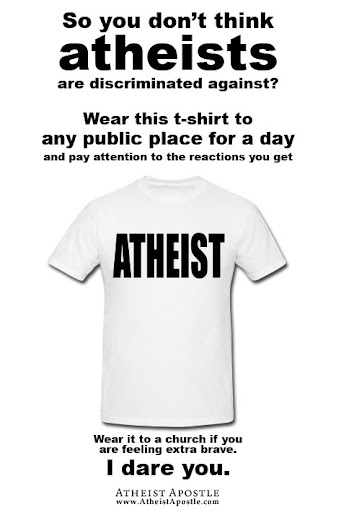
So, you don’t see atheist discrimination?


A challenge (via Atheist Apostle…via Dead Logic)

Wear if you dare!


Now, I have been wearing shirts that advertise my atheism for many years.  I have some acquaintances who question why I wear them as well as why it matters.  They are atheists too, in most cases, and nobody seems to care about it around them.

Well, a few things:

1) Most of my acquaintances who make such comments, especially people I’ve known from from high school, are very privileged private school educated, upper middle class, white men.

2) They rarely or never talk about their atheism, especially to non-atheists.  How would they know if discrimination existed? It’s easy not to be discriminated against if you are so deep in the closet nobody can see you there.

3) I’m not sure if most of these people would know what discrimination looks like, from the receiving end, if they did experience it.

My own admitted privileged status in our culture means that I don’t fully comprehend the repercussions of discrimination myself, and this is magnified for those who don’t expose themselves to being out atheists.  I am well aware of my ignorance about the experience of serious discrimination.  But what small amount of lack of privilege that being an atheist entails in our society (especially when compared to what women, non-white, trans, etc (not to mention the various intersectionality that people experience), I can assure you it does exist.

It’s nothing immediately dangerous (in the vast majority of cases, but I also live in a liberal metropolis), and in most cases it amounts to awkward conversations with clueless people.  It certainly can make job-hunting problematic, as advertising atheist activism on a resume may not be wise.  Although I once did get hired for a job (years ago) while wearing a “Hi, I’m your friendly neighborhood atheist” shirt.

So, atheist discrimination, in comparison with discrimination received by other groups of people is comparatively tame.  But it exists.  The more people that come out of the closet as atheists, the better it will eventually get.

So, whether you wear a shirt like the one pictured above or not, keep in mind that there are significant religious privileges in our society, and that we need more people standing up, speaking, and acting in the name of social justice of all kinds.

All social justice activists are working to make their activism irrelevant.  Let’s make atheist activism irrelevant.

Poly lessons I learned from cheating while monogamous.


This post will be hard for me to write.  It will be difficult because it involves mistakes I have made juxtaposed with ideas about love and polyamory that may come across as crass, cold, and possibly uncaring.  There will undoubtedly be people who read this that think of me as an asshole for the thoughts I will express below, but I think it’s worth exploring these ideas anyway.

After all, it is such experiences which helped give me perspective on polyamory, and perhaps some people will sympathize or have experienced similar things.

So, I have not always been polyamorous.  Well, I suppose somewhere deep down, I have always been predisposed to polyamory, but I have not always practiced polyamory in my relationships.  I discovered it early, being around 20 or so, and while I had a quasi polyamorous relationship back then, I was immature, uninformed, and was not really ready to have very healthy relationships then.

So, after college I was monogamous, serially so anyway.  And during the most serious relationship I was in during my 20’s, I acted badly on at least one occasion.  All of the details of the act are not necessary, but it should be sufficient for me to say that I cheated, hid that act from my girlfriend (with whom I was living at the time), and it was eventually found out.

But I want to focus in on a small part of all of this in order to draw out a lesson I learned about myself, love, and non-monogamy from that time.  This part occurred a long while (I think 6 months or so) before she found out about the act.  It was pretty immediately after the act happened, in fact.  It was the first real opportunity I had to reflect on it in the presence of my girlfriend, and I regret not coming clean at that time, but it’s the past….

I loved her.  In many ways, I still do.  But I truly loved her then and appreciated our relationship and all the wonderful times we had.  Sure, we argued about things like cleaning (she was terribly messy), being on time (She was perpetually late), and so forth, but I loved her genuinely.  The sex was great, she got along with my friends, and I loved being with her.  I found her very attractive, passionate, and there was never a lack of desire from my part.

The cheating act, therefore, was not about lack of attention or satisfaction.  It was just about me being into someone else I had met and with whom I had spent some time in social gatherings  One weekend, the circumstances allowed the possibility to act on it, which I did.  Yes, alcohol was involved, but the responsibility was ours.  We both knew what we were doing was wrong.  We did it anyway.

A couple of days later I was faced with my girlfriend, and I had a choice.  I knew that it would have been easy to get away with what happened, and so while I felt like I should say something, I hesitated.  And so with the intention of sitting her down and telling her, despite knowing it could end the relationship, I found her and could only express a strained but genuine smile.  She was happy.  She was in a great mood, had plans for the day she was excitedly telling me about, and I was genuinely glad to see her.  Yes, the sex had been good with the other girl.  Yes I also liked the other girl.  Yes, I had violated a trust.  Yes, I should have stopped her and said something.

But we were happy. A rationalization for sure, but a true one.

It was at this moment that it fully clicked home for me that there is no contradiction between loving two people.  Or at least loving one person while enjoying sex and intimacy with another person, as I cannot say honestly I was in love with the other girl; that would be a severe stretch of the truth.  We were recent acquaintances, really.  I didn’t know her very well.  But we liked each other, shared attraction, and decided to act on it spontaneously.

I felt the tension of knowing I had acted badly and feeling genuine love for the person whose trust I had violated.  It was guilt mixed with happiness.  I knew, at that moment, that I would be capable of caring for a person deeply and genuinely while also being with someone else.  I knew that polyamory was something I wanted and would be capable of.  The irony of discovering this in the context of doing it all very wrong is not lost on me at all.

We were together for some time after this, even after she found out about the act.  We actually had a polyamorous relationship with another woman later on, which was a fairly successful even if relatively short triad.  The cheating act did create problems, but we worked through them and moved on.  I don’t know if the trust ever fully returned, and the relationship eventually faded until we were friends with benefits, friends, and now there is distance between us.

Now I’m married, and she engaged.  We don’t talk much anymore, but are on friendly terms.  I still love her and care about her, even knowing we cannot work as partners nor, do I think, would either of us want to.  Such is life.

—-

So, here is the thing.  I violated an important trust.  I had sex with another woman while in a monogamous relationship, and after having done so all I could think about was how happy I was with my girlfriend, how much I loved her, and how much I still wanted to be with her. I also thought about how in an ideal world I would continue to see that other girl.  That never happened.  We only saw each other a couple times after that, and eventually job opportunities led her away.

There was no immediate, visceral contradiction there for me.  Yes, there was a tension, but it was mostly fear of losing a person I loved with some guilt for having done it.  But there was no deep feeling of having done something inherently wrong; no feeling that sex with another person while in a relationship was always wrong, just wrong when done in this way.

I was aware of the fact that according to common wisdom there should have been a contradiction there, but it didn’t exist for me.  The tension was all in knowing that I could do it again, at least not in the wrong way.  I wanted to do it in the right way.  And eventually (after she found out) we would start talking about opening up our relationship, and we eventually did decide to become polyamorous.

I was as if, in my mind at that time, I was already polyamorous.  I completely got how one could share and be shared without it being an issue.  The fact that we were not polyamorous at the time, that we had not agreed to share, was a problem that did erode at me, but we continued to be happy.  In fact, later on she did something rather similar with a male friend of hers while visiting home and did disclose it to me immediately.  And it was fine.

It was fine because in my mind I was already willing to share.  I was already geared to have that conversation.  I had already stopped thinking about her as being exclusively mine.  I would love her whether she was with other men (or women) or not.  I loved her because I loved her, not because she loved only me.

Now that I am polyamorous, I experience a similar feeling all the time.  Whether I spend some intimate time with Gina, Ginny, or someone else, if I am to then spend time with my wife or my girlfriend afterwards, I am then focused on them.  The fact that I just had sex with another person cannot touch what I have with them.  What I have with them is special, powerful, and transcends such silly things as where my penis was just a little while ago or whose penis was with them.

Why does that matter? Why should that matter?

And I understood that in that moment I should have disclosed the act, but didn’t.  I rationalized all sorts of reasons why it was better to keep it secret.  I get that even if it didn’t change how I felt or that it really should not matter, I should have disclosed.  And now I do disclose.  If I am with someone else, Ginny and Gina usually know that it is a fair possibility before it happens.  And if it does happen, they know.

And I still love them both, am happy with them both, and all is transparent.

What I learned was that sex and other people cannot damage relationships in themselves.  Relationships fall or stand on their own merits.  If your relationship is strong, it can withstand external intimacy.  If your relationships have weaknesses, those external intimacies will become a lightning rod for those weaknesses, but are not necessarily the cause of them.

So yes, cheating is a violation of trust.  But it is not the act, the sex, that does the damage.  The damage is the violation of trust.  That was a distinction I learned that day, and have ever forgotten.

You don’t have to be a slut, but you should if you are


I love sex.  I think people should have as much sex as they want.

There are a number of cultural, social, and psychological barriers between people’s desires and what they do.  In many cases, these barriers are necessary and good, such as the object of said desire being attached to a subjective point of view that does not share that desire.  In other words, wanting sex with another person is insufficient; they need to want it too.  Having sex with mere objects, however, is fine (so long as it’s your object, I suppose).

Religion, while not really the ultimate source of such barriers, certainly perpetuates many of the behaviors that act as a barrier to healthy desires.  Religion is but a very prominent and powerful outgrowth of human behavior, and much of that behavior is not healthy.  Theological positions which declare our desires to be sinful, ungodly, etc are expressions of our deep fears and insecurities projected onto the universe, magnifying our senses of guilt, repression, and self-deprivation beyond its rational scope.  Most of theology, that is, is anti-human.

We all want sex to some degree.  For some, that amount is zero, and those people will probably not be sluts.  I mean, they can choose to participate in sex, but without the raw desire and attraction, why would they?  It’s not what they really want, so deep down they are not sluts.

For other people, that degree of interest in sex is great.  When I was younger, I remember spending weekends with a girlfriend where marathon sexcapades were common.  Having aged a bit, that is no longer the case but I still love sex, and I like it with women of varying body types, varying personalities, and even with varying numbers of them.  I am an unapologetic slut deep down, and I a not a slightest bit ashamed of that, and I love meeting people who feel the same way, or who at least share an attraction to me.

Whether they also share it with 1, 2 or a 10 others is not really important.

But I also don’t have that much time.  I have two very meaningful relationships, with my wife(!) Ginny and my girlfriend Gina.  Frankly, I don’t have much time to meet other women.  And other times even if I know other women I am attracted to, I don’t communicate it if it seems to create logistical problems, I get no indication that the attraction is two-way, etc.  But, when I do meet someone that I find attractive, I often communicate my interest.  Sometimes it works out, other times not so much.

The point is that I follow where my real desires actually lead, and not to some ideal or expectation.  I don’t artificially pretend that I am more or less interested in sex than I actually am.  Not everyone does this.  Some people reign in their desires, magnify them, or try and intentionally divert them away from some direction they find objectionable.  Now, if they have a good reason for doing so (and what I consider a good reason may differ from theirs), then no problem.  But some people are not comfortable with their sexuality, and that is not healthy.

Slut-shaming is a problem.  There is no reason to talk badly about a person who has a lot of sex with a lot of people, unless they are hurting people in the process.  There is nothing inherently wrong with such a thing as really liking sex and then having it, so long as it is done consensually, comes from real desire, and with transparency.  There is also no reason to feel bad about wanting such things to start with.

From where I stand, the problem comes from where people have those desires but don’t find healthy ways to act on them.  That is if you do have those desires to be sexual, and you are not seeking healthy and consensual ways to act on them, then perhaps there is something wrong.

Are you in an exclusive relationship? Perhaps you need to have an open and frank conversation with your partner.  Are you intimidated? You need to find ways to take steps to get over that.  You you feel dirty? Come on, you don’t find that as part of what makes it hot? No? Well, then perhaps you should find “clean” ways to have sex.

I feel too much pity for people who get into their 40’s, 50’s, or later and finally cannot stand to put off their desires any longer.  I have met many people in the poly community that talk about how they ignored so much about their sexuality when they were young, and then they found later on what they wanted.  Don’t get me wrong, I am glad they did find it, I just wish people would find it earlier.

We need to be who and what we really are under all the bullshit of socialization, religious training, and following of default expectations.  We will all be happier getting what we want out of life by pursuing it rather than putting it off.

In short, we’d be better getting off than putting off.


Holy crap, I’m married!


Like, for real.  Like, marriage license, wedding, reception, and all the rest that goes with it.

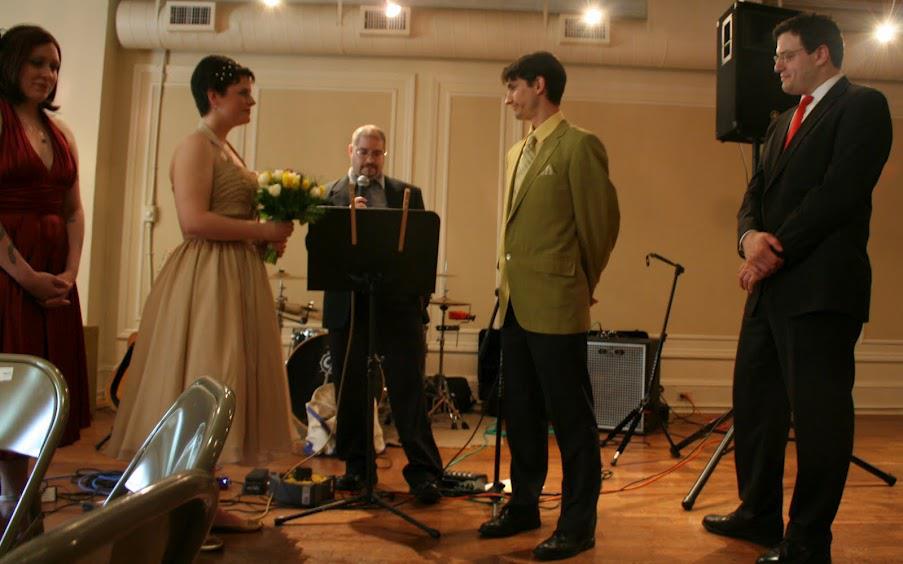
Damn, why do I always stand so awkwardly?

So, Ginny is more into things like traditions, cultural rituals, etc than I am.  In fact, she would pretty much have to be.  But on the whole, the day was pretty normal, at first glance.  There was a guy standing between us saying some words, there was a bridal party, and we stood there looking at each other all lovingly and crap.  You know, like a wedding.

But the guy standing there (my friend Staks) said some non-traditional things.  The nod to gay marriage (we were at a gay community center in downtown Philadelphia, after all), references to Doctor Who, and stuff like that.  He also included some traditional words that one finds in a marriage ceremony, but no references to any sky-fairies or zombie Jews, so that’s a bit abnormal, I guess.

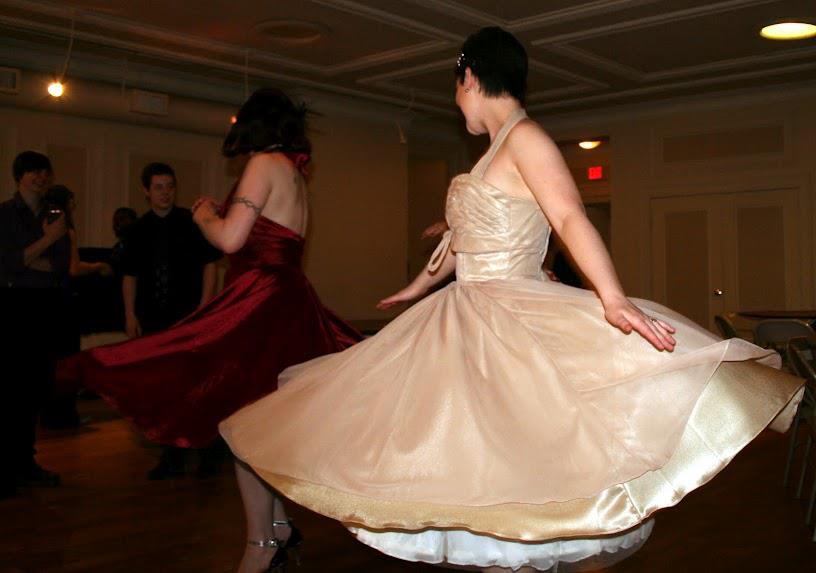
Also, my girlfriend, the hilarious and talented Gina who readers here will all know as the very serious scientist who pisses off reddit with her analysis of comic book science, brought some people with instruments to play some rocking tunes.  (And yes, Arcati Crisis does indeed rock).  So, yes, girlfriend at my wedding.  Happy poly time!

There were speeches, including one quite sappy and teary one which was forced out through sobs (oh, right…that was me).  There was food, drinks, after parties, and crashing of other wedding parties.  Also, dancing to said rocking tunes.

People visited from out of town, mimosas were had with brunch, and people left to go back home.  Now back to real life, right?

This does not change much in our lives.  We are still polyamorous; marriage and commitment do not change that.  I am looking forward to the future, living in the present, and remembering the past few days with a smile, but also knowing that we can’t always have the people we enjoy being with around.

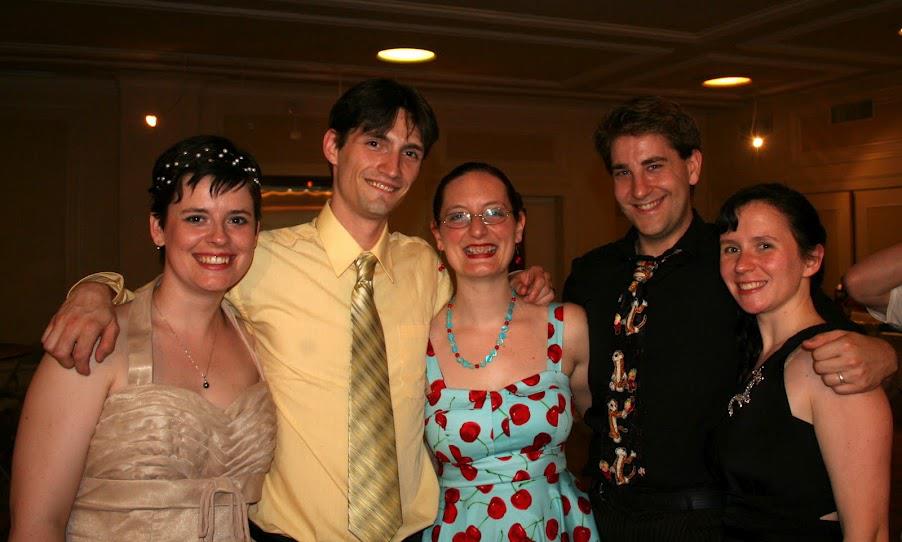
It was great seeing friends from Atlanta, Illinois, Virginia, etc for a couple of days.  It’s a shame that we can’t all hang out on a Saturday night, in a hotel room, with drinks and ginormous pizzas every week.  It’s a shame that everyone had to go home.

But many of them remain, and I am glad for that.

Sunday, Bloody Easter


Jesus had a bad weekend for your sins.

Listen, I don’t accept the crucifixion and then the story of how Jesus rose on the third day for a second.  There is simply no corroborating evidence for it, it parallels too many pre-Christian stories, and the oldest Gospel, Mark, didn’t originally contain the story of the resurrection.  There is a lot out there to read about the issue of the resurrection, and I am certainly no expert (although I know one person who has expertise in related academic fields), so I will leave it to them to address that particular issue in more detail.

But if I did accept the story, that is, the bare facts that some guy (let’s call him Jesus, Yeshua, or Frank for all I care) almost 2000 years ago was wandering around with 12 dudes while preaching about some messianic Jewish story or how the Kingdom of Heaven is at hand, or possibly within you, was arrested, detained, questions, tortured, crucified, and then buried only to appear, alive, a couple of days later…. Well, so what?

Let’s say that I was willing to grant that this happened.  It does not have to mean I have to accept the interpretation of those who claimed to have been witnesses.  I don’t have to accept the dominant narrative that evolved into the Gospel stories nor the earlier Pauline accounts, via his letters to other people who started worshiping this guy around the Mediterranean Sea, do I?.  In fact, this historical fact, if assumed true, does not address the existence of any gods at all, necessarily (nor does it address whether that person was a god, let alone THE god…or at least one of three hypostases of god…whatever).  It would be a mysterious situation that would pique my curiosity (and skepticism), but if it happened then we would have to deal with it as a real event and figure out how it might have heppened.

The problem is that we are so far removed from the historical events, blind to essential details, that the type of necessary investigation would be impossible.  There is nothing to do with the facts other than wonder about them.  So, what does this type of story have to do with god, religion, hundreds of years of violence, repression of scientific and intellectual freedom to advance, and hierarchical infrastructures of people whom are generally automatically revered because they apparently know this guy who rose from the “dead”?

In a word; nothing.  At least it shouldn’t, if we were being rational about things.

Many Christian apologists have claimed that what makes Christianity unique is the fact that it is based upon not mere mythology, but historical fact.  Paul, in the first letter to the Corinthians famously said that

15:14 And if Christ be not risen, then is our preaching vain, and your faith is also vain.

and for many Christians this is the crux (lol) of the matter.  For them, the “miracle” of the resurrection is the fact that defines their faith.  And despite the fact that I (as well as many other people) do not think that it happened, this is irrelevant because even if it did actually happen it does not lead to the salvation story that many Christians want it to tell.


What happened to Jesus, if it happened at all like it is portrayed in Christian orthodox theological terms, was not a sacrifice.  If Jesus was god, or at least one with god, and if Jesus knew this, then it is not a sacrifice because he suffered no actual harm and no real loss,.  It is a bad couple of days, a stubbed toe, an inconvenient breeze in the face of eternity as a freaking all-powerful god! It would be less of a sacrifice than the sacrifice of effort and time it would take to flip a switch within arm’s length in order to save people from certain death by some killing machine, created by some super-villain.

Except in the case of Christianity, God is not only the switch-flipper, but God is also the mad super-villain who created the killing machine as well as the switch itself.  I simply cannot find meaning in this Easter story beyond metaphors for all sorts of themes surrounding rebirth, which are used by most religious traditions and which don’t imply that we are all evil sinners worthy of eternal torture for being what God made us to be so that he would have to send himself to have a bad couple of days to make up for lack of good planning concerning the fate of billions of people throughout all of history.

Yeah, that’s the story of Christianity, people.

Ok, so what if Jesus was a man, albeit a unique and important one? What if Jesus was a man inspired by a true god, or at least the chosen messenger of god, whose efforts in delivering said message would be rewarded with eternal paradise on the right hand, or even down the street from, the real God of the universe(s)?  Then it is merely a form of substitutional atonement; an awful event, morally, if ever there was one.  I’ve heard the apologetic responses, but the story of the atonement, or the replacing of the sacrificial sheep with Jesus (the most unblemished of sacrificial lambs) is absurd.  How does another person dying do anything for my imperfections? The level of theological rationalization around this issue is frankly staggering, and we need to see it for what it is.  The idea simply makes no sense, whatsoever, and it robs us of our personal responsibility for our own misdeeds.

Jesus dying for our sins, whether as god or man (or as some weird genetic cross-breed of god-man), is quite simply absurd and silly.  It appeals to us emotionally and can be rationalized into some meaningful pulp, but it has no nutritional value whatsoever.  It is irrational, un-skeptical, and even immoral in nature.

If anything, it’s just another old religious metaphor for the rebirth of the world, in Spring, from the death that is winter, with the addition of theological concepts which absorb us in self-deprecation and is ultimately anti-life.  You know, like symbols reminiscent of life, birth, and youth but bathed in blood and depressing self-hate.

It’s too bad we don’t have anything this time of year which is like that without all the blood, death, and anti-humanistic rhetoric built-in.

Oh, right, yes we do! Symbols of fertility, birth/rebirth, and youth surround our more secularized version of Easter.  Pagan will try to take credit, and they do deserve some of it, but this is simply human behavior; we want a way to symbolize and celebrate the return of life to the world.  Our history and literature is replete with such symbols and celebrations, and Christianity has (once again) seized them and used them as their own.

But in this case, the thieving Christians, specifically the Catholic Church, didn’t even have the common decency to re-name the holiday! Easter? really? EASTER?

I mean, come on, people? It’s bad enough that Christians stole Christmas, but at least in that case they chose an original name, right?

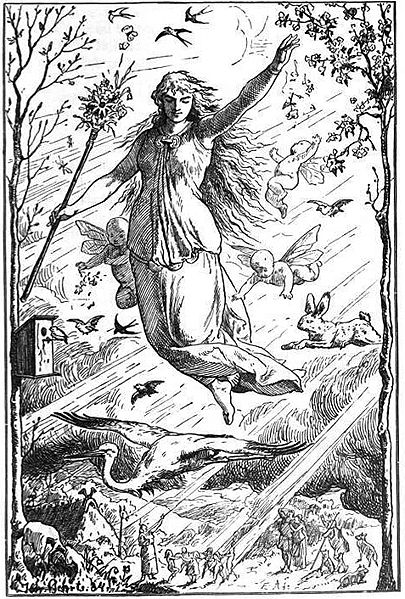
So, here is Ostara (she goes by many names, but essentially she is Ēostre/Easter.  Check the link if you want to know more about the pagan mythology and history of celebrations and rituals surrounding her and this time of year.  But if you don’t, at least take home with you the idea that this holiday is not merely Christian, and insofar as it is Christian it is not the story that the Pope or your pastor tells on Easter morning.

Please, learn your history.  If you are a Christian, please learn where your ideas came from.  Try to understand the context, the subtleties, and even the blatant cultural influences which shape how you see the world.  View the Jesus story as a metaphor, a metaphorical narrative, and possibly not a very good one, which tells you something about our psychology and needs, but not about historical or metaphysical truth.

Jesus, if such a person existed and died via crucifixion, is not the solution to your sense of ultimate personal lacking.  Your imperfections, misdeeds, and falling short of some ideal morality cannot be solved by a person dying, nor subsequent rising from said death, nor from some contrived ‘God sacrifices himself to himself to make up for a law he made about a piece of fruit that nobody ever actually ate’ theology.  You must take responsibility for yourself, toss aside this metaphysical concept of sin, and stop sacrificing this life for some promised other life.

This life is all we have, and we must do what we can to make it all that we want it to be.  So stop bowing to a pseudo-sacrifice and start living in a world which is currently blooming with things wonderful, terrible, and worth working for now

Happy Easter, everyone.