A week ago I wrote a quick post about how I was reading Jonathan Haidt’s The Righteous Mind, and quoted a bit from early on in the book. I am nearly done the book (I have one chapter left), and although I liked much of the early book and think that some of what he thinks about the relationship between our moral instincts and subsequent rationalizations of them are worth reading, I must conclude that i am not on-board with Haidt’s approach to religion, especially his criticisms of the “New Atheists.”
In chapter 11, Religion is a Team Sport, Haidt tries to deconstruct the new atheist approach, following on his anti-worshiping of reason from earlier in the book, and says we need to address religion for what is is (a group selected set of community-building institutions) rather than what it is not (a set of beliefs, ideas, etc). He thinks that our attention to beliefs as motivators for action is too simplistic, and points out that “belonging” has to be placed along with belief and action, in the matrix of religious behavior.
Well, yes of course it does!
I don’t need to get into the details of what is wrong with the book, at least in terms of the criticism of the new atheists, because that has already been done:
I agree that there are parts of the book which are quite worth-while. I did just get it from my local library, after all, and didn’t spend a cent to read it. If you are interested in moral psychology, evolutionary psychology, and group selection (whether or not you agree with any of those research areas specifically), then I suggest reading at least the first several chapters.
But what was most telling was that Haidt kept on talking about the difference between what makes a group work well and what does not. His conclusion is that religion makes groups work well, at least for members of the group. Atheists who ask us to leave religion, as individuals or as a species, risk losing what Haidt sees as the glue that can hold us together.
Haidt is seemingly unfamiliar (due to lack of mention) with any new atheist thoughts past 2007 or so (the book was published in 2012). Perhaps the problem is that he is unaware that many atheists have been working, especially in the last 2-3 years, on building up an atheist community. No, we may not have anything sacred (not even science), but we are working on creating a sense of what it means to be skeptical, non-religious, and living in a world with potential for beauty and terrible atrocity.
Religion is not the only force for group-cohesion, even if it has the advantage of having sacred spaces, authority, and thus loyalty (what Haidt identifies as primarily conservative values). I believe that care, a concern for fairness/ justice, and a sense of liberty (what Haidt identifies as what liberals tend to prioritize) are means to creating community as well. We do not need to give up a concern for what is true (a value Haidt does not list, interestingly, especially because it is a high value for many new atheists, including myself) in order to create shared group identities.
Haidt, an atheist himself, is not connected to the atheist community. Perhaps if he was, then his arguments would not be so poor. Perhaps we should invite him to the party?
Participants in a gay conversion therapy program are suing:
Jews Offering New Alternatives for Healing (JONAH) fraudulently claimed to provide services that “convert” people from gay to straight. These services, known as conversion therapy, have been discredited or highly criticized by all major American medical, psychiatric, psychological and professional counseling organizations.
The Southern Poverty Law Center filed a first-of-its-kind lawsuit against the New Jersey conversion therapy organization for fraudulent practices. The lawsuit, filed in the Superior Court of New Jersey, charged that JONAH, its founder Arthur Goldberg, and counselor Alan Downing violated New Jersey’s Consumer Fraud Act by claiming that their counseling services could cure clients of being gay.
The lawsuit describes how the plaintiffs – four young men and two of their parents – were lured into JONAH’s services through deceptive practices.
Hallelujah. Here’s hoping that this is the first of many.
Solopoly has a list up of do’s and don’t’s when it comes to treatment of a non-primary partner. The list:
Do:
Honor time commitments and dates.
Listen to and honor your non-primary partner’s concerns, needs, and feelings.
Make your non-primary relationship a priority.
Offer reassurance and understanding.
Embrace your non-primary partner’s world.
Keep your promises.
Support good metamour relations.
Invite non-primary partners into negotiations and decisions that affect them.
Clarify your boundaries and commitments BEFORE you begin a new relationship.
Fully disclose your constraints, agreements and boundaries.
Speak up about fairness toward non-primary partners.
Assume good intentions.
Don’t:
Don’t violate agreements.
Don’t conflate “fairness” with “equality.”
Don’t bail at the first bump.
Don’t default to playing the go-between.
Don’t foster competition or conflict among your partners.
Don’t pretend the dynamic of your existing relationship(s) will not change.
Don’t make it more complicated than it needs to be.
These are mostly good suggestions. Most of them apply to any relationship, not just a non-primary relationship, and they are generally rather intuitive. However, I’d like to add something to the list that’s somewhat counterintuitive:
Do Take Sides
This does not necessarily apply to only non-primary relationships, but it applies to any situation in which you are dating multiple people who have exposure to one another. In such a situation, conflict is inevitable. If you date for long enough, your partners are going to have a conflict with each other. In such a situation, your instinct is going to be to remain neutral , to facilitate discussion, but not to exercise judgment. In my experience, this is a mistake.
When your partners have a conflict, you’re going to have an opinion. I’d be willing to bet you’re going to have a pretty clear opinion about who did what wrong, who should apologize, and what they should apologize for. Hiding that opinion doesn’t help anyone. Firstly, it harms the trust you’ve built with both partners. Hiding things always does, and hiding something so relevant and important harms the trust to a greater degree.
Secondly, when you’re in a relationship with two people having a conflict, you have a lot of power to influence how the conflict goes. And as Spider-Man has taught us, that comes with a corresponding responsibility. By being in a position of trust with both people, you are possibly the only person who can talk straight to both parties and have them actually listen. When one of your partners is behaving unreasonably, you are one of the only people who has the ability to talk them down. If you abdicate that responsibility, your partners have to solve the issue themselves. Maybe they will, but they’d stand a much better chance with an effective mediator.
The much better alternative is to pick a side in the dispute. If you think one party is right and the other wrong, say so. If you think both are wrong, say that. If you think one is very wrong and the other is only a little bit wrong, say that too. In almost any dispute, both sides have made errors. Point them out,. But do not try to remain neutral. It’s easy to fall into the “both sides are wrong” trap. It’s easy to point out minor infractions on both sides are pretend they are equivalent. Don’t do it. One side is almost always more wrong than the other. Say which one.
The other thing to remember, and I can’t stress this enough, is do not always choose your primary partner’s side. The whole thing only works if you give your honest opinion and overcome your biases. Your primary being your “top priority” does not mean that you always take your primary’s side in a dispute. Sometimes, your primary is going to be in the wrong. It happens. It’s up to you to say so.
Politically, I tend to align myself with progressive thought. I generally like the idea of progress; moving towards an ideological target. But when I think more closely about the idea of progress as a concept, I think it lacks something important, and has some potential inherent dangers, when compared to the idea of a process.
One of the dangers of political ideologies is that very distracting idea of a target or set of social and political goals. Because while those goals may be based upon clear thinking, good values, and hopefully even empirically sound philosophical bases, the fact is that circumstances change and we may not notice if we keep looking at the destination.
See, progress is teleological. Process is methodological.
Teleology implies intention, design, and is associated with religious theology in many ways. The presence of intent and purpose, when it come to theology especially, might seem safe because the designer is often believed to be perfect, or at least optimally knowledgeable and powerful. But progress in the real world involves imperfect people, and so when we think about progressing towards some ideal utopia, or merely a better set of values and policies, we are almost certain to err. And if we are attached to the destination too strongly, we may not even see those errors.
Instead, we should be focusing on the process by which we solve problems and understand the world. Goals are nice, and often necessary to accomplish anything, but by focusing on the goal rather than the road we walk upon, we will lose sight of many things.
Many forms of religion, and religious thinking, suffer from this very problem. The focus on Heaven (or Hell) for many people is a prime example of this. Built into the worldview of many forms of Christianity, for example, are things like purpose, intent, and ultimate destinations for us in God’s plan. And even within the Christian world people will criticize other believers for focusing too much on the goal, rather than what God wants us to do here. By being focused on getting to Heaven (or avoiding Hell), many people are not doing many of the things here and now that they could, or should, be doing in this life.
And, of course, this leads to the common atheist criticism of religion; people’s focus on the afterlife, rather than this real life (the only one we have), leads people to miss all that we really have. But this mistake is prevalent throughout all of human groups, including some atheists. It’s one of the many imperfections with how our brains evolved, and I think we can all benefit from an awareness about what methods we use, rather than an ideological goal.
That’s what skepticism and science are good for. Because skepticism and science are not goals; they are methods. Granted, it’s hard to avoid looking at the potential horizon in our pursuit of the truth, but we need to make sure that how we think about those goals in the here and now, so we don’t get caught up in the dream rather than the reality.
Focusing on our process, our method, will make sure that we are on the right road, because all-too-often people find that the road they are one don’t lead anywhere; that the location in the horizon was a mirage, and the road (which they were not looking at) just goes in circles, or merely stops one day, nowhere near their illusory destination.
And there are many images of potential futures with science as our road (I’m looking at you, transhumanists). But we cannot live in the hope that those futures will occur. We can be inspired by them, but we have to live where we are. I’ve known Christians who miss too much of life because they are awaiting Heaven, and I have known atheists who let life pass by because they desire their cybernetic bodies or their mind to be uploaded into a different kind of immortality.
In my opinion, we all would be better off by making sure that the thinking we are doing today is connected to real goals and real life, otherwise we may be letting precious time slip by in the name of illusory goals. I want my goals to be attached to a skeptical worldview, utilized to make this life better for us and our descendants.
All of my distant goals and ideals are subject to change and revision because I keep my attention to what is going on around me, and thus my goals sometimes change.
Saying ” because I don’t want to” is a perfectly acceptable justification for one’s subjective preferences. Yet moral judgments are not subjective statements; they are claims that somebody did something wrong. I can’t call for the community to punish you simply because I don’t like what you’re doing. I have to point to something outside of my own preferences, and that pointing is our moral reasoning. We do moral reasoning not to reconstruct the actual reasons why we ourselves came to a judgment; we reason to find the best possible reasons why somebody else ought to join us in our judgment.
This is from page 44 of Jonathon Haidt’s book, The Righteous Mind which I am currently reading.
This idea is central to how I have been thinking about morality in recent years, at least in conjunction to ideas very much like those in Sam Harris’ The Moral Landscape. I take it as axiomatic that preferences exist as the basis for much of our opinions, whether they be about politics, sex, religion, etc. I realize that our values are not chosen, but are the result of fundamental emotional/pre-conscious processes which we don’t have immediate or easy access to.
But when it comes to things like public policy, especially when it comes to things like sexual orientation, I recognize that there is a significant burden on those who seek to limit personal freedoms which derive from our fundamental preferences and desires. Religion is a devastating vehicle for such preferences—preserving and sanctifying them—but it is but one example of the great-grandparent of all vehicles for such things; culture. Culture is not good or bad, per se, but it carries traditions and concepts which we put there, often without knowing why. Culture is the storage space for all of our un-chosen fears, hopes, and everything in between.
It may be one of the great ironies of the human condition that we have to be willing to reject the specific preferences that we have for the sake of personal rights of others. I say it’s ironic, because those same sets of preferences are the bases by which we rationalize morality at all; our personal preferences are the bases for enlightened self-interest, the golden rule, etc. If we didn’t share the universal sets of personal preferences, then morality would not be relevant because we would feel no compulsion towards any particular action, let alone compassion. It is because we care about our own preferences that we can, and feel compelled to, care about the preferences of others.
I cannot change, and did not choose, that I am sexually attracted to women rather than men (overwhelmingly, anyway), any more than another person cannot change that they are attracted to men, all genders, etc. Thus, the same desires I have to create various levels of intimacy and commitment with women are analogous to the desires that gay, bisexual, pansexual, asexual, and even sapiosexual people have for the subjects of their desires. My preferences are mine, and their preferences are theirs. When put next to each other and looked at inter-subjectively, no subjective preferences have a privileged status and all must be given equal initial weight (my like of John Rawls will be apparent here). Thus, gay marriage is as much a right as any other form of marriage between consenting adults, because my preference for women is no more inter-subjectively valid than a preference for men and so forth.
Cultural tradition (specifically religion), the storage space for those bigoted fears, disgusts, and shames concerning homosexuality, are not sufficient reasons to create discriminatory policies against some forms of those desires for intimacy and commitment.
We have our preferences, but those preferences cannot inform, on their own, how we create policies that affect other people, at least in cases where no non-consenting victim exists. And we have to keep in mind that as we dig into our minds (in the sense of Nietzsche’s concept of being archaeologists of the soul), we may find that preferences can change, and that we may grow new ones as we grow and learn. Because while we may not choose our preferences, we can at least expose our mind to new ways of seeing issues which may alter the way our unconscious mind prefers to react.
Pay attention to your immediate and unconscious reactions. Be mindful of feelings of disgust, shame, and fear in the site of things which we cannot find reasons to feel disgusted, shameful, or fearful of. Sometimes interesting facts emerge while probing our preferences. And sometimes our preferences, and thus our values, are actually just wrong and will need to be replaced, if that’s possible.
For the sake of our species I hope that values can be replaced. But if not, I hope that we can at least convince people who have those damaging preferences that they should accept that their preferences will not become laws to govern all.
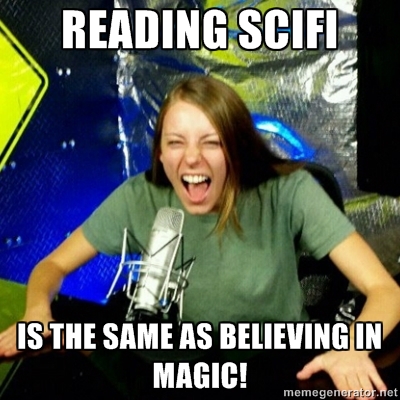
Charlie Jane Anders, a writer for one of my favorite nerd blogs, io9, wrote a post today called Why Smug Atheists Should Read More Science Fiction. The post, to be as charitable as I can, is total crap. Anders starts out by saying
You can’t be on Twitter these days without being bombarded with atheistic smugness. You know what I mean. People who can’t just profess that they don’t believe in God — they have to taunt religious people for believing in “fairy tales.” Or the Tooth Fairy. Most of the time, these are geeks who have immense respect for science… and yet, they won’t recognize a situation where they simply have no data, one way or the other.
The first problem here is that Anders is attacking an attitude without citing any examples, just saying “you know what I mean.” This is an almost guaranteed straw man, as it relies on the detractor’s characterization of the offending behavior with no room for interpretation.
The next problem, just with this paragraph alone, is that Anders characterizes equating religious belief with belief in fairy tales and/or the Tooth Fairy is “smug.” The problem is that religious belief is no more reasonable or supported by evidence as is belief in those other “ridiculous” things. In some ways, it makes more sense to believe in the Tooth Fairy, as parents often specifically set out to provide evidence for its existence. Anders just throws this out there like it’s obvious, instead of providing an argument or any reasons why religious believers shouldn’t be mocked for their ridiculous beliefs.
Third is the classic agnostic fallacy – we “simply have no data, one way or the other.” Wrong. We have a ton of data disproving a ton of religious beliefs. The only way you get to “we have no data” is by reference to a vague, squishy idea of “a higher power” which doesn’t necessarily do much of anything. Any time you get more specific than that, chances are there is some evidence against your belief. But that also ignores a central idea behind all reasonable thought – belief without evidence is unjustified. If we have no data for or against a proposition, the reasonable thing to do is to disbelieve it. The strength of a belief should be proportional to the strength of the evidence. If there is no evidence, there should be no belief, and anyone who has a belief is being unreasonable. Anders continues
A lot of the best science fiction includes a sense of wonder at the hugeness of the cosmos — and the flipside of that is a sense of our own smallness. And the humility that goes along with that. If you want to feel a real sense of quasi-religious awe, don’t think of the world as being 6,000 years old — think of its actual age, measured in billions of years, and the huge timescales of the universe before and after our world. And think of the vastness of the cosmos, whose mysteries we’ve only just begun to glimpse in the past century.
What now? Anders sounds like most of the often-called “smug” atheists I know of in this paragraph. Is Anders trying to suggest that atheists lack a sense of wonder at the universe? I’d say that Anders ought to take a look at The Magic of Reality before making unsourced assertions like that. Anders’ next point:
There’s a common plot in science fiction — particularly media SF — where someone is “seeing things” or having experiences that can’t be easily verified or quantified using technology. Like a sense of “deja vu,” or hearing voices, or seeing the missing-presumed-dead Captain Kirk floating around. And a huge problem in these stories is that nobody can really know what another person is experiencing, or whether it has any validity or is just a hallucination. Thus it is with religious experiences — other people can speak about their profound experiences of the divine, which seem immensely real to them, but may sound like a crazy delusion to the rest of us.
Is Anders seriously suggesting here that “smug” atheists aren’t aware of stories in which people seem crazy, but are later vindicated? Of course we’re aware of those stories. The reason we don’t immediately draw parallels to the people we know who seems crazy is that THESE ARE WORKS OF FICTION! Seriously, how dense do you have to be not to understand that? One of the common criticisms that “smug” atheists level at believers is that they can’t tell the difference between fiction and nonfiction. Anders seems to be proving that point. Anders closes with this:
Still, it’s great to be atheist — and I strongly support arguing publicly and loudly in favor of atheism as a point of view. Just, you know, don’t be smug about it. You don’t actually know any more than the rest of us, and the universe is a much stranger, more bewildering place than any of us can really begin to grasp, and the only thing that would be surprising is if we stop being constantly surprised. If you don’t believe me, just read some science fiction.
This is the paragraph that inspired the title of this post, in that it seems to me that Anders just doesn’t know any atheists. Almost all of the atheists that I know agree wholeheartedly that the universe is a strange, bewildering, and ultimately unknowable place. Our frustration is with religious believers who claim to know things that they cannot possibly know, based on holy books or intuition. It’s the atheists who are insisting that the universe is a giant mystery, and the believers who claim that they have it all figured out. Atheism is nothing more that the belief that the idea of “god” is unsupported by the available evidence. Anders should actually speak to a few atheists before painting them with such a broad brush.
Poly is not a sexual identity, PP, it’s not a sexual orientation. It’s not something you are, it’s something you do. There’s no such thing as a person who is “a poly,” just as there’s no such thing as a person who is “a monogamous.” Polyamorous and monogamous are adjectives, not nouns. There are only people—gay, straight, bi—and some people are in monogamous relationships, some are in open relationships, some are in polyamorous relationships, some are in monogamish relationships, some are in four-star-general relationships. These are relationship models, PP, not sexual identities.
There are a few problems with describing polyamory as a sexual orientation. The first of which is that polyamory is not sexual. Polyamory is about relationships, honesty, and intimacy. Look back at the definitions given by Loving More. Not a single one mentions sex. Calling polyamory a sexual orientation is a joke.
Secondly, polyamory is not an orientation. Polyamory is not a physical desire or a feeling. While there is not complete agreement on what polyamory is, there is clear agreement about it isn’t. And it isn’t just an attraction to multiple people. As Shaun pointed out, if you define polyamory as a feeling or an inclination, then half of the country is polyamorous, which is an absurd result. Almost everyone feels attraction for multiple people at the same time. This does not make them polyamorous.
A third problem with describing poly as a sexual orientation is that being poly is nothing like being GLB. Being GLB is about the type of person to whom you are sexually attracted. Being polyamorous is about the amount of people you love. Describing polyamory as a sexual orientation suggests a false equivalence between the groups, and seems like an attempt to coopt the sympathy that the GLBT community has built up.
Sounds like at least one high-profile member of the GLBT community doesn’t like the comparison any more than I do.
Margaret Downey helping to decorate the Tree of Knowledge in 2008
Over the least few years, the Freethought Society, led by Margaret Downey, has been involved in an effort to include atheists, humanists, and other secular people in the public holiday display area of the West Chester courthouse. It is this very courthouse that, in early 2002, I first met Margaret Downey during the court case of whether the 10 Commandment plaque would remain displayed there. It still remains in place, due to it being historical since it was on the wall for 80 years. In other words, nobody complained for many years and so it became a part of the building’s history. What I learned from this was to complain more about violations of the church/state separation, so that this squirmy legal reasoning cannot become valid.
Starting in 2007, The Freethought Society has tried to maintain seasonal inclusion by participating in the placing of holiday displays on the court grounds, and for some years we were allowed to participate in the mostly conservative county. The tree’s lights were vandalized a few times that first year, but it ultimately remained and the new tradition was continued the next couple of years. In 2009, some interviews sprung up about the event, which include some video about how the tree was decorated and a little more about the history of the idea.
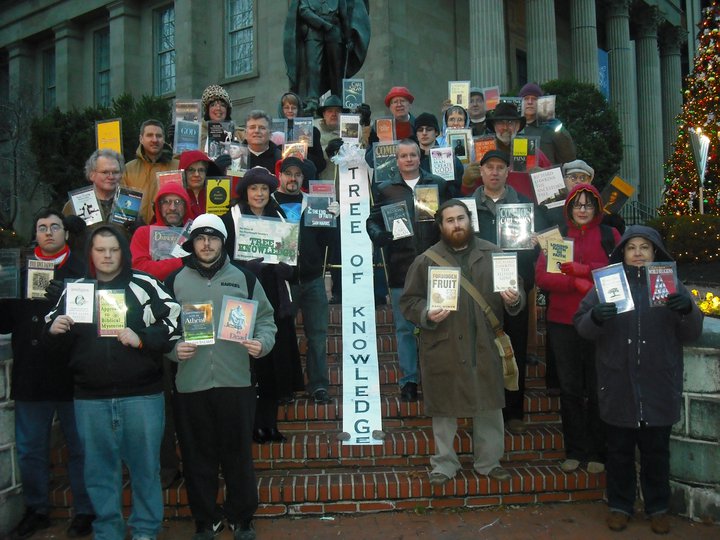
2010 Human Tree of Knowledge
But then in 2010, the Commissioners rejected the request to be included in the displays, and so Margaret got to work on an alternative plan; a human Tree of Knowledge, which doubled as a protest and momentary display. The same thing happened in 2011, and now in 2012 we are left in the same situation. The Commissioners still refuse to allow a Tree of Knowledge on the courthouse grounds, while still including the traditional Christmas and Hanukkah displays.
So, because of this continuing discrimination in West Chester, PA, Margaret Downey and many members and friends of the Freethought Society will be gathering on Saturday, December 1st 2012 in order to create a human Tree of Knowledge. The courthouse is in the middle of West Chester, at 2 High Street, and the event will start at 3:00 PM.
I plan on being there, and we would love to see as many people as possible come out to show your support for a great organization and to protest a discriminatory decision by the West Chester Commissioners.
I just made the mistake of perusing a few wordpress blogs which were tagged with politics. There were more than a few who were lamenting the death of America, the loss of freedom, and the inevitable decline of our civilization in general. We liberal, godless, perverts are going to ruin everything! Oh wait, I mean we are going to help and make it better, just not for them.
I know I am partisan here, but I cannot comprehend how stupid conservatives can be. Not all conservatives are stupid, obviously, but I cannot comprehend how people who lived through the last several years have these absurd views (you know, the kind I parodied 2 days ago) about how socialist and terrible Obama is. The fact is that he’s a moderate, a conservative Democrat, who takes pragmatic approaches to problems. Yes, he does support some idealistic things which I agree with, like gay marriage, but he’s really pretty moderate and takes evidence-based approaches to lots of issues. You know, the opposite of how the Republican Party has operated in recent decades.
I am hopeful that the conservatives whose butts are hurting right now, lamenting their slow but sure loss of socio-political control (often mixed with racism, misogyny, and many other effects of privilege), will become less and less prevalent in our culture in the next couple of decades. I’m hoping that the efforts of skeptics and other forces for progress will have a positive affect on our social, cultural, and political world. I am a bit skeptical, cynical even, that it will happen without lots of death-throws from the right, but it must happen if we are to survive and create a culture worthy of wanting to defend.
So, you Tea Partying, neo-con, far right theocracy/patriarchy toting morons out there, get over it and grow up. Your privilege has been showing )except for to yourself), and you need to get out of your mental cave. Your god is an illusion, your patriarchy is divisive and harmful, your misogyny hateful, and your traditions are often absurd and destructive.
I’ll be as clear as I can; you are on the losing side of history, and are hurting the world around you, including yourself.
So, here at the PolySkeptic Compound, we have been Obama supporters. Personally, I had a few issues with Obama over the last few years, but that was a necessary evil because we needed to wait for the right time. But now things are really going to change, and I would like to be the first to present to you what we, here at PolySkeptic.com, have been planning.
Now that Obama does not have to worry about getting re-elected, he will be able to pull out all the stops and stop pandering to the middle, and even to the mere ‘left’. It’s been quite hard for our secret godless cabal to plan the future without being caught, but let me be the one to tell you what is coming (I won the lottery at the last meeting, so I get to break the story, and details will follow over the next few weeks).
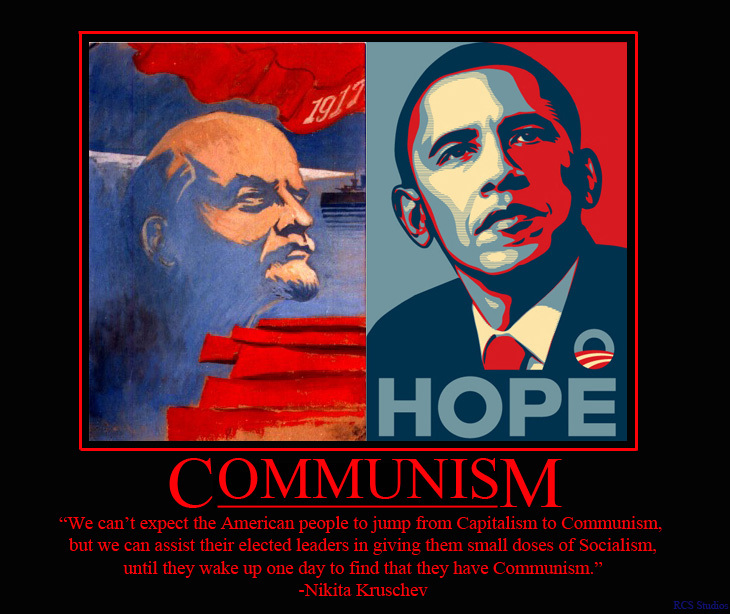
You see, for years the atheist movement has been working hard, behind the scenes, to build up a new political endeavor which will finally destroy god, freedom, and personal responsibility. We have been meeting with the Obama campaign, the Socialist party, Communist party, and some others who will come to light son enough, and just last night we received official confirmation from those close to Obama that we are finally ready to strike tonight, after Obama wins the election.
Over the next few months, Congress and the Judiciary will be weakened before Obama will be named the GREAT CZAR for life, and the great Marxist plot to take over the world will finally truly begin (after a few failed attempts, mind you). Within 6 months, we will officially be the Communist States of America (CSA), and the reckoning will follow.
We will finally unleash the goons on the churches of the land (but not the mosques, for they are actually secret atheist organizations, as Mohammad planned all along, unknown to the uninitiated) and destroy all things godly, and begin the new era of Muslim, atheist, communist dictatorship…I mean utopia.
All of those who have been fearing the loss of a free America, free markets, the 2nd Amendment, etc were right, and if they are smart they will take to the forests now where their stockpiles of weapons are stashed. Not that it will matter, because when we unleash the robot army, their weapons will be useless. With our mastery of Science, and all of the power and control that we can unleash with our mind-controlling chemicals in airplane chemtrails (all we need to do now is release the catalyst chemicals) and our re-education centers (some call it ‘brainwashing,’ but I find that crass), we will be unstoppable.
And the Tea Party and all the other right wing nut jobs who survive? They will be rounded up and forced to live in a new city (which we have built in secret) called Galt’s Gulch, where they will receive no help from the State, and will be left alone to be independent, responsible for themselves, and free to do whatever they want without regulation. They will not be allowed to leave the city, of course (because they wouldn’t like what is outside anyway, so why would they want to), but they should be happy in their free market, non-nanny state that they want so badly. They can be free to pursue wealth with shitty roads and infrastructure (with no taxes, how could they pay for them, right?), no regulation to protect them from sociopathic industry leaders, and all the stupid gods they can pray to for help.
A view from the nearly completed “Douchebag Tower” in Galt’s Gulch, location TBA soon!
Oh, it will be glorious here in the Communist States of America! No churches, praying finally outlawed, and freedom curtailed to keep everyone safe from things like guns, the 1%, and freedom. And best of all, we will force the few extremely wealthy people we allow to remain around to finance our easy lives of sitting around watching gay porn and having debaucherous parties, at least until they run out of money. And once they run out of money, we’ll send them into Galt’s Gulch to try and become wealthy again, and then raid the banks ofthat very city to re-finance our lifestyles without doing more than the minimal amount of work. Great Czar Barack Hussein Obama truly is a genius!
The future utopia will be just like Rome!
In the new CSA, gay marriage will not only be legal but you will have to, by law, marry someone of the same gender as you. And you must consummate that marriage at least once a month! And we will be watching, so you better do it because we’ll know if you don’t. But don’t worry, you will also be able to marry someone else, or like 15 other people if you like, and have your kinky three-ways and four-ways if that’s what you are into…which you better be! Monogamy will obviously be illegal, punishable by threat of being thrown into the orgy pit; the kinky, leather, bondage orgy pit where the safe words must be guessed, and change daily. Good luck!
We will all praise Darwin, PZ Myers (Freethought Blogs in general, actually, as their word is Truth, and always will be), and one other ‘saint’ (we will re-appropriate this word) of atheism of your choosing (from our approved list, of course), and you will have to give 6.66% of your social efforts (since money will be replaced by hugs, kisses, and hot, hot sex) to the great Science Altar where we will force children to be indoctrinated, I mean taught, about Evolution.
Concerning the Truth of Darwinism, we will all now capitalize Evolution and speak reverently, always, of Darwin. For these are the Great Words of reverence which will never be questioned. Creationists will be left in cages in public squares to be laughed at and there will be tomatoes present, if you feel the need to throw something at them. And you WILL feel compelled to throw things at them, if you love the Great Czar.
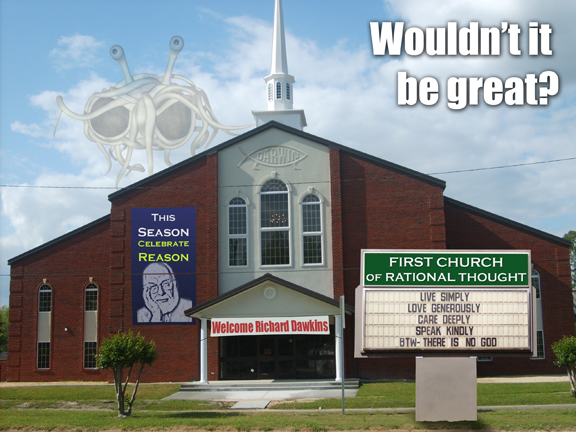
All churches will become this, or an orgy center.
Any praying, worshiping of gods, or even saying the word “Jesus” will be punishable by reprogramming at the Science Altar’s sister organization, the Ministry of Truth (AKA Pharyngula). There, we will decide what is true, so that you can know, and any other attempts at truth will become illegal. All Bibles will be burned, all crosses taken down, and all other religious symbols confiscated and destroyed along with all evidence that such a person as Jesus ever existed. Over time, Christianity will be forgotten, and Islam will be revealed as the atheist cult that it has been all this time. All the other religions? Well, they never seemed to matter much in American politics anyway, so who cares, right? They just better keep it that way.
So, tonight we celebrate the dawning of a new era, and the future belongs to the Great Czar Obama and his Communist State. This New Progress (as it may be called by herstory) has been brought to you by the Gay Agenda (thanks guys, you really gave 100%), Feminism (who taught me, personally, that being a real man is not really important), the Liberal Elite Media (ah, the LEMings! we really could not have done it without you!), and, of course, the Atheists for a New Socialist America (because we are the ‘ANSA’, amirite?), who have been working along side many atheist bloggers, groups, and even us here at PolySkeptic (this is why posting has been infrequent, recently; we were planning for the Obamapocalypse).
Thanks you all. And Obama bless America.
—-
[edit: This was all satire, based on stupid ideas that people have that Obama is a Communist/Socialist/Muslim, as well as ideas about atheists. For some people, a few people were not sure how serious I was. There’s your answer.]






 Skepticism, Properly Applied