Polyskeptic is about to OWN you!


LISA LING

edit; The show has been moved up to the 5th of March, rather than the 12th.

—-

We here at polyskeptic have been involved, over the last few months, with a project that will hit reality in just a few weeks.  Over a few days, separated by some weeks, there were cameras, a camera crew, and even a person whose name you might recognize–Lisa Ling–in our home in order to ask us questions about being polyamorous.  And so on Tuesday, March 12th 2013 at 10pm (EST), on Oprah Winfrey’s Network (OWN), our family will be one of three families featured in an episode of Our America, with Lisa Ling.

We have not written about this yet. In the beginning, it was because we were not allowed to do so, but now that the current season is in progress and the website has already given us a glimpse of what’s coming, I have decided that I can write about it, and have been putting it off for no good reason at all.  Some people close to us already know about it, and a few other people have contacted me (mostly through facebook) after seeing the TV ad for the coming season, which included most of our faces.

In the video below, if you pay attention at around 16 seconds and then 30 seconds, you may see some people you recognize:

Now, we have no way of knowing what kind of response we will get from friends and family or the polyamorous community itself.  We will have an opportunity to find out what some of the polyamorous community has to say right after it airs, as the weekend after it airs we will be in Atlanta for the Atlanta Poly Weekend conference March 15-17.  Whether we will be minor celebrities, run out of town with flaming torches and pitchforks, or merely treated as a few schmucks who were on TV once is yet to be seen.  My guess is that we will be world-famous, wealthy, and more awesome than we already are overnight.

I may be biased.

sleeping
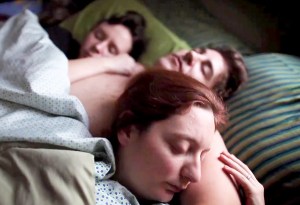
an image from the upcoming show?

I got a chance to meet Kamala Devi and Michael McClure from last year’s  Showtime series at the Poly Living Conference.  Robyn Trask, who is the head of Loving More and who I also got to meet last weekend,  will also be featured along with her family in the OWN documentary (along with a third family I know little about).  My recent experience in interacting with these people, as well as those around them at the conference, has made it clear how many polyamorous people appreciate the exposure of this lifestyle, as coming out as polyamorous can be a real concern for many people.  We, here at polyskeptic, have not hid our identities and now that we are about to be on television (even if only on a cable channel many people don’t watch) we will have little choice about being out to the world.  This privilege of ours is not universal, and for the same reasons atheists need to be out of the closet when they can, the same is true for polyamorous people.

I hope that you all watch, and I would be interested in feedback about the episode, which we have not seen yet.

Show: Our America: with Lisa Ling

Channel: Oprah Winfrey Network

Episode Title: “I Love You & You…& You” (4.8)

Air Date: Tuesday, March 5th, 2013

Time: 10/9c

Poly Living Conference this weekend and thoughts on atheist blogging


I really should be getting to sleep, considering I have work in the morning (11AM, but that’s still morning!), but before I do I wanted to post a few thoughts.

Thought #1: I’m going to my first poly conference this weekend, the Poly Living Conference which is in Philadelphia this year.

I’m planning on taking ample notes, talking to many people, and trying to get a sense of the state of skepticism within the polyamorous community, you know because I’ll be speaking about that in about 5-and-a-half weeks at the Atlanta Poly Weekend Conference.

Centered around this upcoming weekend is some amount of anxiety, because despite a recent comment on this blog, I don’t see a lot of overlap of skepticism and polyamory (especially among those at Loving More, who are running this weekend’s conference).  Now, I know some of the people at the Atlanta conference next month are skeptics and atheists, but I am not sure about the people at the conference this weekend, the keynote speaker of which is Kamala Devi (from the recent Showtime series), a person who seems to be pretty into the woo side of things [Feb 10 2013 edit: my preconceptions here ended up not being fair or true.  I hold Kamala in high regard after having met her this past weekend, and apologize for the prejudice], including tantra. (information about the speakers can be found here).

I’m anxious because I am interested in the conversation about skepticism in light of sexuality, relationships, etc and want to talk with people about it, but in my experience those on the liberal side of religion, who call themselves spiritual, or who are pagan, tend to be pretty sensitive about criticism in general, and I don’t wish to make the conversation impossible by, well, being myself.

I’m anxious because I really don’t want to dislike the polyamorous community, and in some of my experience I have been rather disappointed in polyamorous people when it comes to skeptical thinking.

Though#2: I’m not sure about atheist blogging, sometimes.

There are some wonderful blogs which are primarily about atheism and skepticism, despite the various splits and interpersonal issues that have surfaced in the last few years.  But there are some atheist writers who are still plugging away at the atheism 101 topics, addressing the same old topics that we were all plugging away at back in 2005 or so when this new atheist thing became all the rage.

And there many still be a reason for them to be doing so, because so many still don’t understand this basic stuff, but as a long-experienced atheist activist, writer, etc I find it pretty boring.  Those blogs are not for me anymore and I am less interested in addressing the same issues as I did like 8-10 years ago.  I think that we should still have those resources available for those interested in those basic questions, but I think that we all need to keep our eyes on the larger prize: an intelligent, informed, skeptical world that tries to address injustice wherever it lives.

Others have moved on to try and not only grow the community, but make it better.  By trying to broaden the scope of skepticism and atheist activism, many writers and activists have started to realize that’s it’s not just about being an atheist (which is great, don’t get me wrong), but about helping create better skeptics all around.  I will continue to write about atheism in this sense (and possibly, occasionally, in the other sense), and try to make a world where tehre are mature, aware, and quality atheists; not merely atheists.

Those are my thoughts for the night.

Naked Skepticism and the new polynormativity


One of my motivations for writing this blog is a general sense that there is an important issue which needs to be addressed by, well, all of us.  Our culture does not have a healthy view about sex and relationships.  The mainstream view is not ideal, even where aspects of non-mnogamy and kink enter into it.  50 Shades of Grey; need I say more? And where polyamory gets introduced to the mainstream (and I will be writing more about that in the next week or so), it is portrayed in the light least offensive to that mainstream, much like how accommodationists present atheism to the mainstream.

Atheists tends not to be polyamorous, poly people tend not to be atheists, and skeptics just aren’t implementing their tools at all they should be.  Philosophically, I primarily identify as a skeptic.  But for similar reasons as PZ Myers (link above) and Jen McCreight have trouble with the skeptic community, I identify first as an atheist because I prefer the way that the new atheists have addressed religion in our culture.  I think something similar needs to be done for polyamory.  Let’s called it the new polyamory, or perhaps something less awkward.

In essence, we need to talk about sex.  Oh, and relationships, desires, social expectations, etc.  We need, in short, to apply skepticism to how we think about such things, and I think if we do so then polyamory will be much more prevalent, because I think that polyamory (or at least accidental monogamy through polyamory) will be the result if we do apply skepticism to our sexual and romantic lives.

I have said that skepticism, properly applied, necessarily leads to atheism.  With polyamory, I am willing to say something similar.  Skepticism, properly applied, leads to a new paradigm of relationships, including sex-positivity and the non-default status of monoamory.  If we think critically, as a culture, about relationships, we should arrive at a place very much like the polyamorous world (only better, because their skeptics too).


Naked Skepticism

A good skeptic learns to strip away, as much as cognitively possible, the assumptions and biases which lead us towards irrational conclusions.  Nobody can do it completely, but it should be a goal for all of us to aspire to; deconstructing the worldviews we hold about all of the important aspects of our lives.  Skepticism implies that we require sufficient* evidence in order to believe something.  Something which is merely logically possible cannot be said, reasonably, to be true on those merits alone.   Rather, there should be some empirical evidence in order to lend weight to a proposition.  The proposition that a “god” exists, for example, does not survive this test and so any skeptic worth their salt should not accept the proposition that a god exists until good evidence presents itself (I know of none), and therefore a skeptic should be an atheist.

But more than that, a skeptic should be willing to strip away their assumptions, the foundations to their worldview, as much as they can.  Why do we seek one romantic partner? Why is monogamy the goal? Why is sex often considered dirty, or at least somehow less than pure? Why don’t we start with the bare facts of our desires?

Part of the reason is related to religion, especially when it is tied to traditional gender roles and such, but that is only part of the answer.  Religion is a symptom of this problem, in most cases, and the fundamental problem is the tendency towards jealousy, sex negativity, and perhaps some evolutionary psychological reasons having to do with things such as men wanting to make sure that our children are really theirs, and not those of the mailman (but evolutionary psychology is less reliable, in many cases).  Traditional family values, conservatism, and patriarchy, in other words, are at fault.

So, what can we do about it? We can start by asking ourselves questions like

1) what do we really want sexually and in terms of relationships in general?

2) what are we afraid of, jealous of, and why?

3) what do the people in our lives want?

But in order to get there, we need to strip away the layers of moral, cultural, and often religious thinking about these issues.  We need to be able to apply the best that skepticism, science, and soul searching has to offer us.  We need to challenge assumptions and apply skepticism to our relationships with people, but first we need to apply them to our own worldview so that we can be sure that the answers we give are actually true answers.


Towards a new polynormativity

Recently, the Sex Geek wrote an interesting post called the problem with polynormativity, which is well worth the read.  And while I thought that the post was good and made some excellent points, I think it missed an opportunity; one I wish to tackle here.  The post in question addresses how polyamory is depicted in the media and to the mainstream in general.  The Sex Geek says this:

The problem—and it’s hardly surprising—is that the form of poly that’s getting by far the most airtime is the one that’s as similar to traditional monogamy as possible, because that’s the least threatening to the dominant social order.

This is undoubtedly true.  In my experience with the media, I have noticed that the questions, framing, etc seem to imply a couple-centered view which misses much of the point.  The Sex Geek addresses this and more quite well, so I will encourage you to read the whole post.  So, after that brief thesis, the post continues and eventually goes on to list four norms that make up “polynormativity,” which I will simply list and hope that you will read the full post for the full effect.

1. Polyamory starts with a couple.

2. Polyamory is hierarchical.

3. Polyamory requires a lot of rules.

4. Polyamory is heterosexual(-ish). Also, cute and young and white. Also new and exciting and sexy!

The observations therein are good, and I am in general agreement, but where I think Sex Geek dropped the ball was the opportunity to define what polynormativity could be, rather than what it is.  Because what we are faced with in our Western culture is a hetero-monamorous-normality which is not particularly healthy for many of us, although many manage to tweak it enough to work for them.  And that’s part of the problem.  We are often forced to tweak a set of values about sex and relationships which do not match up with our desires, but which seem ubiquitous, rather than throw out the framework altogether.

So, if we were to claim the term polynormativity to mean something other than a tweaked hetero-normativity, what would it look like? Well, allow me the boldness to try and sketch out a few pieces of that potential puzzle.

1.  Polynormativity would be sex positive. Sex would be what we wanted it to be.  It would be fun, it would be recreational, and it would not be restricted to just our serious partners (hell, if we wanted we could be non-sexual with our serious partners and slut up the rest of the town!).  We would not be ashamed about our desires, we would seek to satisfy them consensually (and hopefully enthusiastically), and we would be transparent about it.  It wouldn’t quite be Brave New World (which was refreshing to read because it turned our current model on it’s head, even if that is not our goal here), but it would erase the idea that sex is reserved for just one person, or one person at a time, and even that it’s not OK to have with friends.

2.  Relationships would be agreed upon.  All relationships structures should occur through overt agreement, or possibly organic growth from actual needs, and not by default or assumption.  Currently, for mainstream society relationships may not start as exclusive, but they tend to assume the default ideal goal of monoamory, often monogamy.  Dating is not assumed, at least in cosmopolitan culture, to be exclusive by many of us young people (especially those even younger than I am).  But the goal for most people is to find one person to make a “commitment,” as if commitment ever necessarily implied exclusivity.  The idea currently is that real love, a relationship of real depth and meaning, must be an exclusive club.  You may be able to have two lovers, but you can’t truly be serious with more than one at a time, because we rationalize our jealousy into a culture of possessiveness through the Disney-esque romanticism of the princess and her prince.

*barf*

3) We would start with our desires, and build up our relationships upon them.  All too often, we fit our desires into the mold of our relationships, rather than the other way around.  We may really like that person we met at the party, but we have a relationship already so that desire either gets suppressed or we act on it surreptitiously.    We decide that a desire, whether it be homosexual, non-monogamous, or kinky in nature, is not acceptable to our lifestyle, so we grin and go along with the status quo.  How many people are in the closet, either as homosexual or bisexual? How many people repress desires for people they care about because they are in a relationship? How many people have fantasies they never explore because they think it is wrong, dirty, or it might make people judge them as a ‘pervert’?

What the hell is wrong with being a pervert? So what if someone gets of on being tickled? Who cares if what Bob really wants is to get peed on? Why do you care if what I want for my birthday is to have hot sex with two or three beautiful women after drinking some fine Belgian ale? (I’m really not that kinky, am I?) We need to have the strength to admit what we really want, and try and find ways to have it if it’s possible (and moral.  If your kink is to murder people, well you might be out of luck).

If we were to follow basic guidelines such as those three above (and the list is not intended to be comprehensive or exhaustive), then I think that most people would land on something like polyamory, assuming they are willing to do the work it takes to maintain the relationships they want.  And the more people that do it the less weird it becomes, and people can stop using the excuse that they don’t want people to find out because it’s weird and they might lose their job or someshit.  If everyone’s doing it, it become the new normal—hence the new polynormativity!

Love each person as you actually love them.  No less and no more.

I’m ready for it.  Are you?

—-

*And what is sufficient will depend on many factors, which go beyond the scope of this post.  But I’ve always liked the maxim that extraordinary claims require extraordinary evidence.  That is, the strength of your evidence should be proportional to the audacity of your claim.  Of course, what is audacious to one may not be so audacious to another, leading to a spiral which I choose not to follow at present, mostly to maintain my sanity.

Where philosophical differences turn into meta-debates about personalities


This, ladies and gentlemen, will be a rant of sorts.  I’m not happy with humanity today, and it’s my own damned fault for reading blogs!

So, I’m a feminist of a specific kind.  I have evolving but ideologically-leaning views about the relationship between gender, history, and culture.  I think there are things that we should be focused on as a society to improve the world related to those feminist ideas.  I think that we need to become familiar with concepts which will be consciousness-raising and will shift our perspectives on how to behave.

The details of what specific kind of feminist I am, what ideologies I prefer, and what changes in perspectives we should work towards are almost not worth explaining, because all I have to say is that I read Freethought Blogs and Skepchick and I agree with them more often than not.  I think Greta Christina is an excellent advocate for both atheism and feminism.  I think Rebecca Watson had something to teach me in talking about a guy in an elevator.  I miss Jen McCreight’s contributions to the conversation.  I have learned lots about race and privilege from Ian Cromwell.  I think PZ Myers is witty, intelligent, and sometimes wrong (actually, he’s mostly right there).

So, now you know where I stand right?

Here’s the thing.  If you read any blogs who have a dog in this fight  (you know, the fight about the role of feminism, if any, in the atheist/skeptic community) then you will either think that Rebecca Watson, PZ Myers, etc are generally right and are fighting for a worthy cause within the community or you will think they are bullies (FtBullies, if you would) who have a view based upon “garbage feminist scholarship” and who are creating a division in the community with their, well, bullying and such.  Some, such as my good friend Staks, have given up reading any FtB posts at all.  I think he’s missing out on a lot by doing so, and I’m not sure if he will change his mind.

It has gotten so bad that I am not even sure what the philosophical differences are, most of the time.  Most of the posts I see now are not substantive philosophical critiques of a point of view, they are an attack on the other side.  This has become a polarized, party-line division, much like what exists in politics.

And this is no surprise to me.  Tribal mentalities exist in all communities, so the fact that this happens in the atheist community is to be expected.  I would like skeptics to be better, but I’m too cynical to really believe that will happen even among those who should, ideally, know better.  Humans are emotional and irrational (which they then rationalize, in most cases), so all I can do is be both frustrated and amused at it all.

Take this post by Maria Maltseva called A World Without Dogma.  it starts off OK, but then you immediately see that PZ Myers, Rebecca Watson, and Richard Carrier are all Marxist feminists who may endanger us with their terrible Marxist ways.  I really thought I had run into a Republican blog by accident, for a moment there.

The arguments there are straw men.  There is no attempt to take seriously the problem of how to address feminism as a skeptic (and yes, I know there are people who do take this issue seriously from some of them I also read), but rather the point is to show how untrustworthy, unskeptical, and how bad the other side is.

And yes, some at Freethought Blogs do the same thing, and I will admit that I am less annoyed when I agree with the one doing the mocking than when I disagree, even though I also do get annoyed, occasionally, by some I agree with (especially Amanda Marcotte, who I agree with more often than not but I find her writing to be abrasive, so I don’t generally read her stuff anymore, except in rare cases).

—-

So, let’s spell it out; there are people on both sides of this issue being snarky, using mockery, and who dislike each other greatly.  I want to see people who are able to see that snark and let it roll off of them.  I don’t want the emotion, passion, and even humor to go away, I want it to be waved off and for us to be able to actually have a substantive discussion about things like feminism without it turning into politics as usual. I want people to be able to hear mockery, snark, etc and let it roll off them and pay attention to the message, but often there is little actual message to sink one’s teeth into.

Yes, some people I will talk to will be wrong (painfully wrong), but can’t we drop the meta-debate? Can’t we stop talking about elevatorgate and talk about the philosophical disagreements which underlie why elevatorgate was such a big deal? Can’t we address privilege, safe spaces, and the concerns that men have all while we recognize that understanding the perspective of others is part of the process of making it all better for all of us?

I know I’m biased, but I think that is precisely what people such as Greta Christina have been doing.  I want a world where the complaints that men have with our culture are solved. I want a world where the complaints that women have about our culture are solved.  I want a world where tribalism and petty interpersonal squabbling don’t dominate philosophical debate.  Mostly what I see now is that PZ Myers and Thunderf00t don’t like each other anymore, Rebecca Watson is (supposedly) an ugly bitch, and my view of feminism is a totalitarian dictatorship in the making.

I want to put aside petty interpersonal squabbles, platitudes, and deal with real issues.  But I won’t get what I want;  the battle-lines will be drawn more vividly and I will be forced to be a combatant even if I try and avoid perpetuating the divisions.  And the effect of this is that I will inevitably become further removed from any real dialogue between people on different sides of this issue.  I will have less exposure to views different from mine, despite my desire to understand their point of view, because the conversation will become meta-, rather than substantive.

I can try to keep it away from here, but the simple fact is that I do think that one side of this debate is mostly right.  It’s just like PZ Myers said some time back, compromise with crazy is half-way to crazy town.  I think that FtB, despite some of their poor behavior from time to time, is mostly right, and I find Maria Maltseva mostly wrong, but still worth listening to in case something good comes through.

Not saying so would be inauthentic, so I will be placed on one side of the battle lines, and when I take a step across to try and understand, I will be shot at because I’m perceived to be wearing the uniform of the person seen as the leader on my “side.”

It’s absurd.  I’m interested in the truth, if such a thing exists, and I will hope that these stupid squabbles evaporate into a truly skeptical conversation.


On Feminism… Are We Talking Past Each Other?


Editorial Note: This post was written by Wes Fenza, long before the falling out of our previous quint household and the subsequent illumination of his abusive behavior, sexual assault of several women, and removal from the Polyamory Leadership Network and banning from at least one conference. I have left Wes’ posts  here because I don’t believe it’s meaningful to simply remove them. You cannot remove the truth by hiding it; Wes and I used to collaborate, and his thoughts will remain here, with this notice attached.

—–


Thanks to Shaun’s latest post (and a couple links he posted on Facebook), I’ve spent the past two days reading feminist articles, critiques of those feminist articles, and critiques of the critiques. I’ve been reading Skepchick, Greta Christina, PZ Myers, Jen McCreight (when she was blogging), and other feminist-friendly atheists for years. What I haven’t been reading are the people at Skeptic Ink or any other major criticism of the Skepchick/FTB-style feminism. The blog that Shaun linked on FB (not approvingly) was Skeptically Left, written by a woman who, to put it mildly, takes some issue with the kind of feminism that is practiced at FTB & Skepchick. One of the first posts I noticed was this one, where Maria Maltseva, the author, takes a collection of words, and gives them the definitions that are used in “certain darker parts of the internet.” A sample:

Feminism — A dogmatic stance on women’s issues promulgated by the likes of PZ Myers, who is notably not a woman.
Misogynist — Someone who disagrees with a feminist. See definition of feminism above. A vile human being.
Rape Enabler — Someone who disagrees with a feminist. See definition of feminism above. A vile human being.
Rape — Consensual sex with a woman after she’s been drinking. Also, actual rape.
Patriarchy — A nebulous conspiracy-like entity responsible for oppression of women in Western society.
Oppression — Being born with a vagina, even if you’re treated like a queen and allowed all the same opportunities as men.
Victim Blaming — The suggestion that women have some degree of control over their own behavior.
Slut Shaming — Pointing out that suggestive attire, inappropriate nudity, and sexual behavior are likely to get attention.
Rapist — Any man who’s had sex. Also any man who hasn’t. Synonym: man.
Rape Culture — A culture that glorifies rape. The one we live in. The same one that makes (actual) rape a criminal act.
Privilege — Something you say to get another party to shut up when you have no real argument, because clearly human beings are incapable of empathy. Existence of actual or even group privilege is irrelevant.

(sigh). I have some sympathy for the victims of unfair attacks at the hands of quick-to-anger feminists, especially at FTB & Skepchick. I too have had the word “privilege” used as a bludgeon to suggest that any opinion I have on a topic that concerns a marginalized group is completely worthless and irrelevant. I have been labeled a misogynist for having the audacity to voice a minor disagreement with a popular feminist. I’ve been decried as a troll and been accused of “JAQ-ing off” for asking sincere questions about a feminist position that I don’t understand. And in none of those situations did anyone come to my defense, so I understand how someone can be upset with the community. But come on, this crap is ridiculous. These definitions are ridiculous caricatures of complicated and nuanced issues, and surrender the moral high ground before the discussion is even started. I think contemporary feminism could use some strong criticism in certain circumstances, but juvenile bullshit like this is just flame warring.

Yesterday, Shaun described a post by Libby Anne at Patheos as “recommended reading.” Libby Anne’s post is a critique of a post by vjack at Atheist Revolution. I was not as happy as Shaun with Libby Anne’s post. The whole post was one big straw man.

vjack’s post was about some people’s hesitancy to identify as feminists, and posited that it was because “feminist” means different things to different people. While many people may be feminists under one interpretation, they may not be under another interpretation, and people don’t want to be associated with the more extreme factions. So far so good. Most of the feminists I know (including me) specifically disavow radical feminism, and specifically its shameful treatment of trans* people. vjack offers the following definitions:

In a nutshell, equity feminism refers to a focus on the goal of social and legal equality. That is, equity feminists believe that women and men should have the same rights, be paid the same for the same work, have access to the same opportunities, etc. They are advocates of equality, and I wholeheartedly embrace this form of feminism. Women deserve equality, and none of us should settle for anything less.

Gender feminism is very different. It looks far less egalitarian, involves sharp criticism of gender roles, and seems to emphasize victimhood. There are aspects of gender feminism with which I agree (e.g., the manner in which patriarchy can be harmful to both women and men, the critique of traditional gender roles), but I do not support the entirety of gender feminism.

So, clearly, those definitions are crap. Aside from the obvious bias of the author, I’ve read them several times now and I still have no idea what “gender feminism” is. As Libby Anne note, vjack did not invent the terms, and followed one of the links vjack provided to this post by Barry X. Kuhle, an evolutionary psychologist. Libby Anne provided the following quote:

What is feminism other than the belief in the social, political, and economic equality of the sexes? Regrettably to feminists like myself, far too many other feminists believe that being one means believing in far more than equality for women. These “gender feminists” cling to an ideologically driven, theoretically unsound, and empirically unsupported perspective on the origin and development of sex differences (Kuhle, 2012). To paraphrase New Jersey philosopher J. B. Jovi, they give feminism a bad name. In so doing, they have discouraged women and men who support sexual equality from self-identifying as feminists. … The reluctance most women and men have to embrace the feminist label in the absence of a definitional nudge is due in no small part to gender feminists’ untenable position on sex differences.

As an evolutionary psychologist, I believe that much light can be shed on psychology by considering how the information-processing mechanisms underlying our thoughts, feelings, and behaviors affected our ancestors’ abilities to survive and reproduce. As an “equity feminist” (Sommers, 1994), I believe that women should have the full civil and social equalities that are afforded men. Equity feminism has no a priori stance on the origin or existence of differences between the sexes; it is solely a sociopolitical desire for men’s and women’s legal and social equality. Defined in these ways, there is no rational reason why one cannot be both an evolutionary psychologist and a feminist.

Gender feminism is an alternative version of feminism and is the dominant feminist voice in academia (Sommers, 1994) and online (e.g., Jezebel.com). And boy (er, I mean girl, er, I mean womyn) do they take issue with feminism being compatible with evolutionary psychology. They ardently argue that psychological differences between the sexes have little or nothing to do with evolution, but instead are largely or solely socially constructed (Pinker, 2002; Sommers, 1994). Whereas equity feminism “makes no commitment regarding open empirical issues in psychology or biology… gender feminism is an empirical doctrine” committed to several unsubstantiated claims about human nature, especially that of the psychological blank slate where sex differences are concerned (Pinker, 2002, p. 341).

Now, Kuhle seems like kind of a windbag, but I can’t point to anything factually inaccurate with his statements, other than that he seems to be doing an awful lot of generalizing based on relatively few citations. Libby Anne, however, finds a lot more of an issue:

In other words, Kuhle argues that there are significant natural and inherent differences between men and women, so while we should support equality of opportunity, we shouldn’t wonder when men and women make different life choices, pursue different careers paths, act in different ways, or value different things. Thus Kuhle appears to be arguing that men and women can be equal even if they, as a result of their evolutionary background, carry out vastly different roles in life.

Excuse me? Did we read the same quote? Kuhle never says “there are significant natural and inherent differences between men and women.” Kuhle merely says that it’s an “open empirical issue.” Kuhle doesn’t say that the idea that the sexes are psychologically identical is incorrect, he just says that it’s unsubstantiated, which is true. The psychological community has reached no consensus on the topic, and there is substantial evidence to suggest that the sexes have genetic psychological differences. Furthermore, Kuhle most certainly does not extrapolate from this that “we shouldn’t wonder when men and women make different life choices, pursue different careers paths, act in different ways, or value different things.” Later in his post (and not quoted by Libby Anne), Kuhle says the opposite:

The first misunderstanding, the myth of immutability, is evidenced when one erroneously concludes that “if it’s evolutionary, then we can’t change it.” As has been discussed at length elsewhere, evolutionary psychology does not view human behavior as impervious to change. In fact, evolutionary psychologists have cogently argued that knowledge of the informational inputs to evolved psychological mechanisms is a crucial first step toward changing the behavioral output of these mechanisms (Buss, 1996; Buss, 2012; Confer et al., 2010; DeKay & Buss, 1992; Geher, 2006).

The second pervasive misunderstanding is the naturalistic fallacy, which rears its illogical head when one concludes that “if it’s evolutionary and hence natural, then it’s okay and hence good.” Numerous evolutionary psychologists have unpacked the mistaken inference that if something is the case then it ought to be the case (Buss, 2003; Geher, 2006; Pinker, 2002).

Evolutionary psychology does not excuse, justify, or rationalize any human’s thoughts, feelings, or actions (Buss, 1996; Geher, 2006). It merely seeks to discover and detail the design of the information-processing mechanisms that underlie our psychology. If some women have been subjugated because they were regarded as different than and inferior to men and some men have excused their misogynistic behavior as being an inevitable consequence of their genes, then a reluctance to embrace a discipline which viewed such pernicious behavior as immutable and excusable would be understandable. But evolutionary psychology is not that discipline (Buss, 1996).

Kuhle may be an asshole, and by the tone of his post, he probably is, but he’s not arguing that women belong in the kitchen. Later in her post, Libby Anne quotes Harriet Hall as saying:

I think it is unreasonable to expect that equal numbers of men and women will be attracted to every sphere of human endeavor. Science has shown that real differences exist. We should level the playing field and ensure there are no preventable obstacles, then let the chips fall where they may.

Libby Anne’s followup:

Kuhle made this same argument in his article when he argued that there are natural differences between men and women and derided the idea that gender roles are socially constructed. Kuhle’s line of reasoning is why some people argue that it’s only natural that the vast majority of engineers are men and that the the fast majority of stay at home parents are women. Men are just better at spacial reasoning, after all, and women are perfectly evolved to care for children!

Again, nobody said that! Kuhle never “derided the idea that gender roles are socially constructed.” And he certainly never suggested that men evolved to be better engineers and women evolved to care for children. It is not “Kuhle’s line of reasoning” that leads to this attitude – it’s unscientific sexism. Kuhle never makes any such suggestion anywhere in his article, and to say that it’s his “line of reasoning” is ridiculous. It’s the laziest kind of slippery slope argument.

Libby Anne spends the rest of her post listing the various evils of assuming that our current gender roles are natural. It’s a good rundown, and would be a good argument against anyone who actually argues the opposite. However, the remainder of the post continuously implies that it is an argument against people like vjack and Kuhle. Libby Anne ironically closes with the following:

it’s critically important to find ways to communicate with those who may not fully agree with us, and listening to each other and trying to understand each other’s perspectives is crucial.

I agree. I hope Libby Anne will make more of an effort to do so next time, before putting words in people’s mouths. Chris Hallquist, of The Uncredible Hallq commented, echoing my concerns:

I’ve read the Kuhle article, and you seem to be reading a lot into it that isn’t there. In particular, [it] can be true that there are some innate psychological differences between men and women and at the same time think the male domination of many fields might be cultural.

Ed Clint, for example, has defended evolutionary psychology (including claims of innate psychological differences between men and women) against its detractors, but has also argued for having 50% women among speakers at skeptic conferences, for the sake of breaking the (possibly? very likely?) self-perpetuating maleness of skepticism.

No response from the OP. Both writers, Libby Anne and Maria Malseva, seem to be ignoring the actual words of the people that they are criticizing. While Libby Anne’s writing is seemingly from a much more conciliatory place, both posts unfairly lampoon their subjects and ignore what they are actually saying. It’s no way to start a dialogue, and it’s certainly no way to reconcile.

We can do better.

Quiet and Afraid


Depending on my mood, I can be rather outgoing and gregarious, or I can be quite and shy.  Especially around people I do not know well, I tend towards shyness.  But I don’t want to be shy.  I want to be warm, engaging, and have interesting and revealing discussions with people. But I rarely do.

I think about why this is the case quite often.  And, depending on my emotional state, my feelings vary.  That is, my rationalizations for my fear of speaking up shift with my mood.  So, today I want to compose two related, but emotionally distinct, reactions to being shy while not wanting to be shy.  I don’t know if any of this will resonate with anyone else, but perhaps it will.  These are the kinds of thoughts I have while battling within myself whether to contribute to conversations, especially if they relate to religion, relationships, etc, in mixed company.

Narrative 1: You will hate me.

I overheard something you just said, and I think that the worldview you seem to come from is misguided, and if I told you what I thought you would find me distasteful and you would rather not talk with me (most likely).  If I talked with you about the topic you are currently engaged in conversation about, the dialog would become awkward and you would wish I would have not said anything.  Thus, I should remain quiet because otherwise you would hate me, and I would just be wasting my time  bringing up my views on your topic of conversation.

This is often followed with a false feeling of superiority; I feel somehow better, more evolved, and I pity those around me.  This feeling is often then followed by the sensation that such thoughts and feelings are a defense mechanism, because I’m afraid that my own worldview is misguided and inferior.  This sometimes leads to the second, but intimately related, narrative.

Narrative 2: I hate me

Man, I really should stay quiet.  These people might be wrong, but my thoughts are just fueled by anger (fear) and I would be better not making an ass out of myself.  It really does not matter how much I have thought this through or how certain I feel right now, because all of that confidence is an illusion.  My ideas are not interesting, my point of view not insightful, and my false pity for them is not warranted.  I wonder if they have these kinds of thoughts too.  I wonder ow strong they doubt themselves….

And this trails off into unrelated or merely tangential thoughts about all sorts of things.

But then, usually later (like right now) I think about the fact that I perceive a sort of mainstream set of cultural expectations and views which I often think I can see through, and then these sets of insecurities play out at a meta-level.  I think things like:

1) Is there actually a set of cultural narratives which I understand and see through (even if only partially)?

2) Can most people really not see it, or do they see it and either don’t care or understand it better than I do?

3) If those narratives do exist, and I can see them better than some people, is it something which I can explain to those people or do they have to either discover themselves or be perpetually blind to it?

The basic fear that informs my silence, at least as it is rationalized, is whether I am actually seeing something which is real, or whether I’m perceiving a delusion.  Do I understand something about human behavior which is real and invisible to most people, or am I creating that narrative to explain the fundamental fear which is the real reason I remain so quiet?

The thought that seems most awful, thus I suspect it is at least partially true, is that the narrative I perceive is real, but I’m just afraid.  It’s not that I’m really concerned with annoying people or being seen as idiotic (although those feelings seem real enough), it’s that I’m just afraid.  Not afraid of anything in particular, mind you.  Just afraid.

And then I have to explain why I’m afraid, which doesn’t help it go away.

It is a perpetual and strangely comfortable sensation, fear. I am almost afraid to not be impeded by it.  I’m not sure what I would be like if that fear disappeared.

To those that read is blog, I may not seem afraid to speak my mind. But that is only when the first narrative, above, dominates.  All too often the second narrative dominates, and I am left quiet and unsure of myself.

That’s enough honesty for right now.  So now I commit my fears to the internet, were they shall never be forgotten.  Great…now I cannot pretend they don’t exist….

American Politics, old and new.


Here is a quote from John Ferling’s Adams vs. Jefferson, page 153-154:

The Federalists also fixated on Jefferson’s religious beliefs, maligning him as an atheist.  This was grounded on what Jefferson had written in Notes on the State of Virginia, drafted in 1782 and first published in the United States in 1788.  Jefferson had lauded the Virginia Declaration of rights of 1776, which provided for religious toleration, but, wishing to go further—he hoped for a law that would separate church and state—Jefferson had dilated on the “rights of conscience,” about which individuals were “answerable [only] to…our God” and never to the state. He then added  that “it does me no injury for my neighbor to say there are twenty gods, or no God. It neither picks my pocket or breaks my leg.” These two sentences were reprinted endlessly in Federalist newspapers as proof of Jefferson’s impiety.  In addition, Federalist scribes cautioned that Jefferson viewed the clergy as “curses in a country.” Primarily, however, they depicted him as a “howling atheist” and “infidel.”  Filled with contempt for Christ, Jefferson supposedly embodied iniquities that would bring on the moral decline of the United States.  In New England people were told to hide their Bibles should Jefferson be elected, and the warning went out that his election would call down God’s vengeance on the United States.Though more from the pulpit than the press, lurid tales were told of bizarre worship services at Monticello at which Jefferson supposedly prayed to the Goddess of Reason and offered up dogs on a sacrificial altar.  One Federalist newspaper advised its readers to vote for “GOD—AND A RELIGIOUS PRESIDENT or impiously declare for JEFFERSON–AND NO GOD.”

How many current cultural tropes did you notice there?

Thomas Jefferson, never self-identified as an atheist, as far as I know.  The conflation of religious tolerance and freedom with repression felt by the dominant religion was as real then as it is now.  We are not dealing with anything new, in talking about this religious privilege and the association with separation of church and state with impiety and even lack of patriotism.

There are simply some people, whether in 1800 or 2013, who simply cannot see that asking for religious neutrality from our government is a good idea.  Those that declare the United States to be a Christian nation have the precedence of idiots from the 18th century who did not grasp the importance of said separation then, and who wanted a Christian president rather than a supposedly godless president.  And those who see the legal foundations of the United States as secular, as its founding documents state, have the precedence of people like Jefferson and Madison on their side.  It’s not simply that we were a secular nation and people forgot, it’s that some people simply could not grasp it at the time, and that tradition seems to have run parallel to the actual law and history.

In short, there are always idiots in society, and it may be the case that they will never go away.  One of the weaknesses of democracy is that those idiots also get to vote, and thus we have Michel Bachmann and Rick Perry.

An unchallenged value is not worth much; or why your values might be wrong


In recent weeks, I have been thinking a lot about the question of the relativity of values.  What do we value? Why do we value those things rather than other things? Might we be more content, happy, or more mature if we were to value other things? Can we change what we value? What the hell are “values”?

Today, I want to sketch out a rough analogy which may pave the road for future posts (or not, if the analogy breaks down or if it just ends up being a stupid idea).

[Also, apparently I was thinking about this last December.]


The Analogy of Tastes and Values

In order for our bodies to function, we need to eat food.  But the kind of food we eat, how much of it we eat, and how often we eat it will have an effect on the efficiency of that functioning, the body such a diet will maintain, and will effect our general mood and ability to accomplish various tasks.

In order for our brain to function as a contributor to our personality as part of a social landscape, it needs information.  The kind of information it receives (especially early in its development) and how (and how often) we exercise it will influence what kind of mind we have.  It will effect how we react to new or old information, what we believe about the world, and what we value.

In terms of our diet and our health, what we want to eat (both what we merely desire and what we think we should eat) is our set of tastes.

In terms of our worldview and moral inclinations, what we think and feel (both what we are inclined to and what we think we should believe and think right) is our set of values.


Desires and Wants

I want to make clear the distinction between what we unwillfully desire and what we want.  If I see a piece of chocolate (especially dark chocolate), I desire it.  My mind is inclined towards eating it, and it is by act of will (free or not) that I either eat it or I do not.  My set of beliefs, values, etc will be responsible for that decision.

In terms of values, there is also a difference between my unconscious, automatic reaction to information and my conscious deliberation about information with emotional content.  It is unconscious and automatic that I feel annoyance, even disgust, when seeing an obvious injustice perpetrated by someone against others (an unequal set of behaviors based upon a logical contradiction, for example; a violation of Kant’s categorical imperative as one rationalized example).  But there is a difference between that feeling of annoyance or disgust and my subsequent deliberation about that behavior.  I, for example, have a visceral feeling of annoyance, sometimes leaning on anger, at seeing some level of clutter (especially if ignored for some time).  But rather than start Hulk-smashing (which just creates more clutter) I take a deep breath and remind myself that this anger is not rational;  that I can either clean it, ask the person responsible to be aware of this emotional response I have and request they clean it, or I can distract myself with another task or activity (and hope it will be remedied in the mean time).

That is, what I desire to do when seeing clutter is to express my anger at the person responsible (a symptom of my personality disorder), but what I want to do is motivate my behavior towards healthier solutions, with the long term goal of correcting the automatic reaction to doing those more pragmatic solutions.  I do not merely bow to my destructive desires, but try and re-orient my emotional reactions to something healthier, and over time it works with diligent effort.  It has become essential and necessary for me to do this every day, and sometimes it’s easier than other times.

Similarly, what I desire is to eat salty snacks, chocolate/ peanut butter, and low fat wheat thins ( much better than the regular ones, IMO) while drinking a couple of delicious beers.  I desire sweet, salty, (low) fatty foods all the time, but what I actually eat is much more healthy and I feel better because my wants govern my desires.  They don’t repress or stifle them, but I feel that mitigating the effect of my desires is wise.


Authenticity

There are things that we desire and want.  There are also social structures around us, with many competing (and sometimes harmonizing) ideas about how we should behave.  Some of those ideas tell us to repress or even eliminate certain desires, because those desires are wrong.

But I think that we need to accept our desires as a given, and decide how we want to act while 1) not pretending those desires don’t exist 2) trying to find a way to express these desires in ways which do not non-consensually harm others and 3) not allowing those desires to consume our life such that we ignore what else we care about.  These guidelines can be applied to conservative religious repression of homosexuality, social stigmatization of our innate sluttiness, or even the use of drugs (including alcohol).  If you are gay, bisexual, or asexual, then you should find the ways you want to express those sexual inclinations.  If you are slut, then you should be a slut. If you like a drug, then if you can do it without it being destructive to the world around you, then do it.

In short, we need to start deciding how to behave, what to believe, and what to value by being authentic.  We cannot ignore the truth, even if we don’t like the truth.  Because in many cases, the part of us that doesn’t like the truth is a part of us that is either broken or was imposed by an exterior idea (such as conservative moral views).  We should care about what is true about our desires, and form our wants based upon those truths.


In Case Your Values are Wrong

If you find yourself living in such a way where you have desires which are unrealized, then you need to ask yourself why they are unrealized.  If you go to church regularly and find yourself plagued by skeptical questions in response to what a religious authority says, then you might need to seek out alternative views.  If you are in a monoamorous relationship but find yourself attracted to others, and even thinking about acting on those desires, then you might need to reconsider how you think about sex and relationships and consider some sort of nonmonogamy.  If you can’t just have a couple of drinks, are getting high every day, or even if you never tried getting high but are curious about it but have always been afraid, then you might want to reconsider your association with those things.

There are diets which are good for us, others which are not.  There are values which are good or us, and those which are not.  How do you know that your values, your emotional relationship to the world, are the best set of values for your inclinations?  And even if they are, have you considered if they are damaging to people around you? (That is, are they moral values, rather than Randian selfish values?).  Do you even care if your values affect other people in ways they don’t want? Also, if they do affect others in ways they don’t want, are their current values, with which yours currently conflict, wrong? If their values are wrong, how can you demonstrate this to them in a way that will not result in them being defensive, yelling at you, or punching you?

What’s more important; standing for the right values knowing that they might actually be ultimately wrong, even if they are better relative to other value sets) or respecting all potential values (even the obviously wrong ones)?  Assuredness or accommodation? (some might call it “temerity or tolerance?”, but that’s simply the other side of the coin).

I don’t have an answer to that question which everyone will accept, or even one that convinces myself all the time.  My inclinations, my desires, often tell me to stand convicted to what I value, because those values are best. But what I want is to actually have the best values, which requires a certain level of uncertainty and skepticism.  I must perpetually challenge my values the way I challenge my beliefs, and thus my certainty about my values is proportional to the amount of beating those values take from challenges both external and internal.  An unchallenged value is not worth much, yet an unchallenged value is worth everything to its owner.

That is, we should be skeptical not only about facts, but also values.  I, along with people such as Hilary Putnam and (seemingly) Sam Harris, think that the qualitative distinction between facts and values is dubious.  Therefore, I also think that the common moral distinction made in our culture between criticizing a person’s facts and criticizing their values is dubious.  I do think that criticizing a person’s values is a harder task to do well, especially if we care about their likely defensive reactions, but it is not an invalid criticism.   There is no logical contradiction to pointing out that values can be wrong, at least in the sense of not matching up with reality and what might provide optimal well-being, emotional maturity, and authenticity.  People are too often attached to their values (as well as their facts), and this should not be accommodated.

In a similar way that what we want to eat (in terms of our health) is something that is subject to criticism, what we value (in terms of being a fully realized and authentic person) is subject to potential criticism.  If you tell me that I cannot tell you what to value, I will nod in agreement with the fact that I cannot force values on you, but that I can tell you that your values may be wrong.