
The homeopathy of god


The hand of God or gas?

The mind is creative. We can take a pile of clay and make bowls, find junk and make art, and we can organize complex instruments into symphonies. We can make patterns out of chaos, see images in clouds, and religious images on various foods and walls.

This ability is a wonderful part of our species. It has allowed us to be artists of various kinds and it gives richness and meaning to our lives. But sometimes this skill can be problematic. It can be problematic because it can sometimes create the illusion that we have found something important or true in places where there was little of significance. In other cases it can make us see more than there is in things because our preconceived notions will not allow us to see something plain.

Theology. The study of god(s) right? I’m not so sure. I think that this is more likely finding patterns in human experience and making ideologies out of them. It seems like people reading scriptures and finding ways to reconcile contradictions into mysteries, nonsense into ultimate meaning, and atrocities into justice.

Because there are many things within the written history of humankind that are interesting, obscure, and opaque.  There are periods of history unfamiliar to us when history, philosophy, and mythology were indistinguishable.  But much of it is now looked at as true.  And some of these true things come across to me as, well, disgusting.

Take, for example, this story from the book of Judges.

11:29 Then the Spirit of the LORD came upon Jephthah, and he passed over Gilead, and Manasseh, and passed over Mizpeh of Gilead, and from Mizpeh of Gilead he passed over unto the children of Ammon.

11:30 And Jephthah vowed a vow unto the LORD, and said, If thou shalt without fail deliver the children of Ammon into mine hands,

11:31 Then it shall be, that whatsoever cometh forth of the doors of my house to meet me, when I return in peace from the children of Ammon, shall surely be the LORD’s, and I will offer it up for a burnt offering.

11:32 So Jephthah passed over unto the children of Ammon to fight against them; and the LORD delivered them into his hands.

11:33 And he smote them from Aroer, even till thou come to Minnith, even twenty cities, and unto the plain of the vineyards, with a very great slaughter. Thus the children of Ammon were subdued before the children of Israel.

11:34 And Jephthah came to Mizpeh unto his house, and, behold, his daughter came out to meet him with timbrels and with dances: and she was his only child; beside her he had neither son nor daughter.

11:35 And it came to pass, when he saw her, that he rent his clothes, and said, Alas, my daughter! thou hast brought me very low, and thou art one of them that trouble me: for I have opened my mouth unto the LORD, and I cannot go back.

11:36 And she said unto him, My father, if thou hast opened thy mouth unto the LORD, do to me according to that which hath proceeded out of thy mouth; forasmuch as the LORD hath taken vengeance for thee of thine enemies, even of the children of Ammon.

11:37 And she said unto her father, Let this thing be done for me: let me alone two months, that I may go up and down upon the mountains, and bewail my virginity, I and my fellows.

11:38 And he said, Go. And he sent her away for two months: and she went with her companions, and bewailed her virginity upon the mountains.

11:39 And it came to pass at the end of two months, that she returned unto her father, who did with her according to his vow which he had vowed: and she knew no man. And it was a custom in Israel,

11:40 That the daughters of Israel went yearly to lament the daughter of Jephthah the Gileadite four days in a year.

What has happened here? It seems quite clear to me. But in a recent conversation with a Christian (a ‘real’ Christian, as he said), I found that what happened here is that Jephthah had offered an animal sacrifice because burnt offerings were always animals. He could not see what the story said because he had a preconceived notion that the God of the Bible and what he would do.  If Jephthah killed his daughter and this was the literal truth of God’s word, then that god is a monster.

What about the Trinity? How did that come about? There is no concept of the Trinity in the New Testament. It is a concept derived from a need during the early church and became orthodoxy in the third century for many churches (but not all). If Jesus was God, then the message is important. If Jesus is just another prophet, then so what?

Mystery. That is the key. Where there are things not understood, the mind reels in the mystery. It looks for understanding, a seeking of sorts, and finds something in the seeking whether something is there or not.  And the further the mystery travels from the sense we employ to the rest of our experience, the more important and meaningful it is. It is sort of like what happens with gambling; sometimes a few dollars come back in small snippets and it keeps the mind attended, even though most of the time it is draining you dry.  Mystery is an addiction.

It is sort of like homeopathy; the less actual presence of the ingredient, the more potent it is. That is, the more mysterious, distant, and unknowable God is, the more it sticks to the mind and suffuses everything.

It will skew interpretations, create the presence of divinity in clouds of woo-woo emotional feelings, and it will create a strong sense of divinity in the stillness of calmness and tranquility. It is the smallest, simplest of assumptions that has the power to make the world look mystical, magical, and miraculous.

Yes, our creativity, sparked by the mystery of the divine, brings the divine into everything. It becomes the explanation of everything. God did it. Godidit. It becomes the placebo that supplies meaning and structure to our lives, when it actually does nothing at all.

In the history of human culture our understanding of nature has pushed the concept of gods back to the corners of the universe. We understand enough to know that the concept of miracle is not necessary, so God gets shuffled to the corners of morality, purpose, and gets attributed to the woo-woo feelings we get when we feel spiritual.  And it works because we want it to work; because our powers of creativity allow us to see it working when it very clearly does not.  But with the faith blinders on, it is difficult to see what is plain and simple.

Jephthah killed his virgin daughter.  God is unnecessary to explain anything.  Santa does not exist.  Sorry, kids.

God lied and so we are all sinners


eveWhen Eve ate of the fruit of the Tree of Knowledge of good and evil, she had no way of knowing that it was wrong. She could not have known that the snake–or God for that matter!–was good or evil. Therefore, she cannot be blamed and the punishment was unjust. Therefore, there is no need for salvation from God because the Fall was God’s fault, being omniscient thus aware of what would happen.
Let’s recap the story just for fun, eh?

God creates Adam…

2:16 And the LORD God commanded the man, saying, Of every tree of the garden thou mayest freely eat:

2:17 But of the tree of the knowledge of good and evil, thou shalt not eat of it: for in the day that thou eatest thereof thou shalt surely die.

After some naming ceremonies and all that, God takes a rib from Adam and makes a woman. Then a snake comes into the picture. Here is the text from Genesis:

3:1 Now the serpent was more subtle than any beast of the field which the LORD God had made. And he said unto the woman, Yea, hath God said, Ye shall not eat of every tree of the garden?

3:2 And the woman said unto the serpent, We may eat of the fruit of the trees of the garden:

3:3 But of the fruit of the tree which is in the midst of the garden, God hath said, Ye shall not eat of it, neither shall ye touch it, lest ye die.

3:4 And the serpent said unto the woman, Ye shall not surely die:

3:5 For God doth know that in the day ye eat thereof, then your eyes shall be opened, and ye shall be as gods, knowing good and evil.

3:6 And when the woman saw that the tree was good for food, and that it was pleasant to the eyes, and a tree to be desired to make one wise, she took of the fruit thereof, and did eat, and gave also unto her husband with her; and he did eat.

What happens next? God comes down and throws a fit, kicks them out of the Garden, and then they go on to somehow populate the earth with only one surviving son after Cain kills Abel.

But let’s take a close look at the situation that Eve finds herself in upon talking with the serpent. Eve has no knowledge of good or evil when the serpent approaches her. She can’t because she has not eaten the fruit of the tree yet. She has heard, whether from God directly or through Adam, that if she eats of the fruit she shall die on that day. The serpent says otherwise.

Now eve, in not having any knowledge of good nor evil, can’t judge whether the serpent is good or evil. She also can’t know whether God is good or evil. She is left with competing pieces of information and little to make a good judgment with. If she has any logical skills, she will have to recognize that she is in a situation with conflicting proposals. God says one thing, but this snake, being wise itself, says something else. How is she supposed to pull the truth from this?

Experiment. That’s right folks, she has a situation where the only way to find out the truth is to eat the fruit and see what happens. She has to be the world’s first scientist, doing a primitive science-like experiment, in order to find out the truth. And what happens? Well, she doesn’t die, and neither does Adam. The serpent was the one telling the truth, not God.

And as a result we have something like science associated with the Fall of humankind. To test God is to sin. That is, if you find yourself in a situation where conflicting information about what God says, to test it in any way is akin to the Fall of humanity, to repeat the original sin for which salvation is necessary.

No wonder Biblical literalists and science are so often at odds.

I’ve heard apologetics that argue that this act was a Fall from God’s grace, but that’s not what the story says. Genesis says that “for in the day that thou eatest thereof thou shalt surely die.” This is supposed to be some kind of spiritual death, but that’s also not what God said earlier. Why would God be so vague when the future of all humanity is at stake, especially when God must know what will happen.

But there is a further point here. Isn’t god supposed to be all-knowing, all-powerful, and everywhere? Wouldn’t god know that the serpent would say what it said, Eve would eat then give the fruit to Adam, and created the universe just this way anyway?

I know, I know….God gave us free will. except if God knows literally everything about the universe, God would know every “free” choice people would make and made it that way anyway. Thus, didn’t god create the universe, including us, just the way he wanted to?

Doesn’t that put the cause of this Fall, whether spiritual or otherwise, squarely in God’s lap?

I much prefer the gnostic interpretations of this story. In one version, God is not the true god but a demiurge–a lesser god, and in many cases an evil god. The serpent is a representative of the truth, of the true god, and is the hero of the story or the savior who becomes a kind of sacrifice. In some versions of ancient Gnostic Christianity, the serpent represents Christ.

And while I find this interpretation fascinating, it does not jibe with the Christian salvation story that I hear. In fact, it nullifies the necessity of salvation. It makes the Fall nothing more than pissing off a “god” that lied from the beginning anyway. Who needs salvation from that? (when typing, I mistyped ‘salvation’ as ‘slavation,’ and made myself laugh…some out there will find that funny).

Bottom line: God lied, the serpent didn’t, Adam and Eve get punished because the serpent called God out on the lie, and as a result we are all sinners. Yeah, makes perfect sense….

Was the crucifixion of Jesus a sacrifice?


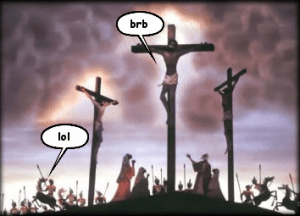
crucifixion_BRBIf Jesus was god, then the crucifixion was not a sacrifice.
If Jesus was not god, then it was a sacrifice, but it has no ultimate significance beyond being one of thousands of possibly inspiring stories of others who have died for various reasons, both noble and otherwise.

If Jesus never existed, then it’s just a story. If you can be inspired by that, then I can be inspired by Superman (and you can stop making fun of me for dressing like him!)

Now, the position of many Christians is that Jesus was wholly God, wholly human. This is nonsensical, and you know it. I am aware that this is one of the central tenants of the vast majority of Christian theologies, but it is absurd. Trying to justify this in your mind, reveling in the mystery of it, is indicative of something awry. It is to rationalize something absurd, mysterious, and impossible and call it a miracle.

But even if it were to be somehow true, then there are still some questions I have. Did Jesus know he was God (as well as human)?

If he did know he was god, then did he have all of the knowledge of god? If he did, then he knew that he would die on the cross–incarnated knowing so, in fact–and did nothing to stop it. He knew he couldn’t actually die, and that the crucifixion would be only symbolic, so how was it a sacrifice? This seems no different than me playing some online game and sacrificing my character in order to allow the rest of the team win the mission (not that I know anything about such thing…).

And if he didn’t have all the knowledge of god (or his divine powers for that matter!), then how could he be wholly god? Sure, he might have been human in body but having the spirit of god mixed in there, but without all the knowledge then there is something of god missing, right? Perhaps God is holographic, and even a part contains the whole? I’m confused….

Now, if Jesus was just a guy, granted one that was possibly sanctioned and chosen by the real god as a messenger, then it was a sacrifice. But how is it a sacrifice for us? How does a person dying two thousand years ago effect me in any other way than symbolically? And even as a symbol, how does it provide salvation? Further, salvation from what? (i’ll deal with that tomorrow).

And if Jesus was just god, and not human at all (as some early Gnostic sects thought), then his death was not a death at all. Then it was not a sacrifice at all. There is no passion to the narrative, just symbolism. Symbolism that god chose. But why choose that symbol? It seems to be a result of people who were used to the concept of sacrifice as a means to atone, like in the Old Testament laws about animal sacrifice and the smell of burnt offerings that are so pleasing to the lord. Man, Yahweh must love barbecues. But this neolithic idea should sound absurd to you.

I honestly do not see the significance of this supposedly historical event. I do not understand how God sacrificing either an innocent person or himself (to himself, to make up for a rule he made due to a Fall that he orchestrated, mind you) is significant to me at all, even if it were true. If I can see past this BS, I’m sure any real god could too. This sounds like iron age mythology to me, no different than the other myths and fairy tales of human history.

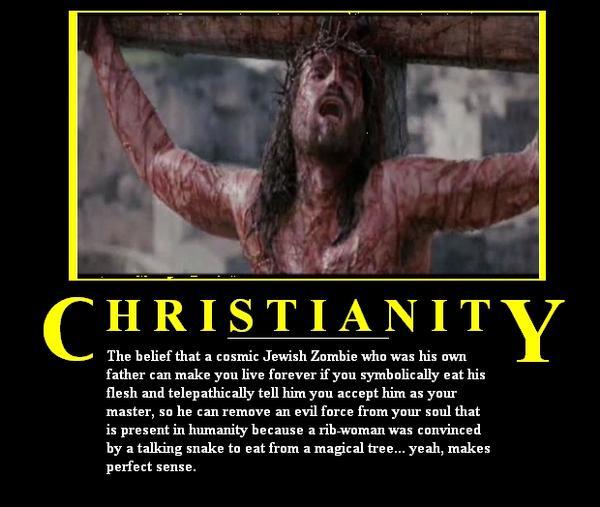
I'll leave you with this…Christianity

Why do we believe in the supernatural?


Why do people yearn for immortality, heaven. or salvation? Why is there a draw, within us, to seek metaphysical explanations? Why do we feel we need supernatural worlds, explanations, and beings?

Neurotheology has offered some solutions. In recent years there have been articles written about the so-called god-gene, or whether there are certain parts of the brain that are responsible for believing in gods or at least spiritual experiences. There has been some success in these attempts, and it is clear that some religious experience is certainly the brain doing its thing.

There are other aspects to this need. Culture, social pressures, insecurity and so forth play their parts. I’ve met too many people who, despite not believing, continue to attend church, profess belief, and just cruise along because of the effects of being open about their skepticism and doubt would damage their family life, work life, or relationship with neighbors. I’ll bet that quite a few of those family members and neighbors would react to them coming out because they repress their own insecurities about those same beliefs.

But I digress.

Religion is natural. In a strange way, this is ironic, but it is true. Through our evolution we have developed powers of cognition that allow us to do amazing things, creative things, beautiful things. But the brain did not develop specifically to do these things. Our brain developed, through millions of years of natural and sexual selection, to be predictors of the future, solvers of patterns, and tool makers.

The skills necessary to complete such ardent tasks came with a price. Because while we will try to predict and solve, it surely is better, for example, to assume something non-animate is animate than the other way around. That is, it is better to assume something moving in the shadows, in the corner of the eye, or even looked at directly has a conscious agency than to assume the other way around because otherwise we may not run from predators. Ancestors who had different tools would have been lunch, thus they would not have had as many offspring. Natural selection at work.

As a result of this, early humans probably saw agency in nature everywhere, hence the early concept of gods for just about anything including lightning, wind, the sun, water, etc. As these concepts developed and matured, our ancestors imagined that conscious intelligent agents were behind the world until we had pantheons of gods with myths to explain them. Stories of origins were composed, told, and created a sense of meaning and purpose, and eventually rituals, rules, etc were concocted along with the development of society and culture. Politics were created, language made more complex, and all along was the agencies behind the natural world, tied into our very thinking about the world around us.

The very symbols, words, and concepts that were used to explain and understand the world was tied directly into the thought patterns which also created supernatural agency. That is, our minds are imperfect, our intellect inadequate, or perceptions imprecise. And these are the same tools we use today to understand the world. With better tools and methods for getting around these imperfections, our understanding is better than it ever was before. But we had to overcome our imperfections to some degree before we could see the blind-spots, biases, and unconscious assumptions guiding our worldviews.

Nietzsche, the 19th century German writer, philosopher, and lover of words, wrote the following.

The metaphysical need is not the origin of religions, as Shopenhauer supposed, but merely a late offshoot. Under the rule of religious ideas, one has become accustomed to the notion of “another world (behind, below, above)”–and when religious ideas are destroyed one is troubled by an uncomfortable emptiness and deprivation. From this feeling grows, once again “another world”, but now merely a metaphysical one that is no longer religious. But what first led to the positing of “another world” in primeval times was not some impulse or need but an error in the interpretation of certain natural events, a failure of the intellect.

The Gay Science, aphorism 151

Nietzsche understood, as many more do now, that the intellect is flawed. Unlike Plato, who thought the intellect the key to the Good (which would ultimately influence the concept of the Christian God, through both Paul and Augustine), he and we understand that our intellect is not purely rational, but it can be made more logical and rational through practice, training, and a desire to understand the truth even if the truth is not kind or pleasant.

Know thyself. Find your biases, blind-spots, and flaws in your mind. Seek out the truth on its terms. Religion will help us understand who we have been, who we may be now, but it can do little to tell us what we will be if we desire the truth. We will need different methods for that.

Mystical explanations are considered deep. The truth is that they are not even superficial.

Nietzsche, The Gay Science aphorism 126

Are science and religion equally valid?


I have a friend from high school that I have been conversing with for a short while ever since we friended each-other and he has been reading this blog as I post links to them on facebook. He said, in a recent blog post of his, a number of things that I disagree with. I would, therefore, like to reply to it here. I hope he does not mind my quoting his blog entirely. The original post can be found here. [edit: no it can’t, because he has removed it.  I guess I made some good points?]

He starts off this way:

I have an old friend from high school that identifies himself as an “atheist, polymorous, geek” (if you’re like I was and unfamiliar with the term “polymorous,” best I can figure out, it means polygamy distinguished semantically from the baggage of Joseph Smith and the fundamentalist Mormons). Shaun keeps a daily blog in which he posts his thoughts in support of atheism and polymorism. At least once a week I open my web browser to find an intelligent, well written article about why atheism is the only possible rational conclusion to be drawn by carefully examining the facts about God.

Now, first off, polyamory has very little to do with polygamy. My partners are free to find other boyfriends or girlfriends as I am. Right now, I have no interest in starting a relationship with anyone else, as I am busy enough. Polyamory really is simple non-monogamy. I just don’t think that monogamy should be assumed. I’m glad he thinks my thoughts are intelligent, at least.

Seriously. He writes, “There is no God” every week, “just look at the facts.” Sometimes he writes this twice a week in essay form. As I read these short essays, I can’t help imagining what people’s reactions would look like if I were to write about the existence of God as much as Shaun writes about supreme being’s nonexistence. Certainly, the white upper-middle class politically left leaning liberal intellectual community in which both Shaun and I were educated would label me as a fundamentalist, religious freak. After all, who else would expend so much time and energy thinking and writing about God?

Clearly, this is hyperbole. I don’t say that there is no god. Why? Because that is not the atheist position as I use it. I say that I am not convinced that a god exists. I think the question is important, so I write about it. I am not really concerned if people look at me as some sort of fanatic. I am interested in what is true. If anyone else were to write bout it as much as I do, I would want to talk with them. Those who are not interested can read something else.

I’m no expert on God or Rationalism. I’m not a theologian. I’m not a philosopher. My field is Depth Psychology. I observe and write about the ways humans make meaning and the stories they tell to make sense of the world around them. I’m not interested, therefore, in discussing whether or not God exists. Using so-called rational science, the existence of an omnipotent being that resembles a carbon based earth creature is just as hard to disprove, as it is to prove. Instead, I’m interested in the concept of God: an undisputable fact.

OK. I’m waiting now for the punch line.

The very attempt to disprove God’s existence is simultaneously an acknowledgment of the concept’s structural existence and an attempt to replace the concept with another. In other words, God is an idea on which both believers and atheists expend mental energy. I agree, when the atheist labels the believer’s ideology a phantastic story that makes meaning out of chaos. However, I also label the atheist’s ideology a rationalistic story that makes meaning out of chaos.

Again, I’m not trying to disprove god. I’m talking about why I am not convinced that tthis being exists. I’m responding to the claim, the apologetics of it, and the proposed reasons to believe and showing why they do not add up.

I’m interested by the idea that we share the “acknowledgment of the concept’s structural existence”, as he says. This seems similar to a thought I have often. I do feel like I’m trying to wrap my mind around a concept of god (that concept depends on what type of theism I’m responding to), but find what concept I am able to glean unbelievable. And I’ll agree, provisionally, that I’m trying to make meaning out of chaos. How similar my method of meaning-making is from that of others I do not know.

Both the phantastic and the rationalistic are valid and real ways to approach the world. In both cases, however, imagining your own approach as “truth” is fundamentalist and dogmatic. There is space for approaching the world from both perspectives. Both perspectives (and the many other possible approaches) are fabrications or fictions that say more about the unique experience of the human species than they do about the universe’s material (or spiritual) reality.

This is where we clearly part ways. I do not accept the idea that all methods of approaching the world are equally valid. And while they are all fabrications, or at least artifacts, that does not mean that they are equally valid any more than the fact that a true and false story come from people make them both valid. Some methods are created such that they can be tested against shared experiences and be tested with the best methods we have. Others do not use these tools. Thus, some methods are clearly better at different things. In terms of discovering what is most-likely true, one stands above the others.

We live in a typhoon of positivist sound bites as dogmatic as the organized religions they criticize. Moralistic commandments with financial agendas are disguised as health tips; they are platitudes accepted as gospel. Our obsession with cleanliness and sanitizing, for example, can be seen as a remnant of a puritan believer’s attempt to wash away nature, to weed out the impure, to restore humankind to its Garden-of-Eden Godliness.

Positivism is no longer a perspective held by the majority of people, especially in science. It was a view derived from early works of Wittgenstein (and not sanctioned by him, as he later came back to academia and attacked positivism). The view is not that all metaphysical (or phantastic, as he calls them) claims are nonsense simply for being metaphysical in nature, but because they do not stand up to scrutiny. The ones that do stand up to scrutiny are then simply considered part of science’s conclusions. The skeptical community to which I belong does not have any dogmatic beliefs about such things, they have tried to test them and found that much of them do not stand up to testing.

We accept the scientific data on faith. Does the atheist examine the research on microbiology and “germs” before washing his hands? Doesn’t he see the inherent contradiction? He’s willing to take the leap of faith necessary to believe in evil creatures so small they are invisible to the naked eye but not a creator so large he cannot be comprehended by the human mind?

No. I accept the conclusions of science for two reasons. One, in some cases I’ve looked at the data myself. But the vast majority is because I understand the peer-review process. The scientific community is full of people who are clamoring for grants, respectability, and maybe even a Nobel prize. In order to get these things, you have to have your theory stand up to the rigor of hundreds or even thousands of others you are in competition with who are trying to use teh best methodology that they know of.

To accept what survives this onslaught is not faith. It is a rational acceptance based on the fact that if the theories proposed by the scientific method via the scientific community were not the best we have come up with, someone else would have proven otherwise. Theories such as the germ theory of disease, relativity, natural selection etc were all tested, retested, confirmed, re-confirmed, and so they are accepted. They are not believed in a technical sense, but accepted. And if a better idea were to replace any of these, what other method besides science could be used? No other method has proven itself to be as reliable, and so that’s why it is used by the experts in various fields…well, most of them, anyway. I’m sure young Earth creationists, for example, try different methods (yet then call it ‘science’, ironically)

We can see small organisms with tools like microscopes. The hypothesis of god has been used to explain many things in history, and as science processes in its understanding, the things some god was supposed to do are being pushed back by better understanding. In ancient times we thought gods made lightning, now we have a natural explanation. Now people think that a god is needed to design life, but science keeps showing that this is not the case necessarily. If a god exists, it is either working through nature (which does not seem parsimonious), or it is so vague a power and so insignificant that why would we continue to worship it or call it god?

So, god is so large it cannot be comprehended by the human mind? Perhaps. But then how do so many people seem to know so much about it? I don’t see a need for such a being to exist to explain anything in nature. It may exist, but I am not convinced. That’s what atheism is.

The microscope-wielding ministers of science at temples like Harvard and MIT may seem to have more clout than the doctors of deities at institutions like the Vatican and the Jewish Theological Seminary. But I think that assumption imagines the mainstream as the whole stream. Instead, I would argue that our rational-discursive oppositional world is dependent on the Science/Religion dichotomy. The conflicting perspectives exist symbiotically, the debate against one point of view feeding the other.

It is not a dichotomy. There is the methods of science and the various ideas of religions, conspiracy theories, new age weirdness, pseudoscience, etc. One method is better than the others. It will continue to give us better explanations while the others cannot compete in terms of methodology. Religion is not a single methodology. It is not a monumental and coherent competitor, but an alliance of people who share similar ideologies who stand opposed to, ignorant of, or philosophically naive in relation to the best methodology humans have yet come up with that tends to demonstrate the weakness of closely held ideologies, such as the dogmas of religions.

There may be something closer to a dichotomy in terms of the ways that we think. To think critically one must train the mind to be skeptical, rigorous, and be willing to tear down your own assumptions and beliefs. To try to rationalize beliefs held is to seek out data that supports the conclusion you want. Good scientists don’t do this, as this is not part of the scientific method. This method is neutral, skeptical, and perpetually bettering itself.

A religious ideology is rigid, and only changes when it needs to. It’s why religion had to give up the earth-centric view of cosmology, the flat Earth (there still is a Flat Earth Society), the 6000 year-old earth (some still don’t accept the much older earth). It seeks data that supports it, apologizes rather than is skeptical, and it feeds off of our desires to be more than mere biological machines. It was only when science came around, providing better methods and thus conclusions, that religions started to change.

These are not equally valid pursuits. This post-modernism is damaging philosophically, epistemologically, and methodologically. So, with respect I disagree with my fellow blogger. But I do look forward to more discussion with him and others.

Taking credit for your own transformation


I can’t tell you how many times I’ve heard the claim, from religious people of various traditions, that people have been changed by their god. They have had some experience that transformed them, improved them, or opened something up for them. And in discussions about the existence of god, these personal experiences tend to be the most powerful and, at the same time, the least applicable in those discussions.

I cannot legitimately challenge whether a person had an experience. If someone says they experience something, even if it seems impossible to me, I have to accept that they had the experience. But there is an important point to be made here; the fact that they had an experience does not necessarily imply that their interpretation of it is true. It is possible that your experience of god was not of god, but of something natural and was associated with a religious idea.

Why is it that those brought up in Christian environments almost always get transformed by the holy spirit or by Jesus? Why is it that people of Islamic backgrounds almost always feel the greatness of Allah? It seems suspect that the religious ideas that people are raised around are the ones they see in times of need. It seems to imply that it is our mind making the association between the experience an it interpretation, based upon the images we are aware of.

What is going on here is that people who find themselves in times of struggle will turn to the tradition they know. And because of the powerful emotions involved, the experiences they have are meaningful. And when people transform themselves, learn about themselves, and mature as a result, they attribute it to their god or to their religion. And when they look back on it, these experiences stand out as evidence that their beliefs are true.

I view this as problematic. No, I view it as ridiculous. There is no need to attribute these experiences to a god. We have the ability to change ourselves, upon reflecting and not liking what is seen, in ways that will be long-lasting. Attributing this to a god is, in my opinion, to underestimate our worth. This is precisely what many religious traditions do.

By making us feel sinful, and then offering us a way to be forgiven for it (for example), religion is doing nothing different than clever marketing. And just like when we watch television or see ads next to the blogs or news we read, we have to keep in mind the subtle psychological manipulation tactics similar to those of religious messages in order to not be unreasonably swayed by them.

I know it’s possible to change without help of any gods. How do I know? Because I’ve done so (and am continuing to do so). And when I see people defending their beliefs and ultimately barricading themselves behind the evidence of their experiences, I can’t help but wonder if they have ever really considered the role that they played in their own lives. Why are they not willing to take credit for their change?

Well, because they don’t believe that they are capable of it on their own. God, they believe, is necessary for something like overcoming alcoholism, gambling addiction, etc. But why? Only someone who has been convinced, or has a preexisting belief, that they are too damaged or imperfect to succeed in any such thing. Just think of the first few steps in a 12-step program.

Step 1 – We admitted we were powerless over our addiction – that our lives had become unmanageable

Step 2 – Came to believe that a Power greater than ourselves could restore us to sanity

Step 3 – Made a decision to turn our will and our lives over to the care of God as we understood God

Take credit for your successes, failures, etc and take responsibility for them. By giving some god the credit (and, interestingly, failing to give some god the credit for failure), we are resting the responsibility somewhere else than where it belongs; on our shoulders.

If you want to change, then take responsibility for it. And if you have already, then consider all you–and those around you–have actually done rather than simply give the credit to some invisible and intangible god.

My trip through the south, while being openly atheist


For the last week and a half or so, I’ve been road-trippin’ through the south. Starting from Philadelphia, we (my girlfriend and I) drove to Atlanta, Pensacola, New Orleans, Austin, Dallas, Little Rock, Memphis, Nashville, Johnson City, Leesburg (where we got a tour through the Howard Hughes Medical Institute, which was awesome), and then back to Philadelphia.

So, what does this have to do with this blog? Well, there are two things. First, I spent that time with one of my girlfriends while leaving the other back home for 10 days. This required some discussion beforehand in order to make sure that this cold be done without making anyone feel unloved or left out. Luckily, everyone was fine with it, I missed my lady here in Philadelphia, but I talked with her often and I got a chance to see her again last night and today. (yay!)

But the other part of interest was traveling through parts of the country while wearing a myriad of shirts that advertised my lack of belief in any gods. I have a number of shirts that identify this about me, and I wore them almost everywhere we went. So, what kind of responses did I get? Surprisingly little.

Yes, I got looks, double-takes, and even a few people becoming less hospitable after reading them. But surprisingly few actual comments or questions from people arose. While in Austin, Texas ( a beautiful city, btw), I did have one apparently homeless man walk by and call my girlfriend (who is not an atheist) an “evil bitch” in response to reading my shirt that said “Hi, I’m your friendly neighborhood atheist!” Talk about irony!

I guess the fact that we spent most of our time in or around cities meant that we ran into either more tolerant people or people who were more used to seeing things like that. Either that or they were just being polite in not asking questions or commenting. I did have at least two people comment that hey liked my shirts. I thanked them with a smile. I had one bartender warn me that wearing such things may not be a good idea. Maybe I just got lucky.

I don’t know what I was expecting. I guess I just wanted to observe whether people would react differently in the “Bible belt” than they do in Philadelphia, where I wear said shirts fairly often. My experience, short as it was, didn’t offer much of a difference. I guess we should have hung out at more rural roadside biker bars or something….

While I was in Austin, where we spent a couple of days, I did get to meet some of the people from the Atheist Community of Austin. I have been listening to their podcast and recorded cable-access TV show for a few years, and since we would be there I figured I would meet some of them. They were very friendly and we got a chance to see them tabling at the Austin Pride festival, which was pretty fun in itself.

But before we reached Austin, we traveled through Pensacola, home of the Pensacola Christian College. This college, which I had never heard of before a couple of months ago, is a school that grew as some people split off from Bob Jones University because it was too liberal. Yes, you read that right. PCC is about at conservative Christian as they come. They are run by the A Beka book company, which means that the school has tons of money and seems to be used by the publisher as some sort of tax shelter.

Now, I know about this school because my girlfriend, with whom I traveled, went to this school before they kicked her out for, as she says, challenging them too much. This is the kind of place where not only can men and women not talk outside of specific places and times, but very conservative dress codes, segregation of races (in terms of dating at least), and constant fear of trouble for questioning pretty much anything abound (listening to jazz, for example). I don’t know how she survived more than three years before she was kicked out.

I have encouraged her to write about her experiences there. I think she could have a book deal coming, if she does. The things she has told me so far are, well, scary. And I’ve seen Jesus Camp.

We didn’t visit the campus. For one, classes were not in session. Another reason is that they would not let either one of us on campus because I am an advertised heathen and she was wearing shorts. Maybe next time we’ll try going in incognito. Maybe not.

It was an interesting trip. We saw lots of great cities, met some really nice people, and now we return to real life.

Why both atheists and the ‘spiritual’ shouldn’t despise religion


Today we should consider it the decisive sign of great culture if someone possesses the strength and flexibility to pursue knowledge purely and rigorously and, at other times, to give poetry, religion, and metaphysics a handicap, as it were, and appreciate their power and beauty.

-Nietzsche, Human All too Human, aphorism 278

So, religion is real. No, really, it is, I swear. There really are religious people out there, and they believe religious things. I know, it seems odd that such a things as religions would exist, but think about it for a moment; our minds are structured such that we tend to have blind spots, we find patterns in chaos, we see meaning where there is none. We are creators, inventors, and composers of incantations both sublime and ordinary.

I don’t mean to be snarky. OK, yes I do. But I don’t mean to be obnoxious. That’s just a natural talent I have. I only mean to be honest. Religion, as I understand it, is a natural outgrowth of our various mental strengths, weaknesses, and our extraordinary normality. Thus, within it is contained all aspects of which we are capable, whether good, bad, or neutral.

There are many atheists I know who dismiss religion. There are many ‘spiritual people’ who despise (organized) religion (the parenthetical qualifier ‘organized’ is necessary), and their are religious people who don’t agree with most of their religion. Yeah, that last one makes no sense to me either.

I applaud the skeptical mind that genuinely seeks the truth through the discipline of the scientific method. I appreciate the effort to put aside our conceits in order to look at ourselves in a mirror, and not a mirror darkly, in order to attempt to pursue the truth. I also appreciate those that attempt to pursue their own growth with deep conviction of things I may find absurd. At least they are trying. As for those religious people who don’t even agree with their own proclaimed tradition…. I’ll let that issue untouched, for now.

But there are beauties, subtleties, and profundities within religious traditions. There are expressions of ourselves, inscribed in the languages of theology, philosophy, and metaphysics that, despite not ‘true’, contain import that are worth exploring.

They are worth exploring because they teach us about ourselves, both as individuals and as social groups. They give us glimpses of what it means to be human in different ways. So we need to allow ourselves to throw off the yoke of skepticism every once in a while and delve into the parts of ourselves that speak absurdities in order to understand the subtleties of their allure.

Religions survive for a reason. That reason is not because they teach us the Truth, but perhaps they can teach us something. Maybe it is a perspective of the truth from a side angle, rather than the straight on face-to-face angle that we aspire to with more meticulous disciplines. Perhaps there are angles of the truth, shades of gray, that can better be seen from the point of view of absurdities.

So, let’s proceed with science and other honest and disciplined attempts to understand our world better. But we should allow ourselves to understand those things that pull the heart, the ‘spirit’, in order to not leave behind the creators and artists within us, even if what we create in such states are not true.

For perhaps it is the untrue that can lead to new perspectives on the true. And if not, at least we can better understand those that still live within those worldviews we may have transcended. And that, at very least, will keep the ports of dialogue open, which will engender increased understanding of our brothers and sisters on this crazy ride of life.

Conversations with Christians about science


This is not what the actual conversation looked like

I spent much of last night having a conversation with someone, a Christian, about religion, evolution, the age of the earth, and atheism. These are conversations I’ve had many times, with many different people, with many different outcomes.

In the atheist community, we talk a lot about science, education, and the feeling of anti-science forces in our culture making it difficult to have well-informed people on the basics of science and to thus be competitive in the world market of science and technology. I am aware that there are others on the other side of the question, and so when I heard that many people felt as if evolution was being “shoved down our throats,” I realized there was a problem that needed to be addressed.

I feel that evolution happened. The evidence is overwhelming, the theory of natural selection supported by many observations, etc. My interlocutor agreed with most of this. What he disagreed about was that it was “proven” (proof is impossible within scientific means, I tried to explain) that the earth and universe were billions of years old; that we actually evolved from single cell organisms (or anything like that). It sounded like he had been reading creationism literature, but he had insisted that he had not.

The conclusion, from this and many other factors brought up through conversation, which I am moving towards is that the idea of “teach the controversy” is landing with much of the population. The fact is that there is no controversy, at least not in the sense that it was meant in our discussion. There are not people who are challenging the age of the earth or human evolution that are doing so on solid scientific grounds. Despite this, many people, including people who seek to understand these things honestly, believe that the scientific world is repressing challenges to prevailing conclusions; that scientists seek to stifle challenges to what is taught in biology classes; thus the “shoving down our throats” comment.

I do not doubt that this does happen, in some places and with some people, but the scientists that I know are open-minded people who seek the truth. And with grant money available for those that can demonstrate problems with prevailing theories, it seems odd that scientists at the top are so powerful as to stifle every attempt to challenge their sacred conclusions. This strikes me as a brand of conspiracy-theory that I find implausible.

The side that I hear more often, in my experience with scientists and atheists, is that all they hear from so-called challengers is the same old tired arguments that have been refuted hundreds of times. And thus they get frustrated, annoyed, and start ignoring them. Is this the source of the feeling of being stifled? If yo are the 100th person to approach a scientist with the same objection or challenge to evolution and are simply ignored, laughed at, or mocked, doesn’t that feel like a stifled challenge? Of course it does, but scientists are human too, right? We lose patience with repeating the same thing to the same objection which, according to them, should be commonly known.

So which is it; Are some scientists simply ignoring legitimate challenges or are challengers ignorant of the fact that their objections have already been answered multiple times and thus are annoying due to repetition and not because it seeks to challenge the accepted conclusion? Mixed bag? Possibly, but I will tend to side with the latter.

The essential question is whether the challenges actually stand up to scrutiny or not. And as my interlocutor admitted, he does not have time in his busy life to research or educate himself on every aspect of this question, but he only has skeptical reservations. That’s fair, I guess. I just wonder where the skeptical reservations originate from. Because it seems like the points of challenge are researched, as if they were lifted from some source, whether it calls itself a creationist source or not (and we know that they sometimes come in disguise as Intelligent Design or simply as “teaching the controversy”), and so I am skeptical that the source of them these objections are legitimate scientific questions being ignored by scientists.

The bottom line is that there are many well-meaning people out there that have reservations about science and its ability to “prove” theories (even though I tried to explain that science’s job is to present an explanation that fits the data best, and never to prove anything). They are skeptical of what science says because humans are fallible and we can get things wrong. “Fine,” I say, “and as soon as you find a better explanation that will become the new theory.” Until that happens the best explanation is still the best explanation.

These conversations are important because it is one of the many means to keeping the conversations from stagnating among those that share the same opinions. If I only talked with scientists and atheists about evolution and the age of the earth, I would never understand why the controversy exists because I would perpectually be creating straw-men to argue with. And if those would-be straw men never talked to me, they would continue to view scientists as biased people who will not accept a challenge to the prevailing worldview they hold.

Thus, we both benefited from the conversation, even if no minds were changed. And we are able to remain friendly and get along in the future. Win!