Controversial lifestyles and maintaining friendships


I have been an out atheist for many years.  I have been open about being polyamorous for some time as well.  I don’t hide who I am because I feel it is important to be a face for things that are controversial, because I feel like our culture is not ideally healthy, and controversy often comes from the sickness rejecting some remedy.  There have to be people willing to take the social stigma away, over time and with patience, so that future generations will not have to consider the balance of social stigma to living fulfilled and authentic lives.  Granted, this balance will probably always be a part of the human experience. but if we can mitigate the actual discrimination due to alternate worldviews and lifestyles, it will be a step in the right direction.  I want a future where the argument that keeping quiet is better for your career, social life, and family life is rare. I want atheists, poly people, and other “abnormal” people to feel less insecure about being who they are, openly.

All of this implies that their still remains a cost to living openly as an atheist or as polyamorous.  I have certainly experienced this in my life, and it has effected relationships with people I know.  Now I’m not going to pretend that the alienation I’ve experienced from friends and family is always due to my being an atheist and being polyamorous.  I have made mistakes in my life which have strained relationships with people I once thought of as friends, but it is also true that having strong, outspoken opinions about people’s beliefs makes you come across as unfriendly, overly-critical, and perhaps even a dick.  I accept this outcome, because I understood the ramifications of living as I do.  And while I do sometimes lament what I have lost, I am also finding that there are positive things gained that may have otherwise remained unfound.

One thing that happens, and I believe this to be a common observation that all people notice as they begin to mature, is that the people who stick around even after we make poor decisions, come out as some socially awkward minority, or proclaim some controversial opinion consistently and loudly are your friends.  They are especially your friends if they tend to disagree with you.  I don’t want all of my friends to merely be people with whom I agree, after all.  Further, the people who shy away from you in times of stress and courage to stand firm in the face of such social stigma are not your friends.  They may remain as acquaintances, but it is often best to cut off your losses with people who abandon you with nothing more than a passivity of intercourse.

But those people I still call friends (and this is not a word I use lightly), are people who know me as I am.  They may not agree with me or understand me completely, but they are willing to live among my life without it affecting our relationship.  And as I ride this thing called life I occasionally meet people with who I can ride along with; people who have qualities which complement mine and with whom I can enjoy my time.  The friends that you meet after finding what has meaning to you are different kinds of friends, but nonetheless friends they are.  Alternatively, the people I knew as a child, the friendships that I maintain that are decades old, are special and important because we know each other well in a way that transcends specific adult interests.  And while not all of those relationships have survived the journey, the ones that have are especially meaningful.  They are people who will be friends for life, most likely, and they keep you tied to where you came from, even we drift further from the safe shores of mainstream culture.

And family is similar.  As I ponder the reality of marriage, which implies a wedding with guests, I ponder the realities of family seeing me as I am, not as they knew me as a child.  They will see a ceremony devoid of god-talk, vows devoid of promises of exclusivity, and assuming my new relationship survives until then (and I truly hope it will dwarf that time-period in length) they will see two people marrying each other while being in love with other people with whom we shall dance, kiss, and celebrate with at our party.  And they will not understand.  And they will judge.  And they will think us lost, perhaps.

They will miss the unrelenting beauty of reality that we dance upon with genuine joy and appreciation.  The beauty of a world devoid of gods, but full of complexity and wonder beyond our ability to comprehend.  They will miss the depths of love and intimacy which is shared beyond the artificial limitations of monogamy.  They will miss the wonder that is my life, even as it sits before them, beautified and smiling.

And yet some will understand, even at a level that is not quite articulate even to their own ears.  And this is the reason I live the way I do; many will not see, but some will.  I live my life to experience the many joys of reality, and reality is awesome.  I will not apologize for it.

Somebody likes me!


So, if you have not been paying attention lately, I have been seeing someone new recently, and therefore exercising my Bacchus-given polyamorous rights, and we have been having a wonderful time.  So, today she wrote another post on her blog that made reference to me by name today, and so I thought I’d like, you know, prove that I read it and stuff by linking to it and making a few references to it below.  Because that is what a supportive partner does

Gina is truly one of the funniest people I’ve ever known, and we keep each other very entertained while one or both of us should be doing more constructive things, like work.  And to boot, she s talented, smart, and you know, like sexy and stuff.  She is a singer and guitarist for the local Philly music thingy called Arcati Crisis, does some theater stuff that may be awesome or super awesome (the jury is still out on that), and she does some other stuff that might be inappropriate to post here.  Nobody wants to read about dead babies.  Those last two sentences were completely unrelated.

On top of how great we get along, she and Ginny talk extensively as well and seem to like each other a lot.  It is hugely advantageous for your girlfriends (I never really like the terms boyfriend/girlfriend that much either), significant others (meh, that is hardly better), or partners (what, are we starting a business?) to get along well with each other.  Can I just call them my bitches and still call myself a feminist?

Probably not.

So, I love my life right now, and I think it has great potential to get better and remain in a stable state of great friends and lovers.  Ginny is awesome, Gina is awesome, Wes and I are apparently the same person, and then there is Jessie (Wes’ other girlfriend) who I have not yet gotten to know well.  Add another currently unnamed girl who I have been seeing more casually and my life is complicated (awsomplicated?) with people, but I’m loving it.

So yes, ain’t life grand?

Big relationship steps and Google


We have a sort of road map for relationships in our culture.  There are stages in a relationship which are delineated by certain events which make clear to the world that the people involved have taken a step.  In monogamous culture, these steps convey a level of seriousness in the relationship; levels of commitment and usually exclusivity.  If they are just seeing each other, then it may not be out-of-bounds to ask tone of them out yourself.  If she’s got a ring, then back off boys (and girls) because she’s spoken for!

Of course, depending on how old fashioned (read, prudish) people are, this might amount to “going steady” or “casual dating” or “fuck buddy,” but the labels and correlated events convey something about  the nature of that relationship which indicates levels of seriousness.  It is not my intention here to analyze these stages, as they really have nothing to do with my freaky life, being all non-monogamous and stuff.  Those normals can have their boring stages, because I don’t want them anyway.

Now, within the poly world, the same rules don’t apply but there certainly are some common themes which could be talked about.  Strictly speaking, there are not any real universally accepted “rules”, but there are certainly some sets of common tendencies and some common markers which tell you the relative seriousness of a relationship.  Perhaps the starkest distinction between the monotonous…I meant monogamous, my apologies…and the polyamorous worlds is that there is a significant decline in likelihood of a level of seriousness between people implying that this person has become off-limits.  Temporarily perhaps, especially if they are so into their new partner that they just have no inclination to see you right now, but not in principle and not generally. And since the general lack of exclusivity implies that one might have to manage one’s time better, this can mean logistical puzzles to solve, and this is where technology comes to the rescue.

One of the markers that has become common in the last few years for poly people is the sharing of Google calendars.  When you get to the point where you want to manage your time better so that you can make sure that you have time to see your new loved one, as well as make sure to fit yourself into their busy schedule (after all, since they are so awesome everyone else wants some time with them too!), then you are declaring that this is more than just some temporary fling, probably.

So, the other day when I was opening my Google calendar settings so that I could add my new lady friend, Gina (she has subsequently given me permission to use her name, which I interpret as permission to gush about her publicly in great detail 😉 ), I also discovered that I had been continually giving permission to 3 ex-girlfriends from the last few years.  Apparently, my usually organized mind does not think to un-invite people who were once important parts of my daily life from this relationship stage, probably having something to do with finding this sharing option only when you are looking for it, thus I simply forgot that I was still sharing with them.  Suffice it to say, the oversight was taken care of.

My guess is that they has simply deleted my calendar information a while back, and not that they had been stalking me.  I assume that because for the most part I have not heard from any of these 3 women in some time.  Hell, even in polyamory breakups can often still lead to people losing contact and moving on.  Sometimes even when one of them lives in your parent’s house and sleeps in your old bedroom (long story).

But in any case, I now have a newly organized calendar with two of my significant others’ information adding color to both my calendar and my days.  I have me a Ginny and a Gina! (I swear that was not intentional, it just sort of happened that way).  Of course, now my calendar tells me that I won’t be able to see Gina until Friday.

Stupid calendar.

When it rains it pours


I am just in a great mood! I had such a wonderful weekend, and I want to share it with the world.

Being polyamorous with someone as wonderful as my dear Ginny is amazing in itself.  I feel very lucky to have someone who fits me so well, who is so beautiful inside and out, and who I can expect to spend a fun, nurturing, and challenging (in the good way) life.  But recently we met a couple who just got married, and since they are also polyamorous (and they are not exactly a couple; there is a third in there), we started to spend some time with them over the last couple of months or so.  And just this last few days it blossomed into a great situation where I find myself beginning what I hope will be another intimate and meaningful relationship.  Of course there is no way to know at this point whether it will be successful or not, but my instincts are good.  I am able to be objective enough to know that intense emotions can cloud judgment and foresight, but I have every reason to believe that all the ingredients are quality, the chemistry is right, and our desire to create something awesome is mutual.

In other words, I met someone I really like, and am feeling really positive about it.  (I have not asked her if I can use her name here, so for now she will remain nameless).  In fact, not only has my fortune been good, my fortune hit the jackpot and doubled.  In addition to the one nameless (girlfriend? Hmm, I guess we have not discussed titles yet) woman I just left less than an hour ago, I have also started to see another woman who I clicked with very easily.  Just yesterday (Saturday) I had a fantastic first date with someone I had met a couple of years ago (before my brief stint in Atlanta), but she recently discovered me on OKCupid (where all the awesome poly peeps are, apparently) and we went out and have a fantastic time.  That on top of seeing my new lady friend both Friday and tonight…I’m a little worn out, I have to say….

And on top of that, Ginny is having a great time with her new boy toy…ok, I don’t know what to call him either.  I suppose all that will work itself out in time.  We are just happy and evolving little poly family here, and I am loving every minute of it.

For those of you who think that this polyamory thing cannot work, that it is destructive and can only lead to hurting people, all I have to say is bullshit! I am happy to see Ginny happy and enjoying herself with another person, and she is happy to see me happy and enjoying myself with another person.  (This phenomenon is what is referred to as compersion, or sometimes as frubble.  Google is your friend).  We love each other, are affectionate and open with each other, and we have other people we care about and have sex with.  And, while ultimately I just want people to find what makes them happy, fulfills their desires, etc I think that many monogamous people who say that they could not do this are really missing out on something awesome.  But, again, I’m riding high on emotion and am, perhaps, not seeing it all clearly at the moment; I just know that right now I am feeling the poly high.

So, now that I am on the verge of finding a way to build three relationships (of varying significance and intensity), I find that I’m looking forward to it.  What more could a person want than more love, friendships, and hot, hot sex with sexy people?

Life is good.


Atheism over humanism: why we must philosophize with a hammer


[EDIT: I want to add a quick note to this article because of some confusion that became obvious to me in conversation.  I am not creating a dichotomy between atheists and humanists; I am commenting on the differences between people who prefer one title over the other.  In my experience, which term a person primarily identifies with tells you something about how they view the issue of how to deal with religion.  Do we take an oppositional stance or do we focus on our positive values which may overlap with religious values?]

Today, on facebook, I ran into this:

The ‘humanist’ label is a fine alternative to one of the hundreds of religious affiliations. It is certainly finer than ‘agnostic’ or ‘athiest’, as they define thenselves against something rather than for something….

Now, many people in the greater community of reason, of which I and the other atheists are a part, prefer the term humanist to atheist.  Others prefer freethinker, rationalist, or….Bright (I dislike that last one very much, as do many others I know).  I prefer atheist for a number of reasons.  Now, this does not mean that I’m not a freethinker, a rationalist, or that I’m not bright (Oh, please stab me with a spoon!), but it means I prefer the term over others such as humanist.

Hammer of the Gods?

But the technical fact is I am a humanist in many ways.  The humanist ideals and values are things I generally agree with.  The Humanist Manifesto, for example, demonstrates ideas that are largely similar to my own ideas, and where I might quibble or disagree it does not lead to a drastic difference of opinion.  For the most part, I find the manifesto to be pretty bland and uncontroversial; its liberal and progressive Christianity without the Jesus, Reform Judaism without YHWH, unitarians without…well, it’s sort of like them, actually.  My disuse of the term humanist is caused by the same basic reason that I don’t attend unitarian services; I simply have no need for it and I often feel like its just a little too much like theistic religion.  As Nietzche put it, it is really a matter of taste–to much stale air!

Therefore, I don’t think that the quote at the top of this post is sufficiently convincing to change my attitude towards the primacy of atheism over humanism in my self-reference.  The reason has everything to do with the quote above; I define myself as being against theism primarily.  It is a value of mine to be against this idea of supernaturalism, not as a mere rebellion, but as a matter of recognition that it has more reach than humanists give it credit for.  It has worked its tendrils into just about every concept, value, and sector of our culture in ways that make our attempts to be “for something” a difficult task if we value truly escaping the clutches of theistic thinking.

While I am not opposed to, and often support, the creation of new values and ways of life other than that created by our largely religion-infused western culture, the fact is that the predominance of that culture necessitates a defensive position in many cases.  That is, the ubiquity of religious ideas, even where there is no actual supernatural belief present, is so suffocating that new values become unwitting atavisms.  Humanist values, often thought of as being new or at least different, are usually mere secularized religious ideas, mostly due to the fact that religion usurped them millennia ago. But religion did not merely adopt these values in those ancient days, it changed them by infusing them with the anti-life message of sin, depravity, and shame.  The stain is old and hard to remove even by those humanists who seek to become reborn out of religion–an image surely evocative of something.

Wait, not THAT Hammer….

Even among atheists, the acculturation of a religious ideas has infected the minds of people to such a degree that even when they reject the theology, they often still hold onto much of the structure of the morality and behavior.  Atheists may not believe that we were created by god to live such a way, yet they still often hold onto archaic sexual norms, conventions of respect for people’s personal beliefs, and cultural definitions of relationships (such as marriage as being between two people of opposite gender).   I have heard atheists who still suffer from discomfort with their own sexuality, try to shame me into not criticizing religion openly, or who actually argue against gay marriage or polyamory.  Only the stain of religious thinking can be responsible for this (at least I’ve heard no good arguments which are not based upon religious ideas, ultimately).  Thus, when people leave religion and create new ways to think, like secular humanists do, often their actual lives are not in any way truly new or revolutionary in any way.  They just drop the problematic metaphysics and declare that the rest of their values are their own.  I am somewhat cynical of this claim; I think their new values are often still pretty traditional and even conservative.  But at least its an improvement over pure theistic religion, in any case.

I don’t think enough people in our culture are prepared for new values yet.  I think too many people are incapable of conceiving of new values, and simply replace their old ones with new personas, while still the same deep down.  Many pagans, wiccans, and other alternative new age religions are guilty of this.  They hate or at least dislike their old religion, and so they replace the mythology with another, while keeping the scars of their religious foundations intact and very influential; they often don’t actually grow, they just change clothes.  And many people still value the words, and what they see as the personality, of Jesus Christ.  They don’t believe he is god, but they see his message as good.  This is the essential problem; Jesus’ words were often insane, non-pragmatic, and dangerous.  He is not the highest of moral teachers, he is a character of his time who idealizes for us bronze-age morality which we should have out-grown by now.  The whole and central moral message of Christianity is perverse and vile, and it is holding us as people, as a society, and as an influential culture, back from truly growing and transcending ourselves.  And while humanism is not trying to accomplish this atavism–or at least the slowing down–of our growth, it often achieves it anyway.

To truly create new values, we must do philosophy with a hammer (as Nietzsche suggests in his Twilight of the Idols).  We must utterly destroy the values which we have before us.  And if we find, after everything has been

Hmm, not really what I had in mind either…

smashed, that we create new values that look a little like those smashed idols, then so be it.  But we, the atheist community, are still trying to teach new people how to wield their own hammers.  And until all is questioned and all corners of our culture analyzed with the skeptical tools of science and logic and we are able to think more clearly about our history as a world of freethinkers, humanism will be a premature step for many people.

Don’t get me wrong.  I want the humanists to keep up their program.  I want those who have trashed their own cultural houses to keep building, but I want them to remember that there are many other people still smashing, as well as many more protecting their idols from those of us who want to hand them hammers.  So, humanists, while you are attempting to build values for yourselves and for others to adopt when they are ready, remember that you still may have missed an idol or two, probably in the attic, basement, or perhaps you didn’t notice that you were clutching it.  Also, remember that we new atheists are with you (in spirit), but someone needs to keep handing out hammers.  And the title for such a person must still be “atheist.”

Happy smashing!

Pastor Herb Swanson rationalizes his cowardice


In a post from earlier today (which, by the time this is published, will be tomorrow), I linked a three part response to an old post of mine about the truthiness of religion.  I tried to initiate a dialogue with Pastor Swanson about some of the errors in his analysis of my views in order to try and dispel common misunderstandings of (new) atheist views.   I think it’s important to keep open and honest dialogue with people of other beliefs in order to see if understanding is possible, even if agreement is not.  However, it was pretty obvious to me from his early responses that he was not taking me seriously and had no real interest in dialogue, but I went ahead in good…faith…and tried to articulate my thoughts to him via email.

But after some back-and-forth, I was not getting any of his thought back; no responses to my criticism at all.  Not completely perturbed, I decided to continue composing my thoughts concerning what I would like theist leaders,  like him, to understand about atheists.  I was generally curious if he understood what I had to say or if they would seem strange or interesting to him.  But rather than get any response of substance for day or so of email correspondence, he finally emailed me quoting what I said at the bottom of my earlier blog post, apparently ignoring the content of my emails altogether.  The entirety of his most recent email was the following:

Shaun,
To quote you regarding the Rev. Herb Swanson, “I will hope to get some actual dialogue going with him, because he is just another theist who seems to have a lot of misinformation about what new atheism is all about.”  Serious dialogue requires trust, which does not begin with putting the dialogue partner in a box labeled, “just another theist.”  I’ve engaged in a fair amount of dialogue with people of other faiths, Buddhist mostly but with Muslims as well, and this is not the way its done.  I appreciate your desire to instruct me and will take to heart the point that there’s more for me to learn.  Actually, I knew that anyway.  But, all of this has only encouraged me to stay clear of the battle you new atheist guys are engaged in as I seek to make sense out of how scientific thought and developments in science can help me better understand and express my faith.  Evolutionary theology – not sure what it means yet, but that’s the sort of thing I’m really interested in – process theology stuff.
Well, any way, don’t see that this is going to work.  Too bad.  But, as I say my plate is really full anyway.  Gee whiz.  Just another theist.  Really?  My bad.  Peace, Herb Swanson

OK, I admit that the choice of words “he is just another theist who seems to have a lot of misinformation about what new atheism is” may not have been ideal.  But what is really frustrating is that the content of my emails was ignored because of it.  Again, it’s about tone.  Just like the arguments between the accomodationists and us gnu atheists, there is no addressing the actual content.  It seems to be mere rationalization of not wanting to address any actual content; we are so fundamentalist, so angry, and so unworthy of their ecumenical and respectful character that they merely have to quote a seemingly disrespectful phrase and wash their hands of us.

….

So, for greater context, and put this in the public record, I want to publish my attempts to articulate my ideas to Pastor Swanson.  What will follow below are the emails which we both sent after some initial friendly correspondence between us.  After making some comments about how I was disappointed to see no comments were allowed on his blog and that his readers would not see my responses, he wrote me saying:

Hi Shaun,
I appreciate your concern.  Let’s see where this goes, if anywhere; and if our exchanges actually prove fruitful, one way or another your concerns will get shared with “my” readers (never thought of folks who read the blog that way, I guess).  We’ll see.  Herb

This was after the email, quoted in its entirety from earlier today (it’s actually yesterday as of now), in which I gave him a lot of substance to which to respond.  I assumed at the time that he had been busy, and that may actually have been the case.  So,with that assumption I wrote back to him the following:

I’ll share an oft-repeated truism which is popular amoung the atheist community, especually around discussions between atheists and theists.  When you debate (or discuss) a topic with someone with whom you disagree (or with whom you expect to disagree, at least), the points you make are not for the sake of the person with whom you dialogue, rather they are for the people listening or reading.

The running assumption behind this idea is that you are almost certainly not going to change the mind of one defending their position.  There is something about the structure of our brains which does not allow our opinions to be changed while in a discussion, or at least to make it extremely rare.  Being aware of this, I recognize that while we may learn things about the other’s perspective, which is valuable in itself, I have no expectation to convince you of anything.  At this point, I think my goal is to have you understand my position as a new/gnu atheist, and not for you to agree with me about anything.  This way, ideally, when you speak to your audience (whether it a congregation or your blog readers), you will have a more rounded perspective on what at least some atheists say.

I say that knowing you will almost certainly misunderstand essential elements of my worldview no matter how clearly I explain myself, as even porfessional apologists and debators still get so much wrong no matter how often they are corrected about the opinions of their debate opponent’s position.

I blog for the readers.  And those who read my blog are my readers, menaing that for the most part they tend to agree with me.  I’d bet that most of your repeat readers agree with you more often than not.  The down side of lack of comments means that they will see, by necessity, less dissent than they would otherwise.  They see one side of the argument, with no response.  Of course there will be trolls, assholes, and irrational people who say stupid and annoying things.  But I think that this is a fair price for free speech.

In any case, I will look forward to talking with you.

To which he responded, within a half-hour:

Hi Shaun,
OK.  So what is it you’d like to have me understand?  Herb

Ok, so now I have written two emails with considerable substance, and have gotten nothing back but meta-discussion about talking more…possibly…if it is fruitful.  A little frustrated by this, I decide to just bear down and articulate more thoughts, hoping he will keep in mind what I have already said.  here is the email I composed shortly after that one-line email above:

Well, I was hoping to get some response to my initial email.  I tried to correct some of the claims you made in your posts, and I was wondering what you thought of what I said.  But, ok, I’ll spell out some of the big issues for you.

Generally, I want you to understand that many of the people in the atheist community are people of genuine desire to understand the world around them.  Most of them are former theists, usually former Christians.  I’m an exemption to this rule, but I wanted to point that out.

Most atheists I have met do not make any absolute claims about the existence of any gods.  The definition of atheism is (And this is a little bit of a controversy, as some atheists have a different definition) someone who lacks beliefs in any gods.  Most atheists would be open to new evidence, others’ experiences, and would be very open to friendly discussion.  I, for example, have been having conversations with theists for many years, and consider myself very experienced in such conversations.

Many atheists, such as myself, primarily identify as skeptics (not to be confused with cynics).  Our epistemological view is one of saying that for something to be considered true, it has to be demonstrated empirically.  It is derived from the methodological naturalism necessary in science; science can only deal with physical things by definition.  The metaphysical naturalism that I hold as true I reach via philosophical argument, and is not an absolute conclusion.  I simply see no reason to believe anything non-physical exists; it does not explain anything, and the gaps in our knowledge cannot be logically filled with claims of supernaturalism without justification.  I simply don’t see such justification.

This skepticism is where the use of science and empiricism comes into play, and why I think many people assume (as you did) that we use the scientific method the same way that literalists use their (more absolute version of) faith.  As skeptics, we demand a higher criteria for belief in things.  We hold the idea that the more extravagant the claim, the more quality the evidence has to be.  And because we don’t see any method which [can] compete with that of empirical science, we use it primarily, perhaps exclusively.  We are, of course, wiling to consider new evidence, but the use of another method will have to be demonstrated as useful in some way before it can be taken seriously.

You should also understand that not all atheists are skeptics, and that many of them will have bad reasons and bad arguments for their lack of belief.  I am as critical of them, upon talking with them, as I am of anyone else.  We need to keep our own house clean.

Most atheists are not strictly logical; we are not Vulcan-like, eschewing emotional considerations because they are all delusions or anything like that.  While some atheists can be largely rational, sometimes seemingly too rational, it is because we appreciate reason-based conversations with people who challenge us intellectually.  We are often people who argue with each other about just about anything, because we are interested in the truth and don’t mind furious debates.  We are also often emotionally open, loving, compassionate, and generous.

We do not hate Christians or have any ill feelings for them, in general.  Now, we have ire for some Christians (say the Westboro Baptist Church), but our dislike is directed at the theology, not the people.  We “new atheists” are particularly concerned with the theology because we genuinely believe, upon reflection based upon experience, that many theological ideas [are] not only are harmful to many things we value, but seem simply untrue.  That is, even if religious ideas inspire people to be better and so forth, we realize that these personal growth and transcending experiences are possible without the theological baggage which we find lacking in moral and intellectual value.

That is, we know theology.  Not all of us went to seminary, but many of us did.  I, personally, have studied Christian history extensively and have read the Bible completely (much of it several times) and seek to understand different religious traditions as an anthropological exercise, among other reasons.  It is only after this experience with theology, Christian culture, and the philosophical arguments can we become confident (often seen as arrogance) in our atheism.  Quite simply, we are familiar with apologetics, usually have had hundreds of conversations with believers (whether family, friends, or otherwise), and get frustrated that they usually know less than we do about the religious tradition they follow.  Studies have shown that atheists have a better understanding of religious beliefs than the religious.  Thus we often feel, and often are, more educated and knowledgeable about religion in general.  And when we talk with the educated believers, we at least have a common share of information, even if we disagree about it.

Finally, and this is more specific to new atheists in particular, we view so-called “sophisticated theology” as often linguistic salad; postmodern meaninglessness.  As a philosopher, I am familiar with postmodern philosophy, and the modern theology I have read, whether it is process theology or otherwise, seems to be of the same caliber.  We are interested in the truth as it can be gleaned through the best intellectual methods we have developed.  We don’t respect faith, as even if it is not the absolutist faith of literalists, it still points to the abjuring of reason for the sake of belief.  As Aquinas said, faith precedes reason, and as Luther said, reason is a whore.

It is there where I think our worldviews differ the strongest.  Our strong words that look so absolutist and angry at this point in the conversation are due to the fact that criticism of each of our most important (“sacred”) values always looks more aggressive than they really are.  There simply is no way to say something critical of someone’s values while sounding nice, which means when we talk about this strongest of distinctions between worldviews emotions become more exposed. We are not trying to be offensive, we just can’t say what we really think without causing offense.  It’s unavoidable, but we have to be honest anyway because for us, respect means honesty.

And in response to that, I only get a complaint about an admittedly poor choice of words and the implication that there really is no point in continuing the dialogue (the first quoted response above).  Not even an attempt to respond to the content of my emails which I spent a little time working on.  It really, honestly, hurts my feelings a little. And so I responded with a short email of my own:

*Sigh*

What is frustrating about that is that you focus on one line, taken in a context in which it was not meant, and ignore the vast content I tried to articulate.  It is not me that does not want to dialogue.  Rationalize it as you like.

Shaun

Snarky, I know, but at this point it is obvious that this is not a person who wants to dialogue.  He will make noises about us being absolutist and like the literalists, and I’m sure he has many reasons…or something…for his faith, but I see none of it.  I only see the arrogance that we atheists are accused of.  I only see an up-turned nose at my direction, as I am simply not worthy to talk with.   I’m simply too rude, too harsh, to take seriously.  He’s “just some theist,” and so I’m just some atheist.  Too bad, indeed.

This is reminiscent of the charges by theologians who say that (for example) Richard Dawkins’ The God Delusion was insufficiently versed in sophisticated theology to be a serious criticism of theology.  Eric McDonald has been doing a series of posts about the reviews of Dawkin’s famous book (here is a recent example), and has pointed out that there really is no substance worth being versed in.  Jerry Coyne has been making the same kind of point for quite a while now, as well.  And having some familiarity with theology myself, I easily agree with this diagnosis of theology being unworthy of much attention.  I suppose that is how Pastor Swanson views me.  I suppose my sophisticated atheism is really mere postmodernist dribble, rationalizing my desire to be disobedient to god and to live in sin.  I suppose there is no real substance, no real subject at all, to my thoughts.  Because otherwise Pastor Herb Swanson is merely taking the easy road out of a situation he does not want wade into.  The atheist pool is unclean, distasteful, and vile.  Or, perhaps,  he is cowardly rationalizing a reason to ignore me and my ilk.

Yet, still, he will post a part 4 of his series in response to my elder post.  Still no comments allowed, and so still no dissent visible.

In other words, like just another theist.

And yes, this time I meant to be offensive.  I see no reason to be otherwise at this point.  Cowardice deserves no respect.

The truth of my truthiness


Way back in the stone ages, also known as 2009, I posted some thoughts about religion on this blog (I know, shocking!).  Riding the memetic wave of “truthiness” which was all the rage back then (ah, the good ol’ days…), I wrote a piece called Truthiness of Religion to rave reviews, mass popularity, and numerous awards…which I turned down and subsequently requested never to be publicized that I was offered such prestigious recognition…because I’m humble….   Also, that mass popularity has seemed to have been forgotten, almost as if it never actually happened.  Strange….

Let’s just let that subject drop, m’kay?

I had not forgotten about the piece, but I didn’t expect it to receive any attention either.  It was just one of hundreds of posts that sits in the archives of posts here, many of which are occasionally discovered by some internet surfer (I might be going to far into the stone age with that usage…).  But in the last few days, this particular post inspired not one, not two, but three responses!

OK, that’s an exaggeration.  In reality it was a three-part (and they are all short) response from one blogger; a Presbyterian pastor in New York by the name of Herb Swanson.  So, here are the three parts:

Part 1

Part 2

Part 3

Now, I don’t want to respond in full yet.  The reason is that I have emailed Pastor Swanson and he has said he will get back to me.  I will quote my email to him in its entirety below, as I think all the salient points are hit upon there:

I discovered your post in response to mt comments about truthiness and religion.  I was interested in commenting because I think you got two essential facts wrong about my views, but you don’t seem to allow comments on your blog (which is unfortunate, because it does not allow for dialogue or genuine openness.  Much like a sermon; no questions or comments from the audience.)

You said, on part I:

The reason they are so angry at each other is because they are fighting over common territory, which they both agree is “the truth.”  They both think about truth in absolute terms.  The new atheists believe that there is only one truth, which is the truth of science.  For them science is an absolutely dependable method for discovering the truth.  The literalists posit their absolute truth in the “facts” of their faith.  There is no room for dialogue with either group.  We best leave them to their war.

This is not true.  I am not an absolutist in any way.  I recognize the slipperiness of truth (I’m a philosopher).  I believe that science, far from being absolute, is probabilistic and gives us tentative conclusions.  These tentative conclusions, called theories, become less tentative the longer they survive scrutiny.   Occasionally, with great effort and verification, our theories become better an better.  A classic example is the fact of gravity and its explanation.  Einstein’s improvement of our understanding, the theory of relativity, is better than Newton’s explanation.  Newtons observations are still pragmatically true for every-day uses, but it’s not “True.”  Quite possibly, Einstein’s general relativity will be improved upon, and so until then it is our best explanation and works for levels of description bordering on our current understanding.  One we have a better understanding of string theory and such, some new genius might add more fine detail to the theories explaining gravity and the other fundamental forces.  So General relativity is only “true” in the sense that it is the current best explanation which has been repeatedly verified.  No other explanation is better than it.  That’s what truth is, for me.  This is not an absolutist’s position at all.

Therefore, I do not claim any absolute truth but I do say that the claims of supernaturalism do not pass skeptical analysis.  The burden of proof is on the claimant (e.g. you), and I am not convinced so far, despite earnest attempts to understand. 

Also, you claim that we are not worth talking to.  The funny thing is that we are not generally interested in dialogue with the literalists because they are so different from us.  The canard that we are like them, just on the other side of the issue, is one we are getting tired of.  Not only are we not absolutists (which they tend to be), we share almost nothing with them other than the superficial similarity of the desire for truth; I say superficial because their methodology is terrible for attaining any.  Our methodologies for truth (our epistemology) are drastically different, hence our different conclusions.  They talk of truth a lot, but they don’t have any justification to back up that use.  You cannot say the same thing about science. And if you think you can, then you are falling prey to the postmodernist relativism of modern intellectual thought.  And no, relativism and absolutism are not the two dichotomies from which one can draw a false seed of my own demise.  In other words, if one is not an absolutist, they are not, therefore, a relativist.  That is sophomoric at best (just in case you had that thought….)

In part II, you say:

McGonigal then distinguishes between two states of mind, the first this creative one and the second a critical or analytical state of mind.  Only the second state leads to truth. 

This is also not true, at least not completely.  I recognize that good art has much to teach us, and we learn much through it.  Creativity is a source for truth, but it cannot, on its own, determine that something is true.  I think that distinction is essential here.  I only think that we need to verify the things we learn via skepticism when they make claims about the nature of reality.  Quite often, things learned from creative impulses are true without much need for verification, and other times even when this seems to be the case, it is due to some cognitive error due to our poorly evolved truth-detection machines in our head. 

But more importantly, I do not think we can make a clean distinction between creativity and reason.  The notion that we can is based upon an ancient idea derived from Plato, and recent neuroscience shows that the two attributes are linked in more ways than we are consciously aware.  This is true not only with moral thinking, but with so called “pure reason” (a fiction that even the great Kant was susceptible).  There is no pure reasoning, nor is there any pure feeling; that is too simplistic a categorization of what goes on in our heads.

Later in the same post, you say:

McGonigal believes that physical reality is reality.  Anything pertaining to the emotions or the a-rational is not real, not true.  Only physical realities can be true.

I want to clarify here.  I believe that emotions, in fact all experience, is a part of physical reality.  I just believe that sometimes what our body/brain come sup with in terms of experience is not always a mirror of any real thing outside of it, however.  That is, the experiences are real, but the simulations that are represented are not always simulations of real things.  We can simulate reality, but we also make grave errors in perceptions, whether via optical illusions or otherwise. Our brains are very easily fooled, as people such as James Randi and other magicians have taught us.

I could comment on more, but most of part III think you might guess what I would say.  Well, given how poorly you understand the “new atheist” position, based upon your comments in your posts, I will not make that assumption.  I will, nonetheless, leave it alone.  If you wish to discuss that we can do so.

The fact that you don’t leave these posts open to public comment, indicates that you are the one who does not want dialogue.  You think there is no talking to us, but you don’t even try.  You make assumptions about what we think rather than ask, and when you do make those assumptions, you do not allow a public forum for us to respond.

I’ve never seen an atheist blog that does not allow comments.  I’ve seen many Christian blogs that do as you do.  That speaks volumes about our relative interest in dialogue.

I will hope to get some actual dialogue going with him, because he is just another theist who seems to have a lot of misinformation about what new atheism is all about.  I’m thinking that I will also have to alert him to my new project, which is intended for people like him and his congregation.  I will post any further developments about our correspondence in coming days.

(BTW, I’m still in correspondence with Dr. Robert Benne.  Right now, not much to report on, just having a discussion about epistemology at the moment.  If you don’t know what I’m talking about, here is some linkage: one, two, and three)

Don’t say “polyamory”


So, yesterday I went to New York to do some upstart talk show by a former Catholic (and present Episcopalian) priest called Father Albert.  While we were prepping to go into the studio, the production staff, after asking many questions, interviewing us, and making a video introduction for the show, coached us to not use the word “polyamory” while on camera or in studio.  They wanted us to use the more commonly accepted term of “open relationship.”

Now, I understand their reasons.  For one, they had a guest who was formerly the 6th wife of a FLDS polygamist (who ended up having 10 wives), and people don’t understand (nor would they likely hear) a difference between the words polyamory and polygamy.  If we are being strictly technical, polygamy can be a sub-set of polyamory, except in most polygamist situations their is little to no love going around.  To distinguish between what Ginny and I are doing and what that women experienced in the environment of a talk show would be a herculean task.  The more general reason is that the term simply is not known widely enough to not be distracting from talking about what are relationship is like.

This is somewhat frustrating from the point of view of someone who is trying to educate people about responsible non-monogamy.  I agreed to not use the term because I realized that my time on the show would be short, and that I would likely be facing some hostility to the nature of my relationship with Ginny from an audience that is more likely to be conservative in their views about sex and relationships.  And that turned out to be a safe assumption, as they were pretty unfriendly to us in general.  I was glad to see one woman stand up and support us, even if she was likely the minority opinion there.

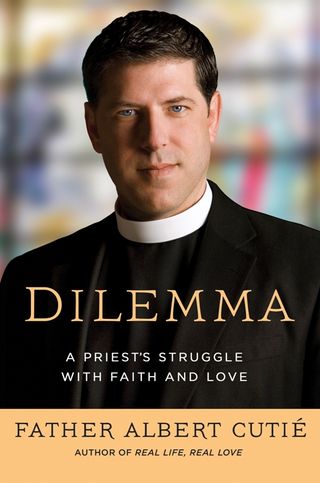
Father Albert himself, the host, was not supportive of us either.  He just didn’t get it, he said.  He talked about counseling couples towards a strong monogamous marriage, and that adding people to our relationship is only dangerous in terms of STDs (which is a real issue) and ultimately destructive to any real intimacy.  My retort was that we have rules of safety about safe sex, our intimacy is enhanced by true openness and honesty about everything, and also that fact that our relationship is constructive; “what can be more constructive than adding value and quality to our lives” (or something very similar to that).

Had we more time, I would have liked to make distinctions between polygamy of the kind that one of the other guests experienced and the polyamory–the loving, open, and honest relationship–that Ginny and I have.  The other people I have in my life that I am interested in pursuing some kind of romantic and/or sexual relationship (they are few, and I think they know who they are), are not being told that this is some divine command, they are not 15 years old, and I am not their superior.  We are equals; adults deciding to pursue relationships which mean something to us.

The bottom line, I think, is that our culture understands what monogamy is.  Even if it is serial monogamy, the idea is simple, feels comfortable, and is usually assumed by most of Americans.  Our culture is becoming more familiar with what polygamy is (at least in terms of the FLDS churches).  And even when they have a more positive model, say like in the show Big Love (which I have seen and like, to some extent), there are still problems such as the fact that it is always men with multiple women, and never the other way around.  Even when you have a Bill Henrickson who genuinely cares for his wives (Big Love), none of them are allowed other lovers.  This is an inequality borne of religious patriarchal thinking, not of genuine open-mindedness and desire to add love and joy to your life without social constraints which are ultimately based upon a relationship model borne out of a property relationship.  So, in our culture non-monogamy is probably associated with male domination of women, even if we can point out the occasional (even if only sometimes fictional) loving counter-example of such.

Polyamory is about treating all adults as, well, adults.  It is about deciding how you want to live your life, with whom, and being open and honest about our desires.  We, as a culture, are so far from understanding the implications of this that a term like “polyamory” just does not have a mental category in which to sit for most people.  Yes, if I had been given a 20 minute segment on the show to talk about polyamory, define it, and give examples and have other people, women and men, talk about the freedom, care, and rewards of living such a life then at least some people would begin to see what it is all about.  But that is not what happened yesterday.

When he introduced us, it was in terms of “here is a man who may want to get married, but he will still want to date other women.”  And not “here are two people who are in love, are committed to each other, have a healthy relationship, and who may have other lovers, boyfriends, and girlfriends.”  The former is based upon tropes common to our culture, the latter is not.

That idea is just too far removed from talk-show America.  And just like the term atheist, which is getting more press and is becoming more accepted (slowly), polyamory is a term that many think we just can’t use right now.  But with time, effort, and some patience (but not too much patience) that will change.

Going to New York to be on Father Oprah


So, apparently some Catholic priest by the name of Albert Cutie left the church to marry his girlfriend.  I vaguely remember this story from some news site a while back, and put it out of my mind; it didn’t seem that important or interesting.  I’m certainly not against people leaving the Catholic church.

But now he has a show.  It is being market-tested in New York and Los Angeles, on FOX, and it is essentially a talk show a la Oprah.  In fact, his media nickname is “Father Oprah,” and his show will be at least partially inspired by her show.  I just hope his staff is not as problematic as Oprah’s has been. In any case, here’s a blurb I found about it where you can get free tickets:

Father Albert Cutié. He helps guests solve dilemmas and resolve conflicts by drawing on methods honed from personal experience, extensive theological training, and thousands of hours spent hearing confessions and counseling couples.

So, what does this have to do with me? Well, I’m sure that the title gave a non-so-subtle hint; my girlfriend Ginny and I will be going up to New York today to do a show recording tomorrow.  They are doing an episode about relationships, and wanted someone to represent an alternative relationship style.  At least I hope that is why they want us there….

So, now the question is what should we expect? Will it be a hostile environment? Will Father Cutie (who is now an Episcopalian priest rather than Catholic) try and ‘help’ us with our ‘problem’?  I just don’t know.  I hope to be able to present an alternative lifestyle and perspective about relationships that will be useful to people.  I hope to not make an ass out of myself, too.

But mostly it will be awesome to get a trip to New York, travel and lodging paid for, and to have a great story to tell one way or the other.

Here’s an interview with Father Oprah that I found online.

This is what an atheist looks like!


I’m working on a new project.  It is just in the initial stages right now, but I have been giving it some thought over the last couple of weeks.  It will be very different than what I do here, and it is not geared towards the atheist community.  I want, eventually, to reach a very different audience than I am reaching for here.  It will require some shift in tone and tactics, but I welcome the challenge.  I’m sure that there will be a time of adjustment where my tone will vleed from what you see here to what it will be.

It will take time.

If it is something that interests you, then i invite you to follow.  If you think it may be something of interest to family, friends, or enemies, link them to it.  I hope to write daily, or at least nearly daily, about observations from an atheist point of view.  Things that would be less interesting here.