Human, gamer, philosopher, godlike being, atheist, nonmonogamous, pariah, contrarian by nature, probably occasionally right human who writes nonsense to very few people.
Some people come here only to downvote my posts. That seems sort of ridiculous, right?
The WordPress.com stats helper monkeys prepared a 2012 annual report for this blog.
Here’s an excerpt:
19,000 people fit into the new Barclays Center to see Jay-Z perform. This blog was viewed about 110,000 times in 2012. If it were a concert at the Barclays Center, it would take about 6 sold-out performances for that many people to see it.
I just noticed that this post was my 360th! That is how many days are in 1 tun! (See here for details about what this means). That must mean something significant, right?
According to some, the world is about to end on December 21st. Of course, those people are pretty ignorant.
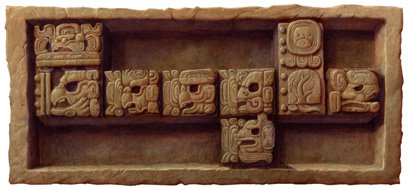
You see, the Mayan calendar “ends” on that date. I use the quotes there because the Mayan concept of time was more cyclical, and all that will happen is the Mayan long count will reach the date 13.0.0.0.0, the end of the 13th baktun, which will mean, well, nothing really.
But today I’m not going to find a bunch of nut jobs to quote and rebut concerning this stupd “prophecy,” while making comments about how skepticism is da shiznit. Today, I’m going to post what was a paper about the Mayan Calendar and their concept of time. This was written in the Spring of 1998 (long before anyone was making a fuss about the 2012 issue, I think, so it does not come up in the paper), and was completed and turned in on April 20th, 1998; or what was the Mayan date of 12.19.5.2.1.
I will not blame you for skipping this one, as it is fairly dry and is after all a term paper from a college sophomore. But in case you wanted to learn a little something about the Mayan calendar, here’s one way to do so.
I have made some minor edits, and included some images.
—-
Time and the the Mayan Calendar
Introduction:
We can admire the Maya for many things including their monumental temples and their wonderful hieroglyphic writing found on countless Stelae and other monuments throughout the Yucatan lowlands and Guatemalan highlands. But when we study the Maya in depth we discover that they had very old and very solid roots in things like agriculture that dealt with religious rituals and seasonal changes. Related to these things very directly were a complex set of calendars and time keeping systems that acted as a axis for all of their religious and secular activity. The Maya had calendars—plural—meaning that not one system of time-keeping was used, but three (maybe four, depending on how technical we want to be). These different time-keeping mechanisms were based on different cycles and were not alike in most ways but were related in very clear-cut and significant ways.
Of the three time keeping devices, the two calendars that were used were the sacred 260-day calendar—tzolkin—and the 365 day calendar known as the haab. Both were very different from our Gregorian calendar in structure as well as mechanics and combined to create a cycle of 18,980 days, slightly less than 52 solar years (Meyer 1). This 52-year cycle in known as the calendar round to the Maya and is significant because it is the amount of time that the tzolkin and the haab, running in unison, will not repeat. In a sense, the calendar round worked for the Maya like the century does in our calendar. The third time keeping method of the Maya is the Long Count dating method. When dates are found in Mayan sites the date is recorded using this method, along side the tzolkin and haab dates, which allowed us to coordinate the systems for our understanding.
The last mechanism worthy of mention is the very specific calculated solar year of 365.2422 days which is mentioned here to establish that the Maya were very aware that their 365-day haab, also known as the Vague Year, was not perfect in calculating the solar year. However, the Maya made no attempt to account for this difference by use of a leap day as we do because of the delicate relationship between the haab and the Tzolkin. If every four years another day is added to the haab, then the cycles of the year bearers (that will be discussed later) and their significance to the Maya would disappear. It is also important to note that despite the fact that the Maya did not use a leap day, they were very aware of and measured closely the effects of this decision, i.e. the accumulated change in seasons as the years cycled (Thompson 121).
Throughout this paper I will be using Mayan names for the days and Uinals (20-day “months”) in the Yucatec language as recorded in Sir J. Eric S. Thompson’s book, Maya Hieroglyphic Writing (pages 68, 106 respectively) and sometimes followed by the Quiché equivalent, found in Tedlock’s book on page 89, in parentheses. Example: Yucatec (Quiché). This will be done as to not confuse the different spellings or words used to express the same days or Uinals in different languages. The other names of days from the other Maya languages are included in the attached section #3.
The Mayan conception of time was by no means elementary or simple; “Mayan astronomers at Palenque were recording calculations which sweep more than 1, 250, 000 years into the past, and then foreword to dates over four millennia in the future” (Thompson 141). It is a controversial topic of whether the unit of time for the Maya was the day or the tun (360-days). If it was the tun, which can be vaguely called a year, then the kins (days) and Uinals (20 days) are just fractions of this basic unit like minutes and seconds are fractions of an hour. From the evidence that Thompson gives us in his book it seems as if the tun would be the more likely candidate for the unit of Maya time because of the large scale view of time that the Maya held—they seemed to think bigger. In his discussion of he Long Count Eric Thompson believes that the unit of time was the tun on the grounds of evidence such as the Chilam Bilam and other sources that refer to time periods in years more and more and days less and less. Also, as he states, if the Maya count were based on the day then “it would be logical to expect a straightforward vigesimal system with a year of 400 days” (Thompson 141-142). But as I will point out, the Maya did not use a pure vigesimal system, and they did not have a calendar of 400 days.
The Long Count:
The Long count was based on a vigesimal counting system, that is, a system of counting based on 20 instead of the decimal system we use. As the system is difficult to understand, and as I write this I find it harder to describe, I will use a description used by John Major Jenkins in his article Introduction to the Mayan Calendar:
It is written using dots to indicate placement values (for example: 8.15.6.0.4). The leftward placements are of higher value. The Long Count dating method is based on a hierarchical day-count based on twenty. The above date represents the passage of 8 baktuns, 15 katuns, 6 tuns, zero uinals, and four days since the zero date (Jenkins 5).
Here is an adapted version of the table that Jenkins provides for us on the same page:
Long Count Periods (read right to left)
Number of Days
1 kin = 1 day
1
20 days = I uinal
20
18 uinal = 1 tun
360
20 tuns = 1 katun
7200
20 katuns = 1 baktun
144,000
13 baktuns = 1 Great Cycle
1,872,000 (around 5,125 years)
And compare it to a pure vigesimal system:
Placement of number (right to left)
Number of days
1 (comparable to the kin)
1
2 (“ “ “ Uinal)
20
3 (“ “ “ tun)
400
4 (“ “ “ katun)
8,000
5 (“ “ “ baktun)
160,000
As the tables above show, the Mayan Long Count, although based on the vigesimal counting system, is not a pure vigesimal system. The system of counting was altered slightly from the system used for counting objects as Peter Meyer reaffirms in his article The Maya Calendar:
When counting days, however, the Mayas used a system in which the first place [starting from the right] (as usual) had a value of 1, the second place had a value of 20, but the third place had a value not of 400 (20*20) [as a pure vigesimal system would] but of 360 (18*20). (This may have been due to the fact that 360 is close to the length of the year in days.) The value of higher places continued regularly with 7,200 (20*18*20), 144,000 (20*20*18*20), etc. (Meyer 1).
Based on the Mayan counting system, the Long Count dates events by stating how many days have passed since 3113 or 3114 BC (this depends on whether we use the Julian or Gregorian calendar, respectively). This dating method is used instead of the combination of the tzolkin and haab dates because the calendar round will repeat every 52 years, making the combination of a tzolkin and haab dates insufficient for dating events because any date, for example 1 Imix 2 Pop, will occur every 52 years or so, meaning that seeing this date on a stele will not tell us which revolution of the calendar round the event occurred, but only limits the possibilities to days that occur every 52 years.
Tzolkin:
“The Tzolkin, Mayan name derived from the word tzol which means “to put in order”, and kin that means ‘day’ (Imagenet. Origins, p. 1).” The Tzolkin calendar is the more complex and unfamiliar to us as compared to the haab and was under the control of certain individuals, called “daykeepers,” who had the responsibility of keeping track of the days and performing the rituals associated with them. Overall, the Tzolkin seems to have been a “divinatory almanac,” as Eric Thompson calls it in his book, meaning that it was used as a basis for predicting the future and what we might call fortune-telling. The days were actually considered gods or lords that carried the burden hence ruled each particular day name. Life surrounded by the Tzolkin was “not monotonous” says Thompson, the days followed “in unbroken succession, each bringing its charge of weal or woe” (Thompson, p. 66).
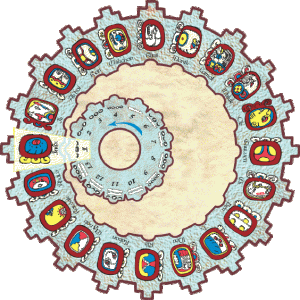
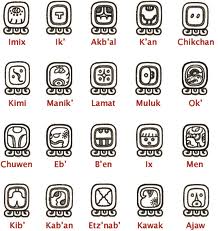
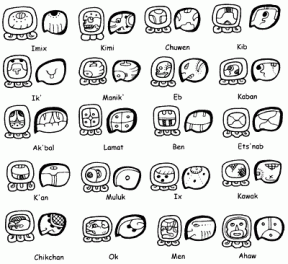
The Tzolkin was broken up into 13 day numbers and 20 day names. Here is the list of days and their equivalent names in the Quiché language. The numbers are present to list the sequence, do not confuse them with the day numbers mentioned above:1.Imix (Imöx)
Mayan glyphs for 20 day names
2.Ik (Ik´)
3.Akbal (Ak´bal)
4.Kan (C´at)
5.Chiccan (Can)
6.Cimi (Came)
7.Manik (Quej)
8.Lamat (K´anil)
9.Muluc (Toj)
10.Oc Tz´i´
an alternate set of glyph images for the same day names
11.Chuen (Batz´)
12.Eb (E)
13.Ben (Aj)
14.Ix (Ix)
15.Men(Tz´iquin)
16.Cib (Ajmac)
17.Caban (No´j)
18.Eznab (Tijax)
19.Cauac(Cawuk)
20.Ahau(Junajpu)
The day names and numbers were indistinguishable from one-another as a single functioning unit with its own meaning and character. “The combination of number and day was a unit, and one part was as meaningless without the other as a telephone number is without the name of the exchange” (Thompson, p. 66). The day 13 Ahau, for instance would not be called 13, or Ahau because one without the other would be incomplete. Having one without the other is like me telling you that to make a cake you needed a half cup or saying that you needed sugar; if I gave you one then you would need the other to make sense of the directions. But despite the fact that a certain day is not identified by its name alone or its number alone, it is also clear that the day name, which is the name of that day lord, has a certain significance that differs from day to day and is separate from the number. Each day lord has his own characteristics and one day may be very different from the previous or the following. This relationship between the day names and numbers and their significance will be expanded when I discuss divination. The concepts of the advance of day names and numbers will become more clear when we establish how the mechanics of the Tzolkin works.
The numbers and days advance in unison; that is, the day name and number advanced on the beginning of a new day instead of the number advancing through what we would call a month. For instance, if today were 1 Manik then tomorrow would not be 2 Manik, but it would be 2 Lamat. This is because the day name Lamat follows the day name Manik in the sequence of days, and 2 follows 1. When, as the days progress, the number reaches 13, then the next day would be numbered as 1. And the last day arrives, then the names repeat in the same sequence from the beginning. This cycle continues indefinitely along with the haab which also cycles endlessly.
The major problem with the 260-day calendar, and to some extent the haab as well, is that there is no identifiable beginning. The Mayans saw time in cyclical terms, there is no beginning or end, it is just the kins, Uinals, tuns, and katuns rolling through time in an endless cycle.
A. . .major controversy about the 20-day calendar concerns the beginning day of the cycle. Central Mexican lists of the twenty day names usually begin with [Imix]. . .but the Mayan picture is less clear. Morley noted that ‘since the sequence of twenty day names was continuous, it is obvious that it had no beginning or ending, like the rim of a wheel: consequently, any day name may be chosen arbitrarily as the starting point.’ (Morley, Sylvanus. An Introduction to the study of the Maya hieroglyphics.)
Despite the lack of absolute evidence for a day that begins the cycle, it is relatively accepted that Imix is the beginning day of the cycle and that the accompanying number would be 1; hence the first day of the Tzolkin is accepted as I Imix (Thompson 102, Tedlock 94). Whether or not this day actually was seen by the Maya as the beginning of the Tzolkin is something that will be argued over and may not ever be known for sure.
While talking about beginnings, it is appropriate to discuss the origins of the Tzolkin itself. Nobody is sure why the Tzolkin developed the way it did. The theory that I most widely encountered, whether in proposing it or attempting to discredit it, was that the 260-day period is very close to that of the human gestation period. Eric Thompson is a critic of this theory, saying that it “is not a very happy explanation because there is no logical reason why the period of pregnancy should be considered in establishing a divinatory almanac” (Thompson, p. 98). But despite Thompson’s critique, the theory is held by many to be reasonable and is held in veneration within the community of Mayanists.
Another prominent theory is that the 260-day period is the amount of time that the sun is south of the zenith of the latitude 14º 30´ (a little south of Copán). The problem with this theory is that this exact latitude does not accurately represent the whole of the Yucatan peninsula and the Highlands. In Some places in Yucatan the sun would be south of this zenith on as many as 311 days of the solar year (Thompson, p. 98). Thompson states that one “must Assume then that the cycle of 260 days originated on the periphery of the area in which it was current, and that, spreading northward and westward, it was eagerly adopted by peoples for whom it had no solar significance” (Thompson 98). This is the same as saying that the tzolkin was developed by someone living along the 14º 30´ latitude and spread throughout the limits of Mayan influence and accepted as it was.
Other common answers to this problem include that this cycle was created because it is the least common denominator of the numbers “13 and 20, both of which are important in Mesoamerican thought” (Tedlock 93). One version of this I found on line and sounds like this:
The time count used for corn cultivation must have been based on the initial Maya numeration which consisted of the number of fingers on both hands and feet or the number 20, a kal. The observation that 13 kal (260 days) were needed from the choosing of the location for the milpa until the burning of the felled forest patch and equal number of kal elapsed from the planting, through the growth and harvest until the corn was stored, gave origin to the first Maya calendar. (Imagenet. Origins of the Mayan Calendar, p. 1)
This may seem reasonable, but I am wary of lending this idea credibility because the idea is not sourced, hence it may just be speculation.
The most interesting [if not far-fetched] idea to me is this one from John Major Jenkins’ article;
The 260-day cycle does not directly correspond with any known astronomical period, yet it serves as a common denominator to synthesize the cycles of Sun, Mercury, Venus, Moon, Earth [and] Mars (as well as the other planets). In essence, it is the key factor of all the planetary periods” (Jenkins 2).
It seems that the Mayan knowledge of astronomy was significantly advanced in calculating the movements of the massive bodies in our solar system and that the Maya may have used this knowledge to develop an unusual calendar.
The last theory of the tzolkin’s origin also deals with astronomy. Barbara Tedlock mentions “that a double tzolkin (520 days) equaled three eclipse half-years” (Tedlock 93). If I interpret this correctly then I conclude that this means that two tzolkin years would be the same time as one and one-half revolutions of the (lunar or solar?) eclipse cycle. Knowing that the Maya did calculate and predict eclipses, this theory is possible as well as the others. Whether any one of these theories, all of them (in parts), or none of them is correct, we at least have a good idea of what the Tzolkin was used for after its creation—a tool for divination.
Divination and Meaning of the day names and numbers:
Divination was believed, by at least some Maya, to involve the predicting of the future and fortune telling. The process itself is not particularly significant in this discussion because it would lead into too many directions that would go beyond the scope of this discussion of the calendars. What I would like to do is describe how the day names and numbers had significance when they were used for divination purposes. As I mentioned, each day name was considered to be a god to the Maya, and that as Thompson states they cannot be separated from the numbers and make any sense. However, in her study of the Quiché people and their rituals Tedlock disagrees with Thompson’s statement that day names and number were not separated based on the fact among the Quiché, “low numbers—1, 2, and 3—are ‘gentle,’ while the high numbers—11, 12, and 13—are ‘violent’” (Tedlock 107). Generally, what this means is that the higher the number along with the day name, the more serious or more severe the meaning of the day name and vice-versa relative to the value, good or bad, of the day god.
I will not describe all 20 days but will focus on how one day name—Imix–is evaluated from two different texts (Tedlock spends a whole chapter on the 20 days that is longer than this paper, thus I am doing myself and the reader a service by not discussing all of them). The mnemonic meaning that Barbara Tedlock discusses refers to her discussion of the meanings and associated phrases among the Quiché people of the Guatemala highlands. As she says in her book, “in actual practice the names [of days] are ‘read’ not as words in themselves but as a kind of oral rebus for quite other words; these other words are linked to the day name by means of paronomasia—that is, by means of poetic sound play” (Tedlock 107). In considering this, we must be aware that Tedlock’s study of the day names comes from her experience with more modern-day highland descendants of the Maya who do not share the same words as the majority of the Maya whom Eric Thompson discusses in his book. Thus, we must be aware that both of the discussions of the day names are coming from two different researchers getting their information from different places and times recorded in different languages.
Imix, according to Thompson, means the earth crocodile “whose back formed the surface of the earth” (Thompson 73) or more generally the earth and the abundance that is related to the earth. Thompson believes that this is due to the fact that the Quiche (possibly the same as Tedlock’s Quiché) associate Imox (their name for the day) with the earth god Mo´x. Whether this association is fortuitous or the two words have a common origin is unclear although Thompson seems to agree with the latter of the two possibilities (Thompson 71). The Mexican equivalent to Imix is Cipacti which symbolizes the earth crocodile. The word Cipacti itself translates loosely into “spiny creature” and the Aztec word for this day also means crocodile. The word Imox, which is similar to the modern Quiché word for this day, refers to the ceiba tree which symbolizes the abundance of mother earth in Maya religion. Thus, it seems reasonable to say that Imix at least vaguely represents the earth and hence the earth crocodile (Thompson 72-73).
Tedlock’s equivalent word for Imix is Imöx (Quiché) and she gives a different description than Thompson does. Tedlock’s approach is to break down the word into its “mnemonic phrases” and describe when the rituals are performed according to the number of the day. How she connects the word Imöx with the phrases “camöxiric (‘one becomes crazy’), nimalaj c´ulel (‘a big enemy’), and cumatz rib chiquiwäch Mam (‘humble oneself before the Mam [year-bearer]’)” (Tedlock 125) is unclear to me, however. The number of the day along with the name further defines the meaning of the day. Some of the rituals involved with this day are dependent on the number; according to Tedlock, on day Imöx numbers 1, 6, and 8, a daykeeper, someone who keeps the 260-day calendar, visits an appropriate public shrine and humbles himself or herself before the Mam (year-bearer) as to not be dominated by their power (which makes one go crazy). On high numbered Imöx days the diviners go to mountaintop shrines to present themselves to the Mam, asking the Mam to dominate persons, in the form of mental and physical sickness, who have used witchcraft against others—hence the “big enemy” (ibid.)
When divination is being performed the day Imix, say in the case of divination for an illness, indicates that an enemy (c´ulel) has asked a diviner for the illness to be put upon you (probably from a shrine on the top of a mountain on a high numbered Imix day). In a marriage divination, the presence of Imix indicates that the desired woman would cause the client to become crazy through unfaithfulness or other malign action (Tedlock 125). A final example of how the day names are used in divination is that a “child born on Imöx will be dominated by the power of the Mam. As a result, he or she will be weak, inefficient, undirected, even insane” (ibid. 126). It is relatively easy to see that the divinatory calendar was and still is highly interconnected with daily life and Mayan thought. It was not like the haab, which is almost purely a secular system for counting days [a separation of religious and secular calendars].
The Haab—365-day calendar:
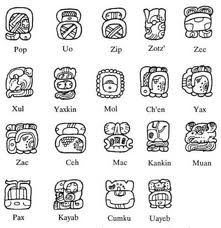
The word haab is also referred to as the vague year and seems to mean “cycle of rains” (Jenkins 2). Unlike the tzolkin the haab is more like the Gregorian calendar than the tzolkin is in that the haab is broken down into what we could call months consisting of numbers for days. The haab is a 365-day cycle that is divided into 18 Uinals of 20 days each and a short month called Uayeb 5 unlucky days added, usually, to the end of the year. The word Uayeb means “unnamed” and therefore the 5 days are not named but do include many rituals. Each Uinal name has its meaning much like the days of the tzolkin do as we saw with my example of Imix. Here is a list of the Uinals starting with Pop, Uo, Zip, etc. which is where most people seem to start the haab:
Pop
Uo
Zip
Zotz
Zec
Xul
Yaxkin
Mol
Ch´en
The Burden (see below)
Yax
Zac
Ceh
Mac
Kankin
Muan
Pax
Kayab
Cumku
Uayeb (5 days)
Like our calendar, each Uinal starts on a day and continues until all the 20 days are through then moves to the next month. The problem comes about when we start looking into the numbers and what the first day of the month is. This has to do with what is referred to as the “seating” of the month.
As Eric Thompson discusses, most Mayan scholars have accepted that the first day of the Uinal is denoted as 0 Pop, 0 Uo, etc. This view holds that the day after 19 Pop would be 0 Uo and this would be the seating of the month. Thompson has quarrels with this on the basis of evidence that he has seen and discusses in depth in his book. “From all we know of the Maya philosophy of time and from all we can gather from the glyphs, the Maya were interested in recording the completion of time” (Thompson 119) is how he begins the argument. He concludes that “the days of the months were numbered 1-19, and that the day between the nineteenth of one month and the first of the subsequent month was usually called the seating of the new month, but sometimes was called the last of the old month. It is possible that ‘seating of’ is not the correct translation” (Thompson 121). What this means is that the seating of a month may not have been part of new the month at all but may have been the end of the last month even though it carried the name of the next month. Another way to look at it would be to view the seating as more like a transition, or as Thompson himself suggests, an “entrance of.” The question is, what exactly is entering in which the Maya were greeting? This problem makes deciphering the rest of the intricacies of the calendars even harder, especially the year-bearer problem that will be discussed in a few moments.
At the beginning of this paper I mentioned that the Maya were aware of the actual length of the solar year (365.2422 days) and that they did not attempt to correct for the difference by the use of a leap day. Eric Thompson tells us that “[s]uch a correction would have played havoc with the whole orderly plan of the calendar and would have disorganized the elaborate system of. . .different time cycles, which were of the highest importance for divinatory and ritualistic purposes” (Thompson 121). But not only would it cause problems with the divinatory aspect of the calendars, it would have caused problems by throwing off the year-bearer every 4 years.
The Year-Bearers (Mam) and the concept of Burden:
The year-bearer is the tzolkin date that falls on the start of the new haab year, which is the seating of Pop (0 Pop) or the first of Pop depending on whom you ask.. Because of the way that the haab and tzolkin correlate with each-other, only 4 day names from the tzolkin can fall on the beginning of the haab. Depending on how the two are calibrated, the 4 day-names will vary, again, depending on whom you ask. The standard system, according to Thompson, had the first of Pop (as 0 Pop could be interpreted as the last day of the old year as I discussed earlier) as only coinciding with the day names Akbal, Lamat, Ben, and Etz´nab. But supposedly “in parts of Campeche and Yucatan a shift took place, as early as 9.12.0.0.0 [around July 1, 672]. . .and was apparently accepted generally in Yucatan in the sixteenth century” (Thompson 124). The change then made the days Kan, Muluc, Ix, and Cuauc the only names that fell on the first of the year. Tedlock gives the set of year-bearers used today in present-day Guatemala highlands among the Quiché; Ik (Ik´), Manik (Quej), Eb (E), and Caban (No´j) which is one of the sets that Meyer gives in the third chapter of his article.
Meyer gives the same three sets in his article that Thompson and Tedlock give together in their books. He mentions the Kan-Cuauc set that Thompson does but Meyer offers it as the result of the coming of the Spanish when the people of Mayapan “began to number their months from 1-20, instead of from 0-19” (Meyer. chapter 3, p.1) which may have been the same cause that Thompson mentioned because Thompson didn’t give a reason and Meyer only gave us a clue of the date (before the 16th century). This shift caused the set of year-bearers to change from the original Akbal-Etz´nab set to the Kan-Cuauc set just as the shift that Thompson mentioned caused. Perhaps the Spanish were the cause of this shift in the calendar when they arrived and as a result we are now having problems being sure what set of year-bearers is the correct one—assuming any one was correct.
It turns out that the set that one uses as the year-bearers depends on the month base being used, that is what the start of the month is, 0 or 1. The confusion seems to be related to uncertainty about the seating of the month, which is then transmitted to the seating of the year. It is best to let Meyer explain:
Some scholars. . .state that the Dresden and Paris Codices use the Akbal/Lamat system of yearbearers. This results from interpreting ‘the first of Pop’ to mean 1 Pop rather than 0 Pop. . .Thompson adduces some evidence that the 0 day of a month was really the last day of the preceding month, so that 0 Pop was really the last day of the old year, not the first day of the new year, but suggests that the Mayas themselves. . .may have become careless in drawing such distinctions. Be it as it may, the system of yearbearers used [here] interprets the 0 day of a month to be the first day of that month, implying that the system of yearbearers used in the Dresden Codex is Ik/Manik and not Akbal/Lamat. (ibid. p. 2).
Due to the lack of clarity in the issue of where the month is seated and the shifts that the Maya implemented in the calendar correlation’s, the problem of the year-bearer is also unclear. The sets used differs from place to place and I am only sure that the present-day Quiché use the Ik/Manik set.
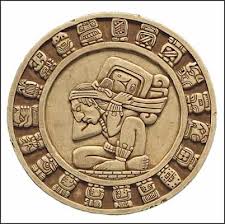
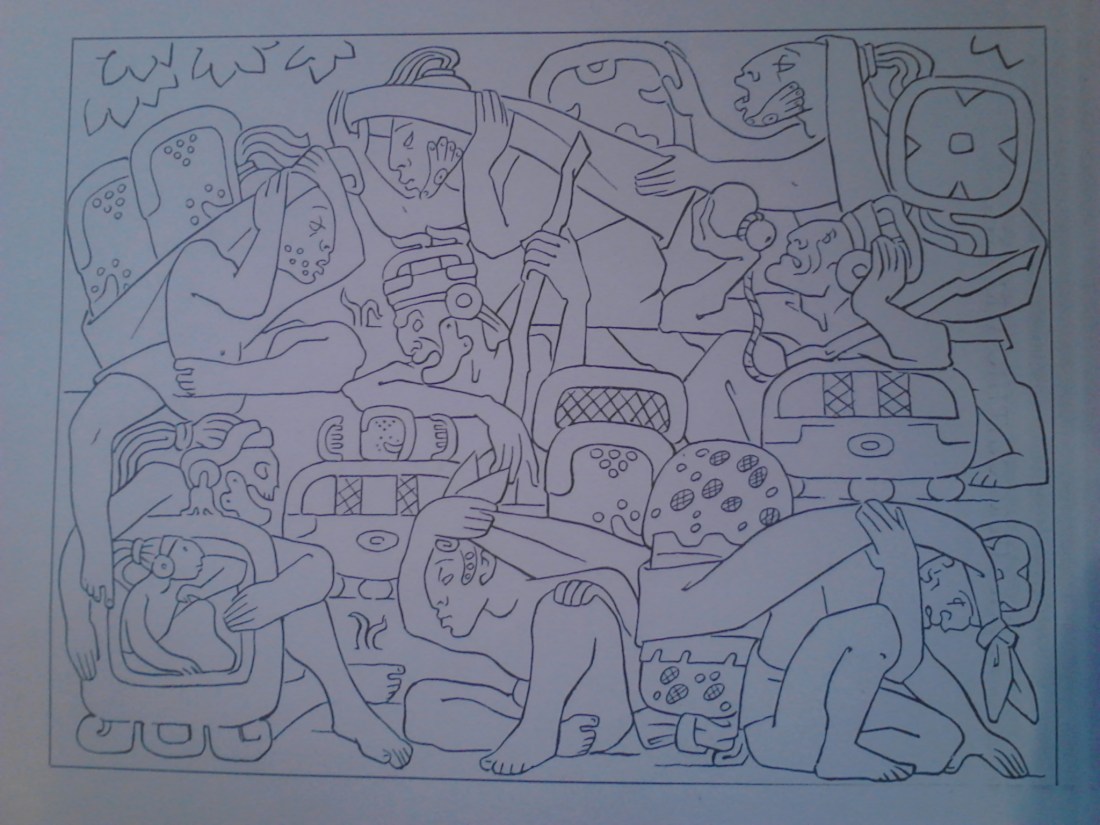
What we are sure of is how the Maya saw the year-bearer as having to carry the burden of the year “as a load on his back” (Thompson 125). A drawing by Jean Charlot is included in Thompson’s book that is adapted from full-figure glyphs that, quoted from the drawings label at the front of the book, “represent arrival at the lub, ‘the resting place,’ of the deified numbers bearing the periods as loads, at the completion of the tun” (Thompson, Frontpiece). This drawing (above) shows many year-bearers with the glyphs of day-names on their backs; some resting, others not. The significance of the concept of Burden of the year has to do with divination; the year-bearer’s characteristics will be associated with the entire year the same way as I described when discussing divination. The same influences of the names and numbers of the year-bearer will further define the characteristics of the year. As a year begins, the tzolkin date that corresponds to the start of the haab then becomes the name of the god that will bear the year on his back for that year until he reaches the lub. The number that was associated with that day when the haab began will further describe the influence of the day god. The higher the number the more severe the lower the number the less severe. But of course this severity is relative to the value, good or bad, of that particular day god. A lower number of a good day god is not a good sign and vice-versa.
A Brief Word about the Venus Round:
Venus has a cycle of 584 days, says John Major Jenkins, which means that it will “rise as morningstar approximately every 584 days” (Jenkins 3). The round that is associated with Venus occurs when the tzolkin, haab, and Venus cycles all fall in unison. This happens every 104 haab and is known as the Venus round. This round holds importance to the Maya but must be kept short here as to not step on the toes of astronomy.
[This latter comment was in the interest of not being repetitive. We students, back in 1998, were working as a class to cover many Mayan topics, and excessive discussion of astronomy would have been redundant with the work of the other students, who we were presenting these papers for]
Conclusion:
To sum what has been said in these pages it is important to emphasize that the Maya thought in terms of cycles. Each calendar was a repeating cycle in themselves and all of the time-measuring systems that the Maya used combined to make many rounds such as the 52-year calendar round, the 1,872,000 day Great cycle formed by the long count, and the Venus round of 104 haab. The tzolkin’s importance lies in the complex divination practices that the Maya seemed to live for and the day lords that came in and out with the change of each day. The tzolkin is made up of 20 day names and 13 day numbers that are inseparable in defining what day it is but not in what the day means. Divination was practiced by interpreting the day names and numbers, and on certain days of the tzolkin year rituals where performed at shrines. The 18 Uinals of the haab act like months with 20 days each with an added short month of 5 days called the Uayeb. The year-bearers carry the tuns (ok, pun intended—but the Maya would have loved it!) from year to year and never seem to complain a bit about this burden. To see that the Maya knew so much about their universe and yet still found a way to collapse as a power should be a lesson to us though. If the saying is true that the bigger you are the harder you fall, then we, as the most “advanced” society in earth’s known history, better be careful as to where we are going.
8. Craine, Eugene R. (ed). The Codex Pérez and The Book of Chilam Balam of Mani. University of Oklahoma Press: Norman. 1979.
9. Tedlock, Barbara. Time and the Highland Maya. University of New Mexico Press:
Albuquerque. 1982.
10. Thompson, J. Eric S. Maya Hieroglyphic Writing. University of Oklahoma Press: Norman.
1960.
—
I know, not very sexy. To be honest, I don’t remember if I ran into any of the 2012 Mayan calendar stuff back then and ignored it, or if it did not exist as a thing then. In either case, nothing more really needs to be said about what will not happen on 13.0.0.0.0, also known to us as December 21st, 2012.
All I know is that I have work that day and the evening before I will have (probably) attended the atheist meetup.
In recent weeks, I have been thinking a lot about the question of the relativity of values. What do we value? Why do we value those things rather than other things? Might we be more content, happy, or more mature if we were to value other things? Can we change what we value? What the hell are “values”?
Today, I want to sketch out a rough analogy which may pave the road for future posts (or not, if the analogy breaks down or if it just ends up being a stupid idea).
In order for our bodies to function, we need to eat food. But the kind of food we eat, how much of it we eat, and how often we eat it will have an effect on the efficiency of that functioning, the body such a diet will maintain, and will effect our general mood and ability to accomplish various tasks.
In order for our brain to function as a contributor to our personality as part of a social landscape, it needs information. The kind of information it receives (especially early in its development) and how (and how often) we exercise it will influence what kind of mind we have. It will effect how we react to new or old information, what we believe about the world, and what we value.
In terms of our diet and our health, what we want to eat (both what we merely desire and what we think we should eat) is our set of tastes.
In terms of our worldview and moral inclinations, what we think and feel (both what we are inclined to and what we think we should believe and think right) is our set of values.
Desires and Wants
I want to make clear the distinction between what we unwillfully desire and what we want. If I see a piece of chocolate (especially dark chocolate), I desire it. My mind is inclined towards eating it, and it is by act of will (free or not) that I either eat it or I do not. My set of beliefs, values, etc will be responsible for that decision.
In terms of values, there is also a difference between my unconscious, automatic reaction to information and my conscious deliberation about information with emotional content. It is unconscious and automatic that I feel annoyance, even disgust, when seeing an obvious injustice perpetrated by someone against others (an unequal set of behaviors based upon a logical contradiction, for example; a violation of Kant’s categorical imperative as one rationalized example). But there is a difference between that feeling of annoyance or disgust and my subsequent deliberation about that behavior. I, for example, have a visceral feeling of annoyance, sometimes leaning on anger, at seeing some level of clutter (especially if ignored for some time). But rather than start Hulk-smashing (which just creates more clutter) I take a deep breath and remind myself that this anger is not rational; that I can either clean it, ask the person responsible to be aware of this emotional response I have and request they clean it, or I can distract myself with another task or activity (and hope it will be remedied in the mean time).
That is, what I desire to do when seeing clutter is to express my anger at the person responsible (a symptom of my personality disorder), but what I want to do is motivate my behavior towards healthier solutions, with the long term goal of correcting the automatic reaction to doing those more pragmatic solutions. I do not merely bow to my destructive desires, but try and re-orient my emotional reactions to something healthier, and over time it works with diligent effort. It has become essential and necessary for me to do this every day, and sometimes it’s easier than other times.
Similarly, what I desire is to eat salty snacks, chocolate/ peanut butter, and low fat wheat thins ( much better than the regular ones, IMO) while drinking a couple of delicious beers. I desire sweet, salty, (low) fatty foods all the time, but what I actually eat is much more healthy and I feel better because my wants govern my desires. They don’t repress or stifle them, but I feel that mitigating the effect of my desires is wise.
Authenticity
There are things that we desire and want. There are also social structures around us, with many competing (and sometimes harmonizing) ideas about how we should behave. Some of those ideas tell us to repress or even eliminate certain desires, because those desires are wrong.
But I think that we need to accept our desires as a given, and decide how we want to act while 1) not pretending those desires don’t exist 2) trying to find a way to express these desires in ways which do not non-consensually harm others and 3) not allowing those desires to consume our life such that we ignore what else we care about. These guidelines can be applied to conservative religious repression of homosexuality, social stigmatization of our innate sluttiness, or even the use of drugs (including alcohol). If you are gay, bisexual, or asexual, then you should find the ways you want to express those sexual inclinations. If you are slut, then you should be a slut. If you like a drug, then if you can do it without it being destructive to the world around you, then do it.
In short, we need to start deciding how to behave, what to believe, and what to value by being authentic. We cannot ignore the truth, even if we don’t like the truth. Because in many cases, the part of us that doesn’t like the truth is a part of us that is either broken or was imposed by an exterior idea (such as conservative moral views). We should care about what is true about our desires, and form our wants based upon those truths.
In Case Your Values are Wrong
If you find yourself living in such a way where you have desires which are unrealized, then you need to ask yourself why they are unrealized. If you go to church regularly and find yourself plagued by skeptical questions in response to what a religious authority says, then you might need to seek out alternative views. If you are in a monoamorous relationship but find yourself attracted to others, and even thinking about acting on those desires, then you might need to reconsider how you think about sex and relationships and consider some sort of nonmonogamy. If you can’t just have a couple of drinks, are getting high every day, or even if you never tried getting high but are curious about it but have always been afraid, then you might want to reconsider your association with those things.
There are diets which are good for us, others which are not. There are values which are good or us, and those which are not. How do you know that your values, your emotional relationship to the world, are the best set of values for your inclinations? And even if they are, have you considered if they are damaging to people around you? (That is, are they moral values, rather than Randian selfish values?). Do you even care if your values affect other people in ways they don’t want? Also, if they do affect others in ways they don’t want, are their current values, with which yours currently conflict, wrong? If their values are wrong, how can you demonstrate this to them in a way that will not result in them being defensive, yelling at you, or punching you?
What’s more important; standing for the right values knowing that they might actually be ultimately wrong, even if they are better relative to other value sets) or respecting all potential values (even the obviously wrong ones)? Assuredness or accommodation? (some might call it “temerity or tolerance?”, but that’s simply the other side of the coin).
I don’t have an answer to that question which everyone will accept, or even one that convinces myself all the time. My inclinations, my desires, often tell me to stand convicted to what I value, because those values are best. But what I want is to actually have the best values, which requires a certain level of uncertainty and skepticism. I must perpetually challenge my values the way I challenge my beliefs, and thus my certainty about my values is proportional to the amount of beating those values take from challenges both external and internal. An unchallenged value is not worth much, yet an unchallenged value is worth everything to its owner.
That is, we should be skeptical not only about facts, but also values. I, along with people such as Hilary Putnam and (seemingly) Sam Harris, think that the qualitative distinction between facts and values is dubious. Therefore, I also think that the common moral distinction made in our culture between criticizing a person’s facts and criticizing their values is dubious. I do think that criticizing a person’s values is a harder task to do well, especially if we care about their likely defensive reactions, but it is not an invalid criticism. There is no logical contradiction to pointing out that values can be wrong, at least in the sense of not matching up with reality and what might provide optimal well-being, emotional maturity, and authenticity. People are too often attached to their values (as well as their facts), and this should not be accommodated.
In a similar way that what we want to eat (in terms of our health) is something that is subject to criticism, what we value (in terms of being a fully realized and authentic person) is subject to potential criticism. If you tell me that I cannot tell you what to value, I will nod in agreement with the fact that I cannot force values on you, but that I can tell you that your values may be wrong.
I do love DarkMatter2525’s videos, and this latest one is no exception. This is sort of brilliant.
The Christian story is disgusting and, from my point of view, immoral. And while I’m no fan of Christmas, it is greatly improved as an old Roman/Pagan holiday about the solstice, gift-giving, and merry-making.
A week ago I wrote a quick post about how I was reading Jonathan Haidt’s The Righteous Mind, and quoted a bit from early on in the book. I am nearly done the book (I have one chapter left), and although I liked much of the early book and think that some of what he thinks about the relationship between our moral instincts and subsequent rationalizations of them are worth reading, I must conclude that i am not on-board with Haidt’s approach to religion, especially his criticisms of the “New Atheists.”
In chapter 11, Religion is a Team Sport, Haidt tries to deconstruct the new atheist approach, following on his anti-worshiping of reason from earlier in the book, and says we need to address religion for what is is (a group selected set of community-building institutions) rather than what it is not (a set of beliefs, ideas, etc). He thinks that our attention to beliefs as motivators for action is too simplistic, and points out that “belonging” has to be placed along with belief and action, in the matrix of religious behavior.
Well, yes of course it does!
I don’t need to get into the details of what is wrong with the book, at least in terms of the criticism of the new atheists, because that has already been done:
I agree that there are parts of the book which are quite worth-while. I did just get it from my local library, after all, and didn’t spend a cent to read it. If you are interested in moral psychology, evolutionary psychology, and group selection (whether or not you agree with any of those research areas specifically), then I suggest reading at least the first several chapters.
But what was most telling was that Haidt kept on talking about the difference between what makes a group work well and what does not. His conclusion is that religion makes groups work well, at least for members of the group. Atheists who ask us to leave religion, as individuals or as a species, risk losing what Haidt sees as the glue that can hold us together.
Haidt is seemingly unfamiliar (due to lack of mention) with any new atheist thoughts past 2007 or so (the book was published in 2012). Perhaps the problem is that he is unaware that many atheists have been working, especially in the last 2-3 years, on building up an atheist community. No, we may not have anything sacred (not even science), but we are working on creating a sense of what it means to be skeptical, non-religious, and living in a world with potential for beauty and terrible atrocity.
Religion is not the only force for group-cohesion, even if it has the advantage of having sacred spaces, authority, and thus loyalty (what Haidt identifies as primarily conservative values). I believe that care, a concern for fairness/ justice, and a sense of liberty (what Haidt identifies as what liberals tend to prioritize) are means to creating community as well. We do not need to give up a concern for what is true (a value Haidt does not list, interestingly, especially because it is a high value for many new atheists, including myself) in order to create shared group identities.
Haidt, an atheist himself, is not connected to the atheist community. Perhaps if he was, then his arguments would not be so poor. Perhaps we should invite him to the party?
Politically, I tend to align myself with progressive thought. I generally like the idea of progress; moving towards an ideological target. But when I think more closely about the idea of progress as a concept, I think it lacks something important, and has some potential inherent dangers, when compared to the idea of a process.
One of the dangers of political ideologies is that very distracting idea of a target or set of social and political goals. Because while those goals may be based upon clear thinking, good values, and hopefully even empirically sound philosophical bases, the fact is that circumstances change and we may not notice if we keep looking at the destination.
See, progress is teleological. Process is methodological.
Teleology implies intention, design, and is associated with religious theology in many ways. The presence of intent and purpose, when it come to theology especially, might seem safe because the designer is often believed to be perfect, or at least optimally knowledgeable and powerful. But progress in the real world involves imperfect people, and so when we think about progressing towards some ideal utopia, or merely a better set of values and policies, we are almost certain to err. And if we are attached to the destination too strongly, we may not even see those errors.
Instead, we should be focusing on the process by which we solve problems and understand the world. Goals are nice, and often necessary to accomplish anything, but by focusing on the goal rather than the road we walk upon, we will lose sight of many things.
Many forms of religion, and religious thinking, suffer from this very problem. The focus on Heaven (or Hell) for many people is a prime example of this. Built into the worldview of many forms of Christianity, for example, are things like purpose, intent, and ultimate destinations for us in God’s plan. And even within the Christian world people will criticize other believers for focusing too much on the goal, rather than what God wants us to do here. By being focused on getting to Heaven (or avoiding Hell), many people are not doing many of the things here and now that they could, or should, be doing in this life.
And, of course, this leads to the common atheist criticism of religion; people’s focus on the afterlife, rather than this real life (the only one we have), leads people to miss all that we really have. But this mistake is prevalent throughout all of human groups, including some atheists. It’s one of the many imperfections with how our brains evolved, and I think we can all benefit from an awareness about what methods we use, rather than an ideological goal.
That’s what skepticism and science are good for. Because skepticism and science are not goals; they are methods. Granted, it’s hard to avoid looking at the potential horizon in our pursuit of the truth, but we need to make sure that how we think about those goals in the here and now, so we don’t get caught up in the dream rather than the reality.
Focusing on our process, our method, will make sure that we are on the right road, because all-too-often people find that the road they are one don’t lead anywhere; that the location in the horizon was a mirage, and the road (which they were not looking at) just goes in circles, or merely stops one day, nowhere near their illusory destination.
And there are many images of potential futures with science as our road (I’m looking at you, transhumanists). But we cannot live in the hope that those futures will occur. We can be inspired by them, but we have to live where we are. I’ve known Christians who miss too much of life because they are awaiting Heaven, and I have known atheists who let life pass by because they desire their cybernetic bodies or their mind to be uploaded into a different kind of immortality.
In my opinion, we all would be better off by making sure that the thinking we are doing today is connected to real goals and real life, otherwise we may be letting precious time slip by in the name of illusory goals. I want my goals to be attached to a skeptical worldview, utilized to make this life better for us and our descendants.
All of my distant goals and ideals are subject to change and revision because I keep my attention to what is going on around me, and thus my goals sometimes change.
Now, this is not the first time Bill O’Reilly and Dave Silverman have met up to create fireworks. Remember the tides thing? I do not know how much of Bill O’Reilly’s on-air personality is an act, or if he really believes what he says in segments such as these, but the things he says are believed by many people, perhaps (in some cases) because Bill O’Reilly says them.
So, O’Reilly claims that Christianity is not a religion, but is a philosophy instead. This is no different than the dozens of times I have heard Christians claim that their relationship with Jesus/God is not a religion, because religion is man-man and this is the truth.
Let’s start by granting that mere philosophical symbols and ideas are fair to display in government space. Much of what the Framers of the Constitution were doing, after all, is political and moral philosophy. Go to the Jefferson memorial and read the walls; that’s philosophy. Seeing images and carvings of Plato, Aristotle, or even religious and historically significant characters (such as Moses or Hammurabi) on government buildings is commonplace, because these figures play a part in our culture’s history—but so does religion, right? So what’s the difference?
A Buddhist Christmas?
OK, so let’s consider a non-Christian ideology such as Buddhism, which is fundamentally philosophical in many respects but also has many of the characteristics of a religion, especially where it is mythologized and supernatural components are included. Would an image of the Buddha, with some quotes from his attributed sayings, be fair game on government property? More relevant here, would Bill O’Reilly have an issue with such displays?
I do not knows what O’Reilly would think here, but my guess is he would be OK with it so long as it does not get in the way of his traditions. So long as Buddhists were not trying to usurp his holiday traditions, I don’t think he’d care. But should secular-minded people care? Should I care?
This is tricky, because the distinction between philosophy and religion is thin in many traditions, Buddhism included. I would say that insofar as any message on government property is not giving privileged or unequal support for any of the mythological, ritualistic, and supernatural aspects of any philosophy or religion, then there is no problem from a secularist’s point of view. That is, so long as Buddhisms presence in such spaces leans towards its philosophical roots, and not its specifically religious traditions, then I don’t think there is an issue.
But we’ll worry about that when Buddhists start becoming anything near a majority. So, probably never.
Unlike Buddhism, however, Christianity is clearly a religion. Yes, it contains elements of philosophy, but I am not sure any religious traditions do not include philosophical ideas. But the essential component to the overwhelming majority of Christian theologies is the relationship between humankind and “God.” Christianity is not a mere collection of rational concepts or methods about finding what is true, beautiful, or wise, it is a set of metaphysical claims about the nature of the universe which has many traditional rituals, stories, and moral teachings.
The major distinction here is the presence of theology. Theology is a type of philosophy–the religious kind–and so if a tradition has a theology it is clearly a religion.
To claim that Christianity is a philosophy is to amputate a significant portion of what it does for believers. Where a thinker such as Plato used logic and dialogue to make propositions and criticisms about ideas, Christianity does this but it does so much more. To imply that Jesus was just a philosopher is to say he was just a man with mere ideas about the world. This view removes the divine messages including the metaphysical significance of the (supposed) sacrifice and makes concepts such as eternal life, eternal punishment, or even ultimate meaning impotent.
Wait…does that mean that this segment of his show reveals that Bill O’Reilly does not believe all of the mythological and metaphysical components of Christianity? Does that make O’Reilly some sort of humanist? Because if he does not think that Christianity is not religious (thus has nothing to do with supernatural claims) then why all the god-talk?
Again, I think this claim that Christianity is a philosophy is part of a set of cultural/apologetic moves to distinguish Christianity from mere religion. It usually takes the form of “I have a relationship with Jesus/God, and religion is a man-made lie!” In this case, O’Reilly seems to be doing something similar. “Christianity,” he might say, “is not a man-made mere religion, it is the true philosophy given to us by god.” Well, if so, Papa Bear, then that makes it a religion.
I don’t think Bill O’Reilly has thought this through, so let’s consider him appropriately pwned.
There is a public meeting in West Chester tomorrow morning at 10:00 AM where people will be able to speak on behalf of abolishing Resolution 58-10. Here’s the information:
313 W. Market St.
West Chester, 19380
6th floor
—
Margaret Downey has just sent out a request for help concerning the issue of displays, including the Tree of Knowledge, at the West Chester courthouse. Here is her request:
We have one and a half days to flood the office of Commissioner Terence Farrell with messages asking him to abolish Resolution 58-10. He is voting on Thursday afternoon so we need people to immediately request that he allow other displays on the grounds of the Chester County Courthouse. We want the Commissioners to give us back our Free Speech Zone.
Here is the contact information for Commissioner Farrell who is the swing vote. Please contact Farrell’s office — no matter where you live. Say that if a Tree of Knowledge display was allowed back on the grounds, you would travel to West Chester to see it. This will bring money into the community and proves that the Commissioners understand the diversity of the community! Get passionate about your rights and freedom of expression. Please act now.
Saying ” because I don’t want to” is a perfectly acceptable justification for one’s subjective preferences. Yet moral judgments are not subjective statements; they are claims that somebody did something wrong. I can’t call for the community to punish you simply because I don’t like what you’re doing. I have to point to something outside of my own preferences, and that pointing is our moral reasoning. We do moral reasoning not to reconstruct the actual reasons why we ourselves came to a judgment; we reason to find the best possible reasons why somebody else ought to join us in our judgment.
This is from page 44 of Jonathon Haidt’s book, The Righteous Mind which I am currently reading.
This idea is central to how I have been thinking about morality in recent years, at least in conjunction to ideas very much like those in Sam Harris’ The Moral Landscape. I take it as axiomatic that preferences exist as the basis for much of our opinions, whether they be about politics, sex, religion, etc. I realize that our values are not chosen, but are the result of fundamental emotional/pre-conscious processes which we don’t have immediate or easy access to.
But when it comes to things like public policy, especially when it comes to things like sexual orientation, I recognize that there is a significant burden on those who seek to limit personal freedoms which derive from our fundamental preferences and desires. Religion is a devastating vehicle for such preferences—preserving and sanctifying them—but it is but one example of the great-grandparent of all vehicles for such things; culture. Culture is not good or bad, per se, but it carries traditions and concepts which we put there, often without knowing why. Culture is the storage space for all of our un-chosen fears, hopes, and everything in between.
It may be one of the great ironies of the human condition that we have to be willing to reject the specific preferences that we have for the sake of personal rights of others. I say it’s ironic, because those same sets of preferences are the bases by which we rationalize morality at all; our personal preferences are the bases for enlightened self-interest, the golden rule, etc. If we didn’t share the universal sets of personal preferences, then morality would not be relevant because we would feel no compulsion towards any particular action, let alone compassion. It is because we care about our own preferences that we can, and feel compelled to, care about the preferences of others.
I cannot change, and did not choose, that I am sexually attracted to women rather than men (overwhelmingly, anyway), any more than another person cannot change that they are attracted to men, all genders, etc. Thus, the same desires I have to create various levels of intimacy and commitment with women are analogous to the desires that gay, bisexual, pansexual, asexual, and even sapiosexual people have for the subjects of their desires. My preferences are mine, and their preferences are theirs. When put next to each other and looked at inter-subjectively, no subjective preferences have a privileged status and all must be given equal initial weight (my like of John Rawls will be apparent here). Thus, gay marriage is as much a right as any other form of marriage between consenting adults, because my preference for women is no more inter-subjectively valid than a preference for men and so forth.
Cultural tradition (specifically religion), the storage space for those bigoted fears, disgusts, and shames concerning homosexuality, are not sufficient reasons to create discriminatory policies against some forms of those desires for intimacy and commitment.
We have our preferences, but those preferences cannot inform, on their own, how we create policies that affect other people, at least in cases where no non-consenting victim exists. And we have to keep in mind that as we dig into our minds (in the sense of Nietzsche’s concept of being archaeologists of the soul), we may find that preferences can change, and that we may grow new ones as we grow and learn. Because while we may not choose our preferences, we can at least expose our mind to new ways of seeing issues which may alter the way our unconscious mind prefers to react.
Pay attention to your immediate and unconscious reactions. Be mindful of feelings of disgust, shame, and fear in the site of things which we cannot find reasons to feel disgusted, shameful, or fearful of. Sometimes interesting facts emerge while probing our preferences. And sometimes our preferences, and thus our values, are actually just wrong and will need to be replaced, if that’s possible.
For the sake of our species I hope that values can be replaced. But if not, I hope that we can at least convince people who have those damaging preferences that they should accept that their preferences will not become laws to govern all.


 Now, this is not the first time Bill O’Reilly and Dave Silverman have met up to create fireworks. Remember the

 Skepticism, Properly Applied