Emotion, Memory, and Quality


I met my wife just over 3 years ago.  On the anniversary itself, which was just a couple of weeks ago or so, she reminded me that it had been 3 years since, and we shared a nice moment between us and I reflected on how much I appreciate having met her.  Of course, we met at almost the same time as an event which shook me to my core, leaving me more depressed and emotionally raw then I have probably ever been, and which had stuck with me for many months (and to some extent, years) afterwards.

I have written about the events in question previously, and even had a now non-existent post about the event itself a few days after, but I found further evidence, just now, for how much emotion affects one’s perception of reality.  I made a video, about 3 years ago now, that was intended for an ex girlfriend of mine to see (I don’t know if she ever saw it).  It was a video which was created in a fever of creative energy based upon a dream I had woken up from.  The creation was an extremely emotional event, and was cathartic in many ways, even though I didn’t understand it then.  No, I will not embed that video here.

Upon finishing this video, I saw it as a sort of great achievement; it moved my deeply and I was unable to delete it from my hard drive even long after it was clear to me that the lost relationship was never to be restored.  The video involved a song–which was part of the dream–in the background, and ever since then that song has had an important emotional affect on me.  In a sense, this video was a great achievement, as it was the first step I took in healing from this loss, and it was not long after that Ginny and I were quite obviously moving towards being together as a couple.  She is a woman who saw me at my worst and helped carry me out of the darkness.

So, tonight while sitting around Polybar Galactica with Gina having some drinks and talking about quantum mechanics, chemistry, and relativity (like you do), the song in question comes up on my computer, which is randomly playing music for u while we pretended to know what we were talking about.  The song, as soon as I notice it, punched me in the stomach (figuratively), and I used my phone to skip to the next song (because Polybar Galactica exists in the future where you can control your computer with your phone) so I could allow the emotional tumult to pass by not listening to that beautiful but painfully mnemonical song (a link just in case you just have to know what song it is).

But then, right after Gina went to bed (because she has a job that involves getting up early and shit) I have this intellectual curiosity to watch this video, which is still on my hard drive.  I wanted to see if I would still feel as vulnerable and sad watching it now as the last time I watched it, which may have been 2 years ago or so.  I was prepared to be emotionally ruined for a few minutes, reminded of the pain that engulfed my life 3 years ago, but that’s not what happened.

So, here’s what did happen.  I smiled and even laughed.  Not comically, like at the gross inadequacy of the video-editing skills (although they are mediocre at best),  but because the images in the video reminded me of good times.  I remember having fun with and loving this girl who tore my heart out so long ago.  I remember her fondly, despite all that happened, and I was able to watch this video without the pain I prepared for.  And I was able to reminisce about some times long gone, with only a tough of bittersweet (which I think is appropriate).

But, perhaps more interestingly, I noticed how not-awesome the video was.  It made me grossly aware that my previous opinion of the quality of this video was intricately and intimately tied to the emotions involved with it.  Emotions which have changed, faded, and perhaps forgotten.  Emotions have a real affect on both memory and perception, and now that the raw emotions have faded away, the quality of the video was perceived, tonight, as appropriately mediocre (at best).

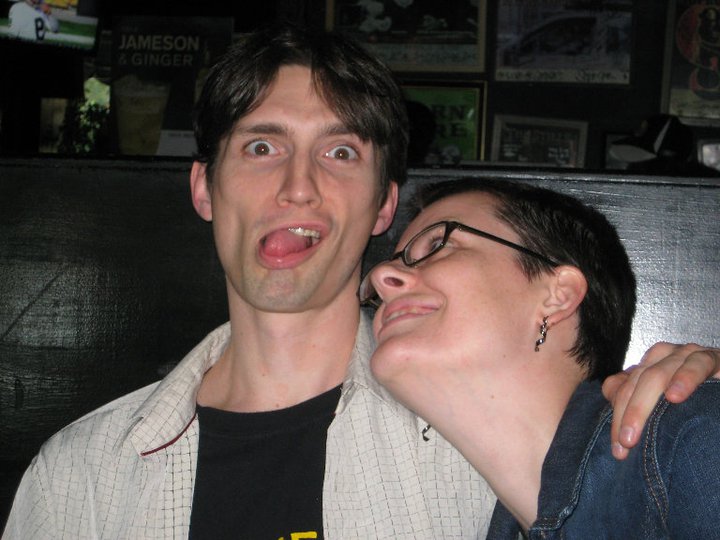
Ginny and I back in Atlanta, after I healed some.

But what has not faded over time, but rather grown, is the other thing that happened 3 years ago.  Ginny, I love you dearly, and I am happy that you are my wife. Thank you for all you have done for me, and all you continue to do.  I live a charmed life.

And thank you, Gina, for sitting with my at Polybar Galactica while talking about things we have no idea about while I make you chocolate martinis.  Also, for being awesome and stuff.

I want to leave with a direct quote from what is on my Google calendar from the date that the event happened.  I don’t remember when I added this note, but it is true, even for this heathen:

Saturday, January 16th, 2010:

All hell falls upon me…and an angel was there to catch me before i fell into its depths


—-

Also, if you missed this previously, you need to read this post (which also mentions the evil Seana event, which is why I was reminded of it right now), because it is me channeling Gina’s hilariousness in a way that I am not sure I can replicate again.  I made myself laugh. Wait, i do that all the time.

You know what? Never-fucking-mind!

Loving Authentically


We should love the people in our lives as we actually desire to do so. We should not unnaturally inflate or deflate our feelings for anyone. We, speakers of English, suffer from the poverty of words to express the varieties of love.  The Greeks knew better, having multiple words for the various kinds of love we feel for people, and perhaps there is a lesson here. Not all love is erotic. Not all love is adoring. Not all love is brotherly. Sometimes we will only feel brotherly (or sisterly) towards a person, while other times we may feel the hot coal of Eros burning within us to touch, savor, and embrace another (or many others) with pure passion. Sometimes we will feel a deep sense of attachment and affection for a person, such that we could not imagine being without them in our lives.  Sometimes you have a little (or a lot) of each.

Whether we are monoamorous, monogamish (a term I’m somewhat annoyed with, personally), “exclusive”  but cheating, or polyamorous we can experience a phenomenon of either inflating or deflating the nature of a relationship based upon social or personal expectations. This happens because how we actually feel for people around us may not fit the categories our culture has for relationships, at least mainstream culture.  In recent decades we have invented new categories, such as friends with benefits, asexuality, etc, but there is still room for better defining what kind of relationships we want from people.

Having been in a number of relationships (and most of the examples below has an analog in my experience), I have noticed that many people will artificially inflate or deflate the nature of that relationship in the name of having that relationship fit into the social context we are used to, or possibly to try and make the relationship look appropriate.  That is, the reality of a relationship may not always mach what it appears to be from the outside, often at the fault of those displaying their relationship.  This phenomenon, of falsely displaying our relationship one way or another, is inauthentic.

What I want to explore here are the implications of this phenomenon on a set of relationships, in order to start thinking about how and why we define our relationships the way that we do and how we might do better.


Inflating Relationships

Monoamory,* in some cases, will force us to inflate how we care for someone unnecessarily and unnaturally. Because people are insecure or afraid, we may have to overcompensate for moments when we may show interest in other activities, other people, and even other potential loves. If we err by having an affair, we try to soften the damage by saying things like “she/he means nothing to me” or “I only want to be with you, nobody else” which are obviously not true in many cases.  Except in rare cases, monoamory is based upon a lie, or if not a lie then an inauthentic approach to who we love.  We try to convince ourselves, and often we tell our partner, that we only want one person, and that we are happy only with them.  We create a mythology of happiness and fulfillment in exclusivity, when the actual behavior–cheating is rampant–says otherwise.

The result is that we try and inflate our partner to being all that we need, everything to us, and the object of all of our romantic and erotic desires. Now, there may in fact be cases where this is actually true, but I suspect that in most cases such claims are an exaggeration of the truth. We may, in fact, have a substantial amount of affection, respect, and attraction to our monoamorous partner, but there is always room to have similar affections, respect, and attraction to other people. To claim to not have such feelings for others is to either deceive or to be a very rare case, if not an unhealthy one.  There are times of course, when we do not lie about our other desires, but for various reasons agree to not pursue them.  This is not as inauthentic, but is perhaps absurd and an accommodation to our fears and insecurities.

When we are single, taking steps into the wilds of polyamory outside of our existing relationship(s), or even when we are in the beginnings of what might become an illicit affair, we may end up either inflating or deflating how we feel for someone. There are times when the way we care for someone is mostly physical. We may actually like the person, rather than hate or be annoyed by them them, but here the primary connection is sexual, sensual, and erotic. For a number of reasons, we may feel that this base desire is insufficient, disrespectful, or possibly immoral in terms of continuing a purely physical, but not emotional or “spiritual” (whatever that means) relationship with them. In such times, we may feel compelled to communicate a feeling of love and try to make more out of the relationship than which actually exists.

This inflation may result in a relationship that walks and talks like a serious relationship, but it does not feel that way inside, perhaps for either of you. You may call the other person your partner, you may be exclusive with them, but the relationship lacks an emotional, intellectual, etc depth that one of both of you may crave. Now, there is no necessary reason to discontinue the physical relationship because of this, because all you need to do is find someone with whom you share the other things you desire in a relationship. So long as the sexual connection lives and is reciprocated, then there is no reason to stop it, but there is also no reason you should pretend the relationship is more than what it is. There is nothing wrong with having acquaintances, friends, or even people with who you have no emotional connection to as a lover, so long as the arrangement benefits both people.

When we are polyamorous, something similar may happen. We may have an ideal that all of our partners should be of similar seriousness, that we should try and develop an emotional depth with all of our lovers or else a relationship will be inferior or unworthy. We may feel, in short, like promoting sex partners to the rank of full romantic partners, when what the two people want from each other is a good time now and then. We need to love the people we love as we actually desire to love them, even if that love is solely erotic in nature, or solely romantic in nature for that matter.

In short, no matter how many relationships we have some or all of them may be presented to the world as more than they feel like inside.  We may do so for all sorts of reasons having to do with the society in which we live, but all of those reasons are inauthentic.  We need to be honest with ourselves, our partners, and the world around us (insofar as it is their business) about what our relationships are, and not inflate them unnecessarily.


Deflating Relationships

Let’s say you’ve been committed, for some substantial amount of time, to a wonderful person with whom you share a deep affinity, share many enjoyable days and nights with, and with whom you share a healthy and active sexual relationship. You have decided to remain exclusive, whether overtly or by mere assumption or accident (based on cultural norms and such), and are happy with your partner.

Let’s say that through work, social circles, or merely by mere chance you happen to meet a person with whom you develop a healthy rapport, you become friends and find that not only do you respect and care for them, you are very attracted to them (or perhaps you are only attracted to them sexually.  If so, the following is equally true). This relationship is a threat to that exclusivity, and in many cases an affair will happen in such cases, often damaging or destroying the primary relationship.  But an affair and damage are not the only options.

In some such cases something different happens. Whether you and your new friend admit an existing attraction or not, it exists but it is suppressed, pushed away, and ignored. You decide to remain platonic friends (or to avoid one-another), despite the reciprocated desire for more. You deflate the appearance of the relationship from what it feels like, inside. You are pretending not to love them in a way that you very much want to love them, so you try and redirect that erotic love into brotherly or sisterly love or to a lack of any relationship at all.

Why do we do such things? The feelings already exist, why do we lie to ourselves about them? Is that love, which already exists, going to do more damage if actually acted on? Yes, you should be honest about your feelings, not only to your new friend but to your partner with whom you have had, perhaps up until then, an agreement to exclusivity. It is such circumstances which support my belief that the vast majority of humans have the inclinations towards polyamory within us already, we just need to be honest about them.  Thus, another option here is to explore non-monoamorous solutions, whether swinging, polyamory, or mere monogamishness.  One does not merely have the choice of either suppressing the desire or cheating, in such circumstances.

Of course, this does not happen only to people involved in a relationship. Single people deflate as well. Some people may have insecurities, fears, or etc which affect their ability to pursue their desires. We may have strong feelings for a person, but not communicate them out of fear of rejection. We may do so because they are not seen as good enough or socially appropriate for us, especially in view of peers or family. They may be single and interested in somebody who is already polyamorous, and be unsure about their ability to handle the emotional consequences of pursuing someone they have to share.

Non-monoamorous people can do something similar as well, especially when they are relatively new to polyamory, or who are involved in the swinging community. Poly people who pursue others may deflate how they feel for a partner in order to protect the feelings of others they are with; to defend jealousies. Jealousies need to be addressed, not merely accommodated to or coddled. We should not pretend that our new love is merely a mild interest, or that our mild interest is merely a friend. Be direct about what what people mean to you, and encourage them to do the same for you.

Swingers, in some cases, ignore or avoid romantic feelings for sexual partners because most swingers become so because they are seeking, primarily, new sex partners and not romantic partners. They may realize that an emotional connection might be destructive to their primary relationship. There are some people inthe swinger community who, if they start to have feelings for their sex partners, stop hanging out with those people. They may decide to suppress those feelings, much like the hypothetical you did above with your new friend, except in this case it is the romantic love which is suppressed, rather than the erotic.

In short (again), no matter how many relationships we have some or all of them may be presented to the world as more than they feel like inside.  We may do so for all sorts of reasons having to do with the society in which we live, but all of those reasons are inauthentic.  We need to be honest with ourselves, our partners, and the world around us (insofar as it is their business) about what our relationships are, and not inflate them unnecessarily.

Concluding thoughts

I encourage all of us, especially myself (as I struggle with this phenomenon as well), to have the courage to admit how we really feel, or to allow ourselves to find how we really feel about the people around us. We may be suppressing feelings without being aware of it, leading us to miss out on a relationship or to remain in one we may not wish to continue.

If the way you feel about a person is erotic, let that attraction be known. If you feel an abiding reverence, deep affection, or romantic impulse for someone, then express that as well. If you see someone as like a brother or sister to you, and while you may not be attracted to them you want them as part of your life, your family, etc, then let that relationship grow as well. And if you feel all of these things, whether in abundance or not, let that relationships—let those relationships—be what they are, informed by your desire and authentically pursued..

Love each person according to your reciprocated desires, and do not artificially inflate or deflate that love out of respect for any cultural, religious, or psychological expectation. In short, love authentically.


—-

*I use the term ‘momoamory’ and the correlating ‘non-monoamorous’ in the interest of being aware that not all relationships are marriages.  Monogamy is an exclusive marriage, technically, and while it is applied to cover all exclusive relationships between two people, I prefer to be more precise and inclusive with my terminology.

Where philosophical differences turn into meta-debates about personalities


This, ladies and gentlemen, will be a rant of sorts.  I’m not happy with humanity today, and it’s my own damned fault for reading blogs!

So, I’m a feminist of a specific kind.  I have evolving but ideologically-leaning views about the relationship between gender, history, and culture.  I think there are things that we should be focused on as a society to improve the world related to those feminist ideas.  I think that we need to become familiar with concepts which will be consciousness-raising and will shift our perspectives on how to behave.

The details of what specific kind of feminist I am, what ideologies I prefer, and what changes in perspectives we should work towards are almost not worth explaining, because all I have to say is that I read Freethought Blogs and Skepchick and I agree with them more often than not.  I think Greta Christina is an excellent advocate for both atheism and feminism.  I think Rebecca Watson had something to teach me in talking about a guy in an elevator.  I miss Jen McCreight’s contributions to the conversation.  I have learned lots about race and privilege from Ian Cromwell.  I think PZ Myers is witty, intelligent, and sometimes wrong (actually, he’s mostly right there).

So, now you know where I stand right?

Here’s the thing.  If you read any blogs who have a dog in this fight  (you know, the fight about the role of feminism, if any, in the atheist/skeptic community) then you will either think that Rebecca Watson, PZ Myers, etc are generally right and are fighting for a worthy cause within the community or you will think they are bullies (FtBullies, if you would) who have a view based upon “garbage feminist scholarship” and who are creating a division in the community with their, well, bullying and such.  Some, such as my good friend Staks, have given up reading any FtB posts at all.  I think he’s missing out on a lot by doing so, and I’m not sure if he will change his mind.

It has gotten so bad that I am not even sure what the philosophical differences are, most of the time.  Most of the posts I see now are not substantive philosophical critiques of a point of view, they are an attack on the other side.  This has become a polarized, party-line division, much like what exists in politics.

And this is no surprise to me.  Tribal mentalities exist in all communities, so the fact that this happens in the atheist community is to be expected.  I would like skeptics to be better, but I’m too cynical to really believe that will happen even among those who should, ideally, know better.  Humans are emotional and irrational (which they then rationalize, in most cases), so all I can do is be both frustrated and amused at it all.

Take this post by Maria Maltseva called A World Without Dogma.  it starts off OK, but then you immediately see that PZ Myers, Rebecca Watson, and Richard Carrier are all Marxist feminists who may endanger us with their terrible Marxist ways.  I really thought I had run into a Republican blog by accident, for a moment there.

The arguments there are straw men.  There is no attempt to take seriously the problem of how to address feminism as a skeptic (and yes, I know there are people who do take this issue seriously from some of them I also read), but rather the point is to show how untrustworthy, unskeptical, and how bad the other side is.

And yes, some at Freethought Blogs do the same thing, and I will admit that I am less annoyed when I agree with the one doing the mocking than when I disagree, even though I also do get annoyed, occasionally, by some I agree with (especially Amanda Marcotte, who I agree with more often than not but I find her writing to be abrasive, so I don’t generally read her stuff anymore, except in rare cases).

—-

So, let’s spell it out; there are people on both sides of this issue being snarky, using mockery, and who dislike each other greatly.  I want to see people who are able to see that snark and let it roll off of them.  I don’t want the emotion, passion, and even humor to go away, I want it to be waved off and for us to be able to actually have a substantive discussion about things like feminism without it turning into politics as usual. I want people to be able to hear mockery, snark, etc and let it roll off them and pay attention to the message, but often there is little actual message to sink one’s teeth into.

Yes, some people I will talk to will be wrong (painfully wrong), but can’t we drop the meta-debate? Can’t we stop talking about elevatorgate and talk about the philosophical disagreements which underlie why elevatorgate was such a big deal? Can’t we address privilege, safe spaces, and the concerns that men have all while we recognize that understanding the perspective of others is part of the process of making it all better for all of us?

I know I’m biased, but I think that is precisely what people such as Greta Christina have been doing.  I want a world where the complaints that men have with our culture are solved. I want a world where the complaints that women have about our culture are solved.  I want a world where tribalism and petty interpersonal squabbling don’t dominate philosophical debate.  Mostly what I see now is that PZ Myers and Thunderf00t don’t like each other anymore, Rebecca Watson is (supposedly) an ugly bitch, and my view of feminism is a totalitarian dictatorship in the making.

I want to put aside petty interpersonal squabbles, platitudes, and deal with real issues.  But I won’t get what I want;  the battle-lines will be drawn more vividly and I will be forced to be a combatant even if I try and avoid perpetuating the divisions.  And the effect of this is that I will inevitably become further removed from any real dialogue between people on different sides of this issue.  I will have less exposure to views different from mine, despite my desire to understand their point of view, because the conversation will become meta-, rather than substantive.

I can try to keep it away from here, but the simple fact is that I do think that one side of this debate is mostly right.  It’s just like PZ Myers said some time back, compromise with crazy is half-way to crazy town.  I think that FtB, despite some of their poor behavior from time to time, is mostly right, and I find Maria Maltseva mostly wrong, but still worth listening to in case something good comes through.

Not saying so would be inauthentic, so I will be placed on one side of the battle lines, and when I take a step across to try and understand, I will be shot at because I’m perceived to be wearing the uniform of the person seen as the leader on my “side.”

It’s absurd.  I’m interested in the truth, if such a thing exists, and I will hope that these stupid squabbles evaporate into a truly skeptical conversation.


Less than 2 months until the Atlanta Poly Weekend, so get your tickets now!


I wrote up a preview and details here, but in case you forgot or you missed it, I will be in Atlanta in the middle of march to participate in a convention of polyamorous people, in part to talk about the relationship between skepticism and polyamory (atheism itself may come up as well, we’ll see!).

So, again:

So, get your tickets now! We at PolySkeptic.com will be there, and we will look forward to seeing you.

The What: Atlanta Poly Weekend 2013

The Who (no, not the band!): you, and all your awesome friends (who will be permitted to listen to The Who, if that is your kink.  The Kinks will also be acceptable).

The When: March 15-17, 2013

The Where: 

Holiday Inn Select Atlanta- Perimeter/Dunwoody
4386 Chamblee Dunwoody Road
Atlanta, GA 30341
(770) 457-6363
(770) 458-5282 (Fax)

The Why: Because it will be awesome!

The How: That is for you to figure out, because I don’t know who you are or where you are coming from.  If teleportation doesn’t work, try a car, train, plane, or penny-farthing.

Skepticism and insecurity


The title of the blog is Atheist, Polyamorous Skeptics.  That is, we are atheists and we are polyamorous, but those are qualifying terms of our (at least my) primary identification; skeptic.

I identified as an atheist before either of the others, temporally.  It was somewhere in the late 1990’s that I started thinking of myself that way, and the winter of 2002, upon meeting Margaret Downey and joining the Freethought Society, that I came out of the closet, as it was.  I never believed in any gods (I toyed with pantheism for a little while, but pantheism is ontologically indistinct from atheism), but I didn’t always see the point in talking about this much or thinking of it in larger cultural and historical terms.

Over the next few years, I was introduced to people such as Michael Shermer, Penn and Teller, James Randi, and others who usually identify as skeptics.  I had already taken critical thinking, logic, and philosophy courses (By 2003, I had a MA in philosophy), but the term skepticism was pretty much academic to me until a couple of years later, even though I was actively writing about and advocating for atheism as a cultural force during both college and graduate school.

I had discovered polyamory as an idea, and practiced it to some degree, in the late 1990’s as well.  But it was not until around 2006 or so that I started to re-think about the idea beyond the fact that I liked the idea of being able to pursue other girls while I was with my girlfriend at the time.  And I believe that the way I started taking polyamory more serious was related to my growing interest in skepticism as a means to living, rather than merely an intellectual exercise.

I had not come to articulate it thus yet, but I was beginning to apply skepticism to all of my life; my beliefs, suspicions, and to other people’s idea which I heard.  It did not always make me popular at parties, and it certainly did not make my native insecurity any better (as I wrote about last night, I still have anxieties about talking to people from this point of view).  But while it didn’t make me popular, it made me feel better about myself and gave me epistemic foundations for my worldview, even while that worldview was shifting.

Most importantly, it gave me a process by which I could counter-act my natural human tendency to allow my biases and fears to skew my worldview, and thus I grew the strengthened ability to challenge myself and learn about other people and ideas better.

Skepticism became, for me, a way of living, thinking, and perceiving.  But I had to train myself to be this way, which my philosophical training helped with.  And it often fails me anyway because skepticism is not easy and it is not natural to our brains.  I’m still prone to things such as selection bias, rejection of ideas which don’t mesh with my worldview, etc.  It takes a constant vigilance to notice and attempt to counter-act such tendencies, and it creates a cognitive uncertainty around my thoughts, quite often.

So, not only do I have to deal with a quite visceral and powerful insecurity at an emotional level, the nature of intellectual processes require me to be unsure about myself and my ideas.  A double dose of uncertainty, which I would rather do without, envelopes me.   And thus I understand people being turned off by skepticism; it feels better to be sure.  Questioning our values and beliefs is difficult, and people really don’t like their values and beliefs to be questioned, even liberal and “open-minded” people.

And yes, I am intellectually very certain about many things, but nuances and stupid semantic distinctions mean I cannot merely insist upon my superiority (although that is something I am prone to, as well).  I resist the urge to be arrogant, insistent, and authoritative because these desires are a defense mechanism against feeling insecure, and not necessarily the result of feeling overwhelmingly right or warranted in my opinion.  That is, there is an air of confidence which is only air.*

This is not to say I’m not occasionally arrogant, insistent, or think I’m intellectually superior.  I have weak moments, after all, and ironically my weakest moments often look, to others, as my strongest moments.  This is why I have trouble trusting people who appear boastful or arrogant; I suspect that underneath this appearance lies insecurity, like it does in me.  And sometimes I genuinely feel confident; the distinction is that when I’m actually confident, I’m calmer, less insistent, and I will probably be governing a wry smile.

And then, of course, I think that maybe some people don’t ever have that feeling of insecurity and that not only do they not feel insecure underneath their apparent certainty, but may have no reason to feel such insecurity because they are smarter and better than I am.

And then I really feel insecure, all because I think it’s important to be skeptical.

But that’s a lie; I just feel insecure fundamentally, and it just happens that skepticism is benefited by a reservation of opinion, which emotional insecurity provides.

But rationalizing is fun.

—-

*There is a wonderful episode of Star Trek TNG, entitled “Attached“, which deals with this very phenomenon.  Trekacademy.com summarizes the scene thus:

Capt. Picard & Dr. Crusher are being held captive by an alien race that implants telepathic devices on both of them, enabling each to hear the other’s thoughts.

While trying to escape, Capt. Picard & Crusher come upon an area which has two possible paths to take. Crusher is unsure which path to follow. Capt. Picard points in one direction and assertively indicates that it is the correct path.

As they start down the path, Crusher hears Capt. Picard’s thoughts and realizes that Capt. Picard had no better idea than her as to which path they should be taking and that he was only guessing earlier when he chose which path to take.

When Crusher tells Capt. Picard about her telepathic observation of him and asks if he does that often when giving orders, Capt. Picard answers, that there are times when it is necessary for the Captain to give the appearance of confidence.

And when I see people confidently proclaiming a decision, I think of this and wonder how universal it is that leaders just appear confident.

Quiet and Afraid


Depending on my mood, I can be rather outgoing and gregarious, or I can be quite and shy.  Especially around people I do not know well, I tend towards shyness.  But I don’t want to be shy.  I want to be warm, engaging, and have interesting and revealing discussions with people. But I rarely do.

I think about why this is the case quite often.  And, depending on my emotional state, my feelings vary.  That is, my rationalizations for my fear of speaking up shift with my mood.  So, today I want to compose two related, but emotionally distinct, reactions to being shy while not wanting to be shy.  I don’t know if any of this will resonate with anyone else, but perhaps it will.  These are the kinds of thoughts I have while battling within myself whether to contribute to conversations, especially if they relate to religion, relationships, etc, in mixed company.

Narrative 1: You will hate me.

I overheard something you just said, and I think that the worldview you seem to come from is misguided, and if I told you what I thought you would find me distasteful and you would rather not talk with me (most likely).  If I talked with you about the topic you are currently engaged in conversation about, the dialog would become awkward and you would wish I would have not said anything.  Thus, I should remain quiet because otherwise you would hate me, and I would just be wasting my time  bringing up my views on your topic of conversation.

This is often followed with a false feeling of superiority; I feel somehow better, more evolved, and I pity those around me.  This feeling is often then followed by the sensation that such thoughts and feelings are a defense mechanism, because I’m afraid that my own worldview is misguided and inferior.  This sometimes leads to the second, but intimately related, narrative.

Narrative 2: I hate me

Man, I really should stay quiet.  These people might be wrong, but my thoughts are just fueled by anger (fear) and I would be better not making an ass out of myself.  It really does not matter how much I have thought this through or how certain I feel right now, because all of that confidence is an illusion.  My ideas are not interesting, my point of view not insightful, and my false pity for them is not warranted.  I wonder if they have these kinds of thoughts too.  I wonder ow strong they doubt themselves….

And this trails off into unrelated or merely tangential thoughts about all sorts of things.

But then, usually later (like right now) I think about the fact that I perceive a sort of mainstream set of cultural expectations and views which I often think I can see through, and then these sets of insecurities play out at a meta-level.  I think things like:

1) Is there actually a set of cultural narratives which I understand and see through (even if only partially)?

2) Can most people really not see it, or do they see it and either don’t care or understand it better than I do?

3) If those narratives do exist, and I can see them better than some people, is it something which I can explain to those people or do they have to either discover themselves or be perpetually blind to it?

The basic fear that informs my silence, at least as it is rationalized, is whether I am actually seeing something which is real, or whether I’m perceiving a delusion.  Do I understand something about human behavior which is real and invisible to most people, or am I creating that narrative to explain the fundamental fear which is the real reason I remain so quiet?

The thought that seems most awful, thus I suspect it is at least partially true, is that the narrative I perceive is real, but I’m just afraid.  It’s not that I’m really concerned with annoying people or being seen as idiotic (although those feelings seem real enough), it’s that I’m just afraid.  Not afraid of anything in particular, mind you.  Just afraid.

And then I have to explain why I’m afraid, which doesn’t help it go away.

It is a perpetual and strangely comfortable sensation, fear. I am almost afraid to not be impeded by it.  I’m not sure what I would be like if that fear disappeared.

To those that read is blog, I may not seem afraid to speak my mind. But that is only when the first narrative, above, dominates.  All too often the second narrative dominates, and I am left quiet and unsure of myself.

That’s enough honesty for right now.  So now I commit my fears to the internet, were they shall never be forgotten.  Great…now I cannot pretend they don’t exist….

American Politics, old and new.


Here is a quote from John Ferling’s Adams vs. Jefferson, page 153-154:

The Federalists also fixated on Jefferson’s religious beliefs, maligning him as an atheist.  This was grounded on what Jefferson had written in Notes on the State of Virginia, drafted in 1782 and first published in the United States in 1788.  Jefferson had lauded the Virginia Declaration of rights of 1776, which provided for religious toleration, but, wishing to go further—he hoped for a law that would separate church and state—Jefferson had dilated on the “rights of conscience,” about which individuals were “answerable [only] to…our God” and never to the state. He then added  that “it does me no injury for my neighbor to say there are twenty gods, or no God. It neither picks my pocket or breaks my leg.” These two sentences were reprinted endlessly in Federalist newspapers as proof of Jefferson’s impiety.  In addition, Federalist scribes cautioned that Jefferson viewed the clergy as “curses in a country.” Primarily, however, they depicted him as a “howling atheist” and “infidel.”  Filled with contempt for Christ, Jefferson supposedly embodied iniquities that would bring on the moral decline of the United States.  In New England people were told to hide their Bibles should Jefferson be elected, and the warning went out that his election would call down God’s vengeance on the United States.Though more from the pulpit than the press, lurid tales were told of bizarre worship services at Monticello at which Jefferson supposedly prayed to the Goddess of Reason and offered up dogs on a sacrificial altar.  One Federalist newspaper advised its readers to vote for “GOD—AND A RELIGIOUS PRESIDENT or impiously declare for JEFFERSON–AND NO GOD.”

How many current cultural tropes did you notice there?

Thomas Jefferson, never self-identified as an atheist, as far as I know.  The conflation of religious tolerance and freedom with repression felt by the dominant religion was as real then as it is now.  We are not dealing with anything new, in talking about this religious privilege and the association with separation of church and state with impiety and even lack of patriotism.

There are simply some people, whether in 1800 or 2013, who simply cannot see that asking for religious neutrality from our government is a good idea.  Those that declare the United States to be a Christian nation have the precedence of idiots from the 18th century who did not grasp the importance of said separation then, and who wanted a Christian president rather than a supposedly godless president.  And those who see the legal foundations of the United States as secular, as its founding documents state, have the precedence of people like Jefferson and Madison on their side.  It’s not simply that we were a secular nation and people forgot, it’s that some people simply could not grasp it at the time, and that tradition seems to have run parallel to the actual law and history.

In short, there are always idiots in society, and it may be the case that they will never go away.  One of the weaknesses of democracy is that those idiots also get to vote, and thus we have Michel Bachmann and Rick Perry.

Seeking Quality over Quantity (or why most people are not worth my time)


For many years I have thought that through determined effort, rational thinking, and patience, it was possible to change people.  And sure, people change their minds in the face of facts, or more likely experience which includes emotion and reflection, but this happens through appealing to a central set of values, inclinations, and other emotional considerations.  I once thought that it might be possible to actually change the core emotional values people have; to make them more prone to caring about self-improvement, authenticity, and thus to become better skeptics (and thus better people).  Granted, I never thought this was possible for all people, perhaps not even most, but now I think such a thing might be impossible, or at least vanishingly rare.

Much of what I have written here at polyskeptic.com, even before the creation of that newer URL nearly a year ago, has been in the hope of making an argument for the application of self-challenging skepticism in order to show that faith is perhaps the worst human trait, as well as to explore the  social and cultural predominance of an often stifling and broken view about sexuality and relationships.  I was hoping that through a combined application of rational argument and a perspectivist’s critique of cultural norms, I could demonstrate that skepticism was a tool for our improvement as people, and hopefully create some new atheists and polyamorous people, because I believed that the truth of atheism and the promiscuous inclinations of the vast majority of humans was universal and that more people should be able to see that.

And while such actions may create new atheists and polyamorous people, what I am leaning towards concluding is that the underlying skepticism is harder to inspire.  There are certain sets of inclinations, desires, and fears which either make a person more or less likely to utilize skeptical thinking, and if some personality traits are not present, you might as well try and yell down a wall.

So, as a result of this leaning (which is even more cynical than I have been previously), I am leaning towards an updated approach to writing about the topics of religion and relationships.  The casual reader may not notice much of a difference, but anyone who knows me will notice the importance of the subtle distinction.  Rather than try and find people who are stuck in the cultural milieu of theism and monogamy, and try and convince them that they would, perhaps (and probably), be happier giving up such things, I want to focus on finding people who display certain personality traits, in order to grow a better atheist and/or polyamorous community.  Rather than transform people, I want to cultivate certain types of people in the hope of finding ways to educate and inspire them, while looking for others to inspire me as well.

Because in many cases, such communities have done a fairly good job at growing (especially the atheist community in recent years), but in doing so it seems we are more interested in quantity, rather than quality.


Build Quality Rather Than Mere Quantity

Here’s the thing; the atheist community has become a cultural phenomenon.  it’s not quite mainstream yet, but it is on the path towards it.  But many people seem to think that we just need to grow, rather than actually improve, what exists. The goal is not to create more atheists per se, the goal should be to find and cultivate better people, and better people will become atheists because atheism is rational (and if it isn’t, those better people will discover that).  Similarly, the goal is not to create more polyamorous people, it is to have people better understand their own romantic and sexual desires, and show them how to find a more healthy way to explore and express those desires.  Thus, better people will tend towards polyamory (or accidental monogamy).

Getting numbers for our communities is an important part of the larger cultural shift, and I will not disparage it altogether as a strategy, but there is a point when the community needs to pause and take note of the shape of the community, rather than its mere size.  What values do we have? How skeptical are we being? Are we keeping in perspective the larger goal of cultural improvement, rather than merely caring about our immediate concerns? Etc.  And I think that many in this community have got caught up in squabbles about stupid shit, and frankly I don’t want to associate with some of them who do not display traits worth wanting.

So, having said that, what types of qualities do I want to seek out and help cultivate in our communities?

1) Attention and empathy.

You know, like mirror neurons and shit.  I want to seek out people who have the capability, and desire, to see the world through the perspective of others.  This means listening, yes, but more importantly trying to understand concepts like privilege and cognitive biases.  By empathy, or even compassion, I don’t mean merely being nice and gentle with people, because sometimes people need a (metaphorical) kick in the ass, and accommodating is not always a good solution.  I mean that we need to make a genuine attempt to understand what is being said, including  the context of those ideas, so that when we do unleash our raptor-like wit and eviscerating critiques, we can hit as many of the actual weaknesses of their position, as well as be aware of our own weaknesses.

Also, it’s possible that we are wrong, or at least partially wrong, and understanding the argument of others might actually teach something about ourselves, including our own privileges and cognitive biases.

In short, the best means to criticism is to make sure you understand the other positions as well as they do (if possible), and the best way to know such things is to listen carefully and try to understand their perspective, especially if it seems ridiculous.  Makes me want to quote some Sun Tzu or someshit.

2) Judgment

We need to be able to be authentic concerning what we think, and be honest with our conclusions (tentative as they may be).  We need to exercise our abilities to discern rationality from irrationality, rationalization from explanation, and good from bad.

There are bad people in the atheist community.  There are bad people in the polyamorous community.  These people have bad ideas, treat people badly, and make rationalizations and excuses for why they are not bad, and for some reason people follow them.  Yes, those people are still part of the larger community, but they should not be our inspirations.  But mostly, there are people who have a mix of bad and good ideas and behaviors, and we need to be able to separate those things.  There are many people who have contributed very much to our success as a community, but who maintain ideas which are damaging.  We need to be able to criticize them without eschewing them, but we should be able to eschew when necessary, at least in terms of our support or respect for such people.

We need to encourage good ideas and criticize bad ideas, and be able to not divide into camps which no longer talk with each other because of disagreements.  We need to be able to take judgment, give judgment, and not create battle lines because of judgments made against us.  In short, we need to accept judgment as a good thing, rather than as a thing which divides us.

Judgment being a bad thing is a religious idea, more often than not, and we need to re-appropriate it for our use as a tool, not a weapon.

3) Expanding our domain of understanding and concern.

Battle lines create quasi-dogmas.  It prevents communication, yes, but more fundamentally it prevents us from taking seriously the perspectives of others.  We need to be perpetually broadening our arena of concern, even if our actual arena of action remains small.  That is, we might only fight for the rights of polyamorous people in the workplace, church state violations in your state or city, or focus on the relationship between race and religion in your culture.  All of these things (and many more) are worth doing, but if you are doing those things, it is important to be aware of how the concepts that you use in your work map onto other parts of our struggle for social justice.  And yes, you should care about social justice in general, and apply skepticism to such questions.  If you don’t care about such things, then there is no point in talking to you, is there? I can’t make you care about something that you don’t care about.  Similarly, if you don’t have the basic emotional capability to empathize, talking to you about morality would be futile except as an intellectual exercise.

The idea that religious people have a privileged status in American culture is not exactly like the privilege that men have, but the concept is transferable to some extent.  How some people understand one while rejecting the other makes no sense to me, and strikes me as a fundamentally conservative mind-set which acts to undermine the larger goal of improving our culture.

Self-improvement is not always linear, in the direction of your personal goal, it is more like a network, where concepts and efforts that we use are related to other things around us, and we should see that the effort to solve issue X is related, in some way, so solving Y and Z.  Skepticism is a tool to be applied to religion, astrology, and homeopathy for sure, but also to gender, relationships, and many other cultural concepts that are too often unquestioned or not analyzed.

4) Exclusion.

There are some people I don’t want at my party.  They simply don’t care about the perspective of others and are unable to comprehend the problem and so they mock it, they either judge in only one direction or pretend not to judge, or they see no reason to expand their scope of applying skepticism and rational analysis to their lives.  Whether it’s fear, apathy, or simple cognitive or emotional inability to understand, there is no point in exerting much effort on some people; they just don’t want the discussion, and it will just be time wasted on your end.  The resources will exist, on the internet, in books, and in your head, if they start to care, but before they do care it’s not really worth the effort.

Such people may still be atheists, they may be non-monomagous, they may be skeptical about some things.  But they are probably not worth my time when it comes down to explaining nuanced concepts which they will not retain even if I tried.  We have to be willing to cut our losses in some cases, and realize that some people simply are not equipped to be real adults with the ability to understand certain concepts.

Fuck ’em.

I’m not wasting much of my time fighting them anymore.  If you want to, then by all means do so.  But I wash my hands of people who don’t have the fundamental values and desires to make themselves better people.  They won’t be going anywhere, it’s just that they are not worth arguing with so I leave them to others who still feel like they can do something to get through to them.  I certainly did for many years, and I can’t change their mind for them either.

I want to see more effort in improving what community we have, rather than merely get more attention and attract more people.  Yes, we want more people, but we should make sure those people are worth wanting.

Meh, call me an elitist if you will, but I think that many people just are not capable of being good as people.  I view relationships the same way; some people are not really worth pursuing.  Why would I try to date a person who I didn’t respect (or wasn’t attracted to)?

This is not a universal creed, it’s just where I stand on this issue at the moment.  And like I said before, I will not decry anyone who wishes to howl at the moon or yell down walls (hell, it sometimes even works!).  I’ll just be watching, paying close attention, judging openly or quietly (depending on the circumstances), while trying to expand my own understanding so that I can keep growing myself.

I’ll hope to meet others doing the same.

Stuart Hampshire on Theology


Because I have to post something, while I’m dealing with my existential crisis, I quote Stuart Hampshire:

Philosophy is a game with objectives and no rules.
Mathematics is a game with rules and no objectives.
Theology is a game whose object is to bring rules into the subjective.

Partially inspired by Jerry Coyne’s recent thoughts about theology, which were inspired by another great thinker, Walter Kaufmann.

And, for kicks, here’s more Hampshire:

A man becomes more and more a free and responsible agent the more he at all times knows what he is doing.

and…

As self-consciousness is a necessary prelude to greater freedom of will, so it is also a necessary prelude to a greater freedom of thought.

Once I figure out my current philosophical crisis, I will be writing more.