The Musicality of Love


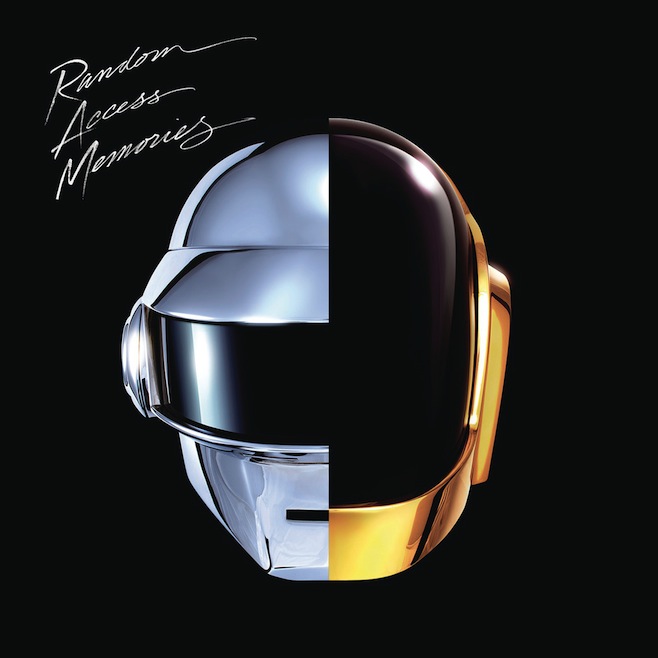
4e6c6fb2Several weeks ago I acquired Daft Punk’s new Album, Random Access Memories.  I had heard a review, and part of a couple of songs, on NPR (because that’s what I listen to if I’m not listening to Daft Punk).  One of the songs (Doin’ it Right) got into my head (the NPR piece had used it as a bump after the review–good choice, NPR production!) and so I had to get the album to satiate the insanity of this song playing in my head.  So, upon acquiring it and adding it to my playlist on my player (I use Foobar), I started playing it and listened to I while I played some Starcraft 2 (yes, I’m that kind of nerd).  Let’s just say that I loved it.  I mean, the kind of love where after the album was done, I re-started it, and listened to it again (I had finished my Starcraft playing at that point).  And then, after that second listening, I listened to it again.

Soon enough, I burned a disc so that I could play it in the car (not having a fancy mp3 compatible player in the car).  And so for the next couple of weeks or so, whether I was in the car, had my iPod on, or at my computer I was likely listening to that album.  The more I listened, the more I liked it.  I would have different songs running through my head while not listening to it, and just had to hear them when I was able to do so.  The album took over my life for about 2 weeks.  It was love at first hearing.

I have a number of favorite albums and songs from various genres and time-periods, including Collective Soul’s Dosage, Counting Crows’ August and Everything After, Beethoven’s 5th and 7th Symphonies (well, the first 2 movements of the latter), Pink Floyd’s Meddle (among others), T Rex’s Electric Warrior, Green Day’s Dookie, R.E.M.’s New Adventures in Hi-Fi, Nas’ Illmatic, Miles’ Davis’ Kind of Blue, quite a few Phish albums (to name a favorite would be too hard), The Beatles (mostly their later work), The Clash’s London Calling, much of The Talking Heads (and David Byrne’s later solo work too),  Ween’s White Pepper, ….

I could go on, but I won’t.

There is some music which simply found its way into my brain and I love listening to them, especially in certain moods.  And as I reflected on this, I started to think about how, at least for me, certain songs, albums, or even musicians have a relationship with me in much the same way as people have.  That is, there are analogous relationships between my history with music and with people.  And in many cases, certain music will always remind me of certain people, and sometimes whole albums are associated with specific people.  Sort of the way that the line “with fingernails that shine like justice” will always remind me of Ginny (as she intended).

The last few weeks, in other words, have been akin to a torrid love affair where I could not get enough of, well, an album.  It’s worn off, mostly, now.  Now I can hear or think about a song from that album without having to listen to the entire thing, but I still love the album and will continue to listen to it in the future.  This experience is not unlike some relationships I’ve had in the past.  You know, with people.  And while the analogy can only go so far, I started to realize, as I thought about it, that I feel the same way about a lot of those people as I do about some music.
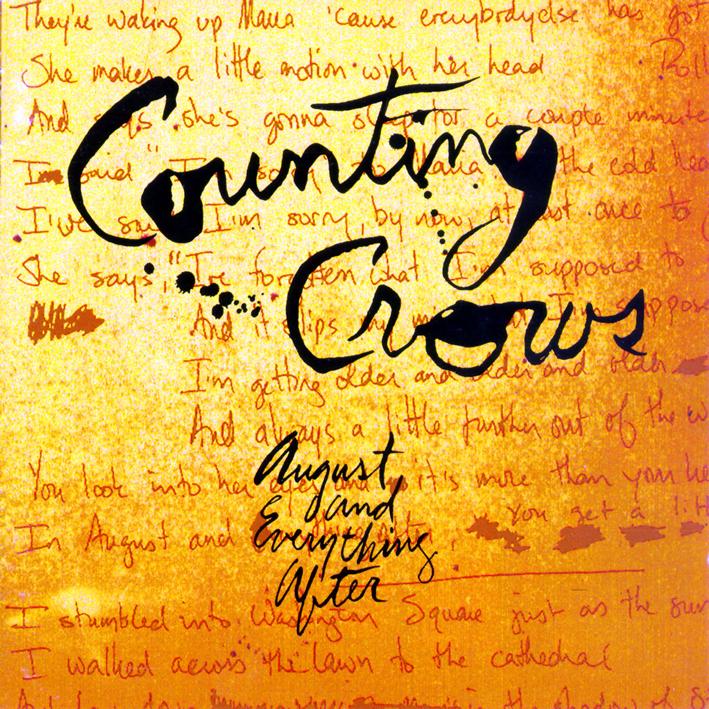
counting-crows-august-and-everything-after-delanteraLet’s start with one of my longest-loved albums, for example.  Counting Crows released August and Everything After in 1993, when I was in high school (the beginning of my sophomore year, in fact).  I have a vague but emotionally powerful memory of driving away from a vacation, with my parents, the following summer listening to that album.  I had met a girl, Nikki, who I liked considerably.  I was 17, hormonal, and the mere few days I spent with her was one of the earlier experiences I had of really getting to know and like somebody in a sexual and romantic way.  Having to say good-bye to her, get in the car, and drive away knowing that I would likely not see her again (we were in Hot Springs Arkansas–my parents choice of location of course–and I was going back to Philadelphia, Nikki back to Ohio) was emotionally devastating for me.  And listening to Round Here on my discman (you remember those?), a song which is emotionally crippling in many ways already, just made the feeling surge in ways I could hardly contain (if I had only known then what Borderline Personality Disorder was, the heart-wrenching pain would have made more sense to me then).  There is a piece of that still every time I gear the first few notes of that song.  I never did see her again, and sometimes I wonder what she’s up to now,  19 years after those few days spent with her.

Ever since then, I associate that song, and much of that album, with that summer and that vacation.   I love that albums still, and I think I always will.  Listening to it now, remembering that summer, thinking about how Nikki made me feel with her skin against mine all bring me the same cocktail of emotions.  Later associations of that album, as well as their second album (Recovering the Satellites, which was not nearly as good) with a relationship of 2 years while in college with a woman named Erin, many of the same feelings arise within me .  That album feels like young and naive love, the kind that incited deep feeling, stinging pain, and nostalgia for being young and being able to give of myself freely, without fear.  It feels beautiful and alien to the man who still is capable of love, but perhaps who will always be tainted by cynicism and fear when it comes to allowing that level of openness. I feel almost the same way about that album as I do about those 2 early relationships in my life, and I still have wonderful feelings about both of those women, even knowing that many years have gone by and neither of them is likely anything like who they were then.

And I could, if I chose, recount the many associations I have with specific music, friends, and lovers from my past.  I won’t do that because it is not all of the specific events of my personal life that I want to emphasize today (plus you probably don’t want to read that).  What I want to emphasize today is that, for some of us anyway, our relationships with music is, in many ways, akin to our relationships with people.  Music is, of course, an object so the analogy falls apart because people are, well, people and thus subjects of their own.  But in my experience, how I feel about things like music is similar enough to how I feel about people to make the analogy useful.

We change how we feel about music over the years the same way we change how we feel about music.   There is music I used to like, for example, but do not like as much anymore.  There is music I didn’t like at first, but now love.  And there is music that I always loved and always will love, but perhaps in different ways than I did before.  Our apprehension of music is not static, after all.  Our experiences of life change us, so how we will feel about other people (who will also change) and how we feel about music is dependent upon the function of that change.
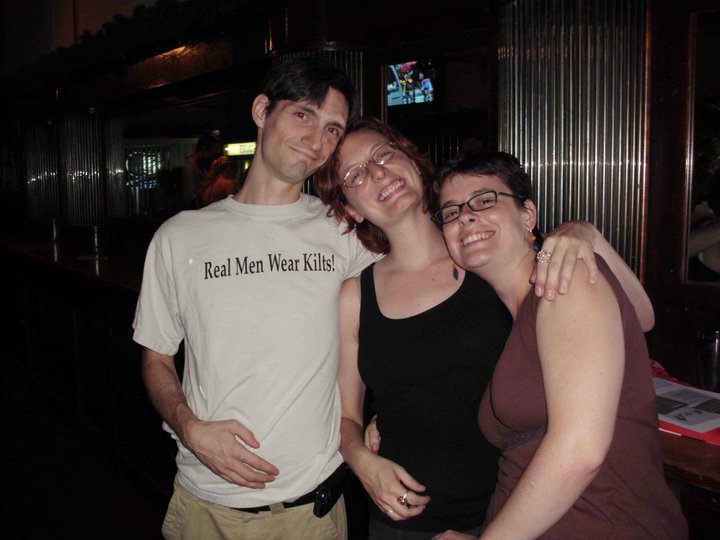
GinnyGinaMeI genuinely miss, and often still have good (if not complicated) feelings about, some ex girlfriends.  There are some I don’t talk to anymore, whether because I don’t want to or they don’t want me to, and there are some I do still talk to (too varying degrees).  And of course, there are Ginny and Gina, who I am still with (and hope to always be with), as well as others who I have other kinds of relationships with.  When I met Ginny, I was into her immediately and immensely, much like my relationship with that Daft Punk Album.  I just wanted to be around her all the time and could not get enough of being with her.  Granted, I was in a bad place in my life and did need emotional support (which she gave), but when I was able to be calm, sane, and forget about that I realize I just wanted her around most of the time, and hopefully she will be around for many years to come, with her fingernails shining like justice.

When I first met Gina, on the other hand, I was not sure how much I would like her at first.  Granted, I first met her when she was in a crappy mood, and we didn’t have much time to actually interact directly for some time, but she was around enough that I got a chance to get to know her a little.  I knew I was attracted to her, but I didn’t know whether we would click together well and so I never took the opportunity to pursue conversation or flirtation of any kind.  But like many of my favorite albums, I didn’t really start to love her until I stopped what I was doing and just listened to her.  It was not until I stopped just having her around, as part of the background of my activities, and started giving her some attention that I realized that she is complex, hilarious, talented, and awesome.  In fact, now that I think about it, it’s not unlike how I see David Bowie’s Ziggy Stardust (an album which Gina loves).  It’s an album I had heard, at least in part, before but I had not really listened to as an album.  But once I took the time to really listen to it, I picked out qualities that a casual or background listen would miss.  Just like with Gina.  I had to have other people apparently leave us alone while at some Steam Punk event about 2 years ago to really talk with her and discover that we had very compatible senses of humor and knew that I wanted to be with her.  I went from liking her, to really liking her, to loving her in a short time because I paid some attention to her.  It makes me wonder how much great music, and people, in the world I’m missing by not paying more attention to them.  I know, first world problems.

And now I’m listening to The Rise and Fall of Ziggy Stardust and the Spiders from Mars as I write this.  Thanks Gina….

Then there are the non-favorite songs, but the ones you really just have to hear occasionally.  I mean, I cannot prevent myself from singing along to Ice, Ice Baby or Baby Got Back, but under no circumstances would I label either song as good, or songs I must have on my iPod nano (neither is, BTW).  Also, there are songs I like, but not in context of their albums.  The Verve’s Bittersweet Symphony is a song I really like to hear occasionally, for example (that song is on my iPod, but not the rest of the album), but it’s not from a great album or a favorite band of mine.  I just really want to hear it occasionally.

And so this is the point where I, unsurprisingly, make the transition to argue that polyamory is superior to monogamy.

I’m sure that many of you saw it coming.  If you didn’t, you have not been reading this blog long enough.  I could do the surface-level argument and say that just like we all love many albums, genres, etc of music, and are not expected to (and should not have to) choose between them in some exclusive way, neither should we be expected to choose who we love, or at least what kind of love we should have with whom.  And while that is true, and ultimately that is what my argument is,  I think that there is some deeper utility to the analogy than that surface point.
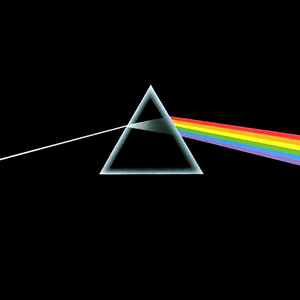
PFJust like one might love albums from high school or college years after those times are over, people can still have fond feelings for exes or for people who are not your current partner.  I mean, not always; sometimes there is no good feelings left after a relationship ends or with people you just don’t like.  Personally, I still have good feelings and memories about ex partners who hurt me and who I generally would generally prefer to never see again.  I mean, the relationship existed for reasons, and those reasons do not always evaporate when the relationship ends.  Just like my love of Pink Floyd did not affect my love of Daft Punk or Collective Soul’s Dosage when I discovered them, neither does any residual feelings I have for someone I am not dating anymore, or even someone else I’d like to date in the future, have to affect how I feel about a current partner.  There is a trope in our culture that talking about, liking, or thinking about exes or other potential partners is doing it wrong.  Somehow, if we chose someone, we cannot continue to, effectively, choose someone else.

And then there is that fact that we might not love certain music, but really like it, like it occasionally, or only at certain times.  Similarly, there are people we know who we don’t feel the need to interact with day to day, or to dedicate our lives to, but with whom we share similar interests, desires, etc and can establish a less committed relationship.  I am not sure how often this happens, but imagine two people who spend time together a couple time a month or so, perhaps even a sexual relationship, but who recognize that they are not good partners for one-another.  They enjoy their time together, but they have other things going on in their lives.  So, in our monogamy-oriented culture, if either, or both of them find a better partner match, this relationship may be expected to end (especially if it’s sexual in nature).  But why?

It’s obvious that the relationship is not a threat to some other more committed relationship (remember, commitment does not imply exclusivity), so why should it have to end? Wouldn’t it be better to allow such relationships to continue or end on their own terms, and not the terms of another relationship? I mean, I don’t want to listen to The Verve all the time, but my life would be (slightly, but noticeably) diminished if I could never hear Bittersweet Symphony again.  For rational reasons or not, that song contributes to my feeling happy (but in a bittersweet way…sorry…), so why, just because I like Daft Punk’s Random Access Memories a lot more, should I not continue to enjoy another song or album?

I’m not trying to be flippant here.  The social and cultural rules about monogamy really do seem as absurd as having to choose one album, or favorite food for that matter, over all others.  Why would we deny the variety of potential valuable relationships there is in the world for the sake of your (perhaps) favorite partner? I mean yes, if I had never met Gina and was married to Ginny and was only with her for the rest of my life, she would be a great partner for me and I would be very lucky to have her.  And if Gina and I had met under different circumstances and were exclusive, we could be happy as well.  So yes, I could be content (in the way that many monogamous people are “content”) with one partner, but the simple fact is that I have existing, and potential, relationships with other people who have things to offer that neither of them can offer on their own (and there are other people they could have relationships with–and do– whom offer things I cannot).  So why would any of us choose sexual and romantic exclusivity?  It’s simply as absurd, from my perspective, as having to choose one song, one album, one artist, or even one genre of music to listen to.

I love many kinds of music.  I don’t often go out of my way to discover new music, or new people for that matter, but I love that both music and people exist in my life.  I love different kinds of music for different reasons, appreciate them for different moods, and listen to music in different contexts and with different frequency.  I approach music on its own terms, like it for its own terms, and enjoy it irregardless of what I think about other music.  It would be silly to say that I can only like this or that genre, artist, or album.  Let me re-phrase that in case you missed the important part of that statement; it would be silly to create a rule which stated that I had to only like one kind of music, and not enjoy other music.  It would be silly because we cannot choose what music we like, just like we cannot really choose what people we like.  Insofar as we can make choices, we can only choose what we do, not what we like.  And just like we choose to listen to a variety of music because we like a variety of music, we should allow ourselves to have the relationships that we want, as we want them.

Some people, and some music, will be pleasant to have around, in the background of our lives.  Our passing acquaintances with people and music can give depth to our lives.  And while we only have so much time and space to truly and intimately appreciate music and people, that limitation should not be defined by the monogamous expectations of our culture.  I can appreciate Beethoven and Green Day, in different moods, times, and spaces.  In that case, I am willing to say I appreciate Beethoven more than Green Day, but if you were to ask me if I preferred the 5th symphony to the 7th…I don’t know.  I don’t know if it matters.  And so with people.  It is clear that I care more for Ginny than an acquaintance who I see from time to time, but beyond that we should not have to sort and rank people into hierarchies and choose one to be our romantic and sexual partner for life, or even just one at a time for weeks or months.

No, we should allow the beautiful musicality of love to add value to our lives as it does naturally, unconstrained by silly social conventions.

That said, anyone have any music that you really love and you think I should listen to?

Also, any awesome people I should meet?
Dear Prudence; yet another advice columnist ignorant about polyamory


Through a polyamory contact on facebook, I found this letter to “Dear Prudence,” a advice column at Slate.com, this morning:

Dear Prudence,
I’m a 27-year-old woman who recently made friends with a nice, attractive 34-year-old man. He asked me out for drinks soon thereafter and made it clear that he’s interested in a romantic relationship. He’s my type, and I like him, but after our date he explained that he’s in an open marriage. I have no doubt that it’s a mutual agreement between him and his wife. And I’m in a situation that makes the idea especially appealing: I just got out of a two-year relationship that was sexually unsatisfying (my boyfriend rarely climaxed). It left me feeling as if there’s something wrong with me. The idea of a fling with someone new, with no commitment potential and nothing to lose, seems like it could be a positive ego boost for me as I look for single, available men to date. New guy is saying: Let me be your rebound! Let’s be friends with benefits! But most of my friends think it’s a morally objectionable thing to do and doubt that I can get involved without getting my feelings hurt in the long run. What do you think?

—Want a Fling

This letter concerns an issue that more and more people are going to be thinking about as non-monogamy starts to spread throughout our culture more relevantly.  And yet a relatively well-known advice columnist drops the ball on it, as I have seen many of them do in recent years.  I think we need a newer set of advice columnists in the world.

Now, before we start let me say that not all of the advice  is terrible, but what it demonstrates is a couple of things: For one, Yoffe is obviously unfamiliar with polyamory.  She may know the word, but she certainly has not bothered to educate herself about any form of responsible non-monogamy.  Another thing is that her views on relationships are, well, old hat.  Let’s look at her response in parts, and I will respond to them in terms of what I was thinking as I read the piece.

She starts:

I wish you’d explained why you are so certain that this guy’s wife is also party to the information that they have an “open marriage.”

This is actually a fair point, but the way it’s made makes me wonder a little whether “Prudie” may addressing the problem too strongly and in the wrong way.  Yes, it is important, when approaching polyamory, an open relationship, etc, that you have some way to be relatively sure that knowledge and consent exists from other people involved with your person of interest.  But in this case I’m willing to take the letter-writer’s certainty for granted, and hoped that Prudie would answer the question as if it were true.  It seems to me that the real issue here is how “Want a Fling” could  deal with an actual open relationship and not how to spot false ones.  Perhaps I’m being over-sensitive about that.

But hen, she goes on:

I’m assuming that he didn’t text a photo of you to his wife in the middle of your date with the note, “Things are going well!” I bet if you decided to have an affair with him, it would quickly become clear your relationship is surreptitious and you would have to go along with his rules.

Why are you assuming that? Has Prudie never actually met real people with open relationships? Does she assume this is code for “I’m cheating” or “my wife/husband will not really care…so long as nobody tells her/him” in most (or all) cases?  This is a kind of poisoning the well before we can even address how to think about dealing with a potential relationship with a married, but open, person.  Rather than address the real issue here, Prudie is tipping her hand and revealing that she is probably not in favor of open relationships.

Don’t worry, it gets better worse:

It doesn’t speak well for this this man’s character (no matter what arrangement he and his wife have) that he withheld the central fact of his being married until after the seductive banter and drinks.

So, this is a great example of monogamous privilege at work.  Prudie has obvious not thought this through.  There may be reasons that this man wanted to keep his open relationship hidden at first. They may have to do with his job, his family, etc and so he only tells people to whom this information is pertinent; like someone he’d like to date, have sex with, etc.  Perhaps he just wanted to spend some time with her to find out if that’s what he really wanted before telling her.

I have been in similar situations before, and done the same thing (although now I divulge this as early as possible to people I’m into, being that I’m completely out of the closet.  Not all people have the privilege of doing so).   I believe that one should always reveal the nature of their relationship status to potential partners early, certainly before any sexual relationship develops, but not always immediately.  During or after the first date is a pretty good time to let your interest know, I think, so I disagree with Prudie here pretty strongly.

It continues:

However, I understand the appeal of a commitment-free sex romp after coming out of a sexually frustrating relationship. But before you give him the benefit of the doubt regarding his friends-with-benefits proposal, make two counterproposals of your own. One is that you two get to know each other better first. I’m guessing he won’t want to invest too much time in activities unrelated to said benefits. Another is that given his history, you need to get a current STD status on him. Again, I assume he’s not going to be interested in generating any paperwork in order to get in the sack with you.

OK, so there is a lot here, so let’s break it down.

Want a Fling has made it pretty clear that she is at least fine with the idea of no commitment fun, and yet Prudie advises a counter-proposal that would imply taking it slow and safely to scare the (probably cheating and lying, amirite?) man away.  The problem with this is that the man has said (according to the letter-writer; the only source of information we have here) that he’s interested in a romantic relationship.  But rather than pick up on this, Prudie thinks that slowing it down and asking for proof of STD cleanliness (which any responsible non-monogamous person would be fine with demonstrating) will expose the lies, rather than potentially turn Want a Fling’s interest in some fun into a situation where it might actually become a potential relationship.  You know, like polyamory.

If the man is actually in an open relationship and is actually interested in a romantic relationship, then this advice will sound fine to him.  I know if I were this man and the woman came back with that counter-proposal, I’d be fine with it.  Now, if that’s Prudie’s intent (to separate the wheat from the chaff, as it were) then fine, but why all the cynical and distrustful language in the response? Why the negativity towards this being a real thing? Why the negativity towards non-monogamy?

Let’s continue:

But even if he demonstrates he’s disease free, consider that aside from the moral questions about a married man, investing your time in one does have a cost. You think you can be looking for that real partner while you are carrying on with this guy. But, as your friends have warned, you can’t anticipate what happens to your emotions once you get involved with someone.

And this revels the problem; Prudie seems to have a view that having a relationship with a married person is immoral in general.  It does not seem to matter whether the relationship is open or not, because even if the wife agrees there is something inherently wrong about this situation.  Because if Want a Fling actually starts to like this married man (and what if he starts to really like here? I don’t know what this particular man means by “open”) then that’s bad,  right?

Well, not necessarily.  I know many polyamorous people who use the term “open” to describe their relationship status.  I don’t know if this man, or his wife, would be OK with more than just sexy fun (they should be, IMHO), so I cannot say any more about that.  But Prudie demonstrates here that she is really unfamiliar with this dynamic which many people live with all the time, and this is problematic for an advice columnist. All she can do is warn of false openness or the fact that she might start to like him.  The horror.

But, to cap it all off:

If this affair gets hot and heavy, it will likely make the available men seem lukewarm and lightweight in comparison. Keep at the forefront of your mind that your goal is to find your own life partner, not borrow someone else’s.

Holy fucking shit she did not just say that! I mean, she did, but holy fuckballs how is this person an advice columnist? Should such people have some actual perspective on things before they are allowed to get paid for this shit?

Anyway, this is terrible.  One, this man is available.  He’s in an open relationship.  His wife does not own him.  He does not belong to her.  Want a Fling is not borrowing property the way she would go to a neighbor to borrow their weed-wacker or someshit.  She is considering having a relationship with another person, who also happens to have a relationship with other people.  Just like we all do (but with sex, which is apparently the way we own people).

And how would this relationship becoming hot and heavy effect other potential partners? The man is obviously non-monogamous, so Want a Fling could be so as well, if she wanted.  She could have a few lovers to help her gain some confidence in her sexuality again, if she wanted.  Perhaps she could even have relationships with, and care about, all of them.

And who said anything about Want a Fling’s goals? Why should her goal be to find a life partner? Perhaps she doesn’t want that at all.  Perhaps she just wants to have flings with men who are in open relationships.  Perhaps she does not know exactly what she wants, but she just wants to try some thing out to learn more (something that, perhaps, Emily Yoffe could have done more of).

Bottom line: Some people should not be giving advice.  I don’t know much about Emily Yoffe, but I think she needs to gain some more life experience and perspective about relationships before she starts giving more advice.  We need more poly-friendly advice-givers.

Hey Slate, hire me.


The Privilege of Passion


I was out watching the Chicago Blackhawks win game 4 (in overtime) of the Stanley Cup Playoffs, at a local bar I like (because they have a great selection of beer), when I saw that I still had about half a beer to drink once the game was over.  I had brought with me (because I’m totes a nerd, even while drinking beer at a bar with a hockey shirt on) a copy of Nietzsche’s The Gay Science which I started reading again recently.  It’s great because it’s a collection of loosely related aphorisms, so it’s perfect for reading when you don’t have a lot of time, and because it’s just an awesome book.

After reading a section about Nicholas Chamfort (which reminds me that I should read some of his work in the future), I got to section 96, which reads as follows:

Two Speakers.– Of these two speakers, one can show the full rationality of his cause only when he abandons himself to passion: this alone pumps enough blood and heat into his brain to force his high spirituality to reveal itself.  The other one may try the same now and then–to present his cause sonorously, vehemently, and to sweep his audience off their feet with the help of passion–but usually with little success.  Soon he speaks obscurely and confusedly; he exaggerates; he omits things; and he arouses mistrust about the rationality of his cause.  Actually he himself comes to feel mistrust, and that explains sudden leaps into the coldest and most repugnant tones that lead his audience to doubt whether his passion was genuine.  In his case, passion always inundates the spirit, perhaps because it is stronger than in the first speaker.  But he is at the height of his powers when he resists the flood of his emotions and virtually derides it; only then does his spirit emerge fully from its hiding place–a logical, mocking, playful, and yet awesome spirit.

This spoke to me in a powerful way.

I have read this particular book a few times already.  But the last time I read it was a few years ago.  Books like this one reveal how we grow, sort of like how when you read Catcher in the Rye every few years to see how you react to the protagonist.  This little paperback is marked up, annotated (I have a system), and is now starting to fall apart a little.  Yet this section was not marked much.  It had slipped past me the first few times I read it, but not this time.  I have sections so inked up, noted, etc that you can barely read the text, but this one was hardly marked at all.  But today when I read it is jumped out at me.

I have been thinking a lot recently about the relationship between argumentation and emotion.  For many years, my writing, perspective, etc was tied up in powerful and partially irrational emotions.  A few years ago, after a pretty awful part of my life, I was told by a therapist that I should read about Borderline Personality Disorder.  Upon doing research, I discovered that there was a name for the particular brain crap that I had been battling for as long as I can remember.  And reading this section of Nietzsche, it makes me wonder it, perhaps, Nietzsche understood something about what it’s like to be me.  I generally think that Nietzsche had insights into humanity that the vast majority of people do not (and perhaps cannot); the fact that I read this book a few times and missed this one makes me wonder what other aphorisms he wrote, which have so far left me cold, have to offer.

There is a part of me that wants to reach out more, emotionally, to people.  But the fact is that when I allow my emotions to lead, more likely than not I will speak poorly, get caught up in anxieties, or simply lose my place in the conversation.  Arguments, especially in person, make me lose my rationality to some degree because I become enveloped in a shroud of emotions; fear, uncertainty, sadness, etc.  I enjoy conversations, but I have come to accept that there are certain types of tones of voice, body language, etc which trigger feelings that I cannot control.  I can guide them, but I cannot harness them.*

I have this ideal view of me becoming a person who iss patient, kind, and attentive person in discussion.  I listen, understand, and respond without emotion clouding my judgment, or without becoming paralyzed by uncertainty.  I desire to be able to listen dispassionately and allow my intellect to efficiently solve the problem, or at least to understand it.  The problem is that I cannot maintain that calm in actual conversation most of the time.  I may appear calm and collected (and you likely have NO idea how much effort it requires just to maintain that appearance), but the fact is that I’m not.  I’m filled with potential outbursts which are inappropriate, destructive, and (for me as well) terrifying.

So, when I read the section quoted above, I felt like I had at least one person who understood.  There is a strength in me, an intelligence and a perspective  capable of awesomeness, that is hard for me to maintain.  But it is there.  Those emotions which rise up when I become anxious are indeed tempting; it’s much easier to allow those emotions to control my behavior than to remain rational and calm, but I cannot simply remain calm.  I cannot allow my passion to step forward because it’s too much for me (or most others) to handle.  That, and what it causes me to say and do have little to do with what my intellect would say.

Others, who have passion but are not overwhelmed by it, can allow the full force of that passion to flow freely.  It comes across as authentic and meaningful, because they don’t have to restrain it.  That is their privilege.  In my case, since I cannot simply let my passions to freely compel my words and actions, the act of restraining it makes it appear forced–ironically because I am not forcing it out, but forcing some of it in.

So, I cannot allow my passion to flow freely, most of the time.**  There is too much of it, most of the time.  So I will continue to practice resisting the flood, perhaps even to deride it.

But no, I shall not speak ill of emotions and passion.  They are both beautiful and powerful, and wonderful tools for those who can wield them well.  But for me they are often too dangerous and destructive to myself and those near to me, and so I will keep striving to develop the ability to speak with passion put aside, knowing that even in doing this it is passion which is the cause of my speaking, ultimately.  The idea, I think, is to allow passion to fuel my words, not to compose them.

[BTW, I was very tempted to title this piece The Passion of the Anti-Christ, but was not sure how many people would appreciate that reference, even though I’ve already mentions Nietzsche here.]

*If you are thinking, right now, that this is something that I can learn to do, then you are in a place of neuro-typical privilege.   This is one of the key parts of my disorder, and the danger is that I think I can control it, but I cannot.  The best I can do to explain is taht the very process of attempting to control the overwhelming emotion simply feeds it, and before I know it it has taken over.

**There are times when I can.  Those times are sometimes late at night, either by myself (struggling to remain sane, rational, and calm while battling some fear or another) or with Ginny or Gina who try to do anything to help me not hurt so much.

Why I can’t be a conservative


I was sitting at my desk the other day and was thinking about what conservatism means.  Ginny was at her desk, next to mine, so I bothered her by asking what she thought conservatism was, fundamentally.  I don’t remember her wording, but it seemed to agree with how I was thinking about it; an attempt to conserve the current social, political, and cultural norms.  The implication is that those who are conservative generally believe that the world, as it is, is fine.  The world is fundamentally right, and as old Pangloss said, “all is for the best in the best of all possible worlds.”

Yep!
Yep!

Now, I don’t think that the primary motivation, especially consciously, of conservatives is the mere preservation of their current cultural values (or what they think of as the best values of some past golden era, perhaps).  I don’t think that conservatives generally think about it in these terms. But in many cases, especially in relation to social justice issues, conservatives seem to side with preserving a status quo, at least in the sense that they maintain traditional definitions concerning mores, values, etc.

So, the question arose for me, in context of this question, as to whether there could be a possible world where I could be comfortable calling myself a conservative.  What I mean is that given the fundamentally broken nature of our current culture, society, and political atmosphere, I cannot be a conservative now (why would I want to conserve this?), is it potentially feasible that a future world might exist that has a culture I’d want to conserve?

But this question gets complicated really quick, which is related to two different questions:

1) Is my personality naturally contrarian?  That is, is my fundamental personality architecture such that no matter what culture I live in, I will be critical of something? If I was raised in what I would call an ideal culture, would I still feel so radical? I don’t know.  I would like to believe that I would follow the evidence, that I would only be critical where criticism is deserved.  That is my goal now, and I hope taht I’m at least close to being good about that.

But perhaps the more interesting question (especially to all of the people who are not me), is this one:

2) Is the value of freedom of criticism, of challenging the culture in which one lives, more important than conserving an ideal culture? That is, if humanity were to achieve some ideal culture, where no unnecessary (logically, that is) inequality exists and no social justice activism is necessary, then would it be more important to maintain that culture, or would it be more important to maintain the right to criticize, challenge, and question?

Because if the world is right as it is, then any challenge is simply a means to make the world not right.  And this, I believe, is how many conservative-minded people must see liberals or radicals; as acting to destroy something that isn’t broken.

This issue is related, at least in part, to The Crommunist’s recent series of posts about the culture wars, using the idea of the dueling myth hypothesis, which I summarized here.  The fundamental question is whether the world is fair or not, and the implications of those views.  I do not think the world is fair, and I think that this is because of the social constructs, derived from faulty individual cognitive and behavioral biases, which we live within.  In other words, I’m almost never a fan of traditionalism, because our history carries so many terrible traditions based on very oppressive ideas (hetero-normativity, patriarchal power structures, monogamy, etc).

I’m concerned with things such as gender equality (for an example which has been all the rage recently) because there are cultural constructs surrounding concepts of gender which are poorly conceived, and which we could make better with education and perspective.  There is a potential culture which would be much less unjust, concerning gender, than we have now and so I care to help implement those changes.

But if someone genuinely believed that the way that the majority our culture views gender (as being more or less digital; male and female and no room for gender-bending let alone actual transitioning), and that this is the right way to think about gender, then trying to change that would be an attempt to destroy a good thing–a correct thing.  From this point of view, conserving the traditional gender roles, including the many personality attributes associated with those gender roles, is defending what is “normal” or right.  And from the point of view of such a person, there is no significant philosophical difference between the rightness of those gender roles now and my hypothetical future world where an ideal social world exists that I might decide to defend.

This, I believe, exposes the fundamental flaw of what I call conservatism, and what Ian Cromwell was calling “the fairness myth.”  And yes, I know that Ian’s concept of the fairness myth does not always correspond with conservative politics (in The USA or elsewhere), but in the sense I’m using “conservative” here it overlaps quite well.  The problem is not that one is defending an idea they think is right, but in defending an idea that is entrenched in culture in such a way that they may be blind to how it is harmful.  Those who defend traditional gender roles don’t think they are causing harm (at least I hope not), because those roles seem natural, normal, and right to them.  That is the nature of mainstream ideas; they seem right to mainstream people (and often to non-mainstream people, which is another problem related to staying in closets and feeling guilty).

As you may have guessed, I think that the value of criticism, skepticism, and the ability to be contrarian (even if not for its own sake) is superior to the value of maintaining traditional ideas, even if those ideas happen to be defensible.  Thus, I do not think that the fairness myth, at least in the world I see, is a defensible myth.  I don’t think conservatism is good per se, even if it might be right on a case-by-case basis.  I cannot be a conservative in this world now, and for the sake of the possibility of my being wrong about what I might potentially try and conserve, I cannot be a conservative in any potential worlds where social justice “wins”.

I think there will always be room for critics, guardians of honesty and the pursuit of truth, and all others who seek to maintain the pursuit of ideals, rather than the defense of them.  True ideals don’t need defense, as the truth does indeed point to itself.  Thus I think that liberalism, radicalism (at least when things are very bad), and skepticism are the superior values in any culture, and thus I can never be a conservative.

Here’s a related article I wrote 2 years ago.  The Tea Party doesn’t want America to change:  I do

Poly Life 101: Taking Turns (with Gina)


OK, that title sounds lascivious, but just give me a sec and I’ll show that it’s not what that sounds like.

Since I have decided to write about more every day polyamorous life rather than always writing overly-philosophically about issues all the time, I figured I’d start with a bit about yesterday.

Thursdays are a day off for me, right now.  So, that meant that yesterday I got up early, did some auto-didactic reading, exercised, made myself a healthy lunch, then spent some quality time further educating myself by reading various interesting blogs and considering the social and cultural ramifications….

OK, that was mostly bullshit.  I did eat a healthy lunch (lettuce, spinach, red pepper, and tomato salad topped with chicken with a balsamic/oil dressing).  The rest of the day was spent watching Game of Thrones (I’m trying to catch up, and just started watching it a week or so ago).   I’m quite enjoying it, and am only a few episodes behind real time.  Oh, I also listened to the new Daft Punk album, Random Access Memories, for like the billionth time since I acquired it a couple of weeks ago.  Seriously, that album is amazing!  I am really having a problem not listening to it.  It plays in my head whether it’s actually playing or not.

Contains 100% Shaun...wait, I think I did that backwards...
Contains 100% Shaun…wait, I think I did that backwards…

But, back to polyamory.  To start with, not only did I make myself said salad, but I made Ginny some to take to work with her as well (because I am uber-husband).  Then, once she was gone I started watching Game of Thrones, and at some point in the day Gina asked me, over Gchat, to take the ground turkey out of the freezer to defrost.  After finishing the episode I was watching, I asked her what she intended to make for dinner, and whether I could help.  She said she planned on making sauce and meatballs, and knowing that I make awesome sauce (I’m also made of awesome sauce, it seems) and that Ginny (who subsequently came home from her short work day) makes meatballs well I suggested that I make some sauce, and Ginny volunteered to make the meatballs.  And so that’s what we started to do, while drinking some fine Belgian-style ales (Kwak and Three Philosophers).

At some point after that, Gina realized she could just come home from a long day at work and put her feet up, and thus it became our turn, Ginny and I, to make dinner.  Gina had planned on coming home and cooking, even though it was my day off and I like to cook, but I decided to do something nice and allow her to relax when she got home.  Most days I’m not home for dinner, because I work in the evenings, but when I am home I look to cook.  And having 5 people in the house means that there a number of everyday household chores and such which we take turns doing.  Not everyone cooks regularly, not everyone cleans regularly, and we are not always all around at the same time either.  But on Thursdays we are all usually here for dinner and thus it’s a situation where 1 or 2 of us accepts the duty (I’m very attempted to reference Kant’s deontological ethical rule here, but will resist more than this meta-comment…) of taking on a task for everyone.

Mmmmmmm....
Mmmmmmm….

Sometimes it’s shopping (Gina does that most often), sometimes it’s cleaning (that’s mostly Gina and I), and sometimes it’s barking at 3:00 AM (that’s usually Lola, the dog).  Whatever the tasks are, there are tasks to be done and just like another kind of family, say one with 2 parents and some kids, those tasks are accomplished by different people at different times.  And, like families with children, there are certainly some jobs some people just don’t do (for various reasons), or at least rarely.  My personal inclination is to be organized, relatively clean, and efficient when it comes to house-maintenance.  As a result of that, I end up cleaning things before other people tend to because I’m thinking about it and I care about it more than them.  When it comes to planning events, making executive decisions, or me remembering to take my phone with me when I leave for work, other people take up those roles because those are not my strong points.

The point is that this arrangement, this abnormal relationship matrix of 5 adults living together with various types of sexual and non-sexual relationships, is not really that much different than any other family.  The advantage, in this case, is that with more capable adults around the jobs that need to be done can be picked up by people who have the time and/or the inclination to do so.  And so when it comes to how we manage all the food for 5 people, that requires not only an app to add groceries to a database we can all access easily, but a expenses spreadsheet which we all contribute to (according to our relative incomes), and the time and spatial acuity to Tetris-like fit all the food into the fridge.  Then, when it comes to cooking the food into delicious meals, cleaning up afterwards, etc we have all done something to contribute, and that’s how this poly family works.

creepy-demotivational-poster-1217302146
What the…I don’t know…where can I get some?

So, yesterday Ginny and I took our turn to cook, and since Gina was involved (in that we were doing it to help her) the situation it was with, or perhaps concerning, Gina.  In other words, Taking turns (with Gina).  Rationalizing creepy phrasing is fun.

Apparently, creepiness mostly what I contribute.  OK, I’m done now.

Just remember, you don’t have to be creepy to be poly.  In fact, it doesn’t help at all.  Nobody told me this until recently.  Thanks, everyone…..

Writers Block


So, in an attempt to not have PolySkeptic disappear into complete (rather than relative) obscurity, I’m deciding to write about the fact that I have been unsure what to write recently.

I feel like I should be writing more often.  But here’s the thing; I feel like I’ve said most of the things that I think should be said about atheism, polyamory, etc already.  Yes, when issues arise I find ways to comment on them using those same themes, but I don’t want to be one of those bloggers who just writes the same posts over and over, in different ways, just to keep content flowing.  When I write something, I want it to be at least a little fresh, even if never completely original.

I’ve considered writing about every day life, living as an actively polyamorous person, but that seems sort of uninteresting.  As I thought that, I thought about how that idea itself is sort of interesting.  I mean, I live with my wife, my girlfriend, her husband, and his girlfriend (they are actually getting married, non-legally, next year).  That is abnormal from the point of view of our culture, even for those who are familiar with polyamory.

But the fact is (and I believe I’ve said this before) that it does not feel abnormal.  I mean, there are house chores, shopping, budgets, and all the other things that families do here at the PolySkeptic compound.  We all have our schedules, routines, times when we do things socially (my birthday just passed, and we all went to have some delicious Moroccan food, for example).  It’s just life, settled into a polynormal framework.

We are not throwing orgies every weekend (or ever, really), we are not always parading around naked (except in the hot tub, from time to time), and we are not knocking on doors together to sell polyamory (although that idea seems sort of hilarious to me).  No, we are just doing normal stuff in a non-normal relationship structure.

So, as I navigate this life of mine, I occasionally think that I should blog about stuff that happened to me today, just in case what seems normal to me would seem interesting, bizarre, or just identifiable to other people.   I mean, I come home from work at night and I say hello to those sitting in the living room (often Gina, Wes, and Jessie) walk over to give Gina a kiss, then usually walk over to the office area (where PolyBar Galactica is) and then kiss Ginny hello.  Is that weird to some people? Does that just seem fitting? I cannot tell how interesting, boring, or whatever that is to other people.  It seems normal to me, but then again so does atheism, feminist criticism of our culture, and having a wife and a long-term girlfriend whom I live with. I don’t know what other people think of as normal.

What I do know is that making a commitment to be with just one person, sexually and romantically, seems utterly silly and bizarre to me, knowing that it seems normal to many other people.  I know that believing in a god seems very strange and irrational to me, but it feels normal to other people.  I know that applying skepticism to as many aspects of my life is natural (now) and feels right to me, but most people do not do that nor would they want to.

So, my perspective on what is worth talking about here is skewed, and so most of the time when I have the thought, ‘I should blog this,‘ I don’t because of this uncertainty.  Perhaps I should just blog right through this uncertainty.

Thoughts?

The Zen of why atheist men should understand #ShutUpAndListen


OK, so I’m a man.  I am going to preempt this post by saying that his is an attempt to explain my understanding of an issue which I may be completely wrong about.  But I think it’s valuable to express it anyway, just in case I might flick on a light bulb for some people.


Ex-theists and perspective:

Many atheists used to be theists.  If this is true for you, then there was a time when they were involved in questioning your beliefs, and during that time you probably had conversations with atheists who were attempting to provide evidence, logic, etc in order to get you to see a point.  For whatever cognitive reasons, your past self was just not seeing it.  But over time, you started to digest the ideas, have them incorporate themselves into your mind, and one day it just sort of clicked.  It just made sense, perhaps suddenly, perhaps a little at a time, but one day it just made sense that belief in a god is not rational nor justified.  You were not necessarily exposed to a new idea, but you were exposed to a new perspective that shifted how you saw the issue.

I am willing to bet that a lot of what delayed this ‘getting it’ was trying to engage with the information.  A theist hears a logical point from an atheist, and they have to try and employ their current worldview against it; their mind has to address it with what content it already has.  In short, they are trying to respond to it as part of an intellectual conversation.

FXdukve
Click for link to article

Privilege is a tricky concept.  One of the important aspects of it is that if you have it, it works to blind you against seeing it.  In our culture, belief in god, mostly the God of Abraham, is widespread and the tradition called “Christianity” has a privileged position.  I’ll bet that most ex-Christians didn’t understand the privilege that theism and Christianity had before they started living as out-of-the-closet atheists.  And now that they are out of the closet (I hope, anyway), they start to understand that privilege because they see it from a new perspective.

Just like the theist could not understand the atheist position, intellectually or in terms of the cultural privilege such belief comes with, many men are struggling with the concept of male privilege right now, and the relationship between these two phenomena should be enlightening.


Male privilege as a perspective

A few women have told me that the ideas that some men are trying to communicate, in regards to feminism, sexism, and “Men’s rights” are ideas they are well-aware of.  On the other hand, many of the messages that many women are trying to communicate to such men, especially right now in the atheist community, are not being understood.  Feminist criticisms are based on ideas that are not part of the mainstream and which are marginalized in comparison with the ideas some men tend to make in such conversations.  So when some men respond, rather than listen, they are repeating the mainstream view which the feminist criticism is responding to in the first place.  It’s like a theist responding to an atheist claim by saying “but god really exists.  Just ask anyone!”

For our purposes here, the (mostly Christian) theistic ideas that many ex-theists are familiar with are analogous to the anti-feminist ideas which many of those same atheists still defend.  Similarly, atheist arguments are analogous to feminist criticisms of mainstream gender concepts and behaviors.  The atheist talking to the clueless theist (clueless in the sense that they do not yet understand either their privilege or the superiority of the atheist position) is therefore also analogous to the feminist talking to the MRA or someone like Ron Lindsay (also see Amanda Marcotte’s open letter to CFI) who simply is not getting why they are being told to shut up and listen.

This is not about free speech.  This is NOT about silencing dissent or quelling men’s place in the conversation.

I will repeat.  #ShutUpAndListen is not about silencing dissent, conversation, or about bullying forward an ideology.  It’s about the fact that if you are not listening, you may not be in a cognitive position to understand because your mind is oriented along the lines of the mainstream idea being criticized.  In this specific case of male privilege, it’s about how one’s position as a male in our society gives that person unconscious, automatic, and unintended advantages that they will not see by trying to engage by using it.

One’s intellect is not in question here per se, but it is partially your intellect—your ability to engage with and converse about ideas—that is the cause of the blindness.  By engaging by use of your perspective, which is privileged, you are using your privilege rather than trying to see it.  There is a paradox at work here, in other words.

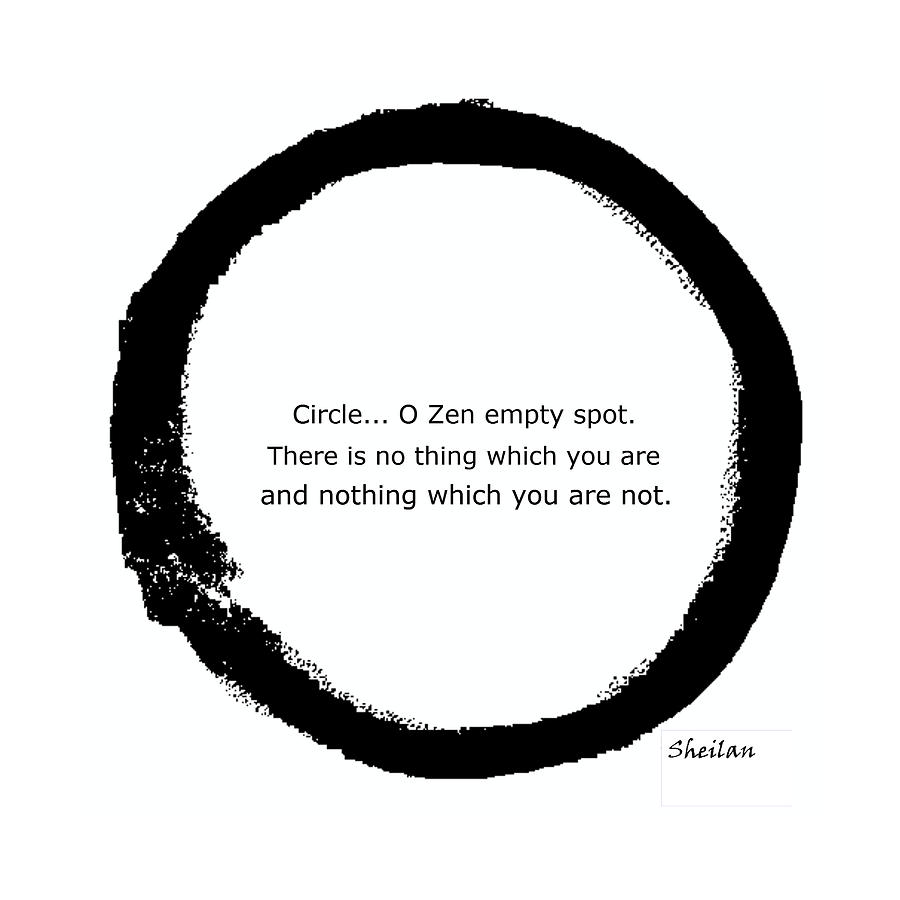
zen-circle-sheilan-sheilanIt seems to me that this is very much like a Zen koan.

If you try and use your intellect only to understand Zen, you will never understand the concept of Zen.  Zen is about transcending ourselves, consciousness-raising, etc.  It is about allowing you to take yourself out of yourself so you can see yourself from another perspective.  Once you see it, your perspectives shifts in a way that you could not have understood, or predicted, before the shift.   After you see the shift, you can engage with it intellectually, but not before.

Privilege is about perspective, perception, and is entwined with the very foundations of how we understand ourselves in relationship with other things.  It is not an objective concept to be apprehended, it is a way we see such concepts.  It is a method, not a fact.

Think about how it changed the way you understand the world to understand that your previous religious worldview (for those that had one) was fundamentally wrong.  Was it conceivable to understand what you understand now, then? When I first saw the shift of my own privilege (which happened much too late, when it comes to male privilege), it changed the conversation for me.  And so now talking with men who do not get it yet is much like talking with a fundamentalist Christian.  I simply cannot show either of those interlocutors either my atheist or feminist  perspective, but I can talk around it.  I can describe it and hope that they are listening to me, rather than thinking about their reply, but I cannot force them to.

All ex-theists had to spend some time really listening, whether live or via reflection, to what an atheist has said to them about belief. Some may do this on their own and without external argumentation, through genuine introspection and self-doubt, but it amounts to the same.  Understanding privilege is more about introspection than it is about understanding a concept.  it’s about understanding how our mind works (or, more correctly, how it doesn’t).

And that’s why we all, at some times, need to shut up and listen.  It’s like meditation; we have to shut down our privilege engines, our verbal and intellectual powers, and watch the mind in action to see how it’s skewing the world for us.  By insisting upon verbalizing it—by talking rather than listening or watching—we are not able to see the machine in action, and to fix it.

So, whether it comes to gender, race, etc, shut up and listen.  Sometimes, it’s the only way to understand.

It’s a Women in Secularism anniversary!


One more day!

logoTomorrow morning, Ginny and I will be getting in the car and driving down to Washington DC to attend the Women in Secularism conference.  And on Sunday, Ginny and I will be celebrating our one year anniversary!  In fact, the reason we didn’t make it to the first Women in Secularism conference was because our wedding was the same weekend last year.  And while I considered skipping out on my own wedding for a conference, ultimately I decided it would not be a good decision.  Plus, our wedding rocked.

I’m looking forward to seeing some old friends, meeting some new ones, and generally having a great weekend.  I may be blogging, or at least tweeting, from the conference (@polyskeptic), but if I don’t I will certainly have something to say after I get back.

I do hope to avoid any and all potential absurdity from some certain persons who will be attending, and broadcasting, from the conference while there.  I will reiterate that I am really not interested in interacting, socially or for the sake of argument discussion, with people who perpetually fail to comprehend the intersectionality of social issues as they relate to the drive that pushes atheists to be active.  The same motivations I have to be active in this community lead me to care, and act, about other issues.  And since (with atheism and feminism, for example) there are overlapping concepts and goals, having a space for people who contain the multitudes of social justice concerns makes sense.  Again, nobody is claiming any necessary logical relationship between atheism and gender equality as envisioned by feminists such as myself.  The point is that the desire to be an activist for one set of concerns—such as the separation of church and state, education and theocracy, and atheist civil right protection—is related to the desire to see other issues dealt with in society.  And since these different issues have some overlapping concepts (like privilege), experiences (like discrimination and misunderstanding), and similar goals (general human rights) it makes sense that some people talk, write, and act on their intersectionality.  The whole point of intersectionality is that various cultural concerns have overlapping affects and experiences, and some of us care about how atheism, skepticism, gender issues, racism, ableism, etc intersect.

The problem, for many critics of this view, is that they don’t agree with or care about the kind of feminism that we espouse.  That’s fine.  They have the legal protection of believing whatever they want, and they can still do pure skepticism/atheism, if they want (I think that’s getting old and boring, personally).  On the other hand, this critical view has nothing to do with the fact that we we plussers and other atheist advocates for third wave feminism comprehend, care about, and argue for the active intersection of these issues.  Nobody is forcing anyone else to contribute or cooperate, and nobody is redefining atheism or trying to enforce community standards.

Why the fuck can’t some people comprehend that?

*sigh*

/rant

In any case, I will be there and I expect it to be a great weekend.

Will you be there? If you are reading this and plan on being there, feel free to come say hello to either of us.  I will likely be wearing the blog shirt or something equally offensive to mainstream sensibilities.

The atheist culture wars; applying moral foundation theory to the great schism


This morning I found myself pondering the idea of cultural relativism, tribalism, and how it relates to the various fights which have emerged in the atheist and skeptic communities.  Cultural relativism is a concept in anthropology which developed as a reaction to a kind of tribalism which is called ethnocentricism.  Just think of Bush-era conservatives with their nationalistic, jingoistic, and what they called “patriotism.”  Ethnocentricism is exemplified by the idea that America was getting it right (well, at least their red-state America, anyway).  Those of us on the political Left, those who voted for Al Gore and who saw Dubya as an awful president surrounded by an awful administration (which dragged us through scandal after scandal) would sometimes point out that perhaps we were not doing it all right.  Perhaps some relativism was necessary…which led to us being told we hated America.

culture_warsIn other words, the culture wars.

As writers such as Jonathon Haidt and the (discredited, but largely for different work) Marc. D Houser have pointed out, much of these political and cultural differences are based in differing value-sets.  There are different ways that we perceive information, in emotional and moral ways, which change how we draw conclusions about reality.  In short, what values we have will influence our intellectual opinions.

Both of these writers have emphasized two primary narratives which lead in two major directions concerning how we think about our tribe, other tribes, what kinds of rules our tribe should have, etc.  In American culture, this translates into the conservative “red state” America and the “blue state” America.  You know, the culture wars distinctions we have been talking about for more than a decade now.

I think this is what’s happened to the atheist community.  I don’t think that the main differences are precisely the same as they are in the larger culture, but I think this is the type of thing that has happened to us, and I am not sure anything can be done to fix it, just like with the larger culture wars.

How can you change someone’s values? I’m not saying that we shouldn’t do things like criticize other people’s values (I, for example, think that liberal values–such as care and fairness–are actually superior to largely conservative values –such as loyalty, authority, and sanctity.  But of course I would say that; I’m a pinko ‘Murica-hatin’ liberal).  The question is  how, assuming that I am in any meaningful way objectively (or at least inter-subjectively) right that my values are better, can I convince a loyal, authority-loving, sanctimonious…sanctified conservative of that?

That’s a harder thing to do.

imagesEver talk to a creationist? How about a “pro-life” (or pro-choice, if you are on the other side of that fence) activist? There is more than a distance of facts (although there often is that), but there is a distance of language-games, values, and worldviews.  Such a conversation needs more than a good moderator, it needs a cultural anthropologist in order to shake out the worldview distinctions.

Ever read a blogger who uses the term FTBully not ironically? Ever read a post by PZ Myers or Rebecca Watson? I do, fairly frequently.  And guess what; I think one side of that fight is crazy, and I think that they are fundamentally wrong from the bottom up (guess which).  The problem is not the factual disagreements (that is a symptom, not the cause), the problem is the fundamental worldview distinctions.  The problems are fundamentally about what values matter to us.

That is, they are not wrong because of their bad logical argument itself, but of their assumptions, worldview, and moral values. This is because logic is only a tool.  It can only manipulate information given to it.  Just like a Bible-toting evangelical conservative Christian can use logic to make their points, so can the atheist they are arguing with.  And while both may make logical errors (guess which I think is likely to make more), the source of the problem is at the level of things like values, assumptions, and biases; not mere facts.

Those who oppose the efforts of inclusion in the atheist community are not wrong because they are opposing inclusion.  In fact, the very framing of that statement was (intentionally) worded to lean one direction (hey, Fox News does it, so can I…).  They are wrong because they are valuing the wrong things.

Value divisions in the atheist community

Surely, there are both political liberals and conservatives in the atheist community.  But how the foundational values we have get expressed in the larger political sphere will differ from how they will create splits in our smaller atheist culture.  The values which split us here; values such as authority, loyalty, and sanctity being expressed in the atheist/skeptic communities as opposed to liberty, care, and fairness will illuminate the foundations of our disagreements.  In other words, I’m applying moral foundation theory to this split, and I’m claiming that it is largely analogous to the conservative/liberal split in the larger community.

Let’s take a look at the third moral foundation, for a clue:

3) Liberty/oppression: This foundation is about the feelings of reactance and resentment people feel toward those who dominate them and restrict their liberty. Its intuitions are often in tension with those of the authority foundation. The hatred of bullies and dominators motivates people to come together, in solidarity, to oppose or take down the oppressor.

I will bet that both sides of this split will identify with this, but in different ways.  Clearly, some people feel bullied by others in the community, and claim that those people are trying to wrangle authority over everyone else.  Those people trying to define what atheism, skepticism, etc mean when it’s clearly not what it means (to them).

But on the other side, the argument is that mere philosophical or semantic precision are not what matters.  PZ Myers’ concept of the “dictionary atheist” was not an attempt to redefine atheist in the philosophical sense, nor to force this definition on anyone, but to recognize that those philosophical senses are secondary to many people.  And he’s right.

See, we are not primarily rational beings.  We are emotional beings who believe things for largely non-rational reasons, and then we rationalize (or explain) the causes of our beliefs.  Hopefully, we are willing to change our minds based on new information, but believing (or not believing, in the case of atheism) is an emotional phenomenon which we later rationalize.  Some people are not aware of this and get overly focused (as I have, in the past) on the semantics and philosophical side of the question.  This is, I believe, Justin Vacula’s primary fault, as a thinker, and why he fails to get it so often.

In other words, rationalized arguments about semantics when the difference is one of values.

Let’s get back to moral foundation theory to see more facets of this disagreement.

Some people want to employ fairness:

2) Fairness/cheating: This foundation is related to the evolutionary process of reciprocal altruism. It generates ideas of justice, rights, and autonomy. [Note: In our original conception, Fairness included concerns about equality, which are more strongly endorsed by political liberals. However, as we reformulated the theory in 2011 based on new data, we emphasize proportionality, which is endorsed by everyone, but is more strongly endorsed by conservatives]

If we interpret this in the sense of giving everyone a fair chance to participate, then there are at least two ways that we can go.  The question concerns the issue of whether we should treat everyone the same or whether we should treat people in the way which produces equal outcomes.  The question of privilege, which has become a lightning rod in recent years, is relevant here.  Treating people the same, irregardless of their place relative to privilege, often leave people in different outcomes (says this liberal pinko).  This is part of an old argument which is reminiscent of not only recent atheist discussions, but culture war arguments over the last few decades.

In the atheist community, this has been most obvious in terms of the treatment of feminism, which some see as exclusive of the rights of men, but which other’s see as learning from the experience of women to make it better for everyone, regardless of gender.  If we seek to include more women, do we treat them like men or do we try to dig deeper and understand that the assumptions about gender need to be revisited so that we stop perpetuating gender roles and expectations, hopefully leading to a more gender equitable community where the varying perspectives are better seen and understood? Seems simple to me, but other people have different values and view equality either secondarily or as a simple function of treating everyone the same, even if that means people get to different places.  One of these values is superior to the other.

Then we can ask whether this foundation is more or less important than purity, or sanctity:

6) Sanctity/degradation: This foundation was shaped by the psychology of disgust and contamination. It underlies religious notions of striving to live in an elevated, less carnal, more noble way. It underlies the widespread idea that the body is a temple which can be desecrated by immoral activities and contaminants (an idea not unique to religious traditions).

But don’t let the description fool you; this is not a strictly religious behavior pattern.  This pattern of behavior, in my opinion, is not religious per se, but was usurped by religion just like morality and rituals.  The feeling that something does not belong; social justice is not relevant to atheism (for example) is a deep and important value for many people.  The question is whether this or the desire to include those affected by social injustice, and trying to counteract that, is more important.

For me, the sanctity of pure skepticism or atheism (as it is seen by some, say Jamy Ian Swiss) are not more important than addressing the intersectionality of skepticism with atheism, racism,gender inequality, etc.  But if someone else feels disgusted by that degradation of the purity of the cause of skepticism (or atheism), they will reject movements such as Atheism+.  They will feel that to include gender issues, race issues, etc into the larger cause is a form of contamination; it just is not what atheism/skepticism is about! (says our sanctimonious friends).  Again, this is a difference of values more than a difference of facts. Again, one of these sets of values is superior.

Accommodationism

Remember the old argument about accommodationism? One of the issues was whether it was important to care about people, despite their beliefs.  How nice were we supposed to be? Well, that’s all about the care/harm foundation:

1) Care/harm: This foundation is related to our long evolution as mammals with attachment systems and an ability to feel (and dislike) the pain of others. It underlies virtues of kindness, gentleness, and nurturance.

Take that in balance with other values, such as the liberty/oppression foundation:

3) Liberty/oppression: This foundation is about the feelings of reactance and resentment people feel toward those who dominate them and restrict their liberty. Its intuitions are often in tension with those of the authority foundation. The hatred of bullies and dominators motivates people to come together, in solidarity, to oppose or take down the oppressor.

and we can see why the anger at oppressive religious institutions and doctrines might override the care/harm value.  Some people were so angry, justifiably so or not, that they were not concerned about being sensitive to people’s feelings. Who cares if some Christian’s feelings are hurt when their beliefs are criticized when you balance that against the harm Christianity is doing to so many people! On the other hand, argued others, if we do not accommodate their beliefs, we will never change their minds and we will simply push them further away.  Whether this is true or not is relevant too, but at an emotional level it exposes how our values are the origin of such arguments, not the facts per se.

Big Tent Atheism

What about our desire to create a large umbrella organization or a big tent? The goal of coming together as atheists no matter our differences, for the sake of our shared rights? Well, that’s the value of Loyalty/betrayal:

4) Loyalty/betrayal: This foundation is related to our long history as tribal creatures able to form shifting coalitions. It underlies virtues of patriotism and self-sacrifice for the group. It is active anytime people feel that it’s “one for all, and all for one.”

Here, anyone who is perpetuating the drama is a traitor.  They are betraying their larger cause in the name is stupid arguments over secondary concerns.  This is, I believe, the motivation behind my long time friend Staks’ anti-drama pledge.  It is a value I understand, but which I do not share as a primary moral concern.  I am more interested in making our community better than making it bigger and closer.  That is, I would rather be a part of a smaller, more inclusive atheist community than one which is more concerned with what I see as a false sense of community around the answer “no” to the question “do you believe in any gods?” I’m more concerned with addressing social justice and the intersection of issues around atheism than focus on merely getting along for the sake of what I see as short-term atheist rights issues.

As I see it, any movement that focuses on its own civil rights over the intersectionality of all human rights is participating in short-term thinking, and will eventually be left behind with the conservatism of history.

As our community continues to grow, transform, and gain political and cultural influence, we will become institutionalized, inevitably.  How we think of ourselves now will effect how we will leave our mark on history.  I would rather leave a smaller, but more inclusive mark on history than a larger but more conservative and exclusive mark.  With this in mind, I want to address the fifth, and as of yet unmentioned, moral foundation; the Authority/subversion foundation:

5) Authority/subversion: This foundation was shaped by our long primate history of hierarchical social interactions. It underlies virtues of leadership and followership, including deference to legitimate authority and respect for traditions.

Five years ago, this foundation would have had no place in this discussion.  Five years ago, we were all subversives, pulling away from a larger tradition of hierarchical religious institutions which dominate our culture.  And, of course, this is still largely true.  But in another sense, this has become a point of division within the atheist/skeptic community, now that we have at least established, at least internally, some traditions (or at least tendencies) and some leadership.

No, there is no atheist pope.  There is, however, some hierarchy and some power.  Richard Dawkins saying something about atheism carries weight.  Not for all of us, but he is a symbol of our movement and his opinions carry some weight.  We can and do disagree with him (some more than others, of course), and his words are not officially conclusive, but because so many people respect him his words have an effect on our thinking.  He’s just one example.

If you love PZ Myers, Rebecca Watson, or Justin Vacula, then their words carry weight.  The people you are willing to listen to will influence your thinking, and those whom you vilify you will, tribalistically, either ignore or hate.

If you have written off someone like Rebecca Watson or PZ Myers (as bullies or whatever), then you will only see her words when someone you like quotes them, and your view of them is skewed.  If you hate Justin Vacula, the same is true from the other side.  Personally, I make a point to read the words of those I disagree with as well as those I tend to agree with.  I never agree with anyone all the time, but there are certainly people with whom I agree more often than not, and those with whom I rarely agree.  I am aware that this is more about values than mere facts.

Anyone who knows me knows that I’m on board with Atheism+, that I am very appreciative of Skepchick for exposing me to many ideas and perspectives I did have 3 years ago, and that I abhor Men’s Rights Activists.  I’m a third wave feminist who makes the attempt to be aware of the privileges I have, and to understand my cultural blind spots.  I have chosen my side, not because I think my side is always right and the others wrong, but because I share values with them.  Just like I am not a Republican or a conservative politically (even if I might occasionally agree with them), I voted for Al Gore, John Kerry, and Barack Obama (twice), and I think that Fox News is pretty awful, I have a side in this atheist schism.  But I still listen to the other side.  I try to understand their values and arguments, and understand that I may never be able to get them to see what I see.

But, most importantly, I think that my values are superior.  Not such that I will force them on anyone, but insofar as I think that they lead to a better world.  Am I objectively right? Well, I don’t think that’s a meaningful question.  Am I intersubjectively right? I think so.   The difference between the two is that the former assumes an objective perspective, while the latter only assumes that such a perspective is always abstracted from a subjective one, and is thus not universal or authoritarian.  This is what I think many political conservatives do not see; liberals may think their views are superior, but they are not actually trying  to demand authority over others based on it.  We want you to see that we are right and join us, are frustrated when you don’t, and we are amused when you call us bullies or totalitarians.  We find it funny because the values which make totalitarianism or bullying possible are conservative values, not ours.

bulliesThe same is true for those in the atheist community who call people such as PZ Myers bullies, to whom the remainder of this post is addressed  The values we have do not include authority as strongly as do yours, so we are not natural bullies.  But since you have those values in stronger measures, you think everyone feels the same and so you project the authoritarian attitude onto us.  We’re not telling you what to do or what you should think, we are just saying what is better (and hopefully why they are better).  And we are sad when you don’t understand it and pull away from us, creating the schism.  We don’t create the schisms; we identify the sources of them and offer a bridge to join us where things are better, which you subsequently see as a demand, a redefinition, and as some sort of totalitarianism (a Horde, if you would).  We don’t seek to control you, we seek to have you understand that the controls already exist and that you are subject to them because you don’t see them.

We are not bullies.  The bullies are your projected values onto us.

Queer Youth Radio on Polyamory


I ran into this today:

I saw it on a blog called Youth Media for Building Healthy Commnities, which I just discovered today.

It’s a fairly good, and short introduction to polyamory intended for young people, specifically in the Long Beach, CA area.  I’m glad to see that resources for young people are inclusive enough, and aware enough, to include polyamory into it’s programming.  The video is pretty low tech, and I don’t know what kind of reach it has, but seeing it’s existence is at least encouraging to me.

I noticed that the video made the claim that polyamory fits under the umbrella of “Queer,” and thus LGBTQ generally, which is an idea which is not universally accepted by all poly people or by all LGBTQ members and allies.  That the struggles which poly people  endure are comparable to those of the traditional LGBTQ community is a tough sale, even if in some philosophical sense there is an affinity between the two groups.  There is a sense that poly people are queer, and perhaps the relationship is more obvious to younger people than it is to me.  I’d be interested to hear from younger people about how they think about that relationship.

I believe that the LGBTQ community should be generally informed about polyamory, especially because there is a natural affinity between minority groups who are struggling for understanding, rights, and community.  We have things to teach one-another, and projects like this video, and the blog with which it is associated, are good positive steps in the right direction.  Also, I would very much like to see a future when comprehensive sex education includes the basic concepts of polyamory as a possibility for people to explore, especially since it will be preferable and more healthy for many people (at least).  We need young people, for the sake of our future world to be a more sex-positive place, to have understanding about their sexuality, possibilities for relationships, and all things related to those two.

I also noticed that they said, near the end, that “monogamy is  an equally valid lifestyle choice, just as polyamory is a great fit for others.”  Putting polyamory on equal footing with monogamy is an improvement over the usual view that polyamory might merely be right for some people, which seems to imply it’s a weird thing that weird people do (well, it is that often too).  I might be willing to go further, and say that polyamory is superior (with the appropriate caveats, of course), but i appreciate the equal footing here.

More of this, please!