Human, gamer, philosopher, godlike being, atheist, nonmonogamous, pariah, contrarian by nature, probably occasionally right human who writes nonsense to very few people.
Some people come here only to downvote my posts. That seems sort of ridiculous, right?
Yesterday, I sat next to the pond for a while and read. There is a park in Collingswood. It has soccer fields, trees, and a pond. There are benches there to sit on, ducks, geese, and even some fish. It is a nice place to sit on a beautiful summer day. Those summer days will end, soon enough.
When spring came around, I yearned for the warm days and sunshine to be able to go outside. I dislike the cold. Hell, it’s summer still and my feet are still cold, so Winter is not my friend. And now as summer is nearing its end, I find myself feeling reflective and I think about aging and appreciating youth and health.
Autumn is beautiful. It is still warm enough, at least in the beginning, but I love the summer. The sounds, the smells, the warmth! And each year that passes I find myself more and more aware that all of this is temporary. I have not reached the point where I believe all is downhill from here. I have many healthy and vibrant years in me still to come. But I am more aware of the finite nature of life. And I must say that I think that I am now experiencing the full bloom of my summer, these last couple of years, and I hope that there are many more to come.
Anyone who thinks that without a god, or other transcendent perspective we cannot truly value life, is not thinking clearly. It is the limitations of life, its brevity, and it’s frailty that makes it valuable. I must keep reminding myself to not let all of this pas unnoticed or under-appreciated. I must keep reminding myself that this will not last, whether it ends happily or in great pain. There will be a day, hopefully many decades from now, when my consciousness will fade into the oblivion, and I will be no more.
But not today. Today I will go back to that park, sit next to that pond, and I will listen to the sounds, smell the scents, feel the breeze and warm sunshine on my face. I will watch the ducks (perhaps feed them a little) and I will know that geese are assholes. I will live today, and appreciate all that I have.
I appreciate all the wonderful people in my life. We all struggle, together, through this ultimately pointless life, creating meaning together. Except for those whom insist upon fabricating or perpetuating false narratives, we as a species are condemned to the reality together. I have no time to make up stories, as I have too much that is real to enjoy.
Therefore, I do not bow to theologies nor to mere social convention. I am capable of loving who I want to and believing what is true. I will not waste this short life pretending or lying to myself. There is too much that is true to keep my attention and appreciation busy.
Now, if you’ll excuse me, I have reality to enjoy.
You knew it was coming. Scientific American — which often pushes cultural agendas as much as scientific ideas — has an article informing us that polyamorous people have so much to teach the rest of us about life. From “The New Sexual Revolution: Polyamory May Be Good For You“
“We have a generation of people coming up who are saying, we also want stability and committed relationships and safety and security, but we also want individual fulfilment. Let us see if we can negotiate monogamy or non-monogamy in a consensual way that prevents a lot of the destructions and pains of infidelity.”
At first glance, the writer could seem (if you are unfamiliar with who he is) to be supporting or criticizing this process of normalization, but then we see that he writes very similar articles about pedophilia:
I have written about this before. In our growing hedonistic culture, pedophilia is in the process of being normalized, downgraded by some from a severe sexual perversion into a mere ”orientation.”
Follow the links if you want to see more, but the bottom line is that Wesley J. Smith doesn’t like any kind of pervert, polyamorous nor pedophile. I am not very familiar with his writing, aside from what I just linked to above, but I would not call him an ally. I would say that in terms of the goals and values that Mr. Smith seems to endorse and the goals and values that I endorse, we are opponents. I’m sure I have more than one opponent in that sense.
The interesting thing is that reading the articles about polyamory could be read as positive, at first glance, because while the conclusions (“Normalization today. Group marriage tomorrow.”) seem dire to the writer, they seem right to many of us. I guess we’re just perverts. No difference between consenting adults who decide to not be exclusive and having sex with children (sorry about your sarcasm meter…).
I’ve thought a lot about, and even written about, how the same information, with the same tone, can look very different to people with different worldviews. Our worldviews are not primarily about having different data, they are about having different values and thus different lenses or filters in the way we interpret and judge the world. The differences between liberals and conservatives, for example, have more to do with morality than information. The differnece between Mr. Smith and myself are more about values, and so when he writes “”Normalization today. Group marriage tomorrow,” he means something different that I would, using the same words.
As I have written before, I look forward to a new kind of polynormativity. But this is not just about making the polyamorous world better, but it is also about being a model for relationships for the world. Wesley J. Smith’s reaction to a basic response to jealousy, and talking about compersion, is to say “Oh, if we could only all be so enlightened.” This could be read as being in agreement, as if to say that the author does wish that everyone could be so enlightened, but by now we know better. This alternative interpretation, of actually wishing for universal enlightenment of this type, would have been in a tone many people,are not comfortable with. However, it’s certainly not a tone that has not been conveyed (by myself, in some cases…wait for it….).
But yes, if only we could all be so enlightened. It’s not that all polyamorous people are wiser and better at relationships than all monogamous people. It’s not even that polyamory is always superior to monogamy. It’s that because we poly people think about relationships more, experience more of them, and because we are forced to deal with relationship skills of higher complexity and more frequency, that we tend to have insights that many non-poly people don’t have. I mean, just look at how poorly non-poly advice columnists deal with questions concerning polyamory–and that’s what they do for a living!
It’s also that we have a community of people who have these experiences who talk to each other about relationships–practically, philosophically, politically, legally, etc–such that we have created a set of resources which have a lot to teach a lot of people, whether monogamous or not, about relationship skills. Put concisely, the polyamorous community may have created the single most powerful resource for understanding sexual and romantic relationships which exists anywhere. We are the experts.
Now, if only we could make ourselves better, as individuals and as a community, we might actually be the enlightened people who could help lead the various societies and cultures all over the world into a better way of loving one another, creating healthy relationships, and having the sex we want.
Thanks to Ron Barber, a graphic artist who I was introduced to through a facebook contact who has been especially awesome for us here recently and whose work you can buy in the intertoobs. She is currently working on a PolySkeptic pendant based on the original logo I created (shown below, for contrast), but perhaps inspired by this new one as well. The new pendant (and perhaps a new shirt as well, which is my next project) will hopefully be available soon for purchase.
Links will be posted when they are available.
As you can see, Ron’s skills with graphic arts software is superior to mine to a significant degree. That’s fine, because I never intended to become a graphic artist, and this way I get to make new talented friends.
I have tried to update this new image to all of the various social media I use, but if you happen to notice that some online PolySkeptic activity is still plagued with my half-assed attempts at design. let us know and we’ll fix it.
Friends Select School. 13 years of my early life was spent here
Growing up, I attended a Quaker school in downtown Philadelphia. A private, religious, and often very wealthy school in the middle of a liberal city. To describe this experience as being progressive would be understating it. Wealthy, educated, and generally privileged as well.
But there were students there who didn’t come from an especially privileged economic background. They lived in various poorer neighborhoods in the city, were often struggling financially (lower middle class, rather than actually poor), but were intelligent and managed to get a scholarship of some kind to attend. My mother, being a person who cared about my education, took a job that she did not especially like nor where she was treated well by an administration who looked down on her (classism and elitism was not unheard of among the Quakers, for sure), which allowed me to attend this expensive and elite school at a severely reduced rate for her to pay.
Being white, I certainly had an advantage over many people in our culture, including many classmates. I didn’t understand this then, at least not the same way I am starting to understand these last few years. I grew up, until I was around 8, in a lower class blue collar neighborhood; Frankford, to be specific. I did not get along with the other local children, who were mostly white. I did not understand them. They lived in a different world than I did, even if they lived on the same block as I did. And even when I moved to a better neighborhood of Philadelphia–Holmesburg–I still didn’t understand the neighborhood children. Our experience of the world was different.
For me, home always felt more like downtown Philadelphia (I still love it there) and the teachers and friends I made there. I still talk to many of them.
At school, I was exposed to music, history, math, and writing in a safe space where a fight was as rare as once or twice a year. Teachers were intelligent, dedicated, and often old hippies. There was some diversity of color and even creed, but there was a large contingent of reformed Judaism. It would forever skew my understanding of how many Jews exist in our culture, being that there may have been 1/3 of the 53 people in my graduating class who were Jewish. Graduating high school, I knew more about the world’s religions, including Islam, Buddhism, and Hinduism, because I was educated in an environment where understanding difference and diversity was a prime value.
The student body was fairly diverse, such that my first girlfriend was born in Sri Lanka. It’s strange how even after many years, a certain fondness still remains for her. But I’m getting away from the thread here (I’m getting there…). And while I looked more like the rich white Jewish students, I had more in common early on, in terms of class and home life, with many of the lower middle class black students, many of whom I spent a lot of time with around 7th and 8th grade. There, I was exposed to some more underground and political kinds rap and hip hop culture, including graffiti (which I participated in), and even started to hear some talk about race privilege (although the term ‘privilege’ was never used, that I remember). I never quite understood the nature of the difference then, but the exposure gave me some perspective.
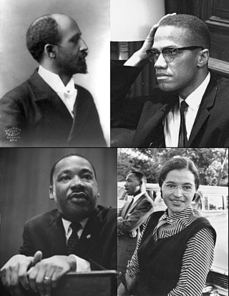
W.E.B. Du Bois, Malcolm X, Dr. Martin Luther King Jr., and Rosa Parks
When high school came around, I was exposed to another side of this issue. I don’t remember the details, but we had a class which was dedicated to the civil rights movement. Figures such as Mohatma Gandhi, Rosa Parks, and Dr. Martin Luther King Jr. were highly venerated people in this largely wealthy, elite, liberal school. We read many of their works, learned of their many deeds and woldviews, and were encouraged to revere them. But what is clear, now, is that the bias of the Quaker view, especially in liberal Philadelphia, ignored much of the fundamental difference and tension inherent in our culture which lay at the foundation of race relations in our society.
Diversity, tolerance, and peace were among the guiding principles, and so when we were exposed to civil rights history the non-violence and messages of peace were amplified while the concepts of privilege (a word I never learned in school) and radicalism were minimized (although, a history teacher did have us read the Communist Manifesto, separate from our civil rights class). This education was a privileged and largely white perspective on the history of race relations in our culture, even when we were reading the works of Dr. King or Booker T. Washington.
Don’t get me wrong; I learned a lot about the many protests, organizations, and thoughts of these leaders. We learned about Frederick Douglass, Marcus Garvey, Malcolm X, and many others. We learned about the Harlem Renaissance of the early 20th century, about the growth of Islam in the black community, and the black influence on modern American music. We were exposed to the concepts of social justice, equality, and it was presented by people who really cared about these things genuinely, some of whom lived through a lot of it.
And no, not all my teachers were white. The few black teachers I had over the years did present us with a different perspective, but there were too many barriers for all of that perspective to strain through. It’s difficult to convey perspective and experience to young people who don’t understand themselves enough yet. At least in retrospect, I can appreciate it more. Some had been there for many of the civil rights events of the 1960’s. One was an open Marxist who taught us about the Black Panthers and had us read Howard Zinn’s famous book (I still have my copy). One of my favorite teachers from middle school is still a musician in Philadelphia, who taught me many things about myself, and who I still communicate with from time to time.
Not completely unlike our Meeting for worship (Wednesdays) at school.
But there was just a religious bias. A liberal (theologically and politically) religion for sure, but a religious bias. Just like all religion, it skews, re-focuses, and distorts the view of these issues, but it does care about them. I would not question the intentions, authenticity, or genuine care of the people I learned from then, but in years since I have come to look skeptically at bias of Quakerism on my early education. If you have been reading this blog since the beginning, you may remember some of these themes from my earlier writing here (before it became polyskeptic.com, and when it was just me writing here).
Because while I read many atheist bloggers who talk about escaping from conservative religious backgrounds, I would describe my journey as growing out of my liberal one. I mean, I’m still a liberal (although I think I’m more radical now), but I get as annoyed with liberal theology as many people do with their former conservative theologies. It’s one of the reasons I have little patience for New Age Pagan ideas; they are too similar to the Quaker background I was raised around, and they are just as untrue.
This Quaker, liberal, theological worldview seeped it way into our understanding of the civil rights movement, history, etc. it was not intentional, it was not even universal, but it was there. I did not understand it at the time, and I am not certain that I remember it exactly as it actually was, but there were times when it was very clear. Here’s one;
It was during a class called ‘Religious Thought,’ which was taught be a very liberal hippie woman who was about as happy and nice as anyone I’ve ever known. One day, she wrote the word ‘God’ on the blackboard, paused, and then wrote under it the word ‘good,’ then proceeded to ramble about how God was good, citing the one letter difference in spelling. At the time, this just seemed odd, and I remember thinking that this accident of language said nothing significant at all. But now, it’s one of the clearest examples of this bias playing out from my high school years. This was before I called myself an atheist, but I certainly didn’t believe in any god at this time, even if god was supposed to be just this good light within us all (as Quakers often believe).
We all have biases. The biases I was raised around, at least while at school, were centered around the ideals of peace, diversity, and tolerance. They are generally good ideals, except when they skew the truth. I have come to regard the truth as being more important than tolerance, for sure, and think that lying about the nature of reality will not necessarily give us diversity or peace. Of course, those who really believe God is the peaceful light within us all are not lying, so much as just speaking nonsense.
50 years since the dream was proclaimed
Washington DC, August 28th, 1963
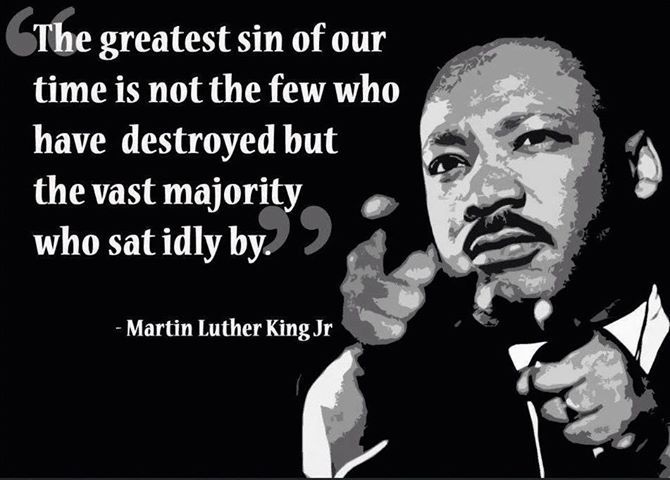
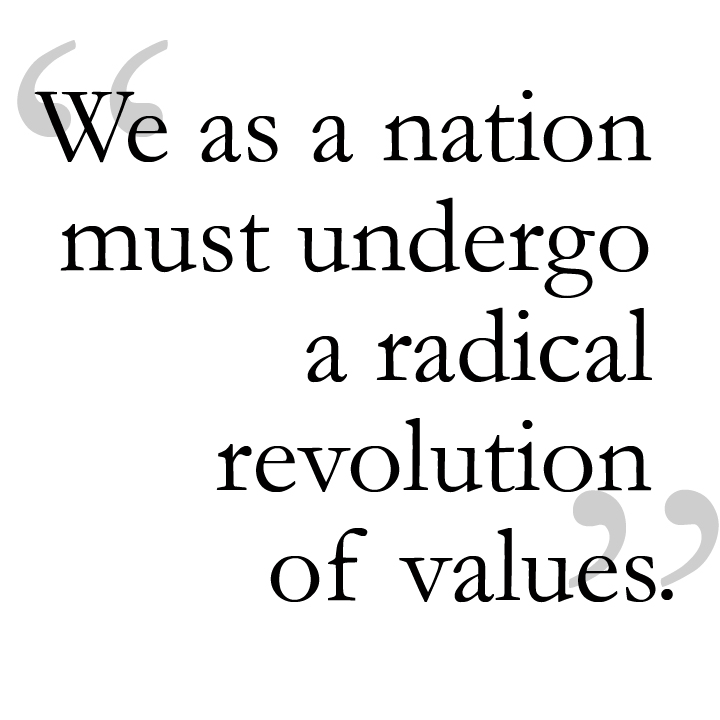
Tomorrow is the 50th anniversary of the march on Washington, which culminated with the legendary and historic speech that Dr. Martin Luther King Jr gave. Today, I am left reflective about my early education, especially in light of what I have learned since. Influences being varied, I think of KRS-ONE, who once said that peace does not come with a flower, but that when negativity comes with a small gun, positivity comes with a larger one. I think of how we remember Dr. King’s non-violence, but forget that he was a radical (especially for his time) who advocated for a shift of economic equality. I think about how many white people I know (or see in media) want to just forget the past, not talk about the racism that many see as past tense, and to just move forward ignoring the continuing tensions.
Recognizing my own white privilege is a struggle for me, given my educational background. Having grown up in a cultural environment where the people are better than average in terms of their views on race, but who also gloss over the real issues still being quite real is problematic. The fact is that even despite this education and exposure to people with different experiences and perspectives on race, I still feel the impulses within me which must lead to racism in our culture. I feel the tribalistic fear and discomfort that must result, when aggregated over the whole culture, in the biases and privileges that effect other people. Within me lies the germ of racism, and only through awareness, education, and struggle do I minimize it.
And I don’t know what to do about it. Studies consistently show that we unconsciously view people who look different than we do differently; that we are more likely to trust those who look like us. And I can feel those impulses, and I am ashamed of them. So no, the race problem in our culture is not past, even if we have made significant improvements. The dream of Dr. Martin Luther King Jr., whose historic speech we remember this week, is not yet realized.
It’s depressing that there are millions of Americans out there who don’t see the problem or who don’t care. Because while I have a long way to go personally before I stop contributing to the culture of privilege and bias at all (if that’s even possible), there are many more who are not even this far. I find myself wishing that the world was composed of people where my current level of contribution was the worst example of privilege and bias. I’d rather it be me, who is struggling, who is the bad example rather than being surrounded by the culture we live in which is drowning in bad examples. Because while we have achieved, politically and socially, many strides towards equality there are many minds still stuck in the cultural time-warp of out instincts, fears, and cognitive biases which result in racism, sexism, etc.
In many ways, we are still stuck in the ancient days of tribalism; primates dressed up in culture but inside still itching to make war with the next settlement (professional sports is an outlet for this) and to protect our own tribe. Conservative think tanks have found ways to pull at this primal drive, as “family values” has demonstrated for many years, conserving conservatism rather than do the work to grow and change.
So, today I want to celebrate the achievements of the civil rights movements throughout history, especially those 50 years ago or so, but am still mired in the realization that we are nowhere near the dream. I appreciate the efforts of the great leaders of the past, including all of those people responsible for the March on Washington 50 years ago, but I am left wondering if the cycle of human ignorance and fear will ever truly end.
I am angry, I am ashamed of the part I play in this still, and I look hopefully at the horizon for real change. I hope I live to see some more of that.
I leave you with these words, spoken by Dr. Martin Luther King from April 4th 1967, a year before his assassination:
Since we released our first podcast a few weeks ago, we got some good feedback. We also received a donation which will help pay for the hosting cost of the podcast. Of course, life got in the way and we never got around to recording another episode….
Until now!
And by now, I mean Thursday.
So, devoted readers, what would you like us to address? And questions for us, about polyamory, or other polyskeptic related material? Tell your friends (monogamous or not) that some awesome, brilliant, and sexy people will be talking about polyamory around a microphone and we want to hear from them. Because if doing this blog has taught me anything, it has taught me that your monogamous friends and family want to listen to a podcast about polyamory.
OK, maybe not. Perhaps you might have to play it for them the next time you have a dinner party. A PolyskeptiCast dinner party!* Now that’s certainly an idea.
Either way, when we are famous and our podcast shows up on iTunes’ front page (for now, you can find it there if you know where to look), everyone and their grandma will be listening to us be awesome and hilarious. But for now, you can get in early and be one of those people that eventually says “I was listening to PolyskeptiCast before it was cool.”
Or something.
—–
PolSkeptic.com does not promise to show up to your dinner party. If there is good beer, cheap red wine, and it is within an hour drive of the Philadelphia area, then we will only promise to try to make it to your dinner party.
I have been having an on-going conversation with someone recently who, upon reading Richard Carrier’s Sense and Goodness Without God (upon my suggestion), quoted this section of his book and responded (below):
The fact that we observe a universe moving through time, ever changing, from the furthest point to the left onward to the right on the diagram above, is the product of the physical nature of both our minds and the universe: it is in one sense and illusion, like the illusion of solidity, when in fact solid objects are mostly empty space; but in another sense it is an interpretation of a pattern that really does exist — a pattern that does not really move or change, but is genuinely experience, just a solidity is genuinely experienced and, in its physical effects, is a real fact of the universe.
Everything we experience is a construct, a convenient way for the brain to represent the otherwise complex and jumbled data of the senses and brain systems. But we have ample evidence, ample reason t believe this “reconstruction” of a world outside of us is based on real data from that world, and thus strongly corresponds to it.
[her emphasis]
First of all, read this book. It stands, for me, as one of the best defenses of metaphysical materialism I’ve seen, and is written for laypeople.
Now, onto her response (in part) and my continued discussion. Warning, this post contains philosophical terminology and may only be interesting to people who care about this issue.
She said (again, in part):
This is what I meant when I was talking about reality being an illusion. Yes, there is a real universe (particles, energy, etc.) but our experience of it is subjective because we are in fact human and not some other mode of creature. We experience time even though time exists all at once. If we weren’t human, but instead a different kind of living creature, for example, a black hole, then (possibly) we wouldn’t experience time, or gravity, or even matter in the same way. In this way, our reality as human beings is an illusion and our experience is entirely subjective. Does that mean there are “laws” of our collective subjective experience that apply to all humans? Of course, gravity is one such law. But gravity is subjective to our experience as humans, and it applies to us only because we are such a creature as such a law applies to. Therefore, our human reality is an illusion because of our collective subjective experience. And a collective subjective experience (I suspect) is the closest we will ever get to an objective reality.
So I understand your point (I think). I’ve bold-faced the important statements, which I will be focusing on.
I want to make a distinction between subjective experience and illusion. The fact that my experience of, say, eating some ice cream is subjective does not mean it’s an illusion. It means that I have a privileged perspective on that experience, one that others only have a limited perspective on, but it still is a real thing. My experience of the ice cream is different from yours (if you are watching me eat it. If we are sharing it that is a more difficult question), but so long as there is actual ice cream, there is no illusion.
The word “illusion” means, for me, an experience with no referent. It means that if I experience the flavor of ice cream (which is subjective) and there is no ice cream, then I experienced an illusion. If I hear the voice of god (and there is no god) I’ve experienced an illusion. But my experience with ice cream, when actually eating ice cream, is not an illusion, It may not be reliably 100% accurate with some hypothetical objective reality, but the fact that there is some difference between the truth and what I’m able to perceive does not imply an illusion, but rather mere inexact perception.
Before I address this further, let’s see what else you said:
Objective reality could possibly exist but it would be impossible for anyone to experience. By argument once you are a “one” you are subjective. Objective reality, therefore, even if it exists cannot be experienced except through limited subjective experiences. And each being/creature/thing will have their own subjective experience of what is. All of us–humans, superior alien intelligence, black holes, or vampire, blood-sucking rabbits– are just blind men feeling up different parts of the elephant (a sexy elephant wearing lingerie).
And I venture to guess you would agree that a “strong correspondence” is still not actual reality.
If I’m looking at a desk, my perception of it creates a simulation of what I’m able to perceive with my eyes. That is, a small set of radiation (visible light). Immanuel Kant was famous for (in part) noting the difference between the phenomena and the noumena. The phenomena is the perception–the simulation our mind creates–and the noumena is the proposed actual desk. He agrees with you, and says that the phenomena is not the noumena. He thought it would be impossible to ever experience the actual desk.
I reject this very framework. My argument is not that we actually see the noumena, I reject this type of model of perception altogether. I don’t think the distinction between the phenomena and the noumena is a meaningful distinction. I think trying to project an actual thing in itself (this is Nietzsche’s term) out there, as an objective being, is nonsensical. This does not mean that the desk does not exist, it just means that the desk is not a separate ontological category as my perception (the phenomena).
The Vedantic tradition, of which both Hinduism and Buddhism are part, offer the solution that says that all is the phenomena, that all of reality, is actually an illusion (maya). That the world exists in mind. This interpretation is dependent upon the subject-object distinction that Kant talked about. It allows the phrase “the world is an illusion” to mean something (or at least to attempt to mean something).
But I view the problem differently. And here, describing it is difficult because our very language (and possibly all language) is modeled on this metaphysical framework. We say, for example, “I see the desk” (subject-object). But there might be another way to describe it. The physicality of the desk, myself, and the radiation interacting with both are part of a larger system (the universe, yes, but the room I’m in is sufficient). There is a continuous physical connection between all of them. The reality of any of them are indicated by the interaction, one specific example of which is perception. That is, my perception is one kind of physical interaction among physical objects, even if it seems different from our point of view.
The problem comes in with subjectivity. The subjective experience is a created phenomenon when a part of this system is self-reflective. It simulates itself, and creates a small “strange loop” (this is Douglass Hofstadter’s term) and this creates the illusion. But the illusion is not the desk (or the world in general). The illusion is the separation (this may be like Zen non-duality, in fact). The illusion is the concept of the distinction between the phenomena and the noumena. In a strange (and imprecise) way, the illusion is the very phenomena itself (but that would still allow the subject-object ontology to be valid).
Remember when you said, above:
By argument once you are a “one” you are subjective.
Well, that to me is telling (assuming I’m interpreting you correctly). Because becoming this “one” is where the illusion comes in. I think this is what some philosophers mean when they argue that consciousness is an illusion (I’m looking at you, Dennett!). It’s not that consciousness does not exist (it is a physical thing), but rather it’s that it creates an illusory separation from the rest of reality and an illusory unified self. I am not sure, but it may have to do this by the very nature of how consciousness works (which is a mystery, still). The illusion of your singular identity, a pattern out of chaos narrative if ever there is one (cf. Dimasio), creates the sense of a subject-object relationship with the rest of the universe (or at least the rest of the room). In reality, you are just a continuous part of that reality.
It’s tempting to flip Kant on his head and say that it is the phenomena which is the illusion (since it actually has no referent, since our simulation is imperfect and is not a faithful representation of the thing) and that the noumena is all we can see (because we are the noumena ourselves), but this does not work because it is equally dependent upon Kant’s same ontologically dualistic description. Whether you look at Kant as he wanted or upside down, the same ontology is necessary, and it is this ontology which is at issue. It fails for the same reason as Kant’s formulation does, just upside down. Perhaps flipping it makes it more clear why his original concept fails, actually.
Kant, Vedanta, and other epistemological/ontological solutions to this problem seek to define the world as the illusion. But it is, in fact, the separation (and thus the subject-object relationship) which is the illusion. So it isn’t that the objective reality might exist but we may never experience it, rather it’s that reality (not subjective or objective) exists, and we cannot help but experience (some of) it. We can’t not experience it because we are part of that reality.
At least, we can’t not experience it until the created loop of our subjectivity can no longer be physically maintained, because the organism which supports it falls apart. So long as the physical (often biological) foundation (our bodies, or whatever computer which simulates something similar) upholds the subjective separation (subjective consciousness), we cannot help but experience the world.
In my framework, we replace Kant’s noumena, or the world “separated” from us, with the problem of resolution. Rather than being dualistic, this is a monistic ontological solution which is left with problems of information transfer rather than ontology-bridging problems (that is what my MA thesis was about). It’s not that we don’t see the real world, it’s that our (current) perceptual gear cannot perceive all existing information (the whole radiation spectrum, every level of detail at all sizes, etc). For this, the solution is not that the other information does not exist or is an illusion, but rather that we need more perceptual tools to see them. Technology, in other words. Science and skepticism.
In the history of religion and philosophy, most metaphysical constructs have separated our (often “limited”) world from the ideal or heavenly world. It may have started with Plato (at least philosophically), but it is pretty universal across cultures. Many materialistic responses have sought to simply reject the transcendent (logical positivism), rather than realize that it’s just not transcendent at all. Many criticisms of this largely universal concept still hold onto, at least implicitly, the dualism that underpins the problem.
Once we realize that we create the illusion, merely by thinking (hence why Zen meditation is still worth pursuing, even if some of the religious associations and rituals still stick to it), we can start to realize that Kant’s phenomena/noumena distinction is not actually a real thing. Then we can go on with our lives, actually living in a real world where words like “objective” and “subjective” are concepts which no longer have any meaning. Then we can stop arguing about objective and subjective (relative) morality and truth, because those distinctions are no longer real either.
On September 13, 14, and 15, 2013, the Freethought Society (FS) and other co-sponsors will host the 2013 Pennsylvania Atheist/Humanist Conference in Philadelphia at The Embassy Suites (9000 Bartram Avenue, Philadelphia, Pennsylvania). To take advantage of discounted room rates that are good only until August 18, 2013, please visit:
The weekend events will kick off with the opening of the world’s only Friggatriskaidekaphobia Treatment Center staffed by Friggatriskaidekaphobia doctors and nurses who will seek to cure attendees of their superstitions. The anti-superstition bash will include mirror breaking, dancing under a ladder, a magic show and many more activities. Attendees are encouraged to bring their own umbrellas for dancing inside. An interactive museum of superstition will disclose the origins of common and uncommon superstitions.
There will also be live musical performances, games, souvenirs, caricature artists and dessert.
The activities continue with a different focus on Saturday, September 14 and Sunday, September 15. Local and national nontheist speakers will highlight the subjects of freedom of thought, maintaining separation of religion and government, building community and the promotion of a unified effort to attract supporters.
The program also includes a comedy show and two concerts.
To purchase tickets and to get more information, please see the following website:
The list of speakers and entertainers so far include:
American Humanist Officers and Board Members
Herb Silverman
Becky Hale
Debbie Allen
Maggie Ardiente
Others include:
Seth Andrews
Author, Blogger, Podcaster and Video Producer
Jamila Bey
Washington, DC Journalist and Podcaster
Rob Boston
Author and Senior Policy Analyst at Americans United for Separation of Church and State
James Croft
Representing the Harvard Humanist Community
Dave DeLuca
A rising atheist star debuting his Common Sense Comedy act
Jerry DeWitt
former minister and author
JT Eberhard
Blogger, Debater and Co-Founder of SkeptiCon
Sean Faircloth
Author and Director of Strategy and Policy for the Richard Dawkins Foundation
Fred Edwords
Activist and Executive Director of UnitedCOR
Steve Hill
Atheist Comedian
George Hrab
Popular Atheist Musician, Comedian, Podcaster and Gadfly
AJ Johnson
Writer, Promoter, Vice-President and Co-Founder of BeSecular
Amanda Knief
Author and Executive Director of American Atheists
Lauri Lebo
Journalist, Writer and Author of “The Devil in Dover: An Insider’s Story of Dogma vs. Darwin in Small-town America”
Tracy Lockwood
Former religious cult member
Teresa MacBain
Former pastor and Executive Director of Humanists of Florida
Joe Nickell
Author and Skeptical Investigator of the paranormal
Edwina Rogers
Executive Director of the Secular Coalition for America
Shelley Segal
Popular Australian Singer/Songwriter at the Top of the Charts!
David Silverman
President of American Atheist
Jamy Ian Swiss
Magician and Senior Fellow of the James Randi Foundation
David Tamayo
Podcaster and Founder of Hispanic American Freethinkers
Joe Wenke
Lawyer and Author
—
The conference fee is $113. The price includes the Friday night Friday the 13th party ticket, Saturday buffet lunch and dinner, plenary passes for Saturday and Sunday. A VIP package is available, as well as student pricing, day passes, and other options.
Please do not miss this great event on par with national conferences. Remember that the deadline for discount hotel rooms is August 12, 2013.
I will be there all weekend (I will be a volunteer performing all sorts of tasks), and will look forward to seeing you there!
So, remember Friday the 13th of September. If you have not seen Maraget’s friggatriskaidekaphobia parties (she does them every couple of years), you should come for that and then decide to spend the entire weekend with awesome people (no, I’m not just talking about me).
You know how people, after reaching a rock bottom point in their lives, often find religion? You know, the old redemption and salvation story. They have had evil done to them, did evil themselves, but now they walk the righteous path! It’s a powerful narrative, and the times it has been utilized in story-telling (both in text and in personal behavior) are countless. It’s a ubiquitous narrative structure of religion, literature, and personal psychology.
In sort, it’s one of the most fundamental aspects of being human.
Now, I could go on about how this narrative is flawed, especially in how it is utilized by religion as a vehicle for more than mere narrative, but of actual truth, but that’s obvious and banal. Besides, many atheist commentators have made that point numerous times, and blogs which keep pestering the same points get stale after a while.
So, how about this; Let’s try and take that narrative and fit it onto a different vehicle. Let’s see how, perhaps, this narrative relates to how we create a false dichotomy in terms of relationships, specifically when it comes to cheating and exclusive commitments.
Similar to the penitent sinner, there is the repentant adulterer. Yes, there are the people who have cheated and who try and commit themselves to being successfully monogamous, but I’m interested in the less obvious versions of this story. I’m interested in a story of the person who struggles with the desire to cheat, and who fights of this desire with an ideal of monogamy and exclusivity. I imagine that this struggle has many facets that we would recognize in man other tropes, including many “romantic” ideals which include concepts such as “one true love,” “soul mate,” and “belonging” to someone.
Somehow, the natural, and undoubtedly widespread, inclination to be attracted to many types of people is shrugged off by rationalizing some special exceptionalism or superficial romantic notion of exclusivity by people who are struggling to fit into respectable expectations. To fit in. They see their desire as a roadblock, rather than as an alternate route. They probably don’t even see the path less traveled. They see the road, the obstacle, but not the other lanes of traffic.
Why is this narrative so clean and obvious in our culture? Is it as simple as the fact that many cultural forces, including the conservative influence of religion, have tried to battle our animal nature, trying to beat the swords of our lust into ploughshares of civil monogamy? Is it as simple as groupthink and herd behavior?
In today’s cultural and political climate, “family” (usually meaning a man and a woman who have children) is often held up to be the foundation of our society and culture. This structure, solidified in monogamy, sexual exclusivity and (ultimately) ownership, is thought to be what holds all of this together. If it disappeared, it would lead to anarchy (“yay” the anarchists may say).
So to not struggle against our instincts is to invite destruction. Not merely of our relationships and our personal salvation and redemption story, but to that of our entire society. This is why I think that the insights of both atheism and polyamory, founded by skepticism (the method, not the community), are so radical. They question the very dichotomy of not only our instincts with many assumed ideals, but they present an alternative perspective through which to view these instincts. They seek to deconstruct the problem, very much in the tradition of the best of postmodern criticism (yes, there are good aspects to postmodernism, believe it or not!) so that we can see the problem from a different perspective.
At bottom, the answer is not to repress, struggle against, or transcend our instincts, but rather to find a way to make our instincts the fuel for creating a responsible, mature, and enjoyable life. The answer to desire is not always denial; sometimes it’s merely to re-think the nature of that desire in terms of what is possible, even if not popular or easy. Our instincts are not good nor are they bad, but they are real and they will continue to pester us, so we might as well get comfortable with that. And since we are getting comfortable with them, we will have to live with giving them some limitations, boundaries, and maybe even rules.
Monogamy is not the answer to variety of sexual and romantic desire. Monogamy is the answer to a genuinely limited set of such desires. Monogamy is what happens when happiness involves one person. Religion is not the answer to our metaphysical needs (cf Nietzsche). Religion is only such an answer when it happens to be true (and unlike monogamy, religion may never fit this bill. That is, monogamy may be rational, but religion may never be so).
We have the capability to re-define things such as “family,” “commitment,” and “love” to be broader than the exclusive and restrictive definitions which are common today. We, if we are to care about progress over the conservative impulses of some of our culture (conserving a system that simply does not work), must continue to demonstrate that progress is not only inevitable, but that it is morally superior.
We should be struggling along with our instincts and desires, rather than against them. It’s not only a pragmatic strategy, but an authentic (and thus moral) one.
In short, keep sinning because it’s not actually a sin. But do it responsibly.







 Skepticism, Properly Applied