The truth of my truthiness


Way back in the stone ages, also known as 2009, I posted some thoughts about religion on this blog (I know, shocking!).  Riding the memetic wave of “truthiness” which was all the rage back then (ah, the good ol’ days…), I wrote a piece called Truthiness of Religion to rave reviews, mass popularity, and numerous awards…which I turned down and subsequently requested never to be publicized that I was offered such prestigious recognition…because I’m humble….   Also, that mass popularity has seemed to have been forgotten, almost as if it never actually happened.  Strange….

Let’s just let that subject drop, m’kay?

I had not forgotten about the piece, but I didn’t expect it to receive any attention either.  It was just one of hundreds of posts that sits in the archives of posts here, many of which are occasionally discovered by some internet surfer (I might be going to far into the stone age with that usage…).  But in the last few days, this particular post inspired not one, not two, but three responses!

OK, that’s an exaggeration.  In reality it was a three-part (and they are all short) response from one blogger; a Presbyterian pastor in New York by the name of Herb Swanson.  So, here are the three parts:

Part 1

Part 2

Part 3

Now, I don’t want to respond in full yet.  The reason is that I have emailed Pastor Swanson and he has said he will get back to me.  I will quote my email to him in its entirety below, as I think all the salient points are hit upon there:

I discovered your post in response to mt comments about truthiness and religion.  I was interested in commenting because I think you got two essential facts wrong about my views, but you don’t seem to allow comments on your blog (which is unfortunate, because it does not allow for dialogue or genuine openness.  Much like a sermon; no questions or comments from the audience.)

You said, on part I:

The reason they are so angry at each other is because they are fighting over common territory, which they both agree is “the truth.”  They both think about truth in absolute terms.  The new atheists believe that there is only one truth, which is the truth of science.  For them science is an absolutely dependable method for discovering the truth.  The literalists posit their absolute truth in the “facts” of their faith.  There is no room for dialogue with either group.  We best leave them to their war.

This is not true.  I am not an absolutist in any way.  I recognize the slipperiness of truth (I’m a philosopher).  I believe that science, far from being absolute, is probabilistic and gives us tentative conclusions.  These tentative conclusions, called theories, become less tentative the longer they survive scrutiny.   Occasionally, with great effort and verification, our theories become better an better.  A classic example is the fact of gravity and its explanation.  Einstein’s improvement of our understanding, the theory of relativity, is better than Newton’s explanation.  Newtons observations are still pragmatically true for every-day uses, but it’s not “True.”  Quite possibly, Einstein’s general relativity will be improved upon, and so until then it is our best explanation and works for levels of description bordering on our current understanding.  One we have a better understanding of string theory and such, some new genius might add more fine detail to the theories explaining gravity and the other fundamental forces.  So General relativity is only “true” in the sense that it is the current best explanation which has been repeatedly verified.  No other explanation is better than it.  That’s what truth is, for me.  This is not an absolutist’s position at all.

Therefore, I do not claim any absolute truth but I do say that the claims of supernaturalism do not pass skeptical analysis.  The burden of proof is on the claimant (e.g. you), and I am not convinced so far, despite earnest attempts to understand. 

Also, you claim that we are not worth talking to.  The funny thing is that we are not generally interested in dialogue with the literalists because they are so different from us.  The canard that we are like them, just on the other side of the issue, is one we are getting tired of.  Not only are we not absolutists (which they tend to be), we share almost nothing with them other than the superficial similarity of the desire for truth; I say superficial because their methodology is terrible for attaining any.  Our methodologies for truth (our epistemology) are drastically different, hence our different conclusions.  They talk of truth a lot, but they don’t have any justification to back up that use.  You cannot say the same thing about science. And if you think you can, then you are falling prey to the postmodernist relativism of modern intellectual thought.  And no, relativism and absolutism are not the two dichotomies from which one can draw a false seed of my own demise.  In other words, if one is not an absolutist, they are not, therefore, a relativist.  That is sophomoric at best (just in case you had that thought….)

In part II, you say:

McGonigal then distinguishes between two states of mind, the first this creative one and the second a critical or analytical state of mind.  Only the second state leads to truth. 

This is also not true, at least not completely.  I recognize that good art has much to teach us, and we learn much through it.  Creativity is a source for truth, but it cannot, on its own, determine that something is true.  I think that distinction is essential here.  I only think that we need to verify the things we learn via skepticism when they make claims about the nature of reality.  Quite often, things learned from creative impulses are true without much need for verification, and other times even when this seems to be the case, it is due to some cognitive error due to our poorly evolved truth-detection machines in our head. 

But more importantly, I do not think we can make a clean distinction between creativity and reason.  The notion that we can is based upon an ancient idea derived from Plato, and recent neuroscience shows that the two attributes are linked in more ways than we are consciously aware.  This is true not only with moral thinking, but with so called “pure reason” (a fiction that even the great Kant was susceptible).  There is no pure reasoning, nor is there any pure feeling; that is too simplistic a categorization of what goes on in our heads.

Later in the same post, you say:

McGonigal believes that physical reality is reality.  Anything pertaining to the emotions or the a-rational is not real, not true.  Only physical realities can be true.

I want to clarify here.  I believe that emotions, in fact all experience, is a part of physical reality.  I just believe that sometimes what our body/brain come sup with in terms of experience is not always a mirror of any real thing outside of it, however.  That is, the experiences are real, but the simulations that are represented are not always simulations of real things.  We can simulate reality, but we also make grave errors in perceptions, whether via optical illusions or otherwise. Our brains are very easily fooled, as people such as James Randi and other magicians have taught us.

I could comment on more, but most of part III think you might guess what I would say.  Well, given how poorly you understand the “new atheist” position, based upon your comments in your posts, I will not make that assumption.  I will, nonetheless, leave it alone.  If you wish to discuss that we can do so.

The fact that you don’t leave these posts open to public comment, indicates that you are the one who does not want dialogue.  You think there is no talking to us, but you don’t even try.  You make assumptions about what we think rather than ask, and when you do make those assumptions, you do not allow a public forum for us to respond.

I’ve never seen an atheist blog that does not allow comments.  I’ve seen many Christian blogs that do as you do.  That speaks volumes about our relative interest in dialogue.

I will hope to get some actual dialogue going with him, because he is just another theist who seems to have a lot of misinformation about what new atheism is all about.  I’m thinking that I will also have to alert him to my new project, which is intended for people like him and his congregation.  I will post any further developments about our correspondence in coming days.

(BTW, I’m still in correspondence with Dr. Robert Benne.  Right now, not much to report on, just having a discussion about epistemology at the moment.  If you don’t know what I’m talking about, here is some linkage: one, two, and three)
Don’t say “polyamory”


So, yesterday I went to New York to do some upstart talk show by a former Catholic (and present Episcopalian) priest called Father Albert.  While we were prepping to go into the studio, the production staff, after asking many questions, interviewing us, and making a video introduction for the show, coached us to not use the word “polyamory” while on camera or in studio.  They wanted us to use the more commonly accepted term of “open relationship.”

Now, I understand their reasons.  For one, they had a guest who was formerly the 6th wife of a FLDS polygamist (who ended up having 10 wives), and people don’t understand (nor would they likely hear) a difference between the words polyamory and polygamy.  If we are being strictly technical, polygamy can be a sub-set of polyamory, except in most polygamist situations their is little to no love going around.  To distinguish between what Ginny and I are doing and what that women experienced in the environment of a talk show would be a herculean task.  The more general reason is that the term simply is not known widely enough to not be distracting from talking about what are relationship is like.

This is somewhat frustrating from the point of view of someone who is trying to educate people about responsible non-monogamy.  I agreed to not use the term because I realized that my time on the show would be short, and that I would likely be facing some hostility to the nature of my relationship with Ginny from an audience that is more likely to be conservative in their views about sex and relationships.  And that turned out to be a safe assumption, as they were pretty unfriendly to us in general.  I was glad to see one woman stand up and support us, even if she was likely the minority opinion there.

Father Albert himself, the host, was not supportive of us either.  He just didn’t get it, he said.  He talked about counseling couples towards a strong monogamous marriage, and that adding people to our relationship is only dangerous in terms of STDs (which is a real issue) and ultimately destructive to any real intimacy.  My retort was that we have rules of safety about safe sex, our intimacy is enhanced by true openness and honesty about everything, and also that fact that our relationship is constructive; “what can be more constructive than adding value and quality to our lives” (or something very similar to that).

Had we more time, I would have liked to make distinctions between polygamy of the kind that one of the other guests experienced and the polyamory–the loving, open, and honest relationship–that Ginny and I have.  The other people I have in my life that I am interested in pursuing some kind of romantic and/or sexual relationship (they are few, and I think they know who they are), are not being told that this is some divine command, they are not 15 years old, and I am not their superior.  We are equals; adults deciding to pursue relationships which mean something to us.

The bottom line, I think, is that our culture understands what monogamy is.  Even if it is serial monogamy, the idea is simple, feels comfortable, and is usually assumed by most of Americans.  Our culture is becoming more familiar with what polygamy is (at least in terms of the FLDS churches).  And even when they have a more positive model, say like in the show Big Love (which I have seen and like, to some extent), there are still problems such as the fact that it is always men with multiple women, and never the other way around.  Even when you have a Bill Henrickson who genuinely cares for his wives (Big Love), none of them are allowed other lovers.  This is an inequality borne of religious patriarchal thinking, not of genuine open-mindedness and desire to add love and joy to your life without social constraints which are ultimately based upon a relationship model borne out of a property relationship.  So, in our culture non-monogamy is probably associated with male domination of women, even if we can point out the occasional (even if only sometimes fictional) loving counter-example of such.

Polyamory is about treating all adults as, well, adults.  It is about deciding how you want to live your life, with whom, and being open and honest about our desires.  We, as a culture, are so far from understanding the implications of this that a term like “polyamory” just does not have a mental category in which to sit for most people.  Yes, if I had been given a 20 minute segment on the show to talk about polyamory, define it, and give examples and have other people, women and men, talk about the freedom, care, and rewards of living such a life then at least some people would begin to see what it is all about.  But that is not what happened yesterday.

When he introduced us, it was in terms of “here is a man who may want to get married, but he will still want to date other women.”  And not “here are two people who are in love, are committed to each other, have a healthy relationship, and who may have other lovers, boyfriends, and girlfriends.”  The former is based upon tropes common to our culture, the latter is not.

That idea is just too far removed from talk-show America.  And just like the term atheist, which is getting more press and is becoming more accepted (slowly), polyamory is a term that many think we just can’t use right now.  But with time, effort, and some patience (but not too much patience) that will change.

Going to New York to be on Father Oprah


So, apparently some Catholic priest by the name of Albert Cutie left the church to marry his girlfriend.  I vaguely remember this story from some news site a while back, and put it out of my mind; it didn’t seem that important or interesting.  I’m certainly not against people leaving the Catholic church.

But now he has a show.  It is being market-tested in New York and Los Angeles, on FOX, and it is essentially a talk show a la Oprah.  In fact, his media nickname is “Father Oprah,” and his show will be at least partially inspired by her show.  I just hope his staff is not as problematic as Oprah’s has been. In any case, here’s a blurb I found about it where you can get free tickets:

Father Albert Cutié. He helps guests solve dilemmas and resolve conflicts by drawing on methods honed from personal experience, extensive theological training, and thousands of hours spent hearing confessions and counseling couples.

So, what does this have to do with me? Well, I’m sure that the title gave a non-so-subtle hint; my girlfriend Ginny and I will be going up to New York today to do a show recording tomorrow.  They are doing an episode about relationships, and wanted someone to represent an alternative relationship style.  At least I hope that is why they want us there….

So, now the question is what should we expect? Will it be a hostile environment? Will Father Cutie (who is now an Episcopalian priest rather than Catholic) try and ‘help’ us with our ‘problem’?  I just don’t know.  I hope to be able to present an alternative lifestyle and perspective about relationships that will be useful to people.  I hope to not make an ass out of myself, too.

But mostly it will be awesome to get a trip to New York, travel and lodging paid for, and to have a great story to tell one way or the other.

Here’s an interview with Father Oprah that I found online.

This is what an atheist looks like!


I’m working on a new project.  It is just in the initial stages right now, but I have been giving it some thought over the last couple of weeks.  It will be very different than what I do here, and it is not geared towards the atheist community.  I want, eventually, to reach a very different audience than I am reaching for here.  It will require some shift in tone and tactics, but I welcome the challenge.  I’m sure that there will be a time of adjustment where my tone will vleed from what you see here to what it will be.

It will take time.

If it is something that interests you, then i invite you to follow.  If you think it may be something of interest to family, friends, or enemies, link them to it.  I hope to write daily, or at least nearly daily, about observations from an atheist point of view.  Things that would be less interesting here.


Experiencing John Dewey


I have not read much John Dewey.  Over the years, I have run into quotes, references, and the occasional summary of some idea of his by another writer.  But in my academic and personal reading, I have never dove in.  So a while back I was at a used book store and found an old clothbound copy of a collection of his work, edited by Joseph Ratner.  And while I bought it some time ago, it has since sat on my shelf unmolested, until today.

Over the last few days, after finishing one of my books about the Revolutionary War (I have been reading about that time period a lot in the last year or so), I looked through my library for a new book to read.  I started on another history book about the Revolutionary war, but within a few pages I knew something was not right.  I just was not in the mood for history.  I wanted some philosophy!  So after a short hiatus on philosophy-reading, I scanned my philosophy section and the John Dewey tome stuck out to me, so I reached for it and thumbed my way past the prologue and right to the meat.

It is an odd thing, trying to familiarize yourself with a thinker who is relatively unknown, both to me and society at large.  I remember how I felt first reading Nietzsche; it felt like walking into a room full of people I don’t know, speaking in an accent that I sometimes could not make out.  But the more I read, Nietzsche started to feel sort of like a nice summer home, not quite home but it became mine.  Now that I’m getting acquainted with John Dewey, I wonder if I will experience the same thing or if I might feel like I did upon becoming acquainted with Kant.  Kant, for me, feels like being in the home of someone who has plastic on their furniture.  Everything is in the right place, they are being good hosts, offering me a drink, but I just can’t relax.  The furniture is not comfortable (it might be, if it were not covered so), and so you can’t just let go and enjoy the time there.  It’s an effort to enjoy, not because the company does not have anything of value to offer, but just because they are trying so hard. It’s a little like that bit from Mr. Bean (it’s the one where he has a couple of guys over for New Year’s eve, if you are familiar with the show).

So far, Dewey not like Nietzsche or Kant.  It’s more like reading Spinoza, if I had to compare it to anyone, thus far.  The language is a little dated, the terms sometimes out of context, but you sort of get what he’s trying to say.  Also, like Spinoza, you can see that he’s trying to get you out of your head.  He’s trying to use the words we see every day to express an idea that is not thought every day (at least by people who are not John Dewey).  It’s like walking into a room full of people who speak your language, and well, but who have all lived in another part of the world for some time and are talking of things that you have to experience the context of over time in order to get the full picture.  I think, in fact, Dewey might have liked that analogy.

I don’t want to say much more myself.  I want to leave you with a “summary” of the introductory chapter, because it says some things that are pertinent to some of the issues I discuss on this blog, if only tangentially.  In any case, I’ll shut up and quote:

All philosophies employ empirical subject-matter, even the most transcendental; there is nothing else for them to go by.  But in ignoring the kind of empirical situation to which their themes pertain and in failing to supply directions for experimental pointing and searching they become non-empirical.  Hence it may be asserted that the final issue of empirical method is whether the guide and standard of beliefs and conduct lies within or without the shareable situations of life.  The ultimate accusation levelled against professedly non-empirical philosophies is that in casting aspersion upon the events and objects of experience, they deny the power of common life to develop its own regulative methods and to furnish from within itself adequate goals, ideals, and criteria.  Thus in effect they claim a private access to truth and deprive the things of common experience of the enlightenment and guidance that philosophy might otherwise derive from them.  The transcendentalist has conspired with his arch-enemy, the sensualist, to narrow the acknowledged subject-matter of experience and to lessen its potencies for a wider and directed reflective choice.  Respect for experience is respect for its possibilities in thought and knowledge as well as an enforced attention to its joys and sorrows.  Intellectual piety toward experience is a precondition of the direction of life and the tolerant and generous cooperation among men.  Respect for the things of experience alone brings with it such a respect for others, the centres of experience, as is free from patronage, domination and the will to impose.


I feel like he’s saying something here that is relevant to the recent discussions in the atheist community.  He is, of course, not necessarily talking about atheism at all, but about the relationship of empiricism, rationalism, and our ideas about the world.  I feel like I want to read more of his views to say much more more, however. I will point out that his comment that the “ultimate accusation levelled against professedly non-empirical philosophies is that in casting aspersion upon the events and objects of experience, they deny the power of common life to develop its own regulative methods and to furnish from within itself adequate goals, ideals, and criteria” is reminiscent of the issue about “sophisticated theology.”  It is a world that does indeed furnish itself with goals, ideals, and criteria, but I am not sure about the adjective “adequate” in that case.  Perhaps there are things to be learned within such realms, for such heathens as I.  Perhaps Dewey will give me reason to consider that more deeply.

What I can say now is that I find a mind, in Dewey, that has an insight that is interesting, borne of a curiosity and apparent honesty.  From what I have read, including the above, I cannot say if I agree with him more often than not, only that I want to read more.  To me, that is the higher criteria; do I want to hear more of what a person says, not whether I necessarily agree with it.  The sad truth is that I don’t, more often than not, want to read more.  “Sophisticated theology” comes to mind again.


Skepticism, Secularism, and Public Policy


Recent conversations (and subsequent private email correspondence I have not published) with Dr. Robert Benne have gotten me thinking about the relationship between skepticism, secularism, and public policy.  It is a subject of interest to me, and one I think will be interesting for the atheist community, and governments everywhere, in coming decades.

Today, I don’t want to try and address this issue in any detail, but I want to throw out a few questions I have been considering.

What is the relationship between skepticism and secularism? Does a skeptical analysis necessarily result in a secular worldview?  To me, this is a similar question to whether skepticism, especially when properly applied, necessarily leads to atheism (I say yes).  So, does skepticism, when applied to how we make decisions for the public, result in a secular process necessarily? I am leaning towards yes, and  I think this is why I am so interested in the issue of Jeffersonian separation of church and state (or separation of religion and government, which might be a better phrasing) and the role of secular thinking in public affairs.

Further, skepticism is a set of methods which relies on scientific analysis in addition to logic.  If skepticism leads to people being secular, does that mean that if we are to ask those who create public policy to use skeptical analysis in their decision-making, we are asking them to be secular? I think the answer is yes.  I also think this is a good thing.  For too long have we tolerated Congressmen making arguments based upon scripture, personal belief, etc.

I don’t know how religious opinion can survive such an environment, and I don’t know how to reconcile the issue of religious liberty with this.  I am not interested in encroaching upon personal rights of belief.  However, when those personal beliefs are to be implemented as policy or effect policy, they have to be vetted.  I don’t want parochial views to be influential, without some secular support for them, upon public policy.  In other words, I want public policy to remain secular.  Allow people to choose how to live their lives, unhindered by scripture or parochial moral views which they do not subscribe to.

Those who try and argue that this is a Christian nation, or who want to apply sharia law to places like Britain, must demonstrate reasons why the ideas which emanate from their worldview should be prescribed to society at large.  I don’t envy them that task, because I think it is fruitless.  In the long-term, perhaps the very long-term, those religious opinions may disappear.  Until then, we need to make sure that those opinions don’t work their tendrils into the lives of the rest of us.


Robert Benne responds


A few weeks back, long before the events of this last weekend, I posted a response to Dr. Robert Benne’s article in a local paper.  I didn’t hear from him for a while, so i assumed I would not hear from him.  Today, he wrote back.

Today’s post is a response to the vast majority of what he wrote to me.

He starts, after some initial introductory comments, by complimenting my civility.  Wait, I thought I was one of those gnu atheists who are uncivil…

I appreciate your civility and attempt at fair-mindedness in your response.  Those virtues were not present in many of the vitriolic and contemptuous responses from what you call “the atheist community.”  I doubt if there is such a thing as an “atheist community” because there are atheists of all stripes, running from open-minded, classical liberals to those as dogmatic and nasty as any hide-bound fundamentalist Christian.  I received a lot of responses from the latter group, so I appreciate your reasonableness.

This is a problem that our community (and it is a community) is dealing with.  We argue amongst ourselves more than we argue with the religious world, I’d bet, over issues such as tone, accommodationism, new/gnu atheism, etc.  A recent issue with how to behave towards women has sparked an upsurge in conversations about feminism and the atheist community just in the last week.  We, as a community, only share a lack of belief in any gods.  Outside of that we disagree about any potential subject (including what to call ourselves, in many cases).  But we are a growing community, evidenced by the various groups, umbrella organizations, and online discussions which are interconnected.  We have a while to go before we are more solidified, assuming that will ever happen.


I think there is still a confusion in your response between the separation of church and state and the interaction of religion and politics, which was the main topic of my op ed.  When you inveigh against those Christians who want to exercise their religiously-based moral values in the political process—as in the restraint on abortion or resistance to gay marriage—you use separation of church and state language  (and suggest that the efforts are somehow illegitimate) when in fact it is an interaction between religion and politics.

One of the reasons for this is that for those of us fighting for the separation of church and state, the distinction between that and the separation between religion and politics is nonexistent, or at least insignificant.  And while the strict legal church/state (or religion/politics) fight is a little different than the issue of keeping parochial religious opinions out of public policy, they are part of the same basic concern.  For many of us, church/state and religion/politics (or government, more often) are interchangeable sets of terms.  This is one of the points of disagreement within our community, but many of us view the separation of parochial religious opinions and public policy to be paramount. Many of us,, in fact, are opposed to religious people imposing their religious views on public policy because there simply is no secular reason to support said views.  Where the courts and precedent will end up on this, I cannot say.  However I believe that trying to keep public policy based upon secular reasons as much as possible is the best way to go about this issue for the sake of everyone, including religious people.

I, for example, am strongly opposed to the government defining marriage based upon religious ideas.  For me, the definition of marriage (as an example) is NOT the union of ne man and one woman.  That definition is only accepted by many because religion has usurped the cultural phenomenon of legalized santioning of people merging their lives for reasons of property, financial advantage, love (that is a recent historical reason for marriage, and not traditional in any way) etc.  The conservative definition, ironically, is relatively new and culturally unsupported by actual practice in the world.

Christians, like others who have deeply held moral values, have every right to push for those values in the legislative and legal processes.  You may disagree with them and will have to contend with them in many ways—arguments, political organization, etc.   It will be in the rough and ready democratic process that these things will be worked out. That sort of democratic process is being worked out on the issues mentioned above. Sometimes it is also worked out in the judicial realm, though it is dangerous for judges to legislate and usurp the legislative process.  That is what has been happening too often, and that overreach makes the courts look too politicized.

I don’t want to address the issue of “activist judges” here, because that’s a rabbit hole too deep for this conversation at the moment.  I will ask you to consider this from another point of view; would you be comfortable with Muslim representatives implementing something like sharia law into our policy?  Are you paying attention to what is happening in Europe concerning this issue?  Is it sufficient that the majority may accept something to make it policy that effects the whole, especially when many are discriminated against as a result?


I agree that Christians should argue the case for their preferred public policies on as common ground as they can, but sometimes it may have to be on more particular religious grounds.  It is a question of prudence and effectiveness.  But as the Norwegian bishops put it when the Nazis tried to compel them to announce racist policies in their country, “we have to obey God rather than man in this case.”

But if there is no god, then the Norwegian bishops were just saying that they must obey their man-made laws over those of another set of men.  That is part of the problem with this issue from an atheist’s point of view.  There is no reason to appeal to God at all because we do have real reasons to reject such policies.  This leads me to the most important aspect of our disagreement here:

Actually, Shaun, there may not be universal rational grounds for anything.  Once reason was spelled with a capital R and purportedly could discern the Good, the True, and the Beautiful on autonomous grounds.  But postmodernism has pretty much finished that.  Reason is much tamed now, mainly being instrumental in character.

I am not a postmodernist.  I reject the postmodernist, relativist, “all-perspectives are valid” view.  I agree with Sam Harris, who in his most recent book tells us that science is the best (no, the only) tool that gives us real effective answers.  Postmodernism has put a hiccup in the liberal worldview that I hope it transcends soon, because it is philosophically sophomoric, politically problematic, and just plain incorrect.  Reason is not tamed; reason is tempered by the realization that we cannot have absolute certainty about our answers, and we must remember that all conclusions are tentative (even things like general relativity, the current explanation of gravity).  Science is a empirical and probabilistic enterprise, but it is effective and achieves results.  The skeptical methods utilized by science and rational thinkers is the best tool we have yet devised to determine truth.  Methods of revelation, pure insight, and even pure philosophy (my field) are all problematic and inferior to science in every way.  This is why I don’t want religious opinions being pushed towards public policy; it is based upon bad methodology, poor reasoning, and is not supported by skeptical inquiry.  When it is shown to the light, it dies.

Reason in this more modest sense draws upon cultural streams that have been dramatically shaped by religious traditions.  You are indebted to the Western Judeo-Christian tradition for your values.  Your “universal” rationality would not work so well in other societies—Islamic, Hindu, Confucian, Communist.

No.  religion usurps our values and calls them their own, while at the same time adding an other-worldly orientation that not only de-values reality, but poisons our ability to think clearly about this world.  In fact, Eric MacDonald, a favorite blogger of mine, wrote about this subject just today.  Here’s the link: http://choiceindying.com/2011/07/07/on-the-web-and-forgetfulness-or-how-the-poison-of-religion-poisons-everything/.  I encourage you to read it, as it says with more eloquence what I would like to say in response to your above comment.

I am not claiming that we know or have some universal rationality necessarily, I’m claiming that if one is to be found, we must use skeptical analysis to find it.  Religion, and the vast majority of its conclusions, simply fail at this.  Therefore, we need to keep it away from public policy.  This is not precisely what Jefferson had in mind, and in defending church/state the argument is somewhat more nuanced, but as a rationalist, atheist, skeptic I am arguing that religion would be better to be grown out of.  The fact that so many representatives pander to religion tells me that either they are lying to us for sustained power or are not the pinnacle of intellectual and emotional maturity.  In other words, they are indeed representatives of our current society.

That concludes my reply.  I will be interested to see if this conversation continues, and what will come of it.  I still think it is good to keep open dialogue with people with whom we disagree.  I hope my civility was sufficient still.


More thoughts on creepiness and sex-positivity


I was responding to a comment from my post yesterday about elevatorgate, just now, and realized part of what put a twist in my panties about this issue originally.  And while I think that I am in agreement with Rebecca Watson almost completely, and thank her for her consciousness raising (assuming she won’t mind the continual use of that term associated with her new BFF Richard Dawkins), I also think that there is a tangential issue that all of these conversations touch on that have been meaningful for me for a long time.

So, while trying to slowly put behind us the specific issue of Rebecca Watson and her elevator friend, I want to address the general issue of being creepy in a sex-positive world full of happy, horny, sluts.

It is essentially this: There is nothing wrong with asking for sex.

I have read, in the last few days, so many comments about proper ways to hit on women that don’t sexualize them, that respect them, and that will not creep them out.  I get it; make sure you are in a safe context, speak to them respectfully, and and don’t just proposition them, but talk to them first.  The last part throws me off a little.  There is nothing inherently wrong with asking a person, in a safe environment and with appropriate words, to have sex with you.  You just have to be prepared to hear and accept a no, because that is likely what will happen in most (but not all) cases.

Before this issue arose, I would have not done what elevator guy did, but mostly for pragmatic reasons.  Whether this makes me privileged, insensitive, or whatever, the fact is that I realize that it just would not work, and is therefore a waste of my time.  I would have not understood the fear that many women would feel in that situation because I, as has been pointed out, have some blinders on.

Fair enough.  Blinders partially removed, trying to understand better, but I still have concerns for how this privilege of mine interacts with a world of happy, horny, sluts.


The world I want to live in; a slut-friendly world.

Many commenters, on Pharyngula and elsewhere, pointed out that men do not have the right to assume that any interaction with a woman gives them the right to assume the possibility of sexual encounters.  That’s right, we should not assume anything.  But this is different than saying they don’t have the right to ask, so long as they are willing to accept a no without feeling rejected.  This distinction is critical, because it highlights where he rub here is.  Asking is not assuming.  In fact, it is perfectly flush with skepticism; you don’t know something so you investigate.  I think that many so-called “elevator guy apologists” are probably trying to articulate this, while still often missing the factor of context.  People talking past one-another on the internet, once again.

The issue is this; what would be acceptable for one woman would be creepy for another.  In other words, just like with the Schroedinger’s rapist issue, we have what I call the similar problem of Schroedinger’s slut; we don’t know (in most cases) when the proposition will be acceptable or creepy for another person.  So, once you find the appropriate place and time, it’s carpe diem time.  Life is too short to live life in fear.  So, if you meet a girl or a guy (or both) at a party, a bar, a club, or elsewhere where they are not physically trapped, then ask what you desire! If you are respectful, open, honest, and so forth and are still seen as creepy, there is nothing you could have done to not be creepy.  That person might just have issues with their sexuality, if you did in fact ask respectfully and in a safe space.

I’m extending this issue into the realm of sex-positivity and sluthood, not common bar/party meetings of people where the normal vanilla rules apply.  In my ideal world, a proposition of sex between relative strangers is morally and socially acceptable, even if it is unlikely to succeed.  I still don’t do it often, because I am often in vanilla circles and realize that many people are sex negative and view sluthood as a bad thing.  But at a kink club, polyamory meetup, or a swing club?

Different rules.

But creepiness is still an issue, and that is what I am curious about.  See for us, one thing we have to learn is how to hear “no.” And how to say no without feeling bad about it.  That is difficult as well.


A Memorable Lesson from Polyamory 101

A few years back I was at a polyamory meeting where had this exercise which has stuck with me ever since.  We stood up and walked around the room asking anyone and everyone for permission to kiss them.  Male, female, old, young, etc.  Everyone had to say “no” (even if you wanted to say “yes!”) so that we could get accustomed to hearing and saying no.  The reason for this is that we learn that there is no harm in asking.  Hearing no is not so bad, and neither is saying it.  Some people may think there is harm in asking, and others feel bad saying no.  That’s just immaturity and prudishness.  By all means be a prude if that makes you happy.  But even in that case you can still say no without it being an issue.

I have been to a few conferences over the years.  Financial struggles make it hard to do so more, especially now.  And while at a conference among godless heathens and (often) libertines, I sometimes meet more freaky people, and the only way I found this out was by asking.  Just not while in an elevator and alone.  But I will not be shamed by my admitted privilege into not asking at all, as some voices in the last few days seem to imply.  That is a form of sex-negativity, and is not a step towards health for our community or for any individuals.

Bottom line: We all need to try and be aware of contexts that present potential dangers and violations of respect, but there is a distinction between the context and the request for sex.  We all, as a culture, need to be able to ask for what we want, be prepared to hear a no (or a yes), and we need to remember that people have different boundaries that we cannot predict upon sight.  When we cross other people’s boundaries, we can apologize; and when someone crosses ours we can realize that they may have meant no disrespect.

And when people do act disrespectfully without concern for our discomfort or boundaries, we have the right to call them out on it.  I am in full support of people who cross boundaries being educated, especially if they display no concern for having done so.  Let’s hope that Rebecca Watson’s education of us will be a prevention of potential harm that could happen.  Let’s hope that nothing more serious than what she experienced ever happens at a conference.

And let’s also hope that the sluts in our community have some hot sex with each-other.

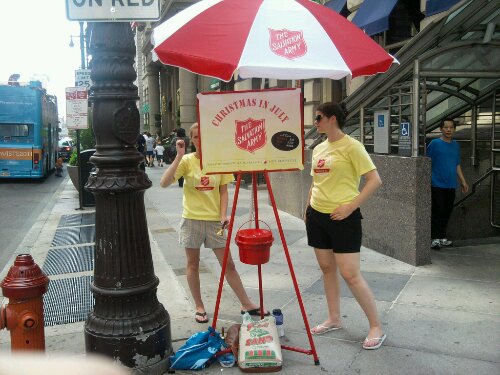
Christmas in July!


image

While downtown today, I ran into this.  Now, most of you out there have probably seen the Salvation Army people ringing bells around Christmas time.  But this was the first time I have seen one in July.

Now, I have heard the cultural meme of Christmas in July, and really don’t care one way or the other about it.  I don’t generally enjoy Christmas and have not celebrated it for many years, but I know many atheists still enjoy the holiday. 

But the Salvation Army…

I don’t have easy access to statistics while mobile, but their charity organization is not exactly altruistic.  Much of what they do with the money they bring in is proselytize their Christian message.  I mean, just look at what they call themselves; Salvation Army.  This is not an organization which is friendly to secular worldviews, and is not an organizagion I would give a penny to.

If you want a better charity, look up Foundation Beyond Belief.  Why are they not on street corners ringing bells? Would people give to an overt secular or non-religious charity?

In any case, I didn’t talk to them because I had somewhere to be, but now that I’m done, perhaps I will ask them what they know about the organization and if they are christians themselves.  Very likely they are.

Elevatorgate: frustrations with creepiness as a man-slut


Another male perspective on something I cannot comprehend, I know.  But I have a few frustrations I want to vent, understanding that many feminists (and I count myself among them) will view my comments as just not getting it.

I will not recap the events over the last weekend about the Elevatorgate issue that arose from Rebecca Watson’s recent video and subsequent kerfuffle.  If you don’t know, then simply skip this (or catch up and come back).  I had a long conversation with Ginny about this yesterday, one that made it clear that I’m not completely understanding Watson’s (and many other women’s) experience with this, but nonetheless an issue I have thought a lot about the last few days.

During that conversation with Ginny, I said something that was better articulated in a comment by a “Marty” on Phil Plait’s blog today (#31)

Just as it would be insulting for me to assume that every moment I spend with other women is a possible sexual encounter, it’s also insulting to treat every moment a woman spends around any man as a potential sexual assault.

This gets to the heart of part of this issue for me.  Now, I recognize that there is no comparing the issue of me being around a woman and feeling like I want to be sexual with her and the fear a woman might feel in an enclosed space, especially if he is hitting on her.  But what I think has been overlooked in the conversations about this issue in the last few days (and I have read many, not nearly half however, of the comments on the various blogs that have brought this up) is the fact that their is a two-sided responsibility here and that there are frustrations that are valid for people in elevator guy’s place.

What I have learned

I have learned that many women would feel uncomfortable, and not in just some socially anxious way, if they were in an elevator with me, alone, and I propositioned her.  Even if I used respectful words.  Even if I didn’t physically touch, or even get close to, her.  Even if (as one commenter on Pharyngula said) it were at noon.  This teaches me that it is just a thing not to do if only for the fact that it will not work.  That is, even if I was convinced there was nothing wrong with doing so per se, as many commenters still uphold, the fact is that it is not pragmatically wise.  I accept that it causes women discomfort, and I want to avoid that.

I have learned that many women think a lot about how to avoid sexual assault day to day.  I have learned that the fear of such things is prominent for many people.  I knew previously that the statistics for rape and sexual assault are astoundingly high, but I learned that an elevator is one of the places where the anxiety is a little higher.

I will not be propositioning women in elevators, ever.  Even if I see one smiling at me and giving me bedroom eyes as we ascend (or descend), I’ll wait until she is off the elevator to say anything.  Certainly, if I see Rebecca Watson in an elevator, I will wait until another time to compliment her, just in case it comes across as flirting.  Let’s just say when I’m interested in someone I don’t hide it well (And no, that was not a crude reference…).

Also, I’ll certainly never look at this song the same again:

Essentially, I understand that as a male in our culture, I have a responsibility to be aware of how my “privilege” blinds me to how I can use sexuality in ways that make women uncomfortable.  I accept that some things I may do, even while trying to be respectful of women as people, will come across as creepy and inappropriate.  I will keep trying to expand my understanding of this problem.

What I want others to understand

For clarification, much of the following is NOT directed towards Rebecca Watson per se.  this issue has grown larger than the initial encounter that spawned it.  It’s mostly a rant.

Just because statistics of rape are ridiculously high, and the vast majority of them are committed by men to women, does not mean that women are rationally justified to live their lives in fear of men, even in elevators.  I know that most women do not, but the comments in recent days concerning this issue tells me that many do.  I am an advocate of not allowing fear to dominate a person’s behavior or thinking.  Fear is a tool of oppression as much as patriarchy, white/male privilege, or wealth disparity.  When you encounter a guy hitting on you in an elevator, you need to keep in mind that even though the statistics of assault are really really high, probability states that he’s just clueless at best, overly aggressive at worst.  He’s probably just drunk.

I want women to be cautious, aware, and safe, but I don’t want them to be afraid of men without justification.  And women do have the right to request that a certain kind of behavior is not done (like hitting on women in elevators), however you have to keep in mind that you are responsible for how you are interpreting people’s actions based upon statistics.  I think it is fair to request that women do not assumes that violence is likely, even while being aware of its possibility.  I think the distinction is important.

I do not believe Rebecca Watson did anything wrong in that elevator or in her subsequent video.  The guy was probably clueless, and her advice to not do that was good advice.  Whatever increases well-being, as Sam Harris says, right?   I like Rebecca Watson.  I think she is intelligent, thoughtful, funny, and eloquent.  I have met her a few times, although we have never spoken more than a word or few to each other because she is usually inundated with fans and friends, as a person of her abilities warrants.  I happen to also think she is an attractive woman, and under the right circumstances I would like to get to know her better (both intellectually and otherwise).  Is that sexist? Am I sexualizing her? Perhaps, but I am not merely sexualizing her.  I think that creates a distinction which matters as well.

Luckily for her, I don’t drink coffee.  I would also not use this euphemism to proposition someone anyway, nor would I do so without any existing familiarity at very least.  I also don’t think that coldly propositioning anyone is wrong or creepy in all cases, just not pragmatic in most cases.

If I were to find myself  talking to Rebecca Watson and got any indication that she might be interested in getting to know me, I would probably ask her if she’d like to get a drink and talk alone (but still in public, to start).  And I would let things take their natural course from there.   I doubt I’d have that opportunity, as I have no reason to think she would be interested in me (despite the fact that I’m brilliant and beautiful, that is…).  Of course, my guess is that most men will certainly avoid, if they have been paying attention, hitting on her at any conferences from now on, and I am no exception to this.  Perhaps that was what she wanted, I don’t know.

But could I imagine a situation where I would say or do something that would set off a woman’s creeper-meter? Oh for sure! I have no doubt that if actually faced with a women I was interested in romantically or sexually, I could (and certainly have in the past) creep said woman out.  The best intentions and the utmost respect can’t always avoid that, as sometimes it is just a look in the eye, bad choice of words, or awful timing to do so.

And that sucks, because it’s very very frustrating to know this fact looms over interpersonal interactions where sexuality is a factor.  As a man who wants to be sex-positive, likes casual sex on occasion, and meets attractive women while out and about, the fact that no matter my intentions I am more likely to creep a woman out than gain her interest is frustrating.  And it’s not that I assume I have the possibility of a sexual encounter with any women for whom I have interest, its just that when I would like some sexual contact with a woman I just met or don’t know well, my asking may come across as inappropriate even while presented respectfully.

I often find myself asking myself, after hearing of stories where men are perceived as creepy, questions like ‘is there a way he could have asked which would not have been creepy?’  And, if not, was it really creepy or was she just not attracted to him in particular? Also, is it sometimes the case that people are creeped out without justification?  I think these questions expose important distinctions as well.

There seems to be a tension, here, between the ideal sex-positive world that I strive for and one described by those talking about privilege of which men are usually blind.  I have no desire to be a pick up artist (PUA), but I do desire to live in a world where sexual interest in a woman, expressed openly, honestly, and respectfully, is not called sexist.   I, as a man, simply don’t know how to approach women I am attracted to, preferably in an at-least partially public area, without being pegged as suffering from privilege-blindness. I hope there is a realistic answer to this tension, because I want to be respectful while enjoying sex with others who want the same thing.  And just like women can’t tell the good men from the bad ones (the Schrodinger’s rapist problem), I can’t always tell the sluts (not a derogatory term) from the women who will view my proposition as creepy.  Let’s call that the Schroedinger’s slut problem.

I, as a slut, just want to be able to be a slut in a feminist world.  I know there are others out there too who feel this way, but now I’m anxious about being the next elevator guy because I crossed someone’s boundaries without knowing it.  Yes, I won’t hit on a woman in an elevator now (my consciousness has been raised, thank you Rebecca), but I might do it while she’s alone at the end of the bar, while at a party where she knows nobody, or some other situation that is uncomfortable or creepy for her.   And then I’ll have to be told that this is also unacceptable, and many people will agree and see me as sexist, and I’ll be just as confused as I was when I first read about what elevator guy did.

At bottom, I want women to give us men a little more leeway concerning creepiness, and I want men to treat women better so that men can stop being feared as sexual predators.  It will be so much better for everyone, men, to stop being predators.  And it would be some improvement if women would give us a little lenience about perceived creepiness.

This is more of a rant borne of frustration than anything else.  Thanks for listening.

So, Rebecca Watson, would you like to come over to Philly for a drink?  I promise; no elevators!

(that wasn’t creepy, was it?)