So, remember several months back there was this whole big thing about the world ending on May 21st, 2011? I mean, there were billboards, people on the street handing out pamphlets ( I still have a copy around somewhere), and lots of media talk about it. In fact, I wrote about it here.
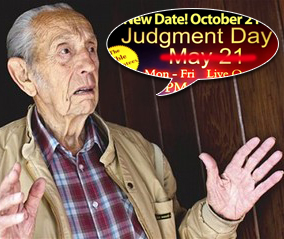
And then the date passed. Explanations were rationalized, and the world moved on. You see, a judgment occurred, but it was “an invisible judgement day”. The end of the world was still coming, it was just happening later…really. So when is that date again?
Oh right, it’s tomorrow.
That’s right folks, the world really is ending on October 21st, 2011! For real this time. I mean, Harold Camping can’t be wrong 3 times, right? Oh, that’s right…he made a similar prediction back in the ’90’s.
Well, in case this ends up being my last post ever (assuming I don’t post some attempt to repent as I see Jesus descending on a could or whatever), I hope you have all enjoyed the show.
But I am betting that life will go on tomorrow as usual.
Yesterday I wrote up some comments about doubt and faith. I am quite happy with it as it stands, but a question was emailed to me from an acquaintance that led me to wonder if I had not been sufficiently clear about one thing, so I wanted to publicly clarify a related question.
The comment emailed to me was this:
Doubt is not the opposite of faith – fear is the
opposite of faith
It was followed by a question about whether there is a difference between religious faith and the belief in things that you simply don’t know for sure or don’t have evidence for (yet, due to lack of sufficient information, etc).
I responded thus (edited to exclude unnecessary specific information):
—
I have heard that comment about faith, and I don’t buy it. I think that the fact that you don’t know [some specific fact] and faith in supernatural things, or at least things for which there is no evidence, are very different questions.
I make a distinction between a reasonable expectation and faith. Based upon your limited experience with me, your understanding of human behavior, etc you can assign some rough probability to my potential actions. You have empirical information upon which to make a guess, even if your certainty about it is shaky. But if you have a belief in a thing that you truly cannot prove, or at least that you do not have evidence to support or rational reason to accept, that is a qualitatively different question epistemologically.
Also, I would be cautious in using the word “prove” or “proof.” In questions of empiricism, such as science, we don’t ever prove things. We gather information, create a hypothesis to explain the information we have, and if that hypothesis stands up to scrutiny then we call it a “theory” which is further tested and stands or falls upon that further testing. But we cannot deductively prove such things because that is only applicable to purely logical/mathematical questions; things that only exist in the abstract. Questions such as what will happen in the real world are not subject to formal logic, and so cannot be proved. There is always room for doubt, even if it is very small.
So, to accept something like “there is a god” or “a soul exists” despite the lack of supporting empirical evidence is faith because faith is the belief in something despite the lack of evidence (or in the face of conflicting evidence). To believe something that has not yet been given support (in this case because it is a proposition about the future) is a probabilistic process; you can assign probabilities based upon experience with similar situations. But since we have no evidence which supports certain types of claims (like a soul, for example), we cannot assign any probabilities because we have no supporting data to work with. A probability assigned in such a situation would be purely fictional and arbitrary.
In short, they are not the same thing.
Fear is not the opposite of faith because it is possible to be in a position of believing something that you have no evidence for because of fear or at least while experiencing fear. Not that it must be the case, but that it is not logically incoherent. Therefore, they cannot be logically opposed. While doubt (the state of recognizing uncertainty about some question) is not the opposite of faith, is not easily consistent with it. My claim is not that doubt and faith are always incompatible or opposed, only that faith often does not long survive in the presence of doubt.
To truly doubt something means that the belief becomes mitigated. To be a skeptic (which includes doubt but is more than that) is the opposite of faith. Skeptics only believe a thing based upon evidence or reason. I am a skeptic first, and that leads necessarily to atheism and the lack of belief in many other spiritual or religious things (because of the lack of supporting evidence). Until supporting evidence is presented, this is the only rational conclusion for a skeptic. Someone who does not care about evidence to support their belief is not concerned with rational conclusions, so asking what would be rational in that case would be irrelevant.
I care what is true, and want to have as many true beliefs as possible. As a reuslt of this, I doubt things for which there is spurious or no evidence (often to the point of lacking belief in them). I still may believe untrue things, and am open to being shown that this is the case. I have not found this attitude to be true for many religious or spiritual people, although there are obviously many other exceptions to this observation.
I have been told by many people, over many years, that doubt is part of faith. The idea is that a person who does not challenge their faith has a weak form of faith. I sort of appreciate the sentiment here, but I wonder how genuine this is. I wonder how deep this lauding of doubt goes. I wonder if it is real, skeptical, doubt.
Skepticism is about doubt. A skeptic is a person who demands substantial evidence in order to accept something as true. Yes, a person may not be ideally skeptical about everything, and therefore may accept as true beliefs which would not stand up to even their own scrutiny if they were to apply it. But I think this is simply the nature of our cognitive limitations. In other words, we are all credulous to certain dumb beliefs, but we’re just human.
It take a certain amount of courage to dig deep into your own beliefs. To be an archaeologist of the soul, as Nietzsche put it, is a hard task. And not everyone will be up for it, nor would most know how if they tried; we sometimes need a little help from our friends, I suppose. And so when I meet a religious person who has the courage to at least make a surface or moderate attempt to doubt, to dig beneath the surface of their convictions, I find myself bestowing respect upon them, at least provisionally.
The provisional nature of this reverence is necessary, I have learned, because the institutions of religion, the insistence of doctrine, and the fragility of faith’s foundations are such that such ego-archaeological excavations often lead to one falling into holes, and thus clutching onto the ground of such landscapes in order not to feel the true exhilaration of freethought. To fall into oneself, underneath the facades of our social selves padded with commitments to supernatural hopes, is a terrifying prospect in the face of oblivious alternatives. The human condition of being, in the end, alone and finite (it’s alright) is a reality which doubts lead to, and which is less often the object of faith.
How often have you met a person committed to a faith that they will cease to exist upon death, and that there is no god that loves them? These ideas are conclusions reached upon careful thought and skepticism, not hope and desires. The claim that these ideas are equally based upon faith are absurd, and are an attempt to level the playing field. It is a rhetorical trick with no substance. Faith seems to almost exclusively own subjects which we seem to prefer (like Heaven), or at least fear as an alternate to what we prefer (Hell).
So, does this imply that faith and doubt are truly at odds? The snark-laiden answer is to point out that if people had evidence (the answer to doubt), then they would not need faith. And while I think that this snark contains an important insight into the nature of the question of faith and doubt, I think that we can go elsewhere to address this issue. The skeptical methods, science and reason, are a means to figure out what is likely to be true given our best tools for determining such things. Doubt, in other words, is the seed of science and all of our (limited) mastery of the natural world. Faith seems to be opposed to this progressive methodology, both philosophically and practically. Anyone who has a long conversation with a true believer will ultimately hear the faith card played; all of our questions, doubts, and debunking of theological apologetics runs into this wall at some point.
Recently Eric MacDonald weighed in on this question of doubt and faith with the following, which was a concluding comment to his long piece about a Julian Baggini article in The Guardian:
If the kind of questioning ”theology” that [Richard] Holloway now indulges in were to become the norm, the churches would simply fly apart from the centrifugal forces of doubt and questioning. And that is why religion will remain dogmatic at its core, and why openness to changing one’s mind is simply not accessible to the religions. It may happen one by one, as religious believers are leached away from religion by the corrosive forces of science and reason, but a religion whose leaders were open to changing their minds in the way that [Julian] Baggini suggests is necessary in order to avoid fundamentalism would spell the end of religion, because religions have no foundation. They are built on air, and openness to revision would quickly expose this.
That is, even where doubt, or questioning in general, is encouraged (whether by accommodating atheists or moderate or liberal theologians), it is a recipe for the excavation of holes in the landscape of religion and the faith which binds people to it. Doubt may be considered a part of being a faithful person, but the religion that survives this process is not the same as the religion that was handed to us from pre-scientific ages. This religion is moderated by compromise, non-literalism, etc and away from fundamentalism. Eventually, it erodes away into postmodernism, metaphors, and empty vessels with sentimental import.
And this is precisely what religious academics, such as the Bishop of Canterbury Rowan Williams and King’s College president Dinesh D’Souza have been doing for some time; we “new atheists” are addressing a straw man, they say, and religion is full of doubt, questions, and nuance which are ignored by comments like Eric MacDonald above. For such people of faith, doubt is part of their lives and to imply that faith is somehow antithetical to doubt is to be unfair and biased in a way that does no justice to sophisticated theology. But it all falls apart, at some point. Eventually, in the corrosive environment of doubt, religion becomes a shade in tattered robes that haunts our ivory towers and sanctuaries, largely unseen by the masses whom insist upon feeding on the corpse of literal truth, real historical promises, and miracles.
Well, Eric MacDonald (who is no stranger to sophisticated theology), Jerry Coyne, and others have said a lot about this very subject, and I shall not try and sum up their thoughts on such things here, as this would quickly turn into a small ebook if I were to do so. So what I want to do is pose some questions which I intend to follow up on in the future. They are questions about faith which I have some perspective on already, especially in conversation with former Christians (almost exclusively) about the role of questions and doubts in religious communities. Having known people who would pose tough questions, voice doubts occasionally, etc within their religious communities, I have seen how some moderate religious communities (like Tenth Presbyterian in Philadelphia, where I visited a couple of years ago) respond to such things. Doubt and questions are not met with curiosity or answers, they are often met with ostracism and loss of friends, as I have had it explained to me. Also, in my experience, outsider’s questions and doubts are treated with initial interest and then silence, in the vast majority of cases.
My questions are as follows (and I intend to ask them of people in positions of leadership in religious communities in coming months):
Are questions, doubts, and criticism welcome?
(if so) are doubts about any and all doctrines acceptable?
Have you seen or heard of people being socially sanctioned for having questions, doubts, or criticisms?
(if so) do you condemn such sanctions?
Is doubt more likely to be lauded or demonized?
Would the answer to the above change depending on the severity of the doubt?
As I said above, I have some experience with exposing religious ideas to doubt. In the extremely vast majority of cases (I have not maintained a running count, but there are few exceptions) even when questions, responses, or criticisms are proposed, they almost always fizzle into nothing. It is almost as if the leaders of these communities, whether they are priests, pastors, or whatever are so glad to hear some commentary, feedback, etc that they don’t notice at first that you have some serious objections to the message they are conveying, and then once that sinks in, they simply close off. They are not interested any longer. I suppose I am not surprised, nor should I be.
But right now, from where I sit, true skepticism, the kind of doubt which seeks to excavate the very foundations and assumptions of one’s worldview are not healthy for faith. But perhaps I err in using “faith” as the Christian scriptures do:
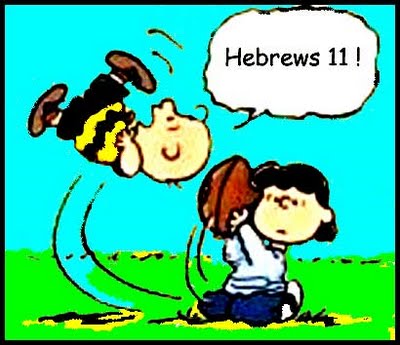
Now faith is confidence in what we hope for and assurance about what we do not see.
Because that seems, on the surface, to be in philosophical opposition to skepticism, and therefore to doubt. Perhaps some other religious tradition has a use of the word faith which differs from this. I don’t remember much about what the Quran says about faith (there is this, for starters), but I doubt that it says much that is friendly to skepticism. And insofar as many religious people do have and maintain doubts, how far do they push those questions, are their questions they would refuse to apply doubt to, and would they truly be open to changing their mind?
I have long said that I want to know the truth. If there is a god (or gods) I want to know. I am open to being convinced of things which I do not currently believe. Do believers share this quality? And if so, how many and to what degree?
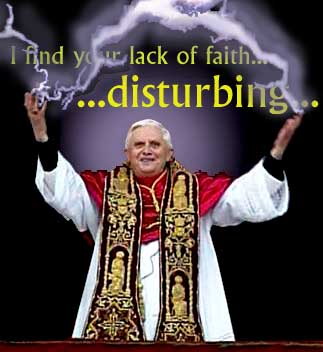
What possible misdeed could finally push people away from this monster?
I mean, a plethora of examples of sexual abuse of children in the last several years have not driven them all away. There are also the less media-fun indulgences which have come back from the dead of pre-Enlightenment days. There is the problem of condoms and the subsequent HIV problem in Africa and elsewhere. Also, there is the fact that there simply is no evidence for their ridiculous theological claims. But that’s not really morally awful so much as it is epistemologically tragic.
But then again, at least the Catholic Church has not been responsible for child-theft and trafficking, right? I mean, maybe one or two Catholics have done such a thing, but at least it has not been a systematic and decades-long problem involving hundreds of children.
Up to 300,000 Spanish babies were stolen from their parents and sold for adoption over a period of five decades, a new investigation reveals.
The children were trafficked by a secret network of doctors, nurses, priests and nuns in a widespread practice that began during General Franco’s dictatorship and continued until the early Nineties.
Hundreds of families who had babies taken from Spanish hospitals are now battling for an official government investigation into the scandal.
Several mothers say they were told their first-born children had died during or soon after they gave birth.
Disgusting. Beyond disgusting. If you are still a Catholic, you have some serious explaining to do. I cannot fathom an excuse sufficient to satisfy me here, but by all means try. I question your moral compass if you ever walk into a Catholic Church for anything except escaping the zombie apocalypse. OK, I might accept attending someone else’s wedding, or possibly in order to simply look at the architecture of many beautiful cathedrals, but there is no excuse for attending a Mass and giving any money to the church anymore.
I was just about to watch a new episode of Parks and Recreation, which is a show I enjoy watching (in part because I have appreciated Amy Poehler since the days of Upright Citizens Brigade), and of course I ran into an ad. It’s pretty unavoidable on Hulu.com. Now, usually I ignore the ad and wait for the show to start, but in this case it caught my eye.
No, not because it looked particularly good, not because it looked like it would be one of those movies that is so bad it’s good, but because it just makes me feel shame for our culture and I was left with my jaw hanging in disappointment.
Here’s the trailer. Watch it if you like, but I’ll summarize what’ important below.
OK, so two male spies who work together are dating the same girl. They find out, and decide to go about dating her and let her pick which one to choose (because she has to choose, of course). And of course they will simply go about their business as they would have otherwise and if she does end up picking one or the other they’ll simply go on with their lives, right? Not so much. This is Hollywood, remember? The world of sensationalized conservative sex values.
So, naturally the men will try to compete with each other, try to trip each other up, and hilarity will ensue. But they are super Hollywood-style spies, so they have like access to guns, bombs, and planes, so of course it will turn into a militaristic competition for who will get the girl, all with explosions, car chases, and of course spying.
Because, you know, they could not share. No, good looking, intelligent, and talented men are way too immature, insecure, and territorial for that. And besides, to prove their manhood they will have to demonstrate that one is better than the other, making the unaware woman for whom they fight a prize, rather than a person.
She should, of course, lose them both, because obviously neither is prepared for an adult relationship. As to how they actually resolve it, and whatever stupid moral lessons are implied, I will have to find out second-hand. I will not be seeing this movie.
Perhaps if someone else does they can inform me of what happens.
Wednesday was busy for me, with the debate and all, but before all that started I had gone over to city hall and talked with people from the Occupy Philly movement, who are affiliated with the Occupy Wall Street people unofficially. I say unofficially mostly as a sort of joke because there is no central control, group, or message which is acting as the guide for these movements. At least not yet (this notwithstanding).
Honest Discussioner and I talked with all sorts of people at the event. He had his camera with him, and so there is video of some of our discussions from people lending logistical, technical, and media support. Also, it became clear, as I had noticed even before Wednesday (I had been to the location a couple of times in the last week or so) that people have different opinions and expectations from the movement, even if they did share some common concerns and goals.
Some were antagonistic to the police, and others pointed out that they were friendly, part of the 99%, and even helpful. This, among other issues (such as that of whether regulated Capitalism, Socialism, or Communism is ultimately the goal) are things which will have to be worked out internally and over time.
The first thing to understand about this movement is that they have a legal right to be there. They have a permit from the city, have received police assistance in terms of protection and even the ushering of some homeless people to the area (where there are resources to feed them and address their health issues). There are tents for media, tech support, first aid, food/water, and many for people who are residing around city hall.
You know, like occupying Philadelphia. In other words, this is not merely a place where people will get up and make there way over to for a day of activism, but rather it is that people are living around city hall right now. It is a small sea of tents, information tables, a library, and advocacy groups of various stripes. I hope that paints some of the picture somewhat.
Message
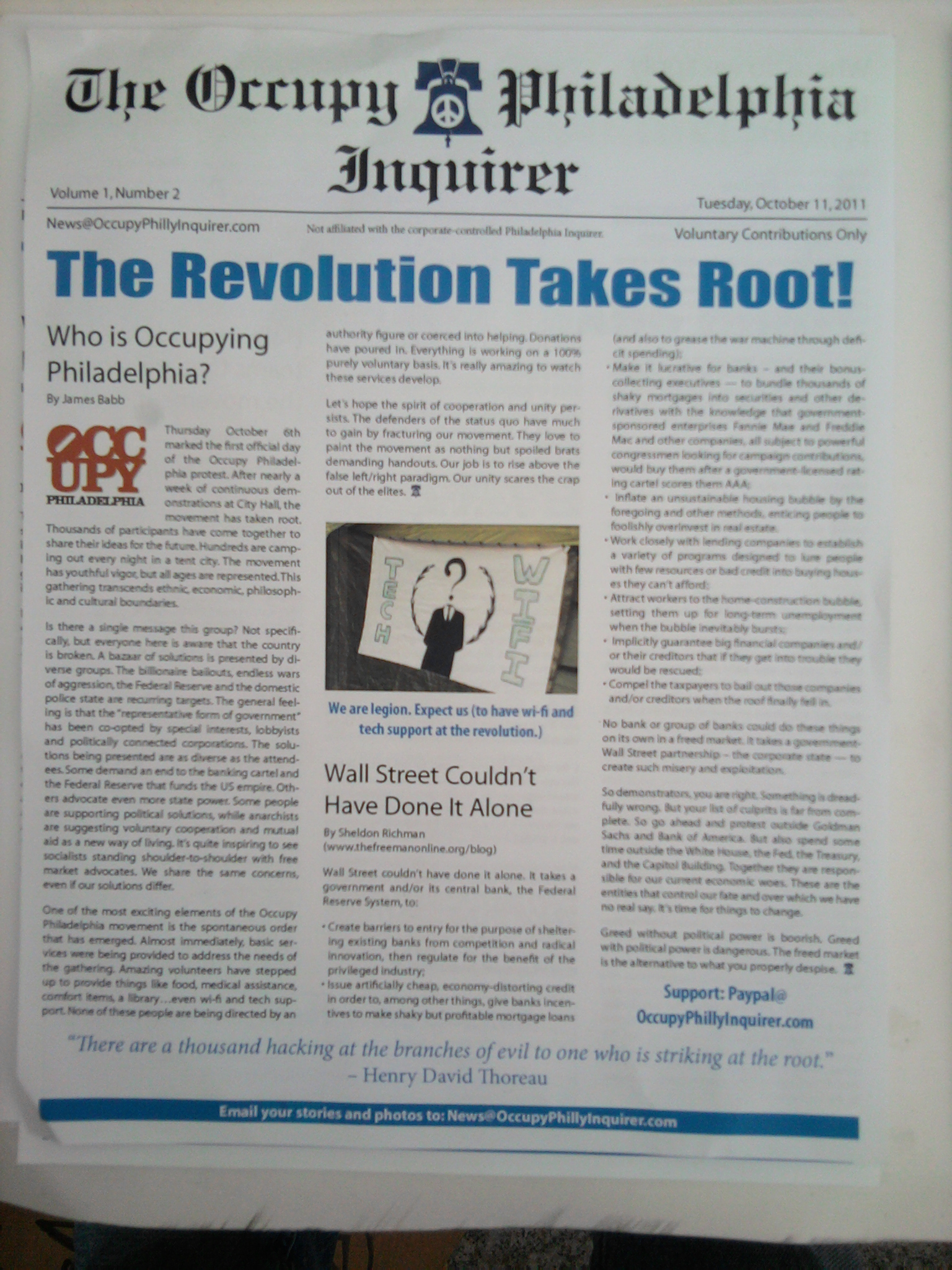
A shot of a newsletter which was available in the library
Essentially, there is no central message coming from the Occupy Philly groups yet. The reason for this is that the movement is still taking shape. There are logistical concerns, and no one group is taking charge of anything except their own messages.
And, of course, there are various groups involved. There are union groups (the AFL-CIO had an event on Wednesday, for example), as did Action United, Philly Jobs with Justice, and many other groups friendly to the goals of Occupy Philly can be found around and willing to talk to interested visitors of residents.
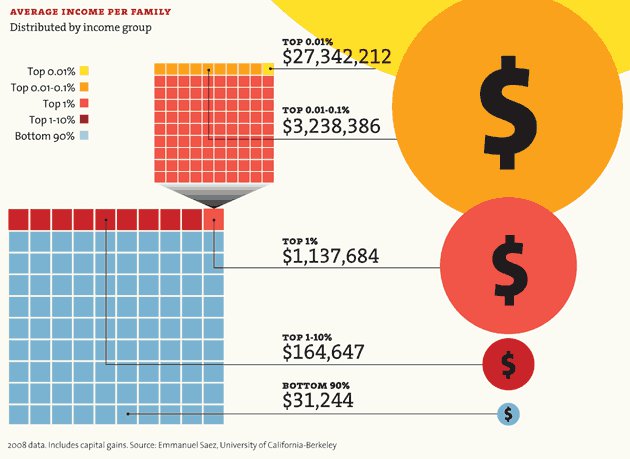
So, Shaun (says the impatient reader) what precisely are the goals? What is the message? Well, since you insist, I will summarize what I think the central message seems to be so far. Money. More specifically, money in politics. The concern is that large business interests control how elections, legislation, and therefore policy are all implemented. There is a feeling that the people (the 99%) are left powerless, unimportant, and sold out.
One sign I have seen several times says “Banks got bailed out, we got sold out.” The message seems to be that as it stands, our political system is geared to protect corporate interests and not people’s interests. Where certain banks are too big to fail, the majority of people who are struggling, with or without jobs, are not. I’ll let economists tackle that question.
But what is clear to me is that in an economy like ours right now, jobs are needed (this blogger sure could use one). The people who have the ability to affect change in that direction are not doing much to help (Jobs bill, anyone?). The “job-creators,” in other words, are not fulfilling their name-sakes. Banks are holding onto money, many people are left with little to no money ( I think I do have 2 or 3 dollars around somewhere…quite literally), and there seems to be systemic reasons for this.
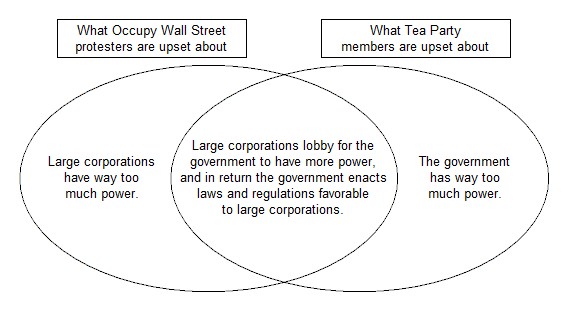
This has been true for a long time, of course. In fact, this issue is not far off from the early Tea Party’s message (before it was bought out by business interests itself, of course). So the question this presents to me is whether the Occupy movements will become something like the Tea Party movement. The irony of it being bought by corporate interests would be high, but this does not make the possibility unlikely. I mean, look what happened to the liberal movements of the 1960’s; totally corporatized both in image and ideology. Not to say there are not still hippies out there who avoided corporate branding, just that they don’t have political power.
But I will not allow myself to become too cynical yet. I will allow people who are working day and night for this movement to create something, and I will allow some small hope that they may achieve something beneficial for all of us.
So, I will continue to follow this movement and hope that it leads to at least some consciousness raising for more Americans. The super rich (those 1%, or even there cronies the top 5% or so) are not likely to simply roll over and change how they operate within politics. Their values seem to be at odds with those of us who are interested in seeing less disparity and inequality in the United States and the world.
If we educate ourselves, become involved in some sort of effort to change the world for the better, and demand more from people who have it we might be able to affect change in the world, even if only a little. Oh, how I hope that’s true.
It seems the title of the debate may have changed a bit since it was announced
So, last night I attended the debate between Dave Silverman, the president of American Atheists, and Dinesh D’Souza who is an author and professional defender of Christianity. Dave Silverman I have known for many years, and I was glad to get a chance to talk with him before the debate about how he was feeling about it. It is always a question concerning what kind of reception an atheist debater will encounter, even in a liberal city such as Philadelphia.
Dinesh D’Souza was in the room as well, but I refrained from talking to him despite having lots of things I could have asked him. I had not previously met Dinesh, and my “Hi, I’m your friendly neighborhood atheist” shirt might have put him off, a bit. It was not the right time or place, and there would be a time for questions after the debate (I did get a chance to ask one, too).
The debate took place at the Irvine Auditorium at the University of Pennsylvania in University City (West Philly), so it was in my neck of the woods. The hall was not packed, but it was full enough. It was clear, from the level of clapping and cheering at certain times, that Dinesh brought a larger contingent, but I did see a fair showing of the Philly atheist community including Margaret Downey, Carl Silverman, and Staks Rosch. I wonder if the rain might have kept some people away as well, even though it had not rained much around the event.
Also joining me was my friend Honest Discussioner who had come into town for the day. We had spent much of the afternoon at the OccupyPhilly events around city hall, as we are both interested in the Occupy movement and wish to better understand its developing message as well as where it will go as a movement. He took some video and there will be both vlogs and blogs upcoming concerning that issue. For now, I will skip any commentary concerning that and dive right into the debate.
We all have the same facts
Dave Silverman started things off with a 12-minute argument about why Christianity is not good for America. “We all have the same facts” he said, and the facts, he thinks, point to Christianity not being good for America.
Dave laid out three metrics to address this question; society, science, and sex. His basic argument was that with issues like marriage rights, women’s rights, science education, and sex education, the effect of Christian belief on social policies is detrimental to our culture.
Pointing to the many other western democracies and their relative secularization and societal health (of which the US is an outlier), it seems clear that the less religious a nation is, it is likely to be healthier. These statistics have existed for some time and have been a core part of the argument for whether religion actually makes societies better. And while it is not proof, the data seems to indicate that you can have a healthy society without a prevalence of religion. Dave goes the next step and argues that it is evidence that religion, specifically Christianity in this case, has a detrimental effect of society. I think the case for this is strong, even if it is not absolute. But is anything absolute when it comes to science?
(no)
Athens and Jerusalem
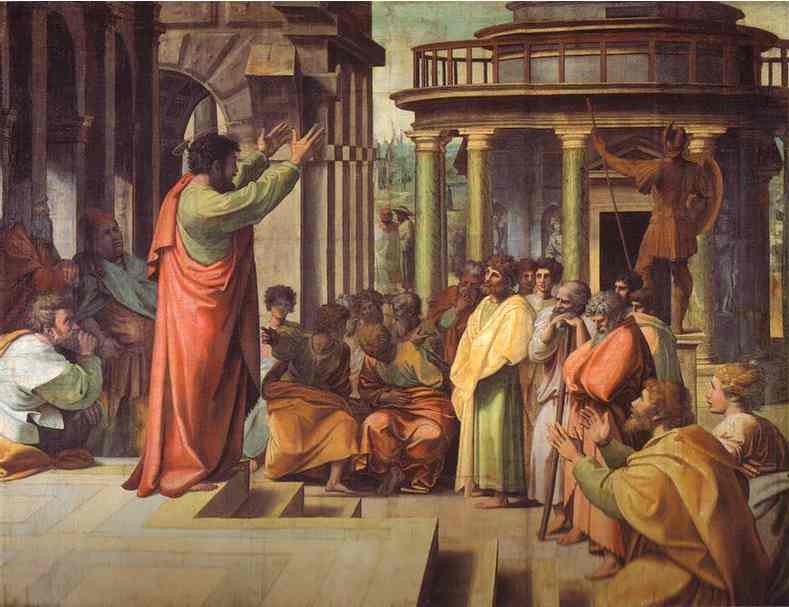
Depiction of Paul in Athens (cf. Acts 17:16-34)
Dinesh D’Souza’s opening argument was not surprising, coming from a person who has heard him debate before. His argument boils down to the claim that the philosophical foundation of American political structures, culture, and values are dependent upon the philosophical and political influence of the ancient Greeks (Athens) as well as the cultural and theological influence of Christianity (Jerusalem). Whether it is Ivy League schools, inalienable rights, or the civil rights movement, Dinesh sees the roots for all of these things within the Christian tradition. I will not dispute the role of Athens, and certainly Christianity has had a great role in American history, but Dinesh’s claim here is stretched too far.
Perhaps his most outlandish claim was that the institution of slavery, in America at least, was questioned exclusively by Christianity. He seems unaware of the influence of socialist activists and other abolitionist movements from early on which were not affiliated with Christianity. It is true that many churches did take part in these movements, and in the 1960’s their role was critical, but to claim that this was exclusively a Christian struggle is simply not true.
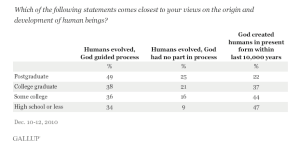
As is common for Christians who take a more “nuanced” perspective on theology, D’Souza claimed that it was only a small percentage of the Christian community that is opposed to science (specifically evolution). Within the liberal Christian circles in which Dinesh and other religious academics swim, I have no doubt that this is true. But in the United states belief in evolution is not dominant (except among those with higher education, like Dinesh and his colleagues). Among most people, Evolution falls behind creationism.
December 2010 Gallup Poll (click for full article)
Again, this is correlation and not proof. But as Dave Silverman points out, the fact that religious conservatives push so hard against evolution, stem cell research, etc is indicative of there being a disjoint between science and Christian theology. It is the evangelicals, after all, that take the scripture more literally than educated academics. And as I (and again) as well as manyothershaveargued, there is a profound methodological and epistemological difference between theology and skepticism (the scientific method and reason). Despite the fact that moderate and educated Christians tend to accept evolution, they still don’t seem to grasp the implications of the scientific method upon revelation and dogma.
In fact, this very fact came to light in conversations with some audience members after the debate; scientific empirical methodology is quite alien to both theologians and many philosophically minded people (especially the postmodernists). In a discussion about the possibility of a soul or life after death with what appeared to be UPenn students, reference to established scientific research by neuroscientists only brought questions of the assumptions about naturalism, and not understanding that these experiments and their results actually happened. There was, quite clearly, a disconnect between the difference between methodological naturalism and philosophical naturalism. It is a common misunderstanding that I believe Dinesh may also be guilty of.
Christianity’s influence today
D’Souza claimed that the foundations of the wonderful society in which we live is due to Christianity. Silverman, in response to this, asks “what about today?” In other words, even if Christianity was good for the foundations of our society (a point Dave does not concede), is it still good today given the detrimental efforts of people who act based upon their adherence to Christian theology. It’s a fair question. Dinesh’s answer is that the values we have, even as secular people, is standing on the mountain built by Christianity. Our moral intuition is given to us by god (and not just any god, but Jesus). His assertion is that without this scaffolding, which cannot be replaced with theories based in evolution or any other purely naturalistic worldview, we could not have the values we have. Further, our blessed science was even given to us by people committed to Christianity, such as Kepler, Newton, etc.
We are a secular world standing on the shoulders of Christian giants, Dinesh D’Souza seems to be saying.
Dave concedes, as he should, that Christians (which he distinguishes from Christianity, which Dinesh seems to miss every time he talks about this) have indeed done many great things in the world. They help others, achieve great things, and are often wonderful people. Dave sees this, and I agree, as giving the credit to the theology rather than the humanity of these people who do the good things. This is stealing credit from humanity and giving it to Christianity, the sources of which are often opposed (scripturally) to many of the achievements of post-Enlightenment society. This, in my opinion, is what makes Christianity so bad not only for America, but as Dave Silverman closed his comments, merely bad.
It is the usurping of what is good about us and claiming that we cannot possibly achieve these things without Jesus. It is the claim that we are fallen, fundamentally broken (or as John Calvin put it, total depravity), and in need of a fix. It is the creation of a problem that is then turned around, like a good salesman, into a sales pitch. Not only does Christian mythology create the problem of our fall from grace, it presumes to provide the cure of redemption. It is god’s cure for a problem he was responsible for. It is absurd, anti-humanistic, and ultimately anti-life (thank you Nietzsche).
Good?
Dave responded to Dinesh a few times during the debate by saying that Dinesh presented no actual arguments for why Christianity is good. I think what he means by this is that Dinesh’s claims about Christianity being the foundation for American culture, politics, and society are spurious, there is a difference between Christianity and the people who claim the title (especially since most Christians are not consistent or coherent in their theology), and that the negative effects of Christianity, even if there are positives, far outweigh the good. I think Dave Silverman is right here (anyone surprised?).
The only point that Dinesh has room to argue is that Christianity does deserve its place at the table in America. However, while it deserves this right, this place cannot be a privileged one. People have a right to vote for candidates who reflect their views, to believe as they wish as private citizens, and religious ideas will exist in the larger public conversation about policy, legislation, etc. However, the position of Christianity to influence those who do not believe is imbalanced and often oppressive. And even if there are secular arguments, as Dinesh proposes there are, against things like abortion, gay marriage, etc it is clear that the overwhelming majority of political pressure in these areas are derived from Christian theology and not secular arguments.
The bottom line for me is that even if Christianity was the primary foundation of our western culture, and without it we would not have the concepts we think of as secular now, that does not necessarily make those foundations nor their effects good. I could point out the fundamental problems of our western world, as focused on by the OccupyEverywhere movement and other social commentary, and show that Dinesh’s argument seems problematic even if valid. That is, even if he is right in his claims about Christianity’s role in our American society and culture, it seems that the influence was either incomplete (in other words, the imperfections are evidence of our fallen nature), or that God’s plan for American was not to be a good Christian example. Oh wait, or there is no God intervening in history.
The fact is that our culture is in need of growth in terms of economics, emotional maturity, and education. Christianity is not the source of skeptical inquiry, the scientific method (which grew around Christianity like a tree grows despite the obstacle of a fence), or of our Constitution. So, despite the language of the Declaration of Independence, which Dinesh D’Souza made reference to (and which has no legal standing in America today), this nation is not philosophically, theologically, or historically indebted to a “Creator” even if there is one.
The idea of freedom of and from religion, the separation of church and state, and the general establishment clause of the first amendment to the Constitution is a powerful protection from Christianity to those who wish to steer clear of it’s discriminatory and archaic ideals. Yes, Christians have grown and changed with the times, in reaction to the enlightenment and other historical breaking from the bondage of religious power, but Christianity still has a scriptural source which is tied to a barbaric ideology.
No matter how intellectual, nuanced, and sophisticated theology becomes, Christianity cannot outrun its essence or its bronze-age past. Whether in terms of the horrors it has caused, the poor worldview it presents, nor the ignorance it perpetuates, Christianity is no friend to any person and so is therefore no friend to America.
Dinesh D’Souza may claim that things such as forgiveness, universal brotherhood, or the idea that we are all equal in the eyes of god are what is central about Christianity, but that forgets so much more of what the scriptures tell us. There is also a redemption for crimes we are not responsible for (the Fall), support for slavery, and multitudes of atrocities beyond anything we would consider acceptable today. If this scriptural tradition is the work of the creator and value-giver of America, we are indeed doomed. Yes, one can visit the cafeteria of the Bible and choose what one likes (as Dinesh claims not to do), but to take it all in context is to see a tradition that is not good for America or anywhere else.
Win?
Is this a win for Dave Silverman? Is this a win for secularism and/or atheism? I don’t think debates are about that. Surely, most of the people there left with the same opinion they had. But ideas get planted, discussion continues, and we move forward. Little by little atheist messages are heard, absorbed, and we slowly become part of the conversation.
Christianity is in a privileged cultural position, and its tentacles reach deep into our American psyche for sure. But around these tentacles lie aspects of our humanity which are evolutionarily and historically prior to Christian thought. On top of all that are secular ideas derived from philosophy, science, and in some cases rejection of religion. Nietzsche is a good example of this latter.
The fact that religion usurps these ideas and cloaks them in theological language is why it seems to so many that it is Christianity which is the foundation for all of these ideas. This is an illusion. This is what religion does; it often will attach itself to ideas and claim them as their own. And the longer we don’t point this usurpation out, the more the original idea and theology intertwine until we cannot tell them apart. After enough time of this process the sophisticated, nuanced, and evolving liberal Christians don’t even realize they have done so, and they genuinely believe that the Christianity they carry is a coherent descendant of the teaching of the Old Testament, Paul, and the Gospels.
We need people like Dave Silverman to keep indicating this delusion. Keep it up, Dave.
OK, some people are stupid. But even many who are not stupid; those who have the cognitive ability to understand complex ideas, who can make logical decisions, and who can think effectively through problems in their lives, still believe stupid things.
It’s a lack of skepticism, I think, which is at root here. It’s the inability (laziness, perhaps?) to apply methodologies that could show someone that their rationalized conclusions are not true, or at least not supported by evidence. And we all do it. We all believe things which are probably unjustified by evidence or reason.
The question is, I suppose, what amount of justified versus unjustified beliefs we hold. Or perhaps it is how often we apply the skeptical sieve to ideas we run across. Or perhaps it’s something else. It’s all tiresome, really. Being a skeptic is hard.
That’s why most people don’t do it.
And I get it. I get how those human biases get caught up in our brain. I get how the ideas, unsupportable as they are, seem to meld so harmoniously with that feeling of sense that pervades our worldview, even if that worldview is itself unsupported. I get how when we think of an idea which does not fit there, it feels like its musical theme that is inharmonious with the background music; it’s like the sound of a honking car when you are listening to some Beethoven piece. Or, perhaps, it’s like some annoying Beethoven when you are stuck in traffic. Analogies are stupid.
I get how easily we reject things that are supported by evidence, because the other thing we believe feels better to us. I get how people are confused by other worldviews and shake our heads disbelievingly when we hear someone state a set of facts to support something that sounds so obviously wrong. I get what it means to be human in this sense. But that does not excuse it.
When someone claims that 9/11 was an inside job, that President Obama is a Muslim, a Socialist, and anti-American, or that evolution is a lie and that the world is less than 10,000 years old, part of me wants to just curl and give up on the world. Part of me wants to allow the vast majority of people wallow in ignorance and lack of skepticism and for me to go seek out enlightened and educated people to enjoy life with.
Part of me does not want to write this blog, knowing that in most cases I’m singing to the choir (and nobody wants to hear me sing, I guarantee). Part of me wants to give up on trying to present any argument for people who are not going to listen, to challenge themselves, or to learn.
But there are the exceptions. Like Nietzsche said, all that is rare for the rare, but you have to give the rare the opportunity to discover they are rare. And our environment is part of this. In many cases the environment makes a huge influence on even a more normally gifted person. I want to be a small part of that environment, just in case receptive voices pass my way.
I was not an exceptionally intelligent child. I am not a genius. I am, likely, above average intelligence and I certainly have some intellectual strengths, but I am not exceptional cognitively. However, had I not been given the rarer opportunity to attend a very good prep school, college, and grad school I would likely be more like my extended family; generally conservative, historically ignorant, and relatively prone to my biases and stuck there. The community I was raised in, without my educational opportunities, would likely have produced someone with less perspective, who is less self-challenging, and less interested in the truth.
Some issues are not mere matters of opinion; things merely to “agree to disagree” about. Some things are actually matters of fact. And even where there is room for subjectivity, there is still room for evidence and reason to make certain conclusions better than others. Some ideas are just stupid, but many people still believe them. Remember the whole Obama nationality argument that led to a birth certificate coming to light? Yes, many people still think he is lying about that.
President Obama has claimed to be a Christian (and this claim itself would make him worthy of death as a Muslim, according to the Koran. If he’s a Muslim he’s a pretty bad one), his policies are more in line with centrism than any form of Socialism (he actually back away from policies which were hardly Socialist, and moved towards the conservative end, pragmatically), and Al-Qaeda has taken responsibility for 9/11 (they are annoyed that so many think that Bush &co could have pulled off such a thing, I suppose).
Yet the ideas that these facts compete with are prevalent. And not mere ideological brain-washing is at fault, either (although there is that). Hannity, Beck, etc are not the creators of stupidity, they are mere ushers of it, in other words. And yes, Michael Moore is guilty of much of the same. Jon Stewart, however, is the freakin’ man (even if I do sometimes disagree with him).
But, being a little biased myself, I will likely call out the conservative voices first. It is somewhat ironic to watch the relativism, postmodernism, etc that seeps into conservative worldviews when it comes to them believing what they want. And what’s worse is they are the ones decrying relativism, most-likely. But, of course, this has nothing to do with conservatism.
That is pure, undiluted, human stupidity. It is our humanity which often misleads us, not mere ideology. Our cognitive and behavioral imperfections (evidence against a loving all-powerful god, for sure) are the source of all bad ideas, whether religious or secular. It is the source of stupidity of all stripes. So whether you want to call out the dumb stoner hippies/new agers, Tea Baggers/truthers/fundamentalists, or the masses of uninformed American people watching reality TV and basically being the suck, I don’t blame any particular stupid ideology because I know that the same unskeptical methods lead to each.
This has been your cynical message of the day. Please go on with your lives as if nothing has happened.
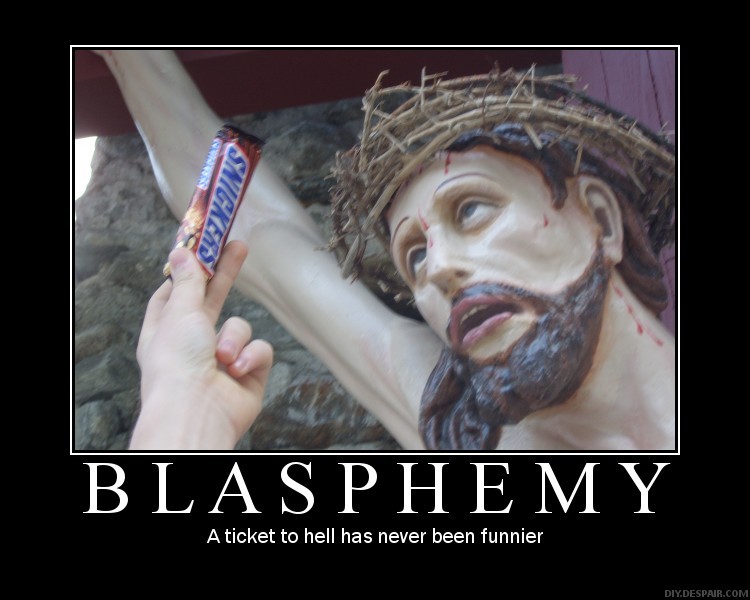
That’s right, folks, not only do we have the right to be blasphemous, but there is a day set aside to have our fellow heathens (and those freedom loving believers who feel like blaspheming others’ ideas) express their inner blasphemer.
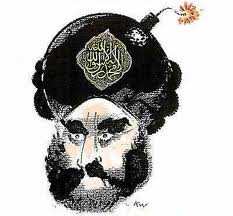
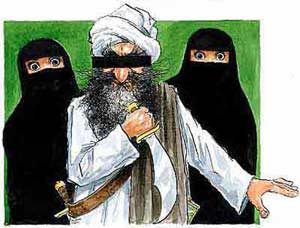
For those of you who don’t remember, or who were not paying attention way back in the early days of the atheist movement, it was September 30th 2005 when those now-famous cartoons were published in Denmark. You know, the ones that made all the Muslim leaders laugh and go on with their lives…or to protest their publication which led to violence and ultimately to more than a hundred dead. Same difference.
The fact is that many of the cartoons were not offensive at all. Most were not funny. But because some Muslims believed that the very attempt to try and depict Muhammad (the prophet guy, not just any Muhammad of which there are many tens of thousands).
The event brought lots of attention, world-wide, to this issue. The atheist community responded by many people stepping up and advocating for people to express their right to blaspheme whatever they want. There was PZ’s issue with a cracker, many campus organizations responded with chalk drawings of Muhammad or blasphemous messages of all kinds, and many individuals have, of course, stepped up in their own ways.
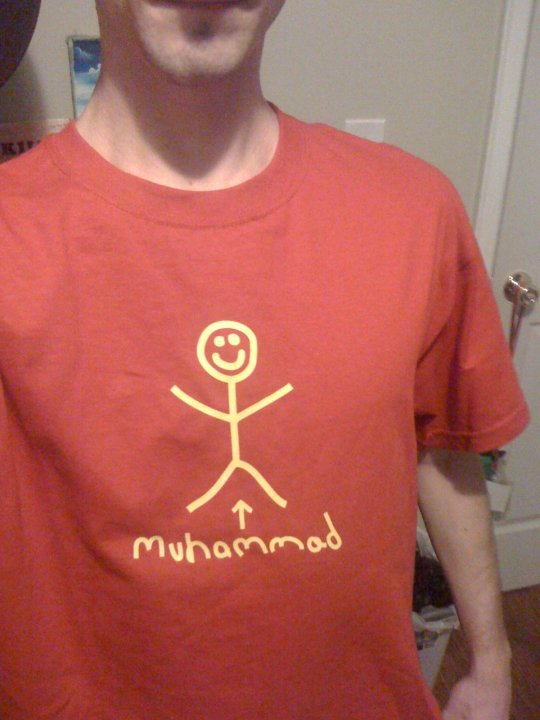
That's me!
And I, of course, will take part. I have one of my favorite shirts ready to wear tomorrow, and I inevitably will have people ask me if I’m Muslim…because people are stupid and ignorant. And while it may be too late for you to get your own shirt, I urge you to find a way to express yourself in some blasphemous way tomorrow. For example, one Halloween several years ago I dressed up as the crucified Christ, with wrist wounds and all, carrying a cross I had made around with me even to a Halloween party. I wish I had pictures of that. Perhaps I will have to re-create that wonderfulness in a Halloween to come.
That’s like in a month, right? Where do I have some wood….
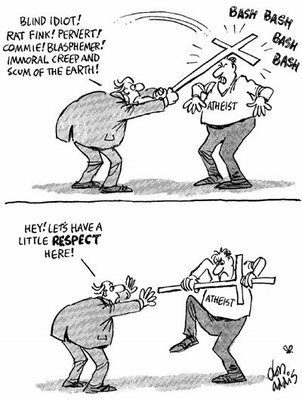
Remember, blasphemy is a victimless crime. So if you feel bad about hurting someone’s feelings, just remember think “What would Shaun do” and then do it anyway…because people have no right to expect non-believers to follow any rules set by religious traditions. And if you are still caught up in this respect thing, remember that if you don’t actually believe a thing is true, right, wrong (or whatever) you don’t actually respect it. You may respect someone’s right to something, but that is not the same thing. So, celebrate the fact that you actually can blaspheme (assuming you are not in one of the many countries where you cannot) and express yourself.
Oh, I almost forgot about this song which persistently gets stuck in my head. Your welcome.
This is an old chestnut which I have cracked before, but I wanted to say a few words about the idea that a person’s personal relationship with some particular god is somehow not religious.
Most people in our culture believe in a god. Not only that, but the tradition from which most people get their idea of god tends to identify this supernatural being as having some relationship to Jesus; Jesus is the Son of God, is God, etc. So, when people in our culture start talking about god, you have a pretty safe bet they are talking about Jesus.
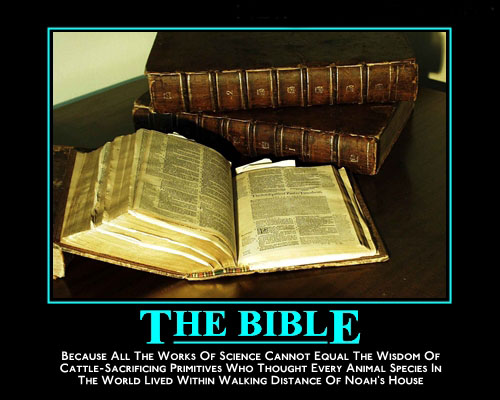
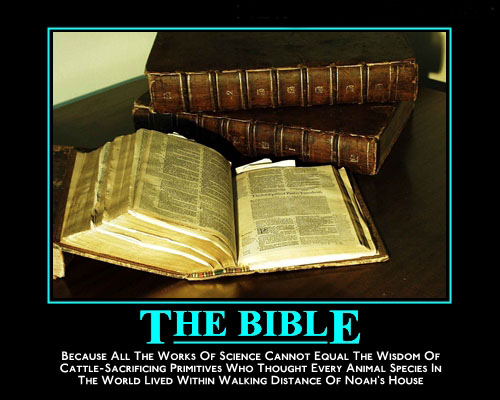
Which means they are talking about the Bible. Or, more specifically, some limited exposure to the collection of books which was put together by a group of people in the 4th century who had specific theological and political motives. And those motives allowed them to choose certain books and dismiss others for the theological content within. Those theological ideas became a religious tradition, or a set of traditions, we now call Christianity.
In other words, the idea of God that they have is not divorced from religion, it is wholly dependent upon it.
And yet, more than a few times (Hell, more than a few dozen times) I have heard people who “believe in Jesus” claim that their relationship with Jesus is not religion. The idea is ridiculous to me. But before I say precisely why, I want to clarify something related.
It is possible to have ideas about god and other supernatural things without being religious. That is, you can come up with an idea for god (some call this “revelation”) and believe it, and until you start collecting other followers and perhaps throwing in some rituals and so forth, you are nowhere near having a religion yet. You simply have an unwarranted belief, truly personal and possibly unique.
But is that how people find out about Jesus? Is there really anyone who has simply came up with the story of Jesus, or at least the essential highlights of it, without some connection to the long theological, historical, and religious tradition of that idea? No, there isn’t.
Have these people not gotten their idea of Jesus from a religious tradition? Of course they get it from that tradition. They may claim that they had some personal experience with some god or other supernatural force, but it is their relationship to that tradition which causes them to identify it as Jesus, the Holy Spirit etc rather than Allah or Vishnu.
That is why any person who has a personal relationship with Jesus is religious; they need the religious tradition to give context and focus to the experience they had, and the religious framework of some specific Christian theology formed their interpretation and understanding. If they merely had an experience and said to themselves something like the following:
“that was pretty wierd, I wonder what that was. It felt like something divine, but it never gave a name or anything”
then at that point they can at least have some basis for saying they have a relationship with something divine that is not religious.
However, very few people make this type of claim. In most cases, people pull out Jesus and all of the religious implications of that name when they have personal experiences and forget that they must justify doing so. Why have they identified their personal experiences, their personal relationship, as having anything to do with Jesus or any other specific god?
By not realizing this oversight, they make their personal experiences into religion without realizing it. If they just dealt with their personal experience on their own terms, and hopefully with a little skepticism, then the gap between it and the religious traditions of the world would be more apparent.

 And then the date passed. Explanations were rationalized, and the world moved on. You see, a judgment occurred, but it was “an invisible judgement day”. The end of the world was still coming, it was just happening later…really. So when is that date again?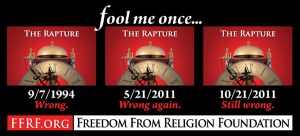






 Skepticism, Properly Applied