But Ultimately Honest Communication is Key


Unless you’ve been living under a rock where you have no internet access and, for some unknown reason, haven’t been reading Polyskeptic, you might have noticed a lot of discussion lately about the tension between being expressing sexual/romantic interest in people and creating a safe space for all to feel comfortable in places like conferences (and really anywhere).  That is quite the oversimplification and I encourage you to read the posts I linked to if you haven’t already.

I thought that perhaps I should weigh in, but I don’t really have a lot to say that hasn’t already been said.  I am in the “Directness is better and preferred” camp of social interaction.  I didn’t used to be…I used to spend a lot of time either not saying things or coming up with excuses so that I didn’t have to say no (and I’m not even talking about rejecting people’s sexual advances.  I’m talking about how I used to speak to my friends).  In the past few years I have made a real effort to be honest even when it is difficult (which is usually is).  In addition, I greatly admire people who are blunt and honest.  To me, dancing around subjects isn’t cute or desired.  In my experience, overly polite communication is unsatisfying and relatively ineffective.

But instead of writing an entire essay about this philosophy, I thought I would write about a recent example of A+ blunt, honest communication being the best way and why I think that this should be everyone’s goal in a perfect world.

I met Alex at a BBQ.  Yes, I met the Alex that now writes for Polyskeptic at a BBQ.  BBQ’s are awesome apparently because you meet awesome attractive people who also happen to be highly intelligent and equipped with mad writing skillz.  Perhaps that’s just this particular BBQ, but I’ll take it.

As is the custom these days, we became Facebook friends days after the BBQ and began “liking” each other’s status updates and posting witty comments on each other’s walls.  I pointed this out to Wes and he coined the phrase “Flirtbooking”.  After a few days of this, I was wondering whether it was, in fact, flirtbooking, and being interested I decided to just come right out and say something.  Long story short, we made a date for last weekend.

After the initial “Ooh! Shiny new person! How exciting” wore off, I started to fret.  It is no secret that I am close to a few self-proclaimed, unapologetic sluts.  I equate this, and many of their other attitudes, as very sex positive.  I have spent a large part of my life being terrified of sex for various reasons and so the confidence and comfort it takes to be this way is something I admire.  Of course, it’s really the confidence and comfort I admire over the actual sluttiness, but it all kind of goes together in my mind.

I suppose that I can say that I have been going through an awakening of sorts over the last few years.  I have become less negative in general, and part of that has been about gaining a positive, healthy point of view about sex.  I have been feeling so much better about it that I thought that it would be possible for me to emulate the things I admire so much.  And yet, there I was fretting about what I was supposed to do on this date if I was going to be all sex positive and stuff.  I kid you not when I say that I actually sat there wondering how best to serve the feminist movement, the poly movement, and the “let’s stop demonizing sex” movement with my actions on this date.  I was barely thinking about how I actually felt and what I wanted to do.

Finally, after many conversations with Wes and Shaun, I realized that I don’t have to be the revolution and the best way to serve any of it is to do what I want.  That’s basically what every revolution is about anyway: Changing society so that more people can be free to do as they please while respecting everyone’s autonomy and agency.  Or something.  The point was that I knew that I felt completely uncomfortable with the idea of hooking up with someone I barely knew, no matter how good at making cheese related puns via text message they were.

So we went out and it was a great time and we talked about a whole lot of things.  I told him about an incident last year that was very upsetting.  It was the closest experience I have ever had to an assault and I realized as I sat there fretting for days that I am still very affected by it.  There was nothing about Alex that was creepy.  Nothing he was saying or doing was indicating to me that I had anything to fear, but I assumed that I should fear and it was a great source of conflict for me.

I came home and was still conflicted and it was all because I was remembering what one asshole did a year ago.  The date with Alex went quite well and I was excited and happy about that, but I was also terrified of making another mistake as I had before in trusting too easily and assuming that no one who knows me and gets to be with me like that would ever hurt me.  And I realize that this is, quite unfortunately, something that many women deal with constantly.  I was lucky in that I had gone 30 years of my life without ever dealing with any kind of thing like that, and I am astounded at the effect that it had on me.

So this week rolls around and we start talking about when we’d like to go out again.  I’m going to put the text messages here (Alex has given me permission to write about all of this):

Alex: I’m free Friday.  Have the whole house to myself, in fact. I might even do some weeding/cleaning if someone’s coming over. J

Me: Hmm, I will let you know.  Have to see if I can have the car and such. J

What was really happening after I sent that message was that I was having a bit of a freak out.  Again, I was completely conflicted.  I knew that I was interested in Alex, and attracted to him…but I didn’t know if I wanted to be in a situation like that.  I talked to Wes about it and he calmed me down saying that if I don’t feel comfortable, then it’s probably premature to be alone with him in his house.  So after that I did the only thing I could: Be clear and honest.

Me:  So here’s the thing.  I definitely like you.  I am definitely attracted to you and all that good stuff.  But, I also think I should get to know you better before I’m in that sexy a situation.  Last night I went through a lot of difficulty remembering everything about the incident I told you about.  Sex requires a lot of vulnerability for me, and I need to trust you.  I don’t think that will take long.  I don’t really see a reason to be scared of you…but I’m scared in general.

He completely understood, saying that he likes showing off his house and that his couch is more comfortable than the dark park we were sitting in before but that going out would also be lovely.

The next day he wrote me a really impressive email explaining himself.  It was impressive for a few reasons.  First, he talked a lot about how he could understand how his proposed plan may have seemed creepy even if that wasn’t his intention.  He admitted that he trusts people pretty easily but that him trusting people will likely not result in some sort of grave consequence.  He explained that he is interested in me for more than one reason.  But he also didn’t say that was uninterested in sex.  He made it very clear that he is attracted to me and would be pleased with that eventuality.

That last part is important.  He could have easily said, “What?  NO! The thought hadn’t even crossed my mind.” Or something that would be a less obvious lie like, “No, no, no, I was inviting you over just to watch Aqua Teen Hunger Force.”  Because he was upfront and honest about everything, I know that the rest of the things said in the email weren’t bullshit.

Now, I could have responded to his text thusly: “Oh, well, it looks like I won’t be getting the car, so getting to your house will be difficult.  Why don’t we meet in the city?”

Perhaps he would have replied immediately that this plan sounded good.  But he also, more likely, could have replied that there were public transit options or that he could come get me or various other solutions.  By not saying my real concern, I have given him a fake stumbling block that is easy to overcome.  I, like many of the people I adore, are solution finders, so if you lie about the problem and the problem is something we can solve, the conversation gets very drawn out.  If I was committed to not hurting his feelings therefore refusing to say that going to his house at this juncture is scary to me, we would have gone back and forth until I would have been forced out of exasperation to tell him the truth OR “give in” and put myself in a situation I don’t really want to be in, be all weird about it, and possibly shame myself into doing something I am “supposed to do” because, well, I’m the one that agreed to come over. (Again, he gave me no indication that anything like that would be an issue, but I had left over fears).

In addition, because I chose to be honest with him, it started a really good conversation.  Both of us apparently had moments in our email exchange where we were afraid to hit send because we thought that sharing that much about the inner working of our minds might be a turn off, but we clicked send anyway and have gotten that much closer to really knowing something about each other.  As such, I am looking really forward to going out on Friday, and not just because we’re going to get to make fun of hipsters at Barcade.

I have chosen to share all this because I think it’s a good example of two people who ARE in fact interested in dating and that it all could have gone to hell if we didn’t choose to really speak to each other.  I know that it’s different than some random person coming up to you at a bar or at a conference, but I think it highlights why honesty and straightforwardness can be so very important and so rewarding.  Sometimes being very upfront, on both sides, can lead to changing the conversation to something both people can be happy and comfortable with, and that can lead to even better things.
Honesty is Hard; Rudeness is Easy


Editorial Note: This post was written by Wes Fenza, long before the falling out of our previous quint household and the subsequent illumination of his abusive behavior, sexual assault of several women, and removal from the Polyamory Leadership Network and banning from at least one conference. I have left Wes’ posts  here because I don’t believe it’s meaningful to simply remove them. You cannot remove the truth by hiding it; Wes and I used to collaborate, and his thoughts will remain here, with this notice attached.

—–


Wes here.

On Sunday, I wrote about how honesty is hard in a sexual/dating context. My previous post was an attempt to address what I see as a problem, where people hide their true intent in social interactions due to politeness, social expectation, fear of punishment, or maliciousness. Today, I’d like to highlight one of the misconceptions of that post, namely, that I advocate cold-propositioning in inappropriate situations. The previous post was meant to address what happens in social interactions, which is why the focus was on dishonest behavior.

A few people have suggested to me that the arguments that I make could be used to justify things like catcalling, interrupting, and other rude/unacceptable behaviors, all in the name of “I’m just honestly communicating.” I do not feel that I made any arguments advocating in favor of such things, but if anyone disagrees, I invite reasonable, calm discussion on the topic.

The difference between what I’m advocating and something like catcalling is that catcalling is rude for reasons other than the sexual content. Yelling “nice tits” at a woman on the street is rude because (a) it interrupts whatever she is doing, and she’s given no indication that she is interested in socializing, or that she is interested in your opinion; (b) it’s not designed to start a conversation; (c) it’s clearly meant to intimidate, not actually to compliment.* This behavior is rude because it involved showing nudity to a non-consenting person, and because it violated the conference’s policy on propositioning (but not for any of the other reasons set forth in the post).

Propositioning someone for sex is rude in any case where propositioning someone for any other activity is rude. If it’s rude to ask someone if ze’d like to go ice-skating, it’s rude to ask for sex. Conversely, if it is NOT rude to ask someone to go ice-skating, then I don’t believe it’s rude to ask hir to have sex (unless of course, that person has made clear that ze wishes not to be propositioned in that manner).

What is also rude is saying “wow, that’s really interesting” when you mean “you’re really hot.” It’s rude to say “I would love to, but I have plans” when you mean “I don’t want to.” It’s rude to pretend to care about someone’s problems when you really just want to get in hir pants. In short, it’s rude to communicate things that you don’t mean and/or take active steps to hide the way you really feel/think. They key, of course, is ACTIVE steps. There’s nothing rude about seeing an attractive person and NOT telling hir that you think ze’s hot (and, depending on context, it can be very rude to just go up to someone and announce that). It’s only rude if you’re actively concealing that fact.

When a woman says things like “I would love to, but I have a conflict” or “I wish I could,” (especially to a sexual invitation) these are generally understood by all parties as clear refusals. Some people have taken this to mean that there is no miscommunication involved in such a refusal. But the fact that it’s a refusal is as far as the clarity goes. All refusals are not created equal. Saying “no, I’m not attracted to you” sends a much clearer message than “I would, but I’m very tired.” The former sends the message that sex is not an option for the foreseeable future, the latter send the message the woman in question would like to have sex under other circumstances. Both are refusals, but both contain different information in addition to the refusal.

Couching a refusal in terms of being unable to do something as opposed to being unwilling is generally seen as polite. I do not see it this way. I see it as a lie, and a very unfriendly thing to do to someone. As I said in my last post, hurting someone’s feelings by telling them the truth is a brave and awesome thing to do.

There is, of course, a grey area in between catcalling on the street and admitting your intentions once conversation has been started. It’s hard to say exactly when it’s ok to approach a person, and when reasonable boundaries are being crossed. What I propose is that sexual desires are given the same treatment as any other desire to participate in an activity with someone. I’m serious about the ice skating thing. Interrupting someone reading a book to ask if ze’d like to go rock-climbing (or bike riding, or going for a walk in the park, or playing video games, etc.) with you is rude; just as doing the same thing with an invitation to sexual activity is rude. Asking someone you just met to go rock-climbing is not rude if you’re already engaged in mutual socializing. However, asking someone if ze’d like to have sex in such a situation is often considered rude, which I don’t agree with. It’s also considered rude to see a person as merely a means to partnered rock-climbing, and not as a human with independent desires of hir own, just as the same thing is rude with sex.

I’m not advocating unbridled communication of sexual desires. I’m just saying that if you’re going to communicate, communicate honestly and bluntly. If someone is going to be creeped out by your desire, hiding your desire is not the answer. Ze should be creeped out by your desire if you have creepy desires. Masking them in subtlety and politeness might make you appear less creepy, but really you’re just hiding them.

In conclusion, I’d like to highlight this comment from Ginny:

part of approaching people respectfully is making yourself the vulnerable one. I highly advocate beginning a sexual advance with, “I’m very attracted to you,” rather than putting the other person on the spot by asking if they’re interested. Stating your own attraction puts yourself in the vulnerable position, and doesn’t instantly demand something of the other person.

Good advice! I heartily agree.

_________________________
*this is a non-exhaustive list. There are probably a lot more reasons why such behavior is rude and/or unacceptable.

Shifting the standards of communication


I said this in a comment to my last post:

The standard social rules, as I understand them, privilege a worldview of monogamy, heterosexuality, and a stance leaning towards sex-negativity. I would like the standards to shift towards polyamory, pansexuality (or at least bisexuality), and sex-positivity. How far should the standards shift? I don’t know. That’s the discussion I want to have (Generally, not necessarily here and with you. Unless that conversation interests you).

This, I think summarizes my primary issue with the whole harassment policy/sex-positivity issue I have been talking about recently.

The way we communicate in this culture has been devised, probably organically, in a world of  conservative sexuality; hetero-monogamo-sexnegativity.  That is, the rules about how we flirt, express our desires, arose in a world where you had to first determine if the object of your desire is single, interested in your gender, etc.

In an ideal world, it should not matter.  If a person directly and respectfully expresses interest, it should not matter if they are married, monogamous, and like only people of not-your-gender.  It should not matter if they are asexual.  They can simply say that they are not interested, and the world simply moves on.

Granted, it is tiring having to say no many times (just like its tiring explaining what “atheism” and “Polyamory” are many times), but it is better than not expressing what we really want, clearly and unambiguously.  That’s my view.

If we get used to directness, it will eventually becomes as natural to us as our current standard of indirectness and politeness.  As Nietzsche said;

that may be a strange and insane task, but it is a task

Harassment and sex-positivity


So, Wes put this post up about how honesty is hard a couple of days ago. And, as usual, people seem to get pissed off about what Wes says.  No news there.  It’s one of the things I like about Wes; while I don’t always agree with him, he does not sugar coat his opinions.  He has strong and often unpopular opinions and he does not veil them, and I find this attribute respectable.

Speaking of which, a commenter of that post embedded this video, which I shall put here because it is quite good, and creates a language to talk about communication in this context:

Speaking of comments; since Wes linked to a post by Jadehawk in his post, Jadehawk has subsequently posted a response to Wes.  I read it today, and my impression is that emotions are getting in the way of clear communication and understanding (it happens), and I posted this comment (currently awaiting moderation):

Jadehawk,

I think that there is a bit of misunderstanding occurring here.  I know Wes fairly well, and I think you may be misunderstanding the message intended in his post.  I cannot speak for him, but being around him frequently and sharing more than a few opinions with him, I can say that your representation of him here is at least partially in error.  Libertarian? lol….

In my view, lack of clear communication is indeed a form of dishonesty.  What seems clear to a communicator is not necessarily clear to the listener.  And while I personally try to be generous with interpretation, sometimes a follow-up direct question is relevant to make sure I am getting the intended message.  I didn’t see you asking for clarification above where ambiguities in language could have led to you understanding Wes’ intentions better.  I saw you running with less-than-ideal interpretations.  I don’t think you did so intentionally.

It is not a lack of impulse control that is at issue here, as I see it.  What is at issue here is that we need to be honest with ourselves with what we actually want, and if we are going to seek a desire that involves another person, we need to be unambiguous about it. That is, once we have decided that this is not a time to reign in an impulse we have (assuming, indeed, that we have free will), we need to be direct about it because veiling our intentions is a form of lying, even if it a common and socially accepted form of lying.  The question is whether this socially accepted form of lying is something we, as rational, skeptical, people, should perpetuate or not.  I think the answer is no, and you may or may not agree with me. That is a discussion worth having.

So, I think we all need to be direct and honest, to not veil our interest, and to learn (as a society) to get used to hearing and answering that honesty (Have you sen The Invention of Lying?).  And while this does not have to include cold hitting on, it may include that.  And I agree that a conference about atheism/skepticism is not be the best place for such cold approaches, if that is indeed what a person wants there is nothing disrespectful about doing it.  It just is unlikely to succeed, so a smart person may put off, temporally, that expressed desire  That is, they do not pretend to have another goal, they just might put off communicating it until introductions and other conversational things are established.  I personally would not coldly approach someone for sex, as my desires do include to get to know someone a bit better before asking for such a thing, but I certainly would not think less of a person for doing otherwise than what I personally want.  I find such directness refreshing, mature, and very respectable.

Some people’s boundaries exist elsewhere.  Some people WANT or even DEMAND direct and blunt questions, and others want some issues to be rarely if ever addressed.  The issue of whose boundaries we accept as the default is not so easy as you seem to argue above.  Why defer to a lower threshold of boundaries, which infringe on those with higher thresholds?  A case needs to be made for that (And I accept that such an argument may exist.  I just have not seen one I find convincing).

The issue is this.  There is a real tension between the important issue of harassment by disrespectful people and sex positivity.  The reason this tension exists is that there is a continuum that stretched from assault on one extreme and enthusiastic consent on the other.  In the middle are things like harassment, being extremely annoying, being amusingly annoying, finding the proposition interesting but not compelling, considering the proposition seriously, accepting it, etc.  The line between unwanted attention and wanted attention will differ, greatly, for different people.

For example, a person coming up to me and putting their arm around me, telling me they think I’m cute, and inviting me to their room for sex crosses no line for me.  It does not matter their gender (I’m heterosexual and male), attractiveness, etc.  I will either say no, perhaps (and discuss what we’re into to see if we’re compatible), perhaps some other time, or “yes! let me get my stuff and I’ll be right with you.”  (Yes, yes, I have privilege which makes this situation non-threatening to me, but I know many women who feel the same way).  For other people, this situation would be harassment.  That’s a problem.

Because leaving out extreme examples, there will be cases where what I find acceptable is considered unacceptable by others.  Clear, unambiguous, blunt questions and answers are the only way to be sure.  And because of our social values of politeness, this is, indeed, hard.

But I am not Wes, so I cannot speak for him.

And, indeed, I am not Wes.  I imagine that he would have a different answer than I would, and we may ultimately disagree about this issue. Disagreement is not bad, however.

My major concern here is that in this larger discussion about how to implement harassment policies (and I think that the OpenSF policies Greta linked to there are quite good), we may possibly run into a real tension between harassment and healthy sexuality.  For example, in the G+ hangout video from a few days ago, the question was raised about whether speakers at conferences should be encouraged or even barred from having sexual relationships with attendees:

You don’t have to watch he whole video, but you should if you are interested in this topic.  The relevant bit starts around 53:10 of the video, where Dan Finke raises the issue about Jen McCreight’s suggestion about having speakers be “out of bounds” (Dan’s wording) for sexual activity at conferences.  Watch the conversation for yourself, and you will see that some people agree with this suggestion.  I agree with Rebecca Watson’s view, that there should be no barrier between any adults at conferences about sexual activity, while others (namely PZ himself), seem to agree with Jen.

This demonstrates, for me, that there is a real tension in this conversation about where the practical and possibly ideal line between harassment and appropriate sexuality in the skeptical/atheist community exists.  This conversation is not just about dealing with harassment–although that issue is the primary and essential issue which needs to be addressed.  But this conversation is also about the line between appropriate and inappropriate sexual activity even where harassment does not exist, and we need to admit that this is part of the issue.

Do I have any certain answers? No.  Do I think that this discussion will lead towards a de-sexualization of conferences? No.  Do I think there will be continued issues about where the line between inappropriate/appropriate sexual activity is? Yes. Do I think sex negativity and sex positivity are relevant issues to discuss in relation to the larger issues? Yes.

Harassment needs to be dealt with unambiguously, swiftly, and as openly as possible without unnecessarily naming specific people.  If and when we successfully deal with implementing harassment policies, there should be more conversation about the problem of sexual activity, appropriate times and places for it, and the issue of differing boundaries and how to deal with them.

I think that the skeptic.atheist community is full of smart and capable people, but  I also think that our culture is rife with ideas about communication which are compatible with conservative (or at least out-dated) modes of sexuality.  We need to think about how the relationship between how we communicate and how we think about relationships affects us.  The conservative hetero-monogamous model of sex is steeped in polite, veiled communication which is quickly becoming obsolete, and I don’t think the atheist/skeptic community is fully aware of this.

One of the first things I learned about how to be polyamorous (which is true even if you are not), is that you need to communicate your needs and desires directly, and that you need to be able to say yes or no clearly, according to your desires. We need to practice saying no, saying yes, and asking for and hearing what is wanted.

Saying “no” can be hard for some people.  Saying “yes” can be hard for others.  Asking for a clear yes or no is hard for most people.  We need to get over this value of ambiguity as a society if we are to grow up, whether we are privileged or not.

As I keep saying, the atheist/skeptic community has a lot to learn from the polyamory community.


The Making of Me, and what makes people gay


In class this weekend we watched The Making of Me, a documentary by John Barrowman in which he goes on a quest to find the reasons why people in general, and himself in particular, might grow up to be gay. It’s not a bad film — Barrowman himself is charming, no surprise, and it’s fun to get to see some of the researchers and methods that are employed in elucidating this question. The scientific logic is horribly sloppy in some places, as is pretty common with mass-market presentations of scientific research, but it does give a good layperson’s overview of the biological causes researchers are looking at right now, and how they’re tested and examined.

Barrowman says at the outset that he wants to find an innate, biological gause for gayness rather than something that traces to social influences. His investigation is pretty heavily colored by this bias throughout, as he shows much more persistence in looking for a “nature” cause rather than a “nurture” one. The bias toward a biological cause is something I’ll discuss further at the end of this post.

Casting aside Barrowman’s cursory investigation of “nurture” causes, one thing I appreciate about the documentary is that it makes clear that there are likely multiple biological pathways to becoming gay, some genetic, some due to the in utero hormonal environment. From what we know so far, it seems that no single biological factor is either a necessary or a sufficient condition for gayness. (This is a good point to mention that the documentary doesn’t talk about lesbians at all. Since it’s very focused on Barrowman personally, it’s excusable here; the overall research gap between the study of gay men and the study of lesbians is less so.)

One thing that’s notable throughout the film is the conflation of male femininity with gayness. This is tricky and probably has a lot of sociopolitical folks up in arms. A lot of people see gay and transgender identities as existing on a continuum, with trans people just being “gayer than gay.” The documentary doesn’t do anything to forestall this misconception, so let me do it here: being a man who is attracted to men is very different from being a male-bodied person with a female gender identity. Even if the two have similar biological roots, the way they manifest in the conscious brain are quite different. Gay men, in general, have no desire to become women, and a female gender identity isn’t fulfilled by a gay male lifestyle.

That said, there is a strong link between childhood gender nonconformity and adult homosexuality. Of individuals who will be gay as adults (both male and female, although the effect is stronger for females), they are much more likely to be gender non-conforming as children than their peers. The gender non-conformity doesn’t necessarily persist into adulthood: Barrowman is hardly your stereotypical swishy gay, but he sure did love his Sonny and Cher dolls as a kid. My favorite hypothesis for the actual roots of sexual orientation draws on this correlation — but I’m going to leave that as a teaser for now.

Ultimately Barrowman claims that he’s found what makes him gay. What that actually means is that he’s found one biological trait in himself that’s been linked with a higher likelihood of being gay (I won’t spoil it here.) He goes home to his partner, happy because it’s been “proved” that he was born gay, that it wasn’t a choice. This would be one example of the ludicrous scientific logic I referred to, but my real objection is this: he lets the assumption go unquestioned that if being gay was a choice, people who condemn gays and lesbians would have a better case for their judgement.

There is no good case that preferring same-sex partners is an inferior trait. If underpopulation was a danger in our society, there might be an argument, but that is manfestly not the case. It is very hard to study the psychological health of gays and lesbians, and the families they create, without encountering the confounding factor of the psychological abuse and social counter-pressure that nearly all these individuals and families face through their lifetimes. But there is no evidence that a life with same-sex partners, in a socially supportive environment, is any less healthy than a life with other-sex partners.

Saying “I had no choice!” avoids addressing the argument that, if you did have a choice, it might have been a bad one. I’d have loved to see Barrowman stand next to his lovely partner and say, “I’m gay, I have a fantastic life, and even if it had been a choice, I wouldn’t have chosen any differently.”

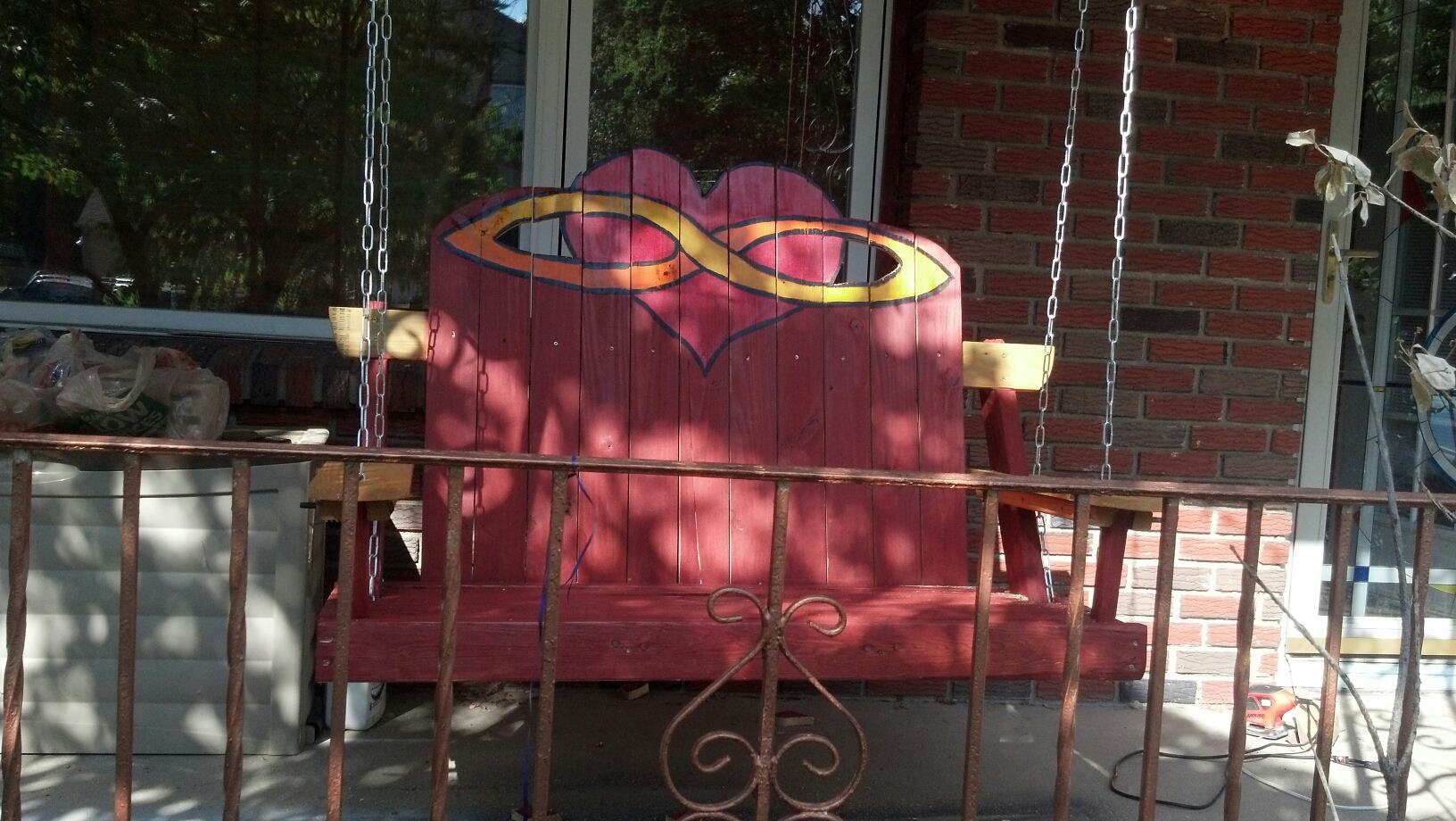
Poly Porch Swing!


Editorial Note: This post was written by Wes Fenza, long before the falling out of our previous quint household and the subsequent illumination of his abusive behavior, sexual assault of several women, and removal from the Polyamory Leadership Network and banning from at least one conference. I have left Wes’ posts  here because I don’t believe it’s meaningful to simply remove them. You cannot remove the truth by hiding it; Wes and I used to collaborate, and his thoughts will remain here, with this notice attached.


—–

I made this porch swing a couple weeks ago, and Gina painted/stained it today! Someone insert a “swinger” joke…

Honesty is Hard


Editorial Note: This post was written by Wes Fenza, long before the falling out of our previous quint household and the subsequent illumination of his abusive behavior, sexual assault of several women, and removal from the Polyamory Leadership Network and banning from at least one conference. I have left Wes’ posts  here because I don’t believe it’s meaningful to simply remove them. You cannot remove the truth by hiding it; Wes and I used to collaborate, and his thoughts will remain here, with this notice attached.

—–


For the past month or so, the skeptic blogosphere has been talk a lot about harassment at skeptic events. Throughout these conversations, I’ve made a few disturbing observations:

  • People (mostly women) are getting harassed at skeptic events. This doesn’t seem to be occuring at higher rates than at other events, but any harrassment is too much, and we can do better than that;
  • Many people (mostly men) in the skeptic community are not taking this problem seriously. This is also fucked up, and I’m glad it’s getting some attention.

These issues have been extensively documented by Stephanie Zvan at Almost Diamonds.  Everything that I could say on the topic (and how disturbing it is) has been said much more eloquently elsewhere, and I have nothing new to add. Suffice it to say that yes, this is happening, and I hope atheist/skeptic conferences all adopt strong harassment policies, with an emphasis on enforcement.

What I’d like to discuss is a secondary issue (which is not nearly as important as the two identified above, but I think is worth discussing): the issue of harassment has led to a number of discussions about exactly where the line is between consensual flirting and harassment.  These are important discussions to have, I think, but I’m bothered by two (somewhat related) themes I keep seeing crop up in these discussions:

1) It’s wrong to want sex from people without being interested in getting to know them

This is generally couched in reasonable-sounding language like this from PZ Myers:

I have a simple suggestion. Think of sex as something two or more friends do; but also keep in mind that most friends don’t have sex together. When you’re at a meeting, plan to make friends promiscuously, but remember: the purpose first and foremost is friendship, not sex partners.

At first glance, this seems like a reasonable suggestion. Most people prefer to get to know people before having sex with them, and most people would rather have sex with someone they like for nonsexual reasons also. But some people just want sex, and there is nothing wrong with that. It’s not up to us to tell people what their goals should be in a social interaction. Denigrating anonymous men for wanting to “bag a young hottie” (which is Jen McCreight’s paraphrase, not an actual quote from anyone) at each speaking gig sends the sexnegative message that desiring sex with a person you find attractive (which is how I would have phrased it) is WRONG and CREEPY. In addition, speaking about it as something that only men do contributes to the myth of men not being hot. McCreight puts desiring sex with attractive women in the same category as talking only to a woman’s chest, nonconsensual groping, and following a woman to her hotel room. I think that’s terribly unfair. There is nothing wrong with sexuality. There is nothing wrong with desiring sex for purely physical reasons. Resorting to slut shaming is not necessary to discuss harassment. It’s bullshit, and it should stop.

2) Dishonesty is expected, and even encouraged, where sexuality may be involved

This is related to Point 1 by virtue of the fact that if wanting sex is wrong, then people who want sex are going to be encouraged to hide that fact until the socially appropriate time. People who just come out and say they want sex (even in the least coercive and lowest pressure way I can think of) are disrespectful, objectifying, and should be ashamed of themselves. Fuck that. Asking for sex is not seeing a person “as your plaything.” It’s just asking for sex. Objecification only happens if you see the other person’s desires as irrelevant. As long as you are genuinely seeking enthusiastic consent, if you want sex, you ought to ask for it! Hiding your intentions is just being dishonest, not respectful. As one commenter on this blog put it:

I too find smart, interesting people who think about things quite sexy, yet am generally skittish of strangers. I’m also alternately oblivious to and skeeved out by the way flirting (in most mainstream venues) happens most times. Still, I’d far prefer for someone to tell me they think I have great boobs and would like to make out with me than to just hint at it, assuming they are respectful of my possible “no thank you.” I like transparent, respectful asks, and people who ask for consent frequently and sincerely.

In addition to those desiring of sex being encouraged to remain silent, women who are objects of such desire are also encouraged to be dishonest about their refusals. The (true) observation that rapists ignore refusals is used to suggest that women shouldn’t be encouraged to clearly communicate their own desires. The (also true) observation that women are socialized not to clearly communicate a refusal is used to suggest that we should not be encouraging women to break free of that socialization and be more honest about what they want. This is confusing the “is” and the “ought.” The undeniable state of mainstream heterosexual flirting is that men are expected to be the aggressors, that clearly communicating a desire to have sex is disfavored, and that a clear refusal is often met with hostility. None of this is an argument that the status quo is the way things ought to be. We should all be encouraged to be more open and honest about what we want from a social interaction, even if the we may be subject to negative social consequences.

The exception, of course, is when physical safety is in question. If anyone is in doubt about his/her physical safety in an interaction, all of these rules go out the window, and people should do whatever they need to in order to get to safety. That cannot be stressed enough, and it should never be forgotten.

Of course, the flipside of this is that we should stop punishing women for being blunt. A woman who clearly communicates a “no” is not being harsh, she’s being honest. A woman who says she’s not interested in someone (even if s/he hasn’t made any advances) is just being communicative. Hurting someone’s feelings through deception is a dick move. Hurting someone’s feelings by telling them the truth is a brave and awesome thing to do, and we should encourage people to do it.

However, the danger of social disapproval is not a good reason to be dishonest. If your friends will think of you as a bitch for giving a clear refusal, get some new friends. If the object of your affection will see you as creepy for being clear about your sexual interest, that’s not a reason to hide your interest. Honesty often has negative social consequences. It does not follow that dishonesty is justified. If flirting should be about creating intimacy, then it relies on both parties behaving in a trustworthy way (i.e. not lying to each other).
Jadehawk disagrees:

You can’t remove the social context because the social context is what determines how women will respond. they’re not flirting with you in a social vaccum, and pretending otherwise is just fucking stupid. We have to fix the social context first (i.e. not punish women for being above-average-assertive, and instead shut down those why try to punish women for blatantly and “rudely” setting boundaries and even taking initiative themselves), before you can seriously expect women to consistently “help” socially inept guys at flirting by being blunt with them.

I agree that it’s unrealistic to expect anyone to completely go against their socialization, but that doesn’t mean that we should not ask them to do so, or, when we’re discussing behavioral standards, to hold up an against-the-mainstream behavior as ideal. Society socializes us to do many things that we reject. Dishonesty could be one of them. Jadehawk’s view is that women are just brainless products of society’s conditioning, and have no choice in how to act. I think we all have a choice, regardless of what we’re told, or how we’re taught. I don’t think “the social context is what determines how women will respond.” I think women will respond based on their own individual choices, in light of the social context.

To be clear, I don’t think people are always (or even usually) obligated to express their sexual interest or lack thereof. It’s all about your intentions. If you intend to send the message for someone to back off, do it clearly. Don’t use subtle social cues that are open to interpretation. If you want to get to know someone, do that. If you intend to communicate sexual interest, do it clearly. Don’t do it by pretending you want to get to know someone. And don’t pretend you’re interested in sex if you’re only interested in getting to know someone. If you want to get to know someone, and also have sexual interest, then feel free to communicate either or both. My only problem here is dishonesty about one’s intentions.

This also shouldn’t be taken to mean that I think people always have clear intentions. It’s perfectly reasonable to be hours, days, weeks, or years into a social interaction, and still not really be sure what you want out of the interaction. That is actually, I would argue, the mainstream expectation. The problem occurs when people know what they want, and pretend that they don’t.

Flirting is not easy. But if we try, we could make it a little easier.

Surrender to me, and all will be well…


Some of us who have left religion can rightly be considered abuse survivors. Sometimes the abuse is obvious and extreme. Sometimes it’s more subtle, but still leaves a lasting impact. The abuse largely consists of having been denied intellectual and emotional autonomy; denied the right to form our own opinions, to choose our own identities, to pursue pleasure and avoid pain. We were taught to be complicit in our own abuse, to agree and submit and accept that yes, denying ourselves was right and good. We were taught to thank the people who held the rod over our heads.

I don’t think all religion does this, or that all people who were religious in their formative years suffer the psychological damage I’m talking about. I think it’s more likely to occur for those who had a parent or spiritual leader with a personality disorder (narcissism is common, in my experience) and who had a compliant, anxious-to-please temperament.

Being one of these, let me tell you what it’s like in my head. I have no confidence in my own ability or freedom to decide what’s right or best, what “a good life” or being a good person means. From infancy, these things were handed to me, with unquestionable authority. Although I began the process of rejecting and questioning that years ago, there’s a part of my brain that is still waiting to accept beliefs and moral dictates from outside. We all have that vulnerability, I think, that sense that it would be such a relief to let someone else tell us what is good and bad, true and false. But mine was strengthened by having been allowed to dominate for the first two decades of my life. My brain was nearly fully formed by the time I shook it off, and it’s still there. Still a threat.

It’s the thing I fear most. I was thinking through my fears today, and when I voiced this one to myself — “I’m afraid of living the next two decades under someone’s thumb, the way I was for the first two” — I began shaking and crying. I’m really, really afraid of that. And I know how my brain works, so I know how real a danger it is.

One thing this means is that when someone expresses their opinion in a flat, factual way, I become hella defensive. Those who are close to me know this well. It’s true that a person can state their beliefs without implying that those beliefs are absolutely correct and you’d better believe them or else — but the part of my brain that’s looking to receive truth from outside is seduced by their confidence, their apparent certainty. I feel it leaning in, wanting to just let go, acquiesce, say “Ah yes, you’re right of course” without giving it further thought. And that feeling terrifies me, and I pull back as hard as I can, in a way that is not at all rational or measured.

We’re all threatened by having our beliefs challenged, but some of us are also threatened by the possibility that we’ll change our beliefs not because we thought them through, not because they fit with our experience of the world, but because it feels so good to surrender and let someone else do the deciding.

I don’t know how to deal with this. I don’t know how to let my defenses down while the surrender-hungry part of my brain is still so strong. I’m not at all convinced that that would be a wise thing to do. So for me, right now, anyone who tries to convince me of something using emotional tactics, or blunt statements that don’t explicitly acknowledge their uncertainty or my right to think differently, is likely to trigger a shitstorm of defensiveness. If anyone who’s been through this has any advice, let me know.

Opening Up About OpenSF


Annalisa and I spent the last week in San Francisco. In part, we wanted to have a nice vacation: I had never been west of Chicago and we had not traveled together for any real length of time for a while. But one of the major reasons for going was also to attend OpenSF, a conference on nonmonogamy, open relationships, and polyamory organized by Pepper Mint. The conference (and related events) lasted from Friday until Sunday, and I’d like to take a bit of time to talk about some of the interesting panels I attended and some of the people I met in and around the conference itself.

Friday

Friday was essentially a welcome/orientation day. Pepper gave an opening address and initiated an interesting icebreaker activity, for which I am thankful because it forced me to meet some new people right off the bat. One of my goals for the conference was to socialize, but walking into a room of strangers, almost all of whom live in the San Francisco Bay area, was daunting for me. I learned an important lesson this weekend: I am extremely bad at approaching people I don’t know, even for casual, “low stakes” chat/interactions. Once I’ve been introduced to people, or compelled to interact with them, I think I’m actually a fairly gregarious person. But the initial awkwardness of “how do I approach that person, and what do I say?” is a huge anxiety trigger for me.

Luckily, the icebreaker required us to move from table to table, each time beginning with a new group of people and a “prompt” question that we were all asked to answer in front of the group (if we chose to answer: enthusiastic consent was a theme of the con, so anyone could opt out of any activity without judgment). Pepper provided excellent questions (“What do you hope to get out of the con,” “What is one of your wildest or most unusual poly moments,” etc.), and I felt mostly at ease meeting 20-30 new people in 15 minutes or so. It was a fun activity, and I might adapt it for use in the classroom.

After the welcome address, many con guests left to attend an off-site lecture/dance/play party. Sadly, I was unable to register in time for the sold-out event, but a group of other event castaways organized a rousing game of Cards Against Humanity, to which I was graciously invited. There I met Dylan of the Life on the Swingset podcast–who had brought a large contingent to the con–and several other people I would see throughout the weekend.

Saturday

Saturday was a day of panels, beginning with Charlie Glickman’s talk, “Sex, Shame, and Love.” For me, this was a highlight of the convention. Glickman discusses shame as a “tent” or “cloud” of emotions, any of which can disconnect us from people with whom we have relationships. One of his most important points, though, and one on which he disagrees with many writers on the subject (and some of his own psychologist colleagues), is that shame is not always detrimental. For Glickman, feeling shame is an important indicator that we’ve broken a communication/relationship “bridge”–yes, he used a lot of analogies–and need to mend it. Awareness of our feelings of shame is the first step in repairing the relationship (I should probably note here that one of the key relationships we can damage with shame is our relationship with ourself). Glickman elaborates on these concepts herehere, and here (among other places).

Most people in romantic/sexual minorities face shame at some point in their lives, often daily. I found it refreshing to hear someone talk about shame’s adaptive value and about avoiding a shame “spiral” (i.e. being ashamed of feeling shame, which only leads to more shame). As an anxiety disorder sufferer, I found in Glickman’s philosophy some useful coping mechanisms.

One other session of note on Saturday (they weren’t all gems, though I can’t say I thought any one was particularly terrible) was on “Poly Theory.” Joy Brooke Fairfield, a Stanford graduate student, gave a staggeringly expansive and eloquent talk about establishing a branch of cultural studies called poly theory (in the vein of feminist theory, queer theory, etc.). She also expanded on Deleuze and Guattari’s metaphor of a rhizome to describe polyamorous relationships. Contrasting her conception with the traditional linear (or arboreal) relationship model–we can see the arboreal model in family trees, corporate organizational flow charts, etc.–Joy argued that our relationships more resembled the root system of rhizomes. Rhizomes lack a central or ultimate root but rather expand from node to node in many directions. If we imagine ourselves each as nodes, we can see how we connect to other nodes, and those nodes to still others, in a complex but interconnected system. It is an elegant, non-hierarchical way to look at groups of linked relationships, polyamorous or otherwise.

After Saturday’s sessions, I got to try Poly Speed Dating. It was a lot of fun, if chaotic. I wonder if something like this would work in our area?

After speed dating was a dance party at Love Triangle dance club, a poly-friendly club in San Francisco’s Mission District. I was heartened to learn that the Mission has not one but several clubs that cater to nonmonogamous folks. Again, I wish our city/region did a better job of providing safe spaces for nonmogamous people to gather to socialize. My overriding feeling all weekend long was that this was one of the first times in my life that I’d found a group of people with whom I fit in totally. Even though I met theists, omnivores, and even (gasp!) political moderates, I felt a deep, almost instant common bond. We’d all wrested loose the shackles of monogamy, and that’s a remarkable thing.

Sunday

The fatigue of late Friday and Saturday parties began to show for most con guests (and even some of the presenters) Sunday, but the day did bring a few highlights.

Tristan Taormino‘s keynote speech was an enthusiastic call to arms. She made several important points, one or two of which I will write about in more depth another time. Briefly, though, she called on the LBGT community not to throw polys under the proverbial bus in their fight for marriage equality. Conceding our opponents’ post hoc and slippery slope arguments hurts both our causes.

In addition, Taormino called on those of us who have the privilege to be “out” as nonmonogamous to live our lives as openly as possible. One of the things that prompted me to start writing for this blog was that I realized that I am fortunate enough to have a job for which I will not be fired for being polyamorous, a supportive and loving family, economic and emotional security, etc. I really must live my life openly, if only to show other people that people like us not only exist but are happy, healthy, and thriving.

I liked a few of the early Sunday panels, but I was really impressed with Cunning Minx‘s afternoon session on creating a non-threatening, attractive online dating profile (i.e. how not to be creepy guy). While her advice was useful, even for those of us who already consider ourselves non-threatening/non-creepy, I was particularly struck by her polished, stimulating, and well-organized presentation. You would be amazed at how many presenters were not particularly well-organized. We’re lucky to have Minx as an advocate/representative/colleague/peer, and I was glad to have met her.

I was also able to meet Dossie Easton, whose inscription in my copy of “The Ethical Slut” left me smiling with fanboy glee.

Monday and Beyond

I’m still processing the experience of OpenSF–and I expect I’ll share some of the fruits of that processing with you in the weeks and months to come–but right now I feel overjoyed to have spent three days among fabulous, non-judgmental, like-minded people. I increased my polyamory vocabulary, something I wasn’t sure was possible nearly four years into my own poly life. And I left San Francisco, and return home, eager to be more of an activist and particularly to advocate for more sex-positive events and safe spaces in our own city. I think we can do it, but I’ll probably need a bit of help. Who’s with me?

Ideas and beliefs do not deserve respect


There is a discussion going on all over the internet about civility and belief.  There is a demand that people’s beliefs, ideas, and opinions be respected.  That idea is fundamentally wrong, and we need to get over it.

Ideas stand or fall on their own merits.  If they are respectable ideas, they will withstand any mockery, criticism, or down-right disrespect we can throw at them.  If they are not respectable, then we, as mature adults, need to be able to handle that.

Our ideas are not held for purely rational reasons.  I don’t care how intelligent you are, how well you have thought out your ideas, or even if you are Vulcan.  Our ideas are based upon emotional values that we have, which are beyond our control, and then we rationalize those opinions after the fact.  In many cases, those opinions can be rationally and skeptically justified, but it is not how we originally form most ideas.

If you care about the truth, then you should be able to mock your own ideas and hear mockery with the ability to remain rational. This is not to say that people will not be emotional in such cases, but that we all need to practice hearing mockery by challenging our own ideas so it does not make rationality impossible in the face of such criticism. The truth will attend to itself, whether we respect it or not.

If you don’t care about the truth, then why do you care if others respect your beliefs? If you don’t care about the truth, then you don’t respect your beliefs.  So why should anyone else?

We all, as adults, need to maintain a safe distance from our beliefs.  We should not make them sacred, protect them from criticism, or demand that people respect them.  To demand that ideas remain protected in such ways, we are telling people that we are less concerned with truth than with our comfort.  We are declaring that we don’t care if our ideas are true.  And, again, if truth doesn’t matter than other people’s respect is irrelevant.

This, above, is the essence of new atheism.  This is the essence to the new movement lead by people such as Richard Dawkins, PZ Myers, and others who have been called “strident,” disrespectful, or unsophisticated.  Rather than defend them, I think we need to recognize that the charge is loaded with assumptions which need to be smashed open, criticized, and mocked.  The truth is that our various bad ideas, whether religious, political, or spiritual in nature, have survived because of the unwarranted demand for respect.

This bubble we create around our personal beliefs has become sacrosanct in the postmodern west.  It is certainly tied to modern liberalism, and certainly it is the weakest part of liberalism from where I stand (and I identify as a liberal).  We need to stop demanding respect for ideas until those ideas have survived skeptical analysis.

We need to distinguish between respect for ideas, legal protection of maintaining ideas, and people.  The first, that of ideas themselves, never deserves automatic respect; that respect must be earned by surviving criticisms both harsh and gentle.  Legal protection of ideas and of people do deserve respect, as we all have the right to our ideas and our ability to articulate them.

We just don’t deserve respect for those ideas automatically.  And by demanding it, we betray that we know that the idea might not survive criticism.

Criticism is not uncivil.