As Shaun recently pointed out, we here at the Polyskeptic compound are rather big Doctor Who fans. On that vein, we are having an awesome Doctor Who-themed Halloween party!
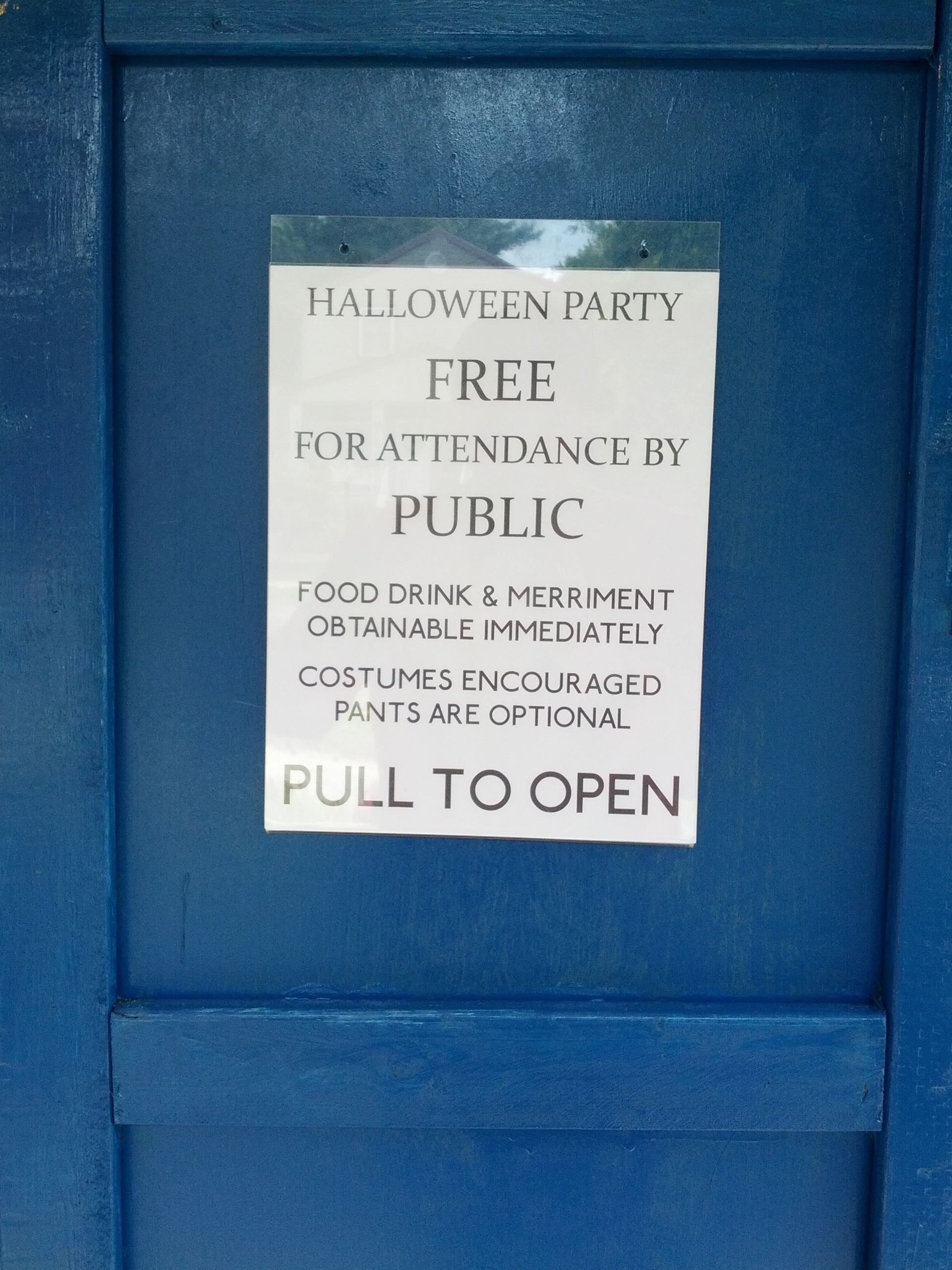
To start, I made the front door into a TARDIS:
It’s bigger on the insideMy kind of party!
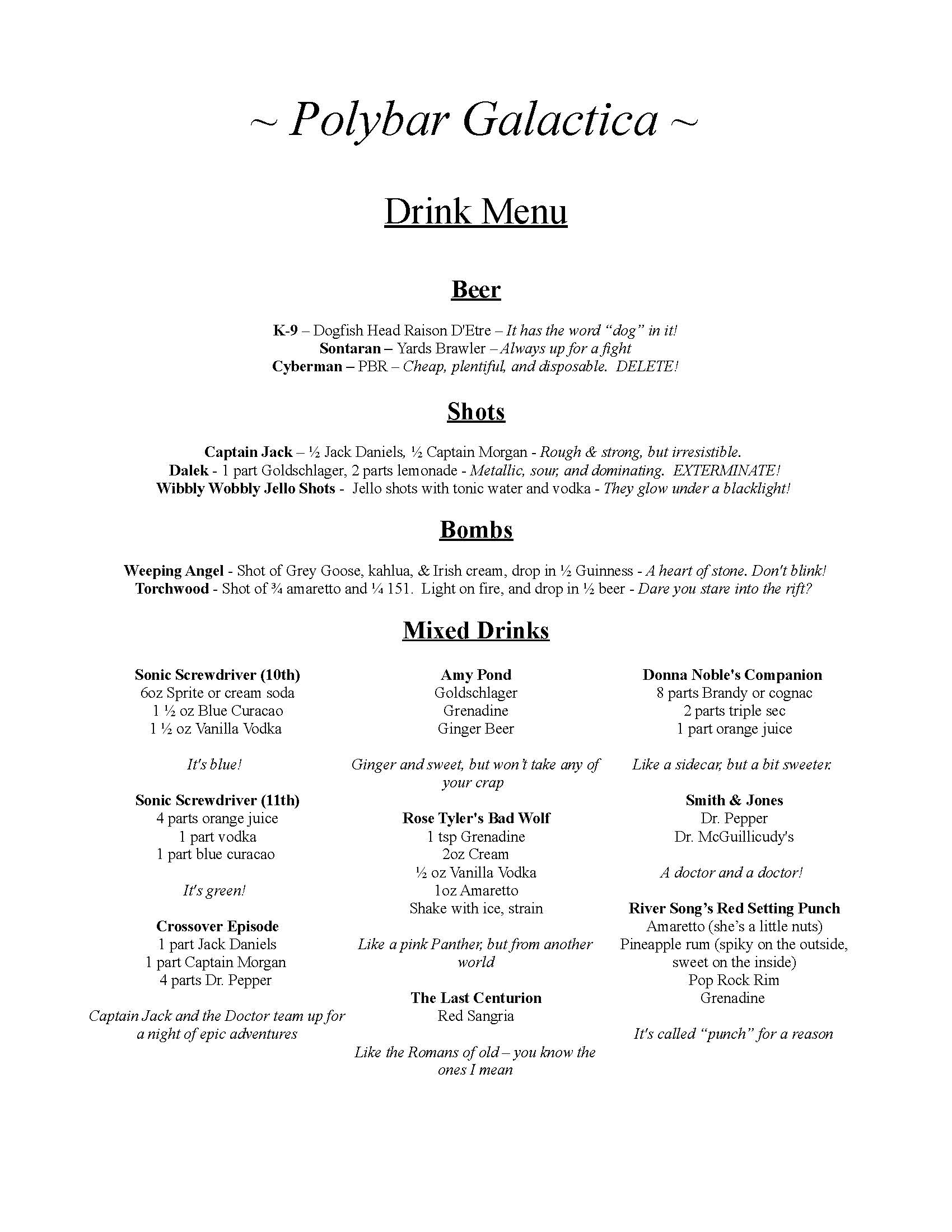
Step 2: make an awesome drink menu:
“Polybar Galactica” is the name of the bar at the house
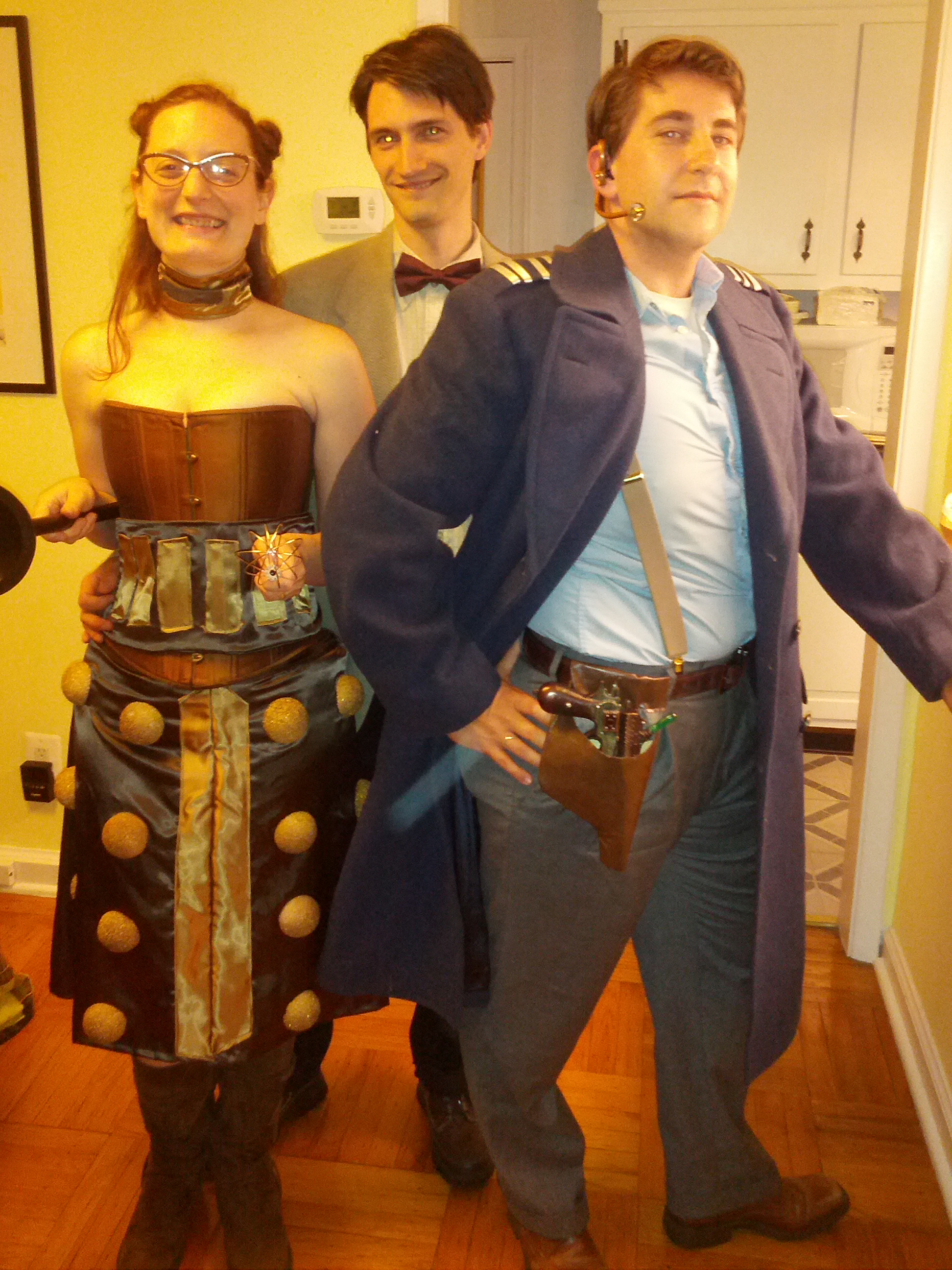
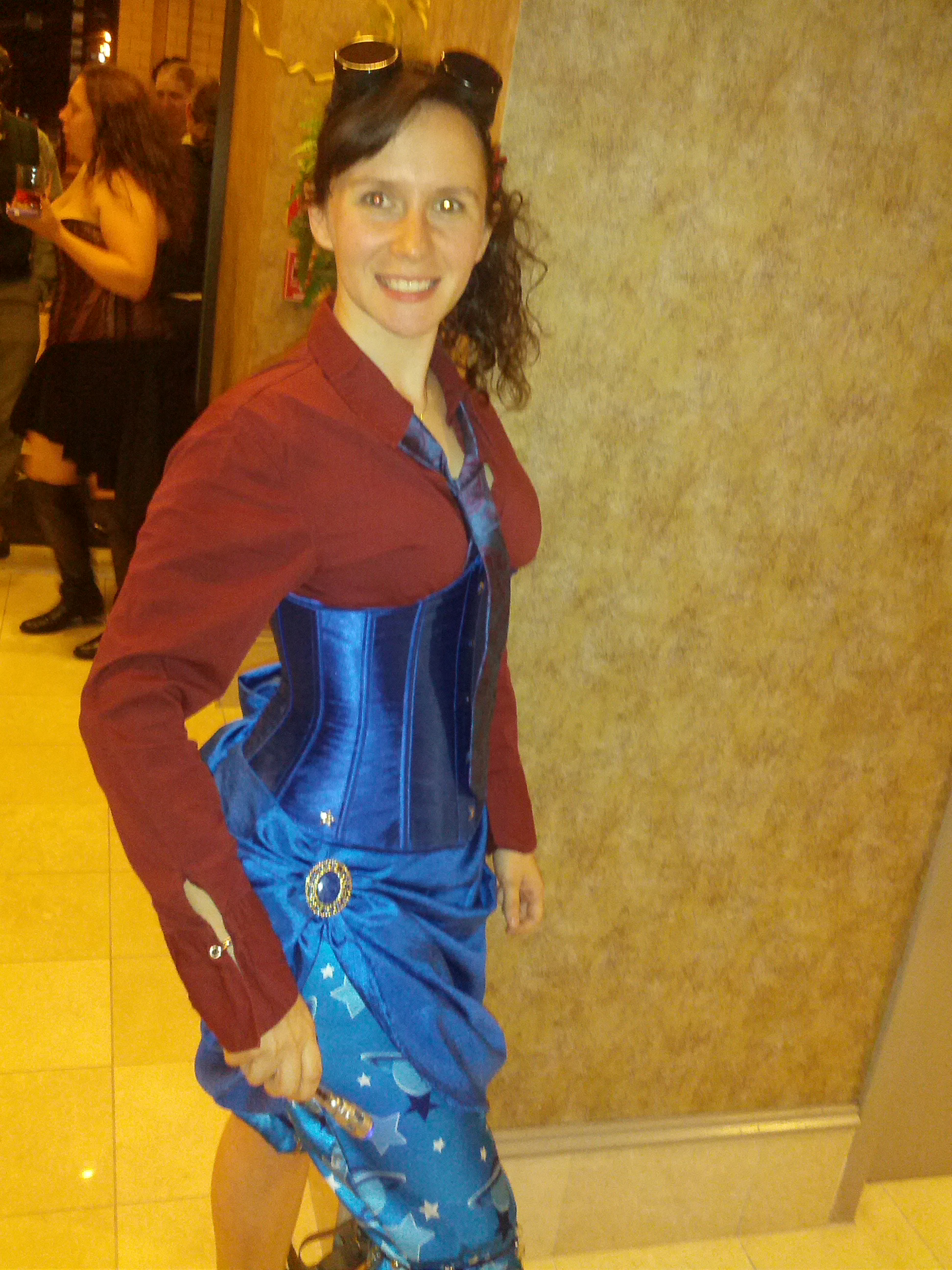
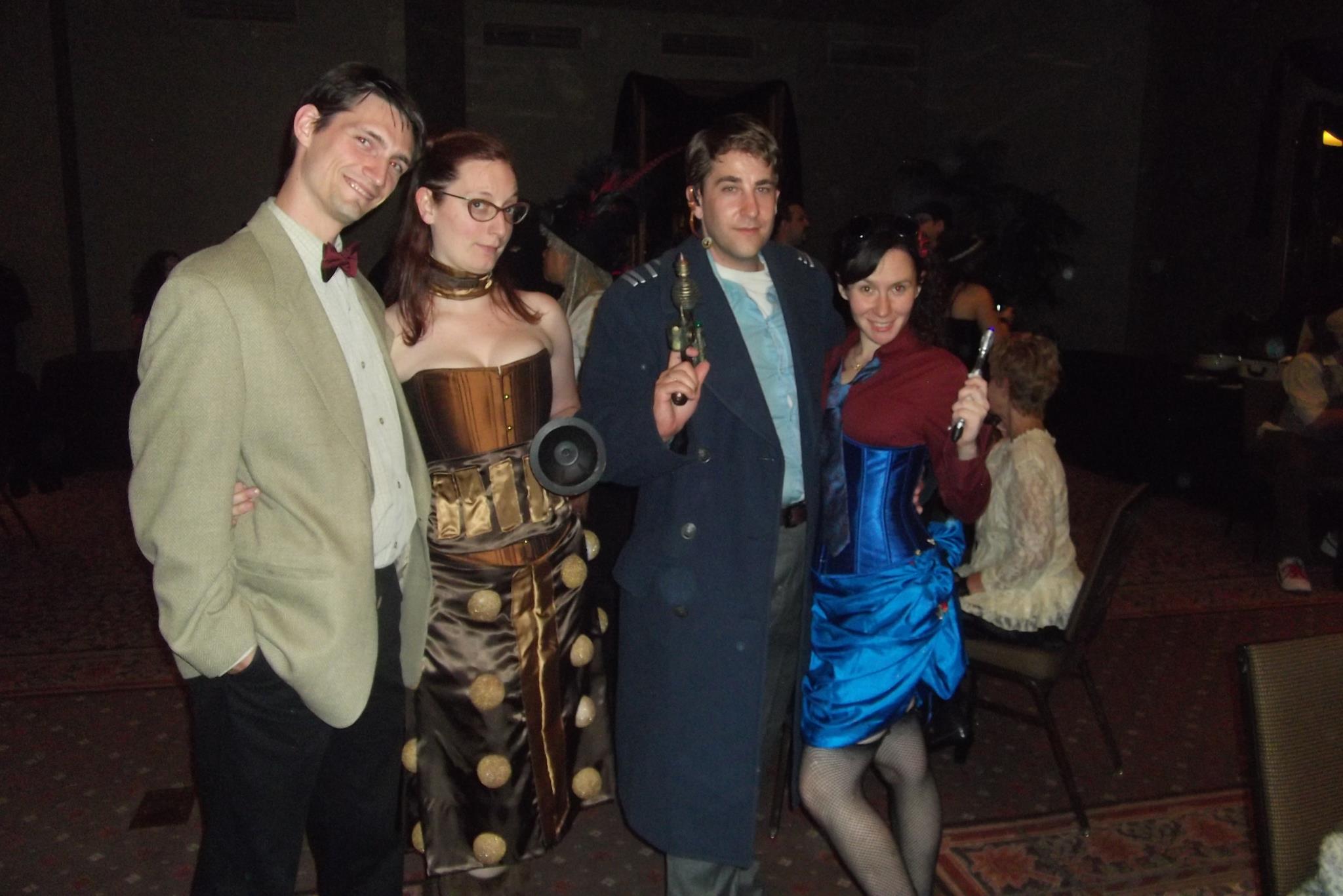
Step 3: Costumes!
Needless to say, we’re pretty excited about it. Allons-y!
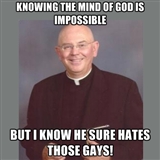
I recently read a post on the Patheos Catholic channel called I Believe In One God by Tim Muldoon. In it, Muldoon makes a good point that atheists make all the time:
thinking about God is limiting in the way that Nietzsche intuited: inevitably the god that emerges from our thinking is little more than a creation of our imagination. We create gods in our own image.
Does Muldoon take this to mean that there probably is no God? Of course not. Does he make the conclusion that, even if there is a God, it would be impossible to know anything about such a being, so attempts to follow God’s Will are misguided and foolish? No. Instead, he points to the real villain – thinking:
For as wonderful as thinking can be, it is still a rather small tool…. Jesus reminds us that ultimately thinking is not the aim of faith; rather, living in love is, which he described with the metaphor of “the Kingdom of God.” At the end of the day, when I put down books with ponderous titles, having wrestled with great thinkers who try anew to stretch our imagination and our knowledge of the world, I get up from my desk and am immersed in a world that is in desperate need of rigorously thought-through love. If love is real, and if anything we do in this vale of tears carries with it the possibility of meaning or beauty, then it is because God is present throughout it.
Muldoon, having rightly pointed out that God cannot be intellectually understood, pivots to say that the way to square that circle is just to stop thinking and have faith.
While Muldoon himself points out that even if he exists, knowing the mind of God is impossible, he still manages to hold orthodox Christian views on pretty much every social issue. And when it’s pointed out to him that this doesn’t make sense, he finds a great solution: just stop thinking.
OK, so first of all the doorway to the polyskeptic compound is totally not in the shape of the TARDIS.
If you drive around New Jersey long enough, you will see this door. If you do, don’t stalk me.
OK, it is, but that does not mean that the house is bigger on the inside. But the house can travel through time and space! …although only forward in time at the usual rate and in space only relative to things like cars, people, and so forth which move around and through it.
There are a couple of issues with the video above, such as the definition of religion used is not universally accepted, but I think it would be somewhat silly to seriously criticize such a video made with at least one tongue implanted in some cheek somewhere.
OK, so that sounds like it might be sexual, but I guarantee I’m only slightly turned on right now (and that has more to do with the TARDIS; it’s bigger on the inside. That’s what she said).
OK, terrible jokes aside, I am sure that under some definitions of religion, some people I’ve met might classify as Whovian-cultists or someshit. After all, a cult is really just a religion that is not Christianity, right? (It pains me to reference Matt Slick, so I feel like I need to balance that out with this video of a discussion between Matt Slick and Matt Dillahunty about the transcendental argument for god, or TAG).
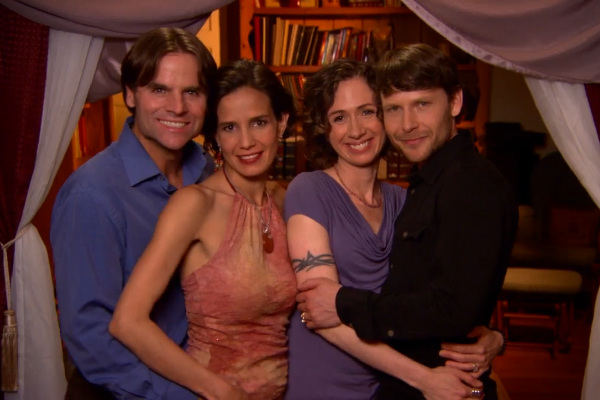
Two sexy Doctors, a Dalek, and even Jack Harkness participating in the traditional Whovian ritual of being drunk.
OK, so Doctor Who, in conjunction with its fan-base, might be thought of as a religion. I have never thought of it that way, but I also think that one part of what makes something a religion is the acceptance, or belief, that the object of reverence is real.
And then I wonder how “real” the people who created texts in ancient times about gods, creation, etc thought the stories were. I think part of what makes mythology interesting is realizing that for many people, throughout many eras, didn’t have the same distinction between reality and myth, nor did they have a solid meaning of reality which we would recognize. In other words, it may be the case that many people who have religious beliefs are not thinking about “truth” or “reality” using empirical or skeptical concepts of either of those terms.
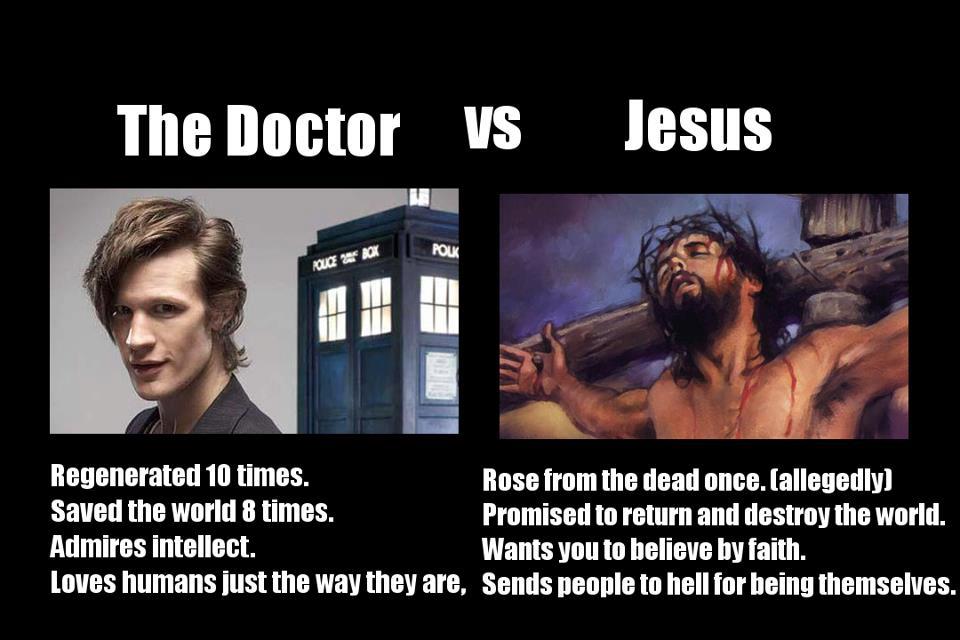
Certainly, people can take those mythological ideas and subsequently think of them as real in our modern sense, but the fact that they end up there does not necessarily mean they started there. There is the question, for example, of whether many of the New Testament books were closer to literature than history (I would recommend Tom Verenna’s blog for more about that), and whether many scriptures from around the world are even comparable to any sort of skeptical inquiry. It may be that Jesus was a character of inspiration for first century Palestine in a similar way as the Doctor is an inspiration for many people now, all over the world.
And this is the point where some people will point at me and be like ‘See! You admit that religion is not to be taken literally, so your criticisms of them as if they are literal beliefs is shown to be wrong-headed,’ or something similar. The problem here is two-fold.
First, in many cases people do take mythology as real in the sense I mean it; as in it describes the actual world and they simply are wrong about the facts. Second, the fact that some people do not think of things this way shows where they are going awry in not understanding that we have a reliable methodology for knowing things about the world, and that mythologizing the world is not a means to understanding, but obfuscation, parochialism, and ultimately a worldview based not on what’s real but rather what is comfortable or even non-confrontational.
Unfortunately, many postmodernist approaches to the world are much closer to those who mythologize the world, which is why, I think, many (secular) progressive intellectuals tend towards liberal theology or at least show deference to such liberal theologies. Karen Armstrong, for example, has talked about ‘God’ without concern for whether such a thing exists, as if that was not even relevant. While I appreciate some of the contributions of postmodernism in philosophy, the tendency towards anti-realism, as opposed to realism, in the philosophy of science and in metaphysics has always been a bane for me.
Art and religion
So, The Doctor is not real. But the show can be a source for thinking about the nature of the world, our choices and their consequences, and so forth. It’s a living mythology, of sorts, which many draw inspiration from. But is that inspiration, entertainment, and possible edification spiritual? Is it a religious experience?
As a person who has never believed in supernatural realities, but who has had experiences that seem similar to the descriptions of spiritual/religious experiences, I would say that there is some gray area here. Where I think I am likely to say no is that I think that these experiences are the result of art, and not religion per se. Religion, the great usurper of all things human, has once again stepped in and claimed something as its own when it belongs to all of us, religious or not.
So, insofar as Doctor Who, or Star Wars, or Star Trek, or Shakespeare, or…you get the point. So long as artistic expression invokes existential inspiration in us, it is art that has done it. We need to stop associating these things with gods or spirits, because they are natural occurrences with no supernatural explanations necessary.
Where does this leave ‘religion’? Well, as we become more secular and educated as a species, I envision religion becoming conflated with artistic and ritual social ties which will probably never go away, even as their supernatural associations dissolve into the nothingness from which they came. But we should not forget that those supernatural and irrational additions to the art we have created over time have been semantically tied to so many things, and that people will continue to associate nonsensical ontological concepts to everyday experiences, hopes, dreams, fears, etc.
Supernaturalism, theism, and even deism are irrational and even silly concepts which are clutching onto our art, even as they slowly die. But the art, the inspiration, and the creativity of the human mind will continue long after the gods have all been forgotten. So Doctor Who might be called a religion, but only in the loose and artistic sense that all that we do and love as humans is considered religious. That is, in the watered down way that only seeks to distract us from what is truly irrational and dangerous about religion; faith.
When art turns into certainty, when creativity and inspiration is not checked by skepticism, is when it goes wrong for our art. Because we can create illusory worlds to play in, but the imaginations of humanity are only for pretend and should not be guidelines from policy or morality without a skeptical check on their influence. We need to leave faith behind because we don’t need to believe that our imaginings are real for them to be interesting. Further, if we do believe they are real then we may be too unwilling, whether through reverence or fear, to make sure that they are rational.
So science and skepticism are not the source of all understanding, but they should be the arbiter of what we accept as true. Art can inspire, entertain, and even teach us about the world, but we must make sure the lessons are actually true and not merely revere them unskeptically.
In other words, enjoy Doctor Who, and remember that he’s probably a better source of inspiration than Jesus.
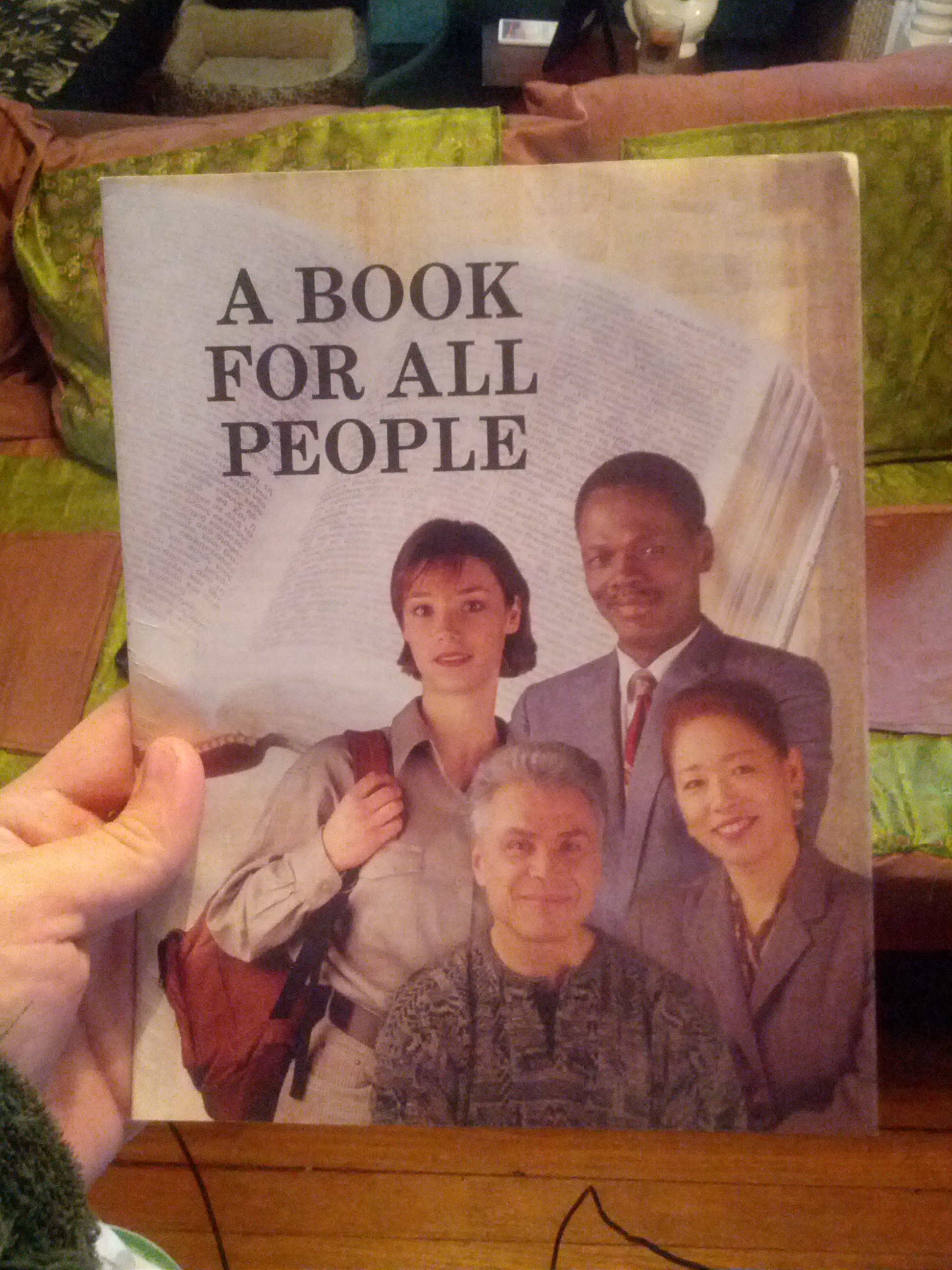
Last week, I was visited by a few Christian missionaries. They gave me this pamphlet:
Men, women, black people AND Asians? Amazing!
I decided to talk with them for a while. After I made it clear that “because the Bible says so” was not an acceptable answer for anything, the conversation turned to why we ought to trust the Bible. According to these missionaries, we know the Bible is true because it made a bunch of prophecies that came true. They were a little fuzzy on the details, but the one that they remembered clearly was the prophecy of Cyrus. According to them, the Bible prophecized that Cyrus would conquer Babylon, and that the gates of the city would be open, over 100 years before it happened.
My response was that the prophecy did not seem all that prophetic, and it was rather vague. The missionaries promised to do a little more reading and then come back. That was last Thursday. They haven’t been back yet. But in the event they do come back, I have a printout from the Skeptic’s Annotated Bible for them, all about Biblical prophecies.
However, I have my doubts that they’ll be back. I’m calling false witness.
Several years ago, Wes and I went to Longwood Gardens and I totally obeyed a sign that said, “Keep off the grass”. I didn’t even think about it. I follow the rules. I keep the status quo. I don’t ruffle feathers intentionally and if it happens, it is usually unexpected.
This is, to put it in thermodynamic terms (as though that makes anything more understandable), my lowest energy state. Breaking rules, going against the grain willfully, challenging largely accepted world views, all require a large exertion of energy for me. It is rarely energizing for me to speak out and often I have regrets because I do not have the thick skin required to withstand the attacks of people who disagree.
I care a great deal too much what other people think of me, be they friends or strangers. I have made “being well liked” a large part of my identity, and as happens with anything you make a Part of Your Identity, challenging it hurts and causes you to question said part. When I wrote that thing the other day and a few strangers on the internet all agreed that, to them, it sounded like a great afternoon and I’m crazy for being uncomfortable and I found myself believing that they were right. “Oh no…what if I AM full of shit? What if I’m just too sensitive? Maybe I’m just an asshole.” But thinking about it, and getting counseling from Wes, I remembered the actual inspiration for the post and had to find my wits again to remember that yes, in fact, there was something out about the whole affair.
I am a pretty theatrical person. Jessie calls me a Muppet all the time (which, in our house, is a high compliment). I am no stranger to putting myself out there in the arena of Making a Fool of Myself. I don’t generally fear performing, public speaking, dancing on a dance floor to the cool tunes of the 1980’s (or anything really), but I am deeply insecure about my intelligence and the validity of my opinions about social issues, government, philosophy and other “high thinking” things.
I live a privileged life. I am not blind to that. I am married to a man and work in science. I own a house and a car and worry about things like when to plant tomatoes. From the outside, I look like a standard white, straight, female member of the middle class. This identity enables me to blend into society. All the other things that very much veer me away from the norm (atheism, polyamory, bisexuality, burlesque, and the fact that I knew that David Carradine died of auto-erotic asphyxiation after only thinking about it for like 5 seconds) can be practiced under the protective covering of Socially Acceptable. I don’t have to be out about any of this to have a high quality of life. I don’t need to fight the good fight to have it all.
And when I try to fight the good fight, I get exhausted with it quickly. I periodically get tired of explaining polyamory, the advantages and necessity of applying the scientific method to all things, or the impressive, insidious nature of sexism and privileged outlooks in our modern Post-Sexist/Post-Racist/Post-Everyist society, for the umpteenth time. When anonymity online emboldens people to cast countless vitriolic, hurtful things on those who dare to speak out with their real names, it is difficult to figure out who you’re fighting for. And when the other end, the end which tells you that you can not disagree…even when disagreement is civil and for the purpose of furthering perspective…lest you offend someone, who is this conversation for? I get tired of being told that I am either crazy for having a problem, or horribly privileged to even think something that doesn’t take the lowest of the low into the fullest account. I do not live for debate. I do not thrive on conflict.
But then, why do I speak out ever? Why do I not stay quiet forever? Well, it’s because I feel an obligation as a privileged (brave, due to that privilege), articulate person living a strange life “behind closed doors” quite normally and healthily to spread the word. My privilege allows me to speak out and say that these are real things in the world. These are things that are healthy and rational and they impose absolutely no threat to you whatsoever.
And I worry that if I don’t exercise this right; if I don’t use this privilege not just to my advantage but to the advantage of the people struggling who do not have a voice, what is my purpose? What is my value? Why should anyone care about me if I am too much of a coward to speak?
Of course, this is all a bunch of ego. I’m not remotely on the level of any great thinkers. I have trumped up my importance to the world and have allowed myself to be defined by it. The world will not stand or collapse based on my willingness to blog or go to conferences. I am one voice in millions saying the same shit. I am part of a force that will continue to swell regardless of my level of involvement. I am not so important that this should be some kind of grand soliloquy delivered to the fourth wall of the world’s stage just prior to my great act of madness and defiance that will cast everything we know asunder. I’m just a chick in a labcoat who thinks about things sometimes. I do not have my finger on the big red button. I won’t make the statement that brings war or peace.
I’m much more Dr. Strangelove than President Muffley, is what I’m saying…in that I will like cackle and talk in a funny accent while the big boys make plans to nuke a country. We do what we’re good at in Difficult Times.
So what I finally realized is that activism doesn’t have to be all or nothing. If you are inspired to speak out or do something, and are able, then do it. If you find yourself exhausted and without words or motivation, then take solace in the fact that ever little bit counts. Some people might listen and you might get through, and some other people might call you a Pinko Commie Cunt. That’s life on Planet Earth. When you get tired of talking, then you should be peaceful in your quiet because your quiet is what you want at that time. You speak and you act because you want a better world, but the responsibility of representing the ideals of this better world is not yours alone or even yours particularly. Speaking out is worthwhile. Living your life as you choose to live it is paramount. You do not need to do it all to have it all or to have great value.
I’m writing this because I never have much to say about atheism as a movement and because I often get exhausted being an ambassador for polyamory and because currently insidious sexism has hit me and has made it hard to be strong and brave and inspiring. All this passes and my urge to say things will become strong again…and then it will get knocked back down. I accept this now. It is just hard to accept it when you want to do everything and have a great sense of humor the whole time you’re doing it.
The thing is I am not an activist. I am a person living in the world but I won’t always be shy about what I see. I question. And with often great difficulty, I call out. And then I go back to regular life. And even this low level dissidence is hard to maintain without injury. So, I applaud those who fight outright. I commend those who go into the fray and debate and enlighten in a way that I just don’t want to, or sometimes can’t. And every now and then, I’ll help in the way I want to, but being a little squeak on the periphery saying, “Yeah! I see it too! You’re not crazy!”
I have been writing, reading, and thinking about the issue of accommodationism for some time. Type ‘accommodationism’ in the search box above for some context, as there are too many posts to link to here. I will say that I have tended to agree with Jerry Coyne’s views about the relationship between religion and science most of the time, and I tend to agree with PZ Myers more often than not.
Yesterday, PZ Myers put up a post about Michael Ruse which I largely agree with, but I want to address something, not because it makes me disagree with the point PZ makes, but because I think it takes a step back and gives some larger perspective on this issue. Here’s the relevant section from PZ’s post, quoting Ruse:
But wait! There are more paradoxes! One of the big problems with the New Atheism, says Ruse, is the way we idolize and support our leaders unquestioningly.
There are other aspects of the New Atheist movement that remind me of religion. One is the adulation by supporters and enthusiasts for the leaders of the movement. It is not just a matter of agreement or respect, but of a kind of worship. This certainly surrounds Dawkins, who is admittedly charismatic.
We worship Dawkins? And possibly Hitchens and Harris? Has he ever noticed how much we all freaking argue with each other? There are no saints and popes in the New Atheist movement.
Oh, wait, yes he has noticed. In the very next paragraph.
Freud describes a phenomenon that he calls ‘the narcissism of small differences’, in which groups feud over distinctions that, to the outside, seem totally trivial. It is highly characteristic of religions: think of the squabbles about the meaning of the Eucharist, for instance, or the ways in which Presbyterians tear each other apart over the true meaning of predestination. For those not involved in the fights, the issues seem virtually nonsensical, and certainly wasting energies that should be spent on fighting common foes. But not for those within the combat zone.
The New Atheists show this phenomenon more than any group I have ever before encountered.
So which is it? Blind, unquestioning worship of our leaders, or incessant fractiousness and dissension? It doesn’t matter. Ruse is just spinning his wheel of deplorable sins and accusing us of whatever random flaw pops up.
I will point out that PZ has missed that these two ideas are not, in fact, in necessarily contradiction, even if Ruse’s argument is ridiculous (which it is). It is logically possible that people in the atheist movement idolize atheist leaders and that fractious arguments also result, just like with religion. All it would take is a hypothetical Dawkins follower to argue with a Sam Harris follower, insofar as Harris and Dawkins would disagree. And there are some people I have met who do seem to look up to some atheist “celebrities” with some level of idolization, but this is to be expected. We are human, with personal flaws, after all. The ideal, however, does not have anyone idolizing anyone. I, for example, respect some people more than others, but I’ve never been a person who idolizes anyone, and never get fanboyish around well-known people, nor do I understand why other people do.
And I agree that there are arguments within the community, but I see this as largely a good thing even though in some cases it is evidence of bad ideas remaining among atheists (such as misogyny and privilege). There is a lot of work to do before our culture matures emotionally, cognitively, and in terms of being aware of our privileges and biases. And as a result of that, many atheists will tend to be stuck behind their own blindness, and fractures will exist which we need to addressed in the form of criticism and education of those people. Hence Atheism+.
But what Ruse is identifying here is not so much that the atheist community is like religion, but that when groups of people gather for any common cause, belief, or lack of beliefs, they tend to have similar behavior patterns of idolization, arguing, etc. So yes, the atheist community has some behavioral issues which are reminiscent of religion, but once again the error is in mis-attributing such things to religion, when in fact religion is the result of human group behaviors not the cause of it. Ruse is showing how atheist communities are acting human, just like religious groups. Why does Ruse make the (apparently unconscious) assumption that these behaviors fundamentally belong to religion?
Our goal—as skeptics and atheists concerned with our culture, our beliefs, and our actions—should be to improve how we all think, behave, and interact. Those working on including social justice in their actions, whether atheist or religious, are taking a step in the right direction in such terms. But what new/gnu atheism is about, Michael Ruse, is about asking whether the views some group has are true or not. We must take as a given that we will err in how he think, behave, and interact, but the question which concerns us is whether our ideas are true, not whether our community is perfectly ideal.
That’s the long-term goal, and it will take time to get there. And, as I understand it, this is what efforts such as Atheism+ were developed to answer. Because if we want to address the human flaws and how they emerge in the atheist community, we have to understand how psychology turns into sociology; how our personal flaws turn into groupthink and tribalism. The problem with religion is not that it fractures, idolizes its leaders, and then fights among themselves. No, that’s a human problem which we all have to deal with. The problem with religion is that it isn’t true; that they are arguing over fantasies.
Skeptical atheists, at least, are arguing over what is true with a methodology which works; science. And if they are not using science and skepticism well enough, then we can use skeptical criticism to point out how and why. When does religion do that? Religion uses logic on top of the assumptions of its theology, but it rarely, if ever, appropriately uses empirical methodology and good skepticism.
Michael Ruse is stuck comparing religion to atheism in ways which must be true because they are activities done by humans. Where atheism and religion are alike, it is attributable to anthropology (what I have my undergrad degree in). What Ruse misses, and what PZ does not articulate well in this case, is that what does separate religion from atheism is the concern for truth of worldviews rather than behavior of participants.
Because sure, some atheists go around idolizing people and arguing over small details, but our goal is to help them personally grow until they are mature, skeptical, knowledgeable people with good cultural and personal perspective. And unlike religion, we actually have real ways to achieve that because we do not have any scripture, doctrine, or limitations of criticism.
We have the best methods in our hands, no rules about where we cannot inquire, and only our personal flaws to hold us back. That tempered by caring about what is true, rather than what is comforting, preferable, or sanctioned is a good road to progress.
I’m out. Anyone who knows me personally and socially who does not know that I’m polyamorous (or an atheist, for that matter), is either not paying attention or is just saying that they know me to look cool to their friends. OK, that last thing never happens. But that fact is that not everyone who is polyamorous is open about it, and they often have anxieties about if, when, and how they should come out to people around them, especially family.
The “pod” from Showtime’s Polyamory: Married and Dating
Recently, I started watching the Showtime series, Polyamory: Married and Dating. It’s a fairly good show, and this issue of coming out is dealt with, but I’m concerned with how the show will effect coming out for the rest of us. I have a hypotheses that when a fringe or minority idea, group, etc comes into the mainstream, it is almost always has serious misrepresentations attached to it. Anyone serious about understanding the minority worldviews, upon its being portrayed in the mainstream, needs to do some personal research to get to the reality beneath the sexed-up mainstream presentation.
And that is true here, as well. The people in the Showtime series are not “bad” representations of polyamory; in fact, they seem at least mostly realistic and genuine. But what I think most people will take away from watching the series is that polyamory is a lot of sex with young, hot people all the time. And, I’m sure, for some people it is just that. At least, it is for a little while. I certainly had a lot more sex, with more people, in the beginning of my polyamorous life.
I’ve been around many polyamory meetups, a few parties, and have talked with poly people form various backgrounds over the last several years. The Showtime series, while somewhat good at presenting the open and honest form of communication between the people, is very focused on sex. I cannot think of too many times when an episode goes more than 5 minutes without some kind of sex being displayed. It’s not that I don’t like seeing hot, naked people enjoying each other, it’s that in my poly life nakedness and sex are not ubiquitous, and I think that’s probably true for most polyamorous people.
But I’m not here to analyze the saturation of nakedness in mainstream portrayal of polyamory, but rather the effect that such things have on other poly people, especially those who may be thinking about coming out to their family, friends, etc. My thought is that while such shows may give some context and grounding of what polyamory is to a larger audience, it also creates a stereotype with which we will be associated.
It’s not all about the sex, right?
It is somewhat common, in some poly resources, to emphasize that it’s not all about the sex. And this is true! Because while we do share some overlapping lifestyles with swingers, we are not swingers. The emphasis of polyamory is, obviously, love. And without getting all cheesy and hippy about it, the relationships we have with people around us are what are most important, and sex is often a part of that (but not always). So now when people I know see me, especially if they have seen Showtime’s presentation, they will associate that overly-sexualized perpetual orgy with what I mean when I say I’m polyamorous.
According to some people Gina knows, she has like 15 husbands (and she has not introduced me to 14 of them!). My mom (hi mom) thinks, or at least thought, that I was just going to keep adding women to my life. She says that I’m just using this as an excuse to sleep with many women (but at least I’m doing it openly, unlike say, my father when they were married). And when I have 500 lovers, my wife will leave me, knowing her turn won’t come around for a year and a half, or someshit. I, after all, will eventually have my own compound with thousands of adoring subjects, and watch over them as the great prophet of polyamory.
Yuck
The fact is that I actually have less sex partners than some of my monogamous friends (who are single), and that my life is not actually a perpetual orgy. (This is not to say that orgies are bad). I would actually not want 500, or 50(!), lovers all at once. Relationships are work, and while I am open to having more lovers if they come around, I’m not looking. This is not to say there are not people in my life I’m attracted to, only that so far nothing has come of it, because my life is not a perpetual pursuit of pussy. I’m afraid that a series like Polyamory: Married and Dating might give the impression that my life is such a persuit, when it is more about loving who I love, as I love them, without artificial constraints.
Getting Perspective
Soon enough, we here at the polyskeptic compound will have a chance to get a little piece of our life out to the world, and what they will see is that we are actually pretty normal most of the time. We watch movies, have dinner, and go out and get drinks together, just like monogamous people. It’s just that we have sex, with consent and knowledge of all involved, with more people rather than just go home and wish we could, like monogamous people often do.
When I was monogamous as a 20-something with a job and disposable income, I would go out with my girlfriend to meet up with male friends and their girlfriends, and everyone would flirt playfully as part of being drunk, young, and horny. We’d make jokes about how much we wanted to make out with the other people there, would steal sexy glances at each other, and then we would go home with our allotted partner. But many times, and this was true for a few of the girls I dated as well, I would sometimes be thinking of this other awesome person I met that night, and what I wanted to do with them. I would find myself wishing I could go home with them instead of, or perhaps in addition to, my girlfriend. It never meant I didn’t love my partner, it just meant I was capable of more and wanted more. And I’m sure some people out there didn’t think about that or want that, but I doubt that that this is true for the majority of people.
My hypothesis is that most people are potentially polyamorous, swingers, or cheaters.
And those people who accept that and are honest about it often become polyamorous or swingers. Some of them have tons of sex with lots of people, like they do in the Showtime series, and some take different routes. There are many ways to approach polyamory, and I wish that the mainstream presentations were more balanced. What I think Showtime should have done was to include a family who are less sex-driven, and more about focusing on relationships. Or at least de-emphasized the sex.
But then, of course, less people would watch it, right?
But this way, we are likely to attract people who just are only looking for tons of sex. Because while the relationships, discussions, etc are dealt with, they are overshadowed by sex. Monogamous couples watching the series might become intrigued by the idea, but get the message that the sex is prominent, which may cause them to jump in too fast and get hurt, which is the story of people who have tried polyamory and didn’t find it to be “for them.” It’s sort of like trying a relationship, not having it work, and then giving up on relationships. Thus, if people are truly going to try and challenge themselves to open up and be honest with what they want with their relationships, sexing it up and getting hurt will only damage the image of polyamory in the long run for many people.
Sex with as many, or as few, people as you want is a good thing. But making it look like sex is the thing that polyamory is about will cause people to overlook the emotional work that needs to be done, not just for the sake of having more sex with more people, but for the sake of becoming a more mature and capable adult. That’s what this culture needs right now.
If we as individuals and as a culture improve ourselves and our current relationships, the sex will come. It’s not like we humans don’t already want the sex, we just need to do the work to be ready to do it well. What Showtime’s series seems to leave out is the work it takes to get where those people are; it gives a glimpse of where we all could be, but not how to get there.
For that, everyone obviously needs to be reading polyskeptic.com!
So, I just got an email about a movie about Deepak Chopra, called Decoding Deepak. This was the content of the email:
Hi Atheist,
SnagFilms would like to get your expert opinion on the figure of Deepak Chopra. Our film DECODING DEEPAK will be in theaters, on cable on demand, and on iTunes October 5th. Gotham Chopra follows his father Deepak for a year to try to better understand him not only as a person but also as a spiritual leader. Controversially, the film shows a side of Deepak that lacks spiritual sincerity.
We would love to get your feedback regarding the film and about Deepak. If you would like to do a post about the film we will include it on our site/through SnagFilms social media network. Please share this film with your readers, and you can find more information at http://www.snagfilms.com/decodingdeepak/.
Thanks and please let me know if you have any questions.
Best,
Jamie
Now, i have not written much about Deepak Chopra on this blog (I have mentioned him, as an example of spiritual idiocy a few times), and I am not an expert on his ideas, so I am curious how Jamie go my contact information. I intend to ask.
If you browse over to the website, you can find this video:
You’ll see that the film is made by, or at least prominently features, his son Gotham Chopra. The film is presented as a sort of personal journey shared by the Chopras, but because I have known a little about Deepak Chopra’s vague, meaningless, spirituality for some time, I am not compelled to watch this film.
Will any skeptics out there watch this film and report? I do not plan on wasting my time.
I visited the America for Jesus rally/festival on Saturday September 29th, and wrote up an article for The Friendly Atheist blog which went up this morning. Go take a look!
My friend, Brother Sam Singleton, will be bringing his revival tent (metaphorically speaking) to Philadelphia this week. So, this Wednesday, at 8pm on North Second Street (near the bars of the trendy Northern Liberties neighborhood of Philly), I should be seeing you!
If you don’t know about Sam, you should. He has a wonderful show, and is always up for a beer or two after the show, so you don’t want to miss this. He does two kinds of shows, one which is called Patriarchs and Penises (which I have seen and is hilarious) and his mock revival, which has the look and feel of an old time Christian revival, only funnier and with more “God damns” thrown in for the sake of making baby Jesus cry.
I already have my tickets, and so I will certainly be there. I hope we get a full house, so bring all your friends!
For more information about Sam and his upcoming tour schedule, check out SamSingleton.com.


 I recently read a post on the Patheos Catholic channel called


 Skepticism, Properly Applied