This is the B-Movie of “Scientific” Theories


A few people on my Facebook news have shared this “article” and I really want to thank them for it because WOW! It’s hysterical and I laughed and laughed.  The people who shared it, shared it with a great deal of anger and ranting.  But I say “bullocks!” to that because it’s way more fun to relentlessly make fun of it.

Is sarcastic mockery an example of positive thinking?  See, I know that it makes me happy to have opportunities like this, much like I experience glee when attending a high budget movie that’s bound to be terrible and fails to disappoint.  Last weekend, several of us went to see The Legend of Hercules in 3D and I doubled over in laughter for most of the film, mainly due to the excessive use of slow motion effects on mud splatter and how the movie would have only been slightly more ridiculous had there been a caption during “character and relationship development” scenes saying, “HEY.  YOU ARE SUPPOSED TO CARE ABOUT THESE PEOPLE. BETTER GET TO CARING, BITCHEZ!”  But alas, there was no informative caption.  Luckily for everyone sitting around me in the theater, I provided the necessary commentary.  Periodically I would say, “Wow, I am really invested in these characters.  FOR REAL.”  I think I gave a convincing performance.

What I’m saying is that one of my favorite pastimes is laughing at moronic garbage dressed up as Art or Cinema or, most of all, Science. So I’m pretty happy to have been directed to an article that says stuff like,

Dr. Masaru Emoto, a researcher and alternative healer from Japan has given the world a good deal of evidence of the magic of positive thinking. He became famous when his water molecule experiments featured in the 2004 film, What The Bleep Do We Know? His experiments demonstrate that human thoughts and intentions can alter physical reality, such as the molecular structure of water. Given that humans are comprised of at least 60% water, his discovery has far reaching implications… can anyone really afford to have negative thoughts or intentions?

And  has this really informative explanation of his “snowflake experiment”:

So, the article is about his “rice experiment”, wherein he labeled jars of cooked rice, each with either a “positive” sentiment like, “You are an awesome grain and I really enjoy making pudding out of you” or a “negative” sentiment like, “Hey, fuck you.  You’ve got nothing on barley.  BARLEY 4EVA, RICE NEVA”. He did this in a school or something and told the kids to say whatever sentiment was written on the jar to the jar every time they passed it by.  And then science happened and the rice inside the forsaken negative jar grew mold and the rice in the happy fun time jar remained unmarred.

Welp, that proves it I guess.  Seeing as this changes everything we think about the world, I think it’s time that we reexamine the concept of spontaneous generation. Sure, sure, Pasteur did a shit ton of work to teach everyone that hunks of beef did not, in fact, conjure flies because they were annoyed at being left to rot on a table.  Instead, he proved that hunks of beef probably already have bugs in them.  YUM!  Good thing humans have the use of fire and learned how to cook their bug infested beef, amirite? THANKS, PROMETHEUS!  Sorry about the whole liver thing though.  Does it help if I say you died for our flaming sins? No? That just makes it worse…Well…um…I think I left something in my car…

…vrooooooom…

Anyway, so yeah, negative thoughts make rice go bad and I assume that flies appear because, to quote Shaun, you touch yourself at night.

The best part of this article is the lively “debate” happening in the comments.  One of the believers makes an inane statement about how beautiful snowflakes are.  Another person tries to make a big scientific sounding claim about how obviously we can control the formation of ice crystals with our minds because they have a very loose understanding of quantum mechanics! And all us skeptics are just a bunch of negative Neds who will be able to only produce ugly, toxic ANGER SNOW.  I mean, think about it: Your mind is a collection of electrical signals and shit, right?  Electricity is made of moving electrons and stuff.  Everything else in the world is made of that too!  So, ipso facto, e pluribus unum, pisca es a patina, because you’re conscious of your mind (’cause consciousness and minds are totes separate things), you can will the objects around you! Probably also the weather!  This rice stuff has revealed a great secret to life.

Maybe I should write a book about it.

Wait…Damn.  Someone already beat me to it. Fine.  How about I just commercialize Anger Snow.  I’m pretty sure it would be Gak or Floam.  Mental note: Email Nickelodeon.

Also, my head hurts now.  And I’ve survived three terms of physical chemistry and one term of quantum mechanics.  My head never hurt this much EVEN THEN. Shit, all the rice around me is rotting.  I’m being too much of an asshole about this…

Why is there all this rice here?

Must be Friday.

I THINK IT’S TIME TO GO HOME.

 

Some Stupid Stuff that has Happened to Me in the Last Few Months


“Oh, well, I’m just waiting for my opportunity to spritz Gina with this hose!” he quipped.

I raised an eyebrow, looked straight at him, and then continued what I was doing.

“Gina? You’re really dour.”

“Dour…” I said. My eyebrow had not descended from its skeptical position.

“Dour!”

“I’m dour?”

“Yes!”

“I’m not 85, if that’s what you’re saying. Also, get the hell out of my lab, thanks.”

“You don’t have to be old to be dour.”

I walked away, smirking to myself because I, like, read blogs and live life as a woman in America, and of course my inability to find this dude funny labels me as a dour woman.

I suppose this guy has been building the Dour Case for a while now. He’s been working here for a few months and has consistently given me a reason to not want to talk to him or find him funny.
Things this dude has said to me:

– Oh, you’ve only be married for 2 years? Have you got him trained yet?
– 2 years, huh? He’s probably still crawling at your feet, heh heh. That’ll change.
– “I think that the world has only gotten better for women. Not men. What do you think, Gina?” “It’s about damn time?” “What??? What would your husband say to that?” “He’d agree.” “Oh man, you DO have him trained.”
– You can cook? Oh, your husband is a lucky man.

This doesn’t even include the time he saw my shelf of knick knacks in my cubical and, upon seeing the geisha doll that was given to me by a supplier, asked me, “What, are you some kind of closet Chinese person?” I don’t really know what that means and decided against saying something like, “No, but I’m totes a communist.” That would have riled him up, for sure!

But yeah, I’m pretty dour. I’m so fucking serious all the time! Why can’t I just accept that this jackass is trying to build a rapport with me based on sexist assumptions and mindless joshing?!?

Several years ago, we all had to go to a sensitivity seminar. The HR person talked a bit about not hitting on coworkers and such, but the video we had to watch was pretty much all about not making fun or making assumptions about Asians. It was the weirdest thing ever. Apparently everyone in the video office kept asking this Asian man what he thought of the new kung fu moving that came out and he was PISSED. Given what I learned at the seminar, I totally could have reported the dude for getting on my case for being a closet Chinese person. MISSED OPPORTUNITY.

Anyway, a day before this guy made the “the world is getting better only for women comment”, I had a ridiculous phone call with a different coworker that left me so revolted and feeling oddly violated that I wrote him a direct email about how we don’t have a familiar relationship and that if he can’t speak to me professionally, then he shouldn’t speak to me. It was one of the best emails I’ve ever written and it cited everything he said. I copied HR.

I got called into HR the next day to go over the events that I very clearly and concisely outlined in my email. Before getting into the nitty gritty, I was reprimanded for writing to him directly because it was too aggressive and confrontational. I said that I understood what she was saying, but that I meant to be assertive and confrontational because I’ve been putting up with this garbage for almost 10 years here. “Yeah, but you shouldn’t.” Um…sure. I will never do it again?

After the meeting I came back wanting to hurt people and was informed about how the world is getting better for women and not men. I nearly turned to violence but cursed instead.
A week later I had a follow up meeting with the HR person about the other employee’s side of the story. He claimed he hadn’t said any of the things that I said he did (even though I wrote the email 5 minutes after our conversation). Why would I make up statements like this:
– Man, you have a nice, pretty voice. Nothing like the mean, mean person you were to me before.
– Ah, you must have your husband trained…or chained up in the basement. Har har har.

And some other stuff.

What is it with dudes thinking that women have their men trained? Why is this an ever present trope? In explaining to the HR person why I find this nauseating, I cited that Wes and I have a pretty egalitarian relationship.

“What? I’m sorry…what does egalitarian mean?”

“…equal.”

“Oh, well good for you. I don’t believe that relationships can be equal, but great.

So, um, yeah, that’s just a smattering of why I haven’t been writing much lately. There’s a lot going on. But I thought I would dip my toe back in with a semi-coherent piece about being a woman with a boy career.

And today I get called dour for finding some dude unimpressive in his choice of humor. Sure. The thing is that now that I have reported something, I know that it is worth it to report things? So…watch the fuck out. 33 year old Gina is a little more bad ass than 23 year old Gina.

Like, a lot more.

Brighter Than Today


Editorial Note: This post was written by Wes Fenza, long before the falling out of our previous quint household and the subsequent illumination of his abusive behavior, sexual assault of several women, and removal from the Polyamory Leadership Network and banning from at least one conference. I have left Wes’ posts  here because I don’t believe it’s meaningful to simply remove them. You cannot remove the truth by hiding it; Wes and I used to collaborate, and his thoughts will remain here, with this notice attached.

—–


Yesterday was the winter solstice. While the solstice has significance in many religions, it has always been a powerful secular symbol to me. The solstice is literally the darkest day of the year. While a powerful metaphor in itself, darkness and cold have real consequences. There is seasonal affective disorder, the cold prevents me from doing a lot of my favorite outdoor activities, and there are even links between emotional warmth and physical warmth.

Winter is also a dark time in other ways. December is prime breakup season. The winter holidays are a stressful time for many people. The new year is often a source of disappointment as we inventory our goals from the previous year and realize how short we’ve fallen. There is often family drama. For atheists, this time of year can be especially isolating as overt displays of religion reach an all-time high, especially among those who have religious families.

The solstice has meaning before me because it means that, though the world is wreathed in maximum darkness, every day for the next six months will be slightly, imperceptibly, but undeniably brighter. It means that every day is the brightest it’s been since December 21st. It means that we have 365 full days before the world is ever this dark again. To me, the solstice marks the turning point from things getting worse to things getting better.

Last weekend, I attended Brighter Than Today: A Secular Solstice in New York City. It was a celebration of secular values through music and storytelling. While I had some criticisms of the event, I truly enjoyed being able to spend the solstice with a group of like-minded people (including my partners and some of my favorite people from the community) celebrating secular values like togetherness, hope, and beauty. I recommend that anyone who can make it next year, do so.

I want to wish everyone a happy solstice, and to remind you that no matter what, tomorrow will be brighter than today.

We are not all swimming in the same river


When I was younger, I really wanted to be wise.  I had a vision of me being the kind of person that when I became old, other people would respect me and come to for life advice.  I was fascinated by books such as the Dao de Jing, by the historical character of Confucius, by Socrates, and many other figures who are considered wise.  I tried to cultivate a cultured and educated manner.  I tried to be intellectual. It was not all pretense; in fact, it was mostly genuine, if not sophomoric and (as Gina would say) “full of shit.”

Over the last few years, I have begun to understand this drive from a different point of view.  I have come to realize that this motive comes from a combination of the desire to be loved, respected, and to not become the kind of person that people avoid, rather than come to.  In short, it was a reaction that people often had to me, and for good reason.  There are people who are no longer friends of mine and who want little to do with me, and in many cases the fault is mostly mine.

When I was introduced to the concept of Borderline Personality Disorder by a therapist a few years back, it led to a set of realizations.  When I was younger, back when I wanted to be wise, I was struggling with feelings of confusion, fear, and guilt about my erratic behavior.  Other people didn’t fly off the handle, yelling and throwing things, when they got angry.  Something was wrong with me, but I didn’t know what it was.  I wanted to be the opposite of out of control, so I wanted to be a symbol of control.  I didn’t want to be seen for what I was (a violent and unpredictable boy with a tendency to be moody and sullen), I wanted to be seen for what I valued (intelligent, rational, calm, and likable).   So why was it so hard for me to do so, when it seemed so easy for so many other people?

Because I am swimming in a different river.

And as I started to reflect on this over the last few years, another angle of this became clear.  It was struggling just for normal, acceptable, behavior.  It wasn’t so much that I wanted to be some wise guru, living on a mountain (perhaps next door to Zarathustra) who everyone respected, it was that I was struggling against a current that other people didn’t experience.  I was simply trying to appear normal while struggling frequently.

But before I started to understand this, I had built up so much resentment, anger, and frustration at seeing other people so easily deal with emotionally trying circumstances (compared to what I often did, anyway).  I didn’t understand that they weren’t actually succeeding in struggling against the an overwhelming current of virulent emotions like  I was.  I didn’t understand that such a current of emotions was rare for them, rather than constant and overpowering.  But I was so angry, ostensibly at them but really at myself, about it that it has led to many deep wounds and scars that I still have work to understand.  There is still work to do.

See, for so long I thought that at some moral fault, rather than simply dealing with a shitty situation.  I thought that when I got angry and made a scene, I was the only one in the room who had not succeeded in stifling the urges.  I thought everyone else around me was struggling with these feelings, and doing it better than I.  And so I strove for that power to restrain and repress it, to appear calm while hurricanes blew in my head, and to appear calm.  And so I built invisible armor for myself, holding in the feelings i assumed everyone else was having and restraining as well.

And I did this for years, until it became habit.  I did it for a long time, with periodic explosions as the armor shattered against the pressure.

Anyone who meets me for the first time will probably assume I’m relatively non-emotional.  I’ve been told this by many people, including some ex-girlfriends (before i started to become comfortable with my emotions, which is still a struggle) even up until quite recently.  I appear robotic, hyper-rational, and even cold sometimes.  It is a defense mechanism that I have built over many years, and deconstructing that wall is not easy.  It may take the rest of my life to do so, assuming I ever can.

(I hope I can)

But now I understand that most people aren’t walking around with a chaotic storm within them.  Most people don’t have frighteningly violent thoughts several times a day, aimed at people who are guilty for minor annoyances.  Most people aren’t swimming against a current that sometimes takes all of their mental fortitude to not be pushed back by or drowned in (because depression is a thing).

And yes, there is another side to this.  There is the overwhelming feeling of love and intimacy that I am capable of as well.  Of course, the problem is that especially in the beginning of a relationship, it is terrifying to show this.  I’m afraid that, much like the potential harm I am capable of, the level of intimacy I can show would be too much for someone, especially when things are new.  I’m afraid of pushing people away.  i was, in some past selves, the guy who was too into that girl after one date.

But you know what is even more terrifying, to me than all of that? Intimacy with other men.  And, I know, this is common in our culture.  I also know that part of this is due to my relationship with my own father, who is a sort of foil for me (the Darth Vader to my Luke Skywalker, as I sometimes think of it).  Men are hard because they reflect myself too much.  I see the same fear in them that I show, and I hate it because I hate that part of myself.  I hate that we keep doing it, and that I don’t know how to fix it.

It’s easier with women, because the sexual and romantic feelings open the door to other kinds of intimacy.  Perhaps it would be easier if I were bisexual.  Perhaps not.  But either way, this lack of intimacy can lead to the problem of relying too heavily on sexual and romantic desires becoming too prominent when befriending women, but for the most part I have been fairly good at mitigating this.  But with other men?

Terrifying.

I have no interest in the machismo game of our culture.  I don’t want to play dominance games, and usually simply avoid them for the sake of peace and not escalating into a situation where I will very likely lose control of my temper (which, to macho men, probably seems like weakness.  But man is it hard sometimes…).  I am a little amused by such games, but I feel more sadness at it.  I feel sad because it is so often the source of the barriers that men put up between each other, this machismo and dominance games.  Sometimes I’ll walk away with a smirk, feeling superior for not playing, and other times I walk away feeling angry, for ‘letting them win.’  Neither are the right attitude, I don’t think.

I think the right attitude is to come away from such things feeling sad that another path could not have been taken.  I think that in such games, nobody really wins.  I don’t win by being emotionally superior, and they don’t win for having me back down.  There simply is no winning there, only loss on both sides.

So, have I become wise? Will I ever be wise? I don’t know.  At this point, I find the whole question to be a rationalization for a conceit.  That isn’t to say that I no longer care about being wise, but that this caring is fading over time.

I hope, one day, that I can stop trying to be wise, so that perhaps I can just be content whether I’m wise or not.

ah, just more conceit….

A Post About Bras


As a pre-teen/teen, I was, to say the very least, physically late blooming.  What I had in bizarre mental wisdom and fortitude, I lacked in evidence of pubescence until I was about 16.  And I was completely ashamed of it.

When I started 6th grade, I came to class to find that many of the girls who had looked just like me the year before had started to really grow up, and all of them were obsessed with breasts and the potential for a first period.  It was relentless.  It was all they talked about.  Everyone wanted to know what bra size everyone else was and whether they had “gotten it” yet.  I always tried to hide during these onslaughts of maturation discussion because I was exemplifying nothing and couldn’t relate.

As I didn’t have any boobs for a long time, I didn’t wear a bra.  This seems pretty obvious and logical to me, but the other girls had moms who were all about getting their daughters ready to be women and apparently a bra signified that.  I’ve always thought that the concept of the training bra was sort of hilarious because I don’t really think there’s much too it, other than remembering to put one on.  But the girls who had one were proud of it and made those of us who didn’t have one feel like toddlers or simply defective.

When I was in 8th grade, every girl in my class was forced to go to an all day seminar/workshop about how to be proud to be a woman and to not feel shame about it.  However, it ended up being a day when I felt possibly the most body/development shame that I had ever felt up to that point.  According to the workshops, all there was to being a woman was boobs and periods.  After watching an assembly that consisted of popular oldies sung with rewritten lyrics (like “Walk like a girl.  You can rule the world.  Walk like a girl, my friend”) and reassurance that we can do anything we put our minds to, we had to go to these workshops.  The workshops began with an icebreaker activity called Girl Bingo (or something) and you had to go around asking people things in the squares to see what you all had in common.  If you found someone with a matching answer to yours, you got to check it off.  Of course, one square was “Bra Size” and another square was “When did you get your first period?”  Having had experienced neither of these things, I felt mortified every time someone came over to me to ask.  The rest of the workshop was more of the same, talking about breasts, blood, and how cruel boys are.  I was ridiculously anxious the entire time and left feeling worse about my own femininity than I ever could have dreamed.

At home, there wasn’t a lot of body shaming per se, but my mother was constantly worried about her weight.  She managed to not exactly pass this on to me, but one thing I was aware of was that she was oddly uncomfortable with the subject of breasts.  Hers were small (she is a generally petite woman) and she often seemed to judge larger busted women for some unknown reason.  The easy explanation is that she was likely uncomfortable with her own, and anything that made her uncomfortable was cause for judgment of others, seemingly.  She used to get on my sister’s case (behind her back) about my sister referencing her boobs all the time.  It was true that my sister was sort of bizarre about it, always pointing out how often she got food on her shirt, right on her boobs!  But, like, whatever, she was sort of bizarre about a lot of things.

What I’m saying is, boobs were a really uncomfortable subject for me and apparently my entire family.  For a bunch of hippie/sort of pagan types, this really seems ridiculous, but someday I will write my memoirs and it will be titled, “This All Seems Pretty Ridiculous, Honestly”.

Gym class was the worst.  As all students have had to do, we were forced to change into gym uniforms in a locker room together where there was no privacy.  And everyone loved to comment on everyone else’s underwear, especially if it was to demean and draw attention to the fact that you were underdeveloped.

At some point though, my pituitary gland kicked in and the things all those strange health class films talk about started to happen to even me.  Before that, I learned about the pituitary in said health class and, since it was at the base of the brain, I thought that maybe I could manipulate it through my head, pressing on my hair hoping to give it a message to get going with the hormone action already.

Yes, I was getting pretty desperate for the mocking to stop.  I was also 14 and didn’t really understand science or logic yet.

And kick into gear it did, slowly but surely and by the time I was 16, I looked pretty much like I do now.  But I was pretty ashamed of my body and was carrying it like someone who would get mocked.  While I wore interesting clothes, they were not form fitting and I kept the fact that I didn’t wear a bra yet as much of a secret as I could.

But gym still sucked.  And I was getting really tired of having to either hide in a bathroom stall or have people stare at me and comment (these people were my friends, by the way…ugh).

So, I decided that I was going to be brave and ask my mom to buy me a bra.  I didn’t have any of my own money (I only got that a few times a year), so I couldn’t take myself at the time.  Also, I figured that this was one of those things that parents do for their kids.  And yet, I was terrified and completely embarrassed by the thought of asking.  But not as embarrassed as I was to not be wearing one in the locker room.

One morning, I mustered all the courage I could, and I was leaving for school, I said, “Hey, Mom.  Do you think we could go out and get me a bra?”

She heard me and looked at me with this strange, skeptical look on her face. “What do you need that for?” she asked in a sort of adversarial tone.

“Well, um, I, uh, have to change in front of people for gym class and it’s embarrassing.”

“Why? You’re just changing in front of a bunch of girls, right?”

“Yeah…but…I…it’s still embarrassing.”

“Yeah, fine, we can go out and get you one.”

She seemed exasperated by the notion and I felt mortified once again by the subject.  I was quickly learning the lesson that there was no way to not be uncomfortable about breasts.

The next weekend, my mom took me to go get a bra.  For whatever reason, she thought it was more appropriate to go to the King of Prussia Mall for it, instead of The Gallery.  KOP was a 45 minute drive from our house and The Gallery was a 30 minute walk.  Who knows?

So we get to the Mall and walk over to Macy’s and find the lingerie section.  I was amazed, looking around at all the options.  I was under the impression that we went to this place for a professional fitting or something, since I had zero clue what I needed to get.  My mother also had zero clue, having never worn a bra in her life either.  But apparently, she decided she was an expert and eyeballed what I would need.  She grabbed a bra said, “This will fit you,” based on looking at my chest through a baggy t-shirt, bought it and we were on our way.

I got home, and was not shocked to find that the bra did not remotely fit me.  It was a 34B and it felt like a corset without any of the flattering aspects.  So, basically, I didn’t have a bra STILL.

I decided that asking my mom for help in this regard was a lost cause, given the Mad Dash Through the Bra Racks I had endured.  So I started saving my money that I got every now and again and finally, after several months had enough to take myself to Kmart (of all places) and get myself something.  I had no clue how a bra was supposed to fit and was too embarrassed to ask anyone who worked there for help, so I found something that felt comfortable and looked fine (I guess) and purchased it in three different colors and walked out of the store having accomplished something that really shouldn’t be all that much of an accomplishment.

It would be years until a friend would take me to an actual professional place and I would be informed that I was wearing the completely wrong size for 15 years.  But whatever, those bras that I bought myself were triumphant purchases. It was a time when I had a nagging problem that was causing me a lot of stress and I found a solution.

Of course, looking back, this was definitely one of those times when I learned more shame than I needed to.  I told this story to my therapist last night and we were laughing and she said, “If it wasn’t so absurd, I’d cry.”

I think this is a pretty apt description of my youth.

These days, I am generally told that my boobs are my best physical feature.  This is sort of a bittersweet thing for me given elements of the stories I just told you.  It’s like, “well, that’s great, I guess, but can’t you see that it is shameful to acknowledge them?” In addition, as an American woman, I fear that if I did not have them no one would look at me ever.  Media, old “friends”, experiences like the ones described above had resulted in my internalizing this idea that I am ugly and not much to look at other than THOSE BOOB OMG and, while it might sound absurd, I fear that I would be nothing without them. I know this is a lie, but sometimes it feels incredibly true.

A large part of my current therapeutic work is about understanding and ridding myself of the immense shame I feel for all kinds of things.  It is unsurprising that I have this, since I grew up around all kinds of body shaming, fat shaming, food shaming, job shaming, money shaming, art shaming, sex/slut shaming…really, anything you can think of, I was around shaming of it. So, it’s going to take a while.

But, it’s super worth it, you know?

Relationship Anarchy and The Spectrum of Relationship Control


Editorial Note: This post was written by Wes Fenza, long before the falling out of our previous quint household and the subsequent illumination of his abusive behavior, sexual assault of several women, and removal from the Polyamory Leadership Network and banning from at least one conference. I have left Wes’ posts  here because I don’t believe it’s meaningful to simply remove them. You cannot remove the truth by hiding it; Wes and I used to collaborate, and his thoughts will remain here, with this notice attached.

—–


For most people, having a sexual/romantic relationship with a person means exercising some kind of control over that person. Traditional couples vary in the amount and types of control they exercise over one another, but part of traditional monogamy is a substantial amount of control over a partner’s sexuality and “outside” relationships.

Part of polyamory’s primary appeal to me was the breaking down of this power structure. For me, the biggest appeal of opening my relationship was that my partner was allowed to do what she wanted, without worrying that she was infringing on my rights as her partner. Several forms of the types of monogamy that I endorse involve partners exercising less power over one another (or explicitly recognizing and formalizing their power structure).

RELATIONSHIP ANARCHY

Relationship AnarchyRecently, I’ve been reading about a relationship style that radically breaks down the relationship power structure: relationship anarchy. As the name suggests, it involves the rejection of the traditional power structure that is the norm in our society. Like polyamory, RA doesn’t have one clear definition or philosophy, but I’ve found several sources which give consistent descriptions.

As will all research projects, we start with Wikipedia:

Relationship anarchy (abbreviated RA) is the practice of forming relationships that are not bound by set rules. It goes beyond polyamory by postulating that there need not be a formal distinction between different types of relationships. Relationship anarchists look at each relationship (romantic or otherwise) individually, as opposed to categorizing them according to societal norms such as ‘just friends’, ‘in a relationship’, ‘in an open relationship’, etc.

The Thinking Asexual has a primer on RA basics. A short excerpt:

A relationship anarchist does not assign special value to a relationship because it includes sex. A relationship anarchist does not assign special value to a relationship because it includes romance, if they even acknowledge romance as a distinct emotion or set of behaviors in the first place. A relationship anarchist begins from a place of assuming total freedom and flexibility as the one in charge of their personal relationships and decides on a case by case basis what they want each relationship to look like. They may have sex with more than one person, they may be celibate their whole lives, they may live with someone they aren’t having sex with, they may live alone no matter what, they may raise a child with one sexual partner or multiple sexual partners, they may raise a child with a nonsexual partner, they may have highly physical/sensual relationships with multiple people simultaneously (some or all of whom are not sexually and/or romantically involved with them), etc.

I encourage you to read the whole thing, and specifically about how RA applies to asexuality and other nontraditional orientations. There is also a good introduction tot the concept at The Anarchist Library. My favorite part:

Life would not have much structure or meaning without joining together with other people to achieve things — constructing a life together, raising children, owning a house or growing together through thick and thin. Such endeavors usually need lots of trust and commitment between people to work. Relationship anarchy is not about never committing to anything — it’s about designing your own commitments with the people around you, and freeing them from norms dictating that certain types of commitments are a requirement for love to be real, or that some commitments like raising children or moving in together have to be driven by certain kinds of feelings. Start from scratch and be explicit about what kind of commitments you want to make with other people!

As you can probably tell, I find RA very appealing, not as something i want to do, but more as a name for something I am already doing. These concepts echo concepts that I have been advocating since I began practicing nonmonogamy, and they resonate with a lot of other ideas that I’ve encountered in the poly community.

THE SPECTRUM OF RELATIONSHIP CONTROL

The term “polyamory” is broad. It covers a lot of different relationship styles, some more controlling than others. If you’re a member of any polyamory groups on FacebookReddit, or other online communities, you’ll often see disagreements regarding the amount of control that’s ideal to exercise in a relationship. Some community leaders such as Franklin Veaux explicitly argue in favor of a less controlling dynamic. Often, this idea offends people (particularly unicorn hunters) who feel that they need to maintain a substantial degree of control in their relationships. Media coverage of polyamory tends to exacerbate this issue.

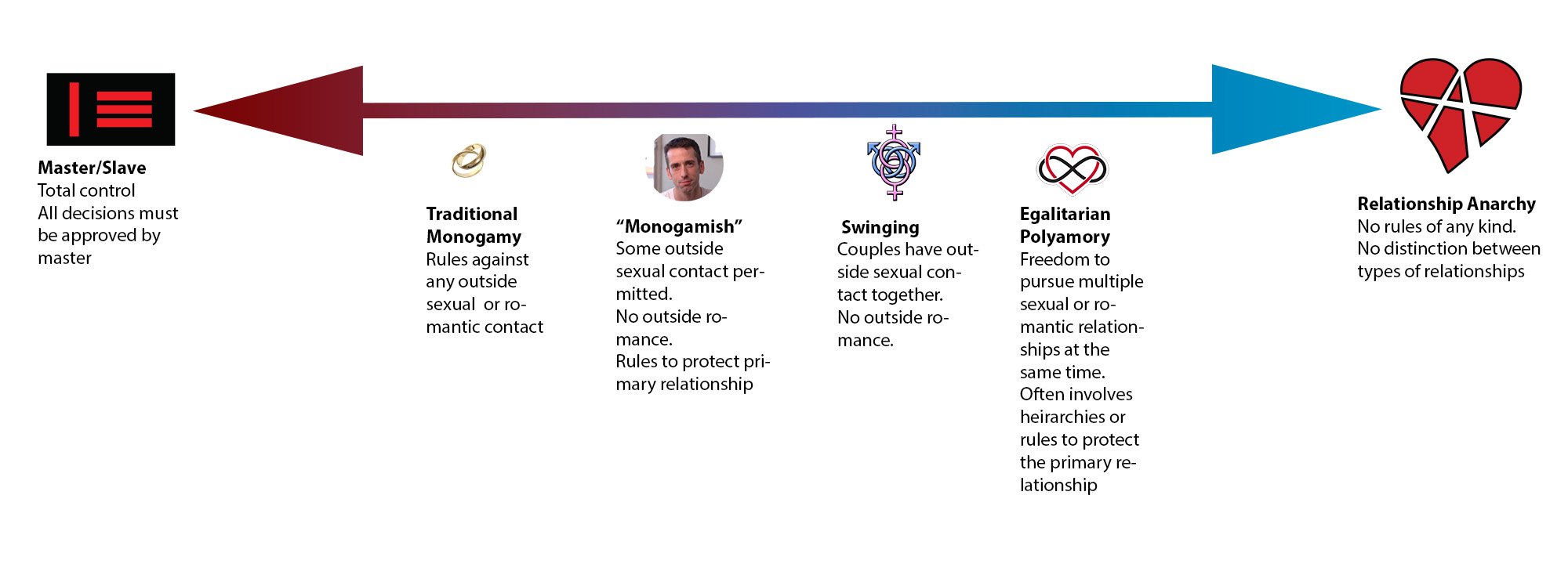
These disagreements arise often, and my theory is these disagreement are inevitable until we come up with a more robust vocabulary. The problem is that people hear different things when you use a term like “polyamory,” specifically in regards to how much control partners exercise over one another. Relationships exist on a spectrum of control, ranging from total master/slave relationships on one end (where one partner makes all major decisions for the other) to completely independent relationship anarchy on the other. In the middle are all other relationships. The archetypical spectrum looks something like this:

Relationship control continuum
^Click to embiggen. There are many other archetypes that carry assumptions about the level of control in the relationship. The problem is that many relationships don’t fit into the archetypes on the spectrum. Some polyamorous relationships can be just as controlling, if not moreso, than traditionally monogamous relationships. Some polyamorous relationships have all of the same rules as traditional monogamy, just with additional people. Some skeptically monogamous relationships can be just as free and egalitarian as relationship anarchists.

I think that, when most of us get involved in the poly community, we’re looking for like-minded people who share our philosophy on relationships. The problem is that those of us on the right of the spectrum have very little in common with polyamorous people on the left of the spectrum (and actually much more in common with skeptically monogamous people on the right of the spectrum). So long as we have no way of communicating our level of control in our relationships, these disagreements are going to continue.

This is not necessarily a bad thing. It’s important for people to be exposed to other perspectives. Particularly, I think newer poly people (who tend to be further on the left of the spectrum) benefit enormously from the perspectives of more experienced poly people (who tend to be further to the right on the spectrum). It’s important for people to see examples of sustainable relationships and how they operate. I’m also not a fan of exclusion, so I’m not advocating forming communities that keep anyone out.

I do think, however, that as polyamory grows in popularity, it will be necessary to come up with a more robust vocabulary to describe our relationships. Any ideas?

Power now available via Smashwords!


Thanks to Ginny, who created this image for me
My book cover (thanks Ginny!)

I wrote yesterday about how I wrote a book and got it epublished on Amazon.com.  Well, I had at least one person who requested that I make it available for the Nook, and so went over to Smashwords and got it epublished there as well.  So, if you have a Nook, and iPad, (or a textpad!) you can read it now.

Get your copy today!

Sorry paper book readers, no dead tree copies available.  I won’t get any printed until there is any significant demand for that.  Right now, the demand is light (I did sell a couple of copies on Amazon yesterday, which was fun to see).  I may decide to get some printed just so I can have one on my bookshelf, and maybe to give out to some friends and family who may want one, but for now that’s not a direction I’m going.

Again, let me know what you think, and if you do like it tell your friends.  It would make me happy to share this universe in my head with more people.

I wrote a book!


(update: buy it here on Amazon!)

Back in 2008, I found myself newly unemployed.  I had been laid off from a job I really liked, but was paid through the summer (it was a school job).  Of course, with the economic recession starting around then, it ended up being a tough couple of years for me after that, so I had a fair amount of time on my hands.  During that summer I re-watched Babylon 5 for the second time (I just finished re-watching it again) while I started looking for another job.  I also had time to start doing more reading and writing.  The origins of this book of mine come from that summer.

The background of this story was based upon a universe I had created in my mind as a child.  It had changed some over the years, but it was essentially the same.  It involved this character, which (to be honest) is a little bit based on me.  But as I started to write, it also became clear that the narrative I was spinning was also based upon living in a post-9/11 world.  It was about fear, insecurity, the desire for power, and understanding our place in the world.  I thoroughly enjoyed watching the narrative unfold before me, and in time I had around 100 pages (in .doc form) and a sort of cliff-hanger ending.  Having done so, I gave it to my girlfriend at the time to read.

By August of 2008 I had moved in with this same girlfriend (we were polyamorous, and I eventually had another girlfriend who lived out in Chester county), and things were going really great between us.  I was still not working steadily, but was managing to keep pretty busy anyway.  Substitute teaching is not very consistent, and it left me more time to write.  I had a really crappy (geocities) website, was starting to write more about atheism (I had been dong so since 2002, off and on), and it would be in February of 2009 that I first created this blog.  Early posts here were from that time, around when the first draft of part 1 of this book of mine was finished.

After my girlfriend finished that draft, she threatened to murder me if I didn’t finish the story.  And so, preferring to stay alive, I did eventually start writing more.  In the mean time, that relationship ended, I moved to Atlanta (October 2009), and then my life went to Hell for a little while.  Sometime during all of this, I started writing again.  By 2011 or so, the book was finished.  It was still fairly rough, however.

Thanks to Ginny, who created this image for me

I did a massive re-write last year (2012) and talked to Ginny about editing it.  She, however, was busy with grad school, and never finished reading beyond part 1.  We had some discussions about my conception of tense (since she was an English major in college), which led to revelations that the way I view time (in its relationship to memory and consciousness) is strange.  So, if you do decide to read it, and I ended up missing some point in the text where I seem to move from one tense to another (which seems natural to me and was partially intentional), then that’s why.  I wonder if I do that in posts here.  I don’t usually notice that I do it, all the time.  My mind is strange.

Anyway, a few weeks ago I wanted to fix a couple of things in the story I had been thinking about (it will never be done! It will never be perfect!) and while i was doing so I wanted to refer to my story notes, but couldn’t find them.  I looked everywhere (or so I thought) and resigned to the fact that they were lost.  Then, the other day, I found them.  As a result I spent the weekend editing the whole book, and decided to bite the bullet and just publish the damned thing already.  I did that just today, and here it is (kindle version, only.  For now).

The book has been worked and re-worked many times.  I have tried to make sure that it is internally consistent, clear, and totally bad-ass.  I may or may not have succeeded in any of those goals.

So, if you are interested, take a look.  if you don’t have a kindle (since so far I only have a kindle version available [edit: now available at Smashwords!]), and you want to read it send me an email, and I can send you a copy [edit: if you don’t have en e-reader, i will consider sending you a pdf copy, if you ask].  I didn’t write this to make money, I wrote this because I loved doing so.  But I figured that maybe I could sell a few copies and pay for a case of beer, a bottle of bourbon, or maybe just a six pack of PBR.

If you do end up reading it and like it, tell your friends.  Also,  tell me! I know not everyone will like it (Ginny, my darling wife, is not a fan of my writing style).  Also, if you just want to check out part 1 ( my favorite is part 2, personally), that is also available.

Anyway, I hope some people like it.  I like it (which, I suppose, is all I was after).

Masters of Sex – Pilot


Tonight is the second episode of Masters of Sex, and just in the nick of time I’m here to review the pilot!

As I said in my introduction to this series, I’ll be going through each episode, partly talking about the story and characters, but largely giving some insight into the truths and untruths about Masters and Johnson, their work together, and human sexuality in general.

For starters, I liked it a lot. I think the actors and characterizations are great, and the show gave signs of digging into all the great issues that make this such a fascinating story: the prudish medical and scientific climate that view sex as a scandalous subject unworthy of research; the strange, somewhat bittersweet contrast of being an expert in sexuality but having just as much confusion and difficulty in one’s personal sexual life as anyone else (something I can relate to); the complex dynamics of gender and power, and especially the way a woman without formal scientific education makes a name for herself as one of the most important sexuality researchers in history. I’m looking forward to seeing all these themes explored in greater depth over the course of the series.

Fact-checking:

To my mind the most consequential departure from reality was the timeline of Gini Johnson’s hiring and interest in the work. After her second divorce, with two young children to support, Johnson set a goal for herself to go back to college and finish her degree. She was interested in studying social anthropology and the difference between nature and nurture. To help pay tuition, she sought a work assistantship at the school’s associated medical hospital.

Meanwhile Bill Masters was looking for a female assistant to help with his work — the story about one of his early sex-worker subjects telling him he needed a woman on the team is quite true. He interviewed Johnson and saw great potential in her. He hired her without telling her he was studying sex; at the time he was a world-renowned infertility specialist, and she was given to understand that she was assisting him with his studies in that area. A few months into the job, she found out by accident, and her comfort with the idea cemented her place as the right woman for the job.

I say this is a consequential departure only because I’m a little irritated that the show portrayed Johnson as becoming fascinated by Masters first, and seeking a job with him presumably just to bask in his light (and only seeking a college degree after talking with him.) In truth, she was always motivated on her own account and had her own plans and ambitions. Working with Masters derailed those plans, but also gave her the opportunity for influence and fame that she likely would never have achieved otherwise. It’s a complicated story, and one of the most fascinating things to me about the whole Masters-Johnson partnership is how inextricable the threads of exploitation and achievement are. That’s probably true for most people who have attained success while holding a marginalized status, and I look forward to seeing it played out more deeply.

The Ethan Haas character is, as far as I can tell, entirely fictional. There were rumors that Gini Johnson was having affairs with some of the medical men she worked around, but given that she was an attractive divorceé, those rumors would likely have existed whether true or not. She did have strong views on the difference between sex and love, and how one could exist without the other. At the time she was just beginning work with Bill Masters, she was dating a judge named Noah Weinstein. I’ll be interested to see if he comes up later in the show.

One of the moments I liked best from the show, although I’m afraid it was too subtle for some, was the interchange between Haas and Masters when Haas is agonizing trying to figure out what Johnson wants in their relationship, and Masters replies, “What does the woman you’re sleeping with want? The wisdom of the universe can’t come close to the unfathomable mystery of that question.” (I transcribed that on the fly so some of the wording may be off.) ‘Waaah, we can’t tell what women want!’ is a lament that’s as tired as it is irritating, but what I love here is that the context exposes its foolishness. Gini in fact told Ethan exactly what she wanted, quite plainly. She wanted to be friends, she wanted to have sex, she didn’t want a romantic entanglement. The reason he can’t figure out what she wants is because he wants something different. He can’t wrap his brain around the idea that her wants and his are fundamentally incompatible.

Bill Masters doesn’t have the excuse of being clouded by emotion and desire, but his ego and general attitude toward women as instrumental satellites to important male life lead him to the same conclusion. In most cases, listening, paying attention, and creating a space that’s safe for an honest answer will clear that whole “what does she want” problem right up. But in the 50s, and often still today, that solution seems foreign to the person asking the question.

The other departure that irked me slightly was Johnson explaining to their coupled research subjects that anything they did together was fine as long as they moved through all four stages of sexual response. I get that it was a good excuse to throw in a little sexuality info, but the four stages of response were developed through these very studies, and probably were not codified at the time their first couple got onto the lab bed. Even if they were, it would be terrible research practice to inform your subjects of what you were looking for ahead of time. And, in fact, the couples who had sex in the lab weren’t required to adhere to any particular pattern, and they didn’t all have orgasms.

(Also on the subject of best practices in research, couples were given masks to wear in the lab, though some opted to remove them. One adorable story that probably won’t come up in the show is that Masters’ mother, when she heard about the study, decided to make nice silk masks for their research subjects to wear, instead of the pillowcases and paper bags they’d been using before. Now that is a supportive mum.)

Incredible but true:

Masters did, in fact, watch prostitutes through peepholes as the beginning stage of his sex research. He also conducted extensive interviews with both male and female prostitutes. He recognized that sex workers were the only existing experts on the subject, and he learned a lot from them.

Masters, the great infertility expert, did indeed have fertility struggles of his own, and he did lie about the cause, presumably to protect his ego. Libby was fitted with the cervical cap, a technology Bill had devised, and the result was… well, you’ll just have to wait and see.

“Why would a woman fake an orgasm?” was the question that prompted the prostitute he was interviewing (with, I like to imagine, a slightly pitying “oh, honey” attitude) to suggest that he bring a woman on board.

Gini and Libby were indeed good friends. The show gave us a little moment where Gini’s friendship with Libby and her position as Bill’s assistant caused some internal conflict for Gini. I’m looking forward to seeing that played out more, too.

“We should have sex with each other… for science!” Yup. I like how the show keeps it pretty ambiguous whether Bill was playing an angle to get into bed with a pretty lady, or whether he was completely sincere.

Episode 2 tonight, and I’ll see you back here within the next week to talk about it!