Alain de Botton and the costly middle-man of religion


Religion is an insult to human dignity. With or without it you would have good people doing good things and evil people doing evil things. But for good people to do evil things, that takes religion.

-Steven Weinberg

A little background and setting

Alain de Botton in Philadelphia 3/11/2012

Yesterday, which was Sunday March 11th, 2012, for those of you reading this from the future, I went to see a free talk given by Alain de Botton about his book, Religion for Atheists.  There has been considerable conversation about de Botton over the lest couple of months, and after reading some of his work as well as much of the criticism (both for and against), I had already felt pretty strongly that I was not in favor of his view.  But I have not read the book and wanted to hear what he had to say for myself, with the possibility of asking a question (I was not able to).

In any case, this will not be an evaluation of the book itself.  Rather, this will be an evaluation of the talk he gave yesterday about the book.

I arrived a bit early, and easily found a seat in the second row, but to the side.  The auditorium filled up quite quickly, however, and there was almost no available seating by the time he was introduced.  The audience was primarily older, although quite a few people in their 20’s and 30’s were there as well.

Many were toting a copy of the book.

I saw few of the people I know from the local atheist community.  The significance of this I will have to leave until after I evaluate what de Botton said in his talk, as I think it will be a fact which illuminates an important problem for the atheist community as a whole.

For now, let’s skip the description of the scene and get to some of what de Botton said, and what I thought of it.

There is no god.  Where do we go from here?

As de Botton has done a lot of recently, he immediately mentioned and criticized the harshness and tone of the atheist critiques over the last decade.  While not always naming names, or even using the term “new atheist,” it was clear what types of people he has in mind; the new atheists such as Dawkins, Dennet, and the late and great Hitchens.

De Botton sees the new atheist criticisms as having a “disgust” for religion, and as an attempt to create and maintain a “complete separation” between religion and the secular ideal of reason.  he sees them going too far, and wishes to rebut their criticisms with a milder, reverent, approach.

He states, flatly and without reservation, that for him “God does not exist” while inviting anyone offended by this to exit at their leisure.  He admits there is much bad about religion, but wants to focus on the good in this discussion and leave the bad aside.  The issue for him is, in admitting unashamed atheism, “where do we go from here?”

And this has been a question which many of us in the atheist community have been pondering for some time.  I honestly don’t know to what extent de Botton has paid attention to the atheist community besides his surface familiarity with its harshness and overly aggressive criticism, but from his talk it is quite clear that he is quite bereft of sufficient perspective on the many points of conversation, especially those conversations among us more “aggressive” atheists.  Like most accommodationists, he is quite ignorant of our point of view, and has bought into a caricature  and a straw man, which he attacks like Don Quixote with his windmills.

The irony of distancing oneself from, while signing in harmony with, Richard Dawkins.

His ignorance came through quite early in his talk.  He says that when it comes to the question of whether a god actually exists, or truth of religion generally (an idea he finds “boring“) he admits that “the doctrines are impossible to believe, but…” and then goes on to list many things he likes about religion.  He mentions holidays, hymns, art, architecture, and many other admittedly nice things that coincide with religious institutions.  But I have heard Richard Dawkins, the man who is, in many people’s eyes, the most aggressive and militant of us, say pretty much the same thing.

Richard Dawkins really likes Christmas, for example.  He likes much about religious music, aesthetics, and even goes to church occasionally for the experience.  And Dawkins is not alone in this, although many of us also feel no affinity for those things (I’m one of them) we recognize that these things are often pretty, useful, and worth keeping around on their own merits.  I wonder if de Botton knows any of this.  I doubt it.

Thus, while de Botton is trying to distance himself from those aggressive atheists, he ends up saying something very similar to what many of them say.  When you fight straw men (or windmills), you will often get straw in the eye (or knocked over by windmill blades).  De Botton is, frankly, ignorant of what the objects of his criticism believe and say, and so much of his criticism falls flat.

He does go further in his accommodation to religion, of course, but his blindness to these facts, precisely where he is attempting to emphasize his distance from the aggressive types, is telling.

The “pick and mix” of the litter

Here’s what de Botton wants to do, essentially.  He wants to look at what religion is good at, what it does well, and pick them out for our usage as non-religious, I mean atheist of course, people.  He wants to “pick and mix” attributes, practices, etc from religion to improve the atheist experience, community, etc such that we can emulate what religion has done right in moving forward as atheists, rather than try to get rid of religion whole-cloth.

He recognizes that this is problematic for believers, but cannot understand how this would be a problem for atheists.  Why would an atheist care if another atheist found something useful in religion?  But here’s the thing; I don’t think any atheists should have an issue with this either.  From one point of view, he is exactly right; if we look at religion and find something good, there is no reason not to adopt that one thing (or several things), perpetuate it, or re-brand it for our use.  That is, there is no reason to not do something merely because it is something that some religion does.  That would be absurd.

Here’s what he is missing; by saying that we should be looking to religion for what it is doing right, he commits three critical errors.

  1. He is mis-attributing natural human behaviors to religion.
  2. He is maintaining the association between those natural human behaviors with supernatural superstition.
  3. He is, probably unknowingly, pulling some of the terrible ideas and behaviors along with the good.

As for the first error, mis-attributing natural human behaviors to religion, the error goes something like this.

As religions developed over the millennia, they inevitably co-develop with behavior patterns and subsequently become usurped by the religious traditions.  The intricacies of religious anthropology (what I have my undergrad degree in, BTW) are too complicated to get into here, but suffice it to say that things such as morality, ritualistic behavior, and other in-group behavior pre-existed religious doctrine and institutions, and they were subsequently adopted and somewhat changed by those traditions.

And because religions usurped human behaviors for their use, they subsequently became associated with religion almost exclusively.  De Botton seems ignorant of this fact, and it leads him to urge us to look towards religion for these behaviors which he likes when he should be encouraging us to leave the superstition behind and allow these natural behaviors to form on their own, as they most-likely will.  It is almost like he is unaware that without religious beliefs (the doctrines he finds so unbelievable), the behaviors around those beliefs would all disappear.

Our natural behavior patterns, rituals, etc certainly would change sans religion, and some would likely disappear altogether (and good riddance!), but we don’t behave ritually because of religious tradition, we have maintained those behaviors because religion needs them to survive.  The behaviors which religion uses are deeper than the religions themselves, and will survive religion’s demise.

This leads right into the second error, that of maintaining the association between those natural human behaviors with supernatural superstition.

By not avoiding the middle man and getting his preferred human behaviors through religion rather than just doing them because he likes them and finds them useful, he perpetuates the association between those behaviors/structures and the supernaturalism that even he is leaving behind.  He is strengthening their co-dependence in people’s lives, rather than divorcing them, as they should be divorced.

By doing so, he is also appealing to a lower aspect of our nature, what Nietzsche called the ‘metaphysical need,’ which keeps us pinned down to irrational thinking.  He wants us to maintain a reverence for the history of our behavior, even through the parts where it believed in and stuck to fantasy.  By doing so, he is helping to curtail human progress away from superstitious, medieval, and irrational thinking which many of us, skeptics specifically, are working to address as a cultural problem.

Again, this leads into the third error; pulling some of the terrible ideas and behaviors along with the good.  Because he fails to see how these sets of behaviors are accessible to us without getting them from religion, he seems blinded to the fact that he has fished up some garbage with the fish.

Probably most egregious in this regard is his unabashed like for the concept of Original Sin.  He “likes” the idea of Original Sin, even as an atheist.  A cry from the audience (it was not me, but it was a person I know well who sat next to me) cried out “but it’s insulting” to which de Botton said nothing substantial in response.  De Botton thinks that the idea that we are fundamentally broken is preferable to thinking that we are ok.  It gives us humility, something to work on, etc.

And they say that we gnu atheists are unsophisticated theologically.  Here is an atheist philosopher defending one of the most decadent and morally bankrupt concepts—a McDonald’s of philosophical ideas—in the history of ideas, and he does so with a smile!  It is astounding how someone can be so unaware of the danger of this idea for people.  It’s not an idea that says “hey, you have some self-improvement to do” or “don’t be so arrogant!”

No.  It is an idea that we are, from the very bottom up and due to a mistake made a long time ago by a (mythological) woman who could not have known better or done otherwise,  fundamentally broken spiritually, intellectually, and physically and thus deserving of eternal punishment by a god who loves us unless we kiss his ass.  Even divorcing it of the theological content, it is perhaps the most despicable of ideas I have ever heard, and I have been listening to the GOP presidential debates!

Not to be repetitive…

Let’s be clear here; Alain de Botton wants us to emulate educational practices of religious traditions.  He wants us to repeat, emotionally charge lectures into sermon-like presentations, and use propaganda.

First, he straw-man’s secular education by describing is as “pouring in of information” and expecting it to stick in their minds.  He then sets up religion’s alternative technique of ‘education’ in the form of repetition, through ritual and structure. He wants to create a way to educate which focuses on having information given a temporal and logistical structure.  This is precisely what good teachers are already doing as part of their teaching curriculum and techniques.  Again, he wants to learn from religion where all he needs to do is look at what people are already doing without religion (necessarily).  And where we may learn from religion in this regard, we risk taking on manipulation, indoctrination, etc.  we are better not learning this from religion per se.

He also wants more sermons and less lectures, because they are exciting and emotionally engaging. he talks about the energy of a sermon, using a Pentecostal service as an example, and (fallaciously) compares them to a lecture, which is obviously boring.  Fallaciously beause he is giving a lecture, and not a sermon.

It makes me wonder if he has seen Sam Singleton do his atheist revival.  Probably not.

And he also wants us to stop thinking of propaganda as a bad thing, just because Goebbels and Stalin made it look bad….which, of course, is precisely what we are doing; disseminating information in the name of a cause.  We just are not doing it primarily with emotional manipulation, slogans (they’re easier to chant repeat), etc.  We are disseminating information in the name of a cause.

Our aggressiveness, which de Botton goes out of his way to deride, is precisely what propaganda, in its real sense, is.  Yes, the term has been associated with the underhanded, dishonest, manipulative techniques of the NAZIs and Stalin’s USSR, but we, again, already are using this tactic without getting it from religion, but from secular sources…precisely where religion and totalitarians get it from.  And then we hear from critics, ironically like de Botton, for doing so.

(*headdesk*)

The important things

De Botton thinks that we are not spending sufficient time structuring our lives to deal with the important things.  I agree that far.  I have been advocating for being introspective, philosophical, and taking time to enjoy the finer and more subtle aspects of life for a long time, but I see what he is proposing as a atavism, not a step forward.

One of my complaints over the years has been that when most people get hit with some tragedy, have something to be thankful for, or just when they are feeling introspective or ‘spiritual’, most people don’t have experience with much of our history of culture such that they can express this type of experience of beauty, pain, or subtlety without appealing to the religion they grew up around.

Even if they are not very religious, the only outlet for such moments, for most people, is religion rather than the wealth of non-religious art, philosophy, and science which gives us insights into these things.

De Botton’s advice would have us perpetuate the poverty of our culture by continuing to associate the most base, unsophisticated, and untrue expressions of human creativity.  Religion is not the highest expression of what humans have to give, although for centuries intellectuals had nowhere else to go because of it’s oppressive nature.  Religion, specifically Christianity, is a true decadence of what is best within and between us as beings, and de Botton is only wedding atheists to an impoverished view, rather than help free them.

It’s truly unfortunate, his perochial view.

And what’s worse, is that the audience responded to him with resounding applause.  To loosely quote Star Wars…so this is how reason dies. to thunderous applause.

Some side thoughts about the future of the atheist movement

What I see coming now is a further split in the atheist community.  Accommodationists now have another dim bulb to follow through their darkness.  Those who stood and applauded Alain de Botton yesterday are the future of the critics of the new atheists and our goal to disseminate reason sans religion, faith, and theology.

The only upside is that most of them are old.

The major downside is that de Botton and his ilk will be around for a while to taint the progress of reason, skepticism, and secularism.  Their view is mediocre, trite, and atavistic.

All that is rare for the rare, I suppose.

Alain de Botton is not rare.  He is all too common.

Poly 101 Lessons for life: Effective Communication


The skills we need to be successfully be polyamorous are nothing more than skills to be better people all around.  For a series on what polyamory has taught me about being a better person, I want to address how they are also important in non-poly circumstances.

One of the most essential things a person needs to do in order to successfully maintain a polyamorous set of relationships is to become better at communication.

This means not only saying what you think, communicating concerns and appreciation, and listening, but also making sure that you do these things effectively.  You need to do your best to not merely do enough, but to make sure that what it is you are communicating is understood by the hearer.  Otherwise why communicate at all?

And this goal of effective communication has obvious uses everywhere, although applying the necessary tools for such are different within relationships than they are in general. In an intimate relationship, for example, you know a fair bit (hopefully) about your interlocutor, and so this is easier than communicating with co-workers, aquaintences, or strangers.  Communicating with the public at large (like most of our readers!) is perhaps one of the hardest things to do with complete effectiveness due to our lack of familiarity with the audience and their points of view.

Obviously, we are not getting our message across...

When I compose my thoughts for a post, I have to consider the way many kinds of people will read the ideas I am trying to convey.  There are readers here who are monogamous skeptics, polyamorous spiritual-but-not-religious people, and even many people of faith who will disagree with just about everything I say.

As a result of these considerations, I have to try and make points in a way that will communicate the idea I want to be read for the largest possible audience, knowing that despite this effort many people will not quite understand my point of view no matter how clearly I try to communicate.

This problem of mis-communication has been a challenge for much of the atheist community over the last several years.  If I had known, back before the publication of The End of Faith or The God Delusion what types of challenges the small and young community would go through with issues such as new atheists/accommodationsts, privilege/minority atheists, and how many in-fighting splits would occur, perhaps we could have avoided some of the mis-communication snafus and be less divided now as a community.

Probably not, but it’s a nice thought.

In many cases I don’t think the ultimate points of disagreement which exist in the movement could be avoided, as they are endemic to the differences in people rather than mere points of confusion (accommodationism is, perhaps, a good example of this).  And in other cases, knowing how things turned out, there are people out there who might have avoided some comment, term, or line of argument had they known what would happen.  And undoubtedly some would change nothing of what they did.

And no, the attempt at constructing effective communication is not the same as accommodationism.  The goal is not to change wording to avoid offense or direct criticism for the sake of tone.  Rather, it means avoiding miscommunication of the strident and blunt points we wish to make by ensuring that the word choices we make do not get taken a completely different way than they are intended.

Because it sucks when you craft a message with the intent to make a harsh point, and have it backfire because something else was interpreted.

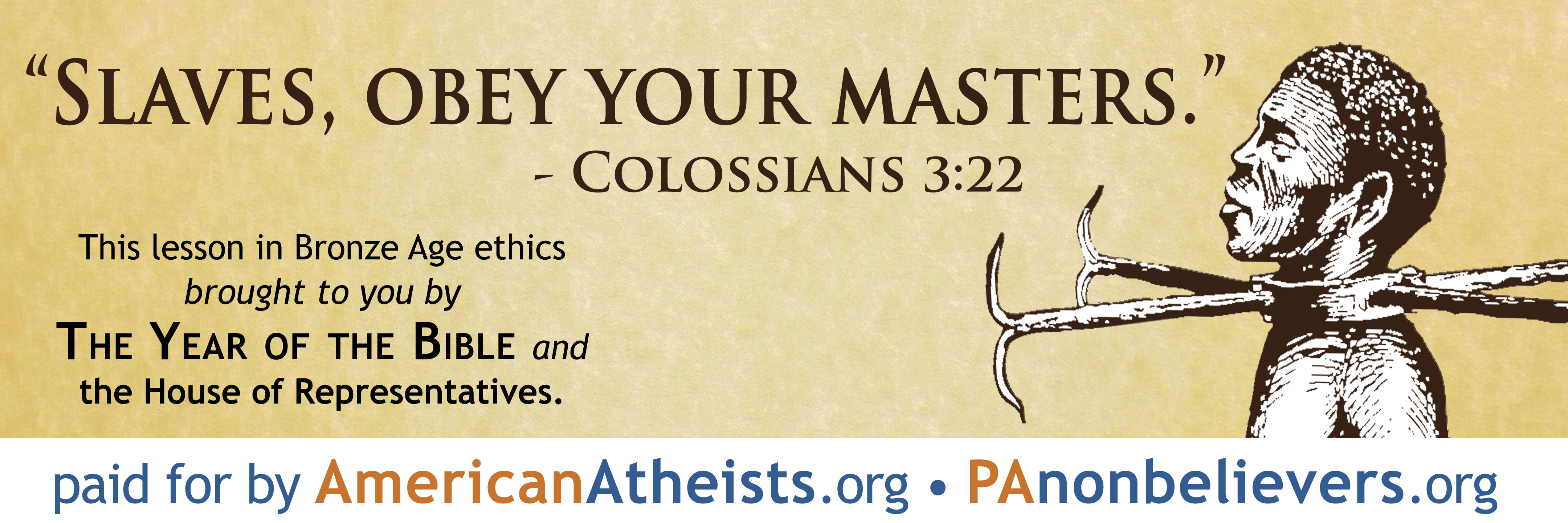
Consider the recent issue with the PA-Nonbelievers billboard (pictured above) which was taken to mean, by some, something very different than what it was intended to convey.  By all means, follow that link for the details of the issue, but essentially the question is whether the billboard, as it appeared (before it was vandalized after being up for one day), was racist.  And although it was not intended that way (I know quite a few of the people from PAN, and I have no indication of racism on the part of those who created the image), being that much of central Pennsylvania (Pennsyltucky, we sometimes call it) is pretty racist, the billboard could easily be mistaken for a very different intended purpose.

BTW, it’s purpose was to respond to the Year of the Bible legislation in PA by showing how immoral the Bible is, using its advocacy of slavery as the vehicle for such an observation.  It simply did not occur (I’m guessing.  I don’t know for sure) to those at PAN that it would be taken as an endorsement of slavery non-ironically.  Slavery is abhorrent (think most Christians), Christians loves their Bibles, and Bibles condone slavery.

Instead, some saw the billboard as racist, the ambiguity of the message left many people confused and irritated.

The fact that this snafu of miscommunication occurred demonstrates that the importance of effective communication is not only essential, but it is quite hard.  Just like, while having an argument with a loved one, sometimes the best-intended statement can be taken quite badly due to a different parsing of the words or even due to some semantic diversion by speaker and listener, the general public will often misunderstand what we atheist activists (or at least proponents) have to say about religion and faith.

Now, there are many sources, both online and otherwise, for learning about how to effectively communicate.  A simple Googling of the term will find you quite a bit about the many techniques and guidelines that can help, and so my outlining them for you here would be redundant.

But the general message I want to convey here to people of any persuasion is that in many cases our conversations, whether they are debates, disagreements, or shouting matches with people being wrong (on the internet or otherwise), we need to keep in mind how we are presenting our case and what pitfalls might interfere with our goals.


By all means, express your indignation for whatever idea you disagree with.  Don’t hold back your opinion, but make sure it is communicated in a way that will not be read as something that it is not.

And remember to listen.  Listening is perhaps the most important skills in effective communication, and it is clear that we need to listen to whatever feedback we receive.  In many cases, this does include keeping your eye on the general public’s views on what you will communicate about, which usually entails reading blogs of those who are theists or defenders of monogamy in many cases, for me.

That said, I want your feedback here at polyskeptic on any and all posts.  we want to know how well we are communicating with you.  If we can do a better job at communicating our point of view, we want to know how we can do so.


Happy Phillyversary!


A year ago today we moved to Philadelphia. Hard to believe. Going through that moving process (and then having to move again a few months later) was one of the things that made me confident about marrying Shaun, from a daily-life-compatibility perspective. It was a hard, intense, stressful experience, and we both hated it, but we didn’t hate or resent each other at any point, and I take that as an excellent indicator for our future.

We decided to drive through the night — I think to avoid traffic? So we didn’t get up terribly early in the morning, but when I woke up I went to get the moving truck while Shaun got all his boxes ready to load. Oh, yes, I should also mention that two days earlier Shaun had gotten sick, and when Shaun gets sick (which, thankfully, is rare), he gets a high fever which leaves him completely flattened in bed for a day or so. I’d had visions of having to do nearly all the box-carrying and truck-driving myself, but fortunately he was at least mobile and generally functional by moving day.

We loaded up his stuff, then took a lunch break, then drove to my place to load up all mine. I hated driving the moving truck… driving big vehicles makes me nervous anyway, but the killer was the car-towing rig on the back. When turning I just didn’t know how it was going to move, and when driving straight I couldn’t see it at all, so I just had to take it on faith that the car was still behind me. In retrospect, we should have just gotten rid of the car in Atlanta… it was near breaking down already, and the guy who showed me how to operate the towing rig didn’t fasten it right and did some pretty severe damage to the undercarriage of the car. I don’t think we ever drove it in Philly, so we wasted the money for the rig and whatever fuel usage it added. And the people we were living with somewhat resented its presence in the driveway, and it’s not like we were lacking in other sources of resentment there.

I think we left in the evening sometime. Saying goodbye to Atlanta was sad for me; it’s the city I became an adult in, and I’ve always felt an uptick in confidence and independence just being there, with all the associations it has for me. Then, too, we were leaving a place where I had a strong network of old friends, and going to a place where I knew nobody. I was excited about the move, but very sad too.

One of the cats pooped about fifteen minutes after we hit the road. I have since learned that he can be relied upon to do this any time I put him in his cat carrier. Fortunately I had put pads down in the crates and brought along extras, so I could just change the pad out the first time we stopped. This was the first time I’d moved with pets, and I was anxious about that. George wanted nothing more than to curl up in his crate and pretend this horrible thing wasn’t happening to him, but Paz wanted to get out and explore, and after a while we let him. I was very nervous about letting him get to the driver’s side, but Shaun said not to worry about it — until he walked across the dashboard right in front of Shaun’s line of sight and Shaun shouted “Get him down! Now!” and it was all very scary for a few seconds, and then I pretty much made Paz stay on my lap and look out the window.

We stopped in Columbia, SC for a break: Shaun and I have a very similar philosophy on road trips, which involves taking prolonged stops in cities you drive through, and trying to get right into the center of the city instead of just stopping at a Cracker Barrel on the outskirts. So we each had one beer, and walked around for a while. I had a little bit of a hunger crisis, because the kitchen of the bar we went to had just closed, and there wasn’t a lot open at that time of night, and I was in that state where I’m too hungry to be rational and couldn’t stand the thought of eating pizza or a pita wrap, and was near tears because I was so hungry but couldn’t find appealing food, and I’m sure the stress was a contributing factor too… and then we spotted a street vendor and I had a kielbasa and it was the most delicious thing ever, and happiness was restored. And I got excited about moving to a city that has street vendors.

We actually did sing the entirety of “99 Bottles of Beer on the Wall.” Somebody called us in the middle, I forget who, but when we were done chatting we picked up where we’d left off. Shaun suggested doing 999 Bottles next, but I said NO.

At some point in the wee hours of the morning we stopped for fuel and there was an issue with Shaun’s debit card (I think the problem turned out to be that he’d used it so many times in so many states that day). That was a definite low point, as we were both exhausted and had a very low tolerance for frustration. I just had to remind myself, “Of course we’re frustrated and unhappy: we’ve been driving all night after a day spent loading furniture, we have hours left to go, and one of us is sick. Life Overall is not horrible, just this particular moment of it.”

Things picked up quite a bit, of course, when the sun rose and we had less than two hours to go. And Shaun, who had been pining for his home city pretty much every day since I’d met him, was very happy to be there, and my general “new place! new things!” excitement was considerably augmented by my knowing how happy he was.

Shaun's "I see Philly!" face.

On the down side, we still had all of our earthly possessions to unload before we could rest. The bed was at the very back of the truck, which I had very mixed feelings about: I wanted nothing more than to lie down RIGHT NOW, but I knew it would be better to get the unloading over with before we slept, and I also knew that I would never have had the motivation if there’d been an option not to. (Shaun probably would have, because he’s much better about the “work now, rest later” thing than I am, so then I probably would have resented him for making me work, instead of accepting it as an inevitability. So, bed at back of moving truck: good plan, would use again.)

It's this image that still gives me a little sinking feeling in the pit of my stomach.

Then we slept into the afternoon, which was amazingly wonderful. Then we got up and left the house to begin exploring our new neighborhood… where, as it turned out, we lived for less than three months. I had my very first pizza steak (which is a cheesesteak with marinara and which exceeded my expectations for deliciousness.) We made plans to eat at all the tiny authentic-looking Ecuadorian and Vietnamese and Korean restaurants, very few of which we actually fulfilled. Life now is very different than we thought it was going to be, that day. Mainly awesomer. Also more expensive, and with the sting of resentment and broken relationships attached to a couple of people… but mainly awesomer.

My very first pizzasteak.

Happy anniversary, Philadelphia! I like you a lot, and I think we should stay together. How about you?

New feature! Ask A Sexologist


Several years ago, when I was frantically catching up on all the information on sexuality I avoided learning in my youth, I discovered Savage Love. I read through every single archived column, and then went back and did it again. It was around that time that I started to think, “This human sexuality stuff seems pretty endlessly fascinating to me… perhaps I will devote my career to it?” So now I’m about a third of the way through a M.Ed in human sexuality. It’s still early days, but I’m very happy with that decision so far.

So now I want to share the riches of my extensive knowledge. Got a question about sexuality? Ask away! If it’s a factual question, I either know the answer or know how to find it (or can tell you “we don’t know yet, but here’s the fascinating history of the investigation so far!”) If it’s advice, well, as Dan Savage points out, the only qualification necessary to give advice is having been asked for it. I will disguise any personally-identifying information, and I will be nice to you: as much as I enjoy Dan Savage’s caustic style, I’m constitutionally incapable of emulating it.

I’ll run the feature from one to three times a week, depending how many questions I get and whether I have a paper due. If you have a question email me: lirelyn at gmail dot com.

Couldn’t You Just Get a Slayer Sticker Instead?


This morning, while Wes was driving me to work, we ended up behind a beat up Toyota Camry with tinted windows.  The bumper was adorned with the following stickers:

“Other than ending slavery, fascism, and communism, WAR never solved anything!”

“Travel the world.  Meet new and exotic people and KILL them.”

“Life, Liberty, and the Pursuit of anyone who threatens them.”

Then, on his gas tank, “Planet Fitness”.

My initial response was, “Oh lord, are you kidding me?  I would like a bomb to drop exactly on top of that douche right now.”  Wes said, “I can’t believe he has those stickers on a Camry.  Should it be an F150 or something?”  He went on to comment that this guy’s penis must be super huge.  Like whoa.

I have thought a lot before about the things that people choose to put on their cars.  It is such an odd communication method.  You have very little space to put something that strangers will see for a fleeting moment.  Based on this fleeting impression, people will make judgments about what kind of person you are.  In the world of Bumper Sticker Communication, the answer people usually come to is “hippie” or “douchebag”.

In the case of this guy, I’m fairly certain that “douchebag” totally applies.  I would even go as far as saying “ignorant douchebag”.  Wes and I decided that the first sticker was the best because it was completely incorrect.

Yes, the Civil War resulted in the ending of the institution of legal slavery.  I won’t deny that.  However, I wouldn’t say that war “ended fascism” as there are still fascist dictators all over the place.  The best, by far, though is the idea that we “ended communism”.  First of all, the Vietnam War didn’t go well for the United States.  I wouldn’t really list that as a WIN.  And no, this is not me being liberal and saying that nobody wins in a war.  I mean, we lost horribly and didn’t achieve our goals (could it be because those goals were not particularly defined?  PERHAPS).  In addition, communism fell in the former Soviet Union after a decades long Cold War.  We didn’t bomb the shit out of them until they relented.  The two countries just sat there with missiles pointed at each other for 40 years, running drills about how school kids should get under their desks when the bombs start to fall.

I remember when I first started working at my current job.  I asked my boss why we didn’t purchase materials (at the time) from one of my former employers.  My boss explained that a couple of years prior the president of my company whipped his schlong out on the table and the sales guy from the other company did the same and they sat there and compared whose was bigger (metaphorically, of course).  Apparently, the president of my company won that contest.  Anyway, this is how I see the Cold War.  It really shouldn’t have had war in the title.  It should have been called the 40 Year Paranoid Dick Size Comparison Contest.

So, I wouldn’t really say that war solved any of those things (with the exception of possibly slavery since the Emancipation Proclamation came out of it…but I would argue that the institution of slavery was only the beginning of the mess and that we still haven’t solved the problem of racism which is what slavery was all about).  I feel like the bumper sticker doesn’t really communicate the proper meaning of the word “solve”.  “Solve” indicates that a problem no longer exists after a certain action was taken.  But I digress.

The second sticker cracked me up because it is one of my dad’s favorites.  It’s something he often says whenever the subject of the military comes up.  I probably don’t have to tell you this, but we are not a military family.  At one time, a brief time, I considered doing ROTC at school for pretty much one reason: I was feeling horrifically undisciplined and thought it would be good for me to do something so ridiculously unrelenting and rigidly regimented to get me in shape and get my mind organized. After a little bit more thought though I realized that I would have to give up something major to be able to think that way.  I would have to check out, at least partially, to do whatever my CO would tell me to do…especially if it involved killing people for a reason I didn’t fully agree with or understand.  I knew that doing ROTC would mean being in the reserves for a certain amount of time after school, and seeing that Shock and Awe occurred on my 22nd birthday, I would have been screwed and horrified.

But the military mindset seems to come down to a combination of the 2nd and 3rd bumper stickers.  Our Constitution and way of life is being threatened (so they tell us), so we have to go off to interesting places and kill the inhabitants because the inhabitants won’t just surrender (though they should because America is better).

I know, I know.  I sound like such a hippie, and that’s fine.  I am not a pacifist.  In a lot of ways, I think that the Civil War and World War II had many necessary elements.  It is unlikely that the institution of slavery would have gone away with just a bunch of talk.  It is also unlikely Hitler would have thought better of killing all those Jews (and others).  He had a mission and he had convinced many in his country that his mission was just.  Diplomacy would not have stopped him from carrying it out.  But since then, none of the conflicts have been just nor have they made much sense.  As a member of the American public, you only get parts of the story.  As a member of the military, you get even less of the story (unless you are particularly high ranking).  The military preys on the poor by promising them access to things that more privileged people have (education, medical care, respect) and then once it has them, it leaves them in the lurch when they can’t kill effectively enough anymore.  The treatment of the soldiers who returned home during the most recent war in Iraq reminded me of horse or greyhound racing.  “Oh, I’m sorry, you were unable to catch the rabbit fast enough today.  Bye bye.”  The difference is that there is no gun to the temple. The gun is replaced with lousy veterans’ care and denial of PTSD.

Promises of great things can do away with skeptical thoughts for those who are approaching desperate.  A few months ago I was driving behind another car that had the following bumper sticker:

“My Marine can pick off your honor student for 30 clicks”

Doesn’t that just explain it all?  It fully admits the stereotype that good soldiers are not book smart and suggests that this is the way it should be.  “While your kid is learning useful information and going on to bigger and brighter things with the power of his brain, my kid is shooting and killing people from far away because the government told him to.”  Skepticism and reason have no place in this mindset.  When the General says jump, you ask how high. When he says kill, you ask how painfully and how fast.  To ask anything else is to be a traitor to your country.  You cannot question and be patriotic at the same time.  If you know too much about the world around you, it may be incredibly difficult to participate in its decimation.

In the ideal world, there would be no need for militaries, obviously.  But that ideal will not be achieved as long as people (and therefore governments) embrace irrationality and faith.  A people must be able to and must want to question their governing bodies.  We can’t just support the invasion of foreign lands and the killing of people just because they say so.  THEY MIGHT BE LYING BECAUSE THEY WANT A WAR (Remember the Maine).  I know that the ideal is not achievable, but I would be happy with an ask questions first model as opposed to what we currently have.

When I see a car like the one I saw this morning, one laden with stickers showing that the person inside blatantly misunderstands history, the underlying concepts that led to the founding of this country, and a complete disregard for the autonomy of other humans, I just can’t help but wonder what they’re really doing.  Clearly the guy is military, but if you don’t give a shit about people then what are you fighting for?  Aren’t you just a government sanctioned murderer at that point?  If you think it’s a joke to go off and kill exotic people, and think that multitudes of people in your own country aren’t as worthwhile ultimately, why should I support or care about you?  Why should I respect you?  Because you’ve got balls?  Asking questions and defending a position in the face of ignorant hate mongers takes just as much courage as pulling a trigger from 30 clicks…if not more, because depending on where you are when you’re challenging that ignorant hate monger, that gun could be pointed at you.

So yeah, likely douchebag sighted this morning.  As for the “Planet Fitness” sticker, I bet he can totes bench press 3 terrorists…on the point of his bayonet.

Wait…no one uses bayonets, do they? How about a musket? No? Too colonial?  Crap.

*Insert Minute Man joke here*

Thank you, and Good Day!

Why it’s OK to hate religion


I occasionally peruse wordpress blogs to see if there is anything worth reading in the religion section, and occasionally I find something worth commenting on.� Often, it is a derisive comment, but sometimes I run into something worth paying attention to.

So just now I ran into a post entitled Why it’s OK to hate religion, and liked not only what he had to say, but how he said it.� Take a look, and if you like what you see, subscribe (like I did).


The First Step is Admitting You Have a Problem


Yesterday I got onto my last train to get home after work.  I only ride it for one stop, so I was only on it for a couple of minutes.  When I got on, I stood in the door opposite the exit side.  Two men were standing on the exit side having a very lively conversation that I, of course, came on in the middle and because the train was noisy, I could only hear a few things here and there.  I don’t normally eavesdrop…at least, I don’t make a point of it when out (eavesdropping was how I got a lot of my on the job training for my current career and we don’t particularly have any rules against it in our home.  In fact, we encourage each other to pay attention to what’s going on at any given time, so yes, I am basically always listening in general), but this conversation caught my ear.

One of the men looked pretty young, possibly in his early 20’s.  The other looked older, probably in his mid to late 30’s.  The young man was explaining that there had been just too many things that the church he used to belong to was doing that was against things that are non-negotiable.

Before I heard the next part, I just assumed that the young man was explaining how he lost his faith, how he was an atheist now or something.  Then the older man said,

“Yeah, I mean, their whole elder structure was totally not even biblically correct.  It’s the Bible!  How are you going to argue with that?”

“Exactly,” said the young man, “You don’t go against the Bible.  I’m going to trust in God and you’ve got to do what the Bible says.  So, I left the church.”

I was astounded; not because it turned out that while these men had generally been so offended by their church that they left, but remained faithful, but because I am still so unaware of the reach faith has everywhere and how most people do not just leap from “My church is full of it” to “and so is religion”.

After I got off the train, I made a stop at the market near the station.  There were long lines and so I was idle for a while.  A group of people who vaguely knew each other were saying hello and after a couple of minutes they were asking each other what church they go to…and they all had an answer.

I continue to be impressed by how skewed my vision of all this is.  Even though I now know (finally) that atheists certainly do not make up the majority of the American public, I still have this lingering sense that most people still don’t really believe.  But lately I’ve had quite a bit of evidence that this is not the case at all.

But perhaps it is all about identity.  How important is the actual belief and practice of belief to most people versus simply calling yourself a person who believes?  When I was growing up and generally surrounded by a whole host of odd things, I suppose I believed in them to a certain extent.  I think it was always a sort of tongue in cheek belief though.  Astrology was not something that I defined myself by.  Sure, I liked a lot of the qualities that are classically assigned to Aries people and liked to believe that I exhibited them.  Even moreso, my mom had this book that talked about each individual day of the year and what a person born on that day is like and man oh man was mine good.  My birthday is the last page in the book and because the year is cyclical, people born on my birthday were supposedly the most evolved…somehow.  Talk about ego stroking.  But all the while as I was reading it, I knew that it was ego stroking.  When I finally let go of all of that, I don’t remember it being horrible and I didn’t feel emptier because of it.  I hadn’t lost community because of it.  My identity remained unchanged (if not a little stronger without all the woo woo stuff getting in the way).

Spirituality was never honestly part of what I considered as my identity.  Wes reminds me that I used to believe and I was resistant to forsaking it completely, but whenever I finally did I felt better for it.  It’s how I feel whenever I get rid of something that effectively closes my mind or stops me from being the ultimate person who I want to be.  Each layer gets cast off and I feel freer.

But religion is a very different thing.  Many are indoctrinated into it from a very young age.  Their impression of themselves is built around it.  If they have reason to doubt their faith, they have reason to doubt themselves.  And if they make the step of leaving everything of faith behind, they are also leaving behind the entire world that they knew.  So I guess it makes a lot of sense why leaving a particular church doesn’t immediately lead to leaving faith altogether.

I had a friend who was going through a major crisis of faith a few years ago.  I couldn’t understand why it was a crisis.  I looked at not being able to believe anymore as some kind of gift he was giving himself.  I thought it should be a happy occasion, “You’re free now!”  But I couldn’t possibly understand.  I have never lost something so fundamental to my sense of self.  Apparently, I have a bit of atheist privilege…something I didn’t even know you could have.

Ginny is an excellent source for me to start to understand what this is like as she has gone through (and continues to go through) this very thing.  It is a world that I have been so far removed from that I still don’t really get it.  I have discovered that my identity is pretty fluid.  I change things, I accept others, I evolve, but I generally always feel like myself.  I have sometimes felt a small sense of loss when friends and I don’t really relate anymore, but it isn’t ever that painful because the people close to me are rocks that keep me grounded in all of it.  I have never been abandoned by anyone or anything that really mattered…and I’m starting to see that this is a privilege and a rarity as well.

Ladies and Ice Cream


I wasn’t raised with having newspapers around regularly.  My parents were NPR listeners.  My friends and my grandparents, however, did get newspapers everyday and I would look forward to visiting with them because I would get to look at the comics section.

Looking back, I don’t know how many of the comics I actually thought were funny.  I must have been amused to some extent, but I can’t honestly say that I really looked forward to Hagar the Horrible or anything.  As a kid I probably just liked the pretty colors on Sundays (thanks God! I’ll be reading that instead of going to church!) and was happy when I got the joke.  Needless to say, I generally skipped Doonesbury, because that shit never made sense to my kid brain.

But for all the comics that I enjoyed (even if just a little bit), there were a few that I despised.  Don’t get me started about how idiotic “Family Circus” or “Ziggy” is.  Still, the cute drawings/bright colors could keep me from becoming completely irate.  One comic, however, could not be tolerated.  That comic was “Cathy”.

I just couldn’t understand how anyone would ever even talk to this woman if they could help it.  Cathy was that coworker that end up talking to while waiting in line for food at the company picnic.  The conversation goes something like this:

Coworker: Oooooh…are those RIBS?!?

You: Yes.

CW: Oooooh, I just love RIBS.

You: Yes, ribs are good.

CW: Oh, but I can’t have any.  They’re just so fatty!

You: I guess.

CW: Oh, but they just look SO GOOD! I really want some ribs.

You: Then I suppose you should have some ribs.

CW: BUT THEY’RE SO FATTY…

You: …

CW: Well, I guess I can have one…and just work out really hard at the GYM!  I’M SO FAT!

You: …

You’ve had that conversation, right?  No?  That’s just my coworkers?  I think you’re lying because television, and the existence of Cathy indicates that this is what women are like.  I mean, we’ve just got so many issues!  According to Cathy, a woman’s daily existence consists of waking up and almost dying without coffee, going to work where you and your female coworkers are all the same (OMG RIBS!) and all the men ignore you.  Then in your free time, you go and feed a hopeless addiction to shoe buying and crying about how swimsuits JUST DON’T FIT.  Then you have dinner wherein you overeat and then feel bad about it and then hide in the bathroom eating chocolate (CHOCOLATE CHOCOLATE CHOCOLATE! ACK!).  Somehow you land a boyfriend and you then spend your days hiding everything about who you are in a desperate attempt to keep him (hence eating chocolate in the bathroom).

And then you die.

Thank goodness for that.  Am I right?  I was quite happy to hear that Cathy kicked the bucket.  What a gift to the next generation!

Side note: Yes, I’m ranting about these things, but I do acknowledge that things like body image, forever seeking a way to be thinner and younger, feeling insecure are all very real issues that people have (myself included)…I just find cheap humor based on the Stereotypical Female to be aggravating.

So, why am I talking about this?  Well, today I, along with Jessie, was involved in a photo shoot for a project called Girls and Ice Cream.  Basically, it was a calendar’s worth of ladies, each one representing a different ice cream flavor.  For instance, I was lemon and Jessie was cookies and cream!  The group of women was made up of people of all shapes and sizes.  The point? To illustrate the beauty and fun of women when they are allowed to simply be who they are.

Leading up to the shoot, we gave our preferences for which flavor we would like to be.  I picked lemon, not because I am such a huge fan of lemon sorbet, but because I felt that the flavor fit my sarcastic personality.  Also, I like bright colors and it seemed like the most “classic pin up” flavor for me.  After we got our flavors, we were basically told what time to show up.  We were encouraged to bring our own costume and makeup ideas.  We had a huge amount of creative input with our shoots.  In fact, most people brought their outfits, said, “I was thinking this” and the photographer said, “Oh wow! Awesome.  We’re going to do that.”  There is something completely empowering and exciting about being able to be sexy on your terms and be rewarded for it.

What do sexy woman-of-any-size positive photo shoots and Cathy have in common? Nothing.  That’s something that made me so happy about the shoot.  Instead of an event lamenting how we are close to powerless to stop ourselves from eating evil, fattening ice cream, we were instead representing ice cream.  We were claiming it!  I have rarely met a person who doesn’t like ice cream.  It makes people happy, and I would much rather be associated with literally being it, rather than have it be some sort of horrible tempter sent to make us less acceptable for human consumption.

Irate Woman Accepts Satire as Truth, Admits Idiocy. Story at 11.


Yesterday a Facebook group to which I belong posted an article claiming that Republican senators were moving to pass a bill outlawing tampons, because hindering the menstrual flow is against God’s plan for women.  I saw the article, immediately went, “Um, what?” and clicked through to the website, Free Post Press.  I had never heard of this before and had no clue that it was ultimately a satirical site like The Onion.

To my credit, I was quite suspicious of it because the article contained no sources and there was no “About Us” section on the site to give me a clue as to what these people were about.

Less to my credit, I went onto Facebook to chastise liberals for writing up “news” stories and then having no evidence to back it up.  As I said, we need all the help we can get and putting up terrible stories without sources makes us look bad and encourages the spreading of misinformation.

Yes, yes.  I know you’re laughing at me.  Go ahead and get it out of your system.

Jeez, I didn’t think it was that stupid.

OK.  CAN I TALK NOW?

Thank you.

Well, looking back at it now, it was pretty obvious that the site was humorous.  But at first glance, it came across to me like a Liberal Ranting and Raving site with a humorous edge.  Don’t worry…I admitted my idiocy as soon as someone pointed it out.  Even though I did that, several people immediately shared the article from my link as truth.  I did what damage control I could.  Ooooooops!

However, my gullibility in this regard ultimately amused me for two big reasons.  (A) The insanity described in the article seemed perfectly plausible to me. (B) The fact that a brightly colored Liberal website would jump at the chance to spread unsubstantiated claims seemed equally plausible.

Ginny pointed out that having not been raised as a hard core conservative or fundamentalist Christian, my filter for true Batshit Conservative Ideology® vs. false batshit conservative ideology (accept NO IMITATIONS!) is not refined.  From the outside, it all sounds the same.  She was raised in that type of environment and called bullshit immediately.

When I was a kid, I really trusted adults and responded well to authority.   I didn’t particularly like anyone in my own age group.  My contemporaries made me uncomfortable and I generally thought they were all full of crap…which was likely quite accurate as we were kids.  I believed what the adults around me told me.  I was young and impressionable.  Most of the adults that I encountered were unconventional people with unconventional ideas.  They always believed that there was more going on than what was being presented and taught me to question everything…everything mainstream anyway.  I suppose I was raised in a somewhat hard core liberal environment.  I took from it a few good things I think.  I learned to question everything on television, for instance.

But I also initially was raised to believe that liberals thought something shady was going on, it was and it was just as bad as you think…if not worse.

As I got older, my scientific mind began to develop.  While learning about how to do research in school, the idea of needing evidence to back up claims was hammered into my head.  And it wasn’t just “find one source somewhere that supports your claim,” but actually, “find several sources that concur”.  At the same time, I started to realize that much like my contemporaries; a lot of the adults in my life were also full of crap.  I found myself listening to them and thinking, “Where on Earth are you getting this from?” I began questioning everything, even if someone I thought was “cool and interesting” said it.

I was a kid in the 80’s and early 90’s.  This was, of course, prior to the internet being as ubiquitous as it is now.  When I was doing research assignments, I had to rely on Encyclopedia Brittanica and hard copy books at the library.  With the advent of the internet, suddenly all information was available and pretty accessible.  This, as we all know, means that really reputable sources can be easily accessed…and that whack jobs have equal access to the etherwaves to spew their theories.  For every intelligent, well researched article discussing important issues of our day, there are 10 (probably more) articles written by some idiot who has completely missed the point.

We are living in bizarre times.  Conservatives are currently very easy to hate, mock and be terrified of.  When you read about the laws they are really trying to pass and the opinions that people really have, anything absurd and Orwellian sounds possible.  There is just so much bad legislation being brought out and not dismissed by nearly a large enough margin, that the momentum of this makes it seem like we’re seconds away from living in a place we don’t recognize anymore.

But then you take a deep breath and realize that the type of government that we have does offer some hope.  There really are still a bunch of checks and balances and we are lucky enough to be able to fight for our rights and that it would be relatively difficult for us to wake up in the morning to a Fascist dictatorship…right?  Something something George Washington something something Dress Up Like Indians and Dump Tea in the River blah blah blah.

So yes, we liberally minded people have reason to be a little uneasy about the current state of affairs and I fear that the coming election is going to be ugly.  Not in the “Obama will lose” kind of way, but just in a “this is what the face and heart of our country looks like” kind of way.

But on the flipside, I see a lot of crap get posted on my Facebook page and I see a lot of people get absolutely up in arms about things that haven’t been proven.  I see countless articles that are written to terrify you, as a liberal.  The chemical, pharmaceutical, oil, what have you industry is in cahoots with the government to kill you.

And, you know, I don’t trust any of them either because there’s evidence that some of these claims are true.  I know this because I read a lot of blogs that will terrify you and every time something is claimed, there is a source with a direct quote to prove it.  There is a link to the actual wording of a bill going up for vote.   But a lot of the articles just make outrageous scary statements and then have no source to back it up.  So if you’re going to say something that is going to scare the shit out of people, BACK IT THE FUCK UP.  The purpose of writing about these things is to educate the public, right?  RIGHT?!? So if you really want to give us a reason to reject a product, give us a bunch of evidence to convince us.  Don’t be paranoid.  Don’t fear simply for fear’s sake.  KEEP THINKING.  Fear is the mind killer, after all.

So yeah, I got totally duped by a satirical article.  You can fool some of the people some of the time and all that rot.  But I think people’s reactions to it showed how crazed some of us are becoming as November 2012 approaches.  The mere suggestion that Republicans might be trying to do something truly insane sends up into a tizzy.  Sure, my tizzy was about the lack of source citations, but I believed that this could be true. 

If you pay attention and keep thinking critically about the things that are unfolding before us, worry not, for there is plenty to be angry about.  It’s not like if you read an article and take a deep breath and verify its contents that you will suddenly be serene.  But it is important to keep our wits about us because I think that’s the closest thing to kryptonite we have against all of it.  If we waste our energy freaking out about every What If and Possibly True, we’ll have nothing left to fight against the stuff that really is happening.

Care Bear Stare!


I debated if I was going to start this off with a long discussions of the important ideals the Care Bears taught us.  That would have likely turned into a discussion about My Little Pony and Rainbow Bright…and then, as I dated myself as an obvious child of the 80’s, I would wait to see how long it would take for my audience to either stop reading or barf, and really, is that what Polyskeptic is about? Room exiting barf inspirations? I don’t think that’s in the mission statement.

Instead, let’s just get to the point: I’m going to talk about apathy.  See what I did there? There’s no Apathy Bear, sillies.  Could you imagine?  Apathy Bear would be such a downer…even more of a downer than Grumpy Bear (or whatever he was called…the blue one with the rain cloud on his stomach…stylish and totes goth)…to the rest of the group.  They’d all yell “CARE BEAR STARE!” and Apathy Bear would look at them, raise an eyebrow and say, “Whatevs” and the evil whatever (Old Man Jenkins?  No…that’s Scooby Doo) would win.  Thanks a lot, Apathy Bear.

Oh lord, I’m writing about them anyway aren’t I…DAMN IT!  OK, I’ll stop.  Onto useful content!

Last night as Wes, Jessie and I were coming home from a lovely little bar in Old City, Wes and I were debating about various topics relevant to reason and religion and such and Jessie said that she thought she had gotten on the Express Train to not giving a crap.  She was raised Catholic.  Catholic turned to nondenominational Christian and then at some point she just gave the whole thing up and went right to, what she calls, Apathy-ism.  Later she would explain that she doesn’t even want to label herself as an atheist because it is still having a definitive label about you in relationship to a god and that she simply has no interest in living life from a theistic point of view, even if it is one of non-belief.  Basically, she has completely rejected religion and god in every way possible. (This is a lot of paraphrasing, so Jessie can feel free to correct me if I got anything wrong!)

When she first said it, I said that I didn’t want to be on that Express Train.  But then I realized that I had already been there and come back from it.  As I mentioned before, non-belief was a matter of course for most of my life.  It was second nature.  It was easy to continue a secular lifestyle because I was very lucky to have gone to school in the Philadelphia public school system…

Never thought you’d see anyone type that, did you?

I went to a really excellent school, but that’s beside the point.  Religion did not make any kind of appearance EVER in my daily activities.  Well, there was this one time when I was in elementary school and this very strange man came in to be a substitute teacher.  He asked us all to draw a picture of what we thought God looked like.  As a 7 year old, I felt that this was royally OUT.  I remember having a general sense of “That is not supposed to be talked about here…and besides, God doesn’t look like anything because…I don’t think there really is one…” and then I drew a picture of the solar system.  I don’t remember what other people drew, but I do remember a lot of people looking confused about the assignment.  I recall being a little upset about it, but luckily that was a rather isolated event.  Something like that would never infiltrate my elementary or highschool education again.  In highschool I had a biology teacher who was all about evolution and genetics.  We had to read The Double Helix for class.  He didn’t mention Creationism…EVER…because it was a science class.  Looking back, I wonder if there were any students whose parents were up in arms about that.  There never seemed to be any issue.  No one yearned for “the other side of the story” to be told.

My point here is that I was apathetic about religion and other people’s views because they didn’t touch my life particularly.  I think I had developed the attitude “Whatever you want to believe is fine” because I didn’t particularly think that there was anything harmful about that…because I didn’t really think anyone believed it anyway.  I was sheltered and felt safe in assuming that I was living in a secular society that only showed its religion around Christmas and Easter.  So, I was apathetic because I didn’t think there was any particular debate.

Then, after I figured out that there was a pretty big fucking debate, I became apathetic because it was just too difficult for me to engage anyone about it.  I have historically been a non-confrontational person, but not because I actually thought that everyone’s views were worthy of respect, but because I just hated having people upset with me and was scared of putting my neck out there.  The few times I participated in a discussion about religion, I ended up just conceding because clearly it was way more important to the religious person to be right.  That was generally my point of view in any argument about a hot button issue.  I didn’t feel equipped to engage.  I didn’t feel that I knew enough.  When someone would confuse me with a bad argument, I didn’t assume it was a bad argument.  I assumed that I was too stupid to be in the debate in the first place.  I mistook passion for knowledge and logic.  Conflict has often made me uncomfortable just being around it so I adopted the opinion that everyone should just shut up about it…not because it didn’t matter, but because listening to it drove me crazy.  When someone of faith was questioned in front of me, it undeniably would result in personal attacks from the theist to the atheist and proclamations that these were their beliefs and no one gets to question them.  Something something that’s what Hitler did something something else.  I would want to scream “YOU ARE WRONG” but was too cowardly to do so.  To enter the fray would be to become an enemy of sorts and I just wasn’t comfortable with that.  So I decided not to care.  “Well, I guess that’s fine…”

I struggled with apathy with a lot of things.  I didn’t want to officially proclaim which side I was on with various issues because I didn’t want to alienate people from me.  I mean, I have always been pro-choice, pro-civil rights for all, regardless of race, gender, creed (yes, creed…I might not value your creed, but I don’t think you should not be able to get married or get a job or vote or whatever else just because of it), or sexual orientation, pro-social programs to help the poor and otherwise disenfranchised, etc., but I never wanted to talk about it.  I didn’t want to fight about it…because I thought that everyone I knew basically agreed with this stuff and I didn’t think any of it was being particularly threatened.  An America where progress was moving toward attainment of all these things was the America I assumed I was in.

Then the World Trade Center was attacked and I hoped against all hope that we as a country would not be idiots about it, that we wouldn’t simply retaliate and wrap ourselves in American Flags and cry about our freedom…well, we all know how that turned out.  When I turned 22, the war started and I found myself caring quite a bit.  I didn’t want to…but I couldn’t help it.  My apathy about that eroded and I started getting in people’s faces about theirs.  I alienated some people from me, and that’s ok. 

In the last couple of years I have found that my apathy about everything else has begun to erode too…pretty drastically.  I don’t find it easy to stay quiet anymore.  I don’t respond well to blatant spreading of misinformation, fear mongering, obvious displays of privilege (when the person displaying them is completely unaware of it), and simple unapologetic (often willful) ignorance.  I fully admit that I am ignorant about a lot of things, that I don’t know very much about a vast array of topics…but I want to learn.  I want to understand.   And I will call people on things when I disagree.

This process of learning to care again has been amazing and also sometimes depressing.  My eyes are open; I am receptive to seeing more…but sometimes when you start to really see things, disappointment is quick to follow.  But in the end, I would rather care and be aware and sometimes completely and utterly irate than to spare myself that anger and be unaware of the truth in things.  The apathy that used to keep me isolated and friendly, even with people who I really didn’t need to have around (fo’ realz), was making me feel dead to the world.  Now I feel alive, if not sometimes completely crazed about the state of the world I am living in.  I’ll take it for now.

Jessie is really only apathetic about the god stuff.  She cares quite a bit about a lot of important things.  I can understand not wanting to give a shit about god after having it beaten into your head for years and years.  I certainly don’t begrudge her that.  She knows considerably more about that existence than I do (hence my continuing ignorance throughout my teens and early twenties).  My life would look very different if I ever had to monumentally reject something that definitive in my life.  Her comments last night just got me thinking about how much I do want to care…about everything…about how I think I do want to make a difference.

And what the fuck was I doing in my twenties?  Yeesh.  Well, for me, the thirties seem to be the new twenties, so let’s get living!