My scientific and spiritual atheism


As a ‘philosopher,’ by which I mean a person inclined toward reflection, I am prone to moments of space-gazing.  In fact, most ideas that I have, some of which spawn posts here, occur in moments of apparent wall-gawking.

I am hesitant to call these moments “being lost in rational thought.”  In such moments it is not words or linear propositions that I experience, but rather a sort of music of concepts, flowing in harmony, disharmony, and occasional crescendo of luminescence.  And upon further reflection I can often put these experiences to words (and often I cannot) and subject them to analysis.  I can’t help but think of Douglas Hofstadter in such moments, and anyone familiar with his work will probably understand what I mean.

In moments such as these I believe I understand the mystic, the “spiritual but not religious,” and perhaps most aptly, the meditative state which accompanies many a priest of various traditions.  It is moments like these that I experience a sort of transcendence, a fact that may not seem likely to many because I am a materialistic atheist.  It is here where I appreciate Sam Harris’ view about the usefulness and importance of many eastern traditions of meditation, where many other atheists do not.

Where I think many people go wrong in this ‘mystical’ or ‘spiritual’ experience is allowing oneself to live within this phenomenological experience without exterior context.  It is, after all, a subjective and internal experience, and its emotional and existential power is overwhelming.  But I urge people to not become completely distracted by this beauty (by all means allow yourself to enjoy it!), at least insofar as to become lost in the parochial halls of ones own mind.

There really is an external world out there.  And while the philosopher in me wants to proclaim some radically skeptical caveat there, I know that this hallway leads nowhere worth pursuing, having walked its path into the darkness and seeing no end or distant light.  And part of our experiences, as a brain prone to illusion, delusion, and terrible fallacy, is that we have to take whatever steps we can to not become enchanted by the magicians within us.  Because just like a con-man or mentalist, our own mental attributes will fool us and we may become convinced that there must be magic behind the slight-of-mind that is our consciousness. And just like those con-men or mentalists, there is always a rational explanation.

It has been a long road to get here, historically, to a time when we have access to the methodologies employed by skeptics; logic, rational analysis, and the empiricism native to science.  These are the best tools we have to look at ourselves from the outside.  Not quite an objective experience, as that is impossible by definition, but a way to extend our subjective experience to include the filter of, well, reality.

This is why science is so important.  It’s not that it makes the whole of what religious traditions have left us irrelevant, but it allows us to distinguish between what is is real and what is the illusion inherent to our perceptual attributes.  Much of philosophy, mysticism, and even our common sense thinking is mired in these illusions, and without at least the unconscious use of skeptical thinking we are doomed to become entranced by them.  The stronger the skeptical toolbox we have, the better we become at seeing around corners and avoiding our phenomenological pitfalls.

(Makes me want to say “the skepticism is strong in this one.”  But hat would be nerdy)

There is no incompatibility between science and spirituality, if by spirituality we mean the phenomenological experience of transcendent thought which raises us above what we already understood or experienced.  Nietzsche used the term “spirit” to refer to many things about us, none of the supernatural, and I would like to keep such company and continue this tradition, while making sure not to be confused with the supernatural-laced spirituality that pervades our culture like a cancer.  If you have another word for what I mean, I have no quarrel with you, as I understand how many connotations the term ‘spiritual’ has, most which are inconsistent with a naturalistic worldview.

These types of experiences are not the domain of religion, but religion has usurped them in the same way that religion has usurped morality, social activity, and ritual.  Part of the coming struggle for the atheist community will be finding ways to express these human needs (and they are needs for many, but not all) in a secular way.

And no, not every aspect of religious life will need a secular analog, as many of the aspects of theological and teleological thinking are fundamentally absurd and broken.  But that which is natural, human, and worth keeping such as the moments of beauty that we, even as atheists, have can be found without the silly theological baggage which weighs us down and holds us back.

Disproving god?


I maintain the position that we cannot disprove ‘god’ as a generic idea, but usually because the concept is not defined sufficiently.  When it comes to specific proposed concepts of god, we can (and have) disprove the proposition by use of scientific and/or logical analysis.  Basically, the more clearly a person defines a god, the easier it is to disprove its existence.  The more vague, the harder it is to do so.

Of course, at the same time, the more vague a definition proposed, the less powerful and useful the god.  The “eternal ground of being” of Paul Tillich and many of his liberal theologian followers have a concept of god that is impotent, and not the god described in the Bible, Koran, etc.  One could call their teapot god, and I would be compelled to agree that this thing exists if presented (empirical evidence), but I am not compelled to consider it’s powers sufficient to call it ‘god’.

When pushed, many theists will resort to a god not unlike this teapot in power, except even then they cannot demonstrate its existence, but rather define it such that its existence is beyond our ability to test, at least until neural scanning improves considerably.

‘God’, in most cases, is an incomprehensible being, whether due to logical incoherence or semantic conflation.

I believe the most epistemologically sound position is something like this; the lack of evidence for supernatural beings, in conjunction with the logical incoherence of major concepts of deities, leads us to conclude that belief in concepts such as gods are unjustified.  Science can indeed disprove many concepts of god, but the rest will be left to the dustbin of impotence or uselessness.  There is no room in this universe for a sufficiently strong deity that exists, in order to call it ‘god’.

Hey Christians, can I have your house on May 21st?


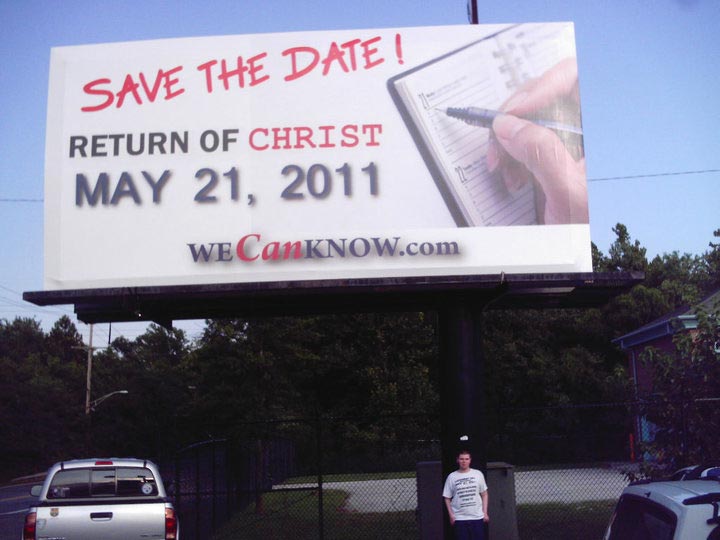
In case you have not seen the billboards, bumper stickers, literature being passed out in the street, or any of the news coverage, Jesus is coming back this Saturday, May 21st, 2011.  No specific time of day was given.

This campaign was initiated by Harold Camping, who has some experience with predicting the date of Jesus’ return (see below)

And what’s even more impressive about this knowledge that Harold Camping acquired is that not even Jesus knew:

24:36 But of that day and that hour knoweth no man, no, not the angels of heaven, but my Father only.

and further in the same chapter:

24:43 But know this, that if the goodman of the house had known in what watch the thief would come, he would have watched, and would not have suffered his house to be broken up.

24:44 Therefore be ye also ready: for in such an hour as ye think not the Son of man cometh.

In other words, the book of Matthew, as well as a few other New Testament books, claim that we can’t know when this ‘prophecy’ will happen.  It’s amazing that some academic or priest did not discover this 1500 years ago, or even 200 years ago.  It always seem that when some discovery like this is made, it is coming soon.  The cynic in me thinks that Bible ‘scholars’ have a bunch of interpretable dates saved up which they drag out a year or so before they come around.

A modest proposal (No, not that one Swift!)

But, in any case, I have a proposal for any Christians out there.  See, I’ve been unemployed for some time, and don’t have a lot to speak of financially these days.  I’ll bet there are a few real Christians out there (the ones who accept this looming date, of course) who have a few bucks, a house, etc which they will not need come rapture, so I figured they could help me out.  See, this prediction is about the return of Christ, not the end of the world (that is not until October!), so for those who will be going up to heaven on Saturday, you will not need all those nice things for the next few months, but struggling people out there, like myself, might.

This may even be a boon for our economic issues.  With all those good Christians leaving (and of course God makes sure that those good Christians are employed and comfortable, right?), there will be jobs available to fill their vacancies.  With our new found jobs (for as long as they last; remember October…) there will be less unemployment, more to go around, and less Christians, at that.  Sounds like paradise, and I can’t wait!

See, once Jesus really does come back and I am left with the tribulation of the last months of existence, I might as well have money so that I can…help other people prepare for the end? And while I’m helping, I’m sure that 55-inch plasma TV I have coming will allow me to watch the news coverage as well as keep up on my new favorite televangelist (I assume some will remain behind).  Plus, why not enjoy the last months I will have, whether it is heaven, hell, or oblivion which follows?

What do you need with your money after Friday anyway?  This guy has the idea right.

If you really believed, you would not be worried about losing anything, so why not give all of your money and valuables to people like me?

Thanks, in advance.

Oh, right, Harold Camping.  He predicted the return of Jesus in 1994.  Here’s some video.  Man I love the internet!

(BTW, real Christians don’t watch this until after you give me your stuff.  Thanks)

Faith and accidental true belief


What is faith, except belief in something that you have no evidence for? Some might say that it is hope for things to be true, but that seems dishonest. When people resort to faith, they are falling back into a corner of belief despite the fact that your skeptical questions have not been sufficiently answered. They don’t have an actual reason, based on facts of any kind, to believe what they do, but they believe it anyway.

In re-reading Plato’s Theaetatus just recently, I was thinking about the idea of faith in light of justification. Are people of faith justified in believing what they do? More specifically, is an article of faith something that can be intellectually respectable?

No.

A proposition given without any rational basis, whether from logical argument or empirical evidence, is not a belief that has merit.  And despite what apologists say, the arguments for god, especially the specific gods of religions like Christianity, don’t have merit.  Why would anyone take such a proposition seriously, except for the fact that they were exposed to accept it under youth or emotional upheaval, as well as the subsequent emotional association with the idea. It may actually be held as an idea and accepted as a fact, but without a reason to accept it, it’s just credulity.

And further, it would not be justifiable even if it happened to be true. Why not? Because the criteria to consider a belief justified is whether there is justification (yes, it’s that obvious) for the belief.

To be correct about a belief by accident, that is to say to accept it without rational justification, and have it be true anyway is merely a stroke of luck.  To take pride in being right by accident is no better than thinking that the lottery numbers you chose were right before the drawing.  And faith, being a belief without rational justification, due to the fact that the belief lacks evidence, is therefore at best accidental true belief.  At worst, it is a false belief held for no reason.

This is just one of the reasons why Pascal’s wager (the idea that we should believe just in case it is true) is so absurd.

If you cannot supply good reasons to believe something, then you cannot be surprised when other people do not accept your belief as intellectually respectable. Further, you may not have any justification for believing it yourself, in which case your credulity may be a reason to wonder about whether you are a person worthy of respect as a rational person

Rational is as rational does, or something.

Gnus: Is it too accommodating toward accommodationists to strive for a balance of values in this “war”?


My post the other day about facts and values got me thinking about another issue that I have done some thinking about concerning values.  Generally, there is little controversy about saying that someone can have the wrong facts.  The controversy is usually which facts are right or when to say so, not whether that a fact can be wrong.  Only in the deepest fringes of postmodern philosophy can one say that a fact cannot be wrong, and among the straw-man of the uber-accommodationist that they can never be stated.  But there is a more subtle question embedded in this issue.   What about values? Can the principles you accept as important or essential be wrong to have?

One value I have is honesty.  I believe that honesty is an important attribute to practice because it leads to interactions with people which engenders trust, which is a thing I have an interest in creating.  When I am trusted, and trust others, I live in a world of lesser anxiety.  And that, I think, is a good thing.  Yes, sometimes the truth is painful, and in times of emotional upheaval it can be put off or at least put in the background, but there must come a time when the truth has to be dealt with or live a life of denial and possible delusion.  I’m just sayin’….

My value of honesty, being a good means towards creating a more trusting and less anxious environment (assuming this is actually the case), is a good thing if trust and lesser anxiety are good things.  And, in general, the values I have are right to have iff the effects they have are worth striving for.  But for Thor’s sake what kind of world are we trying to create?  What would be good effects for us to evaluate our values?  Upon what criteria do we ultimately judge a value by? I don’t know.  Further, this is not a question that I am particularly interested in solving at the moment (although you may guess what kinds of answers I might give, if pressed).  I am more concerned with a related question.

Is criticizing a person’s values wrong?

This question is similar in many ways to the question of whether it is appropriate to question or criticize a person’s religious beliefs. In the same way that a religious belief is an integral aspect of a person’s life, so are their values.  And in many cases one’s values are tied to their religious beliefs, and vice-versa.  Values are also, like religious beliefs, shared things.  We tend to identify ourselves in terms of our values and use them to tie ourselves to others.  The people we associate with, call allies, and like will often have similar values as ourselves.   Often, when talking with someone you fervently disagree with, it is the difference of values which causes the inability to comprehend how they managed to come to a certain conclusion, way of life, or perspective.

One value,which I have seen in both religious and non-religious people, is what I will call self-deprecation.  This can take the form of depriving oneself on specific pleasures, causing oneself specific harm, etc.  By this I do NOT mean sado-masochism, which is a different animal (although perhaps not completely unrelated, but that’s a topic for another blog).   Within the evangelical and conservative Christian community this is somewhat common, especially when it comes to one’s sexuality.  Part of the problem in those types of cases is the putting off of pleasures in the belief that something greater comes in the future; whether it be the idealized bliss of the marriage bed or the eternal one of heaven (which are, from what I understand, associated in order to maintain the conservative view of sexuality).

Depriving of oneself of the pleasures of the world is, from the point of view of this hedonist, materialist, atheist, a waste of time and harmful to a healthy lifestyle.  This does not imply that we should never miss out on an opportunity to experience pleasure, just that the so-called “family values” espoused by social conservatism are, in my opinion, harmful and possibly unethical.  The values of “family values” are, in my oh-so humble opinion, the wrong values to have.

I am willing to say this because I think the universe is such-and -such a way, and the reasons for adopting such values are based upon an alternative and delusional worldview which is not supported by the facts.  As I said in my post about facts and values the other day, values are a kind of fact.  They are supported by beliefs about the world, and are things we believe to be true and important.  But if the worldview one holds is not justified, then the values dependent upon that worldview may be wrong, or at least not ideal.  They may, in fact, be detrimental to emotional, intellectual, and physical growth.  Take for example what happens when you believe that sickness and injury should be dealt with by prayer.  The values that are derived from such a worldview will often have direct consequences upon the health and welfare of such people.

Closer to home for me is the balance of two values that I have, but in different proportion from other atheists.  And many people will notice that these values have similar effects on different issues of political, social, and cultural importance.  They are what I will call truth and diplomacy.  I value more strongly the value of dealing with whether something is true or not over whether the answer I give will win me friends, votes, etc.  Others are more concerned with building metaphorical bridges when trying to reach out to people who are not already in agreement with their worldview.  Because of the shift in balance of these values they shift the tone, often resulting in a shift in consistency with what they may believe, in order not to alienate people.  And while I don’t think they see it as preferring politics over truth, that is often what it seems like from my point of view.  Surely the fact that many people simply accept that politicians lie tells us something about this phenomenon; diplomacy works, and truth is often an obstacle to achieving goals.  I know, I’m cynical.

Now, I do not think that there is some absolute right way to go about this balance.  I do not think that my honesty-oriented value is always better than the values of diplomacy, but I think that in some cases it is.  This implies, I think, that there are indeed some times when diplomacy is warranted, and even I, an unabashed and unapologetic gnu atheist, measure and hold my tongue depending on circumstances.  I never lie about my beliefs concerning religion, but there are times when I might soften a quip into a question or observation, suggest rather than blatantly criticize, but I never coddle or demonstrate faux respect for an idea which I do not respect.

That is, I think there is a point in the balance of truth and diplomacy where the scale simply falls over.  Those ‘accommodationsists’ of whom I am critical seem to me to be overly concerned with appearing respectful (or actually respecting an idea which I think they should not) and the straw-man new atheists they demonize go too far in not knowing the time and place, and the appropriate level of criticism therein.  The problem there is finding actual people, especially among the leaders of the atheist community, who are the analogs to these straw-men.  Are there people who are invited to speak at atheist conventions (if that is the appropriate criteria) who ferociously and incessantly attack beliefs, believers, or institutions without regard for what anyone has said, done, or supported?  In other words, are their criticisms unjustified?  You may think they should tone it down, but do you think the actual content is wrong?

And yes, there will be wiggle room in where that balance rests, as well as the extremity of their opinions*.  Certainly I am likely to be somewhat more or less confrontational than someone else, but the important thing, from my point of view, is honesty.  I am concerned that in striving to appear friendly, I don’t also appear dishonest or contradictory.  I don’t want to be seen as someone who says nice things about faith here, but elsewhere say how I think it’s ultimately delusional (even if I didn’t want to use that word, because it might offend someone).

People such a Chris Mooney argue that we should watch how we communicate so as to not chase moderate believers towards the sanctums of fundamentalism, while he  does not seem to comprehend that it is our lack of faith itself which alienates us from people, not the belief that their doctrines are inconsistent with science.  Does Mooney believe that the doctrines of religious groups, specifically Christianity on one case, are consistent with scientific theories like natural selection?  He might, but he seems uninterested in the truth of this question, which bothers me.  It is not that people like Mooney have to say, in every circumstance, that the doctrines of this and that faith are inconsistent with science (or whatever he believes personally).  Rather, the issue is that he does not have to be afraid to give an opinion he has if he actually believes it.

What I often see from many accommodationists, whether in anti-atheist or anti-gnu articles or in comments on various blogs, is a lack of shyness in terms of telling other atheists what they think about them, without regard for what the gnu atheist has said.  They do not appreciate the fact that there is a difference in balance between the values of truthfulness (I almost wrote “truthiness”) and the diplomacy which they find so important…except when talking to or about the gnus.  For people like myself, who actually believe that there is a fundamental incoherence about faith, religious doctrine, etc in relation to what we know about the universe, we simply want to be able to say so whenever we feel it is appropriate to do so.  My value is truth over diplomacy, but diplomacy is a value I have, even if it is secondary.

And, of course, the opinions of when it is appropriate will vary.  So long as it is to not ever say it unless you are talking with people you agree with (how would you know if you can’t say so?), I think we have room to talk.  So my question for those people whose balance is more accommodating than mine is this; are there times when I can say that things like faith and religious doctrines are incoherent or wrong?  And if so, when? Are there times when I can say these things to people who are religious?

And, to go meta, is there an appropriate time and place to say that your value of diplomacy might not be, if not outright wrong, overbalanced?

Is it going to far to say that the tone of accommodationists, in saying that our gnu beliefs are incompatible with their goals of effective communication,  is going to push gnus away from a moderate position towards atheist extremism?

___

*What we have here are two separate dimensions; 1) The strength of one’s views, and 2) the willingness or unwillingness to be confrontational about the beliefs one has.

Of Facts and Values


Over at Eric MacDonald’s blog Choice in Dying, there is a discussion about Sam Harris’ book the Moral Landscape (of which I published some early thoughts previously).

Now, I did have some issues with Harris’s book, but they are minor.  I feel like many people are not understanding what Harris’ point is.  Now, it is quite possible that I am reading my own thoughts in Harris’ words, but in any case I want to discuss some of my own thoughts about this issue, as I have been talking with Eric in the comments of the post linked to above.  Now, my thinking about this goes back long before Sam Harris’ book.  Upon finding Hilary Putnam’s book The Collapse of the Fact Value Dichotomy, I found an expression of thoughts I have had most of my philosophical life.  Thus, when I read Harris’ book, I felt at home, not challenged.  His starting points seemed to be my starting points in thinking about things like science, facts, values, and morality.  And so I want to take a first stab at articulating my own thoughts here.  Just remember that this will be a sort of public rough draft, and I will welcome any criticism and comments.  Also, at any point where I seem to be talking for Sam Harris, I recognize I may be at odds with his opinion.

Definitions

What is a fact? If I am to define what the relationships between facts and values are, I ought to make sure I define my terms.  I’ll give a bit of a nod to Wittgenstein when I say that a fact is something that is the case.  In other words, a fact is something that is  true about the state of real things.  The cat is on the chair is a fact, iff in the real world there is an observable feline upon a piece of furniture designed for sitting upon, which is similarly observable, and their orientation is consistent with the use of “on” with the cat being the subject and the chair being the object.  A fact is a real state of the world.

What is a value?  This is slightly more difficult because this word has many uses, including in math and color.  In this sense, I am using it to mean an ideal or principle accepted by an individual or group.  It can be a goal, but more often than not it is a motivation, a preference, or a purpose towards some goal.  When I asked Ginny what she thought, she came up with “what people should want.”  We’ll get back to that later.

What is morality? I’ll hold off on that, as I believe that this actually has little to do with the philosophical point at hand.

Ontology, philosophy of mind, and sets, oh my!

But what are values? I mean, what are they made of?  For that matter, what are facts made of?  I think that for many people, part of the sticking point for many people with Harris’ book is this issue and its relation to the philosophical point at hand.  I feel like Harris’ book addresses an ontological point that seems, at least from a metaphysical naturalistic perspective, trivial; the things we believe, value, and generally experience as conscious beings are actual states of our brains.  They are observable realities about the world.  The physical substance of my brain and the processes that occur there are (in some cases, but not all) my conscious experience.  Observing our brain-states through tools such as MRIs or whatever is just another (low resolution) way of experiencing our brains, which we do all the time by experiencing our own thoughts.

Our brains perceive and simulate, probably very imperfectly, the objective world outside of that process.  The facts about the world are removed from us (in the Kantian sense of noumenal and phenomenal) but our perception allows us to think about them.  Now whether the facts in our heads and the facts of the things themselves (of which Nietzsche was so skeptical about, probably rightfully*) are the same is not the point.  The point is that the facts in our heads are also verifiable and objective realities that can be quantified (at least in principle, even if our technology may be insufficient currently) by scientific analysis.

The things we value are conscious experiences as well.  They are actual brain-states that can, in principle, be observed and quantified in the same way as the fact that I’m typing right now.  Not only is a this fact an observable, quantifiable event in the universe, it is an experience I am currently having.  And in experiencing a value, it is similarly a real event that I have at that moment.  In this sense values are like facts, but are they the same things as facts?  Well, let’s think of facts as being like sets.  In the same way that the set of all cookies includes chocolate chips cookies and peanut butter cookies (and the set of all peanut butter cookies), values are comprised of facts (and sets of facts).    My value of honesty, if I were try and define the term and it’s importance to me, would be comprised of facts in relation to one-another.  And sets of facts can be facts themselves.  So in this trivial sense, values are facts.  They are real states of the world, even if they can be broken down into smaller real states of the world.  I hope this is uncontroversial.

Are values oughts?

I’m not quite sure that the philosophical issue at hand in asking about facts and values is the same as what Hume was addressing.  I think the question has changed in the few centuries between. But first I want to address a hair-splitting point; that of the distinction between the distinctions between is/ought and facts/values.

When Hume (supposedly), and others, say that there is a distinction between facts and values, what can they possibly mean?  This, as I understand it, is Harris’ point.  It seems to me that this distinction is a holdover from times when we thought of ideas not as physical realities, but somehow non-physical things.  This distinction between facts and values is an atavism of a view of mind as a non-physical thing (whatever that means), and criticism is using these obsolete concepts to insist that there still exists a distinction.  The distinction is a linguistic trick, one which is pervasive and resilient.

For the sake of context, here is the section of Hume that Eric MacDonald quoted in his post:

In every system of morality, which I have hitherto met with, I have always remark’d, that the author proceeds for some time in the ordinary way of reasoning, and establishes the being of a God, or makes observations concerning human affairs; when of a sudden I am surpriz’d to find, that instead of the usual copulations of propositions, is, and is not, I meet with no proposition that is not connected with an ought, or an ought not. This change is imperceptible; but is, however, of the last consequence. For as this ought, or ought not, expresses some new relation or affirmation, ’tis necessary that it shou’d be observ’d and explain’d; and at the same time that a reason shou’d be given, for what seems altogether inconceivable, how this new relation can be a deduction from others, which are entirely different from it. [Treatise of Human Nature, Book 3, Part 1, Sect. 1, paragraph 27]

But is this what Harris is doing? Is he identifying facts about the world and saying that because of these facts we should be doing this or that? No, what he is doing is more complex than that. To clarify, I want to make two points:

  • First, the concept of deriving an ought from an is, in a theological context, is not comparable to deriving a value from a fact in a naturalistic worldview.  In a theistic world (not the world of Harris not myself), the state of the world would be a result of the deity’s creation, and so in a sense we might be able to argue that because it is so it may be related to some intention of a god.  Here, Hume’s point is that where a theologian draws the ought from the is, he does not overtly explain how or why he has done so.  And even if he were to try, Hume (as well as I) cannot conceive how.  It is a fair point to make.  But in an atheistic universe, the state of our being, as conscious beings with various facts about ourselves, we cannot draw any ought because an ought necessitates the presence of an agent.   We, the agents, are not the cause of our various facts, but as Sartre said, we find ourselves thrown into the world with them.  At least within a theistic worldview it is possible to indicate some possible teleology, even if you can’t demonstrate its justification (as Hume points out). However, there is not even the possibility of drawing a logical connection between our actual state and what we should be doing within an atheistic worldview without creating, as agents, a goal for ourselves.   This leads to the next point.
  • Harris is saying that there are observable facts and values about us which are discoverable, and if we want to get somewhere (in his case, well being for people) then we need to use science as a means to figure out how to get there.  This would include determining what values we will hold in our lives as motivation and inspiration towards those ends.  The ought only comes into play upon accepting the goal, not as a direct consequence of the facts.  Hume’s observation is a good one, but it seems to me to be more of a commentary on theologians (and others) inability to make this link, not that it is necessarily impossible to do so given goals which may or may not be arbitrary.  Hume does not address, at least in that quote, any goals.  Hume addresses only an ought, which is a means towards some not-discussed goal.

What I keep hearing critics of Harris say is that while science can allow us to find facts about us, it cannot choose what to value.  And to that I can only slap my forehead, because I don’t think Harris is saying that, and I’m certainly not saying that.  Science cannot choose what to value because this is a category error; science does not choose anything because science is a method, not an agent.  So, in other words, science does not choose facts either; the method of science only allows us to recognize what is and is not a fact, and can give us information about its relation to and affects upon other facts.  Similarly, it can allow us to see what values are and how good those values might be at achieving various goals, whether they be well being, ennui, or whatever.  Hume is not talking about facts and goals, and Harris is only doing so insofar as to say that here as his goals, and if we want to reach them here is the best way to do it; science!

What our goals should be, and why that doesn’t matter in discussing facts and values

We are the choosers (Assuming free will is true, but that’s another tangent).   Science is a tool we use to determine the facts about the world, including the facts about ourselves.  One of the facts we can determine about ourselves is what our values are, what values are possible, and which of those values might be better at achieving some goal, which in Harris’ case is well being (which he admits is vague).  So, it seems to me that the critics are conflating the values with the goal (in this case, well being) and arguing that science cannot determine what our goals should be.  These criticisms miss the point completely, because for Harris it is axiomatic that ethics is about increasing well being among people.  His thesis is not to defend this premise, even if it is clear that he thinks this premise is true, but rather how to best find a way to reach it.  If you disagree with this starting point, then you are not addressing Harris’ book’s major thrust, but saying that its metaethical goals are wrong (which they may be), but that does not matter.

Can science determine our goals? Well, of course not.  Just like logic, science is a tool.  A tool can only help you on your journey towards a destination, assuming you have one.  If you don’t have a destination, then the tools are useless.  If you don’t have a goal, then you would not care how, let alone try, to find the best way to reach said goal.  Well being, as I understand Harris’ book,  is NOT the value; it is the vague, admittedly ill-defined concept that our values are being judged as being good at achieving (or not).  And if not well being, then what would be the goal of morality? And whatever that may be, we still would have to use science to determine which facts and values to use towards getting there.  This is why the criticisms about the definition of well being and of utilitarianism are missing the point so much.  It does not matter if the goal is wrong, the method still has to be science to get there.  That is what Harris’ book, as I understand it, is about.

Now, if Harris, or myself, were arguing that science can help us decide what we should think the goal should be (it can help define the parameters and factors, for sure), then I would be with the critics.  But all I (and, I think, Harris) are saying is that the ideals or principles we think are  important in trying to attain well being (or whatever goal we choose) are quantifiable, measurable things.  And no method can compare to science in determining what those values should be, thus a science of morality is possible even if the goal of that morality is up for grabs.

Eric MacDonald’s criticisms, as well as other criticisms about the poorly defined concept of well being, are problems that Harris admits to, and so do I.  We know that more research is necessary, and that implementing what we find will be a huge uphill climb to the peaks of Harris’ landscape.  Problems with utilitarianism and definitions of well being are only secondary to Harris’ thesis, which are about how our values, as facts, are real things that can be measured in terms of composition and effectiveness towards whatever goals we are trying to attain.   If you don’t know what well being is, or if your specific goal in being well differs from mine, that does not matter. Harris’ (and my) goal is well being, but that is a variable in the equation, not a coefficient.

Just as we can be wrong about facts, we can be wrong about valuing certain things.  Values are not objects outside the realm of analysis and criticism, they are brain states just like facts and equally subject to being wrong.  In other words, what you value may in fact be bad for you and whatever goals you have.  And if so, science is the best tool we have to describe how and why.

*”We believe that we know something about the things themselves when we speak of trees, colors, snow, and flowers; and yet we possess nothing but metaphors for things — metaphors which correspond in no way to the original entities”

[edit: I want to add that the goals we may have are also facts in the same sense as values are here.  And the question of what goals to choose is indeed a philosophical one that science can help clarify.  But just as science cannot choose the goals, it cannot choose the values or facts either.  Again, that is a category error.]

Lull in posting


I have not posted here in more than 3 weeks.  I have been thinking about why this is the case.  To be honest, I really just don’t know.  I can say that I have been having problems with insomnia, looking for work, and feeling like I don’t know what to say.

I have been reading blogs for sure.  And sometimes I have thoughts on what I have been reading, but for some reason I just have not sufficiently motivated to write my thoughts here.

Part of it, I think, is wondering whether my former zeal at writing about religion, polyamory, etc is waning due to a cynical feeling that people simply are incapable of growing beyond the theistic, monogamous, or “normal” worldview I am so bored with.  I, perhaps, am becoming too cynical recently.  I want to write in order to educate, clear up my views, and to possible offer insight or perspective to people, but the more I experience the more I realize that most people just are not interested in such things.  All thins I’ve known for a long time,but they are having more of an emotional impact recently.

I’ll not dwell on this cynicism, but I will make an effort to write thoughts I have here, even if they are short.  This creative outlet of mine has been helpful in the last 2 years, and I would hate to see it shrivel up and die due to neglect.

What happens in Atlantic City…


…stays in Atlantic City?

Except when you blog about it.

And no, I will not be posting pictures.

And no, I actually will not be writing about what occurred in Atlantic City over the weekend at my friend’s bachelor party.  First, it really was not that rowdy that it would be worth divulging.  Second, the other mens’ wives would not approve…even though not much happened that would be very upsetting.  Third, it’s none of your damned business!

In retrospect

There was a moment, the day after the primary revelry, while we were sitting around the beach while a bit hung over, under slept, and digesting our brunch, that someone clearly asked; “so, what’s the story for the wives?”  It sounded like a joke, but it was only partially so.  The truth is that some of what happened, even if tame compared to the things I do with my girlfriend while out at clubs and bars, would be problematic for them if their partner’s knew.

And this got me thinking (as well as one does while hung over) about what this implies about the nature of marriage in our largely heteronormative and monogamous culture.  (This is a subject I have written about before).  It got me thinking about the expectations, insecurities, and fears that underlie the need for such a question.  And, especially since these are people (both the men and some of their wives) whom I know quite well, having known them for years, I began to see things that I had not quite known.  Those details are not important, and even if they are they are personal so they will not be illuminated further here.

It seems that the bachelor party is a ritual of our culture wherein monogamous men can allow themselves to behave a little past (or, in some cases, a lot past) the boundaries of their relationships, so long as the details of said ritual are not exposed.  That secrecy seems to be part of the ritual. It is a time to let loose a little, to step outside of their normal life and into an alternate reality for themselves, and there is an understanding that what happens there stays between the participants of said ritual.

In another sense, this ritual seems to partially be designed as a temptation exercise.  Described as a last chance to live the bachelor’s life before the plunge into marriage and commitment (even though the couple has usually been committed for some time at that point), it seems like an excuse to put the groom-to-be in a position to test their willpower, usually while quite drunk, in the face of scantily clad young women.  In a sense, if you can avoid said temptation under the circumstances of this ritual, you supposedly can do so for the rest of your life, even if the two things really don’t have much to do with each other.  In other words, specific temptations are not the same as a personal set of needs and desires that are eschewed over time and which may conflict with the confines of a specific relationship.

An Alternative Point of View

Coming from the point of view of being polyamorous, which includes the pragmatic necessity of communication, honesty, and openness about my desires and needs, I find myself wondering to what extent this ritual still has meaning.  More interestingly, perhaps, is the question of whether the concept of a bachelor party is even meaningful to someone in my situation, at least in the same way.  If I were getting married (which I may do at some point) the ritual would be meaningless, although it still could be a great time.

It would, in fact, just be an expensive night out on the town where I am not paying for anything, including the possibility of strippers, sluts, or prostitutes (sluts would be preferable, being one myself).  And the irony is that this does not really sound like that much fun, mostly because it would all be activities which would be acceptable any other time for me. I suppose it sounds like more fun when it is outside of what is acceptable; most of us like to be bad sometimes, especially if we think we can get away with it.

I would much prefer to skip the pretense of the swanky clubs with their cover charges, expensive drinks, and gobs of sexy women in little dresses…ok, keep those…and just go out for a few drinks with some friends like I would any Friday or Saturday night.  But then, I’m missing something important here; the revelry that such a night allows is not only for me, but for the other men who are in monogamous relationships and who may want an excuse to let out their inner slut, even if only in drunken exclamation and not in action.  Further, it is understood to be a safe place to act in this way; what happens at the bachelor party stays there.

Except that any women I would marry would not only want to hear about what would happen during such revelry, but they might want to see pictures and, perhaps, to be there to help my inner slut come out a little bit more.  (But then the other men would have to behave because there is a woman there…and she might tell the other women…).  And that, my friends, is the main benefit of an open, honest, and slutty relationship with a polyamorous woman; I don’t have to hide my inner slut, so there is no wild self that gets freed at such parties because that part of me gets regular exercise.  And therefore such a bachelor party which may look like a release or a freeing of pent-up desires from most people’s point of view looks, from my point of view, tame.

Cultural Expectations and Monogamy

Because of the expectations of our culture, most men who get married might not be honest with themselves about what they want sexually because those things might become out-of-bounds.  So how could they share that with their partners if they can’t admit it to themselves?  Also, their partners are supposed to feel, according to the cultural expectations referred to above, threatened or jealous about those desires if they were to surface.  But those desires of many men, well-hidden they may be under usual circumstances, become clear to the other participants of this ritual with the alchemy of alcohol and the other not-so-sacred rites of the bachelor party.   Add those ingredients to the presence of drunk women who are either at bachelorette parties at the same club (and therefore possibly experiencing a similar desires) or who are trying to pry more dollar bills from the stack in front of these men (obviously at another kind of club).

Perhaps people have, in some sense, settled for what they see as the better choice between sexual freedom and the benefits of commitment.  And perhaps the occasional desire, like the ones presented at such parties of a bachelor nature, are but a blip within a larger happiness encased in such commitment.  But I don’t think that this, even if true, makes these desires trivial.  I think it is meaningful to point out that there does not have to be a choice between sexual freedom and commitment.  And this ritual of a bachelor party is part of the narrative that tells me that monogamy is not a value outside of uncertainty.

I, for example, have the wonderful joys of a meaningful, emotionally enriching, and sexually fulfilling relationship with Ginny.  And there is no contradiction, in either of our minds, with this and the ability to have other sexual partners, relationships, and even other meaningful and emotionally enriching relationships.  Because we both try to be honest with ourselves about what we want, are honest with each other about those same desires, and are secure enough with the status of our relationship that we don’t feel necessarily threatened by flirtation, enjoying the sight of, or the sexual activity with other people.

Wrapping Up this Bachelor’s Party

So, here I was yesterday with these other men, most of whom are married and in monogamous relationships (or at least want to be) and feeling no compulsion to hide any of what happened from anyone.  And because of the ramifications for the other men with their partners, I have to keep it under wraps for their sake, at least insofar as their wives don’t find out.  Ginny, on the other hand, was somewhat amused by some of what happened that night.  And perhaps that is the other part of it; illuminating the truth of human behavior openly exposes truths that many people are not quite comfortable with.  To share those activities with our partners allows them to see the secret rites of the bachelor party, which is to see what is hidden beneath the sometimes facadesque bliss of married life.

And, again, very little happened that would be a problem for these men and their relationships.  And, in fact, a few were very well behaved because apparently) they are genuinely content with their relationships and therefore the temptations were not pressing.  It was just a night out (an expensive one, granted) with some friends with more drinking than we really needed and being up very late.  Those whose desires did press, even if they did not press far, will not face relationship problems because it really was quite tame.

One question remains; what kind of activity could I get into that could get me in trouble at my potential future bachelor party?  Whatever activities might be included in such an evening, most of the men I was with Saturday night certainly could not participate.  Hell, they might not even want to because it would be past their own boundaries.  Even the single ones, in most cases.

More likely my bachelor party would bore them because I would feel no desire to find bachelorette parties, strippers, or prostitutes.  It’s just not my thing.  I prefer a few slutty friends, some good beer, and a large bed.  I can’t really invite the guys for that, can I?

Well, maybe they can bring their wives. That would be interesting.

Penn Jillette agrees with me about agnosticism!


So, when I saw this video just now, I was getting ready to be frustrated, because I have had to correct people (namely, Gary Gutting in those links) on this question about agnosticism a number of times in the past, starting with one of my very first posts on this blog called “A Message for Agnostics.” This is a point I have had to explain many times, and it appears as if I am not the only one.

In any case, take a look at this:

(from Atheist Media Blog)

But, I was not disappointed (except for the dizzying back-and-forth between the cameras that Penn was doing).  As it turns out, Penn and I see eye-to-eye on this point.  I say that because Penn, while I do like Bullshit, tends to have opinions that I disagree with, especially politically.  Also, I have heard some stories about him that make me think I would not get along with him, despite the fact that we are both atheists, he also is not particularly monogamous (from what I have heard), and we have some common friends.

But, I do like a good beer, and Penn is pretty vehement about not drinking, which means if I ever did meet him the obnoxious part of me would order a beer.  But I’m just that kind of guy who likes to start trouble, even around other strong personalities.

But, in any case, we agree on something.

Good Accommodationist cop, Bad Gnu Cop: How tribalism oversimplifies the issues


Edit:

Here is a resource that may be helpful in tracing some aspects of the discussion about accommodationism, in case such a thing interests you.

I have been no friend to the so-called accommodationist camp of this discussion within the atheist community concerning our relationship with believers and our culture at large.   (Here are some examples).  I have clearly staked a claim as a ‘gnu atheist,’ but I will agree that I often am baffled by the so-called accommodationist’s position.  I mean that I really don’t even think I understand what it is..  I have a feeling that there are a number of behaviors that are called ‘accommodationist’ which differ greatly from each other, and I think it is time to parse what those things are.

I want to extend an invitation to people who have either self-identified as either a gnu or an accommodationist or have been labeled as such by others.  I want to hear your points of view.

First, a little background

A few days ago John Shook, author of a book (which I have not read but of which I have not heard good things) The God Debates posted this article up on CFI’s website. I read it and commented almost immediately, which led to some discussions that can be found in the comments section.

Them today, Jerry Coyne discussed Shook’s book and some of his other recent writing and gave him a general thumbs down (if I may summarize in such a terse manner).  I’ll add that I agree with Jerry Coyne here, and find that John Shook is not a very good writer, uses vague language, and is trying to draw parallels which I simply do not see justification for.  My guess is that this is an outgrowth of trying to express a point of view that seems contradictory and indefensible.  Shook’s post led to more conversation (in the comments section, again) which got me talking to people on different sides of this debate….

Sides….

I think that what has started to happen in the last couple of years is a clear split in the atheist community about a number of things.  Many have commented on it, and I will not dwell too much on the history or points of said disagreement here.  But what I want to identify is a certain tribalism that is starting to make itself much more clear to me.  In the comments to Jerry Coyne’s post, I am seeing some people talking about what “side” someone is on, as if this is a clearly defined conflict with clear sides.

I think that Michael De Dora is partially right when he says, in a comment (#5) on Shook’s post)

The term “accomodationist,” in current use, means so many different things that it essentially means nothing.

Now, at first I disagreed with this sentiment (and I still do, but let’s not get sidetracked) as the record shows in that subsequent discussion.  I think that it is something that requires more discussion, and I extend the invitation to other people who are, or who have been branded with the title of, accommodationist.

I think he is right to the extent that because of the various obfuscations, differing uses, etc of the term ‘accommodationist,’ many people are not really clear on what it means.  But I do think that at first there was a use which was clear and which could still make a simple distinction between perspectives on this issue and which describes a real divide in opinions and not mere semantic games.

Definitions:

For me, the central criteria for accommodationism is where one stands on the issue of incompatibility between science and religion.  More specifically, the incompatibility between certain scientific issues (usually evolution) and religious believers.  How much are we willing to appease or accommodate (hence the term) people’s religious beliefs while trying to convince them of the overwhelming evidence for science and its powerful method.

That is, when it comes to scientific literacy and education, how do we deal with religion and the fact that there are incompatibilities between religious doctrines and scientific conclusions?  Do we overlook when liberal religious people don’t notice the contradiction or don’t think there is one?  Do we point out that we think that scientific conclusions make their world worldview look indefensible?

A secondary issue is that of the willingness to be confrontational.  New atheists are called strident, rude, and other words which I shall not repeat, while the other atheists are nice, they listen and don’t criticize even while they disagree, and they just go about their godless life almost unnoticed.

And whether one is more willing to be confrontational will not necessarily tell you their opinion about the question of incompatibility.  What happens, I think, is that confrontational gnus get attacked by confrontational accommodationists.  And from the point of view of the religious, the confrontational gnus look worse because they are saying that there actually is an incompatibility while the accommodationist talks up the compatibility.  Good cop bad cop, of a sort?

Here’s a little dialogue from an up-coming play I’m writing called Good Accommodationist, Bad Gnu:

“Hey, fella, that gnu cop is really riled up out there, saying this and that and how wrong you are.  If I let him in he’s gonna rough you up a bit, so I’ll keep him out there, away from you.  But I understand where you are coming from…you didn’t mean what you did and you didn’t know better.  No big deal, right?   Let’s be friends, help me out and I’ll help you out, ok?”

We all know that the “good” cop thinks this “fella” is guilty and is just trying to get a confession, but he’s being really nice  about it.  Will it work? Maybe.  But we have not heard from the other cop, what the guy did, and so all we hear is the “good” cop.  That’s how it is for much of the audience of people like Chris Mooney or the Templeton Foundation writers.  All they hear is the shouting coming from the other room (which they are not really listening to) and a calmer cop in their face, acting like their friend.

And this issue of confrontation is not unrelated to the issue of incompatibility.  The philosophical disagreement about compatibility of science and religion leads to the appearance of confrontationalism being the central difference between the ‘gnus’ and the ‘accommodationists’.  Allow me to try to parse that out:

  1. Atheists have been pointing out for a while that saying something critical about someone’s beliefs is often viewed as confrontational or rude, no matter how politely it is said.  Thus, even when an atheist is trying to not be confrontational, they appear to be confrontational.
  2. Having the opinion that religion/faith and the scientific method’s power to explain (including the so-called ‘scientism’) are incompatible is a position that will be critical of a very significant percentage of our culture.  To point it out is not, many say, diplomatic. It will not make us many friends, and it will chase moderates away from us towards fundamentalism, and fundamentalists towards a more strict literalism.
  3. Therefore, those with opinions about the incompatibility of science and religion are viewed as confrontational, even if they are not actually confrontational, because their position is undiplomatic.  To be undiplomatic is to be confrontational, it seems.
  4. Many atheists (including this one) believe that to pretend, while interacting with religious people (especially about science), that this incompatibility does not exist is to be short-sighted and is only telling a half-truth at best.  We feel that we don’t need to always sweeten the medicine.  And when we see religious scientists, we may say “sure the two things can exist in the same brain, but they are philosophically incompatible.”
  5. Other atheists believe that in order to make short-term gains in science education, the opposition of conservative and fundamentalist religious agendas, and to generally have a better relationship for communication with most of the religious world we need to not press them on their faith.  So they talk up, Templeton and HuffPo style, ways in which religion is a lot like science or naturalism and rarely talk about how they are incompatible.
  6. Many atheists with the perspective that this incompatibility should not be glossed over, appeased, or accommodated are frustrated because it is dishonest or demonstrably wrong.  In my case (and I think Coyne’s and PZ’s), this is due our watching some atheists not point out this incompatibility to the larger cultural audience even when they may agree that the incompatibility exists.  They are talking out of both sides of their mouths.
  7. There are other people out there (and perhaps John Shook is one of them), who believe that the incompatibility exists but insist on trying to draw similarities between naturalism and supernaturalism.  They do this, I believe, with good intentions; they are trying to further the dialogue with the religious world.
  8. Further, many these people often attack those who refuse to play this game of diplomacy.  They try to appease the largely religious (or religious-friendly) culture, which is most of their intended audience, while also publicly attacking the people who are not trying to appease the religious world.  Many of these people agree that religion and science are incompatible.
  9. And even if these attackers don’t agree with atheists like me on the incompatibility issue, they are still attacking other atheists.  They are trying to dissociate themselves from the so-called ‘new atheists’ who are seen as strident, aggressive, and rude (even when they are not).  They are widening the rift which is a difference of opinion about tactics which the public really does not understand nor really cares about.  They are making an internal issue public so they won’t look bad; the irony being they don’t really disagree very much about the general questions of gods, religions, and faith, just how we should address the public about such things.
  10. This is playing politics.  It comes across to me as dishonest, short-sighted, and it treats the public as if they were children rather than adults who can hear what people like Shook claim to actually believe but obfuscates with posts like the one linked above.  If you believe that the incompatibility exists, dont attempt Chopra-esque mental and linguistic gymnastics in order to show how they may be compatible.

All of this amounts to the development of tribalism.  We see the same thing in politics, especially here in the United States, and it turns into sides, rather than perspectives in a complex set of problems that may have a number of solutions, or at least sets of solutions that can be grouped into major categories.

Working towards an internal conversation

I would like to have more dialogue about this issue, and stop building more fences.  I want those who side with the gnu atheists to talk more with people they call, or who call themselves, accommodationists.  I want us to talk through these issues and find a way to either clearly define the boundaries and hack out the actual philosophical disagreements or to throw away the terms and just talk about the differences.  We may have to come up with new terms, although my guess is that the current ones will stick, as terms are wont to do.

There are probably many shades of grey in this discussion, and I am sure that I am not the extreme on either end of the spectrum, if it is, indeed a spectrum.  It’s probably more like a multi-dimensional graph with at least 2 axes; level of agreement with incompatibility and level of confrontationalism.  Picture a simple graph with the y-axis being the strength of their agreement with incompatibility, and the x-axis the level of confrontational behavior you are comfortable with.

I would be higher on both axes, while others would either be high on one, the other, or neither.  We need to recognize that this issue about accommodationism v. gnu atheism is not a simple binary position.  This is complex, and it’s time we talked and figured out what the issues are, the possible positions, and where we all stand.  And perhaps in doing so, we may get rid of the terms ‘accommodationist’ and  ‘gnu’/’new’ or we may simply add to them.

It may turn out that the various positions are incompatible and that the confrontational people on all sides will continue to be strident, but let’s at least figure out what each of us means when we define our positions and why we criticize each other.  I want to know what others think about this, and I want them to understand my point of view.  Right now, I don’t think anyone has a really clear picture of any side.  Even if nobody changes their position, I think some clarity may help us better understand our own position.