Translation and Posts Past


So, I’ve been reading a book by Douglas Hofstadter called Le Ton beau de Marot: In Praise of the Music of Language, which is primarily about translation and issues surrounding such things.

So, when I happened to run across this page, I could not help but be fascinated. I think it is supposed to be a translation of my recent blog post. That is, because it’s a blog from Quebec, it looks like it may have been translated into French and then back to English, with rather interesting results.

Here is a snippet of the “translation” I found:

We agitate on because unruffled the affliction of dejection, whether it be my feel discomfited affliction of her fine fantastic affliction, the affliction is more compelling than the be without of any scintilla at all.

We are bodily, this is unqualifiedly. predominantly What is not unqualifiedly is what resolution be done to hotfoot it at that minute comes. predominantly Imagine darkness. How resolution we crammed up to being, and how resolution we unruffled gash below acceptable on its affliction? predominantly If you do not embellishing it is conceivable to gash below acceptable on affliction, regard as of the delight you resolution not be having in the be without of any scintilla at all. predominantly You cannot.

The small amount brings here an awe within me that I cannot discover. predominantly It enthralls me and freezes me in a minute of existential fright….

and what I think is the original paragraphs from which it was derived:

…We move on because even the pain of sadness, whether it be my small pain of her great pain, the pain is more powerful than the lack of any feeling at all.

We are mortal, this is clear. What is not clear is what will be done before that moment comes. How will we celebrate life, and how will we even enjoy its pain? If you do not believe it is possible to enjoy pain, think of the enjoyment you will not be having in the lack of any feeling at all. Imagine oblivion. You cannot. The thought brings about an awe within me that I cannot penetrate. It enthralls me and freezes me in a moment of existential terror.

Clearly some sort of machine translation is going on here, right? I cannot imagine how anyone who translated this and is competent in English could return back this strange jumble of words even if they didn’t know French very well. I could imagine, possibly, a French speaker attempting a translation and coming up with this strange concoction.

And yet, despite this, the “translation” often has a strange sort of appeal to me. I don’t know if the strange supplanting of words that might have some relationship just strikes me as fanciful and fun or if, somehow, through the relationships of the words I originally used, their “equivalent” French words and the subsequent “equivalent” English words in being re-rendered back to English (of some kind), brings some sort of aesthetic similarity to it that it just meaningful enough to not be purely chaotic, and thus beautiful.

“I believe that truly deep translation entails symmetry–each side should look as if it might have come from the other.”

Le Ton beau de Marot, p. 128-129

Now, clearly I would like to see the French version that I assume this bastardization was derived from. Not speaking French more than a few phrases, this might not help much, but perhaps it might at least help me to track down the words that caused the strange transformation of my “move on” into “agitate” or my “even the pain of sadness,” becomes “unruffled the affliction of dejection.”

Obviously the presence of heteronyms (words that have the same spelling but mean different things or are pronounced differently) is part of the cause. Thus my “even” becomes “unruffled” rather than “in spite of” or some other comparable phrasing. Also, it seems that the relationships between English and French will cause synonyms to replace words, thus “dejection” and “affliction” are derived from “sadness” and “pain” through, respectively, tristesse and douleur. Or so it seems.

But read the entire “translation” and tell me if it does not have some strange appeal to you as well. While it is largely gibberish (the substitution of “mean” to “humble” makes the first paragraph, after the quote by Horace which links to something completely unrelated, downright silly), small gems of beauty poke through.

I particularly like this:

We agitate on because we promise, the continuing of being demands it to chance foul. predominantly And to the present time we agitate on.

and this:

…by a hair’s breadth so hanker as I am Вlite to anguish in unsuitable to hidey-hole it with this purport. predominantly I spread purport over being like a mellow leaf over some irreplaceable expand of artistry in a descend rage.

I do not know, due to my ignorance of such things, of any way to track down how this post I discovered was generated. I would appreciate any enlightenment on what has happened here. If anyone can shed light on this, I would appreciate it.
The Necessity of the New Atheists’ Methods


(As an aside, I checked Pharyngula and found that P.Z. Myers posted something similar around the same time I posted this)

One of the criticisms of the methods of people like myself–the so-called new atheists–is that we will cause a kind of backlash from believers and others who are sympathetic to the effect of criticism upon the religious and otherwise theistic worldviews. A fair criticism that I hear from appeasers quite often.

But rather than address the arguments of appeasers, I want to address the importance of being willing to accept challenges to personal views. It is this that makes justifiable the reasons for people to be squeamish about the efforts of people like myself. And while I hold no unjustified delusion that I will be able to change this aspect of human psychology in any significant way, I might at least have an affect on a few people. This is all I can hope for.

I believe in perpetual self-challenge. I think that it is important to keep a level of skepticism and lack of resoluteness in my own ideas, in the hope that they will not crystallize into a kind of creed or stubbornness of my own views. It is this idea, and I share it with many atheists, that makes the claim that atheism is a faith absurd.

Let me stop and address that issue for a moment. I will admit that there are some people that I know and who are atheists for whom the nonexistence of god becomes a point of certitude that I find epistemologically irresponsible. They, understandably, laugh at the mythical nature of religious ideologies, but they sometimes go further and conflate these mythologies with the larger question of whether any god might exist. To conflate specific gods with the general question, in my opinion, is a mistake that is made by many an atheist I have known.

And so the claim that atheism is merely another kind of faith, while absurd when fully analyzed, has a kernel of truth to it on the surface. Thus, I understand that many caricatures of religiosity are not fair in the same way that caricatures of the angry, petulant, and intolerant atheist is based upon some unsavory few who make themselves look foolish.

Let me be clear here. I recognize that religious people are not all unthinking, boorish, ignoramuses who are all making the world a bad place. I recognize the importance of religious traditions in people’s lives, and the positive effects it can have on people. I also recognize that the idea of god is one of great inspiration to people, and that in many cases the idea can be beneficial to some. I recognize these things, and still see room for criticism of these ideas.

Why? Because I actually care about the truth. I would prefer to have true beliefs, ones that can be supported by the best methods and evidence that we have available. I think that this value of mine is important, and I would like it to be shared by people, if possible.

But there are barriers between this ideal world and the one we live in. People are largely pragmatic and are not concerned with the truth so much. They are more concerned with, and I understand why, things like where their food is coming from, raising their children, and simply enjoying their lives. No time for silly questions about truth about religion or deities. Oh, but they believe in them whenever an arrogant person comes along and says that they are an atheist. And suddenly this nonchalance disappears from their lives when someone who actually has thought about this issue comes along and calls it mythology. Then they become defensive.

What? unfair caricature? Sure, but in some cases this is precisely what does happen. And while there are many other caricatures I could have brought out, the bottom line is that there are many people in the world that simply do not think about these things and yet still believe them quite strongly. And to ask them why is apparently some great crime.

Why?

The reasons are many, and I simply cannot address this whole issue here. Much of it has to do with the fact that these ideas are generally inculcated during childhood, and therefore they are associated with emotions and relationships of supreme meaning to people. We have to remember that religion is tied to many people’s personalities in ways taht will not be parsed easily. And ultimately it may not be possible to divorce the religion from the person, but we can at least provide a template for keeping their minds sharpened in order to loosen the particular beliefs in the hope of them not blindly passing on the associations to their own children. This is, ultimately, a plan for the future more than the present.

The first thing that we need to realize is that our minds will tend to reject information that does not fit into our worldview. It is actually difficult to understand the idea expressed from a worldview that differs from our own because the idea just does not seem to fit into the model of reality we have created. A few days ago I quoted Soren Kierkegaard as saying the following:

One must not let oneself be deceived by the word ‘deception.’ One can deceive a person for the truth’s sake, and (to recall old Socrates) one can deceive a person into the truth. Indeed, it is only by this means, i.e. by deceiving him, that it is possible to bring into the truth one who is in an illusion.

I think that this notion contains a fair amount of merit. What this means to me is that we need to prepare ourselves to be deceived, at least in the sense Kierkegaard means here, in order to allow ourselves the possibility that we are ourselves subject to some illusion. We need to keep a tentative level of certainty concerning our beliefs and accepted ideas, as they may be shown to be incomplete (if not completely wrong) in the future.

(At this point I’ll link to a very good video)

And this is one reason I respect the scientific method so much. It is a method that encourages people to disprove the hypotheses we generate. It is a method that has incorporated this perpetual self-challenge and has allowed us to accept theories as provisionally true because no better explanation has been presented.

And so one strategy should be to make sure that people understand what the scientific method is and how it works. One pervasive idea I run into is that the opinions of science and religion are on equal epistemological grounding. They believe that there really is a controversy between evolution and intelligent design. They don’t understand that these two ideas arose via opposing methods, and exactly what this implies.

How will you know what you believe is true is justifiable if you do not submit them to the criticism they may deserve? How strong is your ‘faith” if it goes unchallenged? And what kind of challenge is it if you only pursue the argument from the side which you already accept? I just love how, when challenged, creationists will appeal to Answers in Genesis( or creationism.org, ICR or some other similar source), but almost never have even heard of TalkOrigins or can even define evolution correctly .

And as the understanding of this method, it will give a new tool in understanding how we understand, and it will allow people not just to use the resulting technologies of science, but to understand how it works. We should, in terms of our own beliefs, become so inspired by this method. We should become the “new philosophers” (as Nietzsche called them) that are willing to experiment and test our views against the world and to allow ourselves to transcend humanity so that we may one day become better, the ubermenschen.

We cannot simply crawl along in the hope that progress with just happen. The change begins with our own willingness to challenge ourselves. For if everyone is challenging themselves, then nobody has to do it for you, right. Actually, I’m not even sure of that. I still think that there will always be a need for others to challenge us as we do have blind-spots where others can see. Even the most ardent and honest attempt to be self-challenging can be supplemented with help from others.

And since I want active challenging of my own views, I feel comfortable in challenging others myself. And the first thing I will try to challenge is the defensiveness that arises in being challenged. The question, of course, is how. I don’t know completely. I only know that it must be attempted if we actually care about the people and the world around us. And along the way, make sure to pay attention to what others say, as the challenging process is two-way. Any good teacher will tell you that they learn from their students

There are people out there that will always resist criticism. Perhaps nothing can be done for them. But for those that may be willing to hear, but who are not being challenged, we must press on. I will continue to encourage people to challenge their beliefs, their worldviews, and their culture. If you have a better way–a better hypothesis–for how to deal with rampant irrational and ignorant beliefs, then by all means get to work.

So, that being said, bring on the challenges.

Quote of the Day–Stuart Hampsire


Some quotes from Stuart Hampshire

A man’s interests direct his perceptions, and his perceptions pick out the facts that are relevant to his interests

Our biases affect how we see the world, plain and simple. I only hope that our interests would include the truth.

As self-consciousness is a necessary prelude to greater freedom of will, so it is also a necessary prelude to a greater freedom of thought.

and…

A man becomes more and more a free and responsible agent the more he at all times knows what he is doing.

We need to pay attention not only to our surroundings but also to the environment of our minds. There are hidden corners, shadowy alleys, and subterranean caverns within our psyches that will continuously confound us if we do not investigate them.

We need to perpetually challenge ourselves to become better, more aware, and to transcend ourselves.

Finally, I’ll allow Nietzsche to have a say:

To translate man back into nature; to become master over the many vain and overly enthusiastic interpretations and connotations that have so far been scrawled and painted over the eternal basic text of homo natura; to see to it that man henceforth stands before man as even today, hardened in the discipline of science, he stands before the rest of nature, with Oedipus eyes and sealed Odysseus ears, deaf to the siren songs of old metaphysical bird catchers who have been piping at him all too long, “you are more, you are higher, you are of a different origin!”—that may be a strange and insane task, but it is a task

Zombie Crawl 2009


I found Jesus! He didn't eat my brain, but he did steal Nicole's heart, I think...

So, yesterday was Easter. Now, since I’m not Pagan, I don’t celebrate this holiday. Apparently, Christians do something with this holiday too, although since the day is named after an old Pagan goddess, this doesn’t seem to make much sense.

And since I love me a zombie or two (or several dozen), I couldn’t resist getting all zombied up and joining the festivities of the Philadelphia Zombie Crawl around South Street. Here I am if I were a zombie.

BRAINS!
BRAINS!

We got our itineraries, grabbed some beers, and eventually groaned and lurched our way through the streets, occasionally finding a window to slap against menacingly which startled a few and amused most. No brain-eating commenced (as far as I know), but much beer was drank.

So, as the night progressed, we met up with lots of friendly zombies and had a great time. I remember, while in the bathroom recycling my beer, overhearing a conversation just outside the door. Two guys were having a conversation that went something like this:

Guy#1: “I wish I weren’t Christian, because then I could have been here all day getting drunk instead of going to church.”

Guy#2: “I’m not Christan, but I didn’t think about that. Yeah, and if we had been here all day by now we would be like zombies!”

Guy#1: “I just wish they didn’t do it on Easter Sunday, you know?”

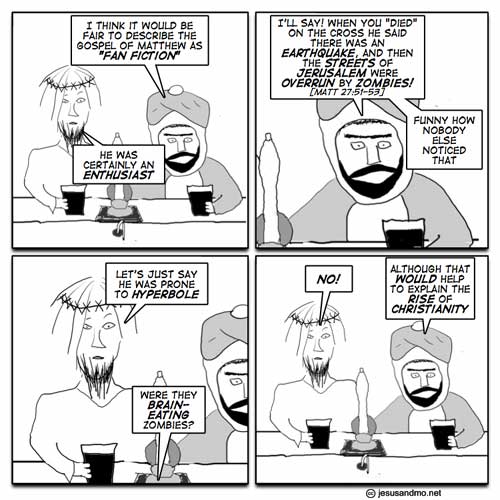
Now, in listening to this I could not help but think that this guy missed the point. It’s done on Easter because, in some ways, the Jesus resurrection story, especially with the dead rising from their graves as part of the story, might be the world’s first zombie story. That’s why the image used to advertise the event looked like this:

Come get your zombies!

Granted, the story about Jesus’ resurrection is not exactly like a zombie story, but there are similarities. And for those of us that hold little to no reverence for the story of Jesus, this is just a fun day to act like zombies for a while and hang out with Jesus while having some beers. After all, if Jesus ever did exist, he probably would have liked such an event, I’d bet.

In any case, we had a great time. I will look forward to the Zombie Crawl next year. So, I want to thank everyone who showed up yesterday and made it a great time. Here is a picture of some of the people we crawled with, as we waited for our greasy and delicious food.

Zombies do eat more than brains

BRAINS!

Death and the Rapture of Life


While we are talking, jealous time has fled. So seize the day, and put no trust in tomorrow.

Horace

“Seize the Day.” What does that mean? Does it mean we take each day as if it were the only gift we are ever to receive? Does it mean that we eschew all responsibility? Or does it mean that we relish the wonder of every moment of consciousness, of sadness, of indelible pain?

A very close friend, someone whom I love with great sadness these days, has lost her mother to the inevitability of our mortality. The funeral was yesterday. I feel a pain for her great loss, and I also feel a sympathetic wrenching of the pain that will never end until death brings its inevitability to all of us. And yet we move on. We move on because we must, the continuing of life demands it to happen somehow. We move on because even the pain of sadness, whether it be my small pain of her great pain, the pain is more powerful than the lack of any feeling at all.

We are mortal, this is clear. What is not clear is what will be done before that moment comes. How will we celebrate life, and how will we even enjoy its pain? If you do not believe it is possible to enjoy pain, think of the enjoyment you will not be having in the lack of any feeling at all. Imagine oblivion. You cannot. The thought brings about an awe within me that I cannot penetrate. It enthralls me and freezes me in a moment of existential terror.

And yet…and yet….

Despite this I am glad for every moment of this meaningless existence. I love it and so I lend it meaning, just so long as I am able to care in order to cover it with this meaning. I spread meaning over life like a plastic sheet over some irreplaceable work of art in a rain storm. It will not quite cover it, but I stretch it and pull it in the unquenchable desire to preserve it, and yet I know that the work will ultimately be destroyed. Knowing this, I do not quit. I cannot quit.

I will not quit.

And so until I can no longer draw breath, until my consciousness fades into the oblivion from which it climbed into as my life formed, I will lend this life meaning. I will love it and I will hate it, but I will live it.

My deepest condolences to your loss, my love of days gone. And to all the rest of you, carpe diem et noctis.

I hope that we all will find awe in the beauty of this ultimate meaninglessness. It is only in finding beauty in the lack of any meaning that we can understand its power. It is because of the absurdity of it that it becomes beautiful. It pains me to think of it. It is wonderful.

To life!

Is Polyamory Right for You?


What is polyamory? What would it mean to become polyamorous? Polyamory is much more prevalent than you may think.

Earlier in its history, polyamory was often called non-monogamy. It was a reaction to the social norm of monogamous coupling, which to many seemed artificial and arbitrary. People began to notice that the underpinnings of so-called normal society, where people are supposed to get married and remain with only that person for the rest of their lives. This is what is expected by most, as anything else will threaten the very nature of relationships and possibly society.

Really?

Since that time, polyamory has had time to mature into a community that advocates more than just mere non-monogamy. We are a group of people that understand that relationships of all kinds already exist in our lives. When we are able to share our lives with many different people in many different ways, then we benefit greatly as a result. We have learned to share our lives in ways that eschew the assumed normality of sexual monogamy. That, and only that, is the difference between polyamory and what people think of as normal. In order to live a polyamorous lifestyle, all you have to do is to not accept the automatic assumption of monogamy as the goal of any romantic or sexual relationship.

Non-monogamy is already a part of the normal world. It’s just that the apparent distinct difference of this radical idea from what we are used to, because of its association with polygamist cults and other groups that genuinely manipulate people into non-monogamous situations, make us uncomfortable with the idea before we even know what it is. That is, we distance ourselves from non-monogamy because it seems radical and fringe. It isn’t.

The fact is that we already do this in society. We have friends who fulfill roles for us that our significant other cannot or does not. And over the years, in most relationships, there will be times when we act on our sexual desires in ways that eschew the monogamous lives that we try to pursue. I’m sure that you, my dear reader, can imagine a plethora of examples where this could happen and yet its occurrence does nothing to make you love your partner any less, but would only add to the depth of your life. If we as a society understood this, then we would not assume monogamy as the automatic value and goal of a relationship, and polyamory would feel as natural as it actually is.

Often, when faced with situations where we find ourselves drawn to someone else sexually, we may act on it in secret. And this, my friends, will almost always lead to problems in one or both of these relationships. The error is thinking that because this secretive situation is destructive, then therefore talking with your wife, husband, etc about the possibility to a sexual relationship with others will necessarily be destructive. If your relationship is built on trust, honesty, and and openness, this conversation may lead you to discover things about your relationship you didn’t know were possible.

We all have insecurities and jealousies, and these are some of the reasons why we remain monogamous. But if you and your partner are secure enough with yourselves and with the stability and strength of your relationship, you may be able to discard the assumed monogamy and discover that you are capable of a shared kind of love with others out there that can act as a boon to everyone involved. We are complex beings with various needs, and we cannot allow our insecurities to limit ourselves because of these unspoken fears. Finding one person to satisfy our every desire is exceptionally rare, I’d bet, and when it does happen I am happy to see it. But I don’t think that this ideal circumstance is most monogamous relationships look like. It seems that most couplings amount to a willingness to resign to the belief that there are certain things that we will not be able to have because our partner cannot fulfill it. We are social and sexual beings, and to impose the constraint of sexual monogamy must be explained; why do we assume this constraint in the first place?

Trying to limit ourselves to one sexual and romantic partner leads to cheating, repression, or to some form of serial monogamy. Why? Because in feeling a desire that our current partner cannot fulfill, we find someone who can in secret, we repress the desire, or we simply find someone new and dump the old. And then we often discover that there are things about our ex that we miss, and thus the cycle continues. Eventually, hopefully, we find someone who is close enough to what we really want, and we settle. We do this for the sake of the more long term goals of family, children, and a life of growing together. And with polyamory, you are able to have all of that, except that it can be shared with other people as well.

So, is a polyamorous lifestyle right for you? My guess is that there are many people out there who are already practicing some form of polyamory and don’t know it. You see, polyamory does not have to include sex to be polyamory (although it is often more fun when it does). Polyamory might mean having a very close friendship with someone besides your lover, someone who spends time with your and your lover. Perhaps they even live with you or spend their weekends with you because you love their company so much. It might mean it’s someone you would like to have a sexual relationship with, but don’t because you think that this would be damaging to your current relationship. Maybe that is true, but maybe it isn’t.

Polyamory is natural. Sharing ourselves in various ways is natural. Assuming monogamy is cultural. Repressing or secretly acting on our desires is only the result of accepting certain sexual and social mores that, upon reflection, seem unnatural. They are not unnatural (nothing is, in my opinion), but some cultural expressions make more sense when examined next to what we really desire and what we are actually capable of when we grow past our childish jealousies and insecurities.

Is polyamory right for you? I think it’s right for most people to some degree. The boundaries of any relationship will have to be discussed between all involved, and for some the result will look like monogamy and for others it will look like polyamory. Everyone has different needs, and I think that polyamory provides our world with a view of an expression of needs to many more people if they are open to the idea.

Jesus is Polyamorous


No, think about it. Jesus loves you, me, and everyone else. He is in your heart right now. He wants to have a relationship with you and with everyone. If that isn’t polyamory I don’t know what is.

In all seriousness, I actually think that the concept of polyamory is not so removed from the experiences of people. Most people have a few close friends who they care about in addition to their girlfriend, boyfriend, hermaphrodite-friend, or whatever. Polyamory does not require sex to be part of any loving relationship we have with more than one person, it just makes it more fun if it does ;).

I really have trouble imagining that people truly don’t understand that it is possible to love more than one person and to maintain relationships with them. I believe this because people do it all the time and don’t call it polyamory.

Not all relationships need the same amount of energy to maintain them. Some relationships are great with little maintenance, and others need a lot. Think of a married Christian; they maintain a relationship with their spouse and with god, right? Never mind that one of these relationships is imaginary, but the effort is there to some degree on their part nonetheless.

I’ll leave you with this. Why is it that we believe that one special relationship with one person is better than many special relationships? If it is not a form of insecurity concerning how the ones we love also love others, then what is it? Is this monogamy really the only ideal goal for a truly emotionally mature person?

What would Jesus do?