The mythology of harmony


Preface

There is an idea in our culture, derived in part from the Enlightenment and many of its thinkers including many of those who helped form the United States, that the universe is fundamentally rational.  The idea is that as we learn about the universe and how it works, the underlying assumption is that what we find to be true is both true in every circumstance (universalization, which is also relevant in Kant’s ethical principle) and coherent with the rest of what we find.

That is, the world is essentially connected and coherent.  The basis for trusting in scientific methodologies as sensible predictions and descriptions of the nature of reality is based upon this view, because if this consistency was not true than using any description of the universe based upon any observation would be useless, since there would be no guarantee that another observation in another place or time would yield the same result.

As a side note, it has been pointed out many times that if such things as miracles, or more generally a supernatural realm or powers, were to be real then this would make this rationality of the universe meaningless, since at any given time a power, force, or being which is supernatural could simply dispense with that rationality and intervene essentially “magically.”  It would make science useless because we could not hope to make sense out of a world that can act essentially randomly or at least without consistent actions leading to theories or laws.

But enough of the opaque philosophical preface, let’s get to what I want to talk about today.

Cooperation

Especially in the more liberal world in which i grew up, there is an ideal of cooperation and striving for practical compatibility which underlies much of our thinking.  We want to get along with not only other people, but their ideas and dreams.  We want our dreams to fit in with the dreams of our neighbors so that when we all dream together, it creates a jig-saw tapestry of diverse and intertwining beauty.

It is a wonderful and beautiful image, especially for this polyamorous man who seeks intertwining in many ways in my own life.  It appeals to even me, the often-cynic and occasional (or not-so-occasional!) grump (or Grinch, as the time of this writing might imply) who is often found to be pointing out where things don’t seem to be cohering or cooperating nicely.

But is it true? I mean, of course t can sometimes be true (right?).  I mean, at least under ideal circumstances people’s beliefs, desires, and ideals will match up quite nicely and they can get along just fine.  And many people believe that if we were to be more tolerant and accepting of others’ ideas then we could all get along nicely.

And, to a certain extent this is true.  If we were willing to accommodate more, to compromise more, and to tolerate more we could all fit our puzzle pieces together and create, well, some kind of image.

But would that image be meaningful?  Would it be even internally consistent or coherent?  Could it be a picture of reality?

Truth and fallacy

The problem is that the best way to find ways to co-exist peacefully with people of different ideals is to re-shape our own in order to fit wither theirs, so long as they are also doing the same thing.  It may imply the occasional forcing of ideological shape into close-enough spaces (which we will politely ignore), but it can work.  I’ve seen it work, among people who are wont to maintain community with diverse opinions.  I went to Quaker school, ok?

The problem is that it sacrifices truth by too easily overlooking fallacy.  Because it prioritizes the coherence of diverse ideas over the question of whether any of the ideas are rationally defensible in themselves, it cannot reliably lead to a picture of what is actually true or real.  Rather than investigate each idea rationally and skeptically, the primary motivation is to fit everything together into a quasi-meaningful whole, which ends up distorted and full of many gaps and bulges where the pieces don’t quite fit.

This is why the skeptic, the new atheist, and the “realist” get such a bad rap around such harmonizing folks.  They are working so hard to find ways to get us talking, agreeing, and peacefully co-existing that they are really not even concerned, and perhaps not fully aware of the relevance, of rational defensibility of ideas themselves.  Such quibbling and nit-picking questions of such as us skeptics is annoying? Can’t we see that they are trying to paint a pretty picture? Why must we insist that it does not look like anything real?

We must be the kind of people that tell 3-year-olds that their picture of a pony looks more like, well, a crude circle and some randomly placed lines! This is not to imply comparison between 3-year-old children and defenders of social cooperation.  Not at all….

And yet, so many people are so enamored with the cooperation of ideas, whether they be science v. religion or otherwise, that they don’t pay attention to whether the larger picture they are putting together contains pieces from more than one puzzle.  They don’t pay attention to the fact that one might be labeled “reality” and the other “fantasy.”

They are blinded, or at least distracted, by the liberal mythology of cooperation and tolerance.   They are biased by the mythological desire for social and interpersonal harmony.  And then they rationalize it as if it were we skeptics and new atheists who are seeing it wrong; they often insist that we don’t understand what the picture is supposed to look like.  They are distracted by the mythological goal, while we are asking questions about the many parts which don’t seem to fit.

The only way to be sure that the image we create will be coherent is to make sure that each piece is the right piece, from the puzzle of reality.  We must each inspect our own ideas, as much as is practically feasible, to make sure that it is the right piece.  If it does not fit with others’ pieces, then we have to inspect both of them to see where the problem may lay.

And if it turns out that the whole puzzle is not coherent, that the universe is not rational, then so be it.  But so far it appears as if the many pieces fit together pretty nicely, so long as we are vetting ourselves–as well as others–before we place them down on the picture of human achievement.

Human experience


A lot of people talk about how religion has changed their life.  They talk about some experience, or set of experiences, which have given them a new perspective on the world and subsequently changed their behaviors for the better.  They say that god, or at least some religious ritual or practice,  changed their life.

Now, I don’t doubt their experience (not usually).  Nor do I doubt it did change them, if only temporarily or periodically.  What I am skeptical of is the source of these experiences and of their subsequent life-changing perspectives.

I have known for a long time that certain things we learn, whether they take the form of a sudden insight about ourselves, others, or the world in general, forever shift our perspective.  They give us a change to the  lens through which to see the world, and we are never quite the same after that.

I think we all have these experiences from time to time.  Perhaps some people are more sensitive to these things than others, perhaps relative to their sensitivity and level of introspection, but I think that this is a common human experience.

So why are some of them, at least by some people, attributed to a religion or to a god? Why are these experiences labeled as “revelations” or “religious experiences”?

Once again it is the bias that we have towards attribution of what is good to god and what is bad (or perhaps just mundane) to us.   All glory belongs to the Lord, or someshit, and so if we have a moment of beauty, personal transformation, etc of course it is due to our religious background, especially if the commitment to that religion is new.

It is at our times of struggle, emotional intensity, etc where we both commit ourselves to god and experience personal transformations, and the correlation of these events lead people to forget that these experiences are human experiences.

I have had many experiences that, had I been religious, I would have attributed to some god or other.  I am well aware that the bias which infects others is present within me, only I was lucky enough to not have been indoctrinated into a religious worldview designed to interpret such experiences from me.

I simply don’t know what to say to someone who will insist that this or that experience was from god when it clearly has human experience written all over it.  This is the primary reason why subjective, private religious experiences are so problematic from the standpoint of evidence; we all have them, no matter of faith or lack of it.


The atheist community is about more than “does god exist?”


A few years back I was pretty close with the people over at the Rational Response Squad.  They made a little noise, became small celebrities in the early atheist community, and probably helped that community grow in ways that other less-quiet ways could not have helped.

There were revered by some, reviled by many more, and a couple of years ago or so they sort of fell off the map in the atheist community.  I know more about all of that than I really need to know, and I do not care to relate the soap-opera involved.

But in any case they never really disappeared completely.  I have been in contact with some of the members of the RRS over the last few years and have watched them change and move in different directions.  One of those old friends is now blogging about history, and I have continued to read his blog consistently because he is a dedicated and intelligent person with interesting things to say.

Then yesterday I read this:

(A)Theism: A Brief Autobiography with a Word of Caution

For those who I left behind in my journey, I have no words of comfort for you.  I suspect that you are either filled with disgust, with acceptance, or are just noncommittal.  Maybe you’re working up a response.  Of course I welcome any discussion.  But it might be important now to note that I have not even yet ventured at an answer to the question ‘does god exist?’  I have refused to answer.  I do not wish to indulge your egotism, your wish to label me, to place me in some convoluted category.  To hell with that.  If you want to judge me, do so on my positions in other more serious matters.  Do not trouble me with your bothersome rantings about the pointlessness or the value in the exultation of faith.

He says more than just that, of course (read the whole post, for full context).  But this was the paragraph that stuck out to me while I was trying to sleep last night (I was not home, so I could not get up and blog about it then).  I kept trying to figure out what this was all about.

I responded in the comments (currently under moderation) [comment has been accepted], and I would like to have some discussion with Tom about this larger issue, because I think that the atheist community has become so much more than the question about the existence of god itself.  Yes, we certainly still deal with that question, but we deal with so much more.  Readers of my blog should know that, in any case.

We deal with questions of skepticism, science and faith, religion and culture, morality, and so many other things which are not only relevant but also important to deal with.  The atheist community, as well as the larger skeptical and reason-based community, are going to be very important in the formation of our culture over the next 20 years (and beyond, probably).

We are no longer a movement surrounding the (possibly unanswerable) question of “does god exist?”  As Matt Dillahunty says, we want to know what you believe and why.  This goes for questions having to do with gods, science, relationships, and everything else.  I personally love it.

Family


Family is more than the people related to you.  Family is also what you create in your adult life.  Who is part of your family also extends beyond who you marry, especially in a legal framework where marriage is restricted (that is, against our natural rights–and I use that in reference to the founding fathers intentionally) to a man and a woman.  Our family consists of those who we want to be a part of our intimate lives, whether they be sexual partners, friends, or people with whom you share genetic information.

Polyamory is about family.  It is about choosing who is part of your life, to what degree they are part of your life, and what rights they have in terms of access, decisions, and all other legal considerations.  whether these rights will be recognized is not relevant to whether they are moral and rational.  The good [sic] Lord knows that all that is legal is what is moral and rational….

The conventions of our culture, conservative and outdated (but I repeat myself!) as they are cannot contain what family is.  We already have the concept of family extending to the people that matter to us, so why is it so hard to allow this concept to restrict us sexually and romantically? It is, to speak plainly, absurd.  Love who you love how you love them.  Do not be restricted or pushed towards obligation or expectation in the matters of love.

The mainstream is not wise, aware, or right; they are boring and atavistic even in looking forward.

Live your life as if it is the only life you have, because it is.  Gods, assumed monogamy, and accommodation to fear are all poisonous to all of us, and we can do better.  Let’s create families large and open, and let’s leave behind the nuclear family of the conservatives and fading liberals (which will soon be the conservatives).

Let’s be progressives not of substance but of perceptual looking forward to improving ourselves, our society, and our world.  Liberal not just to be liberal, but liberal because liberalism is about the striving for improvement.


Two Philadelphia atheist events this weekend


For those of you in the Philadelphia area, I have a couple of events you may be interested in.  They are both affiliated with the Freethought Society, which is run by my friend Margaret Downey, and I will be attending one of both of them.

The first is the Human Tree of Knowledge in West Chester on Saturday December 3rd at 3:00 PM.  The reason it will be a human tree rather than a real one is because the presence of a real tree has been blocked by the city of West Chester, as has been covered recently over at Hemant’s place.  I was there for at least two of the real trees before this form of protest was necessary, as I have worked with Margaret Downey and the FTS for many years.

If you are interested in following news or in networking with people involved, there is also a facebook group.  I will be there on Saturday and will almost certainly do dinner afterwords.  After that I may grab a point at the Iron Hill Brewery since I love their Pig Iron Porter so much.

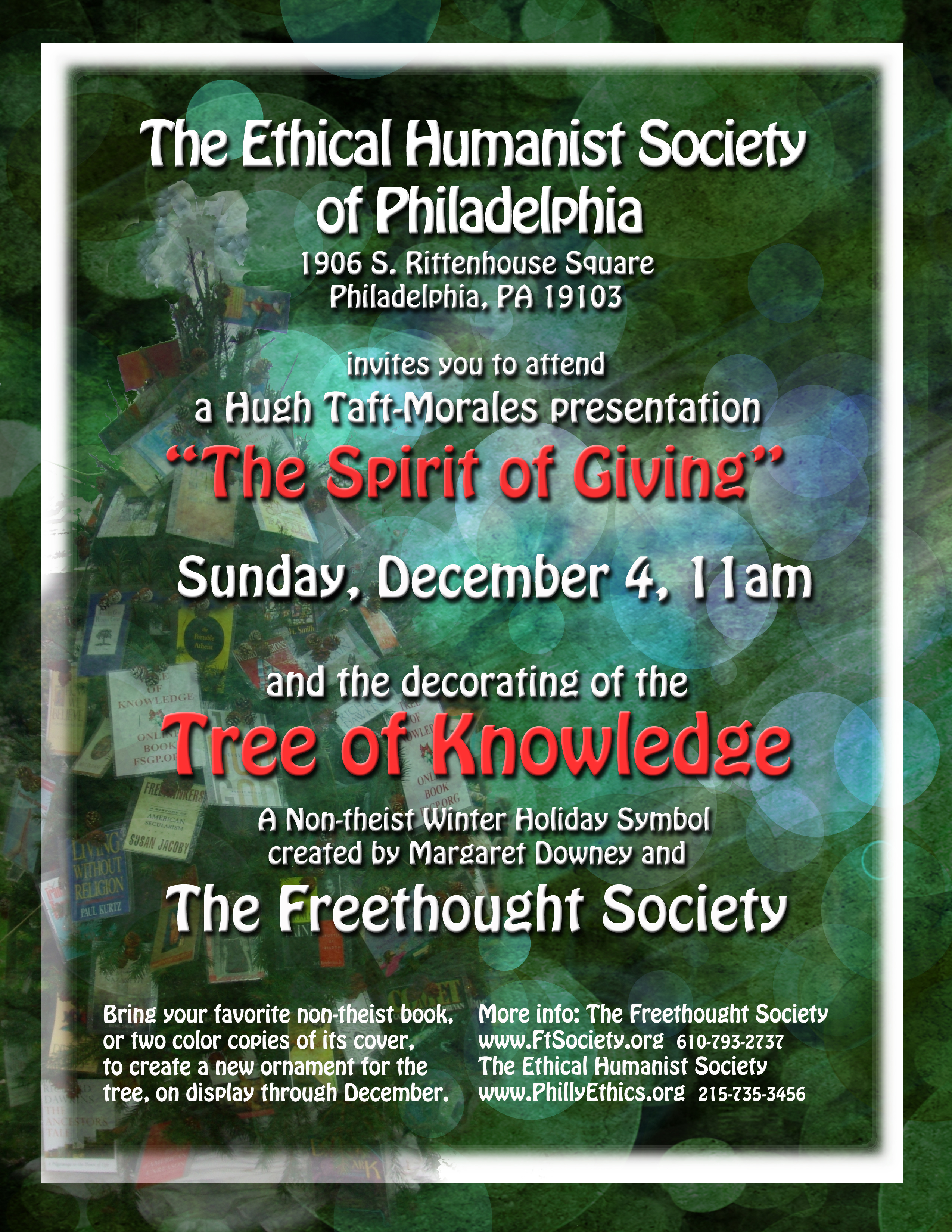
The second event is the following day, Sunday December 4th, and is in Philadelphia.  More specifically it is at the Ethical Society at Rittenhouse Square.  Here is an image of the flier, copies of which may appear there in the next couple of days.

I am not yet sure if I will attend this event.  I’m not big on holiday rituals, but it may be a good time to catch up with local people of reason.

If you will be in the Philadelphia and/or West Chester area this coming weekend, make a point to attend or pass along the information to others who may be interested.

Holiday warfare


Ugh, I really get annoyed by this time of year.  I’m referring to the time after Thanksgiving and right up until the New Year’s celebrations.  You know, the last month of Fall, when winter descends upon us, the days get shortest, and for some reason people do a lot of shopping?  You know…Christmas time.  Oh, do I mean the holidays? Yeah, whatever.

I get annoyed by the consumerism, the obligatory gift-giving that commences at the culmination of the season, and the false expectation of joy that permeates it all.  Yeah, I know, hum bug or someshit.

And now on top of it is the ideas of a war on Christmas.  You know, the cultural conversation about “holidays” rather than “Christmas.”  The privileged status of the Christian/secular Christmas becomes annoying to those of us who don’t like the tattered remains of the religious holiday (which is ultimately pagan anyway) nor the secular outgrowth of that tradition.  Many people, like myself (and my acquaintance Tom Flynn), just feel that the day or so holiday should not be stretched into a month.

But, then there are the parties.  Parties where people drink more eggnog than they should.  Parties where you get to sometimes see another side of your co-workers than you do the rest of the year.  Parties where friends and family who live far away some times come around.  Parties with cookies, candy, warm drinks and various levels of tacky holiday decorations which are both colorful, lively, and (at least to me) hideous.  It’s like the best and worst aspects of our culture become magnified.

No, I think that is precisely it.  Our culture begins to express itself more loudly and the imperfections and relative awesomeness becomes pronounced.  It’s like all the things that bubble under the surface become overt, taking life and becoming part of the common conversation.  Where differences and intimacies are usually subdued in the name of pragmatism and rote behavior, something about this time of year trips up the conventionality of every day life and both exposes our differences via the culture wars and allows us to act more warmly towards each other.  Perhaps its the opening up to each other which exposes those differences.  Either way, it is what happens.

Of course, there are still people who quietly endure under the threat of this exposure.  Men and women, boys and girls, who sit at dinner with family and quietly disbelieve in the grace or sermon being recited.  Polite smiles despite sitting a few feet from a family member, co-worker, or religious leader who is hated, feared, or perhaps merely tolerated.  There are emotions of desperation which come closer to the surface, felt more severely due to the presence of people and rituals which cause false intimacy and bring together the people who you usually do not associate with.

But for many others it becomes a time to enumerate, elucidate, and explore the differences, disagreements, and values which either adhere or rip apart our society.  It becomes a time to expose the privilege of religious majority, to become closer to those with whom we share values and history, and to quite literally gather for warmth created by both said intimacy and the friction of those differences.

It is a powderkeg of our culture, bring closer to the surface all of our various interactions with each other.  It exposes the cracks in our culture or, for some, heals some of those cracks.  It is a strange brew on inauthentic pretending and rubbing together of wounds and scabs which leads to a meta-level authenticity which is so rare in our culture.

It is a thing worth more study.

I sort of like this time of year.

Scientism or skepticism?


There have been quite a few comments in recent months—in articles, debates, etc—proposing the evils of scientism.  Religion and science, say many thinkers, are compatible and to see otherwise is to see science’s reach as going beyond its fingers.  John Haught, for example, defines scientism this way:

Sicentism may be defined as “the belief that science is the only reliable guide to truth.”  Scientism, it must be emphasized, is by no means the same thing as science.  For while science is a modest, reliable, and fruitful method of learning some important things about the universe, scientism is the assumption that science is the only appropriate way to arrive at the totality of truth.  Scientism is a philosophical belief (strictly speaking an “epistemological” one) that enshrines science as the only completely trustworthy method of putting the human mind in touch with reality.

(Science and Religion: from conflict to conversation, page 16)

John Haught

Now, John Haught is considered, by many, to be one of the world’s foremost experts in the relationship between science and religion.  And while I don’t deny that he has a lot to say about both science and religion, much of it valuable, I agree with Jerry Coyne (as well as Eric MacDonald) that his fundamental views about the intersection of science and religion is problematic if not down-right absurd.

Part of the problem, as I see it, is that the critics of the so-called “scientistic” people (one is tempted to juts call them “scientists”) seem to not understand the position as it is commonly used by those, such as myself, who believe that science is the preeminent epistemological methodology in the world (perhaps the universe!).  The other part is, as has been pointed out, that this method conflicts too much with theological methodology which is often non-empirical.  People like Haught have a bias, a conviction that ties them to a set of doctrines which make claims at odds with science, and so they see something beyond the reach of empiricism.

But to say something is beyond empirical reach is to say that there are non-empirical things.  Well, how would they know? How could they know? From where could they get that data? Revelation? By what train does the “revelator” travel in order to get from a non-material world to a material one? What are the connecting tracks made of? Without a justification for how they get their information, we are right to be skeptical.

And that’s precisely it, isn’t it?  It isn’t about science per se, but skepticism.  The critics of us scientistic people think that we are claiming that we can design laboratory experiments in order to find answers for all questions, even their magic ones.  They think that when we say that science can answer questions about morality (for example), that we mean that people in lab coats can sit around with complicated bunson-burner experiments to determine what types of things to value, what meaning is, and how many angels can dance on the head of a pin.  It is a rather silly caricature, isn’t it?

Truth and the scientific method

If we are concerned with what is true, then we need to find tools which can help us find clues as well as shift through them to determine which of those clues can help.  But further, we need to find the best tool-set to use, how to use them, and how to know when they are not working.  Over the millennia human culture has developed a complicated history to how we determine the truth.  From the early days of philosophy and rationalism through the enlightenment which brought us more powerful tools of empirical research, we have developed what we now refer to as the scientific method.

It is through this method that we have the best information about what is likely to be true.  No other methodology is close to competing in terms of practical success or theoretical power.  This perpetually leaves me asking people who are critical of the scientific method what they could even try to put up against it.  There is no competition.  Cake or death, or something….

But despite this success of the scientific method, many people (especially postmodern philosophers and theologians) try and argue that neither empiricism and/or logic can tell us what is true.  That is, we have to assume some axioms, we must assume some things, to get anywhere with any of these methods.

Well, of course we do.  The question is whether A) other methodologies would have to accept the same axioms (such as non-contradiction, existence, and reliability of sensory perception) and B) whether this actually damages the method itself.  All important questions, but also beyond the scope of this post.  Instead, I want to take another related path here.

Do you value truth? Does it matter to you to have as many true beliefs as possible and as few false beliefs as possible?

As a preliminary, I must address the issue of whether I should have to justify why we should desire truth.  Having to justify the desire for truth when considering what methodology to use in determining truth is akin to justifying hunger when considering nutritional value in deciding what meal to eat.  If you aren’t ever hungry, there is no point in making such a decision.  If you don’t value truth, there is no point in the consideration of methodologies.

Is it not a value of yours to know true things? If so, then just stop reading.  Just go somewhere else, play some video games, and have a few drinks because nothing you say, do, or think is relevant any more concerning anything I have said here.  If you don’t care about what is true, or if what you prefer to be true is more important than verification, then there is simply no talking with you about epistemology, methodology, etc because you don’t care enough so it does not matter.

If you do care, then it should be your value, as a direct logical descendant of that prior value of truth-having, to utilize the best methodology for determining if things are true.  To accept any other method would be absurd, because it is not as good at determining if something is reasonable to accept as true.

And the best methodology for determining truth is, well, science right?  Well, partially.  The best methodology is actually…

Skepticism

That is, after all, the central theme of this blog.  “The Atheist, Polyamorous, Skeptic,” right?  The first two terms in that title are qualifiers of the last; they tell you what kind of skeptic I am.  But further, I believe that skepticism, properly applied, necessarily leads to atheism (and possibly polyamory; a topic for another day), but that is beside the point that I am a skeptic first, which should imply that if the evidence were to point elsewhere I would be otherwise.  Because evidence is what matters.

One of the primary ideas in skepticism is the idea of the null hypothesis.  Now, I realize that in every day practical science this ideal is not a reality, but a s a rule of scientific inquiry in general it is essential as a part of the philosophy of science.  It basically says that you should wait for sufficient evidence before accepting a hypothesis as true.  That is, you withhold belief until enough evidence, or at least rational justification, is given to accept something as having a basis in reality.

Obviously the amount of evidence necessary to accept a claim is proportional to the claim; I don’t expect you to withhold belief in the claim that I ate pizza for dinner tonight; it’s not an extraordinary a claim that is worthy of serious skepticism, and accepting it even if false has little to no consequences generally.  A supernatural being who created and controls aspects of the universe is a different matter, one worthy of skepticism and requiring good support to accept.  As far as I have seen, no good support exists for such a claim.

Skepticism involves many tools and ideals beyond crude empiricism.  Empirical testing, verification through demonstration of material effect, logic, reproducibility, etc.  It is a large tool set which together give us a very powerful detection apparatus for what is true, what exists, and what is not sufficiently verified to rationally accept.

It is this method, that of skeptical inquiry, which the scientistic people are on about.  It is not science per se but the whole set of empirical  and logical tools which I call skepticism.  It is thus my proposition that rather than call us “scientistic,” we should just call ourselves skeptics and have done with it.  Rather than argue against scientism in the science/religion debates, we should be framing the debate as one about skepticism versus non-skepticism.

It is my contention that many fans of NOMA or other angles on the science/religion compatibility side are being non-skeptical, or at least not properly applying skepticism to all aspects of their beliefs, worldviews, or reality.  I think this has been the crux of the issue all-along.

Religion

Against skepticsm, religion has a hell of a time competing.  This is not to say that religion does not use logic, empiricism, or skepticism at all.  It just often subverts them under the wing of revelation, authority, tradition, etc.  Many theologians (including William Lane Craig) have said that if it came down to what science says and what their scripture says, they stick with scripture.

But of course many other religious thinkers, such as John Haught and Francis Collins, believe that the methods of science (and perhaps of skepticism) are compatible with their religion.  But the problem with this is immediate, at least to me; religion is often essentially reliant on certain unquestioned propositions (sometimes referred to as “facts”) such as the crucifixion, the miracles of this or that deity or holy person, or the existence of a deity in the first place.  These questions, when pressed against the methods of skepticism (and not merely science), do not stand.  It has been one of the themes of this and many other “new atheist” blogs to demonstrate this week after week.

But when we open our skeptical tool boxes in the presence of ideas accepted due to tradition, faith, or unsupported personal experience we are told that those tools cannot reach there.  We are told that the substance of those things, the nature of their meaning, or even there very ontological status is beyond material manipulation.

But we, as animals with material nervous systems which make up all that we are, are not exceptions to the universe.  We ar enot privy to some magical bridge to some supernatural world.  This has to be supported first.  Haught and his cohorts on sciency-religious love-fests have to demonstrate that there is anything to their revelatory experiences in the first place.  They have to demonstrate that there is any reason to accept that there really is a separation of nature from supernature before they start making claims that the questions about them need different tools.

Science and religion are incompatible because while they both deal with the real world, the extra stuff that religion is supposed to have exclusive access to are not credible in the first place.  There is no reason to think they are real at all.  Only the best set of truth-testing tools that we have can reliably determine what is likely to be true, and those tools don’t expose the presence of the magic world which religion claims propriety over.

If the science/religion discussion is about who can say what about what is beyond the scope of skeptical analysis, then I vote that we let religion have it.   The result is that theologians get to play in imaginationland and skeptics and scientistics can go on having (as Haught says) “the only completely trustworthy method of putting the human mind in touch with reality.”  What Haught and others don’t seem to get is that the rest simply is not rationally acceptable as real.

I’ve decided to become a Mormon


…for Halloween.

More specifically, I am going to be one of those door-knocking missionaries.  You know what I’m talking about; white shirt, tie, name tag, some sort of bag, and literature to leave behind. Except I don’t have an proper name tag, the kind with my name and some LDS cred.  So, I had to make one.

A few years ago I had been working with Margaret Downey on some project on another (likely a tabling event, but I don’t remember), and she gave participants some badges, and I have had mine ever since.  I actually have a whole collection of such badges, from various conventions over the years, and never expected to have them come in handy.  But today as I was thinking about putting together my costume for a Halloween party tonight, and since I have decided to go for the magic underwear angle (no, I’m not wearing that), I glanced over to the door-knob from which such badges hang from their lanyards and a smile crept along the side of my face.

I have a background in art.  I actually attended a summer art class at Moore College of Art after my 8th grade year, due to winning an art competition at the school I attended (Friends Select, if you care) which landed me a scholarship for a summer program, primarily for painting.  So, when it comes to having to use artistic talents, I have something from which to draw.

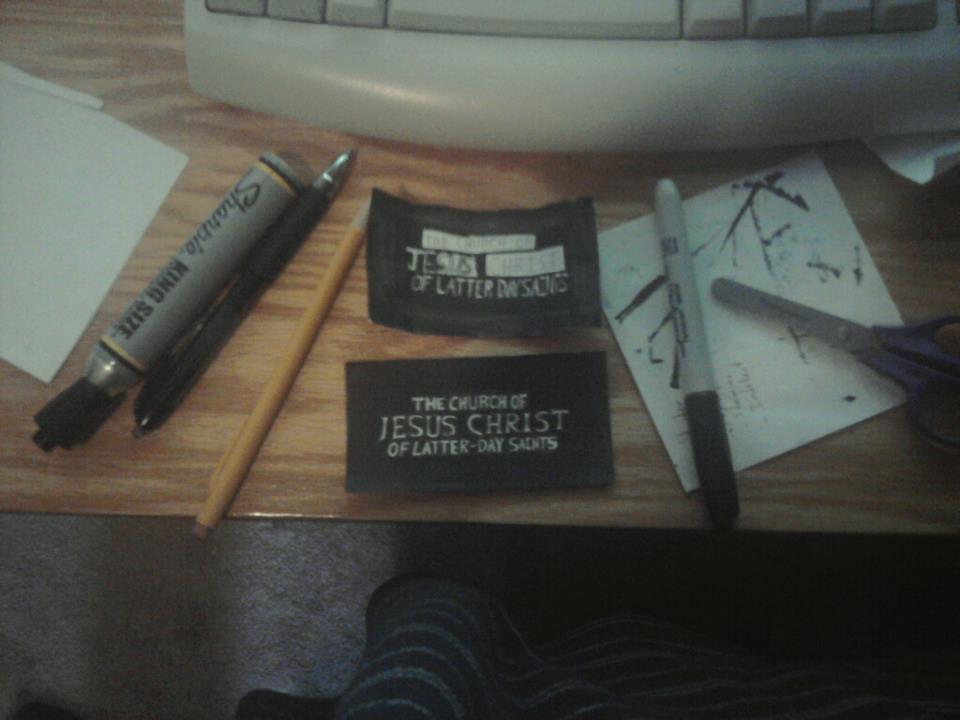
Evidence of an hour's work

But, having only white paper, no printer, and various pens, markers, etc around, I was left with a problem since I would need a badge with white lettering on a black background.  I knew what I had to do, but it was just going to take some patience.

To start, I had to measure the size of the paper, map out the lettering plan on a grid (penciled in lightly), based upon an image of a real missionary ID badge which I had googled and left on my primary computer screen.  Then, once the letters were penciled, I very carefully traced the outside of the letters with a black pen, then filled in the rest of the background with two sharpies.  The results, among the tolls used, are to the left.

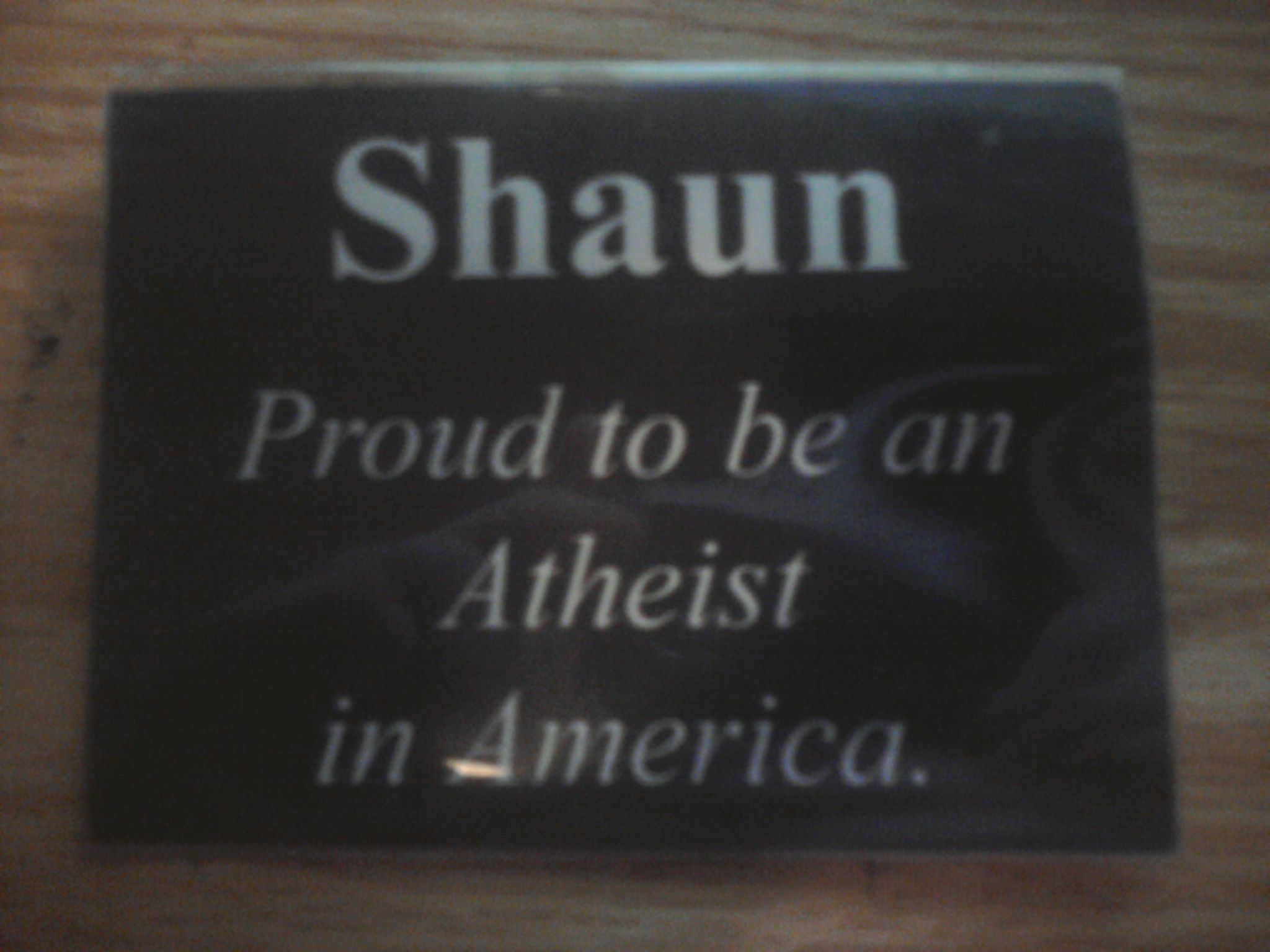
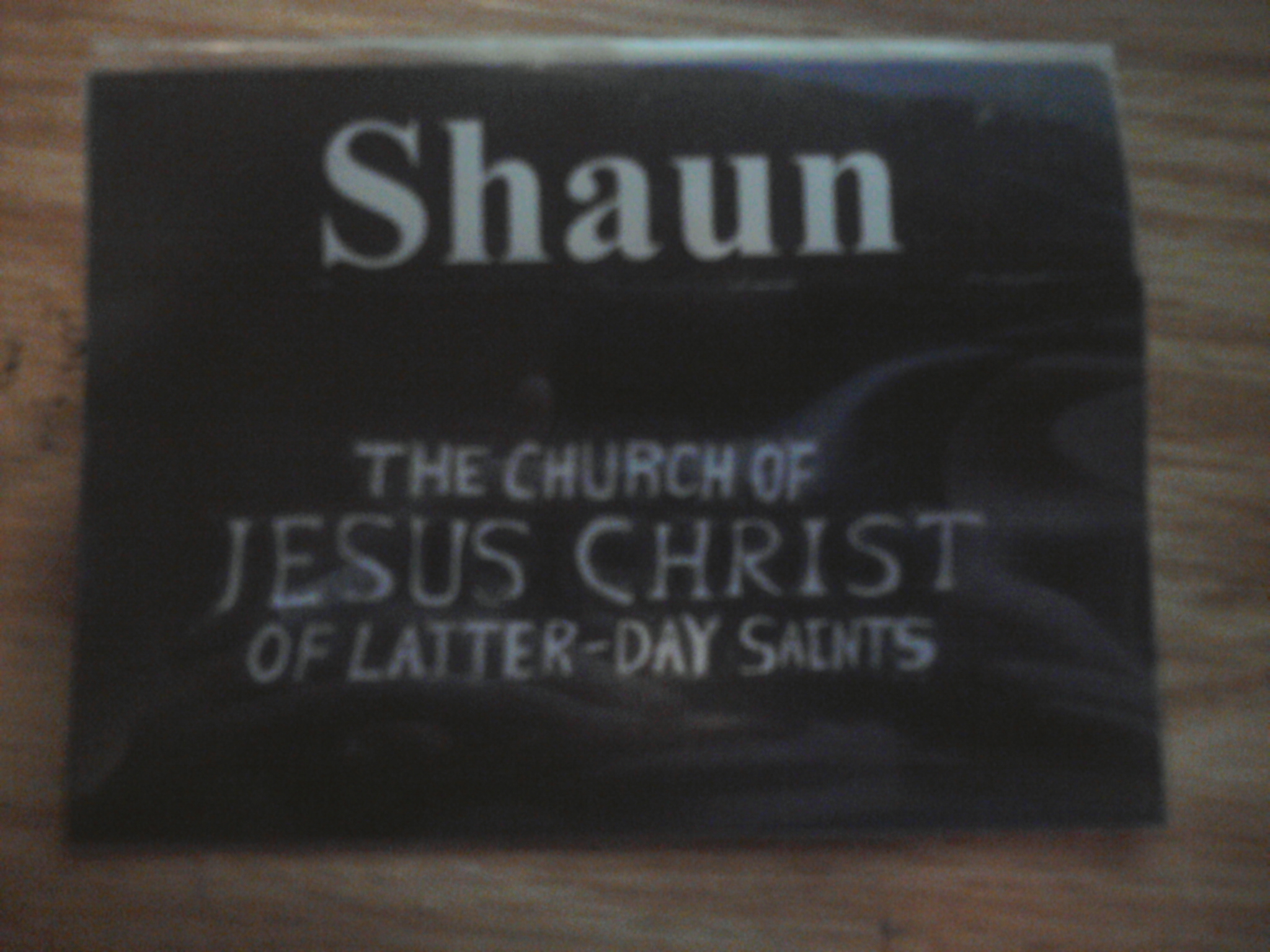
After that, it was a simple matter of sliding the paper in the plastic holder, covering the phrase “Proud to be an Atheist in America” but leaving the name above it in place.  The result can be seen to the right.

But that could not be all! Why? Well, every time I have seen those missionaries I have seen them carrying some sort of bag, backpack or messenger bag usually.  And I have a messenger bag.  Except it has the Dawkins scarlet ‘A’ on it, and that is no bag a Mormon missionary would carry, now is it?

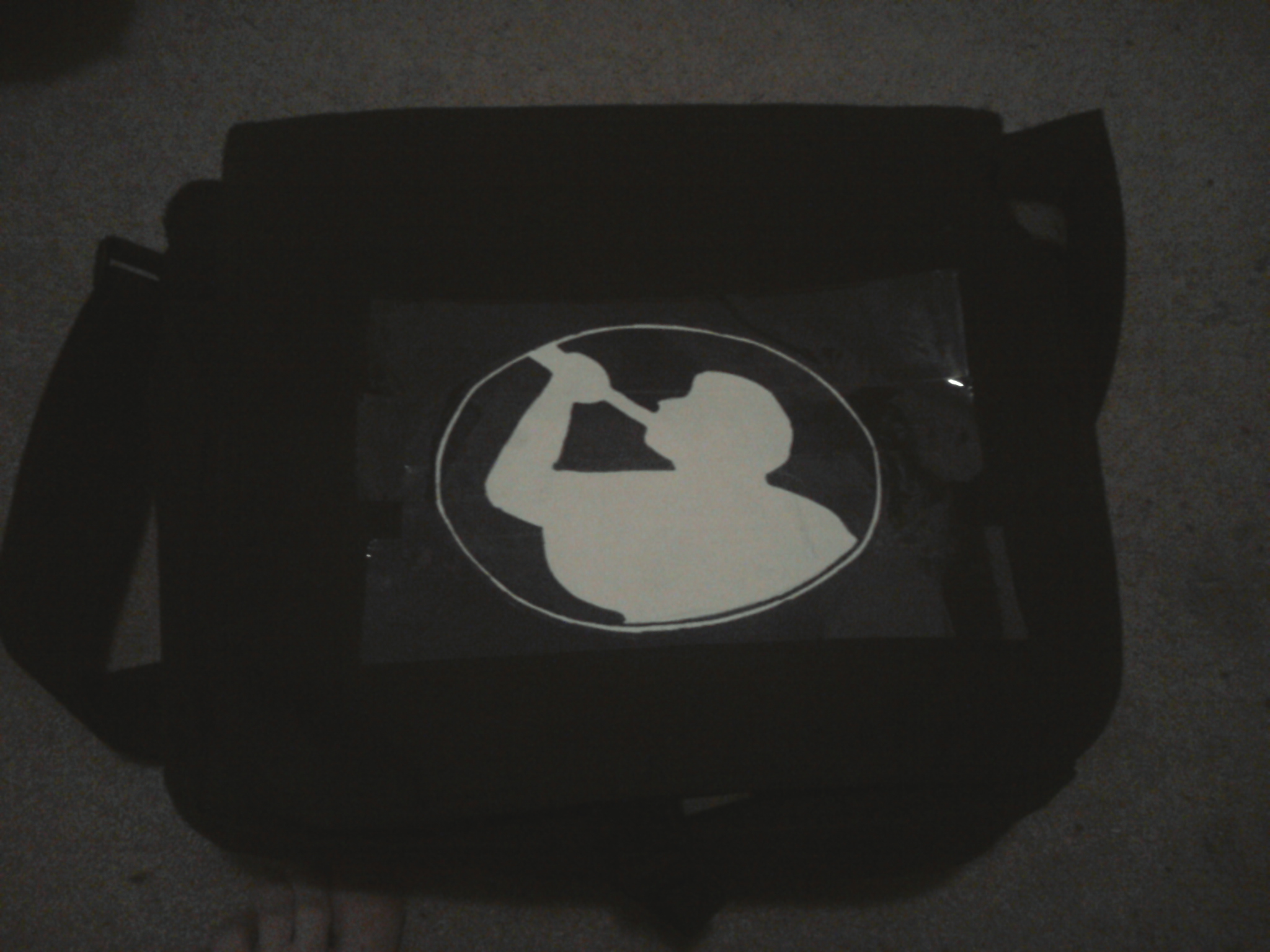
So, I googled Mormon images, found a simple picture of the angel Moroni blowing his horn, and taped a piece of white paper to the screen to trace it (the juxtaposition of technology and Luddite technique does tickle me a bit).  Then I filled it in with the same markers and, after doing so, I used some clear packing tape to affix the paper over the ‘A’ on my bag and, well, voila!

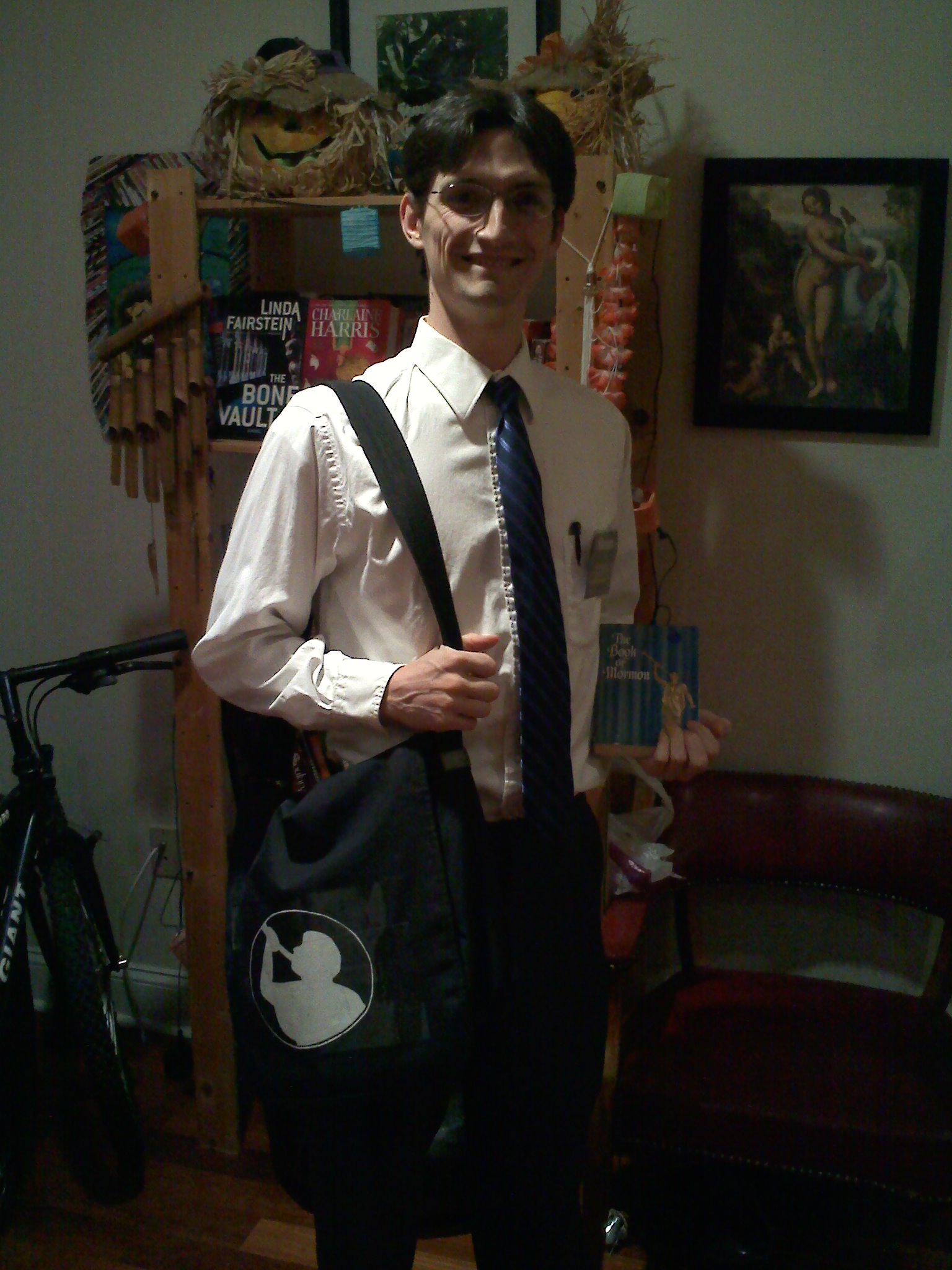
That, with my copy of the Book of Mormon in hand, allows me to transform into Mormon missionary man!

And with it all put together, it all looks like this. So, happy Halloween everyone.

Mere atheism


I’ve been having a long conversation in the comments of another wordpress blogger recently.  I was perusing the religion section of wordpress and ran across this post.  The comments are where it gets interesting. If you are interested in such conversations, I urge you to take a look.  Much of the following will reference that discussion, although you will be able to follow without reading it).

During the conversation, which touches on skepticism and the definition of ‘atheist,’ the blogger jackhudson said that “there is no such thing as a ‘mere atheist’,” and I was forced to agree.  Actually, I quite enthusiastically agreed, as I had never made such a claim that such a creature existed (see the comments there for the details, if you like). But I immediately liked the term and it gave me a little insight into the nature of our disagreement.  It also reminded me of a discussion within the atheist community some time back.

Remember that now infamous PZ post about “dictionary atheists” with which many atheists, including myself disagreed?  Well, I do believe that the definition of “atheist” is still merely the lack of belief in any gods, but I also agree with PZ’s larger point which, ironically, is basically the point that jackhudson is making in the comments I have made reference to in this post.  Ironic because the post is about PZ Myers being wrong about something.  Well, it’s a little ironic.

In other words, PZ Myers was right to say that we, as atheists, are not atheists because we lack a belief in gods.  At the time he wrote that post, I disagreed by arguing, as did many pothers, that being an atheist was nothing more than this lack of belief in gods.  But as I came to understand it, PZ had a larger view in mind, one which jackhudson is also making; none of us are merely lacking belief in gods.  We have other things we do believe in and those things inform our worldview and tell us about how we are atheists.

Even if the definition of atheism is, in fact, the lack of belief in any gods we are so much more than that.  It’s a nuanced point, and I think worthy of further exploration.


Finding your inner atheist

People come to find that they are atheists in a number of ways.  As they do so, they carry all sorts of beliefs, assumptions, and worldviews (all of which may change, of course).  But an essential moment for people who consider their beliefs is when they first realize that they no longer (or never did) believe in a god.

Some of these just of shrug their shoulders and go on with their life.  Others experience a great emotional relief, anxiety, or even anger upon realizing this.  I imagine that some people even repress this and go on as if they do still believe.   The reaction is dependent upon many personal factors which are relevant to a person’s worldview, but are not really relevant to the term ‘atheist’ per se.  That is, if they accept that title as part of their identity, that title merely tells others what they do not believe (gods), but nothing about what they do believe in.

Other labels and titles can do that, in most cases.  Sometimes new labels have to be invented. But no information about what one believes can be gleaned, necessarily, from “I’m an atheist” by itself.

So, I think that PZ’s objection is more about the existence of “mere atheists” rather than “dictionary atheists” (although I’m sure he is still annoyed with people reminding everyone of this definition, as his post indicates).    Having heard him talk about this issue a few times however, I don’t think he disagrees that atheism, per se, is merely this “dictionary” use, only that this lack of belief does not tell you anything anything about what is important.

And while I think it is still important to clarify one’s philosophical opinion (I am a philosophically-minded person, after all), I think that PZ is largely correct.  I will continue to explain the definition when the clarification is warranted, but I think that this is becoming a secondary consideration for me.  It is a bit of a transition I have been noticing for a little while; a bit of atheist maturing, perhaps.

At this point, my concern is to not argue what the definition of atheism is so much as to answer the question that Matt Dillahunty has become known to ask (What do you believe, and why do you believe it?) for my own skeptical views.  That is, I am more interested in explaining my views rather than labeling them and having arguemnts which are purely about those labels.

It is true that I don’t believe in any gods.  It is still true that to claim that no gods exist is beyond my epistemic powers.  It is also true that in some cases (like with the Christian god) I do believe that ‘God’ is not real.  But I think the fundamental point is to show that a skeptical position is where to start, and that I simply do not see reason to believe in people’s religious ideas.

My motivation for all of this is not derived from being an atheist, but rather from being a skeptic who cares about having beliefs which are true.  My being an atheist is not my motivation for writing this blog, being active in godless communities, etc.  My motivation is what I do believe.

I do believe that the truth matters.  I do believe it’s important to want to have reasons for what we believe.  I do believe that skepticism is the best methodology for finding what is true.  I do believe that having a good level of certainty about truth is possible.  I do believe that people can educate themselves towards freeing themselves from delusions of all kinds, including faith.  I do believe that the efforts of the skeptical community are helping our culture move away from religious commitments, even if more slowly than many of us would like.

So no, I’m not a mere atheist, and I don’t think any person is.  To be a person is to have beliefs, even if only tentatively, and nobody is defined by a simple lack of a belief.

But I still believe that identifying openly as a person who does lack that belief, in this cultural context, is important for the ongoing cultural conversation.  I do think there will be a time when identifying as an atheist will no longer have a use (it will still be true, but only useful in the way that identifying as an a-Santa-ist is now).

We are not there yet.