A recent post on Camels with Hammers about intellectual temptations atheists must avoid voices a lot of my thoughts better than I could. Fincke generally allies himself with the New Atheists, but often speaks out against the cruder and less thoughtful instances of New Atheist thought, in a way I really appreciate (since I’m basically in his position as well.) #6 in his list is one I’ve thought about a lot, and want to expand on somewhat here.
Atheists, on the whole, are a pretty individualistic bunch. Relative to the rest of humanity, they feel okay going against the grain, risking social pariah-hood, and rejecting customs that exist for the sole purpose of making humans feel more connected to each other. This makes sense: to adopt a position so counter to cultural norms, a person needs to have a pretty thick skin toward social disapproval. Individualism is a self-selecting quality for atheists in this day and age.
What I see happening a lot is that atheists conflate this individualistic personality trait with superior rationality. They care less about social approval and social bonding, they see that other atheists feel similarly and that people subscribing to all kinds of woo and religion care more about it, and they assume that caring about social approval and social bonding are in themselves less rational. So any time an attempt is made to incorporate community, ritual, and institutions which prioritize social bonding into an atheist frame, you get some voices pooh-poohing the attempt as worthless and meaningless and anti-rational. When someone confesses that they have difficulty leaving religion because of the inevitable social isolation, this is seen as a sign of weakness.
This point of view “I’m individualistic and rational, if you were rational you’d be individualistic too” ignores a basic fact of humanity: we are social animals. We were social animals before we were intellectual, inquisitive animals, and the rise of curiosity and higher-order intelligence did not erase that part of our nature. The social impulse is as valid a part of our humanity as the truth-seeking impulse, and to try to weed out either is to try to change the fundamental nature of humanity.
Humanity is greatly indebted to the individualists: they ask the questions no one else will ask, they think of things no one else has thought of, and they create new ways of being when no one else dares to try. But in doing this, they must also remember that they are statistical outliers: that if the rest of humanity is going to follow them, we’re going to transform the vision into something that meets our common need for connection and social order. This will always happen: this is the kind of beings we are.
I hear some individualists say, “Well, of course I understand that it’s hard to risk social rejection… I struggle with it too.” Yes indeed… individualism and the need for association are not mutually exclusive, and nearly all of us have elements of both. But what I would like more individualists to understand is that their need for association, while genuine, may be far less strong than another person’s. What, for you, was hard in the way running a marathon is hard, might for another person be hard in the way that climbing Mt. Everest is hard. We’re all calibrated differently; we all have different threshholds of need for different human necessities.
And yes, depending on social connection can be a bar to rationality. Of course it can. I’m a good example: several months after my initial deconversion, I was desperately searching for a way back into Christianity. Eventually I found a definition of “faith” I could accept, and I went with it, and continued calling myself a Christian for several years. It wasn’t until I began dating an atheist that I could call myself an atheist again, and that’s not a coincidence. I wanted back in because I was lonely. Because all the people who loved me were Christians, and I felt hopelessly cut off from them — even though they still loved me, I needed a sense of belonging. I couldn’t hack it as an atheist on my own. My need for social connection guided my intellectual investigations, and biased me towards one conclusion.
So, a need to “belong” can influence and distort rational thinking. You know what else can influence and distort rational thinking? A need to be smarter and more correct than other people… a personality trait that self-selecting atheists are overall in no shortage of. The wise, mature ones acknowledge this tendency, recognize how it can bias them, and find ways to minimize its effect. Similarly, I’ve come to acknowledge my profound need for social connection, recognize how it can bias me, and find ways to minimize its effect. One thing that doesn’t work is deciding to care less. That only leads to self-deception.
There are a lot of people who are socially dependent to a degree that cripples them, that cuts them off from acknowledging truths that would improve their lives. A LOT of people. But the way to self-improvement, for many, is not to become diehard individualists, but to become more thoughtful and choosy in the ways they form and maintain their social bonds. The diehard individualists would do well to remember this.
Ever been in an unhealthy relationship? Ever had that relationship go bad and have it end in flames, the coldness reminiscent of the deep vacuum of space devoid of warmth or corporeal presence, or perhaps a little bit of both? I have. It is awful, painful, and ultimately liberating. But before your experience traverses the totality of the immediately previous triad, there is often a moment when the reality of it clicks home, a time when all you are capable of feeling is hurt. The anger and loneliness will come (again), but at that moment all which exists for you is a cognitively-blinding pain which compels a futile grasping towards the emptiness around and, seemingly, within you.
In time, will be the reflection and evaluation through sadness, anger, and even laughter as you remember what was good haunts you for days, weeks, and possibly longer. Eventually, you will begin to understand that the relationship was unhealthy. Sure, the relationship didn’t seem so at the time; the sex was good, you had fun with them most of the time, and there were some really good aspects to the person you cared for and with whom you built something important.
Even though sometimes they would be a little bit crazy or unbalanced. Perhaps they had some strange ideas, insisted upon them, and didn’t seem to allow you the freedom to express your ideas without complaining about being persecuted or somehow oppressed. Perhaps they had a bad history with relationships which you ignored for various reasons. Perhaps the relationship afforded you professional, social, or even political benefits which would be difficult to attain without the associations provided therein.
Or perhaps you thought what was good about them outweighed what was bad. Perhaps you rationalized that the bad was not even really bad, but merely misunderstood quirks and intricacies of the person you loved; things which illuminated their love for you…or something. Rationalization asserts more sense during its subjective composition it than it does through its dissemination.
But when the relationship ended, it hurt. It didn’t matter that the reason it ended was probably something that should make you feel better about getting away. It didn’t even matter that if you stopped to think about it rationally (that is, if you were capable of such a feat under the circumstances), you would realize that you will be much happier removed from such a relationship. The separation from an established relationship often brings forth sadness, depression, anxiety, loneliness, etc.
It does not even matter if the intimacy of that relationship was fictitious, or perhaps merely one-way.
Breaking up with god
Anyone who has left religion might be noticing some analogs here. This is, obviously, intentional. The reason I am drawing some parallels between leaving religion and a break-up from a bad romantic relationship is that I think that there are some interesting comparisons between them. In fact, my experiences with unhealthy relationships has not only taught me a lot about relationships, but I think it gives me a glimpse of what losing religion might be like, since I never had a religion to lose.
To start with, I suspect that many people stay in bad relationships, and religion, longer than the relationships provide actual happiness. I think that much of what keeps people in religion is a combination of habit and the comfort of familiarity. I think that many people stay in relationships whether they are abusive, neglectful, or simply poor romantic matches for similar reasons. It takes a lot to leave a relationship we are invested in, and even knowing that we need to do so does not make the process easier.
Secondly, I think that people stay in such relationships longer than they should because they don’t recognize how unhealthy the relationship actually has been. I imagine that the full comprehension of this is never fully known until much later, in many cases. People often don’t recognize the difference between (co-)dependency and real intimate affection and concern, and this inability perpetuates unhealthy relationships all to often. The feeling of needing someone, especially if that needing reflects some feeling of possession, ownership, or obligation, is not healthy. The fear of loss (often in the form of jealousy), or basic insecurity of uncertainty, is not something to be held aloft as the basis for love, let alone “true” love.
And this is the type of relationship which religion instills; a fear of loss, of being owned, and even of feeling obligated to remain in relationships which are unhealthy.
Healthy relationships
Relationships need to be built upon things like trust, transparency, and honesty. We do not own our partners, we must be open about what we do, what we want, and what we can and cannot handle. We need to do the personal work to make sure that we know what we want, to make sure that we have exercised our ability to perpetually grow emotionally and intellectually, as well, in order to make sure never to prematurely cut off what we can handle to some too easily reachable goal which will stagnate who we could be if we challenged ourselves more.
And in terms of our relationship with the universe, our society, and even the “truth,” we need to make sure that we are continuing to challenge our boundaries, presuppositions, and to keep communicating with people with whom we disagree. The universe is massive, complicated, and often beautiful as well as terrible. We would be temporal thieves of potential experience, understanding, and perspective by not allowing ourselves to see as much of that beauty—and terribleness!—if we didn’t pursue the world with full thrust towards such potential.
We need to approach people and the reality which we all share with an open mind, open heart, and unbridled willingness to hear the world calling us on our bullshit. If we do these things, we will be better off in all our relationships, whether they are the two-way relationships of traditional monogamy, multi-faceted relationships of less traditional polyamory, or the one-sides intimacy of our own self-respect or the respect for reality.
For reality cannot love us back, but that does not stop us from finding it beautiful, compelling, and worth our effort to get to know it as intimately as our limited cognitive ability allows us.
So, you want to include Intelligent design, creationism, or some other moniker for questioning the overwhelmingly established science of evolution into our classrooms. You also, likely, equate evolution with the origin of the universe, so you want to talk about how something must have created the universe too. Like, for example, god. Well, OK. In that case, lets also include creation myths from Hindus, various Native American tribes, and (why not, it’s 2012) the Mayans? Let’s have as many challenges to evolution and cosmology as possible, if we are going there.
Or perhaps you are more concerned with the state of medical science. Perhaps you want to have your medical school include spirituality in their training, so that future doctors will be more spiritually attuned, or something. Well, OK. In that case let’s not forget faith healing, acupuncture, and homeopathy. Hell, let’s throw in some goat sacrificing as well. If we are going to include alternative medicines, why not throw in everything, just in case someone thinks they are worthwhile, eh?
Hyperbole?
Have I gone down a slippery slope? Have I taken what should be seen as a legitimate addition of alternative points of view, in comparison with established science and skepticism, and equated them with obviously erroneous methods? Am I not taking things like spirituality, real “scientific” challenges to the Darwinian conspiracy, etc seriously? Am I merely being flippant and disrespectful?
No.
Quantities of complexity and simplicity
What is the difference between the more sophisticated and complex challenges to the scientific consensus and those which are, how should I say, less sophisticated? What is the difference between the Discovery Institute and the creationist screaming on the street corner (or next to the reason rally)?
There are real differences between these two types of challenge to science. One is better articulated, more gpolished, and appears more professional. The other has not been dressed up in such finery, and is obviously naked to everyone (OK, most of us). From where I stand, all of these sophists look naked, adorned in transcendent Imperial attire, even if to many out there the transparency of such cloth takes on a denseness and opacity to them. Such observations become quite illuminating to complex eyes, but not so complex to need an intelligence to evolve them, such as mine.
That is, the difference between these sophisticated attempts at “skepticism” and creationist buffoonery is one of methodological degree, and certainly not a difference of quality.
For someone to show a distinction between these two, they would need to show some empirical or methodological difference between the two claims. They cannot do this. Because there isn’t any.
No matter how well the Discovery Institute, the Institute for Creation Research (ICR), or any other disingenuous attempts to undermine science dresses up their creationism, that’s all it is. So no matter how slick the presentation, elevated the vocabulary (to make it sound sciency), or how many “credentialed” contributors they parade out (or pay large sums of money) there will only be a difference of degree between them and the whack-jobs on the street-corner yelling about the time being “nigh,” or someshit.
The reason for this is simple. The methodologies of science, based in logic, empiricism, and skepticism generally, are unique and powerful. Religion, faith, superstition are all powerful motivators of human behavior, but they lack that method and so they fail to predict or explain reality. There is a fundamental methodological difference between what real science does and what is done by such think tanks as referred to above. Places like the Discovery Institute and the ICR are not using the best methodologies, but are in fact using the same type of methodology used by the creationist you will meet on the street, in a church, or proposing legislation to allow discussion of creationism in schools.
They arenot using skepticism.
So when we respond to such trite sophistry with what may appear hyperbolic, the fact is that it is not hyperbole at all. It is, in fact, appropriate commentary on the ridiculousness of people’s beliefs about the world; beliefs which are not warranted by the facts or the reason that binds those facts into theories which teach us about reality.
Unhooking the bra of reality
One person’s idiocy is another’s profundity. And one person’s profundity is another’s idiocy. The difference between the two, however, is not mere subjective opinion or preference; reality can inform the difference, and reality gives up her lovely secrets only to skeptics (when she gives them up at all). Faith and superstition—ever the prompts of religion—being so obsessed with what lays beneath nature’s bodice, frees itself to imaginings and unverified declarations. But it is all rhetoric and no real experience.
Real experience requires knowing how to unhook the bra of reality, a secret revealed only by the reaching of the adolescence of our species during our philosophical and scientific development and matured in the fires of the Enlightenment with the advent of the scientific method. Many an embarrassed and inexperienced person claims to have breached such depths, claiming to have seen this or that, done that or this, and have really only masturbated such things while those of us truly entered into mysteries of the plain world in our face, seen with skeptical eyes, know the beauty of reality’s bosom.
Or, to put the analogy more succinctly; pics or it didn’t happen, you keepers of faith and superstition!
Had a great time at the Reason Rally, despite the rain and chilliness, and despite it using every last scrap of social energy this introvert could muster. Adam Savage’s was perhaps my favorite speech, especially this part at the end:
I have concluded through careful empirical analysis and much thought that somebody is looking out for me, keeping track of what I think about things, forgiving me when I do less than I ought, giving me strength to shoot for more than I think I’m capable of. I believe they know everything I do and think and they still love me, and I’ve concluded after careful consideration that this person keeping score is me.
This nicely summarizes a thought that I’ve meant to write about for a while. It’s one of the less obvious negative consequences of religion, and something I myself didn’t realize until I’d been an atheist for several years. The idea of God I grew up with was everything Adam Savage describes in the quote and more: an ever-present companion even in my most profound loneliness, someone to pour out my worries to, share my joy, amusement, and exasperation with, someone who understood me at the deepest level, and, while he might not always approve, always loved and forgave me. Atheists mock theists for their “imaginary friend,” but perhaps they don’t really consider what it would be like to have such a friend that you actually believed existed. It means always being loved, always having support, never being alone. I, like many ex-believers, mourned the loss of this friend deeply when I found it was impossible to believe.
It took me a lot longer to realize that those experiences of feeling loved, supported, and listened to were real. Of course they were: I genuinely felt them. The interpretation I put on them was false, but the feelings were real. And what that means is that that support, that love, that listening ear, was only ever myself. The wise, calm voice I heard speaking back to me, giving perspective on my problems: that was me too. I had all those resources within myself the whole time, but I believed they came from outside of me. I didn’t give myself nearly enough credit. That friendly presence is not lost to me; it’s where it always was.
I started out saying that this was a negative consequence of religion, and I still think it is: religion, for many people, teaches us that the best and wisest part of ourself is not ourself at all, but external. It teaches us that we are dependent on someone else for love, forgiveness, wisdom, and encouragement. And that is a travesty. But on the other hand, perhaps the teachings about God enabled me to develop that part of myself. I don’t know; I’d have to hear from people who grew up atheist, whether they have anything like that sense of self-affirming internal companionship. (Evidently Adam Savage does, but I don’t know his religious history.) My guess is that some do and some don’t; and certainly not all religious people gain that particular thing from their notion of God. For some, indeed, God seems to embody many of the worst aspects of themselves, the bigoted and judgemental, the hateful and fearful. But I was lucky enough to be raised with a version of God that was everything best and wisest and most loving, as I could conceive of it, and perhaps that helped me develop that part of myself in a way I might not have otherwise.
So it may be that this is a possible positive as well as negative aspect of religion: providing a venue for people to shape and nurture their own best impulses. To the extent that my childhood religion did this for me, I’m grateful to it, as much as I resent it for telling me that those things were external to myself. Perhaps one thing the atheist movement should work on is encouraging those impulses, teaching people how to develop that supportive, forgiving, wise voice within themselves. Even though I recognized that it was present and accessible to me, I’ve lost sight of it in recent months, and I think I’d do well to recover it. I’m never as happy, healthy, and well-balanced as when I’m being my own imaginary friend.
Religion is an insult to human dignity. With or without it you would have good people doing good things and evil people doing evil things. But for good people to do evil things, that takes religion.
-Steven Weinberg
A little background and setting
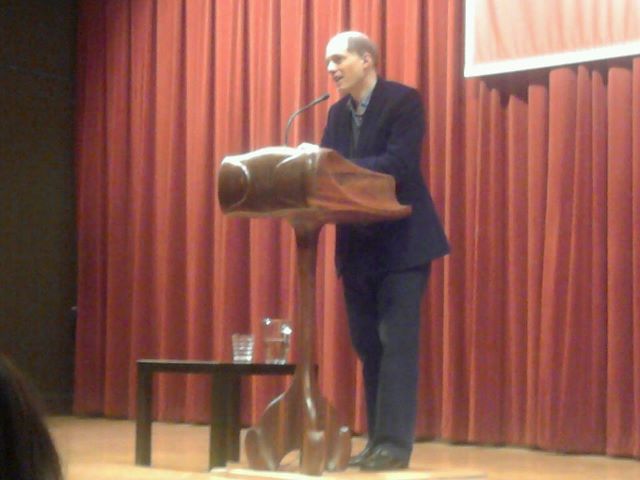
Alain de Botton in Philadelphia 3/11/2012
Yesterday, which was Sunday March 11th, 2012, for those of you reading this from the future, I went to see a free talk given by Alain de Botton about his book, Religion for Atheists. There has been considerable conversation about de Botton over the lest couple of months, and after reading some of his work as well as much of the criticism (both for and against), I had already felt pretty strongly that I was not in favor of his view. But I have not read the book and wanted to hear what he had to say for myself, with the possibility of asking a question (I was not able to).
In any case, this will not be an evaluation of the book itself. Rather, this will be an evaluation of the talk he gave yesterday about the book.
I arrived a bit early, and easily found a seat in the second row, but to the side. The auditorium filled up quite quickly, however, and there was almost no available seating by the time he was introduced. The audience was primarily older, although quite a few people in their 20’s and 30’s were there as well.
Many were toting a copy of the book.
I saw few of the people I know from the local atheist community. The significance of this I will have to leave until after I evaluate what de Botton said in his talk, as I think it will be a fact which illuminates an important problem for the atheist community as a whole.
For now, let’s skip the description of the scene and get to some of what de Botton said, and what I thought of it.
There is no god. Where do we go from here?
As de Botton has done a lot of recently, he immediately mentioned and criticized the harshness and tone of the atheist critiques over the last decade. While not always naming names, or even using the term “new atheist,” it was clear what types of people he has in mind; the new atheists such as Dawkins, Dennet, and the late and great Hitchens.
De Botton sees the new atheist criticisms as having a “disgust” for religion, and as an attempt to create and maintain a “complete separation” between religion and the secular ideal of reason. he sees them going too far, and wishes to rebut their criticisms with a milder, reverent, approach.
He states, flatly and without reservation, that for him “God does not exist” while inviting anyone offended by this to exit at their leisure. He admits there is much bad about religion, but wants to focus on the good in this discussion and leave the bad aside. The issue for him is, in admitting unashamed atheism, “where do we go from here?”
And this has been a question which many of us in the atheist community have been pondering for some time. I honestly don’t know to what extent de Botton has paid attention to the atheist community besides his surface familiarity with its harshness and overly aggressive criticism, but from his talk it is quite clear that he is quite bereft of sufficient perspective on the many points of conversation, especially those conversations among us more “aggressive” atheists. Like most accommodationists, he is quite ignorant of our point of view, and has bought into a caricature and a straw man, which he attacks like Don Quixote with his windmills.
The irony of distancing oneself from, while signing in harmony with, Richard Dawkins.
His ignorance came through quite early in his talk. He says that when it comes to the question of whether a god actually exists, or truth of religion generally (an idea he finds “boring“) he admits that “the doctrines are impossible to believe, but…” and then goes on to list many things he likes about religion. He mentions holidays, hymns, art, architecture, and many other admittedly nice things that coincide with religious institutions. But I have heard Richard Dawkins, the man who is, in many people’s eyes, the most aggressive and militant of us, say pretty much the same thing.
Richard Dawkins really likes Christmas, for example. He likes much about religious music, aesthetics, and even goes to church occasionally for the experience. And Dawkins is not alone in this, although many of us also feel no affinity for those things (I’m one of them) we recognize that these things are often pretty, useful, and worth keeping around on their own merits. I wonder if de Botton knows any of this. I doubt it.
Thus, while de Botton is trying to distance himself from those aggressive atheists, he ends up saying something very similar to what many of them say. When you fight straw men (or windmills), you will often get straw in the eye (or knocked over by windmill blades). De Botton is, frankly, ignorant of what the objects of his criticism believe and say, and so much of his criticism falls flat.
He does go further in his accommodation to religion, of course, but his blindness to these facts, precisely where he is attempting to emphasize his distance from the aggressive types, is telling.
The “pick and mix” of the litter
Here’s what de Botton wants to do, essentially. He wants to look at what religion is good at, what it does well, and pick them out for our usage as non-religious, I mean atheist of course, people. He wants to “pick and mix” attributes, practices, etc from religion to improve the atheist experience, community, etc such that we can emulate what religion has done right in moving forward as atheists, rather than try to get rid of religion whole-cloth.
He recognizes that this is problematic for believers, but cannot understand how this would be a problem for atheists. Why would an atheist care if another atheist found something useful in religion? But here’s the thing; I don’t think any atheists should have an issue with this either. From one point of view, he is exactly right; if we look at religion and find something good, there is no reason not to adopt that one thing (or several things), perpetuate it, or re-brand it for our use. That is, there is no reason to not do something merely because it is something that some religion does. That would be absurd.
Here’s what he is missing; by saying that we should be looking to religion for what it is doing right, he commits three critical errors.
He is mis-attributing natural human behaviors to religion.
He is maintaining the association between those natural human behaviors with supernatural superstition.
He is, probably unknowingly, pulling some of the terrible ideas and behaviors along with the good.
As for the first error, mis-attributing natural human behaviors to religion, the error goes something like this.
As religions developed over the millennia, they inevitably co-develop with behavior patterns and subsequently become usurped by the religious traditions. The intricacies of religious anthropology (what I have my undergrad degree in, BTW) are too complicated to get into here, but suffice it to say that things such as morality, ritualistic behavior, and other in-group behavior pre-existed religious doctrine and institutions, and they were subsequently adopted and somewhat changed by those traditions.
And because religions usurped human behaviors for their use, they subsequently became associated with religion almost exclusively. De Botton seems ignorant of this fact, and it leads him to urge us to look towards religion for these behaviors which he likes when he should be encouraging us to leave the superstition behind and allow these natural behaviors to form on their own, as they most-likely will. It is almost like he is unaware that without religious beliefs (the doctrines he finds so unbelievable), the behaviors around those beliefs would all disappear.
Our natural behavior patterns, rituals, etc certainly would change sans religion, and some would likely disappear altogether (and good riddance!), but we don’t behave ritually because of religious tradition, we have maintained those behaviors because religion needs them to survive. The behaviors which religion uses are deeper than the religions themselves, and will survive religion’s demise.
This leads right into the second error, that of maintaining the association between those natural human behaviors with supernatural superstition.
By not avoiding the middle man and getting his preferred human behaviors through religion rather than just doing them because he likes them and finds them useful, he perpetuates the association between those behaviors/structures and the supernaturalism that even he is leaving behind. He is strengthening their co-dependence in people’s lives, rather than divorcing them, as they should be divorced.
By doing so, he is also appealing to a lower aspect of our nature, what Nietzsche called the ‘metaphysical need,’ which keeps us pinned down to irrational thinking. He wants us to maintain a reverence for the history of our behavior, even through the parts where it believed in and stuck to fantasy. By doing so, he is helping to curtail human progress away from superstitious, medieval, and irrational thinking which many of us, skeptics specifically, are working to address as a cultural problem.
Again, this leads into the third error; pulling some of the terrible ideas and behaviors along with the good. Because he fails to see how these sets of behaviors are accessible to us without getting them from religion, he seems blinded to the fact that he has fished up some garbage with the fish.
Probably most egregious in this regard is his unabashed like for the concept of Original Sin. He “likes” the idea of Original Sin, even as an atheist. A cry from the audience (it was not me, but it was a person I know well who sat next to me) cried out “but it’s insulting” to which de Botton said nothing substantial in response. De Botton thinks that the idea that we are fundamentally broken is preferable to thinking that we are ok. It gives us humility, something to work on, etc.
And they say that we gnu atheists are unsophisticated theologically. Here is an atheist philosopher defending one of the most decadent and morally bankrupt concepts—a McDonald’s of philosophical ideas—in the history of ideas, and he does so with a smile! It is astounding how someone can be so unaware of the danger of this idea for people. It’s not an idea that says “hey, you have some self-improvement to do” or “don’t be so arrogant!”
No. It is an idea that we are, from the very bottom up and due to a mistake made a long time ago by a (mythological) woman who could not have known better or done otherwise, fundamentally broken spiritually, intellectually, and physically and thus deserving of eternal punishment by a god who loves us unless we kiss his ass. Even divorcing it of the theological content, it is perhaps the most despicable of ideas I have ever heard, and I have been listening to the GOP presidential debates!
Not to be repetitive…
Let’s be clear here; Alain de Botton wants us to emulate educational practices of religious traditions. He wants us to repeat, emotionally charge lectures into sermon-like presentations, and use propaganda.
First, he straw-man’s secular education by describing is as “pouring in of information” and expecting it to stick in their minds. He then sets up religion’s alternative technique of ‘education’ in the form of repetition, through ritual and structure. He wants to create a way to educate which focuses on having information given a temporal and logistical structure. This is precisely what good teachers are already doing as part of their teaching curriculum and techniques. Again, he wants to learn from religion where all he needs to do is look at what people are already doing without religion (necessarily). And where we may learn from religion in this regard, we risk taking on manipulation, indoctrination, etc. we are better not learning this from religion per se.
He also wants more sermons and less lectures, because they are exciting and emotionally engaging. he talks about the energy of a sermon, using a Pentecostal service as an example, and (fallaciously) compares them to a lecture, which is obviously boring. Fallaciously beause he is giving a lecture, and not a sermon.
It makes me wonder if he has seen Sam Singleton do his atheist revival. Probably not.
And he also wants us to stop thinking of propaganda as a bad thing, just because Goebbels and Stalin made it look bad….which, of course, is precisely what we are doing; disseminating information in the name of a cause. We just are not doing it primarily with emotional manipulation, slogans (they’re easier to chant repeat), etc. We are disseminating information in the name of a cause.
Our aggressiveness, which de Botton goes out of his way to deride, is precisely what propaganda, in its real sense, is. Yes, the term has been associated with the underhanded, dishonest, manipulative techniques of the NAZIs and Stalin’s USSR, but we, again, already are using this tactic without getting it from religion, but from secular sources…precisely where religion and totalitarians get it from. And then we hear from critics, ironically like de Botton, for doing so.
(*headdesk*)
The important things
De Botton thinks that we are not spending sufficient time structuring our lives to deal with the important things. I agree that far. I have been advocating for being introspective, philosophical, and taking time to enjoy the finer and more subtle aspects of life for a long time, but I see what he is proposing as a atavism, not a step forward.
One of my complaints over the years has been that when most people get hit with some tragedy, have something to be thankful for, or just when they are feeling introspective or ‘spiritual’, most people don’t have experience with much of our history of culture such that they can express this type of experience of beauty, pain, or subtlety without appealing to the religion they grew up around.
Even if they are not very religious, the only outlet for such moments, for most people, is religion rather than the wealth of non-religious art, philosophy, and science which gives us insights into these things.
De Botton’s advice would have us perpetuate the poverty of our culture by continuing to associate the most base, unsophisticated, and untrue expressions of human creativity. Religion is not the highest expression of what humans have to give, although for centuries intellectuals had nowhere else to go because of it’s oppressive nature. Religion, specifically Christianity, is a true decadence of what is best within and between us as beings, and de Botton is only wedding atheists to an impoverished view, rather than help free them.
It’s truly unfortunate, his perochial view.
And what’s worse, is that the audience responded to him with resounding applause. To loosely quote Star Wars…so this is how reason dies. to thunderous applause.
Some side thoughts about the future of the atheist movement
What I see coming now is a further split in the atheist community. Accommodationists now have another dim bulb to follow through their darkness. Those who stood and applauded Alain de Botton yesterday are the future of the critics of the new atheists and our goal to disseminate reason sans religion, faith, and theology.
The only upside is that most of them are old.
The major downside is that de Botton and his ilk will be around for a while to taint the progress of reason, skepticism, and secularism. Their view is mediocre, trite, and atavistic.
All that is rare for the rare, I suppose.
Alain de Botton is not rare. He is all too common.
In the recent conversations I have been having about agnosticism, atheism, etc in the last week or so, I have left out a very potent idea. Ignosticism.
Over at Tristan D. Vick’s Advocatus Atheist, an analysis of this idea was posted today, and after reading it I just don’t know what to say besides, well, read it yourself! I have to say that I’m a bit humbled in that I might be starting to re-think my view on the place of agnosticism in this issue, but I will have to think more about it.
In any case, the post defines ignosticism thusly:
Ignosticism is the theological position that every other theological position assumes too much about the concept of God.
Doesn’t sound like much, does it? Well, follow the thread there and see what you think. he immediately follows the above definition with this:
Ignosticism holds two interrelated views about God. They are as follows:
1) The view that a coherent definition of God must be presented before the question of the existence of god can be meaningfully discussed. [which I have been advocating in recent discussions]
2) If the definition provide is unfalsifiable, the ignostic takes the theological noncognitivist position that the question of the existence of God is meaningless.
Now, I had been on board with both of these points, but I have been insisting that despite this, uncertainty remains, and agnosticism is unavoidable. Tristan discusses this as well, but in order to see how he surrounds this issue, I will insist that you read the rest yourself.
If this issue interests you, you will not regret doing so!
I could not have looked for a better way to sum up the difference between Gnu Atheists and fundamentalist theists on the one hand, and liberal ideologues of all stripes on the other, than this quote from Alain de Botton:
Probably the most boring question you can ask about religion is whether or not the whole thing is “true.”
De Botton is an atheist, but he thinks there’s a lot of useful and interesting stuff in religion, which he goes on to discuss. All well and good, and I agree with him that there is much about religion that’s “useful, interesting, and consoling,” — in fact I myself am still looking for ways to fill some of the holes that leaving religion has left in my life (no, none of them are god-shaped.) But through all the changes I’ve been through, there’s never been a point where I wouldn’t have been deeply offended by the claim that the question of religion’s truth or falsehood is “boring.”
De Botton’s position is very familiar to me. A lot of people, both religious and non-religious, have moved into a space of being fairly indifferent to the actual nature of the universe, and instead seeing religion as purely a social institution or personal mythology. Whatever works for you… all paths lead to God… I believe this, but you don’t have to… they’re all ways of saying the same thing: it doesn’t matter what’s actually true. This is compatible with a lot of religions, as well as with atheism or agnosticism, but it is absolutely incompatible with the monotheistic Abrahamic religions (and perhaps others that I’m less well familiar with.)
In a lot of ways the “I don’t care what’s true” stance is a big improvement, particularly in its social effects. But a key tenet of people who embrace it is not offending anybody, and what they fail to see is that that statement is profoundly offensive to those who do think truth matters. It’s worse than dissent, worse than disagreement: it’s invalidation. It’s saying “I reject the entire foundational concept of your belief. I think the things that are most important to you about your religion are irrelevant.”
A few days ago the story about Mormons baptizing deceased Jews got around, and my take on it was somewhat unusual. If I truly believed that a posthumous baptism was going to gain somebody an (optional) admittance to the eternal kingdom of God, I’d probably do it too! Being the compassionate literalist I am, I’d probably devote a major portion of my life to doing it — if I truly believed. That’s the gift of eternal life, people! Am I going to refrain from giving it just because somebody gets offended? To the extent that these baptisms are being done out of a sincere belief in their efficacy, and not for one of a host of other reasons religious rituals are practiced (I know nothing about the church politics around posthumous baptisms), I can’t fault them for doing these; from their viewpoint, it’s the absolute right and loving thing to do.
I pointed this out on facebook, and somebody responded, “But the people being baptized didn’t believe in the Mormon afterlife!” Which is colossally missing the point. The Mormons doing the baptisms do believe it (I assume, giving them all possible credit.) And under that belief, it doesn’t matter whether what afterlife the other person believed in: your belief is true, and you are helping them to eternal life despite their erroneous beliefs.
The happy, harmonious, multicultural view of religion whereby it’s all just social institution and personal mythology and nobody’s beliefs have a real impact on their life, death, and afterlife is completely ineffective in dealing with people who sincerely belief in the objective truth of their religion. I know; I used to be one. People who stood in that viewpoint appeared hopelessly naive and logically impaired to me. The statement “My religion is objectively true and has real-life consequences” cannot be effectively countered with “To each their own, whatever works for you.” The literalist believer will, at best, dismiss the religious pluralist with an annoyed shrug, and go on literally believing. As long as there are people who say “My religion is objectively true,” there will and should be non-believers who say, “No, it is objectively false,” and I think — have always thought — that those non-believers are giving the believers a hell of a lot more respect than any accommodationist.
Apparently, Ginny was writing about this issue while I was also writing this post, but beat me to publishing. I have not read hers yet, but here it is.
So, as a follow-up from yesterday’s post about certainty and atheism, I want t say a few more things. Also, apparently I wrote about this last year. I’m so ahead of the curve…or something….
Part of understanding science is understanding that we should accept things provisionally, or probabilistically.
Right. To accept something provisionally is to accept that we might be wrong. Now in all fairness, I have not heard anyone who is claiming to be 100% certain about a god not existing say that they would not be willing to be proven wrong, nor even that they could not be wrong. Certainty is not the same thing as proof, after all.
But more importantly, to accept something provisionally should mean that we should not maintain 100% certainty about it. How do we justify absolute certainty in the face of a probabilistic proposition? I really don’t know.
Christina concludes her post by saying that
Science is probabilistic – which is one of the things that separates science from dogma. That’s good. That means science does not close itself off to new information or evidence. A scientist who says, “I don’t care if my data falsify my hypothesis, I am 100% certain my hypothesis is true” needs to hang up hir lab coat, as ze is not doing science. Someone approaching the world rationally is therefore agnostic about everything.
Everything.
Now, here is where I think that the differences of opinion stem from. For me, certainty is about recognizing our epistemic limitations. It is about being provisional about all conclusions, even if the evidence is overwhelming. I am not merely hiding behind any sort of radical skepticism in saying that there is some non-zero possibility that I am wrong about any conclusion about the world. I am simply being honest about my limitations, especially where I am not even sure what the thing being claimed is supposed to be in the first place (i.e. “god”).
See, here’s the thing. If deities are scientific propositions (and I know that this has been a question of past blogosphere arguments), then any conclusions about them have to be provisional. If the claim that a god exists is an empirically-testable one, then even after if is has not been demonstrated after hundreds or thousands of tests (assuming you have not proven it to be logically nonsensical), there is still a non-zero possibility that the proposition is true, even if believing it is completely non-rational.
Surely, you can have an extremely high certainty that it does not exist, and even more surely you are rationally justified in denying its existence, but the words “100% certainty” have to mean something, and what it means is absolute certainty.
Look, if this certainty is nothing but a mere rounding up to the nearest whole number…well fine, but make that clear. But what appears to be the claim is not merely a rounding up (at least in some case), but a finer logical error that I tried to dispel yesterday, but apparently was not able to. So here we are again.
Noncognitivism and certainty
Even if I were to accept absolute certainty as a real and meaningful epistemological position, there is still the fact that the being in question (“god”) is not even defined. What does that word mean? Theologians can’t agree on a definition, and that’s what they do academically and professionally. Sure, the fact that they have no evidence, no body to dissect, is part of the reason why this is the case, but it’s not all of it.
Further, I am not even sure what the necessary criteria of ‘godness’ are to determine if a definition for ‘god’ is legitimate. So, if I were to define god as my cat, then I can demonstrate god’s existence, right? But is this definition legitimate? And if not, why not? And if you have an answer why not, then what about Kim Jong Il? What about Q?
What are the boundaries of criteria for definitions of god? And if those boundaries include definitions which are not in contradiction with known facts about the world, even if they are not demonstrated as real right now, then they are not disproved and therefore claiming absolute certainty about their non-existence is not a rational position.
The noncognitivist position makes this question that much more absurd. The implication seems to be that not only do certain atheists know what the definition of god is (or at least the right criteria for definitions), but that they know that none of the referents for those definitions exists anywhere in the universe (someone alert Ray Comfort!*).
As I said yesterday, this is rational for specific concepts of god, but not for all concepts of god. Noncognitivism explodes the premises of any 100% certainty of a god’s non-existence by showing that because we cannot be sure what the term even means, we cannot say it does not exist.
In conclusion, the only way it is sensible to claim that one knows, or is absolutely certain, that gods do not exist is to start with a definition, or criteria-based set of definitions, of gods which allows one to do this. But this move is not legitimate, because it is essentially begging the question. All such a person can be 100% certain of, at most, is that the definition of ‘god’ they have in mind does not exist.
If these certain atheists** (see what I did there?) were to actually address real definitions of gods used by many real (“sophisticated”) theologians, they will find that those slippery sophists have created gods which survive logical scrutiny because they are designed to be non-disprovable.
And yet those sophisticated gods have still not been demonstrated. Of that we can be absolutely certain.
In the last week or so, I’ve begun a project of going through the emails, blog posts, and private journal entries I wrote throughout my deconversion from Christianity. There are a lot of them, and I may pull them together into a book project in the near future, but for now I want to comment on some thoughts they’ve provoked.
One advantage to having detailed personal records like this is that they guard against hindsight bias and retroactive interpretation. I haven’t looked at most of these writings for years, and I find, looking back, that the story I tell now about the trajectory of my deconversion isn’t entirely accurate. When I want to give the short version of my history with religion, it goes something like this: I was raised in a conservative branch of Christianity and accepted it pretty much without question for the first 25 years of my life. Around the time I was 25, I began seriously questioning my faith, and actually stopped believing in God, although I wasn’t happy about that. I was basically an atheist, though I didn’t use that word, for about a year and a half, then I found a definition of “faith” that allowed me to go back to calling myself a Christian, although never with the same kind of faith as before. Then, around my 29th birthday, the last reasons I had for clinging to Christianity fell away, and I became a full-fledged atheist.
That’s the short version, and it’s broadly accurate, but in retrospect I missed a lot of the complicated nature of that in-between time, between “Yes I am definitely a Christian” and “Yes I am definitely an atheist.” For those who have never had God-belief as an element of their psyche, it might be difficult to understand exactly what was going on there, and it certainly muddies the definitions of “belief” and “knowing” that I’ve been using in the last couple of years. So let me try to explain it.
During part 1, the Christian part of my life, I absolutely believed in God. I would have found it impossible not to. Even if someone had rationally convinced me that there was no good reason to believe in God, I’d have been nodding along and saying, “You’re right, there isn’t a good reason to believe,” and wondering the whole time what God thought of this conversation. It was not something I was consciously maintaining or defending: it was just there, in my brain, a part of the way I thought about the world. To say “I don’t believe in God” would have been a lie, even if I had wanted to disbelieve and had every rational cause for disbelief.
At this time in my life, nearly the opposite is true. If evidence for a god’s existence started springing up all over the place, that internal state of belief still wouldn’t appear in my brain, at least not immediately. I could acknowledge, “Yes, given a Bayesian probability analysis it seems overwhelmingly likely that a deity is the cause of these things we are witnessing,” but in the back of my head I’d still be thinking, “But there can’t really be a deity… let’s keep looking for other explanations!”
It’s important to note before I go further that neither of these belief-states are unchangeable: as evidenced by the fact that my first one did eventually change. I’m no neuroscientist, but my guess is that these belief-states are simply strong neural patterns, habits of thinking that can’t be changed instantly, but only worn away over time as new patterns are developed and rehearsed.
The middle state, that transitional period of 3-4 years, is where things are weird. The things that were going on in my brain at that time don’t fit into a simple category of belief and knowing. The moment that really kicked off that whole transitional phase of my life was a moment where my rock-solid, undeniable belief in God was removed: and my emotional response was anger at God for removing it.
It doesn’t make a lot of sense. I stopped believing in God, and I was angry at God for making me stop believing in him. Clearly, then, on some level I still believed in God, and interpreted even my unbelief through a theistic worldview. But something very significant had changed in my brain, and the best way I could put it to myself was that I had lost my belief.
This state continued, by the way, even after I reclaimed a “Christian” identity. My state of belief didn’t change very much during this time; instead I changed my definition of “faith” to give myself a way back in. My reasons for doing that belong in another post, but from the point of view of mental states of belief and knowing, I didn’t change very much during those 3-4 years.
In atheist circles there’s been a lot of buzz recently about the difference between knowledge, belief, and certainty (prompted mostly by Richard Dawkins’ “shocking” revelation that he wasn’t 100% certain that no god existed, which anyone who’s actually read The God Delusion already knew (actually, anyone who’s read the subtitle of The God Delusion should have known: the word almost is there for a reason, people)). The relevant ground has been pretty thoroughly covered (and is being added to by Shaun even as I write… we’ll see which of us posts first! (I have a parenthetical addiction, by the way; I try not to use at all, because when I start it gets hard to stop)), so all I want to add is my own experience, and how it fits or doesn’t fit into the tidy “atheist/theist” “gnostic/agnostic” categories.
At no point in my life have I been 100% certain that my beliefs about God or gods were accurate. Even aside from evil genius / brain in a jar / Matrix scenarios, I recognize that my foundational assumptions about what constitutes a good basis for knowledge are just that: assumptions, that could be incorrect. I do the best I can with what I have.
I don’t use the word “know” a lot with reference to theism, just because its meaning is too ambiguous. Some people use “knowledge” synonymously with “certainty” (in which case I am an agnostic atheist), some people use it in less absolute terms (in which case I might be a gnostic atheist, depending on how severely you draw the line), and some people equivocate (in which case I’m not playing.)
Belief, now, is a harder question. I don’t think belief is a simple idea, based on my own experience. If all I’d ever experienced were those two states of initial full belief and present full unbelief, I probably would think it was simple. But my transitional phase leads me to think that there are several different strains or mechanisms of belief, which in most people (perhaps) are concordant, but which can also be conflicting. With part of my brain I believed in God, and with part of it I did not, and that was a very different mental state from the ones that came before and after.
Next up: digging a little deeper into the anatomy of that in-between time.



 Skepticism, Properly Applied