Jealousy and polyamory


No! just no....

One of the most cited reasons that people are not polyamorous, even if they are not against the idea in principle, is that they simply could not do it.  They are too jealous.

But jealousy is not a sufficient reason to not be polyamorous.  Not being polyamorous for this reason is simply a way to avoid dealing with the problem of jealousy.

Ever listen to love songs on the radio? Ever watch a sappy romantic comedy where the blunt end of the joke is the presence of competition or possessiveness? The lamenting lyrics of wanting someone’s girl, seeing someone beautiful on the train but she was with another man, or sappy words about how someone belongs to someone else is so ubiquitous that not even us polyamorous people always notice it.  But it is pretty ubiquitous.

Jealousy, whether in the form of competition, possessiveness, or destruction of property is a part of our culture.  It is, indeed, part of the mythology of love in our culture. I use the term myth here because if possessiveness or jealousy are anywhere near the core of love, something is wrong.

But it often is near the core of love in our culture.  Our culture’s use of love, expectations of relationships, and folk wisdom about how to respond to jealousy are pretty unattractive.  It is not surprising that this is the case, especially given that the Bible (which is a part of the foundation of our Western culture) seems to condone this behavior in the book of Exodus.

20:3 Thou shalt have no other gods before me.

and it gets better two verses later!

20:5 Thou shalt not bow down thyself to them, nor serve them: for I the LORD thy God am a jealous God, visiting the iniquity of the fathers upon the children unto the third and fourth generation of them that hate me;

20:6 And shewing mercy unto thousands of them that love me, and keep my commandments.

[emphasis mine]

See, god loves us, but if we were to cast a casual glance to some other god, he would smite us.  And we’d deserve it, of course! How could we be so slutty….

Jealousy as a bad thing

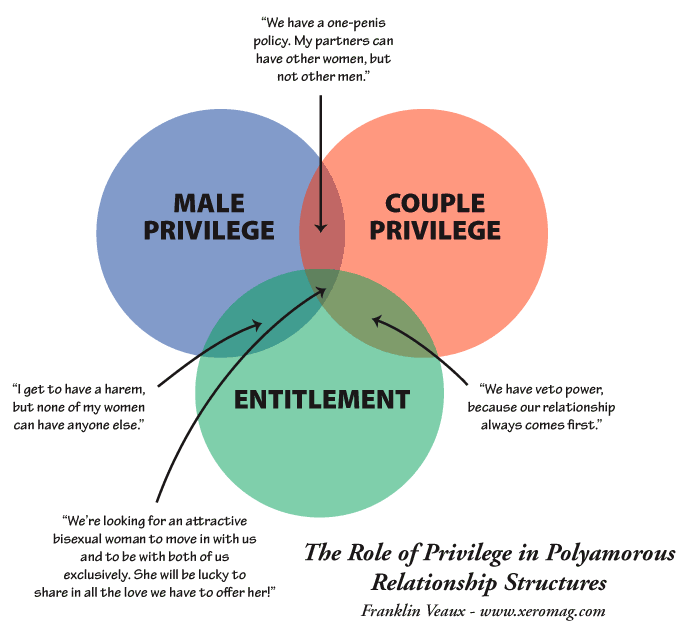
The problem is that people don’t see jealousy as a bad thing.  As the picture at the top of this post shows, there is an idea in our culture that jealousy is somehow an indication that the love is real, rather than imitation love or whatever.  I have been told before that if I don’t mind my girlfriend sleeping with other men, I don’t really love her.  Such people say that when I meet someone who I really love, I would not want to share her.

I suppose I don’t love either of you, Ginny and Gina.  Sorry….

Bullshit! That idea is patently absurd.  I love both of them and I don’t see how bowing to any jealous or possessive feelings I may have is someone more real than recognizing that they are both intelligent, talented, and beautiful people who anyone could love.  How is it rational to love someone (or some thing) and not expect other people to love them too?  And what right do I have to claim possession to a person just because I love them? That is the implication, right; I love them, and anyone else who does is competition.

Of course, for many of us anyway, jealousy still occurs.  Sometimes it’s mere envy, but sometimes it’s not. But what do we do about it?  Do we address the object of our jealousy or do we address the fact that jealousy is damaging to relationships and love in general? Most resources I have seen seem to emphasize that the feeling is probably unwarranted; that what we fear is not happening and we need to stop being so suspicious.  But when you share your lovers, the thing you feel jealous about is happening!  The question is whether you should feel bad about that.

Obviously, if you are agreeing to non-monogamy with your partner(s), you have no justification to be angry about it happening, even if you do feel jealous from time to time.  In such circumstances, your project should be to find ways to rid yourself of those types of reactions so that your good feelings for those people are not tainted by unpleasant experiences of feeling possessive or insecure as a result.  Eventually, you may grow to like the idea of sharing (some call this compersion.  I hate that term.  It’s still better than frubble), and jealousy may be nothing but an unpleasant memory or a curiosity for reflaction on human nature.

Monogamous people may have reasons to be angry if their partners have romantic or sexual relationships with other people (since this was not agreed upon, by definition), but the jeaousy is still something they should try and transcend.  Jealousy does not stop it from happening, and if it is not happening it causes unnecessary anxiety.  It is a sign of lack of trust, security, and can only act to drive people apart, rather than help in any way.

Therefore, there is no excuse for tolerating jealousy, even if one is monogamous.

Monogamy is not a cure for jealousy

Even if you choose a lifestyle of sexual exclusivity, your partner will probably love someone else.  They will probably find other people sexually and/or romantically attractive, they will have fantasies about those people, and ultimately they will probably want more than you are able to give.  If you decide to structure your relationship such that neither of you will pursue anything beyond friendship with others, so be it, but this will not eliminate the existence and problem of jealousy.

It will just avoid the problem by treating the symptom rather than the underlying cause.

The love you have for someone is because of who they are, and should not be dependent upon who else loves them or who else they love.  So, for someone to say that they could not be polyamorous because they are too jealous, what they seem to be saying is that they do not want to deal with the reality of human needs, desires, or the possibility that they may not be able to satisfy every need a person has.

Jealousy is not a reason not to be polyamorous; it is a reason to consider not being in a relationship with anyone.  Jealousy does not go away just because you are not sharing, it just isn’t challenged when we are not sharing.  It’s sort of like teaching children how to share toys; if you just keep them all separate and let them play with their toys separately, the problem never arises.  But when you put children together, they fight over toys.  Separating them does not alleviate the problem, it only avoids it.

Similarly, separating everyone out with monogamous pairings does not make jealousy go away, it just tries to create a dynamic where it ideally is never relevant.  It is an unrealistic expectation and is rarely possible.  So why try?

Only because it avoids the problem most of the time.  From a practical point of view, it is easier to not deal with hard problems.  But this is short-term thinking, and does not lead to us growing up to emotional adulthood.  Jealousy is one of the many aspects to human behavior which we need to address as a species, and too often it is shelved in the name of practicality.

We can do better than that.

High Functioning Polyamory


Three years ago, before Wes and I were officially engaged (though we had been planning on getting married for most of the time we had been together), we went to an Outback Steakhouse and ended up having a very interesting conversation.

I always mention that we were at Outback when we had this conversation because I find it hilarious.  If these blogs start getting a lot of attention, I think we should pitch some sort of advertising campaign in collaboration with them.  Imagine it: It could be a campaign advertising that Outback is a great choice for date nights for couples of all types.  A person with a terrible Aussie accent would say, “G’Day! Are you looking to have a strange, possibly uncomfortable, possibly illuminatin’ conversation about your relationship?  Why not do it ovah a Bloomin’ Onion?  Want to have a date night with ALL your girlfriends and boyfriends? Walkabout right on ovah here to Outback Steakhouse!”  We’ll make millions.

The conversation resulted in both of us agreeing that logically and rationally, non-monogamy was a prudent choice for us.  It wasn’t that either of us had any outside relationship prospects at the time.  It was simply that we both wanted the healthiest, most rewarding relationship possible and for us this meant not wanting to impose limitations on each other’s happiness. 

I’ll fully admit that this was not easy for me when we actually started practicing a non-monogamous lifestyle.  As it turned out, I had a lot of jealous, possessive, and negative tendencies that bubbled up to the surface A LOT in the beginning (and still do from time to time, but not nearly as severely as before).  For the first year and a half of this relationship change, I did not date at all.  I spent the time working out a lot of personal issues that desperately needed to be gotten through.  There were times when I felt like I was getting an unfair end of the deal, simply because I wasn’t dating.  I wasn’t participating…but then I realized that I really was.  Every time I had a problem, I got through it because my ultimate goal was to be happy.  The non-monogamy was not the thing making me unhappy.  It was my irrationality, my insecurity, my bad habits, that were making me unhappy.  Non-monogamy does not cause problems that do not exist in monogamy.  It simply illuminates the issues that are already there.

When we first made this decision together, I had an undefined vision of a successful future.  In the beginning, the vision simply consisted of me being super well-adjusted and happy.  I figured that in several years, maybe I would be dating someone but that in the immediate future, I would just happy that Wes and I had so much freedom in general.  I hated the lousy attributes I mentioned above.  They stood squarely in the way of me being the person that I wanted to be.  In the beginning, I could only see a future in which my brain was fixed…without a lobotomy.  And I assumed that this was going to take an incredibly long time.

In October 2010, Wes met Jessie.  Jessie changed everything.  Before Jessie, we merely had an open relationship.  After Jessie, we had a polyamorous relationship.  The introduction of Jessie into our lives kickstarted a major time of change for me.  I could see pretty quickly that she and the relationship she would have with Wes was special and that it needed to be supported and embraced.  Again, this was not initially easy because of how I am wired, but it was important to get over it.  It was important to get over it not just for the sake of Wes and Jessie, but for my sake, because I really liked her.

In June 2010, Wes and I got officially engaged.  We asked Jessie to be in our wedding party and then Jessie came to the beach for the last couple of days of our honeymoon.  I remember at the wedding reception, Jessie had mentioned that Wes invited her to come down on Thursday night instead of Friday during the day.  I had been unaware of this, but it was fine.  A friend heard her say this and said something like, “It’s their HONEYMOON, Jessie,” as though her presence was somehow inappropriate.  Well, as it turned out, the nights/day Jessie were there were by far the highlights of an already excellent trip.  The whole week Wes and I kept thinking of things to do (mostly “down the Shore” boardwalk silliness) and would say, “Ooh, we should do that on Friday with Jessie”.  A few weeks after that, I realized that I really wanted her to move in with us (another something that I hadn’t envisioned being not only ok with but honestly happy about happening for many years). And so she moved in! We have a wall by the front door (as many people do, unless you’re living in one of those houses that’s just a door…which is just weird) that I like to call the Trio Wall (to myself, and I should come up with a better name than that…).  It has our three masks from Halloween, an Old Timey photo of the three of us from the Boardwalk during our honeymoon and a picture of the three of us in steampunk outfits in Santa’s village.  We have a photo with us dressed up as pirates with Santa too, but that’s not hanging up yet.   (Jessie encourages us to eat lots of candy and dress up in silly costumes.  She does not have to twist our arms).  And finally, we have an ornament of the three of us that Ginny made us.  Every morning, I get to look at that wall when I leave the house and it makes me smile.  I just can’t see my life in any other way and still be as satisfying.

**EDIT** Wes and Jessie pointed out yesterday that I left out a relatively important part of this story.  I left out the part where I had my first boyfriend outside of the relationship.  I am amused that I left that out and that perhaps it speaks volumes about how that short lived relationship panned out, but they are correct in pointing out that the relationship itself was representative of a very important turning point in my life and in our path through poly.  In March of 2011, right around my 30th birthday I noticed that I had developed on a crush on a friend of mine. 

This was huge.  When I was initially working on my emotional issues, etc., I sincerely was not attracted to anyone.  For that year and a half I had no interest in anyone as a romantic partner.  I couldn’t conceive of dealing with jealousy/possessiveness issues with both Wes and some other person too.  It would have been a nightmare.  But, when I found myself attracted to this friend I realized that I had been successful in dealing with a lot of stuff, and it took me by surprise.  We dated for about a month.  It started out well, ended sort of stupidly, but I will be forever thankful that my initial experience was relatively positive because I think that experience helped me be ready when I met Shaun and Ginny. **End Edit**

We had met Shaun and Ginny in April 2011.  They had recently moved back to Philly from Atlanta.  Ginny messaged Wes on OKCupid and she came to karaoke. A few weeks later, she brought Shaun along and he met me.  Unfortunately, I was in a considerably foul mood.  Lucky for me there are second and third chances to make good impressions.  Exactly a week after we got married, Wes and Ginny started dating and about a week after that, Shaun and I were as well.  A couple of months later, I, too was dating Ginny and, well, here we are!  It sounds complicated, but these days it feels very simple.

I was taken by surprise by how immediately comfortable I was with them both.  I was surprised further by my own capacity to love and how much love I got in return.  It wasn’t always easy in the beginning, but it appears that we are all pretty comfortable with each other and see a real future as a wonderful family.  I will say again that this was not something I expected when I signed on for this whole polyamory thing.  But after Jessie, Shaun and Ginny came around, the future I envisioned was more defined and significantly more awesome than I could have ever imagined.

The other day I was chatting with Ginny and she announced that she and Shaun had figured out where they were going on their honeymoon.  She said they’d be gone for a week and I said that I was appreciative of having the advanced notice to sufficiently prepare for being without them (BARF…I know).  Then Ginny said, “You should come at the end of the week!” She’s going to be at a conference at the end of the week and thought it would be nice if I could keep Shaun company.

At first thought I wanted to accept the invitation immediately.  Why on Earth wouldn’t I want to go hang out with them in an awesome city to which I had never been?  Then the next thought was that there were various reasons why Wes wouldn’t go (vacation time he doesn’t necessarily have yet and the fact the Ginny was going to be tied up at the conference all day every day, so she wouldn’t have much time) and I felt crappy about that.  I talked to him about it and he said, “What, you don’t think I can make it 4 days without you???” followed by, “I won’t promise that I won’t feel left out, but that’s not a reason not to do something”.  Then I got all paranoid because I heard my friend’s voice in my head, “It’s their HONEYMOON, Gina”…and I was terrified that I would be a burden or intrusive or something.  So I talked to Shaun about it and he asked, “Did you feel that way about Jessie joining you on your honeymoon?” “Um, no…”I said, “She made it better”. “Exactly…”he said.  I asked Ginny and she reiterated that she wants me there, that me being there would allow her extra time to spend with colleagues at the conference and such.

So, what am I doing after all these conversations?  Well, I’m going to accept what everyone has said and I’m going to go.  I feel lucky and thankful.  As a thank you for Wes and Jessie being awesome, and because me being in Austin will give them a rare weekend alone together, I want to make whatever fabulous date night they want happen.  As for thanking Shaun and Ginny for being awesome, I’ll have to do that when I get there.  I will likely do it with booze and terrible jokes.

A couple of days ago, Shaun posted about how much he loves polyamory and that he hopes that having us all post on here will start to show the general public how functional and happy we are, how normal this life can become.  I suppose looking at all this, you wouldn’t really describe it as normal, but it is comfortable and amazing and oh, so very worth it.  If you had told me several years ago that I could ever be this happy, this healthy, this inspired, I would have assumed you were talking about me getting that lobotomy I mentioned earlier.  I didn’t think I was capable of it.  I had resigned myself to a life of being kind of alright.  I didn’t know that on that night, at Outback, when Wes and I had the first conversation that it would truly improve my life this much.

Well, here’s to happy little surprises.

How much I love polyamory


Anyone who has seen me recently will attest that I am pretty happy with my life right now.  For a while, things were going pretty badly for me, but in the last year or two, things really turned out pretty well.  I can safely say that I would not use a time machine to avoid any of the bad times, just in case it were to prevent the good that I have found.

And a lot of this has to do with polyamory.  You see, being polyamorous has allowed me to maintain two very important and rewarding relationships in my life.  And for readers of this blog, you may have figured out that I am now willing to share them with readers here, at least insofar as their writing can provide a slice of their awesome-pie.

I am excited by the prospect of having more voices here at polyskeptic.com, whose perspectives differ from mine in some ways even if we agree on most things when it comes to polyamory and skepticism.  And I hope that you, whether you follow this blog, stop in now and then, or found us accidentally, will enjoy the perspectives and points of views that we all offer.

There is a lot that our culture does not understand about polyamory, but I think seeing it in action helps make it easier to comprehend.  I could blather on for pages (and I often do!) about why I think polyamory is a wonderful option for people, how it is in some ways more honest and authentic a lifestyle in comparison to monogamy, or how skepticism and polyamory should overlap more (there is a larger project I am working on, which I hope to publish soon-ish, which will address that very issue).

The people that post here, as of now, are my family.  They are my fiance (we will be married in less than 3 months!), my girlfriend, and possibly more to come.  I hope that aspects of our personal lives do seep through this blog in such a way that shows that we are pretty normal, in a lot of ways.

I mean, we are freaks in that we reject gods, monogamy, and some other social niceties, but in addition to that we function, day-to-day, like most people do.  We have dinner, drinks, watch movies or TV together, and sometimes we do awesome things like produce burlesque shows and so forth. OK, so that last one is not so normal.

Fine, our relationship structures are more complicated, but all that is about is more people sleeping with other people than any group of people who are friends and spend time with one-another.  Think of us like a group of people, like in a sitcom, who are more intertwined sexually and romantically than you are used to seeing in a sitcom.  There is funny shit, sometimes drama, and there are important moral lessons embedded in plot arcs which slowly erode the traditional concepts of love, sexual morality, and family.

In fact, we should write that sitcom.  (Ginny and Gina, are you taking notes? I want daily reports on the status of this project!).

In other words, the Religious Right hates us, the Left tends to marginalize us (because they don’t want the Right to think we are associated with them), and most of the center do not even know we exist.  Well, all parts of the spectrum share this ignorance, I suppose.  I hope to help change that.

So, in conclusion, I am very happy with my life right now.  I hope that happiness translates into an awesome blogging experience for years to come.  I hope you continue to read, and I hope that your feedback can help us better communicate our worldview to a larger world which is largely unaware of what polyamory (or skepticism, for that matter) is all about.


Sex+ Questionnaire (via Laci Green)


I’m just answering the questions already answered by Laci and others.

Sex+ Questionnaire For: Shaun McGonigal
Age: 34
Sex: Male
Location: Philadelphia, PA

Sexual Awakenings

1. How did you learn about sex?
I attended a very liberal Quaker school in Philadelphia, where sex-ed was pretty good.  Thus, by 5th grade I had a pretty good idea about what sex was, and in 8th grade we dealt with more advanced questions about STIs, pregnancy, etc that most people don’t learn until later (if ever).  In terms of learning how to do it well, that took practice.  Lots of practice.

2. Were you able to talk about sex with your parents?
Somewhat, but because of good education in school it was largely unnecessary.  I am pretty open now, and have been for most of my adulthood, and now my parents and I can be pretty open about jokes, discussions, etc (so long as they don’t get detailed).

3. Do you remember your first kiss?
Yes.  I was playing truth or dare.  I chose dare (and dared!).  I was about 11, maybe 12.

4. Tell us about an embarrassing moment you’ve had with sexuality/a partner/etc.
Huh…many   Getting caught several times by both parents (mine and my partners) or almost caught.  One time, while with a girl for the first time (it was her first time ever), she looked down and said “I think you’re in the wrong hole” which led to me pulling out and almost falling off the bed.  She was just messing with me (a joke to lighten her anxiety, perhaps), but I was really humiliated nonetheless.

5. How old were you when you made your sexual debut? Were you ready for it?
19, and yes I was.  I waited, passing up a couple of opportunities when I was 14 and 17 or 18, and I suppose I am glad I did.

Relationships

6. Are you in a romantic or sexual relationship?
Yes, two of them (they are both sexual and romantic)

7. Would you prefer being in a relationship or being single? Why?
There have been times when being single was necessary and preferable, but I am extraordinarily happy with my relationships currently.  The joy, opportunity for growth, and intimacy I get with my partners is irreplaceable and wonderful.

8. Would you ever consider a polyamorous relationship?
Have, and am in one.  I am engaged to be married in a few months and my girlfriend and I consider ourselves long-term partners.  Polyamory is amazing.

9. Have you ever cheated on a partner?
Unfortunately, yes.  Worse, I lied about it once.  I learned that honesty is better than not, and eventually discovered taht I can have more sex without having to sacrifice relationships.

10. What was your longest relationship? Your shortest?
Longest was about 3 years, but it was a little off and on.  Mostly on.  Shortest? What is the definition of “relationship”? Because the answer could be “an hour” or ” a couple of weeks or so.”

11. What do you look for in a partner?
Intelligence, authenticity/honesty, lack of faith (IOW, skepticism), sex-positive attitude, and somewhat nerdy/geeky personality.

12. Do you have any “deal breakers”?
Deep religious conviction or lack of intellectual curiosity.

Sexploration

13. What is your favorite way to ask for consent?
“So, I am attracted to you; would you like to have some kind of sex?”

14. What is your favorite position?
Depends.  I love a woman on top, moving how she likes and watching her enjoy herself.  I prefer to finish while on top, especially from behind.

15. Would you/have you had a one night stand?
I have, and would again under the right circumstances.

16. What’s your favorite place to be touched by a partner?
Ears, nipples, penis.

17. Is there anything that you’ve wanted to try sexually but haven’t (yet)?
Not really.  I have had the opportunity to explore fantasies, and very little is left unexplored.  I’m pretty vanilla, overall, and am comfortable with that.

18. Would you/have you had group sex (3+ people)?
I have, many times, and will again, many times.  Most so far (with full penetration, anyway) was with 5 people.  I’ve “fooled around” with around 7 other people before, as well.

19. Would you/have you practiced BDSM?
I have, a little.  i would again, but it would be pretty tame.

20. Would you/have you done role-play?
I have.  Not my cup of tea.  I have trouble pretending not to be in reality (hence the atheism)

21. What is your biggest turn on?
watching someone cum, especially if I’m helping make it happen.

22. Biggest turn off?
being messy, dirty (literally, not metaphorically), or surrounded by excessive clutter.  Scat play is right-out!

23. How often do you masturbate?
Once or twice a week.  Mostly, it’s not necessary, but sometimes it’s just what I want.

24. What do you think is the most erotic part of your body?
right ear or my penis, depending.

Self Love

25. What’s your favorite thing about yourself?
My ability to challenge myself to be better than I have been, and to overcome the struggles I have been handed.

26. What’s your biggest accomplishment in the last 3 years?
Surviving an awful relationship which brought me to Atlanta, left me abandoned, and coming out stronger than I’ve ever been.

27. Tell us one goal you have for yourself.
I want to one day actually become the person I see myself as when I’m feeling confident (some say arrogant, but whatevs…)

28. How do you take care of yourself?
By being honest with myself, opening up to people I love when I need help, and by writing.

Hot Topics

29. Do you support a woman’s right to choose an abortion if she accidentally gets pregnant?
Yes.

30. Do you think prostitution should be legal?
Yes.

31. If you had a baby boy, would you have his foreskin removed (circumcise him)?
No.

32. Should same-sex marriage be legal?
Any legal arrangement between consenting adults should be legal.  So not only should same-sex/gender marriage be legal, but so should polyamorous marriage.

33. Should comprehensive sex education be given in high schools or abstinence only?
Comprehensive, and much of it before high school.

To Infinity, and Beyond

34. What do you want to be when you grow up?
A good husband, boyfriend, and (perhaps) father.  I want to be respected (and I want to earn that respect) and look back with as few regrets as possible.

35. Do you want to get married?
I am getting married (to a wonderful woman)!

36. Do you want to have children?
Almost certainly.  The question will be whether I want to have children with more than one person or not.  Time will tell, I suppose.

37. What do you want to do for others before you die?

Help them see what they are capable of if they rid themselves of there stupid fears.  We are all capable of much, but are held back by so little.

Objectification and polyamory


There should be no doubt that unhealthy relationships exist.  Hell, I have been in a few in years past (and I was not always the one at primary fault, even despite my struggles and past failings).  And the causes of such relationships are varied and attributable to too many psychological, cultural, and communication-based issues to cover here to any sufficient degree.

But I obviously want to address some of it, right? Otherwise I would not be posting anything.  So, a rather cynical and, perhaps, true thought occurred to me this morning while on the subway.  The thought immediately brought to mind real potential examples, from acquaintences of mine, of this thought.

What if one of the reasons that many people could not be polyamorous is simply due to the fact that many people are not in love with (and possibly incapable of such a thing) their partner?  What if the fact that their partner, spouse, etc is a mere object to them (a trophy, for example) and that they cannot imagine what it would be like to love two or more people openly because they can’t really do it with one?

With some such people, their partner is just a sort-of space-occupier.  Yes, this partner has certain attributes which the person likes, but ultimately they are pretty swappable or replaceable And perhaps they go about town being non-exclusive behind their back because, well, sometimes you just want a different flavor.  Afterall, when your spouse is from Stepford, what’s the difference, right?

OK, so some of that is pretty extreme and cynical, but not completely useless to us here. So, for the sake of this idea, imagine relationships which are not very deep, open, or are merely primarily shallow or political in nature.  What sense could polyamory mean to such people? Relationships for such people are not really about deep and meaningful connections made in an effort to complement ourselves, so what sense would it have to talk about doing more of this?

Such people might comprehend swingers better (which is not to put swingers down; they are not always shallow and scared of sharing intimacy), but their world is not dominated by thoughts or practice of authenticity, honesty, and quality (which is not to say that all poly people are seeking such things; I know quite a few who certainly aren’t).

Such a large segment of our culture seems to be about finding some arm-candy, a sugar daddy, or just someone who appeals to us right now rather than a truly good personal match.  Part of this is the fact (it seems pretty true to me, anyway) that many people lack a true ability to find what they like, want, and are capable of.   Finding a good match necessitates some level of self-awareness, which takes work and some courage to attain. 

And since our culture is fairly unaware of itself, many relationships tend to be co-dependent, co-objectifying, and shallow.  Polyamory, to such a culture and to the people which inhabit it, simply would make no sense.  The only sense it could make is having more hot bodies to touch and enjoy, which is not bad in itself but is limiting on how we can see potential partners.

Yes, sometimes another hot body to enjoy is what we polyamorous people want and what we find.  But ultimately I find it much more worth-while to find people I really like intellectually, emotionally, and sexually.  If some people are not looking for all of that with their one (ideally) exclusive partner, then of course polyamory makes no sense to them.

This only leaves why people who do want all that are unwilling or unable to share the wonderful people they find.  Sounds selfish, possessive, and silly to me.

How Ginny became polyamorous


Hey all! My wonderful fiancé Shaun has invited me to become an author on this blog. Anything I have to say about skepticism and polyamory I’ll post over here; for broader discussions of human sexuality and other areas of interest to me, check out my own blog.

As an introduction, I thought I’d write about how I became polyamorous. A lot of people find it perfectly natural that a man would want a relationship where he could have multiple partners, but balk at the idea of a woman’s embracing the same thing. So here’s my story.

I have the disadvantage of still being in my first poly relationship. Before I met Shaun, I just assumed I wanted a monogamous lifelong partner; the fact that it was meeting him that got me reconsidering that assumption casts suspicion on my decision to be polyamorous for a lot of people. “Ah,” they think, and some have outright said, “she knew she had to put up with this to keep him, so she went along and is making the best of it.” If I’d broken up with my first non-monogamous partner and continued to pursue non-monogamous relationships on my own, I’d have more credibility. Unfortunately, I found a terrific, loving, compatible partner the first time around. Sucks to be me.

I’d heard of polyamory before I met Shaun: my best friend dated a poly woman for a while, and we had several discussions about it, during which I concluded that, while I didn’t think there was anything wrong with honest, ethical non-monogamy, I wouldn’t want to do it myself. A truly original statement, that one.

What I meant when I said I wanted monogamy for myself was that I wanted a relationship of deep intimacy and commitment. I wanted to pour my energy, care, and devotion into my hypothetical partner, and I wanted him to do the same for me. And like many monogamous people, I just couldn’t imagine the same depth of love, intimacy, and connection happening in a non-monogamous relationship.

Being confronted with real life has a way of shattering faulty assumptions and expanding our imaginations. When I met Shaun, I knew he was attractive and interesting, and someone I wanted in my life. I also knew that I was pining, fairly hopelessly, for a boy who had been sending me mixed-but-mostly-negative signals. If that boy ever came around, I would want to jump at the chance, which I knew would be unfair to anybody new I’d started dating. In that light, meeting a cute polyamorous man was like a revelation: maybe I could have it all! As it does for many people, just the fact of being interested in two people at once made me realize several things: first, that I was very capable of wanting relationships with more than one person at a time; second, that my interest in one of them had really no impact on my interest in the other; third, that the inconveniences and challenges of polyamory might well be balanced out by the solutions it offered to other inconveniences and challenges that I had always taken for granted.

I didn’t embrace it all at once. I did a lot of reading and thinking. I remembered a lot of daydreams that I’d had as a child and suppressed as I “matured” into the realization that these didn’t fit with the pattern of adult life I’d been taught to aspire to… daydreams about having different lovers that met different needs of mine, shared different interests. I thought of how I’d always said “I could forgive being cheated on, but not being lied to”: I’ve never felt that a partner’s being intimate with someone else was in any way a betrayal of me, but it is vitally important to me that I can trust my partners to be fully, radically honest with me. I thought of how important family is to me, how I’ve always loved being part of a small, close-knit group of peers that shared life and supported each other, how I’ve wondered how to make those communities stable and permanent rather than only for a time.

At the same time, I told Shaun I was interested in polyamory but not making any promises. I might turn out to hate it; I’ve had too many exciting ideas turn out to be unhappy realities to talk confidently about how I’d feel a few months down the road. I took it slow, but what I found as time went by was that non-monogamy felt easy, natural, comfortable and happy. There was never a moment that I said, “Okay, I’m officially polyamorous now, not just trying it out,” but as our relationship progressed and we each dated other people, it became harder and harder for me to imagine going back to monogamy.

For me, it’s not primarily about being able to have multiple partners. I like having multiple partners, and giving that up would be a sacrifice, but it’s a sacrifice I could imagine making if I had a very good reason. The things I couldn’t give up are the view of love without possessiveness, the ethic of honesty and communication, and the opportunities to develop close-knit communities where sexual or romantic interest doesn’t have to jeopardize everybody’s existing relationships. I’m a happy woman.

On accidentally coinciding anniversaries and possible futures


So, today is Darwin Day.  That is, on this date in 1809 Charles Darwin was born, and so every February 12h many scientifically-minded people, including many in the skeptical and atheist community, celebrate the life and works of this man.  And while I have some reservations about elevating Darwin to some quasi sainthood, which seems (Perhaps unconsciously) implicit in doing such, I am glad to have a day to remember the extremely important impact of his ideas on our view of the world.  In many ways, evolution and the mechanisms which underlie it were a serious blow to the explanatory role of theology, which lays sick and holding dearly onto life as we speak.

Well, many of us know its already really dead, and merely being propped up and puppeted—poorly!—by those still intoxicated on the putrid fumes of theology.

But I allowing myself to be distracted.  See, there was something else I intended to talk about today….  Oh, right!


Happy 3rd anniversary to this blog!

That’s right, folks! On February 12th 2009 (which was the 150th anniversary year of The Origin of Species, as well as Darwin’s 200th birthday!), I posted my first words on this blog.

And since then much has changed.  I have gone through some pretty awful times, lived in Atlanta for a while, had some more awful times, and then met my future wife before moving back to Philadelphia.  I have covered topics as wide ranged as the history of religion, commentary on culture and atheism, polyamory, sex, and (of course) philosophy.  I doubt that will change much, but I will talk briefly about what kinds of things I have been thinking about recently which will turn into blog posts in the future.

In the next year, I want to start focusing on what I see as an interesting phenomenon from my point of view.  See, I have been part of the atheist community for about 10 years now.  I know many people within it (although many of the newer and younger contributors have slipped by me since I have not been financially secure enough to go to any conventions recently), and I follow what is talked about in the bloggosphere (I read like 30 blogs), on youtube, and behind the scenes much more than I talk about here.  In many cases, I don’t comment on issues that arise because others are already doing so.  So, for example, when the kerfuffle with the Amazing Atheist came up recently, I sat back and watched others tear him to pieces (I always thought he was a douche bag though).

But one thing I have been noticing recently is that the struggle that the atheist community has been through, the relative attention it is now receiving, is something that those in the polyamory community will have to deal with in the future…probably.  I have already seen pieces of this recently, both in my writing and elsewhere.  Many of the same cognitive biases, types of arguments, etc which atheists have long (and repeatedly) responded to from theists or their accommodaters, I sometimes see in response to polyamory–even from skeptics!  There are exceptions (JT Eberhard, for example), but in my opinion if sexuality, relationships, and our emotional issues surrounding them were to receive the same skeptical treatment that religion has, more people would not only be accepting of polyamory, but they would internalize many of the lessons it has to teach.  This does not mean everyone would (or even should) become polyamorous, but it should mean that the unhealthy, sex-negative, cheating over sharing mentality of our culture would decrease, even if many people would still find themselves content and happy while being actively monogamous.

I want to create a rhetorical platform for polyamory.  I want to foresee the social implications of its collision with mainstream culture, anticipate the reactions from people of all kinds (the conservative Christians will have a field day saying “see, told you! We allowed homosexuality and now this!”), and use what I have learned from the atheist community to help people understand polyamory (much like how Greta Christina taught us how the atheist community could learn from the gay community).

But more broadly, I want to start connecting the dots between skepticism, sexuality, and the default status of exclusivity in our culture.  I want people to be more educated about their sexuality, emotional issues related to it, and about better ways to communicate with people around them. I want people to have what they want without hurting other people to get it.  I want the monogamous and cheating culture to gradually transform into a culture which values sharing ourselves as emotionally mature and authentic people.

Yeah, I’m an idealist.  Sue me.

So, I’m probably not going to get all of that, I know.  But perhaps we can make some inroads, create a few more skeptics in the world, and bring to light the related issues of both religious belief and sexuality.  And maybe, before I die at a ripe old age after a happy life with people I love, I can see a world where cheating is not seen by most as morally preferable to sharing.

Oh, and no religion too!

So, here’s to another year, and thanks for reading, everyone!

Lies, deception, and default monogamy


We lie to ourselves quite frequently, us humans.  We have the ability to conceal cognitive dissonance from our awareness in ways which are quite staggering, whether with the incoherence between religion and skeptical thinking or between our actual desires we have deep down and the way we actually live.  Those internal lies expand into lies to others, ultimately, and create unhealthy relationships.  It is better, I think, to explore all of our desires, share them, and (when possible) have them.

Now, there are obviously people out there that don’t lie to themselves or others in this way.  These people truly explore what they want, are honest about those things, and have largely happy lives.  Sure, they may sacrifice some temporary or insignificant desires in order to have what is more important, but generally they live their lives as they want to.  And such people live lives of many varieties, including monogamy, asexuality, and the varieties of non-monogamous lifestyles.  I want it to be out of the way at the beginning that my argument here is NOT that honesty and authenticity necessarily lead to polyamory, because that is quite obviously not true.

My argument is that if more people were honest with themselves and with other people, more people may be polyamorous (perhaps), but certainly more people would have healthy relationships however those relationships are structured.  And as another side of this coin, I think that many people usually end up attempting monogamy because they are not being honest with themselves or their partner(s).

I am willing to wager that a significant percentage of people entering into an exclusive relationship are doing so by default or in the name of pragmatism.  They either have no conception of other realistic options, don’t think they will meet anyone who will want those other options, or don’t think they could actually do it themselves.

So they lie to themselves that they can be happy being exclusive, and don’t even mention this as a sacrifice to their potential partners (because it offends the monogamous morale to do so).  It becomes a background which is rarely openly discussed, and so monogamy is attained without as much as a conversation.  That’s what it means for monogamy to be the cultural default; it’s never decided upon, it just happens because that discussion of other options is too likely to cause discomfort or even termination of a potentially good relationship.

And what happens so very often? Cheating, or at least thoughts about cheating which lead to resentment and damage to the relationship (because they don’t talk about those thoughts), which often leads to a monotonous life with sparks of fun here and there.  It leads, essentially, to a life not lived fully or authentically.  It leads to having unexplored desires, unexplored because many of our desires are not compatible with the fairy-tale of finding “the one” and being “Happy ever-after.”

Yes, I am the Anti-Disney.

There are expectations built into our culture which nudge us towards a largely unrealistic way of living which is not coherent with the desires that humans tend to have.  We rationalize our decisions to seek exclusivity as a sacrifice towards loftier goals, because those other desires are somehow wrong, destructive, or simply unrealistic.  But over the years we still flirt, fantasize, and sometimes go for that hot piece of ass anyway.  And rather find a new potential partner, lover, and friend we destroy relationships and cause harm where harm is not necessary if we were just honest with what we wanted.

We are human beings with complex desires which do not fit neatly into the boxes our culture often finds acceptable.  And yet these boxes are so resilient and popular.  These ideals and goals that people seek in our culture are just so, well, silly. And when they are challenged (by freaks like me) those same ideals becomes so, well, sacred.

I guess it’s no surprise that I find sacred things silly.

And in a way, the word sacred is not stretching the term too much.  It is pretty clear that the role of religion in these cultural ideas about relationships is significant, but even insofar as these ideas have become secular, they are coveted and central to much of our lives in a way which is at least analogous to sacredness.

And it’s all because we ignore our real desires, pretend that they will not affect our relationships, and invest in relationships which do not match what we really want.  All because we don’t honestly explore and talk about what we really want, all too often.  And when those chickens come home to roost, we find that our desires destroy the sham relationships we have constructed.

A relationship built upon lies cannot stand forever.  And wherein it does stand, it will not provide happy shelter for very long.  Relationships are hard, and they are not made easier by attempting to live a life which does not match our desires.  No one person can fulfill all of our needs and wants all the time, and it is irrational to allow our fears, insecurities, and jealousies to prevent us from having what we want.

So if you do want other people in your life, why would you pretend otherwise? Yes, sacrifice of small, insignificant, and temporary desires is healthy for a relationship, but when that sacrifice is something which perpetuates, festers, and creates (often silent) resentment…well that’s not healthy.

Polyamory is an option for relationships for people who genuinely still care about each other but simply desire something more.  Do not allow the expectations of culture, religion, or your own acculturation to limit your imagination to the small, parochial boxes of exclusivity and fairy-tale love.  Be honest with yourself, with those closest to you, and through work and courage to overcome your own fears and insecurities you can have whatever you want in this short, potentially wonderful, life.

We need a world of adults who are willing to challenge themselves and their worldviews.  Because only with such people can we make the world and the lives of individuals better.