Atheism+: We are the 99%?


OK, first off the bat, it’s quite obvious that atheists are not the 99%.  While atheist/nonreligious numbers are growing, we have yet to break even 15% (The Crommunist has a break down of some numbers here).  But does this mean that our atheist+ values are not similar to the values of the 99%?

What seems pretty clear to me is that the focus on social justice in the atheist/skeptic/secular community cannot be an accident of history.  The Occupy movement of last year,  which continues in a transformed state, has obviously had ripple effects throughout the political and social world.  The 99% meme is now a part of our language and culture, and it has created an ideological watershed that will likely become part of our legacy as a set of generations active today.
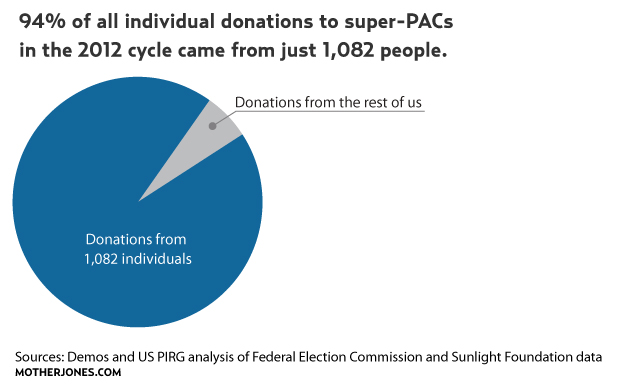
So, to what extent are the values and goals similar to those of the Occupy movement? Well, I’m not sure, but people who are concerned with social justice will recognize the real divide between the economic elite and those below them.  The haves and the have-nots.

Control of the levers of political, and thus to a large extent social and cultural, power are in the hands of extremely wealthy people.  Most of the rest of us get to vote, but forgive my cynicism in pointing out that many people are frankly uninformed and thus have an oversimplified view of policy and thus support idiots.

Hence the current Republican party.  Is it a surprise that science, education, and social equality are not on the list of things-to-do for people who have done such a good job of swaying an electorate with propaganda and emotional appeal in the place of news and public policy? It shouldn’t be.

The Republican party is in serious need for a takeover by people who, while I disagree with them philosophically in most cases, have some important contributions to make to political thought.  You know, the old style intellectual conservatives a la Barry Goldwater.

Clearly Atheism+ is heavily progressive.  My guess is that atheists who lean conservative in this political climate will tend to not support the cause, and if they do so they will do so weakly.  And I don’t mind that it is progressive, because I am largely progressive myself, as are the other people here at PolySkeptic.  Hell, as I said yesterday, I am in favor of being radical, and perhaps I could be described as radical politically, to some extent.

So, do we try and overtly tie the messages and goals of the Occupy movement with Atheism+, or do we think that many of the Occupy people might resent that and leave their meme to their use, and simply help where we can?  Can we call ourselves part of this larger social movement? Because while people in the 1% are probably both atheist and theist, nonreligious and religious, clearly most of the atheists are part of the 99%, and the values of atheism+ contribute t0 the values of Occupy.

The Occupy movement is not about religion or god-belief, although certainly the levers of power have historically been tied to institutions such as the Catholic church and other theocratic forces.  But today the most wealthy don’t, as a rule, sit near an altar, a throne, or in the metaphorical clouds as gods or demigods.  Their power is levered by money, political maneuvers, and ideology.  All tools utilized by religion, sure, but we cannot directly tie the atheist movement to the 99% Occupy movement.

What we can do is point out that many atheists share the popular values of equality, social justice, and the existence of fair opportunity for all people.  Our culture, political institutions, and approach to problem-solving is in dire need of adjustment, and in some cases demolition and rebuilding.  Too much innate privilege is further privileged, too little room for proper application of skepticism is allowed, and too many people are uneducated about how to fix it or even think about it.

As Thomas Jefferson said to William S. Smith Paris in a letter written in 1787;

God forbid we should ever be 20 years without such a rebellion. The people cannot be all, & always, well informed. The part which is wrong will be discontented in proportion to the importance of the facts they misconceive. If they remain quiet under such misconceptions it is a lethargy, the forerunner of death to the public liberty.

We have been too long without a real change in political and social atmosphere.  We, as a culture, are stagnating.  I don’t know what the best solution is, but I know the direction we are going as a culture cannot be it.

To get to a world of social justice and reason and to not continue on this path which empowers so few and keeps ignorant, distracted, and stupid so many, we need drastic change.  While we debate such easy questions as gay marriage, “legitimate rape,” and the place of religion in public policy, the vast majority of us are being swindled without full realization.  The classic misdirection of the pickpocket, except the pickpocket lives in a massive estate and pick-pockets millions of people every day.

We are not powerless, but we are not utilizing our powers.  We need more things like Occupy and Atheism+.  We need education, information, and a set of values to follow towards cultural and political transformation.


Social justice, at all levels, needs to be radical


With the recent label of Atheism+ becoming all the rage, I have been thinking about things like social justice a little bit more than usual.  As a self-described liberal/progressive, even as a voting independent, I do care about creating a world of fairness and compassion.  But I am hampered by a relative privilege which prevents me from fully, naturally, grasping how badly our society needs to consider social justice as necessary.

This blog is undoubtedly a place where we talk about “first world problems.”  I address the assumption of monogamy, theism, unskeptical thinking, and a host of other intellectual problems which take place at all levels of society, but which are mostly relevant among the educated elite of our world.  That is, the educated Western middle class, which you are likely a part of if you are reading this, are subject to really poor thinking, but their problems are pretty insignificant when it comes to the crippling poverty, violence, oppression, and so forth which some other bloggers address.  But they still matter.

I am under no delusion that most of the things we discuss here at PolySkeptic are of lesser importance than many of the issues which social activists deal with.  But what I am willing to say is that the methods we employ—skepticism, logic, and a willingness to accept challenge—are the methods that we need to employ to solve problems of all levels and kinds.

Take, for example, this article from Phillymag.com about PTSD in Philadelphia (it’s quite excellent, so take the time to read it all).  It addresses the cycle of violence, physical brain damage from experiencing violence, and cyclical behavioral effect of said damage on cities such as Philadelphia.  The article takes a scientific approach to the problem, painted with set of narratives, and talks about how we need to approach this on a large scale, as a society.

From the article (page 4):


There’s a solution available—a remedy that might change this city’s funereal culture. But when entire neighborhoods become toxic, the medicine has to be vast in scope. “You really only have two choices,” says Drexel’s Sandra Bloom. “You can remove the person from the environment, or you can change the environment itself.”

So, says Bloom, individual treatment can be helpful, including both talk therapy and pharmaceutical interventions. But big cities like Philadelphia, with large neighborhoods subjected to decades of violence, need to think in broader, more dramatic terms. “To treat large populations and cause a cultural shift,” she says, “we need to look at the kinds of group treatments”—including group therapy sessions and a wide mobilization of mental health resources—“that have been employed in war-torn places like Rwanda and Bosnia.”

Upon first reading, this seems an outrageous statement. In 1994, Rwandans suffered 800,000 deaths in 100 days. But Bloom’s point isn’t that the horror visited upon Rwandans and the murder and injury rates in Philadelphia are statistically equal. Her point is that they are shared experiences of protracted violence that have shaped the way entire communities think and live.


There are so many assumptions, experiences, etc which make up our worldview that we are almost completely unaware of.  We are often so blind, not only to what life is like to others, but even to why we think and behave the way we do, that to try and solve these kinds of problems seems daunting.  Our lives are framed by our experiences, our environment, and we too easily obstructed by such things to see that the problems around us affect us.  We are interconnected in cultural, political, and ideological ways which are usually unseen, but we should try to see them better if we care about solving them.

Whether we are talking about PTSD/violence cycles, poverty and political/legal systems of keeping people poor, religious indoctrination and skeptical skills, or the assumption of monogamy and how that affects how we think about love, relationships, and sex, we have to be aware that any solution will have to be broad and persistent.  We need people aware of the problem and who are capable of helping in some way.

That is what social justice is about.  And now we are starting to see that the atheist movement is being included into the set of social justice issues, and is subsequently willing to group together, as atheists, to lend some hands in spreading ideas, proposing solutions, and hopefully to get our hands dirty in addressing social justice issues.  Many atheist groups have been doing so for years, and now we have a label for such efforts.  I cannot imagine a good reason to oppose this label.

As a community, we have had the discussions, are becoming more aware of the problems, and are realizing we need to create formal and informal organizations to move towards better ways to address the issues which surround and bind us.  Call it Atheism+, call it secular humanism (but perhaps with a generational upgrade), or call it snarfwidgitry for all I care.

But realize that if we are to survive this adolescence of the human race, we need to address some of the fundamental problems, from the crippling poverty, oppression, etc to the lack of application of skepticism to questions of relationships.

We have to be willing to question all of our assumptions, learn to check our blind spots (including privileges), and not simply accept the prevailing wisdom as wise.

In short, we need to be at least a little radical, or we will continue to make the same mistakes over and over again.  Because while we are not inherently Fallen and sinful, we are inclined towards behaviors which are damaging to ourselves and other, and we need to actively work to counteract such inclinations to be better as people, societies, and a species.


Three Parents?


Editorial Note: This post was written by Wes Fenza, long before the falling out of our previous quint household and the subsequent illumination of his abusive behavior, sexual assault of several women, and removal from the Polyamory Leadership Network and banning from at least one conference. I have left Wes’ posts  here because I don’t believe it’s meaningful to simply remove them. You cannot remove the truth by hiding it; Wes and I used to collaborate, and his thoughts will remain here, with this notice attached.

—–


The UK’s Nuffield Council on Bioethics has recently approved a controversial fertility treatment requiring three genetic parents:

scientists are hoping to see it used as a therapy to eliminate rare mitochondrial diseases. Mitochondria function as powerpacks that can be found in virtually every human cell, and just like the nucleus, they also contain DNA. Unfortunately, inherited defects in this mitochondrial DNA affects approximately 1 in 5,000 births, leading to severe or even fatal results.

Researchers speculate that a way to overcome this problem is to take two eggs, one from the mother and one from a donor. The nucleus of the donor egg is removed, leaving the mitochondria intact and replaced by the mother’s nucleus. The resulting embryo has properly functioning mitochondria from the donor — resulting in a potentially healthy baby, albeit one with three parents.

This research is in its infancy, and right now is only meant to be used to prevent mitochondrial disease, but it’s not hard to see how further research in this area would be of great interest to poly parents. Using this procedure, the resulting baby would have only .1% of its genetic material from the donor parent, but even so, having just a bit of a child’s genetic material be from them could mean the world to some parents.

Predictably, the procedure is already getting pushback from natural-law advocates:

“Just as Frankenstein’s creation was produced by sticking together bits from many different bodies, it seems that there is no grotesquerie, no violation of the norms of nature or human culture at which scientists and their bioethical helpers will balk.

“The proposed techniques are both unnecessary, and highly dangerous in the medium term, since they set a precedent for allowing the creation of genetically modified designer babies.”

He argued that such techniques would affect many generations and crossed “what is normally considered the most important ethical line in the prevention of a new eugenics” and this was “precisely how slippery slopes get created”.

The fact that arguments like this are taken seriously is the likely reason why we won’t see this sort of procedure available to three-parent households in anything resembling the near future. Still, as a member of a poly V, and one which intends on raising children together, this is certainly an interesting development.

Why Being Nice Means Nothing


Editorial Note: This post was written by Wes Fenza, long before the falling out of our previous quint household and the subsequent illumination of his abusive behavior, sexual assault of several women, and removal from the Polyamory Leadership Network and banning from at least one conference. I have left Wes’ posts  here because I don’t believe it’s meaningful to simply remove them. You cannot remove the truth by hiding it; Wes and I used to collaborate, and his thoughts will remain here, with this notice attached.

—–


Go read this article:

“God damn it, you’ve got to be nice” sounds porous and gutless next to Kurt Vonnegut’s “God damn it, you’ve got to be kind.” And it reveals the inherent deceit of nice. If you’re “being nice” to someone, you’re not being honest. You’re humoring a person you don’t want to be with and I don’t think I can trust you. Especially when you’re flattering a person one minute and talking shit about that same person when they leave the room. But if you’re “being kind” to someone, you are legitimately trying to understand where another person is coming from and you are willing to change your mind. You are also willing to persuade the person who is so determined to hate.

I’m not interested in being nice. I’m interested in being kind. I’m interested in having conversations with people who have the confidence to walk down a two-way street built on respect.

My thoughts exactly.

Praying for College Students? 10-10-10


So, apparently there is this thing called 10-10-10.  On August 10th, 2012, at 10AM, for 10 minutes, people are supposed to pray for all of the students headed off to college in a few weeks.

I never understood things like this.  I mean, I don’t believe prayer works, but even if I were to lend some legitimacy to prayer as an idea, are prayers which are done at a certain time, by many people, about a particular thing supposed to be more powerful?

Is this akin to getting a bunch of people to sign a petition to the president? (please sign that, BTW,if you already have not.)

Well, let’s take a look at Matthew 18:19 (ISV):

Furthermore, I tell you with certainty that if two of you agree on earth about anything you request, it will be done for you by my Father in heaven,

So, the book of Matthew claims that any two people who get together for a cause, and pray (appeal?) to sweet baby Jesus (or perhaps in his grown up avatar of old-bearded-white-guy.  Sort of like The Dude, but not as cool) then he shall do your bidding.  Something like that.  I personally never gave much thought to mentally controlling the universe through imaginary friends.

Image from the TV show ‘God, the Devil, and Bob.’ Apparently God (right) is an old hippie and Satan (left) was me in grad school. Except I drink beer. And I don’t have horns. Maybe.

What is clear here is that such a thing as 10-10-10 is not intended primary as a petition to the lord and creator of the universe.  It is intended as social media.  It is intended as a media campaign to get people to think about something.

Just not to do anything.

Because there is no reason, empirical, logical, etc, to think that prayer can accomplish anything.  Rather than waste time praying, we need to do.

And there are things we can do to help freshmen starting in college.  Hopefully, we have already worked towards giving them the best high school education we could, including excellent intellectual foundations in science, writing, and study habits.  Hopefully their parents, friends, and the world around them generally have given them good models for rational thinking, self-challenging, and emotional strength.

But now that there are people going off to be more independent, most for the first time, we can begin trusting them now.  We have to start thinking of them as adults, treating them as adults, and give them the wisdom of adult understanding of the world.

This means a healthy scientifically-based understanding of sexuality and safety.  It means at least a basic understanding of personal finances.  This means expectation of leaving your likely-parochial worldview; a preparedness to meet and interact with people with vastly different worldviews than they know.  It means these and many more things.

But in general, if we are concerned with students and young people in general, we need to be working, not praying, to make the world around us better.  We need to be educating ourselves, challenging our sacred or merely closely-held beliefs, and we need to address real problems head-on.

No god is going to help us.  Because if a god exists, it is clearly not interested in getting its ‘hands’ dirty.  The paltry, megalomaniacal, jealous god of many scriptures is not one I would depend on, even if I thought ‘He’ existed.  All evidence points to the only way we are going to get through this life is through mutual effort.

If I were the type of person to try and liberalize scripture to some warm-fuzzy interpretation, I would take Mt. 18:19, quoted above, as an ecumenical, almost secular message about working together.  It would mean that our actions, working together, would be the hand of some god, rather than our own effort.  But that is simply overly-metaphorical and ultimately anti-humanistic.

So, the next time I have a beer in my hand I will tip it in salute to all the new freshmen out there, as well as those getting ready to enter the “real world” at the end of the year.  Remember to challenge yourself, question your assumptions from time to time, and to get out and actually experience the world and other people.

Go out and have some (or a lot of) consensual sex, learn new things, develop a quirky hobby, listen to new music, read something not assigned by a professor, and occasionally have all night sessions of philosophical or personal discussions. In short I think students should learn, enjoy life, and transcend what they currently are.

Don’t take advice from conservative-minded people who seem afraid of “temptation” and leaving your confines of a tiny, religious, worldview.  More and more young people are leaving religion.  Let’s help that trend accelerate.  With the SSA around, I know that there are excellent people already doing so.

What do you think we can do to help students prepare for college or for life-after-college?

Poly culture is a two-way street with a memory


We here ay PolySkeptic have written about how polyamory is about figuring out what you really want and finding ways to get what you want.  We’ve also written about how it isn’t all about you.

Our little polycule–that is, those closest to me and with whom I spend most of my time–think a lot about the right way to do relationships.  We slip up, now and then, and certainly have a lot to learn, but we aren’t douchebags.  We know that not only other people have the same types of needs, desires, etc as we do, but also that when we don’t act this way the poly community around us has a memory.

You know, because we understand the basic idea of ethics and social dynamics.

Figuring out that you are actually attracted to, want to date, or are in love with more than one person is great.  Pursuing relationships with multiple people is great too, so long as you communicate and remember that they are people.  But the poly world is pretty small, and if you act like a dick it will eventually come to pass that potential partners will find out.

And eventually you will have trouble finding a date within the poly community, except, perhaps, with the other douchebags.  This inevitably leads to sub-cultures, within polyamory, of various kinds of people.  This would be a fascinating study for anthropologists.  Behavior-patterns tend to clump people into types of groups, and those who make the same kinds of mistakes will end up, in the long run, with similar people.

Because bad-behavior is co-reinforcing, I suppose.


What kinds of behaviors will get you in trouble?

Not wanting your partners to have other partners is not good poly etiquette.  For example, a guy wanting to collect a ‘harem’ of girlfriends, but making relationships those women have with others difficult via manipulation or some combination of rules or veto.  Veto rules really are not good, people, and this is one example of how and why.

Breaking up badly.  Ideally, when a relationship isn’t working, you should have a conversation and find a way to remain as amiable as possible.  Communication is critical when breaking up, unless some egregious harm was done by the other, in which case you can just walk away.  In the case of many break-ups, you may find that you just need to change the nature of the relationship.  We need to be able to be mature enough to face the harsh realities of love, sex, and friendship and have hard conversations.  People in the poly community around you will find out, eventually, about your bad breakup tendencies.

How do you treat your partners’ partners and their friends.  You don’t have to be friends with everyone.  You don’t have to like them.  Hell, you don’t have to pretend to like them if you don’t.  But are you honest with them? Do you give them an opportunity to impress you or do you keep a distance through some combination of intimidation, fear, and jealousy?  Do you talk badly about them to your partner? And if so, are you aware that your opinion is valid, wanted, and possibly completely wrong?

There are many more ways I could articulate, but it comes down to this; are you being a douche-nozzle? Or are you making an effort to be open, communicative, honest, and are you making an effort to understand other people involved so that your conclusions, actions, etc are informed and mature? In short, are you trying to be an adult?

In the mono world, there is enough room to treat a few people like crap and get away with it for a while, even though you should not do so.  You can simply hang out in a new crowd, move to a new part of town, etc.  But the poly world is small (but growing), and being an idiot will get around faster.  In order to have happy and healthy relationships for years to come, and be able to add new people to your life as they come around, you want to be surrounded by good people and have them respect you.  They only way to do that well is to treat your partners, friends, and acquaintances well and to strive to keep getting better.

It will not always work.  Some people simply are not ready to be adults and they will not wish to be around you anymore and they will be stuck in their world with similar people.  But in the long run they will suffer the result of that, and we can only continue to maintain our life, struggling with what we carry and remembering that the good people we meet along the way help with the heavier stuff from time to time.

And in the long run those who make worse choices will find themselves older, not wiser, and stuck in the beds they have made.  All of you out there who know people who get to the point later in life who still struggle with basic life and relationship problems know what I’m talking about.  People hide, when younger, their issues they have not dealt with and they are able to carry on without significant notice.  Those that struggle earlier with self-improvement will struggle less later, and it will show because the resulting adeptness/ineptness will become apparent.

This life is a struggle with the interaction of our issues with the issues of those around us.  There are better ways to deal with these things, and their are worse ways.  That is, there is actually an objective component to figuring out how to live well.  The test is the real world; what works.  Open and honest communication works better than lack of it.  Facing problems directly works better than avoiding them.  Treating people as complicated and real sentient beings works better than treating them as mere objects of your own desires.  The truth works better than delusions.

Now, if only the delusional could grasp that….


Misogynist repellant!


Inspired by Jen McCreight, I’m going to see how many of these hideous, off-putting qualities I share with most American women (especially the highly educated ones):

1. They’re fat. (Not by any sane standard, but I’m not placing bets on how sane this guy’s standard is.)

2. They’re constantly glued to their phone. (It’s better than intermittently glued… last time I tried ripping it off the superglue took off two layers of skin, so I just keep it glued on now. Makes showering a bitch.)

3. They cut their hair short. (Yup.)

5. They think being funny and witty is a quality that men love. (Be fair, the laughter is a bit misleading.)

9. They have condoms in their drawers because they expect to have random sex with strange men. (Ah yes, random sex. Basically I just walk into a crowded room and see if any penes randomly happen to slip inside me. It’s the best!)

13. They don’t know how to be sexy. (It’s true. I have no idea. Sometimes people find me sexy, and I’m gratified, but it’s rarely because of any planned effort on my part.)

16. They wear pajamas in public. (Only sometimes!)

18. Their idea of travel is going to the beach or France. (Indeed, my idea of travel incorporates both pleasing geographical features and unfamiliar cultures. I’m such a whore.)

20. They are proud to date multiple guys at the same time, as if they were men. (It’s… uh… I just don’t even know what to say to that one.)

24. They make lame excuses for not putting effort into their appearance. (Technically I do put effort into my appearance: I put on clothes every day, usually earrings too, and I quite often put a little product in my hair. But, as with “fat,” I suspect this guy and I are using totally different scales.)

30. On their way home from work, they put on dirty sneakers that don’t match their outfit. (In the summertime it’s Chacos instead of sneakers.)

33. They insist on eating pizza or otherwise fattening food after a night of binge drinking. (Sometimes before, too!)

34. They’re obsessed with cupcakes. (It’s true. I love cupcakes. I’m not sure why this is an issue with this guy, but taking in this and #33, maybe he thinks women properly feminine women have unique limbic systems, lacking the appreciation of fats and sugars that men and us slobby American whores have?)

35. They care more about maintaining their career than a good home. (I write papers while my husband cleans. Thinking about how much that would piss this guy off makes me giggle.)

36. They rarely wear high heels. (I’m trying to phase them out completely!)

And now, a couple that don’t apply to me, but that shattered the Ironometer:

39. They are uncomfortable in their own skin. (Nothing says ‘uncomfortable in your own skin’ like maintaining a fairly natural appearance, wearing shoes and clothes that feel good, and enjoying the pleasures of tasty foods.)

42. They go on and on about the stupidest shit. (HAhahaha… awwww.)

Because I’m polyamorous…


Ian Cromwell has been running a series of essays submitted to him entitled “Because I’m an atheist…” and I have been reading them for a while.  Today, my answer went up, which caused me to think about the implications of being polyamorous.

Because I’m polyamorous, I don’t have to pretend to be anything other than what I am.  I live such that if I meet someone I’m interested in, no matter how I’m interested in, I don’t have to nudge that interest into “appropriate” directions.  I don’t have to avoid friendships with people to whom I am attracted, nor do I have to suppress feelings of attraction, which in the long run often leads to feelings of resentment and often clandestine sexual relationships which destroy relationships when they don’t have to.

I get to love each person according, not to some pre-scripted appropriate way, but to how I actually do want to love them.  All I need is them to have mutual desires, open communication about said desires to my other partners, and the time and inclination to pursue them.

It also means that I get to be who I am, completely.  My wife and girlfriend both know I find other women attractive, but because they know this they know that the affection I show to them is genuine and authentic.  I’m not in a situation where all of my affection is tunneled towards one person, and they have to wonder if I’m only doing it because I have to;  because I have nowhere else to act on such feelings.

As such, because I’m polyamorous there is more grounds for security on my relationships.  See, rather than threaten my relationships, my (as well as my partners’) ability to pursue other people for friendship, hookups, or possibly a new relationships means that if I stay with someone, I really want to be with them.  With (serial, especially) monogamy, it is too easy just to keep holding onto a relationship because you are not sure if you will have another one available(which, of course, is not a good reason to stay in a relationship!).

The big threat for monogamy is often other people.  With polyamory, other people is the rule and so that threat is made mostly impotent.  Of course, interpersonal issues may still arise (as they do with monogamy), but ideally when that other person comes around and draws your partner’s eye, you know they will still come back to you again and again.

Because I’m polyamorous I have been forced to mature emotionally (specifically concerning jealousy), develop better communication skills, and think more about the differences between what we actually want and what we decide is good for us.  It is clear to me that most people want to be with more than one person sexually, romantically, etc.  What is not clear to me is why so many people are monogamous.

Because I’m polyamorous, I have developed a keener eye about how we, as a culture, think about relationships, love, and sex.  So, because I’m polyamorous, I have a better perspective on romance, sex, and relationships than most monogamous people.

Ultimately, because I’m polyamorous, I write about polyamory so that more people can understand why this lifestyle is so wonderful, challenging, and worth every ounce of effort.

Latest Celebrity Cheating Scandal That Could Have Been Solved by Nonmonogamy


Editorial Note: This post was written by Wes Fenza, long before the falling out of our previous quint household and the subsequent illumination of his abusive behavior, sexual assault of several women, and removal from the Polyamory Leadership Network and banning from at least one conference. I have left Wes’ posts  here because I don’t believe it’s meaningful to simply remove them. You cannot remove the truth by hiding it; Wes and I used to collaborate, and his thoughts will remain here, with this notice attached.

—–


In case anyone cares, Kristen Stewart (the vapid lump of clay from those bag-of-shit Twilight movies) cheated on her husband. Or boyfriend or something. Then apologized. Yawn. I only bring it up because this article brought up a good point:

What struck me about actress Kristen Stewart’s public apology for her infidelity wasn’t that it was a rare case of a famous female doing so — although that is notable. Nor was it the fact that celebrities are expected to issue public apologies about the most intimate aspects of their romantic and sexual lives – which is also remarkable. Instead, it was the language she used to explain the affair. She described it as a “momentary indiscretion,” which called up a host of post-affair cliches: “I made a mistake,” “It just happened,” “I wasn’t thinking,” “It was a lapse in judgment” – and so on….

“The chance to feel in love, to feel expanded in some way, to feel understood or intimate with another person, or to be sexual with another person, are powerful pulls for many people,” she says. But those pulls are harder to explain to the cheated partner. “Because of societal stigma around cheating and affairs, it’s also difficult for many people to say things out loud, and sometimes even to themselves, such as ‘I just really desired that person.’”

This is a really good point. The article also points out that cheating is very common, and is often due to the feelings described in the above quote. Those of us familiar with nonmonogamy are very familiar with those types of feelings. The difference is that we do say those things out loud, to ourselves and to our partners.

It’s sad that nonmonogamy is not accepted enough for it to be mentioned in an article of this type. It seems a glaringly obvious omission to anyone familiar with the idea. The assumption of monogamy is so strong that a person can say “it’s… difficult for many people to say things out loud” without suggesting that maybe a person ought to say things out loud, and have a conversation with hir partner about how best to handle each other’s feelings. The article makes it sound like feeling desire for someone outside of a relationship is an unsolvable situation. We know that it’s not.

“You’re Just Trying to Win the Argument”


Editorial Note: This post was written by Wes Fenza, long before the falling out of our previous quint household and the subsequent illumination of his abusive behavior, sexual assault of several women, and removal from the Polyamory Leadership Network and banning from at least one conference. I have left Wes’ posts  here because I don’t believe it’s meaningful to simply remove them. You cannot remove the truth by hiding it; Wes and I used to collaborate, and his thoughts will remain here, with this notice attached.

—–


Generally, I don’t like things that are good for me. I’m really envious of people who like exercise. I hate it. I like sports and games that involve physical activity, but I have real trouble motivating myself to do the exercise video that I do every morning. I’m only able to do it through a combination of bribing myself with television and discipline. Needless to say, I often fail.

One of the few things that’s good for me that I actually like is arguing. Arguing is good for you. Engaging in rational argument is one of the most important steps in rational thinking. We all have unconscious biases which may be completely invisible to us, but obvious to a third party. Submitting our ideas to criticism and rationally defending them is one of the only ways to expose biased thinking. It also has a chance of exposing us to new information or new perspectives that we hadn’t considered before.

I count myself lucky that I enjoy argument. Most people do not. Despite its virtues, engaging in argument, especially about things we consider important, can be daunting. Putting your ideas (especially controversial ideas) out into the world means exposing a vulnerability. Giving people access to your thoughts and feelings, especially when others are likely to disagree, is like giving someone a handbook on how to attack you. It’s scary.

It’s also scary because it puts you on the spot. Arguing about an idea means that you have to be able to articulate, in rational terms, why a certain idea is good, true, useful, etc. This, of course, is one of the reasons why argument is good for us. It’s a lot easier to justify something to ourselves than to articulate the justification to other people. Even if we get no pushback, just the process of saying it out loud often makes us look at our ideas from a new perspective. If we do get pushback, we’re forced to consider other people’s ideas, and answer their questions. It forces us to go outside of our own head and confront our ideas from another person’s perspective. If I can’t articulate a rational justification for an idea, I take that as an indication that my idea is flawed, or at least that I have some thinking to do about it.

Because I enjoy arguing, I do it a lot. I especially enjoy arguing about topics where my thinking is most outside the mainstream, as those are the topics where (a) it’s easiest to find people who disagree, and (b) I have the highest chances of being incorrect. The result is that I often find myself arguing about what honest communication really means, atheism, polyamory, and concepts like that.

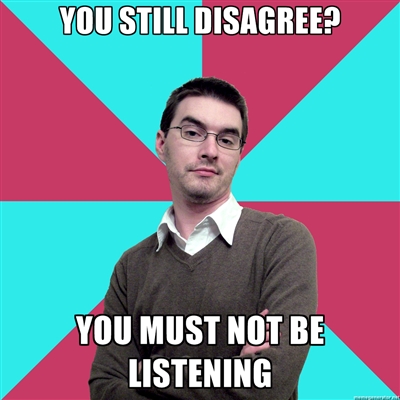
You still disagree? You must not be listening.Recently, I was accused of “just trying to win the argument.” It was not the first time, and I’m sure it won’t be the last. However, I feel it’s a very unfair criticism. For one, it’s an ad hominem attack, and has nothing to do with any of the points being argued. This is all to common in discussions online. People tend to resort to this sort of thing early and often on the internet, as if the only reason that you could possibly disagree is because you have some sort of character flaw which prevents you from seeing the undeniability of the point being argued. Another issue is that I’ve never seen anyone actually make a rational argument attempting to prove that my motives are questionable. It’s always just been tossed out as a way of ending the argument while simultaneously blaming me for perpetuating the argument. Implicit in this statement is the subtext that “if you weren’t just trying to ‘win,’ you would have conceded defeat by now.” It’s implied that the other person’s argument is just so devastating that to continue to disagree merely shows my closed-mindedness.

In reality, if I’m perpetuating an argument, it’s because I disagree with my opponent. Like I said before, I enjoy arguing. But I do not enjoy it when I have substantial doubts about my own position. When I have such doubts, I tend to take a much less confrontational stance, and view the conversation less as an argument, and more as a joint venture, where we’re both trying to figure out how to properly think about a concept.

Most of the time, I’m rather confident in my positions. As I said previously, I argue a lot, and I’ve heard all of the counter-arguments that anyone is willing to make to me. Chances are, if you’re arguing with me on one of the topics I mentioned above, I’ve heard your argument before, and I have a counter-argument ready. Not because I want to be ready to win arguments, but because, if I didn’t have a convincing counter-argument, then I would probably not disagree with your position. The fact the I’m arguing against your position is evidence only of the fact that I disagree with you. If I wanted to win, there are better ways to do so than arguing rationally:

If I’m making a rational argument, it means not only that I disagree with you, but that I respect you enough to think that there’s a chance that you have something to teach me.