Atonement and Monogamy as Impossible Ideals


As a student of anthropology, I think a lot about cultural constructs which permeate our lives, most of which are pretty invisible to us most of the time.  From an early age I was fascinated with the various institutions of religion, as well as the many more personal spiritual ideologies people espouse, and the various psychological and sociological structures which surround them.  Later on, I started thinking about similar aspects of how we think about sex and relationships, and eventually found many similarities between how we think about gods, spirits, and sex.  This is no surprise since one of the best ways for religions to hold our attention is to demand certain behaviors is to hold us hostage with fears about our deepest inclinations; sex is a great example of this.

In religion, there is this idea of atonement.  It comes in many forms from many theological systems, but it is basically the way that we come to make amends with some supernatural or natural power.  Whether we have to deal with a fundamental brokenness in our nature, some separation, or lack of enlightenment (to only scratch the surface of ways religious ideas deal with this atonement thing) from the power we seek atonement with, there is a set of actions and beliefs which we must do or have in order to reach some ideal relationship with the universe, deity, or ourselves.

Tantalus perpetually reaching for fruit and water he will never grasp

It is my view that the religions which survive best find a balance of difficulty and comprehensibility in the ideals it sets up.  Adherents must be, like the  Tantalus of Greek mythology, perpetually reaching for this ideal of atonement which they cannot really achieve, but it must be something they can imagine as a logically possible thing to have.  Sure, people can think that they have achieved the goal (as many Christians believe they are saved), but the scriptures and religious leaders will always mention that this is pride, or something similar in order to keep them in check.

Opposed, conceptually, to atonement is some detriment presented as part of our nature or circumstance.  We stand unenlightened, sinful, or separated from some god(s), knowledge, or understanding and we will remain there until we atone, repent, or whatever must be done to solve this problem, heal this sickness, etc.  As Christopher Hitchens said many times,

Even the most humane and compassionate of the monotheisms and polytheisms are complicit in this quiet and irrational authoritarianism: they proclaim us, in Fulke Greville‘s unforgettable line, “Created sick — Commanded to be well.”

The bottom line here is that there is a tendency in human worldviews, whether religion or otherwise, to present a highly unlikely ideal against some much more likely, and often repugnant, set of behaviors or beliefs which we must be encouraged away from.


The sin of non-monogamy and the atonement with The One.

There is a mainstream view of sex and relationships, here in the modern west and most other developed nations, with monogamy as the ideal relationship type.  The majority of cultures have some version of this practice, and it’s major competitor is some kind of patriarchal polygamy.  Polyandry or true sexual/relationship equality is rare and considered aberrational when it occurs.  It took quite a while before we would have a sexual revolution, and with it true freedom started to become part of our cultural consciousness.

And yet even still there exists within our sexually liberated world a distinction between studs and sluts; men are expected to be promiscuous, women are often valued for their “purity.”  These promiscuous men and these sluts are expected, or at least encouraged, to eventually outgrow this part of their life and find The One, or at least settle for A One.
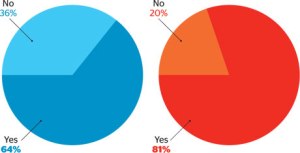
Do you believe that lifelong monogamy is a realistic expectation for a married couple? (click for context and details)

For most people who have a period of sexual liberation, it ends with the attempt to reach an ideal of monogamy. Men and women may be expected to have sexual experiences in their teenage years and into their 20’s, but eventually most people expect them to settle down.  “Settling down” means taking relationships seriously, and usually means exclusivity, marriage, and monogamy.  So while we are liberated as a culture in terms of having sex before we “get serious,” get serious we should, because seriousness means exclusivity and exclusivity is good.

The fallen circumstance, or nature, which even our progressive culture patiently tolerates for is one of promiscuity.  But this sexually liberated part of our lives is held against a stable future ideal of monogamy.   The holy grail of relationships, The One, is presented against the superficial and regrettable reality of youthful promiscuity.  This One is The  person with whom we can have a real relationship, rather than failing perpetually hopping from one insignificant relationship to another (sometimes at the same time!).

A mnemonic device I learned years ago about the word atone was that you can break it down into at+one.  In other words, especially for many Christian traditions, the goal was to work to become at one with some god or another.  All of our other inclinations, not having to do with this atonement, should be secondary to that relationship of working towards chasing that ideal, because nothing was more important than that.  Monogamy has taken a similar place in our culture as that ideal of religious atonement; the sinful and superficial world of sex, lust, and other failings of human behavior are presented against an ideal of monogamy.  That is, even liberal society maintains this ideal, even though that liberality allows sexual promiscuity, co-habitation before marriage, etc.  Anything that looks like monogamy, even if it isn’t really marriage, is what we should be striving for.  The difference here between mainstream conservatives and liberals on this issue is how we get to monogamy, not whether that is the goal.
This shows me that culture tends to be truly human (all too human!) and tends to have worldviews which are conservative even when we are progressive (I actually argue that today’s liberals are tomorrow’s conservatives, because the mainstream is largely conservatives concerning ideals).  We conserve ideals, even as our values shift.  So, even as we become increasingly liberal as a society in terms of seeing redemption and atonement in looser and looser terms, we hold onto the ideal itself.  Liberal views about the supernatural and what we should be doing with our lives changes in terms of the details of the path to get there, but the destination does not really change.  This is one of the greatest failings of most of mainstream liberal culture; it does not seek to question the ideals, assumptions, and goals of our worldviews.


Ideals Worth Wanting

What should be the strength of progressive culture, or perhaps a radical culture, is the re-valuing of our values.  We need to evaluate what is worth valuing, not what we should change in terms of how to get to our Heavens, Nirvanas, or other paradises whether they be otherworldly or physical.  The question is not how we can get to paradise or what we are allowed to do before we settle into monogamy, the issue is why do we value such ideals? Why is being at one with some supernatural power good? Why is monogamy the ideal?

I don’t think there are good answers to those questions, except to say that perhaps those things should not be ideals at all.  With religion, atonement is merely an impossible goal, set before us to tantalize us and keep us striving and behaving within acceptable boundaries.  Monogamy is no different, in that the only way to achieve it is to pretend as if our ability of love is so limited, and our sexual desires so parochial, that we force ourselves into ideal relationship expectations while repeatedly failing in thought if not act.  There is no reason to set us up with impossible ideals which make no sense to value, whether with gods or monogamy, when we have real ideals to inspire us.

A skeptical approach to reality brings us to an informed and skeptical atheism, and allows us to love the people we love, the way we want to love them, in order to live authentic and rewarding lives.  And while we may never be ideal skeptics or lovers, we can at least have ideals worth wanting.
 

God Who?


So, there’s this:

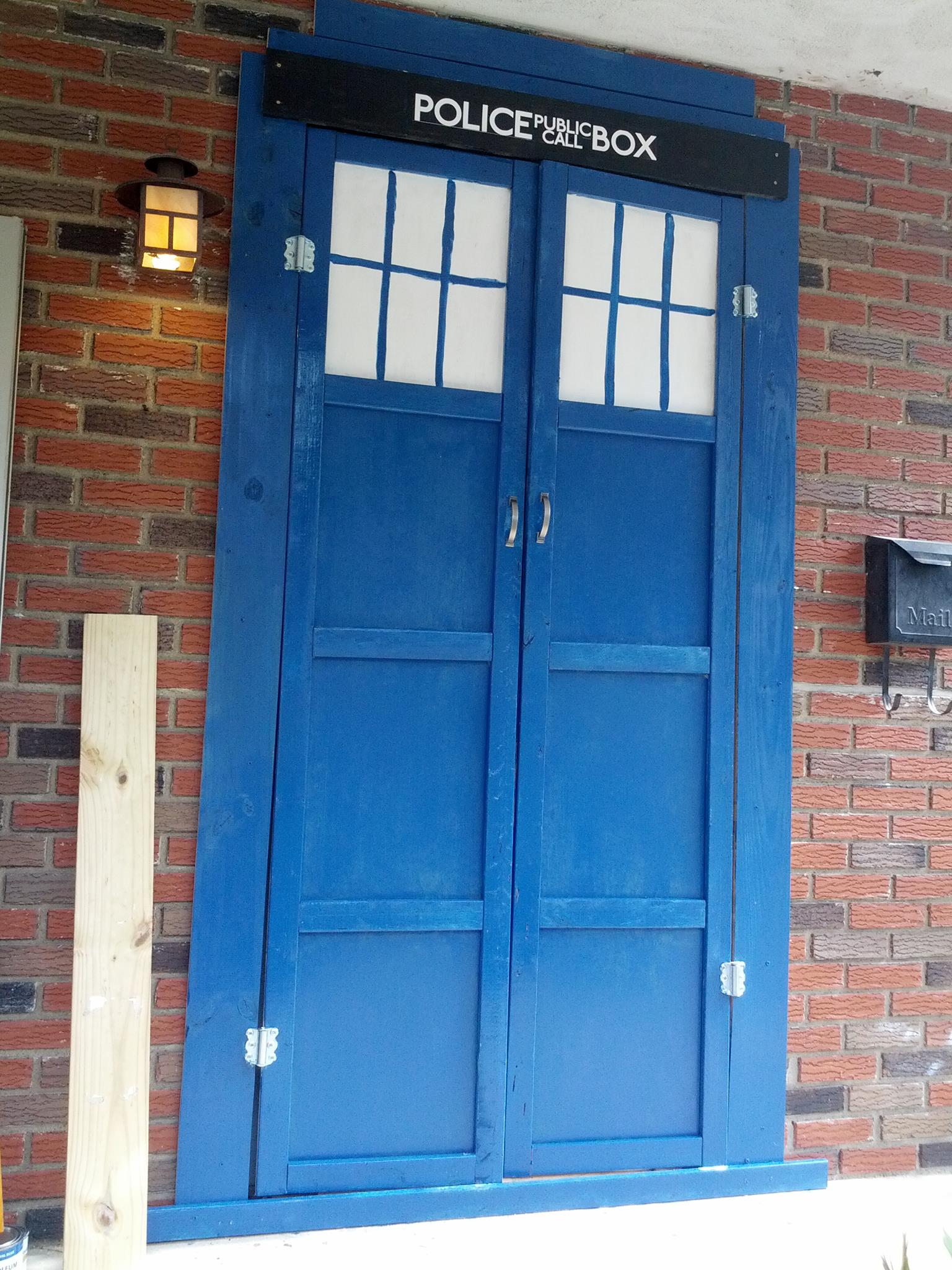
OK, so first of all the doorway to the polyskeptic compound is totally not in the shape of the TARDIS.

If you drive around New Jersey long enough, you will see this door. If you do, don’t stalk me.

OK, it is, but that does not mean that the house is bigger on the inside.  But the house can travel through time and space! …although only forward in time at the usual rate and in space only relative to things like cars, people, and so forth which move around and through it.

There are a couple of issues with the video above, such as the definition of religion used is not universally accepted, but I think it would be somewhat silly to seriously criticize such a video made with at least one tongue implanted in some cheek somewhere.

OK, so that sounds like it might be sexual, but I guarantee I’m only slightly turned on right now (and that has more to do with the TARDIS; it’s bigger on the inside.  That’s what she said).

OK, terrible jokes aside, I am sure that under some definitions of religion, some people I’ve met might classify as Whovian-cultists or someshit.  After all, a cult is really just a religion that is not Christianity, right? (It pains me to reference Matt Slick, so I feel like I need to balance that out with this video of a discussion between Matt Slick and Matt Dillahunty about the transcendental argument for god, or TAG).

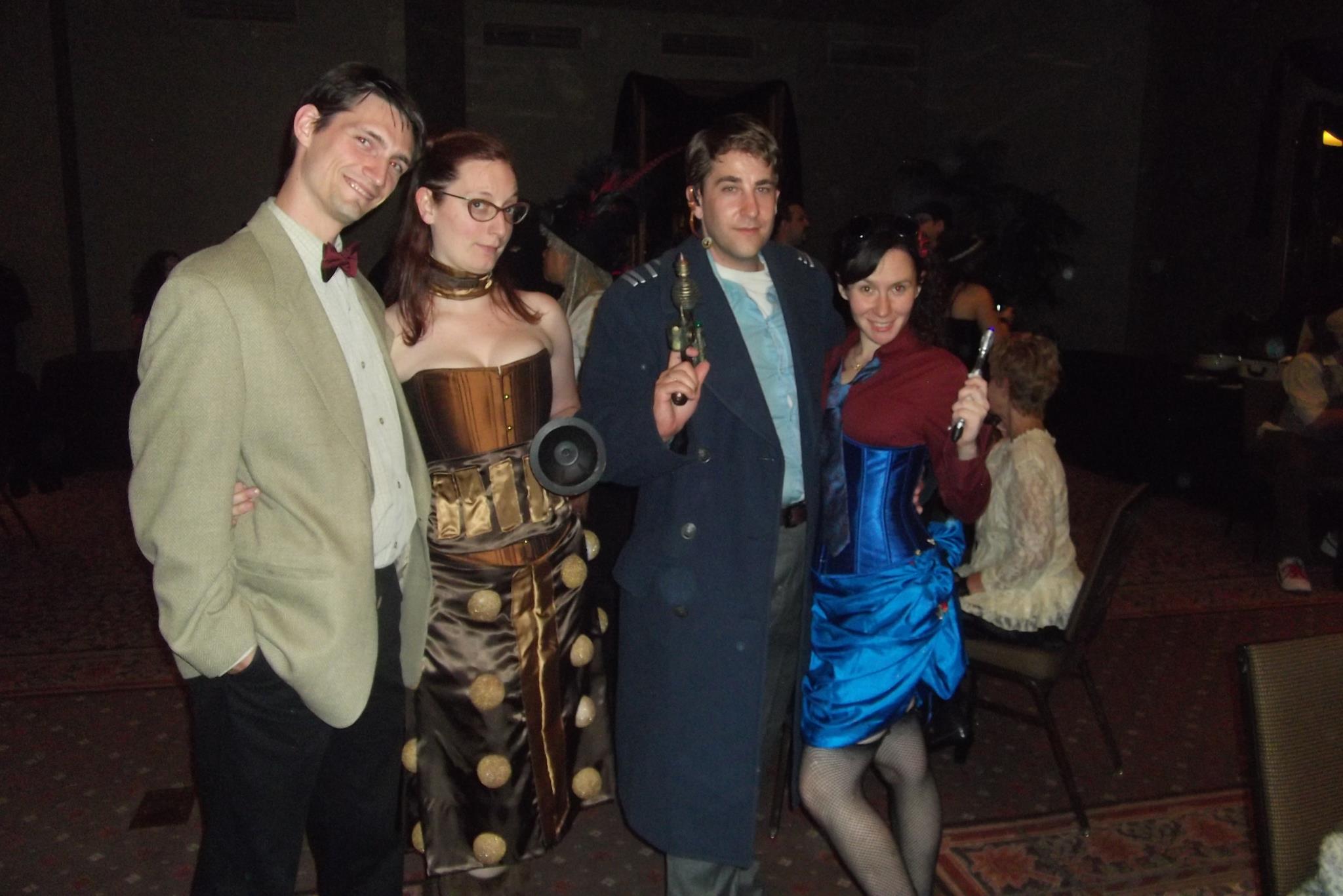
Two sexy Doctors, a Dalek, and even Jack Harkness participating in the traditional Whovian ritual of being drunk.

OK, so Doctor Who, in conjunction with its fan-base, might be thought of as a religion.  I have never thought of it that way, but I also think that one part of what makes something a religion is the acceptance, or belief, that the object of reverence is real.

And then I wonder how “real” the people who created texts in ancient times about gods, creation, etc thought the stories were.  I think part of what makes mythology interesting is realizing that for many people, throughout many eras, didn’t have the same distinction between reality and myth, nor did they have a solid meaning of reality which we would recognize.  In other words, it may be the case that many people who have religious beliefs are not thinking about “truth” or “reality” using empirical or skeptical concepts of either of those terms.

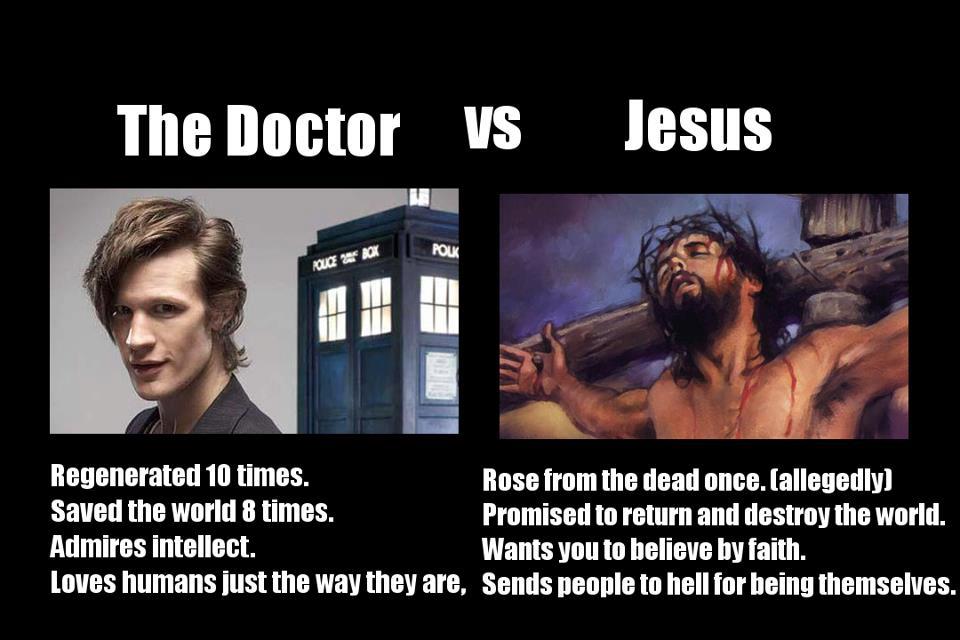
Certainly, people can take those mythological ideas and subsequently think of them as real in our modern sense, but the fact that they end up there does not necessarily mean they started there.  There is the question, for example, of whether many of the New Testament books were closer to literature than history (I would recommend Tom Verenna’s blog for more about that), and whether many scriptures from around the world are even comparable to any sort of skeptical inquiry.  It may be that Jesus was a character of inspiration for first century Palestine in a similar way as the Doctor is an inspiration for many people now, all over the world.

And this is the point where some people will point at me and be like ‘See! You admit that religion is not to be taken literally, so your criticisms of them as if they are literal beliefs is shown to be wrong-headed,’ or something similar.  The problem here is two-fold.

First, in many cases people do take mythology as real in the sense I mean it; as in it describes the actual world and they simply are wrong about the facts.  Second, the fact that some people do not think of things this way shows where they are going awry in not understanding that we have a reliable methodology for knowing things about the world, and that mythologizing the world is not a means to understanding, but obfuscation, parochialism, and ultimately a worldview based not on what’s real but rather what is comfortable or even non-confrontational.

Unfortunately, many postmodernist approaches to the world are much closer to those who mythologize the world, which is why, I think, many (secular) progressive intellectuals tend towards liberal theology or at least show deference to such liberal theologies.  Karen Armstrong, for example, has talked about ‘God’ without concern for whether such a thing exists, as if that was not even relevant.  While I appreciate some of the contributions of postmodernism in philosophy, the tendency towards anti-realism, as opposed to realism, in the philosophy of science and in metaphysics has always been a bane for me.

Art and religion

So, The Doctor is not real.  But the show can be a source for thinking about the nature of the world, our choices and their consequences, and so forth.  It’s a living mythology, of sorts, which many draw inspiration from.  But is that inspiration, entertainment, and possible edification spiritual? Is it a religious experience?

As a person who has never believed in supernatural realities, but who has had experiences that seem similar to the descriptions of spiritual/religious experiences, I would say that there is some gray area here.  Where I think I am likely to say no is that I think that these experiences are the result of art, and not religion per se.  Religion, the great usurper of all things human, has once again stepped in and claimed something as its own when it belongs to all of us, religious or not.

So, insofar as Doctor Who, or Star Wars, or Star Trek, or Shakespeare, or…you get the point.  So long as artistic expression invokes existential inspiration in us, it is art that has done it.  We need to stop associating these things with gods or spirits, because they are natural occurrences with no supernatural explanations necessary.

Where does this leave ‘religion’? Well, as we become more secular and educated as a species, I envision religion becoming conflated with artistic and ritual social ties which will probably never go away, even as their supernatural associations dissolve into the nothingness from which they came.  But we should not forget that those supernatural and irrational additions to the art we have created over time have been semantically tied to so many things, and that people will continue to associate nonsensical ontological concepts to everyday experiences, hopes, dreams, fears, etc.

Supernaturalism, theism, and even deism are irrational and even silly concepts which are clutching onto our art, even as they slowly die.  But the art, the inspiration, and the creativity of the human mind will continue long after the gods have all been forgotten.  So Doctor Who might be called a religion, but only in the loose and artistic sense that all that we do and love as humans is considered religious.  That is, in the watered down way that only seeks to distract us from what is truly irrational and dangerous about religion; faith.

When art turns into certainty, when creativity and inspiration is not checked by skepticism, is when it goes wrong for our art.  Because we can create illusory worlds to play in, but the imaginations of humanity are only for pretend and should not be guidelines from policy or morality without a skeptical check on their influence.  We need to leave faith behind because we don’t need to believe that our imaginings are real for them to be interesting.   Further, if we do believe they are real then we may be too unwilling, whether through reverence or fear, to make sure that they are rational.

So science and skepticism are not the source of all understanding, but they should be the arbiter of what we accept as true.  Art can inspire, entertain, and even teach us about the world, but we must make sure the lessons are actually true and not merely revere them unskeptically.

In other words, enjoy Doctor Who, and remember that he’s probably a better source of inspiration than Jesus.

Amen?

PZ Myers and Michael Ruse’s mis-attribution of the fault in our wars


I have been writing, reading, and thinking about the issue of accommodationism for some time.  Type ‘accommodationism’ in the search box above for some context, as there are too many posts to link to here.  I will say that  I have tended to agree with Jerry Coyne’s views about the relationship between religion and science most of the time, and I tend to agree with PZ Myers more often than not.

Yesterday, PZ Myers put up a post about Michael Ruse which I largely agree with, but I want to address something, not because it makes me disagree with the point PZ makes, but because I think it takes a step back and gives some larger perspective on this issue.  Here’s the relevant section from PZ’s post, quoting Ruse:

But wait! There are more paradoxes! One of the big problems with the New Atheism, says Ruse, is the way we idolize and support our leaders unquestioningly.

There are other aspects of the New Atheist movement that remind me of religion. One is the adulation by supporters and enthusiasts for the leaders of the movement. It is not just a matter of agreement or respect, but of a kind of worship. This certainly surrounds Dawkins, who is admittedly charismatic.

We worship Dawkins? And possibly Hitchens and Harris? Has he ever noticed how much we all freaking argue with each other? There are no saints and popes in the New Atheist movement.

Oh, wait, yes he has noticed. In the very next paragraph.

Freud describes a phenomenon that he calls ‘the narcissism of small differences’, in which groups feud over distinctions that, to the outside, seem totally trivial. It is highly characteristic of religions: think of the squabbles about the meaning of the Eucharist, for instance, or the ways in which Presbyterians tear each other apart over the true meaning of predestination. For those not involved in the fights, the issues seem virtually nonsensical, and certainly wasting energies that should be spent on fighting common foes. But not for those within the combat zone.

The New Atheists show this phenomenon more than any group I have ever before encountered.

So which is it? Blind, unquestioning worship of our leaders, or incessant fractiousness and dissension? It doesn’t matter. Ruse is just spinning his wheel of deplorable sins and accusing us of whatever random flaw pops up.

I will point out that PZ has missed that these two ideas are not, in fact, in necessarily contradiction, even if Ruse’s argument is ridiculous (which it is).  It is logically possible that people in the atheist movement idolize atheist leaders and that fractious arguments also result, just like with religion.  All it would take is a hypothetical Dawkins follower to argue with a Sam Harris follower, insofar as Harris and Dawkins would disagree.  And there are some people I have met who do seem to look up to some atheist “celebrities” with some level of idolization, but this is to be expected.  We are human, with personal flaws, after all.  The ideal, however, does not have anyone idolizing anyone.  I, for example, respect some people more than others, but I’ve never been a person who idolizes anyone, and never get fanboyish around well-known people, nor do I understand why other people do.

And I agree that there are arguments within the community, but I see this as largely a good thing even though in some cases it is evidence of bad ideas remaining among atheists (such as misogyny and privilege).  There is a lot of work to do before our culture matures emotionally, cognitively, and in terms of being aware of our privileges and biases.  And as a result of that, many atheists will tend to be stuck behind their own blindness, and fractures will exist which we need to addressed in the form of criticism and education of those people.  Hence Atheism+.

But what Ruse is identifying here is not so much that the atheist community is like religion, but that when groups of people gather for any common cause, belief, or lack of beliefs, they tend to have similar behavior patterns of idolization, arguing, etc.  So yes, the atheist community has some behavioral issues which are reminiscent of religion, but once again the error is in mis-attributing such things to religion, when in fact religion is the result of human group behaviors not the cause of it.  Ruse is showing how atheist communities are acting human, just like religious groups.  Why does Ruse make the (apparently unconscious) assumption that these behaviors fundamentally belong to religion?

Our goal—as skeptics and atheists concerned with our culture, our beliefs, and our actions—should be to improve how we all think, behave, and interact.  Those working on including social justice in their actions, whether atheist or religious, are taking a step in the right direction in such terms.  But what new/gnu atheism is about, Michael Ruse, is about asking whether the views some group has are true or not.  We must take as a given that we will err in how he think, behave, and interact, but the question which concerns us is whether our ideas are true, not whether our community is perfectly ideal.

That’s the long-term goal, and it will take time to get there.  And, as I understand it, this is what efforts such as Atheism+ were developed to answer.  Because if we want to address the human flaws and how they emerge in the atheist community, we have to understand how psychology turns into sociology; how our personal flaws turn into groupthink and tribalism.  The problem with religion is not that it fractures, idolizes its leaders, and then fights among themselves.  No, that’s a human problem which we all have to deal with.  The problem with religion is that it isn’t true; that they are arguing over fantasies.

Skeptical atheists, at least, are arguing over what is true with a methodology which works; science.  And if they are not using science and skepticism well enough, then we can use skeptical criticism to point out how and why.  When does religion do that? Religion uses logic on top of the assumptions of its theology, but it rarely, if ever, appropriately uses empirical methodology and good skepticism.

Michael Ruse is stuck comparing religion to atheism in ways which must be true because they are activities done by humans.  Where atheism and religion are alike, it is attributable to anthropology (what I have my undergrad degree in).  What Ruse misses, and what PZ does not articulate well in this case, is that what does separate religion from atheism is the concern for truth of worldviews rather than behavior of participants.

Because sure, some atheists go around  idolizing people and arguing over small details, but our goal is to help them personally grow until they are mature, skeptical, knowledgeable people with good cultural and personal perspective.  And unlike religion, we actually have real ways to achieve that because we do not have any scripture, doctrine, or limitations of criticism.

We have the best methods in our hands, no rules about where we cannot inquire, and only our personal flaws to hold us back.  That tempered by caring about what is true, rather than what is comforting, preferable, or sanctioned is a good road to progress.

Coming out poly in light of mainstream images


I’m out.  Anyone who knows me personally and socially who does not know that I’m polyamorous (or an atheist, for that matter), is either not paying attention or is just saying that they know me to look cool to their friends.  OK, that last thing never happens.  But that fact is that not everyone who is polyamorous is open about it, and they often have anxieties about if, when, and how they should come out to people around them, especially family.

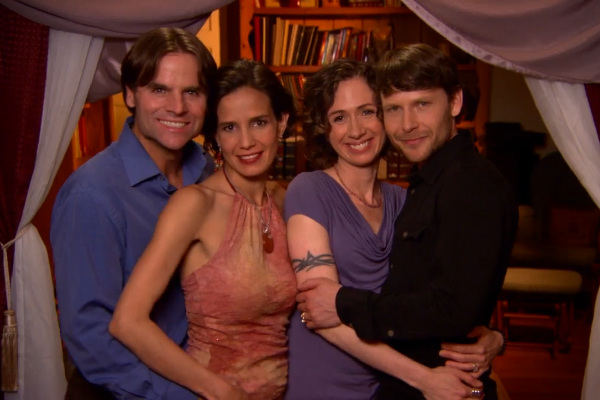
The “pod” from Showtime’s Polyamory: Married and Dating

Recently, I started watching the Showtime series, Polyamory: Married and Dating.  It’s a fairly good show, and this issue of coming out is dealt with, but I’m concerned with how the show will effect coming out for the rest of us.  I have a hypotheses that when a fringe or minority  idea, group, etc comes into the mainstream, it is almost always has serious misrepresentations attached to it.   Anyone serious about understanding the minority worldviews, upon its being portrayed in the mainstream, needs to do some personal research to get to the reality beneath the sexed-up mainstream presentation.

And that is true here, as well.  The people in the Showtime series are not “bad” representations of polyamory; in fact, they seem at least mostly realistic and genuine.  But what I think most people will take away from watching the series is that polyamory is a lot of sex with young, hot people all the time.  And, I’m sure, for some people it is just that.  At least, it is for a little while.  I certainly had a lot more sex, with more people, in the beginning of my polyamorous life.

I’ve been around many polyamory meetups, a few parties, and have talked with poly people form various backgrounds over the last several years.  The Showtime series, while somewhat good at presenting the open and honest form of communication between the people, is very focused on sex.  I cannot think of too many times when an episode goes more than 5 minutes without some kind of sex being displayed.  It’s not that I don’t like seeing hot, naked people enjoying each other, it’s that in my poly life nakedness and sex are not ubiquitous, and I think that’s probably true for most polyamorous people.

But I’m not here to analyze the saturation of nakedness in mainstream portrayal of polyamory, but rather the effect that such things have on other poly people, especially those who may be thinking about coming out to their family, friends, etc.  My thought is that while such shows may give some context and grounding of what polyamory is to a larger audience, it also creates a stereotype with which we will be associated.

It’s not all about the sex, right?

It is somewhat common, in some poly resources, to emphasize that it’s not all about the sex.  And this is true! Because while we do share some overlapping lifestyles with swingers, we are not swingers.  The emphasis of polyamory is, obviously, love.  And without getting all cheesy and hippy about it, the relationships we have with people around us are what are most important, and sex is often a part of that (but not always).  So now when people I know see me, especially if they have seen Showtime’s presentation, they will associate  that overly-sexualized perpetual orgy with what I mean when I say I’m polyamorous.

According to some people Gina knows, she has like 15 husbands (and she has not introduced me to 14 of them!).  My mom (hi mom) thinks, or at least thought, that I was just going to keep adding women to my life.  She says that I’m just using this as an excuse to sleep with many women (but at least I’m doing it openly, unlike say, my father when they were married).  And when I have 500 lovers, my wife will leave me, knowing her turn won’t come around for a year and a half, or someshit.  I, after all, will eventually have my own compound with thousands of adoring subjects, and watch over them as the great prophet of polyamory.

Yuck

The fact is that I actually have less sex partners than some of my monogamous friends (who are single), and that my life is not actually a perpetual orgy. (This is not to say that orgies are bad).  I would actually not want 500, or 50(!), lovers all at once.  Relationships are work, and while I am open to having more lovers if they come around, I’m not looking.  This is not to say there are not people in my life I’m attracted to, only that so far nothing has come of it, because my life is not a perpetual pursuit of pussy.  I’m afraid that a series like Polyamory: Married and Dating might give the impression that my life is such a persuit, when it is more about loving who I love, as I love them, without artificial constraints.

Getting Perspective

Soon enough, we here at the polyskeptic compound will have a chance to get a little piece of our life out to the world, and what they will see is that we are actually pretty normal most of the time.  We watch movies, have dinner, and go out and get drinks together, just like monogamous people.   It’s just that we have sex, with consent and knowledge of all involved, with more people rather than just go home and wish we could, like monogamous people often do.

When I was monogamous as a 20-something with a job and disposable income, I would go out with my girlfriend to meet up with male friends and their girlfriends, and everyone would flirt playfully as part of being drunk, young, and horny.  We’d make jokes about how much we wanted to make out with the other people there, would steal sexy glances at each other, and then we would go home with our allotted partner.   But many times, and this was true for a few of the girls I dated as well, I would sometimes be thinking of this other awesome person I met that night, and what I wanted to do with them.  I would find myself wishing I could go home with them instead of, or perhaps in addition to, my girlfriend.  It never meant I didn’t love my partner, it just meant I was capable of more and wanted more.  And I’m sure some people out there didn’t think about that or want that, but I doubt that that this is true for the majority of people.

My hypothesis is that most people are potentially polyamorous, swingers, or cheaters.

And those people who accept that and are honest about it often become polyamorous or swingers.  Some of them have tons of sex with lots of people, like they do in the Showtime series, and some take different routes.  There are many ways to approach polyamory, and I wish that the mainstream presentations were more balanced.  What I think Showtime should have done was to include a family who are less sex-driven, and more about focusing on relationships.  Or at least de-emphasized the sex.

But then, of course, less people would watch it, right?

But this way, we are likely to attract people who just are only looking for tons of sex.  Because while the relationships, discussions, etc are dealt with, they are overshadowed by sex.  Monogamous couples watching the series might become intrigued by the idea, but get the message that the sex is prominent, which may cause them to jump in too fast and get hurt, which is the story of people who have tried polyamory and didn’t find it to be “for them.”  It’s sort of like trying a relationship, not having it work, and then giving up on relationships.  Thus, if people are truly going to try and challenge themselves to open up and be honest with what they want with their relationships, sexing it up and getting hurt will only damage the image of polyamory in the long run for many people.

Sex with as many, or as few, people as you want is a good thing.  But making it look like sex is the thing that polyamory is about will cause people to overlook the emotional work that needs to be done, not just for the sake of having more sex with more people, but for the sake of becoming a more mature and capable adult.  That’s what this culture needs right now.

If we as individuals and as a culture improve ourselves and our current relationships, the sex will come.  It’s not like we humans don’t already want the sex, we just need to do the work to be ready to do it well.  What Showtime’s series seems to leave out is the work it takes to get where those people are; it gives a glimpse of where we all could be, but not how to get there.

For that, everyone obviously needs to be reading polyskeptic.com!

😉

Provisionality, Offense, and Conviction


I was just reading a short post by Tristan D. Vick about the difference between beliefs and assumptions, and it got me thinking about conviction and offense.

Last week, Ginny and I were talking about offense.  I’m not easily offended, and we were talking about why that is.  Part of the reason, I concluded, is that I don’t have many things I find to be sacred; I don’t have ideas which are beyond criticism, unavailable for investigation, or held with great conviction.  I am bereft of sacred cows to tip over, or something.

My beliefs, accepted facts, and interpretations—in short my worldview—is tentative and provisional, just as Tristan says about his beliefs.  Thus, it’s hard to find ways to offend me because it would imply that some harm is being done to me to challenge or question something I believe.  Since I have already questioned my beliefs (ideally, anyway) on my own, someone else challenging them is redundant and not harmful.  Thus and form of poking fun, mocking, or calling my ideas stupid or silly in itself cannot offend me.  I can be annoyed by poor attempts at criticism, but I cannot be offended by things which are not held with conviction.

So when I see people in the streets of Benghazi, Egypt, or elsewhere protesting the insult to their religion, I have trouble sympathizing with the offense they take.  I can’t sympathize with having a sacred belief which cannot be mocked, questioned, or even illustrated.  I find the idea that offense is taken by such mild acts as making a shitty video, drawing a picture of some guy who is believed to be a prophet, or simply saying that a set of beliefs is silly or unjustified as, well, offensive.

That is, if there is anything sacred to me, it is the freedom of expression, thought, and therefore of criticism.  My ideal that ideas are subject to analysis and discussion is an idea which I don’t think I could be convinced out of.  I am convicted to the idea of freedom of expression, and so the only way to offend me would be to protest such freedoms based on an idea or set of ideas.

And for someone to point of an inconsistency here; to say that I should hold the ideal of freedom of expression provisionally, seems to commit the same error as those who try to criticize what is sometimes called scientism, but which I think is better thought of as consistency in application of skepticism.  That is, there must be some ground upon which we found other ideas and conclusions.  For example, if we don’t accept that our senses are capable of giving us reliable (although not infallible) information, we cannot claim certainty about anything.  If we don’t have some methodological basis for testing ideas (such as skepticism/empiricism), then we cannot test the veracity of hypotheses with any reliability.  If we do not allow free expression free reign to all subjects, then we have no real (legal) freedom to believe what we want, because it becomes to easy to allow bias to inform which ideas are given privilege.

But most importantly, the only means to question the idea of free expression is with free expression.  It is a self-founding idea, or a meta-value.

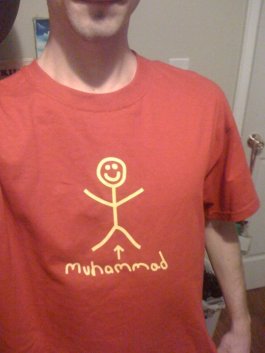
One of my favorite shirts

Finding offense in criticism, whether of ideas you hold or which are held by others, is a sign of placing value on the wrong thing.  There is no good reason to accommodate sets of ideas over the ability to question those ideas.  The meta-value of our world, our species, and of all sentient beings should be the freedom of expression of all ideas.  Privileging a set of ideas, even if those ideas are right, is absurd.  True ideas will survive the light of criticism, and do not need sanctions to survive.  The truth, as Kosh once said, points to itself.

I have no fear of my ideas being questioned, mocked, etc.  If they are good ideas, they will survive.  If they are bad ideas, they will be replaced by argumentation whether in the form of polite discussion or mockery.  The question I have for people who are easily offended, for their own sake or the sake of others, is where your values are?  You can be sympathetic with the hurt feelings people have about having their ideas mocked, but at the end of the day if their ideas cannot survive that mockery, or even polite questioning, then perhaps that sympathy needs to be understood to be about their feelings, not their ideas.

There is a point when we have to take responsibility for our ideas, rather than coddle them.  Ideas are not people, and they cannot be injured.  Ideas are either good (justified) or not (unjustified).  And if you are hurt because your ideas are mocked, then you are either protecting an unjustified idea or one that does not need protection.

Just like gods (if they are to exist), ideas cannot be harmed by our criticism,  mockery, or polite disagreement.  There is no reason to protect such ideas or beings, except to protect the fact that they are bad ideas and free expression might expose such a weakness.

Oh!  That explains it now, doesn’t it?


Adventures in Therapy – Episode One: The Phantom Waiting Room


Today I took the day off from work to go get a check-up (which was free! Thanks, Obama!) and also to go to my long awaited First Therapy Appointment.  At the time that I made it, I was in a pretty low state and that state had continued for a couple of weeks.  I was starting to feel hopeless waiting for the session because I wanted to feel empowered again.  Luckily for me, I talk to my friends and family about my craziness a lot and they are awesome and like to help when they can.  Kelly sent me a link to MoodGYM, which helps with anxiety and negative, destructive thinking by applying concepts of cognitive behavioral therapy (CBT).  It’s an amazing (and free) program that has really, really helped me.  I’m not done the whole program yet, but just in the week I’ve been trying it out and doing the various suggested exercises, I really feel like myself again.  The program seems to be tailored to my exact issues and I am incredibly thankful for it.  If you have felt like you identify with me when I talk about the kind of things I struggle with on a daily basis, I recommend checking it out!

I was especially happy that I found it today when I went to my therapy appointment and had an experience that was almost enough to make believe it omens.

As I said, I made the appointment a month ago and then this past Friday I called to confirm.  They told me to go to the Haddonfield office, and so I did.  I parked out front and then went to the front door.  The door was locked and there was no sign telling me to go around back.  Luckily, I am smart or something and figured out how to get in the building.  Upon entrance, I was greeted by a completely deserted first floor.  I walked through a couple of hallways and then found myself in a deserted waiting room.  The reception area had windows with curtains pulled closed and a sign that said that they no longer had a secretary so…if this was your first appointment, fill out an age appropriate “Welcome Pack” and then  wait until the person with whom you have an appointment comes to get you.  This made me pretty uncomfortable since I had no way to let anyone know that I was there and no way to know if I was actually going to be seen.  It’s worse than calling an automated answering service, because at least there’s some kind of information exchange there…and usually an option to talk to someone in real time.  This just made you feel abandoned and unimportant and questioning whether you made your appointment properly or something!  The entire place was designed to leave you feeling more mentally unstable than when you arrived.

I went to go sit in the waiting room and then I saw that there was a a board that told you which therapist was where.  The person I was supposed to see was apparently on the second floor, so to the second floor I went.  When I got up there I found that there was a second waiting room, and this time there were two people waiting in it.  Progress!

Well, sort of progress.  I think I felt more comfortable in the deserted waiting room.  When I came in to sit down, both people waiting there turned to stare at me.  One looked very not OK and the other looked suspicious of me or something. I sat down uncomfortable getting the idea that it was very not alright to say anything ever.  I was there for 10 minutes and one of them was called in.  I was feeling confused about what I was supposed to be doing, if I was in the right place, etc, so I quickly asked the other person if this was the correct waiting room.

“We’re not supposed to talk about what services they provide.”

“Ok, that’s fine.  I just want to know if this is the right place to be as I have never been here before.”

She was weird for a while and then she explained that it was the right place, and then told me to turn off my cellphone and sign in (on a sign in sheet that was for a different doctor…I didn’t do that part).  Then she told me that she also had an appointment at 1pm and I feared that we had been triple booked.  45 minutes later, the therapist emerged again and asked me who I was there to see.  I told her and she said,

“Oh…did she know that she had an appointment with you?”

“I would hope so?  I confirmed with the office on Friday.”

“Do you have a phone number to call her?  As far as I know I’m the only person here today.”

“No, I’ve never been here before and I don’t have a relationship with this therapist yet.”

“Oh, for an evaluation?

“Yes…”

And then she shrugged and said, “I don’t know what to tell you.”

I thanked her (for nothing) and got up to leave.  I came downstairs to the abandoned waiting room and started to cry.  The whole thing felt ridiculous.  How does this kind of thing happen?  I felt like a fraud for even being there.  The whole time I was dealing with the stupidity, I thought, “I’m glad my issues aren’t that severe. I probably would be completely losing my shit right not otherwise.”  So as those thoughts entered my mind, I didn’t even know what I was doing there.  “What are these people going to even do for me?  I’m fine.  This is stupid.”

As Jessie pointed out though, had this been 2 weeks ago, I would certainly have lost my shit.  I would have cried upon getting into the second waiting room probably and I definitely would have not made it to the abandoned waiting room to fall apart when I was shrugged away.  It is not easy to make the decision to get help with this kind of stuff, especially if you define yourself in large part by your independence.

So I cried for a while in the car and came home and told this entire tale to Wes and Jessie.  They encouraged me to try to make an appointment with someone else.  I was calm by then and happy to have a nice afternoon ahead of me…like I said, I am in an upswing at the moment, so I am able to handle things a lot more rationally than when I’m in a downswing.  Still, I sat there thinking that I just shouldn’t bother with therapy.  There are other people who need it more.  I can handle this crap on my own.  I don’t want to go through this again. (Incidentally, this is my attitude about flu shots…I don’t talk so loudly about it anymore since getting strep last year…will this be the year?)

And then the person with whom I had an appointment called me.  She told me that she had me down for an appointment at the Woodbury office (where she was), not Haddonfield, and that the schedulers totally screwed up.  She apologized profusely and said that she wrote a not-happy email to the schedulers.  And she said, “Here you are making the not-easy-to-make decision to come for help, and you are left to wait for an hour and then your therapist doesn’t show up? My goodness, would that not feel good!”  I couldn’t really say anything other than, “Um, yeah, that about sums it up.”  After apologizing some more, she said she would help get me an evening appointment (since I’m out of vacation days now), and then apologized some more.

Of course, this makes me want her to be my therapist, but I just don’t have the day time hours to go to her, so it’s probably better this way.  I really appreciate that she called and explained what happened and completely understood why it was so shitty.  Because she did that, I will try again and stay with this particular counseling group and hope for the best.  And hopefully next time I’ll be able to tell you, “Man oh man, therapy is awesome!”

May Adventures in Therapy – Episode Two be better than Star Wars – Episode Two.  That’d be nice.

Screw This Survey and the Horse it (Monogamously) Rode in on!


One time at an Arcati Crisis rehearsal, Peter took the time to take a survey being conducted over the phone.  It was some kind of political survey, I think.  The mayoral elections were coming up and they wanted to know where people stood on the issues.  Peter took it and then got off the phone with a scathing review of the survey and the surveyor herself.

At one point she brought up the possibility of bringing gambling to Philadelphia.  Unless you were living under a rock (which I would hope a survey company wasn’t), you may have recalled that the possibility of bringing gambling to Philadelphia was not the simplest of things.  People were terrified of it.  What will it do to the traffic in the already congested area in which they want to build?  What about the potential of an increase in hobos on Delaware Avenue?  WHY DOESN’T ANYONE THINK ABOUT HOBO JOE?  But according to the surveyor, “You probably support gambling because it will bring revenue to the city, and everyone likes revenue, right?”

I feel like that’s like going into a weight loss seminar with a jar of sterile tape worms and saying, “This parasite will make the pounds fly off without any other side effects! Also, the early 1900’s were awesome, with absolutely no caveats!”

If that’s not biased, I don’t know what is.

So, Shaun just wrote about this monogamy survey the GoodinBed.com is conducting, in this post and despite being an intelligent person, I decided to go take it.  I mean, people like us with our big alternative lifestyle should be represented in such things, right?  Right.

Spoilers ahead!!!

I thought about writing a diatribe here, but after I got going it wasn’t so much funny as it was sad.  So instead, I will post the conversation Shaun and I had about it.

Me: Yep.  This survey is dumb.
Shaun: It’s totally monogamy privileged.  There are answers not available to give.
Me: Yeah.  I filled out “other” for relationship status and explained.  And then it immediately talked about you having one partner. And a statement like “monogamy builds intimacy between 2 people” is difficult to answer. Obviously it does, But I feel like I need a caveat there.  I’m sure there’s not the statement, “Intimacy builds commitment between 2 people”.
Shaun: Yeah.  I had the same issues.
Me:  Argh, this is aggravating.
Shaun: Yay, monogamous privilege
Me: It talks about infidelity, but never non-monogamy.
Me: Hahahahahaha  “What are the biggest barriers to monogamy for you? What a way to word that!
(Side note: You were supposed to check off all that apply here.  There were ones that made sense like “Life Experience” and “Attraction”, but there were also choices like “Money” and “Kids”.  The latter would seem like barriers to non-monogamy, but I would be amused if they were suggesting prostitution or something like that.)
Shaun: I was hoping for a feedback box.
Me: Wow…the last part of the questionnaire is the dumbest thing ever.  How well does your partner know you???? This is the Newlywed Game!
Shaun: I know.
Me: Are you thinking of fucking other people right now because you are uncertain your partner knows your favorite food???
  SLUT!
Shaun: lol
Me: Well, I’m sure glad I did THAT
Shaun: You’re welcome.
 Me: I felt completely unable to take it honestly, haha.
“As a person who engages in infidelity, what makes you such a dishonest, mangy slut?”
“Well, I’m not committing infidelity and not particularly a slut…”
“Slut says what?”
“There’s nothing wrong with sluts.”
“Why are you such a SLUT? And why do you hate AMERICA???”
Shaun: You should write a post mocking that survey.
Me: Hmm, perhaps I shall. Ok, I’m doin’ it.  Heh heh, I said doin’ it.
So there you have it.  Shaun posted the results link also and of course the results are that everybody loves and believe in monogamy…but are cheating on their partners a lot, statistically speaking.  But what would the survey results have looked like if polyamorous people could have answered completely?  Would it have shown a decent percentage of people who were satisfied with their relationships, their sex life, and who hold commitment and honesty in very high regard?
Or maybe we’re just the dumb ones that actually took this thing.  Oy!

Where polyamory is needed; relationship advice blogs.


Occasionally I check out the blogs at wordpress (which is the software this site is run on) for tags like “religion” or, in today’s case, “relationships,” to see what people are writing about.  And most of the time I find a bunch of crap, but occasionally I find something interesting.  Today, I found a couple of posts that touched on polyamory.

Over at Emilystarz, we have a post simply called “My Life” which is about a fairly common situation of a woman who has a man in her life who has been, and wants to be, sexual with other people.  The added complication of a baby between them makes the situation more frustrating to see, and it is obvious to me that this is just one more situation where monogamy is not working for at least one person in the relationship.

Now, all I know from the post there is what is written, so any advice I have is most-likely crap.  But I think people in such situations should be aware of polyamory, even if they ultimately decide against it, part ways, or whatever.  I think that this issue of responsible non-monogamy needs to be part of the conversation, not only in specific cases such as this, but in all similar cases with relationships.

I think it needs to be part of our cultural conversation about relationships.  With that in mind, let’s move onto the next post I found.  In this case we have a writer asking for advice, and getting an awful response.  It’s over at lovejays.com, and it is entitled “Playing the Field.”  here’s the gist:

Q: Dear Love Jays,

Is it okay I’m dating one guy (we aren’t exclusive) and sleeping with another?

A: Dear Double Dippin’,

Non-exclusive dating gives you the freedom to date, sleep, or hang out with anyone your little heart desires. Dating is a time when you get to explore several options and decide which person (if any) has the potential of becoming more serious.

So, is it okay that you’re dating one and sleeping with another? Technically, yes. Would I recommend continuing this behavior? No. Sex embodies much more emotions than just the physical exchanges of pleasure between our “money spots”. Sex was designed to be shared between two people who are committed to each other and share something special. Casually having sex with people will eventually take its toll on the mental psyche of woman or man. I’m sure there are several of you who want to rebuttal my last statement, but rest assured – you will have your “aha” moment one day. Long story short, sex simply makes things complicated – physically and emotionally.

Easy advice – pick one and stick to ‘em! It’s much much easier to focus your attention on one person and will save you from emotionally damage, even if you are unaware of it at this moment.. If you get bored of him, on to the next one. That’s the beauty of dating!

Sincerely,

Mr. J

This, quite frankly, is the poly equivalent to reading a creationist argument for an atheist.  Reading this is like looking at a train wreck of relationship advice.

To deconstruct what is wrong with this advice, I would have to start from page one of polyamory.  I’d have to link so many posts from this blog in the past…I just don’t have the energy to do it.

Oh fine…here a couple of examples:

  1. The Bachelorette and Polyamory
  2. Poly lessons I learned from cheating while monogamous

But, onto the post.  Let’s do it a piece at a time:

Non-exclusive dating gives you the freedom to date, sleep, or hang out with anyone your little heart desires. Dating is a time when you get to explore several options and decide which person (if any) has the potential of becoming more serious.

This is not awful.  If I were to try and be fair to this, I could even partially agree with this.  The first sentence, in fact, is spot on.  It’s a statement of fact, but then with the following sentence it takes a turn for the worse.

Where it says “…and decide which person (if any) has the potential of becoming more serious,” it could be read to mean that we use this time to decide which people are worth keeping around, which is true for polyamory as well.  But the “more serious,” as we shall see, implies exclusivity.  Exclusive does not mean more serious, nor vice-versa.

“Mr. J” continues:

So, is it okay that you’re dating one and sleeping with another? Technically, yes. Would I recommend continuing this behavior? No. Sex embodies much more emotions than just the physical exchanges of pleasure between our “money spots”. Sex was designed to be shared between two people who are committed to each other and share something special.

Sex does often involve many emotions, and should be dealt with responsibly, both in terms of physical safety and emotional maturity.  My experience with sex with many people over the years in serially monogamous, polyamorous, and group sex environments has shown me that we are capable of sex in more ways than most people have imagined.

Sex is great between two people.  It has the capability to draw them emotionally close, bring great pleasure, and is even good exercise.  But there is no necessary damage to that relationship just because you have it with other people.  The only way this is possible is by not being safe (and thus subjecting yourself to potential infections) or to not developing your emotional self such that you deal with emotional issues such as jealousy.

Things like jealousy are real issues that need to be dealt with, and it is fortunate that they can be dealt with.  And let’s not forget that some people are simply not prone to it in the same way.  But jealousy is not, in itself, an excuse not to pursue our desires.  Rather, it is a challenge to work on.  Like fear, it stands against us and makes us dip into the well of our baser instincts.  It makes us act irrational, possessive, and petty rather than mature and rational.  Jealousy is not something to be proud of; it is something to try and heal if we can.

Sex can be shared between two people who share something special, sure.  It’s great when that happens.  But it does not imply that at some other time those same two people might also have some special sexy time with some other people with whom they share a close and special relationship.  Further, sex can also can be shared between three or four people who share something special, or even between some people who just sort of like each other a bit and like each others’ bodies.  This conservative view of sex espoused by “Mr. J” is simply not true in general, and so it should not be espoused as general advice.

It may be true for Mr. (and/or Miss.) J, but if it isn’t true for many people, then it’s only true by accident and not by necessity or generally.  Nonetheless, he continues:

Casually having sex with people will eventually take its toll on the mental psyche of woman or man. I’m sure there are several of you who want to rebuttal my last statement, but rest assured – you will have your “aha” moment one day.

I, and many other committed polyamorous (and swinging) people out here in the world have a different experience.  My “aha” moment was realizing that the mythology of the ideal “one” that exists for each of us was the problem.  Mr. J needs to check his assumptions about the very nature of relationships before proclaiming general truths about love and sex, because there are many of us who find his view, well, parochial.

Still, he persists:

Long story short, sex simply makes things complicated – physically and emotionally.

It sure does.  How does this imply that we should have to limit ourselves to one person, ultimately? Because it’s easier? It might be easier, except when you are in love with two people, when you have to repress your natural sexuality in favor of a cultural construct which asks us to repress much of that sexuality, etc for the sake of an ideal.  There is a real existential agony that can exist in moments when we yearn for two loves, and feel like we have to choose.  How awful to be told that you, in fact, should choose rather than consider other options, such as polyamory, swinging, etc.  How trite.  How small-minded. How limited—and limiting!

Why, for the sake of all that is not holy, would anyone have to choose simply because it is superficially “easier”? It’s only easier because it conforms to the narrative you, Mr. J, are drowning in.  Swim to the surface, Mr. J, and breathe pure air.

So, my advice to Double Dippin’; Love who you love, how you love them (even if it’s just dirty, fun, sex) openly, honestly, and with consideration and respect.  Don’t let Mr. J’s conservative views on sexuality ruin your ride in life or force you to choose when you may not have to.

That’s all I can stomach, today.

Poly demographic survey in the UK


Over at Polytical, there is a summary and discussion of a recent small, anonymous, survey of polyamorous people which may be interesting to people who are interested in such things.

UK Poly Mailing List Demographic Survey Results

I was interested to see that the largest segment of them were atheist/agnostic/humanist.  Granted, it is the UK and not The US, but I like to see poly people who are also atheist/agnostic/humanist.

The overwhelming majority of people were white; 92%.  This seems about on par with, if not slightly above, the demographics of the UK in general (at least from the census from 2001, which may be out of date).  I would be interested to see the comparative demographics of polyamorous people in the US compared to the general population.  My guess is that the percentage of white people in the poly community would be higher than the general population.  That because while I don’t think polyamory is privileged, it is definitely easier to be polyamorous when you have privilege.

And, unfortunately, privilege and race often co-mingle.  It’s part of why I care about social justice, and thus support the whole atheism+ thing.

In any case, take a look at the survey results if you like, and let me know if you see more similar surveys in other parts of the world.

I Sense That You Have Ballads to Write…Or Something…


Back when I was about 18 and just starting college, I came home for a dinner party kind of thing at my parents’ house.  In attendance was a couple, we’ll call them Bob and Debbie, that my parents had befriended during their EST days.  At that point in time, their relationship with my parents had faded to almost nothing, so I was surprised to see them there.  I hadn’t seen them in many years.

These people had been frequent characters in my childhood memory, not only because they were around relatively a lot, but also because I watched my parents’ lose adoration of them.  Bob and Debbie lost their luster, much like the New Age.  Of course, I should point out that I am remembering this through the eyes of at 5 year old, but my assessment is probably pretty correct.  In short, my parents abandoned EST when they found out that the movement, in general, was a crap shoot and they didn’t really have patience for Bob and Debbie when they realized that Bob and Debbie were also full of crap.

My parents raised me to be a critical thinker, especially when it came to people.  Never mistake my ability to put up with people’s crap as an inability to identify people’s crap.

That last part makes me sound like that scene in Jurassic Park when the one paleontologist goes digging through a giant pile of triceratops droppings, doesn’t it?

Well, it’s not that graphic, ok (and I totally spared you the picture of triceratops crap that I found online).  I just mean that I’m fairly sure that one of my main sources of misery as a kid (and as an adult) was that I knew so many people who were full of it and refused to call them out on it.

Over the years, I heard a lot of mockery of Bob and Debbie.  As a little kid, I didn’t really get it.  I think what it came down to was that they behaved as though they were incredibly enlightened individuals, but in reality they were both a mess.  They were each facing years’ worth of unrequited dreams and trying to pay the mortgage and raise an emotionally troubled son just like every other jackass.  Of course, this is, to me, the New Age movement in a nutshell.  It has never seemed any better than any other religion to me.  You replace the word God with the word Universe.  You put your faith in it just the same.  Sure, there’s more of a focus on personal responsibility, self-control, all that.  But it still seemed to defer to doing all this in the hopes of receiving gold stars from the Universe when you successfully didn’t throw a chair across the room in a fit of anger.

Honestly, I grew up thinking sometimes that my parents were a little harsh when it came to Bob and Debbie.  I mean, they tried to do things that they wanted to do.  In the end, I think it was because they projected an air of superiority for the things they were interested in and instead of coming across as interesting, they just came across as pretentious.

So they disappeared for a while and when I was 18 I came to a party at my parents’ house and there they were.  They looked about the same.  They weren’t acting any differently.  It was almost as though no time had passed.  The only difference was that I was 18 instead of 8 and I had truly begun to come into my own as a person.  Suddenly I found myself forming my own opinions about these people based on my own personal experience with them and it was both depressing and hilarious.

I found myself in a conversation with Bob.  He asked me what I was doing in school.  I told him that I was studying chemistry and he says, “Oh.  OK.  Well, you know what you should do then?” “What, Bob?” “You should solve nuclear fusion.”

I looked at him and blinked a few times.  I will give him points for not asking me to make him some LSD or something.  That’s usually what people say when I tell them I’m a chemist.  He was kickin’ it Old School™ by saying a close equivalent to, “You say you’re a chemist, ey?  What say you and me go blow up Japan?”  Yes, yes.  I know.  Those were physicists, but most people don’t know the difference.  The nuclear fusion thing was a similar faux pas.

“Solve nuclear fusion?  Oh, well, let me go get a couple of cocktail napkins and I’ll jot down a few of my ideas for you!”  I figured giving in to his demands would be easy…if I had a genie or something.

“I’m just saying, that’s where it’s at.  If you could solve that, then the education would be worth it.”

“Well, Bob, that would be nuclear physics and I’m a first year chemistry student, so I’ll get back to you after I get acids and bases all figured out.”

The rest of the conversation was similar in that he would ask me about something I was interested in and then proceed to tell me what I should actually be interested in and doing.  It reminds me of the conversation between Fry and Leela in one of the greatest episodes of Futurama ever:

Fry – What have you always wanted to do more than anything else?
Leela – *sigh* To meet my real parents…
Fry – Whatever. The correct answer is “to be a super hero”.

At some point we got onto the subject of music.  I informed him that I play the guitar.  Now, at that point I had not written a song yet.  Well, I think I had written one but I didn’t really like it.  I had put a couple of Peter’s poems to music by then but was even more critical of my own words then than I am now.  So, I tell Bob that I like playing Neil Young songs and he says, “Ok.  Well, what you need to do right now is record an album.”

“Um…well, I would if I had any songs that I have written.”

“Well, write some!  Now!  Before it’s too late!”

“I’m fairly certain I’m not going to die in the next couple of days. Look, Bob, I’m not going to write anything if I have nothing to say.  Songs written by people who have nothing of consequence to say make for terrible albums.”

“So what?” he said. “You’ve got to record.  NOW.”

“But whatever I would record NOW would be horrifically mediocre.”

“So?”

“Why would I want recorded evidence of my extreme mediocrity?”

“You might DIE!”

“I WILL in fact die.  Why would I want my legacy to be a string of mediocre ballads about being a teenager or something?”

It went on like this until I found out that he had recently recorded an album.  He brought copies for everyone and made us listen to it.  When the first track started, his wife said, “Oh god.  Again, Bob?”

The album was, as I expected, completely mediocre and uninspiring.  After they left I thought about this a lot.  On one hand, it was hilarious.  On the other hand, it was so very sad because I know that this guy paid out the ass to produce this thing that no one cared about.  To him it was this thing that he did before he died and to everyone else it was boring noise.  Could I fault him for fulfilling a dream of his?  Of course not.  But I am left wondering why it was such a dream of his when he had absolutely nothing of exciting to offer the public.

I was reminded of all this recently as I sat in the attic of Peter’s lovely house recording one of 90 little takes that comprised my electric guitar part for one of our newer songs.  Peter and I have been writing and playing together for 4-5 years (officially) and as we continue on this huge project of recording our first real, fully tracked, studio album I see that we have achieved something brilliant.  We are far from mediocre.  It took me a long while to realize this.  Much like a kid who is short for most of hir formative years who suddenly gets a growth spurt, never quite understanding that zie’s not short anymore, Peter and I used to be quite mediocre musically.  Our friends supported us because they were our friends…and often I feared we were subjecting them to our music, rather than entertaining them.  I still have a hard time understanding that this isn’t the case anymore.  Sure, most of our fan base are our friends, but I think they actually like to come listen to us play.  I think they actually find us entertaining and really worth listening to.  Our friends know the words to our older songs.

At a rehearsal recently, I found myself somehow distanced from the rest of the band.  I was listening to everyone but myself and I found myself thinking, “Wow, this band is awesome.”  I spoke to myself as though I wasn’t part of it.  It was a moment of slight objectiveness wherein I could hear how great a band Arcati Crisis is and then I remembered that I get to front it often.  I looked over at Peter and thought about how we’ve known each other for 17 years and have managed to get here.  No, we aren’t making any money and we don’t have a lot of notoriety, but it is a legacy that I am proud to have etched on my past and present.  I think about that conversation with Bob and I am happy to say that I didn’t just write some songs to say that I had done it.  I wrote some songs because I had songs to write.  If I were die suddenly, I would at least have those songs to leave behind and by listening to them you would get a pretty wonderful idea of who I am.

There’s often discussion about how atheists are depressing, defeatist misanthropes who just want to crap on everyone else’s good time.  People equate saying that there is no God, nor is there magic in the world with “Nothing is beautiful and nothing moves me”.  Well, I wholeheartedly disagree.  I am struck so often by the beauty that is life and that I can appreciate it for its beauty, nothing more nothing less.  When you have one life to live, when you are simply living for yourself and the people you love, simple things like recording truly high quality music with your best friend is really all you need.

So, in the end, Bob was kind of right.  You’ve got to do what you love before it’s too late.  Sure, Bob is kind of an idiot and rather abrasive in that he tells everyone what they should be doing all the time (and thinks that nuclear fusion is just one of those things you think about and figure out), but he did something he had always wanted to do.  Many people can’t say that and go to their grave never having accomplished even a mediocre version of their biggest dreams.  I mocked him back them.  Heck, I mocked him here right now, but ultimately he played a pretty big part in inspiring me to keep at it once I did, in fact, have a song to write.

Don’t get me wrong.  He’s still pretty full of crap.  But we can often find one undigested kernel of truth in even the biggest piles of crap if we don’t mind getting our hands dirty.

Wow.  I really just wrote that.  That might be the worst version of “every cloud has a silver lining” that I could have possibly come up with.  And yet, I’m somehow not deleting it.  Well, I guess with all this talk of legacies, I gotta do what I gotta do.  I yam what I yam.

Close up on a partially opened can of spinach.

*Blackout*