Gay Conversion Therapy Provider Sued


Editorial Note: This post was written by Wes Fenza, long before the falling out of our previous quint household and the subsequent illumination of his abusive behavior, sexual assault of several women, and removal from the Polyamory Leadership Network and banning from at least one conference. I have left Wes’ posts  here because I don’t believe it’s meaningful to simply remove them. You cannot remove the truth by hiding it; Wes and I used to collaborate, and his thoughts will remain here, with this notice attached.

—–


Participants in a gay conversion therapy program are suing:

Jews Offering New Alternatives for Healing (JONAH) fraudulently claimed to provide services that “convert” people from gay to straight. These services, known as conversion therapy, have been discredited or highly criticized by all major American medical, psychiatric, psychological and professional counseling organizations.

The Southern Poverty Law Center filed a first-of-its-kind lawsuit against the New Jersey conversion therapy organization for fraudulent practices. The lawsuit, filed in the Superior Court of New Jersey, charged that JONAH, its founder Arthur Goldberg, and counselor Alan Downing violated New Jersey’s Consumer Fraud Act by claiming that their counseling services could cure clients of being gay.

The lawsuit describes how the plaintiffs – four young men and two of their parents – were lured into JONAH’s services through deceptive practices.

Hallelujah. Here’s hoping that this is the first of many.

Why Helping Someone Cheat is OK, or Dan Savage Disagrees With Me!


Editorial Note: This post was written by Wes Fenza, long before the falling out of our previous quint household and the subsequent illumination of his abusive behavior, sexual assault of several women, and removal from the Polyamory Leadership Network and banning from at least one conference. I have left Wes’ posts  here because I don’t believe it’s meaningful to simply remove them. You cannot remove the truth by hiding it; Wes and I used to collaborate, and his thoughts will remain here, with this notice attached.

—–


This week on The Savage Lovecast, Dan Savage got a call from a man who hooked up with another man who had a(n allegedly) monogamous boyfriend. He wanted to know if he had done anything wrong, and if he should feel guilty. This question strikes me as particularly important to the polyamorous community, as we’re often faced with this sort of opportunity. Most advice I’ve heard from the community stresses that poly is only poly if it’s with the knowledge and consent of all involved, which includes partners of partners.

Dan (disappointingly, to me) gave a pretty standard response. He made a lot of room for degrees of offense committed, but ultimately concluded that the only morally upstanding thing to do would be to turn down a proposition from someone in a monogamous relationship. I was disappointed because, to my mind, that would be the worst choice of the ones available.

The Problem With the Standard Advice

Dan Savage feels that sleeping with someone in a monogamous relationship is wrong because, even if you don’t know the other person in the relationship and thus “don’t have a moral obligation” to that person, it makes you “an accomplice to cheating.” In Dan’s mind, cheating is wrong, and therefore helping someone cheat is wrong.

The poly community has, shall we say, an unconventional view of cheating. We tend to say that the problem with cheating isn’t the sex, it’s the lying. There’s nothing inherently wrong with having sex with a person in a relationship. The problem is that when a monogamous person cheats, they are being dishonest with their partner. The harm is caused by the betrayal, not by the sex.

The problem with the standard advice is that, once the proposition has been made, the harm has already been done. By turning down the proposition, you’re turning a cheater into merely an attempted cheater. Is that really any better? To my mind, it is not. When someone attempts to cheat, the betrayal has already occurred. By preventing the “actual” cheating, all you’re doing is perpetuating the fraud that they are in a monogamous relationship. You’re actually doing more harm to the relationship by turning down the cheater, because you’re making it easier for both of them to pretend no betrayal actually happened. Chances are, unless you tell (more on that later), the other partner will never know about it, so most of the effect will be on the cheater. You’re just making the cheater feel less guilty and less likely to come clean.

So What Should You Do?

When you’re propositioned by a person in a monogamous relationship, from a moral perspective, there are three possible effects that your choice can have: do good, do harm, or do neither harm nor good. If you have sex with the cheater, you’re doing neither harm nor good. As explained above, the harm occurs when the proposition happens. The betrayal has already occurred. Whether the sex actually happens or not, the harm has already been done.

That being said, there are plenty of good reasons not to have sex with a cheater. First off, there’s a perfectly acceptable reason not to have sex with anyone – you don’t feel like it. There is no moral concern that I can think of which would obligate you to have sex with someone you don’t want to have sex with. In addition, the fact that someone is a cheater raises all kinds of concerns about that person’s trustworthiness, character, compassion, and decency. I have absolutely no problem with categorically turning down cheaters for those reasons. All I’m dealing with is the proposition that there is something morally wrong with being an accomplice to cheating.

Dan Savage’s preferred option – rejecting the cheater – is premised on the idea that you have a responsibility for the health and quality of that relationship . As I’ve explained above, rejecting the cheater is, at best, not helping the relationship, and at worst harming the relationship. If you accept that you have a responsibility for that relationship (what I call the “be a hero” option), the only moral choice is to inform the cheater’s partner (or at least make reasonable efforts to do so). Any other choice makes you an accomplice to fraud. If you truly think you have an obligation to that relationship (which I don’t think that you do), your obligation must be to ensure that it isn’t being conducted under false pretenses.  Otherwise, you’re helping the cheater to hide their cheating.

If you’re going to be a hero and take responsibility for the other person’s relationship, a simple rejection isn’t going to do any good. To be a hero, you actually need to take some steps to right the situation. However, there’s no moral requirement to do so. Not everyone needs to be a hero. There is nothing morally wrong with accepting such an invitation if that’s what you want to do.


Poly Do’s and Don’t’s


Editorial Note: This post was written by Wes Fenza, long before the falling out of our previous quint household and the subsequent illumination of his abusive behavior, sexual assault of several women, and removal from the Polyamory Leadership Network and banning from at least one conference. I have left Wes’ posts  here because I don’t believe it’s meaningful to simply remove them. You cannot remove the truth by hiding it; Wes and I used to collaborate, and his thoughts will remain here, with this notice attached.

—–


Solopoly has a list up of do’s and don’t’s when it comes to treatment of a non-primary partner. The list:

Do:

Honor time commitments and dates.
Listen to and honor your non-primary partner’s concerns, needs, and feelings.
Make your non-primary relationship a priority.
Offer reassurance and understanding.
Embrace your non-primary partner’s world.
Keep your promises.
Support good metamour relations.
Invite non-primary partners into negotiations and decisions that affect them.
Clarify your boundaries and commitments BEFORE you begin a new relationship.
Fully disclose your constraints, agreements and boundaries.
Speak up about fairness toward non-primary partners.
Assume good intentions.

Don’t:

Don’t violate agreements.
Don’t conflate “fairness” with “equality.”
Don’t bail at the first bump.
Don’t default to playing the go-between.
Don’t foster competition or conflict among your partners.
Don’t pretend the dynamic of your existing relationship(s) will not change.
Don’t make it more complicated than it needs to be.

These are mostly good suggestions. Most of them apply to any relationship, not just a non-primary relationship, and they are generally rather intuitive. However, I’d like to add something to the list that’s somewhat counterintuitive:

Do Take Sides

This does not necessarily apply to only non-primary relationships, but it applies to any situation in which you are dating multiple people who have exposure to one another. In such a situation, conflict is inevitable. If you date for long enough, your partners are going to have a conflict with each other. In such a situation, your instinct is going to be to remain neutral , to facilitate discussion, but not to exercise judgment. In my experience, this is a mistake.

When your partners have a conflict, you’re going to have an opinion. I’d be willing to bet you’re going to have a pretty clear opinion about who did what wrong, who should apologize, and what they should apologize for. Hiding that opinion doesn’t help anyone. Firstly, it harms the trust you’ve built with both partners. Hiding things always does, and hiding something so relevant and important harms the trust to a greater degree.

Secondly, when you’re in a relationship with two people having a conflict, you have a lot of power to influence how the conflict goes. And as Spider-Man has taught us, that comes with a corresponding responsibility. By being in a position of trust with both people, you are possibly the only person who can talk straight to both parties and have them actually listen. When one of your partners is behaving unreasonably, you are one of the only people who has the ability to talk them down. If you abdicate that responsibility, your partners have to solve the issue themselves. Maybe they will, but they’d stand a much better chance with an effective mediator.

The much better alternative is to pick a side in the dispute. If you think one party is right and the other wrong, say so. If you think both are wrong, say that. If you think one is very wrong and the other is only a little bit wrong, say that too. In almost any dispute, both sides have made errors. Point them out,. But do not try to remain neutral. It’s easy to fall into the “both sides are wrong” trap. It’s easy to point out minor infractions on both sides are pretend they are equivalent. Don’t do it. One side is almost always more wrong than the other. Say which one.

The other thing to remember, and I can’t stress this enough, is do not always choose your primary partner’s side. The whole thing only works if you give your honest opinion and overcome your biases. Your primary being your “top priority” does not mean that you always take your primary’s side in a dispute. Sometimes, your primary is going to be in the wrong. It happens. It’s up to you to say so.

Charlie Jane Anders Should Read More Atheists


Editorial Note: This post was written by Wes Fenza, long before the falling out of our previous quint household and the subsequent illumination of his abusive behavior, sexual assault of several women, and removal from the Polyamory Leadership Network and banning from at least one conference. I have left Wes’ posts  here because I don’t believe it’s meaningful to simply remove them. You cannot remove the truth by hiding it; Wes and I used to collaborate, and his thoughts will remain here, with this notice attached.

—–


Charlie Jane Anders, a writer for one of my favorite nerd blogs, io9, wrote a post today called Why Smug Atheists Should Read More Science Fiction. The post, to be as charitable as I can, is total crap. Anders starts out by saying

You can’t be on Twitter these days without being bombarded with atheistic smugness. You know what I mean. People who can’t just profess that they don’t believe in God — they have to taunt religious people for believing in “fairy tales.” Or the Tooth Fairy. Most of the time, these are geeks who have immense respect for science… and yet, they won’t recognize a situation where they simply have no data, one way or the other.

image

The first problem here is that Anders is attacking an attitude without citing any examples, just saying “you know what I mean.” This is an almost guaranteed straw man, as it relies on the detractor’s characterization of the offending behavior with no room for interpretation.

The next problem, just with this paragraph alone, is that Anders characterizes equating religious belief with belief in fairy tales and/or the Tooth Fairy is “smug.” The problem is that religious belief is no more reasonable or supported by evidence as is belief in those other “ridiculous” things. In some ways, it makes more sense to believe in the Tooth Fairy, as parents often specifically set out to provide evidence for its existence. Anders just throws this out there like it’s obvious, instead of providing an argument or any reasons why religious believers shouldn’t be mocked for their ridiculous beliefs.

Third is the classic agnostic fallacy – we “simply have no data, one way or the other.” Wrong. We have a ton of data disproving a ton of religious beliefs. The only way you get to “we have no data” is by reference to a vague, squishy idea of “a higher power” which doesn’t necessarily do much of anything. Any time you get more specific than that, chances are there is some evidence against your belief. But that also ignores a central idea behind all reasonable thought – belief without evidence is unjustified. If we have no data for or against a proposition, the reasonable thing to do is to disbelieve it. The strength of a belief should be proportional to the strength of the evidence. If there is no evidence, there should be no belief, and anyone who has a belief is being unreasonable. Anders continues

A lot of the best science fiction includes a sense of wonder at the hugeness of the cosmos — and the flipside of that is a sense of our own smallness. And the humility that goes along with that. If you want to feel a real sense of quasi-religious awe, don’t think of the world as being 6,000 years old — think of its actual age, measured in billions of years, and the huge timescales of the universe before and after our world. And think of the vastness of the cosmos, whose mysteries we’ve only just begun to glimpse in the past century.

What now? Anders sounds like most of the often-called “smug” atheists I know of in this paragraph. Is Anders trying to suggest that atheists lack a sense of wonder at the universe? I’d say that Anders ought to take a look at The Magic of Reality before making unsourced assertions like that. Anders’ next point:

There’s a common plot in science fiction — particularly media SF — where someone is “seeing things” or having experiences that can’t be easily verified or quantified using technology. Like a sense of “deja vu,” or hearing voices, or seeing the missing-presumed-dead Captain Kirk floating around. And a huge problem in these stories is that nobody can really know what another person is experiencing, or whether it has any validity or is just a hallucination. Thus it is with religious experiences — other people can speak about their profound experiences of the divine, which seem immensely real to them, but may sound like a crazy delusion to the rest of us.

Is Anders seriously suggesting here that “smug” atheists aren’t aware of stories in which people seem crazy, but are later vindicated? Of course we’re aware of those stories. The reason we don’t immediately draw parallels to the people we know who seems crazy is that THESE ARE WORKS OF FICTION! Seriously, how dense do you have to be not to understand that? One of the common criticisms that “smug” atheists level at believers is that they can’t tell the difference between fiction and nonfiction. Anders seems to be proving that point. Anders closes with this:

Still, it’s great to be atheist — and I strongly support arguing publicly and loudly in favor of atheism as a point of view. Just, you know, don’t be smug about it. You don’t actually know any more than the rest of us, and the universe is a much stranger, more bewildering place than any of us can really begin to grasp, and the only thing that would be surprising is if we stop being constantly surprised. If you don’t believe me, just read some science fiction.

This is the paragraph that inspired the title of this post, in that it seems to me that Anders just doesn’t know any atheists. Almost all of the atheists that I know agree wholeheartedly that the universe is a strange, bewildering, and ultimately unknowable place. Our frustration is with religious believers who claim to know things that they cannot possibly know, based on holy books or intuition. It’s the atheists who are insisting that the universe is a giant mystery, and the believers who claim that they have it all figured out. Atheism is nothing more that the belief that the idea of “god” is unsupported by the available evidence. Anders should actually speak to a few atheists before painting them with such a broad brush.

Dan Savage Agrees With Me!


Editorial Note: This post was written by Wes Fenza, long before the falling out of our previous quint household and the subsequent illumination of his abusive behavior, sexual assault of several women, and removal from the Polyamory Leadership Network and banning from at least one conference. I have left Wes’ posts  here because I don’t believe it’s meaningful to simply remove them. You cannot remove the truth by hiding it; Wes and I used to collaborate, and his thoughts will remain here, with this notice attached.

—–


UPDATE: Dan Savage quotes me in Slog

——————————————–

From the latest Savage Love:

Poly is not a sexual identity, PP, it’s not a sexual orientation. It’s not something you are, it’s something you do. There’s no such thing as a person who is “a poly,” just as there’s no such thing as a person who is “a monogamous.” Polyamorous and monogamous are adjectives, not nouns. There are only people—gay, straight, bi—and some people are in monogamous relationships, some are in open relationships, some are in polyamorous relationships, some are in monogamish relationships, some are in four-star-general relationships. These are relationship models, PP, not sexual identities.

As I’ve been saying for a while, polyamory is not a sexual orientation:

There are a few problems with describing polyamory as a sexual orientation. The first of which is that polyamory is not sexual. Polyamory is about relationships, honesty, and intimacy. Look back at the definitions given by Loving More. Not a single one mentions sex. Calling polyamory a sexual orientation is a joke.

Secondly, polyamory is not an orientation. Polyamory is not a physical desire or a feeling. While there is not complete agreement on what polyamory is, there is clear agreement about it isn’t. And it isn’t just an attraction to multiple people. As Shaun pointed out, if you define polyamory as a feeling or an inclination, then half of the country is polyamorous, which is an absurd result. Almost everyone feels attraction for multiple people at the same time. This does not make them polyamorous.

A third problem with describing poly as a sexual orientation is that being poly is nothing like being GLB. Being GLB is about the type of person to whom you are sexually attracted. Being polyamorous is about the amount of people you love. Describing polyamory as a sexual orientation suggests a false equivalence between the groups, and seems like an attempt to coopt the sympathy that the GLBT community has built up.

Sounds like at least one high-profile member of the GLBT community doesn’t like the comparison any more than I do.

There Can Be Only One


Editorial Note: This post was written by Wes Fenza, long before the falling out of our previous quint household and the subsequent illumination of his abusive behavior, sexual assault of several women, and removal from the Polyamory Leadership Network and banning from at least one conference. I have left Wes’ posts  here because I don’t believe it’s meaningful to simply remove them. You cannot remove the truth by hiding it; Wes and I used to collaborate, and his thoughts will remain here, with this notice attached.

—–


Most poly people encounter a phenomenon where a heterosexual couple decide to open up just slightly, so that one or both members can have sex outside the relationship with women, but not with men. Most tend to call this a “one penis policy.” I think that term is boring, so I’ve taken to calling it “Highlander Penis.”

This is what happens if another guy has sex with your woman

Needless to say, I find it incredibly frustrating, not only as a man who slogs through the dating world, but also because it almost always seems to rely on sexist assumptions about the difference between men and women. Whenever I encounter it, I just roll my eyes and think of this:

Off-Topic: Epic Doctor Who Party!


Editorial Note: This post was written by Wes Fenza, long before the falling out of our previous quint household and the subsequent illumination of his abusive behavior, sexual assault of several women, and removal from the Polyamory Leadership Network and banning from at least one conference. I have left Wes’ posts  here because I don’t believe it’s meaningful to simply remove them. You cannot remove the truth by hiding it; Wes and I used to collaborate, and his thoughts will remain here, with this notice attached.

—–


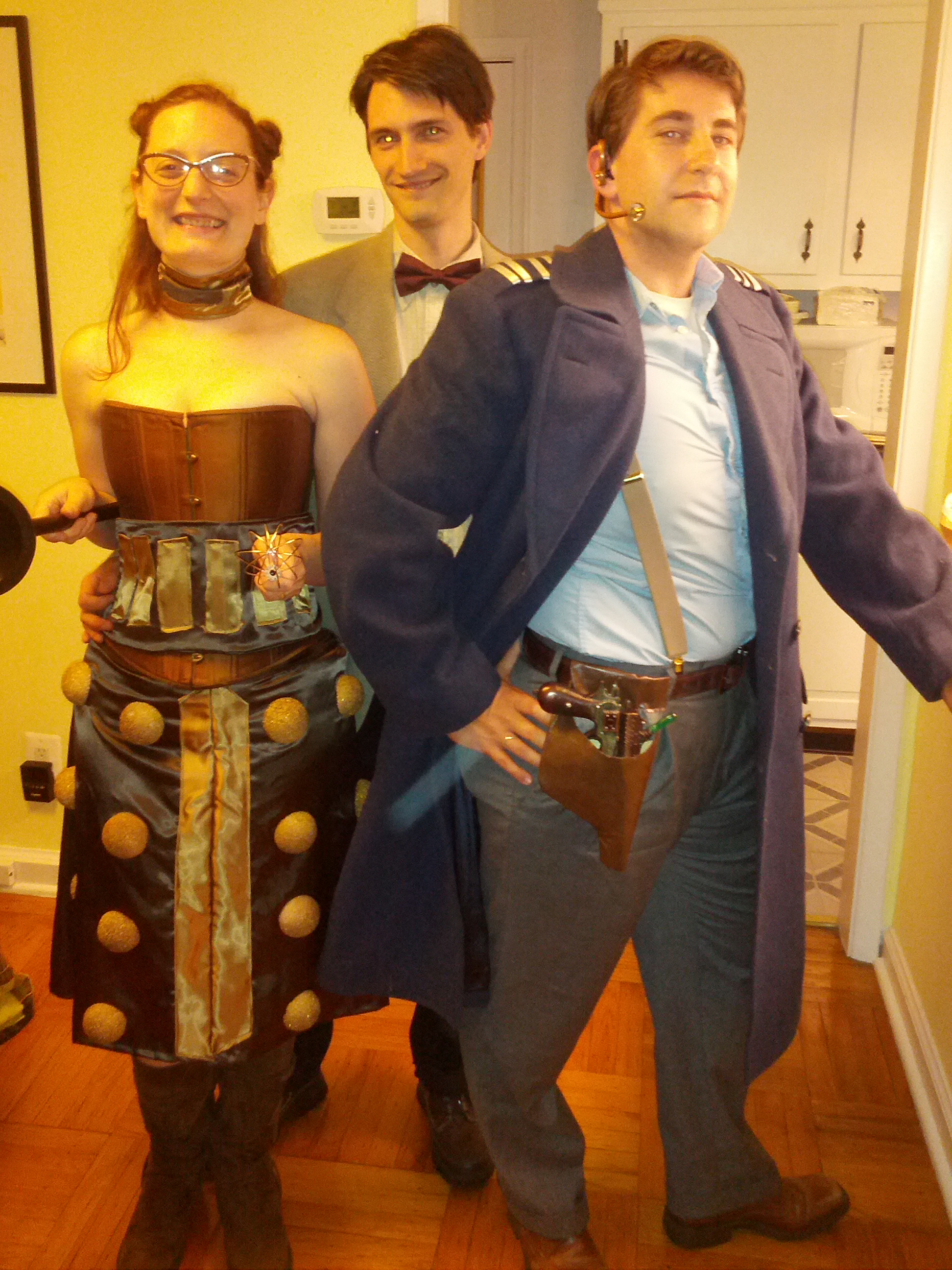
As Shaun recently pointed out, we here at the Polyskeptic compound are rather big Doctor Who fans. On that vein, we are having an awesome Doctor Who-themed Halloween party!

To start, I made the front door into a TARDIS:

TARDIS front door
It’s bigger on the inside
My kind of party!

Step 2: make an awesome drink menu:

“Polybar Galactica” is the name of the bar at the house

Step 3: Costumes!

Needless to say, we’re pretty excited about it. Allons-y!

Tim Muldoon is an Asshole


Editorial Note: This post was written by Wes Fenza, long before the falling out of our previous quint household and the subsequent illumination of his abusive behavior, sexual assault of several women, and removal from the Polyamory Leadership Network and banning from at least one conference. I have left Wes’ posts  here because I don’t believe it’s meaningful to simply remove them. You cannot remove the truth by hiding it; Wes and I used to collaborate, and his thoughts will remain here, with this notice attached.

—–


I recently read a post on the Patheos Catholic channel called I Believe In One God by Tim Muldoon. In it, Muldoon makes a good point that atheists make all the time:
thinking about God is limiting in the way that Nietzsche intuited: inevitably the god that emerges from our thinking is little more than a creation of our imagination. We create gods in our own image.

Does Muldoon take this to mean that there probably is no God? Of course not. Does he make the conclusion that, even if there is a God, it would be impossible to know anything about such a being, so attempts to follow God’s Will are misguided and foolish? No. Instead, he points to the real villain – thinking:

For as wonderful as thinking can be, it is still a rather small tool…. Jesus reminds us that ultimately thinking is not the aim of faith; rather, living in love is, which he described with the metaphor of “the Kingdom of God.” At the end of the day, when I put down books with ponderous titles, having wrestled with great thinkers who try anew to stretch our imagination and our knowledge of the world, I get up from my desk and am immersed in a world that is in desperate need of rigorously thought-through love. If love is real, and if anything we do in this vale of tears carries with it the possibility of meaning or beauty, then it is because God is present throughout it.

Muldoon, having rightly pointed out that God cannot be intellectually understood, pivots to say that the way to square that circle is just to stop thinking and have faith.

Presumably, Muldoon means having faith in the same things that he (Muldoon) has faith in. Things like if a woman enjoys sex outside of a relationship, she’s not being the person God created her to be. Things like gay marriage is bad for society. He even picks a fight with in vitro fertilization, of all things.

While Muldoon himself points out that even if he exists, knowing the mind of God is impossible, he still manages to hold orthodox Christian views on pretty much every social issue. And when it’s pointed out to him that this doesn’t make sense, he finds a great solution: just stop thinking.

Missionaries!


Editorial Note: This post was written by Wes Fenza, long before the falling out of our previous quint household and the subsequent illumination of his abusive behavior, sexual assault of several women, and removal from the Polyamory Leadership Network and banning from at least one conference. I have left Wes’ posts  here because I don’t believe it’s meaningful to simply remove them. You cannot remove the truth by hiding it; Wes and I used to collaborate, and his thoughts will remain here, with this notice attached.

—–


Wes Here.

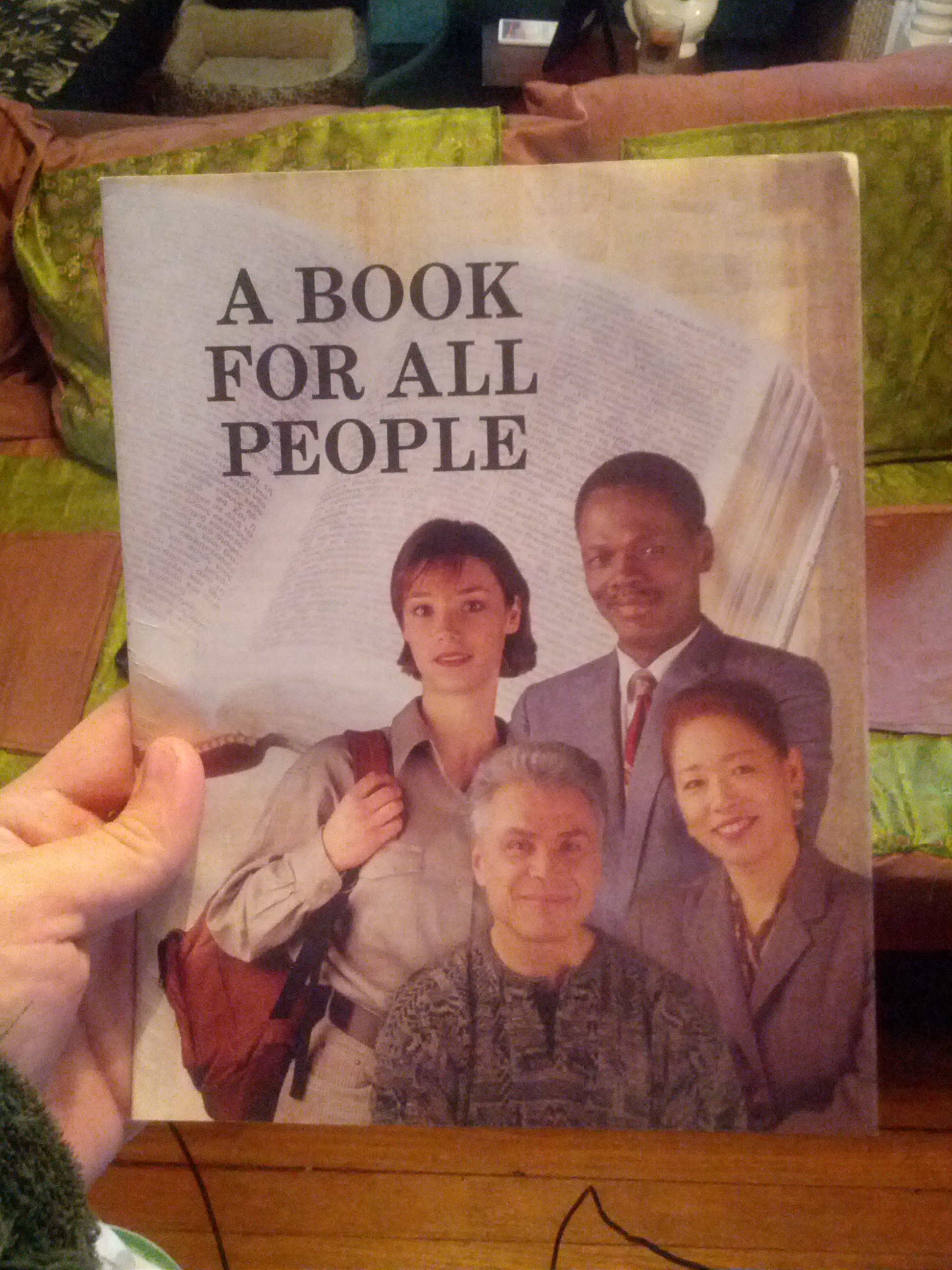
Last week, I was visited by a few Christian missionaries. They gave me this pamphlet:

Men, women, black people AND Asians? Amazing!

I decided to talk with them for a while. After I made it clear that “because the Bible says so” was not an acceptable answer for anything, the conversation turned to why we ought to trust the Bible. According to these missionaries, we know the Bible is true because it made a bunch of prophecies that came true. They were a little fuzzy on the details, but the one that they remembered clearly was the prophecy of Cyrus. According to them, the Bible prophecized that Cyrus would conquer Babylon, and that the gates of the city would be open, over 100 years before it happened.

My response was that the prophecy did not seem all that prophetic, and it was rather vague. The missionaries promised to do a little more reading and then come back. That was last Thursday. They haven’t been back yet. But in the event they do come back, I have a printout from the Skeptic’s Annotated Bible for them, all about Biblical prophecies.

However, I have my doubts that they’ll be back. I’m calling false witness.

Three Parents?


Editorial Note: This post was written by Wes Fenza, long before the falling out of our previous quint household and the subsequent illumination of his abusive behavior, sexual assault of several women, and removal from the Polyamory Leadership Network and banning from at least one conference. I have left Wes’ posts  here because I don’t believe it’s meaningful to simply remove them. You cannot remove the truth by hiding it; Wes and I used to collaborate, and his thoughts will remain here, with this notice attached.

—–


The UK’s Nuffield Council on Bioethics has recently approved a controversial fertility treatment requiring three genetic parents:

scientists are hoping to see it used as a therapy to eliminate rare mitochondrial diseases. Mitochondria function as powerpacks that can be found in virtually every human cell, and just like the nucleus, they also contain DNA. Unfortunately, inherited defects in this mitochondrial DNA affects approximately 1 in 5,000 births, leading to severe or even fatal results.

Researchers speculate that a way to overcome this problem is to take two eggs, one from the mother and one from a donor. The nucleus of the donor egg is removed, leaving the mitochondria intact and replaced by the mother’s nucleus. The resulting embryo has properly functioning mitochondria from the donor — resulting in a potentially healthy baby, albeit one with three parents.

This research is in its infancy, and right now is only meant to be used to prevent mitochondrial disease, but it’s not hard to see how further research in this area would be of great interest to poly parents. Using this procedure, the resulting baby would have only .1% of its genetic material from the donor parent, but even so, having just a bit of a child’s genetic material be from them could mean the world to some parents.

Predictably, the procedure is already getting pushback from natural-law advocates:

“Just as Frankenstein’s creation was produced by sticking together bits from many different bodies, it seems that there is no grotesquerie, no violation of the norms of nature or human culture at which scientists and their bioethical helpers will balk.

“The proposed techniques are both unnecessary, and highly dangerous in the medium term, since they set a precedent for allowing the creation of genetically modified designer babies.”

He argued that such techniques would affect many generations and crossed “what is normally considered the most important ethical line in the prevention of a new eugenics” and this was “precisely how slippery slopes get created”.

The fact that arguments like this are taken seriously is the likely reason why we won’t see this sort of procedure available to three-parent households in anything resembling the near future. Still, as a member of a poly V, and one which intends on raising children together, this is certainly an interesting development.