Human, gamer, philosopher, godlike being, atheist, nonmonogamous, pariah, contrarian by nature, probably occasionally right human who writes nonsense to very few people.
Some people come here only to downvote my posts. That seems sort of ridiculous, right?
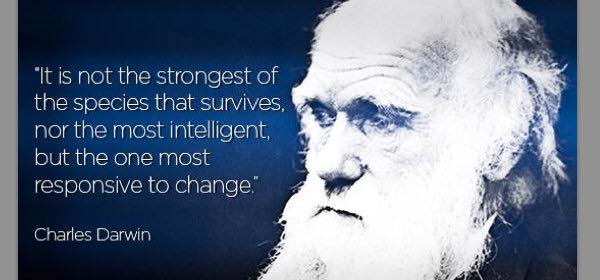
By pure accident, I published my first blog post on Darwin day back in 2009; 6 years ago today. So, for readers who may not know much about Charles Darwin or Darwin Day, Let me point you to some resources.
But there’s also a plethora of excellent resources all over the internet about Charles Darwin. I will not even try to summarize them all, because they are too extensive. There are, of course, organizations and site dedicated to misinformation, misunderstanding, or outright opposition to Darwin and to the theory of evolution itself (it does pain me to post those links…).
Among my favorite evolution/Darwin specific websites is the Understanding Evolution website hosted at Berkeley. There’s a series of articles about the history of evolution, which includes some details about Darwin which start here. among my least favorites would be places such at Answers in Genesis, whgich is a group dedicated to the Biblical “truth” of creation. Hacks, and idiots, really.
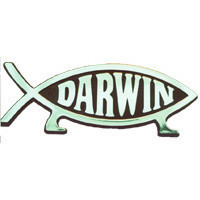
Let’s not forget that you can get all sorts of bumper stickers, decals, and other DarwinFish to put on your car, forehead, or computer screens. They are a good way to show the person driving behind you in traffic that you are educated in the scientific method, understand at least some of the complexities of the concepts within evolutionary theory (such as natural selection), and that you will not submit to bronze-age pseudoscience or creations myths.
That, or you really love your fish named “Darwin.”
I will not even begin to try to summarize the influence of Charles Darwin myself, mostly because I’m not an expert but also because there are already so many good resources on this subject. I’ll simply say that reading the Origin of Species was a positive experience, and what I do understand about biology is both fascinating and often beautiful.
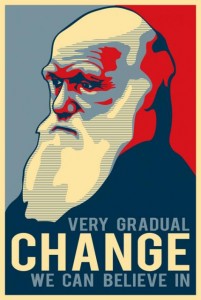
If you don’t know much about Charles Darwin or if you just want to know more, take a look at some of the links here. Or, if you just want to celebrate his birthday with some like-minded people over beers, food, or just conversation, check out the events page and find some local people.
Happy birthday Darwin!
I hope you don’t rise from the grave as a zombie to eat all of our brains, because that wouldn’t be very nice. So, let’s not do that.
Rabbitdarling has some thoughts about responses to abuse as well. Obviously, she and I have some common experiences, and I’m glad that she’s able to articulate her thoughts and feelings so eloquently.
Guys, I have all the tired today, but I’m so ridiculously happy.
The Whiskey Kittens had a show last night, and we had the most fun I have ever had performing. The comedy was on point and utterly irreverent and hilarious. I don’t usually enjoy stand-up, but this was great. I debuted a new act as Iris, the over-worked rainbow messenger goddess, and reclaimed my old Donna Noble, which is consistently well-loved, no matter how many times I reprise it.
I am exhausted, but deeply happy. I got a great group hug when I shared my experiences of the pastyear, and a solemn promise that my autonomy, image, time, talent, and boundaries will always be respected and valued. I cried a little when everyone went back upstairs, and my eyeliner ran a little. Also I am still wearing that eyeliner at 8:45 the following morning, and there is…
Let’s take a look at some of it, and let me say a few things.
When I first tried to articulate what I thought the community response to abuse should be, the only thing I could really think was that abusers need good friends. The kind of friends who are willing to tell them when they are not being the best that they can be. And survivors need good friends. The kind of friends who will be on their side, who will believe them, who will protect them, and who will provide unwavering support when their inner support fails.
I agree with this. The simple fact is that as human beings, complicated as we are, we have the potential to harm others and to take harm from others in a myriad of ways. I have made mistakes and hurt partners myself, and regret doing so immensely. I’m glad that I have friends who are willing to honestly point out where I err, and I am glad that my friends have been there to help me through my own traumatic experiences from both partners and metamours.
Both survivors AND abusers need community support.
Specifically, survivors need protection and validation and abusers need support for accountability.
Again, agreed. People who hurt others, especially if it’s part of a pattern of behavior (and especially if it’s ongoing and unacknowledged) need the people around them to not only keep pointing it out, but also be willing to be ready to support them when they are ready to take steps towards whatever kind of reconciliation or at least personal improvement may be possible.
In most cases, I think that those who hurt other people will be able to find a path back to respectability and welcome by any community. In the cases where they cannot find that path, then the community needs to know about those people in order to make a more informed decision as to what kind of relationship to pursue with those people.
People who don’t want to change will often tell you that they don’t change because of the way that you are asking. This is horse puckey. Change is a personal matter, and it’s hard no matter what. If you want to change, no amount of assholery will be able to stop you. If you don’t, no amount of gentle crooning will make it happen. However, having said that, when we threaten community members who do not support community standards, what we do, mostly, is encourage them to hide their bad behavior.
Change must come from within. It starts with the recognition of wrong-doing, and moves through understanding the cause of the behavior and how it is seen by others. Those who feel attacked, criticized, or maligned by accusations will often find a way to camouflage, rationalize, or re-direct attention from their behavior.
Two of the biggest seeds are the invalidation and naming of another person’s experience and the sense of entitlement over someone else’s choices. Look for it, in yourself and others. Call it out. We can all weed the garden. Remember,
This is my experience. You can not know my experience.
That is your experience. I can not know your experience.
These are my choices. You are not entitled to control over them, you are not victimized by them.
Those are your choices. I am not entitled to control over them, I am not victimized by them.
Look for systemic oppression, and the stories we tell ourselves and each other about why it’s ok. Challenge the stories, and think about how to best support someone who wants to change.
Word. This is a problem which all communities must face, as the atheist community has been facing issues related to harassment and feminism in the last few years. We, within the poly community, have some things to learn about how to deal with accusations of abuse.
How to be the friend of a survivor
Give them a safe space away from their abuser
While you may still be friends with their abuser (remember, abusers need good friends), understand that if you invite both people to the same space, you are actually only inviting the abuser. Try to also create events that are safe for the survivor. If you do not, understand that you aren’t a friend anymore.
I cannot emphasize this enough. I have (and I’m not the only one) avoided a plethora of social activities over the last year to avoid a specific person who I knew would be there, even if the social event was in my neighborhood and would be attended by friends of mine. I have avoided being around this person because almost any memory of him causes a miniature panic-attack. The sound of whistling still gives me chills, because he whistles tunes much of the time. For months after I left his house, the sound of his notification, on someone else’s phone, would cause me to become highly anxious that he was around.
I did not want to be anywhere near him. And the couple of time in the last year I was, it was terrifying and upsetting. Luckily, that is all fading (the nightmares still come around now and then), so I will no longer be hiding, but the fear, anger, and trauma still exist.
We need to be aware of accusations because a victim will avoid their abuser, often for a very long time.
Be willing to distance yourself from people who display abusive behaviors
Sometimes you can’t be a friend of someone who is abusive unless you support their beliefs. It’s hard to fracture your community that way, especially when it is already small. It’s hard when you realize that maybe you can’t just invite everyone to your party. But you know who doesn’t have the choice that you’re struggling with? People who have been abused. Our lives are about avoiding places our abusers are going to be, about losing friends, about being incredibly careful about where and how we share our experiences and about not being able to go to parties. Suck it up.
On top of this, be willing to listen to people who have stories of being abused. I know quite a few people who, upon being faced with the stories of what friends of theirs have done, have refused to even hear their stories. In some cases, the victims are dismissed and the abuser not given a second thought.
This is problematic.
It’s especially problematic if the reason this happens is because the abuser turns it around and blames the victims of abuse. Recently, a dear friend of mine broke out of such a spell, and has received a fair amount of dismissal and disrespect from people within the circle of a person who has caused considerable pain and trauma to people close to me. Her crime? she left the inner circle around the person responsible, after going through her own ordeal with him and his family. She wrote about her experience with this falling out here. Subsequently, someone I know could only speak disdainfully about her for having left the way she did while defending the culpable person as being a victim himself.
Those who do not distance themselves will land on the other side of that rift, and will often not be trusted by victims any longer. The unfortunate reality of social and tribal behavior is that sometimes we lose friends merely because they are no longer part of the safe space.
Believe them
This is actually not as simple as it seems. Because people who are abusive almost always hide as victims. If we believe them, unequivocally, we give safe harbor for abuse. But if we are always suspicious of people who report abuse, we do not give a safe space to survivors who already doubt their own experience. Even more uncomfortable is the fact that when I am talking about “abusers” and “survivors,” I am talking about potential that is in all of us. We are all susceptible to abuse, and we are all capable of it.
Let me emphasize something there: “people who are abusive almost always hide as victims.” Holy shit yes. This is hard, I know. Hearing accusations about abuse and other problematic behavior is tough, especially if you know one or more of the people involved. There is almost always nuance and blame to be shared, and knowing what to believe is hard, especially if accusations are coming from all sides.
But when someone who is the perpetrator of a long and established pattern of abusing others starts to claim to be the victim, the terrifying thing is that it often works. Telling the difference, from the outside, is hard as fuck. I get it. I get it because I think most of us, and maybe all of us, know what it’s like to have hurt someone. A person facing an accusation often wants to emphasize how they were wronged, and having the strength of character to look at one’s own crimes is really really difficult. The result is we become defensive, start spinning counter-narratives, and we may even start to concentrate on our own pain caused by others rather than take an honest look at what we have done.
Recognizing this pattern is the only means towards cutting that shit out.
Throughout our lives, we will be both the accused and the accuser, to varying degrees. And having been through that, we can recognize and empathize with all sides of a situation. And from that vantage point, seeing people on all sides claim to be victims, we tend to want to side with accepting that those people are victims, rather than those responsible for the harm.
It’s hard to look at someone responsible for abuse and see it, especially if the look on their face is one of pain. But it’s possible to be in pain and to be responsible, and we need to be able to handle each separately.
So I want to propose a meditation. When we really understand the difference between these statements, we will understand how to support both survivors and abusers.
“I was victimized by acts of control” is not the same as “I was victimized by the other person’s resistance to my control.”
“This is my experience” is not the same as “This is someone else’s experience.”
This is critical, because I am not sure that when people are in a space of culpability, they understand the difference between the statements above, as they pertain to their actions. I have seen examples of the conflation of these statements from people in my life, and this type of distinction has been topic of discussion around me for some time, now.
This is especially relevant to people who seek to, and are good at, controlling narratives. Persuasion is a powerful tool, and if used well it can be a very effective means of manipulation. Those who seek control may view push-back against that attempt as an infringement on them, and perhaps an injury. This is essentially similar to how power and privilege work against those who have neither; they are used to getting their way, and this time they are not.
It seems simple, but it is not. And I feel that not being able to tell the difference between these things allows us to harbor abuse in our communities and abusive behaviors in ourselves. Being able to see the difference between these statements will allow you to really, truly and solidly hear the story of a survivor. It’s not simple, but if it was, we would have figured it out by now. I’m willing to be imperfect while we figure this out, how about you?
We will all fail, from time to time. We need to be comfortable with failure, if we are to process and improve as people.
We as a community, especially our leaders, need to take the time to learn about how to respond to allegations. When abuse rears its head, they need to not only hear the stories that victims tell, but they need to make sure that they have a means to respond to the accused.
In some extreme cases, there may be nothing to do but to ask them to leave. In most cases, however, there must be room for rehabilitation. But that rehabilitation must keep in mind the place of those they have hurt, and prioritize them. The must be rom for rehabilitated people, but that room should not be next to their victims, and certainly not in a place of authority or leadership over their community.
The community needs to create safe spaces, and those safe spaces must be carved out by those leaders in that community better. We all have more to learn, and more we could be doing better.
So, you know this concept of humility? Yeah, that one is rough sometimes. It seems like some people hear it’s tones as a discordant miasma of chaos, while others hear a well-trained symphony playing something seemingly divine. The truth is that it’s neither of those things, but the nuances of music are such that there is room for argument and taste.
There is the kind of humility which is supposed to be the theme song which follows you around. It’s like a master beat-box artist, or possibly an angel with a harp or even just some dude just wailin’ on that bass (tastes do differ, after all), but not matter what that arrangement is, it’s one of the presences in your life, ideally keeping arrogance, bias, and simple error at bay.
Listen, confidence is great. I’m all for confidence. And I’m definitely not for deference or prostration to either gods, absolutist ideals (or Platonism in general), or traditions. But there are other sources of servitude than religions and traditions. Our emotions, desires, and cognitive biases will perpetually get in the way of our ability to navigate between the Scylla/Carybdis of our hubris/timidity. Humility, if played to an Aristotelian key, is a song of temperance, and not docility.
for my own reference as much as anyone else’s
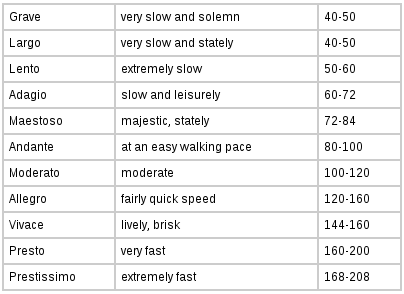
So, given the tempo of this Aristotelian ballad, floating between Prestissimo and the Grave (perhaps an adagio today and an allegro tomorrow), I think that some sense of perspective of who, where, and how we are requires the ability to be self corrective more or less based upon the circumstances in which we find ourselves. That is, we need to listen to the other players if we want to make music well. Life is not all solos.
But also because sometimes it’s time for quiet reflection, and sometimes it’s time to dance! Sometimes we need to assert ourselves, and sometimes we need to step back and listen. And sometimes we might hear something new in our favorite songs or discover that upon further reflection, we hate this song (Hell, Nietzsche could tell you all about that, amirite?). Sometimes we can find new ways to interact with the world, as our desires and tastes change.
The path behind and the path forward
Our preferences are linked to things like memory, experience, and emotional associations. These preferences are also intimately related to the ideals and goals which we revere. These ideals are immensely powerful motivators, but they can also be anchors and delusions.
Sometimes these ideals come from an ancient religion, steeped in history and buried into the very language, culture, and psychology of a community. That is where this blog started, as a log of ideas about how religion wove its way into the fabric of love, sex, and commitment in our culture. It was an exploration of the problematic concepts which underlie all of our ability to conceive of who and what we are as people living in a universe without gods, but within a culture drowning in the psychopathic, unconcerned, or impotent ideas of gods.
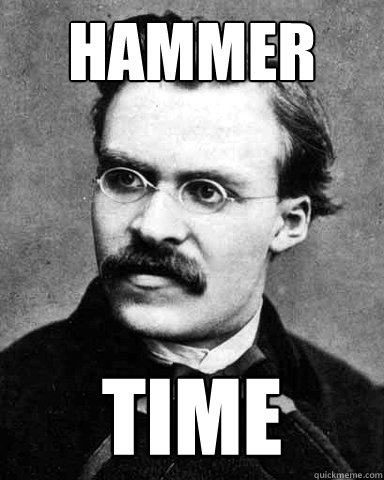
Yes, yet another Nietzsche reference. Get used to it.
This was a blog about exploring what was possible, if we stop adhering to the sexual, romantic, and relationship norms our society defers to. It was, in a sense, one more hammer to the old gods, ideals, and philosophies to which so many are still adhered.
And over time it changed. I started thinking about polyamory more. I started having more experiences within polyamory. I had many wonderful and fulfilling experiences, I’ve had experiences which were fun but often challenging, and I’ve experienced the worst interpersonal trauma from people I lent some trust to.
And I’ve changed. Who I am today is not who I was 6 years ago, when this blog started. And in the last several months, I came to a realization that has had a profound effect on my outlook for the future. I realized that I was wrong about something very fundamental about myself; something that has been the cause of a very significant problems in my life. And I owe that knowledge to someone who I love dearly and who had to allow me to sink or swim on my own.
I swam.
What is it? Well, that’s not really important, is it? The specific lesson is not the point, at all. Besides, that revelation is personal, and while I would be more than willing to share that understanding (assuming I could properly articulate it) with the people I’m close to in my life (and I’m happy that I have people in my life who honor me with their friendship and love), it’s not necessary here.
Also, there are people who still read this blog (hi there! You can one star my post if you like, but that’s sort of childish, isn’t it?) who would attempt to bend and stretch such information against me if they could (narrative spinning is their specialty, after all). Also, because it can’t really be that interesting to most of the rest of you anyway. You don’t come here to be my proxy therapist. I tend to pay people to do that for me.
The last reason I’ll not explore this personal revelation here leads to another kind of humility which I’d like to talk about. This is the kind that comes out of nowhere and knocks you on your ass. These are the striking and emotionally intense notes in the song of your life, ones which have consequences for how you hear the rest of the song.
It’s the kind of humility (humiliation, perhaps) where you have found that you (perhaps) fucked up, big time, and now it’s time to shut up and start listening. Of course, one does not always shut up and listen, so one might talk themselves into a corner. And then, well, you’re in a corner having to decide what to do next.
And then you have to learn some things. Then you have to reflect one how you fucked up, what you are going to do about it, and even though you might hate doing it….
Now it’s time to walk the hard path.
And then, sometimes, while walking that path, you find that you didn’t know as much as you thought, especially about yourself.
I think there might be a metaphor in there….
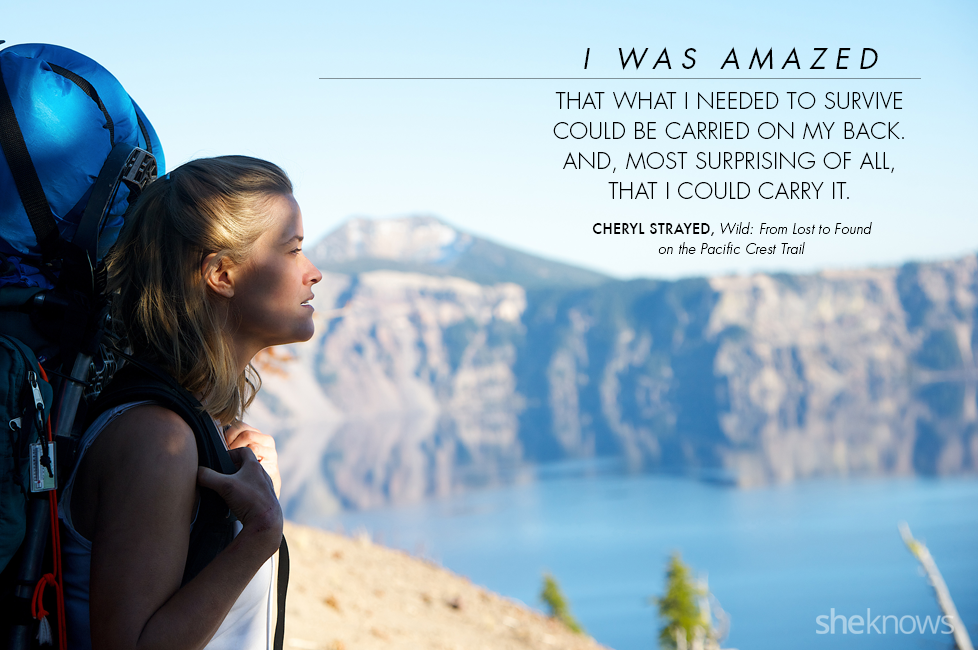
My lovely girlfriend and I, with whom I’ve just celebrated a year together just this week (but who must remain anonymous, for unfortunate reasons related to social expectations and cultural taboos), went to see the movie Wild, which I liked quite a lot. Obviously, it’s a movie about self-discovery and traveling a difficult road (both literally and metaphorically) towards a goal which may be arbitrary, but which takes on new meaning as you approach it.
The problem is that by focusing on that destination, that ideal, you miss all the details all around you. It’s also not unlike hearing that note or phrasing in a piece of music which keeps dancing around a melody, harmonic, or note. If you do nothing but anticipate that note, that goal, or even that (perhaps) perfection then you are not paying full attention to the path itself. You start to miss the trees because you are looking for the whole forest.
If we, as listeners and as path-travelers, learn to pay more attention to the moment then we will notice that it changes our journey from progress to process. In other words, we become less-ends-oriented and we become more aware of the experience of journeying. Knowing precisely where you are is a humbling experience, sometimes. Whether we think of this humility in the cosmic sense of size or in the existential sense identity, it amounts to a humility which should offer us some pause.
And we should accept that offer, from time to time.
Eventually that destination, which was so dramatic and distracting to start, dissolves either into the horizon and becomes your theme song or it starts to fade into background noise, ultimately to be unnoticed or forgotten. And then all there is the path. And when you are bored on this path you start to see things differently. When it’s quiet, when you are alone without distraction, you have the opportunity to listen to yourself a little closer, and you will almost certainly learn something.
Since we’re on a Cheryl Strayed kick today.
Well, I’ve learned some things recently. And I think that I am feeling better than I have in a long time, at least in terms of being optimistic about my personal future. The dawn has broken, the storm clouds are retreating, and what I thought was going to be my end may end up being my greatest beginning.
I’m not saying that it will be easy, because it will not be. I will not say that I do not fear it, because I do. But where it will be hard I will work harder, and where it will be terrifying I will allow myself to slow down, look at the path, consider the destination I may create for myself at that moment. As a practical result, I will no longer retreat from the world as I have been in recent months.
Now, the biggest challenge I have is to have the patience to wait for Spring, because this cold weather is not pleasant for me, at all. Is it May yet?
—
Bottom line? Well, I was wrong about some things concerning myself. But as a result I was able to discover that maybe I have an opportunity for something better, now. My advice is to be willing to listen, be wrong, and to imagine that perhaps the reason you find yourself where you are has more to do about what you are wrong about than anything else. Or, alternatively, you may find that you were more right than you knew, only you didn’t believe in yourself enough.
Not arrogance and not servility, but instead a humble sense of perspective towards finding a way to balance your individual strengths with an ability to weave those strengths into a larger whole. There will be times for solos, soap-boxes, and individual efforts, but working harmoniously and in symphony is often much harder and more rewarding.
I wish for beautiful music along all of your paths.
So, I registered this blog 6 years ago. My first post went up on February 12 (Darwin Day!), 2009.
Previously, I’ve written posts to celebrate the anniversary of the blog with some commentary, links to favorite posts, etc. For example, here was my post from last year.
I’m not going to do that, this year.
This year, I’m just going to post this picture of me from around the time I started the blog.
I’ve been thinking a lot, recently, about objectivity. Or, as some call it, “truth.”
(oh crap, he’s about to get philosophical….)
Oh, shaddap, you!
Anyway, back to what I was saying. I like believing things. It’s often nice if they happen to be true. It happens once in a while. Or, you know, at least once. It might have happened.
There is a part of my mind which just insists that there must be true things, out there, which are true regardless of whether anyone effectively simulates those ideas in their heads or not. I recognize this as my ego desiring that my view of the world is true, and this feeling is much stronger the more emotional I am. And then, well, I analyze that statement and I realize the whole thing collapses on its own weight.
Ker-plunk!
I hate that. Disillusionment is a serious harsh to my mellow. Yes, I just used that phrase, which means it’s now 1995. You’re welcome.
Truth has never been more adorable. Or sleepy.
Minds are, by definition, subjective. There is no objective point of view (this was one of the central axioms of my MA thesis, which I will not try to summarize here because I like you, dear reader, and I want you to keep reading). All we can do is come together and try to construct reality out of the bloody remains of our experience which survives all that bias and interpretation. Our personal experience, in other words, is like a hot dog is to reality’s cow. Don’t think about that analogy too much, because you will die from an aneurysm.
So if that is the case, then how can we talk about anything being “true”?
There is an idea within the skeptic community, which has been articulated in a few ways. The basic idea is that the “truth” is what remains after we remove all (or, at least, as much as possible) personal bias. It is the thing that continues to exist whether we believe in it or not. It is “reality.” It does not care what we think, it just is. And the best way to apprehend such a thing would be by use of the tools of philosophy and science; logic and empiricism.
And I agree with this idea. But how could I? Why not just give over to the anti-realists? (cf this analysis and this article at the SEP). Why not go even further and become a mystic or neo-vedantic philosophies which reject the concept of reality all-together? Why not just admit that all of this “reality” is merely an illusion–maya–-and forgo this western concept of progress, understanding, and materialism? Why not just admit that everything is mere opinion, and that what “really happens” is a nonsensical idea?
Why not just give people flowers at the airport and change my name to Sunbeam…again?
Stubbornness, I suppose. Also, pragmatism, to some degree. Mostly, it’s Nietzsche. Nietzsche is the Goa’uld for whom I am but a host, apparently.
Science fiction and dead Germans aside, this is a tension that sits on the edge of my mind frequently, and one which is sometimes glossed over in conversations about scientific realism and hippies. But that specific argument is not the focus of my attention today. Today, I’m concerned with how we form opinions about ourselves, other people, and circumstances which I believe has some epistemological commonalities with this philosophical question of whether the world is real.
Is my worldview actually based in reality?
If I believe that I am a good person, or that I’m telling the truth, or even if my memories are based in anything outside of my own desires and biases writing themselves to my brain (or to my cosmic consciousness, if I were to accept the neo-vedantic interpretation), how would I be sure that this idea has any coherence with what is real or true?
possibly what my brain, in a vat of piss, looks like in another universe. Yes, I’m Jesus in all universes except this one.
I mean, how do I know I’m not a brain in a vat? Or (possibly worse) a brain in a jar of piss in some other universe’s postmodern art installment? I could merely be some lame artist’s attempt to piss off (see what I did there) some establishment which worships brains. Although, probably not mine specifically. Yet.
I could just be a piece of hardware being ignored by 6th graders on a field-trip!
Ghastly.
When we start thinking about things such as how we view ourselves, the narratives groups maintain through interpersonal relationships, and even vast and complicated cultures we have to take into account not only what is preferable or comfortable to us, but what is uncomfortable and foreign. Who we are at any moment is dependent upon our environment, and our environment is an organism which feeds upon itself and those who foster its creation and maintenance (much like the role that Shiva has in some parts of Indian mythology). So, the question is who are the people feeding that beast, and what attributes, motives, and capabilities do they have?
Also, are they total dicks? Because that’s honestly the worst.
Further, what are the walls between your worldview and the worldview of others? Is that wall merely a thin transparent material holding in piss and/or brain-vat liquid (mostly Gatorade, is my guess)? So many questions. So many disturbing, but artful, questions.
Anyway, why do I care? Is it because I am being paid by the Gatorade lobby? Possibly. Alternatively, it might it be because who speaks for a group, what they believe, and what kind of character they have will have implications for that group. And maybe I care about groups of which I am a part. And, eventually, that family, organization, or culture will start to reflect the people that make it up, which is bad if those people are dicks.
That is, there is a very complicated relationship between the things we do, say, and believe and the social/cultural environment in which we live. Our ability to create a worldview is (in part) a combination of insight, self-knowledge, and willingness to be honest with others and ourselves. Any small inherent deviation from honesty, respectability, or consideration for feelings and boundaries of others has large effects on our lives, relationships, and culture because that inherent tendency defines the vast majority of the decisions, actions, and beliefs which define a group of any size or complexity.
What scientists actually do, for example, has an effect on the scientific community. How people in polyamorous relationships behave has effects on the poly community. Not that everyone needs to be flawless; there is no such thing as perfection, after all. But what we believe about ourselves, our families, our communities and ultimately the ideals we strive for or at least proclaim are questions not merely for ourselves and our closest allies, but also those distant from us or even opposed to us.
We should learn from our enemies, as much (if not more) as we learn from our friends, lovers, and even ourselves. Because even where our enemies might be wrong, they are not always completely wrong. And insofar as they may be right, that correctness is a source from which wisdom (or at least its potential) can be gleaned.
It is the fundamental processes of our character which shapes us more than any occasional mistake, misjudgment, or mess we make. That character is like the fluid in our brain-vats; it’s either pissy, delicious, or merely nourishing. It is the ether in which our consciousness (cosmic, vatted, or merely in skulls) propagates. And that character, no matter what direction it flies, will inform how we respond to mistakes, handle conflict, and maintain relationships. Having made a few doosies of mistakes myself, I know of what I speak.
But I do not speak from a point of superiority or of condescension, but simply from experience and growing understanding. And I have learned from my mistakes, my friends, and my enemies.
Comeuppance?
I don’t believe in any cosmic karma or universal balancing of the scales to have good people rewarded or bad people punished. I believe we have to make our own fates, as it were, and so we need to be paying attention to not only ourselves, but also to others. Not that we need to be watching, with bated schadenfreude, other people’s lives for mistakes. But there is some wisdom in understanding the motivations, actions, and characters of those with whom we share our community, space, and life. And we need to look honestly at those things, because (as I have found) sometimes the people closest to you are not who you thought they were.
More importantly, sometimes you may find that you are not who you thought you were. Which is a disquieting thought, even compared to merely being an art-piece in universe X-5473’s art museum. It’s one thing to not be sure of your very nature, it’s quite another to find that maybe you can change that nature, ever so slightly. Somehow, to me at least, the freedom to make myself be who I am is more terrifying than the uncertainty of what I am. That probably says a lot about me, I know.
I’m working on it.
And so we must rely on a communal system of punishment in order to guide our mistakes through the raging storm of culture, family, and individual characters. The unfortunate fact is that some of us will punish ourselves more than we should while others will not even recognize the need for self-correction at all. We are complicated, and means of figuring out what the right way–the true way–of handling a situation is a very complicated and delicate task which requires wisdom, patience, and a willingness to listen to ourselves and to others. It is, in short, an overwhelmingly difficult task, and one which nobody will likely master.
Ethics is Futile
We have to come forward with our vulnerable hearts opened to the world, and declare not only our errors but our strengths. It is an intersubjective path we walk, one which attempts to take all of our collected experiences and shape them into a “reality” which we can judge better together than alone or segmented into cliques. Truth, therefore, is a kind of transmutation of subjectivities into an attempt to create an objective alloy.
What I’m trying to say is that ethics is like the Borg, except with better fashion sense. At least, I hope so. Aesthetics can’t completely go out the window when coming together into Communist communal eradication of individuality coming together for the sake of world domination growth and support.
And in the end, no agreement will suit everyone. The leaders of our worlds, whether macro or micro, will be idolized or hated by some, rather than seen as humans struggling with difficulties, sometimes successfully and sometimes not. It is when we idolize or demonize that we fail to see nuances. I, as guilty of this as anyone else, understand that only through nuance can we get to any useful judgment. And sometimes we will find that someone is worth watching and learning from, while others not so much.
Some people, I think, really do just exist in jars of piss.
OK, OK….get to the super cosmically wise point already, bro.
Judgment, like science, is probabilistic rather than absolute. It’s why science does not “prove” anything, but merely makes the best case it can based upon evidence. It’s rather tempting to finally judge someone personally, but that judgment must be ongoing, replicated, and alive if it is to have any meaning. We must watch to see what people do going forward, and stop merely focusing on the past. That is what I hope for myself, and it is what I insist upon my judgment of others.
It’s why we need nuance, and why we must remember that our emotions shade the truth from us. When others err, we need to remember that we also err. And when it’s time to correct those transgressions around us, it need not be an absolute judgment, but it is a judgment.
And when you find yourself judged, it’s time for insight, reflection, and perhaps some empathy. And it’s may also be time to recognize that perhaps some things will never be forgiven, especially by those who were harmed, but perhaps you can make something better of yourself. That’s the goal; not to be superior or dominant. We don’t achieve moral greatness, we process moral growth.
The truth is that we all fuck up. Some of us more than others. But the kicker is not what we did, but how we responded. It’s less about he initial infraction than it is how we go forward. And sometimes, if you keep refusing to accept what you did and you make it worse and worse, eventually nobody is going to accept any amount of apology or change.
Behavior unchanged is the closest thing, from a judgmental standpoint, we have to absolute truth. Patterns of behavior, habit, and stubbornness are the roots of a personality caught in its own web. For anyone to be judged “objectively” or absolutely, they must be static and unchanging people. They have to be (to go back to the old Latin meaning) perfect, or even Platonic.
And just like with Plato, who was so convinced that his Good, his Ideal, and his Forms existed in perfect (objective) reality, so those who get caught in their own webs will find that perfection, superiority, and their own undeserved confidence (i.e. arrogance) will also be wrong.
There’s nothing wrong with being wrong. But there is something wrong about stubbornly or blindly holding onto that error for the sake of reputation.
I’ve been stubborn enough in my life, and I’ll strive to be less so in the future.
I recently re-discovered an old journal of mine that I thought I had misplaced. In fact, I think I misplace this journal every couple of years or so, because every time I find it I think to put it some place safe, and then forget where that place is. I wasn’t looking for it, specifically, this time. This time, I was just putting away some paperwork, and there it was.
Also, recently, I’ve started writing in a new journal. It was an idea that I came up with in the context of recent therapy sessions, and it has been helpful to have a safe space to write about things that are too personal, even for me. As readers know, I have not been shy about writing about some personal issues here, and that will not stop, but there are some issues I will not write about publicly.
I’ve also started re-reading The Art of War, by Sun Tzu. In the early chapters, I ran into the idea that all warfare is based in deception. The next line said “if able, appear unable.” In other words, make yourself appear weaker than you are. Or, at very least, do not present yourself as you are, so that your enemy cannot properly size you up.
This, immediately, reminded me of a quote that I ran into many years ago, one which has stuck with me over the years. I remembered it as having been written by Baruch Spinoza, who is among my favorites to read. The truth is that the quote is from Soren Kierkegaard, who I was reading around the same time, many years ago, so the quote was copied in my journal around a bunch of Spinoza quotes. The quote is as follows:
One can deceive a person for the truth’s sake, and (to recall old Socrates) one can deceive a person into the truth. Indeed it is only by this means, i.e., by deceiving him, that it is possible to bring into the truth one who is in an illusion.
The context of this quote, according to this source, is about why Kierkegaard sometimes wrote as if not a religious person (supposedly to lead people to Christ, as Kierkegaard was a Christian Existentialist). But I think it has some significance outside of this parochial context, and I think it can tell us something about human behavior which is worth some consideration.
I don’t want to dig deeply into that at the moment, but I think the most interesting thought embedded in there is the nature of illusion; is not illusion relative? Is not one who is in error prone to see the truth as an illusion? How human is it to be caught in a narrative which is quite delusional, but because one is within that web it appears sensible? Cults, religions, and even some cliques operate in just this way, and sometimes the only way through the miasma might be some creativity with perspective.
The mind is crafty and agile. The mind that wants to believe will, and it will move not only the goalposts, the ball, and the kicker but it will often shift the field upon which it plays in order to keep the illusion of coherence.
It’s harder to hit a moving target. It’s hard to hit what you can’t see. Stealth, in other words, is an advantage in war.
War?
Is that analogy apt? Are we at war? And who are “we”? Civilization? liberals and conservatives? Exes? Family?
For many years, I have advocated transparency. I’ve been open about my flaws, mistakes, and struggles as a person who very much wants personal growth and improvement. And this strategy has been a mixed bag. It has led to some intimacy with people I’m close to, but it has also been taken advantage of by people who like to control people and narratives. And by a person who is especially good at, or at least has a strong desire to utilize, such control and who is also especially good as deception, open war would be fruitless and possibly unwise.
Perhaps.
I don’t really have anything more to say on the subject right now, but I’ll end with a few thoughts about where I’m headed. I’ve been very quiet recently. Last year was a very traumatic and stressful one for me. But do not be deceived; I am not going away nor am I defeated. This year is a new one, and I am feeling better all the time. I’m gaining strength that I did not previously have. I do not fear anyone, or anything, because I have no reason to hide. My pain has only made me stronger.
Deception may be an art of war, but I have yet to decide whether I want to wage war or simply stride along my path impervious and uninterested in the distractions off to the side. So long as the distractions stay to the side, and do not land in my path forward, I will not focus on them. My path, however, is wide and it includes friends, organizations, and some parts of the polyamorous, atheist, and skeptical communities.
The debris which previous warfare has left behind me is not forgotten, however. This is not a washing of the hands, forgiveness, or anything of that nature. Far from it. This is a desire to move forward unmolested, if that’s possible.
All of us carry some amount of pain within us. We, being prone to error, hurt one-another. Hopefully, this pain acts as a teacher, and as we grow, mature, and learn we become more aware of the causes of such things and our capability to hurt weakens. The strength to hurt, to control, and to manipulate are, after all, not reverent strengths.
I have my own pain, carried from various periods of my life. Some stems from childhood, but much of it stems from adulthood. The mistreatment I received over the years worked its way into my bones, and gave me a ubiquitous feeling of not deserving better or even being capable of better myself. I simply got used to not asking for, fighting for, or even feeling worthy of not being treated poorly, which has the all too common effect of not always seeing others worthy to not be treated similarly. Slowly, deeply, and blindly, I became a man who accepted mistreatment, receiving and giving, all too easily. From this was born the quiet, mostly invisible, and powerful demon of resentment, frustration, and ultimately a deep anger which permeated most of my adult life and relationships.
In short, pain begets pain.
All this came to a head in the last year, and I’m glad it’s almost over. All of the trauma I had received previous to the last year or so became magnified by newer events so damaging that I could no longer keep the resentment, pain, and anger within the armor I created to keep my emotions away from those who I wouldn’t allow myself to trust or get close to. I’ve written about some of this before, including when I told my version of what happened with the split up of our former house. In retrospect, I left a cult. The resulting waves, including false narratives and cold war which has sucked people into the cult-like area of influence, has been utterly ridiculous and beyond painful. Those events have been the traumatic trigger for much of the mistakes I have made in the last year, and may have repercussions of many years to come.
In the last year, the raw amount of pain from earlier periods in my life became so bad, so unbearable, that I began to lash out at the people closest to me while not realizing how much pain I was in. As a result, I lost relationships of immeasurable value to me, some of which I will never regain. What’s worse is the demonization I received from some of those parties. Just more fire to the trauma bonfire, I suppose.
These days, my thoughts are full of regret, loss, and the reminder that learning a lesson too late is almost always unhelpful. And what’s worst is the fact that most of it was completely avoidable if I had been less self-absorbed, selfish, and had instead listened to those who were trying to help. Not all of it was unavoidable, of course. Some people are too interested in being right, winning, and petty schadenfreude to have had some of what has happened go any other way. But with others, the damage could have been avoided.
And for that I am immeasurably sorry.
Mistakes
Let my enemies raise their glasses in triumph upon my admitting, again, my mistakes. Let them trumpet their flat songs and revel in their illusory superiority insofar as their delusion allows them to think their dank cellars to be castles. Allow those who care little for empathy or introspection beyond the tip of their noses to laugh and gloat in an illusory sense of triumph over those they abuse. I care not of the opinions of people too narcissistic and myopic to grow or learn from mistakes. I shake off the dust from my feet upon leaving their abodes and seek out better, healthier, lands.
I have been, especially most recently, in error. But the error was not mine alone. I, however, will take as lessons what errors were truly mine, and I will not place blame where it does not belong. I will not take upon myself full blame, nor will I shrug it off onto others when it is tailored for me.
My pain is not an excuse, even if it might be an explanation. My fear, compelling as it is towards acts of desperation, has ruled all too often and subsequently has upturned the potentially flat stones upon which my future path may have been otherwise laid. The ground before me now is unsettled, uncertain, and I have only to become more comfortable with that terrifying foreign land of The Unknown. Knowing that I still have wonderful companions along such a path is heartening.
Today, however, I step off the path, briefly, in order to risk the reflective and refreshing nature of the calm waters there. The fears of its depths are visceral, but perhaps nothing is more terrifying than the nature of it’s placid surface. For nothing is as terrifying as the depths within us, reflected in quiet and still moments besides our paths.
The dark nights of the soul will haunt more than any external spectre.
Reflections
He who fights with monsters should look to it that he himself does not become a monster. And when you gaze long into an abyss the abyss also gazes into you.
-Nietzsche, BGE §146
In the calm, quiet, depths of the night you can no longer run away from yourself. Assuming, of course, you are sensitive to your own light and darkness, these quiet moments will sometimes compel insomnia and self-criticism. And yet some seem to be immune to the disquieting contrasts that the blinding light of solitude create within us, not seeing the shapes of the shadows that exposure and attention engender. Some people can’t be self-critical because they are blind to their own flaws.
I am reminded of J.S. Mill’s question of Socrates and pigs, and a tangential concern springs to mind; is it better to remain aware of our flaws and errors and unsatisfied or unaware and satisfied? Is it better to be content and ignorant of these contrasts within our dark souls? That is, is it better to see ourselves as righteous when none of us are? Would it be better to blind ourselves, like old Oedipus, to the truth of our condition?
Is ignorance bliss?
It’s all too easy to say that we should live in such a way that we do not regret, for when the regretful act is done no amount of living well can undo such an act except to learn from it, perhaps. Avoiding the reality of our responsibility, whether due to lack of concern or because it is too painful to reflect upon it are sociopathic and tragic, and will not lead to growth in either case.
We need the moments of stillness, introspection, and reflection besides our paths, if we care about truth and our relation to it. In the stillness between steps along the paths we traverse, the waters within and around us settle and we are forced to reflect or to keep moving in order to disturb that reflective surface and ignore that reflection. Stillness and quiet are imperative for those willing to surpass the depths within. Noise, motion, and distraction are the tools of those afraid of the abyss.
How many might wait for others to stand still besides that water, all the while dancing about themselves, in order to watch another ponder their own reflection while they, dancing or playing with their phones, to try to co-op the narrative of such reflection? Is this, itself, not a failure of meta-reflection? Is this, in a way, another kind of distraction? Is this not ultimately avoiding one’s own reflection?
Is this, in some sense, among the more terrifying capabilities we humans have, to look into each other and either fail to see ourselves or to see ourselves and not recognize what we see?
Is it more terrifying to see our own depths, or to see that we all share the same depths and are reflections of one another?
Such a realization might imply a kind of obligation stemming from that commonality. Such realizations might also uncomfortably seat us next to those we most despise, where we can think we are looking at their reflection when, in fact, we are looking at both of us or merely ourselves. But perhaps most terrifying is that it might reveal that those we love can as easily be hurt by us as they can hurt us, and that all it takes is the smallest amount of self-deception that we, individually, might matter more than them.
Pain (in love) begets Pain
How easy it is to hurt those we love, and how unfortunate that it’s so difficult to undo. When stones start to break the surfaces of those waters between us, it becomes much harder to see anything but chaos, pain, and to lose sight of those terrorizing reflections. For it is only the still waters which allow introspection.
Selfishness and blindness are two of the sources of cruelty and distance, I think. And when the pain is passed onto the next person, is it any surprise when some of those people no longer wish to walk along the path with you or stop along it to reflect along-side you? Is it any surprise that when you throw your stones at the waters, those who seek that stillness and quiet will seek out calmer waters elsewhere?
No. It is terrible, but it is no surprise.
And so, I believe, I think it’s better to at least be capable of keeping our own waters calm, from time to time. When we lose that reflection for too long, it’s quite likely that we are contributing to the lack of stillness. It is quite possible that we are distracting ourselves with noise and motion, and we cannot see ourselves or each other.
I hope that I can more often find that stillness, calm, and the wisdom that comes with it. It’s hard, so very hard, in the turbulent water in with I now swim, but the storm is no longer raging and I’m finding more and more of myself being reflected back by momentary facets of the increasingly calm waters.
When one is focusing on quieting and calming the mind in order to allow those reflective waters to present ourselves and those closest to us, only the truly malicious can continue to harm. I am many things, many of them unflattering to the image I would wish to reflect, but maliciousness is not one of them.
But I have seen maliciousness. I have seen the face of (at least) one person who, in the calmness and quiet, sleeps well despite the fact that the water around him is only still because he has just drowned the flailing victim who insisted upon threatening his contentedness. So long as I never become that, I can be content that my mistakes can be healed.
A prayer (or, at least, a meditation)
Allow me to offer a sort-of prayer to myself, there being no ultimate authority upon whom’s lap I can lay such an entreaty.
Let me not conflate those unworthy and empty souls with those who have been undeserved second-hand bearers of my own pain. Let me not mistake those who are deserving of criticism and pity with those who, in short, are not. Let me not follow my path thinking that I am solely harmed, when I too have acted deservingly of criticism within the bounds of my own will and capability.
Let my preferences, perspectives, and limitation not be the gravitational center of narratives which I retell further down my path. Let the mistakes lie where they are, and not add flavor or putrid nourishment to the future of my narrative past. Let not the story I tell myself, my very consciousness and self, becomes embedded in pretty lies. Let others spin their narratives as they will; I can only hope that such predators will eventually be seen for what they are.
Finally, let me finally be able to love myself, whether or not other people hate me, smear my name, leave me, or stand beside me. My pain will not rule me forever, and my fear will no longer be my mind killer. Only when I can truly love myself can I love others well and accept their love.
I get closer, every day, to that abstract and unreal goal. There is no perfection or completeness in such a journey; only the path, one step at a time. May I always remember that while only death is the end to such a journey, at each moment I have arrived at myself, and that’s a pretty great place to be.
Before reading this, give this movement a listen. This is Beethoven’s 7th Symphony, 2nd movement, as conducted by Herbert von Karajan (my favorite version):
This, in my opinion, is one of the saddest, most haunting, and most powerful pieces of music I have ever heard. Listening to it, I mean really listening to it, never failed to bring tears and deep feeling.
This morning, after I showered, I decided I really needed to hear Phish’s Wading in the Velvet Sea, which I did while I started to dress. IIt had been in my head ever since I woke up this morning, and when that happens, only a listen will help, I’ve found. You can skip this one, if you like, but here’s the song in case you are curious and/or unfamiliar:
I had left Rhythmbox (my audio player on my computer in my office) on random, and my computer decided that the next song it would play would be Beethoven. You know, the piece I embedded at the top of this post. And I heard the first note. And I froze.
That very first note has a way of transporting me to a place deep within me, and I was helpless to do anything except listen. I was helpless to the power of this piece of music to evoke, within me, all of the beautiful, terrible, and heart-wrenching pain of which I am capable, and transforming this pain into a transcendent experience.
If you don’t know the story of this symphony in context of Beethoven’s life, then let is suffice that when he finished this symphony, Ludwig van Beethoven was nearly completely deaf. I cannot imagine the internal struggle and pain that a person, especially a musical genius, must have gone through upon losing the ability to hear. The effects were pronounced, and Beethoven was forced to take a back-seat to playing and conducting, as a result, and yet he wrote two more symphonies after this one! Including the famous 9th Symphony, of course.
Nonetheless, we can all, perhaps, sympathize with that pain while listening to that piece of music. For me, at least, there is a sense of profound sadness and loss within those notes, but also there is a sense of hope, I think. That hope, buried within sadness, peeks through like a shy puppy during a thunderstorm, afraid and trembling, but capable of forcing a smile onto our lips as well.
And as the piece ended, the emotional resolution left a ghost of those feelings on me for my ride to work, and even resonated into the rest of my busy morning. And here I am, sharing with you.
That’s all I can express, right now. Writing, for me, is an expression of hope and a desire for understanding and intimacy, but recently my life has been an orchestra of painful notes, with a phrasing of hope, now and then. This is a note of hope, but one surrounded by pain, anger, and loss. I hope to return to writing more consistently, soon.
I urge you to listen to the 7th symphony, in whole. This time, start with the first movement, which is wonderful on its own, and listen to at least the first two movements (I think the second two are not as good, but still worth the listen).

 By pure accident, I published my first blog post on Darwin day back in 2009; 6 years ago today. So, for readers who may not know much about Charles Darwin or Darwin Day, Let me point you to some resources.
 But there’s also a plethora of excellent resources all over the internet about Charles Darwin. I will not even try to summarize them all, because they are too extensive. There are, of course, organizations and site dedicated to misinformation, misunderstanding, or outright opposition to Darwin and to the theory of evolution itself (it does pain me to post those links…).
 Let’s not forget that you can get all sorts of bumper stickers, decals, and other DarwinFish to put on your car, forehead, or computer screens. They are a good way to show the person driving behind you in traffic that you are educated in the scientific method, understand at least some of the complexities of the concepts within evolutionary theory (such as natural selection), and that you will not submit to bronze-age pseudoscience or creations myths.
 If you don’t know much about Charles Darwin or if you just want to know more, take a look at some of the links here. Or, if you just want to celebrate his birthday with some like-minded people over beers, food, or just conversation, check out the events page and find some local people.







 Skepticism, Properly Applied