Human, gamer, philosopher, godlike being, atheist, nonmonogamous, pariah, contrarian by nature, probably occasionally right human who writes nonsense to very few people.
Some people come here only to downvote my posts. That seems sort of ridiculous, right?
So, we’re now officially the most religiously deranged country in the civilised world.
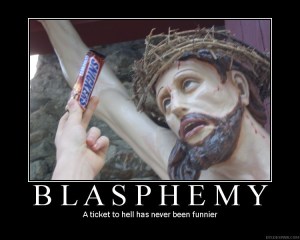
Now that blasphemous libel has been introduced to the statue books, it will be a crime to have a pop at religions.
So, here we go — Catholicism is a cannibal cult which eats its leader, Jews who believe that God wants them to settle in the Holy Land are deranged lunatics, Muslims who wants to install Islamic law are nothing but fascist terrorists and Scientologists are nothing but a bunch of brainwashed weirdos who have been suckered by the malicious rantings of a failed science-fiction writer.
Alright lads, I’ll see you in court.
I’m glad to see it. I doubt anything will come of it, but I’m glad that someone is willing to say it. I hope that more people come out and test this law as Mr. O’Doherty has. For those that don’t know, Ian O’Doherty is a columnist for the Irish Independent. His writing can be found here.
Even if the law has been on the books for some time, the fact that it was revisited means that it has some significance now. The legislature passed it, and I hope that more people will stand up and challenge it.
In the last couple of days I’ve noticed an old pattern come up a little more often than usual. But then again I put myself in the position to notice it more often. The old pattern is of mis-attributing the effects of belief to the veracity of said belief. In other words, people attributing the effects of their beliefs to the object of that belief. This is a logical fallacy.
Take, for example, this comment that was written to me just today through facebook:
Gravity is known through its power on objects. The Love of god is also known through its power on the individual. It is the same evidence.
Now, gravity is indeed known through its effects. If I am holding a pen and then let go of it, it will fall to the ground (or floor…etc). Now, it took some time for humanity to figure out why this is. Newton, after years of work concluded that it was some attraction that material object have for one-another. Later, with Einstein’s work, we now we have a better model of curved space-time that explains gravity better. The idea that space and time are curved due to the presence of matter is not obvious nor intuitive to us, but that model stands up to scrutiny even though Newton’s idea still makes sense and is a good tool to predict how gravity will work in the vast majority of our experiences.
And so there is this idea that the love of God is seen through its effects, and many religiously-minded people will see the more intuitive explanation that since the belief in and love of their god has effects, then the reality of their god can be inferred. The idea is that their feelings they can trust. Their experience is real and the best explanation they have is that the feeling is coming from somewhere real. They are correct, it is coming from something real, but they are mis-attributing the source.
If you will allow the conceit, I think that there might be a shift in paradigms here. I know I’m not the first to see it, but perhaps the first to make the comparison in this way. In the same way that Newton was technically wrong in seeing matter attracting each-other, perhaps those who believe that the effect that belief in god has makes god real are wrong for similar cognitive reasons. Perhaps they are missing the non-intuitive relationship going on behind the scenes, as it were.
Belief is a powerful emotional and psychological action. It certainly has the ability to alter how we behave, how we perceive, and thus it has the ability to change our worldviews. But belief can be effective even when the object of that belief does not stand up to scrutiny. The equations and relationships that Newton, the genius that he was, came up with to describe gravity are still applicable today. They can be used to make accurate predictions, they make cognitive sense to us, but they are wrong.
The more we look at them, they don’t work. In the same sense, the closer we look at the question of whether a god exists, the intuitive and simpler analogies do not stand up to scrutiny. The feeling of god’s love, its power, and it’s effectiveness are all reasons to keep believing to someone who is not looking closely at the question. But those who do look closer find that these arguments do not stand up to scrutiny. They are reasons, at best, to bolster a belief already held. They add imprecise legitimacy to a conclusion desired.
Just as anyone who wants to believe in Newtonian gravity can point to the fact that the equations they use to predict where their rock will land when thrown at a certain velocity and at a certain angle, the theist who points to the effect of their belief is missing the point. They are missing what is going on underneath the problem.
The love of God, in my opinion, is the love of human beings. We feel it, some call it God, and so the rest of us are left slapping our foreheads in frustration that they cannot see the love they are capable of and are creating through their belief. I see it without this belief. I see that the attraction of love is not between God and the world, but it is the curvature of our worldview through the presence of other minds.
I don’t know if any of you have been following the recent legislation in Ireland. I have been reading about the proposed Blapshemy Laws for a few days now, and am concerned. For those of you who would like to catch up, here’s a resource for you.
Basically, it may become illegal to criticize people’s religious beliefs.
The proposed law states the following:
A person who publishes or utters blasphemous matter shall be guilty of an offence and shall be liable upon conviction on indictment to a fine not exceeding €100,000.
For the purposes of this section, a person publishes or utters blasphemous matter if (a) he or she publishes or utters matter that is grossly abusive or insulting in relation to matters held sacred by any religion, thereby causing outrage among a substantial number of the adherents of that religion, and (b) he or she intends, by the publication or utterance of the matter concerned, to cause such outrage.
It shall be a defence to proceedings for an offence under this section for the defendant to prove that a reasonable person would find genuine literary, artistic, political, scientific, or academic value in the matter to which the offence relates.
Now, the second part of this mentions that the problem is outrage being caused by people who become upset by comments, short films, or cartoons. Why the hell would anyone riot over such things? And why are the Irish trying to protect people who would? The problem here is religious people, here primarily Moslems, reacting violently because of criticism, not the criticism itself. It makes perfect sense to riot because someone has implied that your religion is violent, right?
There have been a number of movements in Europe that have moved towards legislating protections for religion in the last few years. The acceptance of sharia in the UK is one such concession. Issues concerning whether women can wear burqas in their identification pictures is another (although the French have not sided with accomodation, at least). What is going on here?
Part of what is happening is that Moslems are moving into Europe and the United States in significant numbers. When I lived in West Philadelphia for a few years, I lived a few blocks away from two mosques and saw women in their burqas quite frequently. When people move into a place, they bring their culture with them. That will inevitably involve their concepts of law, morality, and religion.
Now, there are many points of sharia law that differ from the laws of the various nations that Moslems are moving into. And the openness and liberalism of these nations–places like Belgium, the Netherlands, etc–mean that they will try to accommodate the people that live there. This, to a certain extent, is admirable. The willingness to open yourself up to different cultures can lead to a better understanding of one-another and it is at the heart of what a free society is all about.
However, there is a point where in doing so you give up on what that liberalism and tolerance are meant to protect. Pat Condell says it best, perhaps:
I agree with Pat Condell here. Criticism is essential. We cannot make it a law that you cannot criticize religion. What will come of speech such as Pat Condell’s if Blasphemy laws are passed? What will happen to legitimate criticism of religion (or any other beliefs) if we are not allowed to say anything that may hurt someone’s feelings?
Religion cannot continue to get a free pass on criticism, as it has enjoyed for so long. You can criticize someone’s movie tastes, belief in UFOs, but don’t criticize Islam or Christianity! You might hurt someone’s feelings if you do that. There is no reason to give religious beliefs a free pass here.
It can only be the height of insecurity that would require religious views to be protected behind walls of legislation. We must challenge ourselves. And those that will not, we must allow others to challenge them. We must force those who make claims about the universe to support their ideas and allow skeptics and other dissenters to criticize their views as they merit.
I simply cannot understand what the Dail in Ireland is thinking. I hope that it will not pass the Seanad. And if it does, I hope that some will come out and test this law with blasphemy as loud as one can say it. I hope that the continuing undue respect, especialy to Islam in many parts of Europe, does not continue. I hope that people of reason will not be silenced by the fear that is projected by the faithful who feel the need to protect themselves from harsh words or criticism.
I had a rather busy holiday weekend. I won’t go into the details of all of it (some of it included partying until dawn on Saturday night), but I would like to share one piece of it which is relevant to this blog, my dear reader.
On Friday evening, I accompanied my girlfriend to her friend’s parents’ place for a party. It was a place full of conservative Christians, preachers, and pastors. The McCain/Palin bumper stickers gave that much away as I approached the house. I was warned that this would be the case, but I was not concerned about being myself there.
It was not long before I found myself in a conversation with the lady of the house, a woman who told me that she had been a “heathen” for many years before one day having an experience that “opened up my eyes” and she insisted that if I were to truly seek Jesus Christ, the same would happen to me.
Now, many years ago while I was going through a particularly unhappy period in my life, I did do just this. When I was at my weakest, desperate for some meaning and purpose, I called out to the heavens and I got bupkus. My sincerity was real, and the emptiness in response was depressing. I felt truly alone in the universe. I had never believed in God, let alone any particular ones, but I felt like I needed help of some kind. I had decided to open up myself to the possibility that I had been wrong (I actually had already been open to this, but I was doing it in an emotional way this time).
Nothing came of it.
Now, Christians have told me, including on Friday, that it was because I did not sincerely call out to Jesus Christ, by name, and so I was not truly seeking the truth. See, I was so insistent, even in my time of need and emotional turmoil, to specifically ignore the truth about God and the universe that I refused to truly seek Jesus.
The fact that these people, who found themselves in times of need, heard a call from God and knew it was Jesus Christ is fascinating to me. I ask, whenever I hear this, how they know it was Jesus. They just know. I ask if it’s possible that it is Allah, Vishnu, The Flying Spaghetti Monster, etc and they claim that they just know it’s Jesus. Funny how people who grow up with Christian surroundings always find Jesus in their powerfully transformative experiences, eh? I wonder what happens to people who grow up around Islam when they have such experiences?
But they insisted that i keep seeking. They insisted that the search cannot be intellectual, but rather it must be emotional. I found this to be fascinating as well because while most of my searching is intellectual, I understand the emotional aspect of religion and have not ignored this in my own life. But I could not help but ask what would happen if some part of one’s intellectual searching showed a reason why one should not, perhaps, trust what they find emotionally. This drew mostly blank stares. Probably the deception of Satan, one suggestion surmised.
So we had a nice conversation. Over the evening, I talked to a few interested people about religion, belief, philosophy, and we got along very nicely. Well, except that one woman who, upon hearing something I had to say, interrupted our conversation in order pray to rebuke Satan. I was hoping she was not rebukung me, but she was looking at me…. Really, I’m not Satan or even one of his minions. What I saw was fear in her eyes, and fear in the Christian world evokes Satan, I have found.
I enjoyed my evening. The people were friendly, the food delicious, and the conversation was lively. I would certainly go back to their house for a party another time. And no, it’s not because I want to go back and try and deconvert them, but because I had a lot of fun. I was able to converse with people with whom I shared little in common. I was able to perpetuate conversation between people that rarely talk to one another. I was able to evaporate some stereotypes and assumptions about atheists as well as gain some more understanding of conservatively-minded Christians.
It turns out that I have some things in common with some of them. Imagine that! (That’s sarcasm, people). I wouldn’t be able to be friends with many of them, but there are a number of liberal-minded atheists out there with whom I have the same issue. It is a question of personality less than opinions metaphysical that causes such issues. At this party I found people who were active and athletic (we played a good game of kickball followed by a rousing game of soccer, both of which I enjoyed greatly), some who liked good beer, and people that were interested in talking about their worldview with someone with whom they disagreed.
As far as I can see, that’s a pretty damned good evening.
O my brothers, am I then cruel? But I say: that which is falling should be pushed!
Everything of today–it is falling, it is decaying: who would support it? But I–want to push it too!
Do you know the delight that rolls stones into precipitous depths? –These men of today: just see how they roll into my depths!
I am a prologue to better players. O my brothers! An example! Follow my example!
And him you do not teach to fly, teach–to fall faster!
–Nietzsche, Thus Spoke Zarathustra
Perhaps the height from which we are falling will only manage to bring us back down to Earth?
Moral judgments and condemnations constitute the favorite revenge of the spiritually limited against those less limited–also a sort of compensation for having been ill favored by nature…. It pleases them deep down in their hearts that there are standards before which those overflowing with the wealth and privileges of the spirit are their equals: they fight for the “equality of all men before God” and almost need faith in God just for that.
–Nietzsche, Beyond Good and Evil
Too many commentators will complain that the sky is falling, and yet they cast the blame for such a catastrophe upon others, not seeing there own seeds of destruction. Perhaps what they see falling is something that needs to fall. Perhaps others see them falling.
Blessed be the poor in spirit, for theirs is an imaginary kingdom. Let it fall, and when it does we, with our feet planted firmly upon the ground, will be here to catch you.
I was having a conversation yesterday while out at The Devil’s Alley on Chestnut St. with some friends. As I sat down, I discovered a conversation about “higher powers,” and my ears perked up. What is a god? That was the question.
A good question it is. As a general rule, I don’t define what a god is. I believe that I should listen to what someone tells me they think their god is and answer whether I think such a being exists. In general, the answer is no. But sometimes, someone’s definition of god is more than a little different than the general concept of an omnimax being (omnipresent, omniscient, omnipotent, omnibenevolent, etc). In this context, someone presented a definition of ‘god’ as something that has power over him. I thought that this was a bit vague, so I asked if an alien being were to visit that had great power (technology that would seem like magic to us, for example) would that being be considered a god? He said yes.
This led me to thinking. Has the concept of god become so pushed back to a logical construct or vague power in discussions of theology so much that when I run into more primitive concepts of god they don’t even seem god-like? Take for example the ancient Greek gods. Zeus, the ruler of Olympus, was not an all powerful being responsible for the creation of the universe or even omniscient. He was a powerful being that could kick your ass, perhaps, but he was nothing like the God of modern theology. Would Zeus be considered a god in the theological discussions of today?
My immediate response to this claim that powerful aliens would be considered gods was to say that this definition was too vague and inclusive to be legitimate. This is largely because my atheism, admittedly a reaction to people’s theological ideas, is a lack of belief in a concept of god that transcends mere power over me or greater than me. It is a rejection of a being of ultimate power, presence, and knowledge as is defined by most religious traditions. I do not reject belief in powers greater than me (although I don’t believe in aliens, due to the lack of evidence for them so far) but in the concept of a being that created everything, is all powerful, etc.
There is nothing automatically metaphysically problematic with the idea of powerful beings that exist. Granted, we don’t have the means to replicate this power now, but we may in the future. Being a bit of a sci-fi fan, I could refer to Q (Star Trek), The Ancients (Stargate), The Protectorate (Power; ahem…**shameless plug**) and other such beings that look god-like from a certain point of view. But are these things gods?
If we were to develop technology that would give us these types of powers, would we become gods? Now, Mormons and Scientologists possibly aside, I don’t think that such things are the same type of question as we talk about in the question of whether a god exists or not. If some people are using the term ‘god’ in a non-traditional fashion then I think that there might be room for some discussion, but a different one than what I typically have.
The problem with having a definition of god that can include things like aliens is that where is the line drawn? I don’t want to evoke a fallacy here, but there should be some line where above it is a god and below is something else. I don’t know where that line is, but I think that some baseline attributes need to be considered. What those attributes are…that’s a discussion for another day, perhaps.
Here’s an extreme example. If someone were to define their coffee cup as god, and then show me this coffee cup, then I cannot be an atheist rationally concerning that person’s god because I have good empirical evidence that it exists. But is this legitimate? Is this definition of ‘god’ (the coffee cup) too much of a redefinition of the concept of ‘god’ to be considered to make me me no longer an atheist?
What about a powerful alien, like in Star Trek V where the crew is hijacked and taken to the center of the galaxy where they meet a powerful being that claims to be the God of various traditions, including Judaism and Christianity. But the being ends up just being some powerful alien and ‘Bones’ calls him on this facade and they manage to escape. So, was this being a god (even if it wasn’t the specific god it claimed to be)?
I think that maybe the concept of what a god is has changed somewhat over the centuries. I think that this is because the more we understand how nature works, the smaller the domain of the supernatural becomes. Where Zeus was once a god, the role of Zeus is now no-longer supernatural. Thus, the gods of today are transcendent and invisible. Perhaps as they always were, at least since the days of the pre-Socratic philosophers, but even today we push back the supernatural with every advance in cosmology, biology, and neurology (among other fields).
The “God of the gaps” gets smaller and smaller.
Thus I will leave it as a general rule to allow those I meet to define their god, and I will leave it to them to largely be unable to do so. In fact, this is one of the reasons I am an atheist; theists almost never have a solid definition of what god is (and not just it’s name and what it had done, but what it is). And they want me to believe in it?
I contend that we are both atheists. I just believe in one fewer god than you do. When you understand why you dismiss all the other possible gods, you will understand why I dismiss yours.
Because atheism is not a set of beliefs or even one belief, I cannot speak for anyone but myself in terms of what it is like to be an atheist in today’s culture. I can, however, give a glimpse from a possible point of view that may be shared by other people, perhaps atheists as well. If your experiences differ from mine or if you disagree, then you are an infidel who will regret your heresy come the judgment. Just kidding, maybe….
Being an atheist is nothing like being a minority race. Besides passing, being a different race is not something that can be hidden from society. An atheist can walk down the street and nobody would know that he or she is an atheist, we have not previously been enslaved or killed en mass (the Inquisition notwithstanding), and we don’t have stereotypes about us that are unfair generalizations. OK, that last one may not be true, but I’ve gone three months without eating a baby or worshiping the devil, so get off my back already!
Being an atheist is not like being gay. People are born gay. OK, so people are born atheists as well and then are introduced to religion as children. But besides that, people don’t choose to be gay. OK, in a strict sense a person does not choose to be an atheist either; belief, or lack thereof, is not subject to the will. I cannot simply decide to believe in god, I have to be presented with certain evidence in order to come to the conclusion that a god exists. I have not been presented with such evidence. I’d like it if it were available, but despite my attempts it has not come.
Now, you may tell me that it is simply better to believe because by believing I lose nothing and by not believing I risk my eternal soul, but this would only be pretending to believe, and if such a god existed than that god would know the difference. This wager–that it is better to believe than not because of the potential consequences–are really reasons to pretend to believe, not reasons to actually believe.
But you, my imaginary interlocutor, are distracting me from my point. My point was…oh, right; my point was that being an atheist is not like being gay. Although if I were gay then my being an atheist would be a lot like being gay, because I’d be gay. But my digression continues. Bottom line, I’m not gay (not that there’s anything wrong with that) and my being an atheist cannot be exactly compared to being a homosexual.
Of course, outing myself as an atheist has often been similar to experiences friends of mine–people who are gay or bisexual–have had. But they are not the same.
OK, so being an atheist is not so bad. Sure, people will sometimes look at you funny when you say you don’t believe in any gods, including theirs People will possibly feel sorry for you for not having the relationship with some god as they do. In some cases, you may get a death threat, damned to Hell, or people might pray for you. It’s not so bad.
But my concern is not so much how people treat atheists as it is how I look at the society around me. Now, I believe strongly in personal freedoms. I am willing to fight for people’s right to believe whatever nonsense they like, so long as they are willing to respect that right for others. But I believe that part of our freedom is to be able to criticize where we see fit, and that must include religion. One thing that I see in our culture is the free pass that religion gets; to criticize it is rude, people say, and it doesn’t do any good, they sometimes continue saying. I hear atheists (but don’t call them that to their face!) say things like that a lot. They don’t see the harm religion does to people often. That’s nice for them, I guess. Others don’t have that luxury.
So as I walk around, enjoy a drink at a party, or obnoxiously walk in screaming “God is dead!” during church services and listen to people talk about what their god did for them that day, their sophomoric platitudes about how god is ubiquitous and obvious, and how my life will be so much better with a god in my life, I can’t help but feel like I’m talking to some kids at a kindergarten about Santa. I wonder, as Bill Maher did in his film Religulous, if people were taught fairy tales as religion and the Bible as fairy tales, if people would defend Mother Goose with the same zeal they defend Adam and Eve or Jesus. From an outside point of view, I don’t see much of a difference between fairy tales or Greek myths when compared with what is in the Bible.
So I get a little frustrated with people around me. I feel like people are deluded, blind, and unwilling to genuinely investigate what they believe. What’s most frustrating are the people that live their lives without thinking about religion much at all–sure, they’ll pray sometimes, attend church even, but they have almost never actually investigated the claims of their belief systems–but they will defend their beliefs with a vigour that should only come from genuine certainty about their beliefs. They are sure, but they have little to no reason to be sure because they have not investigated their beliefs and often consider doing so unnecessary because god told them it was true. Of course, people in other religions say the same thing. God must be a prankster or something. After all, he told me that he doesn’t exist, and you can’t tell me that my experience wasn’t real!
So, you’ll imagine how I feel about those street preachers, fundamentalists, and evangelicals, right? That’s right, I respect them. They have read the book (whichever one is theirs), they have tried to understand it, and think they know what is at stake; if their book is right, then they are doing what is right. They are not just waving hands at and going through the motions for their god, they are living what they believe. Now, some few of them will become militant and this I cannot allow to happen, although the fact that someone is willing to risk their lives for what they believe I find refreshing. I will fight these militants with the same fire they are willing to muster, but I at least respect their willingness to take what they believe seriously.
It’s just a shame that their minds are infected with a virus. See, I respect willingness to fight, hopefully peacefully if possible, for what one believes in. I have less respect for the so-called Sunday Christians, cafeteria Catholics, moderately religious, etc. Unless, of course, your specific religion is one of moderation, this is hypocrisy. The Bible, the Koran, and other religious works contain horrifically violent ideas. Yes, there are some beautiful ideas as well, but if you take it as the word of god, you have to take it all. And if you only take what you like because they give meaning to your life, then you cannot claim that any of it is beyond criticism. You must take it all as truth or you must call it all myth, some of which you like. Try as you like, but any standard for differentiating the myth from the truth will leave you at odds with another standard. This is why there are thousands of sects of Christianity. This is why the three major monotheistic religion’s are perpetually in conflict.
I see a world of people who are mostly unwilling to challenge themselves. I see people defending ideas they are unwilling to have challenged. I see emotionally infantile, fearful, and ignorant people in most places who would not know critical thinking if if slapped them. I see people who don’t care, don’t care to care, and who will nonetheless think of me as obnoxious. That is, they care only when they are challenged, and since I’m willing to challenge, then they care. What a dick I am for trying to think critically and talk to my fellow citizens about their beliefs in the hope of sharing and trying to improve the world around me. We should just allow people to isolate themselves in their little worlds and not allow people from the outside to ever challenge those worlds. That would be a utopia.
My experience as an atheist–but more broadly a skeptic and a freethinker–is that I’m in a sick culture that keeps trying to cure itself with one of the symptoms of its sickness. I see people who, when the “new atheists” (people like Daniel Dennett, Chris Hitchens, Sam Harris, Richard Dawkins, etc) speak up, they react by defending the symptom automatically out of misplaced reverence.
I do not respect belief in silly things. I respect individuals. I do not respect, necessarily, what they believe. I do not accept that I should respect people’s beliefs. What kind of absurd bullshit is that? If someone believes that the moon landing was a hoax, do you respect that? When someone believes that they saw Elvis do you respect that? If someone says that they believe that their garden is tended to by fairies at night do you respect that? We challenge ridiculous things in our culture because they are ridiculous. But the one thing that actually has sway over our lives, compels legislators to discriminate against citizens by proposing religiously motivated laws like DOMA, and perpetuates beliefs that do harm by often creating a bias against the best method of determining what works (science), is not allowed to be challenged because it is important to people and you might hurt their feelings. Well, I want to talk about these things with people and people not wanting me to is hurting my feelings.
You want to know what atheists like myself are angry? Imagine if you lived in a world where people literally believed,sort of believed but defended fiercely, or simply thought you rude to challenge that invisible sky pixies created the world and without belief in and worship of these pixies not only are you probably a bad person but you should shut up about your disbelief.
Sky pixies. God. Same difference.
And that’s what it is like for every single “real” atheist out there. If you think you are an atheist and you disagree with what I have said here, then you are a heretic and you will be shunned by the real atheists. Of course, we will not directly shun you, we’ll just treat you differently until you eventually go away to create your own little atheist group (but it will not be the true atheist group) and have your own little heretical meetings and call us the heathens (assuming you don’t get mysteriously wiped out by…well, someone will do it I guess). And after a few centuries, there will be all sorts of atheist sects and we will laugh at the old pagan religions about Moses, Jesus, and Mohammad and we will call those a-atheists immoral people who we will pity for their lack of lack of relationship with our non-god.
Hmmm… Something is awry here. Best not to think about it, I guess.
I willfully agree that there are problems with our culture and nation right now. I submit that there even moral issues that need to be dealt with. I think we need to take steps in order to find solutions to these problems. However, the following is not representative of the right approach to looking at the problems or providing solutions.
WHEREAS, the people of Oklahoma have a strong tradition of reliance upon the Creator of the Universe; and
WHEREAS, we believe our economic woes are consequences of our greater national moral crisis; and
WHEREAS, this nation has become a world leader in promoting abortion, pornography, same sex marriage, sex trafficking, divorce, illegitimate births, child abuse, and many other forms of debauchery; and
WHEREAS, alarmed that the Government of the United States of America is forsaking the rich Christian heritage upon which this nation was built; and
WHEREAS, grieved that the Office of the president of these United States has refused to uphold the long held tradition of past presidents in giving recognition to our National Day of Prayer; and
WHEREAS, deeply disturbed that the Office of the president of these United States disregards the biblical admonitions to live clean and pure lives by proclaiming an entire month to an immoral behavior;
NOW THEREFORE, BE IT RESOLVED that we the undersigned elected officials of the people of Oklahoma, religious leaders and citizens of the State of Oklahoma, appealing to the Supreme Judge of the world, solemnly declare that the HOPE of the great State of Oklahoma and of these United States, rests upon the Principles of Religion and Morality as put forth in the HOLY BIBLE
This is a proclamation brought forth by Sally Kern, whom is a state legislator in Oklahoma. Granted, this is not my back yard, but it is indicative of a significant segment of the United States population who agree with these statements.
Proclamations like this are a waste of taxpayer money (at least it is not mine, in this case), are discriminatory, and present no realistic help to anything at is an attempt to legislate morality, even if it has little to no teeth. It takes very conservative values and proclaims them as a representation of all people in the state of Oklahoma. It says to the homosexual citizens, those who enjoy pornography, and other ‘debouchers’ that they are the cause of the world’s problems.
It implies that these people have earned the wrath of some bronze-aged megaloaniacal bastard of a god, and so they should be condemned and lambasted. It is disgusting, petty, absurd, and frankly immoral.
The problems in our nation are the result of poor education, projected fears and insecurities, as well as greedy and unethical practices by those who control wealth and politics. This list is not exhaustive, of course. Those who maintain a faith in a worldview that is unsubstantiated, fearful, and discriminartory, such as Sally Kern and her ilk, are doing much more to perpetuate the problems than alleviate them.
Religion, while not all bad, will tend to bring out these aspects of human nature. Maintaining religious ideologies such as the conservative Christian worldview that believes in sin and a judgmental and vengeful god are the source of our cultural problems is but one symptom of the sick culture, not a solution to it.
Proclamations such as these only act to appeal to an electorate that is ignorant, hateful, and who oppose civil rights, science, and reality. It only can keep these people from becoming better informed. It only does harm.
So,
WHEREAS people of reason do not accept the parochial moralities of bronze-age mythology, and instead seek to understand reality on its own terms; and
WHEREAS the history of Christianity’s role in America has been a part of some of its culture and not its law; and
WHEREAS the problems of our culture, being many and complex, have many and complex causes that we have no reason to believe are related to any gods, Christian or otherwise; and
WHEREAS discriminatory beliefs concerning sexuality and gender are the result of conservative ideologies centered around Christian congregations which are not shared by all citizens; and
WHEREAS The president of the United states, as well as all other elected officials, both federal and state, are not obliged to capitulate to the moral opinions of the few;
NOW THEREFORE, BE IT RESOLVED that we the undersigned defenders of reason, fairness, and citizens of the United States, appealing to the reason of people everywhere, solemnly declare that the HOPE of The United States of America rests upon the genuine and honest work of people who use the best methods of analysis, investigation, and honesty in the pursuit for truth.
Why do people associate their personal experiences as spiritual experience to be interpreted through their religious community? This may seem like an odd question, but I think it is worthy of consideration. It seems that when people associate their personal experiences–especially when they consider them spiritual experiences–with religious traditions they are in fact doing the exact same thing that people did to create religious doctrines in the first place; establishing human opinions as the will of gods.
What are we talking about here? I’m talking about that little voice we here that tells us when something is wrong. I’m also talking about that sudden and apparently out-of-nowhere idea that motivates us. I’m talking about those moments in prayer, meditation, or possibly while reading something that inspires us (the concept is in the word ‘inspire’) toward understanding. In other words, I’m talking about things that happen to many people every day and are called by many people “spiritual experiences.”
In some cases the experience will demonstrate an idea that may not sit well with the established doctrine of religious communities, even the religious community that said person is a part of. This will often lead to some cognitive dissonance, undesired questions, and possibly conflict. If the situation continues, it might lead to a person looking for a different community that fits better with their own understanding and experience.
But wait, there is something there to consider. If a person can simply look for a congregation that fits their spiritual experiences, doesn’t that imply that somehow their previous congregation was inconsistent with their views?
So, if the experience they had was truly spiritual, as in a revelation from some god, or even if they just think that it seems true (we do tend to think that our ideas are true, which is why we tend to keep them), that must imply that their previous religious institution was in error?
We all have experiences, some similar and some dissimilar, that help make up our worldview. And we find ways to associate these experiences with the greater view of the universe; we will try and plug them into the larger picture of our beliefs. And as this process continues and people find others that agree with their view, communities form with similar worldviews, most who think that their views are somehow the result of communication with divine powers in the universe.
Most Christians will call this the Holy Spirit. Most congregations will tend to think that the interpretation they have of how things like communion, baptism, divorce, the role of faith v. works, etc are superior to other sects. And why? Because the congregation they choose will, in most cases, agree with their experiences.
I should not ignore the fact that being a member of a certain group will tend to color how one will interpret experiences as well. A certain view, whether it be doctrinal or cultural, will tend to give a bias in how we interpret experiences. Thus, there is an interplay going on here between bias informing interpretation and conflicts of interpretation dividing up communities, the details of which are too complex to deal with sufficiently here.
What about conflicts? When someone, whether they are homosexual or not, has some experience that compels them to see being homosexual as being as natural to a person as heterosexuality to another person, what do they do when their religious institution says otherwise? If they join a new church that is gay/lesbian friendly, do they conclude that their previous church was wrong? And if so, what about the previous experiences that they had in association with that institution? Were those other experiences invalid because they do not conflict with that doctrine or was that doctrine somehow accidentally right about that one thing while wrong about others?
How reliable are these subjective experiences that make up the various doctrines of various religions and their sects? Why do we continue to associate our creative powers, experiences, and insights with religion? Why do we think that they are, in fact, spiritual experiences? What are our bases for making this claim?
It is clear that the larger cultural context a person is placed within will color their experiences. It is clear that people create associations with certain kinds of experiences–emotions, inspiration, etc–within their religious community early in life. These associations stick, and as adults most people will continue to associate certain sets of feelings with their church, temple, etc. Thus, the reason why many people think our the every day experiences they have are spiritual seems to be because they were placed in situations that induce these feelings while young while hearing about religious ideas and stories.
But what about non-religious people? How do they deal with these experiences. First of all, non-religious and non-spiritual people have these experiences too. Some, especially those who grew up religious, will still have these emotional associations even though they do not believe in the religious ideas anymore. Others, like myself, simply look at them as a natural part of life, and attach no divine or metaphysical significance to these experiences. As far as I am concerned, I am lacking in nothing as a result of this. as my own personal experiences are deeply meaningful to me.
I challenge others out there to ask themselves, if they associate their personal experience with something spiritual or religious, if this is the only way to look at it?
I updated my facebook status yesterday saying that I was involved in a discussion about whether we are biological machines. I say that we are. In response, a debate ensued among the comments concerning this question that turned into a discussion about free will, moral responsibility, etc. I thought I would share some thoughts here and see what people think. Keep in mind that I am thinking publically here, and not trying to establish absolute certainty on this issue. I invitediscussion.
Of course moral responsibility is based upon our choices. The physical circumstances we find ourselves in will have to be analyzed, perceived, or attended by the brain in some way. The question is whether how our brain reacts could have been any other way than what it does? Could that last sentence I just wrote have been expressed more or less eloquently? Could I have given the opposite opinion?
It is logically possible that a different sentence could have been written, but would it be physically possible? What sense would it make to say another thing could have happened? Would that not imply that the physical properties of my brain or its input would have to have been somehow different? What aspect of the situation would have allowed the different situation to have emerged? What would have to be different to allow different actions? And if the same physical circumstances could have allowed a different action, does that mean that this is a hypothesis about the nature of matter to be unpredictable?
There is a sort of game being played here. It is a game within which we have the ability to think about the alternative ways to describe the circumstances, but from the outside of the game it may be clear, perhaps to a greater perspective or some theoretical god (or some kind of third-person-omniscient point of view) that no other possibility could have been, including those specific concepts of alternatives within the minds present. Another question would be whether such a god-like point of view exists. I don’t think so, but I digress.
The issue of moral responsibility only makes sense within the game of this question, but outside of it the game perhaps the repercussions of our morality are also as determined as the actions being punished. Perhaps the punisment is as determined as the crime.
But we feel free! There is a sense of being able to look at he options–turn right, left, stand still, turn around, etc–and that we analyze the possibilities and decide which to pursue. But I am at a loss as to understand how a physical brain could have made any actions besides what it did. Quantum uncertainty, if it plays a part in neural activity at all, seems a possible area of explanation, even if I am skeptical of it. Perhaps quantum uncertainty throws the monkey wrench into physical determinism at the level of the world around us–the nurture–meaning that given known circumstances our behavior could be predicted but the circumstances themselves are undetermined. I don’t know.
But what does not seem legitimate, to me, is the explanation of souls or spirits that exist within us that allow us to be more than mere biological machines. Why not? Well, if we have a soul, it is either part of our physical structure (not escaping the problem at hand) or it is non-physical, raising questions about how the non-physical and physical interact. If they can interact, then is the non-physical really NON-physical?
It is a difficult issue. I don’t like the thought of my choices being determined by the set of nature and nurture (even if nurture is potentially non-determined). But I don’t know how to escape the problem. I would like to hear comments on how others think about this (assuming you have a choice in how you will respond).


 Skepticism, Properly Applied