Gary Gutting on Atheism and agnosticism


Gary Gutting is a professor at Notre Dame, in the department of philosophy.  About a month ago, he wrote this article for the New York Times.  I rather liked the article, as I remember.  But there was a small annoying catch that caught my attention.  It happens here:

In these popular debates about God’s existence, the winners are neither theists nor atheists, but agnostics — the neglected step-children of religious controversy, who rightly point out that neither side in the debate has made its case.   This is the position supported by the consensus of expert philosophical opinion.

*facepalm*

I have addressed this.  I even re-addressed this.
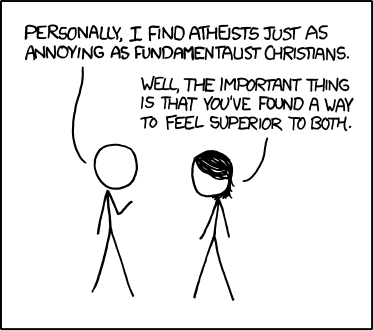
No, Dr. Gutting, this is not the consensus of expert philosophical opinion.  This is ignorance displayed as consensus by gobshites who are so far removed from the atheist community and feel the need to feel superior.  OK, maybe they just have not thought this through….

I was moved to respond.  And so I hopped on my keyboard and churned out a quick response, while including my link from one of my favorite posts about agnosticism.  You know, the one linked above.

I didn’t hear from him after a few days, and forgot about it.

Then, the other day, I happened to glance over at my left-hand panel on my gmail page and noticed that I had a draft email.

What could that be? I thought

For some reason, the email to Dr. Gutting had never sent.  It was just sitting there, unsent, all this time.  So, I decided to send it, finally.

He replied to me today:

Thanks for your thoughts.

Of course, you can use the terms the way you think best.  But your way of putting things ignores two importantly different ways of not believing that God exists. You might not believe in the sense that you withhold judgment as to whether God exists OR in the sense that you believe that God does not exist.  In ordinary usage, the first sense of not believing in God is called “agnosticism” and the second is called “atheism”.  It seems to me that this is a useful distinction, and I don’t see what you gain by eliminating it.
I also think you confuse the discussion by assuming that the agnostic claim “I don’t know whether or not God exists” must mean “I am not absolutely certain whether or not God exists”.  In most contexts, knowledge doesn’t imply absolute certainty; it’s consistent with at least a small degree of uncertainty.  So, if someone says he knows that Paris is the capital of France, but admits that there’s some small probability that a coup in the last few hours moved the French capital to Lyon, we don’t think he’s contradicting himself.  Of course, you can insist that anyone who allows the slightest bit of doubt about a claim is agnostic about it.  Then almost everyone becomes an agnostic about almost everything, and the term has little use.  But  that’s only because of the artificially strong sense you’ve given to “know”.  And, even if you use “know’ that way, there is still the highly useful understanding of agnosticism in terms of belief (not knowledge): There are still many important cases in which people are agnostic about a claim in the sense of neither believing that it’s true nor believing that it’s false.
Best,
Gary

Well, nice.  He responded quickly, if not tersely.  Of course I didn’t give him much to chew on, and I have no way to know if he ever read my post I linked him to.  I doubt he did.

So, what about his response? I thought he was still missing the point, so I sat and started typing, and eventually replied with the following:

*sigh*

I think you have misunderstood my perspective, and would like to try and be more clear, if I can.  I’m mot saying that I am reserving judgment NOR am I saying that I believe that god does not exist.  Neither of those positions are those of the atheist who has considered the philosophical implications of the question at hand.   That’s what you are missing, I think.  The position of the vast majority of atheists I know from the atheist community is that we are not convinced that a god exists.  Our judgment (again, not a reserved one) is that the claim has not been sufficiently demonstrated towards rational belief, while recognizing that we cannot say with absolute or high certainty that the proposed being cannot or does not exist.

This goes to your second point; I am not using the term “know” in this absolute sense either, but rather it’s more fluid common usage accepted by philosophers of many stripes.  I’m an agnostic because I recognize that there is information I do not have, perspectives I have not considered, and because it is not logically impossible for many concepts of god to exist.  Thus some god might exist beyond my current level of knowledge (or not exist beyond my current state of knowledge, depending, of course, on whether I actually believe in such a being currently) but this is not the point.  Again, this is not a epistemologically absolutist position, but rather one of relative strength in the vein of scientific knowledge; overwhelming evidence is sufficient for using the term “know.”

You said:

And, even if you use “know’ that way, there is still the highly useful understanding of agnosticism in terms of belief (not knowledge): There are still many important cases in which people are agnostic about a claim in the sense of neither believing that it’s true nor believing that it’s false.

This does not touch my use of the term agnostic at all.  In fact, it coheres with it, somewhat ironically.  Allow me to explain;

The first clause I will not grant aside from the trivial point that any word could be used in any way a person chooses to use it.  But if we are striving for philosophical precision, we must try to maintain a consistency of terms insofar as they do not stray too far from usefulness in distinguishing concepts in context to the discussion at hand.  ‘Agnostic’ is derived from the Greek word for ‘knowledge’, and in the context of the question of god’s existence this term plays the role of the question of knowledge, rather than belief, because these are epistemologically different concepts (knowledge and belief) and thus need to be distinguished in being precise.  By allowing ‘agnosticism’ to bleed into the question of belief, one fails to recognize that this distinction is relevant.

And if you think that knowledge and belief are not that easily distinct, then you need to demonstrate why and how this impacts the question at hand.  I do not believe you have done so thus far.  However, I do think that this issue might be a point of our misunderstanding of one-another.  I’ll leave that aside for the moment.

In terms of your second clause from above,

There are still many important cases in which people are agnostic about a claim in the sense of neither believing that it’s true nor believing that it’s false.,

this is possibly trivially true, but again you miss the point.  You are creating the wrong dichotomy to understand how I’m using the term ‘atheist.’  I’ll try and pry apart the relevant issues.

I accept, from the start, that there is no rational way to demonstrate that there are no gods of any kind.  I cannot prove a negative, nor am I trying to.  The problem here is that the antecedent ‘dis-‘ in ‘disbelieve’ is ambiguous in that it can mean both “opposite of” or “absence of,” and the logical distinction between these meanings is the very heart of this misunderstanding.  It’s precisely why I use the terminology of “lacking” belief, so as to get rid of this ambiguity.  The term “lack” implies that I’m not saying “there is no god” or “I believe that there is no god” but rather that “the evidence is insufficient to believe, and so I don’t believe.”

The implication of this is that I will go about my day as if said being does not exist even if I know, when pressed, that I cannot logically believe that it does not exist.  The further implication is that the position of “believing that it’s false” is off the table; it is not a position under consideration.  (At least for me.  There are some that try to move in this direction, especially about specific concepts of gods, but this is beyond atheism and into another topic, perhaps anti-theism or some other term that may be more appropriate.  But I digress….).

Thus the dichotomy that you, and many others, draw between [edit*] belief in and the belief of absence (“in the sense of neither believing that it’s true nor believing that it’s false.”) is not the same one that I draw.  You are drawing a distinction between two beliefs, while I am drawing a distinction between believing and not believing.  Again, this is a judgment, just not in favor of any belief.  My judgment is that the evidence and reasons proposed for the existence of any gods fail to demonstrate what they seek to demonstrate towards rational belief, and thus I lack belief. I disbelieve. I am an atheist.  I am without belief.  I do not ‘believe that their is a lack of gods’, I ‘lack belief in any gods.’  I hope you understand the distinction now.

So those that can fall under “neither believing that it’s true nor believing that it’s false” do not make the point I think you wish to make.  Why?  Your formulation of the statement fits the definition of ‘agnostic’ in the same way that a ‘carpenter’ could be defined as a person who either believes in fairies or that the proposition of fairies is false; the term has nothing to do with the dichotomy at all.  That was my point; whether one is a theist (believes), an anti-theist (believes a god does not exist), or an atheist (simply lacks belief) any of them could be an agnostic because agnosticism deals with what one knows, not with what one believes.  The term ‘agnostic’ has nothing to do with “neither believing that it’s true nor believing that it’s false” except in the trivial sense in which the formulation and the term are not mutually exclusive.  They do not touch each-other at all.

You make the claim that “there is still the highly useful understanding of agnosticism in terms of belief (not knowledge)” but do not support this.  I tried to show here why your subsequent clause did not wed agnosticism to belief in any way but a trivial one of non-exclusivity.  In other words, I have not seen sufficient evidence (or reasoning) for your claim, thus don’t believe it.  It may still be true, but that’s for you to demonstrate.  The burden of proof still resides with you.  See the analogy?

I’ll state my position again, and hope you’ll understand this time.  I’m an agnostic; I don’t know if any gods exist.  This is a given because nobody knows, either absolutely or by use of the term ‘know’ in a less absolutist sense.  The term is thus redundant and thus useless; I toss the word to the side because it does not clarify my position in any way, except in the semi-trivial sense of being clear about my use of the term.  Anyone who says that they know there is a god (or that they know there is not one) has the burden of proof, and I shall await their proof or overwhelming evidence.

I have not been convinced either way. The theist has not convinced me, and neither has the one claiming that there are no gods. I have judged both of their arguments to be insufficient to demonstrate their propositions.

Since I have not been convinced by the proposition (again, either one), even in light of attempts to demonstrate said being(s) existence (or against it’s existence), I lack belief in the proposed being (and the proposed lack of being), and lack belief.

Atheists are not going around trying to show why god does not exist (except in rarer cases, who are the extreme exception.  These people are atheists, in that they lack belief, but are trying to take a further step in presenting an argument that gods do not exist, which goes beyond the definition of ‘atheism’ when we are being precise).

No, atheists are going around talking and writing about why they don’t believe in gods.  They are presenting their arguments as to why the arguments proposed for gods fail to be rationally, empirically, or emotionally compelling.  They are reacting to theology, not doing some bizzaro-world anti-theology (again, except for rare exceptions).

Don’t get caught up in the strong language of people saying “there is no god” because they are saying this in the same non-absolute sense that you objected to using “know” in your response above; They are not saying “there absolutely is no god” but rather “there is no reason, as far as I can see, to believe in one.  Thus, I go about my days as if there is no god.”

Continue reading “Gary Gutting on Atheism and agnosticism”

What Atheists Can Learn from the LGBT Movement


I watched this video of a presentation by Greta Christina earlier this week and many of the points have been swimming around my brain since then.

I have heard many people compare the recent atheist activism to the activism of gays 20-30 years ago, and this is perhaps the best presentation on the subject I have seen to date. (This is not to say there are no more comprehensive presentations, only that I have not seen them. If you know of another comparable one, direct me to it, please.)

And certainly there are parallels between the two movements, but since I am not gay (even though I have done activism in support of issues relating to LGBT rights) my commentary will not carry tremendous weight, so I will not say much about how similar they are. I’ll leave that to more authoritative commentators, such as Greta Christina herself, who does talk about many of the same issues as this very blog.

I will point out that the OUT campaign, affiliated with the  Richard Dawkins foundation, is in part modeled on the movement to “come out of the closet” that was started by queers of all types, and which has become part of our cultural language such that atheists’ use of the phrase automatically draws the parallel for most people.  I often wear a scarlet letter T-shirt that signifies this coming out, and will often get asked if I’m an adulterer, making obvious reference to The Scarlet Letter.

(The irony, as some friends have pointed out, is that the concept of adultery takes on different connotations as a polyamorous person.  This is not to say that adultery is impossible within poly lifestyles, only that not all extra-marital sexual relationships will be considered infidelity, causing one to re-think the concept of adultery in such contexts.)

Now, the double reference of the scarlet letter and the coming out movement, wrapped in a symbol like this will cause confusion for most, but it is one that leads to conversations.  Conversations are important to have.  I have have countless (and often) short and friendly conversations explaining what the symbol stands for, what atheism is all about, and why I wear it.  Small steps.

Now, whether the larger atheist community will learn from the mistakes of the LGBT movement or not, is yet to be seen.  I know I am certainly guilty of some of the errors of which Greta Christina speaks.  But it is important for us to keep in mind the lessons that previous social movements have to teach, so that the future will not reflect the past that we have learned from.

And I do believe that there will be a time when atheist (as well as polyamorous) social movements will be unnecessary.  As she says in the video, it is the goal of a social movement to make itself obsolete. Will this happen in my lifetime? I don’t think so.  But if we stop now, it may never happen.

Here’s to making social activism obsolete!

Mythology and the suspension of (dis)belief


I just recently saw the movie Inception, with Leonardo DiCaprio.  I thought it was good, overall.  There were a few times when I winced because the pseudo-scientific explanations for how the world of the movie operated hurt my brain.  But I put it aside; I allowed myself the suspension of disbelief in order to enjoy the movie on its own merits.  I allowed myself to be absorbed by the mythology of the film, in order to enjoy the narrative, characters, resolutions, etc.  And then I enjoyed the movie.

Then I started thinking about mythology.  I started to think how that suspension of disbelief, that acceptance of the mythology of the world I was watching, felt familiar to me.  And then it struck me while I was in the shower (of course; why do such thoughts always seem to hit me in the shower?).

See, I’ve thought before that worldviews; the set of assumptions, beliefs, and (hopefully tentative) conclusions which underlie our navigation of the world, are made up of mythologies.  Each of us have lenses (metaphorically speaking) with which we see the world; we often see very different worlds than those with different lenses.  Stepping into someone else’s worldview will result in lack of understanding, feeling out-of-place, or possibly offended.

Then it occurred to me that in order to step into someone else’s world, one would need to suspend their disbelief.  Further, they would have to first suspend their own belief, for a little while.  They would have to try and take off their lenses and try on the lenses of another, in order to understand the world; to accept the slightly different world which is presented to them.

It is much like going to the movies.

I remember when I was first fascinated by religion, I would enter into situations such as church discussion groups, lectures, etc and I would try and lift my cultural assumptions in order to try and understand how they saw the same event.  See, I studied anthropology as an undergrad, where we learned how to be good ethnologists.  In order to understand cultures different than our own, we had to be able to become open, observant, and to, well, suspend our own worldviews as much as we could.

And the better we became at being aware of our own worldview, the better ethnologists we could become, right?  The better we know what our own lenses do with our perceptions (our biases), the better we can identify how another bias might skew the theoretical objective reality that we are supposed to be sharing.  (This makes me want to comment about the problems that this would bring up for an inter-subjective reality, which I prefer to the idea of an objective reality…but I shall resist the tangent).

So, back to the worldviews of others….

For a time, I was able to see the beauty, the inspiration, the enticement of the worlds I would visit.  I could understand the draw of the love of Christ, understand the greatness of Allah, see the wisdom of the Buddha.  I was able to comprehend, if only superficially and perhaps only as a simulacrum, why people had faith; why they maintained religiosity.  Yes, my dear reader, I was once a faitheist, an accommodationist even, even while I had always been an atheist.

But I never accepted the worldview.  I never became part of it.  I watched it, with interest (and the appropriate disinterest at times) that accompanied my genuine desire to understand, but never accepted it as true.  I couldn’t accept it as true, even when I saw it as beautiful, profound, or insightful.

I was able to enjoy the show.

This leads me to wonder; how often do theists do this?

How often do theists try to see the world through another religion’s eyes? How often do they really adopt skeptical glasses?  I know Lee Strobel claims to do this, but I’m skeptical of this claim, for many reasons.

The Outsider Test for Faith deals with a related point, and I suggest that all theists consider this test for themselves.

But something has changed for me over the last several years.  My genuine desire to understand has not changed, so what has? I no longer can comprehend how a person can continue to wear the glasses of the mythology of religion–I’m thinking specifically of Christianity but not exclusively–with the world as I see it around me.  I do not claim that the world I see it is the TRUTH or that my worldview is superior (although it may be), but I have learned enough, been exposed to enough skepticism, and have thought about it enough to dismiss faith out-of-hand.

I no longer can respect faith.  I can understand why people are stuck there, but not how they can remain to be stuck there with all that the world has to offer in terms of information, contrasting mythologies, etc.

This will remain a point of reflection for some time, and perhaps it is time for another episode of an atheist in the pews.  (See part 2, as well).  Perhaps I can regain some of the appreciation of religion.

Or maybe not.  Perhaps that was an idealist’s dream that died with the cynicism that often accompanies growing up.  Perhaps m more recent feeling, that the supposed beauty of religion is really hidden de-humanizing emotional traps, will prevail.

Time shall tell….

A challenge for ‘skeptics’


So, in recent months the issue of skepticism and atheism has come up a few times.  It didn’t start here, but I’ll trace some of the narrative from there.  I replied with my own post here, which led to some conversation with people here in the Atlanta skeptical community, and the issue died down a little, at least in the blogosphere.

Then this post hit skepchick the other day.

Matt Dillahunty responded, again, and here we are.

The issue here seems simple.  I understand that skeptics believe that there are more pressing issues than this game of “nit-picking” and “semantics,” but that is not the point.

I also understand that there is a point in that we need to focus on common ground in order to build a community of people who want to help confront anti-science and combat charlatans.

But, within the skeptical community, isn’t skepticism the common ground? Isn’t the skeptical tool-set the basis for the community? Since when did not criticizing religious beliefs (specifically faith, IMO) become part of the common ground for so many in the community? I understand that what is meant here is to not cause divisions within the community, and this is important for SOME reasons, but should it trump skepticism itself?

Why is the issue of atheism so divisive in the skeptical community?

Because theists exist within the skeptical community, and they are not comfortable having their beliefs criticized.  It’s the exact same reason why atheists are still demonized, even by other atheists, within the larger cultural conversation.  Skepticism is having the same argument as the rest of us; affirmative atheists are dicks.

So? What if pro-psychics existed in that same community? What if they demanded that there views were beyond skepticism?  What if they whined and moaned about divisiveness? Sure, we would be allowed to criticize them, but when we criticize faith even a little we have to tone it down, use kid words and gloves, and certainly don’t challenge the label of ‘skeptic’ for anyone not being skeptical.

The essential question is whether the belief in any gods can stand up to skeptical scrutiny. The idea that it is outside the purview of skepticism is related to the issue, within scientific and atheist communities, of whether science and religion are overlapping or not (you know, Gould’s NOMA).

If science (the primary tool of a skeptic) cannot address religion, faith, etc, then perhaps a theist could get away with calling themselves a skeptic.  But what about the null-hypothesis? What about the idea, within skepticism, that without evidence for something, lack of belief is considered to be the rational position?  We don’t say that we have proved that psychic powers don’t exist, we point out the lack of evidence that it does.  Same with god.

But, further, what if science CAN address religion, faith, etc?  Well, I believe it can, despite what Massimo Pigliucci and Eugenie Scott have argued (and I like Massimo and Eugenie personally, so don’t say I’m being a dick to them, please).  I believe that the claims of religion are testable, scientifically.

True, if one defines God as being transcendent or somehow beyond empirical verification, then science cannot test this being (if that term is applicable here) directly.  But this ‘God’ is said to have effects, and those can be tested.  Further, the historical, philosophical, and sociological aspects of religion and faith can be tested (and have) to the lack of satisfaction for the hypothesis.

But I’m digressing.

The bottom line is whether the ‘skeptic’ theist is being consistent in believing in a god.  Is their belief justified after applying the tools of skepticism? And further, are they deserving of special exceptionism within the skeptical community out of a desire to not cause in-fighting? Would a skeptical community accept, into their community, someone who were working against the evils of religious groups but who accepted psychics as real with the same vigor?

I’ve seen theists proudly speaking at skeptical events (Laverne Knight-West at the Atlanta Skepticamp this year as an example), and they are often loudly applauded for their skepticism, incomplete as it may be.  In the case of the Skepticamp speaker, when she was challenged on whether her skepticism might contradict her faith, she simply rattled out the old canard that she has other things to worry about.

That’s. Not. The. Point.

I’m not asking all of the skeptics out there to worry about, do anything about, or even care about atheism.  Hell, if you don’t really care why are you arguing so hard against my criticism? I’m asking them if they were to apply skepticism to theism, even if just once for fun, would they conclude that theism is a good solid skeptical position?

Let’s stop talking about common grounds, divisiveness, etc in this issue, because that’s not the point.  The point is that many in the skeptical community are creating a rift between themselves and atheists who feel like skeptics are accommodating religion in inconsistent ways.  It is inconsistent because the merit of theism is no greater than that of psychics, homeopathy, or anti-vaccination.  The difference is that people’s religions are more emotionally tied to them, and so they don’t tend to let skeptical tools near those beliefs.

That’s a weakness of those particular skeptics, and the desire for common grounds and working together should not trump the unifying ground of these communities; skepticism.  If people run away from skepticism because their beliefs are challenged, perhaps they aren’t ready for skepticism except where it does not really challenge them.

It’s easy to apply skepticism to UFO’s, psychics, and anti-vax, especially if these may have been things accepted with little to no emotional attachment.  What is difficult is applying skepticism to things that really matter to us, deep down.  If you don’t want to apply skepticism there, then that is not a strength to be applauded, it is another, larger, hurdle, to overcome.

Point of View


I have thought many times, over the years, about points of view, or perspective even.   One of my favorite thinkers, Friedrich Nietzsche, has been called by many a ‘perspectivist,’ and I think that this is a fair description of his style.   Essentially, Nietzsche seems to be interested in shoving around our perspectives on issues so that we can see other points of view, usually with the goal to start to see the issue as from above, or a transcendent point of view.  He did like the metaphor of living upon a mountain, descending to try and show us what he has learned while living up above.

An arrogant metaphor, perhaps, but perhaps true nonetheless.

And perspective is a complex issue, especially when it comes to looking at issues from different frames.  In recent discussions with some rather conservative-minded people, it is clear that we simply see different things in different ways.  The ways to come to some understanding are difficult, and perhaps worthy (if possible).  There have been attempts to analyze such differences (here’s one by George Lakoff), and certainly the “culture wars” discussed over the last 10 years and more have left many niches for many other explanations for how differently we see the world.

But today I want to address something a bit simpler than that; I want to address a video that I watched a couple of days ago that struck me as odd.

It is this video:

Is this inspirational or cautionary?

Could this video be played, unedited, in front of a Christian congregation and then an atheist audience and be seen in very different ways?

I think so.

The creator of this video, The Thinking Atheist, may be aware of this duality, and may have created the video with that duality in mind.  It is an example of many things that many Christians and many atheists will look at and see very differently.  It is not unlike my reaction to hearing sermons, when I visit churches.  I’m generally appalled by what others find powerfully inspirational.  I find the basic theology of Christianity disgusting, inhuman, and am thus unable to see how others find it beautiful, let alone true.

(This is not to say that truth is never ugly).

That is, it is not only factually incorrect, from my point of view, it’s perverse!  Even if it were true; if the God of the Bible were real, I could not worship Him.  I could not praise a story that was so absurd, poisonous, and wretched.  I see it very differently, apparently, than Christians do.  But now not only do I not see the crucifixion as a sacrifice, but I see it as shockingly absurd.  It is clear that my perspective has shifted on this issue, and it has happened over the last few years.

Let me step back for a moment here, and catch my breath.  See, Christianity was not always perverse to me.  In fact, I used to find it sort of interesting, fascinating even.  The narrative of the sacrificial son and the redemption was never actually inspiring, but I saw it as at least artful.  What changed?

I’m not sure. This will have to remain a point for further thought, I think.

I would love to hear comments about how things such as this video could bee seen very differently by different people.

Carnival of the Godless


Well, I have not posted so much recently.  You know, life happens and stuff.  So, I decided that I would play host to a bunch of other people’s work to make up for it.  I will, as will not be a surprise to anyone who knows me, add a little commentary here and there.

Let’s start with the very first submission I received, from Arizona Atheist.  This blogger has recently underwent a back-an-forth with a non-atheist blogger concerning the topic of whether atheism and communism are linked.  It is clear that communism had more at it’s foundation than atheism, although atheism was an important factor in communist ideology.  The submitted post is apparently the last in the tit-for-tat, as not only has the interlocutor not responded, but the blog post that Arizona Atheist was posting in response to has disappeared.

(As a side-note, I too have had inter-blog conversations, such as this one and another one where the fellow blogger deleted the original post I criticized, so I feel your frustration Arizona Atheist)

The 360 Degree Skeptic is all around these days, it seems.  On of of his travels, he came upon one of those oh-so-entertaining end of days pamphlets.  360’s submission is a short deconstruction of one such pamphlet, noting the common generality and vagueness that infests such literature.  So, 360, who was first with the Sunday Sacrilege thing, you or PZ?

Now, I’ve never lived with Mormons.  And since I have spent most of my life in Philadelphia and now Atlanta, Mormons are not prominent in my world.  But when you do live with Mormons all around you (in other words, you live in Utah), you will tend to focus your godlessness on this particular theological backdrop.

Now, we’ve all heard the old quote which claims that if you “give me a child until he is seven and I will give you the man,” but perhaps ol’ Joe Smith was indeed onto something with making them wait for it until they’re eight, as Living With Mormons argues.  He ends this particular post with a morose rhetorical proposition which I have heard before, and which may illuminate the problem of valuing the afterlife over this life.  And while I know some believers have followed such advise in the past, I doubt that most believers recognize the devaluing of life that ideas such as heaven encompass.

Speaking of Mormons, apparently they throw parties!  And yet, Boho will not be attending this one, unfortunately.  I’ll add that I also prefer not to go to parties that don’t serve beer.

William Lane Graig is considered by many to be one of the best Christian apologists and debate interlocutors.  Craig is fond of the kalam cosmological argument, and it appears that ex-apologist might be fond of Craig…or maybe not; I’ll let you decide.  ex-apologist gives us a handy resource for looking at two of the major problems with Craig’s analysis.

I’ll also link, for those interested, another resource that I (I know, shameless…) have contributed to at ironchariots.org.  If you don’t know about it, it is maintained by those godless in Austin who have a wonderful TV show and podcast.

Atheist Revolution asks us to evaluate the role of patriotism in our efforts to support secularity in American government.  Should the atheist community, or at least the part of it that focuses on separation of church and state issues, try to create a “take back America” campaign like the religious right has?

I don’t know, but I will link a video of a lecture by Chris Eisgruber, Laurance S. Rockefeller Professor of Public Affairs in the Woodrow Wilson School and the University Center for Human Values.  His perspective on religion and American Constitutional law is quite different than than of those I hear from at, say, Americans United for Separation of Church and State, but not hostile to it either.  Fairness, is the question, says Eisgruber.

The Uncredible HallQ submits to us that believing in God in the face of Thor and Santa are not all that dissimilar.  He seems to advocate that we might need to maintain a more intimate relationship with believers to better understand apologetics, despite his inability to conceive how they believe.

Cubik’s Rube is frustrated, understandably.  I’m also tired of the old canard that atheists oppress Christians by simply making it known that we exist.  By using the recently de-faced billboard in North Carolina (the one which simply said “One Nation Indivisible”) as a launching pad, the frustrating claim of oppression is deconstructed as a screaming insecurity and persecution complex.

Yes, never am I more oppressive and offensive to believers then when I let people know I’m an atheist and that I exist.

OK, let’s take a minute to calm down after that rant, and see if maybe we can’t find some awareness.  Now, I became aware that my skeptical nature perked up in reading this post, but I’ll agree with the claim that

Awareness does not require you to believe, or to have faith, or to be strong, or diligent, or to be spiritual.

Let’s try it.

OK, fine.  But before you start thinking this is some woo, keep in mind that Buddhism, which seems to be what’s being presented to us here, can be seen as fundamentally atheistic, even if not always in line with the metaphysical naturalism that many atheists (such as me) espouse.

I don’t know what to say about this.  Granted, I’m no English major of any kind, and literature has not always been my thing (although I did write a science fiction novel).  But is this godless? I see shades of Postmodernism here, and methinks postmodernism sounds like someone suffering from a mild form of aphasia while stoned.  But godless? You decide.

Well, that was a fun carnival, and I hope you won some good prizes at the land the ‘cuffs on the Pope game we had back there.  Personally, I think that game was rigged, as it seems almost impossible to get those damned things to fit right.

n any case, I’ll simply wish you all well, and keep posting godless propaganda for our eventual atheistic utopia that will be serving beer.  And not that crap that people call beer (Miller Lite, anyone?), but real beer (ah, for a Rodenbach Grand Cru…).

Shaun

Atheism: definitions


I while back, I wrote this blog post about how I viewed the distinction between agnosticism and atheism, and offering a definition of atheism that I thought stood up to scrutiny in the world of discourse about such things. And despite some argument from some, I still hold that the best definition of atheist is someone who lacks beliefs in any gods.

Then just today I watched this video, whch makes many of the same points, and does so in a very tight little presentation.

It is a new video in a great series by Evid3nc3, all of which I highly recommend to theists everywhere.  He does a great job of charting his course from being a Christian with questions and becoming an atheist.

Being ‘just friends’ with lovers


I am still in love with a woman I went to college with.  Erin. I have not seen her in around 5 years, maybe 6.  We dated for 2 years in college, and it was with her, and another, that I discovered polyamory.  After some time of being apart from her and my feelings not dissipating, I knew I could never just be friends.  I loved her a way that made just being platonic impossible without great tension and frustration.  It’s easier that I’m not around her, because being in her presence was intoxicating.

I had to be her lover because that’s how I love her.

Some other exes since then I am friends with.  I still love them, but it is different.  I still am attracted to them, I would like to be with them sexually if it were desirable for both of us and it would not deleteriously affect other people, but I am capable of being friends with them, being aound them, without it being unbearable. The way I love them survived not being their lover, even if I would prefer it.  Although with at least one more, Jacque, that preference is close to overwhelming when I’m around her.  I suppose there is a continuum here.

But there are just some people that, for reasons of body chemistry, pheromones, or whatever that make it simply impossible to just be friends with them.  Being around such people is intoxicating and frustrating if you are not currently their lover.  I’ve only experienced this a few times in my life, and one of those times is now.

Just recently I wrote about New Relationship Energy.  This girl…she has an affect on me that is just out of this world.  I didn’t think it would be possible to have so much sexual tension, so raw and powerful.  I have never wanted anyone the way I want her when I’m around her.  To not be her lover is unbearable.  It is just too much.  The way I lust for her is akin to great art; to not be her lover is akin to Beethoven not composing music, a great chef not loving food, or a fat kid not to love cake (anyone else just love that lyric, or do you not get the reference?).  The attraction is simply unbelievable.

And we have never had sex.  We both want it, but for her a relationship is necessary for that to happen.  It’s much more conservative of a position than I am used to, but I just can’t help the way I feel.  When you love someone you just love them, balls to bones.

Now, it’s true that when I first met her the attraction was overwhelming and obvious to everyone–and two-way.  At first it was purely physical.  But as I got to know her, I saw more layers.  She’s intelligent, curious, dedicated, and just lovely in so many ways.  She’s also frustrating in many others, but I love how she makes me feel.  I have recently started to fall in love with her.  I have never told her this (she does not really read this blog, I don’t think, buit if she does then the cat is out….).

I asked her, just recently, to be my girlfriend.  Ginny is all for it, as she likes her too.  At first, it looked like it was inevitable, and a few days went by with the question hanging in the air.  The tension was building, I just couldn’t take it.  She needed time, I needed her, and she needed to think about it.  It is the polyamory, mostly, that is holding her back, although she and Ginny get along very well.

But then two days ago she said the answer was no.  Why? She was not convinced that I cared about her more than physically, and she was scared that if she allowed the relationship to form I would just lose interest.  I only feel this way because I want her so badly (I do), and that once I have it I’ll lose interest.  There is more to it than that, but it is complicated, and the details are not the point.

The point is that I have been telling her that I want more than just the sex, and that if she didn’t want to be in a relationship with me, I would still want to be close with her, to be friends. I really care about her.  But the point is not that I’d be willing to just be friends, it’s whether that is possible.  I could not just be friends with someone I feel this way about, could I?  Does it not betray how I genuinely feel?  I want to be her lover because that’s how I love her.

Yes, I’m willing to just be friends, but the fact is that it would be torture.  The passion I have for her is overwhelming, and this comes across as a bad thing because as a man I am obviously just after the sex, right?  A man who can’t just be your friend does not really care, right? No, I don’t think that’s always true.  Sometimes the attraction is just too intense.  To repress it, ignore it, or otherwise pretend it does not exist is inauthentic, in bad faith, and simply a lie.

I love this girl.  My sexual passion for her is not a sign that I don’t care about her or that I only care about one thing; it is part of how I love her.  I hope she will see that, eventually, because being around her is both intoxicating and frustrating.  I want so much just to love her as she is comfortable to be loved, but when the attraction is this powerful, it is difficult.

Sexual chemistry like this only comes along rarely.  I want to savor every drop and continue to get to know her, to love her, in many ways.  Love is a multi-layered cake, and the icing on top is hot, passionate, intense sex.

I don’t know what I’ll do if she wants to just be friends.  This chemistry is two-way, and while I admire her control over her desires, I wonder if she misses the beauty of this attraction we have.  Sex, after all, is beautiful.

So, here’s to being sex-positive, and to finding great lovers.

Here’s to a lovely girl requiting my love for her in all the ways that lovers love.

New Relationship Energy


I’ve been in a relationship for some time now with a wonderful woman called Ginny.  The circumstances of how our relationship started have to do with a heart-wrenching break up in January of this year and the right person at the right time and place.  Due to the timing of this meeting, it took a while to allow myself to grow closer to her, although closer I grew and I would not want to imagine life without her now. She will never fully understand how her presence in my life was essential for me through an awful time that still occasionally causes sleepless nights.

Because of the slow emotional growth that occurred between us and my emotional fragility in which it grew, there was not that intense emotional high that often punctuates the beginnings of a relationship.  I was emotionally cautious, having been hurt so badly so recently, and didn’t allow my emotions to flower in ways they had with previous lovers.  I had missed the high of the New Relationship Energy (NRE).

This is not to say that I don’t have intense feelings for her, only that they developed slowly, and thus settled deeper.  There is depth that may not have been created under more normal circumstances.  Well, normal is relative, right?

What I mean is the situation I am in now is relatively normal within polyamorous circumstances, but not so normal outside of that worldview.  You see, there is this girl (who I will leave nameless because I am not sure she would want to be identified)  that I have liked for quite a while now.  In fact, she was among the first people I met when I traveled to Atlanta last Summer to look for apartments for my ex and I to move into.  It just happened to be the weekend of Dragon*Con, so of course there was that too.

When we met, I was instantly attracted to her (and her to me), but I was not in a place to pursue a relationship with anyone else because my ex and I had decided to be exclusive for a while before opening up our relationship.  With us moving from Philadelphia to Atlanta and her constantly traveling for work, the amount of relationship tensions were going to be high so the arrangement seemed prudent.  I respected that arrangement in act and intention (not like it mattered in the long run) and kept a respectful distance between us despite the mutual attraction.

But once the ex abandoned me (after inviting me to move down here 3 months previous) I re-connected with her and re-initiated a friendship.  (You see, the ex didn’t approve of her at all, even as a friend, so…).  We have been talking over the last few months, spent some time together, and then this past weekend we spent a lot of time together.  She met my girlfriend, they liked each other, and I asked her is she wanted to be my girlfriend as well.  The answer is forthcoming (and it looks like she may say yes, but we shall see) but in either case the last couple of days have been filled with that high, that NRE, that I had not felt since the ex who I will not name (not out of any hatred or resentment on my part, but out of reverence for her wishes) and I first started spending time together. Ah, for the blissful days of innocence before the fall….

In any case, I’m experiencing NRE big-time, and I look forward to seeing her again (I will tonight).  I’m all giddy, tingly, and excited just thinking about it. I hope that she will say yes to my proposal, but even if she does not I will want to remain close with her because even if she does not want to be my lover, she’s gotta get with my friends…sorry.

So, what does this mean for Ginny? Well, she approves of my proposal and is happy for me being happy.  There are concerns about how it will effect our relationship, but we have talked (and will continue to talk) about any concerns she has. Open and honest communication is paramount in relationships, especially in arrangements like this.  If she accepts, it will change the dynamic of my relationship with Ginny to some degree.  The ideal is to add to the dynamic in ways that benefit everyone.  Whether that means a triad (three people in relationships with each-other), a “V” (me having separate relationships with both of them, ideally with them on friendly terms), or something in-between is yet to be seen.  But for now I will ride the NRE wave as long as it will last and try to allow it to settle into a relationship of genuine love, affection, and mutual growth.

The key is to not allow the NRE to take away from my existing relationship.  It is easy to get caught up in that NRE and to leave the other person feeling under-appreciated.  This is a difficult avenue to navigate, one that I have made mistakes with in the past, but I hope that I have learned sufficiently to not make those mistakes again.

And certainly this phenomenon is not unique to Polyamory.  How often have you noticed that early in an intense relationship you see your friends less, get less sleep, and otherwise get caught up with the intensity of it all?  Now imagine having this while another lover of yours sits aside watching you ride this wave.  While frubble or compersion might come into play (as it has for Ginny in the last couple of days), often some envy or jealousy might as well.  It is really important to be aware of this (even if it is with friends rather than other lovers), because those close to you will miss you while you ride that wave.

So, be aware that your NRE will affect others around you.  And if you can, try and spread some of those good feelings around; share some of that intensity with others so that they can get an idea of how good you feel.

Draw Muhammad Day


So, to day is draw Muhammad day.  It’s a silly sort of thing, actually.  It really does not even deserve the merit of being commented on.  The fact that some people’s lives are at risk because many Muslims don’t agree makes it worthy of comment.

So, here’s a picture of me wearing a shirt that I like.

He really looked exactly like that.

See, I don’t have any respect for Islam.  Nor do I have respect for Christianity of Judaism, but at least I can draw silly pictures of their gods and/or prophets.

And, for the record, it isn’t religion per se that I have the issue with, but the concept of faith, the inability to criticize beliefs, and so forth that I am so annoyed by.  Religion just tends to be the carrier of such things.  So, Muslims, get over yourselves.  We don’t have to play by your rules, and we will not be scared into submission (what Islam means) nor silence.

Happy day, everyone!

(And if I end up dead, you’ll know why)