Human, gamer, philosopher, godlike being, atheist, nonmonogamous, pariah, contrarian by nature, probably occasionally right human who writes nonsense to very few people.
Some people come here only to downvote my posts. That seems sort of ridiculous, right?
It is often true that people in our lives are able to perceive aspects of who we are which we do not or cannot know. Many of the processes which influence our behavior are unconscious to us, and through our facial expressions, body language, and even tone of voice people can pick up on patterns of our behavior and mood of which we are wholly or mostly ignorant. This is how many of our close family, friends, or partners are able to predict, better than we can ourselves, what we are likely to do next under certain circumstances.
When we enter into relationships, part of the relationship is getting to know our partner(s). And while it is true that we will never know them completely, it is true that if the relationship is base upon honesty, openness, and a meaningful and long-lasting intimacy develops, you will get to know your partner(s) fairly well and will learn to anticipate their needs, wants, etc.
But if you care enough to interact and learn about yourself, the other people we are involved with will have things to teach us which we will not find elsewhere. Because even a highly observant, self-reflective, and introspective person will miss more about themselves than they knew existed. There are other perspectives than our own conscious awareness, and those perspectives give angles to what we are which are not available to us without mirrors.
And while other people are not always the best mirrors, sometimes what they perceive about us is extremely valuable if we want to understand more about ourselves and how we interact with the world.
Seeing ourselves from the point of view of others is, therefore, invaluable.
For one, certain aspects of our personality only become relevant through interaction with other personalities. And the more types of personalities we interact with, the more we will have experience with those behaviors, and thus to aspects of ourselves which would otherwise remain hidden.
Secondly, those other people will be able to observe things about us which we may not see even when they do surface. They will likely have access to information that, due to biases, lack of a mirror, etc, we simply cannot see. And by listening to what other people may say about us, even if they will sometimes be very wrong, we can get clues to aspects of ourselves about which we would otherwise remain ignorant.
The importance of relationships
The above is why it is important to have relationships with many people. It does not mean these relationships need to all be sexual, romantic, or even always friendly (our enemies have many valuable things to teach us as well!), but they need to be transparent and honest, at least to some degree.
That is, simply having interactions with people is not always enough. We need to say what we think, openly feel what we feel, and express our actual desires (when appropriate, of course). If we keep communicating and being genuine and authentic people, those around us will give us opportunities to learn important things about ourselves, even when the conversation is not about us directly.
We need to be paying attention to how people react to us, how they initiate (or don’t initiate) interaction, or even to what type of language they use in response to something we say or do. If and when the time is right, we may choose to interact with people about what they see in us, what we see in them, and both may gain perspective on who we they are.
Of course, you may not like or believe what you hear in all cases, but don’t simply reject what is said. They may see something about ourselves that we don’t like but also may be true. They may also see something about ourselves which we like but don’t believe, and it also may be true! No matter how much we like what we hear, how much we believe it, or how true it is, something will be learned from such interactions.
They may be biased about us as well, after all. And sometimes their biases draw them to us despite our imperfections, even if we should know that such a bias will eventually wear off and they will start noticing those imperfections, becoming a clearer mirror for our self-awareness. So long as we keep being real, these types of relationships will give us more perspective, in the future, about how to improve ourselves for your sake, their sake…for everyone’s sake, perhaps.
And we can become better people, in better relationships, who can be better partners and friends to more people.
Polyamory as parallel processing
We are complex beings. Our romantic, sexual, and day-to-day living wants and needs are complicated, diverse, and sometimes conflicted. Figuring out how best to live, to love, and to lust is a life-long learning process. The more relationships we have in our lives, the more we know about how to satisfy our desires and needs (while simultaneously learning ow to satisfy the needs of many types of other people, hopefully).
And while learning these lessons serially can give us plenty of information and perspective, there is no comparing serial to parallel processing. Being able to see ourselves reflected in many multiple relationships simultaneously is a crash course not only in how to maintain relationships, but also in who we are as people, especially as we evolve socially, romantically, and sexually throughout stages in our lives.
If we care to be fully authentic and self-aware individuals, we need to start by being honest, first with ourselves and then the people close to us. And then we need to listen to them, not only about themselves and their needs but how we tend to respond to such things, how they see our strengths and weaknesses, and what concerns they have about us.
Through such methods we can reach levels of self-knowledge unavailable to most. It is a difficult and often emotionally destabilizing climb, one which takes courage and a willingness to look into the dark recesses of the soul (metaphorically speaking, of course), but it is worth it. It is worth it even if we will never know all of ourselves. In the same way that we can never fully know another person, we can never completely know ourselves. But the process of trying reveals possibilities for happiness and satisfaction previously unavailable for our consideration.
Plus, it makes you look wise and shit. Chicks (and dudes) of quality dig that.
I follow a few blogs about polyamory. I specifically like polytical.org, a group of poly people in the UK who often have many good things to say.
Today a post went up that deals with what Lola O, the author, thinks of as some contradictions in the polyamory community. But, primarily the post is about the tension between the goal (or what might often be an expectation) of becoming a non-jealous super-partner in order to be poly and the reality of human emotion, struggles with said emotions, and the stubbornness of those twice-mentioned emotions in not simply disappearing at will.
In any case, the post there is long enough without my predilection to ramble on (and on, and on) adding to your reading. So without further ado I will supply you woth the link:
“All journeys have secret destinations of which the traveler is unaware.”
-Martin Buber
Goals are fine, but allow your destination to evolve in relation to the type of walking you like to do. And don’t forget to experiment with many types of walking!
—
Most of us have goals for ourselves, which is good. They give us direction, purpose, and something to use as a metric to measure success along the way. But sometimes having a specific goal can be problematic, in that if it is too static and well-defined, what we learn along the way my fail to educate us towards re-defining our purpose based upon new information.
Monogamy is, for many people, a goal. That is, while they may have any number of relationships of varying degrees of intimacy, they are seeking a partner with whom they can share a unique, meaningful, and long-term partnership. The question is how to reach such a goal given how complicated people, and thus relationships, are. In order to reach such a goal, many things need to be learned and practiced.
Having relationships throughout our lives gives us perspective on how we might improve ourselves in order to be ready to succeed in maintaining a healthy relationship when we meet the right person. Or, at least, until we meet someone who we think might be the right person. Most people go through a few trials before they find the right person.
But, by focusing on the goal–that of being in a meaningful, committed, exclusive relationship with a person with whom you are well matched–it is easy to be distracted from the skills one will need to reach the goal and be ready to maintain it well. And if those skills are not taken in, then having a successful relationship of any kind is very unlikely.
The lessons that we could learn, if we are paying attention during those many trials, might seriously alter the shape of the goal we have in mind. It might, in fact, change the very nature of that goal because those lessons may change us.
Starting with yourself
The foundation of being successful at relationships with other people is getting a good hold on your relationship with the many conflicting needs, desires, and emotional landscapes that lie within us. We are a conglomeration of many unconscious drives, emotions, and thoughts which emerge into an illusory sense of singular identity. Becoming comfortable with that complexity within ourselves in challenging, but essential, in communicating what we want and need.
We need to know what we want, and how important those desires are, before we can hope to effectively communicate those desires to anyone else.
Getting to know ourselves, finding out what we really want, and finding ways to satisfy these desires in healthy ways is an essential first step in relationships life. We have to be completely and bluntly honest with ourselves, especially where our desires are in conflict with what is considered normal, expected, or even demanded by potential partners.
Why is this so important? Because they don’t go away. Our needs and desires will stick with us, whether we repress them, seek to fulfill them in clandestine ways, or openly deal with them with people close to us. It seems rational, therefore, to explore them openly with those close to us for the sake of our own contentment and because part of intimacy is sharing such desires with those we are close with.
Once you have a grip on yourself, ideally we should hope to find other people who have done the same thing.
The complexity of relationships: others
People are complicated. When we meet someone who is complicated in ways that we like, we often want to learn more about them. We probably want to find out what they learned in their own pursuit of self-understanding. And if we think that who they are is compatible, to any sufficient degree, with what we need and want then we may pursue some sort of relationship with them.
I am forced to be vague here because the range of possibilities is vast. I don’t know what you, or anyone else, will find in their own personal journey of self-understanding, and so I don’t know what compatibility with other people will entail. If you find that you have a deep need and desire to be humiliated and beaten (with a safe word, obviously), then the kind of partner you will be attracted to will probably differ from another person’s need and desire to share quiet nights reading love poetry and having slow, sensual, nights of passion. Of course, the same person might like both.
Like I said, people are complicated.
One of the complications that arises out of having feelings for someone, for most people anyway, is the feeling of possessiveness. Intimacy makes the person with whom you are intimate feel like they are in some way part of you and your life. The connections of shared needs, desires, and the satisfying of those things often binds you with them in wonderful ways.
For many people, this binding is conflated with exclusivity, especially in the presence of insecurity and jealousy. Ideally, issues with jealousy and insecurity will have been dealt with in one’s pursuit of personal growth, but very often it is not. The prevalence of opinion that jealousy is a sign of true love and intimacy is evidence for that.
The bonds we find with others through intimacy are unique, and may also be deeply important, meaningful, and irreplaceable. But there is nothing about that intimacy which makes the possibility of intimacy with others impossible, nor does the presence of intimacy with other people make that intimacy less unique or meaningful, necessarily.
It is quite possible to have any kind of intimacy with more than one person, including sexual and romantic intimacy. Your partner having another lover, partner, or even deeply close friend is no more threatening to your relationship with them than your insecurity and jealousy make it. The only thing that can prevent true intimacy would be some emotional inability to be truly intimate (through fear of commitment, trust, etc), or your inability to share that intimacy (through those same insecurities and lack of trust).
Adjusting your goals
So, if your goal is monogamy, while going through the work to make yourself a better partner, you may miss the possibility that another goal might also fit your set of needs and desires. The key is questioning your own biases, challenging your fears, and allowing yourself to trust yourself and your partners sufficiently to allow everyone, especially yourself, be honest, open, and pursuant of what they really want.
Love all the people you love, as you actually love them without artificially limiting or extending that love Do not let the goals get in the way of what you really want. You may find a plethora of people in your life with who you can have various kinds of intimacy, and a static goal—whether it be asexuality, swinging singleness, monogamy, or polyamory—may blind you to what it is that you really want.
Focus on what you want, what your partners want, and let destinations attend to themselves. You may find yourself in a very different place than you would have reached for, had you allowed your true desires to not be defined by social expectation, fears, and lack of trust.
Religion is an insult to human dignity. With or without it you would have good people doing good things and evil people doing evil things. But for good people to do evil things, that takes religion.
-Steven Weinberg
A little background and setting
Alain de Botton in Philadelphia 3/11/2012
Yesterday, which was Sunday March 11th, 2012, for those of you reading this from the future, I went to see a free talk given by Alain de Botton about his book, Religion for Atheists. There has been considerable conversation about de Botton over the lest couple of months, and after reading some of his work as well as much of the criticism (both for and against), I had already felt pretty strongly that I was not in favor of his view. But I have not read the book and wanted to hear what he had to say for myself, with the possibility of asking a question (I was not able to).
In any case, this will not be an evaluation of the book itself. Rather, this will be an evaluation of the talk he gave yesterday about the book.
I arrived a bit early, and easily found a seat in the second row, but to the side. The auditorium filled up quite quickly, however, and there was almost no available seating by the time he was introduced. The audience was primarily older, although quite a few people in their 20’s and 30’s were there as well.
Many were toting a copy of the book.
I saw few of the people I know from the local atheist community. The significance of this I will have to leave until after I evaluate what de Botton said in his talk, as I think it will be a fact which illuminates an important problem for the atheist community as a whole.
For now, let’s skip the description of the scene and get to some of what de Botton said, and what I thought of it.
There is no god. Where do we go from here?
As de Botton has done a lot of recently, he immediately mentioned and criticized the harshness and tone of the atheist critiques over the last decade. While not always naming names, or even using the term “new atheist,” it was clear what types of people he has in mind; the new atheists such as Dawkins, Dennet, and the late and great Hitchens.
De Botton sees the new atheist criticisms as having a “disgust” for religion, and as an attempt to create and maintain a “complete separation” between religion and the secular ideal of reason. he sees them going too far, and wishes to rebut their criticisms with a milder, reverent, approach.
He states, flatly and without reservation, that for him “God does not exist” while inviting anyone offended by this to exit at their leisure. He admits there is much bad about religion, but wants to focus on the good in this discussion and leave the bad aside. The issue for him is, in admitting unashamed atheism, “where do we go from here?”
And this has been a question which many of us in the atheist community have been pondering for some time. I honestly don’t know to what extent de Botton has paid attention to the atheist community besides his surface familiarity with its harshness and overly aggressive criticism, but from his talk it is quite clear that he is quite bereft of sufficient perspective on the many points of conversation, especially those conversations among us more “aggressive” atheists. Like most accommodationists, he is quite ignorant of our point of view, and has bought into a caricature and a straw man, which he attacks like Don Quixote with his windmills.
The irony of distancing oneself from, while signing in harmony with, Richard Dawkins.
His ignorance came through quite early in his talk. He says that when it comes to the question of whether a god actually exists, or truth of religion generally (an idea he finds “boring“) he admits that “the doctrines are impossible to believe, but…” and then goes on to list many things he likes about religion. He mentions holidays, hymns, art, architecture, and many other admittedly nice things that coincide with religious institutions. But I have heard Richard Dawkins, the man who is, in many people’s eyes, the most aggressive and militant of us, say pretty much the same thing.
Richard Dawkins really likes Christmas, for example. He likes much about religious music, aesthetics, and even goes to church occasionally for the experience. And Dawkins is not alone in this, although many of us also feel no affinity for those things (I’m one of them) we recognize that these things are often pretty, useful, and worth keeping around on their own merits. I wonder if de Botton knows any of this. I doubt it.
Thus, while de Botton is trying to distance himself from those aggressive atheists, he ends up saying something very similar to what many of them say. When you fight straw men (or windmills), you will often get straw in the eye (or knocked over by windmill blades). De Botton is, frankly, ignorant of what the objects of his criticism believe and say, and so much of his criticism falls flat.
He does go further in his accommodation to religion, of course, but his blindness to these facts, precisely where he is attempting to emphasize his distance from the aggressive types, is telling.
The “pick and mix” of the litter
Here’s what de Botton wants to do, essentially. He wants to look at what religion is good at, what it does well, and pick them out for our usage as non-religious, I mean atheist of course, people. He wants to “pick and mix” attributes, practices, etc from religion to improve the atheist experience, community, etc such that we can emulate what religion has done right in moving forward as atheists, rather than try to get rid of religion whole-cloth.
He recognizes that this is problematic for believers, but cannot understand how this would be a problem for atheists. Why would an atheist care if another atheist found something useful in religion? But here’s the thing; I don’t think any atheists should have an issue with this either. From one point of view, he is exactly right; if we look at religion and find something good, there is no reason not to adopt that one thing (or several things), perpetuate it, or re-brand it for our use. That is, there is no reason to not do something merely because it is something that some religion does. That would be absurd.
Here’s what he is missing; by saying that we should be looking to religion for what it is doing right, he commits three critical errors.
He is mis-attributing natural human behaviors to religion.
He is maintaining the association between those natural human behaviors with supernatural superstition.
He is, probably unknowingly, pulling some of the terrible ideas and behaviors along with the good.
As for the first error, mis-attributing natural human behaviors to religion, the error goes something like this.
As religions developed over the millennia, they inevitably co-develop with behavior patterns and subsequently become usurped by the religious traditions. The intricacies of religious anthropology (what I have my undergrad degree in, BTW) are too complicated to get into here, but suffice it to say that things such as morality, ritualistic behavior, and other in-group behavior pre-existed religious doctrine and institutions, and they were subsequently adopted and somewhat changed by those traditions.
And because religions usurped human behaviors for their use, they subsequently became associated with religion almost exclusively. De Botton seems ignorant of this fact, and it leads him to urge us to look towards religion for these behaviors which he likes when he should be encouraging us to leave the superstition behind and allow these natural behaviors to form on their own, as they most-likely will. It is almost like he is unaware that without religious beliefs (the doctrines he finds so unbelievable), the behaviors around those beliefs would all disappear.
Our natural behavior patterns, rituals, etc certainly would change sans religion, and some would likely disappear altogether (and good riddance!), but we don’t behave ritually because of religious tradition, we have maintained those behaviors because religion needs them to survive. The behaviors which religion uses are deeper than the religions themselves, and will survive religion’s demise.
This leads right into the second error, that of maintaining the association between those natural human behaviors with supernatural superstition.
By not avoiding the middle man and getting his preferred human behaviors through religion rather than just doing them because he likes them and finds them useful, he perpetuates the association between those behaviors/structures and the supernaturalism that even he is leaving behind. He is strengthening their co-dependence in people’s lives, rather than divorcing them, as they should be divorced.
By doing so, he is also appealing to a lower aspect of our nature, what Nietzsche called the ‘metaphysical need,’ which keeps us pinned down to irrational thinking. He wants us to maintain a reverence for the history of our behavior, even through the parts where it believed in and stuck to fantasy. By doing so, he is helping to curtail human progress away from superstitious, medieval, and irrational thinking which many of us, skeptics specifically, are working to address as a cultural problem.
Again, this leads into the third error; pulling some of the terrible ideas and behaviors along with the good. Because he fails to see how these sets of behaviors are accessible to us without getting them from religion, he seems blinded to the fact that he has fished up some garbage with the fish.
Probably most egregious in this regard is his unabashed like for the concept of Original Sin. He “likes” the idea of Original Sin, even as an atheist. A cry from the audience (it was not me, but it was a person I know well who sat next to me) cried out “but it’s insulting” to which de Botton said nothing substantial in response. De Botton thinks that the idea that we are fundamentally broken is preferable to thinking that we are ok. It gives us humility, something to work on, etc.
And they say that we gnu atheists are unsophisticated theologically. Here is an atheist philosopher defending one of the most decadent and morally bankrupt concepts—a McDonald’s of philosophical ideas—in the history of ideas, and he does so with a smile! It is astounding how someone can be so unaware of the danger of this idea for people. It’s not an idea that says “hey, you have some self-improvement to do” or “don’t be so arrogant!”
No. It is an idea that we are, from the very bottom up and due to a mistake made a long time ago by a (mythological) woman who could not have known better or done otherwise, fundamentally broken spiritually, intellectually, and physically and thus deserving of eternal punishment by a god who loves us unless we kiss his ass. Even divorcing it of the theological content, it is perhaps the most despicable of ideas I have ever heard, and I have been listening to the GOP presidential debates!
Not to be repetitive…
Let’s be clear here; Alain de Botton wants us to emulate educational practices of religious traditions. He wants us to repeat, emotionally charge lectures into sermon-like presentations, and use propaganda.
First, he straw-man’s secular education by describing is as “pouring in of information” and expecting it to stick in their minds. He then sets up religion’s alternative technique of ‘education’ in the form of repetition, through ritual and structure. He wants to create a way to educate which focuses on having information given a temporal and logistical structure. This is precisely what good teachers are already doing as part of their teaching curriculum and techniques. Again, he wants to learn from religion where all he needs to do is look at what people are already doing without religion (necessarily). And where we may learn from religion in this regard, we risk taking on manipulation, indoctrination, etc. we are better not learning this from religion per se.
He also wants more sermons and less lectures, because they are exciting and emotionally engaging. he talks about the energy of a sermon, using a Pentecostal service as an example, and (fallaciously) compares them to a lecture, which is obviously boring. Fallaciously beause he is giving a lecture, and not a sermon.
It makes me wonder if he has seen Sam Singleton do his atheist revival. Probably not.
And he also wants us to stop thinking of propaganda as a bad thing, just because Goebbels and Stalin made it look bad….which, of course, is precisely what we are doing; disseminating information in the name of a cause. We just are not doing it primarily with emotional manipulation, slogans (they’re easier to chant repeat), etc. We are disseminating information in the name of a cause.
Our aggressiveness, which de Botton goes out of his way to deride, is precisely what propaganda, in its real sense, is. Yes, the term has been associated with the underhanded, dishonest, manipulative techniques of the NAZIs and Stalin’s USSR, but we, again, already are using this tactic without getting it from religion, but from secular sources…precisely where religion and totalitarians get it from. And then we hear from critics, ironically like de Botton, for doing so.
(*headdesk*)
The important things
De Botton thinks that we are not spending sufficient time structuring our lives to deal with the important things. I agree that far. I have been advocating for being introspective, philosophical, and taking time to enjoy the finer and more subtle aspects of life for a long time, but I see what he is proposing as a atavism, not a step forward.
One of my complaints over the years has been that when most people get hit with some tragedy, have something to be thankful for, or just when they are feeling introspective or ‘spiritual’, most people don’t have experience with much of our history of culture such that they can express this type of experience of beauty, pain, or subtlety without appealing to the religion they grew up around.
Even if they are not very religious, the only outlet for such moments, for most people, is religion rather than the wealth of non-religious art, philosophy, and science which gives us insights into these things.
De Botton’s advice would have us perpetuate the poverty of our culture by continuing to associate the most base, unsophisticated, and untrue expressions of human creativity. Religion is not the highest expression of what humans have to give, although for centuries intellectuals had nowhere else to go because of it’s oppressive nature. Religion, specifically Christianity, is a true decadence of what is best within and between us as beings, and de Botton is only wedding atheists to an impoverished view, rather than help free them.
It’s truly unfortunate, his perochial view.
And what’s worse, is that the audience responded to him with resounding applause. To loosely quote Star Wars…so this is how reason dies. to thunderous applause.
Some side thoughts about the future of the atheist movement
What I see coming now is a further split in the atheist community. Accommodationists now have another dim bulb to follow through their darkness. Those who stood and applauded Alain de Botton yesterday are the future of the critics of the new atheists and our goal to disseminate reason sans religion, faith, and theology.
The only upside is that most of them are old.
The major downside is that de Botton and his ilk will be around for a while to taint the progress of reason, skepticism, and secularism. Their view is mediocre, trite, and atavistic.
All that is rare for the rare, I suppose.
Alain de Botton is not rare. He is all too common.
I don’t know how I feel about the idea, but it is basically slightly more organized partner-swapping.
In any case, the term “marital Zipcar” will likely stick with me for a while.
I think the basic idea already slapped your brain with either awesomeness or disgust (no middle ground is possible, I asset!), so the question is obviously whether it would be a concept worth discussing, as polyamorous people?
I am not sure, but it did make me think about it as swinging for poly people; as in, we have our little poly family over here, and so do you all, so let’s mix up and see who might be interested in swapping a partner or two here or there occasionally. Rather than “monogamous swapping” (really, it’s not monogamy if there is sharing of sexual partners) among couples, it is swapping among groups of people who tend to be too busy to go out and look on their own for a little variety.
Sort of like a hybrid between polyamory and swinger communities. Swingers tend to be couples who play with other singles or couples, polyamorous people tend to be more relationship oriented. And, of course, some poly people do a fair amount of interconnecting between poly groups, but rarely do orgies break out (in fact, outside of specific parties which are designed to create such things, I have not seen this appear spontaneously).
So, would a “poly Zipcar” be a variation on polyamory, or would it just be swinging?
I guess the question depends on how we distinguish polyamory and swinging; as a qualitative difference or one simply of relationship versus sexual orientation.
Semantics.
In any case, one of these days Ginny and I will have to re-construct our attempt to graph the dimensions of differences between swingers and polyamorous people; it involved (if I remember correctly) at least three axes!
The skills we need to be successfully be polyamorous are nothing more than skills to be better people all around. For a series on what polyamory has taught me about being a better person, I want to address how they are also important in non-poly circumstances.
One of the most essential things a person needs to do in order to successfully maintain a polyamorous set of relationships is to become better at communication.
This means not only saying what you think, communicating concerns and appreciation, and listening, but also making sure that you do these things effectively. You need to do your best to not merely do enough, but to make sure that what it is you are communicating is understood by the hearer. Otherwise why communicate at all?
And this goal of effective communication has obvious uses everywhere, although applying the necessary tools for such are different within relationships than they are in general. In an intimate relationship, for example, you know a fair bit (hopefully) about your interlocutor, and so this is easier than communicating with co-workers, aquaintences, or strangers. Communicating with the public at large (like most of our readers!) is perhaps one of the hardest things to do with complete effectiveness due to our lack of familiarity with the audience and their points of view.
Obviously, we are not getting our message across...
When I compose my thoughts for a post, I have to consider the way many kinds of people will read the ideas I am trying to convey. There are readers here who are monogamous skeptics, polyamorous spiritual-but-not-religious people, and even many people of faith who will disagree with just about everything I say.
As a result of these considerations, I have to try and make points in a way that will communicate the idea I want to be read for the largest possible audience, knowing that despite this effort many people will not quite understand my point of view no matter how clearly I try to communicate.
This problem of mis-communication has been a challenge for much of the atheist community over the last several years. If I had known, back before the publication of The End of Faith or The God Delusion what types of challenges the small and young community would go through with issues such as new atheists/accommodationsts, privilege/minority atheists, and how many in-fighting splits would occur, perhaps we could have avoided some of the mis-communication snafus and be less divided now as a community.
Probably not, but it’s a nice thought.
In many cases I don’t think the ultimate points of disagreement which exist in the movement could be avoided, as they are endemic to the differences in people rather than mere points of confusion (accommodationism is, perhaps, a good example of this). And in other cases, knowing how things turned out, there are people out there who might have avoided some comment, term, or line of argument had they known what would happen. And undoubtedly some would change nothing of what they did.
And no, the attempt at constructing effective communication is not the same as accommodationism. The goal is not to change wording to avoid offense or direct criticism for the sake of tone. Rather, it means avoiding miscommunication of the strident and blunt points we wish to make by ensuring that the word choices we make do not get taken a completely different way than they are intended.
Because it sucks when you craft a message with the intent to make a harsh point, and have it backfire because something else was interpreted.
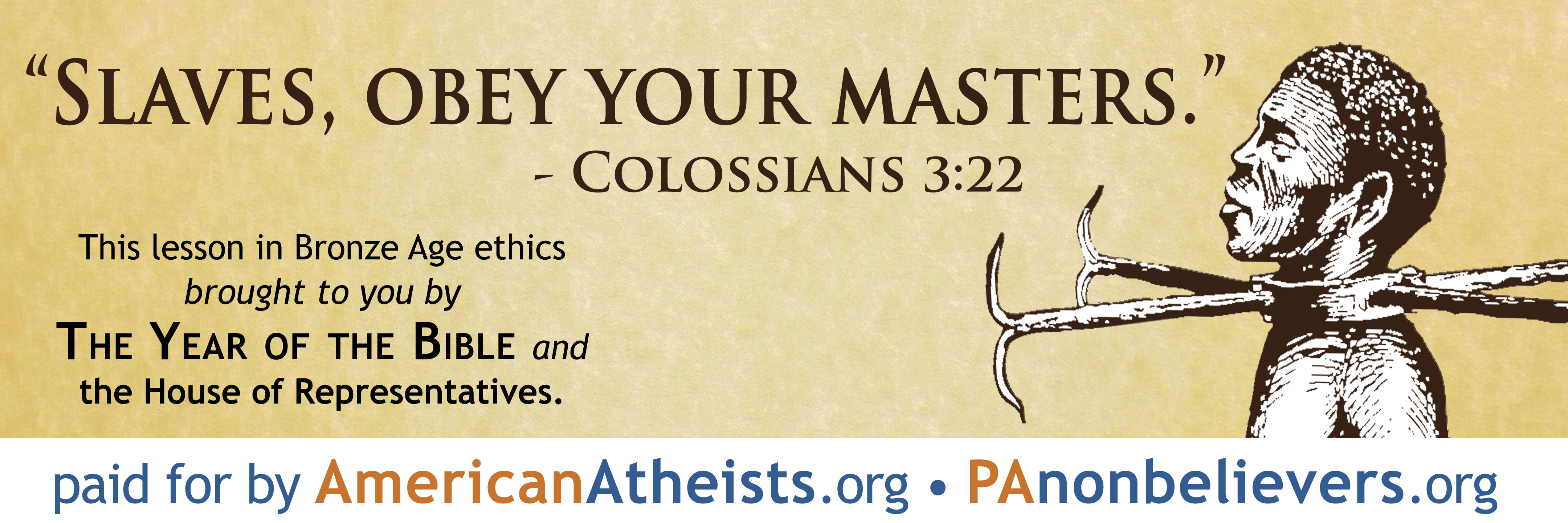
Consider the recent issue with the PA-Nonbelievers billboard (pictured above) which was taken to mean, by some, something very different than what it was intended to convey. By all means, follow that link for the details of the issue, but essentially the question is whether the billboard, as it appeared (before it was vandalized after being up for one day), was racist. And although it was not intended that way (I know quite a few of the people from PAN, and I have no indication of racism on the part of those who created the image), being that much of central Pennsylvania (Pennsyltucky, we sometimes call it) is pretty racist, the billboard could easily be mistaken for a very different intended purpose.
BTW, it’s purpose was to respond to the Year of the Bible legislation in PA by showing how immoral the Bible is, using its advocacy of slavery as the vehicle for such an observation. It simply did not occur (I’m guessing. I don’t know for sure) to those at PAN that it would be taken as an endorsement of slavery non-ironically. Slavery is abhorrent (think most Christians), Christians loves their Bibles, and Bibles condone slavery.
Instead, some saw the billboard as racist, the ambiguity of the message left many people confused and irritated.
The fact that this snafu of miscommunication occurred demonstrates that the importance of effective communication is not only essential, but it is quite hard. Just like, while having an argument with a loved one, sometimes the best-intended statement can be taken quite badly due to a different parsing of the words or even due to some semantic diversion by speaker and listener, the general public will often misunderstand what we atheist activists (or at least proponents) have to say about religion and faith.
Now, there are many sources, both online and otherwise, for learning about how to effectively communicate. A simple Googling of the term will find you quite a bit about the many techniques and guidelines that can help, and so my outlining them for you here would be redundant.
But the general message I want to convey here to people of any persuasion is that in many cases our conversations, whether they are debates, disagreements, or shouting matches with people being wrong (on the internet or otherwise), we need to keep in mind how we are presenting our case and what pitfalls might interfere with our goals.
By all means, express your indignation for whatever idea you disagree with. Don’t hold back your opinion, but make sure it is communicated in a way that will not be read as something that it is not.
And remember to listen. Listening is perhaps the most important skills in effective communication, and it is clear that we need to listen to whatever feedback we receive. In many cases, this does include keeping your eye on the general public’s views on what you will communicate about, which usually entails reading blogs of those who are theists or defenders of monogamy in many cases, for me.
That said, I want your feedback here at polyskeptic on any and all posts. we want to know how well we are communicating with you. If we can do a better job at communicating our point of view, we want to know how we can do so.
I occasionally peruse wordpress blogs to see if there is anything worth reading in the religion section, and occasionally I find something worth commenting on.� Often, it is a derisive comment, but sometimes I run into something worth paying attention to.
So just now I ran into a post entitled Why it’s OK to hate religion, and liked not only what he had to say, but how he said it.� Take a look, and if you like what you see, subscribe (like I did).
People do polyamory in a plethora of possible ways.
Some people rarely if ever spend time with their partners’ partners, but keep their relationships separate. Others, like us weird people, spend a fair amount of time together. Date night is no exception.
So, last night I came hone from work to find Ginny hard at work on dinner. OK, that’s not quite true. I found Ginny at her quite disorganized desk, in a bathrobe, watching something (probably dumb) on netflix. Same difference.
In any case, I was sent to start water boiling (I am actually quite a good cook, so this is really under-using me in the kitchen, but nonetheless it was a necessary first step). After a few minutes, Gina and Wes arrived, earlier than Ginny expected. Ginny then appeared from upstairs to greet all and sundry and eventually she continued with dinner prep.
Chicken parm, a bottle of red wine (drank, by Gina and I, in orca wine glasses of course!), and some conversation was enjoyed by all four of us. We followed that with adorable cupcakes that looked like monkeys which I bought from a bake sale at work.
Then Ginny and Wes went out for bourbon while Gina and I stayed in for a while (Bible-reading, of course) for a couple of hours before going to get a beer (or two, in my case), at the Resurrection Ale House down the street (a theme might be deduced from this…but no, we are not becoming Christians).
Chemistry, cosmology, and quantum mechanics are discussed. What do people usually talk about at bars? Stop looking at me like that! Whatever, we are smart…or pretentious. One of those.
Finally, after some time (space, and dimension too!) Ginny and Wes met us at the Ale House as we finished our beers. Our re-assembling into a four-some, with various affectionate greetings seemingly went unnoticed by the others at the bar (at least it seemed that way) and then Gina and Wes went home, dropping Ginny and I off on their way by the house.
In the end, I go to bed (with a touch of the drunk from two very good ales I had with Gina) with Ginny and the morning comes early.
This all seems so normal to me. I imagine this would seem rather abnormal to other people. This was a pretty typical evening with the four of us (Jessie was elsewhere last night), and it does not seem odd at all.
Polyamory really is not very radical a practice, once you get yourself past the strange non-monogamy thing.
Privilege has been all over the place as a discussion topic in the atheist community since Elevatorgate, but I have not seen too much about it in poly discussions. I do suspect that monogamous privilege is a real thing, but the extent of it is not something I have spent a lot of time thinking about.
One of the most cited reasons that people are not polyamorous, even if they are not against the idea in principle, is that they simply could not do it. They are too jealous.
But jealousy is not a sufficient reason to not be polyamorous. Not being polyamorous for this reason is simply a way to avoid dealing with the problem of jealousy.
Ever listen to love songs on the radio? Ever watch a sappy romantic comedy where the blunt end of the joke is the presence of competition or possessiveness? The lamenting lyrics of wanting someone’s girl, seeing someone beautiful on the train but she was with another man, or sappy words about how someone belongs to someone else is so ubiquitous that not even us polyamorous people always notice it. But it is pretty ubiquitous.
Jealousy, whether in the form of competition, possessiveness, or destruction of property is a part of our culture. It is, indeed, part of the mythology of love in our culture. I use the term myth here because if possessiveness or jealousy are anywhere near the core of love, something is wrong.
But it often is near the core of love in our culture. Our culture’s use of love, expectations of relationships, and folk wisdom about how to respond to jealousy are pretty unattractive. It is not surprising that this is the case, especially given that the Bible (which is a part of the foundation of our Western culture) seems to condone this behavior in the book of Exodus.
20:3 Thou shalt have no other gods before me.
and it gets better two verses later!
20:5 Thou shalt not bow down thyself to them, nor serve them: for I the LORD thy God am a jealous God, visiting the iniquity of the fathers upon the children unto the third and fourth generation of them that hate me;
20:6 And shewing mercy unto thousands of them that love me, and keep my commandments.
[emphasis mine]
See, god loves us, but if we were to cast a casual glance to some other god, he would smite us. And we’d deserve it, of course! How could we be so slutty….
Jealousy as a bad thing
The problem is that people don’t see jealousy as a bad thing. As the picture at the top of this post shows, there is an idea in our culture that jealousy is somehow an indication that the love is real, rather than imitation love or whatever. I have been told before that if I don’t mind my girlfriend sleeping with other men, I don’t really love her. Such people say that when I meet someone who I really love, I would not want to share her.
I suppose I don’t love either of you, Ginny and Gina. Sorry….
Bullshit! That idea is patently absurd. I love both of them and I don’t see how bowing to any jealous or possessive feelings I may have is someone more real than recognizing that they are both intelligent, talented, and beautiful people who anyone could love. How is it rational to love someone (or some thing) and not expect other people to love them too? And what right do I have to claim possession to a person just because I love them? That is the implication, right; I love them, and anyone else who does is competition.
Of course, for many of us anyway, jealousy still occurs. Sometimes it’s mere envy, but sometimes it’s not. But what do we do about it? Do we address the object of our jealousy or do we address the fact that jealousy is damaging to relationships and love in general? Most resources I have seen seem to emphasize that the feeling is probably unwarranted; that what we fear is not happening and we need to stop being so suspicious. But when you share your lovers, the thing you feel jealous about is happening! The question is whether you should feel bad about that.
Obviously, if you are agreeing to non-monogamy with your partner(s), you have no justification to be angry about it happening, even if you do feel jealous from time to time. In such circumstances, your project should be to find ways to rid yourself of those types of reactions so that your good feelings for those people are not tainted by unpleasant experiences of feeling possessive or insecure as a result. Eventually, you may grow to like the idea of sharing (some call this compersion. I hate that term. It’s still better than frubble), and jealousy may be nothing but an unpleasant memory or a curiosity for reflaction on human nature.
Monogamous people may have reasons to be angry if their partners have romantic or sexual relationships with other people (since this was not agreed upon, by definition), but the jeaousy is still something they should try and transcend. Jealousy does not stop it from happening, and if it is not happening it causes unnecessary anxiety. It is a sign of lack of trust, security, and can only act to drive people apart, rather than help in any way.
Therefore, there is no excuse for tolerating jealousy, even if one is monogamous.
Monogamy is not a cure for jealousy
Even if you choose a lifestyle of sexual exclusivity, your partner will probably love someone else. They will probably find other people sexually and/or romantically attractive, they will have fantasies about those people, and ultimately they will probably want more than you are able to give. If you decide to structure your relationship such that neither of you will pursue anything beyond friendship with others, so be it, but this will not eliminate the existence and problem of jealousy.
It will just avoid the problem by treating the symptom rather than the underlying cause.
The love you have for someone is because of who they are, and should not be dependent upon who else loves them or who else they love. So, for someone to say that they could not be polyamorous because they are too jealous, what they seem to be saying is that they do not want to deal with the reality of human needs, desires, or the possibility that they may not be able to satisfy every need a person has.
Jealousy is not a reason not to be polyamorous; it is a reason to consider not being in a relationship with anyone. Jealousy does not go away just because you are not sharing, it just isn’t challenged when we are not sharing. It’s sort of like teaching children how to share toys; if you just keep them all separate and let them play with their toys separately, the problem never arises. But when you put children together, they fight over toys. Separating them does not alleviate the problem, it only avoids it.
Similarly, separating everyone out with monogamous pairings does not make jealousy go away, it just tries to create a dynamic where it ideally is never relevant. It is an unrealistic expectation and is rarely possible. So why try?
Only because it avoids the problem most of the time. From a practical point of view, it is easier to not deal with hard problems. But this is short-term thinking, and does not lead to us growing up to emotional adulthood. Jealousy is one of the many aspects to human behavior which we need to address as a species, and too often it is shelved in the name of practicality.



 , we need to keep in mind how we are presenting our case and what pitfalls might interfere with our goals.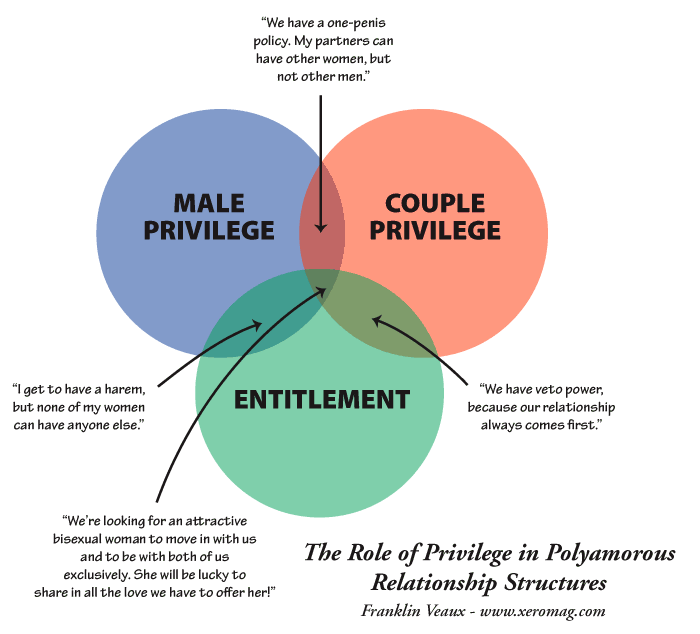

 Skepticism, Properly Applied