Sunday, Bloody Easter


Jesus had a bad weekend for your sins.

Listen, I don’t accept the crucifixion and then the story of how Jesus rose on the third day for a second.  There is simply no corroborating evidence for it, it parallels too many pre-Christian stories, and the oldest Gospel, Mark, didn’t originally contain the story of the resurrection.  There is a lot out there to read about the issue of the resurrection, and I am certainly no expert (although I know one person who has expertise in related academic fields), so I will leave it to them to address that particular issue in more detail.

But if I did accept the story, that is, the bare facts that some guy (let’s call him Jesus, Yeshua, or Frank for all I care) almost 2000 years ago was wandering around with 12 dudes while preaching about some messianic Jewish story or how the Kingdom of Heaven is at hand, or possibly within you, was arrested, detained, questions, tortured, crucified, and then buried only to appear, alive, a couple of days later…. Well, so what?

Let’s say that I was willing to grant that this happened.  It does not have to mean I have to accept the interpretation of those who claimed to have been witnesses.  I don’t have to accept the dominant narrative that evolved into the Gospel stories nor the earlier Pauline accounts, via his letters to other people who started worshiping this guy around the Mediterranean Sea, do I?.  In fact, this historical fact, if assumed true, does not address the existence of any gods at all, necessarily (nor does it address whether that person was a god, let alone THE god…or at least one of three hypostases of god…whatever).  It would be a mysterious situation that would pique my curiosity (and skepticism), but if it happened then we would have to deal with it as a real event and figure out how it might have heppened.

The problem is that we are so far removed from the historical events, blind to essential details, that the type of necessary investigation would be impossible.  There is nothing to do with the facts other than wonder about them.  So, what does this type of story have to do with god, religion, hundreds of years of violence, repression of scientific and intellectual freedom to advance, and hierarchical infrastructures of people whom are generally automatically revered because they apparently know this guy who rose from the “dead”?

In a word; nothing.  At least it shouldn’t, if we were being rational about things.

Many Christian apologists have claimed that what makes Christianity unique is the fact that it is based upon not mere mythology, but historical fact.  Paul, in the first letter to the Corinthians famously said that

15:14 And if Christ be not risen, then is our preaching vain, and your faith is also vain.

and for many Christians this is the crux (lol) of the matter.  For them, the “miracle” of the resurrection is the fact that defines their faith.  And despite the fact that I (as well as many other people) do not think that it happened, this is irrelevant because even if it did actually happen it does not lead to the salvation story that many Christians want it to tell.


What happened to Jesus, if it happened at all like it is portrayed in Christian orthodox theological terms, was not a sacrifice.  If Jesus was god, or at least one with god, and if Jesus knew this, then it is not a sacrifice because he suffered no actual harm and no real loss,.  It is a bad couple of days, a stubbed toe, an inconvenient breeze in the face of eternity as a freaking all-powerful god! It would be less of a sacrifice than the sacrifice of effort and time it would take to flip a switch within arm’s length in order to save people from certain death by some killing machine, created by some super-villain.

Except in the case of Christianity, God is not only the switch-flipper, but God is also the mad super-villain who created the killing machine as well as the switch itself.  I simply cannot find meaning in this Easter story beyond metaphors for all sorts of themes surrounding rebirth, which are used by most religious traditions and which don’t imply that we are all evil sinners worthy of eternal torture for being what God made us to be so that he would have to send himself to have a bad couple of days to make up for lack of good planning concerning the fate of billions of people throughout all of history.

Yeah, that’s the story of Christianity, people.

Ok, so what if Jesus was a man, albeit a unique and important one? What if Jesus was a man inspired by a true god, or at least the chosen messenger of god, whose efforts in delivering said message would be rewarded with eternal paradise on the right hand, or even down the street from, the real God of the universe(s)?  Then it is merely a form of substitutional atonement; an awful event, morally, if ever there was one.  I’ve heard the apologetic responses, but the story of the atonement, or the replacing of the sacrificial sheep with Jesus (the most unblemished of sacrificial lambs) is absurd.  How does another person dying do anything for my imperfections? The level of theological rationalization around this issue is frankly staggering, and we need to see it for what it is.  The idea simply makes no sense, whatsoever, and it robs us of our personal responsibility for our own misdeeds.

Jesus dying for our sins, whether as god or man (or as some weird genetic cross-breed of god-man), is quite simply absurd and silly.  It appeals to us emotionally and can be rationalized into some meaningful pulp, but it has no nutritional value whatsoever.  It is irrational, un-skeptical, and even immoral in nature.

If anything, it’s just another old religious metaphor for the rebirth of the world, in Spring, from the death that is winter, with the addition of theological concepts which absorb us in self-deprecation and is ultimately anti-life.  You know, like symbols reminiscent of life, birth, and youth but bathed in blood and depressing self-hate.

It’s too bad we don’t have anything this time of year which is like that without all the blood, death, and anti-humanistic rhetoric built-in.

Oh, right, yes we do! Symbols of fertility, birth/rebirth, and youth surround our more secularized version of Easter.  Pagan will try to take credit, and they do deserve some of it, but this is simply human behavior; we want a way to symbolize and celebrate the return of life to the world.  Our history and literature is replete with such symbols and celebrations, and Christianity has (once again) seized them and used them as their own.

But in this case, the thieving Christians, specifically the Catholic Church, didn’t even have the common decency to re-name the holiday! Easter? really? EASTER?

I mean, come on, people? It’s bad enough that Christians stole Christmas, but at least in that case they chose an original name, right?
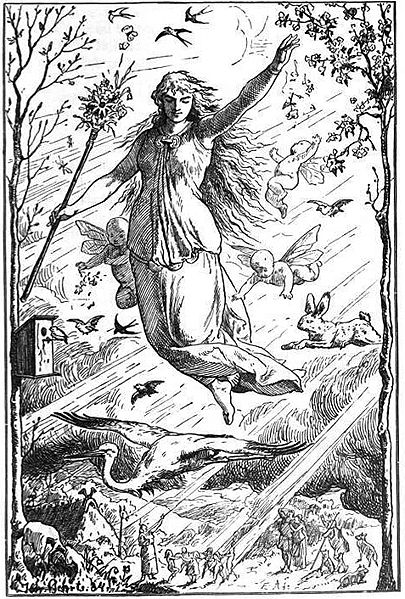
So, here is Ostara (she goes by many names, but essentially she is Ēostre/Easter.  Check the link if you want to know more about the pagan mythology and history of celebrations and rituals surrounding her and this time of year.  But if you don’t, at least take home with you the idea that this holiday is not merely Christian, and insofar as it is Christian it is not the story that the Pope or your pastor tells on Easter morning.

Please, learn your history.  If you are a Christian, please learn where your ideas came from.  Try to understand the context, the subtleties, and even the blatant cultural influences which shape how you see the world.  View the Jesus story as a metaphor, a metaphorical narrative, and possibly not a very good one, which tells you something about our psychology and needs, but not about historical or metaphysical truth.

Jesus, if such a person existed and died via crucifixion, is not the solution to your sense of ultimate personal lacking.  Your imperfections, misdeeds, and falling short of some ideal morality cannot be solved by a person dying, nor subsequent rising from said death, nor from some contrived ‘God sacrifices himself to himself to make up for a law he made about a piece of fruit that nobody ever actually ate’ theology.  You must take responsibility for yourself, toss aside this metaphysical concept of sin, and stop sacrificing this life for some promised other life.

This life is all we have, and we must do what we can to make it all that we want it to be.  So stop bowing to a pseudo-sacrifice and start living in a world which is currently blooming with things wonderful, terrible, and worth working for now

Happy Easter, everyone.

The ends of unhealthy relationships


Ever been in an unhealthy relationship? Ever had that relationship go bad and have it end in flames, the coldness reminiscent of the deep vacuum of space devoid of warmth or corporeal presence, or perhaps a little bit of both? I have.  It is awful, painful, and ultimately liberating.  But before your experience traverses the totality of the immediately previous triad, there is often a moment when the reality of it clicks home, a time when all you are capable of feeling is hurt.  The anger and loneliness will come (again), but at that moment all which exists for you is a cognitively-blinding pain which compels a futile grasping towards the emptiness around and, seemingly, within you.

In time, will be the reflection and evaluation through sadness, anger, and even laughter as you remember what was good haunts you for days, weeks, and possibly longer.  Eventually, you will begin to understand that the relationship was unhealthy.  Sure, the relationship didn’t seem so at the time; the sex was good, you had fun with them most of the time, and there were some really good aspects to the person you cared for and with whom you built something important.

Even though sometimes they would be a little bit crazy or unbalanced.  Perhaps they had some strange ideas, insisted upon them, and didn’t seem to allow you the freedom to express your ideas without complaining about being persecuted or somehow oppressed.  Perhaps they had a bad history with relationships which you ignored for various reasons.  Perhaps the relationship afforded you professional, social, or even political benefits which would be difficult to attain without the associations provided therein.

Or perhaps you thought what was good about them outweighed what was bad.  Perhaps you rationalized that the bad was not even really bad, but merely misunderstood quirks and intricacies of the person you loved; things which illuminated their love for you…or something.  Rationalization asserts more sense during its subjective composition it than it does through its dissemination.

But when the relationship ended, it hurt.  It didn’t matter that the reason it ended was probably something that should make you feel better about getting away.  It didn’t even matter that if you stopped to think about it rationally (that is, if you were capable of such a feat under the circumstances), you would realize that you will be much happier removed from such a relationship.  The separation from an established relationship often brings forth sadness, depression, anxiety, loneliness, etc.

It does not even matter if the intimacy of that relationship was fictitious, or perhaps merely one-way.

Breaking up with god

Anyone who has left religion might be noticing some analogs here.  This is, obviously, intentional.  The reason I am drawing some parallels between leaving religion and a break-up from a bad romantic relationship is that I think that there are some interesting comparisons between them.  In fact, my experiences with unhealthy relationships has not only taught me a lot about relationships, but I think it gives me a glimpse of what losing religion might be like, since I never had a religion to lose.

To start with, I suspect that many people stay in bad relationships, and religion, longer than the relationships provide actual happiness.  I think that much of what keeps people in religion is a combination of habit and the comfort of familiarity.  I think that many people stay in relationships whether they are abusive, neglectful, or simply poor romantic matches for similar reasons.  It takes a lot to leave a relationship we are invested in, and even knowing that we need to do so does not make the process easier.

Secondly, I think that people stay in such relationships longer than they should because they don’t recognize how unhealthy the relationship actually has been.  I imagine that the full comprehension of this is never fully known until much later, in many cases.  People often don’t recognize the difference between (co-)dependency and real intimate affection and concern, and this inability perpetuates unhealthy relationships all to often.  The feeling of needing someone, especially if that needing reflects some feeling of possession, ownership, or obligation, is not healthy.  The fear of loss (often in the form of jealousy), or basic insecurity of uncertainty, is not something to be held aloft as the basis for love, let alone “true” love.

And this is the type of relationship which religion instills; a fear of loss, of being owned, and even of feeling obligated to remain in relationships which are unhealthy.

 Healthy relationships

Relationships need to be built upon things like trust, transparency, and honesty.   We do not own our partners, we must be open about what we do, what we want, and what we can and cannot handle.  We need to do the personal work to make sure that we know what we want, to make sure that we have exercised our ability to perpetually grow emotionally and intellectually, as well, in order to make sure never to prematurely cut off what we can handle to some too easily reachable goal which will stagnate who we could be if we challenged ourselves more.

And in terms of our relationship with the universe, our society, and even the “truth,” we need to make sure that we are continuing to challenge our boundaries, presuppositions, and to keep communicating with people with whom we disagree.  The universe is massive, complicated, and often beautiful as well as terrible.  We would be temporal thieves of potential experience, understanding, and perspective by not allowing ourselves to see as much of that beauty—and terribleness!—if we didn’t pursue the world with full thrust towards such potential.

We need to approach people and the reality which we all share with an open mind, open heart, and unbridled willingness to hear the world calling us on our bullshit.  If we do these things, we will be better off in all our relationships, whether they are the two-way relationships of traditional monogamy, multi-faceted relationships of less traditional polyamory, or the one-sides intimacy of our own self-respect or the respect for reality.

For reality cannot love us back, but that does not stop us from finding it beautiful, compelling, and worth our effort to get to know it as intimately as our limited cognitive ability allows us.

Lies, to protect the relationship


I have been actively polyamorous for a while now.  As a result of this I see the world of sex and relationships in a different way than most.  I see the world with polyamorous eyes.

And while I remember being monogamous earlier in my life, I’m not sure if I can exactly remember how I saw the world differently.  I must have seen it differently to some degree, right?  Perhaps not, but I’m no longer sure.  Perhaps I was always saw a lot of what I now see, just not as clearly.  Again, I’m not sure.

If there has been any perspective shift, it is one of a heightened one; a view from above.  It is the result of a consciousness-raising, where I can see many of the assumptions and behavior patterns of relationships. 

It is not unlike how I see religion, faith, and unskeptical thinking in other avenues (such as politics). It is a view from the outside, being able to see much of what happens within and feeling some sympathy for the experience.

It’s not that I see everything.  It is not even that what I do see I fully understand.  An analogy would be to say that I am seeing more sides, or even dimensions, to our sexual and relationship behavior than those caught in the mire of cultural normalcy.  And what new sides I see makes most of our cultural and psychological tendencies just seem funny and sometimes absurd.

Watching monogamous individuals and couples deal with relationship dynamics, for me, is sort of like a comedy where you, as the audience, know something about the play that the characters do not.  The absurdity of their behavior, the obvious conflict of their desires and what they do, and the oversights of simple solutions missed due to ignored needs and lack of transparency in the relationship.

And usually in the name of maintaining the ideal of monogamy.  Yes, people do unhealthy relationship things, like lie about what they really want, what they really do, and what they are really comfortable having their partners want and do, in order to protect the relationship.

I cannot think of any higher ironic comedy than that.  And is see it all the time, and I am convinced that most monogamous people do it all the time, and that they usually don’t even realize they are doing it.

It is, after all, part of the dating world to lie.  So when people commit, either with marriage or just exclusivity, many of those lies are smuggled in.  After a while, they may not even feel like lies anymore.  They become self-deceptions.

To protect the relationship.

Sense which pleases the Lord


Yesterday, Ginny and I spent a fair amount of time editing a new post for today.  We had wanted to make sure that we got the wording just right, trimmed it down enough to not be overwhelming (I do have a tendency to go on and on…), and were almost done….

What I almost did

So, firefox crashed.  The crash message was there so briefly before the window disappeared that I don’t know the nature of the crash, but crash it did.  “No problem,” I thought.  “WordPress saved most of the work, and it’s fresh in my mind.”  But no.  The work was gone, irretrievable, dead. I had never seen firefox crash in this way before, and that it happened right then was extremely irritating, as if some intelligent force were at work.

I was angry.  Ginny came back into the room and was annoyed too.  I considered re-writing the post, but I was too frustrated, tired, and didn’t have the heart for it.

That was the problem, I didn’t have the heart….

So Ginny came over to me and held me and we grieved together briefly and then, well, something else happened.  This time this new thing happened to both of us, in apparent unison.  A feeling of assurance and understanding washed over both of us and looked at each other in coterminous understanding.

It occurred to both of us that perhaps that strange crash, at that moment, was not mere accident.  Why would it happen then, as we worked on a post together for the first time (sort of like a preamble to our coming wedding vows), rather than any other time? What was the significance?

What if some power, some force, or even some intelligence saw this as the right opportunity to reach out to us.  I have been saying for some time that if a god existed, I’d want to know.  Also, I have said that this god would know how to make itself known to me.  Apparently, god was waiting for the right time.  He surely does work in mysterious ways.

What happened next was too sudden, too intense to record.  Most of it was a blur.  There were tears, prayers, and we had to go out to get what we needed in order to complete the right ritual.  We didn’t have time to call a priest or consult the book, we had to get moving before God smited us.  Of course, finding a goat so late at night would be hard, especially without a car.

We totes have to get one of these...makes great BBQ!

But eventually we found a supermarket that had some goat meat which was open all night, and proceeded to acquire it.  It was not much of a “sacrifice,” but it was all we could do under such short notice.  The meat department were nice enough to supply some goat blood too, as that would be necessary.

We burnt it on an altar to the Lord, as is demanded by Him, and left it for the high priests.

Of course, not having our own altar, we had to go to the local Jewish temple.  But their altar was probably inside, and the door was really hard to get through, so we stopped trying and instead used the front steps and left it there for them.  They will be so happy to know that people are returning to the old ways.

Our offering, before the burnt part

I know, I know…I’m new to this, OK? I have not read Leviticus in so long that I just sort of winged it.  It came from the heart.  That’s all the Host of Hosts demands, right? Later today I will re-read the chapters and do it right, but I thought that the attempt was enough to please the nose of the Lord at the time.

It did smell pretty good.  That YHWH sure loves BBQ.

In any case, we then walked home and prayed loudly in the streets for all to hear and enjoy, sharing our new-found relationship with the true god, the King of Kings, with all who were out sinning in the Babylon which is downtown Philadelphia on a Saturday night.  By this time, the bars were near to closing and we were getting nowhere with the people coming out of the bars drunk on their own dirty sin.  So we just had to try and go in and spread some more good news.

This guy asked for some "help" with these 3. I told him I already had the 3 I needed...

Most people were friendly, but they were not in the mood for helping us find an unblemished male goat for a morning ritual.  Plus, the blood all over us from earlier was apparently off-putting.

If these unforgiven Sodomites and Gomorrah-dwellers would only read Leviticus, they would understand that we hadn’t just slaughtered a room full of children, but in fact had been trying to please the God they were ignoring.

But they were too busy ignoring His Throne in their drunken orgy of Baal or whatever.  Hey, I read the gosh-darned book years ago, it’s not exactly fresh in my memory!If not Baal, it was one of those false idols, like Vishnu or something.  That false god loves drunk people.

So, after getting a few hours of sleep (I slept on the couch, not being married to Ginny yet and all), we woke up for an early church service at the local Baptist church, where we tried to show them all how to properly sacrifice a dove (OK, pigeon.  We were short on time, again).  But they were not interested and asked us to leave.  So we left them to their luke-warmness and proceeded down the street.

These guys followed us all the way back to our house, yelling at us. Sinners!

We were lucky enough to catch the start of a Presbyterian service, and since they were already started we quietly sacrificed the pigeon in the back rows, which seemed to offend a few people.  Perhaps they were upset because we did it at the wrong time? I’m not sure, but I don’t remember where the scripture tells you precisely when to do these things, so perhaps they were yelling at us for no reason except that they preferred to sacrifice birds after the communion.

Apparently, our timing was really bad, because they kicked us out too, a few of them following us down the street.  Something about returning a “collection” plate, whatever that is.

But before trying to catch the noon Mass at the Catholic church, we decided that we should share our good news.  Also, sorry Gina and Wes, but we can no longer take part in your sinning lifestyle.  I guess we can still hang out and stuff, so long as you see the light.  You do have a good back yard for burnt offerings, after all.  However, if you don’t see the truth, we don’t want to be associated with people who will burn for eternity.  And no, it’s not classism, whatever kind of Commie talk that is!

We will also have to take the website down soon, or at least change it to burntofferings.com (if that’s available!).  But right now we have to get to Mass!

They’ll be so glad we brought our own sheep!

Facts or it didn’t happen: unhooking the bra of reality


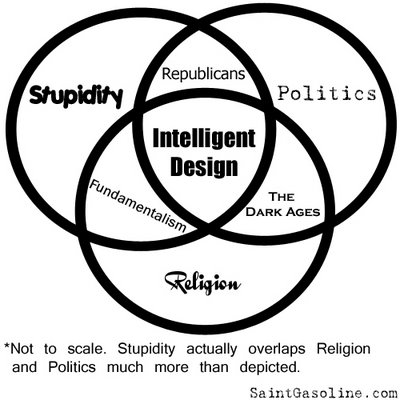
So, you want to include Intelligent design, creationism, or some other moniker for questioning the overwhelmingly established science of evolution into our classrooms.  You also, likely, equate evolution with the origin of the universe, so you want to talk about how something must have created the universe too.  Like, for example, god.  Well, OK.  In that case, lets also include creation myths from Hindus, various Native American tribes, and (why not, it’s 2012) the Mayans? Let’s have as many challenges to evolution and cosmology as possible, if we are going there.

Or perhaps you are more concerned with the state of medical science.  Perhaps you want to have your medical school include spirituality in their training, so that future doctors will be more spiritually attuned, or something.  Well, OK.  In that case let’s not forget faith healing, acupuncture, and homeopathy.  Hell, let’s throw in some goat sacrificing as well.  If we are going to include alternative medicines, why not throw in everything, just in case someone thinks they are worthwhile, eh?

Hyperbole?

Have I gone down a slippery slope? Have I taken what should be seen as a legitimate addition of alternative points of view, in comparison with established science and skepticism, and equated them with obviously erroneous methods? Am I not taking things like spirituality, real “scientific” challenges to the Darwinian conspiracy, etc seriously? Am I merely being flippant and disrespectful?

No.

Quantities of complexity and simplicity

What is the difference between the more sophisticated and complex challenges to the scientific consensus and those which are, how should I say, less sophisticated? What is the difference between the Discovery Institute and the creationist screaming on the street corner (or next to the reason rally)?

There are real differences between these two types of challenge to science.  One is better articulated, more gpolished, and appears more professional.  The other has not been dressed up in such finery, and is obviously naked to everyone (OK, most of us).  From where I stand,  all of these sophists look naked, adorned in transcendent Imperial attire, even if to many out there the transparency of such cloth takes on a denseness and opacity to them.  Such observations become quite illuminating to complex eyes, but not so complex to need an intelligence to evolve them, such as mine.

That is, the difference between these sophisticated attempts at “skepticism” and creationist buffoonery is one of methodological degree, and certainly not a difference of quality.

For someone to show a distinction between these two, they would need to show some empirical or methodological difference between the two claims. They cannot do this.  Because there isn’t any.

No matter how well the Discovery Institute, the Institute for Creation Research (ICR), or any other disingenuous attempts to undermine science dresses up their creationism, that’s all it is.  So no matter how slick the presentation, elevated the vocabulary (to make it sound sciency), or how many “credentialed” contributors they parade out (or pay large sums of money) there will only be a difference of degree between them and the whack-jobs on the street-corner yelling about the time being “nigh,” or someshit.

The reason for this is simple.  The methodologies of science, based in logic, empiricism, and skepticism generally, are unique and powerful.  Religion, faith, superstition are all powerful motivators of human behavior, but they lack that method and so they fail to predict or explain reality.  There is a fundamental methodological difference between what real science does and what is done by such think tanks as referred to above.  Places like the Discovery Institute and the ICR are not using the best methodologies, but are in fact using the same type of methodology used by the creationist you will meet on the street, in a church, or proposing legislation to allow discussion of creationism in schools.

They arenot using skepticism.

So when we respond to such trite sophistry with what may appear hyperbolic, the fact is that it is not hyperbole at all.  It is, in fact, appropriate commentary on the ridiculousness of people’s beliefs about the world; beliefs which are not warranted by the facts or the reason that binds those facts into theories which teach us about reality.

Unhooking the bra of reality

One person’s idiocy is another’s profundity.  And one person’s profundity is another’s idiocy.  The difference between the two, however, is not mere subjective opinion or preference; reality can inform the difference, and reality gives up her lovely secrets only to skeptics (when she gives them up at all).  Faith and superstition—ever the prompts of religion—being so obsessed with what lays beneath nature’s bodice, frees itself to imaginings and unverified declarations.  But it is all rhetoric and no real experience.

Real experience requires knowing how to unhook the bra of reality, a secret revealed only by the reaching of the adolescence of our species during our philosophical and scientific development and matured in the fires of the Enlightenment with the advent of the scientific method.  Many an embarrassed and inexperienced person claims to have breached such depths, claiming to have seen this or that, done that or this, and have really only masturbated such things while those of us truly entered into mysteries of the plain world in our face, seen with skeptical eyes, know the beauty of reality’s bosom.

Or, to put the analogy more succinctly; pics or it didn’t happen, you keepers of faith and superstition!

The Monogamy Delusion?


So, I just finished reading Greta Christina’s new book Why Are You Atheists So Angry: 99 Things That Piss Off The Godless (Kindle version), right after having met her after the Reason Rally, and I will briefly say that I recommend it as a great resource for both believer and heathen alike.  It is a great read for anyone who does not quite understand why we get so fired up about religion and faith.

I use this as a premise for talking about goals of social movements, a question that Greta addresses in her book concerning the goals of the atheist movement specifically, and what this might have to teach the polyamory community.  After watching the atheist movement grow and mature over the last 10 years or so, and given that I am usually thinking about polyamory, I inevitably will ask whether there will ever be a large, organized, coherent polyamory social movement.

And if there were, what would it look like?

As Greta talks about in her book, there are fundamental problems which the larger atheist community addresses through various means.  There are the basic issues of confronting stereotypes, discrimination, and hatred of atheists.  Such things range from moral, legal, and to philosophical issues and are fought for by both theists and atheists.  There is also the front of the atheist community which actively responds to theistic claims, both to truth and socio-political access of levers of power (in the US, this is usually through Christian privilege), with counter arguments of varying levels of intensity.  On the farther end is the ultimate goal of ridding the world—through persuasion—of religion.  Greta and I share that goal.

With that in mind, what types of issues could a polyamory social movement address?

  • are there fundamental cultural, legal, or philosophical problems which polyamory addresses?
  • is there any real and significant discrimination against polyamorous people in the world? If so, is it primarily cultural or legal in nature?
  • Would such a movement be essentially a struggle for equal rights or would it also include questions of truth, such as whether polyamory is the best model for relationships that all people should emulate? (I a thinking about that last point in terms of Sam Harris’ Moral Landscape)

I don’t have any definitive conclusions to these questions right now, nor do I think anyone does.  I ask these questions to tease out some stark differences in the types of problems that the atheist community is dealing with from what the polyamory community has to deal with, whether it will become a larger social movement or not.


Will there ever be a poly equivalent to accommodationists?

In the atheist community, there are those whom like to argue that religion is worthy of respect, should not be criticized, and that there is much about religion that we should perpetuate, learn from, etc.  I have addressed this question numerous times over the last few years, and will not say more than I disagree with this view.  Strongly.

On the other side are people, like myself, who believe that religion is more harmful than not, untrue, and perpetuates the worst parts of our humanity; specifically faith.  I will resist urge to rant about that here.  Resistance is not always futile.

(In other words, urges to rant about faith can be countered with Star Trek references)

So, the question is whether this pattern holds for the polyamory community?  Are there people who will argue that, for example, monogamy is more damaging than not?  That monogamy cannot be a healthy relationship structure? Will people argue that polyamory is objectively better than non-polyamory? Will there, in short, be anti-monogamists? Not merely people who prefer polyamory, think it a better way to live given more options, but actually against the practice of monogamy as an irrational and delusional lifestyle? Will someone write a book called “The Monogamy Delusion”?

Again, not mere amonogamy–the lack of monogamy–but the active social activism against (through persuasion) the continuation of monogamy as a cultural practice.

(Some of you are thinking about Brave New World.  Or, if you are uber-literate, you are thinking of WE.)

Now, I don’t doubt that there are a few people out there who might try to make such an argument.  I’m sure that a rare poly bird out there, or a few, will argue that monogamy is fundamentally wrong, irrational, and possibly a bowing to the worst instincts of humanity; things like jealousy, social conformity, and living against one’s true desires (living inauthentically).

And on some points, I will agree with such people.  I might, in fact, agree with many of the points they will make, and make some of those points myself.   But despite this affinity for such arguments, I am not, at least not right now, one of those people who will make such an argument.  And I want to explain why.


Theism v. monogamy

Theism is a hypothesis about the world, specifically the existence of some supernatural being commonly referred to as a deity, god, etc.  It makes a specific claim which is either testable or untestable.  If it is testable, it has not survived skeptical/scientific analysis so far, and does not appear as f it will ever pass such a standard.  If it is not testable, it is a worthless hypothesis and should be thrown out on those merits alone.  Atheism is the lack of that hypothesis, whether made out of ignorance or through informed analysis, and the arguments it makes are in response to a proposition of how the world is.

Monogamy is a relationship style based upon sexual (and usually romantic) exclusivity between two people.  It is the lifestyle of having one lover, sometimes a spouse, at least at a time but possibly life-long.  It is not a hypothesis about the world, but it is a…choice? (is it really always a choice, given how many people are not even aware of alternatives? A question for another post!).  In any case, monogamy is a structure of one’s relationship, rather than a claim about reality.

What is the significance of this distinction? Essentially, it is the fact that polyamory is not a reaction to monogamy in the same way that atheism is a reaction to theism.  A polyamorous advocate could say something like “this is a better lifestyle for my wants and needs, and it may be better for you” and not “your lifestyle is objectively unproven to be best, true, and so your lifestyle is objectively wrong and you should give it up.” Polyamory is not a reaction against a claim to objective truth, as atheism is.  Polyamory has a relationship, and not always an antagonistic one, to a traditional cultural ideal of monogamy (traditional in much of the world, but certainly not all of it) that feels unnatural to many people.

To clarify the distinction between these two issues, let me ask two questions:

  1. Is it reasonable to consider all of the arguments for and against theism and rationally come out a theist?
  2. Is it reasonable to consider all of the arguments for and against monogamy and rationally come out monogamous?

In terms of (1), there are no good arguments for any gods’ existence, so any skeptic should become an atheist if they properly apply their skepticism to the question of gods.  As for (2), there are people who will, upon honest reflection, discussion, and consideration with their partner, find that they both are actually quite happy, satisfied, and feel no desire to be with other people sexually/romantically.  Those people will be what I call “accidentally monogamous.”  They have seriously considered whether they would want other people in their sexual/romantic life and have concluded that they need no rule about exclusivity but will end up living a monogamous lifestyle, for all practical purposes.

And before anyone thinks to point this out, I admit having argued that a true skeptic should be polyamorous, but I have also argued that monogamy is legitimately rational as a needs-securing lifestyle for at least some people.  To be clear, my view is that polyamory (not having an exclusivity rule) should be the starting position for all relationships, and monogamy is subsequently only fully rational if, and only if (iff), that is what both people actually, authentically, want with each other.  Which means that they would need no rule arguing for exclusivity, because doing so would be redundant because neither is actually interested in pursuing other people.

Wes would probably say that this lack of a need for an exclusivity rule is coterminous with polyamory, and I tend to agree. But I think there is room for debate here about the definition of polyamory, so I am allowing that room in my analysis here.  My views may change in the future, in that I may completely adopt his definition as being sufficient for polyamory.  The consequence of this would be that I might then conclude that all monogamy, unless it is reached “accidentally,” would be irrational and possibly harmful.

I’m not there right now.


Polyamourous evangelicalism?

The conclusion from all of this, as I see it, is that any movement to advance polyamory culturally, socially, or politically will probably be limited to providing information, legal and philosophical challenges, and the decreasing of any discrimination which polyamorous people experience or are legitimately worried about.

I don’t see a strong argument, parallel to atheism’s arguments against theism, religion, and faith, against monogamy.  I see arguments for being polyamorous, but that is not precisely the same thing as being against all monogamy.

There will be people who want to get rid of monogamy, and I will want to hear their arguments why they think we should strive for that (as I would hope atheist accommodationists should want to actually read new/gnu atheist arguments. I’m looking at you, Julian Baggini!).  But for now, I don’t see much room for a “new/gnu poly” movement.  But I suppose only time will tell.

If anyone feels I am being to accommodating to monogamy, I’m open to arguments.

Friendship and polyamory


In my last post, I discussed how monogamy is unlikely to satisfy all of our needs.  I was aware of a few issues tangential to that, but wanted to leave them aside in the interest of keeping posts shorter.  So I will address two issues today; non-sexual friendships and our ability to satisfy needs and desires without relationships.

“The Greatest Love of all”

As I mentioned the other day, in order to have successful relationships, you need to start with yourself.  We need to find where it is possibly, and even preferable in some cases, to find ways to make ourselves happy on our own.

Surely, there will be many circumstances where there will be overlap between this self-satisfying of desires and our relationships with other people.  Our sexual needs, for example, sometimes can be answered with masturbation and sometimes will require, you know, sex with other people.  Also, there will be times when an emotional challenge can be solved by some serious thinking, reflecting, and evaluation of a situation on our own.  Other times we will need the perspective of others to help us, as often other people see things in us we cannot see.

We are not island nations, but sometimes our own domestic policy is sufficient for answering to issues of the day rather than appealing to other nations, (or whatever the UN would be in this analogy) for help.

But the essential point is that when it comes to our needs, simply looking within is a great way to go satisfy them.  Therefore, I encourage everyone to maintain a healthy relationship with the complexity inside our own heads.  I encourage self-love, without getting all hippy about it or something.  Dammit, I think I might be too late….

Polyamory as a footnote to Plato?

…or at least Platonic friendship.

Many of the needs we have in our life, complex as they are, do not require finding a sexual partner at all.  The needs which are not satisfied by our partner(s), which are not satisfied by them, do not necessitate finding another romantic or sexual partner necessarily.  Sometimes just a Platonic partner, or friend, is sufficient.

As I have written about before, polyamory does not require sex to be polyamory.  As a result of this, many people are already polyamorous even if they don’t use the term, or know the term.  Friendships outside of a relationship, especially if they are very close, are so much like what polyamorous people are doing that I often use it as an example of how poly works to people who seem confused by it’s strangeness.  It’s really not that strange.

If you are in a monogamous relationship, there will be things you want and need to do which your partner does not satisfy.  Whether that is watching sports, going shopping, or getting some drinks on a Wednesday night, our friends fulfill many of our needs which our committed, exclusive, relationship do not.

Assuming that one partner in a coupling does not interfere with their partner’s friendships, which does happen (and, I think, is due to the same jealousy which makes most people avoid polyamory), those relationships are highly rewarding, meaningful, and important to us.

Most monogamous people have arrangements just like this, and many of them, in reading this, might be confused why this has anything to do with polyamory.  “So,” the objector may say, “why would people need polyamory when we have friends, ourselves, and our one loving partner to satisfy our needs in life?” Well, if these things actually do satisfy your needs, then perhaps we don’t need to be polyamorous. Where I have the problem is that people ignore, repress, or rationalize away other needs they may have in order to maintain monogamy artificially.  My problem is when monogamy is maintained for its own sake, and not for the sake of authenticity and honesty about what we want.

That is, many people pretend like monogamy+friendship=satisfaction of all needs, when in fact it does not.

What happens when a friend of ours starts to become someone you are very attracted to? What happens when you develop feelings for a person at your gym, book club, or run into an old flame? Why should we ignore this reality, just because we have a sexual/romantic partner? And if so, why?

What’s wrong with enjoying sex, safely, consensually, and transparently with other people whether we, or they, are in a relationship?

What’s wrong with wanting your cake and having it too?

Nothing.

Pursuing every desire?

Yes, there are people out there I am sexually attracted to who I don’t pursue.  I don’t pursue every potential relationship I find, because I recognize that it sometimes there are complexities of desire which are more than I need or want, and so I don’t pursue every desire.

But sometimes the feelings are too strong, the desire to intense, to ignore.  And depending on how much time I have in my life, I will pursue sexual/romantic partners to various degrees.  Right now, my fiance and my girlfriend take up a lot of my time, so pursuing anything very involved or serious is unwise and unwanted at the moment.  That said, if I really got into someone, I would probably find time, because, well, love is worth the effort.

But finding a friend with whom I can share a sexual relationship, especially if that desire is two-way, is healthy and available to me.  It does not threaten my relationships to do so, and it brings some pleasure and joy to my life.  Why should I not want and pursue such things?

Friendships are great, whether they are Platonic or not.  We should allow ourselves to express how we feel about people without artificial censorship or repression because of some strange obsession with maintaining monogamy in our culture.  So keep up your relationships with yourselves, enjoy your friends, and allow yourselves to have the relationships with the people around you as you want, and let “normal” social expectations and pressures have minimal say in how you do so.

Accidental monogamy: surviving the fires of polyamory


People don’t tend to have one small set of coherent and well-understood wants and needs, easily compatible with one other person who also has their wants and needs categorized into an easily communicative format for ideal matching algorithms (not even OK Cupid’s!).  No; our needs are largely unknown, fluid, and evolving and in order to satisfy them we will usually need to have multiple outlets for them which are capable of handling the inevitable evolution of those desires.

For some, a monogamous arrangement may sufficiently satisfy both people involved.  But how can we be sure that this arrangement really does satisfy the needs of both people and is not merely a capitulation to pragmatism and lack of personal challenge?

Let’s start with a basic distinction.

What is the difference between:

    • a couple who have seriously considered and challenged what they want and subsequently arrived, accidentally, at a monogamous relationships structure which fits with what both ideally want and need.
    • a couple who have ignored, compromised, or otherwise rationalized their wants and needs to fit their relationship into the expected relationship structure in our culture due to concerns about jealousies, insecurities, and fear of social stigma?

Answer: one has survived the fires of polyamory and accidentally landed in monogamy, and the other has chosen monogamy without traversing said fires.

That is, the former didn’t create a rule of romantic or sexual exclusivity nor had they assumed monogamy via cultural defaults.  They are accidentally monogamous in that they simply have no desire to be with other people even if pursuing such a thing is permitted.  The latter type of couple cannot be sure if they are maximally satisfied with their relationship because they have not taken the issue seriously enough.  They may, in fact, be missing something potentially wonderful for the sake of pragmatism or insecurity.

In order to be sure that the monogamous arrangement is actually satisfying the wants and needs of both individuals (hence not needing to even create an exclusivity rule because neither partner is interested in straying) one has to address the issue of polyamory.

All too often, the idea of sacrifice, compromise, and repression of certain desires is chosen in place of satisfaction (or at last the attempt of such) of what we want to have.  Many people convince themselves that a relationship with one person is not only a better path to take, but it is more intimate and meaningful one.

That is, quite frankly, not only a myth but it is absurd and irrational.  We need to allow ourselves to explore who we are, if we care to find out, by traveling the paths that will allow us to do so best.  We cannot limit ourselves, based upon social expectations, to learning slowly and inefficiently lessons which will, be invaluable to us.

Calculating the probabilities

Monogamy is logically possible as a means to satisfying all the the wants and needs of two people.  In such cases where this is the case, I applaud the work that was needed and done in order to ensure that certainty, because such certainty cannot be achieved merely through assumption, cultural default relationship progression, or lack of honest communication about needs, goals, etc.

But something being logically possible does not tell us how likely it is.  So, how likely is it that two people would be ideally happy with only one romantic/sexual partner?

The specific sets of desires, personalities, and capabilities which would need to exist in two people will be highly unlikely to ideally math up.  This, compounded by the necessity that each person will have done the essential personal work to know what they need and want from themselves and others makes the matching up, in time, space, and single-ness, highly unlikely.  Also, they need to actually meet.

How I might actually calculate such probabilities, whether with some Bayesian analysis or by some other means, is beyond my ability to do.  First of all, I am not an expert in probability or statistics.  Secondly, I don’t know all the relevant factors or how to weigh them against each-other.  Thirdly, I don’t think that actual probabilities is necessary to make the general point; it seems highly unlikely.

And yet, monogamy is rampant.  My conclusion is that the vast majority of monogamous relationships are not ideally healthy, at least from the point of view of them not satisfying all the wants and needs of the people involved.  Perhaps not everyone shares the value of satisfying our wants and needs above social pragmatism, or something, but either way I think that the world has something to gain by addressing the issue of non-monogamy as a means of making our relationships better.

By putting ourselves through the difficult challenges of figuring out what we want, what others want, and allowing ourselves to find monogamy by accident rather than default, I think much can be learned and our relationships will be better, whether monogamous or polyamorous, for everyone.

The Reason Rally is TOMORROW!


Everyone remember:

The 2012 Reason Rally is taking place on Saturday, March 24, 2012 from 10:00 AM until dusk. More speakers and entertainers were recently added to the roster. The additional celebrities are Adam Savage, Tim Minchin, Eddie Izzard, Paul Provenza and Shelley Segal. See: www.ReasonRally.org for more information about this free and open to the public event.

(from Margaret Downey at the Freethought Society)

All of us here at PolySkeptic will be there (I will even be wearing the shirt, which may or may not be visible depending on weather) and we will be with friends.  I am looking forward to seeing many fellow bloggers, people I don’t get to see because they live far away, and even people that live in the area but I don’t see often enough.

It should be a great time, rain or shine!

Also, we may attend the Atheist Nexus after party.  here are the deets (you know, short for details…except having to explain that makes it not so short…whatevs…):

After the Rally, hop on the subway (Red Line) and head to the Bethesda North Marriott Hotel & Conference Center. Atheist Nexus is hosting a FREE party (8:30 PM until Midnight) that will feature the music of Shelley Segal, and a debaptism ceremony for the living and the dead (Mitt Romney’s freethinking father perhaps?). Also, more mystery guest speakers. Bwahaha.

See you there!