Why knot – Breaking the Silence of Monogamy (upcoming documentary)


I was contacted by Dhruv Dhawan from Film-Real about a documentary entitled Why knot, which has a page at indiegogo, where they are trying to raise funds to complete the project.

As the indiegogo page says,

This film’s objective is not to advocate for or against monogamy, but to break the silence and provoke thoughts on an issue which affects so many relationships and families today.

Our vision is to empower relationships and to encourage communication within, hoping that one day, infidelity and the containment of our desires may only be a remnant of human history.

which I think is a good conversation for humans to be having.  Much like religion, monogamy often gets a free pass in our culture, and it seems that pass is also present in other cultures (being that this is a project originates in India).

From the email:

The director is an acclaimed filmmaker (http://www.film-real.com) who has been researching this film for 5 years and shooting for the past 2. Dhruv completed his BA in Cultural Anthropology from Duke University and is currently pursuing a Masters in Film Production at the University of British Columbia. Through his latest film, WHYKNOT, Dhruv aims to break the silence on monogamy and question whether we as humans can resolve conflicts between our instincts and our morals.

Why Knot is a journey through the intellectual and emotional landscape of monogamy which features prominent scientists in the field and members from Dhruv’s personal sphere. During the production of the film we had the privilege to interview and research several polyamorous individuals and communities and take into account their insights and opinions. We would love to hear what you think/feel about the film trailer, so do spare us 4 minutes and give it a watch! Go on, Why Knot 🙂

Here is the trailer:

It looks interesting and promising, and I hope it gets fully funded. If you want to and are able to contribute to the project, head on over and do so now.

When polyamory isn’t an option, is cheating an option?


Nearly a year ago, Wes wrote this post on the blog about whether it is permissible, morally, to accept an offer of sex from someone in a monogamous relationship.  I was not in agreement with him when I read it, but my disagreement was based on a moral foundation I know Wes does not accept (primarily Kantian), so I didn’t argue since it would have turned into a meta-argument.  I find his logic sound, I just found the basic assumptions to be lacking somewhat.   I carry different moral foundations that the argument presented in that post, and so I realized that it would turn into a conversation about meta-ethics and moral foundation theory, rather than about the question at hand.

Over the last year I have thought about this issue a little, and I have come to agree with his argument, Kantian counter-positions or not, but only in some cases.   I agree that the point of harm is the decision to cheat, and that acting on it only adds the potential harm of STDs or pregnancy  (if precautions against such things are not taken, of course).  The emotional harm was already done, and it is this point where the other person should focus their attention on why they care if their partners wants other sex/romantic  partners, and possibly accept polyamory as another option.  

My reason for refusing the proposition of sex from a monogamous person, morally, has to do with what Wes Said in his post:

the fact that someone is a cheater raises all kinds of concerns about that person’s trustworthiness, character, compassion, and decency. I have absolutely no problem with categorically turning down cheaters for those reasons.

I think that everyone should have a negative response to such a proposition if the person asking is untrustworthy.  I think that a decent person would not even want to sleep with someone in a situation where you can’t trust their character, personality, etc.  I have trouble finding it possible to both be a decent person and wanting to say yes to such a person.  But if an untrustworthy person is still appealing to you, then I suppose you can do whatever you like, even if I don’t think it’s the right decision.  I would not will that maxim to be universal law, but I can’t make decisions for other people either.

However, not everyone who requests, or at least wants, to have sex with someone besides their committed and supposedly exclusive partner (married or not) is untrustworthy or a bad person.  Sometimes, they have good reasons to want and request such a thing.

Why am I writing about this now? Well, because I had a long conversation with a long-time friend today that both depressed and angered me.  It spoke to all the reasons why I advocate for non-monogamy, especially where it rubs against traditional and conservative (patriarchal) notions of marriage, relationships, and commitment.  I’m writing about this because this friend of mine needs and wants romantic, emotional, and sexual intimacy in her life, and is not getting it.


The occasional 2 minutes is not enough.

My friend, who will obviously remain anonymous, divulged to me today that she has been unhappy with many aspects of her marriage for a while.  Sex happens perhaps every month or two, and lasts just about long enough for her husband to be done.  The old squirt and snooze.

Now, she has talked to him about her lack of satisfaction with this amount of physical intimacy, and he had insisted that things are “OK” and that he’s just not going to change.  He’s happy, he’s not going to change, and with her not being able to support herself right now (she’s a house-mom), leaving is not much of an option.  She’s stuck in a situation where she is unhappy, stuck at home most of the time, and wants more from life.  He’s not going to give it to her apparently, and her transparently finding it elsewhere is not a realistic option.  Polyamory is not an option.

She does not want to hurt him, she does not want to put the kids in a situation of going through a potential divorce (her parents were divorced, which was hard on her growing up), and her kids are fairly young.  But she is also seriously considering accepting what she knows are open offers to receive some level of emotional, sexual, and possibly romantic intimacy from other people she knows. She’s thinking about the possibility of cheating.

I want to tell her to do it.  I want to tell her to find the happiness she wants, even if it means cheating.  Her situation, with a selfish and un-giving husband, is a situation where the chains of monogamy are most clear to me.  This type of situation is why Ashley Madison exists.  My friend would benefit from polyamory (ideally, if she wanted that), but that is not an option she can count on happening with any level of probability.  She wants real intimacy, and cannot get it because of this traditional definition of marriage which keeps too many people (both men and women) in unhappy situations, which lead to cheating.

Eventually she will likely leave him (that’s my guess) when she is able to be economically independent.  Whether she would be better off doing now, I cannot say.  I’m leaning towards yes, but I don’t have to deal with all of the consequences of that decision.  But for now, she remains unhappy, unfulfilled, and there is a world out there full of people who would love her more and give her some of what she desires.

And I know there are many people like her out there.

Is cheating sometimes the only option?

So, what is she supposed to do? She has the option to cheat, if she wants it.  She has said that she has people who only need her “yes” to get at least some of her desires fulfilled.  She could do so in a way that would almost certainly not be found out.  She could do so with people she knows and trusts.  Does she have a better option?

Is it better to live with this lack of fulfillment while not breaking her marriage vows and possibly exposing her family to harm, or is it better to take the risk of having an affair and possibly having a secret boyfriend? In her place, I would be very tempted to take the risk and have some happiness, rather than live unhappily.  Of course I don’t have to make that choice, which is why polyamory is the shiznit.

I would not want to live a life of quiet desperation.  I would not want to hurt someone I loved, but in this situation that love seems to be mostly one way (I’m assuming she still loves him, and his actions clearly indicate he does not love her; at least not well).  I would want to broach the subject of polyamory with my partner, and if that didn’t work I would be very tempted to leave and/or cheat, if I were in a similar situation.

So, what would I suggest she do?

You are probably guessing that I would advise that she try to have a serious conversation with her husband about some sort of non-monogamous arrangement.  And ideally, I think she should do that.  But then I think that if she does that, he will suddenly look differently at her going out on a Saturday night to see friends.  He might, in fact, insist that she not do so.  That would make any cheating harder to pull off, even if she didn’t accept his (hypotheitical) insistence of not going out anymore, because he would be curious and prying if he suspected she wanted to do so.  So, given that, is it not only easier pragmatically, but in terms of her ability to find some happiness, just to cheat?

He seems to think that things are fine.  He’s happy getting his rocks off every several weeks, but she wants more and she could get away with doing so.  Probably.  So, in this situation, is it better to cheat?

In a world where polyamory is more mainstream, no it would not be better.  We, however, are not going to get to that world any time soon.  And yes, the idealist in me wants her to take a stand for her desires openly, and demand that he make a better effort to try and fulfill her needs (she has done this, somewhat, to no avail), and to demand that he either let her go find it willingly or share, and fly the polyamory flag.  Or, at least fly the find-a-partner-who-treats-me-well flag.  She has not said she wants to be polyamorous per se, but she has said that she wants sexual and emotional intimacy, and he will not give it any more than he already does.

So should she cheat?

Yes.  I think she should.  And when she can get away, she should.  Because in this case it is not the seeker of extra-marital sex who is untrustworthy or a bad person, it is the person she is stuck with who is.  And I am not convinced that such people deserve the respect of marriage vows.  I don’t think he’s given all he can give to their relationship, and she shouldn’t have to suffer because of that.

Polyamory is great, but it can’t solve this problem because polyamory requires the consent of her husband, and he almost certainly will not give it.  And if he should be hurt by any such cheating, he should take responsibility for being a terrible partner, both emotionally and sexually, and deal with it.  You can’t be an un-giving partner and also expect your partner to be happy just with you.

emotions can be a distracting drug


So, I seriously get annoyed with some aspects of liberal culture, especially where it intersects with religion.  I’ve written about this before, many times, so I don’t need to sat too much (and yet, I will…).  But it is a thing which grinds my gears fairly frequently, including today when I found this good criticism of Francis Spufford’s article at Salon.com by professor Ceiling Cat himself.  Go read Jerry Coyne’s post.  As usual, he makes good points.

While reading the post, however, I was thinking about this argument, which I have heard before, about how religion is a spiritual or emotional experience.  Some atheists, while being smug and disrespectful (as we are wont to do) will compare religion to a drug, and there is some justification for this crude comparison.

But more generally, emotions act in addictive manners in more arenas than religion.  It is certainly something I am familiar with.  The the poly world, there are sometimes discussions of NRE being addictive, which leads some people to pursue new relationships almost unceasingly.  This sometimes leads to situations where one starts to neglect those with whom they share intimacy, simply due to spending time pursuing more and more novelty.

As a Borderline, I am familiar with the desires to pursue the thrills of both intense joys and of (the illusion of) control.  The highs are great, but the pretend goal of maintenance of those heights, and avoidance of the lows, is delusional. In my worst memories, I have images of having gotten the emotional reaction my anger–a result of fear in the absurd pursuit of being loved–was after, which is accompanied by the fleeting, deceptive, addictive pleasure of it all.  Fleeting because a few seconds later it is clear that not only will the reaction not lead to them loving me, but that they will probably never want to be close to me again.

And yet the mind craves it, all too often.  All too often because ever is too often.

And so here we are, back to religion, with Mr. Spufford arguing that we new new atheists are wrong because we do not get that religion is about the emotional experience and not primarily about truth.  The turn-around, here, seems to be that it is Mr. Spufford who does not understand.  I, a life-time student of religious history, theology, and its relationship to culture know all too well how emotion can lead us to belief.

Spufford says:

It is the feelings that are primary. I assent to the ideas because I have the feelings; I don’t have the feelings because I’ve assented to the ideas.

which is, of course, reminiscent of the old Catholic idea of belief prior to understanding (which, if memory serves, was Thomas Aquinas’ dictum.  Correct me if I’m wrong).

This idea is not inspirational.  I am not led to see religion as more understandable because of feelings people have.  Good feelings do not imply a good worldview, moral sense, and especially not good ideas.  I am not less critical of you and your religion  because you have pleasant feelings, which religion provides you with.

And then I think how often, we as humans (even within the atheist community) rationalize terrible ideas, policies, or moral worldviews based upon feelings.  How much is misogyny the result of genuine feelings? How much is homophobia based upon feelings? Etc.

And the feelings don’t have to be bad ones.  Perhaps some misogynistic MRA out there is motivated by a genuine desire to right the wrongs where the system is actually slanted away from men? Well, that instinct is generally good, but without a larger perspective to compare those instincts and feelings to, those feelings (if they are, in fact, good) are insufficient.  Because while motivated to right a structural wrong, many MRA’s miss the larger point that the vast majority of structural injustices in our world are stacked in the favor of men.  Our friendly MRA, and his good feelings which lead him to beliefs contra-feminism, are not sufficient.

Similarly with religion.  Spufford and his family go to church, have good feelings, and so they believe the things believed by the people who are there when they have the feelings.  How absurd is that? We, new atheists, know that you have good feelings while singing about Jesus.  We are glad you are capable of good feelings, we want you to have good feelings, we just want you to get your head out of your ass and realize that the time and place of where those good feelings happen may have nothing to do with the feelings per se.

Or, if they did, then perhaps those feelings are not worth wanting anymore.  Perhaps good feelings are not sufficient reason to keep doing something, you selfish asshole.

At some point, this conversation about truth/experience, science/art, etc comes down to moral principles; things like authenticity and integrity (which I am teased about, by more than a few people, for sharing with hipsters apparently.  I was doing it before there were hipsters, so there…:P).  These moral principles are structures by which we decide how to go about daily living.  Do we care about other people, our environment (immediate and/or global), and what is true or don’t we? Are our good feelings we have at church (or whatever selfish pleasure we are pursuing) more important than the larger picture of our lives and those close to us?

In short, are your jollies more important than all the things that you could do besides them?

Are your emotions more important than the effect they have on the world around you? Are they more important than mine, your neighbors, etc?

Spufford, and others who make this argument, seem to essentially be saying that the good feelings that religion give them are more important than the larger question of whether religion is harmful to society as a whole–let alone whether they are true. They seem inclined towards associating their religion with emotional and spiritual self-improvement, rather than a larger cultural phenomenon with consequences upon history, power structures, etc.  Because their religion only makes people feel good, unlike the fundamentalists who just hate everyone.  Excuses.

Rationalizations.

Feeling good is great.  But there is a reason I don’t want to try heroin.  I have a feeling I will like it, if I tried it.  That isn’t the question.  If I try it, my intelligent mind will find ways to rationalize using it more, despite the detrimental effects it will have, upon extended use, on my life and the world around me.  Spufford’s article is a rationalization of his addiction.  It is a human behavior so common, so ubiquitous, that we forget that we need to step back and apply skepticism, rationality, and logic to the world to make sure we are not getting caught up in our addictions.

Emotions are not inherently bad.  Emotions are an integral part of the tool-kit of decision-making and enjoying life.  But when we see people so blinded by their preferences, biases, etc that they are incapable of seeing the larger picture, we need to be able to say that it is time to stop being led around by our religious dicks.

We are not all swimming in the same river


When I was younger, I really wanted to be wise.  I had a vision of me being the kind of person that when I became old, other people would respect me and come to for life advice.  I was fascinated by books such as the Dao de Jing, by the historical character of Confucius, by Socrates, and many other figures who are considered wise.  I tried to cultivate a cultured and educated manner.  I tried to be intellectual. It was not all pretense; in fact, it was mostly genuine, if not sophomoric and (as Gina would say) “full of shit.”

Over the last few years, I have begun to understand this drive from a different point of view.  I have come to realize that this motive comes from a combination of the desire to be loved, respected, and to not become the kind of person that people avoid, rather than come to.  In short, it was a reaction that people often had to me, and for good reason.  There are people who are no longer friends of mine and who want little to do with me, and in many cases the fault is mostly mine.

When I was introduced to the concept of Borderline Personality Disorder by a therapist a few years back, it led to a set of realizations.  When I was younger, back when I wanted to be wise, I was struggling with feelings of confusion, fear, and guilt about my erratic behavior.  Other people didn’t fly off the handle, yelling and throwing things, when they got angry.  Something was wrong with me, but I didn’t know what it was.  I wanted to be the opposite of out of control, so I wanted to be a symbol of control.  I didn’t want to be seen for what I was (a violent and unpredictable boy with a tendency to be moody and sullen), I wanted to be seen for what I valued (intelligent, rational, calm, and likable).   So why was it so hard for me to do so, when it seemed so easy for so many other people?

Because I am swimming in a different river.

And as I started to reflect on this over the last few years, another angle of this became clear.  It was struggling just for normal, acceptable, behavior.  It wasn’t so much that I wanted to be some wise guru, living on a mountain (perhaps next door to Zarathustra) who everyone respected, it was that I was struggling against a current that other people didn’t experience.  I was simply trying to appear normal while struggling frequently.

But before I started to understand this, I had built up so much resentment, anger, and frustration at seeing other people so easily deal with emotionally trying circumstances (compared to what I often did, anyway).  I didn’t understand that they weren’t actually succeeding in struggling against the an overwhelming current of virulent emotions like  I was.  I didn’t understand that such a current of emotions was rare for them, rather than constant and overpowering.  But I was so angry, ostensibly at them but really at myself, about it that it has led to many deep wounds and scars that I still have work to understand.  There is still work to do.

See, for so long I thought that at some moral fault, rather than simply dealing with a shitty situation.  I thought that when I got angry and made a scene, I was the only one in the room who had not succeeded in stifling the urges.  I thought everyone else around me was struggling with these feelings, and doing it better than I.  And so I strove for that power to restrain and repress it, to appear calm while hurricanes blew in my head, and to appear calm.  And so I built invisible armor for myself, holding in the feelings i assumed everyone else was having and restraining as well.

And I did this for years, until it became habit.  I did it for a long time, with periodic explosions as the armor shattered against the pressure.

Anyone who meets me for the first time will probably assume I’m relatively non-emotional.  I’ve been told this by many people, including some ex-girlfriends (before i started to become comfortable with my emotions, which is still a struggle) even up until quite recently.  I appear robotic, hyper-rational, and even cold sometimes.  It is a defense mechanism that I have built over many years, and deconstructing that wall is not easy.  It may take the rest of my life to do so, assuming I ever can.

(I hope I can)

But now I understand that most people aren’t walking around with a chaotic storm within them.  Most people don’t have frighteningly violent thoughts several times a day, aimed at people who are guilty for minor annoyances.  Most people aren’t swimming against a current that sometimes takes all of their mental fortitude to not be pushed back by or drowned in (because depression is a thing).

And yes, there is another side to this.  There is the overwhelming feeling of love and intimacy that I am capable of as well.  Of course, the problem is that especially in the beginning of a relationship, it is terrifying to show this.  I’m afraid that, much like the potential harm I am capable of, the level of intimacy I can show would be too much for someone, especially when things are new.  I’m afraid of pushing people away.  i was, in some past selves, the guy who was too into that girl after one date.

But you know what is even more terrifying, to me than all of that? Intimacy with other men.  And, I know, this is common in our culture.  I also know that part of this is due to my relationship with my own father, who is a sort of foil for me (the Darth Vader to my Luke Skywalker, as I sometimes think of it).  Men are hard because they reflect myself too much.  I see the same fear in them that I show, and I hate it because I hate that part of myself.  I hate that we keep doing it, and that I don’t know how to fix it.

It’s easier with women, because the sexual and romantic feelings open the door to other kinds of intimacy.  Perhaps it would be easier if I were bisexual.  Perhaps not.  But either way, this lack of intimacy can lead to the problem of relying too heavily on sexual and romantic desires becoming too prominent when befriending women, but for the most part I have been fairly good at mitigating this.  But with other men?

Terrifying.

I have no interest in the machismo game of our culture.  I don’t want to play dominance games, and usually simply avoid them for the sake of peace and not escalating into a situation where I will very likely lose control of my temper (which, to macho men, probably seems like weakness.  But man is it hard sometimes…).  I am a little amused by such games, but I feel more sadness at it.  I feel sad because it is so often the source of the barriers that men put up between each other, this machismo and dominance games.  Sometimes I’ll walk away with a smirk, feeling superior for not playing, and other times I walk away feeling angry, for ‘letting them win.’  Neither are the right attitude, I don’t think.

I think the right attitude is to come away from such things feeling sad that another path could not have been taken.  I think that in such games, nobody really wins.  I don’t win by being emotionally superior, and they don’t win for having me back down.  There simply is no winning there, only loss on both sides.

So, have I become wise? Will I ever be wise? I don’t know.  At this point, I find the whole question to be a rationalization for a conceit.  That isn’t to say that I no longer care about being wise, but that this caring is fading over time.

I hope, one day, that I can stop trying to be wise, so that perhaps I can just be content whether I’m wise or not.

ah, just more conceit….

PolyskeptiCast 1.4


A new episode!

(finally…)

Quiet you!

(…)

That’s better.  OK, so since life has been happening, including some of us having new partners as well as burlesque shows, we have not sat down to record in a while.  And despite Jessie not being available to record with us this time (no OKStupid this time) we managed to crank out 45 minutes of cream filled happy time…or something.

(that…was weird…)

I said quiet you!

(*sigh*)

Enjoy!

(and tell all your friends)

Yes, that too.  The voices in my head aren’t always unhelpful.

Listen to this episode

Emotions and love


Over at Evolving Thoughts, one of the many blogs that I read, John S. Wilkens posted about emotions.  I know, the post is nearly a week old, but I’ve been busy this last week and I’m catching up today.

In any case, the starts with an eye-raising question as the title; “Are emotions 2D?” What on Earth can that mean?

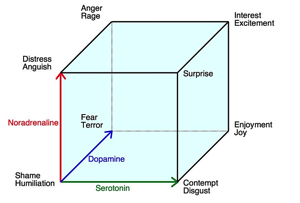
Well, it’s really about how he categorize the basic emotions into a 2 or 3 dimensional model.  From the post:

Paul Ekman, who works as a human ethologist of the emotions, has devised a scheme in which there are six “basic” emotions:  anger, disgust, fear, happiness, sadness, and surprise. Evolutionary psychologists like Cosmides and Tooby have extended this further, arguing that guilt, fear, jealousy, etc., are adaptive responses that increase fitness in our ancestral state.

emotion map

It’s a model I’ve seen before, and since emotions have been a particular lay interest of mine, I think about things like this sometimes.

Now, much of the analysis is way outside of my area of expertise (and as John says in the post, his as well), so I will leave most of the content without comment.  Read the post (it’s not long, but there are links!) if you are interested in the subject at all.

But what I found interesting is where he starts talking about love.  Love, in the model here, is not really its own emotion.  Further, love is not necessarily tied to sex.  Both ideas I agree with, and I think there is good support for that view.

Then, he says the following:

If sex and the value we take from others is separate from the positive regard we have for others, then to my mind, there’s just love. Love for partners, family members (particularly children), and friends is all of a muchness, and the differences are just socially constructed.

Agreed.

For various, and complicated, historical, cultural, and religious reasons we have created boundaries around difference expressions of care we have for others.  As a result, we often distinguish, in our culture, between (for example) romantic love and friendship.  But many see this differently.  For example, Wes wrote yesterday about Relationship Anarchy, and I agree that for many people, including myself, the barriers between different kinds of relationships fall away when examined.  For me at least, part of the reason for this is that the cultural and social distinctions between love itself fall away, in a similar fashion.  The cultural walls and definitions which seem to differentiate between relationships and types of love are mostly illusory, conventional, and in some cases simply wrong and ultimately harmful.

A 3D model of emotion categorization

Yes, there will be differing levels of intensity of the “love” feelings I have for people in my life.  There will also be subtleties in the differing emotional recipes which we call love (a little more serotonin here, a little less dopamine there…).

I can say, without any contradiction, that I love some people more, or at least for more reasons and with greater frequency, but the same basic feeling of caring I have for those closest to me is present with people I really like, whether I have sexual interest in them or not.

And while sexual intimacy is often (but certainly not always) a cauldron where those feelings may brew with greater intensity and speed, those feelings can exist with or without said intimacy.  It is true that I have friends whom I love.  Some of them are sexy as Hell (Hell is, after all, just an eternal orgy, right?) and would hop in the sack with in a second, and others I get no pants feelings for at all.  Similarly, there exist some people for whom being in the same room with is sexually intoxicating, and yet I have little to no love feelings for.

In other words, they are truly different things.  But I’m digressing.  The point is that I have differing levels of pants feelings and love feelings for different people.  You know, I’m human.

John Wilkins finishes his post in a way I really appreciated, for reasons that will become obvious.  I don’t know anything about his personal life, so I don’t know where he lies on the monogamy/polyamory question, but he says the following:

We can choose to have relationships that are of varying strength of commitment without needing to meet the expectations of popular psychology or sociology. We might even be able to adopt a plural relationship of sexual partners or a mix of sexual and nonsexual partners in life without prejudicing those relationships by constructed categories derived from past institutions like marriage that rely upon the ideologies of class, religion or economics.

A-fucking-men.

Just a Friday morning


This morning was a little different than most.  But in another way, it was not all that strange, for this house.  Last night, Jess and I had a date which involved her coming over here after work and hanging out with me around the house for the evening.  Jess is the woman I started seeing recently, and despite the fact I’ve only known her for 4 weeks, things are going very well and I see signs of it continuing for some time.  In short, she’s amazing and I’m really glad I met her.

We stayed in, while many others went out for karaoke, and we watched Doctor Who (she’s new to it, and is hooked!).  So, most of the evening was spent in the living room, cuddled up on the couch, but eventually we got tired and we went to bed.  Since we don’t have an extra bedroom, I fixed up the futon in the library (which is really just a part of the living room), so really we went to futon.  When we all win the lottery and we have a huge mansion with a dozen extra bedrooms, that won’t be necessary.  But that hasn’t happened yet.  Also, none of us play the lottery.  I guess I’m just going to have to sell a million copies of my book.  But seriously you can get it for free (or whatever you want to pay).  But if you all acquire it for free, my ‘selling’ a million copies is not going to get us that mansion/castle/small island with its own airport and private beaches.  You will totally be invited to our 25-person hot tub.

*sigh*  I’m going to have to continue to work and earn money like everyone else, aren’t I? Oh well….

Most people in the house are early risers, having to get to work and such.  I am working today, but I don’t start until around 3:00 today, and then I will be working until midnight or so (Friday night, w00t!).  But this morning was a day when everyone besides me had work early, and so the morning was a house of bustling, ready-getting people buzzing around me as I watched them all do their morning things.  I’m a very light sleeper, so there was no way I was sleeping through any of this, but rather than go upstairs to our bedroom to go back to sleep for another hour or two, I just watched.  A house full of people, all getting ready for work in an environment that is not completely unlike any other family.  The difference between what I watched this morning and, say, a married couple with a few kids was not big.  Rides to work and train stations were worked out, people were doing coffee, perhaps some breakfast on the go, and I had the three women I am involved with all there, together, talking and saying good morning, kissing me good-bye as they left (they all ended up leaving at the same time), and it was actually quite hart-warming.

For anyone who thinks that polyamory is strange, that this thing we do here at the PolySkeptic compound are unbelievable or somehow wrong even, I dare you to see what I observed this morning.  I dare you to see this group of adults, and how we share space, time, etc and to continue to think of us as doing something weird.  We are doing what most people do.  we are trying to maintain the daily stresses and joys of life with jobs, bills, fun, and self-enrichment .  We are just doing it outside the mononormative narrative, which is very strange to some people.  Those people have strange ideas about the world, or something.

It’s a wonderful life, and I’m glad that I was fortunate enough to be here.  And when I get home late tonight, I may see a bunch of people in the hot tub or I may find that everyone is asleep.  Either way, I am working this weekend, I have beer maturing and fermenting in the kitchen, and I have life to look forward to.  Strange though it may seem to some, I know many readers here understand and I’m glad they are out there being weird too.

Take that, rainy day! You aren’t gettin’ me down.

Vulnerability


Intimacy brings with it the promise of wonderful pleasure as well as the potential for pain.

Whenever we open up to someone, we hope that the other person will do the same.  If you meet someone you like, you can try and talk to them and they may respond or they may blow you off.  If you ask someone out, they can accept or they may reject you.  The first time you tell someone that you love them, they may reciprocate and they may not.  But we make these moves anyway, knowing that we are taking a risk of emotional injury.

Among all of these stages, as well as many others, we make ourselves vulnerable.  We display a part of ourselves, whether it be our bodies, our minds, our dreams, or our creations and there is the possibility that these things will not be appreciated.  There is a possibility that something that is important to us will not be appreciated by others.

But for the sake of the possibility of real intimacy and appreciation, we try.  Better to love and lost than not to have loved at all, and all that crap.

The last couple of days I have been reflecting on why I waited so long to publish my book.  I knew that I really enjoyed writing it and  I know that I like it, but what I don’t know is whether anyone else will.  I find myself trying to accept the possibility that nobody else will like it.  The question then is whether that will be OK.

If I like myself, is it OK if I’m rejected? Is it enough to be comfortable with myself? What if I’m wrong? What if my tastes are bad? Is it possible about being wrong about what you like? To what extent is it meaningful to state that something is objectively good?

Similar to my reluctance to publish, I am generally reticent, and shy, in social settings most of the time.  If I have a few drinks, this changes (of course), but I don’t want to be as shy as I am normally.  I fear that the real me, the one that you cannot see behind my reticence, will look uninteresting to you.  I’m afraid of not being liked or loved.

And yet, there are people who like me.  There are people who love me.  Knowing that, I must believe that there are things about me that are good, right? I must be lovable in some way.  The people who love me are are intelligent, interesting, and pretty amazing people, so if they like me that must mean I have some worth, right?

Well, sure.  But that does not mean that everything about me is good.  That does not mean that all the thoughts I have, all the posts I write, and all the things I do are worth anyone’s time or attention.  So what if something I do or say is crap? What if I spent hours writing and editing a novel that is not any good?

Does it matter?

In one sense, all that matters was the journey.  I set out with a goal, worked towards it, and reached it.  My goal was not to create something that everyone would love–or even that anyone else would love–right?  Well, no, not exactly.  I want people to like it.  I want someone to appreciate the effort and the product.  In the same way that when I talk to a person at a party, ask a woman out, or take off all of my clothes, I want the person I’m doing it for to like it.

So, in that case, if nobody likes it have I failed? Is the fact that I like it insufficient, if I’m being honest with myself?

Well, failure is too strong a word.  I have not failed totally; I wrote, edited, and published a book.  That is a success in itself.  But to say that if I like it then that’s enough, I’m not being completely honest.  And so I hope that people will like it.  Even if they are only few.  Even if those closest to me don’t especially like it.  I think that success, here, is measured in making any connection with others.

In the same way that I don’t need to be attractive, funny, and desirable to everyone, I don’t need everyone to enjoy my writing.  I know some people do.  And I suspect that someone else will enjoy my book.  My success will be in finding who they are, knowing that I made myself vulnerable before them and they still like me, love me, and respect me.

Still, it’s scary.

Power now available via Smashwords!


Thanks to Ginny, who created this image for me
My book cover (thanks Ginny!)

I wrote yesterday about how I wrote a book and got it epublished on Amazon.com.  Well, I had at least one person who requested that I make it available for the Nook, and so went over to Smashwords and got it epublished there as well.  So, if you have a Nook, and iPad, (or a textpad!) you can read it now.

Get your copy today!

Sorry paper book readers, no dead tree copies available.  I won’t get any printed until there is any significant demand for that.  Right now, the demand is light (I did sell a couple of copies on Amazon yesterday, which was fun to see).  I may decide to get some printed just so I can have one on my bookshelf, and maybe to give out to some friends and family who may want one, but for now that’s not a direction I’m going.

Again, let me know what you think, and if you do like it tell your friends.  It would make me happy to share this universe in my head with more people.

I wrote a book!


(update: buy it here on Amazon!)

Back in 2008, I found myself newly unemployed.  I had been laid off from a job I really liked, but was paid through the summer (it was a school job).  Of course, with the economic recession starting around then, it ended up being a tough couple of years for me after that, so I had a fair amount of time on my hands.  During that summer I re-watched Babylon 5 for the second time (I just finished re-watching it again) while I started looking for another job.  I also had time to start doing more reading and writing.  The origins of this book of mine come from that summer.

The background of this story was based upon a universe I had created in my mind as a child.  It had changed some over the years, but it was essentially the same.  It involved this character, which (to be honest) is a little bit based on me.  But as I started to write, it also became clear that the narrative I was spinning was also based upon living in a post-9/11 world.  It was about fear, insecurity, the desire for power, and understanding our place in the world.  I thoroughly enjoyed watching the narrative unfold before me, and in time I had around 100 pages (in .doc form) and a sort of cliff-hanger ending.  Having done so, I gave it to my girlfriend at the time to read.

By August of 2008 I had moved in with this same girlfriend (we were polyamorous, and I eventually had another girlfriend who lived out in Chester county), and things were going really great between us.  I was still not working steadily, but was managing to keep pretty busy anyway.  Substitute teaching is not very consistent, and it left me more time to write.  I had a really crappy (geocities) website, was starting to write more about atheism (I had been dong so since 2002, off and on), and it would be in February of 2009 that I first created this blog.  Early posts here were from that time, around when the first draft of part 1 of this book of mine was finished.

After my girlfriend finished that draft, she threatened to murder me if I didn’t finish the story.  And so, preferring to stay alive, I did eventually start writing more.  In the mean time, that relationship ended, I moved to Atlanta (October 2009), and then my life went to Hell for a little while.  Sometime during all of this, I started writing again.  By 2011 or so, the book was finished.  It was still fairly rough, however.

Thanks to Ginny, who created this image for me

I did a massive re-write last year (2012) and talked to Ginny about editing it.  She, however, was busy with grad school, and never finished reading beyond part 1.  We had some discussions about my conception of tense (since she was an English major in college), which led to revelations that the way I view time (in its relationship to memory and consciousness) is strange.  So, if you do decide to read it, and I ended up missing some point in the text where I seem to move from one tense to another (which seems natural to me and was partially intentional), then that’s why.  I wonder if I do that in posts here.  I don’t usually notice that I do it, all the time.  My mind is strange.

Anyway, a few weeks ago I wanted to fix a couple of things in the story I had been thinking about (it will never be done! It will never be perfect!) and while i was doing so I wanted to refer to my story notes, but couldn’t find them.  I looked everywhere (or so I thought) and resigned to the fact that they were lost.  Then, the other day, I found them.  As a result I spent the weekend editing the whole book, and decided to bite the bullet and just publish the damned thing already.  I did that just today, and here it is (kindle version, only.  For now).

The book has been worked and re-worked many times.  I have tried to make sure that it is internally consistent, clear, and totally bad-ass.  I may or may not have succeeded in any of those goals.

So, if you are interested, take a look.  if you don’t have a kindle (since so far I only have a kindle version available [edit: now available at Smashwords!]), and you want to read it send me an email, and I can send you a copy [edit: if you don’t have en e-reader, i will consider sending you a pdf copy, if you ask].  I didn’t write this to make money, I wrote this because I loved doing so.  But I figured that maybe I could sell a few copies and pay for a case of beer, a bottle of bourbon, or maybe just a six pack of PBR.

If you do end up reading it and like it, tell your friends.  Also,  tell me! I know not everyone will like it (Ginny, my darling wife, is not a fan of my writing style).  Also, if you just want to check out part 1 ( my favorite is part 2, personally), that is also available.

Anyway, I hope some people like it.  I like it (which, I suppose, is all I was after).