I follow a few blogs about polyamory. I specifically like polytical.org, a group of poly people in the UK who often have many good things to say.
Today a post went up that deals with what Lola O, the author, thinks of as some contradictions in the polyamory community. But, primarily the post is about the tension between the goal (or what might often be an expectation) of becoming a non-jealous super-partner in order to be poly and the reality of human emotion, struggles with said emotions, and the stubbornness of those twice-mentioned emotions in not simply disappearing at will.
In any case, the post there is long enough without my predilection to ramble on (and on, and on) adding to your reading. So without further ado I will supply you woth the link:
“All journeys have secret destinations of which the traveler is unaware.”
-Martin Buber
Goals are fine, but allow your destination to evolve in relation to the type of walking you like to do. And don’t forget to experiment with many types of walking!
—
Most of us have goals for ourselves, which is good. They give us direction, purpose, and something to use as a metric to measure success along the way. But sometimes having a specific goal can be problematic, in that if it is too static and well-defined, what we learn along the way my fail to educate us towards re-defining our purpose based upon new information.
Monogamy is, for many people, a goal. That is, while they may have any number of relationships of varying degrees of intimacy, they are seeking a partner with whom they can share a unique, meaningful, and long-term partnership. The question is how to reach such a goal given how complicated people, and thus relationships, are. In order to reach such a goal, many things need to be learned and practiced.
Having relationships throughout our lives gives us perspective on how we might improve ourselves in order to be ready to succeed in maintaining a healthy relationship when we meet the right person. Or, at least, until we meet someone who we think might be the right person. Most people go through a few trials before they find the right person.
But, by focusing on the goal–that of being in a meaningful, committed, exclusive relationship with a person with whom you are well matched–it is easy to be distracted from the skills one will need to reach the goal and be ready to maintain it well. And if those skills are not taken in, then having a successful relationship of any kind is very unlikely.
The lessons that we could learn, if we are paying attention during those many trials, might seriously alter the shape of the goal we have in mind. It might, in fact, change the very nature of that goal because those lessons may change us.
Starting with yourself
The foundation of being successful at relationships with other people is getting a good hold on your relationship with the many conflicting needs, desires, and emotional landscapes that lie within us. We are a conglomeration of many unconscious drives, emotions, and thoughts which emerge into an illusory sense of singular identity. Becoming comfortable with that complexity within ourselves in challenging, but essential, in communicating what we want and need.
We need to know what we want, and how important those desires are, before we can hope to effectively communicate those desires to anyone else.
Getting to know ourselves, finding out what we really want, and finding ways to satisfy these desires in healthy ways is an essential first step in relationships life. We have to be completely and bluntly honest with ourselves, especially where our desires are in conflict with what is considered normal, expected, or even demanded by potential partners.
Why is this so important? Because they don’t go away. Our needs and desires will stick with us, whether we repress them, seek to fulfill them in clandestine ways, or openly deal with them with people close to us. It seems rational, therefore, to explore them openly with those close to us for the sake of our own contentment and because part of intimacy is sharing such desires with those we are close with.
Once you have a grip on yourself, ideally we should hope to find other people who have done the same thing.
The complexity of relationships: others
People are complicated. When we meet someone who is complicated in ways that we like, we often want to learn more about them. We probably want to find out what they learned in their own pursuit of self-understanding. And if we think that who they are is compatible, to any sufficient degree, with what we need and want then we may pursue some sort of relationship with them.
I am forced to be vague here because the range of possibilities is vast. I don’t know what you, or anyone else, will find in their own personal journey of self-understanding, and so I don’t know what compatibility with other people will entail. If you find that you have a deep need and desire to be humiliated and beaten (with a safe word, obviously), then the kind of partner you will be attracted to will probably differ from another person’s need and desire to share quiet nights reading love poetry and having slow, sensual, nights of passion. Of course, the same person might like both.
Like I said, people are complicated.
One of the complications that arises out of having feelings for someone, for most people anyway, is the feeling of possessiveness. Intimacy makes the person with whom you are intimate feel like they are in some way part of you and your life. The connections of shared needs, desires, and the satisfying of those things often binds you with them in wonderful ways.
For many people, this binding is conflated with exclusivity, especially in the presence of insecurity and jealousy. Ideally, issues with jealousy and insecurity will have been dealt with in one’s pursuit of personal growth, but very often it is not. The prevalence of opinion that jealousy is a sign of true love and intimacy is evidence for that.
The bonds we find with others through intimacy are unique, and may also be deeply important, meaningful, and irreplaceable. But there is nothing about that intimacy which makes the possibility of intimacy with others impossible, nor does the presence of intimacy with other people make that intimacy less unique or meaningful, necessarily.
It is quite possible to have any kind of intimacy with more than one person, including sexual and romantic intimacy. Your partner having another lover, partner, or even deeply close friend is no more threatening to your relationship with them than your insecurity and jealousy make it. The only thing that can prevent true intimacy would be some emotional inability to be truly intimate (through fear of commitment, trust, etc), or your inability to share that intimacy (through those same insecurities and lack of trust).
Adjusting your goals
So, if your goal is monogamy, while going through the work to make yourself a better partner, you may miss the possibility that another goal might also fit your set of needs and desires. The key is questioning your own biases, challenging your fears, and allowing yourself to trust yourself and your partners sufficiently to allow everyone, especially yourself, be honest, open, and pursuant of what they really want.
Love all the people you love, as you actually love them without artificially limiting or extending that love Do not let the goals get in the way of what you really want. You may find a plethora of people in your life with who you can have various kinds of intimacy, and a static goal—whether it be asexuality, swinging singleness, monogamy, or polyamory—may blind you to what it is that you really want.
Focus on what you want, what your partners want, and let destinations attend to themselves. You may find yourself in a very different place than you would have reached for, had you allowed your true desires to not be defined by social expectation, fears, and lack of trust.
Wes and I have big plans to write a book about relationships someday. We were at a wedding in October and we planned out the structure and such on a set of cocktail napkins like real classy writers. Jessie, Shaun and Ginny will likely contribute to it as well, so this blog is starting to feel like a book in training.
The structure of the book will take into account Wes’ and my strengths as writers. Wes is analytical and straight to the point. I am a meandering storyteller who likes the art of the personal essay. I like to show how my own history has led to a particular understanding of the world. In the book, Wes will present explanations of our philosophies and I will talk about how these philosophies are applied in our lives. That way, it’s not just people spouting off about how things should be with no practical application. We can show how we actually live and incorporate these ideas into reality. Our philosophies about relationships are not simply lofty ideals. They are things we thought about and then tested, again and again, and found them to be true for us.
Polyamory with a dose of skepticism properly applied.
So, today I want to talk about rules. Specifically I want to address the points made in Wes’ recent post, Polyamory Isn’t All About You. The post garnered quite a bit of attention and sparked a bit of controversy. It was for good reason as he was presenting some pretty matter of fact ideas that thoroughly challenge the traditional ideals behind relationships. I, of course, didn’t really see what he was saying as particularly shocking because this general philosophy has guided the structuring of our relationship, even before polyamory. After pondering what he said and the response that it received, I thought it would be helpful and hopefully interesting to our readers to see how these ideas presented themselves in real life.
Wes and I have been together for 8 years and were monogamous for 5 years of it. We were dating for only a few months before deciding that we wanted to live together. It didn’t take particularly long for us to know that we wanted to spend our lives together. Marriage was spoken about very early on and honestly, we were basically married (in terms of the level of commitment we had to each other) for almost all of the relationship. People were shocked when we got together for some reason (a lot of people didn’t know Wes very well and really didn’t know me very well either and they made a lot of assumptions about who each of us were and had lots of opinions about how we shouldn’t be compatible), but soon it became clear that we are incredibly compatible. Like whoa. In the beginning of relationships you measure compatibility by the amount of interests you have in common, the kind of food you like, music, art, whatever. The things you like are a superficial way to first see compatibility (and a lot of people likely put too much stock in these things) and having a lot of these types of things in common makes the getting to know each other part of new relationships fun and generally easier. Wes and I share a love of The Who and Styx and have compatible senses of humor and like a fabulous steak and cheap wine and…well, I could go on.
But these are not the things that led us to marriage. Sure, they helped. It is certainly reasonable to want to have a life partner who is fun to spend time with. In fact, I don’t really understand the number of relationships with this bizarre “We don’t really like hanging out together” thing. It’s that kind of attitude that leads to the hilarious “War of the Sexes” and such (note: I don’t find this hilarious. I find it tiresome and boring and wish that it wasn’t such a favorite topic of media), but that’s a whole other post. So yes, Wes and I have a wonderful time together but beyond that there is a deep and profound compatibility between us that comes from sharing a similar world view, a similar outlook on the way the world is and the way it should be. We are open-minded, inquisitive, skeptical, and both committed to personal growth and improvement.
These are the things that allow us to grow and evolve as a couple. These are the things that allowed us to commit to the likelihood of “Forever”. A common question we get about our choice to become polyamorous (and often with a good bit of venom behind it) is, “Well, why even get married if you’re going to live like that? It sounds like you just want to have everything and screw around.” The answer is that we got married because we are completely and utterly interwoven into the fabric that makes up who we each are. I cannot imagine a life without him. I cannot imagine being old and decrepit and not having him right there with me. We committed to having a life together long before we chose to be non-monogamous. Having the legal recognition allows us to easily proceed into big life things like taxes, house buying, car buying, health insurance needing, important decision making. When we committed to each other, we committed to wanting to be able to do these things together. It’s as simple as that.
To talk about rules though, I think we need to start back before we introduced non-monogamy into our lives.
I used to be an incredibly negative person. I used to be a jealous person. Both of these things can rear their ugly heads in many instances that have nothing at all to do with a partner looking at someone else. For example, one time Wes told me, “Ooh, guess what! I have the day off tomorrow!” I did not have the day off and I felt jealous that he got a day at home and I didn’t. My response was then, “Huh, I wish I had the day off”. Wes looked at me and said, “You should be happy for me, not jealous.” The conversation was more complex than that, but it introduced a very important idea behind healthy longevity of relationships. Relationships should not be transactional. If something good happens for your partner, there is no guarantee that the same will happen for you at the same time. Instead of wanting what your partner has and feeling bitter that you don’t have it (envy) or thinking that you somehow deserve it more and should have it instead of them (jealousy), you should simply be happy that your partner is happy. This is an ideal existence.
This ended up being one of the most important conversations in my life. It was so simple and about something so minor, but it illuminated a dark thing about me…a dark thing that I did not want to be part of me anymore. It had never occurred to me how something so simple could be so damaging. But when you think like this, it can so easily lead to resentment, which leads to unhealthiness in the relationship. Resentment, much like insecurity, starts as a little seed in your mind and we all have a tendency to tend the growth of these things instead of nipping them in the bud. Committing to nipping them (with self-introspection and a lot of communicating) is, in my opinion, a key to a happy, healthy relationship.
It was at this point that I started my own Happiness Project (based on a wonderful book and blog by Gretchen Rubin) and started to change my outlook on life. She helped me to see the great number of things in everyday life that I allowed to bother me. I learned to take control of my negativity and can honestly say that now, a couple of years later, I am a much more positive person. Very little gets me down for long periods of time and when something does, I have the mental tools to process it healthily.
It was around this time also that Wes and I decided to open up our relationship. As such, it was at this time that I also learned just how deep my jealousy and insecurities ran. There were times when things were simply horrible. I would have awful jealousy trips and in my mind I would wonder whether I was cut out for it. But here’s the thing: Wes and I agree that if at any time either of us doesn’t want to do this anymore, we will stop.
I take this INCREDIBLY seriously. That is the trump card to end all trump cards. When I say this I mean that once this card is played, there’s really no going back. And the reason I feel that there is no going back for Wes and me is that if I decided that that I was simply incapable of working through issues, that Wes’ happiness was not worth enough to get over my insecurities and misconceptions, that simply giving up was preferable to honest and open communication, then there would have been something deeply wrong with our relationship itself. Polyamory would be impossible for us if we were not so very compatible and so very committed to each other.
Even at my darkest moments processing through this, I could never bring myself to play the card. I knew that the issues we were having were entirely about me and the problems in my head. You can disagree. You can say that somehow Wes was responsible or that poly was responsible but you would be 100% wrong.
Because I had made the decision in the beginning that the trump card would not be played (unless something monumental happened, which as I said above would likely be a bigger problem in the relationship than poly could ever be), it was important for me to envision the endgame. I had to assume that Wes would meet someone that he would want to have an equivalent relationship with as he has with me. I had to assume that there could be someone who would be in our lives in this capacity as forever. (Yes, I thought about it at the times in terms that I would likely not have a serious relationship…I was apparently quite wrong about that!) Why? Because I couldn’t imagine denying him the happiness of finding someone wonderful. When I thought about the idea of specific rules of attachment, I couldn’t come up with anything that sounded reasonable. Sometimes I would come up with something that sounded good in my head and then I would actually say the words. When I would finish the sentence, I would say, “Um, that’s dumb. Nevermind.”
The idea of rules came up before we even talked about non-monogamy. Wes started law school and made all these new friends and he wanted to hang out with them (as people do). I had to be up for work early during the week, so I didn’t go out much with them. Wes would often close the bar with them and wouldn’t get home until 3am. I had two types of emotions about this. First, I was jealous that he got to do this all the time. The other was that I would worry if he was alright. One of these is reasonable. The other is not. I was letting the jealousy get out of hand and I said, “I want you home by 3am”. I gave him a curfew (barf). I thought that by knowing that he would be home by then, I could sleep better. What happened? I would stay up until 3am waiting for him. I was still unable to sleep.
We talked about it and I admitted the failure of this particular decree. After discussing the idea that Wes hanging out with his friends when I choose not to and then getting upset about it is stupid (I definitely got over that), I realized that I simply want to know when he’s heading home or if he’s going to be out later than usual or whatever. I want to know if I should be calling the police. I want to know that he’s alright and having a good time. The solution was simple: Shoot me a text when you’re heading home or when your plans changed. Just keep me informed.
He started doing that and we both do that today and nobody worries. Once I knew he would do that, I could sleep and was happy that he was out having a good time and I was happy to be able to go to sleep knowing I wasn’t keeping him from something he wanted to do just because I was being insecure and negative.
When the subject of rules came up about our non-monogamous practices, as I said, I just couldn’t come up with anything. It didn’t make sense to me to make rules that would inevitably be broken. I knew that we, being human and passionate, would likely form major attachments to people we chose to date outside our relationship. To attempt to put limitations on that is unrealistic for us. “You can have sex with other people, but you can’t fall in love with them.” Yeah, I’m sure that works out well all of the time. For me, it was all or nothing. The endgame. If we are at the point that we want to explore other relationships, we are at the point that we could potentially find other highly satisfying and amazing relationships. Why on Earth would I want to limit that possibility?
Wes’ post seems to say that we don’t have rules, but that isn’t true. We have three major rules (or really, guidelines): Be safe. Be smart. Be considerate.
These rules cover a whole array of decent human behavior. These rules indicate that we trust the other to be considerate of the other person’s needs and to not be a jackass. And if we happen to be a jackass, the jackassery is to be communicated immediately and worked through.
When we were first open, I had a lot of insecurity about Wes finding someone who was infinitely better for him than me. I saw myself as deeply flawed and that Wes would get tired of dealing with all my bullshit, especially if he found someone without it (ha, right?). What he told me was that he knew all of this about me when he fell in love with me and that it would take me becoming a completely different person for him to want to leave me. This is how we feel about rules. For either of us to break these three guidelines in an egregious way to warrant termination of the relationship would take either of us becoming completely different and ultimately completely incompatible people. It would mean a break in our collective philosophical mind so great that we barely knew each other anymore.
To this end I will tell you a little story. One time very early in my relationship with Shaun, he and I broke a rule that we each had in place with Wes and Ginny (for the sake of transparency, yes, it was the condom rule). It seemed like a fine idea at the time, but then we both realized that we had done something wrong, that we had violated trust and felt terrible about it. So, we both immediately told Wes and Ginny and Jessie. They weren’t particularly happy with us, but we talked about it and though tensions were a little high for a while (mostly in my own mind. I felt like a Grade A Asshole for quite a while and no one is quite as good at punishing me as I am myself), we got through it without any breakups or true terribleness. Instead, I think it showed us all that while, yes, we are clearly imperfect, we could admit to our mistakes (there is really no other reasonable choice) and showed that though we made a mistake, it was not a mistake that we were proud of and cared very much for the other people that would be affected.
These are what “rules” mean for us. We acknowledge that mistakes happen and we work through them if they occur. In the realm of consideration, we all acknowledge that it is highly possible that we will hurt one another. It is impossible not to do this once in a while. Being considerate means considering how your choices might affect another and then weighing the pros and cons of getting what you want verses hurting someone else. It is impossible to give everyone what they want all of the time. In the course of a life with someone or many someones, you will be bothered by things the others do but you have to think about why these things bother you and whether it is something they need to change or something that you need to change about yourself. This is how relationships evolve and grow together, instead of breaking apart. When you are truly mutually committed to each other and each other’s happiness, it is imperative that you also commit to communicating your ideas, wants and needs, and also to making your household into an atmosphere of growth.
This is why those three guidelines are sufficient for us as things specifically stated. Be safe, be smart and be considerate. When specific scenarios arise, we talk about them, figure out our common ground and adjust as needed and, as a result, we learn more about each other and grow.
Certainly polyamory seems quite complicated, but it doesn’t really feel that way to me. It feels no more complicated than any slice of any day on Planet Earth. When you are at the point in your hierarchy of needs, life in and of itself takes on an amazing complexity. We are always learning. There is always room for improvement. Perfect is asymptotic but fun to think about.
In the end, love has no rules and incorporating more of it into a life requires thought and consideration and much work, but oh, is it ever worth it.
I’ve seen a couple of calls for a sex strike of some kind, in response to the many recent attempts to restrict availability of women’s reproductive choice services (both abortion and birth control). I get where they’re coming from, and I think their main argument is correct: before birth control, women and men alike had much less sexual freedom, and the further our access to it is withdrawn, the less sex people will be having. The posts I’ve seen about sex strikes are a well-meaning attempt to confront men with the reality of this consequence before it’s too late. (There could very well be calls out there employing a nastier, “they’re trying to screw us so let’s not screw them!” tone, but I haven’t encountered them yet.) The problem is that tactics like this aren’t paying close enough attention to who is pushing this legislation, who is supporting it, and how a sex strike is going to affect them.
Historically, sex strikes have been effective when the women of a single community took a strong position against actions or policies that the men of their community were embracing. That’s not what’s going on here, though. Pulling back access to reproductive choice services is not something men are doing to women: it’s something political conservatives are doing to everybody. And while political conservatives do tend to skew male, the difference is not dramatic (For an example, look at the demographics of voters in the 2006 elections.) My experience is that people tend to run in social circles with similar political beliefs, so women who vote conservative are more likely to date men who vote conservative. And how likely are women who vote conservative to participate in a sex strike? My guess is… not very likely?
A lot of conservative voters have very strong beliefs around sexual morality, believing sex should only take place in monogamous heterosexual marriages. Needless to say, a sex strike is not going to scare them: unmarried, unready-for-children people having less sex is exactly what they want. So the success of a sex strike depends on the existence of a significant population of conservative voters who are relatively neutral on sexual morality and who enjoy non-procreative sexual activity. And even if that population is large enough to affect election results, the men of that population would have to be dating / married to / hooking up with women that are politically motivated enough to engage in a sex strike. I just don’t see that as likely. I think conservative-voting, apathetic-on-social-issues men are mostly dating (etc) apathetic-on-social-issues women, who aren’t going to participate no matter how hard a strike is pushed.
So I think a sex strike is going to have a negligible effect on conservative voters, who are, after all, the ones who place and keep these politicians in power. What about the politicians themselves? Will they suddenly find themselves unable to get laid and reconsider their stance on birth control availability? Not likely. Rich and powerful men play by different rules, in sexuality as in many other things. Rich and powerful men have nothing to lose by returning to the sexual dynamics of the pre-birth-control era. Do you really think a successful politician in the 40s had a hard time getting laid? It’s the average men and women who gained from the availability of effective birth control, and it’s the average men and women who will lose as that availability is withdrawn.
It’s pretty popular these days to pooh-pooh attempts at grassroots activism on the grounds that they’re ineffective. In general, this irritates me: why discourage people from trying? But in this case I have philosophical objections as well as pragmatic objections. A sex strike encourages women to use their bodies as a bargaining chip, and haven’t we seen enough of that? It supports a “battle of the sexes” mentality, and haven’t we seen enough of that? It makes sex once again about power and control, and not about joy and connection. If I thought it was going to be an effective tactic, maybe I would think all this a worthwhile price to pay — maybe. But I don’t think it is, so I would rather see us support the right to reproductive choice by continually affirming sex as a healthy, joyful, and mutually beneficial part of human nature.
The year was 1990 and I was starting 5th grade at Public Nerd Academy. The more popular name for Public Nerd Academy is J.R. Masterman Laboratory and Demonstration School. In other words, a magnet school for people who scored high in standardized tests and excelled in traditional education settings. I had spent September of that year at my elementary school, awaiting a spot at Masterman. I had applied late and was only going because all of my friends abandoned me to go be smart somewhere else.
In a matter of days, it became clear that I needed to get out of my elementary school. I was doing well, but with minimal effort. On day one, my teacher knew that I was waiting to leave and she tried to shame me and break my confidence about the move. “You think you want to go to a school like that, but those kids spend all their time in the library! You won’t last a day!” On day 5, after I had shown an uncanny ability to memorize boring facts under pressure (including a correction of one of her pieces of data), accelerated understanding of proper family tree notation, and keen comprehension of place value, she started changing her tune. “I hope you get in there. You’re going to be really bored here.”
Finally, after my mom wrote a scathing letter to the school board (someone had transposed my test scores and it was affecting my ability to be accepted into the school), I got a spot. On my last day at my elementary school, my teacher was all smiles. My dad had come to school with me that day and at some point we found ourselves in the principal’s office (scandal!). The principal then attempted to shame me and break my confidence too. “Here you are a big fish in a little pond! There you will be just the opposite!” “I hear your best friend hates it there and wants to come back here!”
Both points were loads of crap, and even at 9 years old, I was aware of it. My dad did not need to defend me, as I looked the principal straight in the eye and said, “I’m not learning anything here. I’m alright with being a little fish. Also, my friend doesn’t want to come back here. She’s happy there.” And with that, my dad signed some papers and I started up at Masterman the next week.
On my first day I was greeted with a whole cornucopia of new information. Some of it seemed useless in retrospect, but it was interesting and it made me enjoy class. Class was more difficult. We were learning things that I didn’t know and I had to think a lot. It was a whole new world! I thought I had found a place completely different from the one from which I came. I had no fear of showing my intelligence. I had no fear of speaking up, of speaking out, of being different. I trusted that the caliber of people I would now encounter would generally be higher now, especially the adults.
Yeah, I was 9. What do you want? Of course I had no fear of these things…I had only been there a couple of days and none of my notions had been challenged yet! Also, as a 9 year old, I respected adults, but I only really trusted my parents because they weren’t full of crap. If they told me someone was, in fact, full of crap, I believed them (and they were usually right).
My 5th grade teacher, Mrs. Levine, was, as it turned out, not a high caliber individual and facilitated my learning of a very important life lesson.
Throughout my education, my mother has been defiant about certain things. She is not a fan of the education system and thinks that people’s obsession and pretention about education (especially higher education) is akin to religious zealotry. I don’t disagree with her on this point, though we have had some conflict since I decided to go to college (I wanted to be a chemist, which requires higher learning than highschool can provide and hands on experience that books cannot provide). As such, she was not really a PTA kind of mom. Obviously, she wanted me to go to school and was involved with my education at home (helping me with homework and such), but she had no desire to be involved at the school otherwise. She didn’t want to make cupcakes for meetings or hear people whine about the text books or whatever it is people go on about at these things. At Masterman, it was called the Home and School Association and every year, the school’s goal was to get 100% of parents to be involved. To join, your parent had to fill out a form and pay $5.
If your class managed to get 100% enrollment, the class was rewarded with…
You guessed it! A pizza party! DOMINOS FOR ALL!
So, I go home my first week of school and tell my mom about this, though I let out the part about the pizza party because, well, I’ll admit something here: I didn’t really care if we got a pizza party or not. If my mom wanted to join The Association (the home and school one…not the wussy band from the 60’s. Though if that had been the case, I would have really tried to convince her. Who doesn’t want to sing “Windy”?), great, but if she didn’t, who was I to force her? It’s her time and money (even if it’s just $5). As expected, she didn’t want to be involved, so I didn’t bring in the form.
A few days before the deadline, Mrs. Levine ominously called 4 students up to her desk. I was one of them. She looked at us with a “knowing” look that was tinged with disappointment. She spoke.
“As you know, the deadline for joining the Home and School Association is coming up. You are the only 4 students to have not brought in your forms and pay. I didn’t want you to be the cause of the class being denied a pizza party, so I filled out the forms and paid $5 for each of you.”
We all looked at each other in a confused fashion. And then she said,
“I expect to be paid back before the party.”
I was astounded, to say the least. When I was 9, I wasn’t really cursing yet, but had I been a cursing type at that time, I definitely would have asked the important question, “Are you fucking kidding me?”
I don’t know what this woman thought was going on, but she seemed to be in complete denial of the various circumstances that led to our parents not joining the Home and School Association. In my case, it was out of principle. My mom didn’t want to be on the Home and School Association, so she didn’t join. How can it be simpler than that? The point of the contest was that the school wanted as many parents involved as possible. That’s a noble goal, but if someone doesn’t want to be involved, they have their reasons and YOU CAN’T MAKE THEM. That seems to go against the idea of a volunteer organization. As for the other kids, sure, it could be simple forgetfulness. Or it could be that $5 is a hardship for the family. We were going to PUBLIC school after all. Theoretically, you’re not supposed to have to pay for your education there. Theoretically, you were going to school to be educated and the money required to get the kid clothes and school supplies might have tapped them out, especially in the beginning of the year. Sometimes you just don’t have 5 bucks. Or maybe the kids that didn’t pay have terrible relationships with their parents and couldn’t bring themselves to tell them about it. Who knows? Mrs. Levine certainly didn’t and she took it upon herself to go against the seeming wishes of the parents simply to win at a dumb contest for a trivial prize.
I often wish that I was the person then that I am now. Over the years after encountering many instances of authoritative idiocy, I started to speak up and call people on their crap (not in my personal life so much but certainly in my school and professional life). If I had been this person, I would have laughed in her face and called her out in front of the whole class and explain to her that she had just taught us a really shitty lesson about how to get your way.
I went home and told my mom about this and she was flabbergasted. I think she may have said, “Are you fucking kidding me?” and I told her that I wasn’t and that my teacher is ridiculous. My mom refused to pay and I agreed with her. There was just so much out about this that I couldn’t disagree with the decision.
So, it went on for several days that I didn’t bring in Levine’s money. As it turned out, my class was the only class to have “achieved” 100% enrollment and Levine was walking around exceedingly smug about it. This was, of course, disgusting because she had cheated to win and was in charge of educating a bunch of 9 year olds. Every few days she would ask us about our payment. I told her that my mother didn’t want to join. One day during a quiet period in class (we were reading or something), she came up behind me at my desk, leaned down and spoke into my ear.
“Gina, you still haven’t paid me back the $5. The pizza party is tomorrow. If you don’t bring me the $5 by then, I’m sorry, but I can’t allow you to go to the pizza party. It just wouldn’t be fair to the other students.”
And then she skulked away.
I was, once again, astounded. This was my teacher? Look, I know. If you elect not to participate, then you don’t participate. But this was a parent thing. The woman knew this and was manipulating me to feel badly so that I would go home and guilt trip my mother. This woman was one of the first adults to show themselves as completely and utterly full of shit. It was an important day in my development.
My mother and I had a very open relationship growing up. She would ask how my day was and I would tell her, in great detail. We talked about everything. So, of course I told her about this incident. She couldn’t believe it. “Really? They’re going to punish YOU because I don’t want to be on the stupid association? REALLY?” She went to her purse and pulled out a $5 bill and gave it to me. She thought about writing a letter and making a big deal of it, but figured that would just bring the place down on me and decided against it. So Levine won that round.
The next year, we had to back to her classroom to get our assignments for 6th grade. She was in a neck brace. Apparently, she got whiplash falling off a dinghy. That was possibly the funniest thing I had ever heard.
I got her back that year because there was a holiday door decorating contest on our floor. I walked down to see what Levine’s class had done and it was clear that Levine had, once again, done the whole thing herself in order to win a fucking pizza party. I went back to my classroom and sat down with the teacher (who I had a really good relationship with) and told her this entire story and then I said, “We are going to win this door decorating contest and we’re going to win with student-done work. Also, FYI, tacky always wins.” So everyone in the class made cut outs and various decorations and we hung up lights and giant balls of tinsel and we won that motherfucking pizza party fair and square.
And it was the best slice of Dominos I have ever had.
Thinking about this incident in conjunction with the teacher and principal at my elementary school attempting to make me feel unworthy and unconfident, I just am amazed that people like this are allowed to have any influence on children. At the age, children are so impressionable. It is the time that really decides how socially adjusted they’re going to be. If authoritative people are telling them that they are not good enough or that they are so full of themselves to acknowledge that they are smart or that being a rational outspoken person makes a detriment to the welfare of the group, they will believe it. If you tell them that cheating to win just to look good, they will adopt that into their own ethics. Or, if you as an authoritative figure show yourself to be untrustworthy and vindictive, kids learn that too. They learn that respect should not be guaranteed and won’t be given away freely.
We live in a time when parents are struggling to keep a home afloat. Both parents work a lot of the time and the time spent with their children is often minimized. Parents influence as much as they can, but once kids are in school their teachers are the parent figures. We spend 13 years in these institutions and form so much of our identities there. We have to be able to trust our teachers to do right by us and so often they fail.
I do think a lot of teachers try very hard to be successful. I have often thought about taking up the profession but it just seems like such a daunting task (much like becoming a parent). I am intimidated by the fact that even if you are the best teacher in the world, you will not reach everyone, you cannot save everyone. I do think that many of the people that choose to do it are generally a noble sort. I don’t believe the old adage, “Those who can’t, teach”. Teaching is a skill that many people do not possess. However, choosing to be a teacher doesn’t mean that you deserve automatic respect and reverence. You need to show your students they can trust you and you need to encourage them to think critically at all times. Breaking down their confidence when they acknowledge that they need more challenge is NOT useful. Teaching that dishonesty and manipulation is the best way to win is completely detrimental to satisfying success. Teaching that it’s ok to assume what’s best for someone without ever talking to them teaches you how to be terrible at relationships. As a teacher, you have just as much influence over kids’ ideas as their parents. Sometimes even moreso.
If they don’t learn the important things in school, they are handicapped for the rest of their lives as they try to catch up.
just spotted the new post on the Brunettes…. So, figured I’d ask a simple question, which is: what books would you recommend for a layman to get acquainted with the current state of sexology/sex research? I’m prompted to ask because I’d been reading this excellent article:
and reading the comments I came across a reference to A Billion Wicked Thoughts. Alas, even a quick check of that book & some online reviews (e.g. at Figleaf’s site) confirmed that it was pernicious dreck. So I’m left wondering what I SHOULD be reading…. In particular, I was curious about how people’s sexual identities are formed–how does one end up being “submissive” or having a particular fetish? And what about cultural differences–what does “kink” look like in other cultures? Are dom/sub, top/bottom binaries pretty much universal or do they have a more recent, specific history?
As you know, there’s a stereotype in popular culture that people who are into S/M have had damaged childhoods or were raped; I gather the BDSM community often hates this stereotype (perpetuated e.g. in the otherwise S/M-positive film Secretary). There’s probably a grain of truth to the stereotype (in my anecdotal observation, anyway) but I was wondering where to go for a more reasoned, empirical study of the topic.
best,
N
_______________
Hi N,
“Why we like what we like” sexually is one of the toughest and — if judged by my cohorts’ research interests — most intriguing questions in sexology. It’s hard to study for a number of reasons: how do you recruit a good representative sample on such a sensitive topic? How do you measure all of the possible variables, both genetic and environmental? How do you gather reliable information about subjects’ childhoods, possibly including pre-memory stages of life? And how do you get funding for a study on the origins of fetishes in our sex-negative political environment?
To have a really solid answer even to the simple question “Does childhood abuse make one more likely to develop BDSM inclinations?” you’d want to do a longitudinal study, starting with a large sample of abused and non-abused children, and follow them through life, interviewing them about their sexual interests in adulthood. I can think of half a dozen reasons such a study would be hard to pull off, just off the top of my head.
SO. I’m sorry to say that I can’t give you a definitive answer, or even point you to resources that have one: as far as I’m aware, it’s not out there yet. But there are some theories being tossed around. One book I found interesting is Arousal, by Michael J. Bader. His basic thesis is that fetishes and fantasies all have the purpose of making us feel safe enough to be sexually aroused. Based on the different insecurities and anxieties we have, some people get that feeling of safety from exhibitionist fantasies, some from submissive fantasies, etc. It’s an interesting read and a valuable theory: I wouldn’t say I’m completely sold on it, but it’s a contender.
For cross-cultural information, Exotics and Erotics, by Dwight R. Middleton, is a great overview on desires, practices, and identities across cultures. The World of Human Sexuality by Edgar Gregersen is longer and more in-depth, and very scholarly in tone, but if you can handle a little dryness in your prose it’s fascinating reading. Neither one of these have a psychological focus: they describe rather than attempt to explain. However, knowing what sexual tastes and practices are considered normal or abnormal in other cultures helps to shed light on our own.
Good job rejecting the Ogas and Gaddam book, by the way. Their work is not entirely meritless, but their research practices are really lousy. I can sort of understand the temptation to do bad research when good research is so difficult and ridden with obstacles, but there’s no excuse for giving in to it.
I started off telling Wes and Jessie this story last night in the same fashion and Wes said, “That’s a pretty dramatic beginning to a story…” I felt like I was about to let them down. The story wasn’t going to be that dramatic. But if it makes you feel better, you can read it in your best film noir voice.
I’ve been in a “Wah! I don’t wanna be productive at work! IT’S NICE OUTSIDE!” kind of mood, so I pondered pretending I wasn’t here. I mean, it’s plausible thing. I could be in the lab doing very important scientific things or not so important scientific things (like analyzing glitter or something). But then I thought, “No, no, no. The minute the lab is unresponsive, everyone gets all up in arms about it and there will be a meeting and I just don’t want another fucking meeting…unless there will be pizza…which there likely will be tomorrow.”
Side note: I don’t know about you, but I remember how the faculty at my middle school totally manipulated us with pizza parties. When you are 10 or 11, there is seemingly no greater prize than the pizza party…and they always ordered Dominos! We were so young and naïve. I mean, Domino’s? Their whole ad campaign right now basically says, “We know our pizza is awful, but we acknowledge that and are really trying to improve! Artisan crusts!” But back then, if you were the kid that jeopardized the class’ chance at that party, you were screwed. I have an entire story about the time I was that kid, actually…seems like an excellent way to talk about indoctrination on here. BUT I DIGRESS. The point is the meeting will be acceptable if there is pizza, but otherwise, fuck it.
So, not wanting yet another meeting about how the lab responsible for everyone else’s irresponsibility (bitter!), I picked up the phone.
It was a coworker with whom I had shared a bit of information about my upbringing. I had lunch with her months ago and as I was engaged at the time, the subject of my changing my name (or in my actual case, not changing my name) came up. One thing led to another and I explained that I was raised by an independent, feminist, strong woman who also believed in a lot things in the sphere of astrology and numerology. Long story short, one of the reasons that my mother changed her name from her married name to her maiden name was because her maiden name was numerologically preferable. I don’t remember how that worked, but the lesson that I took from it was that you don’t have to change your name when you marry. But what my coworker got from this story was that I knew a lot about astrology.
One of the problems with being a good public speaker is that you can convince people that you really know what you’re talking about while only espousing a few facts. I’m not saying that I do this all the time, but I think I have led people to believe that I know a great deal about things that I don’t, simply because I have more than 5 minutes of knowledge about them. It could also be that I simply know more about astrology than a lot of people…but that doesn’t mean I know a lot! As my boss would say, I know enough to be dangerous. In our business, that usually means that you know enough to get into trouble but not enough to get out of trouble.
Anyway, I pick up the phone and she starts off by asking, “Your mom is really into astrology right?”
“Yes…”
“OK, well, I was reading this thing and apparently on my birthday (which was earlier this month), the planets aligned in exactly the way they were the day I was born and…(something something something) it’s called a solar return.”
She wanted to know if I knew how to interpret solar returns and if I knew anything about them. I attempted to look up information about them on my work computer, but the internet filter here blocked them as websites about “alternative spirituality/belief”. Sure, I could go look on my phone, but I’m not going to.
“No, I don’t know anything about solar returns. I haven’t spoken to my mom about that stuff in a long time and I don’t think she ever mentioned them.”
“The website wants a bunch of personal information before it gives me my predictions and I don’t want to do that.”
“Good idea.”
“It’s probably just gimmicky…”
“Yes, probably.”
Yeah, I know. I should have taken the opportunity to say something stronger like, “YES, IT IS MOST CERTAINLY A LOAD OF HORSESHIT!” or, even better, I could have started talking about The Dark Crystal and how if the planets are aligned just right, the crystal shard will illuminate and bring peace to the darkened valley. Then throw out a little strained “I am still emperor!!!” and “TRIAL BY STONE!” and no one would laugh because neither Peter nor Shaun would be around.
This whole thing got me thinking about the fact that the belief systems surrounding your upbringing follow you, no matter how little you subscribe to them. By no means was my “leaving of astrology” cathartic or dramatic. My parents just know that at some point I fully embraced a skeptical, scientific view point on the ugliness and beauty of the world. But my mom still says astrological things very matter-of-factly to me and, well, I don’t really argue.
But regardless of how little influence the actual beliefs had on my morality or point of view, they were still a very large part of my life as a kid. The knowledge is there. The mindset is understood. Much like someone raised in a classic religious setting, I understand how people in that setting think (in terms of their spirituality anyway. I do not claim to be able to predict, say, how they feel about broccoli or Walmart).
When you are raised around the New Age, you find yourself replacing the word “god” with “the Universe”. Instead of saying “God will provide” you say “The Universe will provide you with the things you truly want and need”.
When you study chemistry at Drexel University, you are required to attend Physical Chemistry I through Physical Chemistry IV. In that time you are introduced to quantum mechanics/quantum theory and the wonderful concept of entropy. When I learned about these things in depth (and I say that relatively tongue in cheek as you could study quantum mechanics for a life time with my particular brain and never truly learn about it depth.) the “Universe” made considerably more sense to me.
Don’t worry. I’m not going to suddenly reveal that I am a huge believer in “The Secret” or Deepak Chopra. No. Just no.
I didn’t combine the concept of the New Age “intelligent Universe” and the Universe in terms of quantum theory. I replaced the New Age concept with the scientific concept, with all its chaos and disregard for what kind of guitar I want to find at the used guitar store today. (When I would find exactly what I was looking for on the first try, my dad would say that the Universe knows or something. I liked the idea but I didn’t like it enough to incorporate New Age faith into my life any more than classic religious faith).
Of course, I wouldn’t expect anyone I’ve talked to superficially to be aware of my journey from knowing about astrology and somewhat buying it to rejecting it and not giving a crap (now THERE is a subtitle for a book). But clearly knowing this particular piece of my history really stuck with this person, even though we discussed it almost a year ago. Belief systems tend to leave indelible labels. I assume that people here who know this about me just lump it in with my “free spirit” and “off the beaten path” persona. People are probably much more comfortable with thinking that I obey the stars than knowing that I am an atheist.
I guess that’s fine for now…as long as I don’t get any calls asking about what I know about crystals.
*Working on witty scientifically obscure responses…NOW*
Hi there. I’m Wes. You might know me as Gina’s husband, or as Ginny’s boyfriend. I probably won’t post very often, but I will when I find the time. My posts will probably feature my personal philosophy, and possibly legal issues if anything interesting comes up.
Today, I want to talk about why anyone who is really in love ought to be polyamorous. First, let’s clarify what I mean by “polyamory.” When I talk about a polyamorous relationship, what I mean is a relationship that doesn’t have rules against either partner pursuing other sexual or romantic relationships. You can be polyamorous without dating more than one person. The important thing is that there is no formal or informal agreement between partners to be exclusive, and each partner enthusiastically consents to the other seeing other people.
I talk about polyamory a lot. When I mention it, people generally say “I could never do that. I’m too jealous.” or some variation thereof. When pressed, it becomes clear that, generally, though people would like to be able to date more than one person in a vacuum, people don’t think it would be worth the emotional pain of having their partner be “unfaithful,” and the strain that it would put on the existing relationship, with resulting stress, animosity, fighting, etc. All of which is a big pain in the ass.
This, I submit, is the wrong way to look at it. The most convincing reason, to me, to be polyamorous, has nothing to do with what *I* want for myself. The convincing argument is this: I love my partners. For brevity’s sake, I’ll just talk about Gina, my wife, as she was the only one I was with when we decided to be polyamorous, but were I to rethink my decision today, all of this would apply equally to Jessie and Ginny. To be monogamous would be to say to Gina “if you develop a sexual or romantic interest in someone other than me, I want you to ignore or suppress those feelings,” because exploring them would hurt me. Put simpler, it would be saying “If you get what you want, that is bad for me.” Monogamy, like all rules in a relationship, sets the two partners against each other. For one to gain, the other must lose.
I wanted to be polyamorous because I wanted Gina to have the things that she wanted. I wanted what makes her happy to also make me happy, even if it sometimes inflames my insecurities. That’s what love is, to me. So I don’t look the decision to be polyamorous in terms of what I’m getting out of it (though I’m getting a lot). I look at it in terms of what it means to love someone. I don’t understand how a person can claim to love his partner, but still seek to prevent his partner from gaining happiness in the “wrong” way.
To this, people often say “well, neither of us want to see anyone else.” Which is great, if it’s true. But if your partner isn’t interested in seeing anyone else, then you don’t need an exclusivity agreement. It would be completely meaningless. The only reason to agree to be monogamous by rule is because you anticipate the situation in which one of you wants to date someone else. There are four possible scenarios:
Explicitly Monogamous Relationship:
1. Neither partner wants to see anyone else –> monogamy!
2. One or both partners want to see someone else –> forced monogamy, with all of the nasty implications described above
Polyamorous Relationship:
3. Neither partner wants to see anyone else –> monogamy!
4. One or both partners want to see someone else –> they do!
As you can see, if neither partner wants to see someone else, the results for an explicitly monogamous couple and a polyamorous couple are exactly the same, and no exclusivity agreement is required.
People (often people who aren’t in relationships yet) also often say “I want to meet someone who only wants me. That’s a condition of my having an intimate relationship with someone.” They tend to phrase this in terms of values or compatibility, as in “I only want to date people who share my values.” And while people can set whatever goals they like, by explicitly agreeing to be monogamous, partners are still limiting each other’s future desires in the way I described. Almost everyone feels desire for someone other than their primary partner at some point, and it’s a mug’s game to try to predict if you will or won’t, when you’re talking about a long-term relationship. Also, If you really meet someone who doesn’t want anyone else, you don’t need the agreement. The agreement only matters if one or both partners want to see someone else.
So next time you think about polyamory, and you’re tempted to say “I could never do that,” I urge you to think about why not. If you truly love your partner (or will truly love your theoretical future partner), isn’t it the only thing that makes sense?
Yesterday, Wes, Jessie and I had a lovely poly family and another friend over for dinner. The poly family consists of a triad structured similarly to us. The married couple in the triad have an adorable 3 year old who ran around the whole time trying to get our dog, Lola, to play with her. Lola must be getting old because she just couldn’t keep up with this kid. When she wasn’t trying to convince the dog to go with her places, she was wandering around trying to catch one of the numerous pantry moths that are fluttering around our house. Incidentally, this was a favorite pastime of a few other guests as well. One thing I’ll say about coming over to our house: There’s something for everybody.
At some point, we started talking about my blog and our friend, H, said that some of the posts I had going for a while had her worried or at least feeling badly about my attitude towards myself. She pointed out that I am very hard on myself. If I recall correctly, there was a stint where I was going through some bouts with jealousy and other negative feelings. I was feeling generally down and, as it turned out, it was because I was misidentifying the root causes. The jealousy I was experiencing last month (?) was about wanting to be able to spend more time with Shaun and Ginny. I loved that Jessie lives with us, but I wanted to be able to spend that kind of time, share that kind of space with Shaun and Ginny as well. The circumstances of our lives right now mean that this isn’t practical at all, but it doesn’t change the desire. Once I identified what was really going on with me, the feelings dissipated and I felt fine. But sometimes it’s difficult to discern.
When Wes and I first started practicing polyamory, I, as I have mentioned, had a lot of issues with jealousy and insecurity. At that time, I would define it as pretty classic jealousy. “What? I’m not good enough for you?” “That person you like is pretty different than me. Do you want me to be like that?” “It’s only a matter of time before you leave me.” Stuff like that. People who have tendencies towards jealousy (especially jealousy born from insecurity…which is likely what it is most of the time) have thoughts akin to this, regardless of relationship structure. Being committed to making polyamory work for us simply meant that I had to identify these thoughts and feelings and expose them for what they were: Bullshit. To do anything less would extend the amount of time the polyamory was stressful. The rational part of me knew that if I could punch through the bullshit I heaped on myself that poly would be a source of happiness for me. Those who read my entries on here and on my other blog know that this has certainly turned out to be the case.
But I couldn’t just get there. As I thought more about it and worked through things, I realized that jealousy behaves very much like a disease. It has no value except to harm….
Well, let me not exactly put it that way. It’s not so much of a disease as it is an addiction. If you have a partner who indulges your jealousy, then having a jealous fit can result in them saying nice things to you, reassuring you, taking you out…whatever. While that can be nice, you’re coercing this behavior because you “used”. When you use an addictive drug, you do it to feel the high, but there is a cost.
At least that’s the way I look at it. So yeah, I can see why someone might think I’m often pretty hard on myself. I remember talking to a friend a while ago whilst in the middle of a jealous fit and while I tried to get it together and get centered in reality again, she said something to the effect of “You have every right to make demands. You can negotiate.” I responded, “No, there aren’t compromises here.”
When I say that, I do not mean to give the impression that whatever Wes’ says goes and therefore there are no compromises. I say this to mean that I have an extremely high standard for myself. I look at jealousy and possessiveness as highly negative things, highly destructive things. I do not have tolerance for them in myself.
This is not to say that I don’t feel them. This is not to say that it isn’t a struggle. This is simply to say that I do not feel justified in feeling them. I do not accept them as “just a normal part of our relationship”. They are things to recognize and work through in a healthy way. But they are not cute. They don’t mean that my love is stronger. The costs are not worth the potential (fleeting) benefit.
What needs to be understood here is that I am incredibly happy with my life right now. A large reason for this happiness is that I have learned to deal with the negative things my mind comes up with to distract me from the positive. Polyamory has been a huge motivator in getting me to really face my fears and issues head on and plow through.
But it is never over. Self-improvement, at least for me, is generally about fighting my natural tendencies to do things that cause me stress and unhappiness. If I’m not paying attention, I can easily slip back into those behaviors. So yes, I am hard on myself because I love being happy and my efforts have resulted in my not having very many times where I have to be hard on myself. Slipping into a jealous fit just doesn’t happen all that often anymore, whereas it used to happen every day. There was a time several years ago, long before polyamory came into the picture, when I would cry most days of the week. Now it might be once every several weeks, is short lived and is likely because I’m exhausted and need a nap or a glass of water.
I will fully admit that I’ve been really far too hard on myself from time to time. That has also made it onto the list of things I need to be vigilant about. I am developing an emotional muscle memory of sorts for dealing with old recurring issues and now it’s time for me to pay attention to how big a deal any particular “infraction” is, how much real thought I need to put into why it happened (I usually know right away now), and to generally skip those moments of feeling needlessly feeling bad about myself for “failing again”. There is certainly some insanity to the way I do things, but all I can say is that it has generally served me well and I am working on it. Always working on it.
I will never be perfect. I am starting to see the pleasantness in that thought. Perfection of personality and habit are asymptotic goals, but there’s no harm in knowing that and working on getting closer to that ideal access. I am finding balance.
What I told her ultimately was that I share these stories of what I deal with so that it doesn’t just seem like I just woke up one day and was fine with everyone and everything. My choice to be polyamorous was about wanting Wes and I to be as happy as possible. Freedom, trust, communication, personal growth…all those things are important to mutual happiness and it is a large portion of what we mean when we say that we are committed to each other. But it takes work, no matter what your relationship structure is. It just seems to me that polyamory forces the issue…relationship masterclass, if you will. Currently, the relationships we have outside of our own have made ours much stronger. The skills we have learned, the people we have connected with have added to our compatibility.
I talk about these things so that you know you aren’t alone. I often thought I was alone…that people who practiced non-monogamy were necessarily not jealous by nature. I said this to our guests last night and they all laughed maniacally at me about it. Apparently, I was dead wrong about my assumption (not surprising…do I need to remind you about how I used to think everyone was an atheist Jew?). And so I don’t feel so much like a freak. I hope to do that for you, too.
Religion is an insult to human dignity. With or without it you would have good people doing good things and evil people doing evil things. But for good people to do evil things, that takes religion.
-Steven Weinberg
A little background and setting
Alain de Botton in Philadelphia 3/11/2012
Yesterday, which was Sunday March 11th, 2012, for those of you reading this from the future, I went to see a free talk given by Alain de Botton about his book, Religion for Atheists. There has been considerable conversation about de Botton over the lest couple of months, and after reading some of his work as well as much of the criticism (both for and against), I had already felt pretty strongly that I was not in favor of his view. But I have not read the book and wanted to hear what he had to say for myself, with the possibility of asking a question (I was not able to).
In any case, this will not be an evaluation of the book itself. Rather, this will be an evaluation of the talk he gave yesterday about the book.
I arrived a bit early, and easily found a seat in the second row, but to the side. The auditorium filled up quite quickly, however, and there was almost no available seating by the time he was introduced. The audience was primarily older, although quite a few people in their 20’s and 30’s were there as well.
Many were toting a copy of the book.
I saw few of the people I know from the local atheist community. The significance of this I will have to leave until after I evaluate what de Botton said in his talk, as I think it will be a fact which illuminates an important problem for the atheist community as a whole.
For now, let’s skip the description of the scene and get to some of what de Botton said, and what I thought of it.
There is no god. Where do we go from here?
As de Botton has done a lot of recently, he immediately mentioned and criticized the harshness and tone of the atheist critiques over the last decade. While not always naming names, or even using the term “new atheist,” it was clear what types of people he has in mind; the new atheists such as Dawkins, Dennet, and the late and great Hitchens.
De Botton sees the new atheist criticisms as having a “disgust” for religion, and as an attempt to create and maintain a “complete separation” between religion and the secular ideal of reason. he sees them going too far, and wishes to rebut their criticisms with a milder, reverent, approach.
He states, flatly and without reservation, that for him “God does not exist” while inviting anyone offended by this to exit at their leisure. He admits there is much bad about religion, but wants to focus on the good in this discussion and leave the bad aside. The issue for him is, in admitting unashamed atheism, “where do we go from here?”
And this has been a question which many of us in the atheist community have been pondering for some time. I honestly don’t know to what extent de Botton has paid attention to the atheist community besides his surface familiarity with its harshness and overly aggressive criticism, but from his talk it is quite clear that he is quite bereft of sufficient perspective on the many points of conversation, especially those conversations among us more “aggressive” atheists. Like most accommodationists, he is quite ignorant of our point of view, and has bought into a caricature and a straw man, which he attacks like Don Quixote with his windmills.
The irony of distancing oneself from, while signing in harmony with, Richard Dawkins.
His ignorance came through quite early in his talk. He says that when it comes to the question of whether a god actually exists, or truth of religion generally (an idea he finds “boring“) he admits that “the doctrines are impossible to believe, but…” and then goes on to list many things he likes about religion. He mentions holidays, hymns, art, architecture, and many other admittedly nice things that coincide with religious institutions. But I have heard Richard Dawkins, the man who is, in many people’s eyes, the most aggressive and militant of us, say pretty much the same thing.
Richard Dawkins really likes Christmas, for example. He likes much about religious music, aesthetics, and even goes to church occasionally for the experience. And Dawkins is not alone in this, although many of us also feel no affinity for those things (I’m one of them) we recognize that these things are often pretty, useful, and worth keeping around on their own merits. I wonder if de Botton knows any of this. I doubt it.
Thus, while de Botton is trying to distance himself from those aggressive atheists, he ends up saying something very similar to what many of them say. When you fight straw men (or windmills), you will often get straw in the eye (or knocked over by windmill blades). De Botton is, frankly, ignorant of what the objects of his criticism believe and say, and so much of his criticism falls flat.
He does go further in his accommodation to religion, of course, but his blindness to these facts, precisely where he is attempting to emphasize his distance from the aggressive types, is telling.
The “pick and mix” of the litter
Here’s what de Botton wants to do, essentially. He wants to look at what religion is good at, what it does well, and pick them out for our usage as non-religious, I mean atheist of course, people. He wants to “pick and mix” attributes, practices, etc from religion to improve the atheist experience, community, etc such that we can emulate what religion has done right in moving forward as atheists, rather than try to get rid of religion whole-cloth.
He recognizes that this is problematic for believers, but cannot understand how this would be a problem for atheists. Why would an atheist care if another atheist found something useful in religion? But here’s the thing; I don’t think any atheists should have an issue with this either. From one point of view, he is exactly right; if we look at religion and find something good, there is no reason not to adopt that one thing (or several things), perpetuate it, or re-brand it for our use. That is, there is no reason to not do something merely because it is something that some religion does. That would be absurd.
Here’s what he is missing; by saying that we should be looking to religion for what it is doing right, he commits three critical errors.
He is mis-attributing natural human behaviors to religion.
He is maintaining the association between those natural human behaviors with supernatural superstition.
He is, probably unknowingly, pulling some of the terrible ideas and behaviors along with the good.
As for the first error, mis-attributing natural human behaviors to religion, the error goes something like this.
As religions developed over the millennia, they inevitably co-develop with behavior patterns and subsequently become usurped by the religious traditions. The intricacies of religious anthropology (what I have my undergrad degree in, BTW) are too complicated to get into here, but suffice it to say that things such as morality, ritualistic behavior, and other in-group behavior pre-existed religious doctrine and institutions, and they were subsequently adopted and somewhat changed by those traditions.
And because religions usurped human behaviors for their use, they subsequently became associated with religion almost exclusively. De Botton seems ignorant of this fact, and it leads him to urge us to look towards religion for these behaviors which he likes when he should be encouraging us to leave the superstition behind and allow these natural behaviors to form on their own, as they most-likely will. It is almost like he is unaware that without religious beliefs (the doctrines he finds so unbelievable), the behaviors around those beliefs would all disappear.
Our natural behavior patterns, rituals, etc certainly would change sans religion, and some would likely disappear altogether (and good riddance!), but we don’t behave ritually because of religious tradition, we have maintained those behaviors because religion needs them to survive. The behaviors which religion uses are deeper than the religions themselves, and will survive religion’s demise.
This leads right into the second error, that of maintaining the association between those natural human behaviors with supernatural superstition.
By not avoiding the middle man and getting his preferred human behaviors through religion rather than just doing them because he likes them and finds them useful, he perpetuates the association between those behaviors/structures and the supernaturalism that even he is leaving behind. He is strengthening their co-dependence in people’s lives, rather than divorcing them, as they should be divorced.
By doing so, he is also appealing to a lower aspect of our nature, what Nietzsche called the ‘metaphysical need,’ which keeps us pinned down to irrational thinking. He wants us to maintain a reverence for the history of our behavior, even through the parts where it believed in and stuck to fantasy. By doing so, he is helping to curtail human progress away from superstitious, medieval, and irrational thinking which many of us, skeptics specifically, are working to address as a cultural problem.
Again, this leads into the third error; pulling some of the terrible ideas and behaviors along with the good. Because he fails to see how these sets of behaviors are accessible to us without getting them from religion, he seems blinded to the fact that he has fished up some garbage with the fish.
Probably most egregious in this regard is his unabashed like for the concept of Original Sin. He “likes” the idea of Original Sin, even as an atheist. A cry from the audience (it was not me, but it was a person I know well who sat next to me) cried out “but it’s insulting” to which de Botton said nothing substantial in response. De Botton thinks that the idea that we are fundamentally broken is preferable to thinking that we are ok. It gives us humility, something to work on, etc.
And they say that we gnu atheists are unsophisticated theologically. Here is an atheist philosopher defending one of the most decadent and morally bankrupt concepts—a McDonald’s of philosophical ideas—in the history of ideas, and he does so with a smile! It is astounding how someone can be so unaware of the danger of this idea for people. It’s not an idea that says “hey, you have some self-improvement to do” or “don’t be so arrogant!”
No. It is an idea that we are, from the very bottom up and due to a mistake made a long time ago by a (mythological) woman who could not have known better or done otherwise, fundamentally broken spiritually, intellectually, and physically and thus deserving of eternal punishment by a god who loves us unless we kiss his ass. Even divorcing it of the theological content, it is perhaps the most despicable of ideas I have ever heard, and I have been listening to the GOP presidential debates!
Not to be repetitive…
Let’s be clear here; Alain de Botton wants us to emulate educational practices of religious traditions. He wants us to repeat, emotionally charge lectures into sermon-like presentations, and use propaganda.
First, he straw-man’s secular education by describing is as “pouring in of information” and expecting it to stick in their minds. He then sets up religion’s alternative technique of ‘education’ in the form of repetition, through ritual and structure. He wants to create a way to educate which focuses on having information given a temporal and logistical structure. This is precisely what good teachers are already doing as part of their teaching curriculum and techniques. Again, he wants to learn from religion where all he needs to do is look at what people are already doing without religion (necessarily). And where we may learn from religion in this regard, we risk taking on manipulation, indoctrination, etc. we are better not learning this from religion per se.
He also wants more sermons and less lectures, because they are exciting and emotionally engaging. he talks about the energy of a sermon, using a Pentecostal service as an example, and (fallaciously) compares them to a lecture, which is obviously boring. Fallaciously beause he is giving a lecture, and not a sermon.
It makes me wonder if he has seen Sam Singleton do his atheist revival. Probably not.
And he also wants us to stop thinking of propaganda as a bad thing, just because Goebbels and Stalin made it look bad….which, of course, is precisely what we are doing; disseminating information in the name of a cause. We just are not doing it primarily with emotional manipulation, slogans (they’re easier to chant repeat), etc. We are disseminating information in the name of a cause.
Our aggressiveness, which de Botton goes out of his way to deride, is precisely what propaganda, in its real sense, is. Yes, the term has been associated with the underhanded, dishonest, manipulative techniques of the NAZIs and Stalin’s USSR, but we, again, already are using this tactic without getting it from religion, but from secular sources…precisely where religion and totalitarians get it from. And then we hear from critics, ironically like de Botton, for doing so.
(*headdesk*)
The important things
De Botton thinks that we are not spending sufficient time structuring our lives to deal with the important things. I agree that far. I have been advocating for being introspective, philosophical, and taking time to enjoy the finer and more subtle aspects of life for a long time, but I see what he is proposing as a atavism, not a step forward.
One of my complaints over the years has been that when most people get hit with some tragedy, have something to be thankful for, or just when they are feeling introspective or ‘spiritual’, most people don’t have experience with much of our history of culture such that they can express this type of experience of beauty, pain, or subtlety without appealing to the religion they grew up around.
Even if they are not very religious, the only outlet for such moments, for most people, is religion rather than the wealth of non-religious art, philosophy, and science which gives us insights into these things.
De Botton’s advice would have us perpetuate the poverty of our culture by continuing to associate the most base, unsophisticated, and untrue expressions of human creativity. Religion is not the highest expression of what humans have to give, although for centuries intellectuals had nowhere else to go because of it’s oppressive nature. Religion, specifically Christianity, is a true decadence of what is best within and between us as beings, and de Botton is only wedding atheists to an impoverished view, rather than help free them.
It’s truly unfortunate, his perochial view.
And what’s worse, is that the audience responded to him with resounding applause. To loosely quote Star Wars…so this is how reason dies. to thunderous applause.
Some side thoughts about the future of the atheist movement
What I see coming now is a further split in the atheist community. Accommodationists now have another dim bulb to follow through their darkness. Those who stood and applauded Alain de Botton yesterday are the future of the critics of the new atheists and our goal to disseminate reason sans religion, faith, and theology.
The only upside is that most of them are old.
The major downside is that de Botton and his ilk will be around for a while to taint the progress of reason, skepticism, and secularism. Their view is mediocre, trite, and atavistic.
All that is rare for the rare, I suppose.
Alain de Botton is not rare. He is all too common.

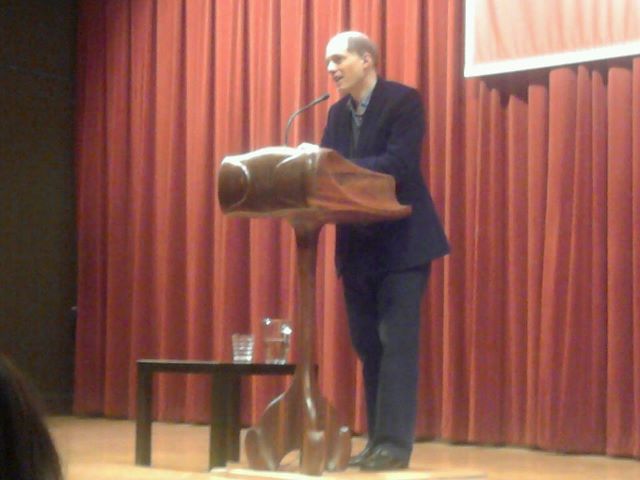
 Skepticism, Properly Applied