Some quick thoughts on liberal Christianity and polyamory


Here are some thoughts I just sent to someone I’m corresponding with via email.  The conversation originated from an argument on a polyamory email list about religion and polyamory.  I will not quote any of what anyone else said, as this email group is intended to be private, but I feel comfortable sharing my own thoughts, especially since they are relevant to this blog.

My interlocutor had asked my to clarify a position of mine concerning internal logical consistency and justification when it comes to churches and the acceptance of polyamory.

The issue I was discussing, concerning consistency, has to do with a religious group being consistent to the ideas in the sources of their beliefs.  For Christians, that is the Bible.  The reason is that without that source, they cannot have any basis for knowing (not to mention justifying) the story of Jesus.  If the Bible is not authoritative, then they cannot have any basis for believing that Jesus said anything, resurrected, or even existed in the first place.  There is little to no historical justification for the historical Jesus’ existence outside of scripture, whether canonical or not.

A church that does not accept some of the Bible must admit, in order to be logically respectable, that they must then justify why they accept some of what the scripture says but not all.  And if they say they are just reading it differently, then they need to justify how the institution that is responsible for the very existence of those books to be included in the Bible interpreted them wrongly for so long.  When a group shapes a message and their descendants say that their ancestors got it wrong, my skeptical dander goes up.

A modern church, accepting polyamory, has to justify how they do so while still accepting the Bible which, along with the tradition in which it grew, rejects such ideas and practices.

I’m not expecting a religion to justify itself to my point of view, I’m expecting it to justify itself to it’s own sources, tradition, etc.

I understand that churches promote messages that will bring people in.  It’s called pandering.  The way I see it, liberal churches orient their messages such that they can attract parishioners, so that it can keep pastors employed.  Church growing is a business, in many ways.

The other aspect of this, as I said before, is that the liberal churches have people that really believe they are being truly Christian.  They don’t like the fundamentalist conservative doctrines, but they still are emotionally attached to their relationship with God and like some of the Biblical messages.  So they ignore the rest, explain them away, or claim they are no longer relevant.  AKA cherry-picking

I, personally, respect the consistency of fundamentalists over liberal theology any day of the week (and twice on Sunday–HA!).  While I disagree with both, I at least respect the fundamentalists’ consistency.  In other words, I am more annoyed by liberal and moderate religious people than the conservatives.

I’m glad that churches are willing to accept such things as polyamory and homosexuality, despite what christian tradition and scripture says.  I just think it’s fair to point out that such churches do so despite these things, not because of them.

Being polyamorously single


It is not a position I would have anticipated being in at this point.  Boy meets girl, girl meets boy’s girlfriend, girlfriend and girl get along and become friends.  Boy dates girl, boy falls in love with girl, girlfriend breaks up with boy, boy stays with girl.  Girl gets job in Atlanta, plans on moving there, and boy decides to go with her to start a new life.  Change in location causes anxiety, frustration, fear, and girl very suddenly breaks up with boy, moves out, and cuts off contact with boy.  Boy is alone, sad, and in a new place where he knows few.  Boy is still polyamorous, but he hurts too much now to love.  Boy is polyamorously single.

Becoming single while polyamorous

It can be difficult, being single.  Several years back I decided I was going to be single.  I had ended an awful relationship with a girl named Lauren whom had ruined me financially and decided I needed time to heal.  For more than a year I did not date at all, and eventually discovered that I was capable of being alone and happy.  The happy part took a while, but it came.

Eventually I met a girl, Amanda, and began dating again.  She was moving to Denver, and we had little time together.  It was intense, and I decided to spend the summer with her in Colorado.  That lasted a week.  Perhaps it should have been then that I should have taken the lesson that moving to a new city, even if only temporarily, to be with a person that you have not known very long but care about deeply is not a good idea.  Perhaps it is a good idea in some cases, but I’m now zero-for-two.

But all of that was before I was actively polyamorous.  When the girl I was living with broke up with me last year I had another wonderful girl to hold me at night and console my great pain.  It softened it, but it still hurt.  But not this time.  This rime she was my sole love, and when she left….

For now, the project is to move on.  I know that the pain, regrets, and sleepless nights will eventually pass.  I know that I will love again, eventually.  But in the midst of such circumstances, it is hard to keep these pieces of knowledge present in thought.

But, then the obvious question; how to be polyamorous? I mean, when a single person who is ready to date and wants to be polyamorous, how do you start?  When I am ready to move on, where will I begin? As a single heterosexual poly, I will address this question from my point of view.  My experience as a gay or bisexual poly is severely limited as is my experience as a female of any kind being polyamorous.  Thus you may have to fill in some gaps for circumstances other than my own.

The Single’s scene

Meeting single women and telling them you are polyamorous, even if it is after the second or third date, may not be the wisest course of action.  Telling them after you’ve been dating for a while is probably much worse. Telling them up front does not always mean that even if they don’t run away screaming things will be alright in the long run.

Most people don’t know what polyamory is, and when they hear the word, they are more likely to hear “polygamy” or something like that. The concept does not fit with most people, quite simply.

There is, in the single and dating world, a sort of acceptance that you are going to not be strictly monogamous.  But this is not polyamory; it is a sort of game where the way to win is to find that one person with whom you decide to settle with.  Monogamy is the goal, even if it is a long-term goal.  In the mean time people are just having fun and not committing.

So when someone like myself comes along and is not looking for monogamy in the long run, it probably looks like a person with commitment issues.  And when I am with someone with whom I want to commit to a more long-term plan, I usually want a time where I focus on her alone in many cases.  Then once we are settled, established, and secure then I can explore other options.  It is sort of a reversal from the monogamous single’s scene.  And, of course, different polyamorous people go about this in different ways than I do.

As a single guy I can go out and enjoy the promiscuity of single culture as well as anyone.  But this is not very appealing to me because it is largely shallow or superficial.  I may meet someone with whom I will share commonalities, but to sift through it all is time and money consuming.  There must be another option.

Poly Communities

And there are places to meet other polyamorous people.  Polymatchmaker is one, for example.  There are local meetup groups, email discussion groups, etc.  I have been a part of a community in Philadelphia and met some people in the past.  Now that I have been in Atlanta I have met a few people, but I have not known them very long or very well.

So, how do you approach polyamorous people when you are interested in dating them? Well, first you should get to know them at least a little bit.  Meeting them might be helpful, too.  But once you have met someone who you are interested in, tell them what you are interested in. Tell them what you want.

From a monogamous point of view, flirting with or asking a woman (or man) on a date of some kind while their significant other is around would usually be a very quiet and secluded conversation done while you are hoping nobody can overhear.   It would be done in the hopes of something clandestine, and perhaps this is part of the excitement.

Flirting with someone with their partner near-by, perhaps even with their arm around them, is usually a game that monogamous people play at in jest or at most because deep down many people like the idea of the flirtation.  To me that speaks volumes about monogamous dating culture.

Polyamorous people are as different as people of any other group.   Some will want you to just come out and ask, others might prefer more subtlety.  Some will want you to be friends (and possibly lovers) with their partner, and some will never want you in the same room with them.  Some will want to be all over you that moment and others will prefer to take their time, get to know you, and eventually get to a physical relationship.  Sometimes that never happens and people have poly partners where sex (no matter how it is defined) is not a part of their relationship.

Getting what you want

As a single guy in polyamory, I have to first figure out what I want.  In fact, this is true whether you consider yourself polyamorous or not.   Upon figuring out what you want, pursue it directly while keeping in mind that it may not happen. 

One of the first things I learned while being polyamorous is learning how to say no and learning how to accept a no from someone else.  There is nothing wrong with telling the person you are attracted to that you would like to take them out, take them home, or have them on the table right there.  There is also nothing wrong with them saying no, and then possibly talking about something else or wishing them a good day and moving on.

More importantly, there is nothing wrong with what you want.  Depending on what that is, there may be something wrong with acting on it, but the desire itself is not the problem (although someone might be able to think of a few desires that may indicate something wrong with a person, such as wanting to rape or murder, but that’s not what I’m talking about).  Wanting to be single is fine, wanting to love and be loved is fine, wanting your friend’s girlfriend is fine.  In fact, wanting your friend and his girlfriend is fine.  What you do about it is where the thorniness begins.

Weighing the risks of transforming your wants to your pursuits can be dangerous ground.   Be careful to accept rejection of what you want.  The fear of rejection is strong in many, but without risk there is no gain.  In love, the risk of the vulnerability of opening oneself up can leave you hurting or broken, but the alternative is the hurting and brokenness of never having tried.   Find what you want, pursue it, and be prepared to be told no.

All in all, being single while you are polyamorous is not much different than being single and not being poly. It is about finding what you want. My advice is to not assume monogamy. In fact, perhaps you should not assume polyamory either. Pursue each desire on its own terms and be open with your partner(s) with what you want. You may get it, you may not, but your desire is only out of your reach based upon those whom you desire and your willingness to act on your desires.

Polyamory and Pagan Woo


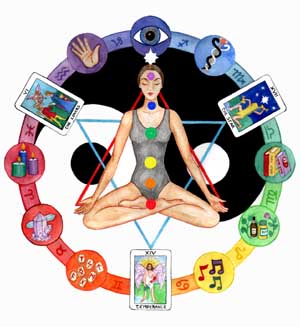
This does NOT represent me

I have been involved with polyamory groups for a few years now, both in Philadelphia and Atlanta.  I have met some pretty cool people through these groups, and have had some interesting discussions and learned a lot from people.  But one thing I have noticed in the past, and it is true here in Atlanta as well, is that there is a very significant overlap of polyamorous people and Paganism.

Now, the term Pagan is too large to try and define here, so I will not try.  But there is also a large segment of the Pagan population that is also into certain things which I, as well as many other skeptics, often refer to as Woo.

What is Woo, you ask? Woo is is chakras, vibrations, and astrology.  Woo is metaphysical silliness that uses words like ‘energy’ (but not even close to it’s physics meaning) or even worse ‘energies’.  Woo is the New Age, or as some call it, ‘newage’ (rhyming with ‘sewage’). It is a significant part of the new Paganism, while having little or nothing to do with pre-Christian Paganism.

And at the same time it has its own life outside of pagan communities.  Some of it lives within liberal Christian communities as well.  Some of it lives by itself in psychics, Tarot card readers, and in pseudo-scientific practitioners that use techniques that are proven to not be effective.  Charlatans, unconsciously or deceptively, they all are.   As far as all of the skeptical inquiry into such matters has so far shown, these beliefs are not justified.

In an age of Twilight, Oprah, and the liberal love of spirituality mixed with pseudoscience, it is sometimes difficult to be a skeptic without sometimes feeling cynical.  There are people convinced that vaccines are dangerous, an idea which endangers people.  There are people who don’t take their children to doctors, only to pray while they watch them die.  And while these ideas are dangerous on a personal and societal level, Woo is downright annoying and insipid.

When people start talking about their energies merging with someone else’s energies, with their chakras opening up, crystal power, or something about their quantum Secret, I wonder how bad our educational system is in terms of preparing people for scientific literacy.  I wonder how people can swallow such idiotic crap without even trying to question it skeptically.

One good book that I read recently concerning this subject is Quantum Gods by Victor Stenger.    In this book, Stenger talks about such things as What the Bleep do we Know?, The Secret, cosmic consciousness, charlatan-Gurus who filch millions from credulous people, and the vast misunderstanding (and possible intentional deception by people such as Deepak Chopra) of all things ‘quantum.’

Paired with a few chapters about how physics actually works, Stenger shows how such New Age beliefs simply do not hold up to scrutiny.  Real physics–science in general–is a beautiful thing that does not need to be made artificially more beautiful by adding in chakras or even prophecies (Celestine or otherwise).

Another great resource is the James Randi Educational Foundation, which offers a million dollars to anyone who can prove the reality or effectiveness of paranormal abilities.  So far, nobody has won the money, even though people like Sylvia Brown and Uri Gellar are very aware of Randi and his challenge.  The same goes for chakras, energies, and other New Age ideas; none have stood up to any serious scrutiny by the larger skeptic community.

None.

And so as I navigate the world of polyamory, more so than other areas of my life, I find myself confronted with these kinds of New Age ideas.  In other aspects of my life I find myself confronted by evangelical Christians, people whom are sometimes chastised by Pagans for their views while the Christians see them as Satanic.  Now, the Christians I understand, even if I disagree with them about most things; they were raised in an environment that derives from an ancient book that has cultural grips on them.  It is embedded in our culture and becomes part of them at a young age.

But New Age, despite its attempts to claim its ancient origins, is new.  Quite frankly, I have studied some of the old Pagan traditions and found them nothing like the new religious movements such as Wicca and other communities which I have observed.  And while they tend to be more liberal and open-minded about many social issues, they are muddle-headed about the nature of reality, perhaps more so than many of the fundamentalist Christians I meet.

And what is so frustrating is that because they view themselves as so open-minded, so tolerant, etc, they sometimes take criticism worse than Christians ever do.  I have seen Pagans become enraged at hearing tough questions about their beliefs.  Perhaps because so much of the New Age worldview encourages emotional openness, many of them are thin-skinned because their beliefs are almost never criticized, especially while they are in ear-shot.  They are not as used to the criticism as more well-known beliefs, such as Christianity, might be.

But since I am told that I should keep an open mind about such things (which I do by the way), I will end this little rant with an excellent video by qualiasoup about open-mindedness.

We should keep an open mind, but not so open that our brains fall out.