“Gnu Religion”?


I do appreciate getting comments on my blog.  But sometimes someone comments that, despite their seemingly jovial and friendly appreciation for what I have to say, gets it so horribly wrong that I cannot leave it without response.

A while back I wrote this piece about gnu atheism, and the other day I received this response.  By all means go and look at it for full context, but I quote enough of it below for you, dear reader, to get the gist.  I will not reproduce the entire comment here in the name of brevity as well as to avoid unnecessary repetition.

But I thought some of what I said in response might be worthy of posting as a blog post, and so here it is.

Well, I thank you for your thoughts, but I have to respond to some of this because I find many flaws here.

It sounds like a gnu atheist is essentially a citizen scientist.

OK, sure.  I can agree to that

It occurred to me some time ago that atheists spend a lot of time pointing out the silliness of religion but little time considering reasonable alternatives. We offer parodies of religion, but have we ever considered that it may well be possible to offer an alternative to “believers” that provides many of the features that make religion attractive to them?

There is a sort-of stock reply to a lot of what you said, especially about finding an alternative, or something to replace religion with.  It is to say that what do you replace cancer with when you get rid of it?

Religion has some good aspects to it (they are human things appropriated by religion.  No, usurped is better), but where it is unique it is poisonous and unnecessary.  Instead of replacing those things, we need to outgrow them.  We need to grow up as a species.

You said:

If we postulate that all information in the universe is conserved, then it would seem inevitable that at some point in the future our descendents or some other sentient beings in the universe would discover how to access that information….

No, information is not conserved.  Energy is conserved (it is equivalent to matter), but the information is lost.

We may be able to find technological ways to store that information and upload it.  This is, in fact, the dream of many transhumanists who look forward to a much longer life lived either in some sort of Matrix world or even in some technological bodies which won’t get sick, can be fixed easier, etc.

To me this is no different, philosophically, from looking forward to a heaven that follows this broken, sinful, world.  It says that this life is not only insufficient, but essentially worthless.  It de-values human life, and makes us overlook it in the hopes for something better.  It is precisely what is wrong with religion, not what we should save from it.

Until such technological feats are a reality, this is dreaming away our lives.  Sure, let’s research the possibilities, but please enjoy this life because it is almost certainly all that we will have.

Faith is of course necessary, but not blind faith, but rather faith based on reason and knowledge – faith in the potential of the human race to evolve and improve, faith made stronger by continued and serious skepticism, faith in the scientific method.

No.  A thousand times no.

Faith is poisonous.  It is the rotten center of all that is not rational or scientific.  Faith is the exact opposite of skepticism and science.

What you seek is reasonable expectations based upon empirical study.  Faith is the vileness of insisting that something is true in the face of all that demands that it is a lie.  It is the assertion of truth where no justification can be found.  It is believing in what has not been shown to be the case.

Ancestor worship would be one handy way to keep our descendents interested in us. Of course we might also simply provide a source of entertainment or research material. There’s plenty of potential for future judgment, which seems to be required by some people to behave themselves. Those that eventually grant us afterlife may judge some to be more deserving than others, and, yes, there’s even the potential of torment and suffering. God would be that future society, hopefully our descendents, that develop the capability of granting us our afterlife.

A millions times, no.  Worship nothing.  To worship is to place it where it cannot be reached, probed, questioned.  If anything is worthy of reverence, it is that nothing is beyond question.  Do not elevate any aspect of reality to a place beyond question, for that is where we lose ourselves to mental slavery.

Idle speculation. However I note that it’s just now approaching the time of the Solstice, and that would be an auspicious time, and convenient holiday, to mark this beginning of the Gnu great religion. ;^)>

Religion is to be outgrown; plain and simple.  I want no part of any “gnu religion.”
The mythology of harmony


Preface

There is an idea in our culture, derived in part from the Enlightenment and many of its thinkers including many of those who helped form the United States, that the universe is fundamentally rational.  The idea is that as we learn about the universe and how it works, the underlying assumption is that what we find to be true is both true in every circumstance (universalization, which is also relevant in Kant’s ethical principle) and coherent with the rest of what we find.

That is, the world is essentially connected and coherent.  The basis for trusting in scientific methodologies as sensible predictions and descriptions of the nature of reality is based upon this view, because if this consistency was not true than using any description of the universe based upon any observation would be useless, since there would be no guarantee that another observation in another place or time would yield the same result.

As a side note, it has been pointed out many times that if such things as miracles, or more generally a supernatural realm or powers, were to be real then this would make this rationality of the universe meaningless, since at any given time a power, force, or being which is supernatural could simply dispense with that rationality and intervene essentially “magically.”  It would make science useless because we could not hope to make sense out of a world that can act essentially randomly or at least without consistent actions leading to theories or laws.

But enough of the opaque philosophical preface, let’s get to what I want to talk about today.

Cooperation

Especially in the more liberal world in which i grew up, there is an ideal of cooperation and striving for practical compatibility which underlies much of our thinking.  We want to get along with not only other people, but their ideas and dreams.  We want our dreams to fit in with the dreams of our neighbors so that when we all dream together, it creates a jig-saw tapestry of diverse and intertwining beauty.

It is a wonderful and beautiful image, especially for this polyamorous man who seeks intertwining in many ways in my own life.  It appeals to even me, the often-cynic and occasional (or not-so-occasional!) grump (or Grinch, as the time of this writing might imply) who is often found to be pointing out where things don’t seem to be cohering or cooperating nicely.

But is it true? I mean, of course t can sometimes be true (right?).  I mean, at least under ideal circumstances people’s beliefs, desires, and ideals will match up quite nicely and they can get along just fine.  And many people believe that if we were to be more tolerant and accepting of others’ ideas then we could all get along nicely.

And, to a certain extent this is true.  If we were willing to accommodate more, to compromise more, and to tolerate more we could all fit our puzzle pieces together and create, well, some kind of image.

But would that image be meaningful?  Would it be even internally consistent or coherent?  Could it be a picture of reality?

Truth and fallacy

The problem is that the best way to find ways to co-exist peacefully with people of different ideals is to re-shape our own in order to fit wither theirs, so long as they are also doing the same thing.  It may imply the occasional forcing of ideological shape into close-enough spaces (which we will politely ignore), but it can work.  I’ve seen it work, among people who are wont to maintain community with diverse opinions.  I went to Quaker school, ok?

The problem is that it sacrifices truth by too easily overlooking fallacy.  Because it prioritizes the coherence of diverse ideas over the question of whether any of the ideas are rationally defensible in themselves, it cannot reliably lead to a picture of what is actually true or real.  Rather than investigate each idea rationally and skeptically, the primary motivation is to fit everything together into a quasi-meaningful whole, which ends up distorted and full of many gaps and bulges where the pieces don’t quite fit.

This is why the skeptic, the new atheist, and the “realist” get such a bad rap around such harmonizing folks.  They are working so hard to find ways to get us talking, agreeing, and peacefully co-existing that they are really not even concerned, and perhaps not fully aware of the relevance, of rational defensibility of ideas themselves.  Such quibbling and nit-picking questions of such as us skeptics is annoying? Can’t we see that they are trying to paint a pretty picture? Why must we insist that it does not look like anything real?

We must be the kind of people that tell 3-year-olds that their picture of a pony looks more like, well, a crude circle and some randomly placed lines! This is not to imply comparison between 3-year-old children and defenders of social cooperation.  Not at all….

And yet, so many people are so enamored with the cooperation of ideas, whether they be science v. religion or otherwise, that they don’t pay attention to whether the larger picture they are putting together contains pieces from more than one puzzle.  They don’t pay attention to the fact that one might be labeled “reality” and the other “fantasy.”

They are blinded, or at least distracted, by the liberal mythology of cooperation and tolerance.   They are biased by the mythological desire for social and interpersonal harmony.  And then they rationalize it as if it were we skeptics and new atheists who are seeing it wrong; they often insist that we don’t understand what the picture is supposed to look like.  They are distracted by the mythological goal, while we are asking questions about the many parts which don’t seem to fit.

The only way to be sure that the image we create will be coherent is to make sure that each piece is the right piece, from the puzzle of reality.  We must each inspect our own ideas, as much as is practically feasible, to make sure that it is the right piece.  If it does not fit with others’ pieces, then we have to inspect both of them to see where the problem may lay.

And if it turns out that the whole puzzle is not coherent, that the universe is not rational, then so be it.  But so far it appears as if the many pieces fit together pretty nicely, so long as we are vetting ourselves–as well as others–before we place them down on the picture of human achievement.

Opinion and objective reality; abortion


Abortion.

If there is any topic more charged than religion (even though it is usually so charged due to religious ideas), that is it.

So, this was posted today on my lovely girlfriend’s blog (http://martinellivarietyhour.blogspot.com/2011/12/value-of-adult-life.html) about a facebook discussion which was itself about some PA legislation which will create problems for women’s health in the state.

I’m mobile, so I want to keep this short.  Everyone is legally entitled to their opinions ad beliefs, but we are not logically or rationally entitled to them.

The reason this is the case is that there is an objective world out there (ok, there is an inter-subjective world which we share and of which we have no direct knowledge–but I risk envoking Kant here so I shall return to the question at hand).

In any case, we share access to empirical facts about the real world, and any proposition, fact, and value we have access to is subject to that world.  We have to test those things againt our empirical methodologies.  We have to test our opinions against reality.

And this is true for all subjects of consideration.  It is true of religious beliefs, moral declarations, facts about the nature of reality, etc.  The certainty we can have about a fact is relative to the amount of empirical information we have about it.

And with abortion, we have access to a lot of information.  Fetuses are not sentient.  They have not conscioussness nor conscience.  They have no souls (whatever those things are supposed to be).  They are not people.  They might become people, but they are not people. 

Adult women are people.  They are sentient, conscious, and their consciences are usually in full swing when they are contemplating such a heavy proposition as getting an abortion.  Until the thing growing in them approaches any level of sentience or awareness, she has every right to get rid of it as she would any parasite, bacteria, etc.

There is no reason—moral, rational, or religious—to be anti-choice.   

Human experience


A lot of people talk about how religion has changed their life.  They talk about some experience, or set of experiences, which have given them a new perspective on the world and subsequently changed their behaviors for the better.  They say that god, or at least some religious ritual or practice,  changed their life.

Now, I don’t doubt their experience (not usually).  Nor do I doubt it did change them, if only temporarily or periodically.  What I am skeptical of is the source of these experiences and of their subsequent life-changing perspectives.

I have known for a long time that certain things we learn, whether they take the form of a sudden insight about ourselves, others, or the world in general, forever shift our perspective.  They give us a change to the  lens through which to see the world, and we are never quite the same after that.

I think we all have these experiences from time to time.  Perhaps some people are more sensitive to these things than others, perhaps relative to their sensitivity and level of introspection, but I think that this is a common human experience.

So why are some of them, at least by some people, attributed to a religion or to a god? Why are these experiences labeled as “revelations” or “religious experiences”?

Once again it is the bias that we have towards attribution of what is good to god and what is bad (or perhaps just mundane) to us.   All glory belongs to the Lord, or someshit, and so if we have a moment of beauty, personal transformation, etc of course it is due to our religious background, especially if the commitment to that religion is new.

It is at our times of struggle, emotional intensity, etc where we both commit ourselves to god and experience personal transformations, and the correlation of these events lead people to forget that these experiences are human experiences.

I have had many experiences that, had I been religious, I would have attributed to some god or other.  I am well aware that the bias which infects others is present within me, only I was lucky enough to not have been indoctrinated into a religious worldview designed to interpret such experiences from me.

I simply don’t know what to say to someone who will insist that this or that experience was from god when it clearly has human experience written all over it.  This is the primary reason why subjective, private religious experiences are so problematic from the standpoint of evidence; we all have them, no matter of faith or lack of it.


The atheist community is about more than “does god exist?”


A few years back I was pretty close with the people over at the Rational Response Squad.  They made a little noise, became small celebrities in the early atheist community, and probably helped that community grow in ways that other less-quiet ways could not have helped.

There were revered by some, reviled by many more, and a couple of years ago or so they sort of fell off the map in the atheist community.  I know more about all of that than I really need to know, and I do not care to relate the soap-opera involved.

But in any case they never really disappeared completely.  I have been in contact with some of the members of the RRS over the last few years and have watched them change and move in different directions.  One of those old friends is now blogging about history, and I have continued to read his blog consistently because he is a dedicated and intelligent person with interesting things to say.

Then yesterday I read this:

(A)Theism: A Brief Autobiography with a Word of Caution

For those who I left behind in my journey, I have no words of comfort for you.  I suspect that you are either filled with disgust, with acceptance, or are just noncommittal.  Maybe you’re working up a response.  Of course I welcome any discussion.  But it might be important now to note that I have not even yet ventured at an answer to the question ‘does god exist?’  I have refused to answer.  I do not wish to indulge your egotism, your wish to label me, to place me in some convoluted category.  To hell with that.  If you want to judge me, do so on my positions in other more serious matters.  Do not trouble me with your bothersome rantings about the pointlessness or the value in the exultation of faith.

He says more than just that, of course (read the whole post, for full context).  But this was the paragraph that stuck out to me while I was trying to sleep last night (I was not home, so I could not get up and blog about it then).  I kept trying to figure out what this was all about.

I responded in the comments (currently under moderation) [comment has been accepted], and I would like to have some discussion with Tom about this larger issue, because I think that the atheist community has become so much more than the question about the existence of god itself.  Yes, we certainly still deal with that question, but we deal with so much more.  Readers of my blog should know that, in any case.

We deal with questions of skepticism, science and faith, religion and culture, morality, and so many other things which are not only relevant but also important to deal with.  The atheist community, as well as the larger skeptical and reason-based community, are going to be very important in the formation of our culture over the next 20 years (and beyond, probably).

We are no longer a movement surrounding the (possibly unanswerable) question of “does god exist?”  As Matt Dillahunty says, we want to know what you believe and why.  This goes for questions having to do with gods, science, relationships, and everything else.  I personally love it.

Family


Family is more than the people related to you.  Family is also what you create in your adult life.  Who is part of your family also extends beyond who you marry, especially in a legal framework where marriage is restricted (that is, against our natural rights–and I use that in reference to the founding fathers intentionally) to a man and a woman.  Our family consists of those who we want to be a part of our intimate lives, whether they be sexual partners, friends, or people with whom you share genetic information.

Polyamory is about family.  It is about choosing who is part of your life, to what degree they are part of your life, and what rights they have in terms of access, decisions, and all other legal considerations.  whether these rights will be recognized is not relevant to whether they are moral and rational.  The good [sic] Lord knows that all that is legal is what is moral and rational….

The conventions of our culture, conservative and outdated (but I repeat myself!) as they are cannot contain what family is.  We already have the concept of family extending to the people that matter to us, so why is it so hard to allow this concept to restrict us sexually and romantically? It is, to speak plainly, absurd.  Love who you love how you love them.  Do not be restricted or pushed towards obligation or expectation in the matters of love.

The mainstream is not wise, aware, or right; they are boring and atavistic even in looking forward.

Live your life as if it is the only life you have, because it is.  Gods, assumed monogamy, and accommodation to fear are all poisonous to all of us, and we can do better.  Let’s create families large and open, and let’s leave behind the nuclear family of the conservatives and fading liberals (which will soon be the conservatives).

Let’s be progressives not of substance but of perceptual looking forward to improving ourselves, our society, and our world.  Liberal not just to be liberal, but liberal because liberalism is about the striving for improvement.


When did you choose to be monogamous?


I have been asked by a number of people over the years why I am polyamorous.  It can be in the form of when I chose to be polyamorous, how long I have actively become polyamorous, how does that work given jealousy, and so forth.  But I think that such questions might be misisng the larger question.

When do people choose to be monogamous?

Have most monogamous couples had a discussion about exclusivity when they reached a certain point in their relationship? I highly doubt that many couples have had the mono/poly discussion at all, actually.  I would love to hear anecdotes to the contrary, as real statistical data is likely to be severely lacking.

Even those couples who might dabble in swinging, swapping with other couples, or even eventually became polyamorous probably never had such a conversation. Most people are ignorant, rather than intimated or uninterested in non-monogamy, especially polyamory

But in a strict sense monogamous people are choosing to live that lifestyle, even if it is an uninformed choice.  The authenticity of the choice is not overwhelming because in most cases alternative options are not realistically considered even if they are understood to be actual options. It’s hard to make an informed decision when you know almost nothing about it; even most of my friends and family know next to nothing about how polyamory works.

The fact is that monogamy is the cultural default, and is rarely realistically questioned.  This is why the polyamorous community is so small, the swinger community is often anonymous and often secretive, and even affairs are kept quiet; they are a blemish on the fantastical ideal of monogamy.

Having been monogamous in my life, I have a perspective where my choice to try and maintain a polyamorous lifestyle is informed.  And for the few monogamous people who are well aware of polyamory and have discussed the issue with their partner, their choice is authentic and informed as well as mine is, but they are rare.

The vast majority of our culture seems to be monogamous by default, rather than by authentic choice.  Until the idea gains more mainstream attention and understanding starts to spread (if this ever happens), this ignorance shall be the norm.

Two Philadelphia atheist events this weekend


For those of you in the Philadelphia area, I have a couple of events you may be interested in.  They are both affiliated with the Freethought Society, which is run by my friend Margaret Downey, and I will be attending one of both of them.

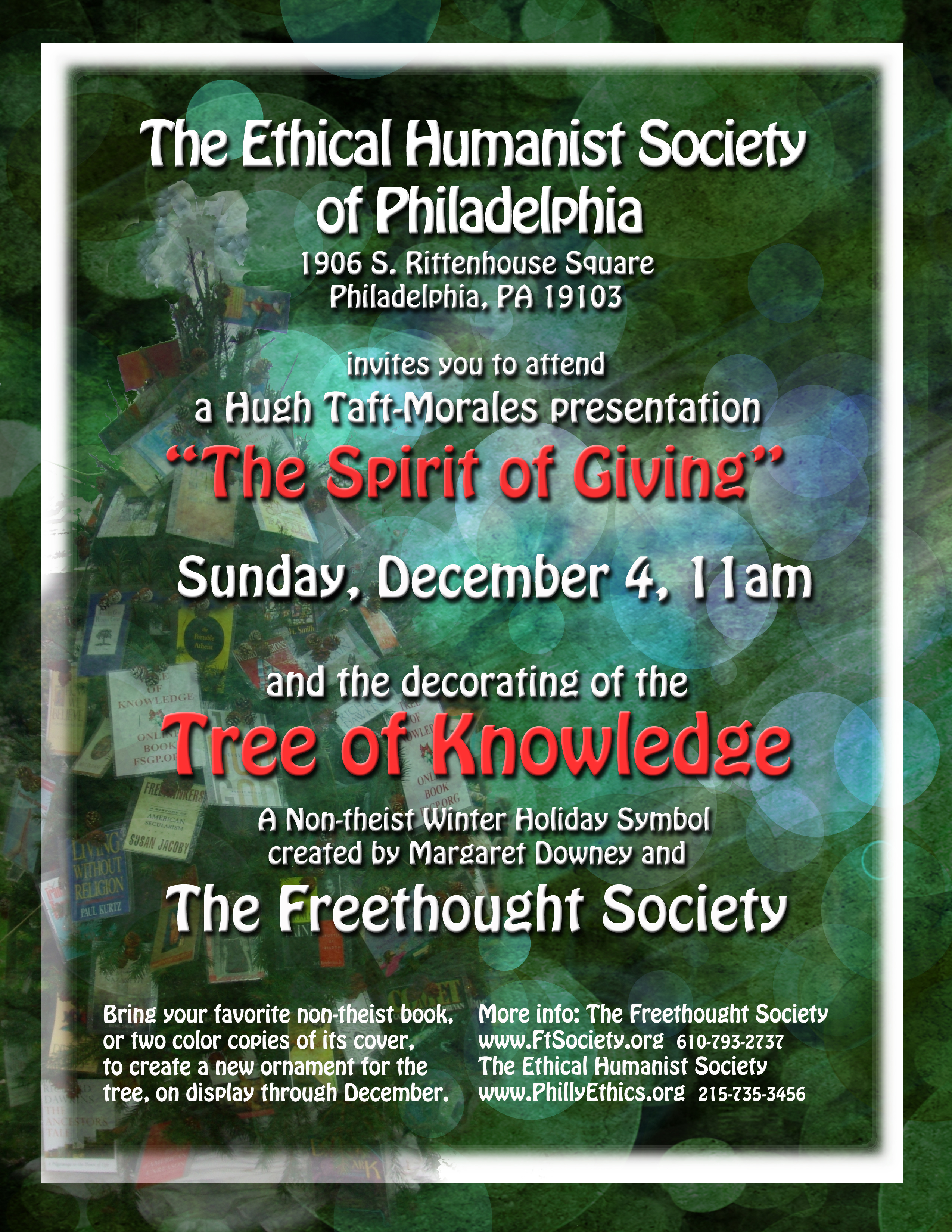
The first is the Human Tree of Knowledge in West Chester on Saturday December 3rd at 3:00 PM.  The reason it will be a human tree rather than a real one is because the presence of a real tree has been blocked by the city of West Chester, as has been covered recently over at Hemant’s place.  I was there for at least two of the real trees before this form of protest was necessary, as I have worked with Margaret Downey and the FTS for many years.

If you are interested in following news or in networking with people involved, there is also a facebook group.  I will be there on Saturday and will almost certainly do dinner afterwords.  After that I may grab a point at the Iron Hill Brewery since I love their Pig Iron Porter so much.

The second event is the following day, Sunday December 4th, and is in Philadelphia.  More specifically it is at the Ethical Society at Rittenhouse Square.  Here is an image of the flier, copies of which may appear there in the next couple of days.

I am not yet sure if I will attend this event.  I’m not big on holiday rituals, but it may be a good time to catch up with local people of reason.

If you will be in the Philadelphia and/or West Chester area this coming weekend, make a point to attend or pass along the information to others who may be interested.