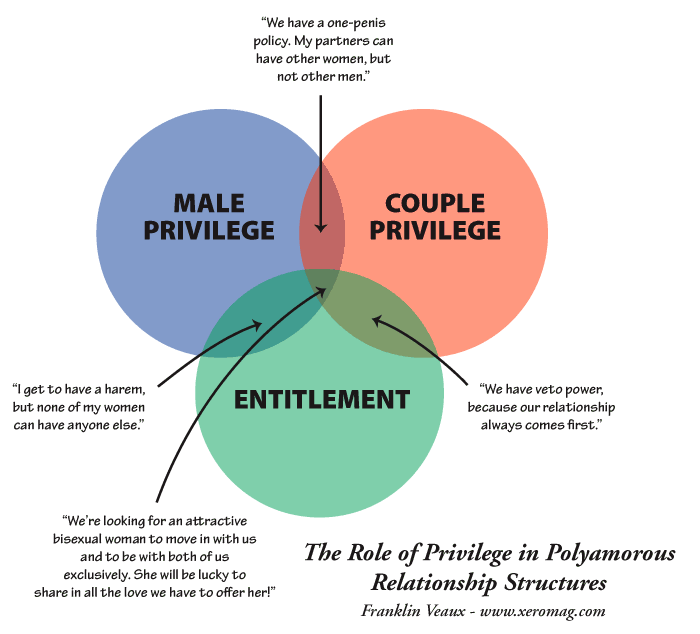
Jealousy and polyamory


No! just no....

One of the most cited reasons that people are not polyamorous, even if they are not against the idea in principle, is that they simply could not do it.  They are too jealous.

But jealousy is not a sufficient reason to not be polyamorous.  Not being polyamorous for this reason is simply a way to avoid dealing with the problem of jealousy.

Ever listen to love songs on the radio? Ever watch a sappy romantic comedy where the blunt end of the joke is the presence of competition or possessiveness? The lamenting lyrics of wanting someone’s girl, seeing someone beautiful on the train but she was with another man, or sappy words about how someone belongs to someone else is so ubiquitous that not even us polyamorous people always notice it.  But it is pretty ubiquitous.

Jealousy, whether in the form of competition, possessiveness, or destruction of property is a part of our culture.  It is, indeed, part of the mythology of love in our culture. I use the term myth here because if possessiveness or jealousy are anywhere near the core of love, something is wrong.

But it often is near the core of love in our culture.  Our culture’s use of love, expectations of relationships, and folk wisdom about how to respond to jealousy are pretty unattractive.  It is not surprising that this is the case, especially given that the Bible (which is a part of the foundation of our Western culture) seems to condone this behavior in the book of Exodus.

20:3 Thou shalt have no other gods before me.

and it gets better two verses later!

20:5 Thou shalt not bow down thyself to them, nor serve them: for I the LORD thy God am a jealous God, visiting the iniquity of the fathers upon the children unto the third and fourth generation of them that hate me;

20:6 And shewing mercy unto thousands of them that love me, and keep my commandments.

[emphasis mine]

See, god loves us, but if we were to cast a casual glance to some other god, he would smite us.  And we’d deserve it, of course! How could we be so slutty….

Jealousy as a bad thing

The problem is that people don’t see jealousy as a bad thing.  As the picture at the top of this post shows, there is an idea in our culture that jealousy is somehow an indication that the love is real, rather than imitation love or whatever.  I have been told before that if I don’t mind my girlfriend sleeping with other men, I don’t really love her.  Such people say that when I meet someone who I really love, I would not want to share her.

I suppose I don’t love either of you, Ginny and Gina.  Sorry….

Bullshit! That idea is patently absurd.  I love both of them and I don’t see how bowing to any jealous or possessive feelings I may have is someone more real than recognizing that they are both intelligent, talented, and beautiful people who anyone could love.  How is it rational to love someone (or some thing) and not expect other people to love them too?  And what right do I have to claim possession to a person just because I love them? That is the implication, right; I love them, and anyone else who does is competition.

Of course, for many of us anyway, jealousy still occurs.  Sometimes it’s mere envy, but sometimes it’s not. But what do we do about it?  Do we address the object of our jealousy or do we address the fact that jealousy is damaging to relationships and love in general? Most resources I have seen seem to emphasize that the feeling is probably unwarranted; that what we fear is not happening and we need to stop being so suspicious.  But when you share your lovers, the thing you feel jealous about is happening!  The question is whether you should feel bad about that.

Obviously, if you are agreeing to non-monogamy with your partner(s), you have no justification to be angry about it happening, even if you do feel jealous from time to time.  In such circumstances, your project should be to find ways to rid yourself of those types of reactions so that your good feelings for those people are not tainted by unpleasant experiences of feeling possessive or insecure as a result.  Eventually, you may grow to like the idea of sharing (some call this compersion.  I hate that term.  It’s still better than frubble), and jealousy may be nothing but an unpleasant memory or a curiosity for reflaction on human nature.

Monogamous people may have reasons to be angry if their partners have romantic or sexual relationships with other people (since this was not agreed upon, by definition), but the jeaousy is still something they should try and transcend.  Jealousy does not stop it from happening, and if it is not happening it causes unnecessary anxiety.  It is a sign of lack of trust, security, and can only act to drive people apart, rather than help in any way.

Therefore, there is no excuse for tolerating jealousy, even if one is monogamous.

Monogamy is not a cure for jealousy

Even if you choose a lifestyle of sexual exclusivity, your partner will probably love someone else.  They will probably find other people sexually and/or romantically attractive, they will have fantasies about those people, and ultimately they will probably want more than you are able to give.  If you decide to structure your relationship such that neither of you will pursue anything beyond friendship with others, so be it, but this will not eliminate the existence and problem of jealousy.

It will just avoid the problem by treating the symptom rather than the underlying cause.

The love you have for someone is because of who they are, and should not be dependent upon who else loves them or who else they love.  So, for someone to say that they could not be polyamorous because they are too jealous, what they seem to be saying is that they do not want to deal with the reality of human needs, desires, or the possibility that they may not be able to satisfy every need a person has.

Jealousy is not a reason not to be polyamorous; it is a reason to consider not being in a relationship with anyone.  Jealousy does not go away just because you are not sharing, it just isn’t challenged when we are not sharing.  It’s sort of like teaching children how to share toys; if you just keep them all separate and let them play with their toys separately, the problem never arises.  But when you put children together, they fight over toys.  Separating them does not alleviate the problem, it only avoids it.

Similarly, separating everyone out with monogamous pairings does not make jealousy go away, it just tries to create a dynamic where it ideally is never relevant.  It is an unrealistic expectation and is rarely possible.  So why try?

Only because it avoids the problem most of the time.  From a practical point of view, it is easier to not deal with hard problems.  But this is short-term thinking, and does not lead to us growing up to emotional adulthood.  Jealousy is one of the many aspects to human behavior which we need to address as a species, and too often it is shelved in the name of practicality.

We can do better than that.

Irate Woman Accepts Satire as Truth, Admits Idiocy. Story at 11.


Yesterday a Facebook group to which I belong posted an article claiming that Republican senators were moving to pass a bill outlawing tampons, because hindering the menstrual flow is against God’s plan for women.  I saw the article, immediately went, “Um, what?” and clicked through to the website, Free Post Press.  I had never heard of this before and had no clue that it was ultimately a satirical site like The Onion.

To my credit, I was quite suspicious of it because the article contained no sources and there was no “About Us” section on the site to give me a clue as to what these people were about.

Less to my credit, I went onto Facebook to chastise liberals for writing up “news” stories and then having no evidence to back it up.  As I said, we need all the help we can get and putting up terrible stories without sources makes us look bad and encourages the spreading of misinformation.

Yes, yes.  I know you’re laughing at me.  Go ahead and get it out of your system.

Jeez, I didn’t think it was that stupid.

OK.  CAN I TALK NOW?

Thank you.

Well, looking back at it now, it was pretty obvious that the site was humorous.  But at first glance, it came across to me like a Liberal Ranting and Raving site with a humorous edge.  Don’t worry…I admitted my idiocy as soon as someone pointed it out.  Even though I did that, several people immediately shared the article from my link as truth.  I did what damage control I could.  Ooooooops!

However, my gullibility in this regard ultimately amused me for two big reasons.  (A) The insanity described in the article seemed perfectly plausible to me. (B) The fact that a brightly colored Liberal website would jump at the chance to spread unsubstantiated claims seemed equally plausible.

Ginny pointed out that having not been raised as a hard core conservative or fundamentalist Christian, my filter for true Batshit Conservative Ideology® vs. false batshit conservative ideology (accept NO IMITATIONS!) is not refined.  From the outside, it all sounds the same.  She was raised in that type of environment and called bullshit immediately.

When I was a kid, I really trusted adults and responded well to authority.   I didn’t particularly like anyone in my own age group.  My contemporaries made me uncomfortable and I generally thought they were all full of crap…which was likely quite accurate as we were kids.  I believed what the adults around me told me.  I was young and impressionable.  Most of the adults that I encountered were unconventional people with unconventional ideas.  They always believed that there was more going on than what was being presented and taught me to question everything…everything mainstream anyway.  I suppose I was raised in a somewhat hard core liberal environment.  I took from it a few good things I think.  I learned to question everything on television, for instance.

But I also initially was raised to believe that liberals thought something shady was going on, it was and it was just as bad as you think…if not worse.

As I got older, my scientific mind began to develop.  While learning about how to do research in school, the idea of needing evidence to back up claims was hammered into my head.  And it wasn’t just “find one source somewhere that supports your claim,” but actually, “find several sources that concur”.  At the same time, I started to realize that much like my contemporaries; a lot of the adults in my life were also full of crap.  I found myself listening to them and thinking, “Where on Earth are you getting this from?” I began questioning everything, even if someone I thought was “cool and interesting” said it.

I was a kid in the 80’s and early 90’s.  This was, of course, prior to the internet being as ubiquitous as it is now.  When I was doing research assignments, I had to rely on Encyclopedia Brittanica and hard copy books at the library.  With the advent of the internet, suddenly all information was available and pretty accessible.  This, as we all know, means that really reputable sources can be easily accessed…and that whack jobs have equal access to the etherwaves to spew their theories.  For every intelligent, well researched article discussing important issues of our day, there are 10 (probably more) articles written by some idiot who has completely missed the point.

We are living in bizarre times.  Conservatives are currently very easy to hate, mock and be terrified of.  When you read about the laws they are really trying to pass and the opinions that people really have, anything absurd and Orwellian sounds possible.  There is just so much bad legislation being brought out and not dismissed by nearly a large enough margin, that the momentum of this makes it seem like we’re seconds away from living in a place we don’t recognize anymore.

But then you take a deep breath and realize that the type of government that we have does offer some hope.  There really are still a bunch of checks and balances and we are lucky enough to be able to fight for our rights and that it would be relatively difficult for us to wake up in the morning to a Fascist dictatorship…right?  Something something George Washington something something Dress Up Like Indians and Dump Tea in the River blah blah blah.

So yes, we liberally minded people have reason to be a little uneasy about the current state of affairs and I fear that the coming election is going to be ugly.  Not in the “Obama will lose” kind of way, but just in a “this is what the face and heart of our country looks like” kind of way.

But on the flipside, I see a lot of crap get posted on my Facebook page and I see a lot of people get absolutely up in arms about things that haven’t been proven.  I see countless articles that are written to terrify you, as a liberal.  The chemical, pharmaceutical, oil, what have you industry is in cahoots with the government to kill you.

And, you know, I don’t trust any of them either because there’s evidence that some of these claims are true.  I know this because I read a lot of blogs that will terrify you and every time something is claimed, there is a source with a direct quote to prove it.  There is a link to the actual wording of a bill going up for vote.   But a lot of the articles just make outrageous scary statements and then have no source to back it up.  So if you’re going to say something that is going to scare the shit out of people, BACK IT THE FUCK UP.  The purpose of writing about these things is to educate the public, right?  RIGHT?!? So if you really want to give us a reason to reject a product, give us a bunch of evidence to convince us.  Don’t be paranoid.  Don’t fear simply for fear’s sake.  KEEP THINKING.  Fear is the mind killer, after all.

So yeah, I got totally duped by a satirical article.  You can fool some of the people some of the time and all that rot.  But I think people’s reactions to it showed how crazed some of us are becoming as November 2012 approaches.  The mere suggestion that Republicans might be trying to do something truly insane sends up into a tizzy.  Sure, my tizzy was about the lack of source citations, but I believed that this could be true. 

If you pay attention and keep thinking critically about the things that are unfolding before us, worry not, for there is plenty to be angry about.  It’s not like if you read an article and take a deep breath and verify its contents that you will suddenly be serene.  But it is important to keep our wits about us because I think that’s the closest thing to kryptonite we have against all of it.  If we waste our energy freaking out about every What If and Possibly True, we’ll have nothing left to fight against the stuff that really is happening.

Care Bear Stare!


I debated if I was going to start this off with a long discussions of the important ideals the Care Bears taught us.  That would have likely turned into a discussion about My Little Pony and Rainbow Bright…and then, as I dated myself as an obvious child of the 80’s, I would wait to see how long it would take for my audience to either stop reading or barf, and really, is that what Polyskeptic is about? Room exiting barf inspirations? I don’t think that’s in the mission statement.

Instead, let’s just get to the point: I’m going to talk about apathy.  See what I did there? There’s no Apathy Bear, sillies.  Could you imagine?  Apathy Bear would be such a downer…even more of a downer than Grumpy Bear (or whatever he was called…the blue one with the rain cloud on his stomach…stylish and totes goth)…to the rest of the group.  They’d all yell “CARE BEAR STARE!” and Apathy Bear would look at them, raise an eyebrow and say, “Whatevs” and the evil whatever (Old Man Jenkins?  No…that’s Scooby Doo) would win.  Thanks a lot, Apathy Bear.

Oh lord, I’m writing about them anyway aren’t I…DAMN IT!  OK, I’ll stop.  Onto useful content!

Last night as Wes, Jessie and I were coming home from a lovely little bar in Old City, Wes and I were debating about various topics relevant to reason and religion and such and Jessie said that she thought she had gotten on the Express Train to not giving a crap.  She was raised Catholic.  Catholic turned to nondenominational Christian and then at some point she just gave the whole thing up and went right to, what she calls, Apathy-ism.  Later she would explain that she doesn’t even want to label herself as an atheist because it is still having a definitive label about you in relationship to a god and that she simply has no interest in living life from a theistic point of view, even if it is one of non-belief.  Basically, she has completely rejected religion and god in every way possible. (This is a lot of paraphrasing, so Jessie can feel free to correct me if I got anything wrong!)

When she first said it, I said that I didn’t want to be on that Express Train.  But then I realized that I had already been there and come back from it.  As I mentioned before, non-belief was a matter of course for most of my life.  It was second nature.  It was easy to continue a secular lifestyle because I was very lucky to have gone to school in the Philadelphia public school system…

Never thought you’d see anyone type that, did you?

I went to a really excellent school, but that’s beside the point.  Religion did not make any kind of appearance EVER in my daily activities.  Well, there was this one time when I was in elementary school and this very strange man came in to be a substitute teacher.  He asked us all to draw a picture of what we thought God looked like.  As a 7 year old, I felt that this was royally OUT.  I remember having a general sense of “That is not supposed to be talked about here…and besides, God doesn’t look like anything because…I don’t think there really is one…” and then I drew a picture of the solar system.  I don’t remember what other people drew, but I do remember a lot of people looking confused about the assignment.  I recall being a little upset about it, but luckily that was a rather isolated event.  Something like that would never infiltrate my elementary or highschool education again.  In highschool I had a biology teacher who was all about evolution and genetics.  We had to read The Double Helix for class.  He didn’t mention Creationism…EVER…because it was a science class.  Looking back, I wonder if there were any students whose parents were up in arms about that.  There never seemed to be any issue.  No one yearned for “the other side of the story” to be told.

My point here is that I was apathetic about religion and other people’s views because they didn’t touch my life particularly.  I think I had developed the attitude “Whatever you want to believe is fine” because I didn’t particularly think that there was anything harmful about that…because I didn’t really think anyone believed it anyway.  I was sheltered and felt safe in assuming that I was living in a secular society that only showed its religion around Christmas and Easter.  So, I was apathetic because I didn’t think there was any particular debate.

Then, after I figured out that there was a pretty big fucking debate, I became apathetic because it was just too difficult for me to engage anyone about it.  I have historically been a non-confrontational person, but not because I actually thought that everyone’s views were worthy of respect, but because I just hated having people upset with me and was scared of putting my neck out there.  The few times I participated in a discussion about religion, I ended up just conceding because clearly it was way more important to the religious person to be right.  That was generally my point of view in any argument about a hot button issue.  I didn’t feel equipped to engage.  I didn’t feel that I knew enough.  When someone would confuse me with a bad argument, I didn’t assume it was a bad argument.  I assumed that I was too stupid to be in the debate in the first place.  I mistook passion for knowledge and logic.  Conflict has often made me uncomfortable just being around it so I adopted the opinion that everyone should just shut up about it…not because it didn’t matter, but because listening to it drove me crazy.  When someone of faith was questioned in front of me, it undeniably would result in personal attacks from the theist to the atheist and proclamations that these were their beliefs and no one gets to question them.  Something something that’s what Hitler did something something else.  I would want to scream “YOU ARE WRONG” but was too cowardly to do so.  To enter the fray would be to become an enemy of sorts and I just wasn’t comfortable with that.  So I decided not to care.  “Well, I guess that’s fine…”

I struggled with apathy with a lot of things.  I didn’t want to officially proclaim which side I was on with various issues because I didn’t want to alienate people from me.  I mean, I have always been pro-choice, pro-civil rights for all, regardless of race, gender, creed (yes, creed…I might not value your creed, but I don’t think you should not be able to get married or get a job or vote or whatever else just because of it), or sexual orientation, pro-social programs to help the poor and otherwise disenfranchised, etc., but I never wanted to talk about it.  I didn’t want to fight about it…because I thought that everyone I knew basically agreed with this stuff and I didn’t think any of it was being particularly threatened.  An America where progress was moving toward attainment of all these things was the America I assumed I was in.

Then the World Trade Center was attacked and I hoped against all hope that we as a country would not be idiots about it, that we wouldn’t simply retaliate and wrap ourselves in American Flags and cry about our freedom…well, we all know how that turned out.  When I turned 22, the war started and I found myself caring quite a bit.  I didn’t want to…but I couldn’t help it.  My apathy about that eroded and I started getting in people’s faces about theirs.  I alienated some people from me, and that’s ok. 

In the last couple of years I have found that my apathy about everything else has begun to erode too…pretty drastically.  I don’t find it easy to stay quiet anymore.  I don’t respond well to blatant spreading of misinformation, fear mongering, obvious displays of privilege (when the person displaying them is completely unaware of it), and simple unapologetic (often willful) ignorance.  I fully admit that I am ignorant about a lot of things, that I don’t know very much about a vast array of topics…but I want to learn.  I want to understand.   And I will call people on things when I disagree.

This process of learning to care again has been amazing and also sometimes depressing.  My eyes are open; I am receptive to seeing more…but sometimes when you start to really see things, disappointment is quick to follow.  But in the end, I would rather care and be aware and sometimes completely and utterly irate than to spare myself that anger and be unaware of the truth in things.  The apathy that used to keep me isolated and friendly, even with people who I really didn’t need to have around (fo’ realz), was making me feel dead to the world.  Now I feel alive, if not sometimes completely crazed about the state of the world I am living in.  I’ll take it for now.

Jessie is really only apathetic about the god stuff.  She cares quite a bit about a lot of important things.  I can understand not wanting to give a shit about god after having it beaten into your head for years and years.  I certainly don’t begrudge her that.  She knows considerably more about that existence than I do (hence my continuing ignorance throughout my teens and early twenties).  My life would look very different if I ever had to monumentally reject something that definitive in my life.  Her comments last night just got me thinking about how much I do want to care…about everything…about how I think I do want to make a difference.

And what the fuck was I doing in my twenties?  Yeesh.  Well, for me, the thirties seem to be the new twenties, so let’s get living!

Ignosticism


Update: Tristan has written a follow-up entitled Type II Cognitive Errors and Ignosticism: Why Belief in God is Meaningless.  It is also well worth the read!

In the recent conversations I have been having about agnosticism, atheism, etc in the last week or so, I have left out a very potent idea.  Ignosticism.

Over at Tristan D. Vick’s Advocatus Atheist, an analysis of this idea was posted today, and after reading it I just don’t know what to say besides, well,  read it yourself!  I have to say that I’m a bit humbled in that I might be starting to re-think my view on the place of agnosticism in this issue, but I will have to think more about it.

In any case, the post defines ignosticism thusly:

Ignosticism is the theological position that every other theological position assumes too much about the concept of God.

Doesn’t sound like much, does it?  Well, follow the thread there and see what you think.  he immediately follows the above definition with this:

Ignosticism holds two interrelated views about God. They are as follows:

1) The view that a coherent definition of God must be presented before the question of the existence of god can be meaningfully discussed. [which I have been advocating in recent discussions]

2) If the definition provide is unfalsifiable, the ignostic takes the theological noncognitivist position that the question of the existence of God is meaningless.

Now, I had been on board with both of these points, but I have been insisting that despite this, uncertainty remains, and agnosticism is unavoidable.  Tristan discusses this as well, but in order to see how he surrounds this issue, I will insist that you read the rest yourself.

If this issue interests you, you will not regret doing so!

High Functioning Polyamory


Three years ago, before Wes and I were officially engaged (though we had been planning on getting married for most of the time we had been together), we went to an Outback Steakhouse and ended up having a very interesting conversation.

I always mention that we were at Outback when we had this conversation because I find it hilarious.  If these blogs start getting a lot of attention, I think we should pitch some sort of advertising campaign in collaboration with them.  Imagine it: It could be a campaign advertising that Outback is a great choice for date nights for couples of all types.  A person with a terrible Aussie accent would say, “G’Day! Are you looking to have a strange, possibly uncomfortable, possibly illuminatin’ conversation about your relationship?  Why not do it ovah a Bloomin’ Onion?  Want to have a date night with ALL your girlfriends and boyfriends? Walkabout right on ovah here to Outback Steakhouse!”  We’ll make millions.

The conversation resulted in both of us agreeing that logically and rationally, non-monogamy was a prudent choice for us.  It wasn’t that either of us had any outside relationship prospects at the time.  It was simply that we both wanted the healthiest, most rewarding relationship possible and for us this meant not wanting to impose limitations on each other’s happiness. 

I’ll fully admit that this was not easy for me when we actually started practicing a non-monogamous lifestyle.  As it turned out, I had a lot of jealous, possessive, and negative tendencies that bubbled up to the surface A LOT in the beginning (and still do from time to time, but not nearly as severely as before).  For the first year and a half of this relationship change, I did not date at all.  I spent the time working out a lot of personal issues that desperately needed to be gotten through.  There were times when I felt like I was getting an unfair end of the deal, simply because I wasn’t dating.  I wasn’t participating…but then I realized that I really was.  Every time I had a problem, I got through it because my ultimate goal was to be happy.  The non-monogamy was not the thing making me unhappy.  It was my irrationality, my insecurity, my bad habits, that were making me unhappy.  Non-monogamy does not cause problems that do not exist in monogamy.  It simply illuminates the issues that are already there.

When we first made this decision together, I had an undefined vision of a successful future.  In the beginning, the vision simply consisted of me being super well-adjusted and happy.  I figured that in several years, maybe I would be dating someone but that in the immediate future, I would just happy that Wes and I had so much freedom in general.  I hated the lousy attributes I mentioned above.  They stood squarely in the way of me being the person that I wanted to be.  In the beginning, I could only see a future in which my brain was fixed…without a lobotomy.  And I assumed that this was going to take an incredibly long time.

In October 2010, Wes met Jessie.  Jessie changed everything.  Before Jessie, we merely had an open relationship.  After Jessie, we had a polyamorous relationship.  The introduction of Jessie into our lives kickstarted a major time of change for me.  I could see pretty quickly that she and the relationship she would have with Wes was special and that it needed to be supported and embraced.  Again, this was not initially easy because of how I am wired, but it was important to get over it.  It was important to get over it not just for the sake of Wes and Jessie, but for my sake, because I really liked her.

In June 2010, Wes and I got officially engaged.  We asked Jessie to be in our wedding party and then Jessie came to the beach for the last couple of days of our honeymoon.  I remember at the wedding reception, Jessie had mentioned that Wes invited her to come down on Thursday night instead of Friday during the day.  I had been unaware of this, but it was fine.  A friend heard her say this and said something like, “It’s their HONEYMOON, Jessie,” as though her presence was somehow inappropriate.  Well, as it turned out, the nights/day Jessie were there were by far the highlights of an already excellent trip.  The whole week Wes and I kept thinking of things to do (mostly “down the Shore” boardwalk silliness) and would say, “Ooh, we should do that on Friday with Jessie”.  A few weeks after that, I realized that I really wanted her to move in with us (another something that I hadn’t envisioned being not only ok with but honestly happy about happening for many years). And so she moved in! We have a wall by the front door (as many people do, unless you’re living in one of those houses that’s just a door…which is just weird) that I like to call the Trio Wall (to myself, and I should come up with a better name than that…).  It has our three masks from Halloween, an Old Timey photo of the three of us from the Boardwalk during our honeymoon and a picture of the three of us in steampunk outfits in Santa’s village.  We have a photo with us dressed up as pirates with Santa too, but that’s not hanging up yet.   (Jessie encourages us to eat lots of candy and dress up in silly costumes.  She does not have to twist our arms).  And finally, we have an ornament of the three of us that Ginny made us.  Every morning, I get to look at that wall when I leave the house and it makes me smile.  I just can’t see my life in any other way and still be as satisfying.

**EDIT** Wes and Jessie pointed out yesterday that I left out a relatively important part of this story.  I left out the part where I had my first boyfriend outside of the relationship.  I am amused that I left that out and that perhaps it speaks volumes about how that short lived relationship panned out, but they are correct in pointing out that the relationship itself was representative of a very important turning point in my life and in our path through poly.  In March of 2011, right around my 30th birthday I noticed that I had developed on a crush on a friend of mine. 

This was huge.  When I was initially working on my emotional issues, etc., I sincerely was not attracted to anyone.  For that year and a half I had no interest in anyone as a romantic partner.  I couldn’t conceive of dealing with jealousy/possessiveness issues with both Wes and some other person too.  It would have been a nightmare.  But, when I found myself attracted to this friend I realized that I had been successful in dealing with a lot of stuff, and it took me by surprise.  We dated for about a month.  It started out well, ended sort of stupidly, but I will be forever thankful that my initial experience was relatively positive because I think that experience helped me be ready when I met Shaun and Ginny. **End Edit**

We had met Shaun and Ginny in April 2011.  They had recently moved back to Philly from Atlanta.  Ginny messaged Wes on OKCupid and she came to karaoke. A few weeks later, she brought Shaun along and he met me.  Unfortunately, I was in a considerably foul mood.  Lucky for me there are second and third chances to make good impressions.  Exactly a week after we got married, Wes and Ginny started dating and about a week after that, Shaun and I were as well.  A couple of months later, I, too was dating Ginny and, well, here we are!  It sounds complicated, but these days it feels very simple.

I was taken by surprise by how immediately comfortable I was with them both.  I was surprised further by my own capacity to love and how much love I got in return.  It wasn’t always easy in the beginning, but it appears that we are all pretty comfortable with each other and see a real future as a wonderful family.  I will say again that this was not something I expected when I signed on for this whole polyamory thing.  But after Jessie, Shaun and Ginny came around, the future I envisioned was more defined and significantly more awesome than I could have ever imagined.

The other day I was chatting with Ginny and she announced that she and Shaun had figured out where they were going on their honeymoon.  She said they’d be gone for a week and I said that I was appreciative of having the advanced notice to sufficiently prepare for being without them (BARF…I know).  Then Ginny said, “You should come at the end of the week!” She’s going to be at a conference at the end of the week and thought it would be nice if I could keep Shaun company.

At first thought I wanted to accept the invitation immediately.  Why on Earth wouldn’t I want to go hang out with them in an awesome city to which I had never been?  Then the next thought was that there were various reasons why Wes wouldn’t go (vacation time he doesn’t necessarily have yet and the fact the Ginny was going to be tied up at the conference all day every day, so she wouldn’t have much time) and I felt crappy about that.  I talked to him about it and he said, “What, you don’t think I can make it 4 days without you???” followed by, “I won’t promise that I won’t feel left out, but that’s not a reason not to do something”.  Then I got all paranoid because I heard my friend’s voice in my head, “It’s their HONEYMOON, Gina”…and I was terrified that I would be a burden or intrusive or something.  So I talked to Shaun about it and he asked, “Did you feel that way about Jessie joining you on your honeymoon?” “Um, no…”I said, “She made it better”. “Exactly…”he said.  I asked Ginny and she reiterated that she wants me there, that me being there would allow her extra time to spend with colleagues at the conference and such.

So, what am I doing after all these conversations?  Well, I’m going to accept what everyone has said and I’m going to go.  I feel lucky and thankful.  As a thank you for Wes and Jessie being awesome, and because me being in Austin will give them a rare weekend alone together, I want to make whatever fabulous date night they want happen.  As for thanking Shaun and Ginny for being awesome, I’ll have to do that when I get there.  I will likely do it with booze and terrible jokes.

A couple of days ago, Shaun posted about how much he loves polyamory and that he hopes that having us all post on here will start to show the general public how functional and happy we are, how normal this life can become.  I suppose looking at all this, you wouldn’t really describe it as normal, but it is comfortable and amazing and oh, so very worth it.  If you had told me several years ago that I could ever be this happy, this healthy, this inspired, I would have assumed you were talking about me getting that lobotomy I mentioned earlier.  I didn’t think I was capable of it.  I had resigned myself to a life of being kind of alright.  I didn’t know that on that night, at Outback, when Wes and I had the first conversation that it would truly improve my life this much.

Well, here’s to happy little surprises.

On absolute truth and those disrespectful accommodationists


I could not have looked for a better way to sum up the difference between Gnu Atheists and fundamentalist theists on the one hand, and liberal ideologues of all stripes on the other, than this quote from Alain de Botton:

Probably the most boring question you can ask about religion is whether or not the whole thing is “true.”

De Botton is an atheist, but he thinks there’s a lot of useful and interesting stuff in religion, which he goes on to discuss. All well and good, and I agree with him that there is much about religion that’s “useful, interesting, and consoling,” — in fact I myself am still looking for ways to fill some of the holes that leaving religion has left in my life (no, none of them are god-shaped.) But through all the changes I’ve been through, there’s never been a point where I wouldn’t have been deeply offended by the claim that the question of religion’s truth or falsehood is “boring.”

De Botton’s position is very familiar to me. A lot of people, both religious and non-religious, have moved into a space of being fairly indifferent to the actual nature of the universe, and instead seeing religion as purely a social institution or personal mythology. Whatever works for you… all paths lead to God… I believe this, but you don’t have to… they’re all ways of saying the same thing: it doesn’t matter what’s actually true. This is compatible with a lot of religions, as well as with atheism or agnosticism, but it is absolutely incompatible with the monotheistic Abrahamic religions (and perhaps others that I’m less well familiar with.)

In a lot of ways the “I don’t care what’s true” stance is a big improvement, particularly in its social effects. But a key tenet of people who embrace it is not offending anybody, and what they fail to see is that that statement is profoundly offensive to those who do think truth matters. It’s worse than dissent, worse than disagreement: it’s invalidation. It’s saying “I reject the entire foundational concept of your belief. I think the things that are most important to you about your religion are irrelevant.”

A few days ago the story about Mormons baptizing deceased Jews got around, and my take on it was somewhat unusual. If I truly believed that a posthumous baptism was going to gain somebody an (optional) admittance to the eternal kingdom of God, I’d probably do it too! Being the compassionate literalist I am, I’d probably devote a major portion of my life to doing it — if I truly believed. That’s the gift of eternal life, people! Am I going to refrain from giving it just because somebody gets offended? To the extent that these baptisms are being done out of a sincere belief in their efficacy, and not for one of a host of other reasons religious rituals are practiced (I know nothing about the church politics around posthumous baptisms), I can’t fault them for doing these; from their viewpoint, it’s the absolute right and loving thing to do.

I pointed this out on facebook, and somebody responded, “But the people being baptized didn’t believe in the Mormon afterlife!” Which is colossally missing the point. The Mormons doing the baptisms do believe it (I assume, giving them all possible credit.) And under that belief, it doesn’t matter whether what afterlife the other person believed in: your belief is true, and you are helping them to eternal life despite their erroneous beliefs.

The happy, harmonious, multicultural view of religion whereby it’s all just social institution and personal mythology and nobody’s beliefs have a real impact on their life, death, and afterlife is completely ineffective in dealing with people who sincerely belief in the objective truth of their religion. I know; I used to be one. People who stood in that viewpoint appeared hopelessly naive and logically impaired to me. The statement “My religion is objectively true and has real-life consequences” cannot be effectively countered with “To each their own, whatever works for you.” The literalist believer will, at best, dismiss the religious pluralist with an annoyed shrug, and go on literally believing. As long as there are people who say “My religion is objectively true,” there will and should be non-believers who say, “No, it is objectively false,” and I think — have always thought — that those non-believers are giving the believers a hell of a lot more respect than any accommodationist.

Gnosis, pt 2


In my last post, I wrote about my own ups and downs with knowledge and belief about God, and the several-years-long transitional phase where I was truly neither a theist nor an atheist. Today I want to dig into what I think was going on with that.

I’m inclined to compare my transitional phase with the apparent beliefs of a lot of non-theists who nonetheless talk about things like “the universe,” “fate,” or “karma” on a regular basis.  There’s a kind of animistic habit of mind which seems very common to human nature, which insists on attributing intention and consciousness to everything. It’s this habit of mind that remained when my explicit God-belief had vanished from my brain; it’s this habit of mind that made me say “God took away my belief in God.”

On top of that animistic habit, I had a deep and thorough understanding of an internally consistent Christian worldview. Everything that I perceived in the world could be interpreted through the lens of Christianity in a way that made sense on its own terms. Even my loss of belief could be interpreted that way. It did not require mental effort or self-deception to come up with an interpretation of the world that was consistent with Christianity: having grown up Christian, it was easy, almost second nature. That meant that it was still possible to continue believing in (a form of) Christianity with full intellectual integrity; what had changed was that it was also possible not to.

I did some studying; I read The God Delusion and some other writings; and I came to the conclusion that an atheist worldview was also internally consistent. I had hoped that there would be features of reality that couldn’t adequately be explained without a deity, but in my search I found none. I found myself looking at two complete, coherent accounts of reality, both plausible to me, both accounts that I could accept with full intellectual integrity, and entirely incompatible with each other. At that time in my life, I don’t think it’s reasonable to say that I was a theist or an atheist. I found both believable, and consequently couldn’t truly believe either.

I said before that I don’t like to use the word “know” in relation to questions of theism, because of its ambiguity. But if asked at that time in my life whether I believed in a god or not, all I could have honestly said was “I don’t know.” For a few years there, I’d say I was a true agnostic, an agnostic lacking both knowledge and belief.

Halfway through those transitional years I returned to Christianity, not because either my beliefs or my assessments of the truth had changed, but because I wanted it to be true. Not a strong reason, but it was all I had. If I’d had more unbelieving friends at that time, it probably wouldn’t have happened — I’d probably have continued in my agnostic paralysis until the unbelieving neural pathways clicked into place. (I just made that up, but it’s a terrific way of thinking about it… the whole thing was basically like a gear shift, and there was a long period there where the chain was suspended, adjusting over the gears, neither one thing nor the other.) But I was lonely, and all but one of my close friends and family were Christian, so I was looking for a way back in. I never thought that my desire for the Christian God to be real made it more likely that he was real; I just seized on desire as an acceptable stand-in for “faith,” since I didn’t have any of that. And I was backed up in that interpretation by some statements in the first few chapters of Introduction to Christianity, by Joseph Ratzinger, who did rather well in the ranks of his faith profession.

I’ll write more about my ins and outs with religion later; now I have to go rant about truth!

Bring on the Drum Circles!


Since I’ve gotten my daily quota of thinking and writing extensively about zombies out of the way, I thought I would write about something really crazy: The usefulness of protest.

When I was 15, I was in that phase that a lot of white children of Baby Boomers go through, the “Idolizing the late 60’s” phase.  You know what I’m talking about, right?  “Oh man, I wish I could have gone to Woodstock.” “Music was so much better then.  Monterey Pop?  Man!” “Protests are really awesome.  Look at what college was like back then.  Peace, man.  The will of the people!”  And so on and so forth.

One day there was some announcement that there were going to be big budget cuts for the Philadelphia public school system.  Big surprise, I know.  So someone somewhere organized a protest and students were encouraged to walk out during class to participate.  I decided to go with some friends because I figured it was time to put my non-existent money where my mouth was.  I took the “dreaded” unexcused absence because I’m a bad ass…apparently.  A bunch of students wussed out and got early dismissals so that the protest wouldn’t count against their PERMANENT RECORD.  Way to be committed, guys.

Anyway, I get there and found a bunch of people outside City Hall screaming incoherently, waving around signs that said things like “We are the future!” and “Abortion is wrong! Here is a photo of a bloody fetus!  This is totes relevant!”  Someone brought a paper mache Grim Reaper with no explanation of who was dying.  I’m assuming it was my chances at a better education or something.

Long story short, first I was extremely confused and then I was extremely disappointed.  I got the distinct impression that the organizers of the protest didn’t really have a useful plan.  They just wanted to yell and scream and not effectively tell the government where exactly they should get the extra money from.  Now, I’m not saying that it wasn’t likely true that there was money bleeding everywhere into useless crap, but the presenters at the protest did not educate anyone who attended.  I left knowing nothing more about the budget cuts than when I arrived, which was very little to begin with.  To make things worse, I’m fairly certain that they cut the budget.  It was hard to tell since we were always scraping for money anyway.  Needless to say, I came away from it with a view of protests that was pretty grim.

To me this seemed very different from something like the civil rights protests on the 60’s.  It seemed to me, from a hindsight perspective of course, that the purpose of those marches was pure visibility.  We are here.  We are strong.  We are organized.   We deserve to participate equally in society.  We are a threat because of our commitment and because of our numbers.  Perhaps it seemed useless because the vast majority of students attending were under 18.  We couldn’t vote.  We weren’t a threat to anyone.  The worst we could do was to not show up to school and I don’t know that this would hurt anyone other than ourselves.  I remember that contemporaries of mine were up at the podium “delivering speeches”.  But apparently they had not been given the memo that a speech is generally not a lot of yelling “It’s our money and we want it now!”  I was being represented by dolts who had clearly missed the point.  I think the organizers thought that if City Hall saw that students themselves were outraged that they would listen.  But they’re not going to listen if you’re acting your age and not saying anything.  In addition, perhaps the protest I attended lacked that sense of danger and sacrifice that has made other ones so much more meaningful.  Absolutely nothing was going to happen to us.  We weren’t going to get arrested (unless we turned violent, I suppose).  No one was going to come out and mow us down with water or gunfire.  We were just there being a pain in the ass for a while…but not a particularly notable pain in the ass.

So I figured I’d pack up my hippie skirts and love beads and never go to a rally or a protest again.

Recently though, especially after following the various Occupy movements, I began to think again about the role of protest and its usefulness.  I remember hearing a lot of comments about the movements pertaining to the fact that they didn’t really have a cohesive message/collective definitive goal.  I mentioned this to a friend and he said that he didn’t want them to decide on a message because when ultimate goals and uniform messages are chosen, they become divisive.  The power of the Occupy movements was the sheer number and diversity of people involved.  I saw the wisdom in what he was saying.  The general idea behind the Occupy movements was that most of the country is in the 99% and our interests should be served.  The interests of the 1% are irrelevant to the vast majority of the voting public, and yet you would not know that looking at public policy.

I started to understand.  Visibility is key.  In the beginning, you need enough organization to give people a reason to join you, but not so much that people get turned off.  When you want people to know you are here and you care that they see you, you want as many people of as many varying backgrounds as possible.  I think that perhaps the protest from way back when was a failure because there just weren’t enough voting adults there to show that these screaming kids are echoing what their parents want and what everyone should want for their population’s education.  Unification would only have been successful had it appeared that kids parents told them to walk out and were now walking along beside them.

As I mentioned before, in a few weeks, I, along with Wes, Shaun and Ginny, will be attending the first ever Reason Rally in Washington, DC.  I am really freaking excited and I think I’m excited because of this new understanding of the purpose of organizing just to be seen.  We are currently in a very strange time politically…or at least it seems rather new and peculiar to me (but that is likely because I am only now becoming really aware of things).  With Rick Santorum appearing to be a viable candidate for president, I find that I have a little seed of terror growing in my heart.  Our country is so very young and yet one of the main underlying ideals of its founding is being continually threatened.  A United States without separation of Church and State is a country that I would be unable to recognize.  And yet, it’s already happening as the open assault on women’s autonomy over their bodies is viciously attacked, as Constitutionally aware teens are being publically torn apart for wanting their public schools free from a faith they do not share, as politicians are chastised for not being Christian as if that has anything at all to do with the American government and what it was meant to be.  I look forward to this humongous gathering of atheists, humanists and secularists.  I want us to take the place by storm and point out definitively:

We are here.  We are strong.  We are organized.

And while I don’t hope for any kind of idiotic violence or ignorant displays, I do recognize that non-believers are threatening.  Not because we’re going to do anything to you but because we exist and many of exist morally, awesomely and well.  Many of us, if not most (I’m just admitting that I certainly don’t know every non-believer out there.  If the Awesome Atheist is any indication, there are definitely some of us who are Grade A Assholes…the A is for Assholes.  That’s how you know it’s real.) are normal, law abiding pleasant people.  All we want is a government that represents everyone’s interests and the only government that can do that effectively is a secular one.

Will you be joining us?  Here’s a bunch of great info to help make that possible from Blag Hag!