High political drama with stakes I actually care about


I am currently watching the most riveting television I’ve seen in weeks. State Sen. Wendy Davis of Texas is filibustering SB5, which would effectively shut down nearly all of the state’s abortion clinics and ban abortion after 20 weeks. She has been standing at her podium without food, water, or bathroom breaks for nine and a half hours, and she’s got three and a half more to go.

I wasn’t following the story closely before today, but I was vaguely aware of it. More background can be found here. The most poignant part of the story, for me, is that earlier in the week masses of Texans assembled to share their testimony against this bill, but they were denied the opportunity to speak. Sen. Davis is speaking for them. For going on ten hours. It’s a beautiful thing.

I tuned in to the live stream (viewable here  if you’re reading this before midnight CST) around 6:15 CST. I was in time to catch the hour-long point of order discussion around whether Davis violated the rules of a filibuster by accepting a back brace from another senator. After 45 minutes of discussion, it was voted that she had, and she was given her second warning. One more warning and the senators can vote to remove her from the floor. (Which they will, because the majority supports the bill.) It was a nail-biter that ended disappointingly, but at least it ate up nearly an hour of time (and the questions immediately following about whether she could be penalized for receiving questions that were non-germane took up the rest of that hour). A handful of allies stood up at every opportunity for questions, clarifications, and occasionally actual arguments.

These points of order and parliamentary inquiries are where the whole thing is really just like watching any sport match: each side endeavors to introduce formalities, raise questions, and contend technicalities. For the pro-bill side, the goal is simply to find a reason to remove Sen. Davis from the floor. For the anti-bill side, it’s a little more fun, because they have to both combat their opponents’ efforts, and take up as much time as possible doing it. Asking for clarification, repeating questions, pointing out anachronisms in a bill’s wording… it all helps, because it’s one more minute Sen. Davis doesn’t have to fill by speaking. Key players in this fight have been Senators Rodney Ellis and Judith Zaffirini, to whom I want to give ALL the hugs. (For Senator Davis herself, ALL the drinks and maybe a weekend spa retreat.)

But then there are the other parts, where Davis herself is holding the floor. And unlike the West Wing episode from which I got most of my knowledge about filibustering, she can’t just say anything. Everything she says has to be germane to the bill — straying into a discussion of Roe v. Wade was what got her her first warning. So for about an hour I just heard her talking through a bill analysis, including a lengthy discussion of fetal pain, with lots of scientific evidence to back it up. Many people on facebook and twitter made the obvious joke that that was the most science that’s ever been read in the Texas senate. She went on to talk about the hardships that this bill puts on doctors and patients alike. She’s making real arguments, good arguments. At some point earlier, she was reading the personal testimonies of many women (and perhaps men) about the hardships that would be created by the passing of this bill. She’s speaking for the people and she’s making good arguments, and at the same time there’s a sort of bitter irony, because it doesn’t matter how good her arguments are. The game is not to convince the opponent, because she knows they won’t be convinced. The game is to hold the floor, and keep talking till they can no longer do the damage they’re intending to do. If the parliamentary games are a sport match, Davis’s extended solo sessions are a mountain ascent, an epic feat of endurance where one misstep could lead to disaster.

As I’ve been writing we’re down to 2 hours and 50 minutes, and Senator Zaffirini brought up another bill that needs to be voted on before the close of the session at midnight. I don’t think I can possibly go to sleep until I know what happens. Regardless of the outcome, I am more inspired than I’ve been by a politician in — possibly years. It’s so rare that we get to see one person, doing one thing, that will have a definitive outcome. I accept the complexity of most real-life political and social problem-solving, but this human heart loves a good story of a lone hero standing up to fight for what they believe in. And I’m watching one now.

Edited to update: The end was just as good, and just as dramatic, as the rest. Seriously, if they make a movie out of this they won’t have to tweak the material far at the climax. With less than 2 hours to go, a third warning was laid against Davis for talking about a sonogram bill which opposing senators claim was not “germane.” Senators Watson, Van de Putte, West, and Whitmire fought hard for the next hour and a half, arguing that there should be a debate, arguing that previous rulings didn’t warrant the ending of a filibuster with only two warnings on germaneness and one on something else. Meanwhile the opposing senators were working to fast-track this, end any debates, and shut things down. There were so many motions, points of order, and parliamentary inquiries raised in rapid succession that I think everybody got a little confused, to the point where it wasn’t just a delaying tactic when a senator asked to clarify what, precisely, was being voted on now. (At least, I think it wasn’t; perhaps they were following better than me.)

With only half an hour to go, Sen. Kirk Watson held the floor with a lengthy protest of the recent proceedings, arguing that opposing senators were not giving proper respect to parliamentary process and the right to filibuster by shutting Davis down on the flimsiest excuses. When he paused too long, an opposing senator put forward a motion to vote (not on SB5 but on whether to take back the earlier warning that took the vote from Davis.)  The vote was taken, despite protests, and the warning stood. Remember: in this environment, every vote is bad for the Democrats.

Sen. Leticia Van de Putte, who had been away earlier in the day to attend her father’s funeral, took the final leg of this endurance race. She stood up saying she had raised a motion to adjourn before that vote had been taken, but had been ignored by the chair, who claimed he hadn’t seen her. (Shouts from the crowd of “We saw her!” rose up, and Van de Putte stated that she had been seen by many in the senate.) She then voted against her party (again, not on SB5 but on one of the motions about proceedings) in order to have the standing to call some measure into question. She was essentially ignored again. With just ten minutes to go, she stood and said, “At what point must a female senator raise her hand or her voice to be heard over the male colleagues in the room?”

And the crowd went wild. Shouting, chanting, yelling, clapping. At first I believe it was a spontaneous, passionate response to Sen. Van de Putte’s comment and the building frustration many of us watching about the silencing of women that was going on on multiple levels here. But then it became clear that noise in the gallery was, perhaps, the only way left to stop the bill. Van de Putte took the final leg, but the crowd brought it home, shouting, chanting, and cheering for ten solid minutes so that the vote couldn’t be taken. (A vote was taken, somewhere in there, but it was a procedural thing, I have no idea what.)

After midnight the shouts died down, although there was still noise. Nobody was quite sure what had happened — was that vote taken in the last few minutes the bill or something else? Then the senators gathered around the dais and voted on SB5. Whether they thought they still had time or were just hoping to get away with it is unclear. Reports on what had happened divided along party lines, with Republican senators declaring that the bill had passed and Democratic senators declaring that the vote was invalid. At that point I went to bed, fearing that this was only going to be resolved with a lawsuit.

Happily, I woke to see that after 3 am a ruling was finally given that the vote wasn’t valid and that SB5 had failed to pass. They did it.
Dear Prudence; yet another advice columnist ignorant about polyamory


Through a polyamory contact on facebook, I found this letter to “Dear Prudence,” a advice column at Slate.com, this morning:

Dear Prudence,
I’m a 27-year-old woman who recently made friends with a nice, attractive 34-year-old man. He asked me out for drinks soon thereafter and made it clear that he’s interested in a romantic relationship. He’s my type, and I like him, but after our date he explained that he’s in an open marriage. I have no doubt that it’s a mutual agreement between him and his wife. And I’m in a situation that makes the idea especially appealing: I just got out of a two-year relationship that was sexually unsatisfying (my boyfriend rarely climaxed). It left me feeling as if there’s something wrong with me. The idea of a fling with someone new, with no commitment potential and nothing to lose, seems like it could be a positive ego boost for me as I look for single, available men to date. New guy is saying: Let me be your rebound! Let’s be friends with benefits! But most of my friends think it’s a morally objectionable thing to do and doubt that I can get involved without getting my feelings hurt in the long run. What do you think?

—Want a Fling

This letter concerns an issue that more and more people are going to be thinking about as non-monogamy starts to spread throughout our culture more relevantly.  And yet a relatively well-known advice columnist drops the ball on it, as I have seen many of them do in recent years.  I think we need a newer set of advice columnists in the world.

Now, before we start let me say that not all of the advice  is terrible, but what it demonstrates is a couple of things: For one, Yoffe is obviously unfamiliar with polyamory.  She may know the word, but she certainly has not bothered to educate herself about any form of responsible non-monogamy.  Another thing is that her views on relationships are, well, old hat.  Let’s look at her response in parts, and I will respond to them in terms of what I was thinking as I read the piece.

She starts:

I wish you’d explained why you are so certain that this guy’s wife is also party to the information that they have an “open marriage.”

This is actually a fair point, but the way it’s made makes me wonder a little whether “Prudie” may addressing the problem too strongly and in the wrong way.  Yes, it is important, when approaching polyamory, an open relationship, etc, that you have some way to be relatively sure that knowledge and consent exists from other people involved with your person of interest.  But in this case I’m willing to take the letter-writer’s certainty for granted, and hoped that Prudie would answer the question as if it were true.  It seems to me that the real issue here is how “Want a Fling” could  deal with an actual open relationship and not how to spot false ones.  Perhaps I’m being over-sensitive about that.

But hen, she goes on:

I’m assuming that he didn’t text a photo of you to his wife in the middle of your date with the note, “Things are going well!” I bet if you decided to have an affair with him, it would quickly become clear your relationship is surreptitious and you would have to go along with his rules.

Why are you assuming that? Has Prudie never actually met real people with open relationships? Does she assume this is code for “I’m cheating” or “my wife/husband will not really care…so long as nobody tells her/him” in most (or all) cases?  This is a kind of poisoning the well before we can even address how to think about dealing with a potential relationship with a married, but open, person.  Rather than address the real issue here, Prudie is tipping her hand and revealing that she is probably not in favor of open relationships.

Don’t worry, it gets better worse:

It doesn’t speak well for this this man’s character (no matter what arrangement he and his wife have) that he withheld the central fact of his being married until after the seductive banter and drinks.

So, this is a great example of monogamous privilege at work.  Prudie has obvious not thought this through.  There may be reasons that this man wanted to keep his open relationship hidden at first. They may have to do with his job, his family, etc and so he only tells people to whom this information is pertinent; like someone he’d like to date, have sex with, etc.  Perhaps he just wanted to spend some time with her to find out if that’s what he really wanted before telling her.

I have been in similar situations before, and done the same thing (although now I divulge this as early as possible to people I’m into, being that I’m completely out of the closet.  Not all people have the privilege of doing so).   I believe that one should always reveal the nature of their relationship status to potential partners early, certainly before any sexual relationship develops, but not always immediately.  During or after the first date is a pretty good time to let your interest know, I think, so I disagree with Prudie here pretty strongly.

It continues:

However, I understand the appeal of a commitment-free sex romp after coming out of a sexually frustrating relationship. But before you give him the benefit of the doubt regarding his friends-with-benefits proposal, make two counterproposals of your own. One is that you two get to know each other better first. I’m guessing he won’t want to invest too much time in activities unrelated to said benefits. Another is that given his history, you need to get a current STD status on him. Again, I assume he’s not going to be interested in generating any paperwork in order to get in the sack with you.

OK, so there is a lot here, so let’s break it down.

Want a Fling has made it pretty clear that she is at least fine with the idea of no commitment fun, and yet Prudie advises a counter-proposal that would imply taking it slow and safely to scare the (probably cheating and lying, amirite?) man away.  The problem with this is that the man has said (according to the letter-writer; the only source of information we have here) that he’s interested in a romantic relationship.  But rather than pick up on this, Prudie thinks that slowing it down and asking for proof of STD cleanliness (which any responsible non-monogamous person would be fine with demonstrating) will expose the lies, rather than potentially turn Want a Fling’s interest in some fun into a situation where it might actually become a potential relationship.  You know, like polyamory.

If the man is actually in an open relationship and is actually interested in a romantic relationship, then this advice will sound fine to him.  I know if I were this man and the woman came back with that counter-proposal, I’d be fine with it.  Now, if that’s Prudie’s intent (to separate the wheat from the chaff, as it were) then fine, but why all the cynical and distrustful language in the response? Why the negativity towards this being a real thing? Why the negativity towards non-monogamy?

Let’s continue:

But even if he demonstrates he’s disease free, consider that aside from the moral questions about a married man, investing your time in one does have a cost. You think you can be looking for that real partner while you are carrying on with this guy. But, as your friends have warned, you can’t anticipate what happens to your emotions once you get involved with someone.

And this revels the problem; Prudie seems to have a view that having a relationship with a married person is immoral in general.  It does not seem to matter whether the relationship is open or not, because even if the wife agrees there is something inherently wrong about this situation.  Because if Want a Fling actually starts to like this married man (and what if he starts to really like here? I don’t know what this particular man means by “open”) then that’s bad,  right?

Well, not necessarily.  I know many polyamorous people who use the term “open” to describe their relationship status.  I don’t know if this man, or his wife, would be OK with more than just sexy fun (they should be, IMHO), so I cannot say any more about that.  But Prudie demonstrates here that she is really unfamiliar with this dynamic which many people live with all the time, and this is problematic for an advice columnist. All she can do is warn of false openness or the fact that she might start to like him.  The horror.

But, to cap it all off:

If this affair gets hot and heavy, it will likely make the available men seem lukewarm and lightweight in comparison. Keep at the forefront of your mind that your goal is to find your own life partner, not borrow someone else’s.

Holy fucking shit she did not just say that! I mean, she did, but holy fuckballs how is this person an advice columnist? Should such people have some actual perspective on things before they are allowed to get paid for this shit?

Anyway, this is terrible.  One, this man is available.  He’s in an open relationship.  His wife does not own him.  He does not belong to her.  Want a Fling is not borrowing property the way she would go to a neighbor to borrow their weed-wacker or someshit.  She is considering having a relationship with another person, who also happens to have a relationship with other people.  Just like we all do (but with sex, which is apparently the way we own people).

And how would this relationship becoming hot and heavy effect other potential partners? The man is obviously non-monogamous, so Want a Fling could be so as well, if she wanted.  She could have a few lovers to help her gain some confidence in her sexuality again, if she wanted.  Perhaps she could even have relationships with, and care about, all of them.

And who said anything about Want a Fling’s goals? Why should her goal be to find a life partner? Perhaps she doesn’t want that at all.  Perhaps she just wants to have flings with men who are in open relationships.  Perhaps she does not know exactly what she wants, but she just wants to try some thing out to learn more (something that, perhaps, Emily Yoffe could have done more of).

Bottom line: Some people should not be giving advice.  I don’t know much about Emily Yoffe, but I think she needs to gain some more life experience and perspective about relationships before she starts giving more advice.  We need more poly-friendly advice-givers.

Hey Slate, hire me.


The Privilege of Passion


I was out watching the Chicago Blackhawks win game 4 (in overtime) of the Stanley Cup Playoffs, at a local bar I like (because they have a great selection of beer), when I saw that I still had about half a beer to drink once the game was over.  I had brought with me (because I’m totes a nerd, even while drinking beer at a bar with a hockey shirt on) a copy of Nietzsche’s The Gay Science which I started reading again recently.  It’s great because it’s a collection of loosely related aphorisms, so it’s perfect for reading when you don’t have a lot of time, and because it’s just an awesome book.

After reading a section about Nicholas Chamfort (which reminds me that I should read some of his work in the future), I got to section 96, which reads as follows:

Two Speakers.– Of these two speakers, one can show the full rationality of his cause only when he abandons himself to passion: this alone pumps enough blood and heat into his brain to force his high spirituality to reveal itself.  The other one may try the same now and then–to present his cause sonorously, vehemently, and to sweep his audience off their feet with the help of passion–but usually with little success.  Soon he speaks obscurely and confusedly; he exaggerates; he omits things; and he arouses mistrust about the rationality of his cause.  Actually he himself comes to feel mistrust, and that explains sudden leaps into the coldest and most repugnant tones that lead his audience to doubt whether his passion was genuine.  In his case, passion always inundates the spirit, perhaps because it is stronger than in the first speaker.  But he is at the height of his powers when he resists the flood of his emotions and virtually derides it; only then does his spirit emerge fully from its hiding place–a logical, mocking, playful, and yet awesome spirit.

This spoke to me in a powerful way.

I have read this particular book a few times already.  But the last time I read it was a few years ago.  Books like this one reveal how we grow, sort of like how when you read Catcher in the Rye every few years to see how you react to the protagonist.  This little paperback is marked up, annotated (I have a system), and is now starting to fall apart a little.  Yet this section was not marked much.  It had slipped past me the first few times I read it, but not this time.  I have sections so inked up, noted, etc that you can barely read the text, but this one was hardly marked at all.  But today when I read it is jumped out at me.

I have been thinking a lot recently about the relationship between argumentation and emotion.  For many years, my writing, perspective, etc was tied up in powerful and partially irrational emotions.  A few years ago, after a pretty awful part of my life, I was told by a therapist that I should read about Borderline Personality Disorder.  Upon doing research, I discovered that there was a name for the particular brain crap that I had been battling for as long as I can remember.  And reading this section of Nietzsche, it makes me wonder it, perhaps, Nietzsche understood something about what it’s like to be me.  I generally think that Nietzsche had insights into humanity that the vast majority of people do not (and perhaps cannot); the fact that I read this book a few times and missed this one makes me wonder what other aphorisms he wrote, which have so far left me cold, have to offer.

There is a part of me that wants to reach out more, emotionally, to people.  But the fact is that when I allow my emotions to lead, more likely than not I will speak poorly, get caught up in anxieties, or simply lose my place in the conversation.  Arguments, especially in person, make me lose my rationality to some degree because I become enveloped in a shroud of emotions; fear, uncertainty, sadness, etc.  I enjoy conversations, but I have come to accept that there are certain types of tones of voice, body language, etc which trigger feelings that I cannot control.  I can guide them, but I cannot harness them.*

I have this ideal view of me becoming a person who iss patient, kind, and attentive person in discussion.  I listen, understand, and respond without emotion clouding my judgment, or without becoming paralyzed by uncertainty.  I desire to be able to listen dispassionately and allow my intellect to efficiently solve the problem, or at least to understand it.  The problem is that I cannot maintain that calm in actual conversation most of the time.  I may appear calm and collected (and you likely have NO idea how much effort it requires just to maintain that appearance), but the fact is that I’m not.  I’m filled with potential outbursts which are inappropriate, destructive, and (for me as well) terrifying.

So, when I read the section quoted above, I felt like I had at least one person who understood.  There is a strength in me, an intelligence and a perspective  capable of awesomeness, that is hard for me to maintain.  But it is there.  Those emotions which rise up when I become anxious are indeed tempting; it’s much easier to allow those emotions to control my behavior than to remain rational and calm, but I cannot simply remain calm.  I cannot allow my passion to step forward because it’s too much for me (or most others) to handle.  That, and what it causes me to say and do have little to do with what my intellect would say.

Others, who have passion but are not overwhelmed by it, can allow the full force of that passion to flow freely.  It comes across as authentic and meaningful, because they don’t have to restrain it.  That is their privilege.  In my case, since I cannot simply let my passions to freely compel my words and actions, the act of restraining it makes it appear forced–ironically because I am not forcing it out, but forcing some of it in.

So, I cannot allow my passion to flow freely, most of the time.**  There is too much of it, most of the time.  So I will continue to practice resisting the flood, perhaps even to deride it.

But no, I shall not speak ill of emotions and passion.  They are both beautiful and powerful, and wonderful tools for those who can wield them well.  But for me they are often too dangerous and destructive to myself and those near to me, and so I will keep striving to develop the ability to speak with passion put aside, knowing that even in doing this it is passion which is the cause of my speaking, ultimately.  The idea, I think, is to allow passion to fuel my words, not to compose them.

[BTW, I was very tempted to title this piece The Passion of the Anti-Christ, but was not sure how many people would appreciate that reference, even though I’ve already mentions Nietzsche here.]

*If you are thinking, right now, that this is something that I can learn to do, then you are in a place of neuro-typical privilege.   This is one of the key parts of my disorder, and the danger is that I think I can control it, but I cannot.  The best I can do to explain is taht the very process of attempting to control the overwhelming emotion simply feeds it, and before I know it it has taken over.

**There are times when I can.  Those times are sometimes late at night, either by myself (struggling to remain sane, rational, and calm while battling some fear or another) or with Ginny or Gina who try to do anything to help me not hurt so much.

Why I can’t be a conservative


I was sitting at my desk the other day and was thinking about what conservatism means.  Ginny was at her desk, next to mine, so I bothered her by asking what she thought conservatism was, fundamentally.  I don’t remember her wording, but it seemed to agree with how I was thinking about it; an attempt to conserve the current social, political, and cultural norms.  The implication is that those who are conservative generally believe that the world, as it is, is fine.  The world is fundamentally right, and as old Pangloss said, “all is for the best in the best of all possible worlds.”

Yep!
Yep!

Now, I don’t think that the primary motivation, especially consciously, of conservatives is the mere preservation of their current cultural values (or what they think of as the best values of some past golden era, perhaps).  I don’t think that conservatives generally think about it in these terms. But in many cases, especially in relation to social justice issues, conservatives seem to side with preserving a status quo, at least in the sense that they maintain traditional definitions concerning mores, values, etc.

So, the question arose for me, in context of this question, as to whether there could be a possible world where I could be comfortable calling myself a conservative.  What I mean is that given the fundamentally broken nature of our current culture, society, and political atmosphere, I cannot be a conservative now (why would I want to conserve this?), is it potentially feasible that a future world might exist that has a culture I’d want to conserve?

But this question gets complicated really quick, which is related to two different questions:

1) Is my personality naturally contrarian?  That is, is my fundamental personality architecture such that no matter what culture I live in, I will be critical of something? If I was raised in what I would call an ideal culture, would I still feel so radical? I don’t know.  I would like to believe that I would follow the evidence, that I would only be critical where criticism is deserved.  That is my goal now, and I hope taht I’m at least close to being good about that.

But perhaps the more interesting question (especially to all of the people who are not me), is this one:

2) Is the value of freedom of criticism, of challenging the culture in which one lives, more important than conserving an ideal culture? That is, if humanity were to achieve some ideal culture, where no unnecessary (logically, that is) inequality exists and no social justice activism is necessary, then would it be more important to maintain that culture, or would it be more important to maintain the right to criticize, challenge, and question?

Because if the world is right as it is, then any challenge is simply a means to make the world not right.  And this, I believe, is how many conservative-minded people must see liberals or radicals; as acting to destroy something that isn’t broken.

This issue is related, at least in part, to The Crommunist’s recent series of posts about the culture wars, using the idea of the dueling myth hypothesis, which I summarized here.  The fundamental question is whether the world is fair or not, and the implications of those views.  I do not think the world is fair, and I think that this is because of the social constructs, derived from faulty individual cognitive and behavioral biases, which we live within.  In other words, I’m almost never a fan of traditionalism, because our history carries so many terrible traditions based on very oppressive ideas (hetero-normativity, patriarchal power structures, monogamy, etc).

I’m concerned with things such as gender equality (for an example which has been all the rage recently) because there are cultural constructs surrounding concepts of gender which are poorly conceived, and which we could make better with education and perspective.  There is a potential culture which would be much less unjust, concerning gender, than we have now and so I care to help implement those changes.

But if someone genuinely believed that the way that the majority our culture views gender (as being more or less digital; male and female and no room for gender-bending let alone actual transitioning), and that this is the right way to think about gender, then trying to change that would be an attempt to destroy a good thing–a correct thing.  From this point of view, conserving the traditional gender roles, including the many personality attributes associated with those gender roles, is defending what is “normal” or right.  And from the point of view of such a person, there is no significant philosophical difference between the rightness of those gender roles now and my hypothetical future world where an ideal social world exists that I might decide to defend.

This, I believe, exposes the fundamental flaw of what I call conservatism, and what Ian Cromwell was calling “the fairness myth.”  And yes, I know that Ian’s concept of the fairness myth does not always correspond with conservative politics (in The USA or elsewhere), but in the sense I’m using “conservative” here it overlaps quite well.  The problem is not that one is defending an idea they think is right, but in defending an idea that is entrenched in culture in such a way that they may be blind to how it is harmful.  Those who defend traditional gender roles don’t think they are causing harm (at least I hope not), because those roles seem natural, normal, and right to them.  That is the nature of mainstream ideas; they seem right to mainstream people (and often to non-mainstream people, which is another problem related to staying in closets and feeling guilty).

As you may have guessed, I think that the value of criticism, skepticism, and the ability to be contrarian (even if not for its own sake) is superior to the value of maintaining traditional ideas, even if those ideas happen to be defensible.  Thus, I do not think that the fairness myth, at least in the world I see, is a defensible myth.  I don’t think conservatism is good per se, even if it might be right on a case-by-case basis.  I cannot be a conservative in this world now, and for the sake of the possibility of my being wrong about what I might potentially try and conserve, I cannot be a conservative in any potential worlds where social justice “wins”.

I think there will always be room for critics, guardians of honesty and the pursuit of truth, and all others who seek to maintain the pursuit of ideals, rather than the defense of them.  True ideals don’t need defense, as the truth does indeed point to itself.  Thus I think that liberalism, radicalism (at least when things are very bad), and skepticism are the superior values in any culture, and thus I can never be a conservative.

Here’s a related article I wrote 2 years ago.  The Tea Party doesn’t want America to change:  I do

Women can be creepy and invasive too!


This is the kind of story Gina tells best, but I’ll do what I can.

After Gina and Wes got back from the color run a little before noon, we all went out to a local diner. This is a common Saturday activity for the Fenzorselli side of the household, but Shaun and I usually don’t go for whatever reason — usually some combination of being still in bed, being out of money, or having other plans. Today, however, we went, and I was greatly looking forward to indulging in some delicious breakfast starches of the kind I eat only sparingly under our new diet. (Have we talked about the new diet here yet? I’m sure it’ll come up at some point.)

While looking at the menu and deciding whether I was going to have hash browns, French toast, or Belgian waffles (I know, I know, a lot of you are “and” people and will suggest all three, but my stomach really isn’t big enough for that), I was dimly aware that there was a cluster of people standing sort of behind me and to my left. I was sitting right next to a waiter station, so presumably they were all waiters who had something to do there. Now, when I say, “dimly aware,” what I mean is this: I had no idea who the people were, I couldn’t tell you now if they had walked past us to get to the station or come up from behind, and if nothing had happened then their presence would probably never have fully registered on my consciousness, and I would be honestly oblivious if someone (probably Shaun) made reference to “those three waiters that were standing behind you and talking before we ordered.”

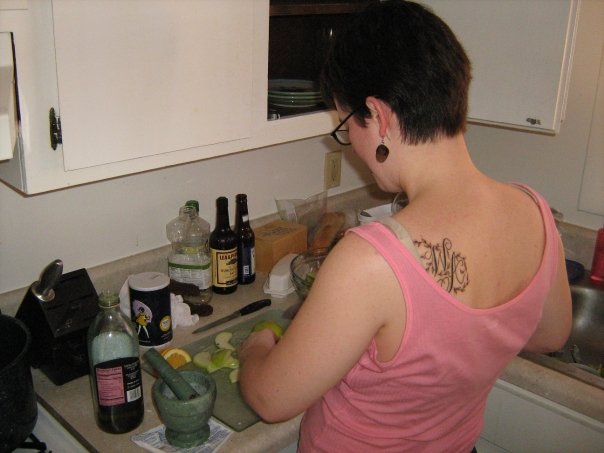
They were brought to my active attention when I heard a woman’s voice directly over my left ear say, “Can I look at your tattoo?” I made some sort of uninvolved affirmative answer like “Sure,” or “Uh huh,” and then immediately cringed because I realized I was about to have that conversation again. The one where someone says, “Oh, that’s so pretty! What do W and A stand for?” and then I have to figure out how to say, “The names we gave to the twins my mom miscarried when I was six” in a way that doesn’t create that record-scratch Unexpected Sad Story moment.

Me cooking with my shoulder tattoo showing: a large capital W and A surrounded by decorative vines.

(I imagine people who have lost someone close to them and find it coming up in response to casual social questions know this dynamic well, although it’s much easier for me since I’m not really sad about the twins anymore.) It’s my fault for only getting tattoos with emotionally heavy significance (the others are even worse!), but I do try to avoid or forestall that conversation in most situations if I possibly can. However, my mind drifts much too slowly from Dimly Aware to Actively Aware and Engaged with the Situation, and by the time it was there, I’d already said “sure.” Fortunately, what actually happened was much less expected and more hilarious.

Mind you, I still haven’t turned around, so I have no idea who the woman is who’s asked me to look at my tattoo, except I think maybe she’s a waitress? The next thing I know she’s pulling the strap of my wide-strapped tank top to the side, then lifting it away from my shoulder so she can peer underneath. I sort of freeze at that point, thinking, “Whoa, this lady is manhandling my shoulder and my clothing in a way I was not prepared for and am not really happy about.” My typical response to Unexpected Weirdness is freeze and detach, so I just went slightly rigid in the shoulders and kept staring at the menu like nothing was happening. Then one of the other people in the cluster, a man, said, “Dude, she didn’t say you could look down her shirt.” And she responded, “It’s just the shoulder, it’s not like I’m looking down the front of her shirt,” and then she added, “I just really like tattoos,” and maybe he said something else, I’m not sure, because I was just sitting there staring fixedly at the menu and thinking, “Why is this person touching me what is going on i don’t even know.” But something the guy said, or maybe just the way I was sitting there rigidly instead of turning around to engage in friendly conversation made the woman realize she was maybe being a tad inappropriate, so she let go of my clothes and patted me soothingly on the arm and said some half-apologetic patter. To which I didn’t really respond because I was still in my “I am so weirded out right now and your soothing pat is STILL YOU TOUCHING ME” frozen zone. And I think by this point she got that I was really uncomfortable, so she broke out the magic words to make it all better: “It’s okay honey, I didn’t mean anything by it, I mean, I like men, ha ha.”

And that was the moment that twisted my reaction from weird and awkward to GODDAMN HILARIOUS. She moved away and I turned to the rest of the table and made a giant :-O face, and they all cracked up. And then I had to recount it a few minutes later for Shaun, who hadn’t really been paying attention, and we all cracked up again. And then it was super-awkward every time that waitress walked by us, (which of course happened quite often) because I didn’t want to give her a friendly smile or anything that would make her think what she did was anything but Way Inappropriate, but I also didn’t want her to think I thought she was the scum of the earth. Or worse, that I thought she was a LESBIAN making LESBIAN ADVANCES. If I was the kind of person who addressed near-strangers with frankness and a desire to improve the world, I’d have stopped her at some point and said, “Listen, lady, I wasn’t weirded out because I thought you were hitting on me. I date women. I was weirded out because you were tugging my clothes around and peering underneath them, and even in such an innocuous area as the shoulder that’s not really okay to do to someone you don’t know. Keep that in mind for future reference, and also keep in mind that just because someone has a tattoo doesn’t mean it’s okay to touch them or put your face right up close to their body unless they invite you to. And also don’t touch pregnant women’s bellies unless they invite you to, because I’m 90% sure you probably do that too. In fact, in general don’t go around touching strangers and very casual acquaintances without their consent. Some of us really don’t like that, but we’re conditioned by social norms not to say anything about it and just to let it happen. And by the way, have you heard of rape culture?”

Okay, I probably would have ended my PSA somewhere before “rape culture.” But of course I didn’t give her any kind of PSA, because when someone is invasive and makes me uncomfortable the last thing I want to do is prolong my interaction with them by carefully explaining why what they did was wrong. I’m pretty sure it was an awkward experience for her too, so hopefully she’ll avoid manhandling inked appendages in the future, even if the story she tells herself is, “Some people are so uptight about their personal space, I just like tattoos!”

I’m just glad she didn’t glimpse the tattoo on my thigh.

A Captive Performer


Scene: I am in a car with a guy to whom I have not yet out myself.  I was discussing my recent wage debacle with him and he suggested that I simply quit since I don’t have any kids and Wes makes good money.

There were a lot of things sort of silly about this suggestion, mainly because of the massive assumptions that he was making about what I spend my money on.  In his (and many people’s worlds, I think) kids are the only reason not to be reckless. Otherwise, screw it.  Throw caution to the wind and backpack in Europe for a year surviving on baguettes and river water, just like you’ve always wanted.  One year I had the opportunity to work in Germany as an ink chemist for a very, very low wage.  When I was considering how I would do this and not be miserable, I thought I would just go be a street musician, specializing in singing Vietnam War era anti-war/government songs, since this was just around the time of Shock and Awe.

But instead, I chose to take a job at the time that would pay me in a week what the job in Germany would pay me in a month, and would set me up better for the career I currently have.  Yes, I am an odd bird in many ways, but I am also pretty practical in things like this.

So this guy tells me that I should just quit since I have nothing to stop me.  I took this opportunity to tell him that Wes and I have a mortgage, two cars to pay off, credit card debt, student loan debt, bills…and, well, I am polyamorous and live with 3 additional people.

The guy’s reaction was large, boisterous and embarrassing.

“WHAAAAAAAT?!? And what, you’re all having sex together or something??? WHAT ARE YOU DOOOOING?!? JESUS!”

I have been told a few times to be patient with people because my life style is weird and it takes people some getting used to.  I get that and I try to be patient, but honestly, I’m relatively over that now.  I can take people thinking it’s odd and having questions, but I do not have to put up with shaming behavior.  This initial reaction and things he subsequently said made me feel shame, like a slut (in the bad way), and stupid.

Of course, these feelings didn’t last long, since I know better.  I told him that his reaction wasn’t helpful and he told me that it was controlling to say that he shouldn’t react a certain way.  I laughed at him and said simply that his reaction makes me not want to talk to him about it because I didn’t feel respected. He said,

“What, do you want me to say ‘Oh Gina, that’s so beautiful!’ Fuck that, I’m not going to say that.”

“No,” I said, “But if you want to ask me extremely personal questions, you could be less of an asshole about it.”

We continued to talk and he told me sordid tales of his past, where he had affairs all the time in NYC while his ex-wife was home and unaware.  People like to tell me these stories of infidelity when I come out as poly.  I’m never sure why since all I have to say about it is, “Yep, that’s unethical and not what I’m doing.”  He told me story after story and my response to each was, “Well, yeah, that should have destroyed your marriage because you were lying and not respecting your relationship.”  He agreed and then said something about how he wants one person to be his and only his, but knows that he also wants other people.  I looked at him and said something to the effect of “Cool story, bro”.

When I come out to people about my relationship style, I’m actually not doing it to judge or convert you.  A common topic of discussion in the family is how I personally don’t thrive on being an ambassador of polyamory.  I’m generally approachable, I realize, but if I’m at a meetup or something, I will answer questions about my personal life and how I deal with it, but I don’t get off on it.  Wes and Jessie have told me that I should just send people to them, which I will definitely do when I can.  Generally though, I don’t really care about what relationship style you have or think you are somehow a jackass for being monogamous UNLESS you try to shame me or claim superiority over me for (a) having ovaries enough to be honest about the way I live and (b) for being capable of happiness and joy in a non-traditional (and fucking awesome) life.  I say this really for the sake of people who might try to shame me or act better than me because while I am not in the business of converting, I can certainly point out to these people the flaws in their assumptions…and can do it somewhat relentlessly if I am so inclined.

In March, the family went to Atlanta for Atlanta Poly Weekend and it was absolutely wonderful.  It was wonderful for many reasons, but one of the biggest reasons was that it was a whole bunch of poly people talking about navigating life and, while poly was an underlying theme…it wasn’t really about that.  Everyone’s life was pretty standard and “normal”, with the exception of the structure of their relationships.  All of the panels I went to discussed things that would be important regardless of one or four partners.  Relationship skills extend beyond our romantic partnerships out into our friendships, our extended families, and our lives at work.  What I’m saying is, it’s really not weird to not only be OK with this but to prefer it.  It is not strange for it to work. I accept that it is not the traditional thing and I accept that because it is nontraditional, I might get reactions that I don’t like…but I don’t have to respect and coddle those reactions.

I agreed to talk to the guy when he wanted to ask more questions, but I felt slimy and uncomfortable the whole time.  Something about the way he was made me feel like more of a specimen than I usually do…more like an exhibit at the Museum of Relationship Oddities and also Slut Bags or something.  But I answered the questions because he asked and I don’t generally refuse to reveal these things about myself.  This gross feeling lingered and I thought about how someone else could have asked those questions from a place of respect and I wouldn’t have felt gross at all.  See, my relationships are my life…they are the most important thing to me.  The fact that some people reduce them to nothing but sex is hurtful and offensive to me.  These are my people.  These are my life partners.  And no, I am not sleeping with all of them.  Weird that more than a spouse can be deeply important to a person.

FYI.

What I learned from that was that I don’t need to talk to everyone about myself just because they have ears and just because they ask.  I understand wanting some things private a little better now.  I still don’t care for the most part, but I think I will assess how safe I feel with someone before giving them the ammunition to hurt me.

When he dropped me off at my house after a long day, I jumped out of the car and walked proudly up the driveway into the house where my family was and, as it has been many times before, my home felt like the sweetest home in the world.

On privacy, and indifference to a cause


I know as much about the current NSA/social media scandals as one can glean solely from reading people’s twitter updates and headlines of articles they post on Facebook… which is to say, very little. I know that people are mad at Google and Facebook for handing information over to the government, and people are buzzing about how intrusive and spyey the NSA is, and I’m not even 100% sure whether these are the same thing incident or two different (but similar) ones. What I know is, there’s a lot of talk about privacy and how much access government agencies should have to our personal lives. The reason I don’t know more is chiefly because I don’t care that much.

Often when someone says “I don’t care about that issue” it comes with an implied “and I think it’s silly that other people do.” This is not that kind of “I don’t care.” I’m glad people are paying attention to privacy issues, because I suspect it’s more important than my personal intuitions would have me believe. So this post is partly an invitation for people who are concerned about privacy issues to educate me, if anyone feels so moved. For the rest of this, I’m going to lay out why I’m not really bothered by the idea that the NSA or CIA or whatever could see all of my internet browsing activity, or, hell, have a camera in my house.

A large part of it is privilege. As a white American-born woman, I am probably in the least vulnerable demographic for coming under unwarranted suspicion about… nearly anything. (Being suspected of troublemaking and rulebreaking is one area where males in our society have it worse than females, starting all the way back in preschool.) Apart from a speeding ticket or two (and assuming I don’t get raped), I can basically assume that the law will be kind to me. I recognize that’s not an assumption that most people can make. Furthermore, I don’t have any secrets, at least not of the kind that would be of any interest to a government. I’m not a political radical, I don’t generally partake of illegal substances, and all of my scandalous activities and beliefs are out on the internet for anyone to see. (Speaking of which, I and the rest of the Polyskeptic compound are putting on our second burlesque show! You should come see it if you’re in or near Philly.) I can’t imagine what the government could find out about me through monitoring my internet usage that they couldn’t find out just by reading my blog. (And yes, I recognize that being able to be public about burlesque and polyamory and atheism and being a sexologist is also a mark of privilege.)

My feeling of invulnerability could change when I have a child. Although it’s not common, there are poly families who have children taken away from them because of their lifestyle, even if there is no abuse or neglect going on. That’s something that will always be a niggling worry in my mind, once there are children about. But it’s still not going to raise a personal privacy concern, because I’ll still be open and public about my lifestyle. That’s a choice I made, based on principle and facilitated by privilege, and so I have very little to fear from a search of my private activity online. If the US is ever taken over by fascists (and no, it hasn’t happened yet, whatever you might say) who persecute atheism or non-monogamy, my family will be in deep trouble. I’m okay with that.

But my relative indifference about privacy has another root, weirder and more personal. Never, since I was a child, have I been able to really believe in privacy for myself. Maybe because I grew up believing in a God who was always watching, but I’ve always felt the same level of embarrassment in doing something privately that I would feel if there was someone to see. Up until I turned 20 or so, I pretty much avoided doing things in private that I wouldn’t be okay with someone else seeing, and even since then, it’s always a struggle with that irrational self-consciousness. (As you can imagine, this hampered my sexual growth considerably as a teenager.) So I find it hard to relate when people describe being creeped out or disturbed by the idea of someone spying on them.

All of this is to say: because of my assorted privileges, values, and weird mental quirks, I’m not bothered by governmental privacy invasions. But I’m not going to go around telling other people not to be bothered by it, because I realize that my privileges, values, and weird mental quirks are far from universal. I mostly wanted to write this to explore my own feelings, like, “Huh, lots of people whose opinions I generally respect are bothered by this, but I’m not at all; I wonder why.” But coming to the end, it occurs to me that I’m also writing a template for how I’d like to see other people respond in a similar position. If lots of people whose opinions you generally respect are bothered by something and you’re not, maybe take a look at the personal factors that give rise to your indifference. Doesn’t mean you have to become an activist: this is the first and probably the last I’ll write about privacy issues, because I have many other causes to put my efforts behind. But maybe take a stab at recognizing how the landscape could look very different to someone else, and avoid getting in their way.

Cars are Annoying and Other Interesting Insights into Human Culture


One thing I will say about women’s liberation is that it makes mundane accomplishments seem like monumental achievements.  Case in point, yesterday I got all “dolled up” for work and walked out to my car.  I sat down in the driver’s seat, started the car, and winced at the ridiculously high volume of the radio…again.  I turned it down, noticed that my “low air in the tires” light was on, and thought, “eh, fine, I’ll just pump up the jam down the road…tire…pump up the tire.  There are no jams to be pumped at this early hour of the day, good sir!”

I, of course, was saying that to myself in a hoity toity British accent and all was fun and games until I drove approximately 5 feet and, as my car lurched and thumped forward I thought, “Well, shit.  Something ain’t right.”

This was said in an offensive Southern accent.

I stepped out of the car and inspected the tires, only to find that one was completely flat.

“Fuck.” I said, out loud, in my own voice with no accent adulteration.  I walked upstairs and announced to Wes that I had a flat tire.  He said something like, “Bummer. Do you have a spare tire?”

I had no idea.  I had not yet had to deal with this kind of thing with the Fit.  So I went outside again and found that I did in fact have a donut.  Impressively, I was happier about that discovery than whether or not I had a delicious donut, though I was starting to think that I would need a donut of the delicious variety soon since drinking wine at 9am is a faux pas or something…unless you’re in France…or unless it’s Sunday brunch.  I’m pretty sure if I were to take a glass of wine and stir it with a celery stalk, it would be the next big acceptable brunch booze option.

Anyway, I had a donut tire and I had a non-complete-bottom-of-the-line hydraulic jack.  Wes appeared next to me and helped me figure out where to put the jack and then said, “Well, I have to go to work! Have fun!”

He drove off in his convertible and I stood there staring at the jack, having already raised the car, realizing that I didn’t know how to get it back down again.  Meanwhile, it was humid and the fresh morning dew was fucking everywhere, so it was time to change costumes.

Jessie, Shaun and Ginny were asleep.  I changed from my spiffy “I’m a god damn professional” outfit into an “eh, fuck it” outfit.  It consisted of ripped, dirty jeans, and t-shirt with a mushroom cloud and scientists fist pumping behind the word SCIENCE! And my hair hastily pulled back into a ponytail.  I stomped out of the house already frustrated (mostly because of the humidity, because I am a northern wuss) and proceeded to sit down in the grass and try to read the (1 page) manual to the jack to figure out how to operate it.  I read the page again and again and started talking to myself about how this didn’t make any sense.  “Yes, I see the release valve, ok?!? BUT HOW DO I TURN IT?!? What handle?!? I HATE YOU!”

Well, it is 2013 and when in doubt, ask Google. After blowing past several links that said things like, “Once you are done with the car in its raised position, simply lower it,” I found something that made sense and I went, “OooooooooooOOOoooH” and managed the first part of this great enigma.

Then I tried to loosen the lug nuts with the tire iron I had…only to find that the tire iron was not the right size.  Luckily for me, there was another car I could drive to go get a new one…but I didn’t do this until I had already exhausted various insufficient and inappropriate tools from the workbench.  Wes’ suggestion was to hit the ratchet I had with a hammer.  Not ready to regress into “Home Habilis Learns to Use Tools” existence, I went with the “drag my ass to Pepboys” plan instead.

I came home with an impressive looking lug wrench and, after thinking that I had gotten the wrong size (only to find that every one of the 4 fittings on there was different), I got the lug nuts loose with my massive strength.

Also with a great deal of help from the concept of leverage.  Simple machines make work easier.  I wish I also had required a pulley and an inclined plane, because then this would be an even MORE exciting post!

Long story longer, I managed to get the donut on and I cheered for myself, and pat myself on the hip where I have a gold star tattoo for situations just like this.  I didn’t even bother to wash my hands or face.  I just got in the car and decided to take the risk of getting down the street to the auto repair place.  Obviously, as I sputtered down the road at a relative snail’s pace with my blinkers on (envisioning the donut suddenly flying off the car due to my shoddy installation job), I was loudly singing the theme to Indiana Jones.

Obviously.

I made it there alive and without any impressive several car pile ups, and surprised the people working there when they realized that I had changed the tire myself.  I was probably just projecting that they were impressed.  The one guy asked if I had done it myself after seeing my dirty hands and the fingerprints on my face.  “You know you can go wash your hands in the sink over there…” Yup, totally awe struck.  I know.  I know it had nothing to do with the fact that I looked like I dropped the car off by jumping out of it while it was moving or anything.

So yes, I changed a tire by myself and was proud about it and also knew that had I told some people the story, they would have been like “Why didn’t Wes do it for you?” Some people did say “Why don’t you go wake up, Shaun?”

Here’s the thing: I accept that statistically, men are overall stronger physically than women.  I know that sometimes it just makes more sense to get a dude to carry heavy things for me because it’s not going to take as much of a toll on them BUT I also think that being able to change a tire is something that every able-bodied should know how to do and, given the proper tools, should be able to do.  When I was younger, I wanted to prove something all the time and proclaim that I didn’t need help.  I still do that, but I am learning to assess when I really need help and when I’m just being lazy.  In the case of the tire, Wes had to get to work and I wasn’t going to ask him to do this for me when I was perfectly capable of doing it (especially since I was at home when I discovered it).  I wasn’t going to go wake Shaun up a few hours earlier than he normally would be up unless there was no option. On Facebook I answered the question of “wake up Shaun” with, “I ultimately was happy to have done it myself.  Women are strong like bull.”

I mention this only because of the implied Russian accent needed to say that sentence properly.

I was jokingly calling this whole thing an Adventure in Women’s Lib, and perhaps it was in the way that the whole day was a lot about gender equality and saying fuck you to gender roles.  I changed a tire on my own and refused to be a damsel in distress (even though I was frustrated as all get out).  Then I walked with Shaun to go pick up a pizza I ordered and he explained to me why he thought the Nietzsche book he was reading was brilliant and unique (then he read a passage to the dog later…she was patient, but confused).  Then Wes came home and made dinner while I sat on the porch with a crossword puzzle and a glass of wine.

Then more friends of ours came over and we sat in the hot tub for hours, drinking way too much for a Tuesday night.

Life is mundane and absurd and amazing.  I like to look at this more as People’s Lib rather than Women’s Lib because at our house, no one really follows any kind of normal definitions.  And I call it quite the privilege.

Gina Wars: Return of the…Um…Not Jedi, but Something Equally Cool.


*THUD! A girl you recognize has appeared before you, accompanied by a loud crash.*

Oh, hi, Polyskeptic readers! It’s me, that other writer who gets a blurb on the bio page.

*Our narrator has fallen out of nowhere and is having a bit of trouble getting up.  She looks around and notices that she is being watched by the entire internet and resolves to get her ass up.  She dusts off her shoulders and notices that she’s getting old as she bends down to pick up her glasses from the ground. She turns to face…the internet…fixes her hair a bit, though she knows that it doesn’t really make a difference.  It’s hard to get rid of that “I just fell off of something” look.  A smile curls across her face.*

Good to see you’re still here.  Thank goodness Shaun, Ginny and Wes decided that writing was a good idea because yeesh.  I have been at a complete loss for words over the last several months!

I know, you are shocked and I don’t blame you, but honestly, had I been writing all this time, I likely would have been doing a whole lot of whining and no one actually likes reading that crap.  If it makes you feel any better, I also wasn’t particularly updating my Facebook page! I KNOW! Sacrilege.  But again, had I been less disciplined about that, I would have possibly put up a bunch of vague “Oh I’m so disappointed in…people…and I am so…upset…and stuff…” kind of statuses, prompting people to send me eHugs and while I would possibly appreciate the sentiment, it wouldn’t have really helped.  What I’m saying is ranting to Facebook is only acceptable to me if I can be hilarious while doing it.  I used to illustrate the ups and downs of my day with appropriate YouTube videos, but alas I cannot access them at work anymore.

So, where have I been?  What have I been doing?  Well, to put it simply, I have been engaged in an epic battle for equal pay at my job.  The story itself is boring at this point.  The important thing is that I started this debacle in January and just today got final written proof of my victory.  Yes, 6 months of fighting.

Now, firstly, I say that it was epic because it felt that way to me…but part of the frustration I was experiencing was that it wasn’t particularly epic to anyone who could make important decisions.  What happened was several months of me arguing and fighting by proxy at the powers that be and getting odd responses that, in some ways, amounted to “well, yeah, I know she’s been here a long time and is important and stuff, but is she really that great?  I mean, what does she DO?”  I internalized a lot of that and it started to seriously take its toll on me.

Secondly, when I say “equal pay”, I’m not referencing a gender inequality thing. At least, I was never able to fully buy that any of this was related to that.  I suppose the case could be made, but I really don’t think so.  The crux of this whole thing was that I wanted to stop limping along to getting my market value.  I wanted to stop having to scream about this every couple of years. I wanted it done so that I could stop fighting and just work…and I didn’t think that was a ridiculous thing to ask for.

It is, however, rare to manage what I have managed, and based on the fact that I felt like I was getting the crap beat out of me often during the process, I can certainly see why.  But I won, damn it, and now I can get back into doing what I’m good at and feeling balanced and calmer. And I know that I am valued enough to keep me happy, at market value…and that’s pretty excellent.

This was an important experience though for a whole host of reasons, the biggest being that I needed to show myself that I could fight for me like this.  I was relatively convinced that I was going to lose and almost gave up a few times, but my family wouldn’t let me.  I would come home and tell them the latest piece of the saga and they would echo my initial reactions and I wouldn’t feel so nuts anymore…but it was hard, because in the end I was the only one who could do anything.

The experience also reminded me how much depression lies and how hard it is to separate yourself from it even when you know what it is and what is causing it.  I felt very lucky to be medicated, because I don’t know how I would have gotten through it without Zoloft honestly.  I still had days where I was having to go to the bathroom at work to cry and I wasn’t able to leave it all at work when I went home.  I was sensitive and insecure.  The stress was wreaking havoc on my mind and body.  It got to the point where I was convinced not only that I was unintelligent and worthless, but also that I was ugly and completely unsexy.  I could barely look at myself in the mirror some days.  And I knew that it was an illusion, that I was looking at myself and thinking about myself with an ugly, terrible filter, but I couldn’t remove the haze.  Finally, I ended up with strep throat and antibiotics waged war on my innards and my thoughts too and I came into work after Memorial Day weekend completely fed up with the entire process.  And finally, after all of that, I got the first good news I needed: a reasonable proposal of compensation and a promise that it was being discussed and that decisions would be official soon.

It took several days for this to sink in.  Even when I got the official word, I was still in disbelief and I was still fighting off residual negativity (this is why primal scream therapy would not work for me at all.  Allow rage and negativity forward leaves burn that takes a long time to heal), BUT I could feel the haze lifting finally.

So I’m back.  I feel like writing again and I have things to say and I don’t have this general feeling that nothing matters and that no one cares.  I missed my own passion and gusto and not caring about whether I looked like an airbrushed magazine mutant.  I was aware of all these seemingly ridiculous notions, and being aware that they are ridiculous served as a light at the end of the tunnel.  “You know this is circumstantial and chemical.  This is not eternal.  This is a down in a life of ups and downs.”  And now I have burlesque shows to write about and the hilarity of family life at the Polyskeptic compound.  I am stronger now than I was before…or at least, have a bit of a sense of humor about it.  That’s pretty much the same thing, right?

What are you thinking?


This is totally trivial, y’all, but I’m curious. Most of us, I think, have had the experience of being asked “What are you thinking about?” and not being able to give an answer. We might say “nothing” or we might make something up. It’s frustrating to ask and get the “nothing” response, but it’s also frustrating to be asked. What I want to know is, when that happens, what are you actually thinking? Or what’s going on in your mind that makes it impossible to answer? I realized, for me, it’s nearly always the same thing, but I’m curious what it is for other folks.

I haven’t blocked repeat voters, so if more than one of these are common for you you can vote twice! If you put “other,” of course I’d love an explanation in the comments.