See Ginny tonight! Coming live to a computer screen near you!


Today is the kickoff of the very first Freethought Blogs online conference! This online conference concept is a brilliant idea that I’m pretty sure will change the world forever… panels and presentations will be conducted through Google Hangout and viewable through hangouts and livestreams to anyone with internet access. I love so much about this. I love that new technology is leading to new and creative ways to form community. I love that this conference will be accessible to people who can’t afford travel and housing costs. I love that the low low price of hosting (pretty much free) and the relatively low time and planning investment (although I’m sure Miri and the other organizers will still be slightly out of their minds by the time the weekend’s over) mean that there’s an incredible diversity and flexibility around topics and presenters. Realize at the last minute that there should be a panel on skepticism and mental illness? Put out a call over social media and throw one together right-quick! I love that attending from home means I can tune in to the sessions I’m most interested in and do my homework the rest of the time. Or pull up the stream of a panel I’m maybe interested in but have the option of doing my homework if it turns out to be not that compelling. (This will almost certainly not happen.)

Oh yeah, I also love that I’ll be speaking at it. The Sex and Skepticism panel is the very first panel after Dave Silverman’s welcome, and it’s going live at 6pm CST, and I’m totally on it, along with Miri, Greta Christina, Franklin Veax, Sophie Hirschfeld, and Benny of Queereka. Since the panel was put together I’ve been debating with myself whether to openly squee about a couple of those names — writers I’ve followed and admired for years — or to play it totally cool, like yeah man, we’re all just sexuality professionals here. (Evidently I chose… neither?) Anyway, I’m pretty sure it’s going to be one of the awesomest panels ever, and you should totally tune in. (The FtBCon main site gives instructions for finding the stream. When it goes up I will try to remember to tweet a link from @polyskeptic.)

For those who have other plans tonight, the entire panel will be uploaded to youtube for your later watching convenience!

Seriously. So excited. This is gonna rock, y’all.

Reality is not an illusion


I wrote this as part of an email correspondence with a new friend. I thought some others might be interested in seeing it:

The physical world is not an illusion. It may not be exactly as we perceive it, but what we perceive is not a lie, but merely one (of many) perspective. If you are familiar with Kant, then you might say that while we have phenomena, we can’t access the noumenal (the real world behind our mere perception). I reject Kant’s, and this Vedantic-style, metaphysics, because I reject the idea that there is a hidden reality behind the shadows on the wall (I think Plato’s cave analogy was completely backwards). We actually see the real world, it’s just that our perceptual gear does not see all of it (our evolutionary survival does not require an infinite resolution of perception) and so our brains often makes up for what we don’t see by filling in based upon experience and pattern-recognition. That is, what we perceive is not the world fully as it is (it can only be made up of one perspective at a time; that’s why it’s called subjectivity), but it is at least one real perspective on what is really there. If it were possible to see a room from all, or at least many, perspectives simultaneously (that’s a contradiction), then we would be objective beings (an oxymoron, like I said before). Subjectivity creates a problem of perspective, but the illusion exists in the description it creates, not the thing it is describing.

I’ve always liked this saying:

Before Zen, mountains were mountains and trees were trees.
During Zen, mountains were thrones of the spirits and trees were the voices of wisdom.
After Zen, mountains were mountains and trees were trees.

I don’t know what this word “spiritual” means. I have been asking people for years, and every time it seems to be a metaphorical rendering of subjective projection onto reality, rather than a peek at some actually real reality past the illusion of Satan, maya, etc. If we look at the world as a quantum fuzzy cloud of indeterminate particles, that is one perspective on reality. But at another level of description–that of tables, chairs, people, air, fire, etc–are all equally valid and real perspectives. Just because the solidity of matter is not real at all levels does not mean it is not a real description at others. The same way that I am technically (physically) a different set of molecules that I was a decade ago and I perpetually change in many ways, I am also the same fundamental person in many other ways. There is no contradiction there. Language is the source of the illusion, not reality itself.

In my experience, the various mystical and spiritual traditions from world history, including Buddhism, are largely about the nature of our description of the world, and not the world per se. They are linguistics, not metaphysics or ontology. In the postmodern era, linguistics and metaphysics get entangled in ways that are problematic. There is what the world actually is (which we use skepticism and empiricism to discover) and there is the problem of perception, description, and cognitive processes, which only have the power to deal with subjective description. We must dis-entangle linguistics from metaphysics.

Science is the method by which we eliminate cognitive and subjective biases and errors (as much as we can) to describe reality. There are interesting things to think about in terms of exploring “spirituality” and other mystical pursuits (through art, for example), but these things don’t teach us about reality outside of ourselves. what they teach is how we perceive the world, not what the world is. Language, art, and mysticism are only about understanding the nature of perception, language, and description of reality, and are always imprecise. They teach us no facts, and may only accidentally tell us anything about reality.

Thoughts?

Adventures in Therapy: Fear is the mind killer, and other nerdy things


It never ceases to amuse me what things terrify a person (and probably shouldn’t) and what things don’t (but probably should).

I was sitting in my boss’ office talking about potentially getting a new fancypants machine that cures UV coating using a curtain of electrons to bust open bonds instead of using UV light to bust up photoinitiators so that they can then, in turn, bust open bonds.  There are various advantages to doing it this way…all of which I will NOT go into now, because I’m sure you don’t care.

The point here is you get to pummel molecules with an electron curtain, which immediately conjures an image of the Iron Curtain, then an iron fist and then we go back full circle to a fist of electrons punching molecules right in their molecular faces.  When all is said and done, the rumble results in shiny coating.  BAM!

As you might guess, something that shoots electrons at other things at high rates might be a little dangerous. Apparently, the state of New Jersey thinks so too and in order to use this thing you need special training, and then 100 hours of use supervised by a Platinum User or whatever they’re called.  You also need to wear an “Am I Getting Irradiated Yet?” badge when using it.  Before anyone gets to use it, there are million inspections including a “Is this thing leaking horrible gamma rays?” inspection.

At this point in the conversation I started reminiscing about my good old days as an intern, employed at a place that had one of these things in the middle of the lab.  I remembered how every time we fired that baby up I would immediately get dizzy.  I would say, “This thing makes me dizzy? Why?” And my supervisors would say, “Oh, there’s a magnet in there.” “Oh,” I would say, “OK. Sounds legit.  I’m just dizzy because of a super magnet.” And I would sit there feeling woozy while I went about my business.

So here I am today finding out that this thing, according to the state of New Jersey anyway, is basically the equivalent of a well shielded dumpster of uranium, and I was exposed to it like it was nothing when I was 19.

My response to this? Light hearted laughter! And a request to get trained in how to use it and all that.  I made some joke to myself about how between the pyrrodine I had to play with (at the same place) and the uranium dumpster, I’m probably sterile! HA! But ultimately, I felt zero fear about this.

Now, part of the reason for that is that I don’t actually think these things are the equivalent of a dumpster filled with uranium.  New Jersey is notoriously strict in all their health and environmental regulations and while I am not going to discourage them from being thorough and mindful, I would describe some of their requirements as Bat Shit.  It’s like how California has a list of chemicals that have to be listed on material safety data sheets because they possibly might cause cancer.  This list includes coffee, alcoholic beverages, and saw dust.

But the other reason is that, well, this just isn’t a fear of mine.  I have always been respectful of chemicals and the reality of the dangers of physical science, and I protect myself from them, but I don’t really think or worry about it.  So my mind goes instead to images of Indiana Jones surviving a nuclear blast in a lead lined refrigerator or other nonsense, but fearing this stuff doesn’t really enter into the equation.

What do I fear? People being mad at me or not liking me, my imperfections pushing everyone I love away, being a burden, and various other variations on the theme of “I will work harder! I will be better! Just please don’t leave!!!”

And when these fears started to border on crippling, I sought out help.  Of course, I was initially quite resistant to medication because I figured that I was weak if I couldn’t do it on my own and I wanted to disprove my weakness…so that people would still want to be around me.  And when I finally noticed that ridiculous thought process, I knew that it was time to try it.

I was afraid of becoming someone other than myself.  I was afraid I wouldn’t be funny anymore.  I was afraid that I wouldn’t feel anymore.  But finally, I was so tired of listening to the nagging, nasty thoughts that were perpetually in my head that those extreme possibilities would be worth it, at least for a time.

And I got lucky. One medication and a month of hell later and suddenly I was feeling OK, and I never realized how much I yearned to feel OK.  The absence of a good deal of my anxiety and depression allowed me to handle stressors in healthy ways and with much less fear.  The way I usually describe how Zoloft improved my life is that no, I am not a different person than I used to be…I am who I have always been with considerably smaller heaps of bullshit weighing me down.

I have been taking Zoloft for 8 months and sometimes I have hard days, but it usually does me good if I can remember how much I have changed and improved and how I generally look at hard days as hard days, not some insurmountable thing that is symptomatic of everything wrong with me.

The first time I really started thinking about medication was when Shaun and Ginny moved in and I was really happy about that…so happy, that I was terrified that I would somehow fuck it up by not…cleaning enough, or being organized enough, or considering their comfort as my number one priority every waking moment I was home.

Yes, it was awful.  I was in a constant state of high stress, cleaning to the point where I would practically fall over and would consider my tiredness some form of failure and that at any moment they would decide that moving in was a big mistake.  I was crying daily and felt completely out of control.  Luckily, I had a lot of people to tell me “Gina, you are driving yourself nuts!” And finally, I saw it and knew that therapy and meds were something that I needed.  After the house was set up, I kept waiting to feel better again, but the effects of the stress I put myself under were persistent and unrelenting.  Those feelings that I spiked never really went away.

So here I am again, still recovering from the great wage debacle of 2013, and I’m starting to come to terms about the fact that the extreme stress I was under during that may be another persistent unrelenting thing.  I may have changed my brain again with how much I put on myself for 6 months trying to remain strong and resolute and not take no for an answer.  I was also convinced that I would be fired for asking for something that I want.  I didn’t think I was a person who got to do that and would be dealt with harshly.

Things aren’t nearly as bad as they were before but I think that I may need an upward adjustment to compensate. And of course, I have fears again about what that will do.  Will it be an amount that DOES change me for the worse? Will it not do anything good and I will have to start looking for a new drug? But my fear of reverting trumps those other fears and I’m willing to work on it even if the answer is not obvious.

I have an appointment in a month and have decided to spend this month paying attention to my moods and focusing on healthy habits (super healthy diet, lots of water, exercise).  I’ve been bad with the exercise, but it’s only day two of my “resolution”.  Then I will go to my appointment with a more scientific approach to whether I need more meds, or simply more discipline.  Probably both.

I am lucky to have the people close to me that I do.  They make this infinitely easier, even when it is feeling so difficult.

I am also lucky that safety standards in laboratories for the time that I have been working in them are really good and so I can joke about radiation leakage instead of lamenting the giant talking tumor that came home with from my internship.  And really, we all know that I want the training so that I can get a certificate with the word Radiation on it to hang on my wall!  I have one that certifies me to handle liquid nitrogen (in 2002…) and it’s the coolest.

See what I did there?  Ugh.

An open letter to a Christian trope


More specifically, this is an open letter to one Christian blogger who apparently ‘liked’ my post from earlier today and who wrote an open letter to doubters of god.  The letter I sent to him just a few minutes ago is quoted below.

[edited to fix formatting issues]

—–

So, through and email notification, I was informed that you liked a post of mine from today.  The notification linked me to this post of yours:

http://tworiversblog.com/2013/06/14/an-open-letter-to-those-who-doubt-or-deny-god/

As well as a couple others.  But I have only looked at this one, since it is, at least I think it’s intended to be, directed towards me (in part).
The reason I am writing to you is that you are making a common, but annoying, error here in your classification.  In order to try and educate you, I want to give you a brief run-down of who I am and what I (dis)believe.

Philosophically, I am a skeptic first.  Not in the tradition of radical skepticism from the ancient Greeks (although I appreciate that as well, to some degree) but as in the Skeptic movement, which is related (though there are tensions) to the atheist community.  Skepticism, in this sense, is the position whereby one accepts a proposition as true iff sufficient empirical and logical evidence has been demonstrated which supports said proposition.  In the case of theism a skeptic, if they are applying their skepticism, will hear the claim “god exists” and will ask for evidence, then iff evidence is presented (which should not be logically fallacious, is at least somewhat empirically demonstrated, and repeatable) then the skeptic can rationally accept the claim.  They should keep themselves open to new evidence always.

You don’t want to argue, so my point in the following is not to refute theism, per se, but rather to clearly explain my position.  I see no valid evidence for the existence of any gods. especially the ‘omnimax’ variety which tends to come from the Abrahamic religions.  I see YHWH/ALLAH/Jesus as a non-demonstrated proposed being, and I also see no evidence for any “philosophers’ god” or even a deism.  After many years of reading theology, religious apologetics, and criticisms of religion, I have concluded that no evidence for any gods exist.  If there are any gods, then I want to know.  So either none of the gods want me to know about them, the gods do not care, or there are no gods.  And if gods exist that don’t care whether I believe in them, then so what?
I am an agnostic-atheist.  That is, while I cannot, logically, disprove the general concept of god (specific gods which are logically impossible can be disproved, but not all gods are clearly defined enough for this), I lack belief because there is insufficient evidence.

In your post, you respond to agnostics and “militant atheists,” leaving out non-militant atheists.  In fact, I will point out that despite having been part of the atheist community for more than a decade, I have never met a militant atheist.  I’ve met some angry ones, and often their anger is justified (not always), but never a militant one.  In what way are atheists militant? Have we taken up arms? Have we been violent towards the religious (as a group; individual examples are anecdotal and do not address atheism per se.  Also, Hitler was a Catholic and Stalin/Mao/etc killed in the name of an absolutist political regimes, not atheism.  What person or group has done anything militant in the name of atheism?)?

I do not wish to eradicate religion.  I find that to be a fruitless goal.  My concern is with faith.  I see faith as a fundamental problem for human psychology, groups, and ultimately the progress towards greater understanding of the universe.  I’m using faith as it is defined in Hebrews, where it is belief in things not seen.  In other words, belief in things despite the lack of evidence.  This is a dangerous phenomenon.  Would you apply that methodology in any other aspect of your life besides religion or spiritual pursuits? Isn’t it fascinating that the more we understand the universe, the further away god is pushed into that gap of what we don’t know?  Compare the concept of god as it was understood hundreds, even thousands of years ago, and how modern theologians talk about god (the “ground of being” and such).  The more we can explain, the more vague and abstract gods become.

I find that fascinating–and telling!

But I don’t hate religion and want it gone merely because it does bad things. While I am very bothered by the many atrocities that people have committed in history, often in the name of some religion, god, or other type of doctrine, my larger concern is with the lack of critical thinking, skepticism, and willingness to transcend oneself towards a greater potential for humanity.  Skepticism, science, philosophy, and even humanism are what is needed, not superstition.
Your post does not seem to carry sufficient understanding of what an atheist is, what many of our goals are, and even what “militant” means.  So while I am not seeking to eradicate religion (I’d prefer people organically outgrew it, which I doubt will happen anytime soon), I am trying to eradicate poor comprehension of atheist arguments and tropes which perpetuate the othering of our community.  I have seen posts like this many times from Christian bloggers.  In fact, I looked at the date it was posted to make sure I had not read this post previously, since it was so predictable and trope-laden.

I suggest reading an atheist blog or two regularly.  Perhaps read a book by a former-Christian atheist, who can communicate that issue much better than I can.  I can refer you to some if you are interested, since there are many.  In fact, this one, by my friend Jerry DeWitt, was recently published and looks excellent (I have not read it yet).
But in general, keep up the conversation, so the next time you write a letter to agnostics and atheists, you at least have a better grasp of the relevant issues.  I wish you the best.

In reason,

Shaun

Born atheist into a crazy world


Every once in a while it strikes me that people really believe this god shit.  I mean the simple fact that theism exists and that people are actually religious never really escapes me, but occasionally I’m reminded that some people actually have to deal with the fact that they used to really believe it, and that they have friends, family, etc who really do, and that is a thing for them.  They think about the concept of identity after that change, how they have a feeling of either being split or otherwise unclear concerning their past self and the self they are trying to reconstruct.  They have to re-build their worldview in the context of a mind trained in crazy thinking.  I cannot fully sympathize, although I try to empathize.

I never believed in a god.  I played with the idea of a “philosopher’s god” for a while, but ultimately found it no more than mental masturbation.  People taking religion seriously, especially conservative Christians, was something I discovered towards my adulthood.  It was not something I grew out of, it was something I found after most of my cognitive development was done, and so it became a strange curiosity for me.  So I spent time around religious groups in college, talking and trying to understand.  What I saw was that it was hurting people.  They didn’t know it was hurting them, but I did.  So I grew to despise it.

As I learned more, I also learned about the history of such ideas, and the philosophical reasons why they were bankrupted–not only in terms of truth, but in terms of morality!  I know, some theists out there just read that and scoffed.  What could an atheist know about morality, right?  Well, frankly I believe that not only does religion not hold the title on morality, in many cases it actually fails at it spectacularly.  I’m not going to address that issue right now, because that’s too much content for what I want to keep a short post.

The point is that religion, theism, and especially conservative theologies which seek to rationalize atavistic emotions which hold us back from progressing, learning, and exploring human potential are things which  I sometimes forget are real.  Or, at least, I am incapable of fully accepting them as real, because they are so absurd.  Sometimes, it seems as if they are part of some intricate fantasy or sci-fi plot, part of a narrative which is not real, but only pretend.  But when I see recent legislative actions based upon these fantasies, read stories of how real people are actually hurt all over the world based on them, and watch as people close to me struggle with family, friends, and their own self over these narratives, it comes home for me.  And then I get annoyed, frustrated, and angry with our culture.

Our species would be better without faith, unjustified metaphysical doctrines, and the unconscious bowing to fear.  We would be better without Christianity (even the liberal types), Islam (oh, if only there were more liberal types), etc.  The ideas that most people hold, about religion, sex, relationships, politics, etc are, frankly, largely crazy.   And while I had to climb out of some of that mire, religion was not really one of the issues for me.  What little “indoctrination” I went through, at a Quaker school, was minimally harmful and I never really believed it anyway.  This world of religion is often an alien one to me.

I’ve always been an atheist, probably always will be, and I will continue to criticize the values of this culture because this culture, in many ways, is fundamentally broken.  We have a legal and political structure which has the potential to be a place for real human growth, and while much of our culture is squandering that right now there is room for improvement.  As a cynic, I don’t think we are getting there soon; too many really stupid people with poor fundamental values about truth and personal challenge.  But we have an opportunity within the rights we have been granted (they are not, in fact inalienable) by ourselves (some illusions are useful, I suppose) to push forward and make ourselves–and our culture–superior.

Conservatism will not help.  Theism will not help.

Skepticism fed by a desire to transcend oneself and grow will help.  Science will help.  Sound sex education will help.  Honesty, to ourselves and those around us, will help.

What else will help?

Ramadan at work


Islam2So, I work for Muslims.

Some people I know would wonder how I could do so (especially since I wrote this), if they were all Islamophobic and such, but it does not bother me.  I really don’t mind working for this Muslim family any more than working for Christians, Jews, or Hindus would bother me.  They are just people, who are from Syria, and who practice Islam.  From my perspective, it’s not much different than working for people, from Italy, who practice Christianity.  They are both silly religions with checkered pasts.

In the several months I have worked there, only once or twice has the issue of religion come up, and never in a proselytizing way.  They are fairly non-political (they have not expressed any strong opinions about what is going on in Syria right now, except to say that America should not be involved, and rarely talk about it at all as far as I know), they seem to support the concept of the separation of religion and government (their comments about groups such as the Muslim Brotherhood seems to indicate that religion should be separate from political and business decisions), and their two sons seem just as American-acculturated as any kids in the neighborhood.  They are not unlike most America citizens; they came here, love it here, and they have a cultural background they brought with them.  It just happens that theirs is a minority culture and religious perspective in America.

Hell, so is mine.

They are relatively observant Muslims.  They pray at least a couple time a day, that I see, in the back office (Muslims are supposed to pray five times a day, according to one of the five pillars of Islam).  They can be heard singing Arabic songs when in a good mood, they sometimes sit and read from the Koran when business is slower, and, well, recently it has become more obvious.

Ramadan feast
Ramadan feast

You see, recently Ramadan started and this has given me a peek into the reality that there is some cultural distance between us which was not as obvious before, but that distance has given me some perspective.  Watching them get more irritable as the day goes on (due to being hungry, thirsty, etc as they fast during daylight hours, which is longer during the summer) and watching the ritual of the sundown feast shows me, up close, how much these people are like everyone else I know from my mostly Christian family background.  Because while there is distance, culturally, between us, this distance is no so far as to make them alien.  In fact, they are so much like the Catholics on my father’s side of my family (many of whom dislike Islam greatly, for political reasons) in that the way they approach ritual and holy times is automatic and interwoven into their routine.

Have you even talked to a (moderately) practicing Catholic about why they do their daily or periodic rituals? Most of the Catholics I know don’t believe all the doctrines.  Hell, they likely don’t even know what most of the doctrine is, as I have had to explain concepts such as the Nicene Creed and other concepts to them, especially in historical context.  Ask a Catholic about the Council of Nicaea some time, and observe the blank stare you will probably get in return.  But when it comes to ritual, they’ve got it down.  There is a sort of sacred time and space and a set of behavior which provides order, meaning, and ‘right’ feelings at certain times.  When there is a baby, there is a baptism.  When they enter a church, they become serious and reverent where before they seem to not care about such reverence.  There is a seeming difference between everyday life and Catholic life, as observed from the outside.

What I have been observing recently is much the same at work.  Ramadan seems to be a sacred time, perhaps somewhat like how Lent is for Catholics, and it seemingly pulls them into a different space of awareness, because they have to fast during daylight which is a constant reminder.  I have not asked them much about it, mostly because they have been a little irritable (being hungry and all) but I suspect that following Ramadan for them is as natural as celebrating Christmas, baptizing one’s child, etc is for Christians.  I suspect that they don’t really think about why they do it, just like many Christians.  It’s just what you do, if you’re  Muslim.

There are other employees there who are Muslims as well.  When sundown comes, they eat with the family for the evening meal.  I have not been invited to join them.  Granted, I am not really hungry because I ate already, not being a practicing Muslim and all,  but I find it interesting that it does not even seem relevant to them.  They don’t even seem aware that this is happening.  As one of the few non-Muslims who works there, I am different.  I am an outsider.  I am kafir.  I don’t feel ostracized or discriminated against (that is, I don’t really care) but it highlights the role of cultural tradition and ritual to simultaneously pull together the in-group and to otherize the out-group.

Religion is not all bad.  However, one of its strengths, creating cultural bonds, has a complimentary function of clarifying cultural lines of division.  Religion fosters tribalism.  Thus, it’s only a strength to bring communities together for those in the community.

This is generally true, for all sorts of cultural traditions, rituals, or ideas.  Monogamy creates bonds within a coupling that others cannot be a part of, by definition.  There are levels of intimacy in all relationships, even in polyamory, which divide those inside and those outside the tribe, family, etc.  Pride of one’s national heritage, as in “I’m proud to be an American” serve the same function.  They pull together a group, but alienates at the same time.

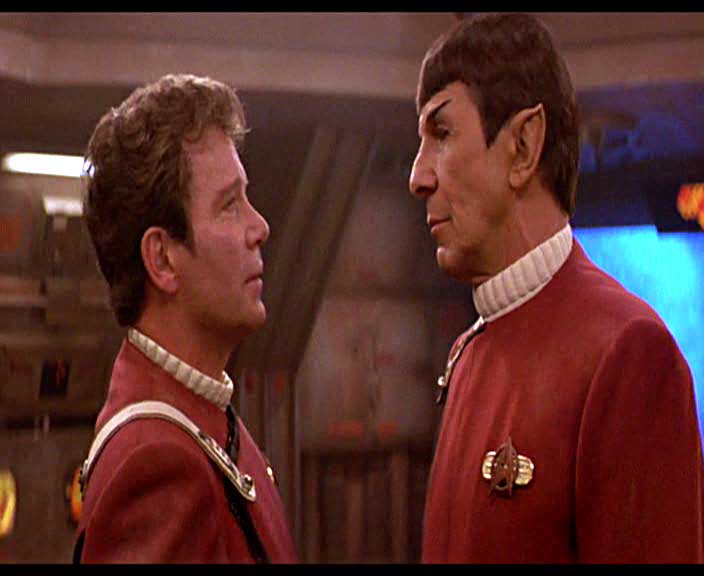
Kirk: “Spock, you want to know something? Everybody’s Human.” Spock: “I find that remark… insulting.”
Kirk: “Spock, you want to know something? Everybody’s Human.”
Spock: “I find that remark… insulting.”

It’s quite unavoidable.  You can try to universalize the message, but this is only a temporary fix.  Define the in-group as humanity and if/when we make contact with alien sentient life, the other is them (I’ve been watching Babylon 5 again…).  It’s a tough knot to untie, and I am not sure there is a solution.  Because having groups of people who vary in importance to us, hierarchical or not, is a logistical and practical solution to only having so much time and energy to spend.  It’s nice to have people close to you, intimate with you, and who you can call family.  But the other side of this is the necessary alienation of others, especially those with whom we share few values.  Liberals, conservative; Democrats, Republicans; Capitalists, Socialists, Communists, Anarchists, etc.  There are people who are, in some way, ‘other’ to you.  Religion, tradition, ritual, and nationalism all use this aspect of human behavior to its simultaneous advantage and disadvantage.

And yes, it will be an improvement if and when humanity outgrows religion, nationalism, etc.  But I doubt that will solve the fundamental problem.  Personally, I’m not sure there is a solution.  I’m not writing this to say we should try to give up the concept of culture, and to transcend culture, because that would just create a new culture.  I’m writing this because we should all be aware of this phenomenon.  And those others who will not understand it are just stupid and evil, or something.  But we, the enlightened, will understand it.  Or something.

As for my employers and this Ramadan thing, I will say that the evening feast usually looks quite delicious.  Perhaps they are trying to convert me with the promise of delicious food.  It’s not working, alas.  Well, if the promise of 72 virgins (or raisins, whatever) won’t do it, food won’t do it, then I guess they are just going to have to verify their claims rationally and empirically.  Yeah, somehow philosophy wins over food and sex for me.  Sorry, religion.

I Want to Live in Amer-i-ca! Everything’s Free in Amer-i-ca!


So, as every red blooded American knows, tomorrow is Independence Day for the United States.  As I understand it, it commemorates the day some white British dudes finally got tired of the taxes being too damned high and declared their independence from the King of England.  They did this by writing the 1770’s equivalent of a bunch of angry Post-It notes listing grievances called the Declaration of Independence.

To be fair, it was much better written than the standard angry roommate Post-It note.  Paper was expensive back then, so when you wanted to stick it to some oppressive landlord or something, you wanted to be a little more eloquent than “Do the dishes, dumbass”.  Also, adhesives weren’t what they are today and likely sticking the Declaration of Independence to the wall would have required some sort of horse-based syrup that was, incidentally, also expensive.  I’m going to go ahead and blame the British for that since there was probably both a parchment tax and a horse-based syrup tax (I think that was a synonym for the Sugar Tax actually…I don’t feel like looking it up).

What I’m saying is that the British loved taxing our forefathers.  Sure, they gave reasons for this like “Listen, you colonial assholes, we saved your butts during the French and Indian War.  Do you think England just has a magical ‘Efficient and Effective War for All’ wand?  DO YOU THINK MONEY JUST GROWS ON TREES, YOU INGRATE KIDS? Get off our lawn! And by lawn, we mean the cotton and tobacco fields of the South, the breadbasket farm colonies of the middle colonies, and the fishing and boat building industry of New England.” But really, I think that it was just that taxation without representation was ALL the rage back then.  Basically, England had a plan for domination of the New World:

Phase One: Send all the people we don’t like to the New World
Phase Two: Tax them heavily.
Phase Three: PROFIT!

Unfortunately, when you send away a bunch of people you don’t like and then try to profit off them, sometimes those jerks start feeling put upon (since you banished them, never invite them to your fancy tea parties, AND tell them that they are helping you pay for the damn tea) and start crackin’ wise about their mama.  In this case, their mama is England.

I just felt like I needed to spell that out for you.  The American school system is not what it used to be.

And so it was the on July 4th, 1776, America sent a Fuck You letter to the King of England and as the letter floated across the Atlantic, already you could hear the gentle pitter patter of a bunch of white dudes arguing about states rights.

There was a bunch of other stuff that happened before and after that (tea brewing and bloody snowball fights in Boston, Lexington AND Concord, um…musket polishing…shoes made out of newspaper…George Washington gnawing off the shooting arm of the leader of the British Navy with his famous wooden teeth, or something…I don’t really remember how the Revolutionary War ended) and after a bunch of people died and a bunch of other people wrote uppity leaflets about common sense and how paying taxes blows, a new country was born!

And, much in the way that America celebrates Mexican Independence by drinking margaritas to oblivion and wearing sombreros bought in bulk from Oriental Trading, tomorrow we shall celebrate our independence by drinking cheap beer in patriotically themed special edition cans whilst cooking animals over open flames and blowing shit up in the sky.

The other thing that’s great about the 4th of July is how every commercial becomes about how awesome being an American is, as represented by our ability to purchase and consume Budweiser WHENEVER WE FUCKING WANT, ENGLAND! Also, thanks troops for keeping us free, or something.

Now, I know what you’re thinking, “Jeez, how interesting…another cynical ‘screw America’ post from some liberal, bleeding heart blogger”.  That’s fair, I guess.  I find American history to be completely hilarious (I mean…the McCarthy Era? COMIC GOLD).  However, it just so happens that this 4th of July is coming to us during incredibly exciting times.

It’s true that I thought I would live to see huge leaps and bounds in marriage equality…but I thought I’d be watching the news from an old folks home while sipping on some Metamucil.  And no, that’s not what I do for fun on Friday night, OK?  Though it probably will be when I’m 90.  The fact that I got to see this in 2013 gives me a great amount of hope for the future of this country.  In addition to that, I got to see the people of Texas storm the capitol to support one woman’s battle to stop a horrific anti-choice bill there.  TEXAS! And she did it!

It’s true that I wasn’t alive to see the Moon landing or feel the energy in the air when Martin Luther King spoke or feel the despair when so many great leaders were taken from us violently and at the height of their attempts at progress.  But the effects of their legacy are with us today and to feel that combined with the amazing things happening for human rights today is exhilarating and amazing and I would not want to live at any other time. I have often said that every day is better than the one before for the rights of disenfranchised people.  I was starting to believe that things were going full tilt backwards.  But now there is hope and I see light at the end of yet another tunnel in this nation’s history.  We are still young in comparison to much of the developed world and it’s true that I feel a certain kind of pride for being a part of a country that stumbles, falls hard, and gets back up again, often as a better place for more people.

As with everything, there is tremendous ways to go to become the great country that America has the potential to be.  People will still be fighting every day for their rights, to be treated as equals on the national stage, to feed their families, to have the families that they want, to be with the people they love, to not be devastated by medical and other hardships, but each monumental judgment like those of the Supreme Court recently is another step in the right direction.  At least for marriage equality.  Voting rights is another story and another fight but I believe that in the end the rights of the people will win.

Because I’m a fucking optimist or something.  Whatever.

Yeah, that’s right.  I love America.

*Cue “Battle Hymn of the Republic” with full orchestral and choral arrangement*

I love America enough to pronounce all the syllables of the word America completely and correctly.  I love America enough to know that being a nation that helps the poor, that protects its citizens from drunken neighbors who want to show off their AK-47 collections, that works to give a large portion of our minimum wage work force a path to citizenship over building a solider studded super wall, that has an open and insane debate over a woman’s right to choose and her agency, that is committed to improvement and change in general even if a lot of the country is stuck in the politics of 1863, makes this a great nation and one of which I am proud to be a citizen.

I got you didn’t I, starting off with all that cynical completely historically inaccurate shit?  You thought I was going to say “I will eat a hot dog ironically while wearing a trucker hat that says ‘Tories 4 Eva’ to symbolically spit on the USA”.  But I didn’t! As it turns out, even a liberal, sexual and political deviant can be a patriot and love the country in which she lives, even if it’s obvious that it needs a lot…a LOT…of work.

Much in the way that we commit ourselves to people who are wonderful but relationships with them require work, so it is with the country in which we build our homes and families in.  I have never threatened to move to Canada over some dumb thing the government is trying to do.  Sorry, America, I am in it to win it.

*Cue “Eye of the Tiger”…with full orchestral and choral arrangement…*

Next week on “Horribly Inaccurate History”, we’ll talk about Lewis and Clark and the French Beaver Trappers of the Grand Tetons (it will be a Choose Your Own Adventure story…maybe…that would be amazing).

Slate talks around polyamory


double XI’m short on time, so I will link to this article about non-monogamy in the gay community, which I found because of this podcast episode at double x about monogamish (I hate that term) gay couple and how it relates to changing how we (they mean straight people) see marriage.

While listening to this podcast, I wanted to throw things.  They asked questions like can we (straight married people) learn something from these monogamish gay couples? And made the point that gay people do non-monogamy but straight couples just cheat.

I don’t have time to dissecct the discussion, because I have work soon, but I urge you to listen to this for yourself if you are interested.  There is so much wrong with this conversation.

How the hell do these people have this conversation with no awareness of the existence of polyamory? I looked in the comments, and no mention of it there either.  I mean, I do go on about how the mainstream is very unaware of polyamory (they should at least know it exists), but to see it so blatantly and ignorantly gabbed about (they call the podcast a “gabfest,” so I am not being flippant) in this way is really frustrating.

I will try later tonight or tomorrow, probably, to contact the people who run this podcast to see if maybe some dialog and perhaps some education could be in order.  For now, I will leave this as is.

Re-reading oneself


I just had a realization.

The more I (re-)read Nietzsche (although, how does one re-read anything, considering how much we change between readings?), the more I feel like I want to read those of whom he writes.  I want to read ChamfortMontesquieu, and more of Goethe.  But (and this was my realization) what I really want to do is keep reading Nietzsche!

Reading Nietzsche opens my mind to a world of concepts to which my every day life is alien, and what I realize is that this sense comes from the reading itself and not from the references or referents.  I’m inspired by the moment, and not necessarily by the potential or the ambition of that moment.  That ambition is not extensive, it is its own reward.  A

And yet….

And yet there is more ambition out there.

This is not unlike the realization, which I have from time to time, that it is the moment of beauty, and not the object of beauty, which is inspiring and awesome.  In a sense, art and our ability to appreciate it is a phenomenon of appreciating ourselves (both specifically and generally, as human beings).  Yes, it was the creativity and genius of the artist which is the efficient cause, but it is the commonality of interior architecture of our minds—the shared culture, language, and worldview of both observer and creator—which is the (metaphorical) location of the art.

Much like the blueness of an object is not contained within the object itself (and certainly not within some ultimate being, whether “god” or some Vedantic/Noumenal/Platonic reality), but within the relationship between our perceptual gear (our brain) and the actual material object which causes the light to exist in such a wavelength as it does.*  And the label, “blue”, a cultural construction used to identify the coherence and consistency of our shared experience (Assuming we are not color-blind), is mere convention of course.  We could learn new labels, but the material reality is not conventional.  It is real.

No, there is no inherent beauty, no inherent color, and no inherent meaning.  The world actually is—there is a reality and it is not an illusion—but there is no inherent perspective before we create it by perceiving.  There is no objective perspective, whether it be a “god” or some set of Platonic ideals.

Similarly, there is no inherent me, only the passing self that will change upon each re-reading.  In a very loose metaphorical sense, we are a book we are constantly re-reading.  And while the subject is unchanging and (perhaps) the words are the same, each time we look at it we come from a different point of view, we notice different parts of the narrative, and perhaps we remembered this or that part differently than we see on this reading.

Each time I re-read a book such as The Gay Science or The Catcher in the Rye I see it from a different point of view.  But the same basic phenomenon is the case each time I look into myself.  Depending on mood, memory, experience, etc I am a different person each moment, even if I know I’m holding the same ‘book’.

I still want to read some Chamfort, if only to make sure that the next time I re-read myself, there is some new perspective from which to read.  It is when we stop desiring new peaks to view the world from that we become bored–and boring!

*We never actually see the noumenal object not because the noumena is inaccessible to us, but because that concept is a category error.  The object does exist on its own, but the perception, including the color, shape, etc, are a simulation based on a physical relationships with the object.  The concept of noumena is an attempt to project that simulation onto reality, where that noumena is, in fact, merely an abstraction of the phenomena.  The noumena, in short, is a fabrication; an attempt to project our linguistic and cognitive constructs onto the world.  The noumena, therefore, is not inaccessible to us, since we create it.  This is precisely what many atheists, myself included, mean when we say that we create gods.  I’m an atheist, in part, because I recognize that we create the noumenal through projection of our own perception onto reality.  I don’t reject the supernatural because I am an atheist, I am an atheist because I reject the supernatural.

Also, I wanted to add this video here, not because it is (directly) related, but just because it’s amazing and beautiful.

The Musicality of Love


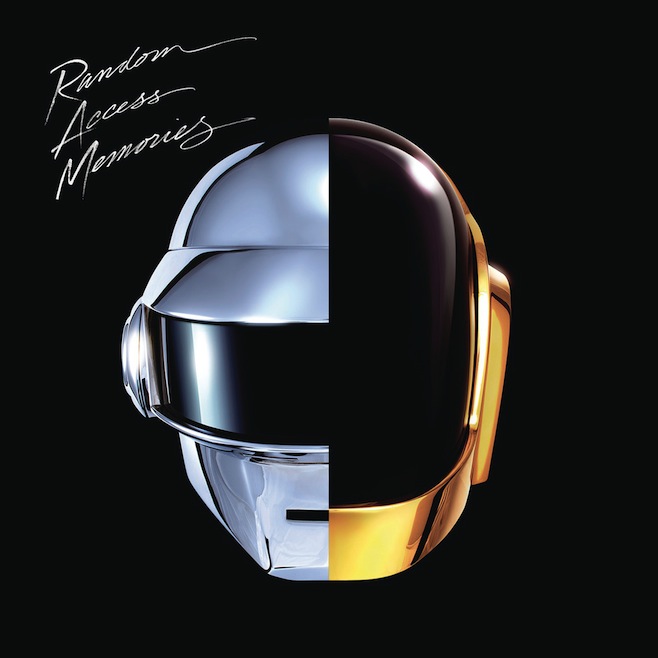
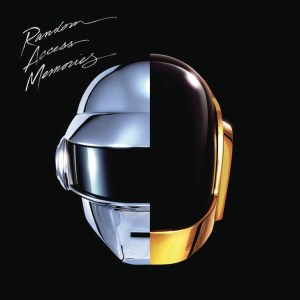
4e6c6fb2Several weeks ago I acquired Daft Punk’s new Album, Random Access Memories.  I had heard a review, and part of a couple of songs, on NPR (because that’s what I listen to if I’m not listening to Daft Punk).  One of the songs (Doin’ it Right) got into my head (the NPR piece had used it as a bump after the review–good choice, NPR production!) and so I had to get the album to satiate the insanity of this song playing in my head.  So, upon acquiring it and adding it to my playlist on my player (I use Foobar), I started playing it and listened to I while I played some Starcraft 2 (yes, I’m that kind of nerd).  Let’s just say that I loved it.  I mean, the kind of love where after the album was done, I re-started it, and listened to it again (I had finished my Starcraft playing at that point).  And then, after that second listening, I listened to it again.

Soon enough, I burned a disc so that I could play it in the car (not having a fancy mp3 compatible player in the car).  And so for the next couple of weeks or so, whether I was in the car, had my iPod on, or at my computer I was likely listening to that album.  The more I listened, the more I liked it.  I would have different songs running through my head while not listening to it, and just had to hear them when I was able to do so.  The album took over my life for about 2 weeks.  It was love at first hearing.

I have a number of favorite albums and songs from various genres and time-periods, including Collective Soul’s Dosage, Counting Crows’ August and Everything After, Beethoven’s 5th and 7th Symphonies (well, the first 2 movements of the latter), Pink Floyd’s Meddle (among others), T Rex’s Electric Warrior, Green Day’s Dookie, R.E.M.’s New Adventures in Hi-Fi, Nas’ Illmatic, Miles’ Davis’ Kind of Blue, quite a few Phish albums (to name a favorite would be too hard), The Beatles (mostly their later work), The Clash’s London Calling, much of The Talking Heads (and David Byrne’s later solo work too),  Ween’s White Pepper, ….

I could go on, but I won’t.

There is some music which simply found its way into my brain and I love listening to them, especially in certain moods.  And as I reflected on this, I started to think about how, at least for me, certain songs, albums, or even musicians have a relationship with me in much the same way as people have.  That is, there are analogous relationships between my history with music and with people.  And in many cases, certain music will always remind me of certain people, and sometimes whole albums are associated with specific people.  Sort of the way that the line “with fingernails that shine like justice” will always remind me of Ginny (as she intended).

The last few weeks, in other words, have been akin to a torrid love affair where I could not get enough of, well, an album.  It’s worn off, mostly, now.  Now I can hear or think about a song from that album without having to listen to the entire thing, but I still love the album and will continue to listen to it in the future.  This experience is not unlike some relationships I’ve had in the past.  You know, with people.  And while the analogy can only go so far, I started to realize, as I thought about it, that I feel the same way about a lot of those people as I do about some music.
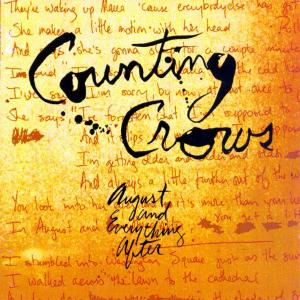
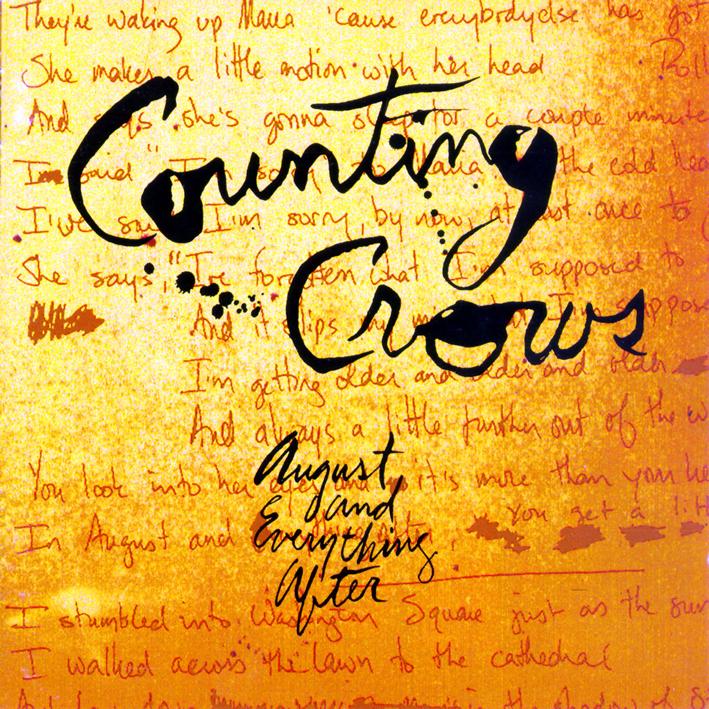
counting-crows-august-and-everything-after-delanteraLet’s start with one of my longest-loved albums, for example.  Counting Crows released August and Everything After in 1993, when I was in high school (the beginning of my sophomore year, in fact).  I have a vague but emotionally powerful memory of driving away from a vacation, with my parents, the following summer listening to that album.  I had met a girl, Nikki, who I liked considerably.  I was 17, hormonal, and the mere few days I spent with her was one of the earlier experiences I had of really getting to know and like somebody in a sexual and romantic way.  Having to say good-bye to her, get in the car, and drive away knowing that I would likely not see her again (we were in Hot Springs Arkansas–my parents choice of location of course–and I was going back to Philadelphia, Nikki back to Ohio) was emotionally devastating for me.  And listening to Round Here on my discman (you remember those?), a song which is emotionally crippling in many ways already, just made the feeling surge in ways I could hardly contain (if I had only known then what Borderline Personality Disorder was, the heart-wrenching pain would have made more sense to me then).  There is a piece of that still every time I gear the first few notes of that song.  I never did see her again, and sometimes I wonder what she’s up to now,  19 years after those few days spent with her.

Ever since then, I associate that song, and much of that album, with that summer and that vacation.   I love that albums still, and I think I always will.  Listening to it now, remembering that summer, thinking about how Nikki made me feel with her skin against mine all bring me the same cocktail of emotions.  Later associations of that album, as well as their second album (Recovering the Satellites, which was not nearly as good) with a relationship of 2 years while in college with a woman named Erin, many of the same feelings arise within me .  That album feels like young and naive love, the kind that incited deep feeling, stinging pain, and nostalgia for being young and being able to give of myself freely, without fear.  It feels beautiful and alien to the man who still is capable of love, but perhaps who will always be tainted by cynicism and fear when it comes to allowing that level of openness. I feel almost the same way about that album as I do about those 2 early relationships in my life, and I still have wonderful feelings about both of those women, even knowing that many years have gone by and neither of them is likely anything like who they were then.

And I could, if I chose, recount the many associations I have with specific music, friends, and lovers from my past.  I won’t do that because it is not all of the specific events of my personal life that I want to emphasize today (plus you probably don’t want to read that).  What I want to emphasize today is that, for some of us anyway, our relationships with music is, in many ways, akin to our relationships with people.  Music is, of course, an object so the analogy falls apart because people are, well, people and thus subjects of their own.  But in my experience, how I feel about things like music is similar enough to how I feel about people to make the analogy useful.

We change how we feel about music over the years the same way we change how we feel about music.   There is music I used to like, for example, but do not like as much anymore.  There is music I didn’t like at first, but now love.  And there is music that I always loved and always will love, but perhaps in different ways than I did before.  Our apprehension of music is not static, after all.  Our experiences of life change us, so how we will feel about other people (who will also change) and how we feel about music is dependent upon the function of that change.

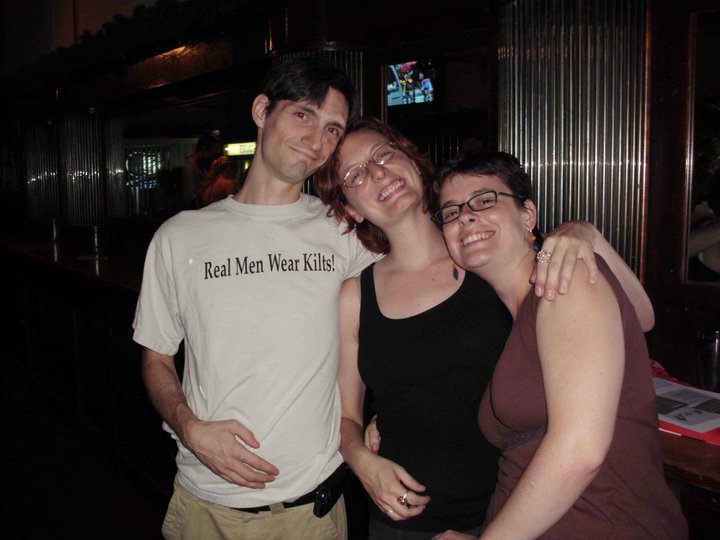
GinnyGinaMeI genuinely miss, and often still have good (if not complicated) feelings about, some ex girlfriends.  There are some I don’t talk to anymore, whether because I don’t want to or they don’t want me to, and there are some I do still talk to (too varying degrees).  And of course, there are Ginny and Gina, who I am still with (and hope to always be with), as well as others who I have other kinds of relationships with.  When I met Ginny, I was into her immediately and immensely, much like my relationship with that Daft Punk Album.  I just wanted to be around her all the time and could not get enough of being with her.  Granted, I was in a bad place in my life and did need emotional support (which she gave), but when I was able to be calm, sane, and forget about that I realize I just wanted her around most of the time, and hopefully she will be around for many years to come, with her fingernails shining like justice.

When I first met Gina, on the other hand, I was not sure how much I would like her at first.  Granted, I first met her when she was in a crappy mood, and we didn’t have much time to actually interact directly for some time, but she was around enough that I got a chance to get to know her a little.  I knew I was attracted to her, but I didn’t know whether we would click together well and so I never took the opportunity to pursue conversation or flirtation of any kind.  But like many of my favorite albums, I didn’t really start to love her until I stopped what I was doing and just listened to her.  It was not until I stopped just having her around, as part of the background of my activities, and started giving her some attention that I realized that she is complex, hilarious, talented, and awesome.  In fact, now that I think about it, it’s not unlike how I see David Bowie’s Ziggy Stardust (an album which Gina loves).  It’s an album I had heard, at least in part, before but I had not really listened to as an album.  But once I took the time to really listen to it, I picked out qualities that a casual or background listen would miss.  Just like with Gina.  I had to have other people apparently leave us alone while at some Steam Punk event about 2 years ago to really talk with her and discover that we had very compatible senses of humor and knew that I wanted to be with her.  I went from liking her, to really liking her, to loving her in a short time because I paid some attention to her.  It makes me wonder how much great music, and people, in the world I’m missing by not paying more attention to them.  I know, first world problems.

And now I’m listening to The Rise and Fall of Ziggy Stardust and the Spiders from Mars as I write this.  Thanks Gina….

Then there are the non-favorite songs, but the ones you really just have to hear occasionally.  I mean, I cannot prevent myself from singing along to Ice, Ice Baby or Baby Got Back, but under no circumstances would I label either song as good, or songs I must have on my iPod nano (neither is, BTW).  Also, there are songs I like, but not in context of their albums.  The Verve’s Bittersweet Symphony is a song I really like to hear occasionally, for example (that song is on my iPod, but not the rest of the album), but it’s not from a great album or a favorite band of mine.  I just really want to hear it occasionally.

And so this is the point where I, unsurprisingly, make the transition to argue that polyamory is superior to monogamy.

I’m sure that many of you saw it coming.  If you didn’t, you have not been reading this blog long enough.  I could do the surface-level argument and say that just like we all love many albums, genres, etc of music, and are not expected to (and should not have to) choose between them in some exclusive way, neither should we be expected to choose who we love, or at least what kind of love we should have with whom.  And while that is true, and ultimately that is what my argument is,  I think that there is some deeper utility to the analogy than that surface point.
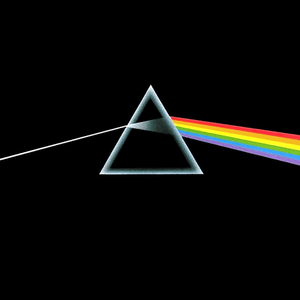
PFJust like one might love albums from high school or college years after those times are over, people can still have fond feelings for exes or for people who are not your current partner.  I mean, not always; sometimes there is no good feelings left after a relationship ends or with people you just don’t like.  Personally, I still have good feelings and memories about ex partners who hurt me and who I generally would generally prefer to never see again.  I mean, the relationship existed for reasons, and those reasons do not always evaporate when the relationship ends.  Just like my love of Pink Floyd did not affect my love of Daft Punk or Collective Soul’s Dosage when I discovered them, neither does any residual feelings I have for someone I am not dating anymore, or even someone else I’d like to date in the future, have to affect how I feel about a current partner.  There is a trope in our culture that talking about, liking, or thinking about exes or other potential partners is doing it wrong.  Somehow, if we chose someone, we cannot continue to, effectively, choose someone else.

And then there is that fact that we might not love certain music, but really like it, like it occasionally, or only at certain times.  Similarly, there are people we know who we don’t feel the need to interact with day to day, or to dedicate our lives to, but with whom we share similar interests, desires, etc and can establish a less committed relationship.  I am not sure how often this happens, but imagine two people who spend time together a couple time a month or so, perhaps even a sexual relationship, but who recognize that they are not good partners for one-another.  They enjoy their time together, but they have other things going on in their lives.  So, in our monogamy-oriented culture, if either, or both of them find a better partner match, this relationship may be expected to end (especially if it’s sexual in nature).  But why?

It’s obvious that the relationship is not a threat to some other more committed relationship (remember, commitment does not imply exclusivity), so why should it have to end? Wouldn’t it be better to allow such relationships to continue or end on their own terms, and not the terms of another relationship? I mean, I don’t want to listen to The Verve all the time, but my life would be (slightly, but noticeably) diminished if I could never hear Bittersweet Symphony again.  For rational reasons or not, that song contributes to my feeling happy (but in a bittersweet way…sorry…), so why, just because I like Daft Punk’s Random Access Memories a lot more, should I not continue to enjoy another song or album?

I’m not trying to be flippant here.  The social and cultural rules about monogamy really do seem as absurd as having to choose one album, or favorite food for that matter, over all others.  Why would we deny the variety of potential valuable relationships there is in the world for the sake of your (perhaps) favorite partner? I mean yes, if I had never met Gina and was married to Ginny and was only with her for the rest of my life, she would be a great partner for me and I would be very lucky to have her.  And if Gina and I had met under different circumstances and were exclusive, we could be happy as well.  So yes, I could be content (in the way that many monogamous people are “content”) with one partner, but the simple fact is that I have existing, and potential, relationships with other people who have things to offer that neither of them can offer on their own (and there are other people they could have relationships with–and do– whom offer things I cannot).  So why would any of us choose sexual and romantic exclusivity?  It’s simply as absurd, from my perspective, as having to choose one song, one album, one artist, or even one genre of music to listen to.

I love many kinds of music.  I don’t often go out of my way to discover new music, or new people for that matter, but I love that both music and people exist in my life.  I love different kinds of music for different reasons, appreciate them for different moods, and listen to music in different contexts and with different frequency.  I approach music on its own terms, like it for its own terms, and enjoy it irregardless of what I think about other music.  It would be silly to say that I can only like this or that genre, artist, or album.  Let me re-phrase that in case you missed the important part of that statement; it would be silly to create a rule which stated that I had to only like one kind of music, and not enjoy other music.  It would be silly because we cannot choose what music we like, just like we cannot really choose what people we like.  Insofar as we can make choices, we can only choose what we do, not what we like.  And just like we choose to listen to a variety of music because we like a variety of music, we should allow ourselves to have the relationships that we want, as we want them.

Some people, and some music, will be pleasant to have around, in the background of our lives.  Our passing acquaintances with people and music can give depth to our lives.  And while we only have so much time and space to truly and intimately appreciate music and people, that limitation should not be defined by the monogamous expectations of our culture.  I can appreciate Beethoven and Green Day, in different moods, times, and spaces.  In that case, I am willing to say I appreciate Beethoven more than Green Day, but if you were to ask me if I preferred the 5th symphony to the 7th…I don’t know.  I don’t know if it matters.  And so with people.  It is clear that I care more for Ginny than an acquaintance who I see from time to time, but beyond that we should not have to sort and rank people into hierarchies and choose one to be our romantic and sexual partner for life, or even just one at a time for weeks or months.

No, we should allow the beautiful musicality of love to add value to our lives as it does naturally, unconstrained by silly social conventions.

That said, anyone have any music that you really love and you think I should listen to?

Also, any awesome people I should meet?