I was pexting (poly texting. Alternate ‘ptexting’. All rights reserved. That’s right folks, I share partners but not patented phrases) with Gina earlier and we started talking about how being in the relationships she is in is providing motivation to be a better person.
Specifically, she was talking about how awesome I am by saying…well, I will let her own words express it:
I know…becoming addicted to you has resulted in me becoming more responsible, more organized and more committed to a positive lifestyle.
And I was all like, that’s awesome. I like being with people who are into self-improvement and all that stuff. And I appreciate how being with her has a similar influence on me. She and Ginny, together and individually, inspire me to persist in my own project to grow and mature further.
She capped it off by saying
My love for you makes me do dishes
Hot!
See, for those of you that don’t know me well, I’m a bit on the tidy side. I’m not crazy about it, I just do dishes after cooking (the vast majority of the time), put away clothes rather than letting them stay on the floor etc, and do things like organize my various objects. The other people in our little polycule (I can’t claim that term as my own invention), not so much.
But that has improved, largely due to my influence as well as their genuine desire to make me a part of their lives. You see, I clean because to be around significant clutter makes me viscerally uncomfortable and anxious, which they know about me. And because they want me to be calm and relaxed in the space we share, they (often, but not always) make an effort to make themselves more organized.
As demonstrated by these positive attributes, there is a general sense of wanting to actually grow as people among the people in my life. There is a desire to actually improve ourselves intellectually, emotionally, and sexually. It is a result, I believe, of having the right attitudes towards relationships and the world.
These attitudes are not unique to polyamory, of course, nor are all polyamorous people actually good at such things. But in my experience, having these complicated networks of relationships with people of various strengths, weaknesses, and different levels of experiences exponentially increases your own relationship experience and makes it more likly that we will mature faster.
Either that, or like natural selection it will eliminate those who are not capable of such lifestyles and those people will usually return to monogamy because it is easier and less emotionally challenging.
My experience with polyamory has opened me up to people of quality (and some not so quality who have returned to either normality or to unhealthy poly relationships), circumstances of personal challenge, and the freedom to truly be myself in ways that I don’t often see in mainstream culture because of the conservative and restrictive nature of hetero-normative monogamous culture.
In many ways, self-improvement is a progressive trait, even if most ‘progressives’ are too conservative in other ways to see what I see as regressive sex and relationship norms. it’s my belief that the progressives of today will largely be the conventional and mainstream social conservatives of the next few generations. As the current conservatism dies out, it will be replaced with a less crazy mainstream conservatism. As gay marriage becomes mainstream, polyamorous marriage will become radical and eventually progressive, for example. Time will tell if I am right.
But back to today….
Having now surrounded myself with people whom I actually like, as well as a more recent attitude to only spend personal effort with people I think worth the time, means that I will likely find new challenges and see new possibilities for more substantial personal growth.
My polyamorous lifestyle creates motivation to make myself a better person. It has contributed significantly to this effort that is, frankly, invisible to much of the world. When you live in abnormal lifestyles and have abnormal opinions, the abnormality is most of what the world sees, even the friends you have had for years but whom you don’t see every day.
I wish more people could understand what both skepticism and polyamory have done to improve my life. Sadly, most of the people I know and see only rarely have only a superficial understanding of it all, and usually avoid talking with me about much of it.
Its a consequence of being weird, I suppose. So, thank you, weird people in my life, for getting it. May we continue to be weird together.
It struck me today that one of the reasons that so many theologically-minded writers are so enamored by teleological thinking when it comes to evolutionary theory—whether it be Intelligent Design, theistic evolution, etc—is that they are so accustomed to thinking teleologically. What I mean is that because theologians seem to simply make stuff up*, they have the freedom and malleability to fit whatever environment they find themselves in, so they are always thinking about designing their ideology to fit the world. This, on the surface, might seem like what one should do, except they also hold onto the core nonsensical propositions while doing so—while reinterpreting them!
The very process of doing theology is exactly backwards to how science works, which is part of why the conversation between theologians and scientists often goes so wrong; their methods are in opposition. The idea of theistic evolution (that god created the world and subsequently guides evolution) is at odds with scientific ideas about how evolution works. There is no need for guidance for it to work, so (for example) the official Catholic Church’s acceptance of evolution as a fact, though guided by god (an idea shared by many people as well) is not the scientific concept accepted by evolutionary biologists. Similarly, Intelligent Design, the cultural political attempt to sneak creationism into us with the guise of “science,” has similar themes underneath. It all is about keeping the idea of design or purpose in a mechanism which needs none in order to work.
And what this reminds me of, this predilection for shaping oneself into the hole it finds itself sitting in, is Lamarkian evolution. You see, early in the development of evolutionary science, there was some debate about how changes in species occurred. One idea, which is now rejected by the scientific community since we know how genes, mutation, and other forces work, was that some organism would change according to the environmental pressures it finds itself in and passes along those changes to the next generation. A common example used to illustrate this is a giraffe that finds its neck too short gets a longer neck (or at least the idea of one), and passes this change onto its offspring.
If some theological idea does not fit with the world, a newer theologian comes along and proposes a new way to see things; a new way to “interpret” the scriptures or the tradition in order to fit better. And as the progress of science has marched along, theology has followed and changed its spots to fit to not be too egregiously out of style with the current scientific consensus. But it is done in such a way as to just change enough to not be noticeable to most people. It changes slowly, little by little, such that the theological concepts talked about seriously now in universities don’t seem to most people to be absurd or too far from their original tradition (which they define, of course).
But take a sophisticated theologian from 2012 (happy new years, btw) and send him to even a comparatively liberal and open-minded seminary from 1000 years ago, and they would be cast out as heretics, unbelievers, atheists even!
But it isn’t really their fault; they have to change to survive. It’s just a shame that they can’t get rid of the core absurdities of their theologies. You know,m stuff like gods and other supernatural crap.
I’ll say it again; theology is intelligently designed, but not intelligently enough.
*”Some time ago, when Jerry Coyne was preparing for his debate with John Haught, I recommended a book of modern theology in which a number of different theologians explained the very different ways in which Christian theology is done nowadays. The result that I hoped would derive from reading the book is what happened to me when I read it: that it would become obvious that theology in fact makes things up; that there is no basis for agreement between theologians, and that the bases for theological positions are as diverse as the positions themselves. That is, there is no basis for doing theology. Theology is like a mood that people have in the presence of sacred texts and the history of thought about them. It has no rational ground.” –Eric MacDonald (source)
So, I was one of the many people who saw Cee-Lo Green (who I had not heard of until someone named him at the party last night) singing John lennon’s anthem Imagine, which has always been a favorite among many humanists, including myself.
I didn’t notice the change in words mostly because the room was singing the correct words in unison, and the noise overwhelmed the audio from the feed. In any case, if you are unaware, he changed the words in the second verse from “And no religion too” to “And all religion’s true,” supposedly in an attempt to be inclusive and accommodating.
But seriously, all religion true?
H/T Hemant Mehta
Is Cee-Lo Green not aware that this idea of all religions being true, rather than be all nice and lovey-dovey, would be a disaster of epic proportions? Rather than be inclusive and respectful, as his apology via twitter seems to indicate was his itention, this idea that all religions being true is not only dangerous but impossible.
Imagine a world where all the religions were true. This would not be a paradise of love, compassion, and peaceful diversity. If the sacred texts of the world were representative of what was real, then it would mean that there are real supernatural powers at odds with one-another. It would be like the ancient Greeks of Romans, except some of the gods think they are all-powerful and demand that the other gods and their followers be converted or slaughtered. It would amount to real total warfare on a global, even cosmic, scale.
No, Cee-Lo, this is not a beautiful dream you imagine in your lyric-changing. It is a representation of your ignorance of what religion is. We already have a world where, in many places, you can believe what you want and practice your religion as you want. That is not the same as wishing all religions true, however. We are permitted, here in the West especially, to believe as our conscience and philosophy leads us, but I hope to the FSM and IPU the that all religions are not true. I would rather live ina universe which does not implode via logical paradox or by universal supernatural warfare.
That’s why Lennon’s original lyric was so profound; because it saw that religion was a cause for strife, not tolerance and peace in our world. Next time, just sing the damned song as John Lennon wrote it!
So, you say we can’t use science or rational thinking to appreciate music, love, poetry, etc?
So, when you look at, hear, feel, small, taste, or apprehend those things, you are not using your empirically-based sensory apparati to perceive something real, and then to subsequently use your physical brain to process the information into a meaningful image with related concepts? Is not that beauty, and the appreciation of it, the result of that physical process? Is that appreciation itself not another physical process in your brain, perceives subjectively?
Is the experience of appreciation of beauty nothing but what it is like to be that process, born of experience with a real world perceived empirically?
And what is science but the use of empirical tools to gather information then to use rational methods to organize that data into meaningful ideas, which may include images, concepts, etc? And when we can predict the behavior of reality based upon the principles learned from this, we have knowledge and understanding.
What is scientism, then, but accepting that the world, all of it, can be understood in terms of empirical methodologies and rational analysis?
It’s frustrating being so busy, because it means when I read something I want to comment on, sometimes it takes days to get to it. Like this, for example. It is a post from Greta Christina from three days ago, and when I first read it I wanted to respond. But then this time of year brings about social activity for me, and I could not get to it until today.
Greta is concerned about the criticism of rationality when it comes to subjective matters. Well, I’ll let her own words tell the story:
But I’ve been noticing a type of disagreement cropping up in atheist conversations, and it’s bugging me. It’s when atheists and skeptics criticize each others’ rationality… about entirely subjective questions.
“Purely subjective questions.” This phrase tickled my skeptic bone as soon as I read it. The reason is that I have a philosophical sensitivity to the distinction between objective and subjective (which is related to Hilary Putnam’s Collapse of the Fact/Value Dichotomy, which I have a copy of and has been of considerable effect upon my thinking). See, the thing is that I’m not sure that the distinction between “objective” and “subjective” questions (especially as Great is using them here), is clean enough to make the points she is making in her post. And so with some quoting of her post, I would like to deconstruct some of these questions and possibly throw a few ideas out there.
But first, a disclaimer. I actually usually agree with Greta Christina, and this post is not an attempt to show that she is irrational or anything. She says she likes the fact that this community is critical of each other, and so I am criticizing what I see as a small oversight. It’s a consciousness-raising exercise. I want to illuminate a philosophical problem with her post as an illustration, and also clarify a few disagreements I have with this particular post.
Irrationality
What is irrational? Well, what is rational? I use the term such that something is rational if it is consistent with known demonstrably true facts about the world as well as with reason or logical analysis. Of course, the question then is how do we apply this? Well, that’s part of what Greta is tackling here in talking about the Straw Vulcan question, where media and pop culture has created a trope that described rationality as being absurdly logical (essentially). Part of Greta’s post was inspired by Julia Galef’s recent talk at Skepticon, which I have previously seen, and which was a continuation of a series of posts that appeared on Julia Galef’s blog as well as Rationally Speaking (Massimo Pigliucci’s blog). Here’s the video of Julia at Skepticon from earlier this year, in case you have not seen it.
A good talk that I recommend (even if for another time). But rather than address Julia’s points, I want to get back to Greta’s post. See, she has concerns about the fact that, perhaps, we are not being rational. Well, what she says is this:
I’ve seen atheists argue that it’s irrational to enjoy drinking. Follow sports. Care about fashion and style. Love our pets. And it’s bugging me. I think it’s pointlessly divisive. I’m fine with being divisive if there’s a point to it — I want us to debate our differences, I don’t want us to march in lockstep — but pointless divisiveness, not so much. And I think it’s a mis-application of the principle of rationality. The “more rational than thou” attitude towards subjective matters is, ironically, not very rational.
The “fashion and style” link makes reference to a discussion that started a little while back about whether fashion and/or style was a rational endeavor. I don’t want to dwell on it except to point out that the question, as I remember the comments on her fashion posts, were not about whether Greta was rational for liking fashion, but whether her thoughts about fashion were rational. It’s an old argument and frankly I don’t care enough to say more than that right now. But generally I agree with her point. I think there is a point where we focus on unimportant things about each other and get caught up in them to the detriment of our community.
So drinking, sports, and pets? These are all mere personal preferences and choices, right? To argue about what you like, subjectively, is pointless and possibly absurd, right? Also divisive. One might be temped to point out that talking about the personal question of religious belief being subjective too, but Greta saw that coming:
Let me start with a premise: Yes, rationality is the best way of determining what is and is not most likely to be true in the external, non-subjective world. What causes rain? Why do people get sick? How did life come into being? Do we continue to live after we die? These are questions with answers. The answers are true, or not, regardless of what we think about them.
Here, she is dividing up the world, perhaps not cleanly and unambiguously, but a division is being identified. She is saying that there is a difference between the “external, non-subjective world” and the subjective world inside us. This is important, so I wanted to highlight it before continuing:
And the best way to find those answers is to suspend/ counteract our irrationality and our cognitive biases, to the best degree that we can, and gather/ examine the evidence as rationally and carefully as we can. Flashes of irrational insight can sometimes point us in the right direction… but to determine whether that really is the right direction or a ridiculous wild goose chase, rationality is the best tool we have.
OK, I’m with her so far. I still have that annoying tingling about the clean split between the subjective/objective which has been hinted at, but that is not a mortal sin here so I am overlooking it, at this point. However, that shakiness because a low rumbling with the next paragraph.
But not all questions are questions about the external, non-subjective world. Some questions are subjective. The answers aren’t the same for everybody. If you enjoy drinking/ sports/ fashion/ pets, then you do. If it’s true for you, then it’s true. [my emphasis]
On the surface, I agree with what I think she is trying to say, but as I read this I get a double layer of meaning which I don’t think are coherent. Let me try and parse these meanings.
1) Some things are external to our direct conscious awareness, and others are part of our internal experience and not accessible to other people generally. The former are subject to empirical verification, analysis, etc, the latter are not. The things that you have as internal conscious experiences, which are not accessible to others, are just brute facts that you have to accept.
2) Some facts about the world we can test easily, other we cannot because they are not part of the inter-subjective world which we can all share. And even if we could test them, we would find that they are not the same for everyone, so we should just accept those things as they appear, no matter what other people seem to think about them.
My problem is that Greta seems to be saying that our internal conscious facts are things which cannot be subject to analysis. She seems to be creating a space for things that, if we simply find we like them, we should just accept them because they are not subject to comparison or possibly even analysis. Now, to be fair I don’t think she actually thinks this; as a person who has written a lot about how she thinks about her own choices, beliefs, etc I don’t think she actually believes what it looks like she is saying here. I think she just missed the philosophical implications involved and I would like to talk a little about that.
She follows the above with this:
Yet atheists and skeptics often treat these subjective questions as if they were objective ones… and scold one another for being irrational when some else enjoys different things than we do.
Again, I agree and disagree. But I think the nature of my disagreement is that I would prefer to say that rather than claim that some things about us are inaccessible from rational analysis, we should simply be saying that while we might be able to apply rationality to every aspect of ourselves, we shouldn’t. The way she puts it, it seems as if she is saying that we cannot apply reason to our likes, dislikes, and possibly even values. So that if I like to drink, I cannot apply rationality to this liking because it is merely true, and thus I should accept it and, I suppose, drink. I don’t think Greta wants to say that, so allow me to make one more point because you toss away my criticism as mere philosophic semantic-trolling.
You might be asking why I’m being so careful and choosy with language. You might be saying “Shaun, you know what she means, and you are just nit-picking,” but one more elucidation might get you to see what I’m identifying. It is this phrase; “Yet atheists and skeptics often treat these subjective questions as if they were objective ones…”. It is here where I get tripped up. It is here where I think Greta misses the boat and mis-emphasizes the wrong aspect of this issue.
NOMA of the subjective/objective
I think that those “subjective” questions really are objective. Well, to be more precise, I believe that there is no such thing as “objective” when it comes to perspectives, but only a continuum of subjectivity, starting with the private world inside our heads and bleeding out to the external world which must be apprehended with perception via our senses (inter-subjectivity) and the tools we use to enhance them; empiricism. Thus, I believe that the “objective” world is really subjective, but the distinction between them is one of accessibility; how much can we analyze the facts involved?
Our likes and dislikes, our values even, are facts about the world. We don’t yet have a full enough understanding of how to empirically test, verify, or even identify all of them, but they are real things in the real world, just like rain, sickness, and propositions of gods. Thus, my like of hockey, Greta’s like of fashion, and your like of this blog (maybe) are all subject to rational analysis. They are indeed “brute facts” that we cannot ignore as realities, but there is a difference between admitting a fact and placing it off-limits to analysis; it is this distinction which I think Greta is missing. This means that while I agree with Greta’s main point in her post (generally), I think she got there a little carelessly and sloppily.
As I said during the discussion about fashion before, on Greta’s blog as well as here, there is no reason to apply rationality or logic to everything. There is nothing wrong with not being rational about some things. As I said before, things like fashion, sports, etc are shallow but so what? So the response should not be to say that things like like of sports or fashion are not accessible to rational analysis (because they are, in fact, accessible to analysis of this sort), but that we are allowed to have likes, values, etc which are not completely accessed (even if they are accessible) by rational analysis.
In a sense, this is sort of like the question of NOMA (the idea that science and religion occupy different ‘magesteria’ and answer different questions). See, Greta’s analysis here seems to create two separate (if not vaguely defined) realms of our personal world. One is external and “objective,” subject to analysis. The other is somehow not part of the real world, made of real things. This division can only be philosophically salvageable by appealing to some ontological dualism. That is, if our likes, dislikes, and values (our inner subjective brute facts which we cannot apply rationality to) are not subject to analysis intrinsically then they must occupy a different ontological reality. They must be non-empirical and this not analyzable by reason, logic, or rational thought.
Greta seems to be advocating for a distinction between the things which our skepticism can be applied to and things they cannot be applied to. I think this is a false dichotomy, as I believe, as a metaphysical naturalist, that all of reality is subject to skeptical analysis, including our base desires, preferences, and values. So yes, we should recognize their truth in that they really are our preferences, we don’t have to accept them are simply true and leave them out-of-bounds for our skepticism.
Applying rationality to our desires, preferences, and values
The last thought I want to leave with you today, dear reader, is this. It is only by the application of rational analysis to our subjective, personal, private selves that we can truly change ourselves in any meaningful way. More importantly this is not only possible but essential as skeptics. It is what allowed me to not only gain my perspective of religion, but also sexuality and relationships. It was the process by which I became polyamorous and openly skeptical despite my intense insecurity, fear, and jealousy out of which I had to grow. Had I accepted my fear and my jealousy as facts about myself that were true, I would not be the person I am today. The maturing, growing, and learning we do in our lives, despite what Greta Christina seems to be saying in her post the other day, is due to the fact that we can ask ourselves whether we should like and spend time thinking about baseball, style, or blog-reading/writing. Are the brute facts about ourselves things we have to just accept or can we change them if we find them lacking in some way?
Because if Greta Christina is right, then we cannot hope to overcome those things. “If it’s true for you, then it’s true” she says. But I think this is defeatist. It tells people that the inner experiences they have with the world are not subject to our changing them or thinking about them in a different way. It puts them out of reach for our analysis (which is a rational exercise), and so it implies they cannot be changed. Now, we may look at some of those things, whether they are drinking, sports, or fashion, and decide that we will pursue them despite their irrationality, decide they are rational, or that the joy they bring is sufficient to overlook the irrationality of them to some degree. That is a lot of what being a rational person is about; not being straw-Vulcan rational, but applying rational analysis to ourselves and being responsible for the conclusions and behavior that derives from that analysis.
But by saying that the brute fact that we enjoy something makes them lay outside our ability to meaningfully question someone’s decisions is, well, irrational. It is not sufficient to say that if someone enjoys something you see as irrational then you should stop being a dick by calling them out on it. What Greta should be saying is that “hey, you don’t know what rational calculus I have used to decide to pursue this thing you see as irrational.” and then the other person can say “OK, so you have thought about this and decided to pursue it anyway? Well, if so, you are responsible for it, and even if I disagree with you I grant you that responsibility.” And then if they want to, they can talk more about it. I think that is what Greta Christina is trying to say in her post, with the minor oversight of, perhaps unintentionally, invoking a kind of ontological dualism into her worldview.
So, you can still think someone is irrational about something specific, even if you only have partial understanding of their reasoning, and simply walk away from it because it’s not your responsibility. But when you spend time in a community of people who think about rationality, there are going to be people who think you have irrational beliefs, likes, or values. That is simply something we will have to live with while not pushing those things out of bounds–a sort of skeptical move akin to moving the goalposts.
All is subject to rational inquiry in exactly the same way and exactly for the same reason that all aspects of reality are subject to scientific (skeptical) analysis. In the same way that religion is subject to science, our like of sports, fashion, etc is subject to rational analysis. The degree to which we pay attention to those things is a different question.
I do appreciate getting comments on my blog. But sometimes someone comments that, despite their seemingly jovial and friendly appreciation for what I have to say, gets it so horribly wrong that I cannot leave it without response.
A while back I wrote this piece about gnu atheism, and the other day I received this response. By all means go and look at it for full context, but I quote enough of it below for you, dear reader, to get the gist. I will not reproduce the entire comment here in the name of brevity as well as to avoid unnecessary repetition.
But I thought some of what I said in response might be worthy of posting as a blog post, and so here it is.
—
Well, I thank you for your thoughts, but I have to respond to some of this because I find many flaws here.
It sounds like a gnu atheist is essentially a citizen scientist.
OK, sure. I can agree to that
It occurred to me some time ago that atheists spend a lot of time pointing out the silliness of religion but little time considering reasonable alternatives. We offer parodies of religion, but have we ever considered that it may well be possible to offer an alternative to “believers” that provides many of the features that make religion attractive to them?
There is a sort-of stock reply to a lot of what you said, especially about finding an alternative, or something to replace religion with. It is to say that what do you replace cancer with when you get rid of it?
Religion has some good aspects to it (they are human things appropriated by religion. No, usurped is better), but where it is unique it is poisonous and unnecessary. Instead of replacing those things, we need to outgrow them. We need to grow up as a species.
You said:
If we postulate that all information in the universe is conserved, then it would seem inevitable that at some point in the future our descendents or some other sentient beings in the universe would discover how to access that information….
No, information is not conserved. Energy is conserved (it is equivalent to matter), but the information is lost.
We may be able to find technological ways to store that information and upload it. This is, in fact, the dream of many transhumanists who look forward to a much longer life lived either in some sort of Matrix world or even in some technological bodies which won’t get sick, can be fixed easier, etc.
To me this is no different, philosophically, from looking forward to a heaven that follows this broken, sinful, world. It says that this life is not only insufficient, but essentially worthless. It de-values human life, and makes us overlook it in the hopes for something better. It is precisely what is wrong with religion, not what we should save from it.
Until such technological feats are a reality, this is dreaming away our lives. Sure, let’s research the possibilities, but please enjoy this life because it is almost certainly all that we will have.
Faith is of course necessary, but not blind faith, but rather faith based on reason and knowledge – faith in the potential of the human race to evolve and improve, faith made stronger by continued and serious skepticism, faith in the scientific method.
No. A thousand times no.
Faith is poisonous. It is the rotten center of all that is not rational or scientific. Faith is the exact opposite of skepticism and science.
What you seek is reasonable expectations based upon empirical study. Faith is the vileness of insisting that something is true in the face of all that demands that it is a lie. It is the assertion of truth where no justification can be found. It is believing in what has not been shown to be the case.
Ancestor worship would be one handy way to keep our descendents interested in us. Of course we might also simply provide a source of entertainment or research material. There’s plenty of potential for future judgment, which seems to be required by some people to behave themselves. Those that eventually grant us afterlife may judge some to be more deserving than others, and, yes, there’s even the potential of torment and suffering. God would be that future society, hopefully our descendents, that develop the capability of granting us our afterlife.
A millions times, no. Worship nothing. To worship is to place it where it cannot be reached, probed, questioned. If anything is worthy of reverence, it is that nothing is beyond question. Do not elevate any aspect of reality to a place beyond question, for that is where we lose ourselves to mental slavery.
Idle speculation. However I note that it’s just now approaching the time of the Solstice, and that would be an auspicious time, and convenient holiday, to mark this beginning of the Gnu great religion. ;^)>
Religion is to be outgrown; plain and simple. I want no part of any “gnu religion.”
There is an idea in our culture, derived in part from the Enlightenment and many of its thinkers including many of those who helped form the United States, that the universe is fundamentally rational. The idea is that as we learn about the universe and how it works, the underlying assumption is that what we find to be true is both true in every circumstance (universalization, which is also relevant in Kant’s ethical principle) and coherent with the rest of what we find.
That is, the world is essentially connected and coherent. The basis for trusting in scientific methodologies as sensible predictions and descriptions of the nature of reality is based upon this view, because if this consistency was not true than using any description of the universe based upon any observation would be useless, since there would be no guarantee that another observation in another place or time would yield the same result.
As a side note, it has been pointed out many times that if such things as miracles, or more generally a supernatural realm or powers, were to be real then this would make this rationality of the universe meaningless, since at any given time a power, force, or being which is supernatural could simply dispense with that rationality and intervene essentially “magically.” It would make science useless because we could not hope to make sense out of a world that can act essentially randomly or at least without consistent actions leading to theories or laws.
But enough of the opaque philosophical preface, let’s get to what I want to talk about today.
Cooperation
Especially in the more liberal world in which i grew up, there is an ideal of cooperation and striving for practical compatibility which underlies much of our thinking. We want to get along with not only other people, but their ideas and dreams. We want our dreams to fit in with the dreams of our neighbors so that when we all dream together, it creates a jig-saw tapestry of diverse and intertwining beauty.
It is a wonderful and beautiful image, especially for this polyamorous man who seeks intertwining in many ways in my own life. It appeals to even me, the often-cynic and occasional (or not-so-occasional!) grump (or Grinch, as the time of this writing might imply) who is often found to be pointing out where things don’t seem to be cohering or cooperating nicely.
But is it true? I mean, of course t can sometimes be true (right?). I mean, at least under ideal circumstances people’s beliefs, desires, and ideals will match up quite nicely and they can get along just fine. And many people believe that if we were to be more tolerant and accepting of others’ ideas then we could all get along nicely.
And, to a certain extent this is true. If we were willing to accommodate more, to compromise more, and to tolerate more we could all fit our puzzle pieces together and create, well, some kind of image.
But would that image be meaningful? Would it be even internally consistent or coherent? Could it be a picture of reality?
Truth and fallacy
The problem is that the best way to find ways to co-exist peacefully with people of different ideals is to re-shape our own in order to fit wither theirs, so long as they are also doing the same thing. It may imply the occasional forcing of ideological shape into close-enough spaces (which we will politely ignore), but it can work. I’ve seen it work, among people who are wont to maintain community with diverse opinions. I went to Quaker school, ok?
The problem is that it sacrifices truth by too easily overlooking fallacy. Because it prioritizes the coherence of diverse ideas over the question of whether any of the ideas are rationally defensible in themselves, it cannot reliably lead to a picture of what is actually true or real. Rather than investigate each idea rationally and skeptically, the primary motivation is to fit everything together into a quasi-meaningful whole, which ends up distorted and full of many gaps and bulges where the pieces don’t quite fit.
This is why the skeptic, the new atheist, and the “realist” get such a bad rap around such harmonizing folks. They are working so hard to find ways to get us talking, agreeing, and peacefully co-existing that they are really not even concerned, and perhaps not fully aware of the relevance, of rational defensibility of ideas themselves. Such quibbling and nit-picking questions of such as us skeptics is annoying? Can’t we see that they are trying to paint a pretty picture? Why must we insist that it does not look like anything real?
We must be the kind of people that tell 3-year-olds that their picture of a pony looks more like, well, a crude circle and some randomly placed lines! This is not to imply comparison between 3-year-old children and defenders of social cooperation. Not at all….
And yet, so many people are so enamored with the cooperation of ideas, whether they be science v. religion or otherwise, that they don’t pay attention to whether the larger picture they are putting together contains pieces from more than one puzzle. They don’t pay attention to the fact that one might be labeled “reality” and the other “fantasy.”
They are blinded, or at least distracted, by the liberal mythology of cooperation and tolerance. They are biased by the mythological desire for social and interpersonal harmony. And then they rationalize it as if it were we skeptics and new atheists who are seeing it wrong; they often insist that we don’t understand what the picture is supposed to look like. They are distracted by the mythological goal, while we are asking questions about the many parts which don’t seem to fit.
The only way to be sure that the image we create will be coherent is to make sure that each piece is the right piece, from the puzzle of reality. We must each inspect our own ideas, as much as is practically feasible, to make sure that it is the right piece. If it does not fit with others’ pieces, then we have to inspect both of them to see where the problem may lay.
And if it turns out that the whole puzzle is not coherent, that the universe is not rational, then so be it. But so far it appears as if the many pieces fit together pretty nicely, so long as we are vetting ourselves–as well as others–before we place them down on the picture of human achievement.
A lot of people talk about how religion has changed their life. They talk about some experience, or set of experiences, which have given them a new perspective on the world and subsequently changed their behaviors for the better. They say that god, or at least some religious ritual or practice, changed their life.
Now, I don’t doubt their experience (not usually). Nor do I doubt it did change them, if only temporarily or periodically. What I am skeptical of is the source of these experiences and of their subsequent life-changing perspectives.
I have known for a long time that certain things we learn, whether they take the form of a sudden insight about ourselves, others, or the world in general, forever shift our perspective. They give us a change to the lens through which to see the world, and we are never quite the same after that.
I think we all have these experiences from time to time. Perhaps some people are more sensitive to these things than others, perhaps relative to their sensitivity and level of introspection, but I think that this is a common human experience.
So why are some of them, at least by some people, attributed to a religion or to a god? Why are these experiences labeled as “revelations” or “religious experiences”?
Once again it is the bias that we have towards attribution of what is good to god and what is bad (or perhaps just mundane) to us. All glory belongs to the Lord, or someshit, and so if we have a moment of beauty, personal transformation, etc of course it is due to our religious background, especially if the commitment to that religion is new.
It is at our times of struggle, emotional intensity, etc where we both commit ourselves to god and experience personal transformations, and the correlation of these events lead people to forget that these experiences are human experiences.
I have had many experiences that, had I been religious, I would have attributed to some god or other. I am well aware that the bias which infects others is present within me, only I was lucky enough to not have been indoctrinated into a religious worldview designed to interpret such experiences from me.
I simply don’t know what to say to someone who will insist that this or that experience was from god when it clearly has human experience written all over it. This is the primary reason why subjective, private religious experiences are so problematic from the standpoint of evidence; we all have them, no matter of faith or lack of it.
A few years back I was pretty close with the people over at the Rational Response Squad. They made a little noise, became small celebrities in the early atheist community, and probably helped that community grow in ways that other less-quiet ways could not have helped.
There were revered by some, reviled by many more, and a couple of years ago or so they sort of fell off the map in the atheist community. I know more about all of that than I really need to know, and I do not care to relate the soap-opera involved.
But in any case they never really disappeared completely. I have been in contact with some of the members of the RRS over the last few years and have watched them change and move in different directions. One of those old friends is now blogging about history, and I have continued to read his blog consistently because he is a dedicated and intelligent person with interesting things to say.
For those who I left behind in my journey, I have no words of comfort for you. I suspect that you are either filled with disgust, with acceptance, or are just noncommittal. Maybe you’re working up a response. Of course I welcome any discussion. But it might be important now to note that I have not even yet ventured at an answer to the question ‘does god exist?’ I have refused to answer. I do not wish to indulge your egotism, your wish to label me, to place me in some convoluted category. To hell with that. If you want to judge me, do so on my positions in other more serious matters. Do not trouble me with your bothersome rantings about the pointlessness or the value in the exultation of faith.
He says more than just that, of course (read the whole post, for full context). But this was the paragraph that stuck out to me while I was trying to sleep last night (I was not home, so I could not get up and blog about it then). I kept trying to figure out what this was all about.
I responded in the comments (currently under moderation) [comment has been accepted], and I would like to have some discussion with Tom about this larger issue, because I think that the atheist community has become so much more than the question about the existence of god itself. Yes, we certainly still deal with that question, but we deal with so much more. Readers of my blog should know that, in any case.
We deal with questions of skepticism, science and faith, religion and culture, morality, and so many other things which are not only relevant but also important to deal with. The atheist community, as well as the larger skeptical and reason-based community, are going to be very important in the formation of our culture over the next 20 years (and beyond, probably).
We are no longer a movement surrounding the (possibly unanswerable) question of “does god exist?” As Matt Dillahunty says, we want to know what you believe and why. This goes for questions having to do with gods, science, relationships, and everything else. I personally love it.
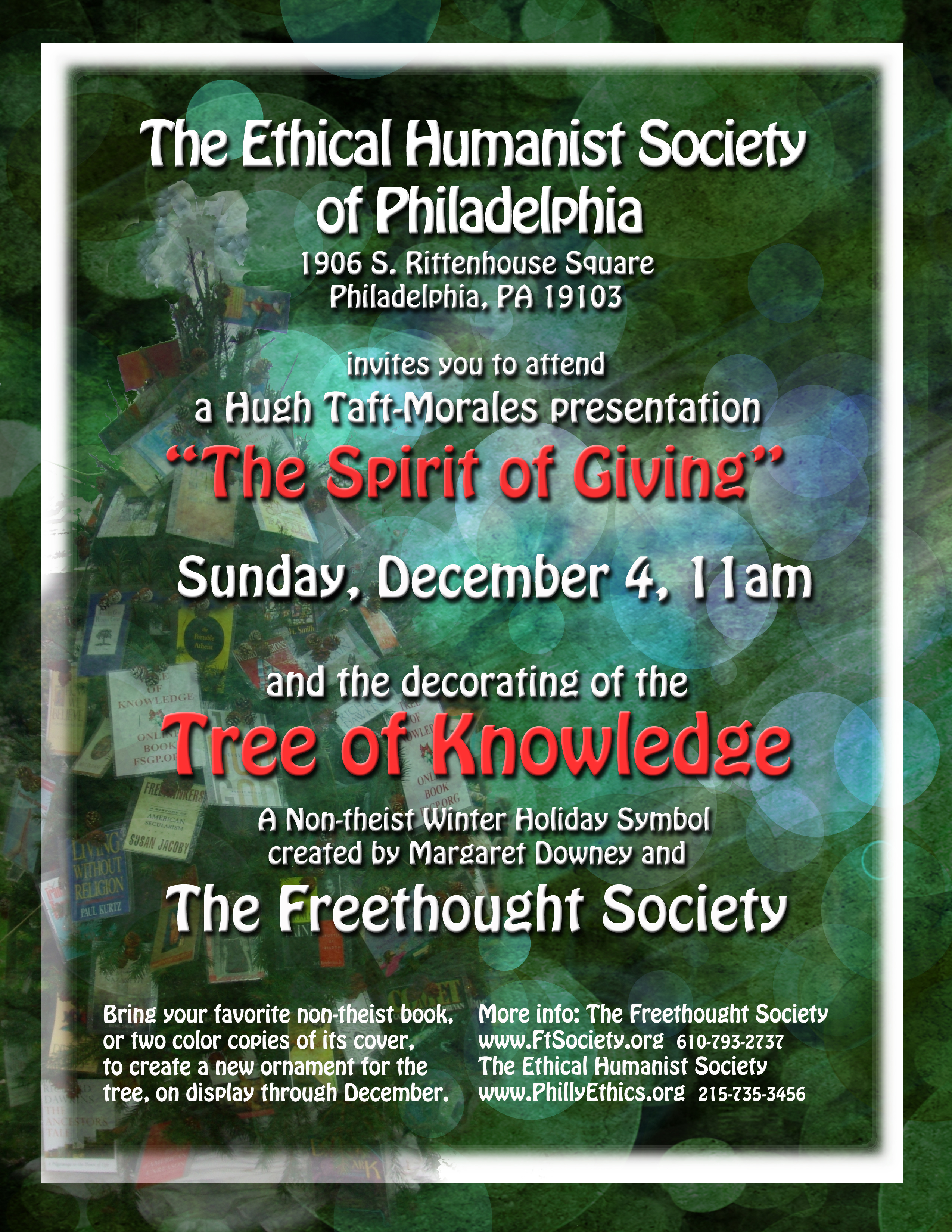
For those of you in the Philadelphia area, I have a couple of events you may be interested in. They are both affiliated with the Freethought Society, which is run by my friend Margaret Downey, and I will be attending one of both of them.
The first is the Human Tree of Knowledge in West Chester on Saturday December 3rd at 3:00 PM. The reason it will be a human tree rather than a real one is because the presence of a real tree has been blocked by the city of West Chester, as has been covered recently over at Hemant’s place. I was there for at least two of the real trees before this form of protest was necessary, as I have worked with Margaret Downey and the FTS for many years.
If you are interested in following news or in networking with people involved, there is also a facebook group. I will be there on Saturday and will almost certainly do dinner afterwords. After that I may grab a point at the Iron Hill Brewery since I love their Pig Iron Porter so much.
The second event is the following day, Sunday December 4th, and is in Philadelphia. More specifically it is at the Ethical Society at Rittenhouse Square. Here is an image of the flier, copies of which may appear there in the next couple of days.
I am not yet sure if I will attend this event. I’m not big on holiday rituals, but it may be a good time to catch up with local people of reason.
If you will be in the Philadelphia and/or West Chester area this coming weekend, make a point to attend or pass along the information to others who may be interested.


 Skepticism, Properly Applied